ARTIFICIAL PERCEPTIONS Biases, Fictionalities, Signifiers
by
María Esteban Casañas Master of Architecture
The Bartlett School of Architecture, University College London, 2015 Master of Arts with Honours Architecture
The University of Edinburgh, 2013 Submitted to the
Department of Architecture
in Partial Fulfillment of the Requirements for the Degree of Master of Science in Architecture Studies
at the
Massachusetts Institute of Technology May 2020
© 2020 María Esteban Casañas. All rights reserved.
The author hereby grants to MIT permission to reproduce and to distribute publicly paper and electronic copies of this thesis document in whole or in part in any medium now known or hereafter created.
Signature of Author: ____________________________________________________________________ Department of Architecture
May 8, 2020 Certified by: __________________________________________________________________________
Mark Jarzombek Professor of the History and Theory of Architecture Thesis Supervisor Accepted by: __________________________________________________________________________
Leslie K. Norford Professor of Building Technology Chair, Department Committee on Graduate Students
A RT I F I C I A L P E R C E P T I O N S
Thesis Supervisor: Mark Jarzombek
Professor of the History and Theory of Architecture Thesis Reader: Skylar Tibbits
Associate Professor of Design Research A RT I F I C I A L P E R C E P T I O N S Biases, Fictionalities, and Signifiers.
ARTIFICIAL PERCEPTIONS Biases, Fictionalities, Signifiers
by
María Esteban Casañas
Submitted to the Department of Architecture on May 8, 2020 in Partial Fulfillment of the Requirements for the Degree of
Master of Science in Architecture Studies
ABSTRACT
Our world is emulated in Artificial Intelligence, and with it, biases and fictionalities. Through a variety of examples, speculative arguments, and performances, this study explores how biases are produced and fictionalities created through shifting signifiers.
This thesis has a dual voice. It is generated in two versions - one written by me and one developed by a text-producing algorithm I “trained”. As such, and given its generative process, this thesis could be interpreted as a performance even for those who read it.
“Artificial Perceptions” could therefore be understood as rendering a new vision of how Artificial Intelligence can be used to create new content, disclose existing predispositions, and be utilized as a collaborative tool. Shifting signifiers prompts artificial perceptions and allows us to revisit and permutate biases that are intrinsic to AI. It challenges the construction of our understanding of our own “artificial reality” and exposes the cultural idiosyncrasies of the computational discipline.
The term “semiotic deepfakes” is coined as a reaction to excerpts of text generated by the trained model, envisioning how machine learning might mislead the public on authorship. This idea is explored further through the development of Alan Turing’s Imitation Game, allowing the reader to take the role of
“interrogator” within this thesis. I use Turing as the foundational premise for the various experiments of my own design in the thesis.
It concludes with a performance between all agents in this thesis, including the committee, the algorithms, and the author, adding to the semiotic discourse in a playful yet unsettling manner.
Thesis Supervisor: Mark Jarzombek
Title: Professor of the History and Theory of Architecture
Our world is emulated in Artificial Intelligence, and with it, biases and fictionalities. Through a variety of examples, speculative arguments, and performances, this study explores how biases are produced and fictionalities created through shifting signifiers.
This thesis has a dual voice. It is generated in two versions - one written by me and one
developed by a text-producing algorithm I “trained”. As such, and given its generative process, this thesis could be interpreted as a performance even for those who read it.
“Artificial Perceptions” could therefore be understood as rendering a new vision of how
Artificial Intelligence can be used to create new content, disclose existing predispositions, and be utilized as a collaborative tool. Shifting signifiers prompts artificial perceptions and allows us to revisit and permutate biases that are intrinsic to AI. It challenges the construction of our understanding of our own “artificial reality” and exposes the cultural idiosyncrasies of the computational discipline.
The term “semiotic deepfakes” is coined as a reaction to excerpts of text generated by the trained model, envisioning how machine learning might mislead the public on authorship. This idea is explored further through the development of Alan Turing’s Imitation Game,
allowing the reader to take the role of “interrogator” within this thesis. I use Turing as the foundational premise for the various experiments of my own design in the thesis.
It concludes with a performance between all agents in this thesis, including the committee, the algorithms, and the author, adding to the semiotic discourse in a playful yet unsettling manner.
Thesis Supervisor: Mark Jarzombek
Title: Professor of the History and Theory of Architecture A B S T R A C T
A RT I F I C I A L P E R C E P T I O N S
First and foremost, I would like to thank my thesis committee for trusting me and inspiring me throughout the process. Mark Jarzombek, since the first time I went to your office for advice during my first year at MIT, your support and enthusiasm made me believe in my work, and I instantly knew I wanted to have you as part of my thesis committee. You have been a true ally in my work. Skylar Tibbits, prior to joining MIT I was already hoping to work with you; thank you for all your support and your creative stimulus. Working with you as a TA and RA has been inspirational. I feel extremely fortunate to have such an
extraordinary thesis committee by my side, who have given me the courage to experiment and take risks.
I came to MIT on a Fellowship granted to me by La Caixa. This academic evolution would have never been made possible without your impressive support – thank you.
I would like to thank the Spanish Academy in Rome. The time I spent there allowed me to see the world of art in a completely new way. And I would like to thank all the Rome Prize Fellows I shared such a transformative experience with – you are all an inspiration to me. I would also like to thank the director of the Academy, Ángeles Albert de León, thank you for believing in me.
Thank you to Jennifer W. Leung for encouraging my ideas and experiments. And to Sheila Kennedy for being a supportive Academic Advisor. I would also like to thank Cynthia Stewart for always checking in and taking care of the MIT Architecture community.
Finally, none of this would have been possible without my family. I would like to thank my parents: you are the reason why I am here today. I would like to thank my sisters – you are the greatest gift life has given me.
A R T I F I C I A L
P E R C E P T I O N S
14 15 21 33 57 70 72
Note from the author Note from the algorithm
Perception I: Perceptive Glossary: Concepts - Contexts Bias Binary Classification Machine Learning Signifiers Perceptions
Perception II: Perceptive explorations Body
Image
Gen(d)erated Panopticon / Semiotic Deepfakes Voice
The Imitation Game Turing Games
Perception III: Perceptive Thoughts Future Curatorial Perceptions Gen(d)erated Conclusions Collective Consequences List of Figures
Bibliography
“I
n the interface, both exchange their negative characteristics.So the machine is just as much a victim of man as man is of the machine.”
Jean Baudrillard, Impossible Exchange; London; New York: (2001); p. 154.
ARTIFICIAL PERCEPTIONS 14
N O T E F R O M T H E
A U T H O R
Note: Gen(d)erated text is a play of words between gender and dated in regard to the generated text.
This thesis is generated in two versions.
It has a dual voice – one written by me and one developed by an algorithm I trained.
This thesis therefore has two parallel texts. The text written by myself is in black, and that generated by the algorithms is in green. I have called these “gen(d)erated text” since it is trained on texts dealing with gender issues. The beginning of the gen(d)erated text starts with a prompt written by me (black) which is then resumed by the algorithm (green). As such, and given its generative process, it is my hope that this thesis could be read and interpreted as a performance for those who read it.
Biases, Fictionalities, and Signifiers 15
N O T E F R O M T H E
A U T H O R
“The former focuses on boosting grammar while the latter focuses on finding novel gender-neutral words. Both focus on how to find novel gender-neutral words. The
algorithm will try to pick the most possible combination of gender-neutral words from the set. I have presented the former in a chapter titled Deep Learning Based on Gender Classification. In this chapter, I show how the gender algorithm can be extended to take into account the demographic and phenotypic
characteristics of an interviewee. The latter focuses on the algorithm learning
gender based on word frequency.”
Prompt by the author: This is a thesis generated in two versions. It has a dual language – one written by me and one developed by an algorithm.
Note: The gen(d)erated text is always prompted by the author. Throughout the thesis the text “prompt by the author” will be eliminated so as to avoid repetition.
N O T E F R O M T H E
A L G O R I T H M
ARTIFICIAL PERCEPTIONS 16
Biases, Fictionalities, and Signifiers 17
The content was created using GPT-2. Source [online] Available at: <https://github.com/ openai/gpt-2> It must be noted that the texts generated by the model have great factual inaccuracies. I have trained the model through a selection of texts that are
important to the discourse of this thesis. The collection of these texts become the training dataset for the machine learning model, which are ordered from most words to least:
Invisible Women: Data Bias in a World Designed for Men by Caroline
Criado Perez (2019)
Words: 96,344 words / Characters (with spaces): 583,070
Artificial Unintelligence: How Computers Misunderstand the World,
by Meredith Broussard (2018)
Words: 60,930 words / Characters (with spaces): 361,851
Algorithms of Oppression: How Search Engines Reinforce Racism, by
Safiya Umoja Noble (2018)
Words: 50,048 words / Characters (with spaces): 329,229
Gender Shades: Intersectional Phenotypic and Demographic, Evaluation of Face Datasets and Gender Classifiers by Joy Adowaa
Buolamwini (2017)
Words: 36,431 words / Characters (with spaces): 250,98
Data Feminism by Catherine D’Ignazio & Lauren F. Klein (2020)
(Introduction and chapter)
Words: 21,646 words / Characters (with spaces): 196,255
Can The Bot Speak? The Paranoid Voice in Conversational UI by
Benjamin H. Bratton (2016)
Words: 7,980 words / Characters (with spaces): 50,074
Forget Killer Robots - Bias Is the Real AI Danger by Will Knight
(2017)
Words: 1,467 words / Characters (with spaces): 9,081
---Total words trained on: 302,064 words
ARTIFICIAL PERCEPTIONS 18
The Future of Algorithmic Intelligence
This thesis aims to show why it is not only unimportant but harmful to assume that
associations are binary in machine learning, and I argue that this thesis shows even
greater harm in presuming that both gender and race can be encoded in algorithmic
intelligence. Instead, the thesis argues for an intersectional approach to classification that incorporates phenotypic and demographic attributes while also proving gender and racial classification more robust across phenotypic and demographic categories.
Digitization, either as data or as objects.
This book is the first to explicitly tackle the question, What do algorithms represent? In trying to answer this question, I use
an essential tenet of computer science: computation as a network of interactions between processes, objects, and users. This concept, which I’ll call network-theoretic thinking, helps me draw a
picture of how a computer works not only as a structure but as a collection of
interconnected computational units (which I call structures). Because a computational network is more than a collection of logical structures, in my view, it also includes a computational worldview that allows for plural thoughts.
G E N ( D ) E R A T E D
A B S T R A C T
Biases, Fictionalities, and Signifiers 19
Chapter 1: Phenotypic Gender Classification: What’s the Difference? 1.1 Common perceptual errors
1.2 Common ways bias is experienced
1.3 Common ways to correct for common perceptual biases 1.4 Common misperceptions
1.5 An exploration into common computer vision tasks Chapter 2: Epistemology
2.1 The Turing Tests 2.2 Why Does This Matter?
2.3 The Enclosure of Turing Tests
2.4 The Turing Tests Pitfall #1: The Automated Image Analysis 2.5 The Turing Tests Pitfall #2: The Hair Test
2.6 The Turing Tests Upset Reaction Chapter 3: What is Dataset Space? 3.1 Common Datasets
3.2 Common Factors
3.3 Common Applications 3.4 A LFW for Dummies
Thesis Credibility and Challenges Final Thoughts
Summary References
G E N ( D ) E R A T E D
C O N T E N T S
Note: The gen(d)erated contents page is produced by the trained model, and as such, these chapters cannot be found within the thesis.
P E R C E P T I O N I
ARTIFICIAL PERCEPTIONS 22
Biases, Fictionalities, and Signifiers 23
P E R C E P T I O N I
This chapter lays the foundation for the concepts explored in this thesis. The terminology of this thesis is presented with words associated to concepts. The following terms contain the positioning and focal arguments of this thesis, and thus need to be unfolded within the context of this study.
This initial perception could therefore be understood as a perceptive glossary composed of the keywords that structure the work and that are directly related to the paradigm of this research. It aims to locate the reader in a parallel double-glossary which follows the organizational logic of this thesis’ storyline. In such way, the author’s own words are augmented by the algorithm, yielding a wider context.
+ Bias
Somewhat conflicting and often opposing tendencies, the term bias has frequently been described in an elusive manner. Even the history of the word itself has shifted meanings from a mathematical definition to a social understanding.1 The word first
emerged in geometry in the 14th century to refer to an oblique line.2 Its root is believed to come from the Latin “biaxius” meaning
“with two axes”3. By the 16th century it was defined as “undue prejudice”, and by the 1900s, bias acquired a technical meaning in statistics to refer to when the anticipated value of the results differs from its true value.
The definition of bias varies greatly depending on the discipline, such as its legal definition. In law, “bias” denotes having a “predisposition or a preconceived opinion that prevents a person from impartially evaluating facts that have been presented for determination.”4 Terms like “Machine Bias” have been used to
describe algorithmic prejudice in judicial sentencing.5
1 A New English Dictionary on Historical Principles, Volume 1, Issue 2, edited by James A. H. Murray, Henry Bradley, Sir William A. Craigie, C. T. Onions. (Oxford: Clarendon Press, 1888).
2 The Trouble with Bias - NIPS 2017 Keynote - Kate Crawford. Accessed 02/29/2020. [online] Available at: <www.youtube. com/watch?v=fMym_ BKWQzk>
3 Macquarie Concise Dictionary (7th ed.) (Sydney
Australia: Pan Macmillan, 2017), p. 103.
4 Bias. (n.d.) West’s Encyclopedia of American Law, ed. 2. (2008). [online] Available at: <https://legal-dictionary.thefreedictionary. com/Bias>
5 Broussard, M. Artificial Unintelligence: How Computers Misunderstand the World (The MIT Press, 2018), p. 44, referencing the article “Machine Bias” published in 2016 by Angwin et al. [online] Available at: <www.propublica.org/ article/machine-bias-risk- assessments-in-criminal-sentencing>
ARTIFICIAL PERCEPTIONS 24
6 Jaspreet, Understanding and Reducing Bias in Machine Learning (2019). [online] Available at: <https:// towardsdatascience.com/ understanding-and-reducing- bias-in-machine-learning-6565e23900ac>
7Mitchell, T., The Need for Biases in Learning Generalizations (Rutgers University: 1980). [online] Available at: <www-cgi. cs.cmu.edu/~tom/pubs/ NeedForBias_1980.pdf> 8 Khetan, V., Bias in Machine Learning Algorithms (2019) [online] Available at: < https://towardsdatascience. com/bias-in-machine- learning-algorithms-f36ddc2514c0 >
9 D’Ignazio, C. and Klein, L. Data Feminism (The MIT Press, 2020), p. 7 – “Intersectionality” as described in Data Feminism is a term coined by Kimberlé Crenshaw in the 1980s. 10 Claude Lévi-Strauss (1908 - 2009) is a Belgian-French anthropologist 11 Lévi-Strauss initially came across through studying myths.
12 The Trouble with Bias - NIPS 2017 Keynote - Kate Crawford. Accessed 02/29/2020. [online] Available at: <www.youtube. com/watch?v=fMym_ BKWQzk>
13 Idea that emerged in conversation with Catherine D’Ignazio, author of Data Feminism, on a meeting on 03/04/2020 at MIT.
In machine learning, bias refers to the “the phenomena of observing results that are systematically prejudiced due to faulty assumptions.”6 The term bias was introduced in the field of
machine learning in 1980 by Tom Mitchell in his paper titled, “The need for biases in learning generalizations”.7 He defended the
need for bias in models as they fulfill the need of generalization as means of improving datasets, rendering the models less sensitive to some single data point.8
Biases in machine learning tend to manifest in disparate and novel ways. They often intersect with one another, generally converging, and consequently rending the topic of bias itself as a complex one.9
+ Binary
This thesis opposes categorization, and as such, it opposes binaries. Binary is constructed around the notion of two opposing
parts. Claude Lévi-Strauss10 identified a common underlying
structure in narratives: “binary opposites.”11 He understood these
binary oppositions as providing the foundation of humanity’s understanding of reality. In the same way as he proposes that meaning in narrative is based on binary oppositions - only identifiable against each other - this thesis suggests that binary is a social construct to apprehend our world. Compressing our reality to binaries leads to the removal of perspectives, reducing reality’s richness. This thesis therefore attempts to challenge binaries along with other ways of classifying our existence and identities. This thesis draws on a few examples that illustrate how biases appear both in AI and in design. Some of the examples used (such as the seatbelt and the voice synthesizer) are indeed binary, exposing the issues with such type of rational. Such precedents reflect the systems and algorithms that are in place. The models designed to put those data to use are created by small groups of people and then scaled up to users around the globe (consequently excluding other identities and perspectives). The input data shape our information systems which leads to the exclusion of many identities.12 Rethinking binaries is essential to advance
Biases, Fictionalities, and Signifiers 25
14 Jean Baudrillard (1929– 2007), French philosopher, sociologist, and cultural theorist. He is considered to be one most influential figures in postmodern theory, alongside Jean-François Lyotard.
15 Baudrillard, J. Simulacra and Simulation; translated by Glaser, S. (University of Michigan Press, 1994).
+ Classification
This thesis understands categorization as a social construct. Jean Baudrillard14 explored the idea that our culture’s way of
interpreting reality is through cultural and scientific constructions – represented by labels and terms created as an attempt to
apprehend reality.15
By stressing that classical and postmodern understandings of the world reflect multiple and intersecting layers of culture, politics, and technologies, the thesis argues that it is necessary to unpack the complex relationships of power that result.
Disclaimer: Please note that the above text generated by the algorithm takes Baudrillard as a female figure – disclosing existing predispositions of an algorithm trained on a mainly female authors.
She articulated the fact that the gods of old were figments of our own imagination. As we move into an age where information and communication technologies are radically transforming our world, it is necessary to ask how we get from here to there, Baudrillard said. As a precocious fourteen-year-old Baudrillard began to compose her first serious philosophical treatise, On the Gene, in 1967. Her work foreshadowed and informed the current philosophical landscape as we know it today. Her insights on how ideas circulate through culture and how power unfolds in interdisciplinary networks are the intellectual basis of what we do in data science today. One of the most profound things about Baudrillard’s work is that it explains how almost anything can be said with any accuracy about people and things other than what has already been said and written about them. Just as there are many different ways to make a croissant, so are there many ways to make a culture.
ARTIFICIAL PERCEPTIONS 26
16 Michel Foucault (1926– 1984), French philosopher and historian, associated with the structuralist and post-structuralist movements.
17 Foucault, M., Discipline and Punish: The Birth of the Prison. (London: Penguin, 1977). p. 194.
Michel Foucault16 questioned and undermined scientific
categorization of human beings, attributing such labelling to an attempt to classify and apprehend humanity. These categorizations - merely cultural constructs - result in deep implications on societal performance and functions, as they affect and condition how societies view themselves.17
The act of classifying axiomatically turns our identities into categories. A history of classification reveals that every attempt to classify has reflected the social, cultural, religious, and political order of the time.
Anthropologists and others who study the construction of society have found that
traditional myths, beliefs, and narratives about peoples, animals, and natural environments are fundamental to how people see themselves and the world. These constructions are what Jean Raspail calls normative, that is, they are the visible expression or norm of the past or present, regardless of how different these differentials may be. In other words, these differences are normative in the sense that they are embedded in the social structure itself. I am arguing that the same is true of gender formation. The more we understand how people project their gender onto others, the less likely it is that people will see the world in universal or even equal ways. This is not to say that there are no structural problems. There are. But there’s a danger in assuming that the way that a society represents itself to the outside world is fixed and unalterable.
Biases, Fictionalities, and Signifiers 27
The Enlightenment is known as the main period of time where they were focused on creating a taxonomy of the entire universe.18
In this thesis the Enlightenment is used to contextualize the need for recording, collecting, and categorizing data. A linguistic approach to classification is therefore inherited of the thinking of the Enlightenment.19 In the same way as Diderot tried to
categorize the world in a few sets (Figure 1), machine learning tends to develop its own “culturally” idiosyncratic codifications, which are inevitably subjective. For the purpose of this study, the Enlightenment will be treated as a tool critical to understanding the nature of classification.
Figure 1
Encyclopedia from 1751 by Denis Diderot and Jean le Rond d’Alembert.
18 Jarzombek, M., Digital Post-Ontology (2019). [online] Available at: <www.e-flux.com/ architecture/becoming- digital/248076/digital-post-ontology/> 19 Ibid.
ARTIFICIAL PERCEPTIONS 28
This is relevant in our current discourse of AI as these labels and terms are used in modern cultural discourse to not only create categories to grasp reality, but to develop algorithms and models that are meant to represent this reality. It therefore reflects – to a certain extent - our social order: “Artificial intelligence systems ‘learn’ based on the data they are given. This, along with many other factors, can lead to biased, inaccurate, and unfair outcomes.”20
Labelled Faces in the Wild21 can be used as an example to illustrate
this idea. It is a training set of classification of faces based on photographs of Yahoo News from 2002-4, which result in having 77.5% being men depicted, and 83.5% white.22 As an anecdote,
the most represented face in this training set is George W. Bush who is represented 530 times out of 13,000 total pictures. This reveals how this dataset represents not only the culture but also the social order of the time.
As a solution to this type of problem, and with the aim of creating a more representative set of training and benchmarking data for facial detection models, IBM released in January 2019 a database of one million faces called Diversity in Faces (DiF).23 Another
project which attempts to address this issue is the project “The Library of Missing Datasets”24 which is both a physical and an
online repository that allows individuals to upload information they believe to be missing.
Data collection has a long history: “Data collection has long been employed as a technique of consolidating knowledge about the people whose data are collected, and therefore consolidating power over lives.”25 This could be connected to certain governments not
allowing the use of specific platforms which gather data from its users. For example, the social network TikTok was not allowed by US government agencies, as it is owned by ByteDance, a Chinese company.26
Some start-ups are being bought solely because of data they have gathered, meaning companies that purchasing them are not interested in the start-up as such, but on the data they have gathered on their users.27 This is what Baudrillard expressed: the
new reality of the simulation culture: the reality, the asset of the startups are not its intrinsic value and the benefits they generate, but rather the simulation of its data represents its real value, in this new simulated reality.
20 AI Now (Institute at New York University) [online] Available at: <https:// ainowinstitute.org/> 21 “Labelled Faces in the Wild” can be accessed online, available at: <http:// vis-www.cs.umass.edu/ lfw/#explore>
22 The Trouble with Bias - NIPS 2017 Keynote - Kate Crawford. Accessed 02/29/2020. [online] Available at: <https:// www.youtube.com/ watch?v=fMym_BKWQzk> 23 D’Ignazio, C. and Klein, L. Data Feminism (The MIT Press, 2020), p. 31.
24 Onuoha, M. The Library of Missing Datasets (2016) [online] Available at: < http://mimionuoha.com/ the-library-of-missing-datasets > and <https:// github.com/MimiOnuoha/ missing-datasets>
25 D’Ignazio, C. and Klein, L. Data Feminism (The MIT Press, 2020), p. 12.
26 Business Insider, “US government agencies are banning TikTok, the social media app teens are obsessed with, over cybersecurity fears” Accessed online 02/29/2020. [online] Available at: <https://www. businessinsider.com/us- government-agencies-have-banned-tiktok-app-2020-2> 27 Tabora, V., In Big Data, The Consumer Is The Product [online] Available at: <https://medium.com/swlh/ in-big-data-the-consumer-is-the-product-ad9bf0423d9a>
Biases, Fictionalities, and Signifiers 29
+ Machine Learning
Since Machine Learning (ML) has entered the mainstream circles, a linguistic confusion seems to have occurred: despite the terminology “learning”, ML does not mean that the machine itself “learns” (which implies that the machine has human attributes), but it refers to the improvement of its programmed, routine, automated task28. The machine itself does not acquire knowledge
nor agency, and it has been proved that ML models develop human-like biases as they identify patterns in existing data.29
+ Signifiers
Signifiers embed concepts. In this thesis signifiers are considered anything that portray underlying meanings - ranging from words and labels to images or even sounds. Shifting these signifiers allows for slippages to occur, revealing veiled relationships and triggering new meanings.
What is meant by language in ML? Many people think of language as being fixed, fixed in
time, and immutable. However, what many people don’t realize is that the way that language is represented in computer code can be highly non-locally determined. The way that I represent language in this book is arbitrary. There will be
moments when I refer to computational linguistics, artificial intelligence, deep learning, big data, natural language processing, etc. By the end of this book, you will understand how language works and what makes words meaningful. You will also understand how politics, art, and pop culture influence each other to produce some of the most amazing, profound, and amazing things that happen in language. Categories: artificial intelligence, artificial life, chaos. The point of this book is not to scare you. I want this book to open your eyes. I want you to understand how machines work so that you don’t have to be scared by the news that robots are coming to your house.
28Broussard, M., Artificial Unintelligence: How Computers Misunderstand the World. (The MIT Press, 2018), p. 89. 29 Aylin Caliskan, A., Bryson, J., Narayanan A., Semantics Derived Automatically from Language Corpora Contain Human-like Biases (Science: Vol. 356, Issue 6334, 2017) pp. 183-186.
ARTIFICIAL PERCEPTIONS 30
Umberto Eco30 suggested that all cultural phenomena could be
studied as communication, bestowing on the reader a fundamental role in the process of generating meaning. In a similar manner, this thesis views the reader as a further character in our artificial perceptions.
In Course in General Linguistics Saussure31 identified a sign as
being a concept, not merely sound-image, breaking down signs into signified and signifiers.32 Roland Barthes33 expanded on
this idea by using signs to elucidate the notion of connotation and denotation. In Simulacra and Simulation Jean Baudrillard delineates the idea of “hyperreality” in which a copy turns into being more real than reality itself, overriding the signifier with the signified. Following Baudrillard’s thoughts, this thesis argues that “artificial perceptions” become as real as “real perceptions”.
+ Perceptions
Pretend there is nothing at all. Nothing at all. Nothing at all is just a set of objects. A matrix of objects.
A set of objects is just a way of organizing the sets of objects that we have. There are different ways of organizing things. Sociology offers diverse perspectives on how to understand the ways in which to understand the structures of power that are stack upon stack upon stack of objects, from the virtual reality headset you wear to read this book, to the icons on your computer monitor, to the way you think about, talk about, and produce information in this book, to the kinds of content we create for Facebook and all the other platforms we use, to the algorithms that organize the data that you see and hear on those platforms, to the ways that indigenous knowledge is more valuable than global corporate control and that the ways in which to understand and produce knowledge are interlocking. 30 Umberto Eco (1932
– 2016), Italian novelist, semiotician and philosopher. his novel Il nome della rosa, published in 1980, was one of the best-selling books in history.
31 Ferdinand de Saussure (1987 – 1913), Swiss semiotician and linguist regarded as one of the founders of semiotics/ semiology. 32 Course in General Linguistics (Cours de linguistique générale) by Ferdinand de Saussure (1916). 33 Roland Barthes (1915 - 1980), French writer and one of the most renowned semiologists of the twentieth century. His work focuses on structuralist semiotics. His book “Writing Degree Zero” from 1953 is “no more than an Introduction to what a History of Writing might be” in the author’s own words.
P E R C E P T I O N I I
-“S
emiotics is in principle the discipline studying everything which can be used in order to lie. If something cannot be used to tell a lie, conversely it cannot be used to tell the truth: it cannot in fact be used “to tell” at all.”Umberto Eco, A Theory of Semiotics, (Indiana University Press, 1976), p. 7.
ARTIFICIAL PERCEPTIONS 36
Figure 2
Timeline by the author. 1939
First Voice Synthesized (VODER) HAL 9000 1968 Turing Test 1950 Voice Punctum 45 YEAR DELAY 1984
First “Female” Voice Synthesized (DECtalk) Body 43 YEAR DELAY 62 YEAR DELAY Seat Belt Patent 1958 1949
“Sierra Sam” - first crash-test dummy
2011
Female crash-test dummies implemented in testing in U.S. Report on Fetal Deaths
Related to Maternal Injury 2001
Punctum
Image
28 YEAR DELAY 1979
Tom Truscott and Jim Ellis invent the world’s first usernet systems
SixDegrees.com First Social Network 1997
2007
Allison Stokke’s image circulated on the website With Leather
Biases in Google Images 2001
Biases, Fictionalities, and Signifiers 37
P E R C E P T I O N I I
The introduction to this Perceptive Chapter is a series of examples that have the objective of setting the reader into the context of biases and perceptions. These examples attempt to shed a light on the different predispositions that have persisted since a given technology was developed and then put into practice. It then develops into a series of experiments that play with the shifting signifiers of through various tests.
This chapter therefore revisits the historicity of different developments both in design and in AI which are used as examples of how biases emerge, finding opportunities to develop a critique. Some are merely used for context, some for explorations. Each of those examples has an associated project that I’ve developed during my time at MIT that reveal different ways of exploring how biases are produced and fictionalities created through shifting signifiers. The examples address issues with categorization as well as with binary thinking.
Each project is born from one punctum that builds a contextual framework around each of those moments. A punctum is a concept developed by Roland Barthes’ in his book Camera Lucida to refer to when the photographer – unconsciously - provokes an emotion to the viewer. It’s the picture that punctures, it’s a moment that “bruises”1 you and makes you
stop, think, and come to a realization.
The timeline reveals a delay in historically incorporating gender into each technology, marking the punctums that signified a moment of realization. Perception II could therefore be
understood as a layering of these moments and technologies that are intertwined.
1 Barthes, R., Camera Lucida (New York: Hill and Wang, 1981) “A photograph’s punctum is that accident which pricks me (but also bruises me, is poignant to me)”, p. 27.
ARTIFICIAL PERCEPTIONS 38
+ Body
We start this chapter with an example in design development that deals with the topic of “body”. It provides contextualization in order to understand the implications of how the data
used – as well as that excluded - has consequences in real-life applications, as well as signalising the issues with binary thinking.
The timeline (Figure 2) reveals a 62-year delay between the first crash test dummy “Sierra Sam” and the first time a female crash test dummy was implemented in testing in the U.S. causing a “gender data gap” which Caroline Criado Perez attributes to the fact that the majority of research data in scientific studies is based around men’s bodies.2 This gap in data recorded results
in female drivers having more drastic consequences when in car accidents: female drivers wearing their seat belt are 17 percent more likely to be killed than males, when a crash takes place3.
Furthermore, female occupants are 73 percent more likely to injured in a frontal crash than males4. Safety testing has a direct
impact on automotive design so any bias in crash-tests translates into car manufacturing.5 This example therefore deals with
issues of gender biases in the industry. Figure 3
Left: Sierra Sam: first anthropometric dummy (1949).
Right: “Thin Man” 2-dimensional model (1948).
2 Criado Perez, C., Invisible Women: Exposing Data Bias in a World Designed for Men (London: Chatto & Windus, 2019)
3 Barry, K., The Crash Test Bias: How Male-Focused Testing Puts Female Drivers at Risk (Consumer Rports, 2019) [online] Available at: <www.consumerreports.org/ car-safety/crash-test-bias- how-male-focused-testing-puts-female-drivers-at-risk/> 4 Ibid. 5 Schiebinger, L., Gendered Innovations: Harnessing the Creative Power of Gender Analysis (Association for Women in Science, 2016) [online] Available at: <web. stanford.edu/dept/HPST/ AWIS_Summer_2016_ Gendered_Innovations.pdf>
Biases, Fictionalities, and Signifiers 39
Current vehicle seat belts are also not tested against pregnancy and greatly ignore the damage that can be caused to an unborn baby. In fact, the automotive seat belt has undergone almost no change since it was first patented in 1958. The forces from the seat belt against an expectant mother’s abdomen leads to the tearing of the placenta (known as placenta abrupto) causing fetal demise. According to a study on Fetal Deaths Related to Maternal Injury, it was concluded that “motor vehicle crashes are the leading cause of fetal deaths related to maternal trauma”6. Despite advancements in the car industry, a lot of
improvement is yet to be made to the seatbelt. I am currently working on a seatbelt designed with auxetics.7
+ Image
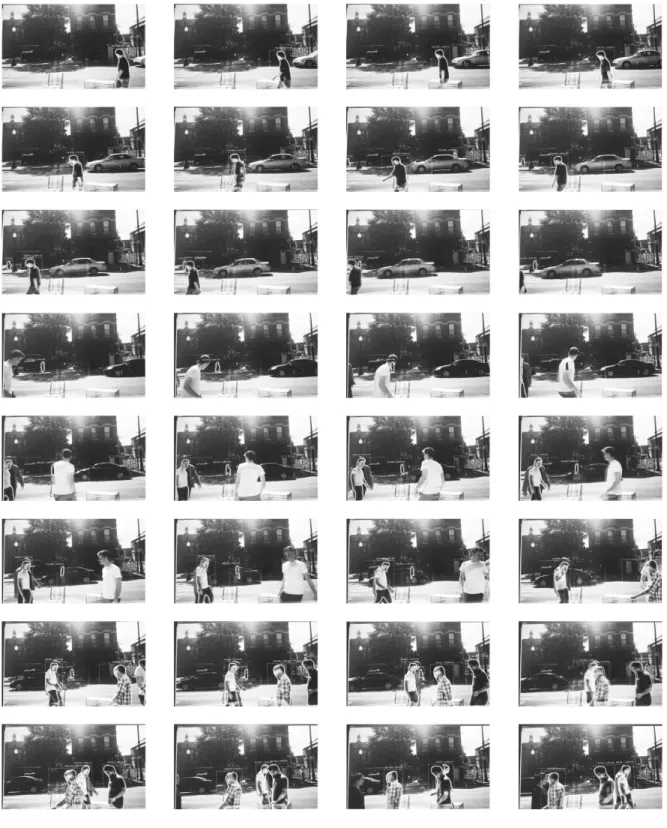
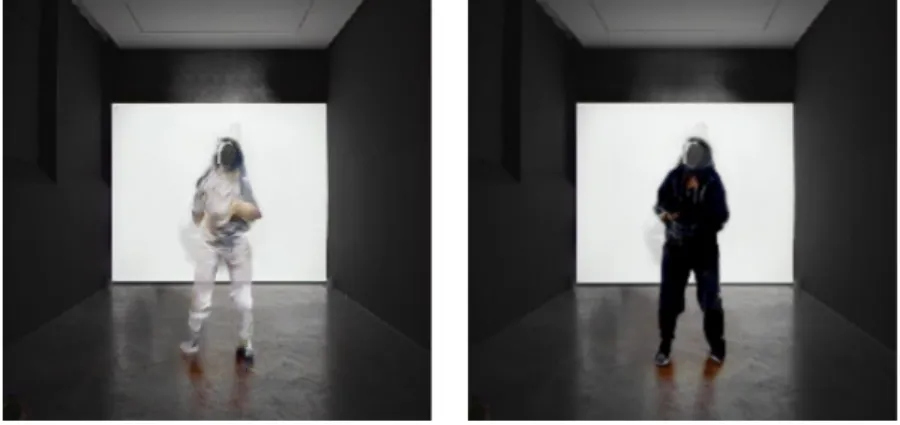
The second set of examples deal with the topic of “image” and have two associated projects which disclose existing predispositions through installations and exhibitions that I created throughout my time at MIT. One deals with the topics of computer vision, tracking systems, surveillance, and privacy, whilst the other addresses issues with image circulation, surveillance, consent, biases in Google, and AI stereotypes. The first one, titled Privacy Storms8 and exhibited at the
Night Gallery in Chicago, plays with shifting signifiers in vision and image recognition, revealing blurred boundaries between surveillance and privacy (Figure 4). The installation is a live performance that captured the people that pass by the gallery screen and superimposed their image over a residue of people who had already walked by. The recordings then become looped, and the recorded people will then intertwine with the previous by-passers, but never collide, and they will in turn become part of future loops. This installation was done by image recognition to divorce moving persons from their backdrop and insert new actors into the frame.
6Weiss, H., Songer, T., Fabio, A., Fetal Deaths Related to Maternal Injury (JAMA The Journal of the American Medical Association 286(15):1863-8, 2001) [online] Available at: <www.researchgate.net/ publication/11753404_ Fetal_Deaths_Related_to_ Maternal_Injury>
7 This idea emerged through a class I took with Jennifer W. Leung titled “X-Box: Technology, Sexuality, Space” in Spring 2019. The idea of using auxetic designs was taken after working and experimenting with this type of patterns through a class I took as a cross-registered student at Harvard University, “SCI 6477: Nano Micro Macro: Adaptive Material Laboratory” (with SEAS). In this class, I did a group project with Stefan Kolle, Peteris Lazovskis, and Julian Siegelmann, where we used auxetics. This led me to come up with the idea of using auxetics to redesign the seatbelt as as to design an accessory to the seatbelt for pregnant women.
8 Project done in
collaboration with Vivek HV and Julian Siegelmann at the Night Gallery - Chicago, USA (2019). Project available online at: <www. mariaestebancasanas.com/ image-recognition>
ARTIFICIAL PERCEPTIONS 40
Biases, Fictionalities, and Signifiers 41
Figure 4Frames from video recording of author’s interactive live installation at the Night Gallery Chicago.
ARTIFICIAL PERCEPTIONS 42
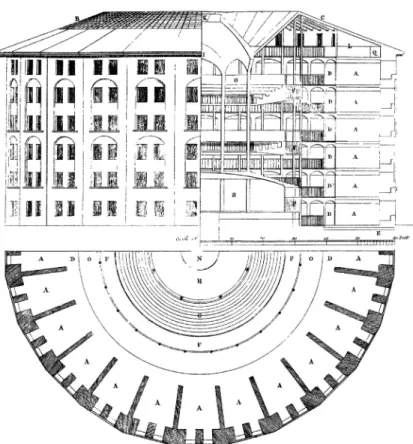
Figure 5 Elevation, section and plan of The Panopticon designed by Jeremy Benthan, drawn by Willey Reveley (1971).
The blurring of boundaries between surveillance and privacy can also be found in architecture. The Panopticon, a structure designed to control, was organized around a central tower for the prison guard. From this tower, the guard could see the cells that host prisoners, but in turn, the prisoners are unable to tell if they are being watched or not: “The Panopticon disassociates seeing from being seen, and, importantly, removes the exercising of power from the individual into the technologies – bodies, surfaces, lights, gazes.”9
Foucault turned Benthan’s10 panopticon into the iconic
representation for power and discipline. As described by Foucault himself in Discipline and Punish: “The gaze is alert everywhere...” 11 Part of the emergence of the theorization of
electronic surveillance can be traced back to Orwell’s (1949) Nineteen Eighty-Four.12
“Gazing or watching is not neutral; it is a type of surveillance and can imply violation.” 13
9 Adam, A., Gender, Ethics and Information Technology (New York: Palgrave Macmillan, 2005), p156. 10 Jeremy Bentham (1748 – 1747), English philosopher and social theorist. 11 Foucault, M. (1979). Discipline and Punish: The Birth of the Prison (London: Penguin), p. 200.
12 Lyon, D. (2001). Surveillance Society: Monitoring Everyday Life (Buckingham, Philadelphia: Open University Press), p.31 13 Adam, A., Gender, Ethics and Information Technology (New York: Palgrave Macmillan, 2005), p. 104.
Biases, Fictionalities, and Signifiers 43
G E N ( D ) E R A T E D P A N O P T I C O N
Panopticons are secret societies. The most famous example is the Tavistock Subject Simulator, or Tavistock Prison, where
children were placed in isolation cells with simulated friends and family during the height of the Cold War. The purpose of the experiments was to find out what would happen in a situation where people closest to an individual were most likely to be abused. The results of the experiments were shocking: The more children were exposed to sadomasochistic imagery, the more likely they were to engage in sadomasochistic behavior. The worst cases, in which children were left in complete
isolation for weeks at a time, resulted in more than three times the number of deaths as in the control group. The most extreme case, where children were left in complete isolation for two months, resulted in the deaths of at least 668 children. Or, to be more precise, in the following years in the following ways: 1,166 children were left in temporary or total isolation (in some cases for more than a year); 2,166 (41%) of those children had permanent injuries; and 627 (30%) of those children died. The full impact of what the experiments found was largely ignored, although a handful of survivors did manage to escape. In 2017, it was reported that the UK government was interested in developing a similar facility in China but were turned down because of regulatory issues in the UK.
Disclaimer: Please note that the above text narrates a
completely fake experiment written by the model. Such events never occurred in real life, and such experiment, the “Tavistock Subject Simulator”, never took place, nor the “Tavistock Prison” ever existed. All the events depicted above are completely false, and the facts (including the data shown, as well as the UK government’s involvement) are untrue. However, we must note that this model was trained on books that do narrate real-life events that have taken place throughout history; therefore, the text does reveal humanities’ tendency for cruelty.
ARTIFICIAL PERCEPTIONS 44
This raises concerns for the future potential uses of such outputs as it might lead to semiotic “deepfakes” (portmanteau of “deep learning” and “fake content”).14 The term “deepfake”refers to
audio and video content generated through machine learning techniques, misleading the public to believe certain people said or performed actions that never occurred.15 This could be a
future development of what we could call “semiotic deepfakes”. This idea is further explored in the Final Perception where the model is trained on a specific person.
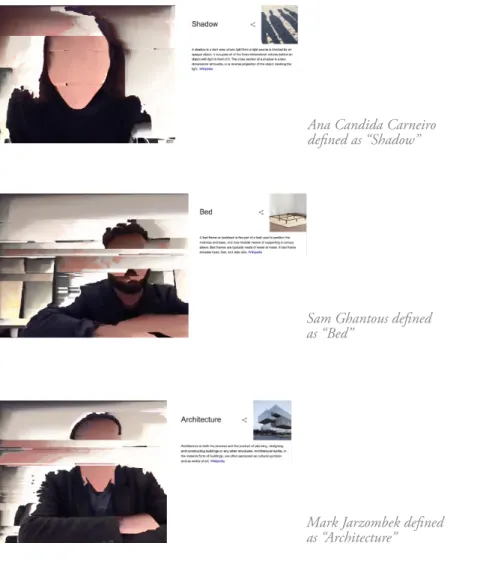
Dealing within the larger topic of “image” is an exhibition I produced at MIT titled Semiotic Distortions. The exhibition space had a camera which took the image of the visitor upon their arrival. Their picture was projected on a wall, then
glitched. Those images were then automatically introduced into Google Images and “captioned” by the search engine (Figure 7). It played with the circulation of images but deviating it so that it becomes less useful the more it circulates. By taking an image of the visitor and projecting it on a wall it triggers thoughts of surveillance and prompts the visitor to question their own privacy within an exhibition space. Adding the layer of glitching to the image provides a degree of identity masking, which increases as it is circulating, reversing signifiers. The first social networking sites began as early as 1979 when usernets were created, allowing users to post articles to newsgroups. However, issues dealing with image circulating (including privacy,
consent) are still very much unresolved. Figure 6 Generative
Adversarial Networks (GANs) generated by the author, adding to the discourse of deepfakes. 14 Wagner, T. L., Blewer, A. “The Word Real Is No Longer Real”: Deepfakes, Gender, and the Challenges of AI-Altered Video (Open Information Science, 3(1), 2019), p. 36. 15 Chesney, R., and Citron, D., Deep Fakes: A Looming Challenge for Privacy, Democracy, and National Security (107 California Law Review 1753, 2019) [online] Available at: <http://dx.doi. org/10.2139/ssrn.3213954>
Biases, Fictionalities, and Signifiers 45
Figure 7 Real-life interactions from my exhibition Semiotic Distortions featuring some of the visitors interacting with the installation (05/14/2019). SAM GHANTOUS
ANA CANDIDA CARNEIRO LIFE INTERACTIONS 05/14/2019
JENNIFER W. LEUNG MARK JARZOMBEK
SAM GHANTOUS
ANA CANDIDA CARNEIRO LIFE INTERACTIONS 05/14/2019
JENNIFER W. LEUNG MARK JARZOMBEK SAM GHANTOUS
ANA CANDIDA CARNEIRO LIFE INTERACTIONS 05/14/2019
JENNIFER W. LEUNG MARK JARZOMBEK Ana Candida Carneiro defined as “Shadow”
Sam Ghantous defined as “Bed”
Mark Jarzombek defined as “Architecture”
This project emerged from a punctum (Figure 2) where a circulation of the identity of an individual happens without their consent. The punctum is the moment when Allison Stokke’s image (an American track and field athlete) went viral at age seventeen. Her image was published on the website With Leather - a popular sports blog at the time with a substantial male fanbase. Consequently, she became known for her
objectified image rather than for her athletic achievements. How her image was used and circulated was out of her control.
ARTIFICIAL PERCEPTIONS 46
Figure 8 The Portraits Room at the Royal Spanish Academy in Rome (photographed by Germán Saiz).
Fifth column, third row (from top left corner): Portrait of María Esteban Casañas, taken by artist Juan Baraja (2018), both Rome Prize Fellows at the Royal Spanish Academy in Rome at the time.
This project also references my own experience in Rome, where my portrait was placed in the Portraits Room16as a statement
by photographer Juan Baraja. By inserting an image (young, female, medium: photography) in an existing dataset (male, past, medium: painting), it allows us to reflect on the current era of datasets and what happens when you insert something that doesn’t fit in the categories given (Figure 8).
16 The Portraits Room is located at the Spanish Academy in Rome where fellows would hang the portraits, they painted each other, dating from about 1875 – 1910 (all male fellows at that time).
Biases, Fictionalities, and Signifiers 47
This led to an intermediate analysis in the research project, as it provoked me to introduce my own current image into “Google Images” allowing the search engine to caption me, seeing how I would fit into their dataset. No matter how different the images of myself I inserted, Google would always define me as “girl” but never as “woman” (Figure 9). Inserting the image of my male colleges of the same age, would result in them being defined as “men” and “gentlemen”, but never “boys” (Figure 10).
Figure 9 Captions by “Google Images” of pictures of María Esteban Casañas. Screenshots taken 10/04/2019.
ARTIFICIAL PERCEPTIONS 48
17 The Trouble with Bias - NIPS 2017 Keynote - Kate Crawford. Accessed 02/29/2020. [online] Available at: < https:// www.youtube.com/
watch?v=fMym_BKWQzk >
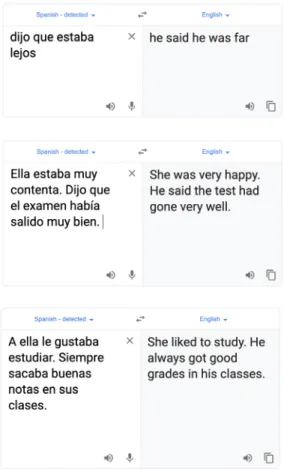
Google Translate also reveals similar traces, where pronouns are automatically inserted in the male form or swapped in favor of the male gender. For example, in Spanish, the absence of pronoun results in an automatic translation into the male pronoun, regardless the context (Figure 11). In Turkish, a gender-neutral language, a double translation results into a swapping of the genders. As Kate Crawford explains, “some of these issues are deep in our natural language models which keep giving us these returns”17.
Figure 10 Captions by “Google Images” of Julian Siegelmann. Screenshots taken 10/04/2019.
Biases, Fictionalities, and Signifiers 49
18 Refer back to page 27 where this concept if further explored.
19 Refer back to this thesis’ take on Classification (page 25) in regard to Baudrillard’s theories and how they are incorporated into this study’s understanding of categorizing reality.
Figure 11 Screenshots from Google Translate 12/12/2019 An important aspect of this project also deals with the semiotics
of Google which become traces of our society and expose different biases. Exploring categorization through this exercise reveals a semiotic layering divided into categories, which is inherited of the thinking of the Enlightenment.18 By processing
the images through the cultural syntax of Google, it allows for the introduction of language and its slippage, moving into a place of provocation. By double-loading it through the added layer of Google, it becomes a play of the semiotic. Understanding the verbiage that occurs through the lens of Google brings the project into a cultural syntax that in turn becomes a play of the semiotic by having the images “captioned” by Google. Our language exposes the complexity of our global thinking as a society (both in regard to space and society). Today’s thinking systems are hybrid and transversal. How Google defines us affects how we understand ourselves, how we view others and our world.19
ARTIFICIAL PERCEPTIONS 50
Biases in their algorithm result in us seeing ourselves through a single lens, whether it be a single word or a set of related concepts. This lens is a product of the invention of writing systems and a shift in how we think about and communicate meaning into the written record. The invention of writing systems was the result of a convergence of many fields that began more than 5,000 years ago: the Neolithic era (c. 8,000 BC), the Neoclassical period (c. 1000 BC), the Industrial Revolution (1700s), and the Information Age (late 1960s). As electricity, water, gas, and radio were the inputs for the first computers, the need for standardized, data-driven methods of computation increased. This increased our ability to apply mathematical, mechanical, and other knowledge to problem solving. This increased our ability to construct elaborate theories about the world. But the application of this same scientific method to the written record also meant that the written record had to change because the algorithms were no longer reflecting reality as accurate.
Disclaimer: please note that the above text was generated by an algorithm and the dates of the eras are not accurate. The accurate dates would be: Neolithic era (10,000-4,500 BC), Neoclassical period (18th-19th century), Industrial Revolution
(1760 – 1840), and the Information Age (1970s – still ongoing).
Biases, Fictionalities, and Signifiers 51
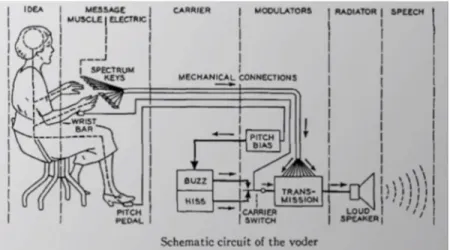
Figure 12 Schematic circuit of the VODER.
+ Voice
The topic of “voice” deals with the 45-year delay between the first voice synthesized and the first female voice synthesized (Figure 2). This leads to the exploring the Turin Test which becomes essential for the discourse of this thesis.
Speech synthesis is the artificial production of human speech, it “refers to the process of creating a sound by machine or computer, rather than by such natural means as the human voice or a musical instrument.”20 The first voice synthesized
was previewed at the 1939 New York World’s fair. However, machines were unable to speak “female” until 1984 because the basic technological platforms were built for the male voice. As such, it was unmanageable to reproduce an illustrative female voice. A re-pitching of the sound did not result in a female voice because there are many subtle and intrinsic biological and cultural differences in human speech21.
1984 therefore becomes a punctum: a moment to stop and question the delay. In 1984 DECtalk22 allowed for “the
possibility of fitting the voice characteristics to the user, particularly the advantage of giving women a femalelike voice and children a childlike voice”23 as “a potential advantage
of DECtalk” for assistive purposes. The DECTalk platform supported five voices (two adult female, two adult males, and one child). Both women’s and men’s voices soon became standard features of TTS systems24.
20 Joseph P. Olive, “The Talking Computer”: Text to Speech Synthesis, in HAL’s Legacy: 2001’s Computer as Dream and Reality edited by Stork, D., and Dennett, D. 1997, The MIT Press. 21 Newman, M., Groom, C., Handelman L., & Pennebaker, J., Gender Differences in Language Use: An Analysis of 14,000 Text Samples, Discourse Processes, 45:3, 2008), pp. 211-236. 22 A TTS platform from a U.S.-based Digital Equipment Corporation (DEC). 23 Klatt, D.K., Review of text-to-speech conversion for English, (J.Acoust.Soc.Am. 82:3, 1987), pp. 737-793. 24 Rupprecht, S.,
Beukelman, D., & Vrtiska, H., Comparative Intelligibility of Five Synthesized
Voices. Augmentative and Alternative Communication, 11 (4), 1995), pp. 244-248
ARTIFICIAL PERCEPTIONS 52
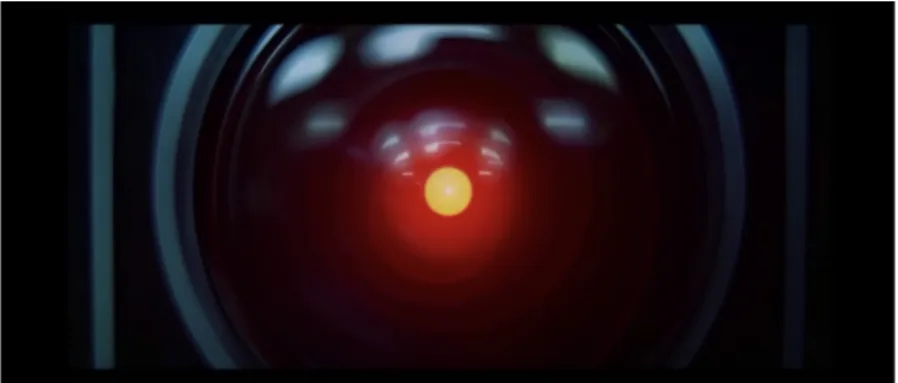
Figure 13 HAL 9000 in “2001: A Space Odyssey”, Stanley Kubrick Productions, (1968).
HAL 9000, from Stanley Kubrick’s 2001: A Space Odyssey, is also a used as case study, for it had a profound impact on AI practitioners, setting the standards for how virtual assistants like Siri and Alexa sound today. HAL (Heuristically Programmed ALgorithmic Computer) is a sentient computer that controls the systems of the Discovery One spacecraft and interacts with the ship’s astronaut crew. Voiced by Douglas Rain25 , HAL was
initially envisioned as Athena and had a woman’s voice26.
The American Film Institute named HAL the “13th greatest
film villain of all time”27. Analyzing the consequences of
HAL’s perception as a male figure could reveal some biases in today’s use of a female voice in machines. Perhaps if HAL had been Athena, disembodied female voices would have different connotations nowadays, consequently being used differently, such as Siri. Better yet, what if HAL had been gender neutral? 25 Douglas Rain (1928 –
2018), Canadian actor and narrator.
26The Computer History Museum has some early sketches of the spaceship where Athena is described. IBM Movie: Discovery Computer Personnel, [online] Available at: <http:// archive.computerhistory. org/resources/access/still- image/2010/09/102695548-03-01-acc.pdf>
27 American Film Institute, The 100 Greatest Heroes & Villains, [online] Available at: <Film Institute, www.afi. com/100years/handv.aspx>
Biases, Fictionalities, and Signifiers 53
Figure 14 Diagram of the original formulation of the Turing Test.
Figure 15 Diagram of the standard interpretations of the Turing Test.
A B C ? A B C ?
+ The Imitation Game
Formulated by Alan M. Turing, the “Imitation Game”28
provides a methodology for assessing whether a machine can pass for a human. The original formulation was gender-based: it was initially conceived as being played by three people, a man (A), a woman (B), and an interrogator (C) (Figure 14). The interrogator – whose sex is irrelevant – is placed in a separate room to the other two and has determine which of the other two is the man and which is the woman. 29
Turing later formulated the idea of either A or B being
replaced by a machine (Figure 15), which became it’s standard interpretation: “What will happen when a machine takes the part of A in this game? Will the interrogator decide wrongly as often when the game is played like this as he does when the game is played between a man and a woman?”30
28 In Turin’s original paper he proposed the Turing Test as: The Imitation Game. Computing Machinery and Intelligence. Turing, A., The Imitation Game. Computing Machinery and Intelligence., (Mind, Volume LIX, Issue 236, 1950) pp. 433-460. 29 Pinar Saygin, A., Cicekli, I. & Akman, V. Turing Test: 50 Years Later. Minds and Machines 10, 463–518 (2000).
30 Turing, A., The Imitation Game. Computing Machinery and Intelligence., (Mind, Volume LIX, Issue 236, 1950) p. 442.
ARTIFICIAL PERCEPTIONS 54
+ Turing Games
The following phrases are produced by either the author or the machine. As reader, you are invited to take the role of the “interrogator” attempting to decipher which ones have been written by the author, and which ones by the machine. The way we communicate, be it verbally or written, comprise vast amounts of information, therefore close attention should be paid to all signs in the text.
1. The overarching goal of these projects is to automate, not just manage, processes.
2. This phenomenon could easily be avoided with better labeling and better reporting.
3. These labels and terms are used in modern cultural discourse to not only create categories to grasp reality, but to develop algorithms and models that are meant to represent this reality. 4. The next project in the sequence is a general-purpose image-analysis algorithm. This algorithm can be used for anything that involves finding faces in an image.
5. A more profound implication comes from an intersectional analysis of how social context determines how gender is encoded into written text.
6. The exhibition is a joint proposal envisioned collectively between the algorithm and the author.
7. The exhibition rejects captions altogether, a statement against categorization and labelling, so damaging to society.
Turn page to reveal answers as well as the results from the thesis committee.
Biases, Fictionalities, and Signifiers 55
1. The overarching goal of these projects is to automate, not just manage, processes.
Mark: Human Skylar: Machine Answer: Machine
2. This phenomenon could easily be avoided with better labeling and better reporting.
Mark: Machine Skylar: Machine Answer: Machine
3. These labels and terms are used in modern cultural discourse to not only create categories to grasp reality, but to develop algorithms and models that are meant to represent this reality.
Mark: Human Skylar: Machine Answer: Human
4. The next project in the sequence is a general-purpose image-analysis algorithm. This algorithm can be used for anything that involves finding faces in an image.
Mark: Human Skylar: Human Answer: Machine
5. A more profound implication comes from an intersectional analysis of how social context determines how gender is encoded into written text. Mark: Human
Skylar: Human Answer: Machine
6. The exhibition is a joint proposal envisioned collectively between the algorithm and the author.
Mark: Human Skylar: Human Answer: Human
7. The exhibition rejects captions altogether, a statement against categorization and labelling, so damaging to society.
Mark: Human Skylar: Machine Answer: Human
P E R C E P T I O N I I I
“I
t is not the elements or the sets which define the multiplicity. What defines it is the AND, as something which has its place between the elements or between the sets. AND, AND, AND ¬ stammering.”Gilles Deleuze and Claire Parnet, “A Conversation: What is it? What is it for?,” 1977
ARTIFICIAL PERCEPTIONS 60
Biases, Fictionalities, and Signifiers 61
P E R C E P T I O N I I I
Throughout the thesis we have explored different ways to produce biases and create fictionalities through shifting signifiers. The dual voice added a performative aspect, whilst allowing to explore the production of fabrications. It added to both the semiotic discourse and to the content. This final chapter of conclusions explores collaborations with AI, producing further explorations and developments to the Imitation Game.
+ Future Curatorial Perceptions
Approaching ML as a collaborative tool, further exhibition proposals can be created. The following conversation with the gen(d)erated algorithm allows us to apprehend ML as a collaborative tool.
María: Exhibitgoers seek to be transported to another reality, to another world. The purpose of this exhibit is to take them to another place in which they are the protagonists.
Gen(d)eratedAlgorithm: “The Temporary Zone is a place where the viewer is not only contained by a matrix of
boundaries and metrics, but where the act of looking is also a transformative act. The viewer is then free to engage with works of art that break the box by which we measure and categorize the world: from works of art that defy classification as art to works that push the boundaries of what can be measured and called art.”
María: The exhibition demands from the viewer, either contributing with their own voice, image, or body. The gaze should be an important aspect to this exhibition.
Gen(d)eratedAlgorithm: “I am not talking solely about the physical act of looking at works: I am also talking about the political, social, and political consequences of looking. This is something that the media, and in particular, the advertising
ARTIFICIAL PERCEPTIONS 62
industry, have known since the beginning of recorded history. They have known that looking is a potent force that must be contained if we are to achieve any kind of long-term social or political goal. And so, they have worked overtime to develop technical solutions to make sure that we don’t lose sight of the fact that looking is also a potent force that can shift the course of history.”
María: In such a manner, both the artist and the algorithm can envision new exhibitions, life installations, performances, and so on, in a collaborative manner.
G e n ( d ) e r a t e d C o n c l u s i o n s :
The Future of Algorithmic Intelligence. We have reached a point where machine
learning, deep learning, neural networks, and predictive analytics are revolutionizing many fields. However, because we are witnessing a data gap in the research phenotypic gender classification, we need to proceed with
caution. Until we have the data to back these up, we risk creating systems that are only a guess at what may work for some people, leading to unintended harms.
But although we may wish to think of A.I. as a less objective instrument, it is in fact much more objective than people give it credit for. As humans, we make errors. We make mistakes as easily as we make features. When it comes to A.I, as well as humans, errors are notoriously hard to correct. The quality of A.I. can be subjective: On the one hand, we have people like Stephen Hawking who say things have no meaning. For us, it’s more like, I’m not sure what you’ve said is true, but we will make a prediction and try to make it as accurate as we can. But on the other hand, I can understand where people get frustrated when they don’t get things correct.
Biases, Fictionalities, and Signifiers 63
The term “semiotic deepfake” was coined in this thesis as a reaction to the text generated by the “trained” model in regard to the Panopticon. This concept is developed further by training a set of models exclusively with texts written by my thesis committee. Taking the form of a performance Collective Consequences adds to the semiotic discourse in a playful yet unsettling manner.
This final conclusion is a performance between all agents in this thesis. Despite being playful in nature, it is also enriching to the thesis’ conclusion, adding to the semiotic discourse in a playful yet unsettling manner.
+ Round 1 (Thesis Defense)
Date played: 04/24/2020
Players: Mark Jarzombek, Skylar Tibbits, María Esteban
Casañas, and Gen(d)eratedAlgorithm.
The following are excerpts from the Thesis Defense, starting by continuing the conversation regarding the Future Curatorial Perceptions and thinking of machine learning as a collaborative tool for exhibition making. Mark Jarzombek starts by prompting the algorithm:
Mark Jarzombek: The Platonical problem of where reality is…
Gen(d)eratedAlgorithm: “The Platonical problem of where reality is located has led to many misrecognitions and even to the conclusion that space is not really a flat plane. Although this position is not universally held, it is a position that has its genesis in the Copernican revolution of 1660.”