
Publisher’s version / Version de l'éditeur:
Vous avez des questions? Nous pouvons vous aider. Pour communiquer directement avec un auteur, consultez la première page de la revue dans laquelle son article a été publié afin de trouver ses coordonnées. Si vous n’arrivez pas à les repérer, communiquez avec nous à [email protected].
Questions? Contact the NRC Publications Archive team at
[email protected]. If you wish to email the authors directly, please see the first page of the publication for their contact information.
https://publications-cnrc.canada.ca/fra/droits
L’accès à ce site Web et l’utilisation de son contenu sont assujettis aux conditions présentées dans le site LISEZ CES CONDITIONS ATTENTIVEMENT AVANT D’UTILISER CE SITE WEB.
Combustion Institute Canadian Section, 2007 Spring Technical Meeting [Proceedings], 2007
READ THESE TERMS AND CONDITIONS CAREFULLY BEFORE USING THIS WEBSITE.
https://nrc-publications.canada.ca/eng/copyright
NRC Publications Archive Record / Notice des Archives des publications du CNRC :
https://nrc-publications.canada.ca/eng/view/object/?id=b034b332-d3a0-46b9-b7c6-e191f10f61c8 https://publications-cnrc.canada.ca/fra/voir/objet/?id=b034b332-d3a0-46b9-b7c6-e191f10f61c8
Archives des publications du CNRC
This publication could be one of several versions: author’s original, accepted manuscript or the publisher’s version. / La version de cette publication peut être l’une des suivantes : la version prépublication de l’auteur, la version acceptée du manuscrit ou la version de l’éditeur.
Access and use of this website and the material on it are subject to the Terms and Conditions set forth at Measuring optical properties of cooled post-flame soot
MEASURING OPTICAL PROPERTIES OF COOLED POST-FLAME
SOOT
A.R. Coderre, D.R. Snelling†, G.J. Smallwood†, and M.R. Johnson
Department of Mechanical and Aerospace Engineering, Carleton University, Ottawa, Ontario, Canada
†
Combustion Group, Institute for Chemical Process and Environmental Technology, National Research Council, Ottawa, Ontario, Canada
INTRODUCTION
Two-colour laser-induced incandescence (LII) is considered to be a mature optical diagnostic that provides an accurate, highly sensitive method of determining the volume fraction of particulate aerosols such as soot in combustion gas. LII is especially well suited for in-flame measurements, and indeed works well for over-fire soot measured immediately above flames. One of the advantages of two-colour LII is that the method provides a measure of soot volume fraction (SVF) that should be relatively independent of the laser fluence used to heat the soot. However, in practice it has been observed that when the diagnostic is applied to exhaust streams at ambient temperature, the measured SVF is strongly dependent on the laser fluence. This poses a problem, since many practical applications of this technology would involve sampling cooled soot, for example from a tailpipe, rather than from within the combustion environment. It is postulated that the fluence dependence of the LII signal may originate from variations in the optical properties of soot as it cools in an exhaust stream.
The optical properties of soot are a much-studied topic, yet most works on the subject yield surprisingly different results. This is perhaps due to the variation in fuels used, from solid fuels such as plexiglass and polystyrene [1], to liquid fuels such as n-heptane and toluene [2,3], to gaseous fuels like propane, acetylene, ethylene and ethane [2-11]. Alternatively, observed differences could be due to the variation in methods used for the measurements, such as reflectivity of compacted soot [5], tomographic reconstruction [12], and optical methods using combinations of scattering, absorption, and extinction [2,4,6,8-11]. Some studies involve calculation of theoretical properties rather than direct measurement, such as Lee and Tien [1] who arrived at their values using dispersion model. What these studies share is that the soot under study was obtained either within a flame or very shortly post-flame [2,4,6-8,9,11,12] or sampled from a flame and physically altered after cooling [5,10]. The present study examines the optical properties of combustion-generated soot, sampled far enough downstream that is has cooled to ambient temperature. This soot will be characterized with the aid of scanning and transmission electron microscopy (SEM/TEM) along with a multiple low-angle scattering diagnostic.
EXPERIMENTAL SETUP
To determine soot optical properties, diagnostics will be carried out on soot of known physical characteristics. These physical, or morphological, characteristics are found using a combination of in- and ex-situ methods. Primary particle size and aggregate size distributions can be found
using scanning and transmission electron microscopy (SEM/TEM) and subsequent image analysis. A multiple low-angle scattering setup will allow for fast and direct measurement of the average radius of gyration of the particles, with the possibility of measuring the fractal dimension. The soot source and diagnostics are discussed in more detail below.
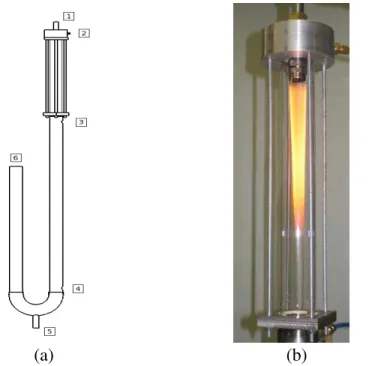
Soot is generated using an inverted co-flow laminar diffusion burner, designed after Stipe et al. [13]. A schematic of the burner can be seen in Figure 1. Methane with variable nitrogen diluant is passed through a central 15.9 mm tube, seen as Station 1 in Figure 1, and annular co-flow air is brought in through Station 2. The flame is stabilized on an annular bluff body, and is visible through a quartz tube. The flow continues downward through a stainless steel tube section, and is turned through 180° at the bottom. Dilution air is used to control the particle concentration, and is injected at Station 3. A port at Station 4 is available for sampling the exhaust stream. Water is allowed to condense and is collected by a drain at the base of the burner, shown as Station 5. The outlet of this drain is kept below the water level of a reservoir so that exhaust gas cannot escape. Extractive sampling and optical diagnostics are applied at the exhaust outlet, seen as Station 6. The burner is mounted on a levelling platform to ensure that the flame is vertical, and thus the buoyancy forces remain axisymmetric. Methane, nitrogen, co-flow air and dilution air are each controlled by mass flow controllers.
(a) (b)
Figure 1: (a) Schematic of burner and (b) photo of burner head
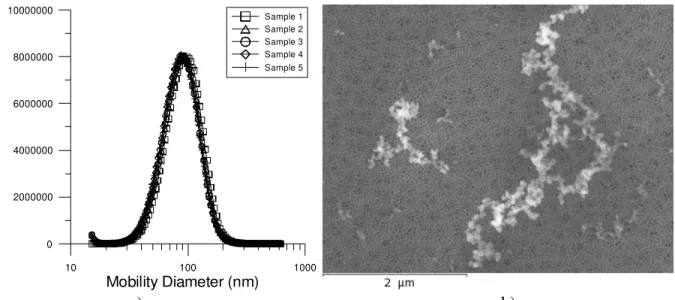
The burner is designed to be a steady and repeatable source of soot, for which the average size and concentration can be independently adjusted by diluting the fuel and by adding secondary dilution air. Some preliminary results for flow rates of 1.2 SLPM methane and 15 SLPM co-flow air (global equivalence ratio of 0.76) with no fuel or exhaust dilution can been seen in Figure 2a, which demonstrates the repeatability of the burner with a scanning mobility particle sizer (SMPS) plot of number concentration against mobility diameter for five consecutive runs. Figure 2b shows an SEM micrograph at 25000X magnification of soot generated at the same
burner conditions. Figure 3 shows SMPS results for various equivalence ratio conditions, demonstrating the ability to control the mean particle size.
10 100 1000 Mobility Diameter (nm) 0 2000000 4000000 6000000 8000000 10000000 N u mb er C o n c ent ra ti on ( # /c m 3) Sample 1 Sample 2 Sample 3 Sample 4 Sample 5 a) b)
Figure 2: (a) Particle size distribution and (b) corresponding SEM image.
10 100 1000 Mobility Diameter (nm) 0 10000000 20000000 30000000 40000000 Nu mbe r Co ncen tr at ion (#/cm 3)
1.0 SLPM Methane & 10 SLPM Air 1.0 SLPM Methane & 15 SLPM Air 1.0 SLPM Methane & 20 SLPM Air 1.2 SLPM Methane & 10 SLPM Air 1.2 SLPM Methane & 15 SLPM Air 1.2 SLPM Methane & 20 SLPM Air
Figure 3: Soot size distributions at different burner conditions
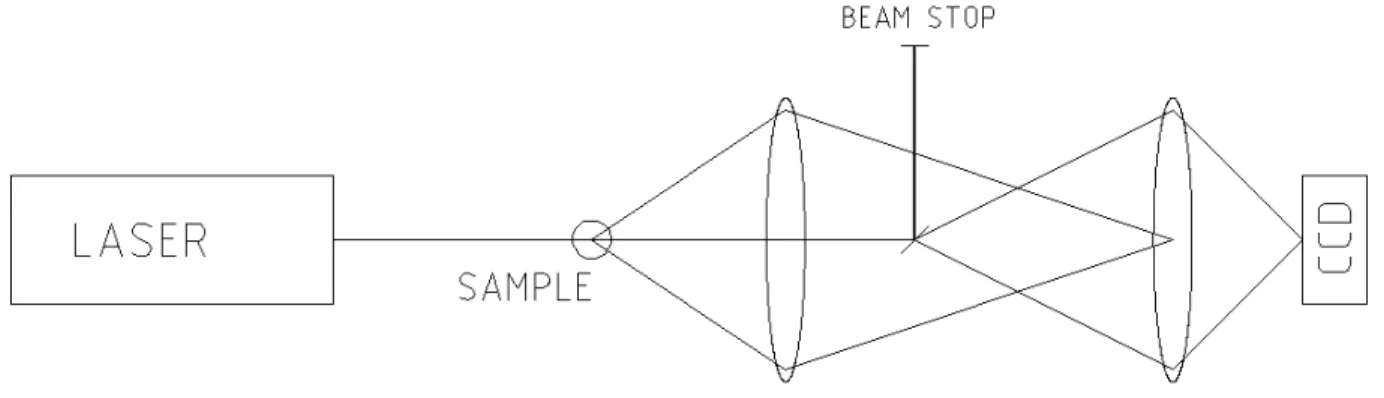
Optical measurements will be performed with a multiple low angle scattering setup, designed after Ferri [14]. A schematic of the optical setup can be seen in Figure 4. The light source is a continuous 75 mW diode-pumped Nd:YAG laser operated at 532 nm, which is passed through the sample stream at Station 6 of Figure 1. The unscattered beam is diverted and dumped, while light scattered at angles of approximately 0.5°-10° is collected by a Fourier lens setup and imaged onto a 1000x1000-pixel CCD camera. Use of the Fourier lens arrangement allows direct
mapping of scattering angle to radial displacement on the CCD [14]. To maximize resolution and detected light scatter angle, the optical axis will be aligned with a corner of the CCD so that only one quadrant of the scattered solid angle is measured. By dividing the CCD into concentric rings and averaging the intensities over each ring, a measure of irradiance versus scattering angle can be obtained. With this information, one can extract the average radius of gyration of the particles, as discussed below.
Figure 4: Schematic of scattering optics
THEORY
Light scattering as a means to measure soot properties has been successfully used by many researchers, including Koylu and Faeth [8,9], Krishnan et al. [2], and Chang and Charalampopoulos [4]. In addition, Faeth and Koylu [15] provide a helpful review of soot morphology and optical properties, and Sorensen [16] provides an excellent overview of the theory and techniques, which is followed here.
In light scattering, the scattering wave vector, q, is of prime importance and is defined as q = ki –
ks, where ki and ks are the incident and scattered light vectors, respectively. The magnitude of q
is given by |q|=q=4πλ-1sin(θ/2), where θ is the scattering angle and λ is the wavelength [16].
The product qRg is used to determine which regime (Rayleigh, Guinier, or power-law) best
describes the scattering behaviour. For the conditions of this experiment, where λ is 532 nm and
θ is 0.5 to 10 degrees, the product qRg is expected to remain slightly less than unity which falls
within the Guinier regime, as seen in Figure 5. As such, we can write [16] 2 2 3 1 1 ) ( ) 0 ( q R q I I g + = (1)
Therefore, on a plot of I(0)/I(q) versus q2, the slope of the line is Rg,ave2/3. This yields the
average radius of gyration of the aggregates.
If the qRg range extends much past unity, it enters the power law regime. Here, if one plots I(q)
against q, the slope of the line gives the fractal dimension of the aggregates [16]. For the low-angle experiment, the values of q are limited so only very large aggregates will fall into this region. It is expected that fractal dimension values will not be obtainable when smaller aggregates are being produced.
Figure 5: Light scattering regimes [16]
FUTURE WORK
The next step planned in this study is to use LII to obtain soot optical properties, in particular the absorption function E(m). Since LII relies on E(m) to arrive at a value of SVF [17], it can also be used in reverse to arrive at E(m) values if the SVF is known. Gravimetric analysis is a non-optical method of acquiring SVF, used by many researchers (eg. [2]). This method requires a measured volume of the exhaust stream to be passed through a soot-capturing filter, which is weighed before and after sampling to obtain the mass of soot collected. Using published density values, the volume of soot and thus the soot volume fraction of the exhaust flow can be obtained. However, there remains the drawback that LII requires knowledge of the relative variation of the absorption function with wavelength in order to obtain the required soot temperature values. Two-dimensional line-of-sight attenuation (2D-LOSA) measurements can also readily be taken. With knowledge of the soot morphology, the Rayleigh-Debye-Gans theory for polyfractal aggregates (RDG-PFA) can be used to calculate the scattering contribution to the total attenuation, which can be subtracted from the measured attenuation to isolate the absorption contribution. In this manner, a measure of the relative absorption as a function of wavelength, and thus the relative E(m), can be obtained. With accurate knowledge of the relative E(m), absolute E(m) values can be obtained using LII as described above.
In summary, the burner conditions can be used to control variables such as aggregate size and concentration as well as temperature and aging time. The multiple low-angle scattering setup allows for a fast, in-situ aggregate size measurement, and thermocouples can be employed to measure temperature. Thus, these measurements can be combined with LII and LOSA to investigate variations in the absorption function E(m) as a function of temperature and aggregate size.
CONCLUSIONS
An inverted co-flow diffusion burner has been designed and constructed as a steady and repeatable source of soot. The burner can produce soot in a range of sizes and concentrations by independently controlling fuel, fuel dilution, co-flow air, and dilution air flows. The morphological properties of the soot can be characterized by SEM/TEM image analysis along with on-line size measurements taken with a multiple low-angle light scattering apparatus. This setup provides a source of soot of controllable size, concentration, temperature and residence time, to which various diagnostics will be applied to measure optical properties.
REFERENCES
[1] S.C. Lee and C.L. Tien, 18th Symp. (Int'l), The Comb. Inst., 1159-1166 (1981.) [2] S.S. Krishnan, K.C. Lin, G.M. Faeth, J. Heat Transfer, 122:517-524 (2000). [3] J. Mullins, A. Williams, Fuel, 66:277-280 (1987).
[4] H. Chang, T.T. Charalampopoulos, Proc. R. Soc. Lond. A, 430:577-591 (1990). [5] W.H. Dalzell and A.F. Sarofim, J. Heat Transfer, 91:100-104 (1969).
[6] J. Zhu et al., Int. J. Heat & Mass Transfer, 43:3299-3303 (2000). [7] D.R. Snelling et al., Comb. Flame, 136:180-190 (2004).
[8] U.O. Koylu and G.M. Faeth, J. Heat Transfer, 118:415-421 (1996). [9] U.O. Koylu and G.M. Faeth, J. Heat Transfer, 116:152-159 (1994).
[10] B.J. Stagg and T.T. Charalampopoulos, Comb. Flame, 94:381-396 (1993). [11] T.T. Charlampopoulos, H. Chang, B. Stagg, Fuel, 68:1173-1179 (1989). [12] I. Ayranci et al., J. Quant. Spectr. & Rad. Transf., 104-2:266-276 (2006). [13] C.B. Stipe et al., Rev. Sci. Inst., 76:023908 (2005).
[14] F. Ferri, Rev. Sci. Inst., 68:2265-2274, (1997).
[15] G.M. Faeth and U.O. Koylu, Comb. Sci. Tech., 108:207-229 (1995). [16] C.M. Sorensen, Aerosol Sci. Tech., 35:648-687 (2001).
![Figure 5: Light scattering regimes [16]](https://thumb-eu.123doks.com/thumbv2/123doknet/14174531.475079/6.918.295.617.114.438/figure-light-scattering-regimes.webp)
