HAL Id: tel-01100292
https://hal.inria.fr/tel-01100292
Submitted on 6 Jan 2015
HAL is a multi-disciplinary open access archive for the deposit and dissemination of sci-entific research documents, whether they are pub-lished or not. The documents may come from teaching and research institutions in France or abroad, or from public or private research centers.
L’archive ouverte pluridisciplinaire HAL, est destinée au dépôt et à la diffusion de documents scientifiques de niveau recherche, publiés ou non, émanant des établissements d’enseignement et de recherche français ou étrangers, des laboratoires publics ou privés.
Distributed under a Creative Commons Attribution - NoDerivatives| 4.0 International License
Access
Sébastien Ferré
To cite this version:
Sébastien Ferré. Reconciling Expressivity and Usability in Information Access: from File Systems to the Semantic Web. Computer Science [cs]. Université de Rennes 1, 2014. �tel-01100292�
University Rennes 1
Reconciling Expressivity and Usability
in Information Access
from File Systems to the Semantic Web
S´ebastien
Ferr´
e
Associate ProfessorTeam LIS, IRISA, University Rennes 1 [email protected]
http://www.irisa.fr/LIS/ferre/
Defended on November 6th, 2014
in front of the defense committee, composed of: Olivier Pivert Professor at Univ. Rennes 1 / president Norbert E. Fuchs Senior researcher at Univ. Zurich / referee Marianne Huchard Professor at Univ. Montpellier 2 / referee Eero Hyv¨onen Professor at Univ. Aalto / referee
Karell Bertet Associate professor (HDR) at Univ. La Rochelle / examiner Fabien Gandon Researcher (HDR) at INRIA Valbonne / examiner
Foreword
Since the start of my PhD in 1999, I have worked on various problems, and produced a number of different contributions pertaining to several domains and research communities. This habilitation thesis is an opportunity for me to summarize them, and to open perspectives. However, that synthesis work is made difficult by the fact that the set of my research tracks look more like a bush than like a tree. In fact, I see the research process as an evolution process where ideas, theories, softwares, and applications compete for sur-vival, and are transformed by mutation and crossover. Some of my research tracks have gone extinct (e.g., logic functors), while others have flourished (e.g., Semantic Web). Some have appeared by mutation (e.g., guided edition from guided search), while others have merged (e.g., conceptual navigation and faceted search). At every time, there is not a single active research track, nor a “best” research track, but a population of diverse and comple-mentary research tracks. That evolution process makes it hard to synthesize the different research results into one “all-inclusive” result. First, merging different existing results in a coherent way is a research process in itself, and a never-ending process. Second, the result of that merging would be a static snapshot hiding the evolution process, and hence hiding both the past and the future of the research activity, and that snapshot would soon become outdated. An alternative approach would be to write a history of research tracks and results, in chronological order. However, people generally do not want to revive the past, which tends to be boring, but rather to know the past in order to understand the present, and envision the future.
What I therefore chose to do is to write a synthesis of my research work over the last 15 years such that it is rooted in the present, and yet, shows the evolution process from past to future. To this purpose, I “datamined” my different research results, and discovered a pattern that provides an uni-fying framework for a number of quite different results: Abstract Conceptual Navigation (ACN). Each result is presented as an instance of the ACN frame-work, without trying to reformulate the original result, only using ACN as a point of view over it. The presentation of successive results through a
same framework makes it easier to compare them, and therefore to highlight progress over time. As an unifying framework, ACN helps to understand the specificity of my research work, and what drived it from file systems to the Semantic Web. The generality of ACN also opens the room for imagi-nation, and helps suggest and structure a number of perspectives. ACN is not a “hook in the sky”, and builds on strong information access paradigms: query languages, navigation structures, and interactive views. In fact, ACN is a proposal for a synthesis of those three information access paradigms.
This habilitation thesis is made of a synthesis chapter, and four selected papers published in international journals as appendices. The selected papers represent important milestones in my research work, and are shown exactly as they were published. The synthesis is centered around Abstract Concep-tual Navigation (ACN), and is made of three parts: state-of-the-art, main contributions, and perspectives. The state-of-the-art is an overview over ex-isting approaches to information access for structured data. It tries to be complete at a coarse level of detail, but it ignores many details and speci-ficities of existing approaches. This is justified, I think, by the objective to introduce and motivate ACN, which is itself at a high level of abstraction. A more detailed account of related work can be found in published papers. The ACN framework is then introduced, and used as a basis for the presentation of the main contributions of my work. Secondary contributions are associ-ated to their closest main contribution, and only briefly presented. Finally, the main contributions are summarized, and ACN is used again as a basis for discussing a number of perspectives. In the synthesis, self-references are distinguished by a boldface font. Each appendix paper has its own reference list.
Even though I use the first-person singular in this foreword because I here express my point of view, most of my work is our work. First of all, all this work would not even exist without the original ideas of Olivier Ridoux in the late nineties, and the opportunity he gave me to work on them. Then, I was lucky to work with many colleagues and students, who largely contributed to the “population growth” of my research tracks. This is why the use of the first-person plural in the synthesis is not only for scientific tradition, but also an acknowledgement of their contributions on many results. I will not try and list all of them here, but the reader will see them all along the synthesis, and as co-authors in self-references.
Contents
Foreword 5
Synthesis 9
1 Introduction . . . 9
2 State of the Art . . . 12
2.1 Query Languages . . . 13
2.2 Navigation Structures . . . 15
2.3 Interactive Views . . . 20
2.4 Summary and Comparison . . . 24
3 Main Contributions . . . 26
3.1 Abstract Conceptual Navigation (ACN) . . . 27
3.2 Logical Concept Analysis (Camelis) . . . 30
3.3 Cubes of Concepts (Abilis) . . . 34
3.4 Query-based Faceted Search (Sewelis) . . . 37
3.5 Updating Through Interaction (Utilis) . . . 41
3.6 Possible World Exploration (PEW) . . . 44
3.7 An Expressive CNL for the Semantic Web (Squall) . 47 4 Conclusion and Perspectives . . . 48
4.1 Theoretical Perspectives . . . 50
4.2 Applicative Perspectives . . . 55
References 61
Index 77
Acronyms 79
A Introduction to Logical Information Systems (2004) 81
B Camelis: a Logical Information System to Organize and
Browse a Collection of Documents (2009) 127
C Reconciling Faceted Search and Query Languages for the
Semantic Web (2012) 153
D SQUALL: a Controlled Natural Language as Expressive as
Synthesis
1
Introduction
In many domains where information access plays a central role, there is a gap between expert users who can ask complex questions through formal query languages, and lay users who either are dependent on expert users, or must restrict themselves to ask simpler questions. In everyday practice, tools like folder trees, search engines, and spreadsheets are far more often used than databases and semantic knowledge bases (formal information systems), even though the later tools offer much more expressivity and precision in search. In fact, formal information systems are so tedious to use that even expert users do not generally use them for their everyday activities. When a database is used, only a limited number of pre-defined queries are generally made available to end users through interfaces. We think this is because there are two bottlenecks in the use of formal information systems. The first bottleneck is the input of data, which requires the formal representation of data. The second bottleneck is the expression of formal queries (e.g., in SQL). The common point between those two bottlenecks is the use of formal languages, an update language for the former, a query language for the latter. Because of the formal nature of those languages, there seems to be an unescapable trade-off between expressivity and usability in information systems. The objective of this synthesis is to present a number of results and perspectives that show that the expressivity of formal languages can be reconciled with the usability of widespread information systems. The final aim of this work is to empower people with the capability to produce, explore, and analyze their data in a formal way.
We focus on formal languages and systems because they are key to a high expressivity and precision. Therefore we restrict the scope of our work to structured and semantic information, i.e. information represen-tations that are amenable to (logical) reasoning. This includes relational databases (RDB) [Codd, 1970], spreadsheets, classification hierarchies, and the Semantic Web (SW) [Berners-Lee et al., 2001,Hitzler et al., 2009]. This
a priori excludes unstructured texts, images and other multimedia objects as those would be seen as mere strings and bitmaps in our approach. How-ever, a large number of works aim at automatically extracting structured and semantic information from such contents (e.g., natural language pro-cessing, clustering/classification, segmentation). A notable example is DB-pedia [Lehmann et al., 2013], a Semantic Web version of Wikipedia that ex-tracts and formally represents about 2 billions facts. More generally, the extension of the Web of documents with a Web of data, which includes the Semantic Web, means that more and more information is available in struc-tured formats, ranging from simple CSV files to Linked Open Data (LOD)1. Because of its structured and semantic nature, its openness, and its support by the W3C, the Semantic Web is the playground of choice for our work, even though similar results could have been obtained on the more established re-lational databases.
Our work focuses on two important properties of information access: expressivity and usability. We here propose idealized definitions of them whose purpose is more to clarify their meaning than to drive practical eval-uations. Expressivity is a measure of how many and which questions can be answered by a system. The set of expressible questions is generally de-fined as a query language, which helps when comparing the expressivity of different systems. A system A is more expressive than a system B if ev-ery B-question can be translated into an equivalent A-question. This def-inition shows the importance of semantics in the defdef-inition of query lan-guages, as it is necessary to define query equivalence. All of this can also be said for update languages, which define the set of expressible state-ments. SPARQL [Angles and Gutierrez, 2008, SPARQL11, 2012] is the ref-erence query and update language for the Semantic Web, and plays the same role as SQL for relational databases. Both SPARQL and SQL are recog-nized as very expressive, and are therefore used as a gauge for evaluating and comparing existing systems, including ours.
Usability is a measure of how many and which people can use effectively a system. Because of human factors, it is more difficult to define usability than to define expressivity. We propose to define that a system A is more usable (for some task) than a system B if every user that can perform the task in system B can also perform it in system A. This definition implies that systems can only be compared on their common tasks. When system A is more expressive than system B, it supports tasks that are not supported by system B, and is therefore “more usable” on those tasks by definition. However, “more usable than impossible” is not very informative as only a few
people may be able to leverage the additional expressivity. A way to compare them is then to evaluate the proportion of B-users (defined as all persons that can perform all tasks supported by B) that can effectively perform the additional tasks supported by system A. Beyond the objective measure of performance (success rate and time), the subjective experience of users is also important when comparing different systems. For example, system properties such as response times, reliability, understandability of results, serendipity strongly affect the user experience.
Since the beginning of my PhD (1999), we have proposed a number of theories and implementations to better reconcile expressivity and usability, and applied them to a number of contexts going from file systems to the Semantic Web. In this synthesis, we introduce a unifying framework to fac-tor out the main ideas of all those results: Abstract Conceptual Navigation (ACN). The principle of ACN is to guide users by letting them navigate in a conceptual space where places are concepts connected by navigation links. Concepts are characterized by a formal expression (e.g., a query, an update), and are made of two parts: an extension and an intension. The extension is made of concrete objects (e.g., entities, values) while the intension is made of formal expressions. The conceptual space is not static but is induced by concrete data, and evolves with it. Navigation promotes usability by guiding users, and freeing them from the burden of writing formal expressions. Be-cause those formal expressions are generated through navigation, instead of being parsed from user input, it is easier to improve their display and under-standability. The formal characterization of concepts promotes expressivity because the conceptual space results from the combination of a formal lan-guage and a dataset. Therefore, ACN can be made more expressive by using a more expressive language. ACN is safe if every navigation path avoids un-safe places (e.g., empty results). ACN is complete if there is a navigation path to every safe place. ACN is abstract in the same way an abstract class is in Java: it only defines a structure to be filled with a concrete definition of the conceptual space. Our theories and implementations qualify as instances of ACN, reaching increasing degrees of expressivity and usability, and covering different kinds of tasks.
This synthesis is made of three parts. Section 2 shortly presents the different kinds of solutions that have been proposed for information access. Those solutions are organized into three main categories, and compared to each other according to a number of criteria. Section3organizes and presents most of our contributions into a unifying framework: Abstract Conceptual Navigation (ACN). ACN is a contribution of this thesis, and helps at the same time to understand past work (What they have in common? How do they compare?), and to sketch future work. Section 4 summarizes our
core contribution to information access, i.e. the reconciliation of expressivity and usability. It also discusses less addressed properties such as readability and scalability. Finally, it opens a number of theoretical and applicative perspectives for future research.
2
State of the Art
In this section, we try and cover the different kinds of existing solutions to access structured information. Given the importance of information access as a research problem, a huge number of works has been done, and is still being done. We only cite a few of them, but after more than ten years working on this problem, we are pretty confident that the vast majority of existing works fall in at least one of the categories that we have identified. Those categories are:
• query languages: e.g., SQL, SPARQL, Natural Language Interfaces (NLI),
• navigation structures: e.g., file systems, hypertext, • interactive views: e.g., faceted search, OLAP.
In the following, we define each category, and illustrate them with concrete and well-known approaches that fit in the category. We evaluate each ap-proach w.r.t. our objective to reconcile expressivity and usability. At a finer level, we use the following properties in our evaluations and comparisons: expressivity: What range of questions can be answered?
reliability: What degree of confidence can be put on answers?
readability: How easy is it for users to read and understand questions, answers, and user interface controls?
guidance: Whether users are guided in the expression of their user needs? safeness: Whether guidance prevents users to fall in dead-ends?
specificity: Whether guidance is made specific to actual data? scalability: What amount of data can be accessed?
The complexity of usability is reflected by its decomposition into reliability, readability, guidance, safeness, and specificity (this list is certainly not ex-haustive). In practice, those properties are partially entangled, so that it may be difficult to evaluate each property independently. For example, a limited guidance may be the cause or the consequence of a limited expressivity.
2.1
Query Languages
This category includes all systems in which the user composes a query, and the system returns query answers. They rely on the definition of a query lan-guage (syntax), a domain of answers, and a mapping from queries to answers (semantics). The query language can range from simple (e.g., keywords) to complex (e.g., SQL); and from formal (e.g., SQL) to natural (e.g., English). Answers are most often sets of objects, but can also be single values (e.g., query answering [Lopez et al., 2011]) or tables (e.g., SQL). Query languages can be classified in three classes, even though there is a continuum between them [Kaufmann and Bernstein, 2010]: formal languages, controlled natural languages, and natural languages.
Formal languages. An archetypal formal query language is SQL for querying relational databases. Other examples are SPARQL for querying (and modifying) RDF graphs [SPARQL11, 2012], and XQuery for querying and processing XML trees [XQuery3, 2013]. Formal languages are based on logic, relational algebra, and structural matching. Their main advantages are a high expressivity and reliability, and are only superseded on expres-sivity by programming languages. Decades of research on the optimization and execution of formal queries (in particular SQL) has led to highly scalable solutions. However, the response time can vary drastically between differ-ent queries, depending on their complexity. The main drawback of formal languages is their formal syntax that exhibits low-level notions such as logic and relational algebra. It takes a trained computer scientist to write SQL or SPARQL queries. It is important to note that the difficulty is not only about learning a particular syntax, but also about learning the data schema, and understanding the low-level and technical notions.
Natural languages. The use of natural languages as query languages is at-tractive because everybody masters at least one natural language since youth, and because natural languages are very expressive. This gives the promise of direct and natural information access. Unfortunately, despite a vast amount of work in the past decades [Lopez et al., 2011], existing solutions are
gen-erally either specific to a limited domain, or unreliable. In order to improve reliability, systems are generally designed and trained for a restricted domain, and for a restricted set of questions. Therefore, despite the high expressivity of natural language, natural language interfaces (NLI) offer a limited ex-pressivity, generally much lower than that of expressive formal languages. In the Semantic Web, most systems (e.g., PowerAqua [Lopez et al., 2012], QAKiS [Cabrio et al., 2012], FREyA [Damljanovic et al., 2010]) generate only Basic Graph Patterns (BGP) [SPARQL11, 2012] with at most a few triple patterns.
Controlled natural languages. Controlled natural languages (CNL) have been introduced to eliminate or reduce the ambiguity problem of natural languages. They have been used to improve communications among humans (e.g., Caterpillar Fundamental English [Verbeke, 1973]), or to provide natural notations for formal languages (e.g., Attempto Con-trolled English (ACE)2 [Fuchs et al., 1999,Fuchs et al., 2006]). According to
Kuhn [Kuhn, 2013], “A controlled natural language is a constructed language that is based on a certain natural language, being more restrictive concerning lexicon, syntax and/or semantics while preserving most of its natural proper-ties”. The main advantage of CNLs is to regain the expressivity and reliabil-ity of formal languages, while retaining the readabilreliabil-ity of natural languages. An analogy can be made with high-level programming languages, which offer the same expressivity than machine language by translating high-level con-structs into low-level instructions (e.g., translating a loop into a combination of tests and jumps). While CNLs are generally designed to be readable with-out training, it is generally more difficult to write correct sentences, similarly to formal languages. Indeed, precise syntax and semantic conventions have to be followed so that machine understanding agrees with user’s intended mean-ing. Most CNLs are designed for the expression of statements and rules, and few of them for the expression of queries [Kuhn, 2013].
Discussion. A common weakness of all query language approaches is the lack of user guidance. Even though it is arguably simpler to use natural languages than formal languages, formulating information needs as queries is in all cases a difficult task. Even if users master the syntax of the query language, they may not know the relevant vocabulary. Even if they know the vocabulary, nothing prevents them to get empty results, which is frustrat-ing for users and force them to search by trial-and-error. Flexible queryfrustrat-ing approaches mitigate those difficulties by returning not only exact answers,
but also approximate answers. Approximation can be based, for instance, on semantic similarity [Corby et al., 2006, Hurtado et al., 2008] or on fuzzy logic [Bosc and Pivert, 1995]. However, it remains necessary to have some knowledge of the vocabulary, and users have generally little control on the approximation process.
Moreover, users may not have a precise idea of what they are look-ing for, and need to get some feedback from the system in order to re-fine their information needs. Blank entry fields, the usual user interface for query language approaches, can trigger a “writer’s block” on users. In-deed, the lack of feedback makes it hard for users to predict the system behaviour, and delays the detection of errors well after they have been en-tered. Query forms, query builders, and auto-completion are improvements to the entry field that offer some level of guidance. Query forms prevent syntax errors by using different fields and menus, but expressivity is limited to the simplest queries or to canned queries. Query builders (e.g., Seman-tic Crystal [Kaufmann and Bernstein, 2010], a query constructor for fuzzy databases [Smits et al., 2013a]) allow for the graphical construction of for-mal queries. They also prevent syntax errors, and provide more expressivity than forms, but they do not entirely solve the problem of readability and un-derstandability because the graphical representations remain close to formal languages. They make it easier for specialists to build syntactically correct queries, but not much easier for non-specialists. Auto-completion can also be used to avoid syntax errors (e.g., Ginseng [Bernstein et al., 2005], Aggrego Search [Smits et al., 2013b]), or even to account for semantic relationships between terms and concepts [Hyv¨onen and M¨akel¨a, 2006], but it is mostly used to avoid vocabulary errors (e.g., typos, synonyms). However, those improvements are not sufficient to provide a fine-grained guidance at both lexical and syntactic levels, i.e., a guidance avoiding empty results (safeness) and giving feedback about the actual contents of the dataset (specificity).
2.2
Navigation Structures
This category includes all systems in which users navigate from place to place by following navigation links (e.g., file systems). They rely on the defi-nition of a navigation graph where nodes are navigation places (e.g., folders), and edges are navigation links (e.g., links to sub-folders). At each naviga-tion step, the user interface shows some contents associated to the current navigation place (e.g., the local files), and links to neighbour places (e.g., the sub-folders). Those systems can be classified in (at least) three classes, according to the shape of their navigation structure: graphs, hierarchies, and concept lattices. In order to formally compare navigation structures to
query languages, we evaluate the expressivity of each category by analyzing the kind of questions that can be answered through navigation.
Graphs. The historic example of a graph used as a navigation structure is the hypertext that structures the World Wide Web (WWW) [Berners-Lee et al., 1992], and maybe the Memex of V. Bush [Bush, 1945]. In WWW’s navigation structure, navigation places are Web pages, and navigation links are hypertext links. A more recent example is the Semantic Web [Hitzler et al., 2009], whose RDF graphs can be used as navigation structures: navigation places are here entities (e.g., people, loca-tions, organizations), and navigation links are semantic relationships between entities (e.g., “has parent”, “is an employee of”, “was born in”). When RDF graphs are published according to the Linked Open Data (LOD) principles, the Semantic Web can be navigated with a standard Web browser3.
Ques-tions are limited to starting from a particular place, and following a number of navigation links. Answers are limited to a single place, which in general represents a single entity. For example, it is possible to answer questions like “What is the birth date of the father of Einstein?”. When there are several outgoing links with same type (e.g., “child of”), only one of them can be followed so that only one of several answers can be retrieved in one navigation path. For example, for the question “What are the birth dates of the children of Einstein?”, the birth date of only one child can be retrieved at a time. Questions like “Who was born in Berlin, and died in Vienna?” cannot be answered because they involve two starting points, here “Berlin” and “Vienna”, and a join between two criteria.
Hierarchies. The archetypal hierarchy used as a navigation structure is the file system, where navigation places are folders, and navigation links are moving to a child folder or to the parent folder. The contents of a folder is a set of files. Hierarchies of folders are also found in a number of applications, where files are replaced by emails or bookmarks. Other examples of hierar-chies are found in Web directories, library catalogues, and as the product of clustering algorithms. At first sight, one could think that a hierarchy, as a tree, is just a particular case of a graph, but there are important differences. The first difference is that the objects of interest are not the folders, but the items in them (e.g., files). Therefore, each folder materializes a ques-tion, whose answers are the items in the folder. The second difference is that an item does not only belong to its folder, but also indirectly to the
3You can give it a try by starting, for example, at http://dbpedia.org/resource/
parent folders, recursively. Therefore, the item set of a folder is included in the item set of its parent folder, and the former can be considered as a specialization or a refinement of the latter. For example, a folder “French films” would be a subfolder of “European films”, which in turn would be a subfolder of “films”. As a consequence, navigation is mostly top-down, mov-ing from the most general folder towards more specific folders. Advantages compared to graphs are that several items can be found as answers, and that several criteria can be combined. For example, photos can be classified and retrieved according to both date and location by using navigation paths like /2013/Europe/France/Rennes/, where photos are classified first by year, then by successively smaller locations. However, a hierarchy suffers from “the tyranny of the dominant decomposition” [Tarr et al., 1999] because it forces a fixed ordering of the different criteria, and therefore limits the set of questions that can be answered, and hence expressivity. In the above exam-ple about photos, photos can be retrieved for the combination of a year and a location, for a year alone, but not for a location alone. The choice of folder also impacts the granularity of criteria. In the above example, photos can be retrieved by year, but neither by month nor by decade (using a single navi-gation path). Using a different hierarchy like /Europe/France/2013/July/ only displaces the problem because it changes the set of possible questions without making it larger. Because of those constraints on criteria ordering and granularity, a hierarchy can only answer a small subset of conjunctive queries. A drawback of hierarchies compared to graphs is the lack of navi-gation links between items. For example, in a hierarchy of people classified by, say, nationality, occupation, and birth date, it is not possible to repre-sent and navigate relationships between persons (e.g., “is a child of”, “was influenced by”).
Concept lattices. Concept lattices are a less known navigation struc-ture [Godin et al., 1993] that comes from the theory of Formal Concept Anal-ysis (FCA) [Wille, 1982,Ganter and Wille, 1999]. They are similar to hierar-chies in that: (1) navigation places (called formal concepts) are ordered from the more general to the more specific, (2) every formal concept contains a set of items (called objects), and (3) every formal concept is characterized by a conjunction of criteria (called attributes). A first advantage over hi-erarchies is that concept lattices are formally derived from data. In FCA, data is organised into a formal context, i.e. a binary relation between objects and attributes. Therefore, users need only to describe objects by attributes, not to classify them. Because concept lattices are derived from formal con-texts, they can be automatically maintained up to date. In this way, the
navigation structure can be maintained consistent and complete, properties that are notoriously difficult to establish in graphs and hierarchies. A sec-ond advantage of concept lattices is to remove the expressivity restrictions of hierarchies by allowing arbitrary conjunctions of attributes as queries. This is possible because a concept lattice can be understood as an overlaying of all possible hierarchies for a given set of criteria [Guillas et al., 2008]. To be more precise, all questions (i.e., sets of attributes) that share a same set of answers (i.e., sets of objects) are merged into a same formal concept. For a given concept, the set of answers is called its extension, and its most pre-cise question is called its intension. A consequence is that there are often several possible navigation paths to a same concept. The main problem is that the number of concepts can be as high as exponential in the number of objects or attributes. Even though it is much lower in practice, it is still generally too high (e.g., a million concepts for a thousand objects) for the visualization of the whole concept lattice. Therefore, a commonly followed approach is to display only parent and child concepts of the current concept (recall that here navigation places are concepts), which can be computed and displayed in polynomial time [Lindig, 1995, Ducrou and Eklund, 2008]. To our knowledge, navigation based on concept lattices has only been applied to small formal contexts with tens to hundreds of objects. When applied to a larger collection, an initial user query is generally used to extract a small formal context [Carpineto and Romano, 1996]. Navigation in concept lat-tices is interoperable with querying as it is possible to start with any query (a set of attributes), to locate the corresponding concept by computing its answers, then to navigate from it. When the query has no answer, a solu-tion [Messai et al., 2008] is to add a dummy one to the formal context, so that parent concepts contain the objects most similar to the query.
Discussion. We here discuss how navigation structures comply with the above properties (Section2, p.12). The main advantage of navigation struc-tures is their usability. The navigation paradigm is a very natural one, and takes its roots in human cognition from navigation in the geographical space. Analogies can be drawn between graph navigation structures and road maps, and between hierarchies and the physical storage of books in a library. Only concept lattices do not have obvious analogues in the physical world, and are indeed more difficult to interpret by users. The user interface of naviga-tion structures always follow the same structure: the identifier of the current place, a view of the current place contents, and controls to navigate to related places. The identifier can be a URL, a folder path, or a set of attributes. The view strongly depends on the kind of contents. It can be a single document,
a list of files, a mozaic of pictures, or a combination of those. The navigation links can be hypertext links, folders, or buttons. This kind of user interface provides a high readability because every element is easy to understand and use. It also provides guidance because each navigation link can be seen as a system suggestion to go on in the search. It is possible to navigate from every place, at least if we consider that going back in the navigation history or moving up to the parent folder are valid navigation links. Specificity is good in navigation structures, because they are built on top of data. Graphs can only connect existing places (e.g., Web pages), hierarchies are generally grown incrementally upon the addition of new items (e.g., file systems), and concept lattices are automatically derived from data and adapt to changes. Finally, safeness is guaranteed, except in hierarchies where there may be empty folders. One may contend that guidance is not safe because it is a common experience to follow a navigation path, and not to find the expected information, while present in the navigation structure. However, this is the expressivity of the navigation structure that should be blamed for that, rather than its guidance properties.
The main limitation of existing navigation structures is their low ex-pressivity. It is limited to relation paths in graphs, and to conjunctions of attributes in concept lattices. In principle, it is easy to combine the two nav-igation structures, like in the Web that combines hypertext links and Web directories (in addition to search engines). However, the two kinds of queries cannot be combined as such, and therefore the set of expressible queries is only the set union of relation paths and conjunctions of attributes. For ex-ample, assuming a hierarchy of films and people, and relationships between them, it is not possible to find in one navigation path “all directors of French films” but only “the director of a particular film” or “all French films”.
Navigation structures offer a very good scalability, when they are explic-itly represented like graphs and hierarchies, because all computations are local to the current place (e.g., using HTTP links in the current Web page, reading the contents of the current folder). The best proof of that is the World Wide Web, which counts tens of billions pages4. In the case of
con-cept lattices, the need to compute the navigation structure from data makes it much less scalable, and in practice, they have only been applied on small datasets.
2.3
Interactive Views
This category includes all systems in which users interact with a dynamic view over data. They follow the Model-View-Controller (MVC) paradigm: the model is the underlying dataset, the view is a representation of a subset of the dataset, and the controller is a set of available interactions that let users modify or transform the view. An analogy can be made with navigation structures with views playing the role of navigation places, and with controls playing the role of navigation links. However, users do not feel that they move in a navigation space, but on the contrary that it is data that moves in front of them. A better analogy is that of a scientist looking at an object through a combination of lenses and filters. The object is the dataset, and does not change. The combination of lenses and filters defines the current view, which can be controlled by adding or removing individual lenses or filters. This category is not so common, but it is valuable because it offers a rich user experience. For example, it is found under a simple form in email tools, where lists of emails can be sorted according to different criteria (e.g., by descending date or by ascending sender name), and filtered by some keyword. It is also found in interactive maps (e.g., Google maps), where a number of layers can be overlaid, and where it is possible to zoom in and out at every position and at every scale (within some range). We discuss in more details two techniques that have been well studied, and played an important role in our own research: faceted search and OLAP.
Faceted search. Faceted Search (FS) [Hearst et al., 2002, Sacco and Tzitzikas, 2009] covers a family of user interfaces for brows-ing a collection of items. It is becombrows-ing a de facto standard in e-commerce websites, and its scope of application is wide: e.g., multimedia information bases [Hyv¨onen et al., 2002, Sacco, 2008, Amato and Meghini, 2008] (see Chap. 9 in [Sacco and Tzitzikas, 2009]). The data model is generally a collection of items described along a number of facets. This is similar to a table in a relational database but FS supports heterogeneous data in that some items may have no value for some facets, or on the contrary have several values for a same facet. A couple (facet,value) is called a filter, because it can be used to filter the collection to items having that value for that facet. The view is made of a set of items (called selection), and the subset of filters that overlap with the selection (called restrictions). This set of restrictions can be seen as an index or a summary of the selection. Assuming the selection is a set of photos taken in Australia, the restrictions are the dates of those photos, people visible on them, more precise locations in Australia, etc. Each restriction is generally displayed with the number
of items in the selection that match it. The selection is analogue to query answers, and restrictions are an important enrichement of the view that supports user feedback and understanding-at-a-glance of the dataset. In fact, when FS is used to explore a dataset without looking for a particular item, restrictions are the useful answers, and the selection is only a means to get them. Restrictions are also useful to modify the selection. Indeed, each restriction covers a subset of the selection, and that subset becomes the new selection when the restriction is selected by the user. In some systems, it is also possible to exclude a restriction, or to select/exclude an union of restrictions. For example, in the previous selection of Australian photos, it is possible to select photos taken in Sydney, or to exclude photos with an animal, or to select those showing Alice or Bob.
The query of which the selected items are the answers is not always explicit in FS, but it can be derived from the sequence of selection transfor-mations chosen by the user. If only selections of restrictions are available, the reachable queries are conjunctions of filters. The expressivity of FS is then similar to concept lattices, where attributes play the same role as fil-ters. If exclusions and unions are also available, the reachable queries are conjunctions whose conjuncts are either filters, negated filters, or unions of filters. This raises expressivity a little beyond concept lattices but far be-low querying languages like SPARQL. In particular, like for hierarchies and concept lattices, FS misses relationships between items.
Semantic faceted search covers a number of approaches that aim to ap-ply faceted search to Semantic Web data. They all have in common to assume that data is represented in a SW format, either RDF(S) or OWL. Most of them, such as Ontogator [M¨akel¨a et al., 2006], mSpace5, and
Long-well6, do not claim for a contribution in term of FS expressiveness, and
contribute either to the design of better interfaces and visualizations, or to methods for the user-centric configuration of faceted views over seman-tic data [Hyv¨onen et al., 2005, Suominen et al., 2007]. The latter is impor-tant for the readability of faceted views given the frequent heterogeneity of semantic data. Therefore, their contributions are somewhat orthogo-nal to ours, and could certainly complement them. Other approaches ex-tend faceted search in order to offer more expressive power w.r.t. relation-ships: e.g., /facet [Hildebrand et al., 2006], BrowseRDF [Oren et al., 2006], SOR [Lu et al., 2007], gFacet [Heim et al., 2010], VisiNav [Harth, 2010]. In this setting, facet-value pairs are property-object pairs, and other filters are introduced such as classes, property domains, and property ranges. In
addi-5mSpace http://mspace.fm/
tion to selection and exclusion, an additional selection transformation is to cross a relation. For example, starting from a selection of French films, the relation “has director” can be crossed to reach the selection of all directors of a French film. This is precisely the kind of query that could not be answered with navigation structures because navigation was either from one item to one related item, or from a set of items to a subset of items. However, even though all ingredients of the core SPARQL are present (i.e., relationships, join, union, negation), existing systems have a number of limitations that makes them significantly less expressive than SPARQL. As we have shown in detail [Ferr´e and Hermann, 2012], the main cause for such limitations is that selection transformations are defined as set operations between the selection and restrictions. In particular, this prevents to reach tree-shaped queries like “Who directed a film produced in the US and starring a woman born in France?”. This also prevents cycle-shaped queries like “Who directed a film in which he/she also starred?”.
OLAP. On-Line Analytical Processing (OLAP) [Codd et al., 1993] was introduced by E.F. Codd to facilitate the analysis of data warehouses by people that are data specialists but not computer specialists. It is an important technique in Business Intelligence (BI), and often works on top of relational databases [Codd, 1970]. The OLAP model is the data cube [Pedersen and Jensen, 2001]. A cube has a number of dimensions (e.g., city, date, and product), where each dimension has a finite domain of values (e.g., a set of cities, a set of dates, and a set of products). The Carte-sian product of those domains of values defines a set of cells, one for each combination of a value for each dimension (e.g., (“Rennes”, “24 July 2013”, “X-shoes”)). Each cell contains one or several values, called measures (e.g., quantity). Each cell represents a fact (e.g., “a sale”), i.e. a combination of values for dimensions and measures (e.g., “12 X-shoes were sold in Rennes on 24 July 2013”). In fact, a cube is equivalent to a relational table, where dimensions and measures are attributes, and the set of dimensions is a key for the table. OLAP cubes are often defined as views over a relational database (R-OLAP), and several OLAP cubes may be defined on the same data to support various data analyses. An important OLAP ingredient that is not native in relational databases is the notion of hierarchies of values on dimen-sions. A dimension hierarchy enables the grouping of dimension values at different levels of granularity. For example, dates can be grouped by month and years. Similarly, cities can be grouped by regions and countries, and products can be grouped by categories. When different values are grouped on a dimension, some cells are merged, and an aggregation operator needs to
be applied to still have one value per measure in each cell. In our example, quantities can be summed when grouping dates by month or when grouping products by category.
An OLAP view is simply an OLAP cube, possibly projected to a subset of dimensions and measures, and with a chosen granularity level for each dimension. As the presentation is generally 2-D, the first two dimensions are presented as a two-dimensional table, and other dimensions are nested in various forms: nested tables, histograms, pie charts, maps, etc. Users can interact with the OLAP view by applying a number of possible operations. The granularity level on each dimension can be made finer (drill-down) or coarser (roll-up). Dimensions and measures can be shown or hidden. The order of dimensions can be changed (pivot). On each dimension, subsets of values can be selected in order to zoom on sub-cubes (slice and dice). In some cases, it is also possible to change the aggregation operator on measures, and to exchange the role between dimensions and measures.
We now relate OLAP views to SPARQL 1.1 queries in order to eval-uate their expressivity. A data cube translates to a fixed graph pattern that retrieves facts by relating values for dimensions and measures. Each granularity level translates to another graph pattern that relates the finest-level value to the coarser-finest-level value. Dimensions translate to GROUP BY clauses and projected variables, and measures translate to aggregations. Hid-den dimensions and measures are simply removed from the SELECT and GROUP BY clauses. This translation shows that OLAP supports complex analytic queries that are not covered at all by faceted search and navigation structures. However, an important limitation is that the main graph pattern is fixed for a given data cube. In practice, this means that users depend on the managers of the information system for the definition of new cubes, and therefore can only get answers for predefined sets of questions. Another limi-tation is that data cubes are mono-valued, i.e. each cell has only one value for each measure. That limitation corresponds to the first normal form (1NF) in databases. It is generally fine for numerical data, but can be problematic for relational data. For example, one may want to visualize a cube of the actors of films per director and year. In this case, the measure is a set of actors, which could easily be displayed as a list in each cell of a two-dimensional table. In fact, 1NF is seldom contested in databases, but deserves to be so here because OLAP cubes are views over data, and not models of data.
Discussion. We here discuss how interactive views comply with the same above properties. Interactive views have a usability that is similar to that of navigation structures while offering more expressivity. The idea that an
initial view is presented, and that users can trigger controls to transform this view iteratively, is arguably a readable metaphor. For complex views and transformations, user training may be necessary, unlike with naviga-tion structures. However, the spreading use of faceted search in e-commerce websites (see [Sacco and Tzitzikas, 2009], p. 265) demonstrates that interac-tive views can be readable from scratch by users. Because views and controls that transform them can be seen as a virtual navigation structure, interactive views offer guidance to users, and can even be qualified as guidance-based, where available controls play the role of system suggestions. Indeed, only available controls are applicable, and every applicable control returns a valid view. Therefore interactive views satisfy safeness and specificity.
The greater expressivity compared to navigation structures comes from the fact that views are not defined explicitly and a priori, but are the re-sult of a computation, i.e. the successive application of view transforma-tions chosen by users. This enables a set of reachable views that can be larger than any manually-defined navigation structure, be it the World Wide Web. The more reachable views there are, the more expressivity is available. This is interesting because it suggests that the expressivity of a system can be increased “simply” by adding transformations, and possibly by adding information into views. Because it is necessary to decide dynamically for each view which transformations are applicable, and to compute the selected transformations, the scalability of interactive views is lower than for explicit navigation structures. However, a good deal of research in both faceted search and OLAP has been devoted to scalability with results satisfactory enough to allow for industrial application (in e-commerce for faceted search, and in business intelligence for OLAP).
2.4
Summary and Comparison
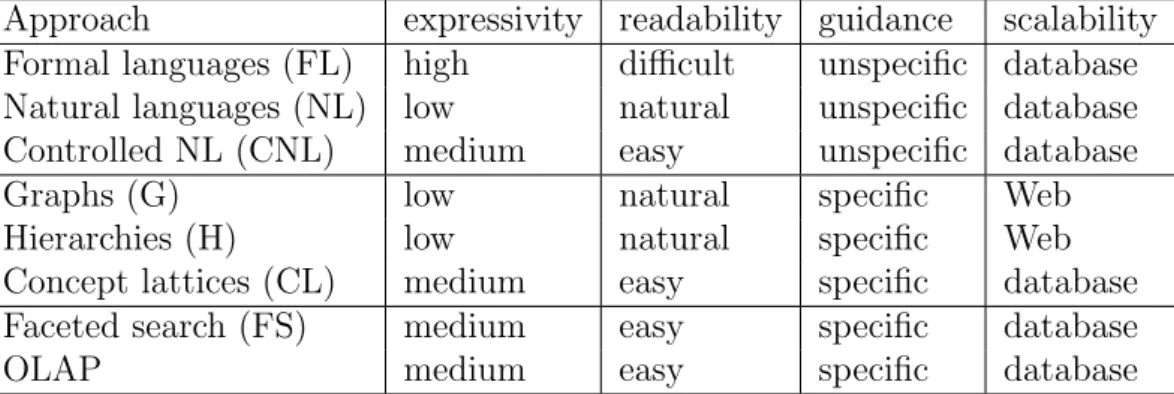
Table 1 summarizes the approaches presented above by comparing them w.r.t. our four main properties: expressivity, readability, guidance, and scal-ability. The objective here is not to make a precise and technical comparison between them, but rather to draw conclusions on how to combine them in order to add their strengths. We have adopted for each property a coarse scale that ignores many details, but is sufficient to exhibit the strengths and weaknesses between approaches. For example, three levels of expressivity have been retained: low, medium, and high. In fact, even in a same ap-proach, different systems may have very different expressivity (e.g., CNL, FS). Furthermore, different systems may not be comparable in that each has features that the other misses (e.g., OLAP vs FS). FL exhibit the highest expressivity, and no other approach gets close to them. At the other end
Approach expressivity readability guidance scalability Formal languages (FL) high difficult unspecific database Natural languages (NL) low natural unspecific database
Controlled NL (CNL) medium easy unspecific database
Graphs (G) low natural specific Web
Hierarchies (H) low natural specific Web
Concept lattices (CL) medium easy specific database
Faceted search (FS) medium easy specific database
OLAP medium easy specific database
Table 1: Comparison of the different approaches to information access w.r.t. key properties.
of the scale, low expressivity concerns approaches where direct navigation in data is used (G, H), or where queries must belong to a fixed number of patterns (NL), or where the size of those patterns is bounded (NL). All other approaches allow for combinatorial queries, generally conjunctive queries, possibly with additional features (e.g., crossing relations in semantic FS, ag-gregations in OLAP, conjunctive queries in FCA), and are given a medium expressivity. CNL are scored higher than NL because their syntactic and semantic analysis is easier, which enables the combinatorial aspect.
Readability is qualified as natural when no user training is necessary and every user input is accepted, easy when some short training may be necessary and most people can manage to use it, and difficult when a longer training is necessary and only a few specialists can use it. Graphs, hierarchies, and NL are qualified as natural because they are already well-known by everybody. FL are obviously the most difficult to use approaches. Other approaches (CNL, CL, FS, OLAP) have precisely been designed to be easy to catch on, and offer a good usability.
Guidance comes in various forms, but can be classified in only two lev-els, depending on the specificity (and safeness) of the guidance. For query languages, only unspecific syntax-based and ontology-based guidance exists, and there is often no guidance at all. In other approaches, guidance is always available, and only leads to valid navigation places or views.
Scalability is tricky to compare between systems as different as a query engine and faceted search, and it does not play a crucial role in our anal-ysis. Therefore we simply discriminate between, on one hand, graphs and hierarchies that can work at Web-scale, and, on the other hand, other ap-proaches that can work at the scale of a large local database. Because of their dynamic computations of navigation links and view transformations during
interaction, FS, OLAP, and CL are more demanding in data access and com-putation, and are therefore more difficult to scale than query languages.
From Table 1, four classes of approaches can be identified with their strengths and weakness:
1. FL: formal languages offer the highest expressivity but the least usabil-ity;
2. NL/CNL: (controlled) natural languages offer a trade-off between ex-pressivity and readability;
3. G/H: explicit navigation structures are the most usable and scalable, but offer only low expressivity;
4. FS/OLAP/CL: interactive views offer a balance between expressivity and readability, plus specific guidance.
The classes FL and G/H are the more contrasted, and also the more widespread today. The class FS/OLAP/CL is the more balanced by com-bining medium expressivity, easy readability, and specific guidance. Those observations are made graphically visible in Figure 1. The approaches NL and CNL are displayed with dash-dot lines because they are respectively included in G/H and FS/OLAP/CL classes. That inclusion is mostly the consequence of our coarse scales, and NL/CNL remain the approaches of choice for reconciling expressivity and readability.
3
Main Contributions
From the beginning, our objective has been to reconcile querying and naviga-tion, i.e., to make querying more usable, or equivalently, to make navigation more expressive. Therefore, our work has concentrated on combining and increasing expressivity and guidance. However, we have also been concerned with readability that ought to be at least easy, and with scalability that should be similar to FS. Our contributions started with concept analysis (FCA), and then integrated principles from faceted search (FS), the Seman-tic Web (SW), OLAP, and controlled natural languages (CNL). The result is a quite diverse collection of theoretical results and softwares. In order to present a synthesized view over our main contributions, we introduce a gen-eral framework that encompasses them all: Abstract Conceptual Navigation (ACN). In Section 3.1, we first define ACN, and discuss how it integrates the three categories of information access discussed in Section 2(query lan-guages, navigation structures, and interactive views), and how it promotes
expressivity readability guidance scalability NL CNL FL G/H FS/OLAP/CL
Figure 1: Radial diagram comparing the different approaches.
the desired properties (expressivity, readability, guidance, and scalability). We then shortly describe our main contributions as different instances of the ACN framework. The last section, Section 3.7, describes Squall, a CNL for the Semantic Web that is so far only a partial instance of ACN, but that will help improve readability and expressivity in ACN.
3.1
Abstract Conceptual Navigation (ACN)
Abstract Conceptual Navigation (ACN) is analogous to an abstract class in object-oriented programming in that it is made of a number of components to be defined in order to build concrete information systems. ACN is useful as a general framework for reconciling expressivity and usability, but not as a concrete theory because no precise theoretical judgement can be made about it. We reuse the term Conceptual Navigation from FCA because the key idea is still to navigate from concept to concept, where each concept defines a navigation place, and where each concept is made of an extensional part, and an intensional part. The qualifier Abstract emphasizes the fact that those extensional and intensional parts can be very different from the object sets and attribute sets of FCA.
query
index
links
Knowledge
Base
concept
results
extension
intension
*
Figure 2: Schema showing the different components of Abstract Conceptual Navigation (ACN), and their interactions.
representation):
knowledge base (K) K is a knowledge base that contains the formal rep-resentation of facts, rules, ontological axioms, taxonomies, etc. Its content is constrained by the needs of the application, and the avail-ability of data and domain knowledge. It is an implicit parameter of all ACN operations defined below.
query language (Q) Q is a query language, i.e. a set of expressible queries. Here, query should be understood in a broad sense, and may include closed and open questions, analytical questions (OLAP), sets of key-words, folder paths, updates, commands, ontological assertions, etc. The current query characterizes the current concept, and is part of its intension.
extension (E and ext ∈ Q → E) E is the set of all possible extensions (a.k.a., query results), and ext is a mapping from queries to their ex-tension, given a knowledge base K. The query extension is any piece of data returned to users from the evaluation of the query. It can be a set of values, an answer list, a table, etc. For some queries, e.g. updates, the knowledge base may be modified as a side effect. The extension of the current query makes up the extension of the current concept. index (I and index ∈ Q × E → I) I is the set of all possible indexes over
the extension, and index is a mapping from queries and their extension to their index. An index is at the same time a summary over the
extension, and a set of query refinements. It is part of the intension of the current concept because it is made of query elements. Its role is to provide feedback and guidance.
links (links ∈ Q × E × I → 2Q) component links defines a set of navigation
links from the current query to neighbour queries. Links can be derived from any component of the current concept: the query, the extension, or the index.
The advantage and raison d’ˆetre of ACN is to subsume the three categories of information access discussed in Section 2: query languages, navigation structures, and interactive views.
• ACN as a query language. Q is the query language, and ext defines query results for each query. Indexes and links are void. For instance, SPARQL editors can be seen as partial ACN instances where the query language is SPARQL, and where extensions are tables of results or RDF graphs.
• ACN as a navigation structure. Navigation places are specified by queries in Q, and navigation links are given by the ACN compo-nent links. Extensions and indexes may be used to compute the links, and may be used to define the contents of navigation places. For in-stance, file system hierarchies can be seen as partial ACN instances where queries are directory paths, extensions are file lists, and naviga-tion links lead to children directories and the parent directory.
• ACN as an interactive view. For recall, interactive views follow the MVC architecture (model-view-controller). In ACN, the model is the knowledge base K. The view is the composition of a query, its exten-sion, and its index (an element of Q× E × I). The controller is made of the links, which are derived from the view contents. Each link acti-vation generates a new view by computing a new extension (ext) and a new index (index ) from the target query. For instance, faceted search can be seen as an ACN instance where a query is a set of facet-values, an extension is a selection of items, an index gives the frequency of facet-values among those items, and links allow the addition and re-moval of facet-values to the query.
On the positive side, ACN inherits expressivity from query languages, and guidance from navigation structures and interactive views, which achieves our main objective to reconcile expressivity and usability. However, it must be noted that the actual expressivity may be less than the expressivity of
the query language in the case where navigation links are not rich enough to reach all valid queries. Ideally, links should be both safe and complete. Safeness means that no navigation path leads to dead-ends (e.g., empty re-sults). Completeness means that every safe query can be reached through a finite navigation path. Safeness is important for the quality of guidance as it avoids users to “bump in the walls”, and completeness is important to leverage the expressivity of the query language. Therefore, a critical issue in ACN is the definition of links, and hence the definition of extensions and indexes because links are derived from them.
On the negative side, ACN inherits the un-readability of query languages, and the un-scalability of interactive views. Readability was not a big issue in our first work because the query language was simple enough, but be-came a bigger issue in more recent work with SPARQL-like expressivity. We have started addressing this issue with the help of CNLs (see Section 3.7). Scalability is the least addressed property in our work, but we have always excluded approaches that could not scale in principle (e.g., computing con-cept lattices), and strived to stick to linear-to-quadratic time complexities in the size of the dataset (e.g., number of objects in a collection).
3.2
Logical Concept Analysis (Camelis)
The first ACN instance is based on the theory of Logical Concept Analysis (LCA), and has been implemented as two systems, Camelis and LisFS, and three Web interfaces on top of them: Geolis, Abilis, Portalis (more de-tails below). We have introduced LCA [Ferr´e and Ridoux, 2000b, Ferr´e, 2002, Ferr´e and Ridoux, 2004] as a logical general-ization of FCA for the purpose of defining Logical Informa-tion Systems (LIS) [Ferr´e and Ridoux, 2000a, Ferr´e, 2002, Ferr´e and Ridoux, 2004, Ferr´e, 2009a]. LCA generalizes FCA by replacing sets of attributes, which are used for the representation of object descriptions and concept intents, by the formulas of ad-hoc logics. The benefit is a gain in expressivity when using concept lattices as navigation structures because this allows for more concepts and more links between concepts. Whereas FCA only offers binary attributes and conjunction, LCA can be plugged in with logics that offer valued attributes, patterns over values (e.g., intervals of dates, string patterns), disjunction, and nega-tion [Ferr´e and Ridoux, 2001b, Ferr´e, 2006]. To facilitate the design of new ad-hoc logics, we have built a rich toolbox of logic components, called logic functor [Ferr´e and Ridoux, 2001a, Ferr´e and Ridoux, 2006], that can be composed in a plug-and-play fashion, while automatically verifying that the composed logic satisfies properties that are necessary
for LIS (e.g., consistency and completeness of entailment). The notion of functor has been extended to LCA knowledge bases, logical contexts, to improve the efficiency of LIS [Ferr´e, 2009b].
A number of other generalizations of FCA have been pro-posed. Generalized FCA [Chaudron and Maille, 2000] and pattern struc-tures [Ganter and Kuznetsov, 2001] independently discovered the same core definitions. However, those approaches have sticked to the computation and display of concept lattices for data mining purposes, and have therefore been limited in terms of expressivity and scalability for navigation purposes. We have also pushed farther the generalization with generic pluggable imple-mentations and the toolbox of logic functors. This genericity allowed us to develop quickly new LIS applications with complex and very different logics (e.g., function/method type signatures in programming libraries with Soazig Bars [Bars et al., 2002], sequence motifs in bioinformatics with Ross D. King [Ferr´e and King, 2004], lexicalized grammars in linguistics with An-nie Foret [Foret and Ferr´e, 2010]).
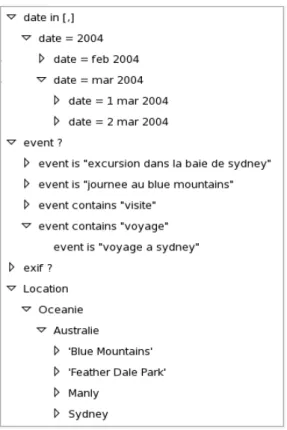
Computing and displaying concept lattices in FCA as navigation struc-tures does not scale well. This is even worse in LCA because a higher ex-pressivity implies a higher number of concepts. However, the concept lattice can still be used as a navigation structure by computing, on demand, links to neighbour concepts only. However, our experiments have shown that an interactive view is more readable than a large navigation structure, in which users can get lost. The user experience in interactive views is the building of more and more complex selections of objects, with a clear view of the current selection at each step. In our approach, the index shows every feature that occurs in the extension, and at which frequency (e.g., 50% of the photos in the extension are portraits). Moreover, the index can be organized and dis-played as a partial ordering according to logical entailment (e.g., all photos taken in France are also taken in Europe). The index provides understanding at a glance, and navigation through the selection of features.
Interestingly, other researchers converged to very similar ideas at about the same time: dynamic taxonomies [Sacco, 2000] and faceted search [Hearst et al., 2002] are closely related. Faceted search is more ad-vanced in terms of usability and scalability, and we are more adad-vanced in terms of expressivity and formalization. We made contributions to dy-namic taxonomies and faceted search by using logics for the design of tax-onomies [Ferr´e and Ridoux, 2007], and by allowing for more complex se-lections involving disjunction and negation [Ferr´e, 2008]. This led to a collaboration with G.M. Sacco and Y. Tzitzikas that resulted in the edi-tion of a book [Sacco and Tzitzikas, 2009], in which we contributed to five chapters.
We now sketch a formalization of LCA-based information sys-tems as an ACN instance. Full details are available in Ap-pendix A [Ferr´e and Ridoux, 2004] (for theoretical aspects) and Ap-pendixB [Ferr´e, 2009a] (for practical aspects).
knowledge base K = (O, L, d): a logical context, where: • O is a set of objects,
• L is a logic, defined as a set of formulas partially ordered by an entailment relationship v, called subsumption,
• d ∈ O → L is a mapping from objects to their logical description. query language Q =L: queries are logical formulas.
extension E = 2O and ext(q) = {o ∈ O | d(o) v q}: extensions are sets
of objects, and the results of a query are the objects whose description entails, i.e. “matches”, the query.
index I = (L → N) and index (q, e) = {x 7→ n | x ∈ Features(K) ⊆ L, n = #(e ∩ extent(x)) > 0}: the index of a query is the set of features x that are “matched” by a number n > 0 of query results. Given a context K, the features are automatically extracted from object descriptions (indexation), and can also be manually specified by users. links links(q, e, i) = {q and x | (x 7→ n) ∈ i} ∪ . . .: the main links consist in conjuncting the query with a feature from the index. Other links enable to reset the query, remove some feature from the query, or to introduce disjunctions and negations of features in the query.
LCA-based information systems were first implemented as a standalone application, Camelis7. It was first implemented in
λProlog [Miller and Nadathur, 1986, Belleann´ee et al., 1999] in 1999, and then re-implemented in OCaml [Chailloux et al., 2000] in 2002. At the beginning, it had a command-line interface that reused the cd/ls paradigm of UNIX file systems. In 2005, it was equipped with a GUI that offered richer visualizations, and better usability. Since then, I have been using it for various purposes (e.g., bibliography, personal photos, homedir files), and it has also been used by other members of the LIS team and beyond (e.g., program execution traces, linguistic data, mushrooms, birds, calls for papers). The efficiency of Camelis was progressively increased, and can
now manage logical contexts up to 10 million object×feature, e.g. 100,000 objects with 100 descriptors each.
The second implementation, LisFS (Logical File Sys-tem) [Padioleau and Ridoux, 2003], was developped by Yoann Padi-oleau during his PhD [Padioleau, 2005]. The originality of LisFS is that it is implemented as a real Linux file system, behind the VFS (Virtual File System) interface. This implies that the standard cd/ls shell commands behave according to LIS principles, and not accord-ing to the classical hand-made folder hiearchy. For example, a file path can be /author:Padioleau/author:Ridoux/title:"A Logic File System"/year:2003/PadRid2003.pdf, where directory names are object descriptors, whose order is not relevant. A directory path represents a query, subdirectories correspond to index elements and navigation links, and local files are the objects in the extension that do not belong to subdirectories. For example, from the directory /title:*Logic*/year:>2000/ (i.e., files whose title contains “Logic”, and whose year is after 2000), some valid subdirectories are author:Padioleau, year:2003, title:*File*. LisFS was also extended in order to refine the granularity from files to lines of textual files [Padioleau and Ridoux, 2005]. This was applied to the browsing of source code, e.g., selecting method definitions with a given class in their signature.
Geolis [Bedel et al., 2006][Bedel et al., 2008b, Bedel et al., 2012] is a Web interface working on top of LisFS, and was developped by Olivier Bedel during his PhD [Bedel, 2009]. It extends LisFS as a Geographical Information System (GIS) in order to browse geographical data. New logic components were designed to represent spatial geometries (e.g., points, lines, polygons), and the objects of the extension are displayed on a map instead of as a list. When index features are spatial geometries themselves, they are displayed on the map and can be selected to refine the selection, like any other feature. Like for date intervals or string patterns, custom geometries can also be drawn on the map for refining the query, and the index and navigation links can still be computed by the system afterwards. The main contribution of Geolis w.r.t. other GIS is to abstract over the distinctions that are usually made between the different layers on one hand (e.g., water layer, building layer), and between geographical data and thematic data on the other hand. Indeed, each layer is simply represented as a descriptor for its objects, and geographical/thematic data simply use different logics for their representation. This abstraction allows for a more flexible and more uniform exploration of geographical data. Another contribution is the first introduc-tion of relaintroduc-tionships between objects in a LIS system [Bedel et al., 2008a], which were used for the representation of Euclidian and topological relations