HAL Id: tel-01751142
https://hal.univ-lorraine.fr/tel-01751142
Submitted on 29 Mar 2018
HAL is a multi-disciplinary open access
archive for the deposit and dissemination of sci-entific research documents, whether they are pub-lished or not. The documents may come from teaching and research institutions in France or abroad, or from public or private research centers.
L’archive ouverte pluridisciplinaire HAL, est destinée au dépôt et à la diffusion de documents scientifiques de niveau recherche, publiés ou non, émanant des établissements d’enseignement et de recherche français ou étrangers, des laboratoires publics ou privés.
Formal verification of advanced families of security
protocols : E-voting and APIs
Cyrille Wiedling
To cite this version:
Cyrille Wiedling. Formal verification of advanced families of security protocols : E-voting and APIs. Other [cs.OH]. Université de Lorraine, 2014. English. �NNT : 2014LORR0199�. �tel-01751142�
AVERTISSEMENT
Ce document est le fruit d'un long travail approuvé par le jury de
soutenance et mis à disposition de l'ensemble de la
communauté universitaire élargie.
Il est soumis à la propriété intellectuelle de l'auteur. Ceci
implique une obligation de citation et de référencement lors de
l’utilisation de ce document.
D'autre part, toute contrefaçon, plagiat, reproduction illicite
encourt une poursuite pénale.
Contact : [email protected]
LIENS
Code de la Propriété Intellectuelle. articles L 122. 4
Code de la Propriété Intellectuelle. articles L 335.2- L 335.10
http://www.cfcopies.com/V2/leg/leg_droi.php
´
Ecole doctorale IAEM Lorraine
Formal Verification of Advanced
Families of Security Protocols:
E-Voting and APIs
TH`
ESE
pr´esent´ee et soutenue publiquement le 21 Novembre 2014 pour l’obtention du
Doctorat de l’Universit´
e de Lorraine
(mention informatique) par
Cyrille Wiedling
Composition du jury
Pr´esident : Fr´ed´eric Cuppens T´el´ecom Bretagne, Brest.
Rapporteurs : Bruno Blanchet INRIA, Paris.
Cas Cremers Universit´e d’Oxford, Oxford.
Examinateurs : V´eronique Cortier CNRS, Nancy.
Ralf K¨usters Universit´e de Tr`eves, Tr`eves.
Yassine Lakhnech Universit´e Joseph Fourier, Grenoble. Pierre-Etienne Moreau Universit´e de Lorraine, Nancy.
Benjamin Morin ANSSI, Paris.
Remerciements
“You’re only given one little spark of madness. You mustn’t lose it.” Robin Williams
En tout premier lieu, j’aimerai remercier tous les membres du jury. Un grand merci à Bruno Blanchet et Cas Cremers d’avoir accepté cette lourde tâche d’être rapporteurs et pour leur relecture attentive de ce manuscrit. Merci également à Ralf Küsters, Yassine Lakhnech et Benjamin Morin pour avoir accepté de participer à ce jury, et à Frédéric Cuppens pour l’avoir présidé. Je remercie également Pierre-Etienne Moreau pour avoir été un référent consciencieux pendant ces trois années. Enfin, je remercie Véronique Cortier, ma directrice de thèse, pour m’avoir fait découvrir la recherche lors de mon stage de Master et pour avoir fait de ces trois an-nées de thèse, une expérience enrichissante, autant sur le plan scientifique que sur le plan humain; pour son soutien (probablement monnayé contre quelques gâteaux au chocolat), sa disponibilité et ses conseils; et, surtout, je salue son courage pour avoir, sans faillir, relu en détails de longues preuves jusqu’à ce que celles-ci soient parfaites.
Je tiens également à remercier l’ensemble de mes camarades de l’équipe CASSIS du LO-RIAà Nancy. Un remerciement particulier à Abdessamad IMINE, qui a été mon tuteur pour mon premier stage de Master. Merci à toute l’équipe pour l’ambiance et la bonne humeur qui rendaient le travail plus qu’agréable. Je remercie également Martine, pour son efficacité red-outable sur toutes mes questions administratives. Un merci particulier à l’ensemble de mes cobureaux : Mounira, Mathilde, Malika, David et Eric, avec lesquels il y avait toujours matière à se détendre lorsque cela devenait nécessaire et qui ont du composer avecmon goût prononcé pour le frais. Un merci particulier pour Eric qui m’a fait découvrir le Shogi, même si je n’ai pas été un élève très assidu; et pour Ludovic qui, je le sais, me remplacera avec brio en tant que Maître-Pâtissier de l’équipe. (Pour la plus grande joie de Véronique !)
Je voudrais aussi remercier mes amis, qui, même s’ils n’ont pas directement contribués à cette thèse, ont été un soutien moral important durant ces trois années. Merci à Anne pour avoir été une oreille attentive et avoir accepté de tenir compagnie à Réglisse lorsque je devais m’absenter à l’étranger. Merci à Mathieu, Jérôme et Arnaud, trio inspérable depuis la fac malgré la dis-tance, pour nos soirées jeux de plateau et cette bulle d’air quasi-hebdomadaire. Un grand merci à Aurélie dont la relecture impitoyable d’une partie de ce manuscrit m’aura évité bon nombre de typos. Et, même si elle ne le lira probablement jamais, un merci à Réglisse, qui, malgré son comportement ronchon et parfois agaçant, a éclairé bon nombre de mes soirées.
Enfin, je terminerais simplement en remerciant mes parents et mes grands-parents, pour leur soutien constant, leur indéfectible confiance, et ce malgré les centaines de kilomètres qui nous séparent. C’est aussi grâce à eux que j’en suis ici aujourd’hui et je leur dédie ce manuscrit.
Contents
Introduction 9 1 Cryptographic Protocols. . . 10 1.1 Cryptography . . . 10 1.2 Protocols . . . 11 2 Electronic Voting. . . 11 2.1 E-Voting Protocols. . . 11 2.2 Security Properties . . . 12 2.3 Attacks . . . 13 2.4 Existing Protocols . . . 133 Application Programming Interfaces . . . 15
3.1 Security APIs . . . 15
3.2 Existing Designs . . . 16
4 Analysis of Cryptographic Protocols . . . 17
4.1 Existing Models . . . 17
4.2 Existing Results . . . 18
4.3 Limitations . . . 19
5 Contributions. . . 19
5.1 Formal Analysis of E-Voting Protocols. . . 19
5.2 A Secure API with Revocation . . . 20
5.3 Type-Systems for Verification of E-Voting Protocols . . . 20
5.4 Research Publications . . . 20
I Formal Analysis of E-Voting Protocols 21 1 Applied Pi-Calculus 23 1.1 Terms . . . 23
1.2 Rewriting System . . . 24
1.4 Operational Semantics. . . 26
1.5 Equivalences . . . 26
1.6 A Detailed Example . . . 28
2 Norwegian E-Voting Protocol 31 2.1 The Norwegian E-Voting Protocol . . . 32
2.1.1 Setting Phase . . . 32
2.1.2 Submission Phase . . . 32
2.1.3 Counting Phase . . . 34
2.2 Modeling the Norwegian Protocol . . . 34
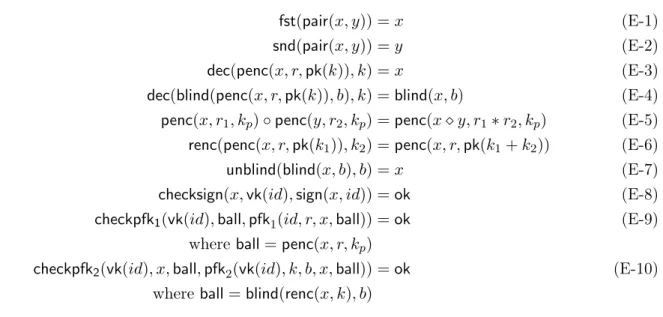
2.2.1 Equational Theory . . . 34
2.2.2 Norwegian Protocol Process Specification . . . 36
2.3 Formal Analysis of Ballot Secrecy . . . 39
2.3.1 Corrupted Ballot Box and Corrupted Voters . . . 40
2.3.2 Honest Authorities and Corrupted Voters . . . 41
2.3.3 Attacks . . . 43
2.4 Lemmas for Static Equivalence . . . 43
2.4.1 Generic Lemmas . . . 44
2.4.2 A More Specific Lemma . . . 47
2.5 Defining a Relation R . . . 51
2.5.1 Partial Evolutions . . . 51
2.5.2 Proof of Observational Equivalence, Assuming Static Equivalence . . 57
2.6 Static Equivalence of the Final Frame . . . 61
2.7 Further Corruption Cases Using ProVerif . . . 62
2.8 Conclusion . . . 63
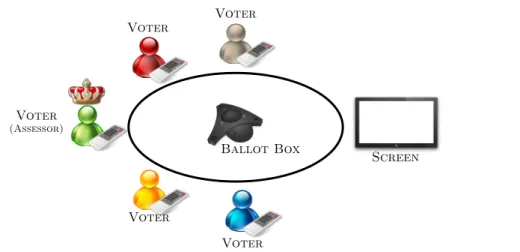
3 CNRS Boardroom Voting Protocol 65 3.1 Context . . . 66
3.2 Face-to-face Voting System . . . 67
3.2.1 Initial System F2FV1 . . . 68
3.2.2 Second System F2FV2 . . . 69
3.2.3 Third System F2FV3 . . . 70
3.2.4 Common Weaknesses . . . 70
3.3 Modeling the Protocols . . . 71
3.3.1 Equational Theory . . . 71
3.3.2 Modeling the Protocols in Applied Pi-calculus . . . 71
3.4.1 Results . . . 73
3.4.2 Proving Ballot Secrecy . . . 74
3.5 Vote Correctness . . . 79
3.5.1 Definition . . . 79
3.5.2 Results . . . 80
3.5.3 Proof of Correctness . . . 80
3.6 Summary & Discussion . . . 83
II Formal Analysis of APIs 85 4 Revocation API for Symmetric Keys 87 4.1 Revocation API Design Issues . . . 88
4.1.1 Background. . . 88
4.1.2 Revocation Issues . . . 89
4.2 Description of the API. . . 91
4.2.1 Setting . . . 91
4.2.2 Commands . . . 92
4.2.3 Management of Revocation Keys . . . 94
4.2.4 Management of Working Keys . . . 94
4.2.5 Example . . . 97 4.2.6 Threat Scenario . . . 97 4.3 Formal Model . . . 98 4.3.1 Syntax . . . 98 4.3.2 Semantics . . . 99 4.3.3 Example . . . 101
4.4 Security Properties of the Design . . . 101
4.4.1 Initial State . . . 102
4.4.2 Keys of Level Max . . . 102
4.4.3 Lower Level Keys . . . 106
4.4.4 Main Results . . . 110
4.4.5 Application . . . 117
4.5 Implementation in Java Card . . . 118
4.5.1 A Few Words about Java Card . . . 118
4.5.2 The Settings . . . 118
4.5.3 The Commands . . . 118
III Type-Systems for Proof-Automation 121
5 Automated Analysis of Ballot-Secrecy through Typing 123
5.1 The rF? Type-System . . . 124
5.1.1 Syntax . . . 124
5.1.2 Typing . . . 124
5.1.3 Soundness . . . 125
5.2 Presentation of Helios . . . 126
5.2.1 Settings: Creation of an Election . . . 126
5.2.2 Submission Phase . . . 126
5.2.3 Counting Phase . . . 126
5.3 Modeling Helios in rF? . . . 126
5.3.1 The Protocol . . . 127
5.3.2 Honest Voters: Alice (and Bob) . . . 127
5.3.3 The Ballot Box. . . 128
5.4 Specifying the Cryptographic Interface. . . 129
5.4.1 Encryption Function. . . 130
5.4.2 Zero-Knowledge Proofs . . . 131
5.4.3 Homomorphic Property . . . 132
5.4.4 Decryption Function. . . 133
5.4.5 Assumptions . . . 133
5.5 Results & Conclusion . . . 133
5.5.1 Future Work . . . 133
Conclusion & Perspectives 135 IV Appendix 137 A Norwegian E-Voting Protocol: Lemmas for Static Equivalence 139 A.1 Notations . . . 139
A.2 Starting Lemmas . . . 140
A.3 Base Case for Static Equivalence . . . 141
A.4 Additional Lemmas . . . 144
A.5 Shape of Valid Ballots . . . 145
B Long Abstract - Résumé de la thèse 157
B.1 Introduction . . . 157
B.1.1 Protocoles cryptographiques . . . 157
B.1.2 Vote électronique . . . 158
B.1.3 API . . . 160
B.1.4 Analyse de protocoles cryptographiques . . . 161
B.1.5 Contributions et publications . . . 162
B.2 Analyse formelle de protocoles de vote électronique. . . 163
B.2.1 Protocole de vote norvégien . . . 163
B.2.2 Protocole de vote en réunion du CNRS . . . 164
B.3 Analyse formelle d’API . . . 165
B.4 Automatisation de preuves avec les systèmes de types . . . 165
B.5 Conclusion . . . 166
Introduction
“The multiple human needs and desires that demand privacy among two or more people in the midst of social life must inevitably lead to cryptology wherever men thrive and wherever they write.” David Kahn – The Codebreakers
For several decades, IT has gained a prominent place in most domains of our society and especially in our communications. Computers, smartphones or electronic tablets have become essential intermediates allowing people to overcome thousands miles of distance to talk to each other or to gain time by performing administrative procedures online without having to queue in official buildings. They also tend to replace human interaction in quite sensitive operations like bank transfers or payments. Whether by their speed, ease of use, or the fact that they allow people to stay connected to the whole world regardless of where they are, these devices have become, sometimes without questioning, true confidants entrusted with secrets such as bank account numbers, credit card information, private details, etc.
But even if this technology is well known for many years by the public, people are not always aware of the risks. One of them is identity theft. In France, according to a CREDOC study1 in 2009, the number of reported identity thefts was about 250 thousands (overcoming the number of robberies by more that 25%). It mainly relies on the possibility for a malicious person to retrieve personal and useful information about someone on numerous documents that could be thrown away without precautions. Thus, although this problem is not inherent to this new technology, the increasing number of official documents, banking or personal information, sent over the Internet provides new opportunities for malicious individuals to achieve their purposes. Indeed, the CIFAS2, the UK’s Fraud Prevention Service, reports an always-increasing number of identity frauds from 2007 to 2012. It also gives a lot of advices to avoid these thefts and most of them concern electronic matters: limitation of private data published on social networks, protection of computers against viruses and malwares, etc.
These threats raise some questions: How do these systems work? How are they secured against potential attacks? How can we trust the security guarantees claimed by the system? To ensure privacy and security over the different networks, devices use cryptographic protocols (or security protocols) which are programs designed to ensure the security of communications (like the secret of a private information), often involving, as the name says, cryptography. Of course, it is not enough to claim the security of such protocols and there is a crucial need of verifying them before using them. If one protocol is found to be flawed, it can have a substantial impact depending on where it is used. Moreover, flaws need to be patched, either, in the best case, by
1
A presentation of this report can be found athttp://protegezvotreidentite.files.wordpress.com/2009/
11/credoc-usurpation-didentite-en-france.pdf.
2
Encryp'on) Decryp'on)
Plaintext Ciphertext Plaintext
Symmetric : same shared secret key
Asymmetric : Pair of public/secret keys
Public Key Secret Key
Figure 1: Symmetric Vs. Asymmetric Encryption Schemes.
a software update, or, in the worst case, by replacing defective hardwares, implying money and time costs.
1
Cryptographic Protocols
In the physical world, safely exchanging information between two or more participants requires particular layouts such as sealed envelopes, padlocked boxes or soundproof rooms. When it comes to the digital world, we use cryptographic protocols to ensure the security of our communications.
1.1 Cryptography
Based on two millennia of history and practice, cryptography aims at designing schemes which allow to hide, and therefore protect, some information from an adversary. Starting with Caesar and his first mono-alphabetical transposition (called Caeser’s cipher ), it has evolved along with technology, using the best of it, often for military purposes like the Enigma Machine during World War II. Nowadays, cryptography is not limited to military uses as the public needs for privacy and confidentiality make it essential for almost everyone around the globe.
Encryption schemes are functions, typically relying on a key k, designed to modify a plaintext into a ciphertext in such a way that it is not possible to retrieve the former using the latter without knowing the key. There are two main types of them: symmetric and asymmetric (see Fig.1). Symmetric schemes are designed in a way that the same key k is used for encryption (modification of the plaintext into a ciphertext) and decryption (reverse operation). DES (Data Encryption Standard), invented in 1977, and its successor, AES (Advanced Encryption Standard), are the most common symmetric schemes. On the asymmetric side, schemes involves a pair of public and secret keys. The public one, known by everyone on the network is used for encryption while the secret one, known only by its owner, is used for decryption. RSA (for Rivest, Shamir and Adlemann, its creators) is a widely used asymmetric scheme since 1978.
Curious readers may refer to the books of B. Schneier [Sch95] and D. Kahn [Kah96] for, respectively, a better overview of the different cryptographic schemes that have been or are currently used and a more detailed history of the early ages of this ever-changing science.
2. Electronic Voting
1.2 Protocols
Through decades, cryptographers worked hard to shape a perfect (i.e. unbreakable) crypto-graphic algorithm. But even if such algorithm may exist, that would not guarantee security in communications once and for all. Cryptography is merely a tool that needs to be used correctly to provide security. A protocol is a kind of manual that describes the way cryptographic algo-rithms should be used in order to get a specific task done. In communications, it is a set of operations designed, for example, to authenticate users together, to establish a secure channel over an insecure one, etc. Obviously, there are different protocols for each different goal and often several protocols proposed for each particular task (for efficiency, server load optimization, mem-ory issues, etc.). Once again, curious readers may refer to [Sch95] for detailed examples. In this thesis, we are going to focus on two specific families of cryptographic protocols: electronic-voting protocols and APIs.
2
Electronic Voting
Voting is not a benign action. It often allows people to elect their representatives, expressing the fundamental principle of a republic. Elections can have serious political and economical impacts and, therefore, there is a crucial need to ensure security of the whole process, allowing people to express their own choices without any pressure, threats or risk of retaliation. In that way, paper-voting, using paper ballots, enveloppes and transparent ballot boxes, is one of the most secure system that can be used to provide strong guarantees to voters but it also have some drawbacks especially in the counting phase. Thus, a question raises: can we use current technology to upgrade this voting process and make it better, faster, stronger?
2.1 E-Voting Protocols
That question already raised about hundred years ago when the first lever-voting machines were introduced in the United States around 1990 [JS12]. These mechanical devices were designed to replace paper-ballot voting and speeding up both voting and counting processes. But these machines were also easy to tamper with, since the inner-mechanic could be modified by a spe-cialist without arousing suspicion. More recently, mechanical technology has been replaced with electronic means with the first EVMs (Electronic Voting Machine) used in elections in 1996 in the United States. During the two last decades, electronic voting (or e-voting) spread out around the world, first with only EVMs and, in 2005, Estonia became the first country to offer Internet voting nationally in local elections.
There are two big families of voting protocols: direct-recording voting and remote e-voting. The former is physically supervised by representatives of governmental or independent electoral authorities directly in a polling station. The latter allows voters to vote from basically everywhere in the world, as soon as they get a connexion to the Internet through a computer. This thesis mainly focuses on remote e-voting protocols. To have some insights on how these protocols work, let us consider some small toy example. During the voting phase, voters cast their votes to the ballot box through their web-browsers after encrypting them using the public key of the election. Once this phase is closed, the ballot box (basically a program running on a server) decrypts the ballots using the secret key and publishes the results publicly. We can also describe this protocol in terms of exchange of messages between the participants (see Fig.2) to describe more precisely what is sent over the network during the execution of the protocol:
V1 (id1,{v1}pk) −−−−−−−! B .. . Vj (idj,{vj}pk) −−−−−−−! B .. . Vn (idn,{vn}pk) −−−−−−−! B B −−−−−−−−−!(vσ(1),...,vσ(n))
Figure 2: Messages Exchange in Etoy.
here the ballot box receives all pairs corresponding to all voters’ ballots and then publishes the outcome which is a permutation of all decrypted ciphertexts.
Even if this toy-example looks quite simple, the principle of having a “black-box” collecting all different votes from players and then decrypting and publishing the outcome of the election is close to the current systems in use in France. Of course, such design provides very few guarantees in terms of security because the ballot box needs to be trusted to ensure anything. That is why several e-voting designs involves different election authorities with specific roles (collecting votes, decrypting votes, etc.) to weaken trust hypotheses.
2.2 Security Properties
E-voting protocols are designed to provide the same security as paper-ballot voting and the range of the security properties granted by the latter is large. During the analysis of a protocol, one major difficulty is to properly define which property will be proven. This section provides an overview of different security properties that are relevant in the e-voting field.
The first property reflects the major and must-have security guarantee someone should pro-vide in any e-voting protocol: the absence of capabilities, for a malicious person, to discover how a person voted during an election. It is called ballot-secrecy. A formal definition of this property, based on equivalences, has been given in [DKR09]. Intuitively, it considers two executions of the protocol where two honest voters swap their votes. If an adversary cannot make a differ-ence between the two executions, then, the protocol satisfies ballot-secrecy. Other definitions of ballot-secrecy exist, in different models, and have been used [KTV11, BPW12] for protocol analysis. In this thesis, the definition of [DKR09] will be retained.
Two enhancements of this property are receipt-freeness [DKR09] and coercion-resistance [ALBD04, DKR09]. While the former refers to the absence of possibilities, for the voter, to prove how he voted during the election, the latter denotes the inability, of a malicious person, to perform vote-buying or to threaten people in order to make them vote a specific option. In [DKR09], these three notions are shown to be related; coercion-resistance implies receipt-freeness which itself implies ballot-secrecy. In a more quantitative setting, [KTV11] shows that these im-plications do not necessarily hold.
Other security properties are desirable like verifiability and accountability. There exist several kind of verifiability. Individual verifiability states that a voter is able to check that his own ballot has been correctly included in the list of counted ballots; universal verifiability corresponds to the
2. Electronic Voting fact that everyone can check if the result of the election corresponds to all the ballots submitted by the voters. Formal definitions of these properties can be found in [KRS10] and [KTV11]. Eligibility verifiability [FOO92, JLY98] denotes the fact that only registered voters can vote in an election. Finally, accountability [KTV10] provides the possibility to detect misbehaviors and impute liability to the responsible election authority. Stronger that verifiability, accountability reports that something went wrong during the process but also points who is responsible. We can also mention correctness, introduced in [JCJ05], which refers to the fact that the published result corresponds to the (sum of) intended votes of the voters.
2.3 Attacks
An e-voting protocol often involves numerous cryptographic primitives but using cryptography does not mean it will lead to a safe protocol. For example, in our protocol Etoy we use an asymmetric encryption scheme to protect the voters’ votes but there is still a way for an attacker to break the ballot-secrecy property. Let us suppose, for simplicity, that we only have three voters, VA and VB, respectively Alice and Bob, two honest voters, and VC, Charlie, a malicious one whose goal is to know how the others voted. We will also suppose that Charlie has control of the network (this hypothesis is usual in protocol analysis).
The scenario of the attack is as follows. During the voting phase, Alice and Bob submit their ballots (idA, {vA}pk) and (idB, {vB}pk) respectively. Charlie, who is listening to the network will see these ballots without being able to decrypt them because he is not in possession of the secret key only held by the Ballot Box. But he can retrieve one ciphertext (either {vA}pk or {vB}pk) and use it as if it was his vote. Thus, by sending (idC, {vA}pk) to the Ballot Box, he would vote as Alice did. During the tallying phase, the Ballot Box will output the result {vA, vA, vB}, then Charlie will now that Alice voted for the candidate with two voices and Bob for the other one.
One can also note that this protocol does not provide any verifiability, since the ballot box behaves as a black box taking some ballots as inputs and returning the outcome of the election. There is no way to ensure, without trusting the ballot box, that the outcome corresponds to the submitted ballots sent by the voters. Nevertheless, this very basic attack illustrates that cryptography does not prevent attacks by itself. Moreover, the more complex is a protocol specification, the more difficult it is to see immediately if there are flaws. That explains why there is a real need of analyzing cryptographic protocols in order to ensure that they satisfy the desired security properties.
2.4 Existing Protocols
Since e-voting is a quite hot topic since around two decades, literature provides several proposi-tions of e-voting protocols. Based on different settings, they achieve different security properties. Here is a non-exhaustive list of existing e-voting protocols. We provide a small description of how they work and which security properties they provide.
FOO This is a scheme proposed in [FOO92]. It relies on two authorities: an administrator and a collector and requires blind signatures and zero-knowledge proofs. This protocol assumes anonymous channels between the voters and the collector. It is composed of four steps: a setup phase, a registration phase where each voter gets a token from the administrator (this step relies on the blind signature scheme), a voting phase where voters send their encrypted vote, including the token, to the collector and a counting phase where the collector decrypts, counts
and publishes the result. It has been showed to satisfy ballot-secrecy [KR05] and it claims individual verifiability but it is also vulnerable to some attacks [KR05].
Okamoto et al. This system [OMA+99] is based on the FOO protocol. It requires an admin-istrator, several mixers and talliers and is based on blind signatures and a threshold encryption scheme. The scheme is designed in three phases: during the registration, the voter prepares a ballot and gets an authorization from the administrator by obtaining a blind signature from the administrator. Then, during voting phase, the voter sends his ballot anonymously, using a mix-net. Finally, during the counting phase, talliers co-operatively open the ballots and count the votes. This protocol, widely inspired from FOO, is meant to satisfy the same security properties but suffers from the same attacks.
Civitas Inspired from a previous cryptographic voting scheme developed in [JCJ05], this pro-tocol is described in [CCM08]. It uses a public encryption scheme supporting homomorphic properties, random re-encryption and distributed decryption, but also requires distributed plain-text equivalence tests (PETs), non-interactive zero-knowledge proofs and mix networks. The protocol participants include a supervisor monitoring the election, a registrar and registration tellers respectively responsible of authorizing eligible voters to participate to the election and jointly creating credentials for them, and tabulation tellers which will jointly decrypt and publish the outcome of the election. It is one of the strongest systems in terms of security. Indeed, it provides coercion-resistance (implying ballot-secrecy), individual and universal verifiability. Helios & Belenios First web-based, open-audit voting system [Adi08], Helios involves an El-Gamal homomorphic encryption scheme which allows re-encryption, zero-knowledge proofs and mix networks. The architecture relies on a public ballot box displaying information on its content allowing verifications from voters who use their web browser to perform cryptographic operations. This protocol aims to ensure ballot-secrecy when the Helios server is trusted and is fully verifiable by anyone, but attacks has been discovered and fixed in [CS13]. Based on the Helios system, Belenios has been developed to provide a system achieving ballot-secrecy, verifiability (individual and universal) and correctness [CGGI13] when the latter was not provided by the Helios system. Caveat Coercitor This design [GRBR13] is mainly inspired from Civitas voting scheme and, therefore, it uses the cryptographic primitives involved in it and follows the same sequence of phases. Caveat Coercitor defines two new security properties coercion-evidence and coercer in-dependence. The former is performed against the bulletin board to accurately determine the degree of coercion that has taken place in any given run while the latter is the ability of the voter to follow the protocol without being detected by the coercer. These new security properties verified by Caveat Coercitor implies less trust assumptions than other remote e-voting schemes like Civitas or Helios.
As mentioned at the beginning of this chapter, there also exist e-voting protocols that are used, in opposition with remote e-voting, directly in the polling station. This kind of voting systems are not the focus of this thesis but are interesting too. Here are some examples of such protocols.
Prêt-à-Voter This protocol presented in [CRS05] uses paper-ballots with two different parts: a randomized candidates list and corresponding empty boxes with a printed unique ID depending
3. Application Programming Interfaces on the permutation of choices and a secure probabilistic encryption scheme. This protocol satisfies receipt-freeness (thus ballot-secrecy), individual and universal verifiability.
Three-Ballots This voting scheme is paper-ballot based [Riv06] and has the particularity to involve no cryptography to ensure security properties. Each voter receives a paper which contains three identical ballots except their unique ID code printed on the bottom. Intuitively, as the name refers to it, each voter submits three ballots. (Since the system is quite visual, a curious reader should definitely have a look to [Riv06] for a more detailed presentation.) Three-Ballots ensure coercion-resistance, individual and universal verifiability.
Scantegrity This protocol is an open source election verification technology [SFCC11] for optical scan voting systems. It uses confirmation numbers to allow each voter to verify her vote is counted. The confirmation numbers also allow anyone to verify that all the votes were counted correctly. Scantegrity ensures ballot-secrecy, individual and universal verifiability.
3
Application Programming Interfaces
With the evolution of technology, embedded systems have increased and, in an attempt for security when they are deployed in hostile environments, they often include a dedicated temper-resistant and secure hardware. This item handles all cryptographic operations and/or is meant to keep all the different keys secure. Such systems exist in our mobile phones or smartphones (SIM card or secure elements), transports ticketing systems (smart cards), ATMs, etc. But it is not enough to use such hardware, we also need an interface to securely access to it. That is the purpose of secure application programming interfaces (APIs).
3.1 Security APIs
A security API is designed to allow an untrusted machine, or program, to access a trusted device in a secure way. It can be seen as an interface between two entities with different levels of trust. Intuitively, it is the interface between a credit-card (smart-card), which is a trusted device, and the ATM, obviously untrusted, only allowing to perform operation if the correct PIN is entered; or the interface between a cryptographic hardware security module and the client machine where it will be plugged. As a protocol, the security API aims to achieve a goal, which is to enforce security properties, no matter what sequence of commands are called. Basically, a security API should prevent any leak of critical data.
Let us consider a toy example on a tamper-resistant device (TRD) designed to store key values, used for encryption and decryption. The TRD’s memory is represented by a table where each entry is labelled by a handle, which corresponds to the name of the entry, and contains a key value. Handles can be used by users to manipulate keys without knowing their actual value. For example, when a secure key is received (encrypted) by a token, it is stored inside the token and the user is only given a handle corresponding to that key. We consider the interface Atoy which allows a user to use two commands: encrypt and decrypt. As shown in Fig.3, the encryption call takes as arguments the data (a specified plaintext or a handle) that needs to be encrypted and the handle pointing to the key that must be used to perform the encryption. The decryption call works similarly with a ciphertext and a handle as arguments. Connecting the TRD to a host machine, a user can use the key stored inside the device to perform arbitrary encryptions and decryptions.
h
1h
2h
3 Host Machine Trusted DeviceA
toy
encrypt, , h2 encrypt, h1, h2Figure 3: The command encrypt of Atoy, an API example.
Security Properties Unlike e-voting protocols where security properties are well identified like ballot-secrecy and verifiability, APIs have, in terms of security, quite specific needs depending on the purpose of the interface itself. Basically, an API is often designed to prevent any key leakage from a given cryptographic token and this will correspond to a first security property. For each design, other properties may be defined depending on its specificities.
3.2 Existing Designs
Security APIs can be used in a very wide range of possibilities. There exist different academic examples, open standards and proprietary solutions. This section provides a non-exhaustive list of them:
• C. Cachin and N. Chandran designed [CC09] a cryptographic token interface that supports multiple users and provides operations for key generation, encryption, authentication, and key wrapping. Their model defines an Access Control List (ACL) for every key. They also show how to implement their token securely from a set of cryptographic primitives and prove that it respects the security policy expressed by the ACL.
• The IBM Common Cryptographic Architecture [IBM06] is a proprietary security API sup-ported by specific IBMs cryptographic coprocessors. It is widely used in ATM (cash ma-chines) networks since it provides several functions that are useful in the context of banking like encryption, decryption and verification of Personal Identification Numbers (PINs). • Trusted Platform Modules [Rya09] are hardware chips designed to store cryptographic
keys or sensitive date in a shielded memory. It also provides an API to allow softwares to use these stored information. TPMs are widely present in current computers, especially laptops of several well-known manufacturers and allow applications like full disk encryption or platforms integrity and authentication.
• The Public Key Cryptographic Standard #11 [Inc04] (PKCS#11, also known as “Cryp-toki”) is a platform-independent API designed for cryptographic tokens like smart-cards and Hardware Security Modules. It defines most commonly used cryptographic object
4. Analysis of Cryptographic Protocols types (RSA keys, Certificates, etc.) and all the functions needed to use, create/generate, modify and delete those objects.
Attacks Like other protocols, APIs are vulnerable to attacks. In a way, they may be more vulnerable since they only define the behavior of different functions where most of protocols specify the whole sequence of messages that will be exchanged during the execution. In the case of APIs, if a malicious user gets access to a secured device, he can use any sequence of any functions available in the interface. Thus, there is a need to ensure that it does not exist such sequence of commands that could lead to a violation of the desired security properties.
In the example of Atoy there is clearly an issue. Since there is no restriction on what can be encrypted or decrypted, we can easily construct a sequence of commands that would leak information on keys to any owner of a secure token. Indeed, a malicious user could just ask for an encryption of an handle by another, for example, (encrypt, h1, h2) and get an encryption C of the key stored in h1. Then, he would ask to decrypt this just-created ciphertext using the command (decrypt, C, h2) and get the key in clear.
Several attacks have been found on deployed APIs, mainly on implementations of PKCS#11 [Clu03,DKS08] since it is the most used and studied standard. More recently, R. Focardi and G. Steel developed a tool named Tookan [BCFS10] (TOOl for cryptoKi ANalysis) performing automated reverse-engineering of real cryptographic tokens implementing PKCS#11. On 18 studied tokens, 10 of them were found to be flawed while the 8 others were only working with really limited functionalities. Flaws have been also found on the IBM 4758 CCA. [BA01] shows that malicious users may get access to the PIN exploiting the properties of XOR operation.
4
Analysis of Cryptographic Protocols
As we have seen in previous sections, verifying protocols is crucial. To perform such analysis the first step is to represent the behavior of the system, including its environment and a potential attacker by a model.
4.1 Existing Models
There exist two different families of models. Computational models consider messages sent over the network as bitstrings. The attacker is abstracted as any probabilistic polynomial-time Turing machine and cryptographic primitives are represented by polynomial algorithms. The main advantage of computational models is that they give strong guarantees on security properties for the studied cryptographic protocols. On the other hand, proofs may be tedious and error prone, even if they have been some results leading to automation of computational verification like EasyCrypt [Com].
On the other side, there are the symbolic models. In those, messages sent over the network are abstracted by terms and cryptographic primitives are supposed perfect and modeled as function symbols. Then, the whole protocol is abstracted and the intruder’s capabilities are fixed by a set of rules. In some ways, symbolic models are much simpler that computational models, and, naturally, proving security properties in the former becomes simpler as well, often leading to possibilities of automation. The literature provides numerous symbolic models like strand spaces [THG99], constraint systems [MS01, CLS03] or Horn Clauses [Wei99, Bla01, CLC03]. Each model usually fits better for a specific application. A large part of this thesis is based on another symbolic model, the applied-pi calculus [AF01].
Abstractions made by symbolic models lead to weaker guarantees on security properties ver-ification than a computational model. Typically, the latter is more accurate, especially in terms of attacks found: if an attack in the symbolic model always has a counterpart in the computa-tional one, the opposite is not always true. Several works attempt to bridge the gap between the two universes and identify when security in symbolic models implies security in computational models [AR00,BDK07,CLC08] especially in order to keep simplicity of the symbolic approach while gaining accuracy of the computational one.
In this thesis, all the different analyses have been performed using the symbolic approach.
4.2 Existing Results
Even with some advantages over the computational model, the analysis of cryptographic protocols in the symbolic model remains a difficult problem. Verifying security properties quickly becomes undecidable [DLMS99]. Decidability results require to consider restrictions on the protocol or on the attacker. One of the most common restrictions consists in bounding the number of sessions. This is sufficient to restore decidability [RT01]. Further solutions consist in restraining the set of considered cryptographic primitives or in abstracting the model.
Trace Properties Several results in symbolic approach concern trace properties which are used to define security properties like secrecy or authentication. Intuitively, these security properties can be seen as a reachability problem, where the analysis reveals if an execution of the protocol may contradict the security property (e.g. a secret information is leaked). There exist several decidability results on trace properties. Different tools have also been developed to automatically analyze such properties like ProVerif [Bla01] based on Horn clauses. Although it may sometimes not terminate, this tool can handle unbounded number of sessions of protocols using a wide class of cryptographic primitives. Other tools perform automatized analyses of cryptographic protocols like AVISPA [Vig06], using the High-Level Protocol Specification HLPSL Language, or Scyther [Cre08] based on a pattern refinement algorithm, providing concise representations of (infinite) sets of traces.
Equivalence Properties Nevertheless, as mentioned in Section 2.2, e-voting security prop-erties are expressed through equivalence. For example, ballot-secrecy is defined by the ab-sence of difference between two executions of the protocol, formally defined as an observational equivalence. First decidability results for such properties come with [Hüt02] in the spi-calculus model. Decision procedures for trace equivalence with bounded number of sessions are shown in [Bau05,CD09] for a specific class of protocols (determinate protocols), or in [CR05] for specific class of primitives. More recent results [CCD13,CCD14] provide first decision procedures for an unbounded number of sessions for a large class of determinate protocols. Several tools have also been designed to automatically analyze equivalence-based properties like SPEC [TD10] based on the spi-calculus model, AKiSs [cC01] using Horn clauses for trace equivalence or APTE [Che14], that implements a complete and sound algorithm based on constraint systems. Moreover, al-though it was first designed for trace properties, ProVerif has also been extended to be able to deal with some equivalences [BAF08].
Analysis of APIs As we mentioned it in Section 3.2, security APIs have been shown to be vulnerable to attacks. The first security models emerged using the Dolev-Yao’s approach [CM06]. Typically “hand-made” from the API specification, they are written using Horn clauses or rewrit-ing rules, representrewrit-ing the APIs by an non-monotonic evolvrewrit-ing state. Findrewrit-ing an attack usually
5. Contributions consists in testing the reachability of specific state or derivability of a given secret. Such analysis can be automatized using model checkers or theorem provers [LR92, CKS07, KT08]. Never-theless, mechanized analysis of APIs still remains a difficult issue. For example, existing tools, using protocols analysis like ProVerif, are not working well with an unbounded number of keys. Different approaches still exist using Horn clause resolution like StatVerif [ARR11] or multiset rewriting rules like Tamarin [MSCB13] which is still in an early development stage.
4.3 Limitations
Despite all existing results and constant progresses in the domain of cryptographic protocols analysis, there are still some limitations, especially when it comes to e-voting schemes.
Voting Protocols In order to ensure security properties like ballot-secrecy or verifiability, remote e-voting protocols often involve several cryptographic primitives ranging from specific encryption schemes (homomorphic, distributed encryption) to malleable (or not) zero-knowledge proofs through signatures, mix networks and PETs. Even if these primitives can often be man-aged separately by tools like ProVerif, e-voting designs required the use of all these functions at the same time making things a lot more difficult because of all the different possible interactions. Thus, it is not rare that challenging automated tools with e-voting processes does not yield a successful result, implying that analysis of such protocols since remains to be done by hand. Security APIs Providing security analysis of APIs designs is often more complicated than for usual protocols. Indeed, the former typically consist in dozens of functions, which may be called in any order, while the latter usually present an exchange of half a dozen messages in a given order. Thus, the abstractions, search techniques and tools are different. Moreover, APIs commands often share the same cryptographic keys, which limits the possibility of analyzing the different commands in a modular way before composing the results. Finally, security APIs models include, in general, a global non-monotonic mutable state, which needs to be modeled with precision in order to get accurate results and avoid false attacks. Such models can be difficult to make using classical approaches of protocol analysis and, therefore, special approaches need to be developed for APIs analysis.
5
Contributions
This thesis is divided in three distinct parts. Part I presents formal studies of examples of electronic voting protocols, based on a symbolic analysis using the applied pi-calculus. Part II
is devoted to the presentation of a new design of security API, which supports a revocation functionality, for symmetric keys management. Finally, Part III describes a new method to apply type-systems in order to automate ballot-secrecy proofs for e-voting protocols. All the contributions of this thesis are detailed below.
5.1 Formal Analysis of E-Voting Protocols
In Chapter2, we discuss the security of the Norwegian internet voting protocol, which has been deployed in Norway and has been used for local elections in more that ten municipalities by around 70’000 voters. After a formal presentation of the protocol itself, we analyse its secu-rity through different corruption scenarios. This formal study is performed using the applied pi-calculus [AF01]. Thus, we first provide a complete modeling of the protocol in this syntax.
Then, we show that this specification of the Norwegian e-voting protocol satisfies ballot-secrecy, according to the definition given by [DKR09], in different corruption cases. Moreover, we com-plete this analysis by displaying some attacks on the protocol in particular corruption cases. At our knowledge, it is the first formal proof of security of this protocol.
In Chapter3, we provide a formal analysis of another protocol: the CNRS boardroom voting protocol. This is a voting protocol, which aims to ease the voting sessions during boardroom meetings. The interest of this system remains in its simplicity since it does not involve cryptog-raphy. Nevertheless, we prove that this protocol still can preserve ballot-secrecy and correctness. In this chapter, we provide three different implementations of this protocol and perform a full analysis, using the applied pi-calculus model, of them - regarding ballot-secrecy and correctness.
5.2 A Secure API with Revocation
In Chapter 4, we present a new design for security APIs, which includes a revocation func-tionality, for symmetric keys management. Building upon a previous work from G. Steel and V. Cortier [CS09], which do not support revocation, we propose a new set of commands that allow to manage symmetric keys and, especially, the possibility to revoke specific keys in the case where they may have been corrupted. In this chapter, we detail the requirements and the different commands of our API. Then, we describe the formal model we used to analyze this design, based on global states and transitions.
We provide a full formal study of our API, ensuring three different security properties. The first one states that the keys stored in the trusted devices remain secure even if the attacker manages to corrupt a few of them (e.g. using side-channels attacks). The second one implies that the overall system is able to repair itself after a certain time. Basically, even if an attacker manages to break into a device through a corrupted key, he will not be able to use it to gain more power in the device. Finally, we show how our revocation functionality helps to immediately secure devices against corrupted keys.
5.3 Type-Systems for Verification of E-Voting Protocols
The last chapter presents a new method for automatic verification of ballot-secrecy for electronic voting protocols. To conduct this approach, we based our work on a new type-system presented by C. Fournet and al. [BFG+14], rF?. Indeed, this type-system is able to tackle equivalence-based properties. Therefore, we propose, in this chapter, a formalization of ballot-secrecy equivalence-based on the type-checking approach. Moreover, we provide an example based on the Helios protocol. We describe how to implement this voting system into the rF? syntax, and we detail a crypto-graphic library to handle the primitives used in the Helios protocol, especially the homomorphic encryption property that is not well handled by tools like ProVerif [Bla01].
5.4 Research Publications
The contribution presented in Chapter 2, 3 and 4 have been published in proceedings of the following conferences POST’12 [CW12], Vote-ID’13 [ACW13] and CCS’12 [CSW12] respectively. They also represent joint work with Mathilde Arnaud (for the second article) and Graham Steel (for the third article). The third part has not been yet been published but is a still ongoing work in collaboration with Matteo Maffei, Fabienne Eigner and Steve Kremer.
Part I
Chapter 1
Applied Pi-Calculus
Contents 1.1 Terms . . . 23 1.2 Rewriting System . . . 24 1.3 Processes . . . 25 1.4 Operational Semantics . . . 26 1.5 Equivalences . . . 26 1.6 A Detailed Example . . . 28We describe here the applied pi-calculus [AF01], introduced by M. Abadi et C. Fournet. The applied pi-calculus is a process algebra that is often used to model protocols. In particular, Chapter2presents a formal model of the Norwegian protocol using the applied pi-calculus while we propose, in Chapter3, a model of the CNRS protocol. In this chapter, we briefly recall the notations and definitions of the applied pi-calculus, providing some examples.
1.1
Terms
Messages are represented by terms built upon an infinite set of names N (for communication channels or atomic data), a set of variables X and a signature Σ consisting of a finite set of function symbols (to represent cryptographic primitives). A function symbol f is assumed to be given with its arity ar(f ). Then, the set of terms T (Σ, X , N ) is formally defined by the following grammar: t, t1, t2, . . . ::= x x 2 X n n 2 N f (t1, . . . , tn) f 2 Σ, n = ar(f ) We write {M1/x 1, . . . , Mn/
xn} for the substitution that replaces the variables xi with the terms
Mi. N σ refers to the result of applying substitution σ to the free variables of the term N . A term is called ground when it does not contain variables.
In order to represent the properties of the primitives, the signature Σ is equipped with an equational theory E that is a set of equations which hold on terms built from the signature. We denote by =E the smallest equivalence relation induced by E, closed under application of
function symbols, substitutions of terms for variables and bijective renaming of names. We write M =E N when the equation M = N holds in the theory E.
Example 1. A possible signature for representing symmetric, asymmetric encryption and signa-ture is Σ = {checksign, dec, pdec, enc, penc, sign} where penc and pdec represent resp. asymmetric (randomized) encryption and decryption, enc and dec stand resp. for symmetric (randomized) encryption and decryption, sign models signature, and checksign a function to check the validity of signature. For example, the term enc(m, r, k) represents the symmetric encryption of the mes-sage m with the key k and random factor r. The properties of the cryptographic functions are represented by the following equational theory Eenc:
dec(enc(m, r, k), k) = m pdec(penc(m, r, pk(i)), sk(i)) = m checksign(sign(m, sk(i)), pk(i), m) = ok.
The first equation models that symmetric decryption is only successful if the key used for decryp-tion is the same as the one used for encrypdecryp-tion; the second equadecryp-tion reflects that asymmetric decryption only succeeds when the corresponding secret key is used; and finally, the last equation checks that a signature corresponds to a given message and a given verification key.
Some cryptographic primitives, like homomorphic encryption, need the use of associative and commutative symbols in order to be fully described. Equational theories including such symbols are called AC-theories. For them, we define an equality modulo AC, noted =AC, which denotes that two terms are syntactically equal modulo associative or commutative properties included in the equational theory.
Example 2. To represent the homomorphic encryption, we can use the signature Σ = {+, ⇤, enc} with + and ⇤ two associative and commutative (AC) symbols and the corresponding equational theory EAC which includes the associative and commutative properties of + and ⇤ symbols, and the following equation:
enc(m, k) ⇤ enc(n, k) = enc(m + n, k).
This equation denotes that two ciphertexts encrypted with the same key can be merged together to create a single ciphertext whose corresponding plaintext is the sum of the two previous plaintexts. In this example, we have that enc(m + n, k) =ACenc(n + m, k) and enc(m, k1) ⇤ enc(n, k2) =AC enc(n, k2) ⇤ enc(m, k1) but these two equalities only holds modulo AC.
1.2
Rewriting System
It might be difficult to work modulo an equational theory. Instead, it is often possible (and more convenient) to reason with a rewriting system. Formally, a rewriting system R, a set of rewriting rules of the form l ! r with l and r two terms. We say that a term s is rewritten in t for rule l ! r, noted s ! t, if there exists a position p in s and a substitution ✓ such that s|p = l✓ and t = s[r✓]p.
Definition 1.1 (Convergence). A rewriting system R is said convergent if:
• for every closed term U , there exists no infinite sequence U ! U1 ! · · · ! Uk! . . . . (In this case, we say that R is terminating.)
1.3. Processes P, Q, R ::= (plain) processes 0 null process P | Q parallel composition !P replication ⌫n.P name restriction
if φ then P else Q conditional
u(x).P message input
uhM i.P message output
A, B, C ::= extended processes
P plain process
A | B parallel composition
⌫n.A name restriction
⌫x.A variable restriction
{M/
x} active substitution
Figure 1.1: Syntax for processes
• for every closed terms U , U1, and U2 such that U !⇤ U1 and U !⇤ U2, there exists V such that U1!⇤V , and U2 ! V . (In this case, we say that R is confluent.)
Since it is impossible to associate a finite and convergent rewriting system to an equational theory including associative and commutative (AC) equations, we consider, for these AC-theories, a rewriting system modulo AC. A term s is rewritten modulo AC in t, noted s !AC t, for a rule l ! r if there exist s0 and t0 two terms such that s =AC s0, t =AC t0 and s0 is rewritten in t0 for the rule l ! r. Then, it is possible to define the notion of AC-convergence.
Definition 1.2 (AC-Convergence). A rewriting system R is said AC-convergent if:
• for every closed term U , there is no infinite sequence U !AC U1 !AC · · · !AC Uk. . . . (In this case, we say that R is AC-terminating.)
• for every closed terms U , U1, and U2 such that U !⇤AC U1 and U !⇤AC U2, there exists V such that U1!⇤ACV , and U2 !⇤AC V . (In this case, we say that R is AC-confluent.)
1.3
Processes
Processes and extended processes are defined in Figure 1.1. The process 0 represents the null process that does nothing. P | Q denotes the parallel composition of P with Q while !P denotes the unbounded replication of P (i.e. the unbounded parallel composition of P with itself). ⌫n.P creates a fresh name n and then behaves like P . The process if φ then P else Q behaves like P if φ holds and like Q otherwise. u(x).P inputs some message in the variable x on channel u and then behaves like P while uhM i.P outputs M on channel u and then behaves like P . We write ⌫ ˜u for the (possibly empty) series of pairwise-distinct binders ⌫u1. . . . .⌫un. The active substitution {M/
x} can replace the variable x for the term M in every process it comes into contact with and this behaviour can be controlled by restriction, in particular, the process ⌫x!{M/
x} | P" corresponds exactly to let x = M in P .
As in [CS13], we slightly extend the applied pi-calculus by letting conditional branches now depend on formulae φ, ::= M = N | M 6= N | φ ^ . If M and N are ground, we define
Par− 0 A ⌘ A | 0 Par-A A | (B | C) ⌘ (A | B) | C
Par-C A | B ⌘ B | A
Repl !P ⌘ P | !P
New− 0 ⌫n.0 ⌘ 0
New-C ⌫u.⌫w.A ⌘ ⌫w.⌫u.A
New-Par A | ⌫u.B ⌘ ⌫u.(A | B) if u 62 fv(A) [ fn(A)
Alias ⌫x.{M/
x} ⌘ 0
Subst {M/x} | A ⌘ {M/x} | A{M/x}
Rewrite {M/x} ⌘ {N/x} if M =E N
Figure 1.2: Structural equivalence.
JM = N K to be true if M =E N and false otherwise. The semantics of J K is then extended to formulae as expected.
The scope of names and variables is delimited by binders u(x) and ⌫u. Sets of bound names, bound variables, free names and free variables are respectively written bn(A), bv(A), fn(A) and fv(A). Occasionally, we write fn(M ) (respectively fv(M )) for the set of names (respectively variables) which appear in term M . An extended process is closed if all its variables are either bound or defined by an active substitution.
An context C[_] is an extended process with a hole instead of an extended process. We obtain C[A] as the result of filling C[_]’s hole with the extended process A. An evaluation context is a context whose hole is not in the scope of a replication, a conditional, an input or an output. A context C[_] closes A when C[A] is closed.
A frame is an extended process built up from the null process 0 and active substitutions composed by parallel composition and restriction. The domain of a frame ', denoted dom(') is the set of variables for which ' contains an active substitution {M/
x} such that x is not under restriction. Every extended process A can be mapped to a frame '(A) by replacing every plain process in A with 0.
1.4
Operational Semantics
The operational semantics of processes in the applied pi-calculus is defined by three relations: structural equivalence (⌘), internal reduction (!) and labelled reduction (!).↵
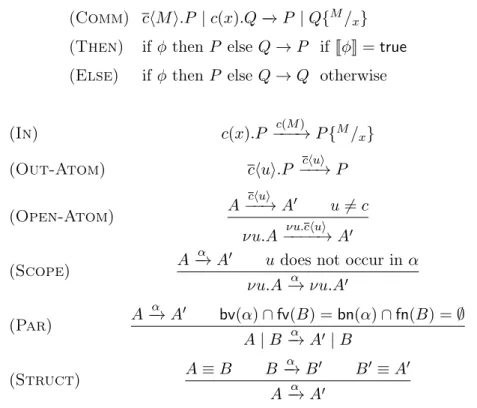
Structural equivalence is defined in Figure 1.2. It is closed by ↵-conversion of both bound names and bound variables, and closed under application of evaluation contexts. The internal reductions and labelled reductions are defined in Figure 1.3. They are closed under structural equivalence and application of evaluation contexts. Internal reductions represent evaluation of condition and internal communication between processes. Labelled reductions represent commu-nications with the environment.
1.5
Equivalences
Privacy properties are often stated as equivalence relations [DKR09]. Intuitively, if a protocol preserves ballot secrecy, an attacker should not be able to distinguish between a scenario where
1.5. Equivalences (Comm) chM i.P | c(x).Q −! P | Q{M/
x} (Then) if φ then P else Q ! P if JφK = true (Else) if φ then P else Q ! Q otherwise
(In) c(x).P −−−! P {c(M ) M/
x}
(Out-Atom) chui.P −−! Pchui
(Open-Atom) A chui −−! A0 u 6= c ⌫u.A−−−−! A⌫u.chui 0 (Scope) A ↵
−! A0 u does not occur in ↵ ⌫u.A−! ⌫u.A↵ 0 (Par) A ↵ −! A0 bv(↵) \ fv(B) = bn(↵) \ fn(B) = ; A | B −! A↵ 0| B (Struct) A ⌘ B B ↵ −! B0 B0 ⌘ A0 A−! A↵ 0
where ↵ is a label of the form c(M ), chui, or ⌫u.chui such that u is either a channel name or a variable of base type.
Figure 1.3: Semantics for processes
a voter votes 0 from a scenario where the voter votes 1. Static equivalence formally expresses indistinguishability of sequences of terms.
Definition 1.3 (Static equivalence). Two closed frames ' and are statically equivalent, denoted ' ⇡s , if dom(') = dom( ) and there exists a set of names ˜n and substitutions σ, ⌧ such that ' ⌘ ⌫ ˜n.σ and ⌘ ⌫ ˜n.⌧ and for all terms M, N such that ˜n \ (fn(M ) [ fn(N )) = ;, we have M σ =E N σ holds if and only if M ⌧ =E N ⌧ holds.
Two closed extended processes A, B are statically equivalent, written A ⇡sB, if their frames are statically equivalent; that is, '(A) ⇡s'(B).
Intuitively, two sequences of messages ' and are distinguishable to an attacker (i.e. they are not statically equivalent) if the attacker can build a public test M = N that holds for ' but not for (or the converse).
Example 3. Consider the signature and equational theory Eenc defined in Example1. Let '1= ⌫k.σ1and '2 = ⌫k.σ2 where σ1 = {penc(s1,r1,pk(k))/x1, pk(k)/x2}, σ2 = {penc(s2
,r2,pk(k))/
x1, pk(k)/x2}
and s1, s2, k are names. We have that '1 6⇡s '2. Indeed, we penc(s1, r1, x2)σ1 =E x1σ1 but penc(s1, r1, x2)σ26=E x1σ2.
Intuitively, since the randomness of the encryption is public, an attacker may reconstruct the ciphertexts and compare. The two messages become indistinguishable as soon as the randomness remain private. That is, we have that ⌫(k, r1).σ1⇡s⌫(k, r2).σ2.
Observational equivalence is the active counterpart of static equivalence, where the attacker can actively interact with the processes. The definition of observational equivalence requires
to reason about all contexts (i.e. all adversaries), which renders the proofs difficult. Since observational equivalence has been shown to coincide [AF01, Liu11] with labelled bisimilarity, we adopt the latter in this part.
Definition 1.4 (Labelled bisimilarity). Labelled bisimilarity (⇡l) is the largest symmetric rela-tion R on closed extended processes such that ARB implies:
1. A ⇡s B;
2. if A −! A0, then B −!⇤ B0 and A0RB0 for some B0;
3. if A −! A↵ 0 such that fv(↵) ✓ dom(A) and bn(↵) \ fn(B) = ;, then B −!⇤ ↵−!−!⇤ B0 and A0RB0 for some B0.
Intuitively, two processes A and B are labelled bisimilar if, anyhow the process A (resp. B) behaves, the process B (resp. A) may behave with the same visible actions and such that their resulting frames are statically equivalent, that is, an attacker cannot distinguish between them.
1.6
A Detailed Example
We provide a detailed example to illustrate the syntax and semantics of the applied pi-calculus. Readers already familiar with this formalism may skip this section. Let us consider a simple protocol proposed (for illustration purposes) by B. Blanchet [Bla08].
Alice {sign(k,skA)}pkB −−−−−−−−−−! Bob {s}k −−−−−−−−−−
In this protocol, Alice sends a newly generated and signed key k to Bob, the whole message encrypted using his public key pkB. Then, the receiver (Bob) is able to check that the signature belongs to the intended sender (Alice). He then encrypts a fresh secret s with k using symmetric encryption and sends it to Alice.
To model this protocol in applied-pi calculus, we use the equational theory Eenc described in Example 1 that models the properties of the different primitives used in the protocol. The behavior of the sender and receiver are modeled in the applied pi-calculus as follows.
A := ⌫k . ⌫ra . chpenc(sign(k, sk(a)), ra, pkB)i . c(x1) B(s) := c(x2) . B0(s)
B0(s) := let y = pdec(x2, sk(b)) in
if checksign(y, pkA) = ok then B00(s) B00(s) := ⌫rb . chenc(s, rb, k)i
In these processes, a and b are secret values that correspond to the private key pair of Alice and Bob, respectively. Since Alice should not have a direct access to b, the secret key of Bob, A is given access to Bob’s public key through a variable pkB and similarly for B. The whole protocol can be easily expressed using Alice and Bob processes:
P (s) := ⌫(a, b) . [A | B(s) | Γ] where Γ =#pk(a)/pkB,
pk(b)/
pkB . As mentioned above, a and b are protected but since pk(a) and
1.6. A Detailed Example (including the attacker). We first illustrate the semantics of the internal reductions by simulating the normal execution of the protocol, without any interference.
P (s)−−−−−−! ⌫(a, b, k, r(COMM) a). h c(x1) | B0(s) | n penc(sign(k,sk(a)),ra,pkB)/ x2 o | Γi (THEN) −−−−−! ⌫(a, b, k, ra). h c(x1) | B00(s) | n penc(sign(k,sk(a)),ra,pkB)/ x2 o | Γi (COMM) −−−−−−! ⌫ ˜n.hnenc(s,rb,k)/ x1, penc(sign(k,sk(a)),ra,pkB)/ x2 o | Γi, with ˜n = (a, b, k, ra, rb). Actually, this simple protocol is flawed. Indeed, an intruder may impersonate Alice’s identity from Bob’s point of view. This attack only requires that Alice had, once in the past, spoken to the intruder using this protocol. This can be showed using our applied-pi calculus model by adding penc(sign(kc, sk(a)), rc, pkC) to the initial frame, which is a message that Alice would have sent to Charlie according to the protocol. Let us define this slightly new process:
Pc(s) := ⌫(a, b, rc, kc) . [A | B(s) | Γc] , where Γc =#penc(sign(kc,sk(a)),rc,pkC)/x,pk(a)/pkA,
pk(b)/ pkB,
pk(c)/
pkC . Let us consider now the
fol-lowing execution: Charlie can send a message M = penc(pdec(x, sk(c)), r0, pk
B) to Bob, where x is the message previously received from Alice.
Pc(s) c(M ) −−−−−−−! ⌫(a, b, rc, kc).⇥A | B0 | Γc⇤ (THEN) −−−−−−−! ⌫(a, b, rc, kc). ⇥ A | B00| Γc ⇤ ⌫rb.chenc(s,rb,kc)i −−−−−−−−−−−! ⌫(a, b, rc, kc, rb). h A |nenc(s,rb,kc)/ xc o | Γc i . Let us define the substitution σ = #enc(s,rb,kc)/
xc,
M/
x2 | Γc. In this execution, the test
per-formed by B succeeds since, according to the equation theory, we have: M σ = penc(pdec(x, sk(c)), r0, pkB)σ
= penc(pdec(penc(sign(kc, sk(a)), rc, pk(c)), sk(c)), r0, pk(b)) =Eenc penc(sign(kc, sk(a)), r
0, pk(b)), thus,
checksign(pdec(x2, sk(b)), pkA)σ
=Eenc checksign(pdec(penc(sign(kc, sk(a)), r0, pk(b)), sk(b)), pk(a))
=Eenc checksign(sign(kc, sk(a)), pk(a))
=Eenc ok
which implies that the message is accepted by B, who therefore believes that Alice just sent him the key kc she had, in fact, sent to Charlie. At the end of this execution, one can see that s is not secret anymore since Charlie knows kc from his previous exchange and can perform a decryption of xc to get s.
We can also illustrate Definition 1.4 using this example. In fact, using this attack, we have that for any s1 and s2, P (s1) 6⇡lP (s2). This is due to the fact that the two processes may evolve in two states that are not statically equivalent (⇡s):
P (s1) !⇤ P1= ⌫(a, b, rb). [A | σ1] and P (s2) !⇤P2 = ⌫(a, b, rb). [A | σ2]
where σiis σ where s is simply replaced by si. We can show that P1 6⇡sP2, due to the fact that the intruder can, using N1 = dec(xc, kc) and N2 = s1, see that (N1=E N2)σ1 but (N1 6=E N2)σ2.
Chapter 2
Norwegian E-Voting Protocol
Contents
2.1 The Norwegian E-Voting Protocol. . . 32
2.1.1 Setting Phase . . . 32
2.1.2 Submission Phase . . . 32
2.1.3 Counting Phase . . . 34
2.2 Modeling the Norwegian Protocol . . . 34
2.2.1 Equational Theory . . . 34
2.2.2 Norwegian Protocol Process Specification. . . 36
2.3 Formal Analysis of Ballot Secrecy . . . 39
2.3.1 Corrupted Ballot Box and Corrupted Voters . . . 40
2.3.2 Honest Authorities and Corrupted Voters. . . 41
2.3.3 Attacks. . . 43
2.4 Lemmas for Static Equivalence . . . 43
2.4.1 Generic Lemmas. . . 44
2.4.2 A More Specific Lemma . . . 47
2.5 Defining a Relation R . . . 51
2.5.1 Partial Evolutions . . . 51
2.5.2 Proof of Observational Equivalence, Assuming Static Equivalence . 57
2.6 Static Equivalence of the Final Frame. . . 61
2.7 Further Corruption Cases Using ProVerif . . . 62
2.8 Conclusion . . . 63
Used in September 2011 and September 2013 for municipality and county elections in Nor-way [Gov], E-voting was tested in ten municipalities. During this nationwide local elections, more than 28,000 voters did use internet to actually cast their vote in 2011 and 70,000 in 2013. While many countries use black-box proprietary solutions, Norway made the protocol publicly available [Gjø10] and, in [Gjø10], Gjøsteen describes the protocol and discusses its security but without security proof. Based on the applied pi-calculus model [AF01], this chapter details a formal analysis of the e-voting protocol used during these trials. Several other e-voting protocols have been studying using formal methods. The FOO [FOO92], Okamoto [OMA+99] and Lee
et al. [LBD+04] voting protocols have been analysed in [DKR09]. Similarly, Helios has been recently proved secure both in a formal [CS13] and a computational [BCP+11,BPW12] model.