Contents lists available atScienceDirect
Environment International
journal homepage:www.elsevier.com/locate/envintLand
fills represent significant atmospheric sources of exposure to
halogenated
flame retardants for urban-adapted gulls
Manon Sorais
a, Marc J. Mazerolle
b, Jean-François Giroux
c, Jonathan Verreault
a,⁎aCentre de recherche en toxicologie de l'environnement (TOXEN), Département des sciences biologiques, Université du Québec à Montréal, P.O. Box 8888, Succursale
Centre-ville, Montreal, QC H3C 3P8, Canada
bCentre d’étude de la forêt (CEF), Département des sciences du bois et de la forêt, Université Laval, 2405 rue de la Terrasse, Quebec, QC G1V 0A6, Canada cGroupe de recherche en écologie comportementale et animale (GRECA), Département des sciences biologiques, Université du Québec à Montréal, P.O. Box 8888,
Succursale Centre-Ville, Montreal, QC H3C 3P8, Canada
A R T I C L E I N F O
Handling Editor: Adrian Covaci Keywords:
Urban wildlife Bird
Halogenatedflame retardant Air pollution
Waste management facility
A B S T R A C T
Halogenatedflame retardants (HFRs) are contaminants that are abundantly emitted from waste management facilities (WMFs) and that became ubiquitous in air of urbanized regions. Urban birds including gulls have adapted to exploiting human food resources (refuse) in WMFs, and have thus experienced population explosions worldwide. However, foraging in WMFs for birds may result in exposure to HFRs that have been shown to be toxic for animals. The objective of this study was to determine the influence of foraging near or in various WMFs on the atmospheric exposure of birds to HFRs, and to localize other sources of HFRs at the regional scale in a highly urbanized environment. We measured the atmospheric exposure to HFRs in one of the most abundant gull species in North America, the ring-billed gull (Larus delawarensis), breeding in the densely-populated Montreal area (Canada) using a novel approach combining bird-borne GPS dataloggers and miniature passive air samplers (PASs). We determined concentrations of 11 polybrominated diphenyl ethers (PBDEs) and three emerging HFRs of high environmental concern in PASs carried by gulls. We show that the daily sampling rates (pg/day) of PBDEs in PASs were highest in gulls foraging in or around landfills, but were not influenced by meteorological variables. In contrast, the daily sampling rates of emerging HFRs were lower compared to PBDEs and were not influenced by the presence of gulls in or near WMFs. This study demonstrates that atmospheric exposure to HFRs and perhaps other semi-volatile contaminants is underestimated, yet important for birds foraging in landfills.
1. Introduction
Free-ranging animals living in highly urbanized environments are exposed to a wide range of anthropogenic chemicals through diverse exposure pathways (Hope, 1995). Urban wildlife is mainly represented by generalist species including omnivorous birds that have successfully adapted to industrialization by maximizing resource exploitation in heterogeneous landscapes (Shanahan et al., 2014). However, certain foraging strategies adopted by urban-adapted birds may result in ex-posure to multiple sources and elevated levels of contaminants emitted from waste management facilities (WMFs). For example, several species (e.g., gulls) gather in occasionally large numbers in WMFs to find abundant and accessible food resources in the form of human refuse. Consequently, shifting from foraging in non-urbanized habitats to WMFs and other anthropogenic sites may increase exposure of birds to a number of environmental contaminants including the halogenated flame retardants (HFRs) that are efficiently disseminated through air
(de Wit, 2002).
The HFRs are semi-volatile organic chemicals that are used mas-sively in a myriad of polymer-based commercial and household pro-ducts such as textiles, upholstered furniture, vehicles and electronics to increase theirflame ignition resistance and meet increasingly strict fire safety standards (de Wit, 2002). Polybrominated diphenyl ethers (PBDEs) were among the most widely used HFRs in North America from the mid-1970s and were sold under three main commercial mixtures, namely PentaBDE, OctaBDE, and DecaBDE (La Guardia et al., 2006). PBDEs are additive chemicals that are not bound to polymers, and hence can readily migrate from materials and diffuse to the environ-ment through atmospheric transport and deposition. PBDEs mainly deposit within 30 km around cities where emissions are closely asso-ciated with population density, depending on wind direction and ve-locity as well as gas-particle partitioning of compounds that are strongly related to ambient temperature (Venier and Hites, 2008; Melymuk et al., 2012; Csiszar et al., 2014; Saini et al., 2019). PBDEs
https://doi.org/10.1016/j.envint.2019.105387
Received 20 August 2019; Received in revised form 28 October 2019; Accepted 2 December 2019 ⁎Corresponding author.
E-mail address:[email protected](J. Verreault).
0160-4120/ © 2019 The Authors. Published by Elsevier Ltd. This is an open access article under the CC BY-NC-ND license (http://creativecommons.org/licenses/BY-NC-ND/4.0/).
emitted to air can also undergo secondary emission after deposition, for instance, in wastewater treatment plant effluents and landfill leachates (de Wit, 2002; Csiszar et al., 2014; Rauert et al., 2015). As a result, PBDEs are now ubiquitous contaminants in terrestrial and aquatic ecosystems worldwide and biomagnify through trophic networks (Tomy et al., 2004; Law et al., 2006; Chen and Hale; 2010; Sun et al., 2012). A growing number of studies have reported exposure-related toxicological effects of PBDEs in wildlife including birds (Guigueno and Fernie, 2017). As a result of their persistence, bioaccumulation pro-pensity and toxicity, PentaBDE and OctaBDE mixtures were added to the Annex A of the Stockholm Convention on Persistent Organic Pol-lutants in 2009, followed by DecaBDE in 2017 (UNEP, 2017). Never-theless, a large volume of PBDE-containing products remains in use today and will ultimately transit to WMFs. As such, Abbasi and col-leagues (2015)estimated that theflow of PBDEs transiting to WMFs in North America was approximately 4 kt/year in 2015 and will be ap-proximately 3 kt/year in 2020. Moreover, international restrictions on PBDEs have led to increasing usage of alternative HFRs known as emerging HFRs including hexabromobenzene (HBB), Dechlorane Plus (DP) as well as other Dechlorane (Dec)-related compounds (e.g., Dec-604 Component B) (Bergman et al., 2012; Covaci et al., 2012; Abbasi et al., 2015).
Wild birds are known to accumulate HFRs all over the globe, from highly urbanized environments to remote sites including the Arctic regions (Chen and Hale, 2010; Chen et al., 2012; Braune et al., 2015; Verreault et al., 2018). However, the tissue accumulation profiles of HFRs vary widely among bird species and populations depending on habitat use and foraging strategies (e.g., diet composition) as well as other biological and ecological factors (e.g., sex, biotransformation capacity, migration, and trophic position). For instance, a pan-Canadian study of HFRs in various gull species reported that concentrations in eggs collected from colonies in the most urbanized regions were one order of magnitude greater than those from rural colonies (Chen and Hale, 2010; Chen et al., 2012). The highly hydrophobic BDE-209 (log Kow ~ 10), which is the main component in the DecaBDE mixture
(> 97%) (La Guardia et al., 2006), typically exhibits contrasting levels among birds depending on their habitat use and foraging strategies. Specifically, contributions of BDE-209 to the summed PBDE con-centrations in tissues and eggs of terrestrial foraging birds were greatest in species relying mainly on aquatic organisms (Chen and Hale, 2010). In Great Lakes herring gulls (Larus argentatus), a temporal increase of BDE-209 concentration in eggs has been attributed to a dietary shift from aquatic towards terrestrial food resources in response to growing industrialization (Gauthier et al., 2008). In the densely populated Montreal area (QC, Canada), plasma and liver of nesting ring-billed gulls (Larus delawarensis) accumulated concentrations of BDE-209 that remarkably made up 25% of all determined PBDE congeners (Gentes et al., 2012). Global positioning system (GPS)-based tracking of ring-billed gulls from this particular breeding colony revealed that plasma BDE-209 concentrations were greatest in males foraging predominantly in WMFs relative to other habitats such as agriculturalfields, city, and riparian habitats (Gentes et al., 2015). In this study, it was concluded that refuse targeted by ring-billed gulls foraging in WMFs was unlikely to explain the elevated BDE-209 concentrations determined in their tissues. In fact, this congener and other HFRs were largely non-detect-able or found at trace levels in anthropogenic food (Poma et al., 2016), which suggests that refuse is not the primary source of HFRs in WMFs. In parallel, studies have reported that WMFs, where a large quantity of HFR-containing products are discarded, represent significant emission sources of BDE-209 and other HFRs to ambient air in urban areas ( St-Amand et al., 2008; Morin et al., 2017). Hence, tissue PBDE profiles dominated by BDE-209 in gulls and other urban-adapted birds may represent a distinctive signature of HFR exposure through air in WMFs. However, while diet is generally assumed to be the major route of ex-posure to contaminants in wild birds, atmospheric exex-posure has re-mained largely unstudied due to the unavailability of field methods,
and thus represents a critical knowledge gap for the characterization of their environmental sources. In order tofill this knowledge gap, we developed a miniature ruggedized passive air sampler (PAS) for medium-size birds such as the ring-billed gull that use a sorbent com-bination consisting of polyurethane foam and glassfiber filter (Sorais et al., 2017). This bird-borne PAS was shown to collect a wide range of environmentally relevant PBDE congeners and emerging HFRs that are present in both the gas- and particle-phase of air, and thus represents a promising tool to characterize the atmospheric exposure to con-taminants in birds (Sorais et al., 2017).
The overall objective of this study was to investigate the atmo-spheric exposure of urban-breeding ring-billed gulls to PBDEs and se-lected emerging HFRs. This species was sese-lected as it is one of the most abundant gull species in North America and exhibits large inter-in-dividual variations in tissue HFR profiles (e.g., DecaBDE) associated with its preference for foraging in WMFs, mainly landfills (Chen et al., 2012; Gentes et al., 2015). We equipped ring-billed gull males and fe-males with a miniature PAS and high-resolution GPS datalogger for two weeks during the incubation period. Our approach allowed us to measure atmospheric exposure of gulls to HFRs while tracking their foraging movements in the highly urbanized Montreal area (QC, Ca-nada), a known hotspot for HFRs (Chen et al., 2012; Gentes et al., 2015). The specific objectives were to: (1) assess whether atmospheric exposure to PBDEs and emerging HFRs in ring-billed gulls was influ-enced by their presence in or near different types of WMFs, while taking into account meteorological variables, and (2) localize other potential sources of atmospheric emissions of HFRs in this heterogeneous urban landscape. We hypothesized that the sampling rates of HFRs in bird-borne PASs are associated with the presence of gulls in or close to landfills.
2. Materials and methods 2.1. Study area and sample collection
Ring-billed gulls were captured on Deslauriers Island located 3 km downstream of Montreal (QC, Canada) in the St. Lawrence River (45.717°N, 73.433°W) (Fig. S1). Deslauriers Island hosts one of the largest breeding colony of ring-billed gulls in North America (32,500 pairs in 2016; Canadian Wildlife Service, unpublished data). Sample collection was carried out between April and June 2015, 2016, and 2017 during the incubation period. Upon clutch completion, 67 adult ring-billed gulls (30 females and 37 males) were captured on their nests using a remotely triggered trap or a dip net. Following methods by Sorais et al. (2017), gulls were equipped with a PAS attached on their back using a customized harness to collect atmospheric HFRs and a GPS datalogger (model AxyTrek, TechnoSmArt, Guidonia, Rome, Italy) at-tached to tail feathers to track their off-colony movements (foraging trips). The bird-borne PAS designed by our laboratory (Sorais et al., 2017) was 3D-printed using an HFR-free polyamide polymer (model PA 22001; Sculpteo, San Francisco, CA, USA). This PAS contained a pre-cleaned (chloroform and methanol; 50:50 vol ratio) polyurethane foam filter (0.023 g.cm−3density; Shawnee Instruments, Cleves, OH, USA)
and glassfiber filter (100% borosilicate glass, 0.19 g.cm−3density; GE Healthcare Life Science, Quebec, QC, Canada).
Ring-billed gulls from this colony were previously documented to perform 1.9 ± 0.8 (mean ± SD) foraging trips/day during the in-cubation period, totaling an average of 4.75 ± 5.8 h (mean ± SD) off the colony per day (Patenaude-Monette et al., 2014). Based on these results, the gull tracking period was set to two weeks (mean ± SD; 15 ± 2.5 days) to maximize HFR sampling in the PASs and insure the representativeness of gull exposure in their entire home range. We avoided recapturing birds during the egg-hatching period for ethical reasons and kept the gull tracking period shorter than the incubation period of 24 to 28 days in this species (Nol and Blokpoel, 1983). We previously reported that this bird-borne PAS using polyurethane foam
and glassfiber filter as sorbents did not reach saturation when deployed on ring-billed gulls for two weeks (Sorais et al., 2017). Specifically, in this study, the daily sampling rates of PBDE mixtures and emerging HFRs were constant in PASs deployed for one, two and three weeks, indicating that the PASs remained in the uptake phase for at least three weeks of exposure. Furthermore, we previously showed that these PASs collected all major HFRs in urban air including predominantly particle-associated compounds such as the highly hydrophobic BDE-209, DP, and other Dec-related compounds. At the end of the tracking period, gulls were recaptured on their nests to retrieve the PAS using the same methods as described above. The PASs were then wrapped in aluminum foil, transferred to a hermetic plastic bag, and kept in a cooler while in thefield. In the laboratory, both the polyurethane foam and glass fiber filter were retrieved from the PAS housing, wrapped in aluminum foil, transferred to a hermetic plastic bag, and kept at−30 °C until chemical analyses. The entire equipment carried by ring-billed gulls including the PAS, harness and GPS datalogger weighed approximately 14 g, which represented 3 ± 1% (mean ± SEM) of the mean ( ± SEM) body mass of these birds (459 ± 6 g). Methods for capturing and handling gulls were approved by the Institutional Committee on Animal Care of the Université du Québec à Montréal (permit no. 885), fol-lowing guidelines issued by the Canadian Council on Animal Care (Ottawa, ON, Canada).
2.2. Chemical analysis
A suite of 35 PBDE congeners and 10 emerging HFRs (see full list in Tables S1 and S2) were analyzed in PAS sorbents following methods by Sorais et al. (2017)without modification. Briefly, the two sorbents from each PAS were transferred to a single stainless steel extraction cell along with diatomaceous earth (J.T. Baker, Philipsburg, NJ, USA), and spiked with 100 µL of a 200 ppb internal standard solution (BDE-30, BDE-156, 13C-BDE-209, and 13C-syn-DP; Wellington Laboratories,
Guelph, ON, Canada). HFRs were extracted using a pressurized liquid extraction system (Fluid Management Systems, Watertown, MA, USA) using dichloromethane and n-hexanes (50:50 vol ratio), and cleaned-up using a free acid-basic-neutral silica column followed by a PBDE-free neutral alumina column (Fluid Management Systems). Identi fica-tion and quantification of targeted congeners or compounds were conducted using a gas chromatograph (GC) coupled to a single quad-rupole mass spectrometer (MS) (Agilent Technologies 5975C Series, Palo Alto, CA, USA) operating in electron capture negative ionization mode (GC/MS-ECNI). The analytical column was a DB-5 HT capillary column (15 m × 0.25 mm × 0.10μm) (J & W Scientific, Brockville, ON, Canada).
Quality control and quality assurance procedures included analysis of procedural method blanks (diatomaceous earth only) and recovery efficiencies of spiked internal standards. Also, for each batch of 15 samples, a blank consisting of pre-cleaned, non-exposed sorbents ori-ginating from the same lot as that deployed in thefield was analyzed. The mean mass of each compound in sorbent blanks was subtracted from the masses of compounds in samples each year as sorbent blanks showed fluctuations among the three years of the study. Procedural method blanks were inferior to sorbent blanks except for BDE-99, -100 and -153 in 2016. For these three congeners in 2016, masses of ex-tracted compounds were blank-corrected using procedural blanks. Mean ( ± SEM) recoveries of internal standards in samples were 90 ± 1% for BDE-30, 92 ± 2% for BDE-156, 56 ± 2% for13
C-BDE-209, and 95 ± 2% for13C-syn-DP. An internal standard approach was
used for HFR quantification, and hence all compound concentrations were inherently recovery corrected. Method limits of detection (MLODs: defined as signal to noise ratio (S/N) = 3) and method limits of quantification (MLOQs; minimum amount of analyte producing a peak with S/N = 10) were based on replicate analyses (n = 8) of matrix samples (in this case 1 g of polyurethane foam) spiked at a concentration of 3–5 times the estimated detection limits that were
established using pure solvents (Tables S1 and S2). Concentrations of compounds are reported as the total number of picograms (pg) per PAS. 2.3. Daily sampling rates of HFRs
The daily sampling rate R (pg/day) of each compound (c) was cal-culated based onSorais et al. (2017)using the following equation:
= ×
R M
h 24
ci c
i
where Mcis the total mass (in pg) of c measured in the PAS carried by
an individual gull i during a tracking period of hihours (rounded off to
the nearest 15 min), and 24 was used for conversion to a daily rate. The daily sampling rate was calculated for 11 major PBDE congeners and three emerging HFRs (HBB, Dec-604 CB, and∑DP (sum of syn- and anti-DP)) that were quantifiable (i.e., > MLOQ) in > 60% of the samples. PBDE congeners were then summed in∑9PentaBDE (BDE-17, -28, -47,
-49, -66, -99, -100, -153, and -154),∑3OctaBDE (BDE-153, -154, and
-183), and DecaBDE (BDE-209) commercial mixtures following La Guardia et al. (2006). Half of the daily sampling rates of BDE-153 and BDE-154 were attributed to PentaBDE and OctaBDE as these congeners are found in both these mixtures in similar proportions. A linear mixed model with sex as afixed effect and year as a random effect was used to test the difference in daily sampling rates for each HFR between females and males in the nlme package using maximum likelihood estimation (Pinheiro et al., 2019).
2.4. Spatial tracking and home range estimation
Geographical positions of tracked ring-billed gulls were cleaned-up by removing data recorded under poor satellite coverage (horizontal dilution of precision > 10). GPS positions were recorded during 74 ± 3% (mean ± SEM; range: 35–95%) of the total tracking period of ring-billed gulls (15 ± 0.3 days). The Brownian Bridge approach of the Kernel method adopted to estimate individual home ranges ac-counted for the trajectory of the gulls and discriminated areas used as stopovers and those used asflying corridors (Horne et al., 2007). The computation of individual home ranges was performed in R 3.4.3 (R Core Team, 2017) using the adehabitatLT and adehabitatHR packages (Calenge, 2006), which led to the estimation of the presence probability of gulls within their home range (SI Materials and Methods 1). A linear mixed model with sex as afixed effect and year as a random effect was used to test the differences between males and females in the propor-tions of home ranges associated with the different foraging habitats (Fig. S2).
2.5. Effects of WMFs in gull home range
A total of 148 WMFs (Fig. S3) were considered as potential atmo-spheric sources of HFR emissions in the greater Montreal area, and were categorized under six major types: landfills (n = 8), electronic WMFs (n = 7), automotive WMFs (n = 17), construction material WMFs (n = 13), mixed WMFs (i.e., disposal of several types of solid wastes; n = 37), and wastewater treatment plants or their effluents (n = 66). Landfills included three large landfills and five transshipment stations. The presence around each type of WMF was calculated as the presence probability of a gull within a 500 m-radius around a given WMF based on the estimation of its home range (SI Materials and Methods 1. and 2.). We built a linear mixed-effect model to explain the variation of the presence probability of a gull in a WMF depending on the type of fa-cility, the sex of the individual, and the interaction between these two variables. Year was considered a random effect. The model included a term allowing the variance to vary among WMF types. A post-hoc Tukey test was then used to identify differences in the presence probability of a gull among different WMF types. We also considered the distance to a WMF as a potential predictor of gull atmospheric exposure as HFRs are
known to diffuse in air and levels to decline progressively from the source. Therefore, we used the mean distance of a gull to a given WMF to test the effect of linear decline of atmospheric concentrations of HFRs with distance from the source. We also tested the quadratic effect of distance to account for the potential effect of a non-linear decline. 2.6. Weather variables
We considered the effect of weather variables on the daily sampling rates of HFRs in PASs. The mean ambient air temperature (°C), relative humidity (%), atmospheric pressure (kPa), wind speed (km/h), and wind direction (degree) were calculated using hourly data obtained fromfive meteorological stations located within the study area during the gull tracking period (Figs. S1 and S4). The mean exposure to HFRs via winds coming from a WMF was also estimated as the proportion of a gull home range located downwind to a WMF and integrated over the entire sampling period. The mean atmospheric concentration of PM2.5
(µg/m3) was calculated based on the hourly monitoring of 10 stations (Figs. S1 and S4). The detailed methodology for the calculation of these variables can be found in supporting information (Materials and Methods 1. and 3.).
2.7. Modeling the daily sampling rates of HFRs
Because most tracked gulls did not visit electronic, automotive, nor construction material WMFs (median of the presence probability close to zero; Fig. 1), these facilities were excluded from further analysis. Similarly, atmospheric pressure was excluded from the analysis as it exhibited very low variability (Fig. S4). The daily sampling rates of each HFR were log-transformed (log(R + 1)) and the potential ex-planatory variables, except for the linear and quadratic distances, were normalized by subtracting the mean and dividing by the standard de-viation. First and second degree orthogonal polynomials were used to model the linear and quadratic effects of distance to WMFs due to the strong correlations between the original values. We formulated a set of 31 candidate linear mixed-effect models that could potentially explain the daily sampling rates of each PBDE mixture or emerging HFR in
bird-borne PASs based on our a priori hypotheses (Table S3). These candi-date models included specific sets of variables such as the presence probability of a gull within 500 m of a WMF, mean distance between a gull and a WMF, sex of the individual as well as several weather-related variables and atmospheric particulate matter (≤2.5 µm diameter) concentrations (PM2.5; µg/m3). We did not include pairs of variables
that were strongly correlated in the same model (i.e. Pearson correla-tion coefficient: |r| < 0.6). Orthogonal polynomials for linear and quadratic distance to a given WMF were uncorrelated (r = 0; Table S4) and could therefore be included in the same model. All models included sampling year as a random effect and half of them included sex along with other explanatory variables as fixed effects based on our hy-potheses (Table S3). The more complex models were used to verify model assumptions (i.e., homoscedasticity and normality of residuals), which were met for all PBDE mixtures and emerging HFRs. Candidate models were compared using AICc computed with the AICcmodavg
package (Mazerolle, 2019). Models within 2ΔAICcfrom the top-ranked
model were considered to explain most of the variation in daily sam-pling rates (Burnham and Anderson, 2002). We used a multimodel in-ference approach to estimate the effect of explanatory variables and predict the daily sampling rates of HFRs using the shrinkage estimator for model averaging (Burnham and Anderson, 2002).
2.8. Atmospheric exposure index
A detailed description of methods used to generate the atmospheric exposure index can be found insupporting information(Material and Methods 1. and 4.). Briefly, we assumed that sampling of HFRs in the PASs at a given geographical point in a gull’s home range was corre-lated with the time spent by this gull on that geographical point because HFRs were collected using a passive sampling method. Therefore, the presence probability of a gull within its home range allowed for spa-tially weighting the daily sampling rates of HFRs within all habitat types used by the 67 tracked gulls. For each PBDE mixture and emer-ging HFR, the average of the spatially weighted daily sampling rate (wR) was calculated where at least three individual home ranges overlapped. This last condition was arbitrarily set to ensure that wR did not include results from the estimation of single individuals. Finally, the average wR was scaled down to an atmospheric exposure index ranging from zero to 1 to compare the locations of compound-specific hotspots of atmospheric HFR emissions in the Montreal area. The atmospheric exposure index was rasterized and represented in the NAD 83/MTM zone 8 system using the raster package in R and ArcGIS 10.3.1. The spatial autocorrelation of the atmospheric exposure index was esti-mated using the Moran Index.
3. Results
3.1. Home range and presence probability in the vicinity of WMFs We estimated the home ranges of nesting ring-billed gull females (n = 30) and males (n = 37) in the Montreal area based on their geographical positions recorded every 10 min over a 2-week period. The average individual home range size was 27 ± 2 km2 (mean ± SEM) for female and 25 ± 3 km2for male gulls. Except for
the colony (Deslauriers Island;Fig. S1), home ranges mainly consisted of agricultural fields, residential areas as well as various lakes and rivers (Fig. S2). The habitat type composition of these home ranges did not differ between males and females (0.13 ≤ F1,63≤ 2.93; p > 0.05),
with the exception of agriculturalfield coverage that was highest in females (mean ± SEM: 37 ± 2% for females and 30 ± 3% for males; F1,63= 5.65 and p = 0.02) (Table S5). The total home range area
as-sociated with WMFs (all types combined) represented only 1% in both males and females.
The presence probability of a ring-billed gull around a WMF varied with the type of waste managed, but not with the sex of the individual Fig. 1. Presence probability of ring-billed gulls (30 females and 37 males) in or
in the vicinity of different types of waste management facilities (WMFs) in the Montreal area (QC, Canada). Horizontal bars across each box represent the median, vertical bars the range, andfilled circles the outliers. Letters indicate groups of significantly different means of WMF types based on the post-hoc Tukey test (Table S6).
(Table S6). On average, gulls were more likely to be around wastewater treatment plants or their effluents (mean probability ± SEM: 0.054 ± 0.003; range: 0.024–0.158) followed by landfills that also included transshipment stations (0.031 ± 0.004, range: 0–0.141) (Fig. 1).
3.2. Daily sampling rates of HFRs in PASs
Among the 11 PBDE congeners and three emerging HFRs that could be quantified in at least 60% of the PASs carried by ring-billed gulls, the daily sampling rates of BDE-209 (DecaBDE) were greatest, followed by BDE-47 and -99 (PentaBDE) (Fig. 2). These three PBDE congeners re-presented 29%, 20% and 18% of∑11PBDE concentrations in females,
and 28%, 23% and 18% in males, respectively. The daily sampling rates of emerging HFRs (HBB, Dec-604 CB, and∑DP) were comparable to the minor PBDE congeners.
The sex-specific daily sampling rates of ∑9PentaBDE,∑3OctaBDE,
and DecaBDE were 47 ± 5 pg/day (mean ± SEM), 4 ± 0.5 pg/day, and 42 ± 7 pg/day in females, and 55 ± 8 pg/day, 5 ± 0.5 pg/day, and 43 ± 6 pg/day in males, respectively. No difference in daily sampling rate was found between females and males for any HFRs or their sums (0.02≤ F1,63≤ 1.78; p > 0.1) (Table S7).
3.3. Factors influencing the daily sampling rates of HFRs
Among the 31 linear mixed effects we considered, the most parsi-monious models explaining the daily sampling rates of PBDE mixtures and emerging HFRs in PASs varied among compounds (Table 1). Spe-cifically, the top-ranked models for ∑9PBDE,∑3OctaBDE and DecaBDE
obtained between 70 and 76% of support (Akaike weight, w) and all included the presence of gulls in or around landfills. In contrast, the top-ranked models for the emerging HFRs (HBB, Dec-604 CB, and∑DP) obtained low support (18–32%), suggesting a weak effect of the vari-ables considered in these models.
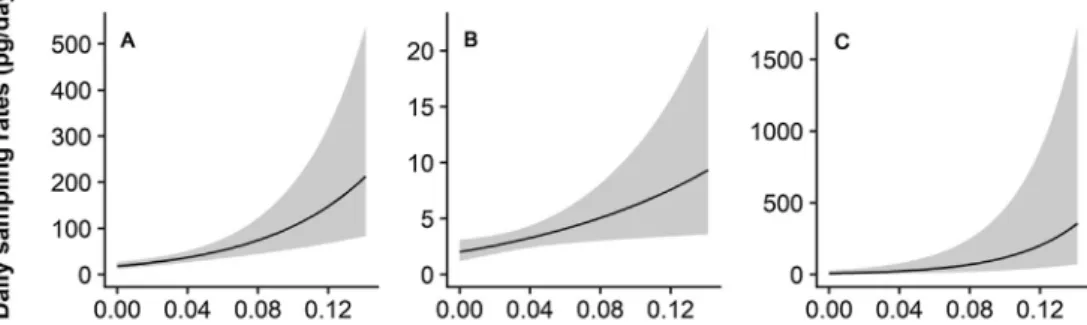
The daily sampling rates of all three PBDE mixtures in bird-borne PASs increased with the presence of gulls in the vicinity of landfills (Fig. 3; Table S8). In contrast, the presence of gulls around landfills had no effect on the daily sampling rates of any of the emerging HFRs. Neither sex, weather-related variables, nor the presence or distance of gulls to other types of WMFs influenced the daily sampling rates of HFRs (Table S8).
3.4. Atmospheric exposure index
An atmospheric exposure index was generated based on the daily sampling rates of∑9PentaBDE,∑3OctaBDE, DecaBDE, HBB, Dec-604 CB,
and∑DP to identify sites in the Montreal area where the PASs carried by ring-billed gulls could have been primarily exposed to these HFRs. This index was calculated when the home ranges of at least three different gulls overlapped within the entire 1,496 km2study area (Fig. 4). This area was unevenly spread around the gull colony and encompassed two outer edges that were associated with two distant landfills (42 and Fig. 2. Mean ( ± SEM) daily sampling rates (pg/ day) of 11 major PBDE congeners and three emer-ging HFRs (HBB, Dec-604 CB, and∑DP) collected in PASs carried by ring-billed gulls in the Montreal area (QC, Canada). Brackets encompass the con-geners composing each PBDE mixture. BDE-153 and BDE-154 are components comprised in both PentaBDE and OctaBDE.
Table 1
Results of model selection (ΔAICc< 2) among linear mixed models explaining the daily sampling rates R of three PBDE mixtures and three emerging HFRs in PASs carried by ring-billed gulls in the Montreal area (QC, Canada). All models included sampling year as a random effect. Explanatory variables include the presence probability of gulls in the vicinity of landfills (Presencelandfill), the exposure to the wind coming from a given type of waste management facility (Windlandfill, Windmixedwaste,Windwastewater), and the atmospheric concentration of particulate matter < 2.5 µm diameter (PM2.5concentration). Weather vari-ables included wind direction and wind speed.
Model K AICc ΔAICc w
∑9PentaBDE
R ~ Presencelandfill 4 193.33 0.00 0.72
R ~ Presencelandfill+ sex 5 195.30 1.97 0.27
∑3OctaBDE
R ~ Presencelandfill 4 145.87 0.00 0.70
DecaBDE
R ~ Presencelandfill 4 226.69 0.00 0.76
HBB
R ~ Wind direction + Wind speed 5 90.50 0.00 0.19
R ~ Windlandfill+ Wind speed 5 91.22 0.72 0.13
R ~ Windmixed waste+ Wind speed 5 91.48 0.97 0.11
R ~ PM2.5concentration 5 92.11 1.61 0.08
Dec-604 CB
R ~ Wind direction + Wind speed 5 142.32 0.00 0.18
R ~ PM2.5concentration 5 142.42 0.09 0.17
R ~ Windmixed waste+ Wind speed 5 143.07 0.74 0.12
R ~ Windwastewater+ Wind speed 5 143.89 1.57 0.08
R ~ Windlandfill+ Wind speed 5 144.15 1.83 0.07
R ~ Wind direction + Wind speed + sex 6 144.18 1.86 0.07
ΣDP
R ~ Presencelandfill 4 202.24 0.00 0.32
R ~ Presencelandfill+ sex 5 204.21 1.97 0.12
K: Number of estimated parameters; AICc: second-order Akaike information criterion;ΔAICc: Difference between AICc of model vs top-ranked model; w: Akaike weight.
37 km away from the colony). The average spatially weighted daily sampling rates (sexes combined) of PentaBDE (51 ± 7 pg/day) was the greatest, followed by DecaBDE (42 ± 6 pg/day) and∑DP (7 ± 2 pg/ day) (Table S9). The atmospheric exposure index of the three PBDE mixtures exhibited significant spatial aggregation (Moran Index range: 0.75–0.81, p < 0.001; Table S10). Specifically, this index indicated that the greatest atmospheric exposure to PBDE mixtures in ring-billed gulls occurred in or near three large landfills and the main flight cor-ridors connecting these with the colony (Fig. 4). The atmospheric ex-posure index for the emerging HFRs showed highly compound-specific patterns, which somewhat differed from those of the three PBDE mix-tures. Nevertheless, the atmospheric exposure index for HBB, Dec-604 CB, and ∑DP was also spatially aggregated, although with a lower Moran index range compared to the PBDE mixtures (0.61–0.76; p < 0.001; Table S10).
4. Discussion
The miniature PASs carried by breeding ring-billed gulls in the Montreal area over two weeks collected major PBDE congeners and emerging HFRs of high environmental concern for wildlife including birds (Guigueno and Fernie, 2017). Specifically, among all targeted HFRs and their sums,∑9PentaBDE and DecaBDE exhibited the greatest
daily sampling rates in the bird-borne PASs. Moreover, the daily sam-pling rates of all three PBDE mixtures were positively related with the presence probability of gulls in or in the vicinity of landfills. In contrast, the daily sampling rates of HBB, Dec-604 CB and∑DP did not vary as a function of any of the variables considered. Nevertheless, the atmo-spheric exposure index generated based on the daily sampling rates allowed identifying potential point sources of exposure to HBB and DP within the home range of ring-billed gulls in this highly urbanized re-gion.
4.1. Atmospheric exposure to PBDEs in landfills
The daily sampling rates of PBDE mixtures in the present study were comparable to those previously reported by our laboratory (Sorais et al., 2017). In this study, PentaBDE reached 46.5 ± 12.5 pg/day (mean ± SEM), OctaBDE 3.9 ± 2.1 pg/day, and DecaBDE 38.5 ± 16.1 pg/day in PASs deployed on ring-billed gulls from one to three weeks. This confirms that bird-borne PASs used in the present study remained in the uptake phase during the 2-week sampling period. Moreover, the summed daily sampling rates of BDE-47, -99 and -209 accounted for 68% of those of∑11PBDE in PASs carried by ring-billed
gull females and males, which also was consistent with Sorais et al. (2017). These results confirm the relative abundance of these three PBDE congeners in the air of the Montreal area. As such, atmospheric PBDE profiles dominated by BDE-47 and -99 (PentaBDE) are commonly observed in urban air worldwide, and are often associated with elevated concentrations of BDE-209 (DecaBDE) that partitions mainly in the particle phase (Ma et al., 2013; Besis et al., 2016; Drage et al., 2016; de
la Torre et al., 2018; Saini et al., 2019). Thesefindings were in line with Abbasi et al. (2015)who estimated that the total mixture volumes used in North America since 1970 reached 380,000 tons for DecaBDE, 46,000 tons for PentaBDE, and 25,000 tons for OctaBDE. In Canada, the use and importation of PentaBDE and DecaBDE was banned in 2008 and 2017, respectively (Government of Canada, 2016a). Since then, the reservoir of PentaBDE and DecaBDE components is restricted to the stock of manufactured products remaining in the use phase or disposed in landfills (waste phase) (St-Amand et al., 2008). Despite more than a decade after the ban of PentaBDE, the current abundance of PentaBDE and DecaBDE congeners in air of the Montreal area indicates that PBDE-containing products still in use or in WMFs represent important ongoing emission sources in urbanized regions.
Among WMFs, landfills and transshipment stations manage a variety of waste types including energy-rich human refuse that may attract many ring-billed gulls locally (Patenaude-Monette et al., 2014; Gentes et al., 2015; Thiériot et al., 2015). However, foraging in landfills may be perceived as stressful for gulls and energetically costly due to the distance from the colony, disturbance from machinery, and deter-rence measures employed in landfills (e.g., falconry). In fact, landfills are preferentially selected by only a small proportion (~15%) of ring-billed gulls breeding in this colony, while most ring-ring-billed gulls rely on food resources obtained from agriculturalfields (e.g., corn grain and earthworms) during the breeding period (Patenaude-Monette et al., 2014; Gentes et al., 2015). Nevertheless, the daily sampling rates of PBDEs in bird-borne PASs were highest in birds preferentially foraging within a 500-m radius around a landfill. As such, models predicted very low air exposure to PBDEs for gulls that did not visit landfills. Indeed, estimates for the daily sampling rates of PentaBDE, OctaBDE and DecaBDE were 18.2, 2.0 and 7.4 pg/day, respectively. Contrary to our predictions, no other variable considered in this study influenced the daily sampling rates of HFRs including the presence of gulls around other types of WMFs, their distance or wind exposure from them, or any weather-related variables. These results suggest that air levels of PBDEs considerably decrease beyond a 500-m radius around landfills.
Mapping the atmospheric exposure index of PentaBDE, OctaBDE and DecaBDE revealed that the greatest atmospheric exposure to PBDEs was localized around the three largest landfills serving the greater Montreal area. Moreover, we obtained a comparably high atmospheric exposure index in areas corresponding to the mainflight corridors of gulls linking these three landfills and the gull colony. These high at-mospheric exposure indices are most likely associated with the transit of gulls that had previously been exposed to HFRs in these landfills. In fact,Racine et al. (2012)showed that ring-billed gulls breeding in the Montreal area tend to reach their feeding sites using a straight bearing from the colony, a pattern that also emerged in our geolocation data. Interestingly, one specific transshipment station where waste transits between residential areas and landfills was also associated with a high atmospheric exposure index for the three PBDE mixtures.
Fig. 3. Model-averaged effects of the pre-sence of ring-billed gulls in the vicinity of landfills on the daily sampling rates of three PBDE mixtures. Predicted daily sampling rates (pg/day) of (A) ∑9PentaBDE, (B) ∑3OctaBDE, and (C) DecaBDE in PASs car-ried by gulls in the Montreal area (QC, Canada) are presented as a function of their presence probability in or around landfills. Shaded areas represent 95% unconditional confidence intervals. Note that the scale of the y-axis varies for each PBDE mixture.
4.2. Unidentified sources of emerging HFRs
The emerging HFRs (HBB, Dec-604 CB, and DP) in the PASs carried by ring-billed gulls occurred at far lower levels relative to the major PBDE congeners in the three mixtures. Thesefindings were consistent with the lower atmospheric levels of these compounds relative to PBDEs in reports from various urban regions within the North American Great Lakes and Europe (Ma et al., 2013; Newton et al., 2015; Besis et al., 2016; Drage et al., 2016; de la Torre et al., 2018; Saini et al., 2019). Unlike the PBDE mixtures, the daily sampling rates of HBB, Dec-604 CB and DP isomers were not associated with the presence of gulls in WMFs
or any other habitat types. However, the atmospheric exposure index of HBB must be interpreted with caution as it was generated based on very low daily sampling rates compared to PBDEs. By comparison, the average daily sampling rates of∑DP were the third greatest after Pen-taBDE and DecaBDE, suggesting its relatively high abundance in the air of Montreal. Regardless, our avian model did not allow depicting a clear picture of the distribution of atmospheric sources of exposure to these three emerging HFRs at the regional scale using the present geo-graphical coverage and resolution.
DP is a chlorinatedflame retardant that has been manufactured for five decades in the Great Lakes region (Niagara Falls, NY, USA) and Fig. 4. Atmospheric exposure index of three PBDE mixtures (PentaBDE, OctaBDE, and DecaBDE) and three emerging HFRs (HBB, Dec-604 CB, and∑DP). This index is based on the mean daily sampling rates of HFRs in PASs carried by ring-billed gulls in the Montreal area (QC, Canada) scaled down to a 0–1 range. Dark red areas represent hotspots of atmospheric exposure to HFRs, while light yellow areas represent the lowest atmospheric exposure. The three large landfills and the five transshipment stations localized in this area are mapped as well as the gull colony. (For interpretation of the refer-ences to colour in thisfigure legend, the reader is referred to the web version of this article.)
imported into North America from China (Government of Canada, 2016b; Olukunle et al., 2018). DP is used mainly in cable coating, plastic roofing materials, and connectors in various electronic products. This putative DecaBDE replacement wasfirst suspected to leach into the environment from plants manufacturing these products. However, Sverko et al. (2011)suggested that air levels of DP in urban regions were mainly explained by the high DP content in currently used elec-tronic equipment. DP along with HBB, which is produced mainly in Japan and used forfireproofing plastics, textiles and wood (Arp et al., 2011), were reported at low levels in the air of remote regions such as the Arctic (Vorkamp and Rigét, 2014), suggesting that long-range transport can take place for these semi-volatile compounds. However, the spatial aggregation of the atmospheric exposure index of DP and HBB in our study suggests that local sources of these chemicals po-tentially exist north of Montreal where several electronic manu-facturing facilities are located. Regardless, it is unlikely that ring-billed gulls specifically target electronic manufacturing facilities for foraging, but food sources including garbage bins outside shopping malls and transshipment stations nearby may have attracted gulls in these areas. Future studies should aim to identify local sources of DP and HBB at the regional scale and further explore the role of electronic manufacturing facilities as potential sources of atmospheric emissions in this area.
Atmospheric sources of Dec-604 CB were more scattered within the Montreal area compared to PBDEs and other emerging HFRs (DP and HBB). Limited information is available on the use and environmental sources of Dec-604 CB that contains both chlorine and bromine, al-though it has been suggested to be a photodebromination product of Dechlorane-604 (Shen et al., 2014). In addition to be used as aflame retardant in North America since the 1980s in plastics, rubber, paint, paper and electronics, Dechlorane-604 was shown to be an impurity (~2%) in the now banned chlorinated pesticide Mirex (also called Dechlorane) (Shen et al., 2010, 2011). Agriculturalfields made up a large proportion of the foraging home range of ring-billed gulls in the Montreal area. Therefore, the atmospheric distribution of Dec-604 CB in our study could also be related to the former application of Mirex on agricultural fields in this region and subsequent degradation of De-chlorane-604 into Dec-604 CB from UV light or microbial activity.
4.3. Weather variables
Weather conditions were hypothesized to influence the daily sam-pling rates of HFRs in PASs carried by ring-billed gulls over the study period based on previous reports of air concentrations that were found to fluctuate under certain weather conditions (Bohlin et al., 2014; Csiszar et al., 2014; Yang et al., 2014). For instance,de la Torre et al. (2018)demonstrated that atmospheric concentrations of BDE-47 and -99 increased in the gas phase and decreased in the particle phase with increasing ambient air temperatures. In contrast, none of the weather variables considered in our study explained the daily sampling rates of HFRs. Most studies investigating the influence of weather conditions on atmospheric concentrations of HFRs are based on year-round measures (St-Amand et al., 2008; de la Torre et al., 2018), whereas the timeframe of our study was restricted to spring (late April through early June). The temperature range during this period was 5.8–19.1 °C, which is nar-rower than the 5.4–29.0 °C reported by de la Torre et al. (2018). Moreover, residential emissions associated with heating of households during the winter influence the total particulate matter concentrations in air, and hence those of PBDEs and polycyclic aromatic hydrocarbons in the gas and particle phases (St-Amand et al., 2008). Consequently, the sampling period in our study was probably too short to detect an effect of weather conditions or concentrations of particulate matter < 2.5 µm diameter on the daily sampling rates of HFRs in PASs carried by ring-billed gulls.
4.4. From exposure to bioaccumulation?
HFRs in gas and particle phases of air can be inhaled in birds or ingested via the gastrointestinal tract when consuming food items and preening feathers onto which HFR-laden particles can be adsorbed. The elevated contributions of BDE-47, -99, and -209 in PASs carried by ring-billed gulls in our study reflect the relative contributions of these congeners in liver (61% of∑45PBDE) and plasma (73% of∑45PBDE) of
ring-billed gulls that were previously reported in this colony (Gentes et al., 2012). This striking similarity in the contributions of PentaBDE and DecaBDE congeners between air (i.e., PASs) and tissues of ring-billed gulls strongly suggests that inhalation or ingestion of HFRs pre-sent in the atmosphere could be dominant exposure pathways in this urban-adapted population. Nevertheless, several characteristics and physiological processes can modulate the toxicokinetics of HFRs in birds, which inevitably influence the tissue profiles of these chemicals. For instance, although male and female ring-billed gulls in our study exhibited similar daily sampling rates of HFRs in PASs, sex-specific differences in tissue HFR concentrations have been observed in this colony (Gentes et al., 2015; François et al., 2016; Desjardins et al., 2019). In fact, female gulls mobilize and transfer lipid-associated HFRs to eggs during ovogenesis, which results in lower tissue concentrations in females relative to males during the post-egg laying period (Verreault et al., 2006). Furthermore, Desjardins et al. (2019)reported greater plasma to guano concentrations of BDE-209 and DP in female versus male ring-billed gulls from the same colony. These authors suggested that this could be explained by a higher excretion rate in males and/or a higher retention of these highly hydrophobic compounds via protein-binding in breeding females that exhibit higher levels of circulating plasma proteins such as albumin.
Concentrations of HFRs in plasma of ring-billed gulls have also been reported to increase with the time spent foraging in other types of WMFs in the Montreal area including aeration basins of wastewater treatment plants (Gentes et al., 2015). In the present study, the daily sampling rates of HFRs were not associated with the presence of ring-billed gulls in or near wastewater treatment plants or their effluents in the St. Lawrence River. Gulls foraging in wastewater basins are po-tentially exposed to HFRs through feeding on invertebrates including emergent insects that can accumulate these contaminants from the primary-treated water (Gentes et al., 2015). Moreover, particle-bound HFRs in landfills can be deposited on food items consumed by ring-billed gulls. Hence, although exposure to HFRs via air clearly is im-portant for ring-billed gulls that exhibit preference for foraging in landfills, dietary intake could also represent a non-negligible exposure pathway in these sites.
5. Conclusions
Using a novel approach combining passive air sampling and high-resolution GPS-based telemetry adapted to an avian model, we showed that the exposure sources to HFRs in the atmosphere are compound-and site-specific at the regional scale in a highly urbanized environ-ment. Specifically, exposure to PBDEs that are major components in the now banned PentaBDE and DecaBDE mixtures was strongly associated with the presence of ring-billed gulls around landfills. These results indicate that landfills represent major environmental sources of atmo-spheric exposure to PBDEs for birds and potentially other mobile wildlife that use these sites for short stopovers to forage on predictable energy-rich human food resources. However, in contrast to PBDEs and despite that several other explaining factors were considered in our study including weather variables, the daily sampling rates of emerging HFRs (HBB, Dec-604 CB, and DP isomers) in PASs carried by ring-billed gulls could not be explained. This suggests that atmospheric exposure to emerging HFRs is more diffuse than PBDEs at the landscape level in the Montreal area. Nevertheless, spatial aggregation of emerging HFRs in this region may eventually resemble that of PBDEs in the future as these
will gradually enter the waste phase in landfills. Overall, this study is thefirst to provide empirical evidence of the atmospheric exposure to HFRs in wildlife species foraging in landfills and potentially other an-thropogenic habitats. These findings have major implications for wildlife due to increased health risks associated with HFR exposure, but also for human health considering that landfill workers and nearby populations also breathe HFR-loaded air and particles.
6. Code availability
The codes for the calculation of the presence probability of a gull in the vicinity of WMFs and the mean distance, calculation of the weather variables, and calculation of the atmospheric exposure index are freely available at:https://github.com/Manontreal/RBG_HFRs_atm_exp 7. Data availability
Data can be obtained by contacting the corresponding author. Acknowledgments
This study was funded primarily by the Fonds de recherche du Québec– Nature et technologies (FRQNT) (2018-PR-205665 to J.V. and J-F.G.). Supplemental funding was provided by the Canada Research Chair in Comparative Avian Toxicology (to J.V.). We acknowledge the contributions of Ling Wang (Université du Québec à Montréal) for chemical analyses, Mélanie Desrochers (Université du Québec à Montréal), Raphaël Lavoie (Canadian Wildlife Service), and Orr Spiegel (University of Tel Aviv) for inputs on data treatment as well as Ludovick Brown and François Chamberland (Université du Québec à Montréal) for assistance with the geographical information system. We warmly thank Francis Saint-Pierre and many interns (Université du Québec à Montréal) for assistance in thefield. The authors declare no conflict of interest.
Appendix A. Supplementary material
Supplementary data to this article can be found online athttps:// doi.org/10.1016/j.envint.2019.105387.
References
Abbasi, G., Buser, A.M., Soehl, A., Murray, M.W., Diamond, M.L., 2015. Stocks andflows of PBDEs in products from use to waste in the U.S. and canada from 1970 to 2020. Environ. Sci. Technol. 49, 1521–1528.https://doi.org/10.1021/es504007v. Arp, H.P.H., Møskeland, T., Andersson, P.L., Nyholm, J.R., 2011. Presence and
parti-tioning properties of theflame retardants pentabromotoluene, pentabro-moethylbenzene and hexabromobenzene near suspected source zones in Norway. J. Environ. Monit. 13, 505–513.https://doi.org/10.1039/c0em00258e.
Bohlin, P., Audy, O.,Škrdlíková, L., Kukučka, P., Přibylová, P., Prokeš, R., Vojta, S., Klánová, J., 2014. Outdoor passive air monitoring of semi volatile organic com-pounds (SVOCs): a critical evaluation of performance and limitations of polyurethane foam (PUF) disks. Environ. Sci. Process. Impacts 16, 433–444.https://doi.org/10. 1039/c3em00644a.
Bergman, Å., Rydén, A., Law, R.J., de Boer, J., Covaci, A., Alaee, M., Birnbaum, L., Petreas, M., Rose, M., Sakai, S., Van den Eede, N., van der Veen, I., 2012. A novel abbreviation standard for organobromine, organochlorine and organophosphorus flame retardants and some characteristics of the chemicals. Environ. Int. 49, 57–82.
https://doi.org/10.1016/j.envint.2012.08.003.
Besis, A., Voutsa, D., Samara, C., 2016. Atmospheric occurrence and gas-particle parti-tioning of PBDEs at industrial, urban and suburban sites of Thessaloniki, northern Greece: implications for human health. Environ. Pollut. 215, 113–124.https://doi. org/10.1016/j.envpol.2016.04.093.
Braune, B.M., Letcher, R.J., Gaston, A.J., Mallory, M.L., 2015. Trends of polybrominated diphenyl ethers and hexabromocyclododecane in eggs of Canadian Arctic seabirds reflect changing use patterns. Environ. Res. 142, 651–661.https://doi.org/10.1016/ j.envres.2015.08.010.
Burnham, K.P., Anderson, D.R., 2002. Model Selection and Multimodel Inference: A Practical Information- Theoretic Approach, second ed. Springer, New York. Calenge, C., 2006. The package“adehabitat” for the R software: a tool for the analysis of
space and habitat use by animals. Ecol. Model. 197, 516–519.https://doi.org/10. 1016/j.ecolmodel.2006.03.017.
Chen, D., Hale, R.C., 2010. A global review of polybrominated diphenyl etherflame
retardant contamination in birds. Environ. Int. 36, 800–811.https://doi.org/10. 1016/j.envint.2010.05.013.
Chen, D., Letcher, R.J., Gauthier, L.T., Chu, S., McCrindle, R., 2012. Flame retardants in eggs of four gull species (Laridae) from breeding sites spanning Atlantic to Pacific Canada. Environ. Pollut. 46, 9456–9463.https://doi.org/10.1016/j.envpol.2012.03. 040.
Covaci, A., Harrad, S., Abdallah, M.A.-E., Ali, N., Law, R.J., Herzke, D., de Wit, C.A., 2012. Novel brominatedflame retardants: a review of their analysis, environmental fate and behaviour. Environ. Int. 37, 532–556.https://doi.org/10.1016/j.envint. 2010.11.007.
Csiszar, S.A., Diamond, M.L., Daggupaty, S.M., 2014. The magnitude and spatial range of current-use urban PCB and PBDE emissions estimated using a coupled multimedia and air transport model. Environ. Sci. Technol. 48, 1075–1083.https://doi.org/10. 1021/es403080t.
de la Torre, A., Barbas, B., Sanz, P., Navarro, I., Artiñano, B., Martinez, M.A., 2018. Traditional and novel halogenatedflame retardants in urban ambient air: gas-particle partitioning, size distribution and health implications. Sci. Total Environ. 630, 154–163.https://doi.org/10.1016/j.scitotenv.2018.02.199.
Desjardins, C.F., Mazerolle, M.J., Verreault, J., 2019. Is the urban-adapted ring-billed gull a biovector forflame retardants? Environ. Pollut. 244, 109–117.https://doi.org/10. 1016/j.envpol.2018.10.003.
de Wit, C.A., 2002. An overview of brominatedflame retardants in the environment. Chemosphere 46, 583–624.https://doi.org/10.1016/j.scitotenv.2009.08.037. Drage, D.S., Newton, S., de Wit, C.A., Harrad, S., 2016. Concentrations of legacy and
emergingflame retardants in air and soil on a transect in the UK West Midlands. Chemosphere 148, 195–203.https://doi.org/10.1016/j.chemosphere.2016.01.034. François, A., Técher, R., Houde, M., Spear, P., Verreault, J., 2016. Relationships between
polybrominated diphenyl ethers and transcription and activity of type 1 deiodinase in a gull highly exposed toflame retardants. Environ. Toxicol. Chem. 35, 2215–2222.
https://doi.org/10.1002/etc.3372.
Gauthier, L.T., Hebert, C.E., Weseloh, D.V.C., Letcher, R.J., 2008. Dramatic changes in the temporal trends of polybrominated diphenyl ethers (PBDEs) in herring gull eggs from the Laurentian Great Lakes: 1982–2006. Environ. Sci. Technol. 42, 1524–1530.
https://doi.org/10.1021/es702382k.
Gentes, M.-L., Letcher, R.J., Caron-Beaudoin, É., Verreault, J., 2012. Novelflame re-tardants in urban-feeding ring-billed gulls from the St. Lawrence River, Canada. Environ. Sci. Technol. 46, 9735–9744.https://doi.org/10.1021/es302099f. Gentes, M.-L., Mazerolle, M.J., Giroux, J.-F., Patenaude-Monette, M., Verreault, J., 2015.
Tracking the sources of polybrominated diphenyl ethers in birds: foraging in waste management facilities results in higher DecaBDE exposure in males. Environ. Res. 138, 361–371.https://doi.org/10.1016/j.envres.2015.02.036.
Government of Canada, 2016. Polybrominated Diphenyl Ethers Regulations. Canadian Minister of Justice, Canada.
Government of Canada, 2016b. Draft Screening Assessment Certain Organic Flame Retardants Substance Grouping: Dechlorane Plus (DP) (Environment and Climate Change Canada, Health Canada). Available at:http://www.ec.gc.ca/ese-ees/ FDE6572D-5801-462E-92F7-241FA591DCBF/DSAR_OFRs %28DP%29_EN 02-11-2016.pdf.
Guigueno, M.F., Fernie, K.J., 2017. Birds andflame retardants: A review of the toxic effects on birds of historical and novel flame retardants. Environ. Res. 154, 398–424.
https://doi.org/10.1016/j.envres.2016.12.033.
Horne, J.S., Garton, E.O., Krone, S.M., Lewis, J.S., 2007. Analyzing animal movements using Brownian bridges. Ecology 88, 2354–3236. https://doi.org/10.1890/06-0957.1.
Hope, B.K., 1995. A review of models for estimating terrestrial ecological receptor ex-posure to chemical contaminants. Chemosphere 30, 2267–2287.https://doi.org/10. 1016/0045-6535(95)00100-M.
La Guardia, M.J., Hale, R.C., Harvey, E., 2006. Detailed polybrominated diphenyl ether (PBDE) congener composition of the widely used penta-, octa-, and deca-PBDE technicalflame-retardant mixtures. Environ. Sci. Technol. 40, 6247–6254.https:// doi.org/10.1021/es060630m.
Law, K., Halldorson, T., Danell, R., Stern, G., Gewurtz, S., Alaee, M., Marvin, C., Whitle, M., Tomy, G., 2006. Bioaccumulation and trophic transfer of some brominatedflame retardants in a Lake Winnipeg (Canada) food web. Environ. Toxicol. Chem. 25, 2177–2186.https://doi.org/10.1897/05-500r.1.
Ma, Y., Salamova, A., Venier, M., Hites, R.A., 2013. Has the phase-out of PBDEs affected their atmospheric levels? Trends of PBDEs and their replacements in the Great Lakes atmosphere. Environ. Sci. Technol. 47, 11457–11464.https://doi.org/10.1021/ es403029m.
Mazerolle M.J., 2019. AICcmodavg: Model Selection and Multimodel Inference Based on (Q)AIC(c). R-package version 2.2-2.
Melymuk, M., Robson, R., Helm, P., Diamond, M.L., 2012. PCBs, PBDEs, and PAHs in the urban atmosphere: spatial and seasonal trends and implications for contaminant transport. Sci. Tot. Environ. 429, 272–280.https://doi.org/10.1016/j.scitotenv. 2012.04.022.
Morin, N.A.O., Andersson, P.L., Hale, S.E., Arp, H.P.H., 2017. The presence and parti-tioning behavior offlame retardants in waste, leachate, and air particles from Norwegian waste-handling facilities. J. Environ. Sci. 62, 115–132.https://doi.org/ 10.1016/j.jes.2017.09.005.
Newton, S., Sellströ, U., de Wit, C.A., 2015. Emergingflame retardants, PBDEs, and HBCDDs in indoor and outdoor media in Stockholm. Sweden. Environ. Sci. Technol. 49, 2912–2920.https://doi.org/10.1021/es505946e.
Nol, E., Blokpoel, H., 1983. Incubation period of ring-billed gulls and the egg immersion technique. Wilson. Bull. 95, 283–286.
Olukunle, O.I., Lehman, D.C., Salamova, A., Venier, M., Hites, R.A., 2018. Temporal trends of Dechlorane Plus in air and precipitation around the North American Great
Lakes. Sci. Total Environ. 642, 537–542.https://doi.org/10.1016/j.scitotenv.2018. 05.268.
Patenaude-Monette, M., Bélisle, M., Giroux, J.-F., 2014. Balancing energy budget in a central-place forager: which habitat to select in a heterogeneous environment? PLoS One.https://doi.org/10.1371/journal.pone.0102162.
Pinheiro, J., Bates, D., DebRoy, S., Sarkar, D., R Core Team, 2019. nlme: Linear and Nonlinear Mixed Effects Models. R package version 3.1-141.
Poma, G., Malarvannan, G., Voorspoels, S., Symons, N., Malysheva, S.V., Van Loco, J., Covaci, A., 2016. Determination of halogenatedflame retardants in food: optimiza-tion and validaoptimiza-tion of a method based on a two-step clean-up and gas chromato-graphy-mass spectrometry. Food Control 65, 168–176.https://doi.org/10.1016/j. foodcont.2016.01.027.
Racine, F., Giraldeau, L.A., Patenaude-Monette, M., Giroux, J.-F., 2012. Evidence of social information on food location in a ring-billed gull colony, but the birds do not use it. Anim. Behav. 54, 175–182.https://doi.org/10.1016/j.anbehav.2012.04.028. Rauert, C., Harrad, S., Stranger, M., Lazarov, B., 2015. Test chamber investigation of the
volatilization from source materials of brominatedflame retardants and their sub-sequent deposition to indoor dust. Indoor Air 25, 393–404.https://doi.org/10.1111/ ina.12151.
Saini, A., Clarke, J., Jariyasopit, N., Rauert, C., Schuster, J.K., Halappanavar, S., Evans, G.J., Su, Y., Harner, T., 2019. Flame retardants in urban air: a case study in Toronto targeting distinct source sectors. Environ. Pollut. 247, 89–97.https://doi.org/10. 1016/j.envpol.2019.01.027.
Shanahan, D.F., Strohbach, M.W., Warren, P.S., Fuller, R.A., 2014. The Challenges of Urban Living. In: Gil, D., Brumm, H. (Eds.), Avian Urban Ecology: Behavioural and Physiological Adaptations. Oxford University Press, Oxford, pp. 3–21.
Shen, L., Reiner, E.J., MacPherson, K.A., Kolic, T.M., Sverko, E., Helm, P.A., Bhavsar, S.P., Brindle, I.D., Marvin, C.H., 2010. Identification and screening analysis of halogenated norborneneflame retardants in the laurentian great lakes: dechloranes 602, 603, and 604. Environ. Sci. Technol. 44, 760–766.https://doi.org/10.1021/es902482b. Shen, L., Reiner, E.J., Helm, P.A., Marvin, C.H., Hill, B., Zhang, X., MacPherson, K.A.,
Kolic, T.M., Tomy, G.T., Brindle, I.D., 2011. Historic trends of dechloranes 602, 603, 604, dechlorane plus and other norbornene derivatives and their bioaccumulation potential in Lake Ontario. Environ. Sci. Technol. 45, 3333–3340.https://doi.org/10. 1021/es104328r.
Shen, L., Jobst, K.J., Reiner, E.J., Helm, P.A., McCrindle, R., Taguchi, V.Y., Marvin, C.H., Backus, S., MacPherson, K.A., Brindle, I.D., 2014. Identification and occurrence of analogues of dechlorane 604 in Lake Ontario sediment and their accumulation infish. Environ. Sci. Technol. 48, 11170–11177.https://doi.org/10.1021/es503089c. Sorais, M., Rezaei, A., Okeme, J., Diamond, M.L., Izquierdo, R., Giroux, J.-F., Verreault,
J., 2017. A miniature bird-borne passive air sampler for monitoring halogenated flame retardants. Sci. Total Environ. 599–600, 1903–1911.https://doi.org/10.1016/ j.scitotenv.2017.04.246.
St-Amand, A.D., Mayer, P.M., Blais, J.M., 2008. Seasonal trends in vegetation and at-mospheric concentrations of PAHs and PBDEs near a sanitary landfill. Atmos. Environ. 42, 2948–2958.https://doi.org/10.1016/j.atmosenv.2007.12.050. Sun, Y.-X., Luo, X.-J., Mo, L., Zhang, Q., Wu, J.-P., Chen, S.-J., Zou, F.-S., Mai, B.-X., 2012.
Brominatedflame retardants in three terrestrial passerine birds from South China: geographical pattern and implication for potential sources. Environ. Pollut. 162, 381–388.https://doi.org/10.1016/j.envpol.2011.12.013.
Sverko, E., Tomy, G.T., Reiner, E.J., Li, Y.-F., McCarry, B.E., Arnot, J.A., Law, R.J., Hites, R.A., 2011. Dechlorane plus and related compounds in the environment: a review. Environ. Sci. Technol. 45, 5088–5098.https://doi.org/10.1021/es2003028. Thiériot, E., Patenaude-Monette, M., Molina, P., Giroux, J.-F., 2015. The efficiency of an
integrated program using falconry to deter gulls from landfills. Animals 5, 214–225.
https://doi.org/10.3390/ani5020214.
Tomy, G.T., Budakowski, W., Halldorson, T., Whittle, D.M., Keir, M.J., Marvin, C., Macinnis, G., Alaee, M., 2004. Biomagnification of α- and
γ-Hexabromocyclododecane Isomers in a Lake Ontario Food Web. Environ. Sci. Technol. 38, 2298–2303.https://doi.org/10.1021/es034968h.
UNEP, 2017. The 16 New POPs (Stockholm Convention Secretariat United Nations Environment). Available at:http://chm.pops.int/tabid/2511/Default.aspx. Venier, M., Hites, R.A., 2008. Flame retardants in the atmosphere near the great lakes.
Environ. Sci. Technol. 42, 4745–4751.https://doi.org/10.1021/es800313z. Verreault, J., Villa, R.A., Gabrielsen, G.W., Skaare, J.U., Letcher, R.J., 2006. Maternal
transfer of organohalogen contaminants and metabolites to eggs of Arctic-breeding glaucous gulls. Environ. Pollut. 144, 1053–1060.https://doi.org/10.1016/j.envpol. 2005.10.055.
Verreault, J., Letcher, R.J., Gentes, M.L., Braune, B.M., 2018. Unusually high Deca-BDE concentrations and newflame retardants in a Canadian Arctic top predator, the glaucous gull. Sci. Total Environ. 639, 977–987.https://doi.org/10.1016/j.scitotenv. 2018.05.222.
Vorkamp, K., Rigét, F.F., 2014. A review of new and current-use contaminants in the Arctic environment: evidence of long-range transport and indications of bioaccu-mulation. Chemosphere 111, 379–395.https://doi.org/10.1016/j.chemosphere. 2014.04.019.
Yang, F., Ding, J., Huang, W., Xie, W., Liu, W., 2014. Particle size-specific distributions and preliminary exposure assessments of organophosphateflame retardants in office air particulate matter. Environ. Sci. Technol. 48, 63–70.https://doi.org/10.1021/ es403186z.