Democratic and Popular Republic of Algeria
Ministry of Higher Education and Scientific Research
Aboubekr Belkaid University - Tlemcen
Faculty of Letters and Languages
Department of Foreign Languages
Section of English
Aspects of Bilingualism
in a Mauritanian Context:
Nouakchott University as a Case Study
Dissertation Submitted to the Department of Foreign Languages in Candidacy for the Degree of “MAGISTER” in
Sociolinguistics
Presented by: Supervised by:
Mr. Sidi Mohamed OULD AHMED Dr. Zoubir DENDANE
Board of Examiners
Prof. Smail BENMOUSSAT President (University of Tlemcen) Dr. Zoubir DENDANE Supervisor (University of Tlemcen)
Dr.Belabbes OUERRAD External Examiner (University of Sidi Belabbès) Dr. Amine BELMEKKI Internal Examiner (University of Tlemcen)
Dr. Ghouti HADJOUI Internal Examiner (University of Tlemcen)
Aspects of Bilingualism in a Mauritanian Context: The Case of Nouakchott University
Abstract
Bilingualism is a linguistic phenomenon that implies the concurrent use of two distinct languages. This situation does not imply the automatic existence of two distinct speech communities, but it happens that the same community has recourse to the use of two, or more, different linguistic systems.
The linguistic situation in Mauritania is characterized by the existence of two main communities: a Berber-Arabic community and a Black-African one, a situation which has led the Mauritanians to use more than one language in their everyday speech. While Arabic and some Berber characterize the former, the latter community can be split into a number of sub-tribes on the basis of the different languages each one uses, particularly Soninke, Pulaar, Wolof, etc.
The major objective of this work is to shed light on the issue of bilingualism as it occurs in Mauritania focusing our research work on Nouakchott University. We have divided the work into three main chapters. The first chapter is about the literature review and definitions of bilingualism. The second chapter is about the linguistic situation in Mauritania and the historical events that lead to today’s linguistic repertoire in the country
Lastly, the third chapter contains analyses of the data collected from the questionnaire and the methodology tools, quantitatively and qualitatively. It is important to mention here that we have based this research methodologically on a questionnaire containing thirteen questions about Nouakchott University students’ attitudes toward bilingualism, their motivations and, on the other hand, direct questions to the teachers and students, adding to that, participant observation during the collection of the data.
Dedications
The completion of this work would not have been possible without the guidance and assistance of several people: First and foremost, I am grateful for the never-ending support and prayers from my parents, grandparents, brothers, uncles, aunts, cousins and all my dear family members.
A special thanks is addressed to Mariem bint Lehbib, Mohamed Lemin ould Abdellahi, and my close brothers: Cheikhna ould Abdelkader, Ahmed Salem ould Ebval, Mohameden ould Mohamed Mahmoud and his lovely son Youssef , Chouayb ould Elghawth, , Mohamed Aly ould Eddou, Youssef ould Maïfe , Mohamed ould Oumar and all who gave me their consistent reliable and long support.
Lastly this work is dedicated to Jebril ould Barhoum , Verha bint Elvil, and to my future wife Fatma bint Sid’Ahmed and to all people I know and whom I have forgotten to mention.
ACKNOWLEDGEMENTS
Praise be to Allah who created all mankind in the nicest images and forms, and sent his prophet Mohamed (PBUH) to guide us towards the straightway. Thank you God. To you I owe everything.
I would like to express all my gratitude and indebtedness to my supervisor, Dr. Zoubir DENDANE, whose encouragements, guidance and support from the initial to the final level enabled me to develop an understanding of the subject.
I would like also to express my deep sense of gratitude to all my teachers in the English department , Pr. Smail BENMOUSSAT, Dr. Ilham SERIR and Dr. Ammaria DERNI.
I am also heartily thankful to all the other teachers of the English department, especially Dr. Amine BELMEKKI, Dr. Nassim NEGADI, Dr. Radia BENYELLES, and all the administrative staff.
Endless thanks also go to my dear classmates, Brahim Elhawri, Rafik, Fatma, Rafika, Abdlekader and others for their considerable cooperation.
Finally my thanks go to all the people of Algeria
CONTENTS
ACKNOWLEDGEMENTS ……….. DEDICATIONS……… ABSTRACT……… TABLE OF CONTENTS……… LIST OF TABLES………... LIST OF FIGURES………... ACRONYMS……… GENERAL INTRODUCTION………...….1CHAPTER ONE: 1.BILINGUALISM AS A LINGUISTIC PHENOMENON...5
1.1 Introduction ……….…...5
1.2 Bilingualism Defined ……….5
1.2.1 Child Bilingual Acquisition...9
1.2.2 Types of Bilinguals……….….9
1.3 Simultaneous and Consecutive Bilinguality…………...…...……..12
1.4 Societal Bilingualism vs. Individual Bilingualism………....16
1.5 Language Attitude and Use………...19
1.6 Language Shift and Maintenance………..22
1.7 Code-switching, Code-mixing and Borrowing………...…...26
1.7.1 Code-switching………..….27
1.7.2 Code mixing………..….30
1.7.3 Borrowing………...30
1.8 Bilingualism and Diglossia………...…………32
1.8.1 Aspects of Diglossia in Mauritania………33
1.8.2 Diglossia vs. Bilingualism………..…...…35
1.9 Language Planning………...….38
1.9.1 Language Planning in Mauritania………..…38
CHPTER TWO: 2. THE LINGUISTIC SITUATION IN MAURITANIA…..…45
2.1 Introduction………45
2.2 Historical Background………...…46
2.2.1 Early History………..…51
2.2.2 Characteristics of Hassaniya Arabic……….…56
2.3 Occupation precursors……….…….…58
2.4 Administration under the Colonial Period ………..…………..62
2.5 The Situation after Independence………..…64
2.6 Arabization……….…67
2.6.1 Historical Events that led to Arabization……… .68
2.7 Today’s Situation of French………..…76
2.8 The Status of Arabic……….….77
2.9 Education and Bilingualism Issues………..…………..…80
2.9.1 Qur’anic Schools………....…81
2.9.2 Modern Education……….………….82
CHAPTER3 FIELDWORK: THE IMPACT OF BILINGUALISM ON EDUCATION………...84
3.1 Introduction ………....84
3.2 The Impact of Bilingualism on Education……….… 84
3.3 Education Profile………..…...86
3.3.1Primary School………..…..86
3.3.2 Secondary Education………..…87
3.3.3 Technical Schools……….88
3.3.4 Universities and other Institutions of Higher Education…....88
3.4 Research Instruments………...………...…89
3.4.1Questionnaire………...90
3.4.2 Methodology of the Questionnaire………..…….. 92
3.5 Data Collection and Interpretation……….… 93
3.5.2Analysis of the Questionnaire……….…96
3.6 Qualitative Interpretation of the Results………...……115
GENERAL CONCLUSION……….117
BIBLIOGRAPHY ……...……….122
APPENDICES ………...………...131
Appendix 1: Questionnaire in Arabic………132
Appendix 2: Questionnaire in French………...134
LIST OF TABLES
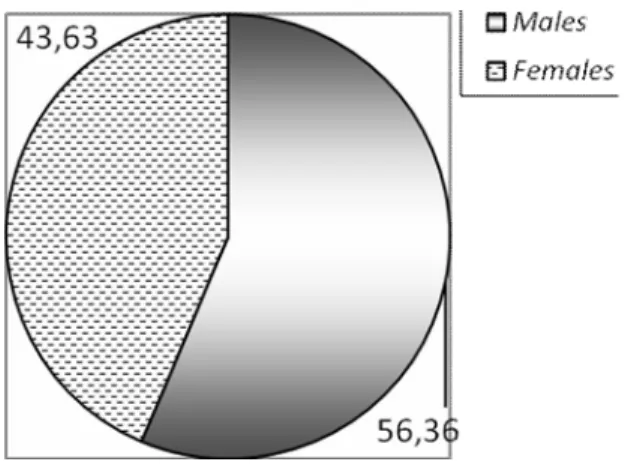
Table 3.1. Informants’ percentage by gender………97
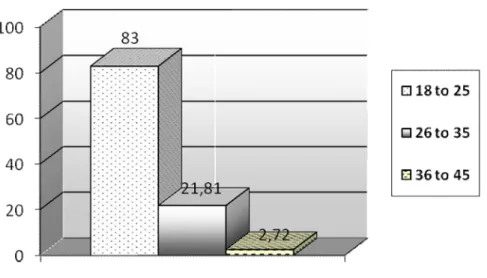
Table 3.2 Age groups of informants………..98
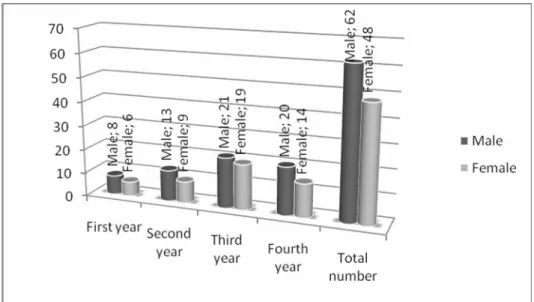
Table 3.3 Number of informants by year of study………...…….99
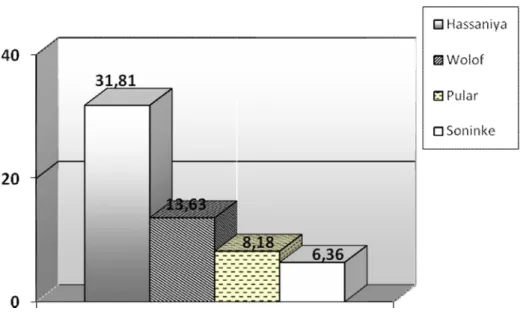
Table 3.4 Students’ native languages………...………...100
Table 3.5 Languages spoken by students...101
Fig 3. 6 Students’ consideration as to their bilingualism………102
Table 3.7 Informants’ awareness of bilingualism……….………..104
Table 3.8 Informants’ attitude toward bilinguals………105
Table 3.9 Importance given to being a bilingual……….107
Table 3. 10 Students’ evaluation of their second language……….…111
Table 3. 11 Nouakchott University, a bilingual community……..……….112
LIST OF FIGURES
Fig. 3.1 Informants’ percentage by gender………..……….97
Fig. 3.2 Percentages of students by age………99
Fig. 3.3Informants’ year of study………...……….100
Fig 3. 4 Informants’ mother tongue……….………101
Fig 3. 5 Languages spoken by students………...………102
Fig 3. 6 Students’ consideration as to their bilingualism………..………..104
Table 3.7 Informants’ awareness of bilingualism……….………..105
Fig. 3. 8 Informants’ attitude toward bilinguals………..106
Fig. 3. 9 Importance given to being a bilingual student …….………108
Fig. 3. 10 Students' level in second language………..111
fig.3.11 Nouakchott University, a bilingual community? ………..112
ACRONYMS
AOF Afrique Occidentale Française
BAC Diplome du Baccalauréat de l'Enseignement du Secondaire BEPC Brevet d'Etudes du Premier Cycle
BTS Brevet de Technicien Supérieur
CEPE Certificate of Primary Elementary Studies CMS Comité Militaire de Salut National
CMSN Military Committee for National Salute CSET Centre Supérieur d'Enseignement Technique DEUG Undergraduate degree in University Studies. ENA Ecole Nationale d'Administration
ENI Ecole Nationale d'Institutueurs ENS Ecole Normale Supérieure
ENSP Ecole Nationale de Santé Publique
ISERI Institut Scientifique des Etudes et Recherches Islamiques ISSM Institut Supérieur de Specialisation Médicale
PPM Parti du Peuple Mauritaniens
SADR Saharawi Arab Democratic Republic
General Introduction
Contrary to what is often believed, most of the world’s population is bilingual or multilingual. For example, in the United States, 46.9 million people speak a language other than English in their home. In Canada, too, two languages, French and English, go side by side. The same fact applies to Finland where English is widely used along the two other official languages, Finnish and Swedish. Moreover, post-colonial states, those in the way of development, are more exposed to this sort of situations.
Generally speaking, bilingualism is a sociolinguistic phenomenon defined as the ability to use two languages. However, defining bilingualism can be problematic since there is variation in proficiency. Most scholars have defined it differently and their answers to the question of where bilingualism starts vary from one to another. As far as the first group of linguists is concerned, Bloomfield (1933), for example, views a bilingual person as someone who can be prefect and proficient in both languages, productively and receptively. On the other hand, some scholars still consider a person as being bilingual even without necessarily having a native-like control of the two languages in the verbal repertoire.
This research work addresses this sociolinguistic phenomenon in Mauritania. Bilingualism is the consequence of a long period of French domination in the area. French was brought through waves of colonization, while Arabic is the tongue of local dwellers. In fact, the two languages were found in a kind of complementary distribution, as each one was reserved to a particular domain: French for education and administration, and Arabic for religious purposes, literature, and daily language interaction.
The Mauritanian community is characterized by the succession of different linguistic waves, and more especially by French which led to bilingualism. Arabic
is the official language of the country as stipulated in the constitution but Mauritanian Arabic, called Hassaniya, is the most widespread variety used by the majority of the population alongside some African languages spoken by those Mauritanians who have African roots.
From its early history, Mauritania knew a certain social organization. It was a tribal society with traditional values. The most important fact that can be noted here is that the Arabo-Muslim civilization has greatly influenced the region and shaped its socio-cultural characteristics, including its linguistic system. The vast geographic area of Mauritania and the coming of a multitude of dialects with different waves of Arab migration from ‘Yemen’ helped a great deal in the stability of Arabic and the degradation of other languages which existed before, especially Berber varieties.
By the beginning of 1900’s, the French establishment overthrew the linguistic scenery and the social structure at the same time. Many policies were taken by the colonizer to impose the French language in the daily lives of Mauritanians.
The confrontation of sixty years of two different languages in Mauritania permitted to create the linguistic association of French and Arabic. This association, in the Maghreb in general and in Mauritania in particular, is very interesting seeing that French is an indo-European language and Arabic a Semitic one; two different origins and completely divergent civilizations (Arabo-Muslim vs. Christiano-European). The civilizational heterogeneity was always present even during the colonial era, whereas the linguistic heterogeneity persists even after independence.
It seems that the very interesting problem of post colonial bilingualism is that it was transmitted by education and the mass-media (TV, newspapers) whereas
the one before independence was transmitted mostly by the social interaction of two different communities. Most Mauritanian researchers agree that this period of Mauritanian history witnessed tow kinds of bilingualism: a passive bilingualism which was only a means of communication between two different speech communities (the bilinguals excelled only in one language but with difficulty in pronunciation) and another one active which became a means of expression, modernity, culture and instruction in that foreign language (the new generation of bilinguals communicates in both languages whereas the bilinguals of the colonial era and because of cultural orientations used to speak only Arabic or French). Thus, the Mauritanian speech community is confronted to linguistic practices where two languages rely on each other, sometimes independently and sometimes in relation.
Indeed, the interaction and the interference of the two languages permitted to create a certain sociolinguistic tendency that the Mauritanian society did not know before the French colonization. In order to study such a linguistic behaviour, that is bilingualism, and attitudes towards each language, the present research work projects an interest in language use by the students of Nouakchott University, with the ultimate goal to answer what follows: is bilingualism in Mauritania a benefit or not? In other words, is it a blessing or a curse? To go deeply, let us pose the following questions:
To what extent is bilingualism used by the students of Nouakchott University?
What are the students’ attitudes toward bilingualism?
Considering French as a medium language between the two communities Arab-Berber and Black Africans, does their co-existence in the country enrich or limit bilingualism?
Proceeding to find appropriate answers, we put forward the following hypotheses:
First, all students of Nouakchott reach university level as bilinguals as a consequence of the educational system in the country, but only a small number are real bilinguals because of the Arabization policy that eliminated the use of French in many institutional settings.
The overall attitude towards French is positive for it is seen as a language of modernity and opening to the world, though some students fear to lose their cultural identity.
The co-existence of Arabo-Berbers and Black Africans can only be beneficial for French use as this language seems at least to play the role of a linga-franca.
To check these proposed hypotheses, we feel it adequate to divide this research into three main chapters. In the first chapter, we try to give a literature review about bilingualism gathering as many definitions of this linguistic phenomenon as possible without forgetting to tackle the issues of diglossia, language use and language planning in order to show their relation to bilingualism.
In the second chapter we try to shed light on the linguistic situation in Mauritania, giving information about historical periods that have led to the linguistic profile of today’s Mauritanians, and then we describe the characteristics of Hassaniya Arabic which is the dialect of the Arabs in the country.
We end this work with a third chapter trying to analyze the impact of bilingualism on education. We elucidate the methodology of data collection and the different ways and tools used for obtaining reliable data. The last part of the third chapter discuses and presents the data quantitatively and qualitatively to come up with the results that may answer the issues raised above. This chapter also presents a general conclusion of our research work.
1. Bilingualism as a linguistic phenomenon
1.1 Introduction
Most people agree that knowing another language is taking in hand a source of communication. Knowing many different languages also provides people with enormous possibilities in their contact and understanding of the people living in other parts of the world. This brings us to a very important issue namely bilingualism, which often described in broad terms as the ability to use two languages to communicate.
In this chapter, we will try to shed light on this sociolinguistic phenomenon and trace scholar s definitions on the issue from Bloomfield’s (1933) definition of bilingualism as “native-like control of two languages” (p. 56) which lies at one of the continuum of definitions used to discuss bilingualism .To the other extreme side, presented by Mcnamara and Saunders. Saunders (1988) who defines a bilingual as a person who is “able to use two languages (for some or all of the skills of speaking, listening, reading and writing” (p. 6). A myriad of additional definitions exist that adapt some aspects of these two or fall somewhere in between.
1.2 Bilingualism defined
A matter of some debate among linguists is the precise meaning of the term bilingualism itself. If we break the word into its constituents (bi from the Latin word for "two", lingual meaning "articulated with the tongue", and ism being the suffix that describes an action or process) we deduce that it means to speak two languages, which is indeed how the term is defined in the dictionary (Dictionary.com).
Many of the various definitions proposed are so diverse because they relate to the speaker's proficiency in two or more languages. Proficiency is difficult to
measure, as it is a continuum, ranging from absolutely no ability to complete fluency. The wide range of definitions encompasses the two extremes highlighted in the introduction above. These are famously provided by Bloomfield (1933), Mcnamara (1969) and Haugen (1953), and illustrated by Baetens Beardsmore (1982) and Romaine (1995).
Bloomfield (1933) states that a bilingual speaker has a "native-like control of two languages", and is so well spoken in his second language, that it would be impossible for listeners to tell him apart from a native speaker. Similar to this idea is the notion of ambilingualism, described by Halliday, McIntosh and Strevens (1970, in Baetens Beardsmore, 1982) in which a speaker's competence in both languages (and in all four modalities; speaking, listening, reading and writing) is "without any traces of one language in his use of the other" (though it is unclear what is meant by "traces" - possibly accent, vocabulary, word order or structure). This kind of speaker is sometimes referred to as a balanced bilingual, and is rare, whereas it has been said that Bloomfield's perfect bilingual probably does not even exist (Deuchar, and Quay, 2000). Matthews (1997) has modified Bloomfield's definition somewhat, into "an effectively equal control of two native languages."(p.122)
At the other extreme, McNamara (1969), proposed that somebody should be called bilingual if he has some second language skills in one of the four modalities (speaking, listening, writing and reading), in addition to his first language skills. McNamara's definition is widely acceptable as it discards the problem of "scale and aggregation". Whosoever has a reasonable command of a second language is bilingual. Therefore, in the Mauritanian context, a bilingual would be defined as someone having a good level of competency in both French and Arabic.
In complete contrast to Bloomfield, Haugen (1953) claims that bilingualism starts when a speaker can produce complete meaningful utterances in a language other than his native tongue. This notion is generally looked upon as being
inadequate as a definition, as many people can greet or thank one another in a foreign language (which are indeed "complete meaningful utterances") but would not be able to hold a conversation in that language (Baetens Beardsmore, 1986). Macnamara (1969) too allows for an overly broad definition by counting minimal skills in one of the four modalities mentioned (in Appel and Muysken, 1987).
Similarly, Diebold's (1964) definition also refers to minimal competence, for example being able to understand a foreign language, but not speak it, thus considered also a degree of bilingualism. This particular example can be described as passive or receptive bilingualism; Diebold calls it incipient bilingualism. But again, there is a drawback in that this definition is far too broad, and that almost anyone could be described as being incipient bilinguals if they know one or two words in another language (Romaine, 1995).
However, our experience as a native member of Nouakchott community and having had some relations with students of Nouakchott University, we can advance the idea that no one has reached the native like degree of equal control of Arabic/French as proposed by Bloomfield. On the other hand, all the Mauritanians can be considered bilinguals in the other attitude, because every Mauritanian can understand and use at least a view words in French.
Between Mcnamara and Bloomfield, Tosi (1984:73) defined bilingualism as “the individuals capacity to a second language while following the concepts and structure of that language rather than paraphrasing his or her mother tongue”. Hamers and Blanc (2000) argue that all these definitions, which range from a native like competence in two languages to a minimal proficiency in a second language, raise a number of theoretical and methodological difficulties. In their view, on one side these definitions lack precision and operationalism because they do not specify what is meant by native-like competence, which varies considerably within a unilingual population, nor by minimal proficiency in a second language, nor by obeying the concepts and structures of that second language.
In this domain, (Hamers and Blanc (2000) put a very important theoretical questions like: can we exclude from the definitions of bilingual someone who possesses a very high competence in a second language without necessarily being perceived as a native speaker because of a foreign accent? Can a person who has followed one or two courses in a foreign language without being able to use it in communication situations or again someone who has studied Latin for six years legitimately be called bilingual? Unless we are dealing with two structurally different languages, how do we know whether a speaker is paraphrasing the structure of his mother tongue when speaking the other language?
Hamers and Blanc also claim that these definitions refer to a single dimension of bilinguality namely the level of proficiency in both languages and ignoring non-linguistic dimensions. For example, Paradis (1995) while suggesting that bilinguality should be defined on a multidimensional continuum reduces the latter to linguistic structure and language skill. (Appel and Muysken, 1987)
Not all definitions relate to linguistic proficiency or competence. Weinreich's (1953) popular definition is that bilingualism is the process of using two languages alternately. Mackey (1962) concurs, and adds that the term allows for the use of not only two languages, but of any number. This phenomenon is sometimes referred to as multilingualism or plurilingualism, but for this essay we will only use the term bilingualism to describe the situation in Nouakchott University.
On the other hand, some definitions are psychological; Hamers and Blanc (1990) refer to bilingualism as being a psychological state, whereby an individual has access to "more than one linguistic code" and is able to use them both to communicate. Other definitions are more sociological; Fabbro (1999) defines a bilingual as someone who, in natural circumstances, has learnt two languages from birth or early childhood.
More sociological definitions exist in different parts of the world. In an African country like Mauritania, the term bilingualism is normally used to describe mastery of European languages in addition to the use of their native African or Arabic tongues. In these cases, the ability to speak more than one local language is rarely considered by the speakers to be bilingualism, since those languages are seen to have subordinate positions. This is because so few of them have been codified and so do not have any official status (Leopold, 1947). It is worth pointing out that the term does not stretch to speaking more than one dialect; this is known as bidialectism (Appel and Muysken, 1987).
1.2.1 Child bilingual Acquisition
Bilingualism is influenced by many factors and has many manifestations. Hamers and Blanc (2000) question definitions of bilingualism that do not take its multiple dimensions into account. Since bilingualism is directly related to the context of acquisition, bilinguals are often additionally classified based on initial age of exposure and developed bilingual competencies. The initial age of exposure is one factor that heavily influences order of acquisition of languages. Simultaneous and sequential bilingualism are terms used to address the order in which children are exposed to languages. Generally simultaneous language acquisition refers to the process of learning two languages at one time while sequential language acquisition applies to situations in which a second language is introduced some time after initial exposure to the first.
More specific definitions of bilingualism, give exact information on the time and amount of exposure to each language required for a person to be classified into one of these categories. McConvell, Simpson and Wigglesworth (2005:41) state that sequential bilingualism occurs when the “child is exposed to one language in infancy and the second sometime later”. While McConvell, Simpson et al. consider
simultaneous language acquisition a result of more or less equal exposure from birth, Grosjean and Frauenfelder (1997: 36) classifies simultaneous bilinguals as those “who acquire two languages before age three” and sequential bilinguals as “those who acquire the second language after three”.
1.2.2 Types of Bilinguals
Bilinguals are also classified by the competencies they are able to develop in their respective languages. The terms receptive, passive, productive, and active are employed to describe bilingual competencies. Receptive or passive bilinguals can “understand (and possibly read) the minority language” while productive or active bilinguals can “talk and possibly write in both languages” (Döpke, 1992, p. 3). Passive bilinguals are still considered to be bilingual provided that they continue to be exposed to the minority language and have age appropriate passive skills (Döpke, 1992).
An additional set of terms used to describe bilingualism have to do with comparing a language user’s perceived proficiency in both their languages. Balanced bilingualism refers to comparable skill level across languages whereas dominance occurs when a person is more proficient in one of the languages. In the same vein, Lambert (1978) also introduced the term-balanced bilingualism to describe individuals who are fully competent in both languages. In his opinion, it describes also those who are thought to have perfect control on both languages in all settings. Baetens beardsmore (1982) argues that balanced bilingualism is close to impossible to achieve, and is therefore rare. Even high-level conference interpreters tend to prefer one of their languages and will often specialize in interpreting into their dominant language, despite the fact that they are highly fluent in both languages.
Bialystok (2001) also limits the definition of bilingualism to its social-communicative dimension when he says that “bilingual persons or communities are those with an ability to meet the communicative demands of the self and the society in their normal functioning in two or more languages in their interaction with other speakers of any or all of these languages” (p:129)
Mackey (2004) points out that the concept of bilingualism has become increasingly broader. Hakuta (1987) also notes that Haugen previous definition of bilingualism incorporates a development perspective which brings the entire process of second language acquisition within the scope of the study of bilingualism. Hakuta believes the field should deal not only with the bilingual individual but also with the circumstance surrounding the creation of bilingualism and its maintenance and attrition.
Mackey (1962) concludes that in order to study bilingualism researchers and scholars are forced to consider it as something relative because the point at which the speaker of a second language becomes bilingual is either arbitrary or impossible to determine. He therefore considers bilingualism simply as the alternate use of two or more languages. He also suggests that there are four questions which a description of bilingualism must address: degree, function, alternation, and interference. The question of degree of bilingualism concerns proficiency, how does the bilingual know each of the languages? Function focuses on the uses a bilingual speaker has for the languages and the different roles they have in the individual’s total repertoire. Alternation treats the extent to which the individual alternate between the languages. Interference has to do with the extent to which the individual manages to keep the languages separate or whether they are fused.
Mackey (2004) on the other hand, lists a number of factors such as sex, age, intelligence, memory, language attitude and motivation, which are likely to influence the bilingual aptitude. Other recent definitions insist on the specific
characteristics of the bilingual. For example, Grosjean (1982) defines a bilingual speaker as more than the sum of two monolinguals in the sense that the bilingual has also developed some unique language behavior. Equally for Leopold (1970:44) who defines bilingualism as “more than an addition of two monolingual competences, but an extreme from polylectality”.
Perhaps the most individually demanding, and socially grounded definition of bilingualism was proposed by Andersson, (2004) who states that bilingualism consistes of “being taken for a native speaker by native speakers of both languages, with perhaps a small allowance for some amount of syntactic, lexical, and phonological interference from their dominant to their non-dominant language”(p:177).
Fishman (1972) goes further, arguing that bilinguals are rarely equally fluent in both languages in all topics. He argues that sociolinguistic forces demand that bilinguals organize their languages in functionally complementary spheres. For example, a German–French bilingual may be able to speak both languages fluently, but is likely to use German exclusively in certain situations or when discussing specific topics. He also emphasizes that it is this complementary nature of language functions that assures the continued existence of bilingualism, because any society that, produces bilinguals who use both languages, with equal competence in all contexts will stop being bilingual, as no society needs two languages to perform the same set of functions. In other words, balanced bilingualism necessarily entails the death of bilingualism.
1.3 Simultaneous and consecutive bilinguality
Since the beginning of the twentieth century scholars from a variety of disciplinary backgrounds, such as psychologists, linguists, neurologists and educators have paid attention to the development of biliguality. In addition, parents in cross-language marriages were the first to study their own children, more or less systematically, and to report the progress of their child's bilingual language acquisition.
One of the earliest systematic records comes from Ronjat (1913) who described the progress of his son, Louis. Wanting his child to be bilingual, he sought the advice of Grammont, a linguist, shortly after his son was born, and thereafter decided to adopt a one person-one language approach with him. Ronjat's wife used only her native German and he used French with the boy. His was a large household, with a range of servants and relatives speaking either German or French. The commonly used language alternated at various times in Louis' early life according to the household, but by the age of 38 months he was able to ask about language as well as use and understand simple French and German (Ronjat, 1913).
Later, Leopold (1939) published four books of data about his daughter's bilingual language acquisition, this time English and German. He and his wife also adopted a one person-one language strategy with their child, and by age four Hildegard too could communicate in the two languages (Leopold, 1949). With both children, their mother's language was stronger, at least initially. Since then many scholars have recorded and reported the bilingual language development of their own children like Saunders, 1982, Taeschner, 1983, Fantini, 1985 etc .
On the other hand, DeHouwer (2006) argues that there are problems with all of these studies; because they deal with special children. They are the children of
linguists, or at least language-aware parents, and the parental relationships cannot be assumed to be unimportant in the development of a child's language. Although language samples are gathered in a natural context, this is rarely described. Parents have often adopted a special strategy to facilitate bilingual development, and there is rarely any measurement of child or parent language use. He added that most children do not have to learn to be bilingual but become so naturally. The most widespread route to bilingual language acquisition is also the most unnoticed; there is one language for the home and one language for the wider world or the formal situations as is the case in Mauritania.
Romaine (1995) reviewed types of bilingual acquisition reported in the literature. She describes six types of language background, and comments that the 'mixed languages' type is probably more common than it seems from the literature. In addition, Schmidt-Mackey (1971) has described critically a number of cases where differing approaches were used, adding and telling comments from her own experience. There were three languages in use when she was a child, first German and Hungarian and later Serbian. Although she learned all three successfully, she comments that the emotional elements involved cannot be easily quantified. Her parents used only German with her and did not realize that she had learned Hungarian until she was four years old. Hungarian was the language that they used with one another. It always seemed more appealing than German, and she felt excluded by their use of it when she was expected to use German.
Saunders (1988) observed that his children went through a three stage developmental sequence in becoming bilingual. While the notion of discrete stages (and allocation of ages) is contested and debated, the general developmental pattern follows. The first stage lasts until the child is approximately two years of age. During this time, the child does not differentiate between the two languages. Vocabulary, for example, is treated as part of one global language system. During the second stage, the child may still be mixing the two languages on occasions.
However, there will be increasing differentiation between the two languages. For example, the vocabulary will be separated; the child will know what language to speak to which person, and what language to speak in which situations. Saunders (1988) also suggests that during this second stage, the child sometimes says both words for the same thing.
In addition, it is important to mention here an initial distinction between simultaneous and sequential childhood bilingualism. Simultaneous childhood bilingualism on one hand refers to a child acquiring two languages at the same time early in life. For example, where one parent speaks one language to the child, and the other parent speaks a different language, the child may learn both languages simultaneously. Furthermore the studies of the acquisition of simultaneous bilingualism in childhood make two other key points. First, Swain and lapkin (1991) found that the simultaneous acquisition of two languages did not differ in development order or process from the acquisition of one language. Children appear to learn two languages as if they were learning one. Second, and related, it seems possible to conclude that bilingualism can be the first language. This includes the idea that there may be a single language system underlying both the languages of the bilingual child.
On the other hand, sequential acquisition of bilingualism refers to the situation where a child acquires a first language, and later becomes proficient in the second language. McLaughlin (1978) recommends that the age of three is used as an arbitrary demarcation line between simultaneous and sequential acquisition of bilingualism.
Speaking about the term sequential acquisition of bilingualism lead us to mention the field of second language acquisition. Such acquisition may be through formal or informal means; informally through street, nursery school and community, or formally through school, adult classes and language courses. One
factor, which needs to be taken into consideration, is the status of the minority language in the family. In a situation where one of the parents speaks a minority language and the other speaks the language of the outside community, it may be quite challenging to ensure that the child receives adequate input from the minority language to enable the child to become bilingual in both languages.
Valdesand Figueroa (2001) examine the parental strategies used with a child acquiring Catalan and English in a Catalan-speaking situation in order to identify the types of input strategies that were used which enhanced the child’s ability to speak both languages. They argue that in a situation in which the minority language is spoken by one parent, the strategy of using code mixing by the speaker of the more dominant language may illustrate an attempt by this parent to promote the use of the minority language.
They also show that a change in strategy by the father (the speaker of the minority language) when the child turned three was successful in developing and extending the child’s communicative competence in this language. Their findings also are in agreement with those of Goodz (1989), who found that fathers tended to have higher expectations of their children’s linguistic abilities in their interactions with their children once the children had acquired a level of language competence, which allowed this.
A further consideration may relate to the location in which the languages are used. Quay (1998) provides a detailed outline of the input a child growing up bilingually receives from her parents, where both of them speak both languages. She discusses the different strategies they adopt. Initially, the mother speaks English to the child when alone with her, but Spanish when the father, who always speaks Spanish to the child, is present. However, when the child is one year old, the mother changes strategies, speaking Spanish to the child at home all the time,
except when monolingual English-speaking visitors are present, when English is spoken. The child also attends a crèche where only English is spoken.
Quay (1998) also reports that the child would speak Spanish at home and on the journey to the crèche, but would switch to English while talking to her mother upon entering the crèche gate. Upon leaving, the child spoke English until she got into the car, whereupon she spoke Spanish. This phenomenon, where language is associated with specific situations, is not unusual. Quay argues that it is important for parents to be flexible in their language use with their children to ensure that children being raised bilingually grow up with appropriate awareness of appropriate bilingual behaviour in different linguistic contexts.
1.4 Societal bilingualism vs. Individual bilingualism
Bilingual individuals do not exist as separate islands. On the other hand, people who speak two languages or more usually exist in groups, communities and sometimes in nations. Bilingualism at the individual level is just half of the history. The other essential half is to analyze how the groups of speakers of language behave and change. Such an examination concentrates in particular on the movement and the change of a language through decades. This also requires examining the situation of the policy and power in which minority languages are located (McMahon, 1994).
By itself, bilingualism is neither a disease nor a virtue, and it is never the direct cause of language loss. It is merely a means taken by communities to change their languages because they no longer see them as useful. In the first stage of regression, the minority language community is persuaded that learning the language of the majority will enrich its culture, ensure a better economic
development, open the community to contemporary internationalism, and enable it to avoid self-isolation (Pavlenko, 2006).
The problem is that social bilingualism is usually exclusively assumed by those for whom it is necessity; on the contrary, it could be useless for others in the society except for reasons of snobbism. The type of bilingualism that prevails in language extinction corresponds neither to individual bilingualism nor to institutional bilingualism but to social bilingualism generalized to the entire community; one can talk about ethnic bilingualism. (Pavlenko, 2006).
On the other hand, individual bilingualism is an isolated phenomenon, which does not question the dominant functions of the mother tongue in the social life; an individual practicing an instrumental bilingualism for limited and well defined functions does not run any risk of losing his native language. Institutional bilingualism enables each one of the groups in presence to practice monolingualism, “letting the burden of bilingualism to the organisms under the control of the state. However, if bilingualism favors the second language in most of the social roles strategically important, the bilingual individual puts his language in danger. The non use of his mother tongue will lead to an atrophy of the linguistic ability and loss of cultural identity” (Pavlenko, 2006:102).
Linguistic mutation is imminent of this kind of bilingualism spreads to a whole community. The most important characteristics of social bilingualism is its evolution. It evolves in a unique direction with more and more people, for more and more functions, still the moment when all the community uses the second language for all their everyday life communicative needs. Then, the mother tongue does not subsist but at a residual state and becomes heavily impregnated with the dominant language.
Bilingualism in individuals implies some degree of knowledge of two or more languages. Reliable information about the proficiency or even about the number of people who speak a language is not easily gathered because of differing conceptions about language. People in various cultures have different ideas about who speaks their language. Even though most people can identify their first or home language, it is not always the best known. An adult might be knowledgeable about the language used in school, while maintaining an emotional attachment with the first language or even language learned later, but which he or she indentifies culturally (Alvarez et al, 1992).
According to Ould Bah (1997) social bilingualism develops starting from a series of contacts of language inside and between countries and communities. One finds it in border zones between the states, because of the constant exchange by visits, trades, wars; or because of the geographical dialect continuum, which was stopped by political borders. An example is the southern Mauritanian continuum of dialect, which crosses through the national borders of Mauritania, Senegal and Mali. These varieties are more or less mutually understandable; a chain of mutual intelligibility binds the rural dialects of these languages. Speakers on each of the political borders have no problems of understanding each other. Moreover many of these people are bilingual since they speak the official national language as well as the local dialect. (Ould bah (1997)
Another very important extent considered language as a salient dimension of ethnicity and ethnic identity. Language in this case plays an important role in intergroup relations when languages and cultures are in contact, not only as a symbol but also as an instrument for upholding or promoting the group’s ethnic identities. In this domain a number of social scientists have investigated the role of language which therefore varies according to importance as a symbol of group identity and as a function of the power relation holding between the different ethno linguistic groups (Hamer and Blanc, 2000).
On the other hand, and according to Baker (2006) political events may divide people speaking the same language or bring together people speaking different languages. The first situation obtains in many African and Asian countries previously under colonial role, where the colonial power drew arbitrary frontiers regardless of ethno linguistic realities. Annexations and invasions, migration, and deportations also bring people and group from different linguistic and cultural backgrounds together. An example of this is found in the south of where people of Wolof speak Senegalese and Bambara in the southeast speak like Malians because of border connections.
Hamers and Blanc (2000) also argue that economic factors can bring speakers of different language into contact; religion too can be a reason for different linguistic groups who share the same faith to live together, whether temporarily (pilgrimages) or permanently (Indian subcontinent). Otherwise, different religious communities may split up a country along linguistic lines. We think here that these lines exist in Mauritania in places of Soufi believers from Ennebakiya 65 Km in the south of Nouakchott to Kewlekh in the east of Senegal .
1.5 Language attitude and use
In the life history of a language, attitude may be crucial. In language growth or decay, restoration or destruction, attitude may be central. The status and importance of a language in society and within an individual derives in a major way from adopted or learnt attitudes. The success of language policy is partly predicated on attitudes surrounding that language.
According to Baker (1992), the term attitude is a valuable concept within the study of bilingualism. In his opinion, a survey of attitude towards language can shed light on community’s beliefs, preferences, and desires and the status value and
importance of a language can be measured by looking at attitudes towards that language.
De Groot and Kroll (1997) introduced their study of language attitude of Chicano and Anglo adolescents in Chicago. The Chicano students had learned Spanish at home, and the Anglo student in high school foreign language classes. Both groups had to rate the personalities of 16 speakers on a tape. Four speakers used English in a home context, four Spanish in home context, four English in a school context, and four Spanish in a school context. The researchers did not use the matched-guise technique. Each speaker was recorded in his mother tongue, with the passages as close to standard or normal as possible. In general, they found that English was rated higher than Spanish, but Spanish was more favorably judged in the home context than in the school context. According De Groot and Kroll(1997) these results show that listeners take the appropriateness of the language variety for a particular situation into account in their judgments.
On the other hand, Bentahila (1983) studied the attitudes among Arabic-French bilinguals in Morocco. Three languages involved: Classical Arabic, Moroccan-Arabic and French. From the answers to the questionnaire, Bentahila concludes that classical Arabic was judged as the richest and most beautiful of the three languages. And French was considered the most modern and useful for studies. Bentahila (1983) furthermore conducted a matched-guise experiment in which three speakers participated two of them spoke high Moroccan French ( which is close to the native speaker of French) and one French with a strong Moroccan accent in addition to Arabic. The first two were rated much higher than the third one.
Furthermore, in this domain, Baker (1992) states that there are two components of language attitude; instrumental attitude and integrative attitude. An instrumental attitude to a language is mostly self-oriented instrumental attitudes of
people towards a language can be both positive and negative because of the desire to gain achievement, status, personal success or basic security and survival. On the other hand, an integrative attitude to a language is mostly social and interpersonal in orientation. It is the desire of people to be like members of the other language community.
Holms (1992) expresses that there are three levels of attitudes towards a social or ethnic groups. The first level is that of attitudes towards social or ethnic groups. Second, the attitude towards the language of that group. The third is attitude towards individual speakers of that language. He adds also that people generally do not hold opinions about languages in a vacuum. They develop attitudes towards language, which reflect their views about those who speak the language, and the contents and functions with which they are associated.
Holmes also points out that the underlying assumption is that, in a society, social or ethnic groups have certain attitudes towards each other relating to their differing positions. These attitudes affect attitudes towards cultural institutions or patterns which characterizing these groups such as language.
It is important to mention here that Fishman (1972) was the first who formed the sociolinguistic notion of domain. He stressed that different settings characteristically call for the use of different languages in bilingual and multilingual societies. In Fishman’s opinion, a domain is a concrete setting like home, street, classroom …ect.
Language use has been analyzed from different perspectives. First, the sociological approach which provides a way to subcategorize people’s behavior of language use. Second the social-psychological approach, which tries also to offer internal reasons to explain why people make a certain language choice. An
anthropological approach looks for external factors to predict people’s language use (Fishman, 1972).
From a social perspective, Fishman (1965) also gave “domain analysis of language use”. He proposes that one language may be more appropriate than another in certain domains and usually it is the standard or prestigious language. This language used in high domains while the vernaculars are selected in low domains. Following Fishman’s model, Ibn Elemine (1997) finds that in Mauritania, Hassaniya is favored in intimate domains such as the family and daily life speech, while Standard Arabic or MSA is chosen in formal situations and domains such as education, mosque …etc.
Returning to language attitude, Trudgill (1974) points out that the dynamic of language attitude can be attributed to two main players: the user and his audience. He notes that clearly when he says:
“…..he will learn these things not so much from what the other man says as from how he says it ….for whenever we speak we cannot avoid giving our listeners clues about our origins and the sort of people we are. Our accent and our speech generally show what part of the country we come from and what background we have, we may even give some indications of certain of our ideas and attitudes and all this, information can be used by people we are speaking with to help them formulate an opinion about us (Trudgill, 1974, p 14).
1.6 Language shift and maintenance
Language shift, language loss, language attrition, language death, language restoration and language loyalty are all used to explain events which are at times referred to as language maintenance and shift (Choi, 2003). In addition, this is what make the phenomena do not have clearly defined borders. However, books and articles on the topic usually deal with why some languages survive when in contact with a dominant language over time, and why others do not (Choi, 2003).
In this vein, Gal, (1979) argues that the central feature of the study of language maintenance and shift is that which studies either the gradual replacement of one language with another in a contact situation, or with the resistance that some languages show to being replaced by another. Gibbons (1987) on the other hand tries to give an explanation of the phenomenon when he states:
“ Language maintenance is a situation in which a language maintains its vitality, even under pressure. It implies, therefore, that the degree of resistance is strong enough to contain any pressure that may be coming from the dominant language. In a situation of language maintenance, the domain of language L1 remains largely the same and transmission of the language to the children is active and as perfect as possible. Moreover, the number of speakers remains relatively stable and maintains a strong allegiance to their language. Language maintenance usually applies to relatively monolingual situations. However, it may take place in stable diglossic situations, in which the function of L1 and L2 are well defined and remain unchanged”. (Gibbons, 1987 p: 179)
Paulston(1992) states that language maintenance can be seen a social source by ethnic groups in “competition for access to goods and survive to a nation” and language maintenance is not a natural phenomenon but a deliberate chosen strategy for group survival. Paulston (1992) also argues that the agency of language shift is bilingualism, which often goes hand in hand with exogamy, where the parents speak the mother tongue with the grandparents and the dominant language with children. He also claims that language shift often begins with women and this is observable in choice of code, and their choice of marriage pattern, and consequently in their choice of language to raise their children.
On the other hand, Bhabha (1994) argues that the linguistic outcomes of prolonged contact of ethnic groups within a ‘modern nation state’ are language maintenance, bilingualism or language shift. The general role for group in prolonged contact within a nation state is for the minority group to shift to the language of the dominant group whether for a short period of time or over many generations. He also argues that if the shift does not take place there will always be two reasons for that: a lack of incentive and a lack of access to the dominant language.
Many theories, models and methods have been developed to answer the very big question of why some languages are replaced by others in contact situations, and why others are maintained. Giles, Taylor and Bourhis, (1973) introduced a concept of ethno-linguistic vitality. In their approach, they propose three variables, which combine to permit an ethno-linguistic minority to survive as a distinctive group. These three variables are status, demographic and institutional support.
Arsenian (1937) mentioned that Toyfel (1974) gives an answer to the preceding questions in his ‘intergroup relation theory, this theory, which entails a description of a chain, expressed as social categorization, social identity, social comparison and psychological distinctiveness. He also suggests that individuals are
motivated in their shifts to seek a positive social identity if they are dissatisfied with their present identity.
Most studies of language shift have looked at the communities’ transition to the new language. The classic pattern is that a community that was once monolingual becomes transitionally bilingual as a stage on the way to the eventual extinction of its original language. Thus, language shift involves bilingualism as a stage on the way to monolingualism in a new language (Romaine, 1995).
Later Haugen (1953) introduces an approach of ‘language ecology’. This approach gives an ecological perspective to language maintenance and shift, namely factors that describe the interactions between languages and environment. Haugen explained his approach as follow:
The struggle between dominated and dominant groups for the right to survive includes what I have called ‘the ecology of language’ by this I mean the preservation of language is part of human ecology, which in turn is a brand of the larger disciplines of sociology and political science. (Haugen, 1953. p 163)
Further, Landry and Allard (1992) develop the concept of anthrolinguistic vitality by Giles (mentioned above). In their theory they incorporate a social network and defined additive bilingualism as a condition, which favors the development of the mother tongue, while at the same time permitting the learning and use of a second language.
They also define subtractive bilingualism as a condition that favors the development of a second language to the detriment of the mother tongue (Edwards, 1993). This model of additive and subtractive bilingual development provides into
the status of language maintenance and shift in bilingual situations. They added (Allard and Landry) that bilingualism is the precursor to language shift in prolonged situations, but in Paulston (1992) point of view this distinction, which they made between types of bilingualism, means that bilingualism is not necessarily an indicator of language shift. Additive bilingualism would therefore favor language maintenance and subtractive bilingualism would be symptomatic of language shift Paulston (1992).
Furthermore, Stossel (2002) introduces his social network theory, which defines the social environment that may have an effect on individual’s attitude and behaviour. He makes the point that the social network theory is very important in language maintenance and shift because of the strong influence that social networks have on language usage and culture. Stossel (2002) emphasizes that language shift or maintenance should not be seen as black or white alternatives. In addition, and since language use is largely contingent on the social environment and also closely linked to the individual’s attitude, one should keep in mind that it can change depending on changes in individual’s lives, their social environment and their attitudes.
The relationship between dialect and standard among minority groups may be an important factor in language shift. Bettoni (1985) found that younger generations of Italian- Australians have tended to shift towards Standard Italian. Such differences are also important in educational policy. Usually it is the standard varieties of minority languages, which are offered to children in school. When the extant of the difference between the varieties spoken at home and school standard is substantial children may experience considerable difficulties.
Clyne (1996) also argues that sometimes, there is a “sudden about-face movement” in what seems to be an irretrievable shift and the language experiences that Fishman has referred to as an ethnic revival. Originally, “the native language
serves a communicative function for the older generation but that assumes largely a symbolic one for the second generation”. Clyne (1996) also says there is an anecdotal evidence that some second generation Australians are reverting to their ethnic languages in order to pass them on to their children.
1.7 Code-switching, Code-mixing, and Borrowing
In monolingual societies, people may think that switching and code-mixing are very unnatural. However, it is inevitable to notice that people usually switch and mix their languages in bilingual and/or multilingual societies. Also as with any aspect of language contact phenomena, the thorny issue of terminological confusion plagues research on code-switching code mixing and borrowing. Not all researchers use the same terms in the same way, nor do they agree on the territory covered by terms such as code-switching, code-mixing and borrowing.
1.7.1 Code-switching
Code-switching and code-mixing are widespread phenomena in bilingual communities where speakers use their native tongue (L1) and their second language (L2) in different domains. However, it is not always the case where each distinct language is exclusively used in one particular domain. Instead, what tends to happen is that a mixture of the two languages in question is used.
Clyne (2003) notes that when bilinguals are made aware of their mixed speech, they blame a “lapse of attention” for their “poor” linguistic performance and promise improvement by the elimination of language mixing and switching. However, Yatim (1988) state that code-switching is an effective communication mode available to proficient bilingual speakers for interactions with other individuals who share both languages.
Clyne (2003) also argues that code switching is a change by a speaker (or writer) from one language or language variety to another one. It can also take place in a conversation when one speaker uses one language and the other speaker answers in a different language. Here, the switching is performed and carried out by the other interlocutor. Speakers may also start speaking one language and then change to another one in the middle of their speech, or sometimes even in the middle of a sentence.
In fact, some people have difficulty distinguishing between code switching and code-mixing. “Code-mixing transfers elements of all linguistic levels and units ranging from a lexica item to a sentence”. Therefore, that it is not always easy to distinguish code-switching from code-mixing (Grosjean, 1982:77). Code-switching on the other hand is defined as “the alternation of two languages within a single discourse, sentence, or constituent. Intersentential alternations occur when the switch is made across sentence boundaries” (Dewaele, (2007:104). Deprez (1999) defines it as “the use of more than one language by communicants in the execution of a speech act.”
According to Bhatia and Ritchie (2004), the vast majority of bilinguals themselves hold a negative view of code-switched speech. They consider language switching to be a sign of “laziness”, an “inadvertent” speech act, an “impurity,” and instance of linguistic decadence and a potential to their own linguistic performance. However, Zentella (1997) claims that code switching is more common during informal interpersonal interactions, including those that take place between family members in natural contexts.
In this vein, Hassaniya speakers in Mauritania are thus facing kinds of multilingual situations: four native languages spoken in the country, a basically bilingual educational system and the long-standing use of Arabic and French, and the situation of diglossia between Arabic and Hassaniya. Multilingualism usually
entails such phenomena as code switching and code mixing which could be considered early stages of attrition or decline of Hassaniya.
In addition, some bilinguals remark that they usually switch and code-mix when they are tired, lazy, or angry (Grosjean, 1982). However, Gutierrez- Crawford (1991) claims that instances of code-switching behavior should not be interpreted as lack of language skill. Children who are bilingual may code-switch within and between utterances depending on multiple factors such as pragmatic, sociolinguistic, priming effects, etc., and not necessarily because of relative lack of proficiency across the two languages or because of parental use of code-switching.
According to Grosjean (1982), code-switching is often used as a communicative strategy to convey linguistic and social information. He also states that code-switching not only fills a momentary linguistic need, it is also a very useful communication resource. Auer (1998) also finds that code-switching serves important purposes in the ongoing negotiation of footing in bilingual interaction. In addition, Green and Price (2001) state that code-switching is not random or meaningless. It has a role, a function, facets and characteristics. It is a “linguistic tool and a sign of the participants’ awareness of alternative communicative conventions”. That is, in terms of the researchers who have positive points of view about code-switching and code-mixing, the fundamental reason why bilinguals switch and mix their languages is not because they lack language skills but because they try to make their utterance more easily understandable and meaningful.
Fishman (1976) also finds that the choice of language among bilingual speakers is determined by factors such as participants, situation, or topic, i.e. factors which are outside the speaker. “In certain circumstances the speakers will speak one language, and if the circumstances change, it may lead them to switch into the other languages”. In addition, Auer (1998) states that one of the reasons