HAL Id: hal-01256729
https://hal.inria.fr/hal-01256729
Submitted on 15 Jan 2016
HAL is a multi-disciplinary open access
archive for the deposit and dissemination of sci-entific research documents, whether they are pub-lished or not. The documents may come from teaching and research institutions in France or abroad, or from public or private research centers.
L’archive ouverte pluridisciplinaire HAL, est destinée au dépôt et à la diffusion de documents scientifiques de niveau recherche, publiés ou non, émanant des établissements d’enseignement et de recherche français ou étrangers, des laboratoires publics ou privés.
Lightweight Synchronization of Ontologies
Arun Sharma
To cite this version:
Arun Sharma. Lightweight Synchronization of Ontologies. Artificial Intelligence [cs.AI]. 2006. �hal-01256729�
Lightweight Synchronization of
Ontologies
Master’s Thesis
Arun Sharma
Mat. No. 262119
July, 2006
Under the supervision of:
Prof. Dr. Matthias Jarke
Lehrstuhl für Informatik V
RWTH Aachen University
&
Dr. Jérôme Euzenat
Project EXMO
INRIA Rhone-Alpes
Advisor:
Dr. Christoph Quix
Lehrstuhl für Informatik V,
RWTH Aachen University
Acknowledgements
I would like to express my special gratitude towards Dr. Jérôme Euzenat for providing me the opportunity to undertake my thesis at INRIA, Rhone-Alpes and supervising me on this thesis. I would also like to thank Dr. Jason J. Jung for his proactive suggestions during the course of my thesis work.
I would also like to express sincere gratitude to Prof. Dr. M. Jarke and Dr. Christoph Quix for their guidance, advice, encouragement and invaluable feedback during this thesis work. Lastly, I would like to thank all the members of the EXMO research team at INRIA for taking part in the PicSter experiment used to evaluate the system and for their constructive feedback during the prototype development.
Declaration
I hereby declare that this master thesis is my own written and all references or assistances received during this work are completely indicated in the bibliography.
Aachen, 4th July 2006 Arun Sharma
Abstract
The semantic web is based on the idea of having formalized knowledge expressed on the web (in languages like RDF). However, we know that people do not like to strictly comply with some ontology and they would tend to add their own tags within existing ontology descriptions. This thesis addresses the issue of heterogeneity within the domain of photo annotation. It presents a peer-to-peer infrastructure and client software that enables users to provide ontology based photo annotations in a free manner (by using the most convenient vocabulary) and share them with other users in a peer-to-peer environment. Moreover, the thesis presents an ontology alignment based mediator service to translate queries among the peers.
Contents
1. Introduction………...1
1.1 Background and Problem……….1
1.2 Contributions of this thesis………...3
1.3 Outline of thesis………4
2. State of the Art and Fundamentals……….5
2.1 Ontology Languages……….6
2.1.1 RDF Schema………..6
2.1.2 Web Ontology Language (OWL)………..7
2.1.3 Ontology Classification and Uses………..9
2.1.3.1 Lightweight and heavyweight ontologies…………...9
2.1.3.2 Local and shared ontologies………9
2.1.4 Expressivity and Complexity………...10
2.1.5 Editing………..11
2.2 Ontology Query Languages………11
2.2.1 Overview of ontology query languages………...12
2.2.2 SPARQL query language……….13
2.3 Semantic Interoperability………15
2.3.1 Ontology matching vs. schema matching………16
2.3.2 Ontology Alignment………16
2.3.3 Classification of ontology alignments……….17
2.3.4 Ontology Alignment API (OLA)……….19
2.4 Peer to Peer System for Knowledge Exchange………...20
2.5 Closely Related Work……….21
2.5.1 Image Annotation……….21
2.5.2 Semantic P2P systems……….23
2.6 Conclusion………..26
3. Design and Architecture……….27
3.1 Introduction and Requirements………...27
3.2 System Architecture………31
3.2.1 Client Interface………..33
3.2.3 Mediator Service………...36
3.3 Conclusion………..37
4. Implemented Technology………...38
4.1 Client Interface Implementation and used Technology………..38
4.1.1 Introduction………...38
4.1.2 Jena Ontology API Architecture and basics……….39
4.1.3 Ontology Languages and Jena API………...39
4.1.4 PicSter Markup Model and Jena………...40
4.2 PicSter peer-to-peer communication using JXTA………..41
4.2.1 JXTA Introduction………42
4.2.2 JXTA in PicSter………44
4.3 PicSter Query Mechanism………..47
4.3.1 Keyword Search………47
4.3.2 SPARQL Text Search………...48
4.3.3 Ontology Based Search……….49
4.4 Query Mediator………...49 4.5 PicSter by example……….52 4.5.1 Peer Configuration………...52 4.5.2 Annotation Process………...………...52 4.5.2.1 Loading Images……….52 4.5.2.2 Loading Ontologies………...52 4.5.2.3 Creating Instance………..53 4.5.2.4 Instance Form………....54 4.5.3 Ontology Editing………...55 4.5.3.2 Creating sub-classes………..55 4.5.3.3 Creating properties………56 4.5.3.4 Searching………...57 4.6 Conclusion………..59 5. Evaluation………60
5.1 PicSter Experiment and Data Collection………60
5.2 PicSter evaluation by users……….64
5.3 Comparison with exiting systems………...66
5.4 Conclusion………..69
6. Conclusion and Future Work………70
6.1 Summary……….70
6.2 Future Work………71
References……...………73
Appendix B: Example alignment generated by the Alignment API……...…...81 Appendix C: Acronyms………..82 Appendix D: Questionnaire………...……….………...83 List of Figures...84 List of Tables...85
Chapter 1
Introduction
The aim of this thesis is to develop a peer-to-peer architecture for making semantic queries in a heterogeneous environment. Introduction of the concept is provided in this chapter, which is divided into four sections. Section 1.1 describes the background and a real life scenario of the problem. Section 1.2 states the contributions made by this thesis. In the last section of this chapter, the outline of the thesis is explained.
1.1 Background and Problem
The thesis addresses the issues involved in the areas of photo annotations, semantic peer-to-peer networks and ontology reconciliation within the semantic web.
Recent advances in the technology and storage media have enabled us to store and distribute a large number of photographs. Searching a particular set of photographs from such a large collection is increasingly problematic. Although large memory spaces (databases) containing images exist, the tools for searching an image are limited. Typically, the databases provide an indexing scheme that allows keyword search but do not offer much help to the user in finding the desired photograph. The semantic web proposes use of explicit background knowledge as a way to address the search problems encountered in multimedia storages. It allows creating a syntactic format (in languages like RDF [MM04]) that specifies the background information of resources. However, most semantic web based applications are distributed and heterogeneous. For instance, within the photo annotation domain, people typically maintain their personal photo collection locally and want to share them with others in a distributed environment. The integration of heterogeneous resources found in such applications is one of the main problems faced by the semantic web community. For contributing a solution to this problem, data is expressed in the framework of ontologies (theories describing the vocabulary used for expressing data). However, in applications like photo annotation tools, people want to use personally modified ontologies without sticking to any reference
ontology. This makes the ontologies themselves heterogeneous and some work has to be done to achieve interoperability: hence, the problem is only lifted at the ontology level.
Ontologies reconciliation is achieved by finding the correspondences between ontologies (called alignments). Finding these alignments is only the first step of the process. Very often these alignments have to be evaluated, improved and finally transformed into some executable procedure before being used by applications. Such ontology alignment techniques can be for mediating queries and answers in peer-to-peer systems and federated databases by transforming an ontology in order to integrate it with another one; generating a set of bridge axioms that will help identify corresponding concepts; and translating messages sent from one peer to another.
Having discussed the background basics, we explain the problem dealt within this by using an example scenario described below which is applicable within the domain of photo annotations.
Example Scenario
1. In near future, almost every computer user will have a large collection of pictures. In such a large collection, finding the suitable photographs can be tedious. Semantic web standards propose a way to provide background knowledge for these pictures in the form of semantic annotations and hence make the search process for meaningful and quick.
2. In a typical scenario, users would normally like to share their pictures and annotations with their friends and relatives, and would always prefer to do so quickly and conveniently. Although there are a number of web portals1,2 which allow this functionality, they are not so useful when the pictures have to be distributed only with a small number of people. Moreover, uploading all the pictures on a web portal is time consuming and tedious. Peer to peer architectures propose a way to distribute information and resources in more time efficient and convenient way.
3. The semantic photo annotations are expressed using a formalized knowledge in languages like RDF. However, people do not like to strictly comply with some standard vocabulary and ontology and they would tend to add their own tags within existing ontology description.
4. Hence, the scenario turns up as the following: The users want to share the pictures and their annotations with their friends but they do not know the vocabularies in which other users’ pictures have been annotated.
Problem: It is because of this tendency to have one’s own vocabulary to express
the metadata about the resources, digital pictures in our scenario, the problem of heterogeneity arises. Ontology alignment techniques propose a way to deal with this problem of semantic interoperability.
This problem of heterogeneity occurs both in personal ontology scenario as well as in other corporate ontology scenarios. We address the issue in personal ontology based applications. Although similar concepts can applied to more complex ontology model based applications.
1.2 Contributions of this thesis
Although there are a couple of tools available for first two sub-scenarios mentioned in the previous section, to the best of our knowledge currently there is no tool that combines the functionalities of all of them and makes an interesting application. Tools based on first scenario [hWGS+05] [RDFPic] either put a restriction by providing a reference ontology for annotating pictures or ask the users to upload the annotations on to a web portal; tools based on second scenario [BEH+04] [NWQ+02] have not been applied to the domain of photography.
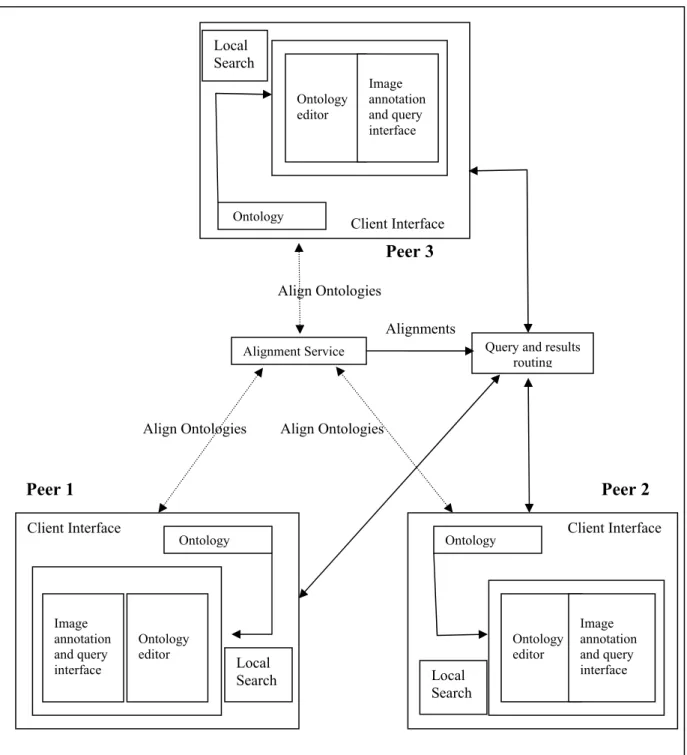
This thesis work combines the ontology based annotation techniques, p2p systems and ontology alignment techniques by developing a basic prototype. In particular it provides the following:
1. An architecture for solving the problem cited in the previous section. The architecture prototype is implemented in a peer-to-peer photo annotation scenario. 2. An application prototype for personal ontology based photo annotation and search: Although, a few ontology based photo annotation systems [SDWW01] [LB02] have been developed, all of them provide their own ontology or require the user to stick to a reference ontology. The prototype developed during this master thesis work allows the users to have their own ontologies by providing basic ontology editing functionalities in addition to the annotation functionality.
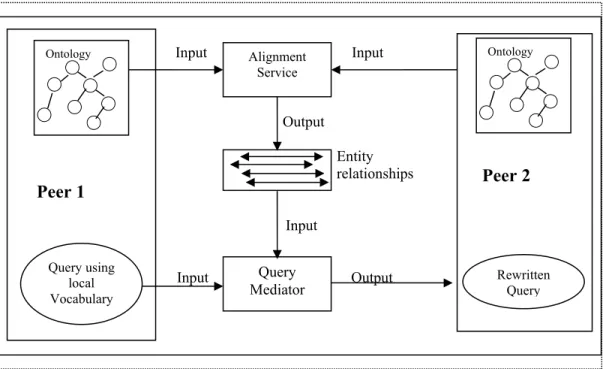
3. The architecture implemented can act as a test bed for evaluating ontology alignment algorithms by real users. A number of ontology algorithms have already been implemented in the alignment API developed by the researchers at INIRIA Rhone-Alpes. The architecture and real users’ metadata developed and attained through this masters’ work has been used to evaluate the algorithms implemented in the API.
4. The developed application tool has been used in a pilot experiment within the EXMO team of INRIA Rhone-Alpes.
1.3 Outline of thesis
This thesis is divided into six chapters. In this chapter, the contributions and introduction of the work was described. Also, the problem statement and the scenario were discussed.
Chapter 2 – The general concepts used in the thesis work are introduced. State of the art of the concepts used is then discussed. Two photo annotation tools are also discussed and a basis for the need of this thesis is developed.
Chapter 3 – The design tool and the prototype design are introduced. Moreover, the architecture of the application is constructed and explained in the following section.
Chapter 4 – Three implemented technologies are described in details. More specific functions of each approach and the realizations in the implementation are stated in this chapter.
Chapter 5 – An evaluation model of this thesis is explained. An experiment performed during the thesis is explained and the results are evaluated. The application developed is then compared with other similar systems.
Chapter 6 – The system developed is then compared with some of the existing systems.
Chapter 7 - The conclusion of this thesis and a summary of all experiences in this work is described. Finally, the future work stated as last section in this chapter. At the end of this thesis, the appendix and references of this thesis are presented.
Chapter 2
State of the Art and Fundamentals
This chapter presents an overview of state-of-the-art technologies which are related to the thesis work.
The World Wide Web has made a huge amount of information electronically available and the trend is growing continuously. So far, various communities have taken advantage of the current web functionalities to strengthen communication and information exchange not only within the community but also with external communities or individual users. Various web portals have appeared with the purpose of providing an open and effective communication forum for their members. In a typical case, a portal collects and presents relevant information for the community, and users can share the resources or information to the community. However, current Web technology presents many limitations to make information accessible for users in an efficient manner. The general problems to find information on the Web are: searches are imprecise, often yielding matches to many thousands of hits. Moreover, it is not possible to directly retrieve a particular piece of information, instead users have to read through all retrieved documents and identify the information manually. These limitations naturally appear in existing web portals based on this technology, making information searching, accessing, extracting, interpreting and processing a difficult and time-consuming task. In this context, the Semantic Web aims at automated information access and use based on machine-processable semantics of data.
This chapter is divided into six sections. Section 2.1 discusses ontologies as the backbone of the Semantic Web. Section 2.2 gives an overview of the ontology query languages and briefly presents one of them which has been applied in this thesis work. Section 2.3 presents the currently applied techniques for dealing with the semantic interoperability problem as discussed in the last chapter. An overview of the peer-to-peer paradigm has been mentioned on section 2.4. Section 2.5 introduces the related work which also provides a basis and a scope for this thesis. Finally, section 2.6 discusses the conclusion of this chapter.
2.1 Ontology Languages
Semantic Web enables automated information access and use based on machine-processable semantics of data. Ontologies [Fen01] are backbone technology for the Semantic Web and - more generally - for the management of formalized knowledge in the context of distributed systems. They provide “machine-processable semantics” of data and information sources that can be communicated between different agents (software and people). In other words, information is made understandable for the computer, thus assisting people to search, extract, interpret and process information.
The proposed mechanism for meaningful communication between people and / or machines within the World Wide Web is to add semantic markup to Web resources in order to explicitly describe their content. This semantic markup makes use of terms for which ontologies provide a concrete specification of their meaning. The significant term structure of ontology languages currently under development for the Web consists of at least two elements: classes and relationships (properties) that can exist among classes. Different types of ontologies are distinguished according to the purpose of their usage. The most common ontology types used in Semantic Web are domain ontologies and application ontologies. Several ontology languages have been developed during the last few years which are defined keeping the Web in mind. For applications on the web it is important to have a language with a standardized syntax. Because XML emerges to be the standard language for data interchange on the web, most of the ontologies use XML syntax. Two such languages RDFS [BG04] and OWL [McvH04] are briefly discussed in next subsections. For the purpose of this thesis OWL ontologies have been adapted because it is increasingly becoming a candidate for the standard vocabulary description language.
2.1.1 RDF Schema
The two basic structuring elements as mentioned above, namely classes and relationships are provided by the Resource Description Framework Schema (RDFS), the lowermost ontology language of the Semantic Web language layer architecture. As with the following ontology languages, RDFS usually is serialized as XML document in order to meet the syntactical requirements of today’s Web communication protocols. RDFS can be considered as a very simple ontology language allowing the definition of class hierarchies via subClassOf statements.
For example, Toyota can be defined as some kind of Car as follows: <rdfs:Class rdf:ID="Toyota">
<rdfs:subClassOf rdf:resource="#Car"/> </rdfs:Class>
Semantically this can be expressed in first order logic (FOL) as an implication between two unary predicates: 8x:Toyota x` a
[Car x` a.
The possible combinations of classes and properties can be restricted by qualifying the domain and range of properties. An owner relationship for cars, called Car-Owner, is narrowed in its domain to the class Human and in its range to Car in the
following:
<rdf:Property rdf:ID="Car-Owner">
<rdfs:domain rdf:resource="#Human"/> <rdfs:range rdf:resource="#Car"/> </rdf:Property>
The FOL correspondence to properties are binary predicates. According to that, the semantics of the property definition is as follows:
8x, y:Car @ Owner x, y` a
[Car y` a and 8x, y:Car @ Owner x, y` a
[Human x` a .
Property hierarchies can also be defined analogous to class hierarchies using
subPropertyOf statements.
2.1.2 Web Ontology Language (OWL)
OWL is developed as a vocabulary extension of RDF Schema and is derived from the DAML+OIL Web ontology language. This extension covers class language constructs like conjunction, disjunction, negation, existential and universal qualified quantification and cardinality constraints of properties (plus some others). OWL itself provides three increasingly expressive sublanguages. The least expressive sublanguage is OWL Lite. We briefly discuss some of the constructs which are typical of OWL language. Syntax and semantics of all constructs can be found in [McvH04].
In OWL, a class can be defined as conjunction of other classes or class descriptions using the intersectionOf statement. For example, it might be rational to define Toyota as the conjunction of the classes Car and Made-in-Japan:
<owl:Class rdf:ID="Toyota"> <rdfs:subClassOf> <owl:Class> <owl:intersectionOf rdf:parseType="Collection"> <owl:Class rdf:about="#Car"/> <owl:Class rdf:about="#Made-in-Japan"/> </owl:intersectionOf> </owl:Class> </rdfs:subClassOf> </owl:Class>
Semantically, this corresponds to logical conjunction in FOL:
8x:Toyota x` a
[Car x`
OWL provides a way for specifying universal qualified quantification for locally restricting the range of a given property within a class definition. For example, a
GermanCar is a car for which all fillers of the property MadeIn are of type Germany: <owl:Class rdf:ID="GermanCar"> <rdfs:subClassOf> <owl:Class> <owl:intersectionOf rdf:parseType="Collection"> <owl:Class rdf:about="#Car"/> <owl:Restriction> <owl:onProperty rdf:resource="#MadeIn"/> <owl:hasValue rdf:resource="#Germany"/> </owl:Restriction> </owl:intersectionOf> </owl:Class> </rdfs:subClassOf> </owl:Class>
The fragment from above has the following semantics in FOL:
8x:GermanCar x` a [Car x` a V 8y :MadeIn x, y` a [y= Germany b c .
Additionally, OWL Lite extends RDFS for transitive, inverse, and symmetric properties. A perfect example of a transitive property within the car world is the car-model relationship olderModel:
<owl:TransitiveProperty rdf:ID="olderModel"/>
Semantically, a transitive property enforce that:
8x, y, z:olderModel x, y`
a VolderModel y, z` a
[olderModel x, z` a . An inverse
property of a given property can be defined as follows:
<owl:ObjectProperty rdf:ID="Is-Car-Of">
<owl:inverseOf rdf:resource="#Car-Owner"/> </owl:ObjectProperty>
In FOL this means: 8x, y:Is @ Car @ Of x, y` a
[Car @ Owner y, x` aand vice versa.
A symmetric property can be introduced as follows:
<owl:SymmetricProperty rdf:ID="Friend-Of"/>
This definition imposes the following FOL semantics:
8x, y:Friend @ Of x, y` a
[Friend @ Of y, x` a
The underlying semantics of these definitions allows inferring logically entailed knowledge implicitly encoded in the cars domain ontology discussed here. Usually, logical reasoning systems are used for making such knowledge explicitly available for users.
2.1.3 Ontology Classification and Use
There are several classifications for ontologies extensively covered by available literature in different fields ([Fen01] [Bru03]). Some are based on quantity and conceptualization type, others are established based on the scope of their applicability, and still others based on their usability and/or reusability.
Two classification schemes which are along the goals of this thesis are mentioned below. The first is based on complex needs to represent the domains of interest and also on the type of use to be made of them in the system. The second focuses on the levels of decentralization of the system and the possible dissemination and spreading of concepts across the entire network.
2.1.3.1 Lightweight and heavyweight ontologies
Lightweight and heavyweight ontologies; both contain concepts, generalizations and
relationships, but heavyweight ontologies, in general, also allow specification of cardinality constraints, refined statements and axioms, while lightweight do not:
• Heavyweight: the ontologies contain rules in formal computer language and are used to perform various forms of runtime automated reasoning. In defining heavyweight ontologies the language must be selected carefully because high expressiveness is needed to declare the large number of axioms. Since they can also be used for reasoning, the language must support them. Some examples of languages include OIL/DAML1. They are normally used as references, since their use is cumbersome.
• Lightweight: these only describe concepts, relations and functions, not rules. The concepts described by their attributes are organised using only the subclass of the relationship. These ontologies are used primarily as a base for organising and standardizing content. Taxonomies, concept hierarchies, and object models and diagrams are common ways to express lightweight ontologies. Their objective is to be shared by a series of users who converge on a particular common world view.
2.1.3.2 Local and shared ontologies
The classification based on local vs. shared ontologies addresses the decentralization issue of any ontology-based application. In open environments, ontologies are developed and maintained independently of each other in a distributed setting. Therefore, two systems may use different ontologies to represent their view of the domain.
If each source has its own local ontology, to achieve interoperability the ontologies must be brought together by mapping links. Here the link between the ontologies must be small.
If all the local ontologies are developed from a common vocabulary, we use the term shared ontologies to describe the ontologies that share the same vocabulary but are allowed to describe more complex semantics. This approach allows a degree of local autonomy and facilitates the mapping between two ontologies predetermined by their relationships with the shared mediated ontology.
2.1.4 Expressivity and Complexity
Expressiveness of an ontology language is a key decision factor in determining its applicability and usefulness in a particular domain description. Normally, there is always a trade-off between the expressive power and efficient reasoning support provided by a language. Generally, the richer the expressiveness of an ontology language, the higher is the complexity associated with it which ultimately results in lack of support for efficient reasoning.
Any ontology language has got two key requirements, namely, a well-defined syntax and a well-defined formal semantics. A well-defined syntax is a key requirement for making the ontology machine-readable. RDF/S certainly has a very well defined syntax. However, because of its lack of reasoning support, it lacks on the semantics issue. The issues typical of RDF/S are discussed later in this section.
Formal semantics is used to describe a precise meaning of knowledge. It is an
important factor for ontology languages because the semantics does not refer to subjective perceptions and is interpreted in one single way by all machines and/or humans. A well-defined semantics allow machines to reason about the knowledge. For ontological knowledge, reasoning has to be done on concepts like class relations such as equivalence of classes, consistency and class memberships.
To support reasoning, proper semantics is required which should be able to check the consistency of the ontology and knowledge; and should be able to classify instances in classes. It should also be able to check unintended relationships between the classes. These requirements are important for the purpose of designing large ontologies which are developed by multiple authors. They are also important for integrating and sharing ontologies from multiple sources.
RDF/S has got its own limitations. RDFS expresses ontological knowledge by using an organization of vocabulary in typed hierarchy. The hierarchy is defined using primitives such as subclass and sub-property relations; domain and range restrictions; and instances of classes. However the language provided by RDFS is weaker because of a number of reasons like – Cardinality restrictions are impossible to express in RDF; RDFS does not allow Boolean combination of classes; it is not possible to express disjoint classes, and so on [Sha05].
Reasoning and Description Logic
Depending on the ontology formalism different mechanisms can be used to enhance systems usability. For example a reasoner can be employed to check cardinality constraints and class membership or an inference engine could interpret symmetric or transitive relationships. Reasoning is an important factor in determining the quality of an ontology. It is important to identify inter and intra ontology relationships and to check consistency of the annotations attached to the ontology. Description logics provide the reasoning support and hence act as a very strong base on which latest ontological languages have been developed. [BHS03] defines Description logics as following: Description logics (DL) are a family of knowledge representation languages that can be used to represent the knowledge of an application domain in a structured and formally well-understood way.
Since description logics provide a well-defined semantics and powerful reasoning tools which are needed for Semantic Web and its integration; researchers of the semantic web community decided to use its expressive power for developing ontology languages. OWL is one such language which is based on RDFS and its semantics is defined in expressive description logic. It is considered to be accepted as a potential standard for the Semantic Web.
Since OWL is developed on top of RDF, ideally the best approach to increase the semantic capability of language would be to use complete RDF syntax and a full logic together. However due the tradeoff discussed above, such a language will be computationally inefficient for many purposes. Because of these reasons, the W3C Web Ontology Group decided to define OWL as three different sublanguages viz. OWL Lite, OWL-DL and OWL Full; each of which has got varied level of expressiveness and complexity.
2.1.5 Editing
A number of ontology editors like Protégé, OntoEdit have been developed for ontology creation and their edition. These editors are quite exhaustive by nature and provide a number of ontology management functions. For the purpose of this master work, some stand-alone simple ontology editing functionalities required for ontology based photo annotation have been developed.
Some other aspects of ontologies especially when speaking in terms of interoperability problem are discussed in section 2.4
2.2 Ontology Query Languages
The support of querying facilities has always been a primary requirement for repositories of any kind. The proliferation of knowledge caused by the widespread use of the Web as a knowledge communication platform has posed the same and
even more imperative requirements for performing queries and thus locating desirable resources into the vast information space. However, the data models used to represent and encode knowledge on the Web differ from the traditional data structures. As discussed in previous section, RDF, RDFS and OWL are the emerging standards used to encode web-based data. Thus, the functionality a querying language should support must take into account the structure and the peculiarities of the new paradigms. In particular, RDF and OWL are based on a directed labeled graph data model, which allows labels both on nodes and edges, while XML uses labels only on edges. Both models can be serialized in a number of different representations, one of which is the use of triples in the form of <predicate, subject, object>.
This section briefly gives an overview of the existing ontology query languages and their requirements and explains the SPARQL [PS06] query language which is used in this thesis work for querying the ontology based metadata. It also briefly compares SPARQL with two other query languages. However before describing these languages, the features that are typical of query languages are mentioned as below:
• Expressiveness. Expressiveness indicates how complex queries can be formulated in a given language. Usually, expressiveness is restricted to maintain other properties such as safety and to allow an efficient execution of queries.
• Closure. The closure property requires that the results of an operation are again elements of the data model. This means that if a query language operates on the graph data model, the query results would again have to be graphs.
• Adequacy. A query language is called adequate if it uses all concepts of the underlying data model. This property therefore complements the closure property: For the closure, a query result must not be outside the data model, for adequacy the entire data model needs to be exploited.
• Orthogonality. The orthogonality of a query language requires that all operations may be used independently of the usage context.
• Safety. A query language is considered safe, if every query that is syntactically correct returns a finite set of results (on a finite data set). Typical concepts that cause query languages to be unsafe are recursion, negation and built-in functions.
2.2.1 Overview of ontology query languages
There are a number of ontology query languages which are based on the criteria for stating whether the query language can exploit the presence of ontology (schema) knowledge, i.e., if the ancestor/descendant traversal of class/property hierarchies can be performed and what filtering conditions can be posed on class/property hierarchies. The basic criterion of the Data Querying is the ability of the query language to provide constructs for calculating the extent of a property/class, i.e., the
ability to find all the resources defined as instances of a particular property/class. Furthermore, in this category fall criteria such as the support of complete Boolean filters (negation, conjunction, disjunction), set-based operations (union, intersection, difference), arithmetic operations on data values and container values constructors, i.e., language constructs that can be used to build sequences or bags.
Data/Ontology Querying refers to the competence of the query language in
combining data and ontology querying in a query expression. The basic way to perform such an advanced query is to use generalized path expressions. A generalized path expression queries data and ontology at the same time, thus enabling the formulation of queries on description bases without exact knowledge of the ontologies employed. Generalized path expressions, as well as the support of existential/universal quantifiers and nested queries are indicative criteria of the expressive power of a query language. Furthermore, there are a number of additional features which are used to evaluate the effectiveness of the query language and the added value of its use when it comes to real, large scale applications. The support of aggregate (min, max, average, sum, count), grouping (e.g., an SQL-equivalent to group_by clause), sorting (for ordering querying results) and built-in data functions (e.g., math and string/date converting functions), in combination with the facilities to support the definition of arbitrary functions and user-defined inference rules are features that add to the expressive power of the query language.
Work on RDF query languages has been progressing for a number of years. Several different approaches have been tried, ranging from familiar looking SQL-style syntaxes, such as RDQL [Sea04] and Squish [Mil02], through to path-based languages like Versa . SPARQL follows this trend and is addressed in the next sub-section.
2.2.2 SPARQL Query Language
SPARQL is a query language and protocol for RDF being designed by the W3C and is undergoing standardization by the RDF Data Access Working Group (DAWG). As mentioned in the SPARQL working draft [PS06], SPARQL is a query language for getting information from such RDF graphs. It provides facilities to:
• extract information in the form of URIs, blank nodes, plain and typed literals.
• extract RDF subgraphs.
• construct new RDF graphs based on information in the queried graphs. The SPARQL query language is based on matching graph patterns. The simplest graph pattern is the triple pattern, which is like an RDF triple, but with the possibility of a variable instead of an RDF term in the subject, predicate or object positions. Combining triple patterns gives a basic graph pattern, where an exact match to a graph is needed to fulfill a pattern.
SPARQL actually consists of two separate specifications. The query language specification makes up the core. Additionally, the query results can be described in XML format for serializing the results of a SPARQL SELECT (and ASK) query. This simple format is easily processable with common XML tools such as XSLT. The second specification is the data access protocol which uses WSDL 2.0 to define simple HTTP and SOAP protocols for remotely querying RDF databases. The XML results format is used to generate responses from services that implement this protocol.
The focus on SPARQL in this thesis has been on the query language itself. The W3C defines four distinct types of SPARQL Queries depending on different keywords used in the query: select, ask, construct and describe. The type of the query determines the result format. Each of the query type has been shown below with a basic example. A detailed syntax and description can be found in [PS06].
• SELECT: returns a table of variable/value bindings. These bindings can also be returned in an XML format. The example below shows a SPARQL query to find the name and email address of a person from the information in the given RDF graph (graphG1). The query consists of four parts, the PREFIX
clause determines the namespaces used in the query; the SELECT clause identifies the variables to appear in the query results; the FROM clause determines the RDF graph to be queried; and the WHERE clause has one triple pattern.
Query:
PREFIX ex: <example.org/ex1> SELECT ?name ?mbox
FROM <http://example.org/graphG1.txt> WHERE { ?X foaf:name ?name . ?X foaf:mbox ?mbox . } Result: ?name ?mbox Jerome [email protected] Faisal [email protected] Arun [email protected]
• ASK: returns a boolean value as the result, depending on the predicates used in the WHERE clause
Query: The following SPARQL query checks if there exists an RDF subject in the given graph with name and mbox as the objects.
PREFIX ex: <example.org/ex1> ASK FROM <http://example.org/graphG1.txt> WHERE { ?X foaf:name ?name . ?X foaf:mbox ?mbox . } Result: True
• CONSTRUCT: The CONSTRUCT result form returns a single RDF graph specified by a graph template. The result is an RDF graph formed by taking each query solution in the solution sequence, substituting for the variables into the graph template and combining the triples into a single RDF graph by set union. The following SPARQL query return the complete RDF triples that satisfy the conditions mentioned in the WHERE clause.
Query:
PREFIX ex: <example.org/ex1> CONSTRUCT { ?X foaf:name ?name} FROM <http://example.org/graphG1.txt> WHERE { ?X foaf:name ?name . ?X foaf:mbox ?mbox . } Result:
@prefix foaf: <http://xmlns.com/foaf/0.1/> _:b0 foaf:name “Jerome”
_:b0 foaf:mbox <mailto: [email protected]> _:b1 foaf:name “Faisal”
_:b1 foaf:mbox <mailto: [email protected]> _:b2 foaf:name “Arun”
_:b2 foaf:mbox <mailto: [email protected]>
• DESCRIBE: According to current conventions, DESCRIBE form returns a single result RDF graph containing RDF data about resources. This data is not prescribed by a SPARQL query, where the query client would need to know the structure of the RDF in the data source, but, instead, is determined by the SPARQL query processor. The query pattern is used to create a result set. Since there is not a common consensus on the use of DESCRIBE queries, they were not used by this project.
2.3 Semantic Interoperability
With current ontology standards, a manual or automatic ontology co-ordination is a challenging task. In evolving domains, it is expected that ontologies will not remain
static and various versions of ontologies will have to be tracked. Interdisciplinary ontologies may need to be created from existing domain-specific ontologies, domain specific ontologies may need to be merged with more general ontologies, different versions of single-domain ontology may need to be merged, and new information may need to be merged with existing ontologies. Furthermore, new ontologies may be built by merging information from heterogeneous databases or other information sources. Hence, these ontologies will have to be reconciliated. Such a semantic reconciliation has been termed as ontology alignment in [EP04] [EP04], which involves finding relationships between objects belonging to different ontologies. These ontology alignment results can be used for various purposes such as displaying the correspondences, transforming one source into another, creating a set of bridge axioms or rules between the ontologies, or generating query wrapper. [EP04] defines the problem of ontology alignment as following: given two ontologies each describing a set of discrete entities (which can be classes, properties, rules, predicates etc.), find the relationships (e.g. equivalence or subsumption) holding between these entities.
2.3.1 Ontology Matching vs. Schema Matching
Before introducing the specifics of ontology alignment techniques, it is important to differentiate two form of interoperability, viz. syntactic and semantic interoperability. While syntactic interoperability is mostly dealt with schema matching techniques [RB01] [RaB01] [EBB+04] [Shv04], semantic interoperability is addressed by ontology matching/alignments. Ontologies provide a shared and common understanding of domain that can be communicated between people with distributed or heterogeneous application systems. On the other hand a schema defines a set of relations and certain integrity constraints. A detailed comparison of schema matching and ontology is out of the scope of this paper [see 7]. However, it is worthwhile to note that although (unlike ontologies) schemas do not provide explicit semantics for the data they represent; both schemas and ontologies provide a vocabulary of terms that describes the domain of interest.
2.3.2 Ontology Alignment
Ontology Alignment ([EP04] [KS03] [ES05] [Euz05]) is the task of establishing a collection of binary relations between the vocabularies of two ontologies. Since a binary relation can itself be decomposed into a pair of total functions from a common intermediate source, the alignment of two ontologies O1 and O2 can be
described by means of a pair of ontology mappings which generates an alignment
O0. Such an aligned ontology is generated in a way that further merging of ontologies can be carried out. The intuitive way of such an alignment consists of defining a pair-wise distance between entities of ontologies and computing the best match between them by minimizing the distance of similarity measure between them. Roughly speaking, these entities correspond (but not limited) to the following: classes, relations, properties and instances of classes and properties.
2.3.3 Classification of ontology alignment techniques
The pair-wise similarity distance measure and matching described in previous section can be done by different methods. As discussed in [SE05] and [EBB+04], the use of appropriate methods depends on the objects to be compared, their context and their external semantics. Figure 2.1 taken from [SE05] presents such a context classification. The figure decomposes these methods in two perspectives: kind of techniques used (top-to-bottom) and the kind of manipulated entities (bottom-to-top). The lower layer is concerned with the type of input considered by the technique use which can be broadly classified into extensional, terminological, structural and semantics. The next layer further classifies it on language methods and distinguishes structural methods into external or internal structures. This lower classification is briefly described below.
Figure 2.1: Classification of ontology alignment approaches [SE05] Terminological methods
Terminological methods focus on string comparison. They can be applied to the name, the label or the comments concerning the entities to find those which are similar. This can be used for comparing class names and/or URI. In terminology, the relation between terms and concepts can have multi-meanings, i.e. terms can refer to more than one concept, and a single term can have many variants, all
related to a single concept. The concepts can be represented by different names in different ontologies.
In [EBB+04] term-comparison has been specified in two categories which depends on the consideration of character strings only or if they use some linguistic knowledge.
String based methods: These methods take advantage of the structure of the string
as a letter sequence. String based methods normally find similar classes but not the alignment between them. Strings can be compared in many ways depending on ones perception, for e.g. an exact sequence of letters, an erroneous sequence of letters, a set of letters, etc.
Language based methods: These methods rely on using Natural Language
Processing techniques to find association between instances of concepts. These methods essentially depend on the expressiveness and productivity properties of the natural language, which implies that even technical terms can be expressed in different ways without altering their meaning.
Structural Methods
These methods are based on comparing the structure of entities of ontology instead of comparing their names. This comparison can be subdivided in a comparison of the internal structure of an entity or the comparison of the entity with other entities to which it is related.
Internal Structure: These methods are constraint based aligning methods which use
the criteria such as the range of properties, cardinality, transitivity and symmetry of properties to calculate similarities between the entities. Since the entities with similar internal structure or properties can be numerous, these methods are known to create alignment clusters rather than to discover accurate correspondence between the entities.
External Structure: This matching technique is based on the hierarchical positions
of entities in their respective ontologies. It is based on the criteria that if two entities from two ontologies are similar, their neighbours might also be similar. The criteria which can be used to find such similarity may include finding similarities at super and sub entities, sibling entities, descendant and leaf entities.
Semantic Approaches
The key characteristics of semantic methods are that they have model-theoretic semantics which is used to justify their results. Hence they are deductive methods. Propositional satisfiability (SAT) and modal SAT techniques represent a few examples of such techniques. In SAT techniques the alignment is described as a translation of the matching problem and mapping queries into a propositional
formula and then to check its validity. Modal SAT can be used for extending the methods related to propositional SAT to binary predicates. Its basis is to delimit propositional SAT from the case of trees which allows handling only unary predicates (like classes) by admitting binary predicates (like slots). The idea hence is to enhance propositional logics with modal logic or description logic operators. Therefore the matching problem is translated into a modal logic formula which is further checked for its validity using sound and complete satisfiability search procedures. Description logic techniques can be used to establish the relations between classes in a purely semantic manner.
2.3.4 Ontology Alignment API (OLA)
OLA [EP04] developed within the EXMO team at INRIA is a class of algorithms for ontology alignments which targets the following characteristics:
• covering all the possible characteristics of ontologies (i.e., terminological, structural and extensional);
• taking care of collection structures (lists, sets) and accounting for them during matching;
• expliciting all recursive relationships and finding the best matching through iteration.
OLA is implemented for ontologies described in OWL-Lite [EP04]. It uses the Alignment API and implementation that was recently developed by the Exmo team at INRIA-Rhone Alpes [Euz04] and the University of Montréal. The algorithm first compiles the OWL ontologies into graph structures unveiling all relationships between entities. These graph structures produce the constraints for expressing a similarity between the elements of the ontologies. The similarity between nodes of the graphs follows two principles: (i) it depends on the category of node considered (e.g., class, property), and (ii) it takes into account all the features of this category (e.g., superclasses, properties). This similarity is a weighted linear aggregation of the similarity measures between all the entities a couple of entities is in relation. This accounts for all the relationships between entities. However, these features (like subclasses) are sets of entities, the similarity between these sets of entities, thus depends on a local matching between these entities. A matching of both sets is considered which is: (i) of maximal total similarity, (ii) exclusive, and (iii) of maximal size.
Similarity between labels can be produced by any kind of particular terminological method (e.g., string distance, linguistic evaluation). Similarity between data values and data types can be provided by specialized external similarity measures (e.g., Euclidean distance, symmetric difference distance).
The definition of this similarity provides a set of equations whose variables are the similarity values between entities of the ontologies. This set of equations cannot be solved directly due to local matching. Depending on the currently computed similarity, the matching as defined above can be different. An iterative algorithm
has been proposed in [Euz04] which compute a first approximation of the similarity (without the local matching), then compute the local matching and reiterate.
From this solution, it is possible to extract an alignment between the two ontologies. This ontology alignment API will be used in the master’s thesis work to compare the existing alignment algorithms.
2.4 Peer to Peer Systems for Knowledge Exchange
Peer-to-Peer computing (P2P) allows devices to communicate and collaborate through a connecting network without reference to a central server. It also provides the functionality as a decentralized discovery system and point-to-point messaging system. The peers are software components that have to agree upon a common set of rules to publish, share and access “resources” like services, data or applications, and communicate among each others. P2P infrastructures are especially suitable for all areas where there can’t be a centralized control. These infrastructures allows for the much needed degree of autonomy. A detailed description on advantages of P2P systems can be found elsewhere in the literature.
Napster [NAP01] was among the first real-world applications that used P2P technology to share music files. But in organizational/personal context, business applications for P2P computing fall into a handful of scenarios like:
• Peer-to-peer collaboration among the users.
• Helping businesses deliver services and capabilities more efficiently across diverse geographic boundaries.
• Allowing computing networks to dynamically work together using intelligent agents. Agents reside on peer computers and communicate various kinds of information back and forth. Agents may also initiate tasks on behalf of other peer systems.
Lately, P2P infrastructures have been considered to be especially suitable for distributed knowledge management applications, as used in this thesis.
But today’s P2P solutions have some issues:
• In many projects, P2P is just a solution for distributing disk space. But this is the minor importance for knowledge management. It is the sharing of information and knowledge which needs to be supported.
• At the moment, search and retrieval are limited just to keyword-based search. No support for metadata is provided.
• Query answering uses resources in a single location, while many queries require combination of information from different sources.
Theses issues make traditional P2P solutions invalid for knowledge sharing purposes. It is necessary to design and implement the system over a P2P framework, (like JXTA [JXTA]) to fit the distributed knowledge resources.
2.5 Closely Related Work
This section describes some of the work that has been done in the areas which are dealt within the master’s thesis viz. annotation with ontologies and semantic peer-to-peer systems techniques.
2.5.1 Image annotation
Recent advances in storage media along with the web have enabled users to store and distribute photographic images worldwide. However, with this ever increasing content of digital images either locally or on the web, finding suitable photographs for a particular purpose is increasingly problematic. A number of annotation tools have been devised in this direction. Some of them are discussed below:
Standalone Tools: Lately, a number of tools have been developed that work as
photo organisers. These tools, such as iPhoto and Picasa, provide a number of basic functionalities to annotate personal photo collection. Simple keyword based search is also provided. Such tools are good when used only for personal uses. However, they do not provide any functionality for sharing the photos with other users.
Web Portals: Since last few years, a number of websites have come-up which
provide means to publish a collection of digital photos online in a centralized and organized fashion but with no formal knowledge specifications. These web portals (e.g. flickr.com) are based on semi-structured indexing schemes that allow a keyword search. Flickr’s popularity has been fueled by its innovative community tools that allow photos to be tagged and browsed by folksonomic means. Although currently a hit among the masses, such portals lack the personalization aspect of searching and sharing. In a normal scenario tags are not sufficient to annotate the pictures properly. Hence although such portals are good for sharing the pictures with a larger group like on world-wide-web, they are not very useful when one wants to share the picture only with a limited number of people. Finally, keyword based searches return hundreds of pictures that may not be of interest to the user.
Ontology based image annotation: With the emergence of semantic web standards
such as resource description framework and related languages like OWL, creating a syntactic format with semantic background knowledge is possible. This makes the process of searching and annotating more precise. This technique can be used to index and search collections of photographs by storing background knowledge about the pictures in ontologies. This section briefly describes some of the existing tools which provide the capability to annotate images based on ontological descriptions.
Photo Annotation Tool (University of Amsterdam) [SDWW01]
This tool was one of the first photo annotation applications to make use of ontologies. The goals of the tool development were intended for assisting magazine editors and others to search the photographs quickly from their collection. Following are the key highlights of this tool:
1. The tool used the notion of structured annotation by using subject matter ontologies written in RDF-Schema. Two kinds of ontologies were used: (a) A photo annotation ontology, which specifies an annotation’s structure independent of the particular subject matter domain. This ontology provides the basic template for the annotation construction, and (b) subject matter
ontology which specifies the vocabulary and background knowledge of the
photo’s domain. For this purpose, the tool developers developed a domain ontology based on phylum hierarchy of animal species through a set of subclass relations between the species classes.
2. The tool reads an RDFS file containing ontology specification which conforms to W3C standard. From the RDFS specifications, the tool generates a user interface for annotating photos. The user can then annotate the pictures based on the ontologies loaded by the tool. The user interface generator is defined independently of the ontology. The tool just reads the RDFS representing annotation schema. For each property of this schema that represents another compound schema, it generates a tab or sentence item.
3. The tool also provides a simple query interface to test the annotations. It searchers the database for annotations that have all properties specified in the target description filled with values that are equal to or specializations of the value in the target.
Although this tool did not provide extensive query mechanisms and was based on static ontologies, it was first of its kind which triggered research in ontology based annotation approaches in other field like music as well.
RDFPic (INRIA-Sophia Antipolis, MIT, Keio) [RDFPic]
RDFPic is also one of the fist tools providing ontology based annotation facility. It is a tool to ember RDF descriptions of a picture into the image itself. It is built around the concept of an RDF "schema". Each schema has a number of attributes whose values can be set. For instance, a schema "rendering" could include a "Renderer used" field. Each of these schemas has a tab in the left bottom section of the RDFpic interface. The tool provides two default schemas viz. Dublin Core and a Technical Schema which specifies the technical. Each of the attributes of a schema has a row in the tab pane. The tool can be plugged in with web-servers like Jigsaw [LM99] to serve either the either the JPEG image data or the RDF description that is stored in it. The choice can be made by using HTTP content negotiation to determine which of the two a client wants.
However, the tool doesn’t take care of the existing annotation in the image files, for examples those generated by the camera in the EXIF tags. Moreover it is based on very basic schemas which don’t take advanced semantic relations between the entities.
PhotoStuff (Mind Lab, University of Maryland) [hWGS+05]
PhotoStuff is an image annotation tool (written in Java) which uses an ontology to provide the expressiveness required to assert the contents of an image, as well information about the image (date created etc.). In order to provide this capability, an underlying OWL ontology has been defined that describes various concepts such as region, image etc. and properties including hasRegions, depicts etc. This allows assertions to be made stating that an image contains a region that depicts some concept.
PhotoStuff allows users to annotate regions of an image with respect to concepts in any ontology specified in RDFS or OWL. It provides the functionality to import images, ontologies, instance-bases, perform markup, and export the resulting annotations to disk or a Semantic Web Portal. PhotoStuff can extract the existing metadata from the images and encode them in RDF/XML formats. It also maintains a loose coupling with a Semantic Web portal and can retrieve all the instances that have been submitted to the portal and submit generated RDF image markup.
2.5.2 Semantic peer-to-peer systems
Numerous advantages have been cited in literature about the advantages a peer-to-peer system over centralized applications: scalability in data volumes, robustness against failure of single component; to name a few. However, besides being the solution to many problems, the large degree of distribution of Peer-to-Peer systems is also the cause of a number of new problems: the lack of a single coherent schema for organizing information sources across the Peer-to-Peer network hampers the formulation of search queries, duplication of information across the network results in many duplicate answers to a single query, and answers to a single query often require the integration of information residing at different, independent and uncoordinated peers.
The research community has recently turned to the use of semantics in Peer-to-Peer networks to alleviate these problems [PJR+04] [SWAP2]. The use of semantic descriptions of data sources stored by peers and indeed of semantic descriptions of peers themselves helps in formulating queries such that they can be understood by other peers, in merging the answers received from other peers, and in routing queries across the network. In particular, the use of ontologies and of Semantic
Web technologies has been identified as promising for Peer-to-Peer systems. This section briefly reviews two such existing systems.
Edutella
The Edutella network implements an RDF-based metadata infrastructure for P2P networks based on JXTA framework. In order to access content stored on the network it uses the query language RDF-QEL.
Edutella network connects highly heterogeneous peers (in their up time, performance, storage size, number of users, … ) implementing a set of services:
Query service (this is the most basic service and allow the peers register the queries
it may be asked and standardized query and retrieval of RDF metadata), Replication
service (providing support to storage by replicating data in different peers and
workload balancing), Mapping service (translating between different metadata vocabularies to enable interoperability between different peers), Mediation service (to join data from different sources and reconcile conflicting and overlapping information), Clustering service (to set up semantic routing and semantic cluster using semantic information) and Annotation service (to annotate materials stored anywhere in the network).
An Edutella peer has some kind of local storage for RDF triples (e.g., a relational database), as well as some kind of local query language. (e.g., SQL). One of the Query service purposes is to abstract the metadata that describes the content of a peer, from various possible RDF storage layer language and user lever query language. For that, it uses the Edutella Query Exchange Language and Edutella Common Data Model (ECDM) that provide syntax and semantics needed to achieve this goal.
Edutella wrappers enable the peer to translate queries and results from Edutella query and result exchange format to the local format of the peer and vice versa, and to connect the peer to the Edutella network. For communication with the Edutella network the wrapper translates the local data model into the ECDM and connects to the network using JXTA P2P primitives, transmitting the queries based on ECDM in RDF/XML form.
In considering the functionality provided by Edutella, we can say that its main asset is that it favours broad interoperability among heterogeneous peers. Edutella Mapping Service will handle the mapping among peers so that the system properly manages the use of multiple ontologies with overlapping information. This is really its primary objective.
The ability to use metadata to specify the type of queries that a peer can receive favours enormously an adequate selection of peers to obtain the most precise response. However, there are no reliability mechanisms in one peer or another when faced with possible contradictory or imprecise responses.
Using a common language for exchanging queries and results requires local translation in each peer. This could result in reduced results performance, as well as limited capacity in expressiveness in the language of each peer. Additionally, each peer can only describe resources from a single source (which is known in Edutella as RDF repositories).
Another of the problems with Edutella is its possible inefficiency in managing traffic from queries over the network or Peer selection service routing: the selection is done not at the selecting peer but at the receiving peer. This means that the query is broadcasting through the network and then, this only scales well in small groups. It uses the standard services of JXTA to find peers and to route messages.
Bibster
Bibster [BEH+04] is a Peer-to-Peer system based on the SWAP architecture [SWAP], which allows to easily integrate, share and search bibliographic metadata using semantic technologies for the representation of the bibliographic instances and the peers’ expertise to allow effectively routing of the queries. It addresses a typical problem in the daily life of a computer scientist, where one regularly has to search for publications or their correct bibliographic metadata. Semantic similarity measures identifying duplicates allow to visualize and to integrate the heterogeneous search results from the peers. Bibliographic entries are extracted from BibTex into an ontology. The query results themselves represent small ontologies, containing duplicates.
Finding duplicates is related to finding corresponding mappings. In both cases it is necessary to recognize identical objects despite their different identifiers. In the given scenario duplicates are bibliographic entries which refer to the same publication or person in the real world, but are modeled as different resources. The similarity function is based on different features of the respective instances. For persons one can refer to the name. For publications to title, authors, editors, journal, address, type of publication, etc. The function returns a value between 0 and 1 by applying specific heuristics to every feature: Strings are compared using the Levenshtein distance; the authors of publications are compared by comparing the two sets. Some domain specific features require special heuristics: if the type of one publication is “Misc”, this only means that no further information about the type was available. If another publication is e.g. type “Article” the similarity is set to 0.5 rather than 0. Besides individual functions, the approach focuses on applying an aggregation function to achieve an overall similarity. Through transitive closure a set of identical entities is gained and duplicate query results are visualized as one merged resource. A relatively detailed explanation of similarity measure techniques is describes in the next section.
2.6 Conclusion
This chapter introduced some concepts according to the thesis requirement. Also, state-of-the-art of used technologies has been described.
A requirement case was formed after studying that current ontology based annotation systems do not allow a scope for personalization of the vocabulary used. Moreover, to the best of our knowledge, we have not come across any peer-to-peer and ontology based photo annotation tool. A comparison between the existing semantic P2P systems and the one developed during this thesis work is drawn in chapter 7.
Chapter 3
Design and Architecture
This chapter presents the high level system architecture of the application prototype called PicSter developed during the thesis work. Section 3.1 introduces the problem and their possible solutions along with the requirement specifications followed by section 3.2 gives the system design of the architecture. Implementation related information is described in the next chapter.
3.1 Introduction & Requirement Specifications
In this section, we revisit the example scenario described in section 1.2. The scenario is split into sub-scenarios as user requirements with each of them followed by possible solutions to the problem faced and a recommendation to the PicSter. Each sub-scenario is presented as a user requirement, following which a system requirement will be specified after analysing the possible solutions.
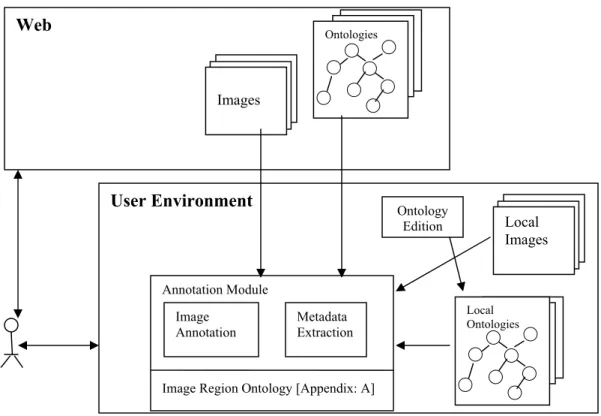
User requirement: Users want to annotate local as well as web resources, images in
the case of PicSter.
Possible solutions: Schema based metadata; ontology based annotation.
The importance of data is quite well known but data without meaning are not very useful on their own, since they are ambiguous. The data used to describe the data itself is termed "metadata". One of the options used most to define metadata is the XML language. The metadata plays an important role in interoperability among different communities and applications by structuring the contents of the data.
However, something more powerful than metadata is required for a formal description of contents. Metadata allow us to structure the contents, but they do not help us define their semantics. One of the solutions is to use ontologies. The advantage of these is that they represent a standard and they are widely accepted by the research community.
![Figure 2.1: Classification of ontology alignment approaches [SE05]](https://thumb-eu.123doks.com/thumbv2/123doknet/14425317.706818/26.918.193.802.425.832/figure-classification-ontology-alignment-approaches-se.webp)
![Figure 4.2: Statements in Jena Ontology Model [Jena]](https://thumb-eu.123doks.com/thumbv2/123doknet/14425317.706818/49.918.285.645.467.718/figure-statements-in-jena-ontology-model-jena.webp)