HAL Id: tel-03187467
https://tel.archives-ouvertes.fr/tel-03187467
Submitted on 1 Apr 2021HAL is a multi-disciplinary open access archive for the deposit and dissemination of sci-entific research documents, whether they are pub-lished or not. The documents may come from teaching and research institutions in France or abroad, or from public or private research centers.
L’archive ouverte pluridisciplinaire HAL, est destinée au dépôt et à la diffusion de documents scientifiques de niveau recherche, publiés ou non, émanant des établissements d’enseignement et de recherche français ou étrangers, des laboratoires publics ou privés.
Activist worker’s responses to tensions in hybrid
organizations : the case of solidarity economy
Marie Lemaire
To cite this version:
Marie Lemaire. Activist worker’s responses to tensions in hybrid organizations : the case of solidarity economy. Business administration. Université de Strasbourg, 2021. English. �NNT : 2021STRAB001�. �tel-03187467�
UNIVERSITÉ DE STRASBOURG
ÉCOLE DOCTORALE Augustin Cournot
LaRGE
THÈSE
présentée par :Marie LEMAIRE
soutenue le 14 janvier 2021
pour obtenir le grade de :
Docteur de l’Université de Strasbourg
Discipline/ Spécialité
: Sciences de Gestion
Activist worker’s responses to tensions
in hybrid organizations :
The case of Solidarity Economy
THÈSE dirigée par:
Mme Hélène RAINELLI-WEISS Professeure des Universités, Université de Rennes 1 M. Patrick ROGER Professeur des Universités, Université de Strasbourg
RAPPORTEURS :
M. Damien MOUREY Professeur des Universités, Université de la Polynésie Française Mme Géraldine SCHMIDT Professeure des Universités, Université de Paris 1
AUTRES MEMBRES DU JURY :
Mme Jessie Pallud Professeure des Universités, Université de Strasbourg M. Philippe Eynaud Professeur des Universités, Université de Paris
3
Remerciements
Je remercie en tout premier lieu ma directrice de thèse, Hélène Rainelli-Weiss, qui a su à la perfection allier exigence et bienveillance. Je vois comme une grande chance d’avoir pu être encadrée, et plus encore soutenue par quelqu’un dont je partage la vision de la recherche, du travail et bien souvent de la vie en général.
Je remercie les autres membres du jury qui auront accepté de passer du temps pour prendre connaissance et commenter ce travail doctoral, et pour les réflexions que certains de leurs travaux ont pu m’inspirer.
Merci aux travailleuses et travailleurs de l’économie solidaire, qui ont sur ces trois projets, consacré plus de 200h de leur temps libre et m’ont aidée à trouver dans leur entourage les participants à cette étude. Connaissant la pénibilité du travail que beaucoup endurent, et combien ce temps est précieux, je ne peux qu’être touchée de ce don sans contrepartie, d’autant plus quand ces personnes ont partagé leur histoire avec authenticité et confiance.
Merci bien sûr à mes ami(e)s pour leur soutien indéfectible, matériel et pratique, leurs relectures attentives ou simplement pour leur touchant intérêt pour mon travail !
Je remercie mes collègues, et les membres du service Recherche pour la bonne humeur, les conseils et le soutien. Ces années resteront ponctuées de bons souvenirs.
Je remercie ma famille, et tout particulièrement ma mère qui m’a montré par son exemple, comme une évidence, qu’il était possible, à tout âge, et avec une charge de famille, de reprendre des études. Et bien sûr ma fille Céleste, qui m’a donné la force et la persévérance pour achever ce travail.
Déclaration sur l’honneur
Declaration of Honour
J’affirme être informé que le plagiat est une faute grave susceptible de mener à des sanctions administratives et disciplinaires pouvant aller jusqu’au renvoi de l’Université de Strasbourg et passible de poursuites devant les tribunaux de la République Française. Je suis conscient(e) que l’absence de citation claire et transparente d’une source empruntée à un tiers (texte, idée, raisonnement ou autre création) est constitutive de plagiat.
Au vu de ce qui précède, j’atteste sur l’honneur que le travail décrit dans mon manuscrit
de thèse est un travail original et que je n’ai pas eu recours au plagiat ou à toute autre forme de fraude.
I affirm that I am aware that plagiarism is a serious misconduct that may lead to administrative and disciplinary sanctions up to dismissal from the University of Strasbourg and liable to prosecution in the courts of the French Republic.
I am aware that the absence of a clear and transparent citation of a source borrowed from a third party (text, idea, reasoning or other creation) is constitutive of plagiarism. In view of the foregoing, I hereby certify that the work described in my thesis
manuscript is original work and that I have not resorted to plagiarism or any other form of fraud.
Nom : Prénom : Marie Lemaire Ecole doctorale : Augustin Cournot Laboratoire : LaRGE
Date : 12 mars 2021
5
Table of contents
Introduction 19
Overview 21
The activist worker 21
Tensions induced by militancy at work and organizational consequences 23 Hybrid organizations, refuge of the activist worker? 24 Research context: the case of the solidarity economy 27
Definition of solidarity economy 27
A hybridity generating paradoxes and individual tensions 29
The ambiguity of ideological positioning 29
Hybridization of resources 31
The absence of a legal framework and the need to legitimize one's belonging: solidarity economy
versus social economy 32
Increased tensions 32
Extended solidarity 32
Economic difficulties 32
Conclusion: the special interest of the solidarity economy as a field of research 34
Structure of the thesis 35
Epistemological posture 40
Relationship with the field 40
Posture towards Critical Management Studies (CMS) 46 Chapter I “Sometimes I wish I didn’t care…” - Constructing paradoxes and dilemmas as a response
to occupational tensions among hybrid organization workers 51
1. Introduction 53
2. Theoretical background 56
2.1. Hybrid organizations: the challenge of overcoming tensions 56 2.2. The paradox studies approach to understanding organizational tensions 57
6
3.1. Research context 59
3.2. Data collection 60
3.3. Data analysis 62
4. Findings 64
4.1. From anti-identity to ideal identity: constructing a dilemma to account for occupational
choices 64
4.2. Many organizational tensions experienced at the individual level 66 4.2.1. Tensions due to workers’ high expectations /Tensions generated by the organization’s
hybridity 66
4.2.2. Social role and demands of exemplarity 68 4.2.3. The quest for alignment with other aspects of personal identity 68 4.3. Paradox vs Dilemma mindsets: are tensions to be lived with or overcome? 70 4.3.1. The paradox mindset: “Tensions cannot be overcome but I can be a bridger” (the bridger) 70 4.3.2. A first dilemma mindset: “Tensions should and could be solved if only I were stronger” (the
sinner) 72
4.3.3. A second dilemma mindset: “Tensions should have been resolved but I see myself as having
lost the battle” (the quitter) 74
4.3.4. A last dilemma mindset: “Tensions must be solved and will be… by the organization” (the
believer) 76
5. Discussion 77
6. Conclusion 84
Chapter II “It’s a Bible!” - Alleviating activist workers’ identity tensions with organizational CSR
standards 87
1. Introduction 89
2. Theoretical background 91
2.1. CSR as a domination tool: a critical perspective 91 2.2. The influence of the pre-existing “responsible self’’ on the matching process with CSR
standards 93
2.3. CSR standards in hybrid organizations 96
7
3.1. Research context 98
3.1.1. The organization: Orgacoop network 99 3.1.2. Management tool studied: specifications 102
3.2. Data collection 103
3.3. Data analysis 104
4. Findings 105
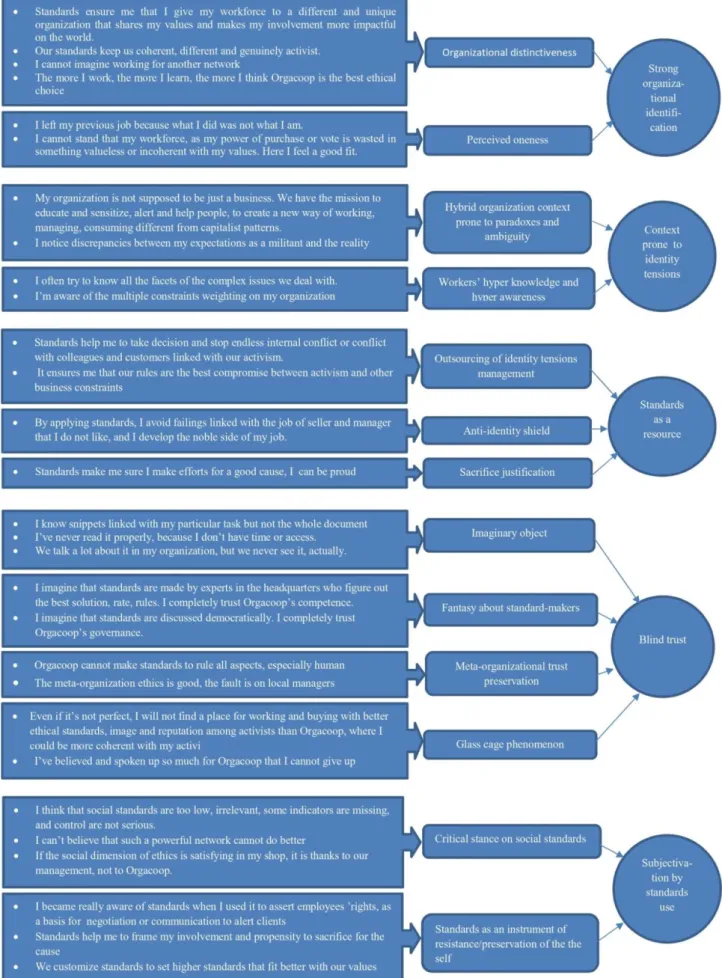
4.1. CSR standards as a response to pre-existing tensions ensued from personal activism 107
4.2. A tensions-prone context 108
4.2.1. Paradox and ambiguity in a hybrid organization 108 4.2.2. Hyper awareness and hyper knowledge 113 4.3. Specifications as an object helping workers to alleviate identity tensions 114 4.3.1. Outsourcing of identity tensions management to the organization 114
4.3.2. A shield against anti-identities 118
4.3.3. A justification for the sacrifice of personal identity 119
4.4. Organizational blind trust 120
4.4.1. CSR standards as an ubiquitous but imaginary object 120
4.4.2. Fantasy about standards-makers 121
4.4.3. Preservation of the confidence in the meta-organization 122
4.4.4. Glass-cage phenomenon 123
4.5. Using standards for resistance 125
4.5.1. Critical stance on social standards 125 4.5.2. Standards as instruments for resistance and emancipation 129
5. Discussion 130
5.1. CSR standards as a resource in the management of tensions ensued from activist orientation 131 5.2. Cultural- symbolic aspect of CSR standards and relieving mechanism 133 5.3. Worker-subject versus worker-object of CSR standards: a calling for a particular consideration
of the social dimension 136
5.4. Managerial implications: from compliance to consent 138
8
Chapter III “Hey! What did you expect?” - The impact of job satisfaction and workers’ social engagement on satisfaction regarding CSR and whistleblowing intentions 143
1. Introduction 145
2. Background and hypotheses 147
2.1. Positive outcomes of CSR among workers 147 2.2. The impact of personal expectations on perception of CSR 149 2.3. Behavioral responses in case of misfit 149 2.4. Measuring “personal social engagement” 150
3. Method 154
3.1. Sample and data collection 154
3.2. Operationalization of study variables 158
3.2.1. Social engagement 159
3.2.1.1. Responsible Consumption (RC) 159
3.2.1.2. Activism orientation (AO) 161
3.2.2. Satisfaction regarding CSR (SATISCSR) 161
3.2.3. Job satisfaction (JS) 162
3.2.4. Organizational commitment (OC) 163
3.2.5. Perceived external prestige (PEP) 163
3.2.6. Whistleblowing intentions (WB) 164
3.2.7. Control variables 165
3.3. Measure assessment 165
3.3.1. Partial Least Squares (PLS) approach 165
3.3.2. Distribution of data 165
3.3.3. Reliability and validity of measurement scales 166 3.3.3.2. First order constructs validity and reliability 168
Convergent validity 168
Discriminant validity 173
3.3.3.2. Second order constructs validity and reliability 173
Convergent validity 173
9
3.4. Analysis 177
4. Results 178
4.1. Model 1: Satisfaction regarding CSR and the hypothesized antecedents and impact on
organizational commitment 178
4.1.1. Hypothesis 1a: Social engagement is negatively related to satisfaction regarding CSR. 178 4.1.2. Hypothesis 1b: Job satisfaction is positively related to satisfaction regarding CSR. 179
4.1.2.1. Minimizing the reverse effect of satisfaction regarding CSR on Job satisfaction 180
4.1.2.2. Perceived External Prestige (PEP) as another possible variable impacting SATI CSR
through direct and indirect effect 181
4.1.3. Hypothesis 2: SATI CSR is positively related to Organizational Commitment. 183 4.2. Model 2: Scenario 1 - Internal whistleblowing intentions and the hypothesized antecedents 185 4.2.1. Hypothesis 3a: Social engagement is positively related to internal whistleblowing
intentions. 185
4.2.2. Hypothesis 3b: JS is negatively related to internal whistleblowing intentions. 186 4.2.3. Hypothesis 3c: OC is negatively related to internal whistleblowing intentions. 186 4.3. Model 3: Scenario 2 (internal social practices) - Internal whistleblowing intentions and the
hypothesized antecedents 188
4.3.1. Hypothesis 3a: Social engagement is positively related to internal whistleblowing
intentions. 189
4.3.2. Hypothesis 3b: JS is negatively related to internal whistleblowing intentions. 189 4.3.3. Hypothesis 3c: OC is negatively related to internal whistleblowing intentions. 189 4.4. Model 4: Scenario 1 – External whistleblowing intentions and the hypothesized antecedents 191 4.4.1. Hypothesis 3 a: Social engagement is positively related to external whistleblowing
intentions. 191
4.4.2. Hypothesis 3b: JS is negatively related to external whistleblowing intentions. 192 4.4.3. Hypothesis 3c: OC is negatively related to external whistleblowing intentions. 192 4.5. Model 5: Scenario 2 – External whistleblowing intentions and the hypothesized antecedents 194
10
4.5.1. Hypothesis 3a: social engagement is positively related to external whistleblowing
intentions. 194
4.5.2. Hypothesis 3b: JS is negatively related to external whistleblowing intentions. 195 4.5.3. Hypothesis 3c: OC is negatively related to external whistleblowing intentions. 195
4.6. Conclusion 198
5. Discussion 199
5.1. Job satisfaction as the key component of satisfaction toward CSR and whistleblowing
intentions 199
5.2. Workers social engagement impact 203
5.3. The impact of education 204
5.4. Limitations and further research 205
5.4.1. Exploring other antecedents 205
Identification 206
Internal whistleblowing channels 206
Perceived constraints 206
5.3.2. Exploring other outcomes 207
5.3.4. Sample features 210
5.3.5. Calling for new scales 211
6. Conclusion of the chapter 212
Conclusion 215
Contributions from each chapter 217
General contributions of the thesis 219
Activist workers: a specific population to be integrated into hybrid organizations 219 The activist worker, structuring agent of the hybrid organization 224 The paramount importance of working conditions in hybrid organizations 226
Limitations and research avenues 230
Shifts between profiles 230
Access to the field 231
Quantitative analysis approach 232
11
References 235
Appendices 257
Appendix 1: Presentation of the sample (Chapter I) 259 Appendix 2: Presentation of the respondents’ organizations (Chapter I) 262 Appendix 3: An example of intra-narrative structural analysis: the narrative of Oscar (Chapter I) 263 Appendix 4: Summaries of interviews (translation of summaries sent in French for approval to each
respondent) (Chapter I) 273 Sidonie 273 Hilde 276 Ben 279 Daphne 282 Dam 285 Marine 289 Oscar 292 Paul 295 Victor 298 Nathan 302 Charlie 304 Leo 306
Appendix 5: Presentation of the sample (Chapter II) 311
Appendix 6: Interview outline (Chapter II) 312
Appendix 7: Overview of Orgacoop’s Specifications (anonymized) (Chapter II) 313 Appendix 8: Welcoming message for online survey (Chapter III) 315 Appendix 9: Distribution of data (Mean, median, Kurtosis and Skewness) (Chapter II) 316 Appendix 10: Fornell and Larcker’s Criterion (1981) (Chapter III) 318
Appendix 11: Cross loadings (Chapter III) 319
Appendix 12: Measurement model (Chapter III) 320 Appendix 13: Items of the survey used in the final measurement model (originally in French)
(Chapter III) 321
13
Tables
Table 1: Potential tensions in solidarity economy ... 34
Table 2: Structure of the thesis ... 39
Table 3 : The agents in Oscar's narrative ... 63
Table 4: Summary of the four narrative schemes ... 80
Table 5 : Specifications ... 102
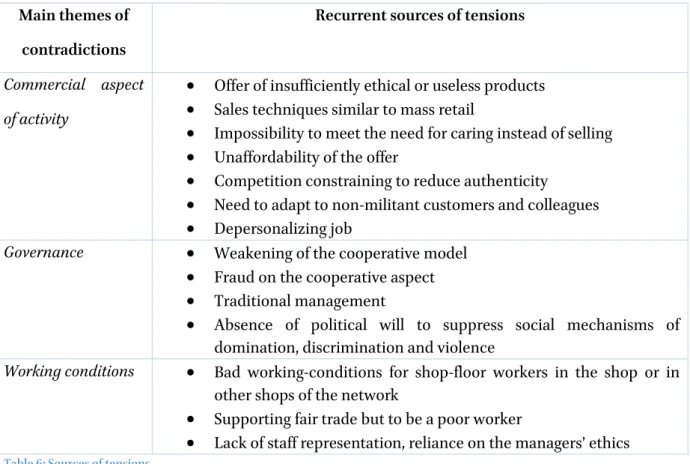
Table 6: Sources of tensions ... 112
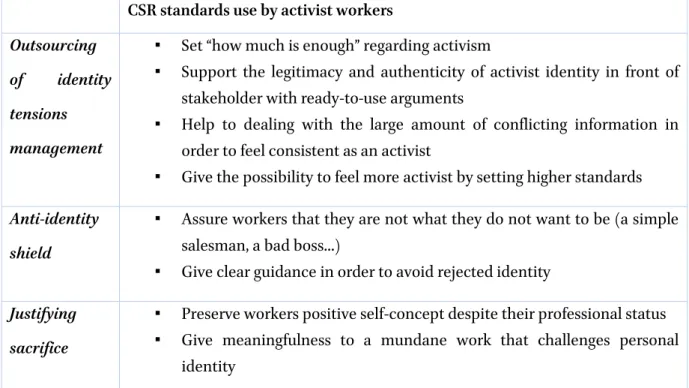
Table 7: Alleviating identity tensions with CSR standards ... 120
Table 8: Descriptive analysis of the sample ... 158
Table 9: Convergent validity indicators for reflexive constructs ... 172
Table 10: Convergent validity of formative constructs... 174
Table 11: Collinearity factors between indicators ... 175
Table 12: Weights and loadings of indicators ... 176
Table 13: Collinearity factors in the structural models ... 177
Table 14: Path coefficient and significance for hypotheses 1a and 1b... 179
Table 15: Path coefficients and significances for hypotheses 1a and 1b without Job dimension ... 181
Table 16: Path coefficients and significances for hypotheses 1a and 1b with Perceived External Prestige ... 182
Table 17: Path coefficients and significances for Hypothesis 2 ... 184
Table 18: Path coefficients and significances for hypotheses 3 a, 3b and 3c (S1, Int WB) ... 186
Table 19: Path coefficients and significances for hypotheses 3 a, 3b and 3c (S2, Int WB) ... 189
Table 20: Path coefficients and significances for hypotheses 3 a, 3b and 3c (S1, Ext WB) ... 192
Table 21: Path coefficients and significances for hypotheses 3 a, 3b and 3c (S1, Ext WB) ... 195
15
Figures
Figure 1: The two dimensions of solidarity economy (Laville, 2010) ... 31
Figure 2: Findings ...106
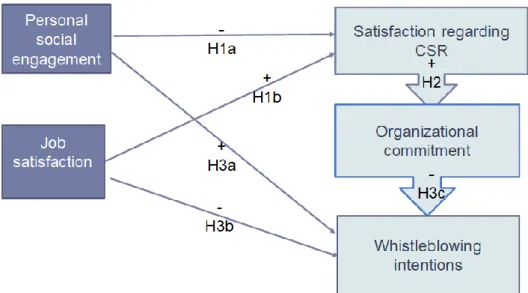
Figure 3: Theoretical model ... 154
Figure 4: An example of second order construct: Job Satisfaction ... 168
Figure 5: Model 1 - Path coefficients (p-value) ... 185
Figure 6: Model 2 - Path coefficients (p-value) ... 188
Figure 7 : Model 3- Path coefficients (p-value) ... 191
Figure 8: Model 4 - Path coefficients (p-value) ... 194
Figure 9: Model 5 - Path coefficients (p-value) ... 197
17
Communications and publications
Communications
Juillet 2020 EGOS virtual Colloquium
“Hey! What did you expect?” - The impact of job satisfaction and workers’ social
engagement on satisfaction regarding CSR and whistleblowing intentions
Décembre 2019 Journal of Business Ethics Publishing Workshop
“It’s a Bible!” - Framing activist workers’ identity tensions with organizational
CSR standards
Juillet 2019 EGOS Colloquium (Edimbourg)
“It’s a Bible!” – Unexpected use, misuse and non-use of CSR standards.
Février 2019 King’s Business School conference “Promises on sustainability” (Londres)
“The importance of being earnest” Framing identity tensions among internal
activist with organizational CSR standards
Juillet 2018 EGOS Colloquium (Tallinn)
“It’s a Bible!” – Unexpected use, misuse and non-use of CSR standards.
Octobre 2017 Présentation au séminaire du LaRGE
“Sometimes I wish I didn’t care”. Identity work of the responsible worker Juillet 2017 EGOS Colloquium (Copenhague)
“Sometimes I wish I didn’t care”. Identity work of the responsible worker
Mars 2017 6th
Critical Management Studies Workshop (IAE Paris Créteil)
“Sometimes I wish I didn’t care”. Identity work of the responsible worker
Publications
En cours de soumission
En co-écriture avec Hélène Rainelli-Weiss
“Sometimes I wish I didn’t care…”Constructing paradoxes and dilemmas as a
19
21
Overview
The activist worker
"We have to do what we can do. I do what I can, hummingbird, dedicate to Pierre Rabhi, do what you can do. Do even your best, so that we are irreproachable. We can't have guilt, we did our best. Even if it's not enough...we did our best." (Ben, 2017, Interview for Chapter I)
The excerpt from the interview given by this young organic farmer in the context of this research work is a powerful illustration of the demanding quest of a growing number of workers. The exponential multiplication in recent decades of "bullshit jobs", those jobs that contribute nothing to society, sometimes severely questions our contemporaries (Graeber, 2019). Lack of meaning, as well as conflicts of values, figure prominently among the factors favoring burnout, this new "evil of the century" that lastingly ravages the lives of certain individuals (Zawiedja, 2017).
In response, and sometimes at the price of economic and social sacrifices, an increasing number of individuals seek to make their work a source of meaning, of self-definition, and to find the opportunity to "make a difference". The idea of discovering "a calling" and responding to a particular mission, often linked to the pursuit of an aesthetic, artistic or scientific ideal, for example, is now valued, relayed by the popular media (Cardador and Caza, 2012; Dik and Duffy, 2012). However, particularly as awareness and knowledge about environmental and social issues grow, it is what can be described as "social idealism" that especially influences the career choices of many individuals. In response to the scale of current societal challenges, a proportion of workers are orienting their career choices towards a job that is at least neutral, but even better, that can have a positive impact and constitute a vector for change or social added value.
This search for alignment with personal values is particularly present among "Generation Y", or "Millenials", (i.e., individuals born between 1981 and 2000 (Ozcelik, 2015)), who today represent on
22
average about half of the active population in Western countries. Among generational differences (Eisner, 2005), in general, these individuals place a lot of importance on the meaning found in work (Gong et al., 2018) and, more specifically, on belonging to organizations that have a positive impact on society (Weber, 2019). At work, as well as in their consumption, this generation is more in search of social responsibility. As a result, socially responsible companies appear to be particularly attractive to this population (Alonso-Almeida & Llach, 2019; Klimkiewicz & Oltra, 2017).
An extreme case of this type of attitude towards work is provided by individuals who choose work with the objective of being able to live a militant orientation. In this thesis, we will call the individuals involved in this process "activist workers". With reference to Corning and Meyers (2002), we define them as individuals who have expressly chosen work that responds to personal need to pursue collective interests, by addressing social and environmental issues affecting the collective, in order to produce some changes and preventing other ones.
The same authors define activist orientation as " an individual’s developed, relatively stable, yet
changeable orientation to engage in various collective, social-political, problem-solving behaviors spanning a range from low-risk, passive, and institutionalized acts to high -risk, active, and unconventional behaviors.” Because of the stability of this orientation, the authors point out that it
would tend to persist over long periods of time, up to decades, although some external influences would increase the propensity to act (e.g., intergenerational effects, early activist experiences, new social environment), whereas some would reduce it (especially having children). With a constant and assertive activist orientation, it seems clear that these activist workers adopt particular behaviors in their work settings, opening up a field of study in organization studies. Activism in the workplace has thus often been approached under the more general term of “idealism” by researchers in this field, who have until now mostly been interested in the dynamics created by the cohabitation of this particular type of profile with other workers. The "idealist" worker, as opposed to the "pragmatic" (Ashforth and Reingen, 2014), or the "capitalist", "pluralist" or "indifferent" (Besharov, 2014) are characterized by the fact that they place social values above financial profitability, and their main consideration is the social mission of the organization.
23
Tensions induced by militancy at work and organizational consequences
Still some of the dynamics created by workplace activism remain poorly understood. It has been shown that the pursuit of a higher purpose and meaning found at work would have undeniable positive consequences, promoting, among other things, well-being and satisfaction in life, job satisfaction, career and organizational commitment. It would also promote organizational identification, defined as “a perceived oneness with an organization and the experience of the
organization's successes and failures as one's own" (Mael & Ashforth, 1992). The organizational benefits
would be multiple (Wzesniewski et al., 1997; Cardador & Caza, 2012; Elangovan et al., 2010; Duffy and Dik, 2013; Bunderson & Thompson, 2009). However, workplace activism carries the seeds of a number of difficulties. Activist workers react in a singular way. Among the four categories of members studied by Besharov (2014), for example, she observes that "idealists" are the only ones who cannot be converted to another identity, even a pluralist one. Because of this inflexibility, some have to give up managerial responsibilities or leave the organization. They would also be the only ones likely to experience the "violation of their identity", that is, to interpret the behavior of other members as a transgression of their values. The ideological breach would also act as a violation of the "psychological contract" concluded with the organization (Rousseau, 1989), a tacit contract based on expectations about what the individual and the organization are, but nevertheless defining reciprocal obligations (Thompson & Bunderson, 2003). Among these workers, there is thus an increased risk of disillusion and dis-identification (rejection of the organizational identity) and their organizational consequences (e.g.: intention to leave the firm, reduced efforts) (Besharov, 2014).
The pursuit of a higher goal and a pro-social mission confers to the activist population many of the characteristics of "calling", which are recognized as potentially weakening for the individual. According to Schabram and Maitlis (2016) who studied the evolution of workers with a pro-social mission in animal shelters, responding to a calling would involve a process of overcoming difficulties that is intense and substantial because "a vocation involves work that is rooted in people's values and
that matters a great deal to the individual" (Schabram and Maitlis, 2016). Over time, these individuals
would adopt divergent paths, characterized by more or less noxious consequences. These workers would be more affected by overwork, burnout, work addiction, and difficulties in maintaining a
24
balance with private life and sacrifices (Cardador and Caza, 2012; Duffy and Dik, 2012, 2013). Bunderson and Thompson's (2009) study of zoo keepers also showed that vocationally-oriented workers were more prone to exploitation by the organization, which did not consider it useful, for instance, to give them the same financial compensation.
These authors also point out the major risk of "over-identification" at work. This describes “an
individual who may internalize the organization's goals to such an extent that the individual self is diminished and he/she becomes blind to other concerns and accordingly engages in a course of action that may ultimately undermine the true long term interests of the organization” (Galvin, Lange and
Ashforth, 2015). Thus, the search for work that has a deep meaning for the worker can obviously also have a negative impact on the organization: these individuals would be subject to “myopia” or narrowness of vision in the decision-making process, lack of flexibility, and a relentless pursuit of higher standards (Cardador and Caza, 2012; Duffy and Dik, 2012, 2013). As a result, some organizations would prefer less clear-cut profiles, and recruit, for example, workers who have not yet developed this pro-social orientation and who are easier to model according to the organization's logic (Battilana and Dorado, 2010).
Hybrid organizations, refuge of the activist worker?
Activist workers naturally tend to turn to organizations that share their personal social mission, where they hope to find an echo of their values. Thus, the research projects that these "idealistic" workers are the subject of are often conducted in the context of organizations that pursue a social or environmental mission while engaging in market activities to support their operations. Having emerged in previous decades in the for-profit sector in order to provide a response to social and environmental issues, they have been described as "hybrid organizations" because of the duality of their identities, logics, resources, or modes of governance.
In their extended definitions, hybrid organizations are those that integrate distinct institutional logics (Sirris, 2019; Battilana et al., 2015; Battilana 2018), divergent objectives (Ashforth & Reingen, 2014;
25
Smith & Besharov, 2019), organizational forms (Battilana & Lee, 2014; Padgett & Powell, 2012), resources and multiple organizational identities (Besharov, 2014). Thus, a hospital or an orchestra in which two major logics coexist can be considered as hybrid organizations: they have thus existed for centuries. In this thesis, however, we will reduce our field of research to organizations committed to creating a positive environmental or social impact through the pursuit of commercial activities (e.g. Battilana & Dorado, 2010; Battilana et al., 2015; Hoffman, Gullo, & Haigh, 2012; Pache & Santos, 2013) in which individuals with pro-social orientations have previously often been studied. The term "social enterprise" has emerged since the 1980s / 1990s to refer in popular parlance to these organizations operating in a wide variety of sectors (e.g. rehabilitation enterprises, microfinance, food sector, software development). (Dacin, Dacin, & Tracey, 2011; Battilana, 2018) These organizations are also sometimes referred to in the literature as "alternatives", which can be loosely described as any organization or organizational practice that challenges dominant field level norms around business and capitalism (Parker, Cheney, Fournier, & Land, 2014).
In the absence of economically viable organizations that are fully in line with their vocation, hybrid organizations should a priori provide activist workers with a framework for a satisfactory alignment of their profession with their personal values. However, the contradictory logics at work in these hybrid organizations can create a sense of paradox in the individual, forcing him or her to deal with persistent contradictions. This individual level of tension management has so far been neglected by the literature on hybrid organizations, having favored the organizational level in understanding responses to the duality of missions (Deville & Mourey, 2018; Ashforth & Reingen, 2014; Battilana, 2018). Authors in "Paradox studies" who have further initiated the exploration of this field at the individual level in other research contexts confirm for their part that contradictions can create significant tensions at the individual level among members of an organization (Miron-Spektor, 2018; Zheng et al., 2018), namely
"stress, anxiety, discomfort, or tightness in making choices, responding to, and moving forward in organizational situations" (Putnam et al., 2016, p. 68).
However, Miron-Spektor (2018) demonstrates that the individual's ability to manage these tensions linked to contradictions would depend on his or her mental structuring: being endowed with a "paradox mindset" (vs. dilemma mindset), (i.e. being able to accept and be stimulated by the tensions),
26
allows some individuals to be more efficient and innovative. Zheng et al. (2018) uses this same paradox theoretical framework to study women managers who experience the tensions between agency, seen as a masculine trait, and communion, considered as a feminine injunction. She suggests that the intensity with which these women experience these tensions, for example, and the psychological resilience they demonstrate depends in part on the level of congruence required: they would thus be more or less able to withstand contradictions. However, it can be assumed that the worker who deliberately chooses a job in the hope of finding alignment with the values he or she holds dear is inclined to experience contradictions with a certain intensity, and is reluctant to accept this "paradox" state of mind. We can therefore ask ourselves how these individuals, demonstrating through their career choices a certain aversion to paradox, individually respond to the divergent logics at work in hybrid organizations that potentially represent the best compromise with regard to their activist orientation.
The literature suggests that an individual's ability to deal at the individual level with conflicting logics would also depend on the organizational context. Miron-Spektor (2018) pointed to resource scarcity as a factor that accentuates tensions, while Zheng et al. (2018) brought to light the importance of an organizational learning orientation in adopting a mindset that allows for the acceptance of contradictions. Thus, in addition to the individual's own characteristics that seems to determine his or her level of psychological resilience in the face of divergent logics, certain organizational factors could amplify or, on the contrary, reduce the experience of tensions and the responses adopted. The integration of this particular category of workers is therefore a subject for Organization Studies, since the organizational context could have a significant impact on the tensions experienced, and on the ultimate matching of the organization and its members.
Some research studies seem to lead to the observation that the tensions experienced by activist workers on the one hand and hybrid organizations on the other hand do not necessarily lead to the worst. Workers with an authentic, stable and confirmed militant orientation manage to flourish in organizations that ensure the duality of their mission (Besharov, 2014), and to overcome the challenge of responding to a calling (Schabram & Maitlis, 2016). Better still, the presence of these "idealistic" individuals could prove to be an asset for hybrid organizations, arguing for the mix in the profile of
27
recruits (Besharov, 2014; Battilana & Dorado, 2010). In particular, Ashforth and Reingen (2014) have highlighted some of the beneficial dynamics at work related to the presence of activists: inter-group conflicts between "idealists" and "pragmatists" and the rituals to repairing and maintaining the relationship would ultimately promote the smooth functioning of the organization. One group would project on the other what it does not want to be, while it needs the other to play this role for the viability of the organization.
Research context: the case of the solidarity economy
In this study, we linked the concept of hybrid organizations with the concept of the French "solidarity economy" (Laville, 2014; Laville, Hillenkamp, Eynaud, Coraggio, Ferrarini, Gaiger & Wanderley, 2016). We have sufficient literature on this sector in France, allowing us to identify the potential tensions at work. Indeed, the solidarity economy presents, due to its hybridity, a large number of characteristics, making it a field that is both favorable to tensions, while generating great expectations among those who join it in the hope of bringing values and work into harmony. It is therefore a particularly favorable context for studying the responses of activist workers to tensions. After defining this research field more precisely and demonstrating the multiplicity of tensions inherent in the duality of the mission, we will show the relevance of this choice for our empirical studies.
Definition of solidarity economy
Looking at the literature, it is difficult to find a universal definition of the solidarity economy, "because
the solidarity economy shows a multiplicity of practices rather than a unified theory" (self-translation)
(Allard & Matthei, 2008). According to Bernard Eme and Jean-Louis Laville (2006), the solidarity economy can be approached as "the set of economic activities subject to the will to act democratically,
where social relations of solidarity take precedence over individual interest or material profit"
28
The history of the solidarity economy in France is rooted in the philosophies of past centuries, but really took shape with the emergence and then domination of the capitalist economic model. The development of this economy is linked to changes in order to defend ethics in the face of the challenges of our society: from the Christian utopians to the workers' movements, from the self-sufficient communities of the 1970s to today's hyper-connected anti-globalization movements, this economy finds its living strength in the debates that are constantly renewed and fueled by history.
The solidarity economy is a subset of the social and solidarity-based economy (SSE) which brings together private or public organizations (companies, cooperatives, associations, mutual societies or foundations), seeking to reconcile economic activity and social utility. This solidarity economy aims to be useful from an economic, social, ecological and political point of view. It is much more than a reparation economy, to which it has often been confined, but has on the contrary a proactive role: resisting the commodification of life and bringing about economic activities with a human purpose, promoting the advent of another world, new ways of living, working and producing wealth without exploiting or excluding, and without destroying the planet.
The difficulty in defining the solidarity economy stems in part from the diversity of initiatives grouped under this vague term with imprecise boundaries: for instance, solidarity finance, AMAP, peasant agriculture, organic produce purchasing cooperatives, fair trade, free software, popular education or renewable energies. However, if we examine solidarity economy, we see three characteristics that set it apart (Laville, 2014). First, the objective is to question the ideology of progress that is inseparable from the patriarchal society that produces social inequalities. Second, the initiatives have a political goal. This translates into impacts on the internal functioning: democratic governance, formal equality between members in the statutes and deliberative practices whose participants come from different groups (employees, users, producers, consortiums, elected officials...). Finally, this political dimension modifies the economic model: hybridization of resources, recourse to reciprocity and redistribution. These characteristics derive from two individual principles of action structuring the solidarity economy: reciprocity replaces individual interest and selfish calculation and emanates from the will of the individuals to freely involve themselves on an equal basis in relations with groups or individuals. The second normative principle is to act democratically. The political dimension of the solidarity
29
economy is based on reciprocity and the construction of public spaces that allow for debate between stakeholders on social demands and the objectives pursued (Eme and Laville, 2006).
A hybridity generating paradoxes and individual tensions
According to Torres and Hersent (2014) "The solidarity economy is intended to be a project of social
transformation limiting social and territorial inequalities and allowing people to flourish in the workplace. By relying on collective energies and strengthening people's capacity for action, it also provides answers that encourage the emancipation and empowerment of the various actors involved in the initiative” (self -translation).
We see in this definition the importance of the expectations that workers joining solidarity economy organizations may have: transformation of society, capacity for action, fulfillment in work or emancipation. The "solidary" aspect of those organizations gives them responsibilities and characteristics in the eyes of the stakeholders, which may contradict other injunctions and which tend to become over time more burdensome.
The ambiguity of ideological positioning
In France, the solidarity economy carries the weight of an important cultural heritage: the critical function. It was born in the post-68 counter-culture movements: self-management culture, rural community, anti-militarist struggles, ecology, feminism, local development, etc. Among the militant initiatives of the time, some asserted their economic dimension while articulating it with a will for social transformation. The initiatives of this period are called "alternative economy". Although they often failed in their most radical form, they left their mark on the collective imagination, but also on the culture of the solidarity economy. Historically, this economy does not have a repairing but a critical function.
30
Far from the vision of the liberal economist Milton Friedman according to which the only social responsibility of the company is to make profit (2007), the commercial organizations we are particularly interested in are at odds with this idea, and mix multiple and sometimes antagonistic logics of action: to be part of the commercial world while defending a world free from commodification.
Being part of the commercial world often goes hand in hand with an activity heavy with mundane, repetitive tasks, difficult working conditions, and the need to keep an eye on purely quantitative indicators. A job in a restaurant or in the food trade, even if it is part of a "solidarity" project, is still associated with the notion of "labor" for the person who carries it out. Endrissat (2015) at the end of her study on workers in American organic supermarkets thus admitted the possibility of an authentic and sincere approach to creating an "enchanted" workplace as the very object of the organization, while summarizing the paradoxical nature of this situation: can one attempt to overcome an alienated workplace by selling non-alienation? And to what extent can one free oneself from the capitalist model in a mercantile enterprise? The mercantile dimension, by inscribing itself in contradiction with the ideological positioning of the sector, can favor the feeling of incoherence among the worker. The ancestral cultures of trade can also enter in contradiction with the culture of the solidarity economy. In the great diversity of the organizations that make up the solidarity economy, we find cultures that are historically deeply rooted in a patriarchal model, such as that of the catering industry, which is highly hierarchical and values the preponderance of the profession over private life, or that of the farming world, where land ownership is important. These cultures imply logics, identities that can create a sense of paradox for the militant worker.
Democracy is also an ambitious project that has been the subject of much criticism. The "degenerations" observed, for example in SCOPs, often show how difficult it is to think about managerial functions in such firms, where they are contested but remain central (Gand & Béjean 2013; Pasquet & Liartet, 2012). The ambition to act democratically can also contradict modes of governance and entrenched social mechanisms, creating tensions at the individual level.
31
Hybridization of resources
Solidarity initiatives reinvent hybrid models to combine different market resources (price paid by users or customers), non-market resources (public funding due to the social utility of the activity) and non-monetary resources (voluntary contribution according to the principle of reciprocity by the different stakeholders). In addition to this, there is also special financing such as solidarity financing. According to Laville (1997), the sustainability of organizations depends on this hybridization. The hybridization of resources is a guarantee of security (in the event of a defaulting partner). It also protects the company's ethical project, since it avoids orientation in the interest of a particular partner. However, the hybridization of resources multiplies the stakeholders and functions of the company. Individuals therefore have several, possibly contradictory roles to fulfill (e.g. as partner and employee, manager) and various stakeholders to satisfy (e.g. partners, employees, consumers, producers). The organization wants to innovate through its democratic model, which opposes resistance to the reproduction of internalized patterns. This context favors individual tensions.
32
The absence of a legal framework and the need to legitimize one's belonging: solidarity
economy versus social economy
The notion of belonging to the social economy is not very problematic, as it is clearly defined by the legal status of organizations (associations, mutual societies, cooperatives, foundations), without even a social or environmental objective being necessary. By contrast, the legal status is still failing to prove membership in the solidarity economy despite the attempts of the legislator (the creation of the ESUS1
accreditation framing the solidarity character of organizations). As a result, this membership is not defined, but is questioned every day by the acts of the organization and its members. The identity of solidarity economy worker is thus never permanently acquired and obliges the individual to be permanently vigilant regarding the organizational project, maintaining this state of tension.
Increased tensions
Extended solidarity
The tensions related to the solidarity character of the organization are accentuated by the fact that this solidarity character today covers an important and complex reality. If solidarity developed as a secular alternative to the charity of religious congregations or the politicized philanthropy of the most powerful, it was at the time more a "class" solidarity and had a very local dimension: one thinks for example of Godin's phalansteries. Today this solidarity raises new questions, since it is no longer a question of thinking only of the interests of one's social class or fellow citizens, but of all living and unborn humans. It is, however, this definition of solidarity in the broadest sense that underpins the solidarity economy and makes its project more ambitious than ever.
Economic difficulties
33
Certainly, there is an appeal to the general public to which the solidarity economy responds for what is called "socially responsible consumption". However, this should not make us forget the economic difficulties faced by these hybrid organizations in particular, especially in comparison with those responding to consumer demand without necessarily sharing the same political project. Today, it is becoming rare to find a company that does not communicate on its "social and environmental responsibility". It is therefore very difficult for these organizations, sometimes born decades before we talk about CSR, to stand out for the sincerity of their approach in the eyes of "responsible consumers" who are new to the subject.
The SSE law of 2014 has certainly created the ESUS status allowing them to benefit from specific aid and funding, but solidarity economy organizations remain subject to the same obligations as "classic" companies regarding taxation, standards, or labor costs. They are confronted with the same economic constraints inherent to these projects. It is difficult to value the ethical surplus of the organization, which nevertheless weighs in terms of financial costs. Positive externalities are difficult to measure and only partially compensated. Because of the “sub-additivity of preferences”, the propensity to pay for the community or for others is quickly saturated. For example, a consumer will be willing to pay a surplus for an organic product, but will not be willing to pay again to the same extent for its fair trade aspect (Cochoy, 2008). As a result, an organization's willingness to multiply the constraints in order to achieve the most ethical offer possible will not be valued to the same extent on the market.
Moreover, the ambition of many organizations in this solidarity economy is to propose an accessible offer, whereas the surplus of "ethical" values often has a cost. Hence, these organizations have the alternative of reducing the cost of its actions (by reducing the quality of its services, salaries and management costs), or of making the demand solvent while educating the consumer (Boncler, 2004). The worker therefore often bears part of the cost of the ethical added-value, limiting his or her salary without necessarily having any hope of progress. This contradicts the claims of the solidarity economy to want to remunerate its actors fairly.
34
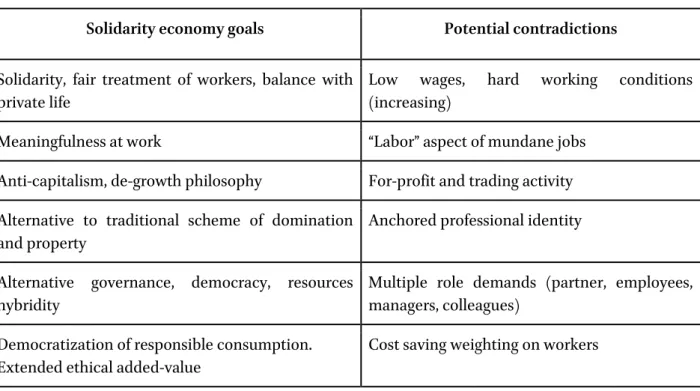
Solidarity economy goals Potential contradictions
Solidarity, fair treatment of workers, balance with private life
Low wages, hard working conditions (increasing)
Meaningfulness at work “Labor” aspect of mundane jobs Anti-capitalism, de-growth philosophy For-profit and trading activity Alternative to traditional scheme of domination
and property
Anchored professional identity Alternative governance, democracy, resources
hybridity
Multiple role demands (partner, employees, managers, colleagues)
Democratization of responsible consumption. Extended ethical added-value
Cost saving weighting on workers
Table 1: Potential tensions in solidarity economy
Conclusion: the special interest of the solidarity economy as a field of
research
Solidarity economy therefore has the desirable characteristics for a research field. At the crossroads of consumption, work, savings and citizenship, the solidarity economy is not only a place of political expression for individuals wishing to defend their ethical commitments, but also to flourish at work. The importance of expectations combined with the tensions inherent in the field make the activist worker of the solidarity economy an "extreme case" of managing paradox: the worker has a hypersensitivity to contradictions, and will be plunged into a universe that favors them. Extreme cases are desirable for constructing a theory because the dynamics are more visible (Eisenhardt, 1989). This population of militant workers also presents widespread characteristics: family responsibilities, socialization in a common environment, professional experiences in traditional organizations. These common traits give our results a more generalizable character than would be the case with more
35
atypical profiles (in humanitarian work, religious congregations or alternative communities living in autarky).
Structure of the thesis
This thesis is structured around three essays.
Chapter I: "Sometimes I wish I didn't care... "- Constructing paradoxes and dilemmas as a response to occupational tensions among hybrid organization workers
In this essay, we are interested in the responses that the individual brings at the individual level to identity tensions by creating meaning through narrative. While the challenges presented by hybrid organizations have been studied at the organizational level, we offer an overview of how individuals in these organizations interpret the tensions they face in their work.
In this chapter, we answer the following two research questions: What are the interpretations employees resort to when confronting the tensions created by the complex nature of hybrid organizations? To what extent do these interpretations reflect the paradox versus dilemma mindsets of their authors?
For this, we propose a structural analysis of the life story (Demazière & Dubar, 1997) of twelve workers in the market solidarity economy. We conduct twelve in-depth interviews with members of French hybrid organizations in order to document how they justify the tensions they experience in their working lives.
Referring to the literature on paradox (Miron-Spektor et al., 2018), we show that members of these organizations show a strong sensitivity to what they perceive as a dilemma between their personal pro-social values and the values carried by capitalist type organizations. We document the personal professional tensions they experience in addition to those generated by the hybrid character of the organization they work for.
36
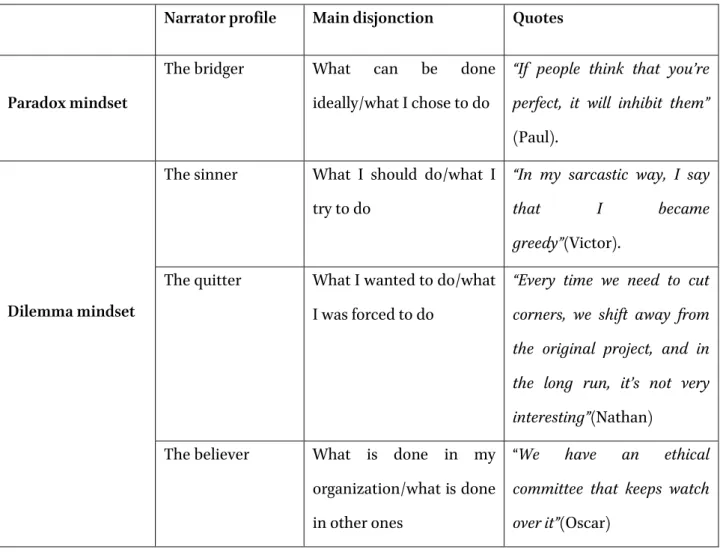
Moreover, individuals facing similar tensions either resort to a mindset in which they accept these tensions inherent to their profession (paradox mindset) or to a mindset in which they perceive the tensions as having to be eliminated (dilemma mindset). Three narrative patterns stand out within this dilemma mindset, corresponding to particular personal and organizational risks.
We contribute to the literature on hybrid organization by observing considerable interpretative variation in the way challenges are experienced at the individual level. We contribute to the literature on paradox by providing precise descriptions of the ways of thinking about paradox and dilemma that workers in hybrid organizations can exploit to deal with pervasive workplace tensions and by highlighting the dynamic dimensions of these ways of thinking.
Chapter II: "It's a Bible!" - Alleviating activist workers’ identity tensions with organizational CSR standards
In this study of the activist worker's responses to tensions, we explore the worker's interaction with organizational practices in this process. The previous chapter suggested the possibility for hybrid organizations to relieve the activist worker in the management of tensions. In this second chapter, we propose to explore this line of research through a sociological approach to management tools (Chiapello & Gilbert, 2013). The Critical Management Studies (CMS) have above all demonstrated the potential exploitation of the individual by Corporate Social Responsibility (CSR) practices and its instrumental dimension (Costas & Kärreman, 2013; Banerjee, 2008). The objective of this empirical study is to understand the process of adaptation of worker activists to CSR standards that may generate individual tensions due to their inadequacy or contradictions with the worker's expectations regarding the ethics of the organization. As critical scholars have also highlighted the potential alienation of these ideal-seeking workers’ personal identity (Bunderson & Thompson, 2009; Schabram & Maitlis, 2017), particularly in hybrid organizations (Kenny, 2010; Endrissat, 2015), we wonder about the impact of these tools on this issue.
37
We therefore attempt to answer the following research question: for the particular category of activist workers, what role do CSR standards play in managing the tensions created by the nature of hybrid organizations?
To this end, we interview twenty-seven individuals combining activism and work in a cooperative network of organic stores, Orgacoop (a pseudonym). This meta-organization has a hybrid identity (an original hybrid activist and a commercial identity) and frames the activity of independent retailers through specifications (a set of standards) detailing CSR imperatives.
Putting us in dialogue with the CMS, the main contribution is to show the cultural-symbolic dimension of these specifications, a management tool that is omnipresent and central, but that almost nobody really knows. This tool seems important by its mere existence rather than by its content. Workers use these CSR standards as a resource to outsource the management of identity tensions to the organization, due to a strong organizational identification. These standards protect workers from over-questioning and over-involvement, and help them manage ambiguity and paradoxes.
Echoing a Foucauldian approach (Foucault, 1984), we oppose two dynamics. As subjects of the standards (acting using the standards), workers show a deep trust in the standard-makers, stemming from an imagery about the expertise and ethics of the organization. Based on what appears to be an organizational myth, they blindly use this management tool as a resource to frame hyper-consciousness and hyper-knowledge creating endless internal conflicts. As the objects of these standards (regarding the internal social standards governing how the worker is used as a resource by the organization), workers tend to adopt a more critical or cynical stance. As a result, dissatisfied workers use these standards as a resource in a salutary struggle, to limit their propensity to sacrifice themselves for a higher goal. These results invite hybrid organizations to a participatory work of creation and adaptation of these standards, and to a particular attention paid to working conditions.
38
Chapter III: “Hey! What did you expect?” - The impact of job satisfaction and workers’ social engagement on satisfaction regarding CSR and whistleblowing intentions
In this last essay, we continue our exploration of the activist worker's responses to the tensions related to the hybrid nature of organizations by identifying, using a quantitative approach, the different individual and organizational variables impacting workers’ cognitive, emotional and conative responses.
Intrigued by the recurrent discourse heard in the previous project (Chapter II) that some stores preferred not to recruit candidates with an activist profile because they would be more inclined to be dissatisfied with CSR and quick to react, we wanted to scientifically verify whether this strategy was justified: does activist engagement in private life make people more critical of the organization's practices, less satisfied and likely to create conflicts in this case? More broadly, is idealism more problematic or valuable (Ashforth & Reingen, 2014) for an organization? How does this affect struggles and conflicts?
This study will seek to answer the following research question: What is the impact of personal social engagement on satisfaction regarding CSR and whistleblowing intentions?
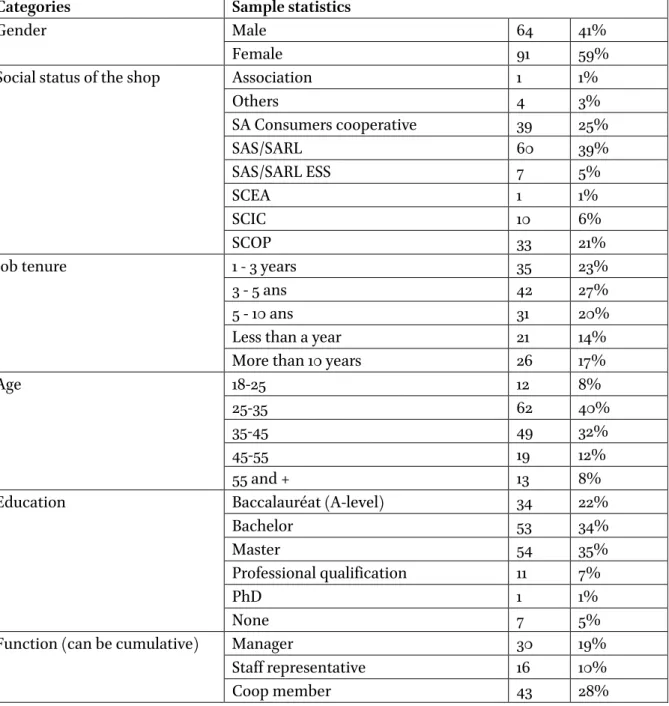
Drawing mainly on Social Identity Theory (Tajfel, 1974), we propose to empirically test the impact of personal social engagement on satisfaction regarding CSR and whistleblowing intentions in case of dissatisfaction with CSR practices. The 155 responses to a survey conducted among Orgacoop network employees made it possible to measure personal social commitment (through responsible consumption and activist orientation), satisfaction with Orgacoop's CSR practices, job satisfaction, organizational involvement and intentions to "blow the whistle" internally (staff representative, head office, etc.) or externally (word of mouth, denunciation in the media or social networks) in the event of ethical conflict. We use a Partial Least Square (PLS) approach to data processing.
In this study, we demonstrate that, contrary to the initial hypothesis, personal activist engagement is partially linked to greater satisfaction with CSR practices. On the other hand, it does promote alert
39
intentions in the event of a perceived ethical conflict. However, the impact of this variable is negligible in relation to job satisfaction. The perception of good working conditions and meaningfulness found at work favor internal means of recourse to raise the alarm, and reduce resort to means of resistance that are more harmful to the organization, such as word-of-mouth or public denunciation. Organizational involvement can also counterbalance the impact of activist orientation on external whistleblowing intentions.
These results help rethink the priority of CSR programs, showing the greater importance of job satisfaction, and relativizing the danger that employee activist engagement can represent for the organization, especially considering the other benefits that this type of employee brings to hybrid organizations in terms of legitimacy and reputation with other stakeholders. We invite one to consider militant workers as detectors of ethical drifts, guarantors of the organization's integrity. We identify several factors likely to promote internal whistle-blowing intentions and to reduce external ones: job satisfaction, organizational commitment but also representative functions or participative governance. Although we may doubt that activist orientation can be managed at work, these factors can easily be subject to management practices.
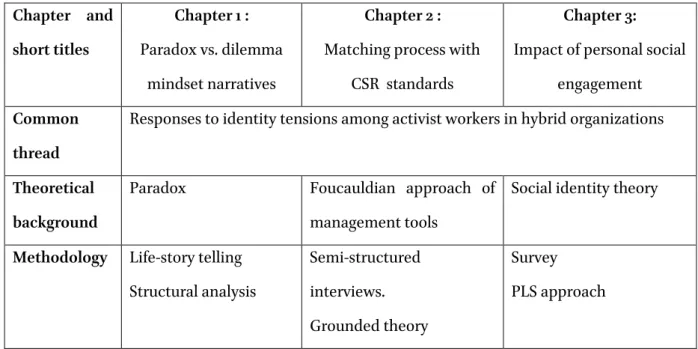
Chapter and short titles Chapter 1 : Paradox vs. dilemma mindset narratives Chapter 2 : Matching process with
CSR standards
Chapter 3: Impact of personal social
engagement Common
thread
Responses to identity tensions among activist workers in hybrid organizations
Theoretical background
Paradox Foucauldian approach of management tools
Social identity theory
Methodology Life-story telling Structural analysis Semi-structured interviews. Grounded theory Survey PLS approach
40
Epistemological posture
This doctoral work forces us to question the posture of the doctoral student as a producer of knowledge. An honest and reflexive questioning on the possible biases linked to the relationship with the field and the choice of research methods is necessary. This thesis also presents a critical aspect that invites us to question the doctoral student's own conception of the researcher's role in society. Consequently, in that section, I will switch from “we” to “I”. Rather than a theoretical presentation on epistemological postures, I will first and foremost share my reflections on my posture as a researcher, which have obviously shaped the work I am presenting today.
Relationship with the field
In 2009, I obtained a Master Entrepreneur degree that I followed with the objective of creating an organic/fair trade grocery/tea store. In this sense, I started to get closer to the responsible consumption network of Lille, as a client, as a potential entrepreneur, then as a worker. My first permanent job, part-time in parallel with my studies, was in L’Epicerie équitable, a store selling fair trade products, mostly organic or in short supply chains. Despite the rather difficult working conditions, I found this job very fulfilling. The counter and its €1 coffee in a popular market attracted a very mixed clientele. Having later become a manager and partner of this company, the co-managers gave me their trust to develop the grocery store and adapt to the environment.
After the birth of my daughter, I became involved without careful consideration in a catering SCOP, a "canteen-bar-café" in a co-working space in Lille. This work, although not an easy and pleasant experience pushed me to ask myself this question: what makes a hybrid company work or not, not only economically, but also humanly? I saw so much diversity around me in the experience of the workers, from enthusiasm to exhaustion, often revealing the atmosphere prevailing in the organization that I wanted to understand what was going on, behind the enthusiastic articles in the press and the smile that you can't get rid of as an entrepreneur. I had the will to grasp what was
41
happening behind the apparent cohesion of the teams around a project bigger than themselves, bigger even than the organization.
When I resumed my studies in 2016 in Strasbourg, it was this questioning that shaped the subject of my first research paper, and then of this doctoral work. I naturally turned to the Solidarity Economy, a field where I felt particularly capable of collecting data. Even though I gave up my work in commerce, I kept an active membership at the Nef2
, where I regularly meet project leaders with a strong social and/or environmental dimension. This familiarity with the issues of Social and Solidarity Economy (SEE) trade organizations has enabled me to create a relationship of trust with the research field. Moreover, my experience of working in the trade allows me to have the vocabulary specific to the world of store work or organic farming, for example, and to collect data that I think is rare in its spontaneity and authenticity. Finally, my status as a young woman and a mother has also sometimes created a climate of trust conducive to the expression of more subjects of tensions.
Being a former SSE worker and an active member in Nef, as well as the contacts I have been able to maintain in this network have provided me with my first point of entry. I would probably have had difficulty getting interviews without this prior experience. The solidarity economy environment attracts a diversity of profiles, and individuals with very variable socio-cultural capital. Some are very open to the academic world, sometimes impressed by the status of researcher, while others show a certain mistrust of this milieu that does not properly "work" as they perceive it. It is also a field where there is a lot to be done, and a lot of struggles to be overcome. Time already tends to be short, leaving little time to talk and receive researchers. Moreover, the subject of tensions meant that delicate or disturbing subjects had to be addressed, and I also observed the extreme sensitivity of the quality of the data to the conditions of the interviews, especially in the workplace: some stories sometimes took a different turn because someone closed the office door as they passed by. The data collection was therefore still a great challenge and required a great deal of tenacity.
2 La Nef is a solidarity-based finance cooperative with headquarters in Vaulx-en-Velin (Auvergne-Rhône-Alpes). It only finances