HAL Id: tel-01573561
https://hal.archives-ouvertes.fr/tel-01573561
Submitted on 9 Aug 2017HAL is a multi-disciplinary open access archive for the deposit and dissemination of sci-entific research documents, whether they are pub-lished or not. The documents may come from teaching and research institutions in France or abroad, or from public or private research centers.
L’archive ouverte pluridisciplinaire HAL, est destinée au dépôt et à la diffusion de documents scientifiques de niveau recherche, publiés ou non, émanant des établissements d’enseignement et de recherche français ou étrangers, des laboratoires publics ou privés.
Assessment
Pierre Magistry
To cite this version:
Pierre Magistry. Unsupervised Word Segmentation and Wordhood Assessment: The case for Mandarin Chinese. Linguistics. Paris Diderot; Inria, 2013. English. �NNT : 2013PA070077�. �tel-01573561�
U.F.R. de Linguistique
Numéro attribué par la bibliothèque
a a a a a a a a a a
Thèse
Nouveau régime Pour obtenir le grade de Docteur en Sciences du Langage Discipline: Linguistique Générale Présentée et soutenue publiquement
par
Pierre MAGISTRY
Le 19 décembre 2013
Unsupervised Word Segmentation
and Wordhood Assessment
The case for Mandarin Chinese
PhD supervisors:
Sylvain KAHANE,
Benoît SAGOT and Marie-Claude PARIS
Thesis Defence Committee:
PR. Sylvain Kahane (directeur) Université Paris 10 Nanterre, MoDyCo PR. Marie-Claude Paris (co-directrice) Université Paris Diderot, LLF
DR. Benoit Sagot (co-directeur) INRIA, ALPAGE
PR. 謝舒凱 Hsieh Shukai (pré-rapporteur) National Taiwan University PR. Yves Lepage (pré-rapporteur) Waseda University
Je tiens tout d’abord à remercier mes encadrants, Sylvain Kahane, Marie-Claude Paris et Benoît Sagot qui m’ont fait confiance et m’ont accordé beaucoup de liberté dans mon travail tout en se montrant toujours très disponibles et d’excellents conseils. Depuis les années de licence et master où je suivais leur cours à Paris-Diderot et jusqu’aux derniers moments de la rédaction de ce mémoire, leurs influences sur les idées et les réalisations présentées ici sont majeures.
Je suis également très reconnaissant à Yves Lepage, Hsieh Shu-Kai et Pierre Zweigenbaum pour avoir accepté d’évaluer mon travail et d’être membres du jury. Je sais d’ores et déjà que les remarques qu’ils m’ont adressées seront d’une grande importance pour mes travaux à venir. Il me faut aussi remercier Rachel Bawden pour sa relecture attentive de mon anglais et ses commentaires détaillés qui m’ont permis d’améliorer la qualité du texte (M’étant fixé des délais un peu trop serrés, je n’ai pas pu lui fournir la totalité du texte et profiter pleinement de son aide. Il reste donc sûrement de trop nombreuses erreurs et maladresses qui sont entièrement de mon fait).
Avant d’être le produit du travail de ces dernières années, ce qui est présenté dans ce mémoire est le fruit de nombreuses rencontres avec des personnes m’ayant guidé ou accompagné et auxquelles je suis redevable. C’est d’abord Fabienne Marc qui m’a transmis de sa passion et de ses connaissances sur la langue et l’écriture chinoise. C’est elle aussi qui m’a suggéré de m’intéresser au traitement automatique des langues et m’a donné la motivation pour quitter mon travail de l’époque et reprendre les études à temps plein pour viser le doctorat.
Les années de master puis de doctorat au sein de l’équipe ALPAGE furent aussi instructives qu’agréables. La compagnie des autres doctorants, Charlotte, Chloé,
aura rendu ces années considérablement plus joyeuses et détendues que ne peut l’être la conduite d’une thèse dans d’autres circonstances. Ça va me manquer. Au delà des murs de Paris 7, les fidèles des «Informels» ont aussi contribué à ma bonne humeur et dans le même temps à élargir mes horizons linguistiques à d’autres langues et d’autres questionnements. Merci surtout à Nicolas, Olivier, Ilaine, Ivan, Ji-hye. J’espère que ces petites réunions tout comme nos amitiés dureront encore longtemps !
Mon travail doit aussi beaucoup aux deux années passées à Taïwan entre le master et le doctorat. J’y ai poursuivi mes études de linguistique à L’Université Nationale de Taïwan et eu mes premières expériences de publication sous la direction de Cheung Hintat qui m’a initié aux recherches en acquisition du langage.
Ce séjour à Taïwan fut l’occasion de s’ouvrir à la réalité linguistique du terrain sinophone dans sa variation et sa complexité. C’est surtout Yoann qui m’a judicieusement poussé dans ce sens. Cette ouverture amène de nouvelles questions trop peu présentes dans ce mémoire, mais ça viendra vite ! Et son obsession à chercher partout la clef des champs m’aura au moins donner envie de creuser un peu le mien.
De façon plus surprenante, c’est aussi à Taïwan que j’ai eu l’occasion de rencontrer, de travailler et de me lier d’amitié avec les Toulousains de la «Proxteam». Ils m’ont ainsi montré que nous vivons bel et bien dans un petit monde ! Merci à Ben, Bruno, Karine, Manu, Yann et Yannick qui tout en travaillant à d’autres projets m’ont souvent offert un regard exterieur et une oreille attentive sur mes travaux. Ils m’ont permis par là de les clarifier. J’espère très vite voir les premières applications pra-tiques de mon travail en l’intégrant aux leurs !(oui je sais, ça ne tient plus qu’à moi…)
Enfin, je voudrais remercier mes parents qui m’ont regardé poursuivre ces projets un peu fous de thèse et d’allers et venues à l’autre bout du monde. Avec un tel comportement un fils s’attirerait à coup sûr les foudres de Confucius, mais eux ne m’en ont jamais tenu rigueur. Ils m’y ont même encouragé et m’ont soutenu au fil de toutes ces années !
List of Tables xiii
List of Figures xv
Foreword xvii
I. Background
1
1. Introduction 3
1.1. The Need for Segmentation . . . 3
1.2. Language, Speech and Corpus . . . 5
1.3. Language Acquisition vs Language Description . . . 6
1.4. Computational Linguistics and Natural Language Processing . . . 6
1.5. Working on Written Data . . . 7
1.6. The Choice of Mandarin Chinese as a Case Study . . . 7
1.7. Outline of the Dissertation . . . 8
2. A First Naive Approach: the Orthographic and Sociological Word 11 2.1. Orthographic Word and Writing Systems . . . 11
2.2. A Short History of Orthographic Word Boundaries in Writing . . . . 15
2.3. Towards a Linguistically Sound Analysis . . . 18
3. The Word in Chinese Linguistics 21 3.1. Words, Phrases, Affixes and Clitics . . . 23
3.2. A Review of Commonly Used Wordhood Criteria . . . 25
3.2.2. Freedom of parts . . . 26 3.2.3. Semantic Composition . . . 26 3.2.4. Exocentric Structure . . . 27 3.2.5. Adverbial Modification . . . 28 3.2.6. XP Subsitution . . . 29 3.2.7. Productivity Criterion . . . 29 3.2.8. Syllable Count . . . 30 3.2.9. Insertion . . . 30 3.2.10. Intuition . . . 32
3.2.11. Applying the Criteria . . . 32
3.3. Minimal Units in Syntax and Semantics: The Case for MSC . . . 34
3.4. Computability of Wordhood . . . 37
4. Beyond Chinese: Word Segmentation and Multi-Word Expressions 41 4.1. Lexicalism in Linguistic Description . . . 42
4.2. Jespersen’s opposition . . . 44
4.3. MWE in Lexicography and NLP . . . 45
4.4. MWEs and the Dissociation of Syntactic and Semantic Units . . . 47
4.5. MWE with Regard to Chinese Word Segmentation . . . 49
5. Towards a Corpus-based Definition of Wordhood 53 5.1. Refining our Goals . . . 54
5.2. Corpus and Autonomy . . . 55
5.3. Corpus and Wordclasses . . . 56
5.4. Interaction Between two Graded Phenomena . . . 57
5.5. Towards Formalization . . . 59
6. Chinese Word Segmentation Bakeoffs and Resources for Automatic Processing 61 6.1. Introduction . . . 61
6.2. Evaluation Metrics . . . 62
6.3. A Short History of Chinese Word Segmentation as an NLP Task . . . 64
6.4. Criticism Regarding CWS Bakeoffs . . . 67
6.5. Available Corpora and Corpora Used . . . 68
6.6. A Contrastive Overview of Segmentation Guidelines . . . 69
6.6.2. AS Guidelines . . . 70
6.6.3. CITYU Guidelines . . . 72
6.6.4. PKU Guidelines . . . 74
6.6.5. Remarks . . . 75
7. Overview of Word Segmentation Systems 77 7.1. Systems Relying on External Resources . . . 77
7.1.1. Lexicon-based Algorithms . . . 77
7.1.2. Supervised Machine Learning . . . 78
7.1.3. Adaptive Supervised Systems . . . 80
7.2. Unsupervised Systems . . . 81
7.2.1. Sproat and Shih, 1990 . . . 81
7.2.2. Bayesian Inference and Psycho-linguistic Researchs . . . 83
7.2.3. Harris . . . 88
7.2.4. Minimum Description Length . . . 91
7.2.5. Combining Systems . . . 95
7.2.6. Evaluating Unsupervised Segmentation Systems: Results and Issues . . . 95
II. Autonomy Measure and Segmentation Algorithms
99
8. Variations on the Harrissian Hypothesis 101 8.1. The Choice of the Harrissian Hypothesis . . . 1018.2. From Elicitation to Corpus-Based Estimation . . . 102
8.2.1. Formulation . . . 102
8.2.2. How Probability Estimation Differs from Elicitation . . . 103
8.2.3. VBE as a Cue for Wordhood . . . 106
8.2.4. The Need for Normalisation . . . 111
8.2.5. Consequences for the Autonomy Measure . . . 112
8.3. A Novel Segmentation Algorithm . . . 112
8.3.1. Normalisation . . . 112
8.3.2. Autonomy Function . . . 113
8.3.3. Segmentation Algorithm . . . 113
8.3.4. Dynamic Programming Formulation . . . 114
9. Rationale and Effects of preprocessing 117
9.1. Refining the Definition and Processing of Factoids . . . 117
9.2. Numbers . . . 118
9.3. Date and time . . . 119
9.4. Addresses . . . 119
9.5. Web-related Factoids . . . 120
9.6. Adding MSC to Sxpipe . . . 120
9.7. Quantitative Results . . . 121
10.Enhancement Using Minimum Description Length 123 10.1. A New Segmentation Algorithm Based on MDL and NVBE . . . 124
10.2. Evaluation of the Base System . . . 125
10.2.1. Quantitative Results . . . 125
10.2.2. Step-by-step MDL results . . . 128
10.2.3. Error Analysis . . . 128
10.3. Description and Evaluation of our Constrained System . . . 130
10.3.1. Evaluation and Discussion . . . 131
11.Qualitative Evaluation 133 11.1. Evaluation of Typed Positions . . . 133
11.1.1. Typing Positions . . . 134
11.1.2. Experiment Results . . . 139
11.2. Visualisation of the n-best Solutions . . . 141
11.2.1. The Data . . . 141
11.2.2. Visualisation Tool . . . 146
11.2.3. Algorithms . . . 147
11.2.4. Discussion . . . 149
11.3. Bootstrapping a Probabilistic Lexicon . . . 149
12.Conclusion and Perspectives 153 12.1. Summary . . . 153
12.2. Extendibility to Other Languages . . . 154
12.2.1. Taiwanese Hokkien . . . 154
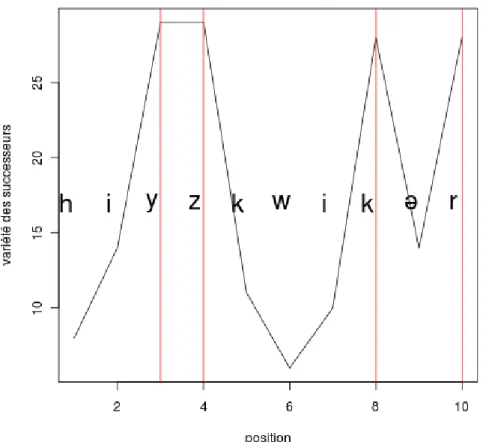
12.2.2. Segmentation from Phonemic Transcriptions and Alphabetic Scripts . . . 156
12.3. Going further . . . 159
12.3.2. Multi-Word Expressions . . . 160 12.3.3. Inferring Word Classes . . . 160 12.4. Discussion . . . 161 A. Typed Evaluation 165 B. French Data 175 B.1. Using NµV BE . . . 175 B.2. Using NzV BE . . . 176 Bibliography 179
2.1. Degree of Syllabic freedom, from DeFrancis (1984, p. 185) . . . 13
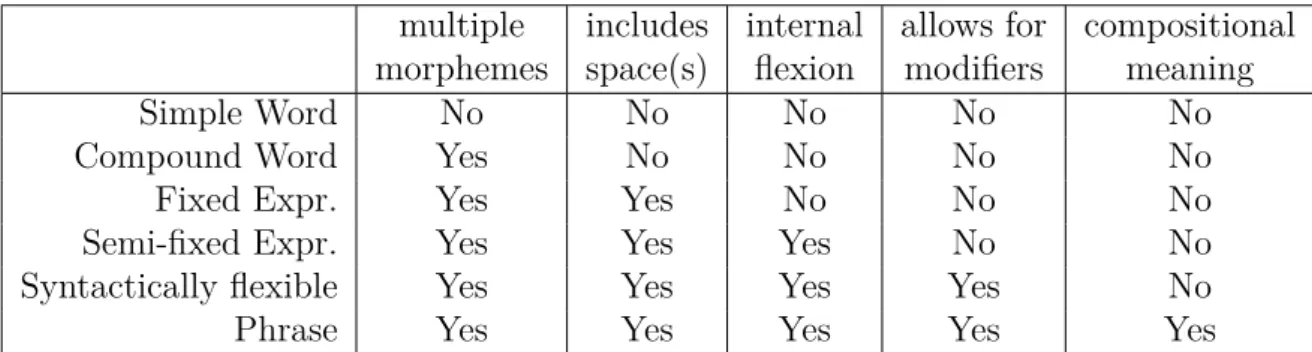
4.1. types d’expressions multi-mots et critères utilisés dans cite sag et al 2002 . . . 48
4.2. Summary of all mentioned units . . . 51
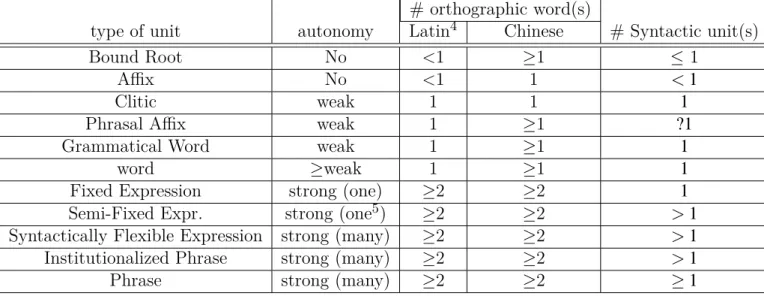
6.1. Size of used corpora . . . 70
7.1. Baselines and Toplines on Bakeoff 2 corpora with Maximum Matching algorithm . . . 78
7.2. Fw obtained by a cross-trained ZPAR (Zhang & Clark 08), all words . 97 7.3. Fw obtained by a cross-trained ZPAR (Zhang & Clark 08), unigrams only . . . 97
7.4. Fw obtained by a cross-trained ZPAR (Zhang & Clark 08), bigrams only 97 7.5. Fw obtained by a cross-trained ZPAR (Zhang & Clark 08), trigrams only . . . 98
7.6. Reported results of various segmentation systems . . . 98
8.1. Results of the different segmentation algorithms inspired by the Harrissian hypothesis on the Bakeoff 2 testset. . . 116
9.1. Regular expressions for numbers used in preprocessing. . . 119
9.2. Date and Time regular expressions used in preprocessing . . . 120
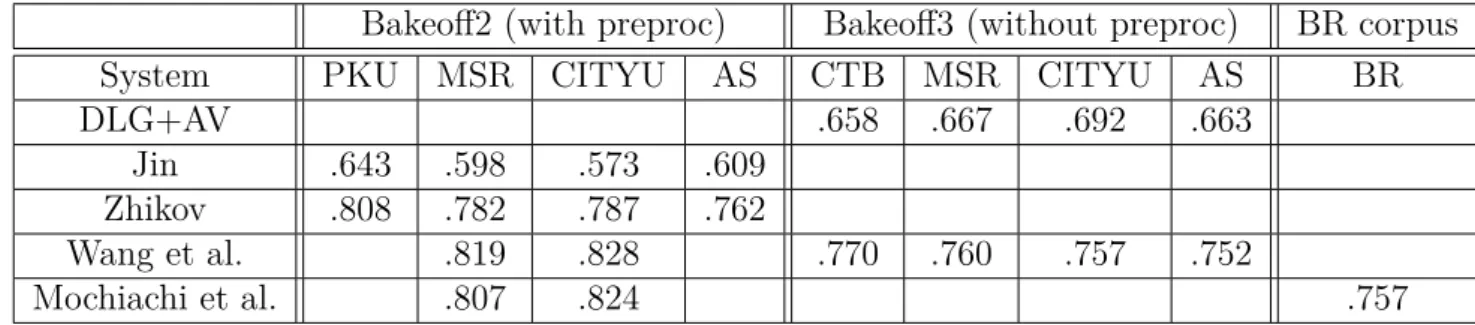
10.1. Scores on different Corpora for Zhikov et al. (2010) algorithm (without and with their MDL-based improvement step) and for our base system (without MDL and with our base MDL algorithm). Final results are
displayed in Table 10.3 . . . 127
10.2. Examples of merges (sorted by number of occurrences) . . . 129
10.3. Final results . . . 130
11.1. Sinica Simplified Tagset . . . 135
11.2. Typed positions evaluation on boundaries, for types with at least 100 occurrences, with our basic system (sample from Appendix A) . . . . 142
11.3. Typed positions evaluation on boundaries, for types with at least 100 occurrences, with our basic system + MDL (sample from Appendix A) 143 11.4. Typed positions evaluation on non-boundaries, basic system . . . 144
11.5. Typed positions evaluation on non-boundaries, basic system+MDL . 145 12.1. Size of the Taiwanese data used . . . 156
12.2. Segmentation of Taiwanese Hokkien written with Chinese characters, evaluated against the orthographic segmentation of its romanisation. 157 12.3. Segmentation of phonemised Child-Directed Speech from the BR Corpus157 A.1. Typed positions evaluation on boundaries, for types with at least 100 occurrences, with our basic system . . . 165
A.1. Typed positions evaluation on boundaries, for types with at least 100 occurrences, with our basic system (continued) . . . 166
A.1. Typed positions evaluation on boundaries, for types with at least 100 occurrences, with our basic system (continued) . . . 167
A.1. Typed positions evaluation on boundaries, for types with at least 100 occurrences, with our basic system (continued) . . . 168
A.1. Typed positions evaluation on boundaries, for types with at least 100 occurrences, with our basic system (continued) . . . 169
A.2. Typed positions evaluation on boundaries, for types with at least 100 occurrences, basic system+MDL . . . 170
A.2. Typed positions evaluation on boundaries, for types with at least 100 occurrences, basic system+MDL (continued) . . . 171
A.2. Typed positions evaluation on boundaries, for types with at least 100 occurrences, basic system+MDL (continued) . . . 172
A.2. Typed positions evaluation on boundaries, for types with at least 100 occurrences, basic system+MDL (continued) . . . 173
A.2. Typed positions evaluation on boundaries, for types with at least 100 occurrences, basic system+MDL (continued) . . . 174
1.1. Stemma for French (from Tesnière, page 15) . . . 4
1.2. Stemma for Chinese . . . 4
7.1. Simplest DAG (expected segmentation) . . . 78
7.2. A more realistic DAG . . . 78
7.3. Segmentation of “He’s quicker”, following Harris (1955) . . . . 89
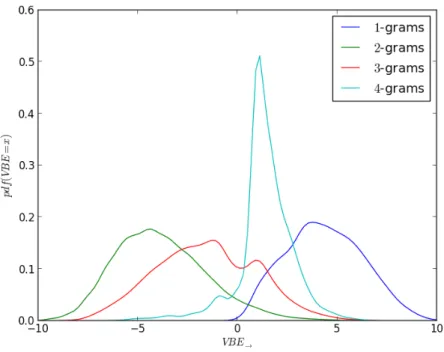
8.1. Probability Density functions of V BE→ values for 1-grams . . . 107
8.2. Probability density functions of V BE→ values for 2-grams . . . 107
8.3. Probability density functions of V BE→ values for 3-grams . . . 108
8.4. Probability density functions of V BE→ values for 4-grams . . . 108
8.5. Probability density functions of V BE→ values for 5-grams . . . 109
8.6. Probability Density functions of V BE→ values for 6-grams . . . 109
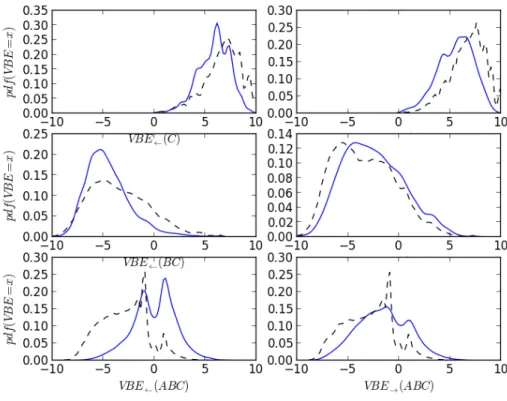
8.7. VBE of all substrings of the trigrams (dashed black) and for the substrings of the trigrams that are segmented as words in the manually segmented corpus (blue line). . . 110
8.8. V BE→ for words of different lengths. . . 111
10.1. DL minimization . . . 126
10.2. f-score on words as a function of description length for the three algorithms . . . 126
11.1. An example of ambiguous output visualised with What’s Wrong with my NLP . . . 148
After decades of research in Natural Language Processing and a hundred years of works aiming to describe Modern Standard Chinese, it may seem surprising, or unnecessary to come back to the question of wordhood. However, up until present there appears to be no fully satisfying definition of the minimal units for linguistic description and for language processing that also fits the needs of quantitative linguistics.
In my own previous work, the inadequacy of existing segmentation systems to my needs for linguistic studies has been a major issue. During my work on the quantitative analysis of the productivity of morphological rules (Magistry, 2008), state-of-the art segmentation systems were not an option because they performed (and still perform) poorly when dealing with the items I was targeting: rare occurrences of long words. I had to restrict my experiments to a manually segmented corpus and this was the main limitation of my work.
During my stay in Taiwan, I had the great opportunity to participate in the on-going Franco-Taiwanese project called M3 “Model and Measurement of Meaning” (Desalle et al., 2010; Magistry et al., 2009, among others). This project compared results from psycho-linguistic experiments on language acquisition to computational linguistic models of the lexicon. The lexical models were based on synonymy graphs of Mandarin and French. Questions related to the segmentation of Mandarin took a large part of the discussions in the first joint meeting in which I participated where both the Taiwanese and French teams were present.
The issue revolved around the choice of vertices for the Mandarin lexical graph. The question “what is a word in Chinese?” has been around for decades, and it was inevitably asked once again. It felt like this question could neither be avoided nor definitively answered. Building the Mandarin graph was one of the tasks of the M3 project. The French graph on the other hand was already available before the
beginning of the project and was not a subject of discussion in itself. It had been compiled by merging multiple synonymy dictionaries, therefore it inherited from traditional French dictionary entries the decisions on what constitutes a vertex in the graph. As a consequence the French graph included many so-called Multi-Word Expressions (MWE). But discussing the relevance of the presence of such expressions in the graph was outside the scope of the project.
It appeared to me that this striking difference in term of how lively the debates about wordhood were on each side of the table was not so closely related to typological differences between French and Mandarin. On the contrary, it was mostly the result of differences in terms of lexicographic traditions and trust in the available resources.
In view of what has been said above, I felt I had to address this question in my dissertation.
General linguistics offers many definitions and theories concerning its minimal units. But in practice, applying these theories to large-scale corpora often ends up in endless debate and disagreement among human experts. The current practice in Chinese word segmentation is to provide guidelines with heuristics that allow expert annotators to reach a satisfying level of consistency in the manual segmentation of the training corpus. Then supervised machine learning is used to mechanise the segmentation process in order to segment unseen data. In doing so, we purposely leave behind linguistic felicity.
On the other hand, I believe it possible to refine the definitions and segmentation procedures inherited from early works in structural linguistics, in order to provide segmentation algorithms which would not need manual annotation but would extract the implicit structure from raw language data. This is precisely the purpose of unsupervised machine learning. The resulting segmentation will thus depend on the corpus being segmented and may vary from one corpus to another, but this seems to be a desirable property which corresponds to psycho-linguistic findings. More importantly, the results will be perfectly reproducible. This contrasts with supervised learning whose segmentation heavily depends on training data and whose reproducibility is limited by the reproducibility of the manual annotations.
If an unsupervised segmentation system is designed to follow sound principles from structural linguistics, its output can be expected to be equally sound. This is
As the ideas presented here are the result of an unquantifiable number of interactions over the last few years, when I was working in very inspiring and diverse environments with many people to whom I feel indebted, I have decided to write the remainder of this dissertation using the plural pronoun “we”, even though “we” is not a well defined and constant group of people, especially from one chapter to another.
Chapter
1
Introduction
This dissertation addresses the problem of the characterisation and recognition of linguistic minimal units, in particular minimal syntactic units. These are the minimal building blocks for syntax, and their internal structure is described by morphology. The present work thus falls right in the middle of these two levels of analysis.
We propose a linguistically sound yet practical method to measure the syntactic autonomy of the forms present in a corpus and propose an algorithm to perform the segmentation of utterances into relevant segmentation units using the proposed measure of autonomy.
1.1. The Need for Segmentation
Speech and writing1 are essentially observable as a linear (unidimensional) sequence of phonemes or characters. However, to analyse utterances, virtually all formal theories of syntax require some kind of multidimensional representation to describe the relations between possibly non adjacent sub-sequences of characters.
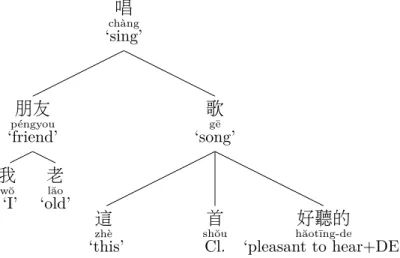
For example, for the linear utterance Mon vieil ami chante cette jolie chanson ‘My old friend sings this beautiful song’, Tesnière (1959) gives the dependency analysis reported in Figure 1.1 (the stemma under Tesnière’s terminology). In this trivial case, segmenting on the space characters does yield satisfying units. However if we translate this simple sentence into Chinese, we may produce the sequence of characters 我老朋友唱這首好聽的歌. To be able to propose the analysis illustrated in Figure 1.2, we need a segmentation that cannot be trivially derived from a graphical
chante ‘sing’ ami ‘friend’ mon ‘my’ vieil ‘old’ chanson ‘song’ cette ‘this’ jolie ‘beautiful’
Figure 1.1.: Stemma for French (from Tesnière, page 15)
chàng 唱 ‘sing’ péngyou 朋友 ‘friend’ wŏ 我 ‘I’ lăo 老 ‘old’ gē 歌 ‘song’ zhè 這 ‘this’ shŏu 首 Cl. hăotīng-de 好聽的 ‘pleasant to hear+DE’
Figure 1.2.: Stemma for Chinese
clue. The segmentation into 我•老•朋友•唱•這•首•好聽的•歌2 is a prerequisite to a syntactic analysis. The case for French may also not be as simple as it first seems because of the so-called “multiword expressions” discussed in chapter 4.
(Tesnière, 1959, chapter 10) makes interesting statements about the notion of the word (the vertices of his stemma). He considers that sentences are not to be defined starting from its words. Quite the opposite, it is the words that are to be defined from the sentence. He states that “one can not define the word in itself, but only from the breaks that delimit its beginning and its end” and describes these “breaks” as being:
• partial, they never completely break the speech;
2Throughout the dissertation, we indicate explicitly the segmentation using middle dots• and
• variable, “the cuts they dig are not of an equal depth”;
• relative, they can only be measured with respect to one another.
Tesnière considers that these cuts are “not only unclear, but also impossible to clear up. Therefore the notion of the word is essentially elusive.”
We agree with Tesnière’s description, but we believe that this notion can be made less elusive with the help of computational linguistics. The corpora now available and computation power allow us to estimate the “depth” of the cuts based on statistics drawn from unannotated corpora and thus to attempt an empirical, data-driven definition of the word.
We will see that a single notion of “word” is not sufficient to describe the variety of phenomena we can observe in terms of syntactic autonomy. Therefore we prefer to talk about ‘syntactic units’ or ‘segmentation units’.
We shall try to characterise these units (chapters 2 to 5), underline the limitations of current practices in NLP (chapters 6 and 7) and propose a new method to perform the segmentation of the linear input (part 2).
1.2. Language, Speech and Corpus
Saussure et al. (1916) makes the distinction between la langue ‘language’ and la
parole ‘speech’, contrasting the “set of necessary conventions adopted by the social
body so as to permit the usage of the faculty of language among individuals” with “the act of the individual putting his faculty into practice”.
The language data that we can observe and collect (i.e., the corpus) is a collection of “speeches” that individuals have consciously crafted to pursue a specific communicative goal. They did so freely to a large extent but they nevertheless had to follow language conventions to build understandable messages.
We work under the hypothesis that by doing so, they let the language (la langue) impose its structure on their speech (leur parole) in a way that is statistically observable and that makes human speech distinguishable from a random sequence of symbols or sounds.
Unlike most previous works, we are not designing a segmentation system which would explicitly follow a specific linguistic theory. We rather take the position of the observer and try to see what the distributions we find in corpora can reveal about linguistic units and boundaries. We check afterwards whether it matches our theoretical position (presented in section 3.3).
Our task naturally points to lexical units but we proceed bottom-up: we select abstract principles that should define linguistically relevant boundaries, implement them in a segmentation system and observe the output to see which aspects of linguistic theories are captured.
1.3. Language Acquisition vs Language
Description
We work under the hypothesis that the structure of the language can emerge from a wide range of speech varieties. We consider this assumption reasonable because the situation our system will be facing is to some extent comparable with the situation in which children acquiring their first language are placed.
However, this thesis is not an attempt to model the actual process of language acquisition (unlike related work presented in section 7.2.2). We do not claim any psycholinguistic felicity regarding the segmentation procedure. Nevertheless it is very likely that the clues useful to our system are somehow related to the clues used by infants. Describing this relationship is outside the scope of our study but would grant a cognitive plausibility to the output of our system.
Rather than language acquisition modelling, our work can be considered as a first step towards a fully mechanised structural linguistic analysis in which language structure is induced from raw data.
1.4. Computational Linguistics and Natural
Language Processing
We evaluate our work following the current practice in the Natural Language Processing community. We do so because it is the only available way to compare our system to other systems and prove its output sensible. Nevertheless, we underline
the limitations of such an evaluation in chapter 6 and section 7.2.6. Our purpose is the computational and automatic study of language, we do not have any specific language technology application in mind (in this dissertation at least), apart from pursuing the automatic analysis and description of a language.
1.5. Working on Written Data
As our work is achieved based on written materials, it is worth noting from the start that provided a system to convert an acoustic signal into a sequence of symbols is available, everything that is presented in this dissertation should be applicable.
This being said, we do not subscribe to the idea that writings are only a secondary encoding of a language which is of lesser importance for linguistics studies compared to speech data. From Saussure’s 1916’s statement that ‘language and writing are two distinct systems of signs” we draw the conclusion that writing is a system of its own that deserves to be studied too.
As recent works in corpus linguistics and NLP massively target written material, further discussion about the relevance of such study seems unnecessary. A more comprehensive discussion on this point can be found in (Harris, 2005). The exact relation between spoken and written languages is also outside the scope of our work.
1.6. The Choice of Mandarin Chinese as a Case
Study
This dissertation focuses on the current standard form of Mandarin Chinese, or Modern Standard Chinese (referred to as MSC throughout this dissertation). Some aspects of what we are referring to with the name MSC are presented in chapter 2 with further references for details.
We did not choose to work on MSC because the ideas and algorithms proposed here only apply to this language. On the contrary, we would argue that this work can be extended to any language and script. But MSC exhibits interesting properties that make our point easier to make than it would have been on many other languages (French for example).
Firstly, MSC in its standard written form does not explicitly mark any kind of unit that resembles what we intuitively call a “word” in French or English. Without
any intuitive notion of “word”, the difficulty to define a segmentation unit is more striking (especially to NLP practitioners). This is discussed in details in chapter 2. It results in a large body of previous works in linguistics (chapter 3), a variety of existing segmentation systems for MSC as well as well-established evaluation practices (chapters 6 and 7).
Secondly, MSC presents no inflection system. This greatly simplifies our problem. A proper treatment of inflection is left for a future work.
Thirdly, the use of Chinese Script for MSC provides an interesting graphical unit, larger than a Latin letter, that correspond to a syllable with a certain degree of semantic disambiguation: a given syllable can be transcribed by various distinct characters, depending on the intended meaning (chapter 2 and 3).
1.7. Outline of the Dissertation
This is dissertation is organised as follows:
The first part focuses on the linguistic aspects of our work and its relations to previous works in both linguistics and Natural Language Processing.
The next chapter provides an overview of what is traditionally considered as a
word outside linguistics and the equivalent unit, the character (
zì
字 ) for Chinese. It explains why a more subtle analysis of the minimal units is required in linguistics.
Chapter 3 discusses the linguistic definitions and criteria from the Chinese linguistics literature and describes the position we adopt in our work in section 3.3. In chapter 4, we argue that the issues raised for Chinese are not limited to Modern Standard Chinese (MSC) but can be related to that raised by the presence of Multi-Word Expressions (MWE) in any language.
Chapter 5 explains the specificities of a study solely based on raw corpus data, compared to traditional linguistic studies that rely also on introspection and elicitation.
Chapter 6 provides a short history of the establishment of Chinese Word Segmentation as a typical task for NLP researches. It discusses the available corpora for training and evaluation and their guidelines.
Chapter 7 presents different approaches to the problem of word segmentation, with a specific focus on the unsupervised systems more closely related to our work.
of the combinatoric autonomy of forms, the first required step towards a fully unsupervised and automatic assessment of wordhood.
Chapter 8 presents our improvements of the reformulation of a Harrissian hypothesis concerning the segmentation for it to be operational on corpus data.
Chapter 9 stresses the relevance and the importance of preprocessing, which significantly increases the quality of our segmentation.
Chapter 10 reports experiments on refining our system by using the Minimum Description Length principle. It shows mixed results that on the one hand allow us to achieve state-of-the-art performance, but on the other hand limit the genericity and the clarity of our approach.
Chapter 11 presents a new method to evaluate the quality of a segmentation. It relies on dependency structures annotated in a Treebank and provides a finer-grain evaluation. In this chapter we also provide a visualisation technique and a way to formulate our results as a probabilistic model. This allows us to better understand the behaviour of our system and to confirm its relevance for our long-term goals.
Chapter 12 concludes this dissertation with preliminary results from auxiliary experiments on other languages. It also provides insights about our future research directions.
Chapter
2
A First Naive Approach: the
Orthographic and Sociological Word
The notion of “word” may sound like an intuitive one. For English or French, it may seem to be part of the speaker’s intuition that it is futile to question. We will see that this impression is misleading and that our intuitive notion of the word is mostly a cultural artefact based on orthography. Regardless of which language is analysed, a strict definition of minimal units for text processing is not trivial to find.
2.1. Orthographic Word and Writing Systems
To begin, we claim that what appears as intuitive to the speakers of languages such as French or English (written with the Latin alphabet) is the correspondence of two different possible definitions of word. Namely what Chao (1968) and Packard (2000) call the sociological word and the orthographic word.
The sociological word is the cultural item present in many social activities such as boardgames. It is the basic unit of the traditional dictionaries we are used to. The
orthographic word is the unit defined by typography. In modern Latin script, they
are typically surrounded by spaces or other punctuation marks. This, in fact, is part of the orthography and has to be learned explicitly. Consider examples (1) and (2) in French.
(1) a. au
at-the
milieu
middle ‘in the middle’
b. autour at-the-periphery ‘around’ c. *aumilieu (2) a. à at seule only fin end de of
‘for the sole purpose of’ b. afin
at-end
de
of ‘in order to’ c. #à fin de
Many things could be said to justify the presence or the absence of white-spaces in such contrasting examples. However a justification will hardly convince us that those are not essentially conventions that are learnt at school. Correct spacing is thus part of the orthography, just like the use of any punctuation mark. The
orthographic word arises from tradition and the explicit normalisation of writing
practices. For practical reasons (it is technically trivial to split on space characters to turn a string of characters into a sequence of tokens), they are also the basic processing unit of most of the NLP applications and research for French and English.
Now if we look at the Chinese Script, the situation seems totally different. The set of punctuation marks available to write in MSC does not include a white-space or an equivalent way to systematically mark boundaries. On the other hand, each Chinese character is written in a (invisible) square of the same size and they are written with a constant distance between two characters. This makes each character easy to isolate from the others (even when handwritten in cursive style). It follows that Chinese characters are a natural candidate for the orthographic word in Chinese script. Interestingly, the Chinese character is also the sociological word when people write using Chinese script. The differences begin to appear when the Chinese characters are used as a basic unit for linguistic analysis and NLP.
When dealing with MSC, a more subtle treatment to select minimal processing units is required for linguistic analysis and for many NLP tasks. Interestingly, this has not always been well accepted. DeFrancis (1984) advocates a non strictly
character-based approach to study MSC, he explains in his chapter on “the Monosyllabic Myth” that the cultural status of the Chinese character was a source of confusion for early analysts. DeFrancis traces this confusion back to early missionary works that state that in Chinese, “words, syllable and written symbols are the same”. He then explains the need to distinguish between free, semi-bound and completely bound characters: “These three categories are roughly comparable in English to the free form teach, the semi-bound form er in teacher and preacher, and the completely bound forms cor and al in coral. The first two categories are morphemes, the third is not, as is the case also with their counterparts in Chinese”.
DeFrancis also provides some statistics based on a two hundred characters sample from the “Concise Dictionary of Spoken Chinese” Chao and Yang (1962), one of the few dictionaries that explicitly label characters as free or (semi)bound. Completely bound forms are noted as forming part of a unique fixed combination of characters. The figures he gives are reported in Table 2.1.
Free 44% Semi-bound 45% Completely Bound 11%
Table 2.1.: Degree of Syllabic freedom, from DeFrancis (1984, p. 185)
Using one of the manually segmented corpora that we shall present in more detail in chapter 6, we computed similar statistics. As we base our statistics on corpus, we are able to account for ambiguity (characters that have both free and semi-bound uses).
The training part of the corpus provided by the Peking University (hereafter the PKU corpus, which we will describe in details in chapter 6) contains 4574 distinct Chinese characters for a total of 1.6M occurrences. 2886 characters (63%) can occur as a free word and 4425 (97%) can occur inside a multi-character word (as a semi-bound or completely semi-bound form). 2737 characters (60%) have at least one use as a free morpheme and one use as a bound morpheme. Only 515 characters (11%) appear only as free morphemes and 1688 as bounded morpheme only. 1654 are completely bound (they always appear in the same multi-character word). If we consider all the 1.6M occurrences of characters, only 350,000 (22%) are occurrences of free morphemes and 78% are bound morphemes inside a larger word.
The differences between our figures and those reported by DeFrancis can be explained by the difference in data source. DeFrancis used a “concise dictionary”
in which many low frequency words and characters present in our corpus were left out by Chao and Yang. The other factor is that the authors of the dictionary have probably considered that if a character has a usage as a free morpheme, it is not considered as possible semi-bound form. If we discard low frequency words and remove the free forms from the list of ambiguous forms, we obtain figures similar to DeFrancis’s.
In any case, DeFrancis’s position against a monosyllabic treatment of MSC still holds with our figures. The use of characters as the basic units of processing is equivalent to the assumption that each character is totally free. This is inadequate for the majority of the characters in a corpus.
For the case of French, assuming that every orthographic word is free may also be wrong in the case of so-called “Multi Word Expressions” (MWE). Chapter 4 will focus on MWE, and points out that examples like au milieu de could or should be considered as a complex but single unit (a preposition). We can also consider example (3), also a MWE in which fur is not free and can even be argued to have no meaning in synchrony (it is Completely Bound in the terms of DeFrancis, just like
cor in coral). In synchrony, this word only appears in the idiomatic expression au fur et à mesure, it is therefore impossible to induce a meaning from its use without
looking at an etymological dictionary. Most native speakers of French will know the expression au fur et à mesure but not know that fur used to mean price then rate (ending up as a near-synonym for mesure).
(3) au at-the fur ? et and à at mesure measure ‘gradually’
So it seems to us that the two situations are not fundamentally different. Starting from orthographic words in French is also error-prone. Only the proportion of erroneous forms is not the same. Constant et al. (2011) notes that in the French Treebank (Abeillé et al., 2003), 15% of the orthographic words are annotated as belonging to a larger MWE (and most of them may be free forms in other contexts). These 15% correspond to the 78% we found in our manually segmented Chinese corpus if we consider multi-character words as “Multi (orthographic) Word Expressions” in MSC.
Chinese is due to the respective proportions of non-free orthographic forms. The need for a more subtle processing has thus been felt since the beginning of Chinese NLP whereas MWE are less crucial in NLP for languages written in Latin script and are ignored in many practical applications.
To have a complete picture, it is important to note that this proportion of non-free forms in orthographic words is not constant. We shall mention that although orthographic norms seem more prescriptive than descriptive in their relation to language, the need for word boundary punctuation marks was felt by writers long before any kind of standardisation. If writers feel the need for it, it must be part of their intuition about the language. It is worth taking a glimpse into the evolution of writing practices.
2.2. A Short History of Orthographic Word
Boundaries in Writing
In NLP literature on Chinese Word Segmentation, it is common to read that “unlike English, Chinese has no word boundaries”. A lot of confusion underlies this kind of statement. First of all, it seems important to distinguish the language from the script used to write it. A given script may be used to represent multiple languages in slightly different ways and a given language may be represented by multiple scripts. For example, the Latin script can be used to represent English, French, German, and so on. The Chinese script is used for modern Mandarin Chinese but also for classical Chinese, Japanese, Taiwanese and Cantonese amongst others. On the other hand, Chinese characters in Vietnamese, Korean or Taiwanese can be or have been replaced by other scripts.1 Some languages including Japanese, Korean
and Taiwanese are also written with Chinese script mixed with other scripts.
The relationship between a script and a language is subject to evolution through time, so are the scripts themselves. This evolution may affect the explicit marking of boundaries. It is worth mentioning that ancient Greek and Latin were initially written in scriptio continua, i.e., without any word boundary markers. The habit of writing explicit boundaries came about progressively, first with a middle dot (a
1Interestingly, it has been so with different strategies. For example romanised Vietnamese kept
the same orthographic word as Vietnamese in Chinese script but romanised Taiwanese join these units with a hyphen and mark larger orthographic words with spaces.
·) and later with spaces. This habit for Latin script became the common usage in Europe only during the second half the the first millennium (see Drillon (1991)).
Although DeFrancis claims that the equivalence between words, syllables and written symbols in Chinese has always be wrong, we can argue that it has been “less wrong” than it is nowadays. At some point, the situation for Chinese was comparable with the current situation for orthographic words in French (Latin script), that is to say, with an orthographic word boundary mark (the space between two Chinese characters) that corresponds well to a syntactic and semantic unit. At that time, Chinese script was used to represent Archaic and Classical Chinese. Compare examples (4) in Classical Chinese (a quotation from Confucius’s Analects and (5), a possible traduction in MSC.
(4) 季路 Jilu 問 ask 事 serve 鬼神 ghost-spirits 。 . 子 master 曰 say : : 「 “ 未 not-yet 能 can 事 serve 人 man , , 焉 how 能 can 事 serve 鬼 ghosts ?」 ?”
‘Ji Lu asked about serving the spirits of the dead. The Master said, “While you are not able to serve men, how can you serve their spirits?”’
(5) Jìlù 季路 JiLu wén 問 ask rúhé 如何 how shìfèng 事奉 serve guĭshén 鬼神 gods 。 . kŏngzĭ 孔子 Confucius huídá 回答 answer shuō 說 saying :「 :“ bù 不 not néng 能 can shìfèng 事奉 serve rén 人 man , , zénme 怎麼 how néng 能 can shìfèng 事奉 serve guĭshĕng 鬼神 gods a 啊 PART ?」 ?”
We can spot some expressions involving multiple characters in the Classical Chinese example, but such expressions were not as pervasive as in its MSC counterpart.
With the evolution of Classical Chinese, more and more multi-characters expres-sions with non compositional meanings or with no syntactic freedom appeared. Those could mostly be considered as “multiword expressions”. As the proportion of those expressions increased, the boundaries between linguistically relevant expressions became more and more fuzzy.
marking in “Chinese” (as a script): the shift from vehicular to vernacular languages for official written materials and the establishment of Modern Standard Mandarin Chinese as the national language of the Republic of China in a reform movement that started in 1913. For more details about the historical aspects of that shift, on can refer to (Norman, 1988) and (Kaske, 2008). To concur with DeFrancis’s
Monosyllabic Myth, we can stress that the first event in that direction in 1913 was
not explicitly about building a national language, but about unifying the reading of Chinese characters. It was called the
dúyīn tŏngyī huì
讀音統一會 Commission on the Unification of
Pronunciation (for more historical and sociolinguistics details, see Chen (1999)).
This is indicative that even during the shift from vehicular to vernacular as the main written language, the Chinese character remained the sociological word.
The only aspects in which the reforms during the 20th century affected the script itself are the graphic simplification of some characters (only in the People’s Republic of China), and the introduction of certain punctuation marks (which are indeed word boundary markers,2 but not as pervasive as spaces can be in other scripts and languages).
With regard to our subject, this sociolinguistic evolution is the root of the confusion between Chinese Script and Standard Mandarin and the frequent unclear statement that “Chinese has no word boundaries”.
The national language defined later was mostly based on the vernacular languages spoken in the North of China which are as distant from classical Chinese as many modern Romance languages can be from Latin. We shall note here that a large variety of vernacular languages spoken in China (including Mandarin) already had various traditions of writing before the institutionalisation of Mandarin Chinese as the national language and its standardisation. They were written both using Chinese characters and romanised characters (under the influence of missionaries, see section 12.2.1 for Taiwanese Hokkien as an example). When written in Chinese characters, no clear orthographic words larger than one character were observable. Romanisation however, did provide such larger units. Written vernacular Mandarin using Chinese characters also served as the basis to define the lexicon of Modern Standard Mandarin Chinese. However, influences of the various local vernacular languages can still be found both in oral and written languages.
2With the exception of the semicomma 、 used to form coordinated lists and which can be used
This historical background is crucial for any work on Chinese languages, but the full picture is outside the scope of the present research. We just want to stress that word boundaries were first more clearly marked in texts written with Chinese characters. But those marks, or strictly speaking the function of those marks, slowly disappeared with language evolution and a strong and sudden change in language policies concerning the official written language led to the present situation.
To conclude this short incursion into the history of writing systems, we follow Drillon in claiming that spacing characters are part of the punctuation and what is commonly referred to as a word is what Packard (2000) describes as the orthographic word. It matches with the sociological word in both Latin and Chinese scripts, but it doesn’t match linguistically relevant units to the same extent in the two scripts. In fact, this orthographic and sociological unit seems to be more resistant to changes than the linguistically relevant units that are to be defined.
2.3. Towards a Linguistically Sound Analysis
This mismatch between the orthographic word and a larger morpho-syntactic unit in MSC led many scholar to deny the existence or the relevance of words in Chinese. The distinction between characters (
zì
字 ) and a larger word-like unit (
cì
詞 ) was made in 1907 by Zhang Shizhao, but the relevance of this level of analysis was still contested years later. One reason is often the confusion between Old Chinese and Modern Standard Chinese at a time when MSC was still under the process of standardisation. This is especially visible in dictionaries where the definitions at the character level do not typically distinguish meaning of a free form and etymology of a character. There is often a lack of distinction between information about the actual language in use in synchrony and the knowledge drawn from philology. Another reason to deny the relevance of a word-like level was the difficulty to design a precise set of tests that would yield consistent analysis. See for example the position of Chao Yuanren in his grammar (Chao (1968), as cited by Duanmu (1998)):
“Not every language has a kind of unit which behaves in most (if not all) respects as does the unit called ‘word’ ... It is therefore a matter of fiat and not a question of fact whether to apply the word ‘word’ to a type of subunit in the Chinese sentence.”
Nowadays, the relevance of a word-like morpho-syntactic unit is widely acknowledged, even though a fully satisfying and widely accepted definition for it is still lacking. The set of usable tests to isolate and classify wordforms in MSC has been well described in the literature (Huang, 1984; Duanmu, 1998; Packard, 2000; Nguyen, 2006). We review the criteria that are the most relevant for our discussion in the next chapter. In Chapter 5 we discuss the usability of those linguistic criteria in a corpus study with a high degree of automation. Next we will explain how these tests relate to general linguistics to sketch out how our work can be extended to other languages. This will stress the need for unsupervised segmentation and lead us to a discussion on Chinese Word Segmentation in NLP, in chapter 6.
Chapter
3
The Word in Chinese Linguistics
This chapter reviews a selection of previous works that provide the traditional methodology to delimit and qualify words in MSC.
Chinese script does not mark relevant boundaries in MSC. On top of that, MSC has very few inflections. Spaces or other equivalent punctuation marks and inflection paradigms are the two main indicators of wordhood and word classes (parts of
speech) in the languages that use the Latin alphabet. For example, English verbs
can be characterised by a bound root which combines with a closed set of inflectional affixes and English nouns will typically take a suffix -s to mark a plural form. These two important clues are not available to analyse MSC, hence the need for a specific set of criteria and tests to distinguish words, phrases, affixes and clitics.
Methodology and criteria can be found in (Kratochvíl, 1967; Huang, 1984; Duanmu, 1998; Packard, 2000; Nguyen, 2006). This chapter revolves mostly around Kratochvíl, Duanmu and N’Guyen’s proposals.
We also describe our adaptation of the description of minimal units exemplified with French in (Kahane, 2008) to MSC (Magistry, 2008).
Duanmu and N’Guyen both provide a clear review of the variety of tests that have been proposed to distinguish between the the various types of units. Duanmu does so to demonstrate consistency between a selection of morpho-syntactic criteria and a phonological definition of wordhood. His morpho-syntax is based on constituent analysis. On the other hand, N’Guyen aims at defining the guidelines to write an “Explanatory Combinatorial Dictionary” (Mel’čuk and Polguère, 1987) in the dependency-based Meaning-Text Theory (MTT) (Mel’čuk, 1988, 1994). We contrast the two approaches to stress important issues for our own purpose.
Kratochvíl (1967) gave some guidelines towards a description of MSC word classes. It is worth mentioning that Kratochvíl only outlined the methodology and explicitly refused to provide a comprehensive description of those classes because of the socio-linguistic context at the time. He claims that such work may have easily been taken as a prescriptive normalisation of MSC even if such a pioneering work would have necessarily been flawed in one way or another.
He first suggests the need for a system of word classes because it allows for a more concise description of the language and he starts with the following example:
(1) wŏmen 我們 We yĕ 也 also qù 去 go ‘We go too’
from which he extracts three commutation paradigms • X: {
wŏ
我 ‘I’,
nĭ
你 ‘you’,
Wáng bóshì王博士 ‘doctor Wang’, gāngcái剛才 來lái 的de 那nà 個ge 人 ‘therén
person that just arrived’, …} • Y: {
dāngrán當然 ‘naturally’, mànmànde慢慢地 ‘slowly’, dĕng等 一會兒yīhuì’r 就 ‘just in a moment’, …}jiù
• Z: {
lái
來 ‘come’,
gāoxìng高興 ‘happy’, 跟他gèn tā 借了jièle bùshăo不少 的de qián錢 ‘borrowed a lot of
money from him’, …}
in the context of example (1), the first item can commute with any member of class X, the second with any member of class Y and the third with any member of class Z. Note however that not all X Y Z combinations are possible.
Kratochvíl calls the contexts of possible commutation “substitution frames”. For the three aforementioned classes, these are :
(2) a. X X yĕ 也 also qù 去 go b. wŏmen 我們 we Y Y qù 去 go c. wŏmen 我們 we yĕ 也 also Z Z
The members of the classes proposed by Kratochvíl are of various kinds, ranging from grammatical affixes (including clitics) to phrases (XP).
To find out what the minimal forms are, Kratochvíl suggests proceeding by
reduction. Reduction is comparable to strong autonomy in the MTT framework
proposed in Mel’čuk (1994) that N’Guyen follows. In this example,
qù
去 ‘go’ can be used alone with the same semantic contribution, for example as an answer to the question “will you go?”. This would not be true for the first character
wŏ
我 ‘I’ which is the first person singular pronoun whereas
wŏmen
我們 is plural, both are different answers to the question “who will go?”. The second character
men們 is a bound form
that cannot occur alone, therefore
wŏmen我們 ‘we’ is a minimal autonomous unit. For
expressions that cannot occur alone such as adverbial
yĕ
也 ‘also’, Kratochvíl argues that the fact that they can be minimally suppressed during the reduction process without affecting the contribution of the other element to the sentence like in (3) can justify their treatment as wordforms.1
(3) wŏmen 我們 We qù 去 go ‘We too’
This is for a sketch of Kratochvíl’s procedure, let us now turn to the various types of unit that can be the outcome of the analysis.
3.1. Words, Phrases, Affixes and Clitics
Words and Affixes In Chinese linguistics literature, a word is usually defined as
the atomic unit of syntax. Duanmu describes it as an expression that can occupy an X0 position in the X-Bar theory.2 In dependency grammars such as MTT, it is a
vertex of the graphs describing dependencies in surface syntax.
Chinese words can be made up of a single character or composed of multiple characters. Internal characters are divided into roots and affixes. The distinction between roots and affixes is a matter of productivity. Affixes are or have been sufficiently productive to form morphological families, which are sets of wordforms that are all derived from the same affixation rule. Bound roots may be used in multiple words with related meanings but without the regularity that would enable
1In this example, Kratochvíl seems to consider that
men
們 affects the meaning of the pronoun more than
yĕ
也 ‘also’ affects the meaning of the verb. We believe that other insights, such as the diversity of items with wich they combine is needed to reach the same conclusion.
2In the X-bar theory, The X0 position is occupied by a lexical head to which is associated a
us to define a lexical rule. As productivity in morphology is typically a graded phenomenon (Baayen, 1992; Magistry, 2008; Arcodia and Basciano, 2012), we expect the boundary between word formative affixes and bound root compounds to be fuzzy. However this does not question the wordhood of the resulting composed expression. Under Kratochvíl terms, affixes can be either word formative affixes or
grammatical affixes. Neither can occur alone but he distinguishes them because the
former combine with bound roots and the latter combine with free wordforms.
However, Kratochvíl’s grammatical affixes include a variety of items. Some are affixes such as
le
了 (an aspectual marker for which it can be argued that it is a flexion of a verb), but others are considered as clitics or prepositions by others, for example the marker of potentiality
de
得 is analysed as a clitic by N’Guyen. Some others are even segmented as grammatical wordforms by most of the segmentation guidelines such as the negation marker
bù
不 . (Those three items are given as example by Kratochvíl).
In more recent linguistic works, Kratochvíl’s grammatical affixes are subdivided into clitics, affixes and phrasal-affixes Zwicky and Pullum (1983); Miller (1992). In our work, we call “affixes” what Kratochvíl calls “word formative affixes” and subdivide his “grammatical affixes” into “clitics”, “prepositions” and “phrasal affixes”.
Phrases, clitics and phrasal affixes Phrases are the projection of a lexical head in generative frameworks, or a head and its dependants for dependency grammars. In any case, they are a combination of words, grammatical words and clitics. The rules involved in these combinations have to be highly productive.
We reserve the word “clitics” to denote bound forms lacking prosodic structure and attached to their phonological host postlexically (as the selection of the host depends on the syntactic structure at a phrase level). For MSC this definition of clitics limits its use to a closed set of morphemes whose tone can be neutralised. We will use the term “phrasal affixes” for other bound form whose position is constrained at a phrase level. We also distinguish phrasal affixes from grammatical words such as prepositions. The difference is on a syntactic level; both are non-autonomous but grammatical words are the head of a phrase, which is not the case for phrasal affixes.
3.2. A Review of Commonly Used Wordhood
Criteria
Both Duanmu and N’Guyen follow a methodology that is similar to Kratochvíl’s, but they give a more detailed account of the way they make a decision for the unclear cases. Such cases typically arise when full reduction is impossible. They describe a set of criteria that is widely used in the literature and select those they consider the most relevant.
3.2.1. Conjunction Reduction
Conjunction reduction is the process of factorising a part shared by two coordinated elements. Huang (1984) suggests that such a reduction can be done with coordinated phrases but not with coordinated words.
Example (4) shows an acceptable reduction which demonstrates the autonomy of
shū
書
book. It contrasts with (5) where
chē
車 -vehicle is a bound morpheme. (4) a. jiù 舊 old de 的 DE shū 書 book gēn 跟 and xīn 新 new de 的 DE shū 書 book ‘old books and new books’
b. jiù 舊 old gēn 跟 and xīn 新 new de 的 DE shū 書 book ‘old and new books’ (5) a. huǒchē 火車 fire-vehicle gēn 跟 and qìchē 汽車 gaz-vehicle ‘train and automobile’ b. * huǒ 火 ‘fire gēn 跟 and qìchē 汽車 automobile’
Regarding this test, Duanmu follows the criticisms raised by Dai (1992) and limits its applicability to the detection of bound forms. As some compounds may exhibit regular syntactic pattern, the impossibility of performing a reduction points to a wordform but its possibility does not imply that the tested form is a phrase.3.
3Some languages allow for the conjunction reduction of affixes as in German In- und Ausland.
Similar examples can be found in MSC such as
guónèiwài
國內外 country-inside-outside only without a conjunction :
N’Guyen uses this test in a similar manner.
3.2.2. Freedom of parts
The Freedom of parts criterion states that if a component of an expression is a bound form, then the expression is a wordform.
For Duanmu, just like conjunction reduction, this test only applies when identify-ing wordforms. Effectively, two free forms can be combined in a sidentify-ingle wordform (a compound word), as exemplified by (6) where
jī
雞 chicken is a free wordform and
yā
鴨
duck is a bound morpheme that requires the noun-formative suffix
zi
子 to be used as a noun meaning duck. It is inappropriate to reach divergent conclusions for the two expressions in this example. Therefore Freedom of parts is used by Duanmu to conclude that
yādàn
鴨蛋 is a wordform, but it says nothing about
jīdàn 雞蛋 . (6) a. jī 雞 chicken dàn 蛋 egg b. yā 鴨 duck dàn 蛋 egg
N’Guyen rejects this criterion as unusable because it is cyclic: one needs to know that
yā
鴨 is a bound form to conclude that
yādàn
鴨蛋 is a wordform. But if we decide to treat
yā
鴨
dàn蛋 as a phrase, then 鴨 becomes a free wordform without anyyā
contradiction.
We can add that this criterion cannot be applied with phrasal affixes. The result of the combination of a phrase and a phrasal affix cannot be considered as a word. If applied with word-level affixes only, we agree with N’Guyen’s criticism.
3.2.3. Semantic Composition
This test is also of limited use to Duanmu and is rejected by N’Guyen. According to Chao (1968), once we establish that the parts of an expression are free, we can check whether its meaning is compositional. Expressions with compositional meaning should be treated as phrases and expressions with non-compositional meaning as
guónèi 國內 gēn 跟 guówài 國外 but * guónèi 國內 gēn 跟 wài 外
wordforms.
However, when applied as-is this criterion leads to the conclusion that all Multi-word Expressions (MWE) should be regarded as words. This would lead to contradictions with other criteria, especially adverbial modification, XP substitution and productivity. Since many MWE allow for a certain level of variability and modifi-cation. We will give a more detailed description of various kinds of MWE in chapter 4.
Because of this, Duanmu regards this criterion as no more than an indication and N’Guyen rejects its use.
3.2.4. Exocentric Structure
Exocentric constructions are expressions with an apparent inner syntactic structure but whose distribution is not the one expected for such a construction. For example,
je ne sais quoi (lit. ‘I don’t know what’) is a well formed sentence in French (headed
by a verb) but in some contexts, it can be used as a noun, in which case it is often written with hyphens un je-ne-sais-quoi. This nominal use of the expression was even borrowed as such into English.
An expression which has an exocentric structure is regarded as a compound by Duanmu. N’Guyen defines the test by adding the condition that the considered exocentric structure not be attested as productive in the language. He gives the following example in French
(7) Je I tue kill quiconque whoever me myself contredit contradict ‘I kill whoever contradicts me’
where [quiconque me contredit] is a nominal phrase headed by a verb. Such a construction with a non-referent relative pronoun is productive in French and should not be regarded as a compound.
If we follow the exocentric structure criterion without such a precision, this would lead to the conclusion that [quiconque me contredit] is a compound wordform, which would be unfortunate as it conflicts with other criteria (productivity, XP substitution,
3.2.5. Adverbial Modification
Duanmu retains the Adverbial modification criterion from Fan (1958) who remarks that in [A
de
的 N ] structures, A can typically take an adverb of degree whereas [A
N] does not allow such an adverb to be present. He gives the following examples.
(8) a. xīn 新 new de 的 DE shū 書 book ‘a new book’ b. hĕn 很 very xīn 新 new de 的 DE shū 書 book ‘a very new book’ c. gēng 更 more xīn 新 new de 的 DE shū 書 book ‘a newer book’ d. zuì 最 most xīn 新 new de 的 DE shū 書 book ‘the newest book’ (9) a. xīn 新 new shū 書 book ‘a new book’ b. *
hĕn很 新xīn shū書
very new book
c. *
gēng更 新xīn shū書
more new book
d. * zuì 最 xīn 新 shū書
most new book
Duanmu explains this contrast by suggesting that [Adv Adj] is always a phrase and as such cannot occur inside a compound. On the other hand, [Adj N] are compounds.
N’Guyen adopts a similar criterion which is more general.
“S1S2 is a wordform if at least one of its constituents loses its ability to accept modifiers when it is combined with the other constituent. On the
other hand, it is a phrase if its constituents still accept modifiers.”
Note that constituents of idiomatic expressions may or may not lose their ability to accept modifiers. This will be discussed in the next chapter.
3.2.6. XP Subsitution
If one considers all [Adv Adj] to be phrases, Adverbial modification can be seen as a specific case of XP Substitution where the Adj is replaced by a phrase. The original test also comes from Fan (1958) who notes that N in [M
de
的 N] can be substitued by a typical NP such as [Numeral Classifier N]. Example (10) illustrates this substitution. (10) a. xīn 新 new de 的 DE shū 書 book ‘a new book’ b. xīn 新 new de 的 DE sān 三 three bĕn 本 Cl. shū 書 book ‘three books that are new’ c. xīn 新 new shū 書 book ‘a new book’ d. * xīn 新 sān 三 bĕn本 shū書
new three Cl. book
Conclusions are consistent with the Adverb modification criterion.
3.2.7. Productivity Criterion
Phrases are supposed to be derivable from the phrase construction rules of the grammar. Such rules are defined to be productive, that is to say to be able to create a large number of phrases, including new, unseen ones.
If an expression has an internal structure that does not correspond to a productive rule in the grammar, it will be treated as a wordform (by both Duanmu and N’Guyen). Previous [Adj N] wordforms are an example of such cases as X→ Ad j N cannot be considered as a productive syntactic rule for MSC (unlike English). An other example given by N’Guyen is