HAL Id: tel-00789724
https://tel.archives-ouvertes.fr/tel-00789724
Submitted on 18 Feb 2013HAL is a multi-disciplinary open access archive for the deposit and dissemination of sci-entific research documents, whether they are pub-lished or not. The documents may come from teaching and research institutions in France or abroad, or from public or private research centers.
L’archive ouverte pluridisciplinaire HAL, est destinée au dépôt et à la diffusion de documents scientifiques de niveau recherche, publiés ou non, émanant des établissements d’enseignement et de recherche français ou étrangers, des laboratoires publics ou privés.
Distributed and cooperative intrusion detection in
wireless mesh networks
Anderson Morais
To cite this version:
Anderson Morais. Distributed and cooperative intrusion detection in wireless mesh networks. Economics and Finance. Institut National des Télécommunications, 2012. English. �NNT : 2012TELE0046�. �tel-00789724�
DOCTORAT EN CO-ACCREDITATION
TELECOM SUDPARIS ET L’UNIVERSITE EVRY VAL D’ESSONNE
Spécialité : Informatique
Ecole doctorale : Sciences et Ingénierie
Présentée par
Anderson Morais
Pour obtenir le grade de DOCTEUR DE TELECOM SUDPARIS
Distributed and Cooperative Intrusion Detection in
Wireless Mesh Networks
Soutenue le 28 Novembre 2012 devant le jury composé de :
Directeur de thèse : Prof. Ana Cavalli - Télécom SudParis Rapporteurs : Prof. Patrick Sénac - ISAE et LAAS-CNRS
Prof. Marcelo Dias de Amorim - LIP6-UPMC
Examinateurs : Jean-Luc Richier - LIG
Michel Bourdellès - THALES
Prof. Stéphane Maag - Télécom SudParis Prof. Nina Yevtushenko - Tomsk State University
iii
Acknowledgements
In the first place, I would like to thank my advisor, Prof. Ana Cavalli, for accepting me in her research group and providing me inestimable guidance throughout my doctoral study. I especially appreciated her precious advices and inputs during my research work.
Special thanks to Prof. Patrick Sénac and Prof. Marcelo Dias de Amorim for carefully reviewing my thesis manuscript and providing valuable comments. Also thanks to Jean-Luc Richier, Michel Bourdellès, Prof. Stéphane Maag, and Prof. Nina Yevtushenko for taking the time to check my thesis.
I also thank my friends in LOR department for their cherished friendship and the good time we passed in these three years: Anis Laouiti, Iksoon, Pramila, Pablo, Felipe, Mazen, Fayçal, Alessandra, Xiaoping, Khalifa, and Brigitte Laurent. With special thanks to friends Dario and Elisangela who helped me during my arrival in France.
Here I would like to express my sincerest thanks and deepest appreciation to my wife, Klicia, for her encouragement and support during this period. Without her company and assistance, I could not accomplish this mission.
Thanks are also extended to Prof. Eliane Martins who put me in contact with Prof. Ana Cavalli and encouraged me to start the PhD thesis.
Finally, I would like to express my profound gratitude to my family for their constant and generous support always believing in me. And I would like to thank Lord Jesus Christ for all spiritual strength, comfort in darkest hours, and constant presence.
v
Abstract
Wireless Mesh Network (WMN) is an emerging technology that is gaining importance among traditional wireless communication systems. WMNs are becoming popular as a way of providing Internet access in a cost-effective, easy, and fast manner. However, WMNs are particularly vulnerable to external and insider attacks due to their inherent attributes such as open communication medium and decentralized architecture. A compromised mesh device, for instance, can launch attacks by fabricating malicious routing information to disrupt the network routing operation, then putting the entire mesh network at risk. In WMNs, the mesh nodes cooperate and forward packets from each other in order to enlarge their communication range and reach nodes outside their transmission range. Nonetheless, internal malicious nodes may refuse to cooperate by intentionally dropping packets in order to violate the integrity of the network communication system.
In this research, we propose a complete distributed and cooperative intrusion detection system for efficient and effective detection of WMN attacks in real-time. Our intrusion detection mechanism is based on reliable exchange of network events and active cooperation between the participating nodes. In our distributed approach, Intrusion Detection Systems (IDSs) are independently placed at each mesh node to passively monitor the node routing behavior and concurrently monitor the neighborhood behavior. This is suitable since we do not have a centralized point of traffic concentration in the mesh network where a central IDS can be deployed to aggregate all of the traffic for analysis.
Based on that, we first implement a Routing Protocol Analyzer (RPA) that accuracy generates Routing Events from the observed traffic, which are then processed by the own node and exchanged between neighboring nodes. Second, we propose a practical Distributed Intrusion Detection Engine (DIDE) component, which periodically calculates accurate Misbehaving Metrics by making use of the generated Routing Events and pre-defined Routing Constraints that are extracted from the protocol behavior. The DIDE component is able to efficiently signalize malicious activities in real-time on the own node communication link or in the neighborhood with low computational overhead. Third, we propose a Cooperative Consensus Mechanism (CCM), which is triggered among the neighboring nodes if any malicious behavior is detected. The CCM module analyzes the
vi
Misbehaving Metrics and shares Intrusion Detection Results among the neighbors to track down the source of intrusion, i.e., the malicious node, and decide on its culpability. In, addition, a threshold-based approach is developed to improve the analysis of Misbehaving Metrics so we can achieve a higher detection rate and lower false positive rate.
To validate our research, we implemented the distributed intrusion detection solution using a virtualized mesh network platform composed of virtual machines (VMs) interconnected, which represent the network topology. We also implemented several routing attacks that are representative of common WMN security threats to evaluate the performance of the intrusion detection mechanisms. Our experiments show very encouraging results on detecting different types of routing attacks and properly identifying the attacker nodes while incurring small computation cost.
vii
Résumé
Les réseaux maillés sans fil (WMNs - Wireless Mesh Networks) sont une technologie émergente qui prend de l'importance parmi les traditionnels systèmes de communication sans fil. WMNs sont de plus en plus populaires comme un moyen de fournir l'accès à l’Internet d'une manière rentable, facile et rapide. Toutefois, WMNs sont particulièrement vulnérables à des attaques externes et internes en raison de leurs attributs inhérents tels que le moyen de communication ouverte et l'architecture décentralisée. Un appareil sans fil mesh compromis, par exemple, peut lancer des attaques en fabriquant des informations de routage malveillants pour perturber les opérations de routage du réseau, puis mettre l'ensemble du réseau mesh en danger. Dans WMNs, les nœuds mesh coopèrent et transmettent les paquets les uns des autres afin d'élargir leur gamme de communication et d'atteindre autres nœuds en dehors de leur sphère de transmission. Néanmoins, des nœuds malveillants internes peuvent refuser de coopérer en supprimant des paquets intentionnellement afin de violer l'intégrité du système de communication réseau.
Dans cette recherche, nous proposons un système complet de détection d'intrusion distribué et coopératif qui détecte efficacement et effectivement des attaques au WMN en temps réel. Notre mécanisme de détection d'intrusion est basé sur l'échange fiable des événements du réseau et la coopération active entre les nœuds participants. Dans notre approche distribuée, systèmes de détection d'intrusion (IDS - Intrusion Detection System,) sont indépendamment installé dans chaque nœud mesh pour surveiller passivement le comportement de routage du nœud et en même temps surveiller le comportement de son voisinage. Ceci est approprié puisque nous ne disposons pas d’un seul point de concentration du trafic dans le réseau mesh dans lequel un IDS centralisé peut être déployé pour analyser le trafic du réseau.
Sur cette base, nous avons d'abord développé un Analyseur de Protocole de Routage (APR) qui génère avec précision des événements de routage à partir du trafic observée, qui sont ensuite traités par le propre nœud et échangés entre les nœuds voisins. Deuxièmement, nous proposons un Mécanisme de Détection d'Intrusion Distribué (MDID) pratique, qui calcule périodiquement des Métriques de mal comportement précises en faisant usage des événements de routage générés et des Contraintes de Routage prédéfinies qui sont extraites
viii
à partir du comportement du protocole. Le module de MDID est capable de signaler efficacement les activités malveillantes en temps réel sur le lien de communication du propre nœud ou dans le voisinage avec un coût de calcul bas. Troisièmement, nous proposons un Mécanisme de Consensus Coopérative, qui est déclenché parmi les nœuds voisins si tout comportement malveillant est détecté. Le Mécanisme de Consensus Coopérative analyse les Métriques de mal comportement et partage les Résultats de Détection d'Intrusion parmi les voisins pour traquer la source de l'intrusion, c'est à dire, le nœud malveillant, et décider de sa culpabilité. En, outre, une approche basée sur seuil a été développé pour améliorer l'analyse des Métriques de mal comportement afin que nous puissions atteindre un taux de détection plus élevé et un taux de faux positifs inférieur.
Pour valider notre recherche, nous avons mis en œuvre la solution de détection d'intrusion distribuée en utilisant une plate-forme de réseau mesh virtualisée composé de machines virtuelles (VM - Virtual Machines) interconnectés, qui représentent la topologie du réseau. Nous avons également implémenté plusieurs attaques de routage, qui sont représentatifs des menaces communes à la sécurité du WMN, pour évaluer la performance des mécanismes de détection d'intrusion. Nos expériences montrent des résultats très encourageants sur la détection des différents types d'attaques de routage et l’identification des nœuds attaquant alors que les coûts de calcul sont bas pour le nœud.
x
Table of Contents
Acknowledgements ... iii
Abstract ... v
Résumé ... vii
List of Figures ... xiv
List of Tables ... xv
1 Introduction ... 1
1.1 Motivation ... 3
1.2 Contributions ... 5
1.3 Results ... 8
1.4 Organization of the Dissertation ... 10
2 Background and Related Work ... 12
2.1 Intrusion Detection ... 12
2.2 Intrusion Detection in Wireless Mesh Networks ... 16
2.3 Distributed and Cooperative Intrusion Detection ... 20
2.4 Conclusion ... 25 3 Attack Analysis ... 28 3.1 System Model ... 29 3.2 Attacker Model ... 30 3.2.1 Attacking Methods ... 31 3.3 BATMAN ... 34 3.3.1 Protocol Overview ... 34 3.3.2 Flooding Mechanism ... 35 3.3.3 BATMAN Advanced ... 37
xi
3.4.1 Attack Methods ... 38
3.4.2 Example of Attack Scenario ... 39
3.4.3 Attack Model ... 40
3.5 Experiment and Results ... 41
3.5.1 Experiment Environment ... 42
3.5.2 Attack Implementation ... 43
3.5.3 Attack Emulation in Scenario 1 ... 43
3.5.4 Attack Emulation in Scenario 2 ... 46
3.6 Attack Detection ... 50
3.6.1 Results for Scenario 1 ... 51
3.6.2 Results for Scenario 2 ... 54
3.7 Conclusion ... 55
4 Distributed and Cooperative Intrusion Detection ... 58
4.1 System Model ... 59
4.2 Attacker Model ... 60
4.3 Distributed Intrusion Detection Architecture ... 60
4.3.1 Bro IDS ... 61
4.3.2 Routing Protocol Analyzer ... 62
4.3.3 Distributed Intrusion Detection Engine ... 64
4.3.4 Cooperative Consensus Mechanism ... 65
4.3.5 Response Mechanism ... 69
4.4 Threshold Approach ... 71
4.5 Distributed Detection of Message Fabrication Attacks ... 73
4.5.1 RPA: Routing Events ... 73
4.5.2 DIDE: Routing Constraints ... 75
4.5.3 DIDE: Misbehaving Metrics ... 75
4.5.4 CCM: Consensus Algorithm ... 77
4.6 Performance Evaluation ... 79
4.6.1 Experiment Platform ... 79
xii
4.6.3 Emulation of Message Fabrication Attack ... 82
4.6.4 Results ... 84
4.7 Performance Analysis ... 87
4.7.1 CPU and Memory Consumption ... 87
4.7.2 Communication Overhead ... 91
4.8 Discussion ... 93
4.8.1 Security ... 93
4.8.2 Complexity and Limitations ... 95
4.9 Conclusion ... 97
5 Distributed Detection of Packet Dropping Attacks ... 100
5.1 System Model ... 101
5.2 Attacker Model ... 101
5.3 Distributed Detection of Malicious Packet Dropping ... 102
5.3.1 Routing Protocol Analyzer ... 102
5.3.2 Distributed Intrusion Detection Engine ... 103
5.3.3 RPA: Routing Events ... 103
5.3.4 DIDE: Routing Constraints ... 105
5.3.5 DIDE: Misbehaving Metrics ... 106
5.4 Cooperative Consensus Mechanism ... 107
5.5 Performance Evaluation ... 111
5.5.1 Experiment Platform ... 111
5.5.2 Defining the Threshold ... 111
5.5.3 Emulation of Packet Dropping Attack... 114
5.5.4 Results ... 115
5.6 Performance Analysis ... 119
5.6.1 CPU and Memory Consumption ... 120
5.6.2 Communication Overhead ... 123
5.7 Discussion ... 126
5.7.1 Security ... 126
xiii
5.8 Conclusion ... 129
6 Conclusion and Perspectives... 132
6.1 Conclusion ... 132
6.2 Future work ... 135
xiv
List of Figures
1.1 Wireless mesh network architecture ... 2
3.1 BATMAN flooding scheme ... 36
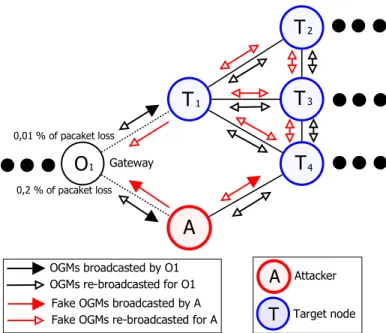
3.2 Route manipulation attack ... 39
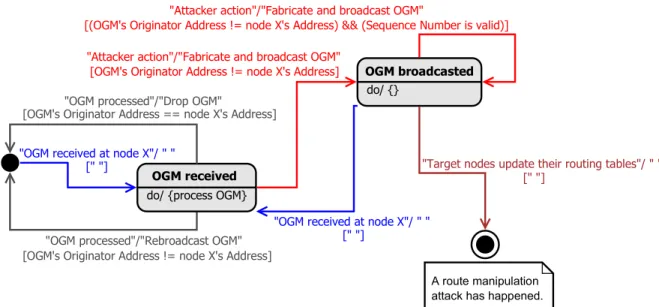
3.3 State machine for routing manipulation attack ... 41
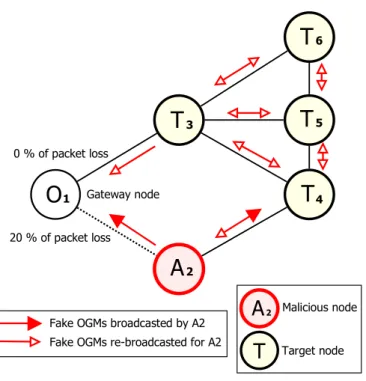
3.4 Mesh network topology for scenario 1 ... 44
3.5 Routing table updates for target nodes ... 45
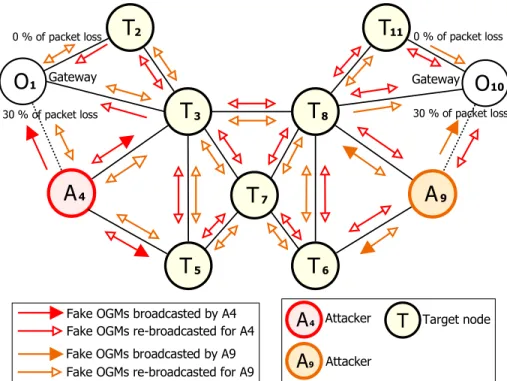
3.6 Mesh network topology for Scenario 2 ... 47
3.7 Routing table updates for Scenario ... 48
3.8 Detection results for Scenario 1 ... 52
3.9 Sequence Number tree for node O1 ... 53
3.10 Detection results for node O1 ... 54
3.11 Detection results for Scenario 2 ... 55
4.1 Distributed intrusion detection architecture ... 61
4.2 Mesh topology emulated for the experiment ... 81
4.3 Misbehaving Metrics calculated by node O1 ... 81
4.4 Routing redirection attack ... 83
4.5 Misbehaving Metrics calculated by nodes O1, O2, and O3 ... 84
4.6 CPU usage for the IDS at node O1 ... 88
4.7 Memory usage for the IDS at node O1 ... 90
5.1 Mesh topology emulated for threshold definition ... 112
5.2 Packet Dropping Metrics calculated by node O4 ... 112
5.3 Malicious node executing packet dropping attack ... 114
5.4 Packet Dropping Metrics calculated for Scen 1 ... 115
5.5 Packet Dropping Metrics calculated for Scen 2... 117
5.6 CPU utilization for the IDS at node O1 ... 121
xv
List of Tables
4.1 Thresholds estimated for nodes O1, O2, and O3 ... 82
4.2 CPU statistics for the IDS at node O1 ... 88
4.3 Memory statistics for the IDS at node O1 ... 90
5.1 Thresholds calculated for nodes O2, O3, and O4 ... 113
5.2 CPU consumption statistics for the IDS at node O1 ... 121
Chapter 1
1
Introduction
Wireless Mesh Network (WMN) has emerged as a new technology to cope with the challenges of next-generation wireless networks, such as providing flexible, adaptive, and reconfigurable network architecture while offering inexpensive solutions to wireless Internet service providers (ISPs). ISPs are choosing WMNs to provide Internet connectivity to costumers as it allows a fast, easy, and cost-efficient network deployment.
WMNs are typically self-organized, self-configured, and self-healed networks [1] whereas the mesh nodes automatically establish a multi-hop ad hoc network and maintain the connectivity among the participating nodes. The mesh nodes transmit traffic from others nodes to reach a destination which they could not reach by themselves. This multi-hop routing strategy widens the wireless service area and enables the network self-managing and self-healing properties, e.g., if a mesh node can no longer operate or has a temporary loss of connection, its neighbors simply find an alternative route through one or more intermediate nodes and the network continues operating. Unlike traditional wireless networks, WMNs do not rely on dedicated wireless infrastructure, but the nodes count on each other to maintain the network fully connected and transmit traffic to destination. As a result, the network is very reliable and has a good wireless coverage since there is often more than one path between a source node and a destination node in the network.
WMN can be considered as a particular type of wireless ad hoc network. As Mobile ad hoc networks (MANETs), WMNs also offer improved services and lower infrastructure costs than conventional wireless networks since both architectures use multi-hop routing strategy. Therefore, MANETs and WMNs are similar, but MANETs also have to deal with the problems introduced by the constant mobility of nodes and frequent changes of network topology. There are basically two types of mesh nodes: mesh routers and mesh clients [2], as shown in Figure 1.1. The core nodes are the mesh routers, which constitute a wireless mesh backbone among them and offer multi-hop wireless Internet connectivity to the mesh
Chapter 1. Introduction 2 clients. As the mesh routers provide rich radio mesh connectivity, the up-front deployment cost and subsequent maintenance costs are significantly reduced. Mesh routers can be assigned as gateway routers, which are then connected to the high-speed backhaul network, i.e., to the Internet, in order to provide Internet connection to all nodes in the network. The mesh routers have limited or no mobility and perform the role of routing traffic received from stationary or mobile clients, who normally have no routing functionality, to the gateway router that is connected to the Internet. Mesh clients are often mobile wireless devices such as cell phones and laptops.
Figure 1.1: Wireless mesh network architecture.
WMNs generally use IEEE 802.11 technology to communicate between wireless mesh routers. Since 2004, IEEE 802.11 Task Group ‘S’ [6] has been developing an amendment to IEEE 802.11 standard to address the issue of multi-hop communication in WMNs defining how wireless mesh devices can interconnect to create a WLAN mesh network without having an Access Point (AP) between them. Wireless community networks and municipal wireless networks are good examples of real-life WMNs offering multi-hop paths between the wireless clients and gateway nodes. This type of network architecture provides low-cost Internet access via Wi-Fi technology to whole neighborhoods and a
Mesh clients Gateway routers Internet router Internet router Mesh routers Internet
Wireless mesh backbone (mesh cloud)
municipal area by using inexpensive IEEE 802.11 wireless routers to deploy the WMN.
1.1 Motivation
Unlike wired networks, which possess sophisticated security defenses for gateways and routers to circumvent threats such as firewalls, antivirus, and complex cryptographic systems, in a wireless network environment, the radio nodes are continuously threatened by security intrusions. A WMN is highly vulnerable to several types of attacks due to its inherit characteristics such as shared wireless communication channel, lack of physical protection of nodes, absence of a centralized administration authority, high dependence of cooperation of all nodes, and devices with limited resources. The lack of fixed infrastructure and a reliable medium access mechanism make the mesh nodes potentially vulnerable to external attacks, such as passive eavesdropping and jamming attacks.
In WMNs, the nodes need to trust each other since a node depends on intermediate nodes to reach the other nodes in the network and eventually the Internet. Consequently, the routing mechanism of WMN assumes that each participating node provides accurate routing information and cooperatively forwards packets for its neighbors as specified by the routing protocol with no malicious intention. By taking advantage of this assumed trust, a malicious node can in practice adulterate routing paths of the network easily by disseminating incorrect routing information through the mesh network.
Insider attacks against the routing protocol, such as node impersonation and routing misbehavior attacks, are particularly a serious issue for the mesh network because they not only compromise the integrity of paths but also the availability of the entire mesh network. Attackers performing flooding and resource depletion attacks generate malicious packets, which uses valuable network and hardware resources and puts the mesh devices at risk. As a consequence, WMNs are exposed to a broad variety of active attacks, including routing loop attack, selfishness, black hole attack, wormhole attack, routing table poisoning, route manipulation or link spoofing attack, and Denial of Service (DoS) attacks.
Many research efforts have been conducted to conceive security methods for the existing routing protocols of WMNs. In this case, many secure routing protocols have been designed such as ARAN [3], Ariadne [4], and SAODV [5]. Most of these approaches rely on key management, public key infrastructure (PKI), and encryption technologies to protect
Chapter 1. Introduction 4 the integrity and authenticity of routing messages as well as prevent unauthorized nodes from joining the network. Outsider attacks can be avoided by applying cryptographic techniques, including authentication and encryption mechanisms, in which the transmitted messages are protected from modifications. Nevertheless, a compromised device owning a legitimate key, or even a non-authenticated mobile node that have access to the network, can generate malicious traffic, intercept and modify packets, and refuse to forward traffic by discarding packets received from neighboring nodes. Furthermore, cryptographic schemes usually require high computational overhead, which consume a significant portion of hardware resources, such as CPU and memory, and can be exploited by DoS attacks.
Malicious nodes disrupt the integrity of routes and compromise the whole network operation when they propagate fake routing messages to manipulate the network routes, or behave in a selfish manner by dropping legitimate routing and/or data packets that are expected to be relayed by the node. Selfish nodes can choose to drop packets in a selective or random fashion, or drop all the packets without forwarding any traffic. Hence, message fabrication and packet dropping attacking techniques represent a serious threat to the normal routing functioning and data transmission of WMNs.
Satisfactory security solutions and attack detection mechanisms in this emerging wireless network environment have not been sufficiently studied. Therefore, a distributed and cooperative Intrusion Detection System (IDS) is essential for wireless ad-hoc networks to defend against malicious behavior, to secure the routing of WMN, and to cope with the limitations of cryptographic systems. IDSs, which have been successfully used in wired networks to detect attacks, can provide an appropriate second line of defense to identify malicious traffic and misbehaving nodes in hostile wireless environments.
Intrusion detection task comprises data collection by monitoring the various system activities such as system logs or captured packets from the network, and subsequent analysis of the data to identify possible security breaches such as intrusions and misuses. However, designing IDS for WMNs is a difficult task because of the intrinsic properties and physical limitations of WMNs. First, since all nodes are expected to be well-behaved and highly cooperative, malicious nodes can exploit this assumption to launch different attacks targeting any node in the mesh network. Then, the IDS design must cover the largest possible number of attacks that can be executed by misbehaving insider nodes.
Second, detecting insider attacks in a mesh network requires intense collaboration between the neighboring nodes and a broader view of the network activity in order to track down the source of intrusion, i.e., each node needs sufficient monitoring information from the neighbors to detect intrusions. A distributed intrusion detection approach is more convenient than exclusively relying on local observation of individual nodes since the node can only see a portion of the network traffic: the packets it sends or receives. Therefore, local data auditing is intrinsically inaccurate, and cannot detect some type of routing attacks, for instance, byzantine attacks, due to the absence of a centralized point of traffic concentration in the ad-hoc network topology.
Moreover, the communication links between nodes are more unstable in a wireless environment than a wired network because of interferences and congested channels, then causing loss of messages between nodes. Therefore, the intrusion detection mechanism must take into account the link quality in terms of packet loss rate in order to have a minimum amount of traffic information to analyze, and maintain a precise intrusion detection accuracy with reduced false positive and false negative rates.
In addition, mesh devices, such as netbooks and mobile phones, commonly have constrained hardware resources, such as memory, CPU, and battery power, and restricted bandwidth usage. Then, this diversity of mesh nodes with scarce resources may affect the effectiveness and efficiency of the IDS they support. For instance, a node can silently drop packets to conserve resources then encumbering the IDS task of distinguishing overloaded nodes from selfish nodes. Thus, the IDS should be efficient in the matter of producing minimum communication overhead and low computational overhead during the intrusion detection process. Therefore, intrusion detection for WMNs remains a complex and challenging issue for security researchers.
1.2 Contributions
The main contribution of this work is the implementation of a complete distributed and cooperative intrusion detection solution for WMNs. We focus on efficiently detecting insider intrusions in real-time by collaboratively monitoring the network activity of the mesh nodes and by exchanging suspected traffic information. We also study routing attacks against the nodes of the WMN, which reveal security breaches of the routing protocol. In
Chapter 1. Introduction 6 particular, the key contributions of this dissertation include as follow.
In a first part, we present routing manipulation attacks against Better Approach To Mobile Ad hoc Network (BATMAN) [7], a proactive routing protocol especially designed for WMNs but also applicable to MANETs. We provide analysis of routing manipulation attacks and demonstrate the attack feasibility in detail. We show how a unique compromised node is capable of manipulating the routes of the rest of the mesh nodes and redirect the traffic to the compromised node. In order to validate our analysis, we implemented the routing manipulate attack in an emulated mesh network environment composed of virtual machines (VMs), which represent the mesh nodes executing BATMAN protocol. We perform routing attacks by using a network traffic generator, which emulates the malicious node behavior that fabricates routing packets to mislead the target nodes. Then, we perform extensive experiments on emulating routing manipulation attacks to check BATMAN security mechanism. We also present an efficient mechanism to detect routing manipulation attacks and identify the source of attack, i.e., the malicious node, which makes use of the BATMAN traces produced by each mesh node.
Therefore, we provide insights into how to emulate routing attacks against the real routing protocol implementation, in our case we utilize BATMAN protocol, in a controlled virtualized mesh network environment since most of previous ad-hoc network security approaches, including intrusion detection solutions for WMNs, have been validated using simulation-based studies and network simulators. Our analysis and experimental results of routing attack emulation expose the security vulnerabilities of BATMAN protocol.
In the second part of the thesis, we propose a distributed and cooperative intrusion detection approach for WMNs. In our approach, an IDS tool runs individually on each node to passively monitor the network traffic and eventually detect routing attacks in collaboration with the neighboring nodes. We implement specific traffic filters for the IDS tool in order to select the appropriate routing packets being transmitted on the node network interface. Then, each node IDS tool concurrently analyses the collected routing traffic and generates routing protocol events, which are processed by the own node and subsequently exchanged with direct neighbors to minimize the message overhead when monitoring the neighborhood behavior. For that purpose, we developed a Routing Protocol Analyzer (RPA) module which examines each routing packet and produces respective Routing
Events according to the protocol behavior. In this work, we make use of BATMAN routing protocol as case study, and therefore BATMAN specification is used to define the Routing Events. However, the RPA module is quite customizable and flexible, and can easily accommodate other routing protocols as well.
After, we implement the core part of the distributed intrusion detection architecture, the Distributed Intrusion Detection Engine (DIDE) component. This module processes the Routing Events produced by the RPA module and also the Routing Events received from neighboring nodes to cooperatively detect routing misbehavior intrusions. We define Routing Constraints which are extracted from the routing protocol behavior and are integrated into DIDE component. Again, we use BATMAN specification to formulate the Routing Constraints, nevertheless additional routing protocols are similarly supported. We also implement part of the routing attack detection algorithms in the DIDE. Based upon the Routing Constraints, the DIDE component periodically calculates Misbehaving Metrics. The Misbehaving Metrics indicate if possible malicious routing behavior is occurring on the node network interface or in the neighborhood, i.e., if the node or a neighbor is originating malicious routing traffic, for instance, the malicious node is transmitting fake routing packets to its neighbors. Our collaborative intrusion detection procedure, which is carried out by the DIDE component, is executed in real-time by the IDS tool having low computational overhead and reasonable message overhead, and it is quite efficient with regard to hardware resources consumption.
We propose a Cooperative Consensus Mechanism (CCM) module that is triggered by the node IDS if any evidence of malicious routing information is found by the IDS agent. The CCM module inspects the Misbehaving Metrics provided by the DIDE component, such as rate of inconsistent routing packets received by the node, and confirms if abnormal routing behavior detected by DIDE is a routing attack or not based on thresholds. Then, the node IDS warns the neighboring nodes about the detected routing intrusion. Before making the final decision, the node IDS consults its neighbors. Thus, the CCM module shares Intrusion Detection Results with neighboring CCM modules to confirm that its neighbors diagnosed the same routing attack to finally make a collective decision about the suspicious node. If the majority of nodes detected the intrusion, a consensus is reached among the neighboring nodes on the suspected node. The proposed Consensus Algorithm coordinated
Chapter 1. Introduction 8 among neighboring nodes is able to efficiently detect malicious routing traffic in a neighborhood and the source of the intrusion with good precision in real-time.
Furthermore, we propose a threshold-based scheme that is used along with CCM module to enhance the accuracy of analysis of Misbehaving Metrics. The threshold mechanism takes into consideration the rate of packet loss between communication links of nodes to differentiate attack detection rate from false alarm rate in order to achieve a better true positive rate and low false positives. Our threshold-based mechanism results in smaller false positives and also provides better efficiency in terms of intrusion detection rate.
We demonstrate the efficacy of our distributed intrusion detection approach by applying a virtualized mesh network environment that consists of VMs interconnected. The VMs connected with each other are equivalent to mesh nodes executing our distributed intrusion detection solution in a mesh topology. In this platform, we represent the adversary nodes by using VMs which execute attack injector tools. We employ these attacking tools to implement the most common routing misbehavior attacking techniques such as routing message fabrication and packet dropping attack variants. In that manner, we satisfactorily evaluate the performance of our distributed intrusion detection algorithms. Our experimental results show that our distributed intrusion detection method achieves high detection rate for different types of message fabrication and packet dropping attacks with no false negatives and low false positive rate.
We show the our IDS implementation presents good effectiveness and high level of reliability in the role of detecting different routing attacks, and yet incurs small computation overhead, i.e., CPU and memory overhead, and acceptable communication overhead for the mesh devices. Then, our intrusion detection solution achieves scalability having good performance in terms resources consumption with practical assumptions.
1.3 Results
The constant pursuit of publishing the obtained results conducted the development of this work. Therefore, as soon as we obtained preliminary results on the intrusion detection approach we published the first article in a relevant conference. Thus, the listing below shows in ascending order by date of publication the articles which have been resulted from this thesis work and provides a quick description about each one.
• A. Morais, and A. Cavalli, Route Manipulation Attack in Wireless Mesh Networks, In Proceedings of the 25th IEEE International Conference on Advanced Information Networking and Applications (AINA 2011), pp. 501-508, March 2011, Biopolis, Singapore.
This paper presents detailed security analysis of routing manipulation attacks against Better Approach To Mobile Ad hoc Network (BATMAN) routing protocol. In this paper, we demonstrate the attack practicability through a virtualized network environment where we perform several attacks by using an attack injector tool. • A. Morais, and A. Cavalli, Detection of Attacks in Wireless Mesh Networks, In
Proceedings of 5th Latin-American Symposium on Dependable Computing (LADC 2011), pp. 45-54, April 2011, Sao Jose dos Campos, Brazil.
This paper analyzes routing attacks against the proactive routing protocol Better Approach To Mobile Ad hoc Network (BATMAN). We demonstrate the impact of these attacks by using an emulated mesh network platform that consists of virtual nodes executing BATMAN protocol. Then, we show how to detect this type of attack by making use of BATMAN traces produced by the mesh nodes.
• A. Morais, and A. Cavalli, A Distributed Intrusion Detection Scheme for Wireless
Ad Hoc Networks, In Proceedings of 27th Annual ACM Symposium on Applied
Computing (SAC'12), pp. 556-562, March 25-29, 2012, Riva del Garda, Italy. This paper introduces the distributed intrusion detection approach which is based upon exchange of events and cooperation between the mesh nodes. The proposed mechanism relies on non-intrusive traffic monitoring at each node, which generates network events. These events are processed by the intrusion detection system that is able to signalize malicious activities in real-time. We demonstrate the approach efficiency for detecting misbehaving nodes through the virtualized network environment that consists of virtual nodes interconnected.
Chapter 1. Introduction 10 • A. Morais, and A. Cavalli, An Event-Based Packet Dropping Detection Scheme for
Wireless Mesh Networks, In Proceedings of 4th International Symposium on
Cyberspace Safety and Security (CSS 2012), pp. 309-323, December 12-13, 2012, Melbourne, Australia.
In this paper, a distributed and cooperative approach for detection of packet dropping attacks is provided. An intrusion detector placed at each node monitors the node behavior and shares routing events and detection results with neighboring nodes. Based on these events, each node is capable of detecting malicious dropping behavior on the own node or in the neighborhood. A virtualized mesh network environment is used to implement the distributed packet drooping detection approach and to execute packet-dropping attacks.
1.4 Organization of the Dissertation
The rest of the dissertation is organized as follows. In Chapter 2, we discuss related concepts of intrusion detection in wireless ad-hoc networks and WMNs, and compare our work with other related work. Chapter 3 presents the routing manipulation attack against BATMAN routing protocol and provides a trace-based method to detect this type of routing attack and malicious nodes in the WMN. Chapter 4 describes the proposed distributed and cooperative intrusion detection architecture and its main modules for collaborative detection of routing attacks and the corresponding adversarial nodes. In this chapter, we focus on detecting message fabrication attacks variations. Chapter 5 applies the distributed intrusion detection architecture for detection of packet dropping attack variants. In Chapters 3, 4 and 5, we demonstrate the effectiveness of our attack detection and distributed intrusion detection mechanism in a virtualized mesh network environment through extensive experimental evaluation. Finally, Chapter 6 concludes this work and points toward some future research directions.
12
Chapter 2
2
Background and Related Work
Many studies have been focused on providing security schemes to WMNs. Cryptography tools such as authentication services and access control mechanisms can improve the level of security of WMNs. However, these attack prevention approaches alone cannot avoid all possible attacks, such as internal attackers. Therefore, it is indispensable to have additional security schemes to deal with misbehaving mesh nodes that have a valid key and access rights. In this case, various intrusion detection approaches for WMNs and wireless ad-hoc networks have come to existence. In this chapter, we discuss background and related work to our research.
2.1 Intrusion Detection
Intrusion refers to an incident of unauthorized access to data or a computing service. Intrusion Detection System (IDS) is a device or software application that collects data by monitoring the different system activities, and subsequently analyzes the gathered data to detect possible unauthorized activities, such as malicious activities or security policy violations. The collected data can be audit logs created by the operating system or packets captured from the network interface. When an intrusion is detected, a passive or active response is triggered by the IDS according to the response policy.
IDSs are primarily focused on identifying potential security threats, logging information related to the observed events, producing security reports, and notifying security administrators of suspected events so that the attack can be contained to minimize the system damage and the attacker can be properly identified. The accuracy of the IDS is usually estimated in terms of false positives, i.e., false alarms triggered by the IDS when no attack has happened, and false negatives, i.e., attacks not detected by the IDS. Then, IDSs seek to reduce both false positive rate and false negative rate to improve the IDS performance and its efficiency. IDSs can be classified into two categories according to the
monitored events, i.e., the collected audit data.
• Host-based IDS (HIDS): HIDS monitors and analyzes internal events of the computing system such as system calls, application logs, and file system activities to identify intrusions. Basically, HIDSs checks the dynamic behavior and the state of the computer system, which is stored in RAM, in the file system, or in log files. • Network-based (NIDS): NIDS monitors the network traffic. This can be achieved
by putting the network interface into promiscuous mode, so all the packets are captured and are subsequently examined to detect malicious activity.
An example of HIDS is OSSEC [8]. OSSEC is an open-source HIDS that performs log analysis, checking of file integrity, policy monitoring, rootkit detection, time-based alerting, and active response. OSSEC is composed of a central manager that stores file integrity checking databases, logs, events, and system auditing entries, and it receives information from agents, syslog, databases, and from agentless devices. Agents are programs installed on systems in which they collect information and forward it to the central manager for analysis and correlation. Agentless perform file integrity monitoring on systems without an agent installed, for instance, firewalls, switches, and routers.
A popular NIDS is the open-source Snort [9]. Snort can operate as a packet sniffer, which reads packets traversing the network link, and display them on the console, as a packet logger to dump complete packets into a log file for later analysis, or as NIDS which monitors the network traffic and checks the packets against a set of rules defined by the user. A Snort rule set is a file of attack signatures with respective actions that tells Snort what to do in case packets match the rule criteria. It works basically as an attack pattern matching technique. However, Snort does not provide communication mechanisms which allows Snort instances deployed in different nodes to share attack detection information. As a result, Snort does not support distributed intrusion detection and collaboration between the participating nodes to identify malicious nodes in a consensual manner.
Bro [10] is a representative NIDS that passively watches traffic on the network link for detecting network intruders. Bro is divided into an event engine that transforms the filtered
Chapter 2. Background and Related Work 14 network traffic stream into a series of higher-level events, and a policy script interpreter that runs these events by performing event handlers, which are written in a specialized Bro language. Event handlers are used to express security policies, and are capable of updating the global state information, synthesizing new events, scheduling events, recording information to disk files, and generating alerts.
Since Bro provides a flexible and extensible monitoring architecture, we take advantage of Bro structure to implement our distributed intrusion detection architecture for WMNs, as explained in Section 4.2. Then, we apply Bro monitoring engine in the proposed intrusion detection solution to capture and filter network traffic. In addition, we employ Bro enriched language to implement a set of attack detection algorithms for identifying malicious routing behavior. Moreover, we make use of Bro communication mechanism to maintain intrusion detectors connected and implement the scheme of exchange of network events and intrusion detection results between nodes, so we can monitor local vicinities independently and perform collaborative diagnosis of routing attacks in the neighborhood. We provide more details on our distributed intrusion detection architecture in Section 4.2.
More recently, Suricata [11], an open-source NIDS developed by Open Information Security Foundation (OISF) was released. The novelty of Suricata is it employs a multi-threaded architecture allowing the detection engine to take advantage of multiple core and multiple processor host architecture to increase the speed and efficiency of traffic analysis using hardware acceleration. As Snort, Suricata is a rule-based IDS then it matches a set of pre-defined rules to the captured traffic to recognize attacks. Nonetheless, Suricata presents the same architectural limitations as Snort by not providing a cooperative scheme between nodes to share intrusion data for mutually detection of attacks.
IDSs are also classified depending on the detection engine, i.e., the detection technique used to identify malicious behavior, into three main categories as follows.
• Signature-based or misuse IDS: The IDS compares the collected traffic with a pre-defined set of attack patterns, known as signatures/rules, to identify intrusions. If an intrusion pattern matches, then that attack is detected. The advantage of signature-based detection is its accuracy. For that reason, signature-signature-based IDSs are widely preferred for commercial use. One limitation of this technique is it can only detect
known attacks, not being able to detect new attacks or even variants of known attacks, then presenting many false negatives. Therefore, IDS signatures must be constantly updated to not leave the system vulnerable to new attacks, which can take a significant time.
• Anomaly-based IDS [12]: The IDS uses profiles of normal behavior of the system, usually defined statistically through automated training, to match against the actual system activity, and it signalizes any significant deviation as anomalous behavior, but not necessarily malicious. The underlying assumption is that malicious activities will considerably deviate from normal behavior. The advantage of anomaly-based IDSs is they are able to detect unknown attacks without prior experience. The major drawback is the high false positive rate since normal behavior has large deviations and it changes over time. Thus, false alarms must be investigated by the system administrator, which is a time consuming job.
• Specification-based IDS [13]: The IDS relies on a set of constraints or rules that specify the correct behavior of a program/protocol, and monitor the actual behavior of the program/protocol in execution regarding these constraints. The intrusions, which generally make the program/protocol behave in an incorrect manner, will be identified without exact knowledge about the nature of the intrusion. This technique combines the strengths of anomaly-based detection and signature-based detection techniques, and it is able to detect known and unknown attacks with low false positives. However, this approach cannot detect some type of attacks, such as DoS attacks because they do not directly violate the program/protocol specification. Snort and Suricata NIDS are good examples of signature-based IDS, which rely exclusively on rule-based detection to inspect the network traffic. Bro policy script engine also incorporates a signature matching facility that searches for specific traffic content as Snort pattern matching. However, for Bro, these signatures are expressed as regular expressions rather than fixed strings.
Chapter 2. Background and Related Work 16
2.2 Intrusion Detection in Wireless Mesh Networks
The current IDS tools for wired networks cannot be directly applied to WMNs. Building IDS for inspecting the mesh network activity is not an easy task because of the intrinsic characteristics and physical restrictions of WMNs. However, an IDS for WMNs is essential to secure the network routing functionality and to cope with the limitations of cryptographic systems, then providing a second line of defense. Consequently, researchers have been working hard to develop new IDSs for WMNs or adapt the existing IDSs to suit the characteristics of WMNs. Most of the research in intrusion detection pertains to MANETs because WMN is a relatively recent development. Nonetheless, in principle, all of the intrusion detection approaches of MANETs can be applicable to WMNs.
There have been few signature-based detection approaches proposed for WMNs and little research on attack pattern matching techniques for this type of network. The constant need of updating the signature database is a difficult process in mesh network architectures and each node IDS signature database has to be individually updated each time. Attack databases cannot be easily updated without a central administration.
Anomaly-based detection engines for WMNs rely on particular models of node expected behavior, that are mainly based on statistical approaches, and label those nodes that deviate from the behavior model as malicious nodes. However, there is no clear separation between normal and abnormal network activities in mobile wireless scenarios. Since nodes can join or leave the network arbitrarily and communication links can be quite unreliable, e.g., with significant packet losses, then fluctuations on the transmission of routing information can be attributed to a malicious node, or a node that has a poor wireless connection, or a mobile node moving independently. As a consequence, the problem of false positives becomes worse for the IDS in this environment with different scenarios.
A number of specification-based intrusion detection approaches have been proposed to detect attacks against Ad hoc On-Demand Distance Vector (AODV) and Optimized Link State Routing Protocol (OLSR) traditional routing protocols. Tseng et al. [14] proposed the first specification-based intrusion detection approach for MANETs. The approach uses Finite State Machines (FSMs) for specifying the correct routing behavior of AODV. Network Monitors (NMs), which are assumed to cover all nodes, employ these FSMs for detecting run-time violation of AODV operations, especially during the route discovery
process. NMs analyze request-reply flows, i.e., Route Request (RREQ) and Route Reply (RREP) messages, to identify attacks on AODV. NMs can ask neighbors about previous messages or other node information. However, the approach does not take into account natural packet loss present in wireless networks and cannot distinguish between lost messages and packets dropped on purpose. Moreover, some of the assumptions used in this work are not very realistic, e.g., MAC addresses and IP addresses of all nodes are registered in the NMs and remain unchanged, and MAC addresses cannot be forged. In addition, the approach requires adding additional field in the protocol original message RREQ to keep track of the RREQ path, which certainly will cause incompatibility issues with other nodes executing the unmodified routing protocol version.
Huang et al [15] propose to model AODV protocol behavior by decomposing it into normal basic events and modeling these events by using Extended Finite State Automaton (EFSA). The EFSA can detect anomalous basic events, such as fabrication of routing messages or modification of routing messages, which are direct violations of the protocol specification. They also use statistics on the states and transitions of EFSAs for building a detection model to identify anomalous basic events that are temporal and statistical in nature, i.e., not violate directly the specification, such as flooding of routing messages. The approach combines the advantages of specification-based and statistical-based intrusion detection. However, the protocol behavior is only analyzed from the point of view of a single node with no communication between neighboring nodes for sharing collected data/detection results, which makes the intrusion detection process inaccurate due to the distributed and cooperative nature of WMNs and the constant instability of wireless links.
Orset et al. [16] provide a formal specification of correct behavior of OLSR protocol by applying Extended Finite State Machines (EFSM) in order to detect run-time violations of protocol implementation, i.e., some typical OLSR attacks and conformance anomalies. The approach is similar to EFSA-based detection approach and therefore it has the same limitations as it, i.e., the approach only monitors the correct behavior of each node separately and do not considers the point of view of neighboring nodes for cooperative detection of attacks. Moreover, the approach does not provide additional methods, for instance, statistical schemes, to circumvent the main limitation of specification-based IDS: detect attacks that do not immediately violate the protocol specification, e.g., message
Chapter 2. Background and Related Work 18 flooding attacks. In addition, building detailed formal specification for complex routing protocols can be a very time consuming job.
Our IDS approach is mainly based on specification-based intrusion detection since we specify Routing Constraints, which define the correct protocol behavior, so we can detect malicious behavior that violate these constraints. The reason for using Routing Constraints is they are optimized to cover the most common routing attacking methods of WMNs: message fabrication, packet dropping, and message flooding. However, we essentially rely on routing events, that are defined based upon the protocol specification, and are generated as a result of the analysis of each routing message. By making use of routing events together with Routing Constraints, we can identify most of attacks of WMNs in a reliable and collaborative way since routing events are analyzed in parallel by the node and its neighboring nodes to compute misbehaving metrics. Furthermore, we integrate a threshold-based mechanism to distinguish between accidental packet loss of links and malicious packet dropping. Hence, our intrusion detection approach provides better detection accuracy with no false negatives while limiting the number of false positives. Moreover, the approach is able to identify any new attack that makes use of these common attacking methods without the need of updating the intrusion detection engine.
IDSs can also be classified according to the architecture employed for intrusion detection in the network environment as follows.
• Stand-alone IDS: In this architecture, the IDS is installed at each node and strictly utilizes node’s local audit data for detecting network intruders without collaborating with other nodes. Nevertheless, the fact that the IDS architecture relies exclusively on local audit data to recognize malicious behaviors the IDS performance is limited in respect of detection accuracy and type of attacks that the IDS is able to detect because of the distributed nature of WMNs. This architecture is more suitable for flat network infrastructure.
• Distributed and cooperative IDS: To resolve the problem of absence of a single point of traffic concentration in WMNs, where the IDS can be deployed for traffic analysis, distributed and cooperative IDS architecture is proposed. Similarly to
stand-alone architecture, a IDS installed in each node processes node’s audit data locally but they also communicate with other nodes to exchange audit data and/or detection results, examine the neighbors behavior, make agreed decisions about inconclusive intrusion detection and suspected nodes, and provide responses to attacks. This IDS architecture is more appropriate for flat networks.
• Hierarchical IDS: This architecture adopts a multilayer approach that divides the network into clusters or zones. Some nodes are selected, based on specific criteria, to perform as cluster-heads and have more responsibilities and roles in the intrusion detection, such as communication with other clusters, that are different from those of nodes that are part of the cluster, i.e., the cluster members. Cluster members usually execute lightweight IDSs that only analyze local audit data, while cluster-heads run a more complete intrusion detection engine that function as a second layer of IDS using audit data from the cluster members to carry out global detection and response. Hierarchical IDSs perform somehow cooperatively to detect intrusions. Hierarchical architecture is preferred for multi-layered networks. However, the process of creating and maintaining clusters often imposes extra processing load and communication overhead to the network nodes.
Snort, Bro, and Suricata IDSs have per default a stand-alone IDS architecture. However, Bro provides a communication system for exchanging intrusion detection information that can be perfectly applied for distributed and cooperative detection, then making Bro a distributed and cooperative IDS as well. That is the main reason why we employ Bro for implementing our distributed intrusion detection solution for WMNs.
Since nodes in WMNs have partial view of network data, a distributed and cooperative IDS architecture is preferable than stand-alone architecture in order to provide sufficient traffic data to each node’s detection engine to reach the correct decision about detected intrusions and malicious nodes. Moreover, relying on local data auditing is essentially inaccurate and cannot detect some specific attacks, such as coordinated/collusion and byzantine attacks, due to the absence of a central point of traffic concentration in the WMN topology. Detection of internal attacks implies strong collaboration between neighboring
Chapter 2. Background and Related Work 20 nodes and wider view of network operation in order to locate the source of attack, i.e., each node IDS requires enough traffic information from neighboring IDSs to diagnose such intrusions. Therefore, the majority of the most recent intrusion detection approaches for WMNs relies on distributed and cooperative IDS architecture.
2.3 Distributed and Cooperative Intrusion Detection
Since the network data is forward by the nodes of WMN in a cooperative manner which is analogous to the mode that Internet routers relay IP packets, intrusion detection in Internet routing environment is directly related to intrusion detection in wireless ad-hoc networks. WATCHERS [17] is one of the first intrusion detection approaches proposed for Internet routing environments, which makes use of a distributed intrusion detection scheme running concurrently and independently in each router. Subsequent intrusion detection approaches proposed for ad-hoc networks and WMNs adopt similar ideas from WATCHERS. In the approach, routers check incoming packets to identify any routing anomalies. In addition, each router keeps track of the amount of data received and transmitted to neighboring routers. A link-state routing protocol is assumed since each router is aware of other routers and the network topology. Then, routers periodically exchange their respective collected metrics by using a flooding protocol, and start the analysis phase for doing the comparisons. The purpose is detecting in a distributed manner misbehaving routers, which can be compromised by an attacker and are selectively dropping packets above a given threshold, or can be malfunctioning and are misrouting too many packets. If misbehaving routers are detected, the other routers will change their routing tables to avoid forwarding packets through these bad routers. However, computational costs can be high in this type of Internet environment since each router must keep packet metrics for all of its neighboring routers and share this information by flooding. In addition, certain conditions must be respected, for instance, the majority of routers must be good, and each good or bad router must be connected to at least one good router.
Zhang et al. [18] proposed one of the earliest distributed and cooperative intrusion detection architecture for ad-hoc networks. In the architecture, IDS agents are placed individually on each node. The IDS agent model is composed of six modules. The local data collection module gathers audit data, such as communication activities within the node
radio range. Then, this collected data is analyzed by the local detection engine module for evidence of anomalies. If an anomaly is detected with strong evidence, the IDS agent can independently determine that the network is under attack and can initiate a response action by triggering the local response module, which raise an alert, or starting the global response module. If an anomaly is detected with inconclusive evidence, IDS agents request the cooperation of neighboring IDS agents for global detection using the cooperative detection engine module, which communicates to other agents through a secure communication module to exchange relevant data. However, the authors do not present the details of the cooperative detection algorithm, i.e., which type of data is exchanged. In addition, they only evaluate the local detection engine module for detecting intrusions locally.
Marti et al. [19] proposed watchdogs and pathraters. A watchdog runs on each node to monitor the behavior of neighboring nodes by listening promiscuously the neighbors’ transmissions. When a node forwards a packet, then the node’s watchdog verifies that the next node in the path also forwards the packet. Since it is assumed Dynamic Source Routing (DSR) as routing protocol, the watchdog is aware of which route the packet will follow through the network. If the watchdog detects a neighboring node is dropping packets more than a certain threshold bandwidth, the node is considered as misbehaving one and a message is sent to the source node. The pathrater mechanism avoids routing packets through the detected misbehaving nodes. Each node maintains a rating for all the other nodes between 0 and 1. Then, it calculates a path metric by averaging the nodes ratings in the path. A neutral rating value of 0.5 is initially given for each node. The rating of nodes on all actively used paths is periodically incremented, but if a node is suspected of misbehaving, it will have its rating drastically decreased. But, the approach has serious limitations, e.g., since the watchdog must have knowledge of the route it is limited to source routing protocols. In addition, the watchdog cannot detect a misbehaving node in the presence of ambiguous and receiver collisions, neighbors with limited transmission power, false misbehaving report (blackmail attack) [41], collusion between nodes (coordinated attacks), and partial dropping, i.e., a node dropping packets below the threshold.
Kachirski and Guha [20] introduced a multi-sensor intrusion detection system based on mobile agent concept. The IDS is divided into three levels of mobile agents (sensors) with certain functions: monitoring, decision-making, and action. Mobile agents, which monitor
Chapter 2. Background and Related Work 22 the network packets, are only executed in certain nodes that are chosen by vote within a cluster. In addition, these nodes, i.e., the cluster-heads, execute decision-making agents, which make collective decisions about network intrusions and also collect host-based intrusion information from the cluster members. Every node executes an action agent that is responsible for resolving intrusion situation on the node, e.g., locking out a node. The advantages of this structure are reduced communication cost and the security analysis computation is restricted to a few key nodes. Nonetheless, the feasibility of proposed multi-sensor IDS, via simulation or implementation, is not studied for attack detection scenarios with malicious nodes. Therefore, we cannot verify the approach efficiency.
Sterne et al. [21] proposed a general cooperative intrusion detection architecture for MANETs. The architecture is organized as a dynamic hierarchy using multiple-layering clustering. Intrusion detection observations are obtained from leaf nodes and cluster-heads, which are responsible for collecting data by promiscuous monitoring or direct participant reporting. Then, leaf nodes report the detection metrics to cluster-heads periodically. These cluster-heads can be part of a second cluster, then reporting respective detection data to their cluster-heads. The intrusion detection data is incrementally analyzed, consolidated, correlated, and summarized as it flows upward towards the nodes in the top of the hierarchy. The infrastructure also allows dissemination of intrusion response. The proposed architecture is well formulated and it claims reducing communication overhead through hierarchy. However, the practicability of the approach is not demonstrated via simulation or implementation, so it is difficult to estimate the cost of operation and maintenance of the architecture. Moreover, the approach does not differentiate between link packets loss and malicious packet dropping, it can only detect a significant number of packets dropped.
Yang et al. [22] introduced SCAN, a network layer security solution for detecting and reacting to misbehaving nodes. In SCAN, each node monitors the routing and packet forwarding behavior of its neighboring nodes by promiscuously overhearing the neighbor transmissions, and independently detects any misbehavior in its own neighborhood. A distributed consensus scheme is implemented, in which a node is convicted of being malicious only after multiple neighbors have reached that consensus. Nonetheless, SCAN has the same disadvantages of Marti’s watchdogs approach since SCAN approach is limited to AODV routing protocol that is similar to source routing protocol. Detection of routing
misbehavior is only possible by adding new fields to AODV RREQ and RREP routing messages so each node can maintain part of the routing table of its neighbors. In addition, SCAN cannot detect packet forwarding misbehavior in the presence of neighbors with weak signal transmission, and is not able to distinguish packet loss due to collision from intentional packet dropping. Another limitation of SCAN is the need for multiple neighboring nodes to collaborate in order to make a decision about a suspicious node.
Razak et al. [23] proposed a cooperative two-tier IDS architecture. In the first-tier, a local-level IDS collects local audit data by overhearing network activities in promiscuous mode and analyze these data firstly using a signature-based detection engine and then an anomaly-based detection engine. If the IDS at first-tier cannot decide whether the suspicious activity is malicious, the tier of the architecture is triggered. The second-tier IDS of the node applies a global detection mechanism, which gathers audit data from neighboring nodes and examines these data by using signature-based and anomaly-based detection, similarly to the first-tier. The second-tier IDS maintains a list of friends to ensure that nodes exchanging audit data with the IDS are trustful. This friendship mechanism reduces the problem of false data transmission, i.e., blackmail attacks, since only trustful nodes are allowed to send audit data to the second-tier IDS. However, the exchange of audit data, the use of multiple detection engines for local and global detection, and the use of trust management increases the IDS complexity and imposes a considerable computational and communication overhead for the nodes that have constrained resources. In addition, the accuracy of the IDS in detecting common routing attacks is not evaluated.
Komninos and Douligeris [24] proposed a layered intrusion detection framework (LIDF) to detect compromised nodes in ad-hoc networks. LIDF consists of collection, detection, and alert modules, which operates locally in every node in the network. The collection module collects audit data at OSI link layer, for checking one-hop connectivity and frame transmission, and at network layer, for checking routing and data packet forwarding. The detection module processes the most relevant audit data collected from these different layers to perform anomaly-based layered intrusion detection. Once malicious activity is detected on a node, the alert module is responsible for notifying the neighboring nodes which can request additional audit data from neighbors in order to reach a more precise decision regarding the suspicious node. However, the approach does not
Chapter 2. Background and Related Work 24 specify in which attack scenarios the cooperative detection scheme is triggered. In addition, the cooperative scheme requires that each node have at least three neighbors for functioning in reliable way, but it is vulnerable to blackmail attacks. The authors claim the approach is able to detect malicious packet dropping, but details of packet dropping detection mechanism are not given neither experimental evaluation is presented.
The recent approach [25] proposed by Zhang et al. introduces an anomaly-based detection system, termed RADAR, to detect and handle anomalous nodes in WMNs. Monitor agents running on each mesh node gather local traffic observations, which are fed to a reputation management system to calculate trust values for deriving the node reputation. These agents exchange their opinions periodically or as required. Managers, which can be deployed on mesh routers, run a dual anomaly detection engine, which uses observations from the agents as input, i.e., the calculated node reputation that represents the node behavior, in order to measure deviations between normal and anomalous behavior for each node. Response policies handle the anomalies reported by the two detection engines. However, the authors have not specified when the nodes decide to request the neighbors’ cooperation for exchanging detection information, e.g., the trust values of node, and how this cooperation is achieved. Moreover, authors are vague about how monitor agents and managers are deployed in the network, i.e., what type of the IDS architecture is employed. Consequently, we cannot estimate the communication and computational overhead added by the intrusion detection architecture. Nevertheless, the use of two detection engines at each node increases the processing overhead.
More recently, Saxena et al. [26] propose a hierarchical architecture for detecting selfish behavior in WMNs and enforcing cooperation among mesh routers. The architecture adopts a decentralized detection scheme by dividing the mesh routers into clusters. Monitoring Agents (MAs) installed on specific mesh routers watch the behavior of neighboring mesh routers in the cluster by collecting periodic traffic reports from the mesh routers and sending them to Sink Agents (SAs) hosted at the mesh gateways. SAs process the reports and detect the presence of selfish mesh routers. Malicious packet dropping is detected by counting the packets that the mesh router was supposed to forward and the packets that it actually forwarded. A reputation mechanism is used to punish selfish mesh routers. As opposed to the preceding approaches, the IDS architecture considers the