
HAL Id: tel-03178698
https://hal.univ-lorraine.fr/tel-03178698v2
Submitted on 24 Mar 2021
HAL is a multi-disciplinary open access
archive for the deposit and dissemination of sci-entific research documents, whether they are pub-lished or not. The documents may come from teaching and research institutions in France or abroad, or from public or private research centers.
L’archive ouverte pluridisciplinaire HAL, est destinée au dépôt et à la diffusion de documents scientifiques de niveau recherche, publiés ou non, émanant des établissements d’enseignement et de recherche français ou étrangers, des laboratoires publics ou privés.
Formalisation models and knowledge extraction:
Application to heterogeneous data sources in the
context of the Industry of the Future
Mario Lezoche
To cite this version:
Mario Lezoche. Formalisation models and knowledge extraction: Application to heterogeneous data sources in the context of the Industry of the Future. Computer Science [cs]. Université de Lorraine, 2021. �tel-03178698v2�
Modèles de formalisation et extraction de connaissance :
Application aux sources de données hétérogènes dans le
contexte de l ‘Industrie du futur
HABILITATION A DIRIGER DES RECHERCHES
présentée et soutenue publiquement le 12 Janvier 2021 pour l’obtention d’une
Habilitation de l’Université de Lorraine
(mention Automatique, Traitement du Signal et des Images, Génie Informatique)
par
Mario LEZOCHE
Maître de Conférences
Docteur de l’Université ROMA TRE
Composition du juryPrésident :
Hind BRIL-EL HAOUZI Professeur des Universités, CRAN, Université de Lorraine Rapporteurs :
Marianne HUCHARD Professeur des Universités, LIRM, Université de Montpellier II Néjib MOALLA Professeur des Universités, DISP, Université Lumière Lyon II
Angel ORTIZ BAS Professeur des Universités, ETSII, Universitat Politecnica de Valencia, Espagne Examinateurs :
Michele DASSISTI Professeur des Universités, DMMM, Politecnico di Bari, Italie
Alejandro FERNANDEZ Professeur des Universités, LIFIA, Universidad Nacional de La Plata, Argentina Virginie GOEPP Maître de Conférence HDR, ICUBE, INSA de Strasbourg
Hervé PANETTO Professeur des Universités, CRAN, Université de Lorraine Invités :
William DERIGENT Maître de Conférence HDR, CRAN, Université de Lorraine Centre de Recherche en Automatique de Nancy — UMR 7039
“Any fool can know. The point is to understand.” ― Albert Einstein
« Carpe diem »
Acknowledgements
Acknowledgements in an HDR manuscript are an essential part. Although I have often been advised to use the personal pronoun "I" when reporting the results of the research I have worked on, nothing would have been possible without the intervention of the many colleagues and collaborators with whom I have had the pleasure and honour to work. The path I have travelled since reaching my first academic goal, the PhD, has been studded with stimulating, pleasant, enriching encounters that have made me the university professor I am today and that are still working to allow me to change and improve in order to reach new evolutionary goals in the future.
The first person I would like to thank is without doubt Hervé Panetto, my scientific godfather! Without him, I would not be here to write my manuscript for the qualification to lead research. He was the one who welcomed me to CRAN, the one with whom I learned to direct the PhDs of my students, the one with whom I learned to weave the strong professional relationships that have added so much to my academic views. He enabled me to fully understand a domain that was unknown to me: Interoperability. Hervé and I share many Italian, Serbian, Spanish, English, Brazilian and Argentinean friends, and his great communication skills have taught me a lot.
At CRAN I was welcomed by the many colleagues from the ISET department with whom I have shared my life as a researcher since 2010! Alexis, Pascale, William, Alex, David, Phuc, Benoit, Hind, Eric, JP, Thierry, Patrick, Vincent, Didier.
A separate chapter of my researcher story has been the great teamwork with the PhD students I have had the pleasure of framing: Yongxin, Silvana, Yasamin, Concetta and Mickael! They have all been fantastic research partners who have helped me to simplify scientific communication and to go deeper and deeper into the research domains I care about.
The HDR process is lengthy and has involved many researchers who have invested a lot of time in evaluating the results of my teaching and research activities and eventually the future project. I would like to thank Hind Bril El Haouzi and Néjib Moalla for agreeing to evaluate my manuscript in its initial form, which resulted in the University of Lorraine's authorisation to conduct research. Special thanks to Marianne Huchard, Néjib Moalla and Angel Ortiz Bas for being the main rapporteurs on my manuscript and for their reports which were a great source of improvement. Thanks are due to Hervé Panetto, Michele Dassisti, Virginie Goepp, Alejandro Fernandez and William Derigent who completed the jury.
The fruitful exchanges we had while defending HDR is one of the reasons why I chose this profession!
I have the enormous good fortune to do a job that I have chosen and that I am passionate about, but all this would be meaningless if there was no Life outside the professional sphere.
Many people have been at my side and have accompanied me to make me who I am today. This HDR also stems from their presence.
My parents, my mother who has always pushed me towards research and my father who is always proud of the path I have taken. My brother Diego who, despite being geographically distant, has always been at my side in important moments.
The family of my beloved wife, who has long since become my family. My birth family who have always cheered me on and have always supported me even when my choices have taken me far away from them.
My friends with whom I share the other passion of my life, martial arts, and those with whom I share the rest of my life: Guf, Raffi and the whole wonderful gang of troublemakers with whom it is nice to share the passing of time.
My soulmate, Lisa, who has put up with my very long days, my white nights and all the work I have brought home over many weekends. Her encouragement has always been an inexhaustible source of inspiration for me. She is my companion on the journey, that magical path that I have been 'lucky' to share with her and that takes us far away together. Thank you for helping me to remember what the priorities of our existence are.
I dedicate this qualification to my partner in Life, the one who
helps me along this wonderful path that is Life:
Acknowledgements ... 4
List of Images ... 9
List of Tables ... 10
Foreword ... 11
General Introduction ... 12
Industry 4.0 and Knowledge ... 13
Cyber Physical System as information sources ... 14
The positioning of my research ... 15
CPS modelling in cooperative information systems ... 16
FCA and RCA: Knowledge extraction methods ... 23
Research issues ... 23
Document structure ... 25
1 Summary of teaching and research activities ... 27
1.1 Curriculum Vitae ... 28 1.1.1 Academic Titles ... 28 1.1.2 Administrative situation ... 28 1.1.3 Career summary ... 29 1.2 Teaching-related activities ... 31 1.2.1 General presentation ... 31 1.2.1 Administrative Responsibilities ... 31
1.2.2 Summary presentation of the teachings 2012 - 2020 ... 32
1.2.3 Participation in academic training ... 33
1.2.4 Responsibilities of Teaching Units ... 34
1.3 Research-related activities ... 34
1.3.1 Summary of publications ... 34
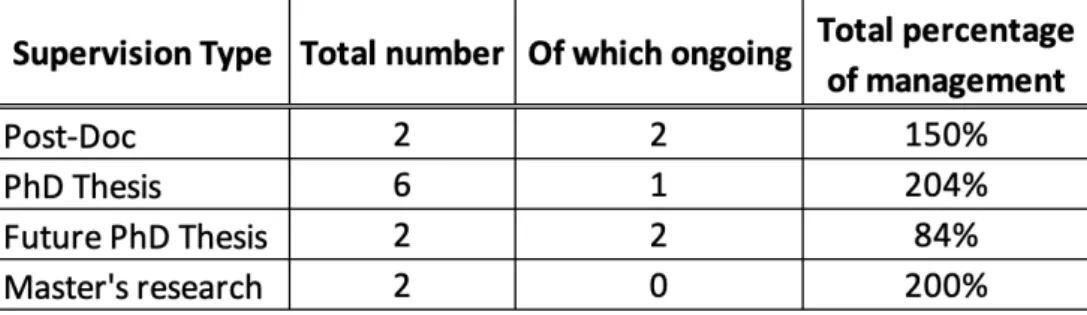
1.3.2 Research mentoring activities ... 42
1.3.3 Scientific Outreach ... 46
1.3.4 Participation in working groups and learned societies ... 47
1.3.5 Participation in research projects ... 48
1.3.6 Collective Responsibilities ... 49
2 Synthesis of research work 2012 - 2020: Semantic interoperability through the knowledge formalization in enterprises IT systems. Industry 4.0 Context. ... 50
2.1 Yongxin Liao’s thesis: Semantic annotations for system interoperability in a PLM context. ... 51
2.1.1 The proposed solution ... 52
2.1.2 The contribution ... 54
2.1.3 Formalization of semantic annotation ... 55
2.1.4 The Semantic Annotation Framework ... 57
2.2 Silvana Pereira Detro’s thesis: A framework for interoperability assessment in E-Health information systems using process semantics mining ... 61
2.2.1 Research Questions ... 61
2.2.2 Framework for configuring process variants through process mining and semantic reasoning ... 62
2.2.3 Synthesis ... 64
2.3 Yasamin Eslami’s thesis: A Modelling-Based Sustainability Assessment in Manufacturing Organizations ... 65
2.4 Concetta Semeraro’s thesis: Contribution to the formalization which is driven by the data
of modelling invariants of cyber-physical systems ... 69
2.4.1 Definition of the approach to extract data-driven invariant modelling constructs ... 73
2.4.2 Knowledge discovery ... 73
2.4.3 Knowledge extraction ... 74
2.5 Mickael Wajnberg’s thesis: Relational concept analysis: a versatile method for knowledge extraction ... 76
2.5.1 Formal Concept Analysis ... 76
2.5.2 Relational Concept Analysis ... 79
2.5.3 Improvement of the Relational Concept Analysis ... 80
3 Research and teaching project ... 83
3.1 Research project: Formal methods for extracting and reusing knowledge from heterogeneous sources for semantic interoperability of distributed architectures in a Factories of the future context. ... 84
3.1.1 From rough data to knowledge extraction: a long path ... 84
3.1.2 Research project description ... 89
3.1.3 Research project justification ... 90
3.2 Teaching project ... 92
3.2.1 Three axes of my teaching project ... 93
3.3 General conclusion: ... 95
List of the author's publications ... 96
List of Images
FIGURE 1-CPSHOLISTIC VIEW [GUNES,2014] ... 15
FIGURE 2–IMPLICIT SEMANTICS AND SEMANTIC INTEROPERABILITY PROBLEM ... 16
FIGURE 3-COMPOSITE CPS3 CONSISTING OF TWO SUBORDINATE SYSTEMS CPS1AND CPS2, AND PROVIDING ITS PROPER FUNCTIONALITY THROUGH COMPONENTS P3AND C3 ... 20
FIGURE 4–CPSMETA-MODEL FROM THE PAPER [IJ17] ... 21
FIGURE 5-CPS FUNCTIONAL MODEL DECOMPOSITION AND RELATIONS DISCOVERY AND REPRESENTATION ... 22
FIGURE 6(A,B,C) PRESENT THE TEACHINGS DIVISION BETWEEN 2012-2020 ACCORDING TO THE TOPIC, NATURE AND LEVEL ... 33
FIGURE 7CONTRIBUTION OF SUPERVISED PHD THESES IN THE ISSUE OF FORMALIZATION OF KNOWLEDGE IN AN INDUSTRY 4.0 CONTEXT (THIS IMAGE IS ADAPTED FROM DT1 IMAGE) ... 50
FIGURE 8–SEMANTIC ANNOTATION METAMODEL FROM [C14] ... 56
FIGURE 9–SEMANTIC ANNOTATION PROCEDURE [C14] ... 57
FIGURE 10–SEMANTIC ANNOTATION FRAMEWORK ARCHITECTURE [DT1] ... 59
FIGURE 11–REASONING ENGINE MODULE 11[DT1] ... 60
FIGURE 12FRAMEWORK FOR CUSTOMIZE PROCESS VARIANTS FROM [IJ5] ... 63
FIGURE 13- STREAM OF THE LOGIC AND THE MAIN TASKS FOR THE STUDY [DT3] ... 65
FIGURE 14-TRIPLE COMBINATION OF ENVIRONMENTAL SUB-DIMENSIONS [DT3] ... 67
FIGURE 15-THREE-DIMENSIONAL MODEL FOR SUSTAINABILITY ASSESSMENT [DT3] ... 68
FIGURE 16-AN EXAMPLE OF A SUSTAINABILITY CUBICAL [DT3] ... 69
FIGURE 17–RESEARCH CONTEXT [DT4] ... 71
FIGURE 18-THE PROCESS FOR DETECTING DATA-DRIVEN INVARIANT MODELLING CONSTRUCTS [DT4] ... 72
FIGURE 19-THE APPROACH TO EXTRACT AND TO FORMALIZE DATA-DRIVEN MODELLING CONSTRUCT [DT4] .. 73
FIGURE 20-FROM KNOWLEDGE DISCOVERY TO KNOWLEDGE EXTRACTION [C30] ... 75
FIGURE 21–HASS DIAGRAM OF TABLE 6 ... 79
List of Tables
TABLE 1–ACADEMIC TITLES ... 28
TABLE 2–CAREER SUMMARY ... 30
TABLE 3-TEACHING AND STUDENT SUPERVISION BETWEEN 2012 AND 2020. ... 32
TABLE 4- SUMMARY OF PUBLICATIONS ... 35
TABLE 5–MENTORING ACTIVITY ... 43
Foreword
The document you are about to read describes my activities as a teacher and researcher since September 2012. On that date I integrated as associate professor (Maître de Conférences) the CRAN (Research Centre for Automatic Control, CNRS UMR 7039) and the IUT (University Institute of Technology) Hubert Curien d'Épinal in the QLIO (Quality, Industrial Logistics and Organization) department which is a component of the Université de Lorraine.
The professional life of the researcher is studded with the creation of different reports, scientific articles, balance sheets, administrative articles, documents related to projects, this document that you are about to read could be counted as another document that must be generated to continue on his professional path. In reality this report is something unique, not because it is the document necessary for my qualification to lead research (habilitation à diriger la recherche), but because it has helped me to better understand who I am as a researcher and where I want to go.
Writing, reflecting and asking myself many questions, I found myself reflecting on the present of my research and pedagogy, it made me rethink the path I took to get to this point and finally it basically helped me to put in order the multiple ideas to create my research project for the years to come.
In the last 8 years the taste for study and research has been getting more and more refined and thanks to the immense fortune of being able to do a job that I love and that allows me to be free in my choices I had the opportunity, always growing, to move towards themes that attracted me intellectually more and more. The formalisation of knowledge, its extraction and reuse in a variety of contexts completely attracts the interest of my intellect. From my point of view this theme is central to the very definition of humanity and as such I am completely involved in it.
This qualification document has above all a vocation to demonstrate the ability to lead a research team. Through its general introduction and the following three chapters it will show on overview of my research domain interests (introduction), my research management skills (chapter 1), my technical-scientific skills (chapter 2) and will present my research and future teaching project (chapter 3).
General Introduction
The speed and measure of the changes coming about by the fourth industrial revolution are not to be ignored. These changes will bring about shifts in power, shifts in wealth, and knowledge. Only in being knowledgeable about these changes and the speed in which this is occurring can we ensure that advances in knowledge and technology reach all and benefit all [Min, 2018].
The first industrial revolution marked a period of development in the latter half of the 18th century, precisely in 1760, that transformed largely rural, agrarian societies in Europe and America into industrialized, urban ones. Goods that had once been painstakingly crafted by hand started to be produced in mass quantities by machines in factories, thanks to the introduction of new machines and techniques in textiles, iron making and other industries. This transition included the use of coal as the main energy while trains were the main means of transportation. Textile and steel were the dominant industries in terms of employment, value of output, and capital invested. Fuelled by the game-changing use of steam power, the first industrial revolution began in Britain and spread to the rest of the Europe and the entire world, including the United States, by the 1830s and ‘40s. The second industrial revolution began in 1900 with the invention of the internal combustion engine. This led to an era of rapid industrialization using oil and electricity to power mass production. Technology has changed the world in many ways, but perhaps no period introduced more changes than the second industrial revolution. From the late 19th to early 20th centuries, cities grew, factories sprawled, and people’s lives became regulated by the clock rather than the sun. Rapid advances in the creation of steel, chemicals and electricity helped fuel production, including mass-produced consumer goods and weapons. It became far easier to get around on trains, automobiles and bicycles. At the same time, ideas and news spread via newspapers, the radio and telegraph.
Another century passes and we bear witness to the third industrial revolution. It started in 1960 and was characterized by the emergence of yet another source of untapped, at the time, energy. Nuclear energy. The third revolution brought forth the rise of electronics, telecommunications and of course computers. Through the new technologies, the third industrial revolution opened the doors to space expeditions, research, and biotechnology. In the world of the industries, two major inventions, Programmable Logic Controllers (PLCs) and Robots helped give rise to an era of high-level automation.
For many people, Industry 4.0 is the fourth industrial revolution [Prisecaru, 2016], although there is a large portion of people that still disagree. If we were to view Industry 4.0 as a revolution, then we would have to admit that it is a revolution happening right now. We are experiencing it every day and its magnitude is yet unknown. Industry 4.0
started in the dawn of the third millennium with the one thing that everyone uses every single day. The Internet. We can see the transition from the first industrial revolution that rooted for technological phenomenon all the way to Industry 4.0 that develops virtual reality worlds, allowing us to bend the laws of physics. The fourth industrial revolution shapes the world. Worldwide economies are based on it.
All industrial revolutions have substantially changed the way humans live. Each of them has increased the specific value that knowledge has in allowing the management of processes (marketing, finance, logistics, production, human resources, etc.). The more revolutions followed one another, the more companies have equipped themselves with systems to manage data, information and knowledge, which has become the key resource in a world where systems are increasingly complex, and information is increasingly numerous and comes from heterogeneous sources.
Industry 4.0 and Knowledge
In the fourth industrial revolution, the main goal of the implementation of new technologies is related to the effective and efficient customer-oriented adaptation of products (and thus production) and services in order to increase the value added for companies, raising their competitive position, while for customers improving satisfaction and loyalty [Roblek, 2016]. In order to achieve this goal, manufacturing companies need to develop and manage new knowledge that is crucial for the organization’s decision-making process and the achieving of the related business goals [Abubakar, 2019].
Industry 4.0 reflects a combination of digital and manufacturing technologies, Specifically the new technological transformation embraces technological advances that concern the production process (i.e., advanced manufacturing systems, autonomous robots, additive manufacturing), the use of smart products and/or data tools and analytics [Porter, 2015]. Within the manufacturing process, the adoption of autonomous and/or collaborative robotics [Adamson, 2017] or 3D printing is opening up new opportunities to create new knowledge concerning products and processes [Anderson, 2012].
At the same time, smart products and “data-driven technologies” enable the successful acquisition of useful data from several sources within the organizational boundaries as well as from customers and suppliers [Klingenberg, 2019]. Therefore, Industry 4.0 stresses the huge potentialities of data that can be used in real time, enriching contextual knowledge or generating new one in the way products can be produced and used, as well as in the practices concerning value generation (from product to service), allowing firms to take actions and make decisions based on such knowledge [Tao, 2018]. Moreover, it is essential to consider a holistic view of manufacturing processes, integrating data from different sources to achieve the business benefits of new technologies [Schneider, 2018].
Therefore, products and services are highly influenced by this new industrial paradigm. Products become more complex, modular, and configurable supporting mass customization to meet specific customer needs.
Cyber Physical System as information sources
The technological advances have led to some examples of a new systems generation. Cyber-Physical Systems (CPSs) represent more than networking and information technology, information and knowledge being integrated into physical objects. By integrating perception, communication, learning, behaviour generation, reasoning into such systems a new generation of intelligent and autonomous systems may be developed. Industry 4.0 technologies related to cyber-physical systems, IoT, and cloud computing can generate benefits from a circular economy point of view since they allow design for circularity based on the information gathered from customers as well as through the whole production process [De Sousa, 2018].
A component is a core concept in the Industry 4.0 context. An Industry 4.0 component constitutes a specific case of a Cyber-Physical System (CPS). It is used as a model to represent the properties of a CPS, for instance, real objects in a production environment connected with virtual objects and processes. An Industry 4.0 component can be a production system, an individual machine, or an assembly inside a machine.
Some core concepts in CPS can be traced back to the sensor network research and technologies related to sensor nodes and sensor networks. A sensor node integrates sensors, actuators, computing elements (e.g. processor, memory, etc.), communication modules, and a battery. The sensor network interconnects many small sensor nodes via wireless or wired connection [Golatowski, 2003] as can be seen in the Figure 1. Called as Wireless Sensor Networks (WSN), a large number of sensor nodes equipped with wireless network connection can be deployed in the environment of the physical phenomenon. Those sensor nodes may provide raw data to the nodes responsible for data fusion or they may process the raw data by means of their computing capabilities and relay the required part of it to the other sensor nodes.
A large-scale CPS can be envisioned as millions of networked smart devices, sensors, and actuators being embedded in the physical world, which can sense, process, and communicate the data all over the network. Proliferation of technology-mediated social interactions via these highly featured and networked smart devices has allowed many individuals to contribute to the size of Big Data available. Depending on the size of data sets and number of smart devices involved, Big Data may be in the range of multiple terabytes to many petabytes (i.e. 1024 terabytes) [Sheth, 2013].
Figure 1- CPS Holistic view [Gunes, 2014]
The data generated by CPSs are contextualised, which makes them information. This makes CPSs, in the context of Industry 4.0, a huge source of information that brings with it, often implicitly, relationships about the environment and the working domain. This information and relationships are a potential source of knowledge that must be extracted, formalised and, potentially, reused.
The positioning of my research
The subject of my research has always been: • the knowledge formalization in systems; • the knowledge modelling activity in systems;
• the possibility to use this knowledge to characterize the semantic interoperability of the studied systems. Semantic interoperability can be defined as the ability for two or more systems to share, to understand and to consume information.
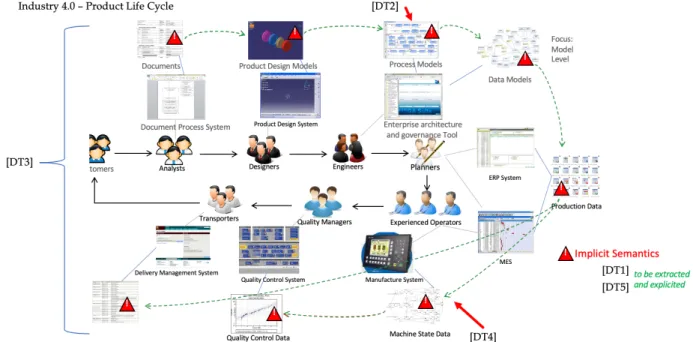
The increasing multiplication and complexity of the information necessary for the management of production processes pushes to the structuring of knowledge to accelerate its passage and optimize the interoperability of systems. In Figure 2 we can see all the different steps where the implicit knowledge of the systems is a brake to the knowledge passage itself between the various systems.
The first section of this introductory chapter highlighted the impact of the Fourth Industrial Revolution on the human economy and society. In the face of this new epochal change, two characterizations were highlighted:
- The importance of knowledge as a means of development and evolution. The information needed to manage production processes is increasingly numerous, more
heterogeneous, more volatile and more distributed. This implies the use of business information systems increasingly linked to real processes in a continuous way in order to retrieve and process data, contextualize them into information and apply knowledge to improve performance.
Figure 2 – Implicit semantics and semantic interoperability problem
- The key role that some technologies, such as cyber-physical systems, are playing in the restructuring of dominant roles in society.
The exploitation of the knowledge accumulated in the various systems involves two different issues. The first is the need to model systems so that they can semantically interoperate without problems of meaning. The second is to highlight methods to formalize and extract knowledge from all systems that are part of the value creation chain.
CPS modelling in cooperative information systems
The CPS, as we discussed, describes a broad range of network connected, multi-disciplinary, physically aware engineered systems that integrate embedded computing (cyber-) and technologies into the physical world (adapted from [Derler, 2013]). Inside this kind of network, each smart component (a sub-system of the CPS) is with sensing, data collection, transmission and actuation capabilities, and vast endpoints in the cloud, gathering and providing large amounts of heterogeneous data.
As presented, the CPSs are leading the Industry 4.0 with benefits from high flexibility of production, more accessible participation of all involved parties of business processes. The new manufacturing paradigm is characterized by autonomous behaviour and intercommunicating properties of its production elements across all levels of manufacturing processes.
At this regard the research directions, related to the CPS and the Industry 4.0 paradigm, take an important place, they focus on various scientific problems like the optimization of sensor networks organization by handling big datasets, challenges about the information and knowledge representation and processing. These research domains can benefit from scientific methods well known in the artificial intelligence domain, and machine learning. Focusing on this motivation I’m currently investigating the application of a mathematical approach named Formal Concept Analysis (FCA) for modelling and thus analysing a large-scale set of collaborative CPS.
One of the research interests I’m focusing on, is related to an extension of the FCA-based patterns for optimizing the interoperability in distributed systems, like the CPS, in the Industry 4.0.
Cooperative Enterprise Information Systems (CEIS) and interoperability issues
The Information Systems are systems whose activities are devoted to capture and to store data, to process them and produce knowledge, used by any stakeholders within an enterprise or among different networked enterprises. It is commonly agreed that Cooperative Information Systems (CIS) provide a backbone for the Integrated Information Infrastructure [Sheth, 1998].
The cooperative manufacturing systems involve large number of Information Systems distributed over large, complex networked architecture in relation to physical machines. Such cooperative enterprise information systems (CEIS) have access to a large amount of information and have to interoperate between them and with the machines to achieve their purpose. The CEIS architects and developers have to face a hard problem: interoperability at a large scale. There is a growing demand for integrating such systems tightly with organizational and manufacturing work so that these information systems can be fully, directly and immediately exploited by the intra and inter-enterprise processes [Izza, 2009].
Although the progress made in information technology considerably improved the efficiency of applications development, its drawbacks and limitations are obvious and serious. The components technologies are heterogeneous, platform- and machine-dependent. The above-mentioned limitations and barriers measurably hinder the development and the maintenance process.
There is a growing demand to integrate such systems tightly with organizational work so that these information systems can be directly and immediately used by the business activity.
Some work [Chen, 2006] in the INTEROP NoE project has identified three different levels of barriers for interoperability: technical, conceptual and organisational. Organisational barriers are still an important issue but out of scope of this paper. The technological barriers are strongly studied by researchers in computer science and the solution is generally based on model transformation [Frankel, 2003].
My, past and actual, research [Lezoche et al, 2011] focuses on the conceptual level of interoperability that is the ability to understand the exchanged information. A concept is
a cognition unit of meaning [Vyvyan, 2006], an abstract idea, a mental symbol. It is created through the action of conceptualisation, that is, a general and abstract mental representation of an object. During the history of human effort to model knowledge, different conceptualisation approaches regarding different application domains were developed [Aspray, 1985].
When trying to assess the understanding of an expression coming from a system to another system, there are several possible levels of interoperability [Euzenat, 2001]: - encoding: being able to segment the representation in characters;
- lexical: being able to segment the representation in words (or symbols);
- syntactic: being able to structure the representation in structured sentences (or formulas or assertions);
- semantic: being able to construct the propositional meaning of the representation; - semiotic: being able to construct the pragmatic meaning of the representation (or its
meaning in context).
This structure is coherent, each level cannot be achieved if the previous levels have not been completed [Euzenat, 2001]. The encoding, lexical and syntactic levels are the most effective solutions for removing technical barriers for interoperability, but not sufficient, to achieve a practical interoperability between computerized systems. Dealing with trying to enable a seamless data and model exchange at the semantic level is still a big issue that needs conceptual representation of the intended exchanged information and the definition of the pragmatic meaning of that exchanged information in the context of the source and destination applications.
To achieve the purpose of the cooperation between the different Information Systems, information must be physically exchanged (technical interoperability), must be understood (conceptual interoperability) and must be used for the purpose that they have been produced (conceptual and organizational interoperability).
Classifying interoperability problems [Panetto, 2007] and [Panetto, 2008] may help in understanding the degree of development needed to solve, at least partially, these problems but conceptualization and semantics extraction is still an important issue because of the various contextual understanding of tacit knowledge embedded into those applications. The main prerequisite for achievement of interoperability of information systems is to maximize the amount of semantics which can be used and make it increasingly explicit [Panetto, 2008], and consequently, to make the systems semantically interoperable.
The main prerequisite for achieving the interoperability of information systems (and thus a set of collaborative CPSs is to maximize the amount of semantics that can be used and to enact it by making it increasingly explicit [Obrst, 2003]. There are different approaches in conceptual modelling and these differences are reflected in the conceptual languages used for the modelling action. Entity-Relationship approaches (E-R) have been widely used and extended. They led to the development of different languages for data modelling [Barker, 1990], [Czejdo, 1990] and [Hohenstein, 1991], Object-Oriented
Modelling (OOM)) [Rumbaugh, 1991] approach addresses the complexity of a problem domain by considering the problem as a set of related, interacting Objects. However, the abstract semantics inherent to these approaches imposes the modeller to make subjective choices between entities, attributes and relationships artefacts for modelling a universe-of-discourse [Lezoche et al, 2012b]. In order to cope with such heterogeneous modelling patterns, we focus our interest on approaches that enable their normalization to a fine-grained semantic model by fragmenting the represented knowledge into atoms called formal concepts.
A Meta-Model of a Cyber-Physical System
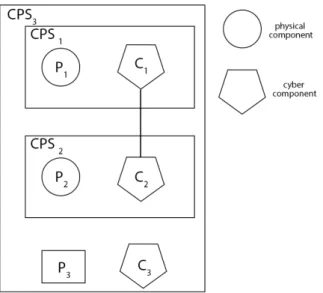
The components of a CPS: lets denote as Pi and Ci respectively the set of physical and cyber components of a system CPSj. CPSj is a structural agglomerate of these elements Pi and Ci which can also include other subsystems CPSk into a composite cyber-physical system.
There are two relations of different nature between these components:
RP - the relation between subsystems to be physically connected (e.g. in a production line) and signifies transmission of any kind of physical object between systems.
RC - the relation of the connection between cyber components which signifies presence of an information/control channel between the components.
The components of a system perform certain functions depending on their role in the system, and according to that they have input Ii and output Oi, that capture the flows between this element and the elements that it is related to by RP and RC. As an example, for a sensor, input and output reflects transformation of mechanical or physical alterations of the physical world into quantitative measurements of a particular property. The source and destination of the exchange can be either other components of the system or the environment or some external source. To cover the latter case, we introduce, into the sets of all physical and all cyber elements of CPSs model, two elements eP and eC to stand for those kinds of sources or destinations.
We define a system of CPSs as a tuple CPSs = 〈𝒫, 𝒞, 𝒞𝒫𝒮, 𝑅!, 𝑅"〉, where 𝒫 = e
P ∪ ⋃iPi is a set uniting physical components of individual CPS, 𝒞 = eC ∪ ⋃iCi is a set of cyber components, and 𝒞𝒫𝒮 which is set of CPSs. Each individual CPS of the set 𝒞𝒫𝒮, as was defined before, is a tuple of subset of cyber components, physical components and other CPS that it consolidates. Here we assume that every element of 𝒫, 𝒞 and 𝒞𝒫𝒮 has its corresponding input Ii and output Oi. In general, Ii and Oi can be of any type and have any values.
physical production activities, or as an actuator such as light switch which can be considered as a part of two systems: one is local electrical circuit of an apartment, and the other is a smart-home system for automating and controlling the household electronics. Following figure is an example of two simple CPSs consisting of one physical and one cyber component each forming a composite CPS. Where the communication between CPS1 and CPS2 is done through the C1 and C2; and the composite CPS3 has its own actuator components P3 and C3.
Figure 3 - Composite CPS3 consisting of two subordinate systems CPS1 and CPS2, and providing its proper
functionality through components P3 and C3
The proposed meta-model CPSs = 〈𝒫, 𝒞, 𝒞𝒫𝒮, R#, R$〉 that we have elaborated is presented
in UML 2.0 notation on Figure 4. In the scientific literature, some authors have proposed different results related to CPS meta models from different points of view. [Jeon, 2012] present the CPS Meta Modeller tool for designing complex and large-scale systems using the Electronics and Telecommunication Research Institute (ETRI1) CPS Modelling Language. [Mezhuyev, 2013] show the geometrical meta-metamodel, allowing to link the physical properties of domains with its spatial structure. Some other authors [Son, 2012] show how to transform a Simulink model into an ETRI CPS Modeling Language (ECML) model for modelling CPS for simulating its behaviour and [Klimeš, 2014] shows how to control cyber-physical systems deriving behavioural specifications from user inputs. All these researches focused on the design and the internal behaviour of a CPS. The work I presented is a formal meta-model of the structure of any CPS, for proposing a common formal foundation of a composite CPS, aggregating the broad definitions found in the literature.
The elaborated meta model finds its focus in the interaction of the cyber component, which naturally stands for its computational functionality, and the physical component, which models its physical behaviour. The existence of those two entities let emerge the
concept of Cyber-Physical System. If one of those components doesn’t exist there is no possibility to have a CPS. The Physical component is modelled as an abstract class, it could be composed by a sensing component, an actuating component or by a component that merges the two capabilities. A CPS component needs an input and an output. It cannot exist a CPS component that has got only one of those two properties. An atomic CPS is the one that does not have any subsystems, but his own functional elements. This definition is created to show, with the best detail possible, the relationships between the two different parts of the entire CPS system. It stops at the presented “atomic” level because of the scope of my actual scientific interest that focuses on the relationships of the CPSs and the possibility to improve their interoperability.
I didn’t specify the difference between physical and cyber types of communication and the corresponding types of input and output interfaces, although it could be a worthwhile extension for a future model.
The relation ‘is part of’ (physically) is introduced into the model to represent physical structure of systems and their inclusion into one another on the physical level. As an extension to this type of composition of complex CPS we also introduce the aggregation relation ‘logically includes’. Together with inheritance relation between classes Composite CPS and Atomic CPS it complies to the structural Composite pattern. With the help of this aggregation relation, I modelled the property of CPS of dynamical reconfiguration and adaptation. Any system can lend its functionality to many super-systems (I borrow the utilisation of sub- and super- prefixes from mathematics, by analogy with subsets and supersets), although probably not at the same time. Inversely, any system can accommodate multiple subsystems.
The class of Cyber-Physical Production Systems can be viewed, in the proposed meta-model, as a subclass of Composite CPS. This interpretation goes in the same direction of the Monostori definition [Monostori, 2014]. There is a tight connection between these two relations ‘is physically part of’ and ‘logically includes’, in the sense that whenever a system is in the relation ‘is physically part of’ this also entails that it is being ‘logically included’ in that system, but not in the other direction.
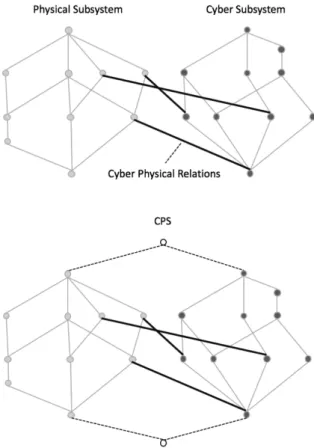
Hierarchical structures of the meta-model and corresponding algebraic lattice representation Unlike our previous approach [Morozov et al, 2015] where we modelled CPS using Formal Concept Analysis in a standard object-attribute fashion, currently we extend modelling approach to also account for links that exist between components and also for hierarchical inclusion of systems one into another according to their composite structure. In this way CPSs can be modelled independently in the physical and cyber perspectives using corresponding relations, each one defining an algebraic lattice. The hierarchical structure gives rise to the third lattice that can be used for tacit knowledge recognition and further explicitation. The relations between the two Lattices are related to the context. The merging of the two Lattices is computationally expensive.
FCA and RCA: Knowledge extraction methods
Understanding the domain behind the data is a key to business growth and competitiveness. Knowledge discovery from data (KDD) helps addresses that concern by distilling trends and patterns that are intelligible to human experts [Dehaspe, 1999]. In industry, data objects are typically unlabelled and often comprise both proper features and object-to- object links. Such datasets fit the unsupervised multi-relational data mining (MRDM) mode [D'Aquin, 2011], i.e. clustering and association discovery. However, existing MRDM association miners [Buitelaar, 2005], [Dehaspe, 2001] and [Ferré, 2015] restrict their output format to singleton-premise rules, hence they fail to capture more subtle associations.
Formal concept analysis (FCA) [Džeroski, 2003] has been proven as a versatile framework for KDD [Kramer, 2001] in many practical applications [Baader, 2007]. It extracts knowledge as a compact set of association rules [Goethals, 2002]. Relational concept analysis (RCA) [Rouane-Hacene, 2013] is MRDM extension of FCA. However, straightforwardly defined relational association rules may easily contain circular references or references from conclusion to premise, thus preventing a meaningful interpretation.
Formal concept analysis [Džeroski, 2003] is an algebraic approach for eliciting the conceptual structure of a dataset. Input data format is a triple K = (O, A, I) called a (formal) context. O is a set of objects, A is a set of attributes and I ⊆ O × A an incidence relation listing valid pairs (o, a) (object o has the attribute a). FCA reveals all pairs of sets (X, Y) ∈ ℘(O) × ℘(A) strongly correlated, meaning that all objects having the attributes in Y are in X and vice-versa. Such pair is a (formal) concepts with an extent X and intent Y.
Relational concept analysis assumes datasets are made of several contexts, one per type of object, and context-to-context relations. Any relational intent can be described with only non-relational attributes. Such expansion avoids circular dependencies, even if one may exist between full intents. We will present FCA and RCA deeper in the Chapter 2.
Research issues
The main focus of my research has always been how to formalize the implicit knowledge in models representing systems of all kinds. Since 2012, the year of my integration at CRAN, semantic interoperability has been added to my interests, bringing a great openness of methods and possible developments.
An approach to interoperable systems engineering must be based on different types and levels of abstraction or models. These models must express and formalize not only the
constrained by requirements specific to the system domain (business rules). Another type of constraint may be induced by the interoperation protocol(s), which may impose strict rules to endow interoperating systems with properties such as autonomy, confidentiality and transparency [Lezoche et al, 2012b].
The goal of my research is to study the problems posed by model-driven cooperative systems engineering, the cooperation concerning "actors" (organizations, design teams, software systems, etc.) willing to interoperate. Collaborative enterprises are now organized in enterprise networks, either as extended or virtual enterprises [Bititci, 2004], [Camarinha, 2008].
Defined as such, these collaborative enterprises can be likened to an open enterprise network system [Oberndorf, 1998], and by extension the Information System (IS) of this network can itself be considered an IS network system. The specification of such an IS network implies a shift from a single integration paradigm to an interoperation paradigm [Fisher, 2006].
One of the requirements of this need for collaboration concerns the capacity of these components to interoperate, i.e. their interoperability, which is more or less total. Ducq [Ducq, 2008] considers the interoperability of systems as a particular performance requirement of the company.
There are standards and reference tools providing practices and metrics to measure this interoperability [IJ4] [Liao et al, 2016]. Several studies have proposed maturity models and formal metrics to assess the potential or degree of semantic interoperability of enterprises wishing to establish a collaborative network [Ducq, 2008]. However, these results do not allow a complete automation of the evaluation process because they suffer from a computer formalization of their models.
The scientific challenge is a computable formalization of the models and to make available and extend mathematical and modelling languages and tools adapted to each enterprise modelling project, despite the heterogeneity of business skills and the multidisciplinarity of the domains.
The analysis of formal concepts is a useful and powerful tool to formally describe the links between any objects (which form a context), in particular, as said, between objects carrying knowledge. The RCA, the FCA extension, method is not limited to the extraction of knowledge from distinct contexts: it aims to express knowledge by interacting the semantics of the different contexts, i.e. in addition to extracting knowledge from one context, data contained in other contexts are used to enrich the knowledge extraction. One of the possible applications is related to the extraction of knowledge from complex systems. As Obendorf [Oberndorf, 1998] indicates, companies can be likened to complex systems. Currently, companies are focusing their interest on the Industry 4.0 paradigm to find a dynamic and rapid way to optimize their production. Formalization and optimization actions to deal with their procedures according to the parameters of Industry 4.0 are highly time-dependent [Ocampo-Martinez, 2017].
Document structure
Chapter 1 of this document presents a summary of activities related to teaching and research. After a short curriculum vitae, the entire course of teaching activities is presented, including administrative responsibilities. To conclude, all research-related activities are presented, such as the summary of publications made, participation in national and international working groups, links with other international research groups, participation in research projects and responsibility in relation to the scientific world. This chapter should make it possible to quantitatively evaluate my teaching and research activities.
Chapter 2 details my research work since 2012, the year of my recruitment as associate professor (maître de conférences). This part of the document will present how the current vision of my research theme has been built up over the years by the possibility of supervising students who are eager to explore the fields of research most interesting to me. The semantic interoperability of models has been a fascinating domain with which I started my scientific career as a professor and it has declined, in the first two theses I supervised, in how semantic annotations are useful for semantic interoperability and how the contribution of semantics in the creation of models of decision-making processes can optimize the use of the resources of the examined systems. The following two theses were the watershed of my scientific interests. Together with semantic interoperability, I have combined a domain to which I am strongly attached, the formalization, extraction and reuse of knowledge in industry 4.0 contexts. The third thesis focused on the formalization of data-driven knowledge within invariant structures of cyber-physical systems. The fourth thesis focused on more theoretical issues by solving some questions for the optimization of association rules extraction that are useful for the explicit expression of implicit knowledge in enterprises related Big Data. This chapter should allow a qualitative evaluation of my research activities.
Chapter 3 describes my research project concerning the formalization and extraction of knowledge applied to heterogeneous data sources in the context of industry 4.0. First of all, this chapter takes up the concepts stated in the introduction on the need to optimise knowledge management in an environment like industry 4.0 which is completely based on the optimisation of sharing and implementation of actions deriving from knowledge generated from heterogeneous sources. The aim of this project is to contribute, through the results of my research, to define formalization and knowledge extraction methods specific to the multimodal environment defined by industry 4.0. The proposed project is strongly supported by the tools and results presented in chapter 2.
This project is then contextualised in the local, regional, national and international context. The chapter ends with the presentation of my teaching project which is characterized on the one hand by my responsibilities at IUT (University Institute of Technology) Hubert Curien d'Épinal level in the QLIO (Quality, Industrial Logistics and
Organization) department where I manage all the information technology paths at industrial level, both at DUT (University Technological Diploma) and Licence Professionnelle (Professional Faculty of the first University level course) level, and on the other hand by my contribution in the engineering school Telecom Nancy where I can structure courses that are in line with the use of tools directly related to knowledge formalization and management in industry 4.0.
1 Summary of teaching and research activities
Consideré que incluso en el lenguaje humano no hay ninguna proposición que no implique a todo el universo; decir "el tigre" es decir los tigres que lo generaron, los ciervos y las tortugas que devoró, el pasto que alimentó a los ciervos, la tierra que fue la madre del pasto, el cielo que dio nacimiento a la tierra.
I considered that even in human language there is no proposition that does not imply the whole universe; to say "the tiger" is to say the tigers that generated it, the deer and tortoises it devoured, the pasture that fed the deer, the land that was the mother of pasture, the sky that gave birth to the earth.
1.1 Curriculum Vitae
Mario LEZOCHE Personal details
• Born the 3th of April of 1974 in Santa Maria Capua Vetere (Italy) • Double nationality: French and Italian
• Married the 1st of August 2020 Personal contact details
• 4, rue Joseph Piroux, 54140, Jarville-La-Malgrange, France • Mobile : +33 (0)6 24 58 97 37
• Personal web site: http://www.lezoche.eu Professional contact details
• CRAN, Campus Sciences, BP 70239, Faculté des Sciences, 54506 Vandoeuvre cedex
• Téléphone : +33 (0)3 72 74 53 23
• Email : [email protected] • Web: http://www.cran.univ-lorraine.fr
1.1.1 Academic Titles
2011 Post-doc's Degree in Computer Science Engineering, Université Henri Poincaré – Nancy I, CRAN laboratory 2009 Ph.D Thesis at CNR of Rome and University of “Roma Tre”
2006 Research Master's Degree in Computer Science Engineering, University of Roma TRE
Table 1 – Academic Titles
1.1.2 Administrative situation
• Associate professor (Maître de Conférences) normal class, echelon 6 on the national post 61MCF0693.
• I am a teaching member of the University Institute of Technology (IUT) Hubert Curien of Épinal at the department of Quality, Industrial Logistics and Organization (QLIO) since the 1st September 2012.
• I am researcher at
o the Research Center for Automatic Control (CRAN) that is a joint research unit (UMR 7039) between the University of Lorraine and the French National Scientific Research Center (CNRS) - Institute for Information
Sciences and Technologies (INS2I) and Institute for Engineering and Systems Sciences (INSIS) directed by the Full professor Didier WOLF; o I am in the Eco-Technic systems engineering (ISET) department coordinated
by Full Professor Hind BRIL-EL HAOUZI and Full Professor Benôit IUNG; o I collaborate in the coordination of the research project team Intelligent System and Objects in Interaction (S&O-2I) with the Associate Professor William DERIGENT and Associate Professor Philippe THOMAS;
• I am bound to the session 61 to the CNU
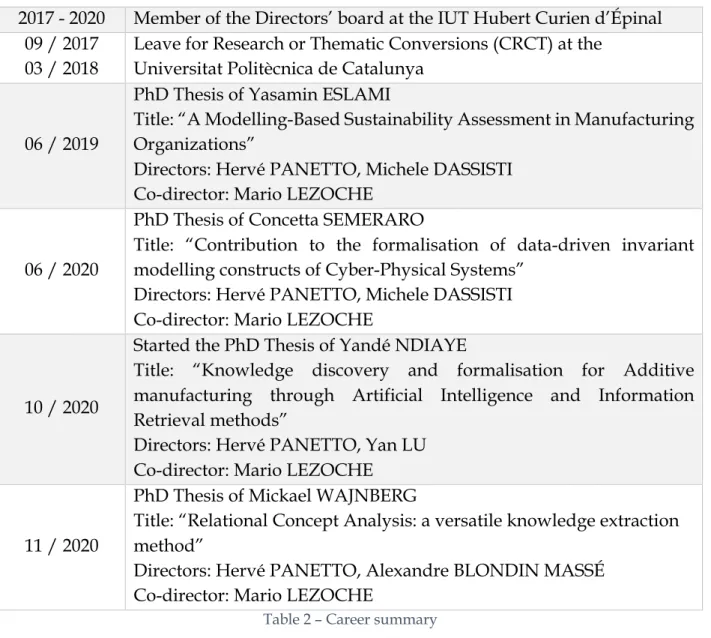
1.1.3 Career summary Date Highlight
12 / 2010 09 / 2012
Appointed as Post Doc at the University of Lorraine Post Doc Researcher at CRAN UMR 7039 CNRS 09 / 2012
Appointed as professor at the University of Lorraine at the IUT Hubert Curien d'Épinal
Researcher at CRAN UMR 7039 CNRS 09 / 2013 Tenure
11 / 2013
PhD Thesis of Yongxin LIAO
Title: “Semantic annotations for system interoperability in a PLM context”
Directors: Hervé PANETTO and Nacer BOUDJLIDA Co-Tutor: Mario LEZOCHE
2013 - 2016 Coordinator of the Professional Licence Industrial Production and Development of the Innovation Approach (PIDDI)
2013 - 2016 Elected to the Institute Council of the IUT Hubert Curien d'Épinal Teacher-researcher representative
2016 Chair of the workshop Enterprise Integration, Interoperability and Networking (EI2N) in Rhodes
09 / 2017 Obtaining the doctoral supervision and research grant (PEDR) Level B (CNU 61 session)
11 / 2017
PhD Thesis of Silvana DETRO
Title: “A framework for interoperability assessment in E-Health information systems using process semantics mining”
Directors: Hervé PANETTO Co-director: Mario LEZOCHE 2017
Transformation of the PIDDI Professional Licence in E-Commerce and Digital Marketing (ECMN) Professional Licence
New accreditation of the ECMN Professional Licence
2017 Chair of the workshop Enterprise Integration, Interoperability and Networking (EI2N) in Rhodes
2017 - 2020 Member of the Directors’ board at the IUT Hubert Curien d’Épinal 09 / 2017
03 / 2018
Leave for Research or Thematic Conversions (CRCT) at the Universitat Politècnica de Catalunya
06 / 2019
PhD Thesis of Yasamin ESLAMI
Title: “A Modelling-Based Sustainability Assessment in Manufacturing Organizations”
Directors: Hervé PANETTO, Michele DASSISTI Co-director: Mario LEZOCHE
06 / 2020
PhD Thesis of Concetta SEMERARO
Title: “Contribution to the formalisation of data-driven invariant modelling constructs of Cyber-Physical Systems”
Directors: Hervé PANETTO, Michele DASSISTI Co-director: Mario LEZOCHE
10 / 2020
Started the PhD Thesis of Yandé NDIAYE
Title: “Knowledge discovery and formalisation for Additive manufacturing through Artificial Intelligence and Information Retrieval methods”
Directors: Hervé PANETTO, Yan LU Co-director: Mario LEZOCHE
11 / 2020
PhD Thesis of Mickael WAJNBERG
Title: “Relational Concept Analysis: a versatile knowledge extraction method”
Directors: Hervé PANETTO, Alexandre BLONDIN MASSÉ Co-director: Mario LEZOCHE
1.2 Teaching-related activities 1.2.1 General presentation
Since the day I was hired in 2012, I have made my teaching career mainly at the IUT Hubert Curien in Épinal. The majority of my teaching service is done in the Quality, Industrial Logistics and Organization (QLIO) department and in the two Professional Licences, the Industrial Logistic (MILI) one and the one I was managing, the Industrial Production and Development of the Innovation Approach (PIDDI) until 2016. The PIDDI Licence was then transformed into an E-Commerce and Digital Marketing Licence and which I co-directed until today (2020). During my Post-Doc I performed also the temporary teaching and research associates (ATER) during the years of Post-doc and thanks to that experience I continued to teach at Telecom Nancy computer engineering school.
My teaching is mainly focused on three topics, Databases, information management in enterprises through business information systems such as ERP, ESM and knowledge formalization through the teaching of logic and ontologies.
If the teaching in the QLIO department is quite standardized with a uniform program at national level, the teachings in Licence pro and engineering school have been shaped by my desire to teach through concrete projects that integrate the more theoretical parts. I have built the modules used for teaching the formalization of knowledge through Ontologies and also those related to algorithmic learning.
In 2016 I built up the Licence pro E-Commerce and Digital Marketing accreditation dossier together with the co-responsible of the Licence.
I have also invested heavily in accompanying students for the DUT 2A, TN 2A and TN 3A projects.
1.2.1 Administrative Responsibilities
1.2.1.1 Direction and animation of teaching courses • From 2013 to 2016 responsible of the PIDDI Professional Licence
• From 2014 to 2017 responsible for the specialization in Enterprise Information Systems (SIE) at the School of Engineering Telecom Nancy.
• From 2017 to 2020 co-responsible for ECMN Professional Licence
1.2.1.2 educational administration management • From 2012 member of the admission commission of the DUT QLIO
• As of 2012 member of the DUT QLIO improvement council
• From 2013 to 2016 member of the Admission Commission of the PIDDI Professional Licence
• From 2013 to 2020 member of the directive IUT Institute council
• From 2013 to 2016 Elected to represent teacher-researchers on the IUT Institute Council.
• From 2013 to 2016 member of the restricted Committee of the Institute Council IUT • From 2013 to 2016 member of the PIDDI Professional Licence Development Council • From 2018 to 2020 member of the admission commission of the Professional Licence
ECMN
• From 2018 to 2020 member of the ECMN Professional Licence Development Board
1.2.2 Summary presentation of the teachings 2012 - 2020
All my teachings at DUT level, Licence and engineering school are in frontal mode and combine initial, continuing and professional training. On average my annual teaching service counts more than 300 hours H.Eq.TD without counting the hours calculated for administrative responsibilities.
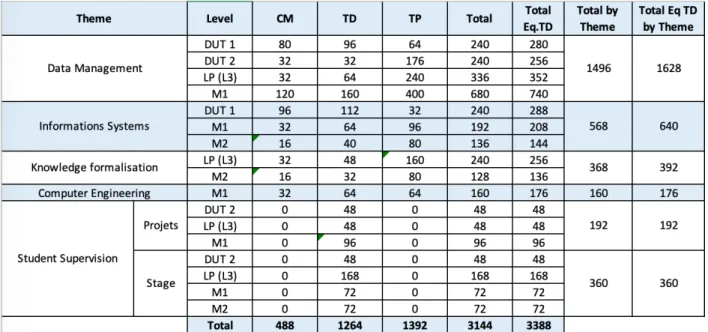
The three diagrams of the Figure 6 present the division of my teaching between 2012 and 2020 according to the topic (Data Management, Information Systems, Knowledge Formalization, Computer Engineering), according to the nature of the teaching (CM, TD, TP) and finally according to the level of the diploma.
The hours associated with student placement are the paid hours and are therefore not representative of the associated investment. For this reason, they are not represented in the diagrams. The Table 3 does not count the hours related to administrative responsibilities in the various academic formations.
Table 3 - Teaching and student supervision between 2012 and 2020.
More than half of my teaching (58%) concerns data management, which is one of the axes of my research, together with the formalisation of knowledge (14%). Half of my teaching, during these eight years, has been for the school of computer engineering students,
therefore for a level M1 (40%) and M2 (10%). The other half of my teaching was offered to the university primary cycle students. This has allowed me to develop a pedagogy approach that allows me to get in touch with the whole range of levels of university students.
Figure 1a
Figure 1b Figure 1c
Figure 6 (a,b,c) present the teachings division between 2012-2020 according to the topic, nature and level
1.2.3 Participation in academic training
• 2012 - 2013
o DUT QLIO 1 (L1): Data Management, Computer engineering o DUT QLIO 2 (L2): Information Systems
o Engineering School Telecom Nancy (M1): Data management • 2014 – 2016
o DUT QLIO 1 (L1): Data Management, Computer engineering o DUT QLIO 2 (L2): Information Systems
o PIDDI Professional Licence (L3): Data management o MILI Professional Licence (L3): Data management
o Engineering School Telecom Nancy (L3): Computer engineering o Engineering School Telecom Nancy (M1): Data management
o Engineering School Telecom Nancy (M2): Data management, Information systems, Knowledge formalisation
o Master ISC (M1): Knowledge formalisation • 2017 – 2020
o DUT QLIO 1 (L1): Data Management, Computer engineering o DUT QLIO 2 (L2): Information Systems
o ECMN Professional Licence (L3): Data management, Knowledge formalisation o MILI Professional Licence (L3): Data management
o Engineering School Telecom Nancy (M1): Data management
o Engineering School Telecom Nancy (M2): Data management, Information systems, Knowledge formalisation
1.2.4 Responsibilities of Teaching Units
• Design of information systems (L1 - DUT 1) • Algorithms (L1 – DUT 1)
• Artificial Intelligence (M1 – Telecom Nancy)
• Integrated business management software (M2 – Telecom Nancy) • Enterprise 4.0 – Blockchain (M1 – Telecom Nancy)
• Organize and direct the production of knowledge (L3 – ECMN LP) • Information Systems (L3 – MILI LP)
• Database management (L3 – ECMN) • Use of an ERP (L2 – DUT 2)
• Database management (L2 – DUT 2) • Database systems (L1 – DUT 1)
1.3 Research-related activities 1.3.1 Summary of publications
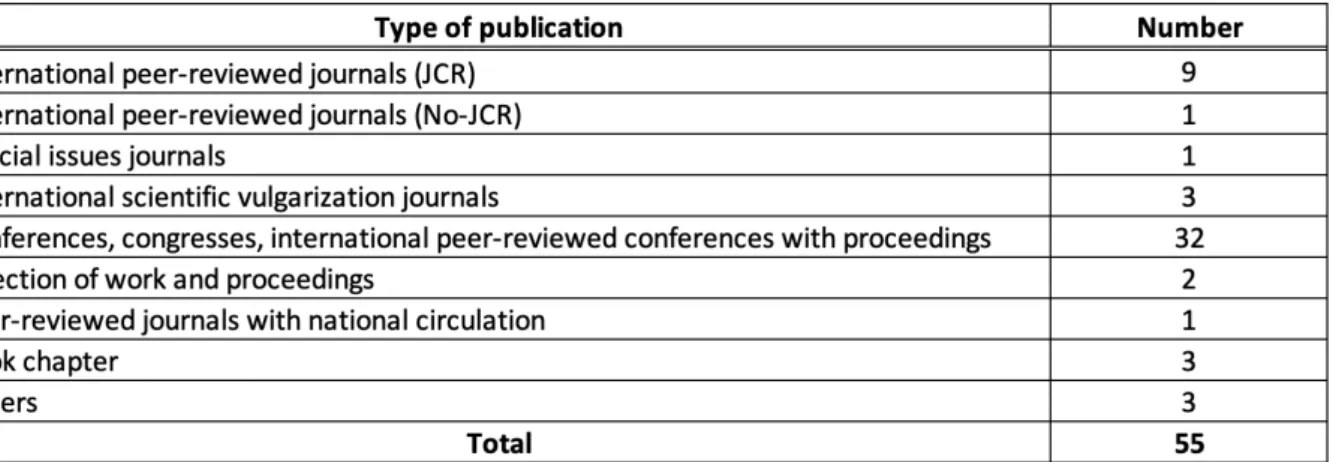
The Table 4 contains a summary of the publications to which I have contributed. The following section creates an exhaustive list of publications in which I have participated. My name will be in bold. Publications that refer to work with students that I have personally followed are recognisable by the fact that the students will be underlined. The impact factor of publications in JCR science journals will be in bold where known. It will be in reference to the year of publication. I will use the identifiers of these references throughout the document to cite them.
Table 4 - summary of publications
1.3.1.1 International peer-reviewed journals (9)(JCR) [IJ9] Mario Lezoche, Jorge Hernandez, Maria del Mar Alemany Diaz, Hervé
Panetto, Janusz Kacprzyk. Agri-food 4.0: a survey of the supply chains and technologies for the future agriculture. Computers in Industry, Elsevier, 2020, 117:103187, ⟨10.1016/j.compind.2020.103187⟩. ⟨hal-02395411⟩
[IJ8] Yasamin Eslami, Mario Lezoche, Hervé Panetto, Michele Dassisti. On analysing sustainability assessment in manufacturing organizations: A survey. International Journal of Production Research, Taylor & Francis, 2020, ⟨10.1080/00207543.2020.1755066⟩. ⟨hal-02524117⟩
[IJ7] Mario Lezoche, Hervé Panetto. Cyber-Physical Systems, a new formal
paradigm to model redundancy and resiliency. Enterprise Information Systems, Taylor & Francis, 2020, ⟨10.1080/17517575.2018.1536807⟩. ⟨hal-01895093⟩
[IJ6] Yasamin Eslami, Michele Dassisti, Mario Lezoche, Hervé Panetto. A survey on sustainability in manufacturing organisations: dimensions and future insights. International Journal of Production Research, Taylor & Francis, 2019, 57 (15-16), pp.5194-5214. ⟨10.1080/00207543.2018.1544723⟩. ⟨hal-01911366⟩ [IJ5] Silvana Pereira Detro, Eduardo Portela Santos, Hervé Panetto, Eduardo
Loures de Freitas, Mario Lezoche. Applying process mining and semantic reasoning for process model customization in healthcare. Enterprise
Information Systems, Taylor & Francis, 2018,
⟨10.1080/17517575.2019.1632382⟩. ⟨hal-02155320⟩
[IJ4] Yongxin Liao, Mario Lezoche, Hervé Panetto, Nacer Boudjlida. Semantic annotations for semantic interoperability in a product lifecycle management
context. International Journal of Production Research, Taylor & Francis, 2016, 54 (18), pp.5534-5553. ⟨10.1080/00207543.2016.1165875⟩. ⟨hal-01286475⟩ [IJ3] Yongxin Liao, Mario Lezoche, Hervé Panetto, Nacer Boudjlida, Eduardo
Rocha Loures. Semantic annotation for knowledge explicitation in a product lifecycle management context: a survey. Computers in Industry, Elsevier, 2015, 71, pp.24-34. ⟨10.1016/j.compind.2015.03.005⟩. ⟨hal-01123854⟩
[IJ2] Mario Lezoche, Esma Yahia, Alexis Aubry, Hervé Panetto, Milan Zdravković.
Conceptualising and structuring semantics in Cooperative Enterprise Information Systems Models. Computers in Industry, Elsevier, 2012, 63 (8), pp.775-787. ⟨10.1016/j.compind.2012.08.006⟩. ⟨hal-00722419⟩
[IJ1] Esma Yahia, Mario Lezoche, Alexis Aubry, Hervé Panetto. Semantics enactment for interoperability assessment in Enterprise Information Systems. Annual Reviews in Control, Elsevier, 2012, 36 (1), pp.101-117. ⟨10.1016/j.arcontrol.2012.03.008⟩. ⟨hal-00671856⟩
1.3.1.2 International peer-reviewed journals (1)(No-JCR) [IJN1] Yongxin Liao, Mario Lezoche, Eduardo Rocha Loures, Hervé Panetto, Nacer
Boudjlida. A semantic annotation framework to assist the knowledge interoperability along a product life cycle. Advanced Materials Research,
Trans Tech Publications, 2014, 945-949, pp.424-429.
⟨10.4028/www.scientific.net/AMR.945-949.424⟩. ⟨hal-01026591⟩
1.3.1.3 Special issues of journals (1)
[IJSI1] Hervé Panetto, Mario Lezoche, Jorge Hernandez, Maria del Mar Eva Alemany Diaz, Janusz Kacprzyk. Special issue on Agri-Food 4.0 and digitalization in agriculture supply chains - New directions, challenges and applications. Computers in Industry, Elsevier, 2020, 116:103188, ⟨10.1016/j.compind.2020.103188⟩. ⟨hal-02450378⟩
1.3.1.4 International scientific vulgarization journals (3) [IJV3] Concetta Semeraro, Hervé Panetto, Mario Lezoche, Michele Dassisti, Stefano
Cafagna. A monitoring strategy for industry 4.0: Master italy s.r.l case study. INSIGHT - International Council on Systems Engineering (INCOSE), Wiley, 2019, Systems engineering research at French Universities, 22 (4), pp.20-22. ⟨10.1002/inst.12269⟩. ⟨hal-02423272⟩
[IJV2] Mickael Wajnberg, Mario Lezoche, Blondin Alexandre Massé, Petko Valtchev, Hervé Panetto. Complex system tacit knowledge extraction trough a formal method. INSIGHT - International Council on Systems Engineering (INCOSE), Wiley, 2017, 20 (4), pp.23-26. ⟨10.1002/inst.12176⟩. ⟨hal-01673069⟩ [IJV1] Silvana Pereira Detro, Eduardo Portela Santos, Hervé Panetto, Eduardo
Rocha Loures, Mario Lezoche. Configuring process variants through semantic reasoning in systems engineering. INSIGHT - International Council on Systems Engineering (INCOSE), Wiley, 2017, 20 (4), pp.36-39. ⟨10.1002/inst.12179⟩. ⟨hal-01673070⟩
1.3.1.5 Conferences, congresses, international peer-reviewed conferences with proceedings (32) [C32] Mickael Wajnberg, Petko Valtchev, Mario Lezoche, Hervé Panetto,
Alexandre Blondin Masse. Mining process factor causality links with multi-relational associations. 10th International Conference on Knowledge Capture, K-CAP'19, Nov 2019, Marina Del Rey, CA, United States. pp.263-266, ⟨10.1145/3360901.3364446⟩. ⟨hal-02377662v2⟩
[C31] Mickael Wajnberg, Petko Valtchev, Mario Lezoche, Alexandre Blondin Masse, Hervé Panetto. Concept analysis-based association mining from linked data: A case in industrial decision making. 2nd International Workshop on Data meets Applied Ontologies in Open Science and Innovation, DAO-SI 2019, Sep 2019, Gratz, Austria. ⟨hal-02455243⟩
[C30] Concetta Semeraro, Mario Lezoche, Hervé Panetto, Michele Dassisti, Stefano Cafagna. Data-driven pattern-based constructs definition for the digital transformation modelling of collaborative networked manufacturing enterprises. 20th Working Conference on Virtual Enterprises (PRO-VE), Sep 2019, Turin, Italy. pp.507-515, ⟨10.1007/978-3-030-28464-0_44⟩. ⟨hal-02191335⟩ [C29] Shaofeng Liu, Guoqing Zhao, Huilan Chen, Alejandro Fernandez, Diego Torres, Mario Lezoche, Knowledge mobilisation crossing boundaries: a multi-perspective framework for agri-food value chains. 6th Model-IT International Symposium on Applications of Modelling as an Innovative Technology in the Horticultural Supply Chain, Jun 2019, Molfetta, Italy. ⟨hal-02191439⟩
[C28] Yasamin Eslami, Michele Dassisti, Hervé Panetto, Mario Lezoche. Sustainability assessment of manufacturing organizations based on indicator
![Figure 1- CPS Holistic view [Gunes, 2014]](https://thumb-eu.123doks.com/thumbv2/123doknet/14465219.713363/16.892.294.583.108.411/figure-cps-holistic-view-gunes.webp)

![Figure 8 – Semantic annotation metamodel from [C14]](https://thumb-eu.123doks.com/thumbv2/123doknet/14465219.713363/57.892.150.752.629.958/figure-semantic-annotation-metamodel-from-c.webp)