Peoples’ Democratic Republic of Algeria
Ministry of Higher Education and Scientific Research University of Frères Mentouri Constantine
Faculty of Letters and Languages
Department of Letters and the English Language
v
Dissertation submitted in partial fulfillment of the requirements for the degree of Doctorate 3ème cycle in Applied Linguistics
Submitted by: Miss. Nesrine HAMANI Supervised by: Prof. Abdelhak NEMOUCHI
Transfer of Knowledge from First-Year-English Writing Classes to Writing In the Disciplines: Case Study of Writing across the Curriculum
-Chairman: Prof. Ahmed MOUMENE University of Frères Mentouri Constantine
- Supervisor: Prof. Abdelhak NEMOUCHI University of Oum El Bouaghi -Member: Prof. Said KESKES University of Sétif
-Member: Prof. Riad Belouahem University of Frères Mentouri Constantine - Member: Prof. Samir Laraba University of Frères Mentouri Constantine -Member: DR. Sarah Merrouche University of Oum El Bouaghi
D E D I C A T I ON
I dedicate my humble work to my lovely parents who helped, supported and
encouraged me along my whole path.
I also dedicated this work to all the inspiring teachers of the English Department, the
University of Frères Mentouri Constantine, who motivated and left a print in their student’s
life.
This dissertation is utterly dedicated to my lovely and faithful friends and my most loving supporters the “StuliGirls”.
A C K N O W L E D G E M E N T S
I ought to express my heartfelt gratitude for those who have been, teaching, supporting and helping me.
First of all, my special appreciation goes to my supervisor Professor. NEMOUCHI Abdelhak for his professional guidance and continuing care which provided me with great power and perseverance to accomplish this work. He guided my writing with extensive and thoughtful reviews; I certainly was privileged and honored to have him as a supervisor.
My sincere appreciation and gratitude are to all my truly and lovely friends: Mérieme, Mouna, Assia, Issmahene, Rym, Amina, Mérieme Z, Sara, Rania, Samira and Amira, who provided endless emotional support and encouragement and motivated me to give my best.
My other special thanks go to my dearest friends and colleagues at the University of Frères Mentouri .Constantine: Mohamed Lakhel-Ayat, Fouad Bouabdallah, and to many other people who always kept warming me up and providing me with help when needed.
Lastly, and most importantly, I wish to thank my family. Special thanks go to my parents; they have raised me, supported me, motivated me, guided me, taught me, and loved me. Finally, a special appreciation is to my lovely and one brother Mohamed, my sister Namira, my niece Maya, and my nephews Amir and Iyed.
ABSTRACT
The present study aims at exploring the transfer of knowledge from first-year writing classes to writing in the disciplines. It examined the students’ performance in the writing class as well as in the other modules which require a written form; the main objective was to detect if students are applying the writing rules learnt during the writing class towards other modules, or not. Through a questionnaire administered to teachers (of different disciplines) at the Department of Letters and the English Language, University of Frères Mentouri. Constantine, plus our own examination of the 2nd year students’ exam papers in four modules namely: Written Expression, Linguistics, Literature and Culture, we intended first to check the teachers’ opinions about their students’ level in writing and how the transfer of the writing conventions through the disciplines is regarded in the Department of Letters and the English Language, University of Frères Mentouri. Constantine. Second, the study investigates to what extent students’ writings in different modules reflect the rules taught in the written expression classroom. The results of the present study show first, if students are aware of the close relationship which exists between writing and the other modules, and most importantly whether students transfer the writing conventions form one module to another when they are asked to write different assignments across different disciplines. Furthermore, the study tries to suggest some efficient methods to help both teachers and students to succeed in transferring knowledge across the disciplines.
List of Abbreviations
CSE: Common Standard English L1: First Language
L2: Second Language
MTSA: The Michigan Science Teachers Association NRC: Common Standard English
WAC: Writing across the curriculum W.E: Written Expression
WID: Writing in the Disciplines WTL: Writing to Learn
LIST OF TABLES
Table Title Page
Table 1 The Process Approach versus the Product Approach 53
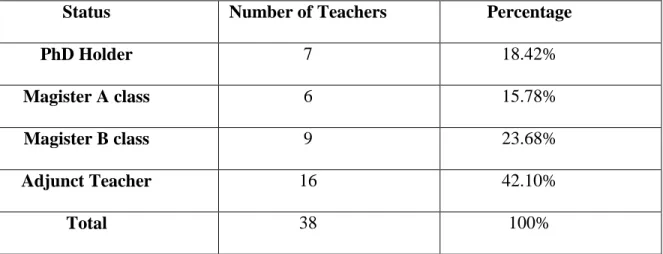
Table 2 Teachers’ Grade 134
Table 3 Teachers and Modules 134
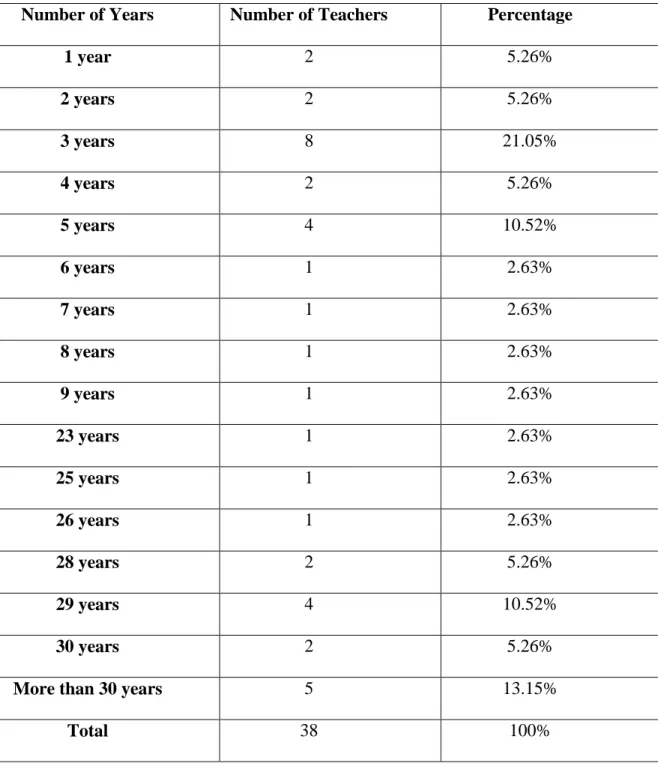
Table 4 Experience in Teaching 136
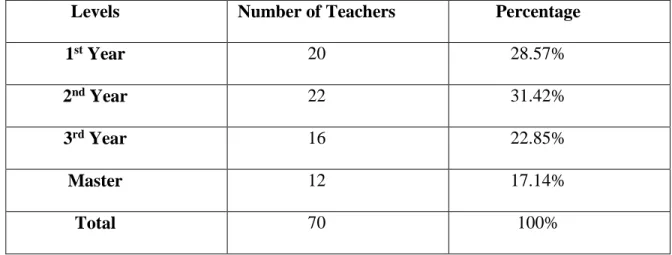
Table 5 Taught Levels 137
Table 6 Students’ Level in Writing 139
Table 7 Classification of the Students’ Weaknesses in Writing 140
Table 8 Focus on Content/Form 141
Table 9 Transfer of Writing Rules to Other Subjects 142
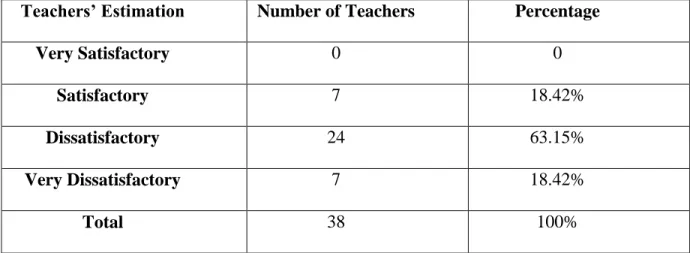
Table 10 Rate of Satisfaction with Students’ Writings 143
Table 11 Suggestions for Improving Students’ Level in Writing 144
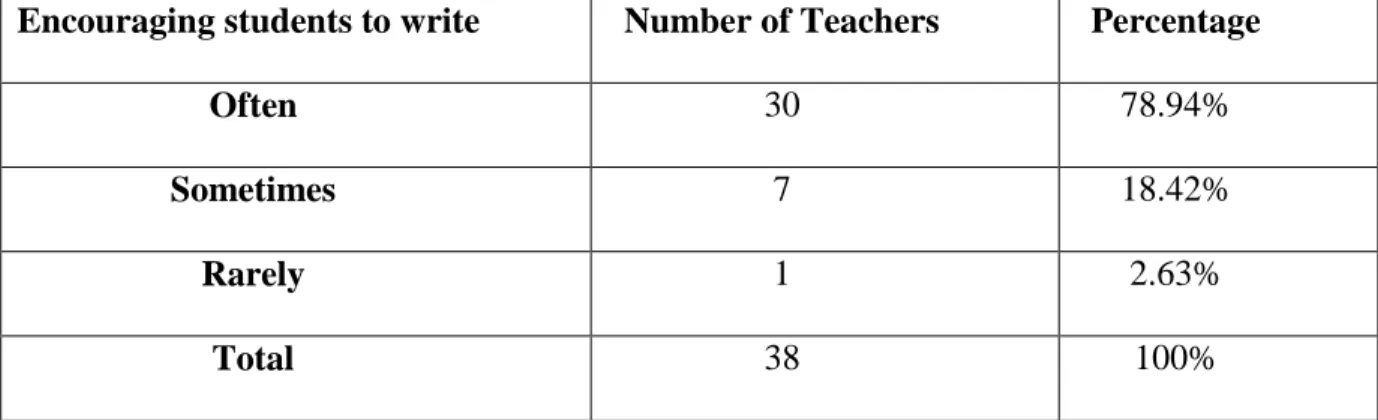
Table 12 Encouraging Students to Write 146
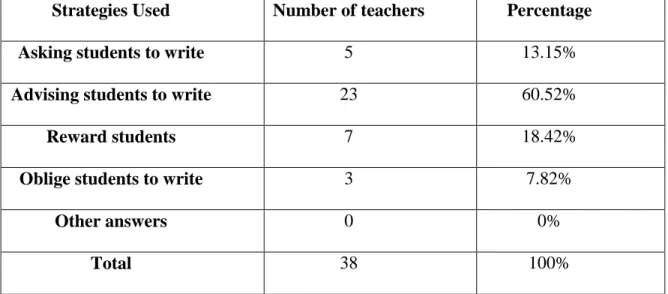
Table 13 Strategies Used to Improve Students’ Writing 147
Table 14 Practice for Better Writing 148
Table 15 Efficient Writing in Teachers’ Stance 148
Table 16 Classification of Important Features in Writing 149
Table 17 Writing Closeness to Other Subjects 152
Table 18 Knowledge Transfer 154
Table 19 Reasons That Prevent Students from Transferring Their Knowledge 155 Table 20 Students’ Readiness for Writing in Others Subjects 158
Table 21 Techniques for Boosting Knowledge Transfer 159
Table 22 Meaning of Writing across the Curriculum 161
Table 23 Efficient Teaching and Knowledge Transfer 162
Table 24 Correlation between W.E and Linguistics 170
Table 25 Correlation between W.E and Literature 171
Table 26 Correlation between W.E and Culture 173
Table 27 The Use of the Writing Conventions in the Students’ Compositions 175 Table 28 The Use of Cohesive Devices in the Students’ Papers 176 Table 29 Most and Least Frequent Cohesive Devices used in Writing 176
Table 30 W.E and Linguistics Scores 177
Table 31 Correlation between W.E and Linguistics 183
Table 32 W.E and Literature Scores 185
Table 33 Correlation between W.E and Literature 191
Table 34 W.E and Culture Scores 193
Table 35 Correlation between W.E and Culture 199
Table 36 Computation of the Mean, the Variance and the Standard Deviation of W.E versus Linguistics
202 Table 37 Frequency, Mean, Variance and Standard Deviation of W.E versus
Literature and Culture
LIST OF FIGURES
Figure Title Page
Figure 1 Correlation between W.E and Linguistics 171
Figure 2 Correlation between W.E and Literature 172
Figure 3 Correlation between W.E and Culture 174
Figure 4 Correlation Between Writing and Linguistics After Re-Examining The Students’ Exam Papers
185
Figure 5 Correlation between W.E and Literature After Re-Examining The Students’ Exam Paper
192
Figure 6 Correlation between W.E and Culture After Re-Examining The Students’ Exam Paper
Table of Contents
Dedication ... i
Acknowledgements... iv
Abstract ... v
List of abbreviations………... vi
List of tables………... vii
List of figures ………... x
General Introduction………1
1. Statement of the Problem ………...2
2. Aims of the Research………..3
3. Research Questions ………..………3
4. Research Hypothesis………4
5. Structure of the research ...4
Chapter One: Review of Writing Introduction………...6
1.1. Definition of writing………6
1.1.3 Effective Writing...14
1.1.4. How to write in the L2 ...24
1.1.5.Writing in the English Department...35
Conclusion...33
Chapter Two: Approaches to Teaching Writing Introduction...34
2.1 Approaches to Teaching L1 Writing...35
2.1.1 The Process Approach...35
2.1.2 The Prose Model Approach...35
2.1.3 The Experiential Approach...35
2.1.4 The Rhetorical Approach... 35
2.1.5 The Epistemic Approach... 36
2.1.6A Linguistic System Approach... 36
2.2. Approaches to Teaching Writing in L2...37
2.2.1. The Controlled-to-Free Approach...49
2.2.2. The Free Writing Approach...41
2. 2.3. The Paragraph Pattern Approach ...44
2. 2.4 The Grammar Syntax Approach...45
2. 2.5. The Communicative Approach ...45
2.2.6. The Product Oriented Approach...48
Conclusion...68
Chapter Three: Writing Across the Curriculum Introduction...69
3.1. Definition of Writing across the Curriculum...69
3.2. Students’ Reaction towards the Rules of Writing...77
3.3 Writing in Other Disciplines...79
3.4. Techniques of Knowledge Transfer...84
3.5. Features to be transferred across the Disciplines……….……92
3.6. Activities Designed for Improving Students’ Transfer at the Academic Level..…96
Conclusion ...106
Chapter Four Research Design and Methodology Introduction...108 4.1 Research Design ……….109 4.1.1 Qualitative Research………109 4.1.2 Quantitative Research ...110 4.2 Research Setting……….112 4.3 Research Participants ……….….113
4.4 Data Collection Tools ………114
4.5 The Questionnaire………..115
4.5.1 Description of the Questionnaire……….117
4.5.2 The Administration of the Teachers’ Questionnaire……….118
4.6 The Examination of 2nd Year Students’ Exam Papers in four Modules………..118
4.6.1 Writing Conventions………..………122
4.6.2 General information of the pilot study……….125
4.6.3 Results of the pilot study……….126
4.7 Re-examining the students’ exam papers using a Specific Standard Protocol...126
4.7.1 Materials and scoring………126
Conclusion ……….……….130
Chapter Five: Questionnaire Analysis and Interpretation Introduction………..………...………….………131
5.1. The Questionnaire Analysis………132
5.1.1 General Information ……….………..…132
5.1.2. Evaluating Students’ Writing...137
5.2 Results and discussion……….165
Conclusion……….………167
Chapter six: Analysis of Students’ Exam Papers in Four Modules Introduction ………..168
6.1. The Pilot Study... 168
6.1.1 Correlation between W.E and Linguistics...169
6.1.2. Correlation between W.E and Literature………...170
6.1.3. Correlation between W.E and Culture………172
6.1.4. Results of the Pilot Study………..173
6.2 Re-examining the Students’ Exam Papers Using a Specific Standard Protocol...176
6.2.1 W.Eand Linguistics Scores………..…..176
6.2.2 Correlation between W.Eand Linguistics...182
6.2.3. W.E and Literature Scores………184
6.2.4. Correlation between W.E and Literature……….…..190
6.2.5. W.E and Culture Scores………192
6.2.6. Correlation between Writing and Culture……….198
6.3. Frequency, Mean, Variance and Standard Deviation of W.E versus Linguistics….201
6.3.1. Frequency, Mean, Variance and Standard Deviation of W.E versus Literature and
Culture……….203
6.4. Results and interpretation………..205
Conclusion ……….206
Chapter seven: Pedagogical implications and recommendations Introduction………208 7.1. Pedagogical Implications ………208 7.1.1 Writing as a process...209 7.1.2. Writing as a product...211 7.1.3. Language Transfer...211 7.3.4. Creative Writing………..212 Conclusion………..223 General Conclusion………..……..224
Suggestions for Further Research...226
Bibliography……….……….…….227
Appendices ……….…...…239
Résumé………245
General Introduction
In the present time, communicating in foreign languages is an undeniable requirement for any type of professional activity and it concerns both speaking and writing. Learning to write adequately is not an easy task, and almost all teachers of writing would assert that writing is the most complex language skill among the four others. In addition for not consuming lots of time and effort, teaching writing requires a systematic instruction; in fact, writing imposed itself as an inevitable skill to be taught at all educational levels. At the university level, students are expected to write appropriately in English since their first year, not only in the written expression module, but in all the modules they undertake since all of them require an evaluating written form. Furthermore, students are expected to transfer the writing conventions they learn during the writing class into other disciplines. Writing is seen as a reservoir that feeds subjects like Linguistics, Literature, Culture...etc.; in other words, writing overlaps with those modules in the sense that some important writing conventions must be incorporated into the students’ writings. It is hard to imagine students’ compositions without technical rules of writing. While writing across the disciplines, students write according to different contexts, different topics, yet, they must take into account that their writing should obey the writing conventions which must be incorporated automatically while writing such as the indentation, topic sentence, unity, coherence, introduction, conclusion...etc. The relationship that exists between writing and the other modules is known as knowledge transfer; it would be quite important to know how learners manage to put into practice what they are learning in writing classes. Teachers generally wonder what the appropriate method to ensure a successful transfer is, even if multiple methods of transfer exist; but teachers have to identify the suitable one for their students. It is clear that the transfer takes place with a full and a
clear instruction. That is to say the job of teachers is not only to provide students with specific rules, but rather to allow them to use these rules and to practice them across all the disciplines.
The present research is designed to investigate to what extent students apply or not the rules learnt in the module of the Written Expression subject within other disciplines. In addition, we want to investigate if there are potential techniques that may help students for a successful transfer of knowledge in order to write effectively across other disciplines.
Statement of the Problem
In the process of learning how to write effectively in English and how to transfer the writing rules towards other disciplines, students encounter great difficulties; that is why it is not recommended to teach writing independently from other disciplines. Each discipline has its own guidelines and has to obey some specific rules, and students must be familiar with the numerous writing conventions before starting to write in each discipline. In other words, students in the Department of Letters and the English Language, have to master the writing skill inside and outside the writing class. Teachers often complain about their students’ level in writing, so it would be worth interesting to know the main reasons behind this poor level.
The study also seeks to explain why students are incapable of transferring their knowledge of the writing rules they are provided with during the writing class towards other content subjects such as Linguistics, Literature and Culture. That is why the writing sessions have to be conducted on suitable instruction for students. Therefore, the role of teachers of writing is not only confined in what they teach in the classroom; rather, they should go far beyond and must confirm that what they have been teaching during the writing class should be practiced and used in other subjects.
Aims of the Research
For the difficulties stated above, the present study is designed to investigate the relation between writing and other subjects in the curriculum of the Bachelor Degree in the Department of Letters and the English Language. It is known that some modules like Linguistics, Literature and Culture require a written form during exams; the latter are often compositions which must reflect the content taught previously and the students’ ingenuity in writing. To say it differently, students are expected to link between different modules they are taught and to transfer rules from one module to another.
Nearly all teachers, of different disciplines complain about their students’ performance and production in writing. The present study aims at investigating the reasons behind this matter by examining the students’ exam papers in the modules mentioned above and explains why students are incapable of transferring the writing conventions towards other disciplines depending on the appropriate contexts. This failure may be overcome by providing students with some appropriate and efficient tools to make this transfer operate successfully.
Research Questions
On the basis of these claims, the research questions to be answered can be expressed as follow:
o Do students of English transfer their knowledge of writing to other subjects?
o Do teachers use enough methods with the scope of enhancing students’ knowledge transfer?
o If such a transfer exists, what kind of features students transfer more in their writings?
o Are there some efficient techniques or activities that may be implemented into the curriculum as a way to help students transfer their knowledge across the disciplines?
Hypothesis
We hypothesise that an appropriate transfer of writing rules by students of English towards other subjects of the curriculum would lead to a better performance and an adequate production when writing compositions in content subjects.
Structure of the Thesis
The present thesis comprises seven chapters turning around teaching, learning and the importance of writing; it also seeks to define the relationship between writing and other disciplines through a teachers’ questionnaire and an examination of the writing rules that students’ transfer, or not, when writing compositions in different disciplines.
The first chapter entitled “Writing” is theoretically grounded in the area of writing; it starts first by giving some important definitions of writing and then explains the importance of writing as a skill. Finally, we display theories related to techniques of teaching writing and how the notion of writing is perceived in the English Department at the University Frères Mentouri. Constantine.
The second chapter outlines the most prevailing approaches designed to teach writing and ends with a comparison between the process and the product approaches emphasizing both similarities and differences.
The third chapter entitled “Writing across the Curriculum” introduces some of the most important features used in this thesis. It deals notably with the concept of writing across the
curriculum by defining and clarifying the idea. Then, an effort is made to familiarize students with the notion of knowledge transfer, and the main writing conventions students are ask to transfer from writing class to other modules.
The fourth chapter is a detailed presentation of the methodological procedure that undertaken for this research by identifying the population and the tools used in the investigative process, namely a teachers’ questionnaire and a corpus based study concerned with examining the students’ papers in three modules: Linguistics, Literature and Culture.
The fifth chapter shelters the analysis of a questionnaire filled in by 38 teachers of different disciplines in the Department of Letters and English Language (University Fréres Mentouri . Constantine). The questionnaire is divided into four main sections and includes 24 questions. The questions are related to the way informants perceive the teaching of writing and their points of views about their students’ compositions in the writing class as well as in other modules.
The sixth chapter is another field of investigation concerned with the analysis of the students’ writing in the modules of Linguistics, Literature and Culture. This investigation aims at determining if students transfer effectively and successfully the rules acquired in the module of writing to other subjects.
The last chapter of the thesis is a series of pedagogical implications and recommendations. The general conclusion points out the advantages and the limits of the present research, the confirmation or not of the research hypothesis, and some other suggestions for further research.
Chapter One:
Review of
Writing
Introduction
Listening, speaking, reading and writing are the four language skills identified by researchers; each one of them plays an important role in EFL syllabus-design. As we are particularly concerned with one of these skills, writing, this chapter will cover a general definition of writing and shifts to the importance given to the writing skill. It also attempts to explain how students can learn to write in a second language. Besides, this chapter considers also how teachers proceed in teaching writing in the English Department.
1.1. Definition of Writing
It is true that there are several definitions for the notion of writing, but let us shed light on the most prevailing ones. Generally, writing is defined as the ability to put down graphic symbols, translate a spoken discourse into letters and words which are linked together to form sentences, paragraphs and essays. In other words, we can define writing as a means to represent the language by using signs or graphic symbols.
Writing is considered as a powerful mode of communication; it represents our thoughts and ideas through written language. Writing has always formed an important part of the syllabus in teaching English as a foreign language.
For Spratt, Pulverness and William (2005), writing is the act of transmitting successfully a particular message to other people. In order to do so, we need to have enough ideas that are well organized and should be expressed in an appropriate style (p.26).
Byrne (1979) claimed that writing is transforming our thoughts into language, or more exactly writing is the ability of being able to communicate with the language through graphic representations of ideas.
Writing as defined by Al-Mutuwa and Kailani, in 1989, is an active means of communicating ideas, which means that writing is the productive skill in the written form. They insist on the fact that writing is not an easy task and it can be classified as the hardest one among the four skills not only for students of English as a foreign language, but even for native speakers since writing represents the development and the representation of thoughts in a structured way.
Writing is said to be a translation of our thoughts. In writing, some people express themselves better than others by putting some considered thoughts on papers, which make them be good writers. This explains why many great ideas and observations are born just because their creators have decided to express them.
Language skills are classified either receptive as listening and reading, or productive as speaking and writing. Spratt, Pulverness, and William (2005), once again, pointed out that these two last skills are concerned mainly with conveying information or more exactly a message. Al-Mutuwa and Kailani also agreed on the fact that speaking and writing are similar; they claimed that in order to master the skill of writing, students are asked to practice a lot, exactly like oral practice is necessary to become fluent in speaking a language.
Grabowski (1996) said that writing well has a very close relationship with academic and professional success; he noted down:
Writing as compared to speaking can be seen as a more standardized system which must be acquired through special instruction. Mastery of this standard system is an important prerequisite of cultural and educational participation and the maintenance of one’s rights and duties...The fact that writing is more standardized than speaking allows for a higher degree of sanctions when people deviate from standard. (p.4)
According to Harmer (2006), writing is taught to students of English in order to augment their learning of grammar and the acquirement of new vocabulary of the language (p.31).
1.1.2 The Importance of Writing as a Skill
The second part of this chapter attempts to illustrate the importance of the writing skill in the process of teaching English as a second language. Students have troubles in mastering the writing skill; they are highly dependent on the teacher’s support and instruction. The role of the teacher is to guide and to teach this skill effectively so that his/her students become better writers, and at the same time they have to understand the impact the writing skill has on their careers.
Writing sounds simple; all what we have to do is to pick up a given topic, then write down all the ideas that come to our mind related to the topic, and later on link all these ideas together to form sentences or paragraphs. Most of us wish to be able to write effectively in the second language, but writing is not as easy task; in fact, it is said to be the least easy skill to acquire in comparison with the other ones, even for the native speakers; it demands lots of time and practice.
Bell and Burnaby (1984) pointed out that the writing activity means that the writer must master the content, the sentence structure, the vocabulary, the punctuation, the spelling, and most
importantly the way the paragraphs and texts are organized in a coherent and a cohesive way (p.36).
Nunan (1989) claimed in his book entitled “Designing Tasks for the Communicative Classroom” that the skilled writers are the ones who are capable of going beyond the sentence (p.36).
For Brown and Hood (1989), the mastery of the writing skill depends highly on practice. In short, students will benefit from lots of practice, so they advise learners to write more often at home even if it is only for them (p.6).
The role of teachers is to help students to become good writers. There are some techniques in order to reach this goal; for example they can start teaching their students how to arrange their ideas, how to use the suitable vocabulary, and how to pay attention to the grammar, the spelling and the punctuation. It is true that these techniques are time consuming but very necessary to any piece of writing. This is exactly what Spratt, Pulverness and William (2005) noted down when saying:
Mistakes in spelling or grammar are difficult to ignore; they must be corrected. Students want their language mistakes to be corrected. Generally, language mistakes are more easily and quickly diagnosed and then corrected than ones of content and organization (p.171).
The common technique that the majority of teachers follow in their classroom is to let students correct each other’s assignments. By repeating this activity, they will be able to detect some shortcomings, and by doing so more often, students will learn how to avoid repeating the same mistakes; and they will get used to profit from each other’ s criticism, whether positive or
negative (p.171). This method will mainly help students to develop the sense of objectivity concerning work.
Nemouchi (1996) wrote in his magister dissertation that” acquiring writing requires an intensive process of training and a long-term pedagogical assistance in a specialised situation”.
Spratt, Pulverness, and William (2005, p.27), once again, pointed out that in order to teach students the writing sub-skill; teachers need to focus mainly on:
Accuracy which involves spelling correctly, punctuating correctly, using grammar correctly, join sentences correctly, paragraphing correctly, choosing the right vocabulary and using correct layouts.
Communicating a message; by writing students have something to say, so they have to communicate this message successfully to readers.
The writing process stages: if teachers encourage using the writing process in the classroom, learners will become more creative.
Writing is viewed by students of English as the less enthusiastic skill. That is why students should be encouraged and motivated to write in English, and this is mainly the role of teachers who are supposed to help their students by finding some clues. According to Harmer (2004) the importance behind mastering students the writing skill is to develop in some way their general language competence (p.39). When helping students to perform well in writing, teachers have a number of tasks to do like: first, finding out ways to attract their attention by making them aware of the writing conventions and the genre constraints in specific types of writing. Second, by motivating them to write especially when we know that students fell themselves ”lost for words” when they are asked to write. To solve this problem, the teacher may help by provoking students
to have ideas and by insisting on the value of the task. For example, students may be asked to complete tasks on the board or to reassemble jumbled texts, or to discuss ideas together before the writing activity starts, or the teacher may give his students the words they need to start writing etc. All these methods will allow students to get involved in the writing tasks and will be prepared to do other activities (p.41).
According to Gordon (2009) there is no a given technique to apply in order to master the skill of writing, but there is a relation that exists between four elements that can help writers as well as students to learn how to write adequately; these elements are: the writer, the content, the reader, and the forms of the language. These elements must be handled together in the act of writing because each one of them completes the other. (p.3).
Sometimes when students are asked to sit and to write, they feel afraid, annoyed and get easily bored, especially if they do not like the topic; so teachers may find solutions in order to allow students to approach the task of writing. Gordon (2009) pointed out that this fear of approaching writing exists not only among students but even among the writers themselves. For example, the novelist Joseph Conrad (2005) said that he always felt afraid and less confident before he starts to write. Russell also, one of the most accomplished writers, mentioned in his bibliography how he sat down for many hours, and sometimes during few days, looking at his paper when he was working on one of his novels (p.4).
Writing as well as the other skills is of much importance since they all contribute in the language learning and teaching. According to an article published on the internet by Hansen (1996) entitled “The Importance of Good Writing Skills”, writing helps students learn how to form and produce language, how to spell, how to make logical argument. In addition, Hansen
claimed that writing skills can be considered as the key that lead to better academic success and achievement.
Tan (2010) pointed out in another article that the writing skills have a direct impact on your career and future. In fact, when one writes a good paper in which he presents himself well, this can have a positive impact to ensure him a job because what and how one writes can say a lot about him as a person. In short, writing well opens the door to advancement in any field one can choose in the future; it is said to be the primary basis upon which the work and the learning of a person will be judged in college, in the workplace, and in the community.
The University of Missouri (2010) published an article showing the importance of writing as follows:
Writing makes your thinking visible
Writing gives the ability to explain complex events and situations to the readers and even to you.
Writing refines your ideas.
Writing out you ideas permits you to evaluate the adequacy of your argument.
Writing equips you with the communication and thinking skills you need in your life. Writing is an essential job skill.
Some studies on the importance of writing skills have shown that in American schools writing is a common activity; in fact, 50% of teens said they do some writing for school every day, even if their writing assignments are short as a paragraph of one page length. According to Budig (2008), 93% of American teens write for fun; they appreciate the chance of choosing topics which
are sometimes relevant to their own lives and experiences. Teens feel encouraged to write and like having an audience as teachers and other students for their work.
Harmer (2006) claimed that writing encourages students to focus on accurate language use and because they have more time to think as they write, they can consult dictionaries, grammar books, and other materials to help them; this may provoke language development (p.31).
Some rules have been suggested, in an article, to writers by DR. J. Schaeper (2011), to improve their writing and make it efficient; they are called the 10 commandments:
All good writing must have a clear purpose. Too many words can bore the readers.
The most important information should belong to the beginning of any writing. Mistakes in grammar, punctuation and spelling must be avoided.
Thinking about the readers before starting to write.
Writers should make their writing powerful and have an impact on their readers. Do not use complex words instead of the simple ones.
Leave out all the information that are not related to the main purpose. Use dynamic words in order to bring the writing to life.
Never assume that your readers know more than you do.
Writers as well as learners should keep in their minds four elements that are considered as the four basic keys that lead to a successful writing, these elements were suggested by Griffies and Perrie (2009), and they are:
Concise: all the important elements should be presented in a simple and a concise way, and they should be placed at the beginning of any document.
Compelling: the more your writing is compelled, the more the readers will be willing to read it properly and the more the message will stick to their minds. Clear: good writing is simple and clear. Some writers use complicated words to
lend importance to their writing. However, your readers may not understand what you mean and you will fail in transmitting your message to them. So, avoid sentences and expressions that are difficult to follow (p.39).
Correct: a misspelled word, a comma in the wrong place, a period instead of a question mark etc. will have a bad impact on your writing, and they will tell your readers that your writing is unorganized (p.43).
1.1.3 Effective Writing
Studentsare required to write different kinds of assignments in English, ranging from short paragraphs to essays, articles, reports, book reviews, research proposals and dissertations. Each different assignment has its own structure; it depends mainly on the purpose of that assignment and on the audience for whom it is addressed. We will attempt, throughout this part, to help students to develop their writing ability in English by breaking down some barriers they face most of the time when they are asked to write. When they are asked to write, students have to deal with the organization and ordering of the ideas, paraphrasing, linking ideas, selecting appropriate words, and using adequate spelling and punctuation in order to write in a good academic style.
Academic English writing is defined as the standard written form of the language; its objective is to inform rather than to entertain.
The Australian School of business (2011) defines academic writing as the product that results from the process of thinking (p.2). According to this school, academic writing must have a clear structure so that the readers will understand from the introduction what the writer wants to convey as a message. In addition, writers should check and edit their writing mainly for the content, cohesion and coherence (p.3).
There are some aspects of writing that students may find difficult, according to Mutuwa and Kailani (1989, p.5) as the organization of ideas, choosing the right words, linking ideas, paragraphing, spelling and punctuation.
Before starting to write, writers as well as students have to learn about the process of writing which is according to Brown and Hood (1989) composed of these three main stages:
1. Preparing to write: Most writings require some preparation, how long does this preparation takes place depends mainly on the reader, the purpose of writing, the content and the writing situation. The first thing to do is to search for ideas, then writing them down without paying attention to the mistakes, after that looking through the notes and trying to use numbers or narrows to put them in order of importance in one’s writing. It is important to have a look at the language used especially the important expressions (p.10). 2. Drafting: drafting stage means to get words onto paper. It is important at this stage to
examine clearly what you have written and what changes you have got to make. Do not worry a lot about the beginning since you will often want to change it. One important thing
Revising Drafting
to do is to carry on drafting without stopping not to interrupt the flow of ideas. Finally, read aloud what you have written so far, and then begin to rewrite (p.15).
3. Revising: this is the most important step in the writing process which takes place while or after drafting, so it needs all the attention. At this stage, the writer must check that the content as well as the purpose is clear and appropriate for the reader. In addition of checking the punctuation, spelling and grammar, the revising stage involves also arranging, adding, changing and so on (p.20).
Spratt, Pulverness, and William (2005, p.27) noted down some stages that students should pass through when they are asked to write, these stages are:
Brainstorming: during this first stage we think about everything we can write about a giving topic.
Writing down these ideas into notes. Planning (organizing ideas).
Writing a draft which is a piece of writing that is not finished and may be modified.
Editing which means correcting and improving the text. Producing a new draft.
Proof-reading which means checking the mistakes in accuracy.
Most of the time, students are given a specific writing assignment and in order to become good writers they have first to ask themselves what their teachers really want them to write. To help students, two clues were suggested (Grenville, 2001, p.12):
1. The task word, which is the main verb in the assignment that really tells you what you have to do, it might be to discuss, to compare, or to describe. 2. The limiting words: the main objective behind this clue is to narrow the assignment in some way. Students write about a given topic but they have to be careful of not write too many details; they have just to be restricted to the question and give only the appropriate information.
Grenville (2001) insisted on the fact that no one is born knowing how to write, but it is a skill that we can learn and develop with time, and the more we do so the easier it becomes. According to Grenville (2001), there are six steps that both students and teachers may follow in order to learn how to write correctly and effectively, these steps may be applied for all types of writing such as: short stories, essays, reports, novels, poems, reviews, letters etc.,
Grenville (2001, p.8) insists on the application of these steps; she said that they really work well, even for her when she decides to sit and to start writing ().These steps are:
Getting ideas.
Selecting the most useful ideas.
Making a plan by putting down these ideas from the most important until the least ones.
Writing down a first draft.
Revising this draft by adding or omitting some details. Editing by checking the spelling and the grammar.
According to Mutuwa and Kailani (1989), writing should be developed at an early stage of learning the foreign language: Some experiences of listening, speaking and reading (p.125).
Writers as well as learners should keep in their minds four elements that are considered as the four basic keys that lead to a successful writing, these elements are (Mutuwa and Kailani, 1989, p.125):
A knowledge of the English alphabet so that students learn how to spell correctly and how to identify letters.
Learners must know the relationship between sounds and written symbols. Knowledge of the mechanics of writing: spelling, capitalization, punctuation,
paragraph indentation, leaving space between words, syllable division, and other writing conventions.
Familiarity with grammatical, referential or anaphoric connectors.
Familiarity with lexical connectors, for example: repetition of key words or the same word in different forms or the use of synonyms and antonyms....etc. An ability to combine sentences in order to create effective paragraphs and
knowledge of the organization of the whole composition. Familiarity with transitional words or phrases.
Adequate control of syntax and vocabulary in order to put ideas into writing. Some experiences of listening, speaking and reading.
Writers as well as learners should keep in their minds four elements that are considered as the four basic keys that lead to a successful writing, these elements were suggested by Mutuwa and Kailani (1989, p.43):
Conciseness: all the important elements should be presented in a simple and a concise way, and they should be placed at the beginning of any document.
Compellingness: the more your writing is compelled, the more the readers will be willing to read it properly and the more the message will stick to their minds. Clearness: good writing is simple and clear. Some writers use complicated words
to lend importance to their writing. However, your readers may not understand what you mean and you will fail in transmitting your message to them. So, avoid sentences and expressions that are difficult to follow (p.39).
Correctness: a miss-spelled word, commas in the wrong place, a period instead of a question mark...etc., all of these mistakes will have a bad impact on your writing, and they will tell your readers that your writing is unorganized.
As mentioned before, writing is a complex skill since it demands both physical and mental activity on the part of the writer. Byrne (1979) argues that writing is neither an easy nor a spontaneous skill, it requires conscious mental effort. That is why he divided the problems that make writing difficult into three categories. The first category, called psychological, is mainly concerned with the lack of interaction that occurs between the writer and the reader. The second category involves linguistic problems. In order to avoid such problems, the writer must express himself in a more explicit grammatical manner. The third category involves cognitive problems; writing requires formal instruction in order to be mastered (p.4).
However, learning to write is a gradual process which starts with simple copying and ends with free expression. Students should be trained systematically, under the guidance of the teacher to pass through several stages of writing experience, for instance: handwriting, copying dictation, controlled, guided and free writing. Such graduation is necessary for developing the writing skill. However, before teaching students how to write a paragraph, teachers must teach them first how to
write a sentence. In short, the mastery at one level is necessary before students proceed to the next level.
Abisamra (2011) stated in a web article that an effective writing should follow some conditions, so that the reader would understand the writer’s premise, and accepts or rejects the writer’s point of view. First, an effective writing should focus on the topic without containing irrelevant information. Second, it should be well organized so that it enables the reader to follow clearly the flow of ideas, that is to say the beginning, the middle and the end. Lastly and most importantly, an effective writing should contain supporting ideas that are developed through the use of details, examples and vivid language; besides, it should follow the conventions of standard written English as: punctuation, capitalization and spelling.
Abisamra (2011), again, reported in the same article what West said about good writing:
“Good writing does not just happen. The best writers spend a great deal of time thinking, planning, rewriting and editing.”
Rosenberg (2010) claimed that the two classes that helped him a lot among the other ones have been English Composition and Business English. He published an article in which he explained why writing skills are important by giving some tips to writers:
Use a simple language; do not try to impress the reader with your huge vocabulary.
Stay away from jargon that your reader may not understand; in other words, stick to words the person you are writing for will understand.
Use the active voice because it makes your sentences stronger and usually shorter.
Do not be redundant. Pay attention to grammar.
Revise and check your writing from possible mistakes as misspelling words, and proofread your composition, if it is possible , ask someone else to read it too.
Thus, teachers may contribute in the improvement of their students’ level in the writing skill. It is true that there is a lack of writing activities by comparison to those of reading and listening comprehension. When we check on books that are concerned with learning and teaching writing, we will find that they are more concerned with gap–filling, reorganizing sentences to make a whole paragraph and sentence completion. However, there are some activities that may be introduced in the curriculum designed to teach writing and which can be applied in the foreign language classroom; these activities include different tasks and are based on the teachers’ experiences.
The “Search Learn Center” (2000) provides a sample of these activities and recommended highly their application:
o Free Writing Students are asked to write about a given topic from 2 to 5 minutes without
stopping. The aim behind this activity is to develop the writing skill and learn how to arrange ideas. Free writing can be used either at the beginning or at the end of the lecture (p.15).
o Word Filed
During this activity, students can work in groups or individually by writing about a specific topic. Word filed can generate meaningful vocabulary on a variety of topics and are good starter activities for writing long narratives (p.17).
o List Making
A list of words or ideas is created by students. For example, for a preparation of an exam, learners are asked to write a list of questions relevant to the course material. In groups, students exchange their questions and discuss possible answers. This exercise helps them to process course content as well as encouraging collaboration (p.19).
o Spelling
Spelling activities are of a great importance since they are used to reinforce and develop writing skills. Learning to spell correctly is a skill that demands lots of practice and time (p.20).
o Letters
Through letters writing, students can learn appropriate forms of correspondence. Students can learn to write formal letters as well as informal ones. This activity can be used in different ways and be practised at all levels (p.22).
o Summaries
Summaries of texts, videos, or films can be used to check comprehension and to develop writing skills beyond the sentence level (p.24).
o Story Telling
In a story telling, students practice writing with logical sequence of events. Writing stories involves practising many important elements as: description, transition, point of view, interpretation...etc. as students write their own stories and review the work of their peers, they develop an understanding of these aspects of narration (p.25).
o Film and Video
Film and video are very necessary in a foreign classroom because they combine visual, audio, and cultural elements. For instance, after seeing a film; students may be divided into small groups to write sequence analyses by focusing on sound, characters, setting, editing, etc. They can also watch a video without the sound, and then write texts or dialogs for the visual image (p.28). o Creative Writing
Creative writing assignments motivate students to explore, play with and find new ways to use words and languages. Many learners find this activity enjoyable because it makes them think about the foreign language in new ways (p.20).
o Processing Course Materials
Writing to learn activities is not only helpful for developing language skills, but it is also for processing course content. For instance, students choose a topic on which they would like to write an essay. They describe in writing how they would approach the topic and how they would plan and structure their essay (p.30).
Writing is a deliberate, conscious process, which should be planned and organized. Once, learners are taught the writing process and strategies, they can start writing. There are other aspects of writing such as grammar, vocabulary, punctuation, capitalization...etc, which are also important in the writing act. Teachers contribute highly in teaching their students how they can write effectively following some aspects and steps, and most importantly practising in order to become good writers. Teachers can provide their students by introducing some writing activities which can facilitate their learning according to their needs and objectives.
1.1.4. How to write in the L2
The study of second language acquisition (SLA) has mainly expanded and developed throughout the years. That is not to say that before there was no interest in that field, but since that time the field encountered a clear progression. For example, before it was believed that the process of writing in the first language (L1) is the same as the second language (L2), but many recent L2 researchers have identified many differences between writing in one’s mother tongue and writing in a L2. This is what we tend to explain in the following part of this first chapter after defining and explaining how student must write in their L2.
Generally the second language acquisition refers to the acquisition of a new language system which means that students have to achieve the same degree of knowledge and proficiency in the L2 as they do in their native one. For example, teaching English as a foreign language means teaching English to students whose first language is not English by teachers who are themselves non-native speakers of English.
Gass and Selinker (2008) defined the term L2 as the process of learning another language after the native one; it might be the second, third, fourth, or fifth language. This term means both the acquisition of a second language in the classroom as well as in more natural situations (p.7).
According to Grass and Selinker (2008), a L2 learner needs to learn the grammar of the target language as well as other aspects of language such as: phonology, syntax, morphology, semantics and pragmatics (p.8).
Gass and Selinker (2008), once again, claimed that learners rely extensively on their native language in the learning of the L2 (p.89). In this area Lado (1977) stated clearly in his book entitled ‘’Linguistics across Culture” that:
Individuals tend to transfer the forms and the distribution of forms and meanings of their native language and culture to the foreign language both productively and receptively when attempting to grasp and understand the language and the culture as practiced by natives.
Hyland (2003) pointed out that learning to write in a L2 mainly involves linguistic knowledge, the vocabulary choices, syntactic patterns and the cohesive devices that include the essential building block of texts (p.8).
The main goal behind teaching students writing in the L2 is to make them acquire the abilities and skills they need to produce different kind of texts.
In a website article published by Matsuda (1998) the L2 writing emerged in the late twentieth century as an aim to facilitate the advancement of knowledge in the field of L2 writing.
In the past, writing was viewed as something to be taught for its own object; whereas in the L2 writing was most considered with the mastery of the structures studied in class.
In the past twenty years, L2 writing researchers identified some differences between writing in one’s mother tongue and writing in a L2. These differences according to Woodall (2002) tend to be quantitative rather than qualitative. An example of a quantitative difference was given by (Hall, 1990; Pennigton & So, 1993) who were cited in Woodall’s book. They explained that less skilled writers spend more time pausing while writing short texts and spend more time re-reading their texts than they do while writing in their mother tongue (p.8).
A qualitative difference, on the other hand, means that the L2 writer has two languages or more at his disposal. In addition, L2 writers sometimes switch to their native language during the writing process. Woodall (2002) explained that in the example given by (Cumming,1990; Qi, 1998) the language switching does not have a communicative purpose, but it is usually done as a mean to face and to solve the problems encountered while writing in the L2 (p.8).
Recent studies proved that writing in the L2 differs from writing in the L1. For example, Alasdair (2010) published an article in which he discussed what Silva (1993) did to compare between L1 and L2; in fact she evaluated 72 studies to compare between the two, with regard to both composing processes, she found a number of differences. In the same article, Weigle (2002) pointed out that Silva (1993) found that writing in L2 tend to be “more constrained, more difficult, and less effective” than writing in L1 (35). Beare (2011) discussed also in another article the study Silva conducted to compare between L1 and L2. The subjects in this study were undergraduate
students in USA which means that they have an advanced level of English proficiency. The result Silva came out with at the end was that L2 writing was less effective than writing in L1.
Hyland (2003, p.37), in his turn, talked about the differences between L1 and L2 writers may have, and summarised them as follows:
Grammatical competence; knowledge of grammar, vocabulary, and the language system.
Discourse competence: knowledge of genre and the rhetorical patterns that create them.
Sociolinguistic competence: the ability to use language appropriately in different contexts, understanding readers and adopting appropriate authorial attitudes.
Strategic competence which means the ability to use a variety of communicative strategies.
Other scholars proposed other differences between writing in L1 and L2. For example, Bardovi-Harling (1995) and Cumming (1989), cited in Alasdair’s article, claimed that the writer’s relative proficiency in the target language is also considered as a source of differences between L1 and L2 writing.
According to Alasdair (2010), these differences clearly exist, especially for writers with low level of proficiency in their L2, and who most of the time rely on their L1 resources. Even if these differences occur, there is still a considerable variation among L2 writers; Wissberg (2000), cited in the same article, suggests that writing plays an important role for L1 in L2 development of accuracy and also in the emergences of new structures.
Other scholars talked, on the other hand, about the similarities that do exist between L1 and L2. Berman (1994) who was cited in Beare’s article found that many learners transfer their writing skills between languages. Berman used an experiment approach where the subjects were divided into three groups who were asked to write essays. Berman’s results showed learners’ transfer of writing skills from their L1 towards L2. He explained that this students’ transfer depends mainly on their English grammatical proficiency.
When students are asked to write in a L2 in academic contexts, they may face problems as the formation of new ideas. In fact, academic writing demands more efforts and more practice in order to compose, to develop and to analyse ideas. While writing in L2, students are asked to acquire proficiency when using the language, writing strategies, techniques and skills.
Myles (2002) published an article entitled “Second Language Writing and Research” in which she claimed that academic writing requires both effort and practice in composing, developing, and analysing ideas. It is the act of composing what students find the most difficult, especially when they are asked to write in L2 in academic contexts. Myles (2002) explained that composing implies the ability to transform, or to formulate information into new texts (p.1). She also pointed that when teaching students how to write in a L2, teachers should take into consideration both strategy development and language skill development while working with students.
Globally speaking, teaching L2 writing turns around:
2. Text formations 3. Themes or topics 4. Creative expression 5. Composing processes 6. Content
7. Genre and contexts of writing
According to Hyland (2003), only few teachers adopt these steps in their classrooms; they usually tend to adopt an eclectic range of methods that represent several perspectives; in other words, they do not choose only one method to teach their students. It is very rare to apply a particular theory (p.2).
It is believed by many writers that the tasks are fundamental in order to learn how to write. Hyland (1993) stated that the notion of tasks attracted many writers as Cookers and Grass in 1993, and also Nunan in 1989; they said that tasks in the L2 writing class “are regarded as a central concept in curriculum design” (p.112). In fact, tasks played an important role in the L2 class since the contribute effectively in first encouraging writing, and also in developing a clear understanding about the way the language is used for communicative purposes (p.112).
Thus, writing in a L2 is a gradual process which demands both effort and time. Students must devote lots of practice in order to manipulate the structure of the new language which is English; that is to say they must be capable to write different kinds of assignment in that language. Teachers, as well should find solutions in order to help students approaching the L2 and get involved in it.
1.1.5. Writing in the English Department
Learning to write adequately is not an easy task; it requires lots of time and practice that is the main goal behind teaching writing in the Department of Letters and the English Language during three years. The English Department at the University of Frères Mentouri (Constantine) has the charge of teaching English as a foreign language to the Algerian students and permits them to speak and to write effectively and correctly in English. Among the modules that are taught to students we find written expression which is of a great importance since it helps develop the mastery of English in its form. It is taught to first and second year students twice a week, which means three hours per week, and four hours and a half for third year students. This shows the importance of writing in the curriculum especially that the majority of the modules take a written form.
It is worth important to mention that the English Department greets each year a huge number of students (around 700 freshmen), and still this number is in a constant increase. That is why teachers complain about the number of students per group (more than 50) and also about time constraints. In fact, if there were fewer students per group and more time on the schedule, teachers would get better results and feel at ease with their students; and this would certainly lead to a better writing performance of the students.
The first year students are taught, during the first semester, the conventions of writing in details. It is a necessity for students to know the basic principles of the English conventions before they start writing. Learners are familiarized with how to write correct meaningful sentences and how to identify the types of English sentences such as the simple, the complex, the compound and the complex–compound sentence. Besides, the importance of the mechanics as capitalization,
when to put commas, semicolons, periods etc. Learners should benefit from lots of practice in order to know how to use these conventions effectively. In addition, lots of time is devoted to teaching appropriately these writing conventions.
During the second semester, students move to another stage which is how to write successful paragraphs. They first start to understand well what a paragraph is; the teacher may spend several days or weeks to explain how many sentences the English paragraph contains, of course, by giving numerous examples to the learners so that they distinguish the difference between a paragraph and an essay. Once they understand the meaning of the paragraph, teachers engage to explain what is meant by the topic sentence and supporting details. During the second semester, students benefit from a lot of practice since they are asked to write different kinds of paragraphs, most of the time individually and sometimes in groups of three or four. Then, teachers may ask them to write their own paragraphs on the board and correct it together; through this method, learners may detect easily each one’s mistakes and avoid repeating them again. As they are learning gradually to develop the writing skill, the teacher must guide his students step by step during this stage.
After writing short effective paragraphs, students learn how to develop these paragraphs into essays, and this is what they are expected to do during their second year. The teacher has the task to explain what the form of a paragraph is; that is to say, the introduction which includes the thesis statement followed by three or more paragraphs. The teacher may ask students to write about specific topics or let them choose their own so that they get more involved with the task and develop their thinking abilities.
The curriculum designed to teach writing to third year students is nearly the same as the second year, with slight differences. That is to say, students are exposed to more complex topics
and activities than they used to deal with previously. The role of the teacher is less stressful than it was during the previous years since students are the ones who are expected to write more assignments about different topics.
Teaching writing is a collaborative work between both teachers and students. The ““Search Learn Center” (2000), again, gave some efficient clues to improve students writing:
1. Faculties should reward good students’ writing and penalize the poor ones; it motivates and encourages students for their own efforts.
2. Teachers have to ask students to write about any topic they want either at the beginning or at the end; such an exercise improves their skills.
3. Instructors should discuss with their students the value of the outlines and explain how to narrow a topic and then critiquing the first draft.
4. A non English teacher should always remind students that writing is not an easy task and help them to identify the writer’s key activities such as developing ides, finding a thesis, composing a draft, getting feedback and comments from others, revising the draft and expanding the ideas, editing and presenting the finished work.
5. Students should have opportunities to talk about their writing; so that they can formulate their thoughts, generate ideas and focus on their topics.
6. Learners should not think that teachers are only judges of grammar and style. Both the quality of their writing and the content should be taken into account.
If all the faculties applied and followed the previous steps, the students’ writing production and level will be clearly advanced. The English Department as well as teachers must be involved
and should try all the possible ways to make students write effectively and appropriately in English.
Conclusion
As a conclusion to this first chapter, it can be said that learning to write is a skill which is gaining more importance than before since it contributes to the integration in social roles. However, writing is the least easy skill to acquire among the four skills; that is why teachers should examine seriously an effective way to introduce that skill to learners. At the same time, teachers should insist on the importance of the writing skill and the role it plays on the learners’ careers. Through the writing process, students are guided by their teachers who can recommend some efficient activities that may help in learning how to write in a L2. Similarly, the English departments should try to collaborate with each other and try to adopt a specific writing curriculum so that their students’ production in writing progress uniformly.