RESEARCH OUTPUTS / RÉSULTATS DE RECHERCHE
Author(s) - Auteur(s) :
Publication date - Date de publication :
Permanent link - Permalien :
Rights / License - Licence de droit d’auteur :
Bibliothèque Universitaire Moretus Plantin
Institutional Repository - Research Portal
Dépôt Institutionnel - Portail de la Recherche
researchportal.unamur.be
University of Namur
Three decades of sociolinguistic bibliographies
Darquennes, Jeroen
Published in: Sociolinguistica DOI: 10.1515/soci-2020-0018 Publication date: 2020 Document VersionVersion created as part of publication process; publisher's layout; not normally made publicly available
Link to publication
Citation for pulished version (HARVARD):
Darquennes, J 2020, 'Three decades of sociolinguistic bibliographies: a wealth of data waiting to be thoroughly explored', Sociolinguistica , vol. 34, pp. 267-276. https://doi.org/10.1515/soci-2020-0018
General rights
Copyright and moral rights for the publications made accessible in the public portal are retained by the authors and/or other copyright owners and it is a condition of accessing publications that users recognise and abide by the legal requirements associated with these rights. • Users may download and print one copy of any publication from the public portal for the purpose of private study or research. • You may not further distribute the material or use it for any profit-making activity or commercial gain
• You may freely distribute the URL identifying the publication in the public portal ? Take down policy
If you believe that this document breaches copyright please contact us providing details, and we will remove access to the work immediately and investigate your claim.
RESEARCH OUTPUTS / RÉSULTATS DE RECHERCHE
Author(s) - Auteur(s) :
Publication date - Date de publication :
Permanent link - Permalien :
Rights / License - Licence de droit d’auteur :
Bibliothèque Universitaire Moretus Plantin
Institutional Repository - Research Portal
Dépôt Institutionnel - Portail de la Recherche
researchportal.unamur.be
Three decades of sociolinguistic bibliographies
Darquennes, Jeroen
Published in: Sociolinguistica DOI: 10.1515/soci-2020-0018 Publication date: 2020 Document VersionVersion created as part of publication process; publisher's layout; not normally made publicly available
Link to publication
Citation for pulished version (HARVARD):
Darquennes, J 2020, 'Three decades of sociolinguistic bibliographies: a wealth of data waiting to be thoroughly explored', Sociolinguistica , vol. 34, pp. 267-276. https://doi.org/10.1515/soci-2020-0018
General rights
Copyright and moral rights for the publications made accessible in the public portal are retained by the authors and/or other copyright owners and it is a condition of accessing publications that users recognise and abide by the legal requirements associated with these rights. • Users may download and print one copy of any publication from the public portal for the purpose of private study or research. • You may not further distribute the material or use it for any profit-making activity or commercial gain
• You may freely distribute the URL identifying the publication in the public portal ? Take down policy
If you believe that this document breaches copyright please contact us providing details, and we will remove access to the work immediately and investigate your claim.
Bestätigung der Metadaten/Metadata Approval Sheet
Sehr geehrte Autoren,
Bitte prüfen Sie diese Angaben sorgfältig. Sie sind für alle nachfolgenden Publikationswege (Print, Online,
Abstracting und Indexing, De Gruyter Open, Suchmaschinen etc.) relevant. Änderungen sind später nicht
mehr möglich. Bitte führen Sie eventuelle Korrekturen in den beschreibbaren Feldern in der rechten Spalte
aus. Bitte bestätigen Sie die Korrektheit der Daten, indem Sie das Feld unten anklicken.
Vielen Dank für Ihre Mitarbeit, De Gruyter
Dear author,
Please check these data carefully. They are relevant for all following publication processes in
Abstract-ing and IndexAbstract-ing Services, De Gruyter Open, search engines. They can not be changed after publication.
Please fill in your corrections within the editable fields in the right column. Please confirm the correct
data by clicking the field below.
Thanks for your kind cooperation, De Gruyter
Journal-Name: Case Reports in Perinatal Medicine
Article-DOI: 10.1515/crpm-2015-0095
Article-Title: Acute myocardial infarction in a
premature infant on the first day of life
Subtitle: none
Article-Type:
Author 1:
Surname: Ciarmoli
First Name: Elena
Corresponding: yes
E-Mail: [email protected]
Affiliation: Neonatal Intensive Care Unit,
MBBM Foundation, San Gerardo Hospital,
Via Pergolesi 33, 20900 Monza, Monza, Italy,
Tel.: +39 039/2339174, Fax: +39 039/2339178
Author 2:
Surname: Doni
First Name: Daniela
Corresponding: no
E-Mail: no
Affiliation: Neonatal Intensive Care Unit, MBBM
Foundation, San Gerardo Hospital, Monza, Italy
Bestätigung der Autoren-Metadaten/
Author Metadata Approval Sheet
Sehr geehrte Autoren,
Bitte prüfen Sie die unten aufgeführten Autoren-Metadaten sorgfältig und ergänzen bzw. korrigieren Sie diese ggf. in der beschreibbaren rechten Spalte.
Vielen Dank für Ihre Mitarbeit, De Gruyter Dear author,
Please check and complete carefully the author metadata listed below by using the editable fields in the right column.
Thanks for your kind cooperation, De Gruyter
Journal-Name: Jahrbuch Sociolinguistic
Article-DOI: https://doi.org/10.1515/soci-2020-0018
Article-Title: Three decades of sociolinguistic bibliographies: a wealth of data waiting to be thoroughly
explored
Bitte vervoll- ständigen/ Please complete
Author Meta
Data Bitte ändern/To be changed Author 1
Surname Darquennes First Name Jeroen Corresponding yes
E-Mail [email protected] Affiliation 1 Namur institute of Language, Text and
Transmediality, Université de Namur, Rue de Bruxelles 61, B-5000 Namur, Belgique, [email protected]
Institution 1 Université de Namur
Department 1 Namur institute of Language, Text and
Transmediality
City 1 Rue de Bruxelles 61, B-5000 Namur Country 1 Belgique
https://doi.org/10.1515/soci-2020-0018
Jeroen Darquennes
Three decades of sociolinguistic bibliographies:
a wealth of data waiting to be thoroughly
explored
In the preface to the first volume of Sociolinguistica, the yearbook’s founding editors (Ulrich Ammon, Klaus Mattheier and Peter Nelde) expressed their hope that the year-book would positively “contribute to a better coordination of the many facets of Euro-pean sociolinguistic research”. Networks of sociolinguists working in different coun-tries already existed back in 1987, but they were perceived by the editors as “generally poorly developed or limited to only a few countries”. Scanning the bibliographies of publications available to them, the editors also noticed that sociolinguists considered “often only research in one’s own country or in a country with an easily accessible language” and that “definitive studies [in the French version of the preface they use the adjective ‘fondamental’, jd] published elsewhere remain[ed] unknown”. They saw it as the main task of the yearbook to “avoid … isolation, to create contacts and to contribute to cross-fertilization within sociolinguistics throughout Europe as a whole” (Ammon/Mattheier/Nelde 1987: IX).
In retrospect, the question deserves to be asked if the 34 volumes of the yearbook have really helped to create a denser European sociolinguistic community. Providing a straightforward answer to this question is far from easy. In fact, it would require a careful analysis of the kind of bi- and multilateral network ties that the yearbook (as well as yearbook-related activities) as such helped to create over the past 34 years. It would also require a careful analysis of the way in which the web of authors that con-tributed to Sociolinguistica overlaps with the exchange and the interactive networks that were part of the first-order ego networks of the original editors or still are part of the first-order ego networks of their successors (i. e. Sue Wright who succeeded Klaus Mattheier in 2008, Jeroen Darquennes who succeeded Peter Nelde in 2008 and Leigh Oakes who succeeded Sue Wright in 2018). A detailed analysis of the above-mentioned networks clearly goes beyond the scope of this contribution. With many of the scholars who published in the yearbook still alive, it might nonetheless be worthwhile pursuing such an analysis in itself or as part of a wider project on the development of applied linguistics on the European continent (cf. Darquennes [2013: 20] for a brief outline of such a project). A historical sociological account of the way in which sociolinguistic networks developed in Europe would help the research community to gain a more com-plete understanding of the field and of the way in which personal ties sometimes tend to have an influence on the circulation and the promotion of research topics and ideas. Jeroen Darquennes, Namur institute of Language, Text and Transmediality, Université de Namur,
268 Jeroen Darquennes
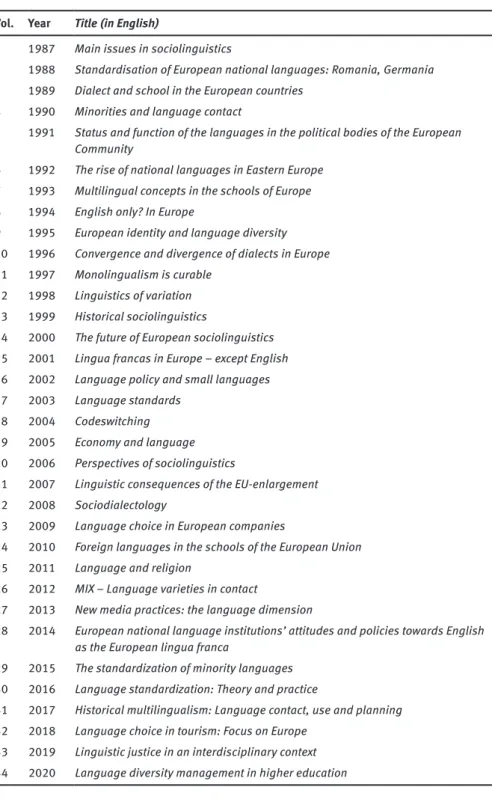
When it comes to the analysis of the circulation of topics, Sociolinguistica can serve as a useful source in at least two ways. Given the thematic focus of the yearbook (cf. Table 1 for a complete list of the volumes published so far), the bibliographies of the chapters of each issue offer an overview of research that exists at a certain point in time on a certain (broad or specific) topic. The fact that the yearbook covers some topics more than once – e. g. main issues in sociolinguistics (volumes 1, 14 and 20), language standardization (volumes 2, 17, 29 and 30), dialects and language variation (volumes 10, 12, 22 and 26), language use in educational settings (volumes 3, 7, 24 and 34), historical sociolinguistics (volumes 13 and 31) and a variety of language policy issues in European settings (the majority of the volumes) – allows us to trace certain changes or consistencies in the ‘bibliographical anchorage’ of topic-specific research literature over a certain period of time. Of even greater importance for an analysis of the circulation of sociolinguistic topics is the ‘European-wide’ sociolinguistic bibliog-raphy included in each volume. At a time when online search engines did not yet exist and library users still relied heavily on the use of index cards, the founding fathers of the yearbook engaged in establishing a network of sociolinguistic correspondents whose main task it was to compile country-specific sociolinguistic bibliographies cov-ering the publication year two years prior to each issue. Published in 1987, the first bibliography thus covered the year 1985, while the last bibliography, published in the present volume, covers the year 2018.
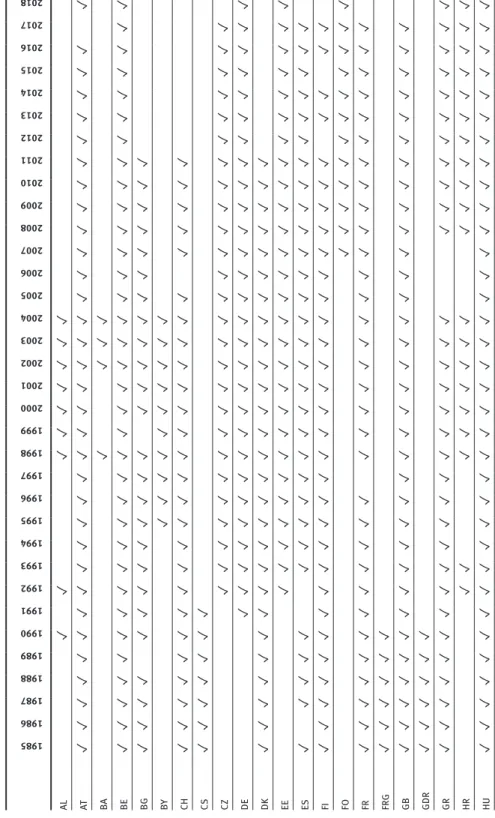
The philosophy behind the European sociolinguistic bibliography never really changed. It was never meant to provide an exhaustive overview of sociolinguistic mon-ographs, collections, book chapters or journal articles published by scholars active in a specific European country. Rather, each of the 34 bibliographies aims to offer as complete a picture as possible of the dynamics of sociolinguistics in a (because of the non-availability of country correspondents rather fluctuating) selection of Euro-pean countries. As Table 2 reveals, the most complete bibliographies (2002 and 2003) contain an inventory of sociolinguistic publications in 38 countries, while the short-est (2018) contains an overview of publications in 15 countries. Table 2 also reveals that the bibliographies reflect geopolitical changes that took place in Europe ranging from German unification to the implosion of the USSR and the creation of a series of new independent states in Central and Eastern Europe after the fall of the Iron Curtain.
One of the most distinctive features of the sociolinguistic bibliography is that is has tried to pay equal attention to sociolinguistic publications in all corners of Europe from the very beginning. Over the past decade, however, the bibliography clearly lost momentum as far as its geographical coverage is concerned. It not only proved increas-ingly difficult to find a replacement for the correspondents who – after sometimes many years of loyal service – wanted to pass on the torch. In an era characterized by the development and the increased use of interactive and dynamic digital tools, the editors as well as some correspondents also started to question the printed (and there-fore also linear and static) nature of the bibliography. At an editorial meeting in Berlin
Three decades of sociolinguistic bibliographies 269
Table 1: Issues of Sociolinguistica published between 1987 and 2020 Vol. Year Title (in English)
1 1987 Main issues in sociolinguistics
2 1988 Standardisation of European national languages: Romania, Germania 3 1989 Dialect and school in the European countries
4 1990 Minorities and language contact
5 1991 Status and function of the languages in the political bodies of the European Community
6 1992 The rise of national languages in Eastern Europe 7 1993 Multilingual concepts in the schools of Europe 8 1994 English only? In Europe
9 1995 European identity and language diversity 10 1996 Convergence and divergence of dialects in Europe 11 1997 Monolingualism is curable
12 1998 Linguistics of variation 13 1999 Historical sociolinguistics
14 2000 The future of European sociolinguistics 15 2001 Lingua francas in Europe – except English 16 2002 Language policy and small languages 17 2003 Language standards
18 2004 Codeswitching 19 2005 Economy and language 20 2006 Perspectives of sociolinguistics
21 2007 Linguistic consequences of the EU-enlargement 22 2008 Sociodialectology
23 2009 Language choice in European companies
24 2010 Foreign languages in the schools of the European Union 25 2011 Language and religion
26 2012 MIX – Language varieties in contact
27 2013 New media practices: the language dimension
28 2014 European national language institutions’ attitudes and policies towards English as the European lingua franca
29 2015 The standardization of minority languages 30 2016 Language standardization: Theory and practice
31 2017 Historical multilingualism: Language contact, use and planning 32 2018 Language choice in tourism: Focus on Europe
33 2019 Linguistic justice in an interdisciplinary context 34 2020 Language diversity management in higher education
270 Jeroen Darquennes Ta ble 2: Li st of co unt rie s c ov er ed in the soc io lingui stic b ib liogr ap hy (1985–2018) 1985 1986 1987 1988 1989 1990 1991 1992 1993 1994 1995 1996 1997 1998 1999 2000 2001 2002 2003 2004 2005 2006 2007 2008 2009 2010 2011 2012 2013 2014 2015 2016 2017 2018 AL ✓ ✓ ✓ ✓ ✓ ✓ ✓ ✓ ✓ AT ✓ ✓ ✓ ✓ ✓ ✓ ✓ ✓ ✓ ✓ ✓ ✓ ✓ ✓ ✓ ✓ ✓ ✓ ✓ ✓ ✓ ✓ ✓ ✓ ✓ ✓ ✓ ✓ ✓ ✓ ✓ ✓ ✓ BA ✓ ✓ ✓ ✓ BE ✓ ✓ ✓ ✓ ✓ ✓ ✓ ✓ ✓ ✓ ✓ ✓ ✓ ✓ ✓ ✓ ✓ ✓ ✓ ✓ ✓ ✓ ✓ ✓ ✓ ✓ ✓ ✓ ✓ ✓ ✓ ✓ ✓ ✓ BG ✓ ✓ ✓ ✓ ✓ ✓ ✓ ✓ ✓ ✓ ✓ ✓ ✓ ✓ ✓ ✓ ✓ ✓ ✓ ✓ ✓ ✓ ✓ ✓ ✓ BY ✓ ✓ ✓ ✓ ✓ ✓ ✓ ✓ ✓ ✓ CH ✓ ✓ ✓ ✓ ✓ ✓ ✓ ✓ ✓ ✓ ✓ ✓ ✓ ✓ ✓ ✓ ✓ ✓ ✓ ✓ ✓ ✓ ✓ ✓ ✓ ✓ CS ✓ ✓ ✓ ✓ ✓ ✓ ✓ CZ ✓ ✓ ✓ ✓ ✓ ✓ ✓ ✓ ✓ ✓ ✓ ✓ ✓ ✓ ✓ ✓ ✓ ✓ ✓ ✓ ✓ ✓ ✓ ✓ ✓ ✓ DE ✓ ✓ ✓ ✓ ✓ ✓ ✓ ✓ ✓ ✓ ✓ ✓ ✓ ✓ ✓ ✓ ✓ ✓ ✓ ✓ ✓ ✓ ✓ ✓ ✓ ✓ ✓ ✓ DK ✓ ✓ ✓ ✓ ✓ ✓ ✓ ✓ ✓ ✓ ✓ ✓ ✓ ✓ ✓ ✓ ✓ ✓ ✓ ✓ ✓ ✓ ✓ ✓ ✓ ✓ ✓ EE ✓ ✓ ✓ ✓ ✓ ✓ ✓ ✓ ✓ ✓ ✓ ✓ ✓ ✓ ✓ ✓ ✓ ✓ ✓ ✓ ✓ ✓ ✓ ✓ ✓ ✓ ✓ ES ✓ ✓ ✓ ✓ ✓ ✓ ✓ ✓ ✓ ✓ ✓ ✓ ✓ ✓ ✓ ✓ ✓ ✓ ✓ ✓ ✓ ✓ ✓ ✓ ✓ ✓ ✓ ✓ ✓ ✓ FI ✓ ✓ ✓ ✓ ✓ ✓ ✓ ✓ ✓ ✓ ✓ ✓ ✓ ✓ ✓ ✓ ✓ ✓ ✓ ✓ ✓ ✓ ✓ ✓ ✓ ✓ ✓ ✓ ✓ ✓ ✓ FO ✓ ✓ ✓ ✓ ✓ ✓ ✓ ✓ ✓ ✓ ✓ ✓ FR ✓ ✓ ✓ ✓ ✓ ✓ ✓ ✓ ✓ ✓ ✓ ✓ ✓ ✓ ✓ ✓ ✓ ✓ ✓ ✓ ✓ ✓ ✓ ✓ ✓ ✓ ✓ ✓ ✓ ✓ ✓ ✓ FRG ✓ ✓ ✓ ✓ ✓ ✓ GB ✓ ✓ ✓ ✓ ✓ ✓ ✓ ✓ ✓ ✓ ✓ ✓ ✓ ✓ ✓ ✓ ✓ ✓ ✓ ✓ ✓ ✓ ✓ ✓ ✓ ✓ ✓ ✓ ✓ ✓ ✓ ✓ ✓ GDR ✓ ✓ ✓ ✓ ✓ ✓ GR ✓ ✓ ✓ ✓ ✓ ✓ ✓ ✓ ✓ ✓ ✓ ✓ ✓ ✓ ✓ ✓ ✓ ✓ ✓ ✓ ✓ ✓ ✓ ✓ ✓ ✓ ✓ ✓ ✓ ✓ ✓ HR ✓ ✓ ✓ ✓ ✓ ✓ ✓ ✓ ✓ ✓ ✓ ✓ ✓ ✓ ✓ ✓ ✓ ✓ ✓ ✓ HU ✓ ✓ ✓ ✓ ✓ ✓ ✓ ✓ ✓ ✓ ✓ ✓ ✓ ✓ ✓ ✓ ✓ ✓ ✓ ✓ ✓ ✓ ✓ ✓ ✓ ✓ ✓ ✓ ✓ ✓ ✓ ✓ ✓ ✓
Three decades of sociolinguistic bibliographies 271 IE ✓ ✓ ✓ ✓ ✓ ✓ ✓ ✓ ✓ ✓ ✓ ✓ ✓ ✓ ✓ ✓ ✓ ✓ IS ✓ ✓ ✓ ✓ ✓ ✓ ✓ ✓ ✓ IT ✓ ✓ ✓ ✓ ✓ ✓ ✓ ✓ ✓ ✓ ✓ ✓ ✓ ✓ ✓ ✓ ✓ ✓ ✓ ✓ ✓ ✓ ✓ ✓ ✓ ✓ ✓ ✓ ✓ ✓ ✓ ✓ ✓ ✓ LT ✓ ✓ ✓ ✓ ✓ ✓ ✓ ✓ ✓ ✓ ✓ ✓ ✓ ✓ ✓ ✓ ✓ ✓ ✓ ✓ ✓ ✓ ✓ ✓ ✓ LU ✓ ✓ ✓ ✓ ✓ ✓ ✓ ✓ ✓ ✓ ✓ ✓ ✓ ✓ ✓ ✓ ✓ ✓ ✓ ✓ ✓ ✓ ✓ ✓ ✓ ✓ ✓ ✓ ✓ ✓ ✓ ✓ ✓ LV ✓ ✓ ✓ ✓ ✓ ✓ ✓ ✓ ✓ ✓ ✓ ✓ ✓ ✓ ✓ ✓ ✓ ✓ ✓ ✓ ✓ ✓ ✓ ✓ ✓ MD ✓ ✓ ✓ MK ✓ ✓ ✓ ✓ ✓ ✓ ✓ ✓ MT ✓ ✓ ✓ NL ✓ ✓ ✓ ✓ ✓ ✓ ✓ ✓ ✓ ✓ ✓ ✓ ✓ ✓ ✓ ✓ ✓ ✓ ✓ ✓ ✓ ✓ ✓ ✓ ✓ ✓ ✓ ✓ NO ✓ ✓ ✓ ✓ ✓ ✓ ✓ ✓ ✓ ✓ ✓ ✓ ✓ ✓ ✓ ✓ ✓ ✓ ✓ ✓ ✓ ✓ ✓ ✓ ✓ ✓ ✓ ✓ ✓ ✓ ✓ ✓ ✓ ✓ PL ✓ ✓ ✓ ✓ ✓ ✓ ✓ ✓ ✓ ✓ ✓ ✓ ✓ ✓ ✓ ✓ ✓ ✓ ✓ ✓ PT ✓ ✓ ✓ ✓ ✓ ✓ ✓ ✓ ✓ ✓ ✓ ✓ ✓ ✓ ✓ ✓ ✓ ✓ ✓ ✓ ✓ ✓ ✓ RO ✓ ✓ ✓ ✓ ✓ ✓ ✓ ✓ ✓ ✓ ✓ ✓ ✓ ✓ ✓ ✓ ✓ ✓ ✓ ✓ RS ✓ ✓ ✓ ✓ ✓ ✓ ✓ ✓ ✓ ✓ ✓ ✓ ✓ ✓ RU ✓ ✓ ✓ ✓ ✓ ✓ ✓ ✓ ✓ ✓ ✓ ✓ ✓ ✓ ✓ ✓ ✓ ✓ ✓ ✓ ✓ ✓ ✓ ✓ ✓ ✓ SE ✓ ✓ ✓ ✓ ✓ ✓ ✓ ✓ ✓ ✓ ✓ ✓ ✓ ✓ ✓ ✓ ✓ ✓ ✓ ✓ ✓ ✓ ✓ ✓ ✓ ✓ ✓ ✓ ✓ SI ✓ ✓ ✓ ✓ ✓ ✓ ✓ ✓ ✓ ✓ ✓ ✓ ✓ ✓ ✓ ✓ ✓ ✓ ✓ SK ✓ ✓ ✓ ✓ ✓ ✓ ✓ ✓ ✓ ✓ ✓ ✓ ✓ ✓ ✓ ✓ ✓ ✓ ✓ ✓ ✓ SU ✓ ✓ ✓ ✓ ✓ ✓ UA ✓ ✓ ✓ ✓ ✓ YU ✓ ✓ ✓ ✓ ✓ ✓ ✓ ✓ ✓ ✓ ✓ ✓ ✓ ✓ ✓ ✓ ✓ ✓ ✓ ✓ Rem ark s: (1) The a bbr ev iation s in the li st ar e e xp lained in Ta ble 3; (2) r eader s s ho uld kno w th at the a bbr ev iation s u sed her e do not corr es pond to the ec lectic a bbr ev iation s u sed in the fir st 22 is sue s of the ye arboo k; (3) on ly fr om i ss ue 23 on war ds did the a bbr ev iation s u sed in the b ib liogr ap hy corr es pond to the ISO 3166–1 a lp ha-2 c ode s; (4 ) the DK b ib liogr ap hy a lso c ov er ed Gr een -land; (4 ) in some e arly is sue s the FO w as p ar t of the DK b ib liogr ap hy , l at er on FO w as co ver ed in the NO b ib liogr ap hy and fr om 2009 on war ds the FO b ib liogr ap hy bec ame a sep ar at e ent ry; ( 5) f or quit e a nu m ber of ye ar s, the b ib liogr ap hy wr ongly u sed YU f or Serb ia (an err or th at w as corr ect ed in i ss ue 23 of 2009 when RS st ar ted to be u sed for the R ep ub lic of Serb ia).
272 Jeroen Darquennes
in September 2019, the decision was taken to no longer include the bibliography as part of the printed issue from volume 35 onwards.
At this stage we do not want to rule out a digital restart of the bibliography, but finding the financial and human resources that would allow us meet the current stand-ards of digital research practices proves to be a major challenge. Pending a potential digital restart, we do, however, hope that the existing collection of sociolinguistic bibliographies will not fall into oblivion and will prove to be a useful resource for students and researchers interested in the development of European sociolinguistics. The sociolinguistic bibliography not only has the potential to function as a solid basis for an historical overview of trending topics in sociolinguistics in different parts of Europe, it also complements the information found in chapters similar to those in
The handbook of sociolinguistics around the world (Ball 2010), which as far as Europe
is concerned, cover the German-speaking area, the Dutch-language area, the Nordic region, the British Isles, France, Italy, Spain and Portugal, Hungary, the Czech Repub-lic and Poland, the Balkans, the Russian Federation, Ukraine, Belarus, Moldova and the Baltic States.
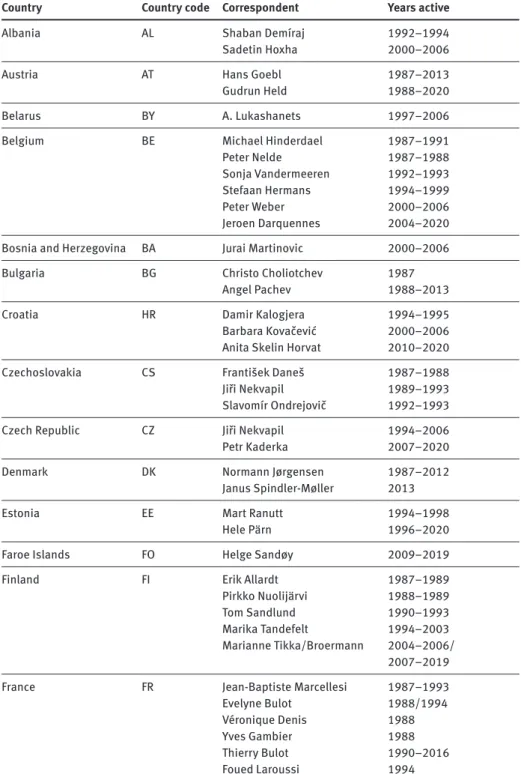
This small contribution on three decades of sociolinguistic bibliographies would be incomplete without mentioning and paying tribute to the many faithful corre-spondents on which the editors of the yearbook could rely. Table 3 contains the com-plete list of persons who acted as a sociolinguistic correspondent during one or more of the past 34 years. The correspondents who steadily kept on sending us sociolinguis-tic bibliographies for more than twenty years are Gaetano Berrutto, the late Thierry Bullot, Jenny Cheshire, Ina Druviete, Hans Goebl, the late Jens Normann Jørgensen, Laima Kalédiene, Georges Lüdi, Sonia Novak-Lukanović, Slavomír Ondrejovič, Angel Pachev, Hele Pärn, Joachim Raith, Helge Sandøy, Natalia Troshina and Francisco J. Zamora. Gudrun Held deserves special mention because she started gathering data for the Austrian bibliography in 1988 and has kept on doing so ever since. Our most faithful correspondent, however, is Ranko Bugarski, who served the yearbook from volume 1 to volume 34. His scholarship, wisdom, wit and patience shimmered through in every mail that I had the pleasure of reading. A heartfelt thank you to Ranko and all the other correspondents who helped us gather a wealth of data which I hope will be thoroughly explored in the near future.
Three decades of sociolinguistic bibliographies 273
Table 3: List of sociolinguistic correspondents listed between 1987–2020
Country Country code Correspondent Years active
Albania AL Shaban Demíraj 1992–1994 Sadetin Hoxha 2000–2006 Austria AT Hans Goebl 1987–2013 Gudrun Held 1988–2020 Belarus BY A. Lukashanets 1997–2006 Belgium BE Michael Hinderdael 1987–1991 Peter Nelde 1987–1988 Sonja Vandermeeren 1992–1993 Stefaan Hermans 1994–1999 Peter Weber 2000–2006 Jeroen Darquennes 2004–2020 Bosnia and Herzegovina BA Jurai Martinovic 2000–2006 Bulgaria BG Christo Choliotchev 1987
Angel Pachev 1988–2013 Croatia HR Damir Kalogjera 1994–1995 Barbara Kovačević 2000–2006 Anita Skelin Horvat 2010–2020 Czechoslovakia CS František Daneš 1987–1988 Jiři Nekvapil 1989–1993 Slavomír Ondrejovič 1992–1993 Czech Republic CZ Jiři Nekvapil 1994–2006 Petr Kaderka 2007–2020 Denmark DK Normann Jørgensen 1987–2012
Janus Spindler-Møller 2013 Estonia EE Mart Ranutt 1994–1998
Hele Pärn 1996–2020 Faroe Islands FO Helge Sandøy 2009–2019 Finland FI Erik Allardt 1987–1989 Pirkko Nuolijärvi 1988–1989 Tom Sandlund 1990–1993 Marika Tandefelt 1994–2003 Marianne Tikka/Broermann 2004–2006/
2007–2019 France FR Jean-Baptiste Marcellesi 1987–1993 Evelyne Bulot 1988/1994 Véronique Denis 1988 Yves Gambier 1988 Thierry Bulot 1990–2016 Foued Laroussi 1994
274 Jeroen Darquennes
Country Country code Correspondent Years active
Nicolas Tsekos 1995 Elatiana Razafi 2008–2014 Mélanie Texier 2012–2014 Gudrun Ledegen 2013–2019 Germany FRG Ulrich Ammon 1987–1988 Klaus J. Mattheier 1987–1988 Joachim Raith 1989–1993 GDR Wolfdietrich Hartung 1987–1992 DE Joachim Raith 1993–2011 Jeroen Darquennes 2012 Birte Kellermeier-Rehbein 2013–2019 Great Britain GB Jenny Cheshire 1987–2012 Leigh Oakes 2013–2018 Jakob Leimgruber 2019 Greece GR Eliza Kitis 1987–1993
Lukas D. Tsitsipis 1994–2006 Dionysos Goutsos 2010–2020 Argyris Archakis 2010–2020 Hungary HU Sándor Györi-Nagy 1987–1991 Miklós Kontra 1992–1999 Anna Borbély 2000–2017 Balázs Sinkovics 2018–2020 Iceland IS Kristján Arnason 1989–1990/2000
Thornstein G. Indriþason 1993–1999 Ireland IE John Harris
Pádraig O’Riagáin 1987–2000/ 2004–2006/2009 Italy IT Monica Berretta 1987–1995
Gaetano Berruto 1996–2020 Latvia LV Ina Druviete 1994–2019
Lithuania LT Laima Grumadiene/Kalédiene 1994–2008/2009–2019 Luxembourg LU Fernand Hoffmann 1987–1994
Harald Fröhlich 1995 Nico Weber 1996–2006 Peter Gilles 2007–2010/
2012–2020 Jeroen Darquennes 2011 Macedonia MK Liliana Minova-Gurkova 1999–2007 Malta MT Manwel Mifsud 2004–2006
Three decades of sociolinguistic bibliographies 275
Country Country code Correspondent Years active
Moldavia MD Vasile Dumbrava 2004–2006 The Netherlands NL Marinel Gerritsen 1987–1993 Durk Gorter 1994–2007 Adriana Kaspers 2008–2009 Sjaak Kroon 2010–2014 Norway NO Geirr Wiggen 1987–1999 Helge Sandøy 2000–2008 Magnhild Selås 2008–2013 Edit Bugge 2012 Randi Neteland 2014–2020 Poland PL Franciszek Grucza 1987–2006 Portugal PT Maria F. Rezende Matias 1987–2004
M. Celeste Van Egmond-
Augusto 2005–2020 Cláudia Fernandes 2018–2020 Rumania RO Tatiana Slama-Cazacu 1987–1988/
1994–1995/ 1997–2006 Marina Ciolac 1987–1988 Sabina Teiuș 1989–1993 Antoaneta Olteanu 1996–2000 Andrei A. Avram 2001–2003 Diana Ghido 2004 Domnita Tomescu 2005–2006 Russia RU Leonid P. Krysin 1993–1999 Natalia Troshina 2000–2020 Serbia RS Ranko Bugarski 2003–2020 Slovakia SK Slavomír Ondrejovič 1994–2018 Slovenia SI Sonia Novak-Lukanović 1994–2015 Soviet Union SU Leonid P. Krysin 1987–1993 Spain ES Miguel Siguan i Soler 1987–1988 Santiago Mollfulleda 1989–1990 Francisco J. Zamora 1991–2019 Sweden SE Bengt Nordberg 1987–2002 Britt-Louise Gunnarsson 2003–2012 Anna-Malin Karlsson 2013–2015 Rasmus Lund 2013 Emil Paulsrud 2014–2015
276 Jeroen Darquennes
Country Country code Correspondent Years active
Switzerland CH Georges Lüdi 1987–2001/2005–2013 Simone Pekarek 2002–2004
Ukraine UA Yaroslav Pylynskyi 2000–2003 Liubov Lazarenko 2004–2006 Yugoslavia YU Ranko Bugarski 1987–2003
References
Ammon, Ulrich/Mattheier, Klaus J./Nelde, Peter H. (1987): Editor’s Foreword. In: Sociolinguistica 1, IX-X.
Ball, Martin J. (ed.) (2010): The Routledge handbook of sociolinguistics around the world. London: Routledge.
Darquennes, Jeroen (2013): Current issues in LPP research and their impact on society. In: AILA Review 26, 11–23.