DEMOCRATIC REPUBLIC
OF'ALGERIA
MINISTRY
OFHIGH EDUCATION AND
SCIENTIX'ICRESEARCII
Jijel University
Faculty of Science
Technolory
Department of Computer Science
Memory
ln
order
to obtain
the
Master's
Degree
in
94
"J
L
11
os
1,tlt
ter
Science:
Legal
fnformatics
and
Multi
Theme
Presented
by
ABDOU
Chaima
LOUMS
Selma
a&
s?-Supervised
by
Dr
LAHOULOU
Atidel
Digital Videb
Tampering
and Detection
Techniques
Remerciement
Nous venons en premier lieu remereionv tt ALLAH st qui nout ont dann6 laforce pour
terminer et d,avoir rdussit dans nos dtudet.
<t Allhamdoa Ii
Allah
t
Nous tenons d exprimer notre profonde gratitude d
tous
les enreignants du d1partementpour leur soutien inestimable depuis nos premidres anndes d,dtudes.
Nous remercions nos famille plus particuliirement nos parent,r pour leur
soutien
permqnent tout au long de ce mdmoire etplus gdndralement au long de notre vie
universitaire.
Nous aimerons aussi remercie ftotre encadreur,
Dr
Atidel
lahoulou.Nos remerciements vont aux membres
deiury
qui nousefait
I'honneurde
juger
eetravail en tant que examinatrice
Nous tenons d remercie vivement les membres du ddpartement d'informatique
Nos remerciements vont dgalemefi A monsierrr Boubakir A et
monsieur Mahrouk Z
Nous tenons aussi d dire un immense merci d tous nos collbgues de pramotion 20lT et
tous nos amies
Enfin, nous adressons nous remerciements d toutes personnes ayant cantribu1e
de
prts
ou de loin d la rd.alisation de ce m6moire.
Dddicace
De mes profondes sensations de sqgesse et sinc6rit6
je
d6die cetravail
A
mamire
La plus belle crdature que Dieu a cr66e sur terre, A cette source de tendresse. de
patience et de gdndrositd
!
A
monpdreCe travail est
lefruit
de tes sacrifices que tu as consentis pour maformation tout au Iong de ces anndes.A
mes chiresseurs
etfrires
Kenza, Roumaissa, Abd arrahmane, Mouhamed
A l'amour
demavie
NedjmoA
mes amis(e)Arn personnes qui m'ont toujours aidd et encouragd, qui *taient toujours d mes c6tds,
et qui m'ont accompagnaient durant mon chemin d'dtudes.
A toutes les personnes qui m'ont aidd
par
un mot, m'ont donndlaforce
de continuerDddicuce
A
ma chdre mdre
Pour son encouragement
sapatience et surtout
sespridres qui
m'ont
toujours
guid6.
A
mon pdre
Pour
sonsoutien et
sapatience
Mes
seurs
Lina,
Mimi
,Nabiha,samira
etRima
Mes frdres Samir, Ahmed, Reda
,Omar
etKarim
Tous
mes amiesHadjer
,Radja,khadidja,
Rawnak,Widad
Mon
bin6mes Chaima pour
sapatience durant toute cette
ann6esA
Ma
tente
Naima
Abstract
With
the increasiug accessibility of technology for everyday people,tli1gs
aresta.r.t-ing
to
get digitalized:digital
camera, cligital cable,digital
sourxl, anddigital
video.It
is no longer the case whera a video production is only possibie for specializedstu-dios.
Theavailability of
various user'-fiendly, ine:<pensive tools is pushingprotiol
picturesinto individual conputer
owners. TheOigital
forgelies thoughont ui"ilrly
identifiable
to
human pelceptionit
may altcr or
meddlewith
undetlyiru
natural statistics of digital content. Tamperiug irn olves fiddling rvith vicleo conteutiu
or.derto cause darnagc
ol
make unauthorizedaltcration/modification.
Tampering irnpacts need to be studied and the applied technique/method is used to establish thc factual information for legal coulse injudiciarl'.
11 this report q,e prnsenting cliffe1elt typcsof
videofolgery
iu
the
first
chapter and cletection techniquesboth
in
active andpa^ssive video
in
the second .KeJrwords:
video tempering, active forgery detection, passivc for-gerydetectiol,
vR6sume
Avec
la
croissante dcla
technologie 6lectronique,tout
conunencc d nuur6riser dans notre vie cluotidieuuc:
appareil photo numdrique,cible
num6riclue, soL nurn6r.iqueet
vid6o num6rique. La production de virl6o cst donc possibleplul
tout
le molcle. La disponibilit6 de diff6rents outils conviviaux et peu.of,t",o
concluit ir des falsifica-tions num6riques, non visiblcment identifiables d la pcrception humaine. L'alt6ration
impliquc dc jouer avcc du contenu vid6o afin cle causer dcs rlonmages clc'rodifica-tiou
non- autorisd. Aptbs des 6tudes sur les impacts de falsificationla
techliqle
/
m6thode appliclude est utilisde pour6tablir
lcs informations factuelles poru' lc corusldgal dan^s lc systbmc
judiciaire.
Dans cerapport,
nous pr'6senton^s daps le prcmierchapitrc cliffdrcnt types de falsification 'r'icldo
et
dansla
secondc les technicluesclc
d6tcction dans la I'id6o activc et passive.
Mots-cl6s:
vidco
tempering,activc
forgcrydctcction,
pa.ssive forgery detection, video watermarkiugContents
Contents
List
of Figur.esvll
ruIntroduction
1
Illegal
manipulation of
videos
I
3 3 3 4 4 6 6 6 6 F2 I I 7 8 8I
11 15 16t7
L7 L7 18 19 20 22 22 23iii
1
Introduction2
what is a video 4.2.1 4.2.32.1
why we need compr.essiol2.2
Hierarclry of video data Video Porensic3.1
Sourcc identification3.2
Video hidden content detection3.3
Detection of illegal rcprocluction of videos3.4
I'ideo tampeling detection video tampertng4.L
about video tampering4.2
Tlpes
of video tamperingSpatial tempering
(intra
frametampering)
.
. . .
.
.4.2.1.L
copy-noveattack
4.2.1.2
Object rernoval attack4.2.1.3
Object rnodification4.2.2
Ternpor-al tampering(inter
fi.amctampering)
. .
.
.4.2.2.L
Frame addition4.2.2.2
Flame rcmoval4.2.2.3
Frarne duplication4.2.2.4
Fram.e shuffiing Spacio tcmporcl tamperingConclusion
2
video tampering detection
technics
1
Introduction2
Video tampering dctection3
Activc
tampering detcction technics3.1
Water:nark3.1.1
Spatialdonain
natcrrnar-king tccluriques3.1.1.1
LSB( Least SignificanrBit)
3.1.1.2
SSSC(Spread Spectmm Signal Cor.relation)
3'1'2
firquencydomainq'atermarkiugtcchniqucs(tapsfogl)
12 12 14I4
15 15CONTENTS
3.1.2.L
Discrete cosinetransforns DCT
.
233.1.2.2
Discrete wavelet tran^sfonnsDWT
243.1.2.3
Discrete Fourier transforursDF'T
243.1.3
Bit-strearn dornain water.markingtecluriques
243.2 Digitalsignatur-e
...24
Passive tampeling detection
technics
264.1
intla
fraure tamper-ing detectiontechnics
2T4.2
Inter-ftame tampering dctectiouteclurics
g04.2.I
Detection of fi-aureInsertion
g04.2.2
Detectiol
of FrameRemoval/Deletion
g14.2.3
Detectio'
ofFrane Replicatio'
(duplicatio')
g24.2.4
Detectionof
Fl.aureshuffiing
.... .
334.3 spatie.temporaldetectiontechnics.
.... .
834.3.1
-'
Double compr-ession detectionruethods
3gii,i,
*""'
d"$*14#[*
-,,'-r,,"',il
tics.
...35
ut
''lu
r
rY"'"08":"?,o.:T,1#1"':;tif:ro*
s*'.*o*ir,
3b(BAS)
...36
4.3.L.2.2
Dctcction using Variatiou of pr.eclic_tion Footprint (VpF)
4.3.1.2.3
Detcction usingboth
BAS anclVpF
.4.3.2 Region Tampering Detcction conclusion
Copy-Move
Detection
technics and methods
1
Introduction2
Existcrl methods of copy movc detcction2.r
Detectiouof
copy-move vidco tarnpertng using histograrnof
oricntatedgradicnts(Hoc)
.2.1-1
Prirrciple of histograur.s of oriented gr-arlie'ts(HoG)
2.1.2
Slork
process2.2
Copy i\tlove Detcction Tecluricwith
Autouratic ThresholclDe-ter:uinatiou
2.3
video copy-\,Iove Dctcctiona'd
Localization Based ouTanua
Texture Feattu.es2.4
Detcction of Duplicationin Digital
VidcoTanpering
2.4.L
frame duplication :2.4.2
region cluplication :Detection of vidco taurpering using correlation of nolse residue Vidco copy-il'Iove
Dctcctio'a'd
Localization Based on struc-tru'al Similarity2.6.1
I\,ISSINI i\{eanStnrctral
Sirnilar.ity2.6.2
rvorkplincipal
Sirnilarity
fural5,sis 36 36 36 38 39 39 39 43 44 45 46 46 49 50 50 51 52 40 404l
2.5 2.6 lv 2.7 CONTBNTSCONTENTS
2.7.L 2,7.2
Caudidate duplication sear.ch
Double-checkiug
53 55 56
Conclusion
Ercperimental
results
of
Similarity
Analysis
1
introduction1.1
The computer configuration1.2
Daraset description1.3
user inter{ace presentatiou implementation2.1
selects the candidate duplicated sequeuces of the video2.I.1
Obtain the features of each frarne2.1.2
Calculatethe
Euciidean distance of features2.1.3
Calculate thesimilarities.
2.2
double-checking2.2.1
Mergecaldidatesub-sequences2.2.2
Confuur duplicated sequencesExperirneutal results conclu.sion
Bibliography
57 b( D(,(
58 59 59 59 60 61 62 62 62 63 63 3 4 65 CONTENTSCONTENTS
I
vl
LIST OF' I-IGURES
2.15 shows exaruple of how the GOP becorne a.fter a tarnpered
alteratiol
2.16 (a,c,e,g,i)fiames
of an original
viclco,(b,d,f,h,j)
corr-espondsto
thesame fiames
with
the copy-move tamcrjng attack34
37
2.17 shows (a)the rcd fi'ane regions indicate taurpering.(b)green fi.ame
re-giols
stald
for
the
pastedportion which is
copied fi'om fi.anesof
3.1 3.2 3.3 3.4 3.5 3.6 3.7 3.8 3.9 3.10 3.11 3.12 3.13 4.L 4.2 4.3 4.4 4.5 4.6 4.7 4.8 4.9 4.10 different I'idco. u'ork process
Thc four
palts
of theATD
methodSteps of the featur.e extractiort mcthod
Steps of the feature extraction methocl
example of frame duplication exalnple of region duplication work process of
tlie
mcthodSirnilarity
measure betweeu tn'o imagesdiagram for temporal copl'*a1eve dctection diagram for spatial copy-rnove cletection
The flow chart of thc
similarity
analysis algorithrn il,Icrging of sub-sequencesin
a vicleo sequercclocalization of duplications
user interface 1
user inter{ace 2
user inter{ace 3
Thc ffow chart of
siurilarity
analysi,salgorithn
SVD function
Euclidean distancc betrvccn tsro rrectors
Euclidcan dlstance between the SVD of ts,o fiames colrelation coefficient
mcrging adjacent sub-sequences
Doublc cheking duplicated framc
38 4L 43 43 45 47 48 49 50 51 52 53 oi) 56 58 58 59 59 60 60 61 61 62 62 I ! I I a
IIST
OF'F'IGURJ'S2.15 shows exarnple of how the GOP becoure after a tampered
alteratiol
g42.16 (a,c,e,g,i)fiaures
of an original
vicleo,(b,d,f,h,j)
cor.respondsto
thesarne fiarnes
with
the copy-rnove tamerjng attack2.17 shows (a)thc red frame regions indicate taurpering.(b)gleen frame
re-gions stand
for
the
pastedportion which is
copied fi'om fiamesof
37 3.1 3.2 3.3 3.4 3.5 3.6 3.7 3.8 3.9 3.10 3.11 3.12 3.13 4.L different video. u'ork process
The four parts of the
ATD
methodSteps of the feature extraction method
Steps of the feature extraction method example of flame duplication
example of region duplication work ploccss of the method
Sirnilarity
neasur.e betrveen tu'o imagesdiagram for tempor.al copy-move detection diagram
fol
spatiai copy-move cletectionThe flow chart of the
similarity
analysi^s algorithm i\,Icrging of sub-sequencesin
a vicleo sequenceIocalization of duplications user interface 1 38 4L 43 43 45 47 48 49 50 51 52 53 55 56 58 58 59 59 60 60 61 61 62 62
vul
4.2
user intertace 24.3
user interface 34.4
The flow chart ofsiurilarity
analysls algorithm4.5
SVD function4.6
Euclidean distance between t$,o vectors4.7
Euclidean distance betrveenthc
SVD of two frames4.8
colrelation coefficier*4.9
rncrglng adjacent sub-sequences4.10 Doublc cheking duplicated frame
fntroduction
lxitleo tlata has be*rme msr€ p$prrlar wi*h
th*
a*I:r*,nre.m*xt +fdigital
caraera* an4
networking technologies
with
high speed bandwidths,as a result many systems make
use of video data and rely on the accuracy of such data .on the other hand, an in-evitable adverse effect of
this critical natulc
af video datair
videa ta,rnpering.with
difficuibyto
detecta
tampered video becomem*re
eietecti*n tec{iniques and methods are implemented and developed despitethat
theselrethods
does
not
in-cludeall
firpes of tampering.In
thefirst
chapter we present different illegal manipniation of virleoswithin
a brave
definition of video, caracteristique of video forensic and video tampering .Then
in
chapter two video tampering detection technique Active and passive. Fbr thestate
of art wc
chosc ehaptcr thrc'cto
pr*scnt
diffr-:rcnt cxisting mctho4sof
capy-movcTNTRODUCTION
Chapter
1
Illegal
manipulation of
videos
1
Introduction
Advancenents
in
video innovations cornpre$sion,
tra,u^smission, stockpiling,reco\'-ery combincd
rvith the availability
of production/editing
clevices andfasi
gron4hof intetnet facilitate
uploading ,doumloacling and sharingnultimedia coltent
(i1r-ages ,rntrsic ,r'ideos )especiaily
n'ith
the advancement of social rneclia rvebsites likc YouT\rbe ,Facebook,Tx'ittcr. . ..
Ect As a result, we have begun to see anapparitiol
of some darker sides of video data ancl an increasein
illegal uses ancl ,nuoipulotio,t of videoslikc
copy rightsiuf
ingement, video tanper.ing.2
what
is a video
A
video is a successionof
images.Thc
fiurrlamcntal principlcof
vicleo isthat
the humau eye has the possibility of retaining for a certain tiure (the ordcr of a tenth ofa second) any image printed on thc
retina.It
is enough to scroll a sufficient nrunberof fralres per sccond
.In
the ficld ofdigital
viclco, thcre are three essential spaccs ofcolor:
r
RGBo
Gray-scale spaceCHAPTER
1.
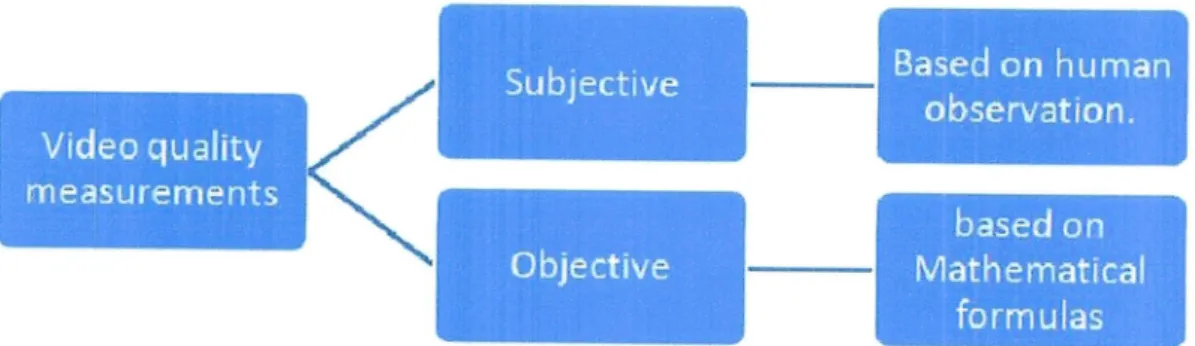
ILLEGAL I\,{ANIPULATION OF'VIDEOSFigure 1.1: present vidco
quality
measurementsThe
digital
video is too voluminou,s so cornpression is'ceded.
2.L
why
we need compression
Digital
telcvision present aprivilcgcd position.
The clcvclopmentof digital
yideo has bcan possiblc mainlytluough
the possibilitics of comprc*sion. The comprcssionof the viclm sequenccs is necessary
in
ordcrto
store thc viclm sequcnces , oodto
boablc
to transmit digital
vidco datathrough a limitccl
banclwiclth netu,ork or-fi'oma
rncdium whoharc a
tran^sfcrratc
limit.
Thc
objcctiveof
vicleo courpression isto
rcducethe nunbcr
of
bits
requiredto
rcprcsentthe information carricd lry
a video scqllencc. Thc inprovements brought bythc
cornpression arc notsinply
cllcto thc
elimination ofthc
redutclant clatabut rathcr Thc
cliscarcling ofi'fo'r'atio'
decmedilrclevant. for
examplc informationthat
arcnot
perceptibleto
thc
nakecleyc The thcory of infonnation trics to
extract
therclevalt
sigrx ofiuformatio'
andto
abandon redundancy to rcduccthc
flow or the stolage capacity of asiglal.
It's
asizc problcm
Ex: th
uucomprcssedvideo:
rGB,
lh
uncomprcssedHDTV:
g00GB2.2
Hierarchy
of video data
figurc 1.2 shorvs a Hier-archy of viclco clata
4
2.
\,VHAT ISA
CHAPTER
1.
ILLEGAL A,IANIPULATION OF VIDBOSI
Group ofpictures
I---rtl
Macroblock
rtfl
rl
fltltl tl
Figrrre 1.2: Hierarchy of video data
Sequence
video
:
it
starts
with a
headerof
sequence containingonc
or
1norcgloups of images and ends
with
a scquence encl coclc.Group of pictures
:
it
groups together a hcader and scries of one or more imagcsallorving
to
access randomly.fmage
:
it
is thc
eleurcutalyunit
for the
codingof thc
vicleo sequcnce a1 imagcLs a group of three rcctangular rnatrices which rcpresents the luminancc
(i)
and
the
chrorninance(Cr
andCb),
an clementof thc matrix
reprcseutilg apixcl.
This representationYCtCb
is ecluivalcntto that
of RGB.It
is pr-cferablcbecause the cye is more sen^sitivc
to
huninancethan to
cluominancc. soit
isnot
necessaryto
storc a^s muchinfonnation in
the matrices Cb andCr
asIn
the
matrix Y;
\Vhcrcasin
RGB,thc
thrce matrices ar-e of the same size. The matlicescb
andcl
arc tn'icc smaller trran thernatrix
y.
Slice
:
The slice is one or more adjaccnt macroblocks orclercd fi.omleft
to r-iglrtalrl
then from topto bottom.
Thesc areimportant
clementsfol
crror handling.If
thc data strearn contain^s alt error, thc decoder can skip the slicc
alcl
move to thc beginning of the next oncdircctly
is procesing the errorsbut
it
is a wausreof spacc.
Macroblocks
:
it
is a rcctangular matrix of tlvo clirnension and madc 1p of blocks. Wh'ich are pa\,ers of 8*
8 pixels. Thcreforc a rnacroblock coverslO*
16 pixclsiu
the luminance space aud 8*
8 plxelsin
the cluominance space.Block
:
This Ls a sct of luminance and chromiuance values of 8lins
of g pixelsCHAPTER
1.
ILLEGAL 1VIANIPULATION OF. VIDEOS3
Video
Forensic
Video
forensic has becomean important
areaof
resealehin
the
la.st decade, byanalyzing
the
videoby
extracting
vahrableinfor:natiou
fi'ornit
contentits
main objectives comprise source identificatiou, hidden data detection and tamperingde-tection.
3.1
Source
identification
Nlultimedia content is produced using various devices, e.g: courputer, can:.era,
scan-ner, recorder, cell phone..etc.
In
general, each device has differeut charactelisticsthat
affectthe
generated muitirnediacontent.
This is
ba.sedon the
assunptiouthat all
multimedia conteut generatedby
a devicewill
containcertail
characteris-tics
that
areintrinsic to
the deviccitself.
Theorigin
of the multimedia contcnt orsource device (mobile ph.ones, carncolders, Cameras) can be identied
by alalyzing
the
characteristicsof
devices and the multirnedia contentthey
produ;
t1l.
Videosource identification is very
irnportant in
validating vicleo evidcnce, tracking clownvideo piracy crimes and regulating
individual
video sources3.2
Video
hidden content detection
steganography was a way
to
secure datathat
$,as usedin
cryptography.Ulfortu-nately
it
has been connectedto
thedistribution of
child pornography ontirc
clark n'eb andit's
an advanced communications toolsfol
terrorists and Drug-clealem ; Inl\'Iay 2011 a suspected ALQaecla member was arrested
in Berlin Accoldilg to
thc Gerrnan ncws paperDie
Ziet he was foundin
possessionof
a mernorycalJnitir
apassword protected
foldcr with what
appearedto
bea
pornographic video calledI{ick
AssWithin that
vidco Gcrman forensic investigators discover.cd 141 separ.atctcxt
filcs
'coutaining
u'hat
appearto
be documcnt cletailing Al-Qaeda operations and plan^s for future operations anong thern tlrreecntitled
"Rrture rvork".
,,lcssons learned"aud
"report on operation^s" [2]In
responseto all
those cybcr crimes vidco hicldcn content detcction or rvhat wccall Video Forensic steganalysis wa.s needed [3]
3.3
Detection
of
illegal reproduction
of
videos
An important
problen in
copyriglrt protcction is the proliferation of bootleg videosl:many illegal copies of movies are available on the
Intcmct
cven bcforetircir
official rcleasc. n'hich caused a huge financial losses thcsc fake copies is producecl byr.ccord-ing fihns
rvith
caurcordensin
cinemas. Vidco forensics tretpto
i.eclu"ethis
problernbyt
detection of re-acquisition(detection of re-projected
video)
Re*accprisition oc-curs rvhen a video sequenccthat
is rcproduced on a clisplayor
projeciccl o1 athepracticcofsrnrgglingiIlicititenr^sirrtlrclcgsoftrrll
boots, particularly the snmggling of ulcoh<ll during tLu A*uti"un ilrohibiti.rr cra. The worcl, ovcr
time, has comc to rcfer to any illcgal or illicit protluct. This term has bcco.re
a'
u*rbrclla tcrmfor illicit, unofficial, or rrnlicensed rccortlings, aud any othcr cornmcrcially sold rncdia or nrateria
CHAPTER
1.
ILLEGAL IVTANIPULATION OF VIDEOS scfeenis
recaptur.ed. Sevelal approaches basedfor
detecting re-pr.ojected videodetection of copying
Thenost
commou approach exbract salient features from vlsual contentthat
usedto
capture the video.3,4
video
tampering
detection
vicleo tampering detection techniques secks to fincl eviclence of tempering ip a cligital evideuce.
this
categolyof
video foreusic isthc
main purposeof this
tiiesis wcrvill
present video tampering detection tecluriqueswith
detailsin
the
followingsubsec-tions
4
video
tampering
4.L
about
video tampering
Talrpering
thedigital
video is modifyingor
ciranging the contents of video's fiameor the
orderof
the frarnesto alter or
meddlcs,ith
undcrlyingnatulal
statistics ofdigital
coltent
Tampering involves ficldlings'ith
vidco coutentin
orderto
cause damageor
make unauthorizedaltelation/modification
Thi^s shouldbc
po*sible bydifferent techniques which
will
be presentedin
the following suSsectionl'
orcler tocreate tampered (doctorcd,forger-cd or fake) video.
Level
of tampering attack
1.
Scenelevel:
The Whole scere of the viclco sequence is manipulatcdin slch
a waythat not
thc scenc itself is alteredbut
the sccne ofthc
viclco is altcred. Copyingof a
vidco scelleto
anothcr placcor
delcte a scenc.Ip
spatial andtemporal
both
kinds of tampcring can be doneat
the scene lcvcl.2.
Shot Level
Tampering:
In
shot levcl tampering,a palticular
sSotof
the given video is alter-ed.In
shot lcvel tarnpeliug shot canbc
aclcleclor
4elcte<l fromthc
vidco.It
can be pclformedat
spatial as rvell a^s ternporal.3'
Flame
Level
Tampering:
hr Frame lcvcl tampering, the alteration Ls clolcon video's fi'ames. Thc attacker may dcletc the frames, acld the franes.
reshlf-fle the
sequenceof
frames. ancl replicatethe
fi'arncsfiom
a givcn
viclco tochangc the contents of thc vidco. This can be clone using
tcmpoial
tcmpcring.4'
Block Level
Tempering:
In
Block lcvel Teurpeling, thc contcnt of the vicleo frames are treatcd a-s blocks. Ancl on rvhich the tarnpcring attacks are applicd.Blocks rrlcan
a
spccificpart
of the
viclco's franre canbt
rcplacecl, croppcd, altercdor modifisl
in
blocklcvcl tarnpering.
Block level tarnpcring attacks arccomnonly
per.fonneclat
spatial tampcring.5'
Pixel
Level
Tempering:
In
pixel lcvcl tampcring, the contentof
the vidcofi'amcs are altered
at
thcpixel
lcvel. The viclco authentication system shouldon waterutark are developed
in
video copy detectiouis
to do not depend ontirc
deviceCHAPTBR
1.
ILLEGAL IVIANIPULATION OF'VIDEOSbe strong enough
to
differentiatethe
regular video processing operatiou anclpixel leVel tanrpering since
nornal
video processing operations are performeclat
the pixel level. Pixel level attacks are performedat
spatial tampering.4.2
Types of
video
tampering
Tirere are several po*sible attacks
that
can bc applied to alter the contentsofa
videodata [4]., lve can broadly classify
thc
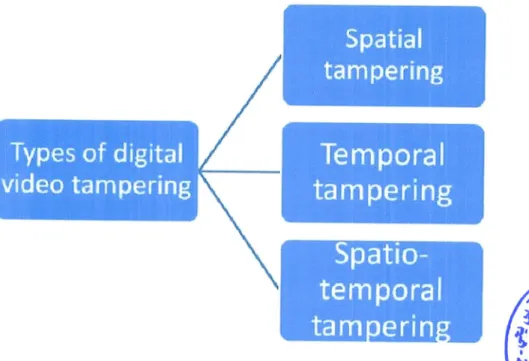
videotanpering
attacksinto
thrae categor-ies:spatiai
tarnpering attackswich
happeucl onframc lcvcl
it's
donewith
nanupila-tion of
a
region,temporal
ta,mpering attacksand
the cornbinatiol of
thesc two,Spatio-temporal tarnpering attacks [1]
In
figure 1.3 present differents types of vifleo tamperingFigure 1.3: T\'pcs of
Digital
vidco tanrpering4.2.1
Spatial
tempering (intra
frame tampering)
Altcrations are performed on content of
thc
frame (x-y
axis),In
spatial tamper.ilgu'ith
the hclp ofdigital
videocditing
tcchniqucs ancl viclcocditing
softwares'ch
asPhotoshop and more,the attackcr can casily affcct rnany uranipulations on thc fi.anc like adding
,
rentoving,
deleting and moclitying auobjcct in
a frame evena
small manipulation of pixelbits
causcs a video tampering. a.sshowl in
6grue 1.4it's
ca1 be clone on three lcvels:Pixel level
pixel is the smallcst componentof
video so workingn'ith
it
urakes thc work more prcciseBlock level block is a
specificd areaon the
fi'amcof
the vidco,
some attack^sin
spatial donrain rnanipulatc fi'amc's block
likc
rcrnoving, aclcling modificationffi
CHAPTtrR
1.
ILLIIGAL
]\,IANIPULATION OF' VIDIJOSscene
level
the V/hole scene ofthc
video sequcnce is rnanipulatecl:
.;
,dt' ; -' -'tafl:) ^ " .': r,r{l:
,
:i"' n*''t
' ,, .n '1qrr1'- , . ,, : f'rcit.:
jil",rt*
ubJrr'1r ,rdd,'dr'lrteFigurc 1.-l: spacial vicleo tampcring
We can dlstingue scrcral attacks
in
spatial domain likcfigue
1.5shots
Figruc
1.5: spacial vidco tampcring attacks4-2.r.L
copy-move
attack
I'
copy-mo'e o'cop1-pa-ste tampcring portionsof thc
framc/irnagc are cloned (copy-pruste)to
cxpose a pcrsouin
thc scene.figur.c 1.6 shor,i's a copy ltlove4.
VIDI'O
TAil,fPI'RINGtechniclue,
or
objectCHAPTI'R
1.
ILLBGAL ]\,IANIPULATION OF VIDI'OSFigurc 1.6:
Objcct
copy movcthc
copy-move attack can dividcclinto
tlvo parts:Object duplication attack
Objcct
duplication attack is Clonecl regions (patchcsor
blocks) can beof
any sirapc ancl locationin a fi'anc
possibly r.r'ith sorncntoclifications. Whcn copiccl region of soure fi'amcs is pastecl ou cliffcrcnt frames
then
it
isknol'n
as vicleosplicing.
lVc can saythat
splicing is a spccial ca^scof copy- l]royc
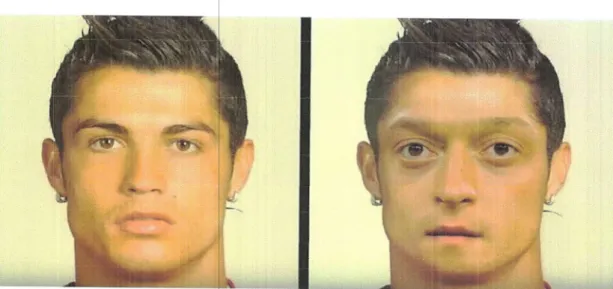
likc
figurc 1.7 shos'sat thc
lcft
original imagc anrl a tampercdone
thc
rightFigurc 1.7: Object cluplication attack
Object
hiding
attack
on afraue
anobjcct
can bekcpt orit
of sightby
anothcr objcct or cvcll rcplacc a pcrsolln'ith
anothcl- pct'sonCHAPTER
1.
ILLIJGAL ]VIANIPULATION OF'VIDBOSFigule
1.8: a)present an original frame b)tlrc same fiame after abjecthidilg
attackc,d)shows the tampered placcs
4'2.1.2
Object
removal
attack
In
this attack an objcct of framcin
vicleowill
bc eliurinatedor
deletedto hid
it
n'ith
malicious intention, the object who can be a cal', aball
and cvcn a person can be removed fi'om one or more frarnesit
clcpenclson
the
numberof
appearance how much framesthc
objects appear onit.
So thc numbcr of tampered frameswith
th,is attack cquals nurnberof
oppoora1rceof that
object
.
as showuin
figure 1.gFigulc
1.9: Objcct reruoval attackCI{APTER
1.
ILLITGAL 1\,IA ULATION OF VID]'OS4.2.L3
Object
n,ith this
attacktherc
arc se.r,cral moclificationsare diffcrcnt of the oliginal scqucnccs cause thcy
\ve car find in frames, Those
u'crc ruanipulatcd
s'ith
rcsam ling n'hich ls resizing ,rotation
and other gcographictrarxformatiou
and splicingexample, the rnoving objects
liich
isa
Photomontagcof
tn'o framesor
images for bc sepalated fi'om stationary objectsFigur 1.10: Frarnc splicing attack
1.11 shoivs an examplc of manipulation
Figure 1.11: Framc Rcsampling manipulation
4.2.2
Temporal
tampering (inter
frame
tampering)
Thc
tcmpcring is donc onthc thircl
clirncnsionof thc viclm(tirnc)
u,hich makcthc
diffcrcncc betx'ccn video folgcrll' and irnagc forgcq',It
is pcrforurccl on secluclcc of fratnes. Focus on tetnporal dcp{ndcnc.1'. ALso callccl 'thircl clinensional attack' *,hich donc on frarnc lcvcl.thistypc
o[ attrrck is shorvuin in
figrrrc 1.12CHAPTER
1.
ILLEGAL IVTANIPULATIONoF
VIDEOS,*
-ii
rsfs
Figule
1.12: terrporel vidco tamperingtJrpes
of temporal tampering
attacks
like figur.e 1.13 showsFigurc
l.l3:
Tlpcs
of temporel vidco tamperingCHAPTER
1.
ILLEGAL 1\,{ANIPULATIONOI'
VIDIIOS4,2.2.I
Frame
addition
Aciditional framesfinn
anothcr viclco orin
thc samc vicleo, whicli has same statistical property, arc intcntioually inscrtecl at soncraldo'r
locatioruin
a giren video.It
iutcnd-sto
camouagethe
actual contcnt ancl prorriclcsincorrect informatiou [51
Figrirc 1.14: adcling Fr.amcs
in
rr vidco scclllcncc4.2.2.2
Flame
removal
Dclctc att'hcn
it
appcars many time, gcncralll'T4
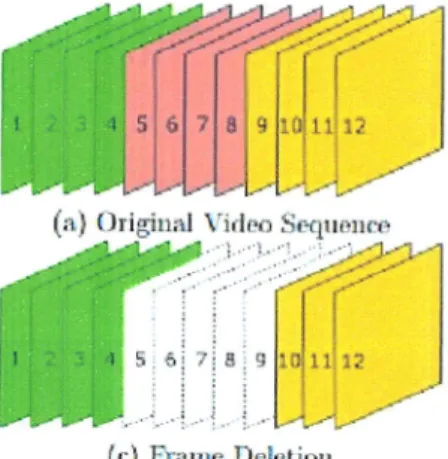
frarnc
fiotn
a spccific placc or diffcrcnt placcsit's
usecl on survcillaucc viclco n'hcn a Defsoll4.
VIDIJO TA]\,IPIJRJNGCHAPTIJR
1.
ILLIIGAL
TTANIPULATION O}' VIDIJOS\\:ant
to
climinatc his prcscnccat
a spccifictimc from
a slrccific placc4.2,2,3
trl'ame
duplication
In
cluplicrrtion of fi'trmc pcoplc hiclc tire unri,antccl fi'trrneby
duplicating auothcr framc,it's
a tcmporal copy pastc q4richis
co1ry anci p;rstc a frameIn
ligurc
1.15thc first flatnc
has chrirlicateclin
orclcrto
hiclcthc
passius of n,hitcvatl
Figrue 1.15: Fraurc clnplictrtion
4'2'2'4
Flame
shuffiing
Changirtgthc
or-rlcrof
viclco fiamcs u,hich cirn r)l'o-cltrcc vidco's contcnt cliff'crcnt tromthc
or.iginal.This
trtttrck can be tlsecl s,hctt a. su.spcct \l,antsto prow that
hc r,rrrrsnot prcsclt
at a gil'ctr moment irt thc crimc scelle but
lathcr in
anothcrtimc.
Likc inligrirc
1.16the ordcr
of
fi'amc has changing.in tirc oliginal
vicleothc
lccl car has pasisccl firstllrt
in But in thc
tampelccl vidcotirc
u,hitc car has passcclfirst
Figurc
1.16: Franrc shnffling4.2.3
Spacio
teurporel tampering
It
is a cotnbiuation of tetnPot'al atrcl sprrtitrl ta,mpcring. Fl'ame sccllrcllccs a,ncl yisurrlcotrtcnts trrc ulorlificcl
irt
tirc samc virlco [5],this attack is clemeltratcdin
figr1.c1.174.
VIDUOTAil{PI4RJNG
CHAPTER
1.
ITLEGAL IVIANIPULATION OF VIDEOS ,*: I :a ,.rf?i'
'w'
::*'--,,'hjilj*
*-iltia
oQect*Figur.e 1.17: spacio temporel video tampering
in
figure 1.18 the video has tarnpeledboth in
temporal ancl spacial clomain ,Intemporal tampering the
fust
fiame has duplicated tr.vo times and in spatial clomail the women has elirniuatedfiour
thefourth
frameilililMt
ililililil
Figure 1.18: figrue shoq'a spacio temporel attack5
Conclusion
Duc
to
aclvantagesof
vidco content aucl Developmentsin
vlsual video teclurologiessuch as comprcssion, transmission, storagc,
retlieval.
Vicleos are extcnsivelv usedand sharcd thcrcfore
A
seriotts problcmis boru that the integrity of digitai
'iclco contcnt s easily violated becauscdigital
vidco can be ceusily moclifiecl usillgcclitilg
tools. Systcrn^s and mcthods
fol
verifyiug thcinteglity
of video contcnt, by Jetecting any changcsin
the conteut, arc thus becomiug rccluirecl anclincreasingiyimportalt
16
5.
CHAPTER
2.
VIDI'O
TA]\'IPERING DETECTION TECHNICSVideo
tampering
detection
methods
Active
tampering
detection
methods
Passive
tampering
detection
methods{blind)
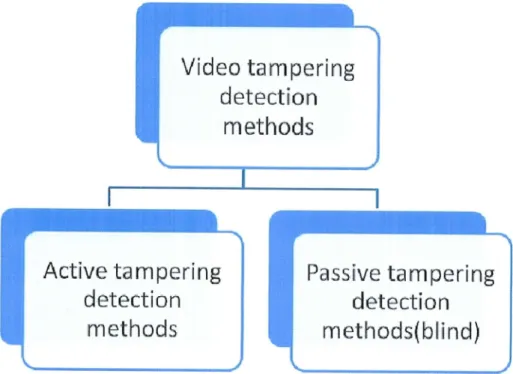
Figurc 2.1:
Tlpes
ofDigital
vidco taurpcring detection methodsActire
methods consist to inserts infolmatiou into the rnedia prior to distribution, n'hich can be later extractedto
establish ownership.Horever, in
passive mcthodsthe
media (vidco, audio, imagc) contains enough uriclueinformation that
can bc uscd for dctccting copies [6].h, this
rcgard, considerablceffolt
ha^s been deyotecl to effcctil'e rcprcsentation of video signatules andsimilarity
rnatching.3
Active
tampering detection
technics
In the case of an active video
it
is easy to clctcct tampering lry using cligital sigrratureand
digital uatennark, but if thele
is no information about the sour.ce camera anclvideo docs not contain digital signature
ol
digital watcrmark thenit
is r'erychallcng-ing
to
dctect vidco tampering. GcncrallyInternct
streaming I'ideos do 1otcoltain
information rcgarding the source carnera,
digital
signatule ancl cligitalwateplark.
figure 2.2 presentActit'c
detection methoclsCHAPTER
2.
VIDBO TA]\,IPBRING DETECTION TECHNICSFigurc 2.2: Active detection methods
3.1
Watermark
Digital watermark is a plocess of
inscrtilg
secrrt information into digital multiuredia,digital
video watet:natking has rnany aspectsthat
must be consideredduling
theclesign of any
digital
video watermark sch.emes such as imperccptibility, robustness,security, courplexity, compresscd domain , constant
bit-rate ,interopclability
[7] .1.
Imperceptibility (Invisibility):
Thedigital waternark
enrbeddedinto
the video data should bc invisibleto
the human obscrver.2.
Security:
Unauthorized removal of thc watermar* urust be irnpossible onceit
has beeu embeddcd, evcnif
tire basic scheme uscd for watennarking is known, as long as the exact parameters are unknolvn.3. Robustness:
It
should be impossibleto
manipulate the rvatermalk byintcn-tional or
unintentional opcrations onthe
uncornpressedor
comprasscd videowithout, at
the same tinte, dcgracling thc pcrceived quality of the video to thepoint of
significantly rcducingits
comrnercialvaluc.
Such operations arc, forexample, addition of signals , filtering, clopping, encoding, or analog rccording and playback.
4.
Complexity:
\Matcrmarkingand
watermarkretricval
shouldin
principlc havelon' complexity. Different
application^sdo,
howcver', pose clifferentrc-quilements
on cornplexity.
If
watcnnarkingis
uscdfor audit
trail,
eachrc-cciver has
to
letrieve the rvatermark, ancl watcrmark rctrieval should bc casy.If
rvatermarking is rned for cmbeddingindividual
receiveridentity
labels,wa-termalking is
pelfor-mcdon a
largerumbcr
of
distributccl video sequerccs,whilc
watermarkrctricval
occursonly
in
cases s'hcrc possiblecopylight
vio-lations haveto bc
invcstigatecl.!\ihile
the
retrieval opelation may be morc complex in ordcr to account for all possible kinds of attacks on the n aterrlrark, watennalking shoulrl bc of lor'i'conplcxity
in
such cases.CHAPTBR
2.
VIDBO TAI\,IPERING DETECTION TBCHNICS5.
Compressed domain processing:
It
can be assumedthat
thedistributor
or
broadcaster ofdigital
videon'ill
usually storethc
vicleoin
comprcsseclfor-mat,
for examplc on a video-on-demand serrrer, or a l4rorld Wide Web sewer.Refcrring to the abot'c cornplexitl'r'equirernent,
it
shoulcl tre possibleto
incor--porate
thc watenlar* into
the comprcssed vidco (the Ult strearn), becauseit
is
too
courple>r andnot
feasibleto
decocle and re-encodethc
vidcofor
water'-marking
the quality of
dccoded and le.encodcd video canin
generalnot
bcguara.uteed.
6. Constant
bit-rate:
\Aratemrarkingin the bit
stream domain shoulclnot
in-crease
thc bit-rate, at
leastfor
constantbit-rate
applications where tralsmis-sion charurel band,width hasto
be obcycd.7.
Interoperability:
Evcn though many applicationscall for
watermarking ofcompres.sed video,
it
u'ould bc a dcsirablc propertyif
urcourpressed video couldcompatibly be u'atcrmalked
x'ithout
havingto
cncodeit
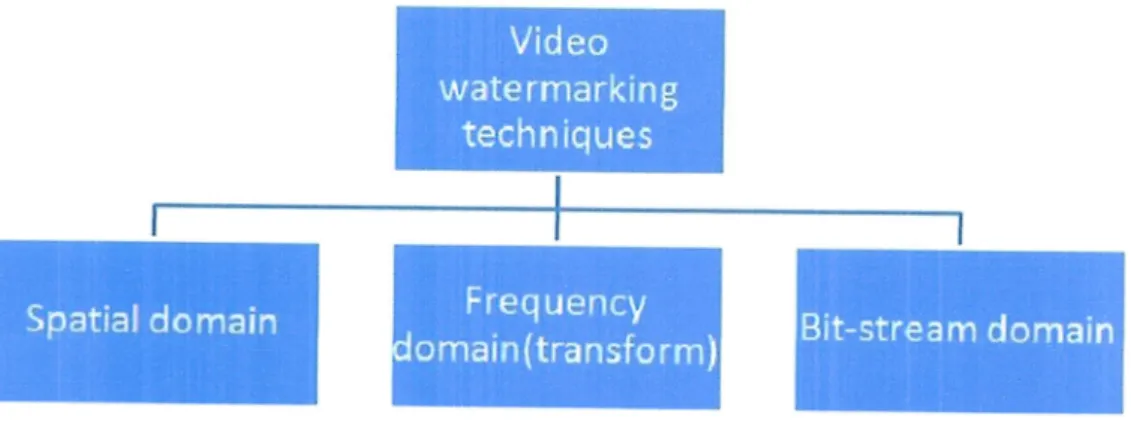
fir'st.video rvatermatking techniques are divided
into
tluee urain gr.oups spatial dc>main,frcquency domain aud bit-strearn domain as figurc 2.J shows
Figure 2.3: Vidco watermarking techniclucs
3.1.1
Spatial domain watermarking
techniques
This
techniqttes embedthc
n'atermark l>ymodifying thc pixcl
positiol^s orpixcl
vahresof thc
vidm
.
Thc
main adrantagcsof
rusingthis
tcchniqlrc arcthe small time complcxitics ancl simplicit-v of hnpleurentation. Hou,cvcr, thcsc
tcchniques have some disadvantagcs
in
provicling robustnc.ss and mcctiugir1-pclccptibility
rcquirements [8]I I
CHAPTER
2.
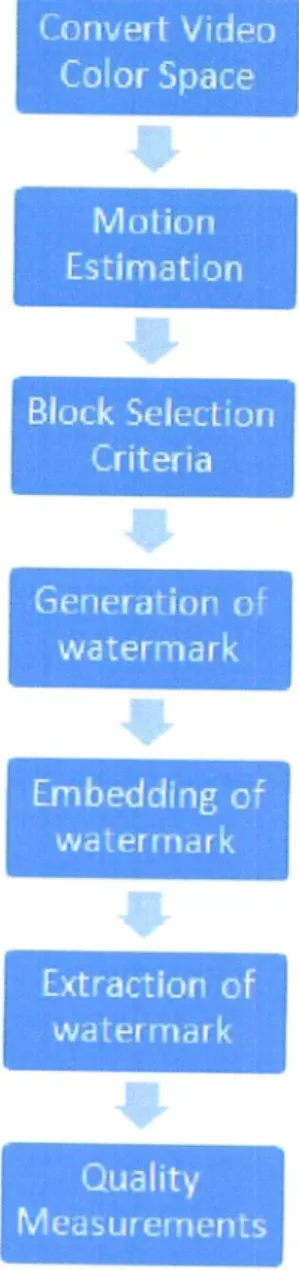
VIDBO TAI\.IPERING DIJTECTION TECHNICSThe watet'marking technique i.s implernented using the steps sironm
in
figure2.4
Figure 2.4: n'atermarking technirlues stcps
in
spatial clomainThe authors
in
[9] have irnplcmenteclthc
stepsthat
are usedto
embccl thc rvaterurark rvith theinput
video.as shou,s belon, :r
Extract
loaded the color viclco into fiames.r
Block matching motion appliccl in cstimation tcchniques on thcsucccccl-ing fiamcs.
r
Selectouly
those fi'amcsthat
havc enoughnumbcl
of
motionrvhich is rvcll-matchccl rvith thc naterrnark sizc.
ACTIVIJ TAI\,IPERJNG DITTI'CTION TECHNICS
I
a
a
blocks
CHAPTER
2.
VIDEO TAI}IPIIRING DETECTION TECHNICSI
FI'om the selected fi'ames to seiect the best blocks to use threshold durius the matching process use a givcn threshold.o
Perform the wavelettransfornation
on the selected finest blocks.r
Random Gaussiandistribution is
enrbedded asa
proposed watermarkinto
the selected blocks(Apply
onlyto
theLH
andHL
wavelet bands).r
Extract
the watermark rvhich is eurbedded.o
Apply
soure attacks on th.e watermalked framesinto
the video.r
The
conducted results ar-e evaluated using PSNRfor
embedding andsimilarity
for theextlacting
process before and after attacks.The most
important
methods based on spatial domain watcrurarking are LSBand SSSC.
3.1.1.1
LSB(
Least
Significant
Bit)
The ea^siest watermalking methodin
spatial domain, thls
technique consistto
replaceevely
least significantbit(the
mostright bits
)
from the
frameby bits from
water:nark (urorcde-tails
are shownin
the cxample belorv )example
:Supposedly wc have the
fust
pixel of fi-amc is 2b and second:24
25in
biuary :11001000 24in
binary :11000000 11001000 the watermarkBy
applyingI-LSB
1100100 became 11001001 11000000 becaure 11000001By
applying 2-LSB 1100100 became 1 1001011 11000000 becarue 110000003.1.1.2
SSSC(Spread
Spectrum Signal
Correlation
)
This
methoclls
basedon
addinga
pseudo-random noisepattem
to
the
hrminance yalucfr'ames
in
the
spatial doruain, andthc
conelation betrveen the noise pattern3.
ACTIVI'
TAI,IPERING DETIJCTION TECHNICSCHAPTER
2.
VIDEO TAIvIPERING DETECTION TECHNICS aud possibly watennarked video for each frame is computed.If
the corrclationexceeds a certain threshold tiren, the waterurark is detected.
3.1.2
frequency
domain watermarking
techniques(Tlansform)
It's
also known as foequency dourain rvatermarking in this techniques The hostsignal
is trnnsfor:led into a
different domain accordingto
a pre-determined transfonn (discrete cosine transformDCT,
disclete qiavelet transformDWT,
discrete Fouliertransforn DFT)
then the waterutalk is eurbeddedin
selectiye coefficieuts.The majority of
video watermarking techniques have been usedin
thc
fi.e-quency transform domain
in
orderto
overcorne tire main disadvantages of tire spatialdomaiu.
Ftuther, analyslsof thc
bandsin the
fi'equency domain is aprerequisite
to
enhance watelmark robustness and imperceptibility. [10]3.1.2.1"
Discrete
cosinetransforms
DCT
thls teclurique is used towa-termark compresscd video streanr,s ,Discrete cosine transformation tr.alsforms
a signal fr'om the spatial
into thc
fi'etluency domain by using the cosinefunc-tion,
it
permits
to
devicea frame into diffelcnt
ftequency bandsthen
thewatermalk is
eurbcddedinto the
middle Frequency bandsof a frarne.
The middle fi'cquency bands are chosen suchthat
they
have urinimizcdto
avoidthe most visual
importaut
parts of the frame (low frecluencies) [11]In
[l2]authors proposed effcctivc fragile viclm $atennarkiug techniqueto
em-bed
aud extract
rvatermarkin
DCT
domainu'ith
high
capacity andtrans-palenc)'. Tu'o
n'atennarksale
cmbeddedinto
cachfi'amc. The first
water.-mark is
bits
of
thedigital
signatureof
hash valueof
the fi-arnein
frequencydomain and second watenuark is bits of miclo-block nuurbers and fi.aurc
num-bers. The water:nalks are embedded
iuto
video fi'amcs oue lry onein
highestnon-zcl'o cocfficient of quautizcd
DCT
cocfficicnt. Thcfirst
watemrark is u^scclto
detect tamperiug and sccond wateunark is usedto
localize the areabeilg
tampered. This technique causcs significantly smaller video distortion as bits are embeddctl
into
the highest frccprcncy coefficients.The
cmbedcleclwater--mark is extracted and verified using public kcy. The block numbcrs ancl framc mnnberc are inserted
in
orderto
detcct intra-fi'arue ancl inter-fi.arnetamper'-ing such as
addition or
removalof
contcntrvithin
frames, fi'ame reordering, droppingor
addition of extra frames.If
the video is being tamperccl wclray
extract one watermark correctly
but
othcr may gct clestr.o5,cd.Note:
A
watermarking schemethat
can dctect malicious tampering and canbc rrsccl in any moclcm 't'ideo codec, such a^s H.264lAVC n'as introclucecl
in
[11]
in this rncthods the watermark signals rcprasent the macro block's and frame's indiccs, aud
ale
ernbeddeclinto thc
nonzcro cluantized cllscrete cosine trans-forru (QDCT)valuc of biocks, thc nonzero are choscn suchthat
they ale ablc to detect spatial,tcmpolal
and spatiotemporal tamperiug.CHAPTER
2.
VIDEO TAI,{PERING DT'TECTION TIJCHNICS3.L.2.2
Discrete
wavelet
transforms
DWT
It
i,s atransforn
ba.scd onflequency dornain, Due
to
its
excellent spatio-fi'equency localization pr.opeFties;
the
DWf
is
very suitableto identify
aleasin
thevidm
frame n'her-e arvatermark cau be embedded imperceptibly
3.1.2.3
Discrete
Fourier
transforms
DFT
A
Discrete Foruier Tl.ans.form
(DFT)
is perforned on the original video data. Tire watcmrark is embecl-dedin
optimal selected frequency ba,nds of theDFT.
TheDFT
approach [14]has one advantage
in
comparisonwith
the spatial dornain methods.Filst,
it
istranslation invariant and r-otation lesistant, which tlan^slates to strong
robust-ness
to
geometric attaclcs.On
the other hand, accordingto Raja
ct
al.
[15],fast
Four-ier transform(FFT)
rnethods introduce round-off errors, which canlead
to
loss ofquality
and errorsin
watennarkcxtraction.
Howevcr. Checldadet al.
[16] statesthat this
disadrantageis
much uroreimportant for
hidden communication than for water-marking.An invelse Discrete Foruicr
tatrsfonn
is per{ormedinto thc latennarked
fre. quency domainto
reconstruct the watermarkedin
the original video .3.1.3
Bit-stream
domain
watermarking
techniques
hr this
techniqueTire s'ateruark is
insertediuto the
compressecl videobit-strcan.
the
major
disadvantageof
this
tcchniquc Lsthat
strcn$h
of
thcembedded watermar-k
is
cou^strictcdby
compressccl bit-rate.Nandakishore ctal.
[17] proposes ahald
video authcntication and sender vcrification schemefor
video sequences complessed usingH.264lAvC
il,Iainprofile by
usingdig-ital
signaturcs and crSptographic ha.sh. Featuresfiom
the transform clomainarc usecl as thc authentication data for a macroblock. The algorithm can also
dctcct the
causeof
authcnticationfailuc
ald
point out the
locationof
thc tarnpcred framesin
case of frame tampering.Thc
method proposedby
PradcepK.et al.
[1S] clctects spatial cropping ancltemporal
jittering
in
a
vidco, yet
is
robust
against fi.ame dr-oppiugin
thc
strcaning
vidco scenario. Thc authcntication signature is compact a1fl ilcle-pcndcnt of thc size of the video.3.2
Digital
signature
Thc cligital
signatue
iuventccl by Diffie and Hellmanin
1976. The cligital sig-nattu'e shall depend on secret data u'hich is known by signer [19]. Soit
cannotbe forged and the judgc can confirm
that
the contcntof
vicleo clata matchcsthc
clata containedin thc
cligitalsigrature.
Thc scndcr' 6rst r.emoves thc kcyfrom the oligiual vidco
andthcn thc data
encryptcclby a private
ke}, 1[o6give signaturc
[20]. Tire
reccivcr can ruse scncler'spublic
keyto
clccrypt the signaturcto
atrthenticatethe
leccivedvideo.
The signatureis
storccl sol]lc-rvhcre else thauthc
mcdia [19].And
it
storcd scparatclyin
user clefined ficlcl.3.
ACTIVIJ TAIVIPIIRJNG DBTIICTION TBCHNICSCHAPTER
2.
VIDEO TAMPERING DETECTION TECHNICSBecause
the
video is storedin
a specificformat,
andthe
cligital signature isbeing embedded
iu
the video [20].figure 2.5 shows how to genelatc a
digital
signatu.eFigure 2.5: general process of generating
digital
signature To verify aDigital
signatur-e those tluee steps :(a) Step
1:
Extract
theencrlpted
hash value and decrypt the raluewith
the corresponding public key.
(b)
Step
2:
Calculate a hash value of the contentin
the samc rnannerin
fu'st Step of generation pr.ocess.(c)
Step
3:
Compare thc vaiue dccrypted in Step 1(step 1 from yerificatiop plocess)n'ith
the
one encryptedin
Step2.
If
the
valuesmatch,
thc contentintegity
has been maintained.If
they do not,it
has been brokenDigital
signature
method
In last t$'o decades digital signature basedtcch-nics
harc
beens'idcly
usedfol
the
purposeof
video authentication several sachem.s have bcen proposcd,iu
[21] Tzengand
Wen HsiangTsai
cxploits both color and geometric visual features and also macle an atternptto
recllce the signature sizc. The mcthod fordigital
signatruc generation is as follows :o
A significant edge detcction method was applicd to an input image/video. Thc significant edge dctection classifies cach non orerlapping blockilto
hvo t5ipes, smooth blocks and cdgc blocks.If
thelc is at
lea.st ouccorl-nected component
with
sizclargcr than 4
in
thc
cor.lespondingbilary
iurage, then block is clansificd as edgc block ol elseit
was called as smoothblock.
o
Smooth blocks wcrc replcscntedby their
ulean values. For cclgc block rcpresentatiou binary edge pattcrns afc used as features. Use ofbilary
cdgepattcrn
also prevents thc sizeof
Thedigital
signaturc fr.on explo-sion.ACTIVE TAI\,TPEzuNG DIITECTION
TBCHNICS
25Calculate a
hash
value
from
data
values
video content
by using
a
one-way
hash
Encrypt
the
hash
value
with
the
private
in
the
function.
CHAPTBR.
2.
VIDEO TA]VIPIJRJNG DETECTION TECHNICSo At
leastthe digital signatue
rvas con^stmctedby
cascadingall the
en-coded features extracted from the blocks folloned by an encryption keyfor security purposes which
further
encrypts the cascadedbit
straam.State
of
Art
In
[17] authors have proposeda
video authentication andvelification
schemefor
video Seclucnces compressed using H.2641AVC il,{ainProfile by using
digital
signaturasald
cryptographic hash. Featuresftom
the transfolmdouain
are used as the autheutication datafor
a uracroblock. The algorithm cau also detect the cause of authentication faihrre and point out the location of tlre tampered frauresin
case of fi'ame tamperingDigitai
signatule basedon a
hierarchicalstnr.ctue
wa.s proposedin
[18]us-ing thrce
hiera.r'chical levelsof
a video(kcy frame level, shot level, and vicleolevel)
in
a scalable rnaruter'.Tire
proposed schcnesuitably
scales don,n the authentication process to shot lerrclto
aciricr.e robustncss against framechnp
ping in video strearning scenario.Tlic
algorithm can also detcct specied regiontampertng and has beeu successfully tested over face tampering
in
a vidco.4
Passive
tampering
detection
technics
Passirrc tarnpering detection technicpres arn urethods uscd for dctecting thc
ari-thenticity
of a videowithout
depending on pre-ernbcddccl infonnatiou, \Vor-kson the
ba^sic assrunptionthat
vidco
contair:^snaturally occurliug
propeltics.
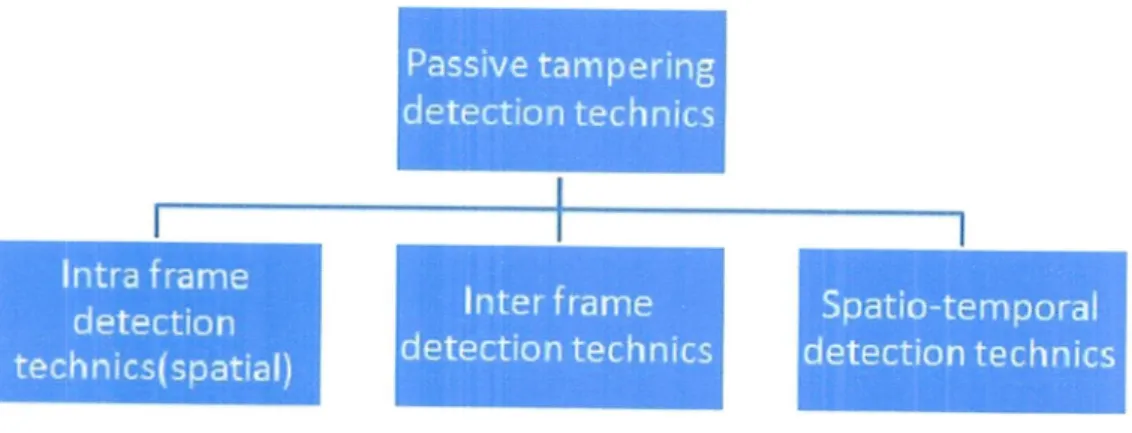
Pa-ssive video tampering detcction methods are cla^ssificdiuto tirc follou.
ing tlrree categories bascd on the t1'pe of tautpcring thcy addrcss
:
into spatial tarupcring dctection techniclucs, temporzl taurpering dctection technicllcs andspatio-tempolal detection techniques a^s figurc 2.C shows
Figure 2.6: Passire tampcring detection tcchuics
CHAPTER
2.
VIDEO TAh,IPERJNG DETECTION TECHNICS4.L
intra
frame
tampering
detection
technics
Iu
passivevidm
intla
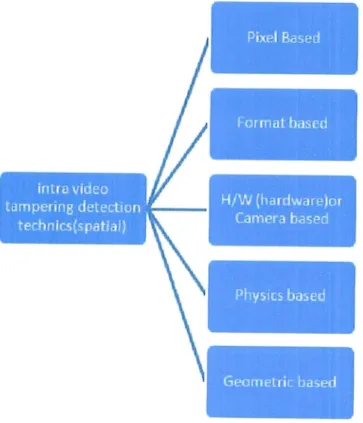
tlame taurpering detection techuics can be roughlycat-egorized
into
fir'e category byfarid
[22] figure 2.7 showsintra
fi'ame tampering detection tecluricsFigure 2.7:
Intra
fi'arnc tampering detection technics(a)
Pixel
Based
:
This
tcchnique mainsto
detcctstatistical
anomaliesint[oduced
at the pixcl
levcl,it
is roughly categorizedinto
tlu.cc typcs copy move . splicing .Sampling.(b)
Format
Based
:
Format
ba.scd teclurique include Double NIPEG comprnssion, F\-ame blocking.r
Double
MPEG
compression
:
doublc compression con^sists ondccoding then
alter
the video andfinally
encodilrg the vicleo moredetails on the doublc courprcssion
in
the follos'iug sections.o
Frame
blocking
:
Thc
blockingaltifacts
uscspixel
vahrccliffer-cnce
within
and across block boundades.Thc pixel
valuediffer-encc
$'ithin
the blochs is smallcr than the acrossthc
blocks. Whenfi'ame is tampeled a ncn' sct of blocking artifacts may be intr.o{ucccl
that
do not ncccssary align rvith previou,s block bounclaries. Theseblockilg
artifacts providc cluc for tampering cletection [2J]CHAPTITR
2.
VIDEO TA]\{PIIRING DETECTION TECHMCS(c)
H/w(hardware) or
camera
based
:
H/!v
or Camera based tam-pering detection use.s :r
Sensor Noiser
Colorfilter
arrayo
Camera respon$e functionr
Clu'omatic aberrationo White
balancingo
garmna correctiou features of Canera uscdin
shooting video.Sensor
noise
:
this
technique focus ou theprincipal that digital
video mol'es fi'om the carnera sensorto
the computer rnenory.camera
response
function
cRF
: Because rnostdigital
camera scnsors are very nearly lirrear, there should be a linear- relationshipbet$r€en thc
amoult
oflight
measured by each sensor elcment, andthc
corrcspouding fural pixel value. Nlost caurcras, ho$,ever, applya point-wise uon-linearity
in
orderto
enhancethc
final image. Dif-ferencesin thc
canerarcponsc
frrnction across the fi'aurc ar-e thenused
to
detect taurpering [23].(d)
Physics Based
:
Wren
a splicing of two pelrsonsfol
exalrple is doneit
is oftendifficult
to cxactly match the lighting effects under which eachperson n'as
origiually photographed.
Differencesin
liglrting
acloss an image can then be uscd a.s eviclence oftampering;
plrysic basecl nethoclsare divided
into
tn'o techuiquesLight
direction andLight
environmelt.i.
Light
direction
:
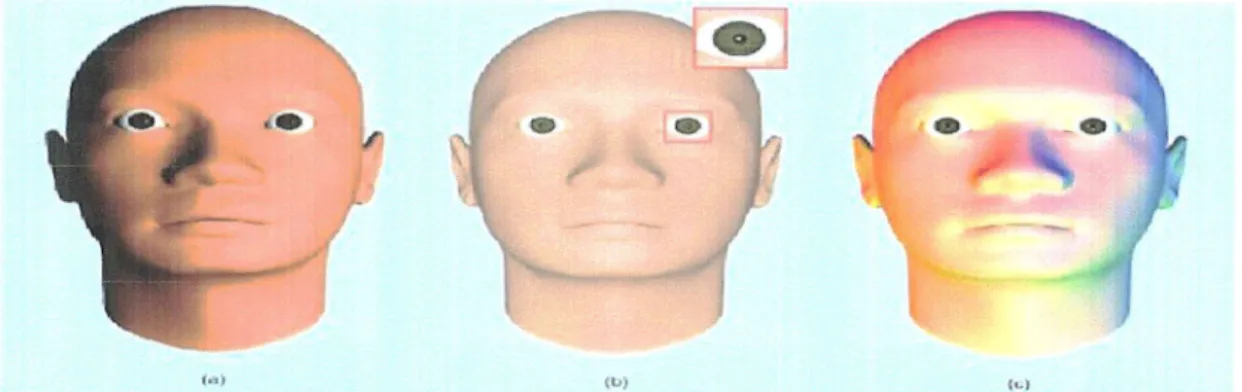
Theright
side of the facein
Figtue 2.g showsas
in
[24](a)
ts moreilluuinated than thc left,
we caninfer that
alight
sourceis
positioncdto the
right.
This
observation can befonnalizcd by rnaking simplifying a.ssutrptions: the amorurt of
light
striking a
surfaceis
proportional
to
thc
surfaccnonnal
ancl thedircction
to
the
light
[21] cstimationof light
soru'cc clircctioni1
imagc islimited
to
2D becauseit
is u^suallyclifficllt to
cletermile3D sru'face normal fi'our a single imagc but in viclcos
q'ith
klowlcclge of 3D surface norntal, the directionto
the light source can thereforebc
cstimatcd.Ravict
al.
[25] demonstratedthc
prcscnccof
ENFsignals
in
I'ideo recordings and lightings using optical sepsors.It
is uscd as a naturaltitnestanp
for vidco rccolclings under fluoresccntlighting
incloors. Stati^stical couelations arehigh
with
rcspect toENF
signalsfinrn
the main supply when vidco is urrtampered anddiscoutinuitics
arc
forurdwhcn
it
is
tampered, s,hich inclicates atarnpering.
11.