HAL Id: hal-01682776
https://hal.archives-ouvertes.fr/hal-01682776
Submitted on 14 Apr 2018HAL is a multi-disciplinary open access
archive for the deposit and dissemination of sci-entific research documents, whether they are pub-lished or not. The documents may come from teaching and research institutions in France or abroad, or from public or private research centers.
L’archive ouverte pluridisciplinaire HAL, est destinée au dépôt et à la diffusion de documents scientifiques de niveau recherche, publiés ou non, émanant des établissements d’enseignement et de recherche français ou étrangers, des laboratoires publics ou privés.
Sulfoxidation inside a C 3 -Vanadium(V) Bowl-Shaped
Catalyst
Dawei Zhang, Jean-Pierre Dutasta, Véronique Dufaud, Laure Guy, Alexandre
Martinez
To cite this version:
Dawei Zhang, Jean-Pierre Dutasta, Véronique Dufaud, Laure Guy, Alexandre Martinez. Sulfoxidation inside a C 3 -Vanadium(V) Bowl-Shaped Catalyst. ACS Catalysis, American Chemical Society, 2017, 7 (10), pp.7340 - 7345. �10.1021/acscatal.7b01886�. �hal-01682776�
Sulfoxidation inside a
C
3
‑Vanadium(V) Bowl-Shaped Catalyst
Dawei Zhang,
†Jean-Pierre Dutasta,
†Veronique Dufaud,
‡Laure Guy,
†and Alexandre Martinez
*
,§†Laboratoire de Chimie, École Normale Supérieure de Lyon, CNRS, UCBL, 46 allée d’Italie, F-69364 Lyon, France
‡Laboratoire de Chimie, Catalyse, Polymères, Procédés CNRS, UMR 5265, Université Claude Bernard Lyon 1, CPE Lyon, 43 Bd du
11 novembre 1918, 69616 Villeurbanne cedex, France
§Aix Marseille Univ, CNRS, Centrale Marseille, iSm2, Marseille, France
*
S Supporting InformationABSTRACT: The confined enantiopure oxido-vanadium complex SSS-RRR-1 was synthesized and tested as a catalyst for the oxidation of sulfides into sulfoxides. This catalyst is very efficient with a reaction rate more than 300 times higher than that of the model compound SSS-RRR-3, and a turnover number (TON) close to 105was reached in combination with
a good selectivity (more than 90%) in the sulfoxide product. Moreover, enantiomerically enriched sulfoxide can be obtained, breaking through the major limitation of the previous chiral vanatrane catalysts that show no detectable enantiomeric excess (ee). Further investigations revealed that
the complex SSS-RRR-1 adopts a bowl-shaped structure with an open hydrophobic pocket. The microenvironment of the chiral pocket above the metal center accounts for the strong improvement in catalytic activity and enantioselectivity.
KEYWORDS: sulfoxidation, enantioselectivity, supramolecular catalysis, oxido-vanadium complex, high TON, chiral pocket
■
INTRODUCTIONConfined catalysts in supramolecular architectures are very attractive, since they offer precise spatial control of chemical transformations by surrounding the surfaces of reactants,1 bringing substrates into close proximity and imposing a specific orientation of the substrate in the vicinity of catalytic sites;2 hence, high activities and selectivities can be reached with such bioinspired catalysts. Nevertheless, supramolecular catalysts frequently display low reactivity because of the high rigidity of their skeleton, which blocks the access of substrates to the catalytic sites, or because of product inhibition, which prevents any catalytic cycles.3Thus, the right balance betweenflexibility and rigidity of the structure should be considered when designing a confined catalyst, which should favor the binding of the substrates and the release of the products.4
Among the reactions that have been catalyzed by confined catalysts, the selective oxidation of sulfides into sulfoxides appears as particularly appealing.5 Indeed, sulfoxidation is a challenging and important process, since sulfoxides are key intermediates in the synthesis of bioactive compounds, including several marketed pharmaceuticals and agrochemicals,6 or can serve as chiral auxiliaries in organic synthesis or as chiral ligands in enantioselective catalysis.7 In nature, vanadium haloperoxidases catalyze this reaction with high efficiency and selectivity: for instance, vanadium bromoperoxidase from the brown seaweed Ascophyllum nodosum converts thioanisole to the R enantiomer of the sulfoxide with 55% yield and 85% enantiomeric excess (ee).8 The confined active site of such enzymes displays a vanadium atom in a trigonal-bipyramidal
geometry with an axial VO bond, three equatorial O atoms, and an axial N donor.9 In order to mimic the high activity of these enzymes, bioinspired oxido-vandium complexes have been reported.5gNevertheless, moderate reactivities associated with a limited substrate scope are often observed and an excess amount of oxidant is necessary to achieve high yields in sulfoxides.5a,10
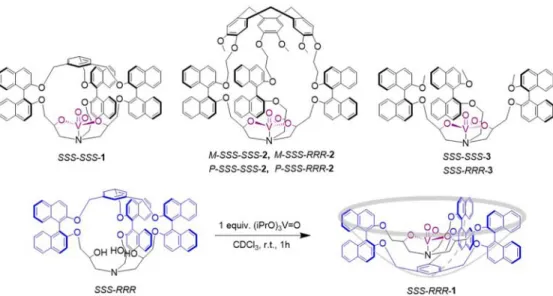
To date, most of the synthetic model complexes focus only on the first coordination sphere around the metal and the influence of the second coordination sphere on catalysis has often been neglected. However, vanadium catalysts confined in a hydrophobic environment have been revealed to be very efficient for this reaction, leading to high yields and selectivities in sulfoxide: the higher hydrophilicity of sulfoxides, in comparison to sulfides, increases the concentration of the latter in the vicinity of the vanadium site and helps to expel the former once the reaction has occurred.11 In this context, our group has recently reported a series of oxido-vanadium(V) cage complexes for oxidation of sulfides into sulfoxides (complexes SSS-SSS-1 and the four diastereomers of 2;Figure 1).12These systems combine both an active site similar to that of vanadate-dependent haloperoxidases and a well-defined hydrophobic pocket just above the vanadium center. The hemicryptophane catalysts 2, which associate a cyclotriveratrylene (CTV), binaphthols, and an oxido-vanadium(V) moiety, were found
Received: June 9, 2017
Revised: August 26, 2017
to be the most efficient supramolecular catalysts, isolating the sulfide and the transition state from the bulk of the solvent and expelling the hydrophilic sulfoxide from the hydrophobic molecular cavity. They exhibit a catalytic rate 3- and 33-fold higher than those of the SSS-SSS-1 and SSS-RRR-3 catalysts, respectively. Moreover, at low loading, a remarkable turnover number (TON) of close to 104was reached with complexes 2. Despite this high reactivity, no enantioselectivity was observed and the sulfoxide was obtained as a racemic mixture.
Here, we report on the catalytic activity of the vanadium complex SSS-RRR-1. The smaller cavity in 1, in comparison to previously reported hemicryptophane vanadium complexes, was initially designed to improve the confinement effect. Unexpectedly, remarkable differences in catalytic behavior are observed between diastereomers SSS-SSS-1 and SSS-RRR-1. Reaction rates 24-, 9-, and 301-fold faster with the catalyst SSS-RRR-1 in comparison to those with SSS-SSS-1, -2, and -3, were respectively obtained in the oxidation of thioanisole. Furthermore, a TON of 8.6 × 10⁴ was reached. A modest enantioselectivity, but unprecedented for chiral vanatrane catalysts, was also achieved with this complex.
■
RESULTS AND DISCUSSIONCatalytic Properties. The vanadium complex SSS-RRR-1 was obtained using the procedure described for SSS-SSS-1 (Figures S1−S4 in the Supporting Information).12 This new catalyst was first tested in the oxidation of thioanisole into sulfoxide, using cumene hydroperoxide (CHP) or tert-butyl hydroperoxide (TBHP) as the terminal oxidant, with 1.5 mol % catalyst loading in CH2Cl2at 0°C for 20 min. Unexpectedly,
SSS-RRR-1 was found to be much more efficient than our previous systems. A higher conversion (90%) with a good selectivity for the sulfoxide product (92%) over the sulfone (8%) was observed using either CHP or TBHP as oxidant (entries 3 and 4,Table 1), whereas only 20−30% yields were reached with diastereomer SSS-SSS-1 (entries 1 and 2,Table 1). The previous most effective supramolecular catalyst, hemi-cryptophane M-SSS-RRR-2, also showed much lower yields (36% and 61%, respectively, with CHP and TBHP) and conversions (40% and 62%, respectively, with CHP and TBHP) (entries 5 and 6, Table 1). Moreover, opposite to the previous catalysts that were unable to induce enantiose-lectivity for this reaction, ee values of 10% and 17% were achieved using SSS-RRR-1 with CHP and TBHP as oxidants, respectively. Although good enantioselectivities were reported with Schiff base vanadium complexes,5i,10a,13
other vanadium-containing systems generally gave low or no ee.5a,k,14 In particular, several attempts have been undertaken to obtain enantiomerically enriched sulfoxides with chiral vanatrane catalysts, but enantioselectivity has never been observed,4,12 probably because of the C3 symmetry of the ligand.
15
These remarkable changes in the catalytic behavior, including both activity and enantioselectivity improvements, indicate that the structure and conformation of the SSS-RRR-1 complex should strongly differ from those of our previous systems.
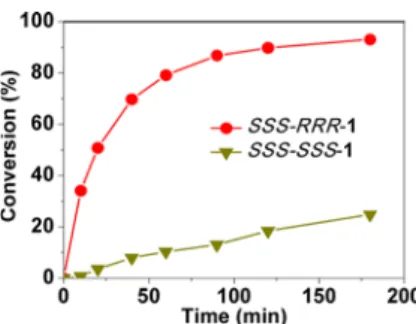
To compare more accurately the catalytic activities of these systems, the catalyst loading was decreased to 0.4 mol % and CHP was used as the oxygen source while the other conditions remained identical. As shown inFigure 2, the reaction rate with SSS-RRR-1 is much faster than that with SSS-SSS-1, achieving
Figure 1.Structures of previous supramolecular and model catalysts and the new catalyst SSS-RRR-1.
Table 1. Oxidation of Thioanisole with CHP or TBHP Catalyzed by Oxido-Vanadium-Derived Complexesa
entry catalyst oxidant yield (%)b conversion (%)b selectivity (%)b ee (%)b
1 SSS-SSS-1c CHP 21 23 92 <3 2 TBHP 34 35 97 <3 3 SSS-RRR-1 CHP 85 92 92 10 4 TBHP 85 92 92 17 5 M-SSS-RRR-2c CHP 36 40 90 <3 6 TBHP 61 62 98 <3
aConditions: 1.5 mol % catalyst, 1.0 equiv of oxidant, CH
2Cl2, 0°C, 20 min.bYield, conversion, selectivity, and ee were determined by HPLC with
90% conversion of thioanisole in 120 min. On the basis of the initial rate, the kinetic constant with SSS-RRR-1 was estimated to be 24-fold higher than that with SSS-SSS-1. In combination with the previous results,12catalyst SSS-RRR-1 displays reaction rates 24-, 9-, and 301-fold faster than those obtained with complexes SSS-SSS-1, -2, and -3, respectively.
The absence of product inhibition and the strong improve-ment in the reaction rate prompted us to investigate the TON efficiency of catalyst SSS-RRR-1. Figure 3 shows that, with a
catalyst loading of 0.001 mol %, a TON of 8.6× 10⁴ can be
reached after 7 days. Although the catalyst loading was extremely low, the high selectivity of the reaction was retained (90%), which suggests that SSS-RRR-1 remains stable over the whole period. SSS-RRR-1 even outperforms our previous most efficient confined complex, hemicryptophane M-SSS-RRR-2, with a TON 10 times higher.12
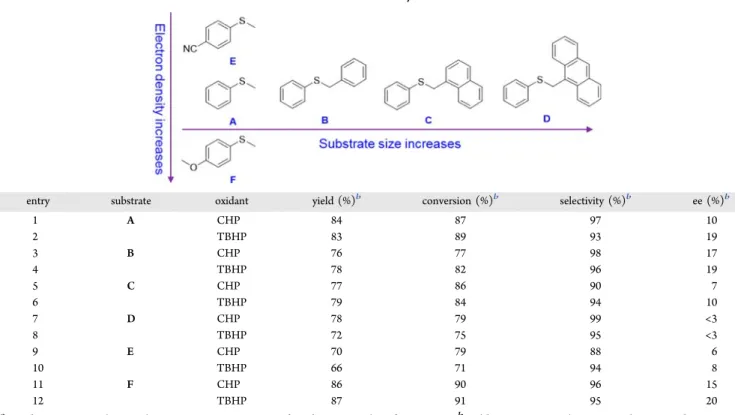
To investigate the substrate scope with this supramolecular catalyst, the oxidation of other sulfides with various substituents was performed (Table 2). These substrates were chosen to discern the effect of electronic and steric properties of the catalyst on reactivity and selectivity: from substrate A to D, the steric hindrance increases, while the electron density of the phenyl ring gradually increases from E to F. As shown inTable 2, the substrates A−F all exhibit conversions between 70 and 90% after 90 min with either CHP or TBHP as oxidant, underlining that the efficiency of the catalyst is not substrate dependent. However, changes in ee value can be observed for different sulfides and oxidants. (i) For the oxidation of almost all substrates (except D, with no detectable ee), the use of TBHP always gives rise to higher ee values in comparison to the use of CHP. (ii) From substrates B to D (entries 4−8), with an increase in the number of aromatic rings and steric hindrance, the ee values decrease; this result indicates thatπ−π interactions between the phenyl ring neighboring the S atom of the substrate and the binaphthol walls might take place for
asymmetric induction, as reported by Licini et al.16Indeed, the presence of other large aromatic moieties within the substrate may disrupt this favored π−π interaction and conformation, lowering the ee values; this is also consistent with the observation that, when different oxidants are used, the cumyl ring of CHP results in lower ee values in comparison to TBHP. (iii) From substrate E (entries 9 and 10) to A (entries 1 and 2) and F (entries 11 and 12), the ee values increase with an increase in the electron density of the phenyl ring: i.e., with a decrease in the reactivity.
Enantioselective Oxidation. A kinetic study was carried out to investigate if the measured ee resulted from the direct enantioselective oxidation of sulfide or from the kinetic resolution of the resulting sulfoxide through its subsequent oxidation into sulfone (Figure 4a).16The kinetic profile for the oxidation of thioanisole in the presence of 0.4 mol % of catalyst SSS-RRR-1 and 1.0 equiv of TBHP showed that the ee value of sulfoxide remained almost constant (18% in favor of the R enantiomer) with the R enantiomer generated 1.5 times faster than the S enantiomer (Figure S5 in the Supporting Information). After 120 min, the yield of sulfoxide reached 84% and 7% of sulfone was also obtained. The constant ee value indicates that the direct asymmetric oxidation of sulfide to sulfoxide is the primary source accounting for the ee value.5b,17 To study whether the subsequent kinetic resolution could further improve the ee, the catalyst loading was increased to 1.5 mol % after 120 min, and an additional 1 equiv of TBHP was added.13,18 As shown in Figure 4a, the initial 18% ee value obtained after 120 min increased to 42% after 480 min accompanied by 87% of sulfone and 13% of unreacted sulfoxide. This phenomenon indicated that the kinetic resolution could be used to further improve the ee. To confirm this, catalytic oxidation of racemic methyl phenyl sulfoxide to sulfone was performed. As shown inFigure 4b, over time the ee value slowly increased with the formation of sulfone, and 20% ee (the R enantiomer being the major species) was achieved associated with a yield of 85% in sulfone and 15% of remaining sulfoxide. Thus, the S sulfoxide enantiomer is oxidized more quickly than the R sulfoxide, whereas the direct asymmetric oxidation of sulfide favored the R enantiomer; this accounts for the improvement in the ee observed.
Mechanism Investigation. Since the catalytic properties of SSS-RRR-1 are significantly different from those of SSS-SSS-1, we decided to investigate the origin of this specific behavior. As the structure and properties of a catalyst are strongly correlated, the structure and conformation of SSS-RRR-1 should strongly differ from those of SSS-SSS-1. In order to get further insight into the structure of SSS-RRR-1, we compared its NMR and mass spectrometry data with those of diastereomer SSS-SSS-1 that was fully characterized previ-ously.12First, the HRMS spectrum of the complex SSS-RRR-1 exhibits the same m/z species as those of SSS-SSS-1. Second, whereas the complex SSS-SSS-1 displays sharp1H NMR signals,
the 1H NMR spectrum of SSS-RRR-1 exhibits slightly broad signals but still correspond to an overall C3molecular symmetry
(Figure S6 in the Supporting Information). Equilibrium between different conformers, induced by a conformational rigidification of the whole structure, could account for such an NMR behavior.19 Third, 51V NMR spectra of the two complexes display similar chemical shifts indicating, in both cases, a trigonal-bipyramidal geometry for the vanadium with the N atom of the tertiary amine trans to the oxo group (Figure S7 in the Supporting Information)20 and ruling out the
Figure 2.Oxidation of thioanisole with catalysts 1 and SSS-RRR-1 (0.4 mol % catalyst, 1.0 equiv of CHP, 0°C, CH2Cl2).
Figure 3. Oxidation of thioanisole catalyzed by catalyst SSS-RRR-1 (0.001 mol % catalyst, 1.0 equiv of CHP, room temperature, CH2Cl2).
formation of polymeric species.1H DOSY NMR experiments
(Figures S8 and S9 in the Supporting Information) further confirmed this point: the diffusion coefficient of SSS-RRR-1 (1.4× 10⁻¹⁰m2s−1) was slightly larger than that of SSS-SSS-1 (0.9 × 10⁻¹⁰ m2 s−1), suggesting similar sizes of the two complexes. These results prompted us to propose a bowl-shaped conformation for the complex SSS-RRR-1, as illustrated in Figure 1. This conformation is in agreement with the rigidification of the C3structure and the similarities observed in
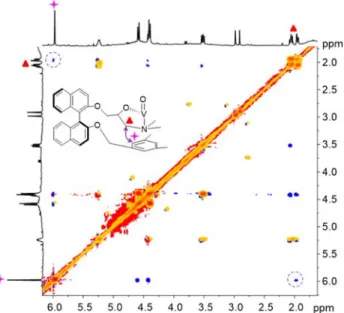
the NMR and mass spectra of the two diastereomers. It results from the vanadium coordination to the inverted trialkanol-amine core of the imploded tris-binaphthyl ligand,21 as previously observed with other cage compounds containing the trialkanolamine unit.22To confirm this hypothesis, ROESY experiments were performed: a clear NOE correlation between the protons of the phenyl group and the methylene protons linked to the nitrogen of the trialkanolamine unit are observed (Figure 5), while this cross peak is not detected in the ROESY spectrum of SSS-SSS-1 (Figure S10 in the Supporting
Information), strongly supporting the proposed structure. The collapsed structure of complex SSS-RRR-1 has been also optimized by an MM3 model using the SCIGRESS software package (Figure S11 in the Supporting Information),23which shows that the vanatrane unit is located centrally in an aromatic pocket.
After the structural information on SSS-RRR-1 was obtained, the high activity of SSS-RRR-1 in sulfoxidation could be rationalized. As shown inFigure 6, in comparison to the cage structure of 1 or the expended conformation of SSS-RRR-3, the bowl-shaped conformation of SSS-RRR-1 is neither too rigid nor too flexible. The right balance between rigidity andflexibility and the existence of an open hydrophobic pocket promote the accommodation of the hydrophobic sulfides near the active site and facilitate to a large extent the release of the hydrophilic sulfoxides,4,12 while the preserved chiral micro-environment of the cavity gives rise to the observed asymmetric induction.24
Table 2. Oxidation of Various Sulfides in the Presence of the Catalyst SSS-RRR-1a
entry substrate oxidant yield (%)b conversion (%)b selectivity (%)b ee (%)b
1 A CHP 84 87 97 10 2 TBHP 83 89 93 19 3 B CHP 76 77 98 17 4 TBHP 78 82 96 19 5 C CHP 77 86 90 7 6 TBHP 79 84 94 10 7 D CHP 78 79 99 <3 8 TBHP 72 75 95 <3 9 E CHP 70 79 88 6 10 TBHP 66 71 94 8 11 F CHP 86 90 96 15 12 TBHP 87 91 95 20
aConditions: 0.4 mol % catalyst SSS-RRR-1, 1.0 equiv of oxidant, CH
2Cl2, 0°C, 90 min.bYield, conversion, selectivity, and ee were determined by
HPLC with benzophenone as the internal standard. Selectivity is defined as the yield/conversion ratio.
Figure 4.(a) Oxidation of thioanisole catalyzed by catalyst SSS-RRR-1 (for thefirst 120 min, 0.4 mol % catalyst, 1.0 equiv of TBHP, 0 °C, CH2Cl2;
after 120 min, the catalyst loading was increased to 1.5 mol % and another 1.0 equiv of TBHP was added). (b) Oxidation of racemic methyl phenyl sulfoxide (1.5 mol % catalyst, 1.0 equiv of TBHP, 0°C, CH2Cl2).
■
CONCLUSIONIn summary, we have described herein the new enantiopure oxido-vanadium supramolecular catalyst SSS-RRR-1 for the selective oxidation of sulfides into sulfoxides. This new catalyst is very efficient in comparison to its diastereomer SSS-SSS-1 and to the previous most efficient hemicryptophane catalysts 2. The oxidation of thioanisole using SSS-RRR-1 exhibited reaction rates 24-, 9-, and 301-fold faster than those with SSS-SSS-1, -2, and -3, respectively. A TON of close to 105was reached with an extremely low catalyst loading (0.001 mol %). Moreover, the new catalyst also showed an asymmetric catalytic effect, in which the enantioselectivity of the reaction was found to mainly originate from the direct asymmetric oxidation (ee of 19% associated with a yield of 83% in the oxidation of thionanisole), although the strategy of kinetic resolution could also be used in this work to improve the ee (up to 42%, with a yield of 13% in anisole sulfoxide). Despite the fact that higher ee values have been reported with other vanadium catalysts, such as Schiff base complexes,5d,i,10a,25 the catalyst presented here showed an unprecedented asymmetric catalytic effect for C3-symmetrical vanadium complexes, breaking through the
major limitation of the previous vanatrane catalysts. HRMS,1H
and51V NMR, DOSY, and ROESY experiments, revealed that, different from the cage conformation of 1 and 2, SSS-RRR-1 adopts a bowl-shaped structure with an open
hydro-phobic chiral pocket. The microenvironment above the metal center leads to a strong improvement in catalytic activity and to some extent in enantioselectivity. Oxidation of other substituted sulfides indicated the role of aromatic interactions. Future work will seek to apply this highly efficient vanadium catalyst to other oxidation reactions: for instance, for the asymmetric epoxidation of alkenes.
■
ASSOCIATED CONTENT*
S Supporting InformationThe Supporting Information is available free of charge on the
ACS Publications websiteat DOI:10.1021/acscatal.7b01886.
1H, 13C, and 2D NMR spectra and catalysis details
(PDF)
■
AUTHOR INFORMATIONCorresponding Author
*E-mail for A.M.:[email protected].
ORCID
Jean-Pierre Dutasta:0000-0003-0948-6097
Alexandre Martinez:0000-0002-6745-5734
Notes
The authors declare no competingfinancial interest.
■
ACKNOWLEDGMENTSA.M. thanks ANR OH-risque for funding (grant number ANR-14-OHRI-0015-01).
■
REFERENCES(1) (a) Meeuwissen, J.; Reek, J. N. H. Nat. Chem. 2010, 2, 615−621. (b) Yoshizawa, M.; Klosterman, J. K.; Fujita, M. Angew. Chem., Int. Ed. 2009, 48, 3418−3438. (c) Otte, M. ACS Catal. 2016, 6, 6491−6510. (d) Marchetti, L.; Levine, M. ACS Catal. 2011, 1, 1090−1118. (e) Raynal, M.; Ballester, P.; Vidal-Ferran, A.; van Leeuwen, P. W. N. M. Chem. Soc. Rev. 2014, 43, 1660−1733. (f) Raynal, M.; Ballester, P.; Vidal-Ferran, A.; van Leeuwen, P. W. N. M. Chem. Soc. Rev. 2014, 43, 1734−1787. (g) Pluth, M. D.; Bergman, R. G.; Raymond, K. N. Acc. Chem. Res. 2009, 42, 1650−1659.
(2) (a) Brown, C. J.; Miller, G. M.; Johnson, M. W.; Bergman, R. G.; Raymond, K. N. J. Am. Chem. Soc. 2011, 133, 11964−11966. (b) Shi, Q. X.; Masseroni, D.; Rebek, J. J. Am. Chem. Soc. 2016, 138, 10846− 10848. (c) Kopilevich, S.; Muller, A.; Weinstock, I. A. J. Am. Chem. Soc. 2015, 137, 12740−12743. (d) He, Q. T.; Li, X. P.; Chen, L. F.; Zhang, L.; Wang, W.; Su, C. Y. ACS Catal. 2013, 3, 1−9. (e) Kuijpers, P. F.; Otte, M.; Durr, M.; Ivanovic-Burmazovic, I.; Reek, J. N. H.; de Bruin, B. ACS Catal. 2016, 6, 3106−3112.
(3) (a) Sanders, J. K. M. Chem. - Eur. J. 1998, 4, 1378−1383. (b) Cullen, W.; Misuraca, M. C.; Hunter, C. A.; Williams, N. H.; Ward, M. D. Nat. Chem. 2016, 8, 231−236. (c) Hooley, R. J. Nat. Chem. 2016, 8, 202−204.
Figure 5. Overlap between the partial COSY (orange) and ROESY (blue) spectra of SSS-RRR-1 in CDCl3 (500.1 MHz, 25 °C). The
phenyl protons, the methylene protons of the trialkanolamine core, and their NOE correlations are indicated.
(4) Martinez, A.; Dutasta, J.-P. J. Catal. 2009, 267, 188−192. (5) (a) Licini, G.; Conte, V.; Coletti, A.; Mba, M.; Zonta, C. Coord. Chem. Rev. 2011, 255, 2345−2357. (b) Wojaczynska, E.; Wojaczynski, J. Chem. Rev. 2010, 110, 4303−4356. (c) Xuan, W. M.; Ye, C. C.; Zhang, M. N.; Chen, Z. J.; Cui, Y. Chem. Sci. 2013, 4, 3154−3159. (d) Kelly, P.; Lawrence, S. E.; Maguire, A. R. Eur. J. Org. Chem. 2006, 2006, 4500−4509. (e) Egami, H.; Katsuki, T. J. Am. Chem. Soc. 2007, 129, 8940−8941. (f) Lee, S. J.; Cho, S. H.; Mulfort, K. L.; Tiede, D. M.; Hupp, J. T.; Nguyen, S. T. J. Am. Chem. Soc. 2008, 130, 16828− 16829. (g) Pordea, A.; Creus, M.; Panek, J.; Duboc, C.; Mathis, D.; Novic, M.; Ward, T. R. J. Am. Chem. Soc. 2008, 130, 8085−8088. (h) Newhouse, T. R.; Li, X.; Blewett, M. M.; Whitehead, C. M. C.; Corey, E. J. J. Am. Chem. Soc. 2012, 134, 17354−17357. (i) Sun, J. T.; Zhu, C. J.; Dai, Z. Y.; Yang, M. H.; Pan, Y.; Hu, H. W. J. Org. Chem. 2004, 69, 8500−8503. (j) Kamata, T.; Hirano, T.; Mizuno, N. Chem. Commun. 2009, 3958−3960. (k) Mba, M.; Pontini, M.; Lovat, S.; Zonta, C.; Bernardinelli, G.; Kündig, E. P.; Licini, G. Inorg. Chem. 2008, 47, 8616−8618. (l) Licini, G.; Mba, M.; Zonta, C. Dalton Trans. 2009, 5265−5277.
(6) (a) Legros, J.; Delhi, J. R.; Bolm, C. Adv. Synth. Catal. 2005, 347, 19−31. (b) Bentley, R. Chem. Soc. Rev. 2005, 34, 609−624.
(7) Fernandez, I.; Khiar, N. Chem. Rev. 2003, 103, 3651−3706. (8) ten Brink, H. B.; Tuynman, A.; Dekker, H. L.; Hemrika, W.; Izumi, Y.; Oshiro, T.; Schoemaker, H. E.; Wever, R. Inorg. Chem. 1998, 37, 6780−6784.
(9) Messerschmidt, A.; Wever, R. Proc. Natl. Acad. Sci. U. S. A. 1996, 93, 392−396.
(10) (a) Pellissier, H. Coord. Chem. Rev. 2015, 284, 93−110. (b) da Silva, J. A. L.; da Silva, J. J. R. F.; Pombeiro, A. J. L. Coord. Chem. Rev. 2011, 255, 2232−2248.
(11) Karimi, B.; Ghoreishi-Nezhad, M.; Clark, J.H. ACS Catal. 2013, 3, 1657−1664.
(12) Zhang, D.; Jamieson, K.; Guy, L.; Gao, G. H.; Dutasta, J.-P.; Martinez, A. Chem. Sci. 2017, 8, 789−794.
(13) Drago, C.; Caggiano, L.; Jackson, R. F. W. Angew. Chem., Int. Ed. 2005, 44, 7221−7223.
(14) (a) Maurya, M. R.; Saini, P.; Kumar, A.; Pessoa, J. C. Eur. J. Inorg. Chem. 2011, 2011, 4846−4861. (b) Lütjens, H.; Wahl, G.; Möller, F.; Knochel, P.; Sundermeyer, J. Organometallics 1997, 16, 5869−5878.
(15) (a) Moberg, C. Angew. Chem., Int. Ed. 2006, 45, 4721−4723. (b) Lohr, H. G.; Vogtle, F. Acc. Chem. Res. 1985, 18, 65−72.
(16) Santoni, G.; Mba, M.; Bonchio, M.; Nugent, W. A.; Zonta, C.; Licini, G. Chem. - Eur. J. 2010, 16, 645−654.
(17) (a) Cheng, M. P.; Li, Y. H.; Zhou, J.; Jia, G. Q.; Lu, S. M.; Yang, Y.; Li, C. Chem. Commun. 2016, 52, 9644−9647. (b) Matsumoto, K.; Yamaguchi, T.; Katsuki, T. Chem. Commun. 2008, 1704−1706. (c) Wu, Y. O.; Liu, J. T.; Li, X. S.; Chan, A. S. C. Eur. J. Org. Chem. 2009, 2009, 2607−2610.
(18) Yamaguchi, T.; Matsumoto, K.; Saito, B.; Katsuki, T. Angew. Chem., Int. Ed. 2007, 46, 4729−4731.
(19) Zhang, D.; Gao, G. H.; Guy, L.; Robert, V.; Dutasta, J.-P.; Martinez, A. Chem. Commun. 2015, 51, 2679−2682.
(20) Zhou, Y.; Jung, J. Y.; Jeon, H. R.; Kim, Y.; Kim, S. J.; Yoon, J. Org. Lett. 2011, 13, 2742−2745.
(21) Zhang, D.; Cochrane, J. R.; Di Pietro, S.; Guy, L.; Gornitzka, H.; Dutasta, J.-P.; Martinez, A. Chem. - Eur. J. 2017, 23, 6495−6501.
(22) Martinez, A.; Robert, V.; Gornitzka, H.; Dutasta, J.P. Chem. -Eur. J. 2010, 16, 520−527.
(23) Stewart, J. J. P. SCIGRESS, version 2.9.0; Fujitsu Limited, Washington, DC, 2009.
(24) Liao, S. H.; Coric, I.; Wang, Q. G.; List, B. J. Am. Chem. Soc. 2012, 134, 10765−10768.
(25) (a) Nakajima, K.; Kojima, K.; Kojima, M.; Fujita, J. Bull. Chem. Soc. Jpn. 1990, 63, 2620−2630. (b) Canali, L.; Sherrington, D. C. Chem. Soc. Rev. 1999, 28, 85−93. (c) Bolm, C.; Bienewald, F. Angew. Chem., Int. Ed. Engl. 1996, 34, 2640−2642.