HAL Id: hal-02125540
https://hal.archives-ouvertes.fr/hal-02125540
Submitted on 10 May 2019HAL is a multi-disciplinary open access
archive for the deposit and dissemination of sci-entific research documents, whether they are pub-lished or not. The documents may come from teaching and research institutions in France or abroad, or from public or private research centers.
L’archive ouverte pluridisciplinaire HAL, est destinée au dépôt et à la diffusion de documents scientifiques de niveau recherche, publiés ou non, émanant des établissements d’enseignement et de recherche français ou étrangers, des laboratoires publics ou privés.
Theory-guided materials design: two-dimensional
MXenes in electro- and photocatalysis
Albertus Handoko, Stephan Steinmann, Zhi Wei Seh
To cite this version:
Albertus Handoko, Stephan Steinmann, Zhi Wei Seh. Theory-guided materials design: two-dimensional MXenes in electro- and photocatalysis. Nanoscale Horizons, Royal Society of Chemistry, 2019, �10.1039/C9NH00100J�. �hal-02125540�
1
Theory-Guided Materials Design:
Two-Dimensional MXenes in Electro- and Photocatalysis
Albertus D. Handoko1, Stephan N. Steinmann2, Zhi Wei Seh1,*
1Institute of Materials Research and Engineering, Agency for Science, Technology and Research
(A*STAR), 2 Fusionopolis Way, Innovis, Singapore 138634, Singapore
2Univ Lyon, ENS de Lyon, CNRS, Université Lyon 1, Laboratoire de Chimie UM R 5182, F-69342,
Lyon, France
*Corresponding email: [email protected]
Abstract
Two-dimensional transition metal carbides and nitrides (MXenes) have made significant impact on sustainable energy research in the fields of energy storage and conversion. Unlike short-term energy storage strategies (e.g. batteries and supercapacitors), the catalytic conversion of simple molecules to value-added chemicals using renewable energy represents a more long-term solution to the world’s energy crisis. Significant advances in density functional theory and low-cost computing in the past decade have enabled the generation of reliable materials data from fundamental physics equations. The paradigm shift towards theory-guided materials design is expected to enhance the catalyst discovery and development process by providing rational guidance to screen viable MXene catalysts more rapidly than an experimental-only approach. In this review, we aim to provide a critical appraisal of the latest theoretical and experimental work on MXenes in the fields of electro- and photocatalytic energy conversion, including relevant reactions involving hydrogen, oxygen, carbon dioxide and nitrogen molecules. In the process, we will also be pointing out current limitations in theoretical models, existing scientific gaps and future research directions for this field.
2
1. Introduction
The burgeoning energy demand linked to rapid global population growth and expanding industrialization calls for new sources of sustainable and renewable energy. The U.S. Energy Information Administration estimates that close to 80% of the world’s primary energy consumption is derived from fossil fuels, including coal, natural gas, petroleum, and related products.1 Fossil fuel is not a renewable source of energy, and its depletion within the next century
could pose grave consequences if suitable alternatives are not found in time.2 In addition, fossil
fuel combustion is also a major source of CO2, along with other noxious pollutants like soot, SOx,
NOx that further exacerbate environmental issues.
Electro- and photocatalytic energy conversion presents an attractive pathway to convert Earth abundant molecules (e.g. H2O, CO2, or N2) into high-value products and fuels (e.g. H2,
hydrocarbons, oxygenates, or NH3). While sustainable conversion can be achieved by tapping into
renewable energy sources, the viability of this process is contingent on the development of selective, robust and affordable catalysts that allow faster reaction rate to occur at lower overpotential. The search for high performance catalysts, especially those without precious metals content, has attracted intensive research interest.3 MXenes, a contemporary family of 2D materials
based on transition metal carbides or nitrides, have shown interesting properties and promise in catalytic energy conversion.4 So far, of the 54 MXenes proposed to exist in silico, only 22 of them
have been experimentally realised (Fig 1). One of the challenges in MXene synthesis is the instability of some of its constituents in strong HF etchant, particularly nitrogen and transition metals reactive to fluorine.5 More recently, milder synthesis routes using in-situ HF generated from
fluoride salts in acid have been demonstrated.6, 7
In this review, we will discuss the latest promising research on MXenes in the field of electro- and photocatalytic energy conversion, based on the strategy of theory-guided materials design. First, the fundamentals of catalytic energy conversion will be elaborated, including H2
evolution reaction (HER), O2 evolution reaction (OER), O2 reduction reaction (ORR), CO2
reduction reaction (CO2RR) and N2 reduction reaction (N2RR). The key properties of MXenes
relevant to electro- and photocatalysis will also be discussed. A critical appraisal of the state-of-the-art research using MXenes as catalysts in the above reactions will follow, including both theoretical and experimental aspects. Using computational chemistry to guide materials design has
3
the potential to accelerate catalyst development by uncovering broader governing principles and providing rational design guidelines. In the process, we will also be pointing out current limitations in theoretical models, existing scientific gaps and future research directions for this field.
Figure 1: Different types of MXene discovered so far, both theoretically and experimentally.
Adapted with permission from Ref4 Springer-Nature, Copyright 2017. Updated with newly
synthesised MXenes from Refs.7, 8 2. Fundamentals
2.1 Basic Concepts
Electrocatalysis exploits the thermodynamic and kinetic tuning of electrochemical reactions occurring on electrode surfaces as a function of the applied external voltage. An electrocatalyst modifies the catalytic reaction rate compared to solution electrochemistry or an inert electrode, by providing favourable reaction sites, altering adsorption energies and/or introducing alternative reaction pathways. Therefore, faster product formation can be achieved at lower overpotentials. Modifications in exposed facets,9 surface functionalisation,10 size11-13 and doping/co-catalyst
4
on the target reaction, MXenes can be suitable electrocatalysts due to high electronic conductivity and optimal adsorption strength for key reaction intermediates.
In photocatalysis, the driving force arises from electron/hole pairs generated in semiconducting materials upon light irradiation. The additional step of photocarrier generation makes photocatalysis generally less efficient than electrocatalysis due to the associated energy losses. Important strategies to improve photocatalyst performance usually involve bandgap alteration,16 addition of co-catalysts,17-19 or the formation of cascading junction (Z-scheme)
structure20-22 aimed to enhance light absorption and promote photogenerated carrier separation.23
MXenes can be a prime choice for co-catalysts as the Fermi level is compatible with popular wide-bandgap photocatalysts like TiO2 and ZnO such that it encourages electron migration to MXene
surfaces and simultaneously form a Schottky barrier at the interface to prevent back-flow.18
Before going into the details of electro- and photocatalytic process, there are several fundamental terms that need to be defined.
Overpotential describes how much additional voltage above the thermodynamic
requirement is needed to drive an electrochemical reaction. Expressed as a potential difference, overpotential is considered as one of the primary metric in evaluating the catalytic activity as it is strongly related to the redox reaction kinetics and the overall energy efficiency of the process. Experimentally, it is determined by the onset potential at which a redox event is observed, usually marked by a significant rise of the current density compared to the baseline (non-redox) level. Electro- and photocatalytic reactions such as CO2RR can be complicated, with multiple electron
transfer steps involving different intermediates and overpotentials.24 It is common to take the
largest overpotential (i.e. the most difficult) of those individual steps to be the overall redox overpotential. An excellent catalyst should display overall overpotential value close to zero.
Faradaic efficiency (FE) describes how efficient a catalytic system is in using electron
input to facilitate a particular chemical reaction. In catalysis, FE is usually calculated by comparing the eoutput, estimated based on the amount of product generated (or reactant consumed), with the
actual einput as measured by a coulombmeter or a potentiostat. A real catalytic reaction usually
shows FE less than unity, as Faradaic losses can be incurred when electrons or ions participate in unmonitored side reactions. Comparison of FE among different products can serve as insightful
5
indicator for both energy efficiency and product selectivity, especially important for CO2RR where
product selectivity is a critical challenge.
Turnover number (TON) describes the intrinsic activity of a catalyst. It is usually defined
as the total number of reactant molecules converted (or the total number of product molecules generated) per active site. TON is also often used to describe the “recyclability” of a catalyst, which is calculated by the number of molecules of reagent that a molecule of catalyst can convert before it becomes inactive. In both cases, an ideal catalyst should have a very large TON, approaching infinity. Sometimes, the term turnover frequency (TOF) is used, which is simply TON per unit time. TOF describes the number of catalytic conversions that occur at the active centre per unit time, which also gives information on the overall kinetics. Thus, the higher the intrinsic reaction rate, the higher the TOF value.
Tafel plot/equation relates the rate of electrochemical reaction on a particular catalyst to
the applied overpotential:
ŋ = 𝑏 × log (
() (1)
𝑏 =*.,-,./01 (2)
where ŋ is overpotential, b is Tafel slope, i is current density, and i0 is exchange current density. The constants and coefficients used in the equation are R, T, F and α, representing gas constant, temperature, Faraday’s constant and reaction transfer coefficient respectively. Two of the most important measures in the Tafel equation are b and i0, as they can provide insights regarding interaction between reactant/electrolyte and the catalyst surface, as well as the rate-determining reaction step. Experimentally, the values of b and i0 can be obtained by plotting the applied overpotential against the logarithm of observed current density. The Tafel slope b is the overpotential difference required to increase the observed current density by a decade (thus the unit V dec-1), and i
0 is obtained by extrapolating the Tafel plot to intersect the “log i” axis at zero
ŋ. Smaller b and larger i0 values are indicators of a good catalyst, implying a larger reaction transfer coefficient and better binding between reactants/electrolyte and catalyst. Tafel slope values, subject to limitations, can also be used as indicators of reaction pathway and rate determining step in electrochemical reactions. For example, a multi-step reaction with rate determining chemical
6
step preceded by two 1-electron electrochemical steps should display Tafel slope of around 30 mV dec-1.25
The Sabatier’s principle states that the adsorption between the catalysts and reactants
should be neither too weak nor too strong.26 When the adsorption is too weak, it becomes difficult
to bind the reactants onto the catalyst surface, and no reaction would take place. On the other hand, very strong adsorption causes the reactant to be too strongly bound, slowing down the product desorption step, and sometimes leading to rapid catalyst deactivation.27 Hence, an optimal catalyst
should bind the reactants just strong enough to allow surface adsorption of reactant, while still allowing facile desorption of the intended products. Taking a relatively simple HER as an example, the catalytic activity (expressed as i0) of the elementary steps (Volmer, Tafel or Heyrovský) is exponentially proportional to the partial pressure of hydrogen (pH2) and the standard Gibbs free energy of adsorption of atomic hydrogen (ΔGH) by:28
𝑖- ∝ (𝑝6*7/*𝑒𝑥𝑝 ;∆=> *?/ ) (1 + 𝑝6* 7/*𝑒𝑥𝑝;∆=> *?/ ) ;7 (3)
where, k is the Boltzmann constant and T is temperature in Kelvin.
Plotting log i0 against ΔGH results in a triangle that yields a maximum value of i0 when
ΔGH is close to 0, and rising and falling log i0 when ∆=*?/> ≪ 1 (very strong *H adsorption, * denotes an adsorption site on the electrode) and ∆=>
*?/ ≫ 1 (i.e. very weak *H adsorption) respectively, giving rise to the ‘volcano plot’.
2.2 Computational Methods
Density functional theory (DFT) is frequently exploited to calculate the adsorption energy based on the differences between the energy of a “clean” atomic surface model plus half the energy of a H2 molecule, representing the proton/electron pair. This model is known as the computational
hydrogen electrode (CHE).29 In combination with DFT computations for the intermediates (e.g.
the energy of hydrogen bound onto the same surface model), thermodynamic overpotentials can be estimated at low computational cost. The thermodynamic overpotential is defined as the potential at which each electrochemical step (coupled proton/electron transfer) is thermo-neutral.
7
These overpotentials can then be plotted as a function of a descriptor (e.g., the d-band centre or the adsorption energy of a particular intermediate) to obtain a volcano plot. Though simple, volcano plots have proven to be a powerful tool that can predict the activity of different materials in catalysing various reactions.3, 30, 31
In its most commonly used CHE formulation, neither electrolyte presence nor electrode polarization due to applied electrochemical potential is taken into account. It also assumes that no additional kinetic barriers exist, i.e. if a reaction is thermodynamically favourable at a given potential, it will also occur at a high rate. These assumptions, which simplify the computational work significantly, often provide correct trends,32-34 although they cannot capture the details of the
electrochemical processes.35-37 Furthermore, for complex reactions, where chemical and
electrochemical steps have to be considered, microkinetic simulations are necessary to estimate the rate of the electrochemical reactions, rather than taking the thermodynamic overpotential as provided by CHE as a proxy for the activity of a given catalyst.38, 39
In order to lift the approximations of CHE, transition states for all processes need to be determined, which is particularly challenging for electrochemical reactions.40, 41 Second, the
electrochemical potential needs to be included explicitly, which is equivalent to simulating electrode surfaces in the presence of a surface charge. Third, the solvent needs to be modelled as well. The computationally most efficient approach is to rely on an implicit solvent/electrolyte,42-44
which comes at the cost of neglecting “direct” (i.e. chemical) effects of the solvent, such as the competition of the adsorption between reactants and the solvent or the assistance of solvent molecules in breaking bonds.45 Alternatively, aqueous electrolytes are often approximated as
ice-like layers,46, 47 which is very cumbersome for studying various reaction intermediates, as the
(arbitrary) placement of adsorbates into or under these ice-like layers is associated with uncontrolled effects on their properties. Furthermore, for non-aqueous solvents, no obvious organization for placing explicit solvent molecules is currently available. All these challenges explain why the simplistic CHE model, with its success in predicting activity trends, continues to be highly popular.
8
In order to elaborate about MXenes, one has to understand a special family of the layered MAX phases. The acronym MAX comes from the materials’ composition, Mn+1AXn (n = 1, 2 and 3),
where ‘M’ stands for early transition metals such as Sc, Ti, Cr, Nb, V, Mo and so on, ‘A’ is group IIIA or IVA element, and ‘X’ represents C and/or N. MAX is composed of Mn+1Xn face-sharing
octahedral layers and interlayer cation A, resulting in a hexagonal 𝑃6,⁄𝑚𝑚𝑐 structure, the same symmetry as graphite (Fig 2a). By etching out the interlayer cations A, a graphene-like 2D transition metal carbide/nitride Mn+1XnTx (here T represents the surface termination groups such
as fluorine, oxygen or hydroxyl) is obtained, and the name MXene was given due to their remarkable similarity to graphene and the relation to MAX phase.5
The relatively strong metallic M–A bonds in MAX phases suggests that the mechanical method is not suitable to exfoliate the Mn+1Xn layers. However, the distinct chemical activities
between M–A and M–X bonds make selective etching plausible. Thus the first reported carbide MXene, Ti3C2Tx, was obtained via aqueous hydrofluoric acid (HF) etching of Ti3AlC2 at room
temperature (Fig 2b).5 The majority of other MXene phases were synthesized with similar recipe,
using either direct addition of HF or via in-situ formation of HF (e.g. by adding LiF to HCl), sometimes at elevated temperature and/or prolonged heating.4, 6
Most pristine (bare) MXenes show metallic characteristics.48 The high conductivity can be
linked to the redistribution of the outer M(1) atoms’ 3d states from the broken M(1)–A bonds into delocalized M(1)–M(1) metallic-like bonding states placed in the window around the Fermi level (Fig 2c).49 The M(1) atoms are distinct from the inner M(2) atoms that interact more closely with
the X atoms.
Further delamination of the MXene layers can be achieved by intercalation strategies, using sonication in moieties such as dimethyl sulfoxide, tetrabutylammonium hydroxide or amines.4, 6, 50, 51 Other synthetic methods, such as etching MAX powders in molten fluoride salt at high
temperature and inert environment, or chemical vapour deposition (CVD), have so far been demonstrated only on limited types of MXenes.52-56 We note that, while requiring high vacuum
and high temperature, the CVD growth method is particularly promising for extra-large grain growth of bare MXenes that may be of interest in energy storage application.52, 53 Nitride variant
9
So far, among the 70 odd MAX phases present, only Al-containing ones have shown successful conversion to MXenes.4 This lead to the exploration of other, non-MAX layered
materials, like Zr3Al3C5 that have been shown to form Zr3C2Tx after HF etching.57 Unlike the case
for MAX precursor, where only a single layer of ‘A’ element is removed, multiple layers of atoms are removed for the non-MAX precursors (e.g. 3 Al–C layers for Zr3Al3C5).
Up to now, there are around 22 MXenes successfully synthesized and dozens more theoretically predicted.4 However, producing single phase MXene monolayers remains highly
challenging for many MXene compositions, and less hazardous synthesis procedures are still under investigation.
Figure 2: (a) Structure of MAX and the corresponding MXenes after etching “A” layer and
sonication. Reprinted with permission from Ref.58 Copyright 2013 WILEY-VCH Verlag GmbH
& Co. KGaA (b) Scanning electron micrograph of Ti3C2Tx after HF etching of Ti3AlC2. Reprinted
with permission from Ref.59 Copyright 2012 American Chemical Society. (c) Calculated valence
electron density of bare Ti2C. Ti1 and refers to the outermost Ti atoms that has direct bonds with
‘A’ atoms, while Ti2 represents inner Ti atoms that interacts only with X atoms. Reprinted from Ref.49 Copyright 2012, with permission from Elsevier. (d)Schematic showing CVD growth of
10
formed in-situ at high CH4 flowrate condition. Reprinted with permission from Ref.52 Copyright
2013 WILEY-VCH Verlag GmbH & Co. KGaA
3.1 Surface Terminations
To maintain charge balance, surface terminations quickly form on the “dangling” M(1) atoms during the etching of A atoms in aqueous HF solutions. –OH, –O, –F are the most common species that can be observed filling the Tx surface termination sites in wet-etched MXenes. An exception
is MXenes produced via CVD method, of which bare Mo2C has been grown on molten Cu/Mo
substrate from CH4 precursor.52 Larger and thinner Mo2C grain was achieved by increasing CH4
flowrate, which results in in-situ formation of graphene underlayer that improves the crystallinity of Mo2C (Fig 2d).
Precise characterization on the surface coverage and ratios of termination groups using X-ray techniques remains challenging due to the intrinsic low-scattering strength of the light elements. Solid state nuclear magnetic resonance (NMR) spectroscopy is one potential solution, as it has been successfully used to quantify the surface termination composition on Ti3C2Tx MXene.60 More
importantly, the study indicates that the ratio of Tx surface termination species can be tuned by
adjusting synthesis method. DFT calculations also indicate that the tuneability of the Tx population
is also related to the different metal species in MXenes, which governs the stability of the M–Tx
interaction.61, 62
Being the outer-most layer, the composition of Tx significantly influences MXene’s
physical and electronic properties. For example, –O terminated MXenes have been calculated to have smaller lattice parameter and thinner interlayer thickness than –F and –OH terminated variants, leading to higher mechanical strength.63 The presence of Tx termination also makes
MXenes more semiconducting. The source of this electronic properties alteration is linked to the distinct electron orbital hybridization that yields bandgap variations. For example, the bandgap Sc2CTx MXene was found to be dependent on the Tx species in the order of Sc2CO2 > Sc2CF2 >
Sc2C(OH)2.63 Generally –F and –OH have similar effects on the electronic structures because both
can only receive one electron, but –O differs significantly because it readily demands two electrons.63 It is also shown that –O functionalisation are most favourable for high Li-ion capacity,
11
superior to those with –F and –OH terminations, as Li prefers to adsorb on O.64, 65 In some other
applications areas such as heavy metal ion adsorption, –OH terminated MXenes are preferred.66
The Tx composition was also found to affect surface adsorption and magnetisation
behaviour. For example, –O terminated Ti3C2Tx exhibits a near zero ∆𝐺6 of 0.003 eV while bare
and –F terminated Ti3C2Tx give high values of -0.927 and 1.995 eV, respectively.18 Moreover, –
OH terminated Ti3C2Tx is calculated to show stronger CO2 adsorption than –F terminated ones.19
In general, the experimentally hardly avoidable surface termination by Tx suppresses the
magnetism and electronic conductivity in MXenes. For example, the semi-metallic ferromagnetic behaviour of bare Cr2C has been shown to become semiconducting antiferromagnetic upon –F, –
OH and –H functionalization.67 Similarly, other properties such as optical, thermal and charge
transport are effectively modified by the presence of surface functionalizations.68
3.2 Carbide vs. Nitride MXenes
The relatively more electronegative nitrogen compared to carbon at the MXene X sites gives stronger bonding to the electropositive M, thus variation in physical and electronic properties related to the shorter M–M and M–X interatomic distances are expected. For example, bare Tin+1NnTx has been calculated to have smaller lattice constant and monolayer thickness compared
to Tin+1CnTx, accompanied by larger in-plane Young’s modulus.69 It is interesting that Tin+1NnTx
MXenes, including –O terminated ones, have higher density of states (DOS) at the Fermi level, as opposed to carbide MXenes.70 These findings lead to predictions of higher electronic conductivity
and more catalytically active surface on nitride MXenes.
Despite their immense promise, nitride MXenes are generally more difficult to obtain due to less stable M–N layer in the etching solution and higher formation energy. Nevertheless, an etching strategy to produce Ti2NTx by exploiting the K+ ions that can intercalate and weaken the
M–X layers has recently been proposed.7 An alternative strategy is to obtain nitride MXene via
ammoniation of the carbide MXene, for example Mo2NTx synthesized from Mo2CTx, is reported
to exhibit 3 orders of magnitude higher electrical conductivity than the corresponding carbide.8
Although limited by difficulties in synthesis, we expect that nitride MXenes will continue to be the subject of intense experimentation to exploit their superior electronic and physical properties potential.
12
3.3 Effect of Metal Species
Many interesting properties of MXenes arise from the open d orbitals in the M transition metal. Thus, modification of M with different metal species, either as solid solution, ordered layer or ad-atoms, is expected to bring dramatic change to their properties. The strong interaction between the M and the adjacent Tx suggest that MXenes with different metals may energetically favour
different functional groups. For example, –F and –O species are more commonly detected in Ti3C2Tx, whereas –F and –OH are more common for V2CTx.61, 62 Consequently, alteration of M
species composition will bring about significant change in the electronic properties of MXenes.48
More subtle change in the electronic structure has been predicted on MXenes with varying M but same Tx preference, as seen in the increased bandgap in the order of Ti2CO2 < Zr2CO2 < Hf2CO2.68
Addition of transition metal ad-atoms over the MXene layer has also been reported to yield interesting HER catalytic properties.71
The discovery of double-transition metal MXenes,72 containing sandwiched configuration
of different M’ and M” transition metal species, has enriched the family further. The metals can be
either randomly distributed (e.g. (Nb, Zr)4C3Tx, solid solution73), or form ordered layers of M’–X–
M”–X–M’ (e.g. Mo
2TiC2Tx) or M’–X–M”–X–M”–X–M’ (e.g. Mo2Ti2C3Tx74). The overall
electronic properties will be highly dependent on the overall DOS near the Fermi level which contains both M’ and M” partially filled d orbitals due to degeneracy effect. This means
double-transition metal MXene can be intrinsic semiconductors (like the ordered Mo2TiC2 and Cr2TiC274, 75) or semi-metal (like Ti
2MnC2Tx76). It is interesting that Ti2MnC2Tx is still found to be
ferromagnetic in the ground state regardless of their surface terminations,76 while surface
terminations have been shown to quench magnetism in single MXene like Ti2CTx.
Understandably, the outer M’ atoms still play a more important role in MXene’s surface
behaviour compared to inner M”. For example, Mo
2TiC2Tx shows Li adsorption behaviour closer
to Mo3C2Tx, rather than the isostructural Ti3C2Tx, thus the former shows larger capacity when
applied as Li-battery electrode.74 The current investigation on double transition metal MXenes is
very limited, but it is expected to expand rapidly. Khazaei et al. proposed that many compositions are topological insulators due to their large spin orbital coupling between metal elements, that can be widely applied in many energy applications such as thermoelectrics.77
13
3.4 Effect of Layer Thickness
Due to the higher volume to surface ratio, the stability of MXenes generally increases with increasing layer thickness, such that M2XTx < M3X2Tx < M4X3Tx, in agreement with experimental
observation on the better stability of Ti3C2Tx compared to Ti2CTx.48 Effect of layer thickness on
mechanical properties are investigated by first principle calculations, highest Young’s moduli for the thinnest MXene are obtained from comparison of Ti2C, Ti3C2 and Ti4C3.78 The equilibrium
bond strength calculations indicate Ti2C has the shortest Ti–Ti distance but longest Ti–C bond
among the three.49 As surface properties mainly depends on the outer layer atoms, different layer
thickness does not induce significant effect on their preferred surface functionalization, e.g. Tin+1CnTx show similar Tx preference of –O > –F > –OH, regardless the number of n.78 However,
distinct metal d band degeneracy was observed on MXenes with the same atomic constituent but different n, thus displaying significantly different electronic structures.79 DFT calculations found
that the DOS near the Fermi level generally reduces with increasing n for pristine Tin+1Xn.49
Interestingly, bulk Ti3C2Tx (n = 2) displays much smaller electrical resistivity than Ti2CTx (n = 1)
possessing similar surface functionalization, probably due to the increasing difficulty for electron hopping in between the layers when n is smaller.59 Due to the varying accessibility and tuneability
of the active sites, different numbers of n have also been shown to cause variations in the HER activity.11, 80
With proper delamination, MXenes can be obtained in monolayer or multilayers; the inter-layer spacing can be tuned by intercalation using multivalent cations, water or organic molecules. The transition metals with partially filled d-orbitals can have different oxidation and spin states, bringing up vast range of interesting properties. The hydrophilic nature of Tx leads to stable
water-based solution or suspensions, which facilitates applications requiring coating or thin film fabrications.
While it has been established that most MXenes show metallic-like behaviours, the actual bulk conductivity depends greatly on preparation method. Milder etching and delamination conditions generally result in higher bulk conductivity,81 so is more thorough removal of
14
surface functionalization are key to the excellent electronic, physical and surface properties of MXenes, making them unique among the 2D materials reported so far.
In the next few sections, we will discuss how the excellent properties of MXenes can be exploited to enhance catalytic conversion to various value-added chemicals and fuels.
4. MXene Catalysts for Hydrogen Evolution
4.1 Electrocatalytic Hydrogen Evolution Reaction (HER)
As one of the two half-reactions of electrochemical water splitting, HER provides a cornerstone in the exploration of other, more complex electrocatalytic processes that involve multiple electron transfer. In brief, the mechanism for HER can be separated into three distinct elementary reactions in acidic condition:
Volmer (adsorption/discharge reaction)
𝐻M+ 𝑒;+ ∗ → 𝐻∗ (4)
Tafel (combination reaction) 2 𝐻∗ → 𝐻
*+ 2 ∗ (5)
Heyrovský (ion + adsorbed *H reaction) 𝐻M+ 𝐻∗ + 𝑒; → 𝐻
* + ∗ (6)
In alkaline condition, a different Volmer and Heyrovský mechanism is proposed due to low H+
ion concentration in the electrolyte: Volmer (alkaline)
𝐻*𝑂 + 𝑒;+ ∗ → 𝐻∗ + 𝑂𝐻; (7) Heyrovský (alkaline)
𝐻*𝑂 + 𝐻∗ + 𝑒;→ 𝐻
* + ∗ + 𝑂𝐻; (8)
Regardless the steps taken, the overall rate of reaction is highly dependent on the hydrogen adsorption free energy ∆𝐺6. Recalling the Sabatier’s principle, if the hydrogen binds to the surface too weakly, the adsorption (Volmer) step will be difficult. On the other hand, the desorption step
15
(Tafel or Heyrovský) becomes rate-limiting with overly strong hydrogen binding. Beyond this qualitative assessment, Nørskov et al. found that the activation energies (Ea) of various
bond-dissociations are linearly correlated with the respective adsorption strengths (ΔE) on a number of different metals of similar surface geometry according to the Brønsted–Evans–Polanyi relationship.83, 84 The fact that the relationship between E
a and ΔE is more dependent on the surface
structure of the reaction site rather than the type of molecules means that there exists a universal relation for various activity observed on different catalysts.85
Nørskov’s finding opened a new dimension on catalytic research and now DFT is routinely employed to predict the reactivity of catalyst, based on the calculated binding strength to a particular surface structure information. In the quest to search for a prominent HER electrocatalyst amongst MXenes, a holistic consideration of intrinsic metal orbital hybridization, surface terminations as well as layer thickness are required. MXene’s high DOS near the Fermi level, constructed of partially filled d orbital of M(1) and M(2), is expected to favourably interact with the hydrogen 1s orbital. This is advantageous compared to other, rather inert, 2D materials such as MoS2,86 as the entire basal plane of MXene’s highly anisotropic monolayered structure has the
16
Figure 3: (a) Volcano plot showing calculated ΔGH and theoretical overpotentials for different M2XTx MXenes and (b) zoom-in to the top of the volcano plot. (a-b) Reprinted with permission
from Ref.87 Copyright 2012 American Chemical Society (c) Linear scanning voltammetry (LSV)
of various MXenes containing different –F termination content in 0.5 M H2SO4 electrolyte. From
Ref.10 (d) HER polarization curves of carbon paper (CP), Mo2TiC2Tx MXene, Mo2TiC2Tx with Mo
vacancy (–VMo), Mo2TiC2Tx with embedded Pt single atom (–PtSA) and Pt/C (40%) in 0.5 M H2SO4
solution. Reprinted by permission from Ref.15 Springer-Nature, Copyright 2018.
DFT is an ideal tool to assess MXene’s potential for HER electrocatalysis, as it provides a framework for rapid, precise, systematic and yet qualitatively correct predictions of the catalytic performance. The primary metric is ∆𝐺6, and volcano plots based on calculated ∆𝐺6 values are then constructed to aid in material screening (Fig 3a).80, 87 In the case of MXenes, the composition
17
and role of Tx surface functional groups for *H adsorption site need to be clarified and taken into
account for a more realistic approximation. In M2XTx type MXenes, –O or –OH was found to be
the preferred Tx species, with five MXenes with theoretical HER overpotential under 100 mV
identified: Sc2C(OH)2, Mo2CO1.75(OH)0.25, Hf2NO2, Nb2NO2 and V2NO2 (Fig 3b).87 Ling et al.
further observed that the HER overpotential calculation may be simplified as it is directly related to the electron gain of the –O Tx group from various transition metals in M2CO2 systems.88 These
theoretical works enable the rational selection of promising MXene catalysts for further experimental testing.
Using theory-guided materials design, Handoko et al. demonstrated Mo2CTx MXenes that
can achieve HER current density of 10 mA cm-2 at 190 mV overpotential (Fig 3c). It was found
that the HER overpotential and activity of MXenes vary significantly with changing Tx species
composition.10 In particular, –F species was found to be particularly detrimental to MXene’s HER
activity: Ti3C2Tx obtained from etching in 50% HF (with 70% –F coverage on the basal plane)
exhibited >350 mV worse HER overpotential compared to the mild LiF-HCl etched ones (with 18% –F coverage). This observation is consistent with separate DFT investigation of Ti, V and Nb-based MXenes that suggest that –O functionalization weakens *H adsorption of bare MXenes towards ideal ∆𝐺6 value.79 This is a strong indicator that the T
x species plays a dominant role in
the catalytic activity of MXenes. For example, the HER activity variation of Mo2CTx > Mo2TiC2Tx >
Mo2Ti2C3Tx is more closely correlated to the extent of –F coverage on their surfaces than the outer
metallic species (Fig 3c), as Mo is the outer M’ species in all three cases above.10
Several other promising theoretical and experimental approaches have been explored to enhance the HER activity of MXenes, such as:
(1) Controlling the surface functionalization. In particular, replacing –F termination with other moieties such as –O or –OH with suitable *H adsorption strength as described in the case of Ti3C2Tx.10
(2) Interlayer delamination. Delamination of MXene interlayers increases the basal plane accessible for HER. This effect has been demonstrated on Mo2CTx, where the overpotential to
achieve 10 mA cm-2 current density can be reduced by 30 mV after delamination.10 The improved
overpotential indicates that the basal planes of Mo2CTx are catalytically active towards HER,
18
Alternatively, the interlayer delamination may have also improved the electron hopping to the basal plane.89 Similar improvement on HER overpotential has also been demonstrated on Ti
2CTx
after delamination treatment in N-methyl-2-pyrrolidone.87, 90
(3) Morphology modification and interfacial coupling. For example, specially shaped Ti3C2Tx nanofibres etched from Ti3AlC2 fibres show a much lower HER overpotential of 169 mV
and a smaller Tafel slope of 97 mV dec-1 compared to Ti3C2Tx sheets.91 Interfacial coupling
between MXene and carbon or other 2D materials, like reduced graphene (rGO) or MoS2, has also
shown enhanced HER activity. Lower HER overpotential of 236 mV was observed on Mo2C/graphene compared to 320 mV for bulk Mo2C.52 Separately, nanohybrids of MoS2/Ti3C2/C
composites show low HER overpotential of 135 mV compared to 352 mV for MoS2/rGO without
MXene.92 The reasoning for the improved HER activity has been linked to the lowered Schottky
barrier contact.93, 94
(4) Chemical modification such as addition of adatoms or vacancies. Ling et al. proposed to introduce an electron donor onto the surface of V2CO2, to weaken their high hydrogen binding
strength to the surface O, so as to enhance the HER activity.95 Addition of Fe, Co and Ni transition
metal promoters were found to induce significant charge transfer between the promoters to the surface O, leading to less charge transfer between O and H and increased ∆𝐺6 closer to 0 eV. The most electropositive Fe was found to induce the strongest charge transfer to O, thus increase the ∆𝐺6 with largest magnitude, followed by Co and then Ni.95 In this way, it is possible to optimise the hydrogen adsorption strength by adding different metal ad-atoms. DFT is also an ideal tool in this case, as high-throughput screening combination of various MXenes and ad-atoms can be performed. Several combinations with ∆𝐺6 close to ideal were identified using this approach:
Os-Ta2CO2, Ir-Sc2CO2, Ag-Nb2NO2, Re-Nb2NO2, and W-Nb2NO2.71 Investigations into MXenes with
metallic vacancies such as Mo1.33CTx and W1.33CTx were also reported to show promising HER
activity.96 Very recently, electrochemical treatment of Mo
2TiC2Tx MXene have resulted in Mo vacancy creation that increases its HER activity.15 Similar treatment in the presence of Pt resulted
in atomic Pt embedment in Mo2TiC2Tx lattice, achieving similar HER performance as Pt/C catalyst, but with 40 times the mass activity (Fig 3d).
Other approaches such as introducing structural strain on monolayer MXenes can also be promising. Strained surface has been shown to increase metal d-states energy and increase surface
19
reactivity.97 Strasser et al. has demonstrated that the catalytic activity of Pt-Cu alloy can be tuned
by introducing surface strain through de-alloying.98 Similar concepts may be applicable to MXenes,
as strain has also been predicted to change the covalent character of the M-X bond and release d-electrons.99 These newly formed states may also show favourable interaction with adsorbed *H
and increase HER activity.
4.2 MXenes in Photocatalytic HER
Although most bare and terminated MXenes have no or very small bandgaps, they have found their way as co-catalysts for photocatalytic HER due to their electrocatalytic HER performance. Additionally, MXenes are relatively water stable with hydrophilic surface and metallic conductivity, making them a good substitute to noble metal co-catalysts. For example, a composite of 5 wt% MXene and a classic photocatalyst, TiO2 (Fig 4a), was reported to exhibit up to 940%
higher H2 production rate under visible light compared to bare TiO2.17
Similarly, 2.5 wt% loading of –O/–OH terminated Ti3C2Tx on CdS nanoparticles yields a
136.6 times higher H2 production rate, superior to Pt/CdS at the same condition (Fig 4b),
presumably due to the better interfacial contact between MXenes and CdS.18 Understandably,
higher MXene loading does not necessarily result in better HER, as too much MXenes will block the light from the CdS semiconductor (Fig 4c). In another example, Ti3C2Tx and Ti2CTx were also
shown to exhibit activity enhancement on g-C3N4.100, 101
As metallic-like MXene could not have generated photo-carriers, the enhanced photocatalytic HER was attributed to the inherent catalytic activity of MXene in facilitating HER. Additionally, the formation of Schottky barrier between MXene and semiconductor encourages electron pooling and ameliorates charge recombination within the semiconductor band structure (Fig 4d). The height of Schottky barrier is proportional to the work function of the outer M’ transition metals, therefore higher photocatalytic activity can be further optimised by selecting MXenes-semiconductor composite pair with suitable Fermi level.
We note that some MXenes, especially Sc and Y based ones like Sc2C(OH)2, are predicted
to be good HER photocatalyst, as it has indirect bandgap of around 2 eV and conduction band minimum above HER theoretical potential, thus opening up further opportunities.102, 103
20
Figure 4: (a) Electron micrographs of TiO2/Ti3C2Tx (50 wt%) composite. Reprinted with
permission from Ref.17 Copyright 2016 WILEY-VCH Verlag GmbH & Co. KGaA (b)
Photocatalytic H2 evolution performance of CdS/Ti3C2 composite (CT) with varying Ti3C2Tx/CdS
mass loading ratio (0 to 7.5%) compared to bare Ti3C2Tx and other composites of CdS with
different catalysts. (c) UV-Vis diffuse reflectance spectra of the composite. (d) Proposed charge separation and transfer mechanism in CdS/Ti3C2 system under visible light irradiation. (b-c)
Reprinted from Ref.18 (CC BY 4.0).
5. MXene Catalysts for Oxygen Evolution and Reduction
5.1 Oxygen evolution reaction (OER)
OER is the anodic half-reaction for overall water splitting. However, the substantial overpotentials required to overcome the kinetic barrier, even with the most efficient precious metal catalyst, make this process particularly challenging.3 Additionally, OER (along with ORR) is also the major
21
bottleneck step for rechargeable metal-air batteries.104 Electrochemical OER is proposed to be a
four-electron transfer process with the overall reaction as follows: In acidic electrolyte:
2𝐻*𝑂 → 𝑂*+ 4𝐻M+ 4𝑒; (9) In alkaline electrolyte:
4𝑂𝐻; → 𝑂
*+ 2𝐻*𝑂 + 4𝑒; (10)
Due to its relatively positive potential (with respect to most metal oxidation potential), it is proposed that oxide layer always forms at the catalyst surface during OER,105 sometimes even
involving an increase in the formal oxidation state of catalyst.106-108 One of the more likely
mechanism is therefore the electrochemical oxide path (assuming acidic electrolyte):109
𝐻*𝑂 + ∗ → 𝑂∗ 𝐻 + 𝐻M+ 𝑒; (11) 𝑂
∗ 𝐻 → 𝑂∗ + 𝐻M+ 𝑒; (12)
2 𝑂∗ → 𝑂*+ 2 ∗ (13)
As can be seen, the mechanism for OER is more complicated than HER as it involves multiple steps and intermediates. Furthermore, the formation of oxide on non-oxide catalyst surface needs to be taken into account as it affects the intermediate stability and OER reaction mechanism significantly. Various other reaction mechanisms based on catalyst behaviour in electrolyte have thus been proposed.105, 110 For example, an ‘associative’ (or metal peroxide route109) on
intermediate *O binding energy surfaces like β-MnO2 is proposed:
𝐻*𝑂 + ∗ → 𝑂∗ 𝐻 + 𝐻M+ 𝑒; (14) 𝑂 ∗ 𝐻 → 𝑂∗ + 𝐻M+ 𝑒; (15) 𝑂 ∗ + 𝐻 *𝑂 → 𝑂∗ 𝑂𝐻 + 𝐻M+ 𝑒; (16) 𝑂 ∗ 𝑂𝐻 → 𝑂 *+ ∗ + 𝐻M+ 𝑒; (17)
Regardless the route taken, a common feature is that the initial catalytic step involves the discharge of a hydroxide ion at a catalytically active surface site (*) to form a surface adsorbed hydroxide (*OH).111 Subsequent steps in the reaction reflect the formation of surface intermediates that
22
of involvement from lattice oxygen atoms, as demonstrated by 18O labelling experiment on
“nickelate” (MNiO3) and cobalt phosphate (CoPi) catalysts.112, 113
Admittedly, OER is a more complex process than HER, and a universal “activity descriptor” for its activity is elusive, as different rate determining steps exist for different catalysts and reaction conditions. Seminal works by Trasatti suggested that the OER reactivity of simple oxides can be correlated to the standard enthalpy of transition from lower to higher oxide,114 while Bockris and
Ottagawa suggested that the catalytic OER activity on perovskites is inversely correlated with *OH binding energy.110 Using DFT calculation, Rossmeisl et al. suggest that *O binding energy is a
more suitable descriptor, putting RuO2 at the apex of the volcano plot.115 More recently Suntivich
et al. proposed, through molecular orbital theory (MOT) calculation, that the level of surface cation
(eg) occupancy in perovskite type AMO3 is a suitable descriptor, as it determines the binding of
intermediates to the transition metal M (Fig 5a).31, 116
By itself MXenes do not show efficient OER electrocatalytic activity to date. However, when coupled with other catalysts, a synergistic effect has been shown to significantly accelerate oxygen evolution process.117-119 As most OER catalysts are based on metal oxides, the associated
low electrical conductivity of oxides (except for ruthenates) is a major bottleneck. The hybrid systems assembled with MXenes would result in unique nanostructures, as the metallic conductivity and hydrophilic surfaces of MXenes, as well as enhanced surface area of the hybrids can effectively promote the charge transfer. Yu et al. created a 2D hierarchy of 80 wt% FeNi-LDH (i.e. layered double hydroxide)-Ti3C2Tx achieving an onset overpotential of 240 mV and a low
overpotential 298 mV at 10 mA cm-2.118 This is superior to the 372 and 407 mV displayed by bare
FeNi-LDH and Ni(OH)2 respectively, and also to the benchmark RuO2 (397 mV). Similarly,
Ni-Co mixed metal sulphide (NiNi-CoS) incorporated with Ti3C2Tx also yields a more competitive OER
rate than RuO2 in terms of smaller overpotential and Tafel slope, and larger TOF (Fig 5b-d). XPS
measurement suggested that the NiCoOOH originated from NiCoS during OER acted as the active sites.117
23
Figure 5: (a) The relation between measured OER catalytic activity and the occupancy of the eg
-symmetry electron of the transition metal (M in AMO3 perovskite). Reprinted by permission from
Ref.116 Springer-Nature, Copyright 2011. (b) Linear sweep voltammetry curves and (c) Tafel plot
of NiCoS/Ti3C2Tx and NiCoS-LDH/Ti3C2Tx composites compared to the baseline compound and
RuO2. (d) TOF comparison of NiCoS/Ti3C2Tx composite compared to RuO2. (b-d) Reprinted with
permission from Ref.117 Copyright 2018 American Chemical Society. (e) Trends in ORR activity
24
with permission from Ref.29 Copyright 2004 American Chemical Society. (f) ORR polarization
curves in O2-saturated 0.1 M KOH showing superior activity of Fe-phthalocyanine (FePc)/Ti3C2Tx
hybrid compared to bare FePc and Pt/C benchmark. Reprinted with permission from Ref.120
Copyright 2016 WILEY-VCH Verlag GmbH & Co. KGaA
5.2 Oxygen Reduction Reaction (ORR)
ORR is a fundamental reaction for many processes in biology, energy conversion or materials dissolution, including fuel cells and metal-air batteries.104 In acidic condition, ORR can be
described as simple dissociation of adsorbed oxygen on catalyst surface, followed by formation of hydroxyl species via electron transfer and hydrogenation:29
𝑂*+ 2 ∗ → 2 𝑂∗ (18) 𝑂 ∗ + 𝐻M+ 𝑒; → 𝑂∗ 𝐻 (19) 𝑂 ∗ 𝐻 + 𝐻M+ 𝑒; → 𝐻 *𝑂 + ∗ (20)
Alternatively, it is also possible for the protonation for the oxygen to occur first before the di-oxygen is being dissociated. This mechanism is termed the “associative” mechanism:
𝑂*+ ∗ → 𝑂∗ * (21) 𝑂 ∗ *+ 𝐻M+ 𝑒;→ 𝑂∗ 𝑂𝐻 (22) 𝑂𝑂 ∗ 𝐻 + 𝐻M+ 𝑒; → 𝑂∗ + 𝐻 *𝑂 (23) 𝑂 ∗ + 𝐻M+ 𝑒; → 𝑂∗ 𝐻 (24) 𝑂 ∗ 𝐻 + 𝐻M+ 𝑒; → 𝐻 *𝑂 + ∗ (25)
Nørskov et al. proposed that the ORR activity can be closely correlated with the binding strength of the two reaction intermediates, i.e. *O and *OH (Fig 5e),29, 121 which remains valid even when
the associative mechanism involving *OOH is included. This observation is rationalised later on by the discovery of the scaling relations of adsorption energies of similarly adsorbed intermediates.122
In alkaline electrolyte, another indirect mechanism involves electron transfer (tunnelling) to solvated molecular oxygen cluster in the outer Helmholtz plane.123 This mechanism explains
25
the high ORR activity of non-noble metal catalysts in alkaline electrolyte, typically yielding peroxide (𝐻𝑂*;)
ST that is detectable in the rotating ring disc electrode experiment. 𝑂 ∗ 𝐻 + [𝑂 *∙ (𝐻*𝑂)W]ST+ 𝑒; → 𝑂∗ 𝐻 + (𝐻𝑂*•)SZ[+ 𝑂𝐻;+ (𝐻*𝑂)W;7 (26) (𝐻𝑂*•) SZ[ + 𝑒; → (𝐻𝑂*;)SZ[ (27) (𝐻𝑂*;) SZ[ → (𝐻𝑂*;)ST (28)
While having similar reaction intermediates and electron transfer requirement with OER, ORR (especially in alkaline solution) is more complex with multiple, direct and indirect mechanisms running in parallel. Thus, modelling ORR requires the incorporation of a realistic environment model that includes (explicit) surface water to estimate the charge capacitance of the system.124
Combination of DFT and kinetic Monte Carlo approaches has uncovered that the ORR activity is significantly affected by the stabilisation of intermediates provided by hydrogen bonds with water molecules from the environment.125
Some research has been dedicated to search for a “bifunctional” oxygen catalyst (i.e. both OER and ORR active), as it is of great interest to metal-air batteries. However, finding such a material turns out to be challenging, simply because the requirement of variable oxidation states and stable structures at very different working potentials is difficult to fulfill.104 Perovskites,126 and
compounds of Mn that can accommodate multiple stable oxidation states127 are the few prominent
candidates that demonstrate this bifunctional activity.
Like in the case for OER, there are only sparse reports on the use of MXenes as ORR catalysts. Lin et al. found that Ti3C2Tx only becomes reasonably ORR active (onset potential ~0.8
V vs. RHE) after delamination into single layer with tetrapropylammonium hydroxide.128 The most
striking ORR performance is displayed when MXene is combined with other catalyst with intrinsic ORR activity. Notably, Li et al. showed that combining Ti3C2Tx with Fe-phthalocyanine (FePc)
can result in excellent ORR activity surpassing Pt/C in alkaline electrolyte (Fig 5f).120 While FePc
is known to be ORR active,129 combining it with Ti3C2Tx doubles its activity. The source of activity
enhancement is proposed to be Fe 3d electron delocalisation and spin-state transition of Fe(II) ions upon coupling with Ti3C2Tx.
In another example, Xue et al. prepared Mn3O4/Ti3C2Tx nanocomposites using
26
overpotential as low as Pt/C.130 The enhancement mechanism is fundamentally the same as that
for HER and OER as discussed earlier. The Mn3O4 nanoparticles were detected to be well
dispersed on MXene nanosheets, and increased the surface area by inhibiting aggregation.130
Interestingly, the Ti in Ti3C2Tx MXene can form strong hybridization with Ag when the
alkaline-treated MXene was stirred with AgNO3 solution in the presence of poly(vinylpyrrolidone) and
deionized water for 60 mins.131 The existence of reductive low valence Ti2+ and Ti3+, confirmed
by XPS, results in the formation of metallic Ag, therefore a hybrid MXene with bimetallic Ag/Ti was obtained. The MXene/Ag0.9Ti0.1 nanowire exhibited an onset potential and a half-wave
potential of 0.921 and 0.782 V vs. RHE at 1600 rpm, respectively, which were significantly more positive than the 20 wt% Ag/C catalyst or even pure Ag nanowire.131 The MXene not only served
as structural support, but also an efficient charge carrier conductor. The Ti doping induced vacancies or defects also provided more active sites for O2 adsorption.131
While by itself MXene has not been considered as active ORR catalyst, the synergistic coupling between MXenes and other catalytic materials has opened up a new approach for the development of efficient electrocatalysts. Of particular interest is the fact that MXene coupling can induce significant change and delocalisation in the catalyst’s d-band electronic structure. We note that there is still much to be explored in this area as only one MXene, Ti3C2Tx, has been
investigated. We speculate that, with realisation of new types of MXenes, many interesting properties can be discovered by coupling existing catalyst materials with MXenes.
6. MXene Catalysts for CO2 and N2 Reduction
6.1 CO2 Capture and Electrocatalytic CO2 Reduction Reaction (CO2RR)
Electrocatalytic reduction of CO2 to value-added products has attracted a lot of attention due to its
value proposition of creating a closed-loop anthropogenic carbon cycle.132 Depending on the
nature of the catalyst surface, CO2RR has been proposed to begin with the formation of either
*COOH, *CO2- radical or *OCHO.133-135 From there, a maze of multi-stepped process continues
towards one or more of the 16 distinct molecular products that have been reported on Cu surface.136
With so many viable reaction pathway permutations, finding an excellent catalyst for CO2RR goes
beyond lowering the required overpotential, but also tailoring the catalyst to enhance reaction selectivity towards a certain product. The complexity of CO2RR has called for advanced DFT
27
approaches beyond computational hydrogen electrode (CHE) models that incorporate explicit solvent layers44, 137 and surface charge.35
The “universal” linear dependence of Ea and ΔE on the surface structure of the reaction site
proposed by Nørskov and co-workers83, 84 has an overreaching consequence for CO
2RR, especially
upon the revelation that the adsorption energies of similarly bound intermediates (e.g. *C and *CH; *O and *OH; etc.) are linearly correlated.122, 138 These unfavourable scaling relations suggest that
the CO2RR limiting potential is not expected to surpass that of Cu (211),139 unless a new catalyst
surface structure with differently coordinated intermediates is found.
In this regard, MXenes, with delocalized M(1)–M(1) metallic-like bonding states and tuneable surface termination Tx, present a viable solution. Interactions between CO2 and MXenes
have been subject to theoretical investigation due to its potential use in CO2 sequestration and
activation.140, 141 On bare M2C MXenes, CO2 adsorption was found to be relatively strong, with
binding strength ranging between -1.13 and -3.69 eV on W2C and Ti2C respectively.140 Like on
many transition metal surfaces, the adsorbed CO2 molecule remains intact but bent, reminding of
an activated 𝐶𝑂*]; anionic species (on Pt and Ni(111)).142 It should be noted that DFT calculations
performed on bare (non-terminated) MXenes may be unrealistic as most MXenes are quickly functionalized with Tx termination species during synthesis and/or catalytic testing in aqueous
solution.
Li et al. screened the interaction between various bare M3C2 MXenes (M = group IV, V
and VI transition metals) and CO2 using DFT calculations.143 Similar to Morales-Garcia et al.140
they found that MXenes can adsorb and activate CO2, and proceed along the reaction pathway
towards CH4. What’s interesting in Li et al. work is that some of the intermediate molecules appear
to be coordinated to MXene’s surface through –O,143 different from pure transition metal surfaces.
Cr3C2 and Mo3C2 were identified to be the most promising M3C2 MXenes for CO2RR based on
the least endergonic overall reaction free energy towards CH4.
More recently, Handoko et al. found that CO2RR to CH4 can proceed through a more
favourable *HCOOH pathway on the majority of M2XTx MXenes.144 This work takes into account
the most favourable terminating species Tx on each M2XTx MXene, which is a more accurate
representation of actual MXenes. On M2XTx MXenes, the intermediates were bound to MXene
28
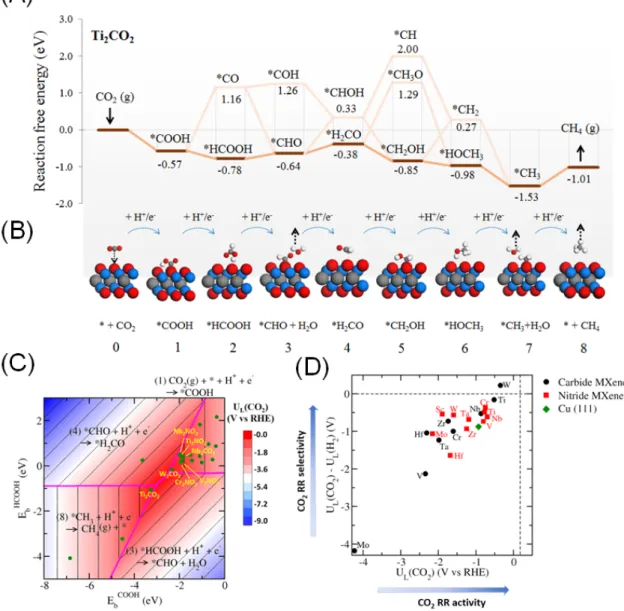
as *HCOOH). Linear scaling relations were established using the binding energies of *COOH and *HCOOH as important descriptors. Fig 6a-b depicts the reaction coordinate and adsorption configuration on Ti2CO2 MXene. W2CO2 and Ti2CO2 are identified to be promising CO2RR
catalysts, based on the highest CO2 limiting potential of -0.35 and -0.52 V vs. RHE respectively
(near to the red apex of the 2D volcano plot shown in Fig 6c) and best selectivity against competing HER (Fig 6d). This limiting potential corresponds to theoretical CO2RR to CH4 overpotential of
0.52 and 0.69 V, significantly lower than that of Cu (0.91 to 1.10 V).145, 146
Figure 6: (a) The lowest energy path and (b) schematics of the molecular adsorption geometry for
CO2RR to CH4 on Ti2CO2 MXene. (c) Contour volcano plot of the limiting potential (UL) for
29
catalyst towards CO2RR relative to HER. Reprinted from Ref.144 with permission from The Royal
Society of Chemistry.
6.2 Photocatalytic CO2RR
Research into photocatalytic CO2RR is largely inspired by the natural photosynthesis process,
where complex carbohydrate molecules and oxygen can be obtained from CO2, water and
sunlight.22 Arguably, photocatalytic CO2RR is even more challenging than electrocatalytic CO2RR
due to the additional processes of photocarrier generation and charge transfer.147 These processes
are generally inefficient and the quantum yield of photocatalytic CO2RR is typically less than
1%.148
As elaborated previously, most MXenes are not able to generate photocarriers due to its metallic characteristics. Only some –O and –OH terminated MXenes like Ti2CO2 and Sc2C(OH)2
with narrow bandgap (around 0.9 to 2.0 eV) may be photocatalytically active. DFT calculations suggest that Ti2CO2 could be active for photocatalytic CO2RR to HCOOH.149 The oxygen vacancy
(Ov) on –O terminated Ti2CO2 was found to play an essential role to enhance CO2 adsorption since
the adsorption on a perfect –O terminated surface was too weak. It is interesting that the energy barrier for the rate limiting step was much lower than that of anatase TiO2.150
Instead of being the main photocatalyst, MXenes can also take the role of co-catalyst or conductive support when combined with an efficient semiconductor photoabsorber during CO2RR.
One of the sources of inefficiency is the relatively poor CO2 adsorption and activation. Ye et al.
proposed that the –OH functional groups on the MXene surface may serve as basic sites that facilitate the adsorption of relatively acidic CO2.19 The group employed KOH treatment to replace
majority –F termination with –OH on Ti3C2Tx and combined it as co-catalyst with the commercial
P25 TiO2 (Fig 7a). The resulting photocatalytic CO2RR to CO rate was increased by 3 times and
CH4 production rate was boosted by 277 times.19 In another example, a hybrid Ti3C2/Bi2WO6
composite shows a higher yield of CH4 and CH3OH by 4.6 times compared to bare Bi2WO6.151
Recently Persson et al. devised a sequential heating treatment in H2 environment during
in-situ TEM experiment to realise O-deficient Ti3C2 MXene.152 In-situ CO2 exposure to this fresh
30
(Fig 7b-c). This result shows that careful modification of MXene surface may also a viable approach to improve MXene’s CO2 uptake. Introducing MXenes as co-catalyst with high
conductivity, proper band structure alignment (i.e. favourable Fermi level) to extract photo-induced electrons, and enhanced active sites for CO2 adsorption, provides a realistic solution to
improve the reaction efficiency. With proper surface engineering, MXenes can be tuned into a semiconductor with suitable bandgap for photocatalytic CO2RR.
Figure 7: (a) Proposed photocatalytic CO2 reduction mechanism on Ti3C2(OH)2/P25 composite
under light irradiation. Reprinted with permission from Ref.19 Copyright 2016 WILEY-VCH
Verlag GmbH & Co. KGaA. (b) Electron diffraction pattern and (c) EELS spectra on Ti3C2
acquired after exposure to 3.5 mbar CO2 gas at 100 °C for 0.5 h preceded by H2 exposure for 1 h
at 650 °C. From Ref.152 (d) Faradaic efficiency of electrocatalytic N2 reduction in molten
NaOH/KOH mixture at 200 °C at constant current of 10 mA cm-2. Different reaction and controls
are as described. Reprinted with permission from Ref.153 Copyright 2014 American Association
31
6.3 N2 Reduction Reaction (N2RR)
Ammonia is an important molecule, widely used for fertilizers, and is an important precursor to most nitrogen containing products, including amines for polymers and basic chemical compounds like nitric acid.154 Currently, 3-5% of natural gas worldwide is used to make ammonia through
successive processes of reverse gas shift, Haber-Bosch and purification, releasing large amounts of CO2 to the atmosphere.155 Although the Haber-Bosch process (N2 + 3H2 → 2NH3)is exothermic,
the kinetics are very slow under ambient conditions. These kinetic limitations are overcome by the combination of an iron-based catalyst with high pressure, high temperature conditions.153
Electrochemical N2 reduction (N2 + 6H+ + 6e- → 2NH3) aims at forming ammonia under
ambient conditions, replacing H2 as hydrogen source by proton/electron pairs, therefore reducing
the number of process steps, costs and the CO2 emission related to natural gas reforming.156 Pickett
and Talarmin demonstrated the possibility of electrochemically synthesising ammonia from N2 via
controlled hydrogenation of dinitrogen complex (trans-[W(N2)2(Ph2PCH2CH2PPh2)2]) over
Hg-pool electrode.157 While promising, the reaction rate is uncompetitive compared to the high
temperature process using H2. Two approaches are common in electrochemical N2 reduction:
moderate temperature (400-600 °C) using solid oxide proton conductor electrolyte158 and aqueous
alkaline electrolyte using Nafion membrane.159 Generally the aqueous electrolyte approach is
attracting more interest due to higher ammonia TOF, but the overall FE is generally below 1% due to competition from HER. Biological N2RR using extracted or synthesised Fe-nitrogenases has
also been proposed,160 however such process is very sensitive to O 2.
Recently, Licht et al. demonstrated that FE up to 35% can be achieved by conducting N2RR
on dispersed nano-Fe2O3 catalyst in molten hydroxide at 200 °C (Fig 7d).153 The cell voltage
required to drive 10 mA cm-2 current density was 1.2 V. However, the proposed contraption was
not stable as electrostatic would eventually coagulate the nano-Fe2O3 catalyst and halt the
electrochemical process.
Herein, MXene has the potential to step into the foray as the state-of-the-art N2RR catalyst
is still based on the same Fe2O3 that is used in 1910. Current investigation for MXenes to be applied
as N2RR electrocatalyst is led by theoretical DFT calculations.161, 162 Although N2 is relatively