RESEARCH OUTPUTS / RÉSULTATS DE RECHERCHE
Author(s) - Auteur(s) :
Publication date - Date de publication :
Permanent link - Permalien :
Rights / License - Licence de droit d’auteur :
Bibliothèque Universitaire Moretus Plantin
Institutional Repository - Research Portal
Dépôt Institutionnel - Portail de la Recherche
researchportal.unamur.be
University of Namur
High area-to-mass ratios geostationary space debris : stability and secondary
resonances (MEGNO and frequency analysis)
Delsate, Nicolas; Valk, Stéphane; Carletti, Timoteo; Lemaître, Anne
Publication date:
2008
Link to publication
Citation for pulished version (HARVARD):
Delsate, N, Valk, S, Carletti, T & Lemaître, A 2008, 'High area-to-mass ratios geostationary space debris : stability and secondary resonances (MEGNO and frequency analysis)', Paper presented at SF2A Annual meeting of the French Society of Astronomy and Astrophysics, Paris, France, 30/06/08 - 4/07/08.
<http://adsabs.harvard.edu/abs/2008sf2a.conf..113D>
General rights
Copyright and moral rights for the publications made accessible in the public portal are retained by the authors and/or other copyright owners and it is a condition of accessing publications that users recognise and abide by the legal requirements associated with these rights. • Users may download and print one copy of any publication from the public portal for the purpose of private study or research. • You may not further distribute the material or use it for any profit-making activity or commercial gain
• You may freely distribute the URL identifying the publication in the public portal ?
Take down policy
If you believe that this document breaches copyright please contact us providing details, and we will remove access to the work immediately and investigate your claim.
HIGH AREA-TO-MASS RATIOS GEOSTATIONARY SPACE DEBRIS : STABILITY
AND SECONDARY RESONANCES (MEGNO AND FREQUENCY ANALYSIS)
Delsate, N.
1, Valk, S.
1, Carletti, T.
1and Lemaˆıtre, A.
1Abstract. Recently a new unexpected population of 10 cm size space debris near the geostationary orbit (GEO) has been discovered. These objects with high area-to mass ratios sometimes present highly eccentric orbits (Schildknecht et al., 2004, 2005). Recent numerical and analytical investigations (Anselmo & Pardini, 2005; Liou & Weaver, 2005) prove that this newly discovered population consists of near geosynchronous objects with high area-to-mass ratios. The large area-to-mass ratios space debris have a dynamical behavior dominated by the solar radiation pressure and the resonance with C22 spherical harmonic. In this paper
we develop further the analysis done by Valk et al. (2008) by using a frequency analysis to study both the stability and the resonances of such particular orbits.
1 Introduction
As the GEO region is indisputably all-important for both commercial and scientific missions, ESA has recently initiated an optical search for fragments in the geostationary ring in order to improve the knowledge about the debris population and to understand their future evolution (Schildknecht et al. 2005). These observations have been performed, on behalf of ESA, by the Astronomical Institute of the University of Bern (AIUB) by using the 1 meter telescope located in Tenerife (Canary Islands). The recent observational discoveries in high altitude Earth’s orbit (for the most part in geosynchronous orbits) stimulated the revisit of direct radiation pressure models. In particular, numerical investigations were recently performed in order to assess the time evolution of objects subject to such extreme situations (Anselmo & Pardini 2005; Liou & Weaver 2004). In this framework, short-term as well as long-term evolutions of geosynchronous space debris were studied in detail. These objects sometimes present highly eccentric orbits with eccentricities as high as 0.55 (Schildknecht et al. 2004, 2005). In addition, these authors and others, such as Chao (2006) and later Valk et al. (2007) presented some detailed analytical results concerning the short- and long-term evolution of high area-to-mass ratios geosynchronous space debris subjected to direct solar radiation pressure. More specifically, these latter authors mainly focused their attention on the long-term variation of both the eccentricity and the inclination vector. Recently, Valk et al. (2008) presented investigations of the long-term stability (intrinsic stability of such uncommon orbits) of high area-to-mass ratios space debris subjected to the direct solar radiation pressure, by means of the MEGNO criterion, moreover a relevant class of additional resonances (w.r.t the main resonance due to C22 spherical
harmonic) appearing in the phase space were emphasized. In this paper, we improve such results based on the MEGNOindicator, by performing a preliminary frequency analysis of these additional resonances. The paper is organised as follows, first we summarize the Valk et al. (2008) paper. Secondly, we sketch the main ideas of the FMA (Frequency Map Analysis) theory and we lastly conclude by presenting our results based on the frequency analysis results.
2 Short review of the state of the art
In a recent paper (Valk et al. 2008) we studied the global dynamics of high area-to-mass ratios geosynchronous space debris, applying a recent technique developed by Cincotta et al. (2000), Mean Exponential Growth factor
1
University of Namur, D´epartement de Math´ematique, Unit´e de Syst`emes Dynamiques, 8, Rempart de la Vierge, B-5000,
Namur, Belgium
c
114 SF2A 2008
of Nearby Orbits (MEGNO), which provides an efficient tool to investigate both regular and chaotic components of the phase space. For the purpose of this study, we considered the modeling of a space debris subjected to the influence of the Earth gravity field (includes the central body attraction, the second degree and order harmonics J2, C22 and S22), as well as the combined attractions of the Sun and the Moon. The perturbing
effects of the direct solar radiation pressure were also taken into account for a high area-to-mass ratio fixed to A/m = 10 m2/kg. The GEO objects exhibit a resonance due to the C
22 harmonic, thus the main dynamics of
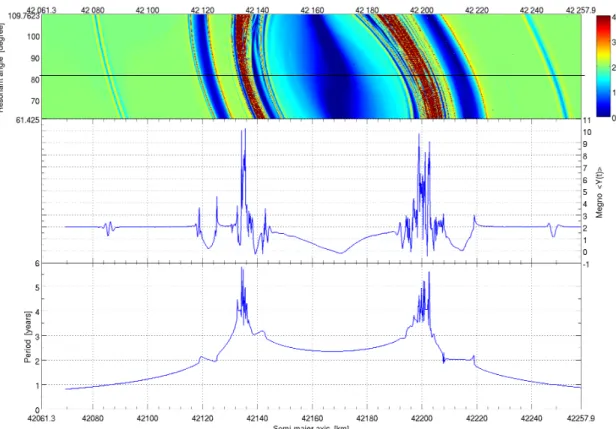
a large set of GEO object can be described by the double pendulum. In this paper we improve the main results of the Valk et al. (2008) reported in Figure 1. The interested reader could find there more details in Valk et al. (2008).
Fig. 1.Blow-up of the phase space around 1:1 resonance due to C22[Graphics and caption from Valk et al. (2008)]. For
a resonant angle section (horizontal black solid line), evolution of the MEGNO (middle panel) and the fundamental period of σ with respect to the initial semi-major axis a0 (bottom panel).
3 Extended numerical analysis: Frequency Map Analysis
We now introduce a second original approach to study the stability of the high area-to-mass ratio space debris. We use a powerful frequency analysis FMA (Laskar 1990, 1993, 1995), previously introduce and used to study, for example, the chaotic motion of the solar system (Laskar 1990). To the best of our knowledge the present study provides the first application of FMA to the geodesy.
Let us briefly sketch the main idea of the FMA. Let f (t) be a quasiperiodic regular function of the time t, with values in a complex domain, whose Fourier coefficient ak have decreasing amplitudes with k. The FMA is
a efficient numerical method allowing to obtain an approximation f′
(t) of the given signal with a given number (N ) of harmonics, from the numerical knowledge of f (t) over a finite time span [−T, T ] (Laskar 1990, 1995)
f (t) = ∞ X k=1 ake iνkt f′ (t) = N X k=1 a′ ke iν′ kt
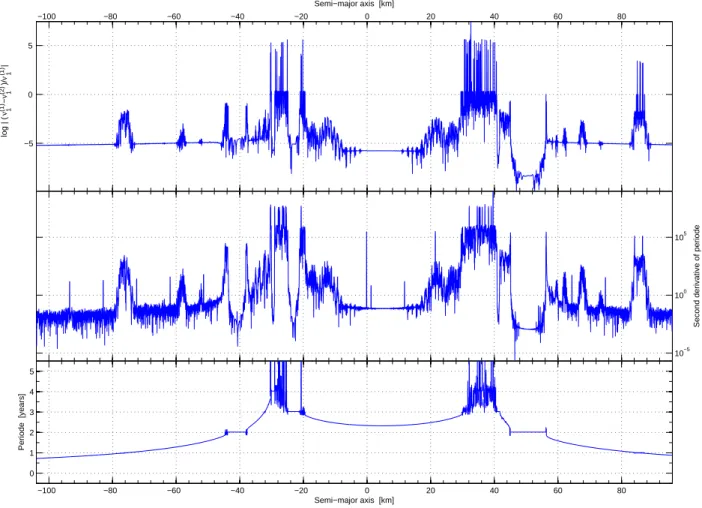
For our results, we use the FMA software (Laskar 1990). For the same resonant angle section (Fig. 1) but within a simpler model (only J2, C22 and radiation pressure with circular sun, over a time span of 500 years)
we calculate the first fundamental period of resonant angle (Fig. 2 bottom). To improve the direct analysis of the frequency curve (ν1(a)), we calculate (Laskar 1993) the numerical second derivative (δδν1(a) = ν1(a) −
2ν1(a − h) + ν1(a − 2h)) of the frequency of the resonant angle (Fig. 2 middle pannel). We can also calculate
the diffusion of the main frequency with respect to the time (Laskar 1993). This is obtained by computing a first value ν1(1) of the main frequency of the resonant angle over a time span T1 (for example to −T untill 0)
and a second value ν1(2) of this main frequency of the same signal but over a time span T2 (for example to 0
untill T ). Then we estimate the diffusion rate (Fig. 2 top) by computing a numerical indicator of diffusion of frequency log |1 − ν1(2)/ν (1) 1 |. −100 −80 −60 −40 −20 0 20 40 60 80 −5 0 5 Semi−major axis [km] log | ( ν (1) 1 − ν (2) 1 )/ ν (1) 1 | −100 −80 −60 −40 −20 0 20 40 60 80 10−5 100 105
Second derivative of periode
−100 −80 −60 −40 −20 0 20 40 60 80 0 1 2 3 4 5 Semi−major axis [km] Periode [years]
Fig. 2.The same resonant angle section in Fig. 1 but with a simpler model. Evolution of the fundamental period (bottom panel), second derivative (middle panel) and diffusion indicator (top panel), with respect to the initial semi-major axis a0.
We can observe the same structure on both plots for derivative and for diffusion indicator. But the former exhibits less noise. One can easily recognize the main additional resonances when the period is equal to 2 years (between 42 and 58 km above the ”eye” of the resonance due to C22 and between −36 and −44 km below
the ”eye” of the resonance). One can also observe an additional resonance when the period is equal to 1 year (between 84 and 86 km above the ”eye” of the resonance due to C22and near to −76 km below the ”eye” of the
resonance). Our analysis suggest that other additional resonances can be observed. A first one when the period is equal to 3 years (at ±42km above the ”eye” and ± − 32km below the main resonance); a second resonance when the period is equal to 4 years (at −30km below the main resonance) and a third one when the period is equal to 3/2 years and equal to 4/3 years. We can also observe a secondary resonance (inside the main ”eye” of
116 SF2A 2008
the resonance due to C22) when the period of the resonant angle is equal to 3 years, clsoe to the separatrix (at
−20km to −24km above the main resonance) and a weak evidence of secondary resonance (in the main ”eye” of the resonance due to C22) when the period of the resonant angle is equal to 2.5 years (at −16km below and
24km above the main resonance). 4 Conclusions
In this paper, using numerical estimato, we brought to the fore a relevant class of additional resonances in the GEO for space debris with high area-to-mass ratio. Some of these resonances correspond to commensurabilities between the primary resonant angle and the ecliptic longitude of the Sun were also underlined in Valk et al. (2008). A set of these resonances have been discovered using the MEGNO indicator. Because of its better resolution, a larger set of resonances has been discovered by using the FMA (corresponding to periods equal to 4/3 and 3/2 years).
An analytical analysis of these additional resonances will be investigated in a forthcoming publication. Moreover a whole atlas, as in Valk et al. (2008), has been created using frequency analysis confirming the existence of a large number of additional resonances that wasn’t discovered using the MEGNO indicator.
References
Anselmo L., & Pardini C. 2005, in Danesy, D. (Ed.), Proceedings of the Fourth European Conference on Space Debris, ESA SP-587, ESA Publications Division, Noordwijk, The Netherlands, pp. 279-284
Chao, C.C. 2006, AIAA Paper No. AIAA-2006-6514. In: Proceedings of the 2006 AIAA/AAS Astrodynamics Specialist Conference, Keystone, Colorado
Cincotta, P.M, & Sim´o, C. 2000, A&A Suppl. 147, 205 Laskar, J. 1990, Icarus, 88, 266
Laskar, J. 1993, Physica D, 67, 257
Laskar, J. 1995, in Proceedings of 3DHAM95 NATO Advanced Institute 533, S’Agaro, June 1995, pp. 134-150.
Liou, J.-C, & Weaver, J.K. 2004, The Orbital Quarterly News, Vol. 8 issue 3, The NASA Orbital Debris Program Office. Schildknecht T., Musci, R., Ploner, M., Beutler G., Flury, W., Kuusela, J., Leon Cruz, J., de Fatima Dominguez Palmero,
L. 2004, Advances in Space Research, 34, 901
Schildknecht, T., Musci, R. Flury, W., Kuusela, J. de Leon, J., & de Fatima Dominguez Palmero, L. 2005, in Danesy, D. (Ed), Proceedings of the Fourth European Conference on Space Debris, ESA SP-587. ESA Publications Divison, Noordwijk, The Netherlands, pp. 113-118.
Valk, S., Lemaˆıtre, A., & Anselmo, L. 2007, Advances in Space Research, doi:10.1016/j.asr.2007.10.025. Valk, S., Delsate, N., Lemaˆıtre, A, & Carletti, T. 2008, Advances in Space Research, submitted for publication.