Social
reasoning skills in adults with Down syndrome: the role
of
language, executive functions and socio-emotional behaviour
L. Hippolyte,1
K. Iglesias,2
M. Van der Linden3
& K. Barisnikov1 1Child Clinical Neuropsychology Unit, University of Geneva, Geneva, Switzerland
2Methodology and Data Analysis Unit, Faculty of Psychology, University of Geneva, Geneva, Switzerland
3Cognitive Psychopathology and Neuropsychology Unit, University of Geneva, Geneva, Switzerland
Abstract
Background Although the prevalence of mental illness and behaviour problems is lower in adults with Down syndrome (DS) than in other popula-tions with intellectual disabilities, they do present emotional and relational problems, as well as social integration difficulties. However, studies reporting on specific competences known to be central in developing appropriate social relationships (e.g. social reasoning, emotion processing, theory of mind) remain rare in the adult DS population and the mechanisms underlying these people’s emo-tional and relaemo-tional difficulties are unclear. Method The present study investigated the ability to understand the appropriateness of others’ social behaviour in34 adults with DS, using the Social Resolution Task (SRT). Their results were com-pared with those of34 typically developing (TD) children matched for gender and receptive vocabu-lary. The relationships among the SRT experimental task, cognitive competences (receptive and produc-tive vocabulary, non-verbal reasoning, inhibition, selective attention) and a caregiver-rated measure of socio-emotional behaviour were examined in the DS group.
Results The DS participants’ global SRT scores did not differ from those of the controls. However,
analyses of the SRT subscores revealed that the DS group identified significantly fewer inappropriate situations than the control group. Nevertheless, when they correctly identified the behaviour as inappropriate, they were as well as the controls to explain the rules underlying their responses. Regres-sion analyses showed that receptive vocabulary and selective attention and a specific dimension of the socio-emotional profile (social relating skills) consti-tuted the best predictors of the DS adults’ perfor-mance on the SRT.
Conclusions The main findings show that the DS participants demonstrate relatively good social rea-soning skills in comparison with TD children matched for verbal age. However, the two groups present distinctions in their response patterns, and the influence of cognitive variables on success on the SRT also appears different. While selective attention skills are found to be significant predictors for both groups, the influence of receptive vocabu-lary level is much stronger in the DS group. The implications of particular cognitive and socio-emotional factors for success on the SRT in this group are considered in more detail.
Keywords down syndrome, language, executive functions, social behaviour, social cognition
Introduction
Research conducted on socio-emotional abilities in people with Down syndrome (DS), and specifically
Correspondence: Dr Loyse Hippolyte, Child Clinical Neuropsy-chology Unit, University of Geneva,1211 Geneva 4, Switzerland (e-mail: [email protected]).
in adults, remains surprisingly rare when one con-siders the number of people affected by this syn-drome. DS is the most common genetic form of intellectual disability (ID), and the adult population is largely represented in sheltered workshops and specialised institutions. For a long time, people with DS have been characterised as presenting good socio-emotional skills and few social behavioural problems (Gunn & Cuskelly1991; Dykens et al. 1994; Carr 1995). Furthermore, studies reporting on mental illness and behaviour problems in adults with ID show a lower prevalence in people with DS. Antisocial, aggressive or destructive behaviour remains relatively low in this population compared with other adults with ID (Mantry et al.2008; Melville et al.2008; Cooper et al. 2009).
Yet, studies in DS people have also emphasised emotional and relational problems such as opposi-tional behaviour, intrusive behaviour and stubborn-ness (Coe et al.1999; Fidler et al. 2008). Social integration difficulties have been underscored in young DS adults, who have been found to show particular problems developing a social network and maintaining friendships (Soresi & Nota2000). Fur-thermore, adults with DS present difficulties with specific competences known to be central to the development of appropriate social relationships, such as emotion processing (Hippolyte et al.2008; Hippolyte et al.2009a) and abilities related to theory of mind (Zelazo et al.1996a; Abbeduto et al. 2001). To date, very little work has investigated these competences in DS adults and the mecha-nisms underlying these people’s emotional and rela-tional difficulties.
While social reasoning ability has been extensively investigated in typically developing (TD) children (e.g. Nucci & Turiel1978; Turiel 1983; Zelazo et al. 1996b), few studies have been conducted in popula-tions with neurodevelopmental disorders. We found only two studies exploring this ability in children with autism (Loveland et al.2001; Grant et al. 2005), whereas, to the best of our knowledge, these skills have never been investigated in adults with DS. In the DS population, social understanding has essentially been considered through questionnaires (Loveland & Kelley1988; Hawkins et al. 2003; Rosner et al.2004), which might be explained by the difficulty of finding suitable tasks for this popu-lation. In our view, it would be interesting to
develop a task adapted to DS participants, in order to assess their competences by a direct measure.
Consequently, our main objective in the present study was to explore the social reasoning skills of DS adults by using the Social Resolution Task (SRT), which was specifically created for people with ID. This task assessed the ability to understand the appropriateness of other people’s social behav-iour based on the knowledge of conventional and moral rules. In this study, we were also interested in investigating potential competences involved in the success of the SRT, such as general cognitive abili-ties and socio-emotional behaviour.
Regarding cognitive abilities, we first considered general cognitive processes reported to be related to socio-emotional competences and theory of mind skills in people with ID. The involvement of lan-guage skills has been emphasised in numerous studies (Frith et al.1994; Abbeduto & Murphy 2004; Thirion-Marissiaux & Nader-Grosbois 2008a). In addition, executive functions such as inhibitory control, attentional processing and working memory have been shown to play a signifi-cant role in the success of these socio-emotional tasks in populations of TD children (Gordon & Olson1998; Carlson et al. 2002; Flynn et al. 2004; Rhoades et al.2009) as well as in clinical popula-tions involving children with autism spectrum disor-ders ( Joseph & Tager-Flusberg2004; Ames & Jarrold2007), fragile X (Grant et al. 2007) and traumatic brain injury (Henry et al.2006).
In our experimental design, we proposed to the DS group measures of receptive and productive vocabulary and non-verbal reasoning to control the impact of language skills in the SRT task. The poten-tial influence of inhibition processes, which are often reported to be impaired in DS people (Munir et al. 2000; Rowe et al. 2006), was also controlled for.The assessment was completed with measures of visual selective attention. These skills were also assessed in the control group, as they may play a critical role in the processing of the SRT drawings.
Regarding the measure of the socio-emotional behaviour, studies involving TD children generally found associations between poor social reasoning skills and aggressiveness (for a literature review, see Harvey et al.2001). Basquill et al. (2004) also observed such associations in adult males with mild ID (aetiology non-specified). However, the studies
investigating these links in populations with ID remain rare, and there are no studies in DS people. In the present study, we were interested in explor-ing the potential relations between the SRT and the socio-emotional behaviour of the DS adults. We therefore introduced a caregiver-rated measure of the DS participants’ behaviour and emotional prob-lems which assesses difficulties such as aggressive-ness, anxiety, social avoidance or communication disturbance.
The DS adults’ results on the SRT were com-pared with those of TD children matched for their receptive vocabulary abilities. We chose this match to check for differences in verbal ability that might interfere with the SRT. Furthermore, it constitutes a measure frequently used in studies reporting on social reasoning skills in people with ID (e.g. Gomez & Hazeldine1996; Bieberich & Morgan 2004; Grant et al. 2005).
Materials and methods Participants
Thirty-four French-speaking participants with DS (12 of whom were women) who had a moderate ID took part in the study. They were employed by two sheltered workshops, and lived with their families (91%) or in congregate settings (9%). All partici-pants had a medical diagnosis of Trisomy21 and had attended special schools for people with ID. Partici-pants with significant sensory or physical disabilities were excluded from participation, as these difficul-ties might impede them to fairly complete the assess-ment; participants with psychiatric disorders (e.g. pervasive developmental disorder, mood disorder) as well as clinical symptoms of dementia were also like-wise excluded. The mean chronological age (CA) of the group was of32.22 years (SD = 9.66; age range 18 to 52, of which 91% under 42.5). Adults were individually matched for gender and raw score on a receptive vocabulary task with a control group com-prising TD children attending an elementary public school (mean CA=5.69; age range 4 to 11, of which 97% under 8.5).The vocabulary task was the French adaptation of the Peabody Picture Vocabulary Test – Revised (Evip-R; Dunn et al.1993). On this task, the DS group obtained a mean raw score of65.85 (SD=22.77) and the control group had a mean
score of66.59 (SD = 20.01).This difference was not statistically significant.
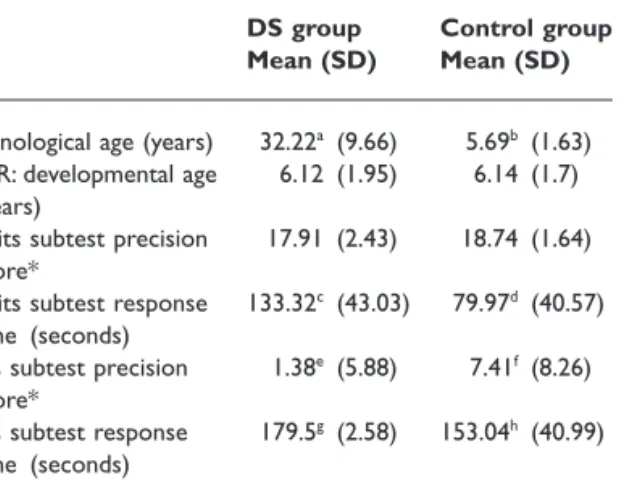
Two selective attention subtests (Rabbits and Faces) taken from the Nepsy neuropsychological battery (Korkman et al.2003) were administered to all participants (see Table1). However, two children in the control group ages4.2 and 4.3 could not be given the Faces subtest as they did not understand the task instructions (subtest intended for children from age5). In the Rabbits subtest, participants were asked to search for target pictures (rabbits) among dissimilar distracters (e.g. apple, tree and dog). The Faces subtest was more complex as two targets (two specific faces) had to be found among similar distracters (other faces). The time was limited to180 s for each subtest, and participants were instructed to proceed as quickly as possible. The DS group obtained a poorer precision score (number of hits minus false alarms) for the Faces subtest (P=0.001), and took significantly more time to perform both subtests (Rabbits: P< 0.001, Faces: P< 0.001) than the TD children.
Additional cognitive tasks assessing non-verbal reasoning, productive vocabulary and inhibition skills were administered to the DS adults to check for their potential influence on the SRT. These tasks could not be proposed to the control participants as we had time constraints for their assessment.
Non-verbal reasoning ability was assessed using Raven’s Coloured Progressive Matrices (CPM;
Table 1 Participants’ main characteristics
DS group Control group Mean (SD) Mean (SD)
Chronological age (years) 32.22a (9.66) 5.69b (1.63)
Evip-R: developmental age (years)
6.12 (1.95) 6.14 (1.7)
Rabbits subtest precision score*
17.91 (2.43) 18.74 (1.64)
Rabbits subtest response time (seconds)
133.32c (43.03) 79.97d (40.57)
Faces subtest precision score*
1.38e (5.88) 7.41f (8.26)
Faces subtest response time (seconds)
179.5g (2.58) 153.04h (40.99)
* Maximum precision score =20.
Raven et al.1998): mean raw score = 15.09, SD=5.31 (corresponding approximately to an IQ of57). Productive vocabulary abilities were assessed with a naming subtest taken from the Isadyle French language battery (Piérart et al.2007): mean percentage score=70.34, SD = 11.72. Two tasks requiring participants to inhibit a prepotent response were administered: the Sun-Moon task (verbal response) (computerised version; Hippolyte et al.2009b), which is adapted from the Day-Night Stroop-like task (Gerstadt et al.1994) and the tapping task (motor response) (Diamond & Taylor 1996; the number of items was increased from 16 to 24). The DS participants obtained a mean percent-age score of82.39 (SD = 30.99) in the Sun-Moon task and of60.42 (SD = 35.67) in the tapping task.
Finally, the Developmental Behaviour Checklist (DBC-A adult version, Mohr et al.2005) assessing the emotional and behavioural problems of adults with ID was completed by the DS adults’ referent caregivers at the sheltered workshop. This checklist provided a global score as well as six sub-scale scores. We used the French version of the DBC-A and the internal consistency of its six sub-scales was satisfactory (Cronbach’sa between0.8 and 0.9 for sub-scales1 to 4 and 6; Cronbach’s a of 0.72 for sub-scale5). The items are rated on a 3-point scale (0 = not true, 1 = somewhat or sometimes true, 2 = very true or often true) and mean scores can be calculated (continuum between0 and 2). The DS group obtained a mean global score of0.19 (SD=0.16), and mean scores on the sub-scales were as follows:0.25 (SD = 0.28) for sub-scale 1, Disruptive (e.g. tantrums, irritable);0.08 (SD=0.09) for sub-scale 2, Self-absorbed (e.g. bangs head, screams);0.25 (SD = 0.22) for sub-scale3, Communication disturbance (e.g. talks fast, hallucination);0.08 (SD = 0.14) for sub-scale 4, Anxiety/Antisocial (e.g. hides things, steals);0.42 (SD=0.35) for sub-scale 5, Social relating (e.g. loner, shy); and0.19 (SD = 0.25) for sub-scale 6, Depression (e.g. withdrawn, lost self-care).
Procedure
The assessment was conducted in French, and all participants were tested individually in a quiet room at their workplace or at school. The TD children in the control group completed the SRT and the
cog-nitive tests (Nepsy and Evip-R) in one session (25 to35 min). Two to three sessions were necessary (25 to35 min each) to administer all the tasks to the DS participants, depending on the participants’ fatigue and motivation. Tasks were administered in a counterbalanced order and sessions took place over approximately1 to 2 weeks. The research was approved by the Ethics Committee of the Univer-sity of Geneva and authorisations from the institu-tion, the legal guardians of the DS adults, and the school were obtained. Participants gave their oral consent to take part in the study, and were free to withdraw from the procedure at any time.
The Social Resolution Task
The SRT (Barisnikov et al.2005) assesses the ability to judge the appropriateness of social behav-iour based on knowledge of conventional and moral rules. This task was basically created for people with mild to moderate ID but its use also seems to be adapted for young TD children. Although the psy-chometric properties of the SRT have not been investigated, developmental norms for children ages 4 to 12 years (Barisnikov et al. unpublished data) shows that the SRT global success score progres-sively increases with age, without any floor or ceiling effects.
The SRT consists of 14 coloured drawings illus-trating daily social situations. Five items depict an appropriate situation (e.g. helping an elderly lady to cross the street, cooperating in washing dishes) and nine items depict an inappropriate situation (e.g. failing to share cookies with a friend, destroy-ing property). For each item, participants are asked by the experimenter whether the situation is appropriate or not. This first question assesses the ability to judge the situation from a general point of view. Then participants have to point to the element on which their judgement is based. This question considers the ability to identify the rel-evant constituent of the social situation. Finally, participants who answer that the situation is inap-propriate (even if it is actually apinap-propriate) are asked to explain why. This last question assesses the understanding of the situation in detail. One trial item depicting an appropriate situation is first presented to ensure that the participants under-stand the task.
A global SRT score (maximum=105 points) and three subscores – one for each question asked by the experimenter – were calculated. In addition, separate scores could be calculated for the appro-priate and inapproappro-priate situations.
Question1: 2 points were awarded if the answer was correct and0 if it was wrong (judgement sub-score; maximum=28 points).
Question2: 1 point was awarded for a correct answer and0 for a wrong one (identification sub-score; maximum=14 points).
Question3: this question was coded into four categories according to the participants’ level of social understanding and cognitive reasoning.0 to 7 points were given for the explanation of each inap-propriate situation (understanding subscore; maxi-mum=63 points). 0 point (level 0 response) for an incorrect or inappropriate answer (e.g. when seeing a girl pulling another girl’s hair: ‘it is wrong, they should be in class by now’).2 points (level 1 response) for a description of the scene without social awareness (e.g. ‘it is wrong, she is pulling her hair’).5 points (level 2 response) for an answer based on causality relations with social awareness (e.g. ‘it is not nice, she is going to cry’);7 points (level3 response) for an answer based on concep-tual knowledge of conventional or moral rules (e.g. ‘it is wrong to hurt someone’).
Results
Comparison between groups on the SRT global score and subscores
The SRT data were investigated using four types of analysis: (1) a Student t-test analysis to compare the
global SRT score between the groups; (2) non-parametric1analyses (Mann–Whitney U-tests) to
compare the subscores between the groups; (3) multilevel models (mixed effects models with crossed random effects) to control for the impact of the two SRT dimensions (conventional and moral); and (4) multiple regression analyses to investigate the impact of the different predictors on the SRT scores (for the inappropriate situations and for the global score) in interaction with the group variable and in the DS group alone.
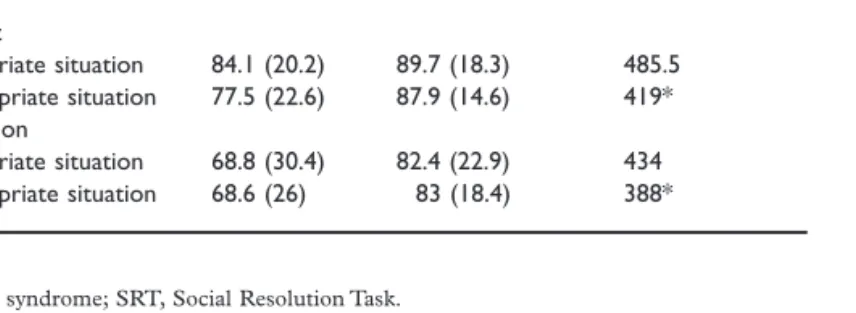
The mean SRT global score (percentage) was 46.72 (SD = 15.46) for the DS group and 50.84 (SD=10.63) for the control group. The Student t-test analysis showed that these two scores were not statistically different, t(66) = -1.28, P = 0.21. The two groups’ mean SRT subscores related to the questions of judgement and identification (dif-ferentiating appropriate and inappropriate situa-tions) are reported in Table2 with their Mann– Whitney U-values. For the appropriate situations, the two groups’ performance did not differ. For the inappropriate situations, we observed that the DS group obtained significantly lower scores than the controls for both judgement (P=0.044) and identi-fication (P=0.018) subscores. However, no differ-ences were observed within groups between judgement and identification subscores according to the appropriateness of the situation.
We then analysed the SRT understanding sub-score for the two groups (inappropriate situations only). No differences appeared between the DS
1While the SRT global score was normally distributed, the
distri-bution of the SRT subscores was continuous but asymmetric. Non-parametric analyses were therefore conducted on these subscores.
Table 2 Scores (percentage) of the DS
and control groups for the judgement and identification questions of the SRT
DS group Control group Mann–Whitney
U Mean (SD) Mean (SD) Judgement Appropriate situation 84.1 (20.2) 89.7 (18.3) 485.5 Inappropriate situation 77.5 (22.6) 87.9 (14.6) 419* Identification Appropriate situation 68.8 (30.4) 82.4 (22.9) 434 Inappropriate situation 68.6 (26) 83 (18.4) 388* * P< 0.05.
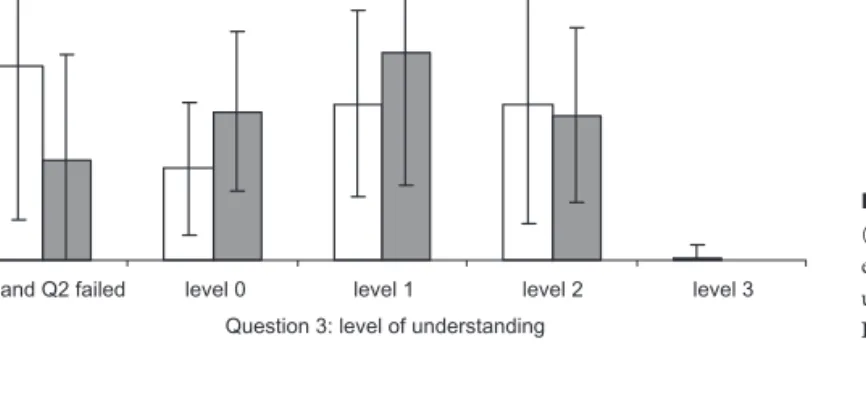
group (mean percentage score=27, SD = 14.6) and the control group (mean percentage score=27.1, SD=10.2) when we considered the global sub-score, U=552, P = 0.75. Finally, the levels of social understanding (number of items for each level) reached by the two groups were investigated (see Fig.1). As expected, the DS adults failed signifi-cantly more of these items than the controls (U=387.5, P = 0.017). However, it was observed that, when they correctly judged and identified the situations, they gave fewer incorrect or inappropri-ate answers (level0) than the control group (U=384, P = 0.015). The two groups’ subscores did not differ for the explanation of the situations at levels1, 2 and 3.
The SRT assesses the ability to judge the appro-priateness of social behaviour based on knowledge of conventional (3 items) and moral rules (6 items) and we tested for a difference between these two dimensions on the SRT score. We ran a mixed effects model with subject and item as crossed random effects on the SRT and with the group and type of item as factors. No differences were found between the items testing moral versus conventional rules for the two groups.
Analyses of the SRT subscores revealed that the DS adults had more difficulties judging and identi-fying inappropriate social situations than the con-trols. In order to examine the potential variables that might explain this inter-group difference, we conducted a multiple regression analysis on a com-pound score related to the inappropriate situations (judgement and identification subscores together). As predictors for this analysis, we used the cognitive scores on the Evip-R (receptive vocabulary task),
Rabbits and Faces (selective attention subtests) and CA and the interaction of these variables with group. The best model found explained almost40% of the variance in the dependent variable (R2=0.39
and R2adjusted=0.35). We observed a main
nega-tive effect of the Rabbits subtest (response time) (b = -0.42; t(63) = -3.35, P = 0.001) and a positive main effect of the Evip-R (b =0.25; t(63) = 2.35; P=0.022), while the main effect of group in the complete model was not significant (P=0.67). There was a significant interaction between group and the Evip-R (b =0.22; t(63) = 2.18; P = 0.033). The analysis of the interaction revealed that the Evip-R had a greater impact on the DS group’s score (b =0.45), than on the control group’s score (b =0.03). Regarding to the appropriate situations, we did not conduct regression analyses as no differences were found across the groups for these situations.
A multiple linear regression analysis was then conducted on the SRT global score using the same predictors (Evip-R, Rabbits and Faces, CA, group). The best model explained nearly45% of the SRT global score’s variance (R2=0.49 and R2
adjusted=0.45). There was a main negative effect of the Rabbits subtest (response time) (b = -0.38; t(60) = -3.09, P = 0.003), a marginal positive effect of the Evip-R (b =0.20; t(60) = 1.86; P = 0.068) and a positive effect of the Faces subtest (precision score) (b =0.33; t(60) = 2.71; P = 0.009). The main effect of group was not significant (P=0.154). Finally, we found a significant interaction between group and the Evip-R (b =0.30; t(60) = 2.98; P=0.004). The analysis of the interaction again showed a greater impact of the Evip-R variable on
Figure 1 Number of items
(inappropriate situations) obtained for each level of representation in the understanding subscore for both groups. DS, Down syndrome. 0 1 2 3 4 5
Q1 and Q2 failed level 0 level 1 level 2 level 3 Question 3: level of understanding
Number of items
DS group Control group
the DS group’s score (b =0.50) than for the control group’s score (b = -0.09).
Analysis of the SRT global score for the DS group A multiple linear regression analysis was conducted on the DS group’s SRT global score introducing whole cognitive variables (i.e. non-verbal reasoning, productive and receptive vocabulary, attention, inhi-bition), CA and the DBC-A checklist. To explore the data, we first looked at the correlations between the SRT and the explanatory variables. As expected, significant relations were found with the Evip-R task (r=0.058, P < 0.001), and the two selective attention subtests (Rabbits response time: r= -0.43, P=0.012; Faces precision score: r = 0.41,
P=0.015). Positive relations were found with two additional cognitive measures: the Isadyle produc-tive vocabulary task (r=0.53, P = 0.001) and the tapping inhibition task (r=0.35, P = 0.048). Finally, a negative relation appeared with sub-scale5, ‘social relating’ from the DBC-A checklist (r= -0.42, P=0.014).
The best regression model found explained over 50% of the variance in the SRT global score (R2=0.56 and R2adjusted=0.51). It included three
predictors: the Evip-R (b =0.52; t(30) = 4.23; P< 0.001), sub-scale 5, ‘social relating’ from the DBC-A (b = -0.35; t(30) = -2.84; P = 0.008) and the Faces precision score (b =0.26; t(30) = 2.01; P=0.049).
Discussion
The main objective of this study was to investigate social reasoning skills in adults with DS by using a new task specifically created for people with ID. Indeed, no previous studies had examined these competences in DS adults by means of an experi-mental design. The SRT assesses the judgement of appropriateness of social behaviour. We adminis-tered it to a group of34 participants with DS whose results were compared with those of a control group matched on a receptive vocabulary task. We also wanted to examine the role that general cognitive abilities might play in success on this task. We focused particularly on factors that had already been identified as critical in studies
reporting on socio-emotional skills such as language and executive functions. The potential differences which might appear between the two groups were explored using the cognitive measures available to all participants. In addition, we were interested in investigating the relations between social reasoning skills, as measured by the SRT experimental task, and a caregiver-rated measure of the DS adults’ emotional and behavioural problems (DBC-A checklist).
The DS participants’ global SRT scores did not differ from those of the control group. However, analyses of the SRT subscores revealed differences between the two groups depending on the appropri-ateness of the situations. For the appropriate situa-tions, the DS adults judged and identified the pertinent element of the items similarly to controls. On the other hand, they obtained lower judgement and identification subscores for the inappropriate situations, showing that they found these situations more difficult to process than the controls. Interest-ingly, although the DS adults on the whole pro-cessed fewer inappropriate situations correctly than the control group, the two groups performed simi-larly for understanding. The analysis of the levels of social understanding achieved by the two groups explained this result. In fact, we noticed that the DS group gave fewer inappropriate answers (level0 responses) to the social scenes than the controls did (e.g. when seeing a man destroying a street lamp with a baseball bat: ‘this is wrong as he may hurt himself with the glass fragments’). Regarding the level1 and 2 responses, it was found that both groups provided as many factual responses (e.g. ‘it is bad to break the street lamp’) as responses showing social awareness (e.g. ‘then it is all dark in the street, and this is dangerous for the other people’). With the exception of one adult with DS, none of the participants made a response based on conceptual knowledge (level3 responses). The lack of level3 responses observed in the control group is consistent with the results found in TD children using the SRT (Barisnikov et al. unpublished data), as this level of response does not emerge before the age of10. Furthermore, several developmental studies report that a more mature social reasoning appears quite late in development, around the ado-lescence (Piaget1932/2000; Selman 1980; Colby et al.1983).
To our knowledge, social reasoning skills have never been explored in DS participants through an experimental task, and we did not have specific hypotheses about the DS adults’ results. According to studies of socio-emotional competences in the DS population (Soresi & Nota2000; Fidler et al. 2008), we might have, however, expected a poorer understanding of inappropriate situations than in the control group. Yet the DS adults’ results could be related to their own life experience; they might be familiar with the social situations presented in the SRT and even be regularly confronted with some of them (e.g. queuing politely at the post office). In addition, these situations might be fre-quently discussed with caregivers and families (respecting other people’s private life, being careful with other people’s equipment). On the other hand, it may be argued that life experience in special edu-cation environments where other people with ID reside can turn to the DS adults disadvantage to identify the SRT inappropriate social interactions. In comparison with TD children, the DS partici-pants are more likely to have observed more extreme socially maladaptive behaviours and might therefore be inured to less serious inappropriate interactions. Our experimental design does not allow for this hypothesis, although this point might be somewhat negated by the subset of DS partici-pants who were able to identify these behaviours as well as the control group. This last observation underlines the fact that there is some variability within the DS adults’ competences to identify and explain inappropriate situations.
It is also essential to emphasise that the DS adults’ results were compared with those of much younger participants. Although the SRT presents common social situations, the DS participants still have greater amounts of practice in these kinds of situations than the TD children, which might explain the general equivalence in the results of the two groups. In order to control the impact of life experience in the SRT performance, it would be necessary to examine other adult populations with ID and see whether they perform similarly on the SRT. Moreover, people with DS are frequently reported to demonstrate empathy and care for others (Buckley et al.2002; Kasari et al. 2003). This trait might have a positive impact on their under-standing of social interactions. In order to
investi-gate this issue, it would be interesting to compare their results to those of other populations present-ing a similar general level of ID but showpresent-ing differ-ent cognitive and socio-emotional profiles (e.g. people with autism or fragile X).
In the present study, we were interested in inves-tigating the relationships between general cognitive competences (receptive vocabulary and selective attention) and success on the SRT for all partici-pants. For this purpose, multiple regression analyses were run on the SRT global score, as well as on the compound score including judgement and identifi-cation of the inappropriate situations, as the DS adults processed them worse than the controls. These two analyses gave similar results. The selec-tive attention competences (Rabbits subtest response time and Faces subtest precision score) were significant predictors of the SRT global and compound scores for all DS and control partici-pants. These results showed that participants with better selective attention skills were more successful in performing the SRT task. This relationship can be explained by the demands of the SRT, as partici-pants have to focus their attention on the pertinent elements of the drawings linked to social interac-tions. The role of attentional skills had already been highlighted by the successful performance of socio-emotional and theory of mind-related tasks by TD children and people with ID (Hughes1998; Thirion-Marissiaux & Nader-Grosbois2008b).
The influence of receptive vocabulary skills also stood out, but the interaction between group and the Evip-R revealed that the impact of this variable differed according to group; the Evip-R variable appeared to be a critical predictor for the DS group, while its influence was much weaker in the control group. In relation to the DS participants, these results were similar to previous findings reporting positive relations between receptive lan-guage and socio-emotional competences such as emotion processing (Hippolyte et al.2008, 2009a) and abilities related to theory of mind (Yirmiya et al.1998). This significant relationship between the Evip-R and the SRT task found in the DS group might yet question the comprehension of this task by the DS participants. Indeed, the SRT can be considered as linguistically demanding, and some adults may have not fully understood its instructions. Nevertheless, the DS group succeeded
in the appropriate situations of the SRT, similarly to their controls, suggesting that their understanding of the task was satisfactory. We might also add that even if the participants did not correctly identify or understand an inappropriate situation, their answer always corresponded to task instruction.
In relation to the control group, we might suggest that this language measure is less pertinent for TD children. Indeed, the developmental literature shows that receptive vocabulary has a weaker relationship than general language measures with tasks related to theory of mind (Milligan et al.2007), even when these tasks (e.g. false belief) are strongly related to receptive language. Moreover, the SRT makes con-siderable demands on expressive language, which was not measured in this group. It is thus possible that other language measures (e.g. narrative skills, syntax) would be related to SRT performance in TD children.
The focus of the present study was the DS popu-lation, and additional cognitive variables (non-verbal reasoning, productive vocabulary, inhibition of a predominant response) along with a measure of emotional and behavioural problems (DBC-A checklist) were assessed, allowing for a more in-depth investigation of the competences poten-tially involved in the SRT success. The best regres-sion model, which accounted for more than50% of the variance in the SRT global score, included three predictors: the receptive vocabulary task Evip-R, the ‘social relating’ sub-scale of the DBC-A and the precision score of the Faces subtest. These results confirmed the impact of receptive language and selective attention on successful performance on the SRT.
With regard to receptive vocabulary, the analyses showed that this measure was more central than productive vocabulary (Isadyle) to success on the SRT. This result is important, as the SRT, which requires a verbal response, is strongly related to productive language. Moreover, people with DS generally present an asynchrony between receptive and expressive language, with the latter being weaker (Chapman & Hesketh2000).
Considering these elements, a methodological artefact could have been inferred in the DS group if the Isadyle measure had been more strongly related to the SRT than the Evip-R; in this case, the DS participants’ performance might mainly depend on
their linguistic impairments. Based on our results, we can consider that the conceptual representation of social objects is decisive in the DS adults’ perfor-mance. Participants with a poorer receptive vocabu-lary level might have difficulties understanding these concepts, which are central to figuring out social situations. It is also important to underline that there is considerable variation in language skills within the DS population (Rondal & Comblain 1996; Miller 1999). Nevertheless, the Evip-R comes out as a significant predictor of the SRT despite its variability in the DS group. This result supports the crucial role of the receptive vocabulary in the SRT success. As it has been emphasised in the control group, it would also be of interest to assess in the DS participants other aspects of language such as syntax comprehension and production with regard to the linguistic demand of the SRT.
Interestingly, a sub-scale of the DBC-A checklist proved to be significant in the model, showing an association between the caregiver-rated measure of social behaviour and social reasoning skills mea-sured by an experimental task. The ‘social relating’ sub-scale mainly refers to social avoidance behav-iour (remains aloof, prefers to do things on his or her own, resists being cuddled by close friends or family). The DS participants who were rated as more ‘socially avoidant’ by their referent caregivers performed poorly on the SRT. To our knowledge, such a relationship has never been pointed out in the literature looking into the links between social reasoning skills and behaviour in adults with ID or in TD children. Indeed, the factor that has always been found to be related to poor social reasoning skills is aggressiveness (Crane-Ross et al.1998; Harvey et al.2001; Basquill et al. 2004; van Nieu-wenhuijzen et al.2009).Yet in our study no rela-tions appeared with this factor, which can be referred to the DBC-A ‘disruptive’ sub-scale (describes abusive, provocative or irritable behav-iour). We might explain this absence of relationship by the fact that very few difficulties were reported on the ‘disruptive’ sub-scale; the aggressiveness factor therefore appeared to be of little relevance in our DS population. In addition, previous studies conducted on people with ID separated them into groups according to their aggressiveness level (not aggressive versus very aggressive). We suggest that studies including a more representative population
could observe relations with other components of socio-emotional behaviour.
Regarding the results found in the DS group con-cerning the SRT’s relation to the ‘social relating’ sub-scale, it can be hypothesised that the adults who understand social interactions poorly tend to stay in the background. They may prefer to avoid situations that they do not understand as these episodes could be stressful or unpleasant (e.g. sharing something reluctantly, having to be nice to people one dislikes). By implication, a vicious circle is created, as such people will miss out on opportu-nities to learn these skills because of their with-drawal. It is difficult to discern the main causes of a poorer understanding of social interactions, but personality factors could be an avenue worth exploring. For instance, we might hypothesise that DS participants with less empathetic sensitivity would be at a disadvantage in understanding inter-actions. It would be interesting to clarify these issues in further studies. In addition, we must underline the difficulty to assume the linearity of the relation between social aloofness and poor social understanding. A longitudinal study of these constructs could be of great interest to better understand the origin of the DS population’s social withdrawal.
To conclude, as no ceiling or floor effects were reached with the SRT, this measure seems to be well-adapted to assess people with mild and moder-ate ID. It therefore constitutes a promising tool for studying social reasoning skills in this population. Indeed, the SRT would also be useful for other clinical populations with a particular socio-emotional profile, such as Williams syndrome, fragile X or autism and ID. The DS adults’ ability to understand the appropriateness of others’ social behaviour appears to be related to specific cognitive and socio-emotional skills, which opens up pros-pects for rehabilitation programmes. It would be important to work on selective attention and recep-tive language abilities, as they proved to be central to success on the SRT. Moreover, improving the social reasoning skills of socially withdrawn partici-pants might have a positive impact on their integra-tion. The SRT methodology might also be of great interest to study other kinds of social interactions in people with ID. Forensic issues concerning appro-priate sexual behaviour could be one as these
people frequently have difficulties to understand what is right or wrong in relation to sexual issues (Balderian1991; Furey 1994).
As this is the first study reporting on social rea-soning skills in DS adults, further studies are now required to see if the present findings can be confirmed. The psychometric properties of the SRT which have not been evaluated in this study should also be explored. In addition, we need to conduct comparative studies assessing populations who present ID with another origin to find out whether the pattern observed for our adult group is specific to DS or not. Furthermore, it would be important to examine other executive skills domains which could be involved in the success on the SRT. The shifting abilities might be particularly interesting as Zelazo et al. (1996a) found significant relationships between these shifting skills and theory of mind in DS adults. Regarding the demands of the SRT task (processing the drawing, pointing out its most perti-nent elements, elaborating an answer), introducing a measure of planification abilities might be also of great interest. By adding the shifting and the planification abilities to the SRT predictive model, we will furthermore improve our comprehension of the executive processes implied in the social reasoning abilities. Regarding the impact of the cognitive measures on the SRT performances, it would also be interesting to propose all cognitive measures to the TD participants in further
studies. This could enable us to compare the way in which these variables influence the SRT perfor-mance with regards to TD children and clinical populations.
In relation to the measure of the DS adults’ emotional and behavioural problems, the DBC-A checklist was completed by the sheltered workshop referents who provided information about partici-pants’ behaviour at their workplace. As adults may behave differently outside the work setting, it would be interesting to assess their profiles in their typical living environment and see if the ‘social relating’ sub-scale is still a significant pre-dictor. Finally, it should be noted that the SRT assesses social reasoning skills through static stimuli. It would therefore be interesting to compare the SRT’s results with those of a task that provides dynamic stimuli (e.g. staged social scenes presented on a video).
Acknowledgements
The authors thank all the adults, children and car-egivers who agreed to take part in this study. K.B. was supported by the Swiss National Science Foun-dation (grant number100014-120657/1).
References
Abbeduto L. & Murphy M. M. (2004) Language, social cognition, maladaptive behavior, and communication in Down syndrome and fragile X syndrome. In:
Develop-mental Language Disorders: From Phenotypes to Etiologies
(eds M. L. Rice & S. F. Warren), pp.77–97. Lawrence
Erlbaum Associates Publishers, Mahwah, NJ. Abbeduto L., Pavetto M., Kesin E., Weissman M. D.,
Karadottir S., O’Brien A. et al. (2001) The linguistic
and cognitive profile of Down syndrome: evidence from a comparison with fragile X syndrome. Down Syndrome,
Research and Practice7, 9–15.
Ames C. S. & Jarrold C. (2007) The problem with using
eye-gaze to infer desire: a deficit of cue inference in children with autism spectrum disorder? Journal of
Autism and Developmental Disorders37, 1761–75.
Balderian N. (1991) Sexual abuse of people with
develop-mental disabilities. Sexuality and Disability9, 323–35.
Barisnikov K., Van der Linden M. & Hippolyte L. (2005)
Tâche de Résolution Sociale, Geneva (unpublished)
Basquill M. F., Nezu C. M., Nezu A. M. & Klein T. L.
(2004) Aggression-related hostility bias and social
problem-solving deficits in adult males with mental retardation. American Journal on Mental Retardation
109, 255–63.
Bieberich A. A. & Morgan S. B. (2004) Self-regulation
and affective expression during play in children with autism or Down syndrome: a short-term longitudinal study. Journal of Autism and Developmental Disorders
34, 439–48.
Buckley S., Bird G. & Sacks B. (2002) Social Development
for Individuals with Down Syndrome – An Overview.
Down Syndrome Education Trust, Portsmouth.
Carlson S. M., Moses L. J. & Breton C. (2002) How
spe-cific is the relation between executive function and theory of mind? Contributions of inhibitory control and
working memory. Infant and Child Development11,
73–92.
Carr J. (1995) Down’s Syndrome: Children Growing up.
Cambridge University Press, Cambridge.
Chapman R. S. & Hesketh L. J. (2000) Behavioral
pheno-type of individuals with Down syndrome. Mental
Retar-dation and Developmental Disabilities Research Reviews6,
84–95.
Coe D. A., Matson J. L., Russell D. W., Keith J. S.,
Capone G. T., Baglio C. et al. (1999) Behavior problems
of children with Down syndrome and life events.
Journal of Autism and Developmental Disorders29, 149–
56.
Colby A., Kohlberg L., Gibbs J. & Liebermann M. (1983)
A longitudinal study of moral judgment. Monographs of
the Society for Research in Child Development48, 1–124.
Cooper S. A., Smiley E., Jackson A., Finlayson J., Allan
L., Mantry D. et al. (2009) Adults with intellectual
dis-abilities: prevalence, incidence and remission of aggres-sive behaviour and related factors. Journal of Intellectual
Disability Research53, 217–32.
Crane-Ross D., Tisak M. S. & Tisak J. (1998) Aggression
and conventional rule violation among adolescents: social-reasoning predictors of social behavior. Aggressive
Behavior24, 347–65.
Diamond A. & Taylor C. (1996) Development of an
aspect of executive control: development of the abilities to remember what I said and to ‘Do as I say, not as I
do’. Developmental Psychobiology29, 315–34.
Dunn L., Thériault-Whalen C. M. & Dunn L. (1993)
Peabody Picture Vocabulary Test – Revised. Psycan,
Toronto, ON.
Dykens E., Hodapp R. M. & Evans D. W. (1994) Profiles
and development of adaptative behavior in children with Down syndrome. American Journal on Mental
Retarda-tion98, 580–87.
Fidler D. J., Most D. E. & Philofsky A. (2008) The Down
syndrome behavioural phenotype: taking a
developmen-tal approach. Down Syndrome, Research and Practice10,
37–44.
Flynn E., O’Malley C. & Wood D. (2004) A longitudinal,
microgenetic study of the emergence of false belief understanding and inhibition skills. Developmental
Science7, 103–15.
Frith U., Happe F. & Siddons F. (1994) Autism and
theory of mind in everyday life. Social Development3,
108–24.
Furey E. (1994) Sexual abuse of adults with mental
retar-dation: who and where. Mental Retardation32, 173–80.
Gerstadt C. L., Hong Y. J. & Diamond A. (1994) The
relationship between cognition and action: performance
of children3 1/2–7 years old on a Stroop-like day-night
test. Cognition53, 129–53.
Gomez R. & Hazeldine P. (1996) Social information
pro-cessing in mild mentally retarded children. Research in
Developmental Disabilities17, 217–27.
Gordon A. C. L. & Olson D. R. (1998) The relation
between acquisition of a theory of mind and the capac-ity to hold in mind. Journal of Experimental Child
Psy-chology68, 70–83.
Grant C. M., Boucher J., Riggs K. J. & Grayson A. (2005)
Moral understanding in children with autism. Autism9,
Grant C. M., Apperly I. & Oliver C. (2007) Is theory of mind understanding impaired in males with fragile X
syndrome? Journal of Abnormal Child Psychology35,
17–28.
Gunn P. & Cuskelly M. (1991) Down syndrome
tempera-ment: the stereotype at middle childhood and adoles-cence. International Journal of Disability, Development and
Education38, 59–70.
Harvey R. J., Fletcher J. & French D. J. (2001) Social
rea-soning: a source of influence on aggression. Clinical
Psy-chology Review21, 447–69.
Hawkins B. A., Eklund S. J., James D. R. & Foose A. K.
(2003) Adaptive behavior and cognitive function of
adults with Down syndrome: modeling change with age.
Mental Retardation41, 7–28.
Henry J. D., Phillips L. H., Crawford J. R., Ietswaart M. &
Summers F. (2006) Theory of mind following traumatic
brain injury: the role of emotion recognition and
execu-tive dysfunction. Neuropsychologia44, 1623–28.
Hippolyte L., Barisnikov K. & Van der Linden M. (2008)
Face processing and facial emotion recognition in adults with Down syndrome. American Journal on Mental
Retardation11, 292–306.
Hippolyte L., Barisnikov K., Van der Linden M. &
Detraux J.-J. (2009a) From facial emotional recognition
abilities to emotional attribution: a study in Down
syn-drome. Research in Developmental Disabilities30, 1007–
22.
Hippolyte L., Iglesias K. & Barisnikov K. (2009b) A new
emotional Stroop-like task: application to the Down syndrome population. Archives of Clinical
Neuropsychol-ogy24, 293–300.
Hughes C. (1998) Executive function in preschoolers:
links with theory of mind and verbal ability. British
Journal of Developmental Psychology16, 233–53.
Joseph R. M. & Tager-Flusberg H. (2004) The
relation-ship of theory of mind and executive functions to symptom type and severity in children with autism.
Development and Psychopathology16, 137–55.
Kasari C., Freeman S. F. N. & Bass W. (2003) Empathy
and response to distress in children with Down
syn-drome. Journal of Child Psychology and Psychiatry44,
424–31.
Korkman M., Kirk U. & Kemp S. (2003) NEPSY: Bilan
neuropsychologique de l’enfant – manuel. Les Editions du
Centre de Psychologie Appliquée, Paris.
Loveland K. & Kelley M. L. (1988) Development of
adap-tive behavior in adolescents and young adults with autism and Down syndrome. American of Mental
Retar-dation93, 84–92.
Loveland K., Pearson D., Tunali-Kotoski B., Ortegon J. &
Gibbs M. C. (2001) Judgements of social
appropriate-ness by children and adolescents with autism. Journal of
Autism and Developmental Disorders31, 367–76.
Mantry D., Cooper S. A., Smiley E., Morrison J., Allan
L., Williamson A. et al. (2008) The prevalence and
inci-dence of mental ill-health in adults with Down
syn-drome. Journal of Intellectual Disability Research52, 141–
55.
Melville C. A., Cooper S.-A., Morrison J., Smiley E.,
Allan L., Jackson A. et al. (2008) The prevalence and
incidence of mental ill-health in adults with autism and intellectual disabilities. Journal of Autism and
Develop-mental Disorders38, 1676–88.
Miller J. (1999) Profiles of language development in
chil-dren with Down syndrome. In: Improving the
Communi-cation of People with Down Syndrome (eds J. Miller, M.
Leddy & A. Leavitt), pp.11–40. Paul H. Brooks Press,
Baltimore.
Milligan K., Astington J. W. & Dack L. A. (2007)
Lan-guage and theory of mind: meta-analysis of the relation between language ability and false-belief understanding.
Child Development78, 622–46.
Mohr C., Tonge B. J. & Einfeld S. (2005) The
develop-ment of a new measure for the assessdevelop-ment of psychopa-thology in adults with intellectual disability. Journal of
Intellectual Disability Research49, 469–80.
Munir F., Cornish K. M. & Wilding J. (2000) A
neurop-sychological profile of attention deficits in young males
with fragile X syndrome. Neuropsychologia38, 1261–70.
van Nieuwenhuijzen M., Orobio de Castro B., van Aken
M. A. G. & Matthys W. (2009) Impulse control and
aggressive response generation as predictors of aggres-sive behaviour in children with mild intellectual disabili-ties and borderline intelligence. Journal of Intellectual
Disability Research53, 233–42.
Nucci L. P. & Turiel E. (1978) Social interactions and the
development of social concepts in preschool children.
Child Development49, 400–7.
Piaget J. (1932/2000) Le jugement moral chez l’enfant.
Presses Universitaires de France, Paris.
Piérart B., Comblain A., Grégoire J. & Mousty P. (2007)
Isadyle: Instruments pour le screening et l’approfondissement de l’examen des dysfonctionnements du langage de l’enfant.
Solal, Marseille.
Raven J. C., Court J. H. & Raven J. (1998) Progressive
Matrices – Colour. Oxford Psychologists Press, Oxford,
UK.
Rhoades B. L., Greenberg M. T. & Domitrovich C. E.
(2009) The contribution of inhibitory control to
preschoolers’ social-emotional competence. Journal of
Applied Developmental Psychology30, 310–20.
Rondal J. & Comblain A. (1996) Language in adults with
Down syndrome. Down Syndrome, Research and Practice
4, 3–14.
Rosner B. A., Hodapp R. M., Fidler D. J., Sagun J. N. &
Dykens E. (2004) Social competence in persons with
Prader-Willi, Williams and Down’s syndromes. Journal
Rowe J., Lavender A. & Turk V. (2006) Cognitive execu-tive function in Down’s syndrome. British Journal of
Clinical Psychology45, 5–17.
Selman R. L. (1980) The Growth of Interpersonal
Under-standing: Developmental and Clinical Analysis. Academic
Press, New York.
Soresi S. & Nota L. (2000) A social skill training for
persons with Down’s syndrome. European Psychologist5,
34–43.
Thirion-Marissiaux A.-F. & Nader-Grosbois N. (2008a)
Theory of mind ‘beliefs’, developmental characteristics and social understanding in children and adolescents with intellectual disabilities. Research in Developmental
Disabilities29, 547–66.
Thirion-Marissiaux A.-F. & Nader-Grosbois N. (2008b)
Theory of Mind ‘emotion’, developmental characteris-tics and social understanding in children and adoles-cents with intellectual disabilities. Research in
Developmental Disabilities29, 414–30.
Turiel E. (1983) The Development of Social Knowledge:
Morality and Convention. Cambridge University Press,
Cambridge.
Yirmiya N., Erel O., Shaked M. & Solomonica-Levi D.
(1998) Meta-analyses comparing theory of mind
abili-ties of individuals with autism, individuals with mental retardation, and normally developing individuals.
Psy-chological Bulletin124, 283–307.
Zelazo P. D., Burack J. A., Benedetto E. & Frye D.
(1996a) Theory of mind and rule use in individuals
with Down’s syndrome: a test of the uniqueness and specificity claims. Journal of Child Psychology and
Psy-chiatry37, 479–84.
Zelazo P. D., Helwig C. C. & Lau A. (1996b) Intention,
act, and outcome in behavioral prediction and moral