travel in individual group members. We conducted a series of playback experiments with free-ranging putty-nosed monkeys at Gashaka Gumti National Park, Nigeria. In a first experiment, we observed the behavior of the females of a habituated group in response to playbacks of natural call series of their own male. A female could serve as focal subject if she was located at the periphery of the group while the male was at the opposite side, hereby ensuring that the male’s calls emanated from the correct direction. Playback trials consisted of five ‘hacks’, five ‘pyows’ or a five-call P–H sequence. Using a GPS unit, the focal female’s location was marked prior to and 20 min after playback, while her behavior was monitored continuously.
Our results showed that playback of ‘hack’ series (usually indicating eagle presence) inhibited movement in females (median = 1.0 m) and
Meaningful call
combinations in a
non-human primate
Kate Arnold and Klaus Zuberbühler Human speech is based on
rule-governed assemblage of morphemes into more complex vocal expressions. Free- ranging putty- nosed monkeys
(Cercopithecus nictitans) provide an interesting analogy, because males combine two loud alarm calls, ‘hacks’ and ‘pyows’, into different call series depending on external events [1]. Series consisting of ‘pyows’ are a common response to leopards, while ‘hacks’ or ‘hacks’ followed by ‘pyows’ are regularly given to crowned eagles [2,3]. Sometimes, males produce a further sequence, consisting of 1–4 ‘pyows’ followed by 1–4 ‘hacks’. These ‘pyow–hack’ (P–H) sequences can occur alone, or they are inserted at or near the beginning of another call series. Regardless of context, P–H sequences reliably predict forthcoming group progression [4]. In playback experiments, we tested the monkeys’ reactions to ‘pyows’, ‘hacks’ and P–H sequences and found that responses matched the natural conditions. Specifically, females started group progressions after hearing P–H sequences and responded appropriately to the other call series. In a second experiment, we tested artificially composed P–H sequences, and found that they were also effective in eliciting group progressions. In a third experiment, we established that group movement could only be triggered by the calls of the group’s own male, not those of a stranger. We conclude that, in this primate, meaning is encoded by call sequences, not individual calls. Many birds and primates are limited by small vocal repertoires [5,6], and this constraint may have favored the evolution of such combinatorial signaling.
We designed playback
experiments to investigate whether P–H sequences given by a male are causally responsible for eliciting
A Synth P-H P-H Hacks Pyows 60 50 40 30 20 10 0
Median distance traveled (m)
B Synth P-H P-H Hacks Pyows 12 10 8 6 4 2 0
Median latency to travel (min)
Current Biology
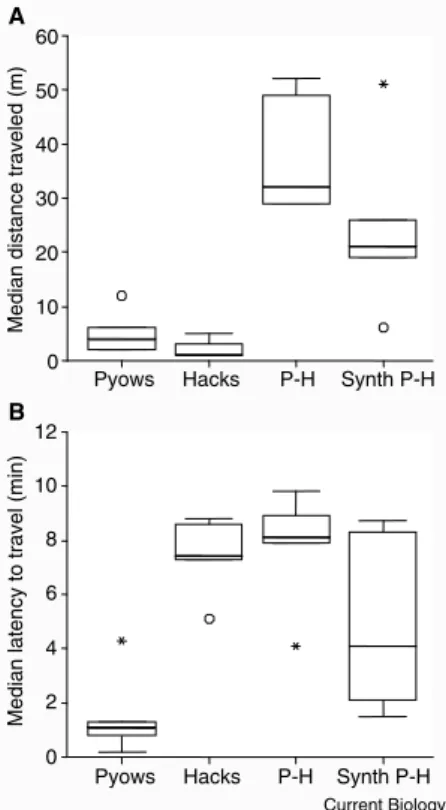
Figure 1. Median distance traveled (A) and median latency to travel (B) after hear-ing playbacks of different call series by the group’s male: ‘pyow’ series, ‘hack’ series, natural P–H sequences (P–H), and artificially composed P–H sequences (Synth P–H). Box plots indicate medians, inter-quartiles and ranges; outliers are indicated by open circles.
caused long latencies to move (median = 7.4 min), as under natural conditions. Playback of ‘pyows’ (indicating a range of disturbances, including leopard presence) elicited relatively rapid responses (median = 1.1 min), although the distance traveled towards the speaker was small (median = 4.0 m). Movement was often accompanied by scanning behavior in the direction of the calls, as if trying to acquire additional information about the cause, a pattern also seen to natural ‘pyows’. P–H sequences resulted in significant travel towards the calls (median = 32.0 m), although females only responded slowly (median = 8.1 min). Statistically, both travel distance and latencies differed significantly across the three conditions (Figure 1A: nH = nP =
nP–H = 5, d.f. = 2, χ2 = 8.4, p = 0.008;
Figure 1B: nH = nP = nP–H = 5, d.f. = 2, χ2 = 7.6, p = 0.024, Friedman tests,
two-tailed; see Supplemental data for individual responses, post-hoc analyses, and comparisons with natural responses).
At this point, it could be argued that there were subtle acoustic differences between ‘pyows’ and ‘hacks’ produced as part of P–H sequences compared to calls given in response to predators, and that listeners responded to these differences, rather than call combinations. Although acoustic analyses did not support this hypothesis (see the Supplemental
17 16 17 N = P-H Hacks Pyows 100 80 60 40 20 0 –20
Median distance traveled (m)
Current Biology
Figure 2. Median distance traveled towards the playback speaker by females after hear-ing playbacks of ‘pyow’ series, ‘hack’ series or P–H sequences by a stranger male. Box plots indicate medians, inter-quartiles and ranges; outliers are indicated by open circles; extremes are indicated by stars. Published in Current Biology, Vol. 18, Issue 5, 2008, p. R202-R203
data available on-line with this issue) we carried out a second experiment, this time using artificially composed P–H sequences edited from ‘pyows’ and ‘hacks’ originally given to predator stimuli. We found no differences between artificial and natural P–H sequences in the distance traveled by females and their response latencies (P–Hreal
median = 32.0 m, P–Hsynthesised
median = 21.0 m: Wilcoxon signed ranks test, n1 = n2 = 5, z = –1.483,
p = 0.188; P–Hreal median = 8.1 min,
P–Hsynthesised median = 4.1 min:
Wilcoxon signed ranks test, n1 = n2 = 5, z = –1.214, p = 0.313;
Figure 1). We concluded that the communicatively salient property of the signal was how calls were assembled, rather than any context-specific acoustic variation within ‘pyows’ or ‘hacks’.
In a final experiment, we investigated whether females discriminated between calls given by their own male compared to other males of the same population. At our study site, monkey groups are often surrounded by neighbors, suggesting that females should be selective in their responses when hearing male calls, particularly to P– H sequences. We repeated the first experiment, this time testing various unhabituated groups within a 32 km2
study area. In response to ‘pyows’ and P–H sequences some females traveled towards the speaker (35.5%, 29.4% of trials, respectively) but never in response to ‘hacks’ (0.0%). However, approaches were only observed in a small number of females (median = 2.0) and only in association with their own male. All remaining group members stayed behind regardless of stimulus type, so that the median travel
distances to all stimuli were negligible (median = 0.0 m in all conditions; Kruskal-Wallis, n1 = 16,
n2 = n3 = 17, d.f. = 2, χ2 = 5.177,
p = 0.075; Figure 2), confirming that females discriminated between call sequences by their own and those of stranger males, especially in response to P–H sequences.
Our study has demonstrated that putty-nosed monkey call combinations convey at least three types of information: the event witnessed by the male, the caller’s identity, and whether he intends to travel, all of which are
recognized by other monkeys. We conclude that, contrary to current theory, meaningful combinatorial signals have evolved in primate communication [7–9] and future work may reveal further examples. Many forest primates and most bird species are limited by small vocal repertoires [5,10], and this constraint may have favored the evolution of combinatorial signals. The exact psychological mechanism of how the observed semantic changes are achieved when two call types interact in a sequence, however, is a matter for further investigation.
Acknowledgments
We thank the Nigerian National Parks Service, the Nigerian Conservation Foundation, V. Sommer, A. Tappare, I. Timothy and D. Stothard for permissions and vital assistance. Fieldwork was funded by the Wenner Gren Foundation, European Science Foundation (OMLL), British Academy, Leverhulme Trust and EC Nest Pathfinder Initiative “What it means to be human”.
References
1. Eckardt, W., and Zuberbühler, K. (2004). Cooperation and competition in two forest monkeys. Behav. Ecol. 15, 400–411. 2. Arnold, K., and Zuberbühler, K. (2006). The
alarm-calling system of adult male putty-nosed monkeys, Cercopithecus nictitans martini. Anim. Behav. 72, 643–653. 3. Arnold, K., Pohlner, Y., and Zuberbühler, K.
(2008). A forest monkey’s alarm call series to predator models. Behav. Ecol. Sociobiol. 62, 549–559.
4. Arnold, K., and Zuberbühler, K. (2006). Language evolution: semantic combinations in primate calls. Nature 441, 303.
5. Catchpole, C.K., and Slater, P.J.B. (1995). Bird Song: Biological Themes and Variations (Cambridge: Cambridge Univ. Press). 6. Zuberbühler, K. (2003). Referential signaling
in non-human primates: Cognitive precursors and limitations for the evolution of language. Adv. Study Behav. 33, 265–307.
7. Zuberbühler, K. (2002). A syntactic rule in forest monkey communication. Anim. Behav.
63, 293–299.
8. Clarke, E., Reichard, U., and Zuberbühler, K. (2006). The syntax and meaning of wild gibbon songs. PLoS One 1, e73. 9. Crockford, C., and Boesch, C. (2005). Call
combinations in wild chimpanzees. Behaviour
142, 397–421.
10. Riede, T., Bronson, E., Hatzikirou, H., and Zuberbühler, K. (2005). Vocal production mechanisms in a non-human primate: morphological data and a model. J. Human Evol. 48, 85–96.
School of Psychology, University of St Andrews, St Andrews, KY16 9JP, Scotland, UK.
E-mail: [email protected]