Down-regulation of tomato PHYTOL KINASE strongly impairs
tocopherol biosynthesis and affects prenyllipid metabolism in
an organ-specific manner
Juliana Almeida1, Mariana da Silva Azevedo2, Livia Spicher3, Gaétan Glauser4, Katharina vom Dorp5, Luzia Guyer6, Andrea del Valle Carranza7, Ramón Asis7, Amanda Pereira de Souza1, Marcos Buckeridge1, Diego Demarco1, Cécile Bres8, Christophe Rothan8, Lázaro Eustáquio Pereira Peres2, Stefan Hörtensteiner6, Félix Kessler3, Peter Dörmann5, Fernando Carrari9 and Magdalena Rossi1,*
1 Departamento de Botânica, Instituto de Biociências, Universidade de São Paulo, Rua do Matão, 277, 05508-900, São Paulo, Brazil 2 Departamento de Ciências Biológicas, Escola Superior de Agricultura ‘Luiz de Queiroz’, Universidade de São Paulo, Av. Pádua Dias, 11, CP 09, 13418-900, Piracicaba, Brazil
3 Laboratory of Plant Physiology, University of Neuchâtel, 2000 Neuchâtel, Switzerland
4 Neuchâtel Platform of Analytical Chemistry, University of Neuchâtel, 2000 Neuchâtel, Switzerland
5 Institute of Molecular Physiology and Biotechnology of Plants, University of Bonn, D-53115 Bonn, Germany 6 Institute of Plant Biology, University of Zurich, Zollikerstrasse 107, CH-8008 Zurich, Switzerland
7 CIBICI, Facultad de Ciencias Químicas, Universidad Nacional de Córdoba, CC 5000, Córdoba, Argentina 8 INRA and Université de Bordeaux, UMR 1332 Biologie du Fruit et Pathologie, F-33140 Villenave d’Ornon, France
9 Instituto de Biotecnología, Instituto Nacional de Tecnología Agropecuaria and Consejo Nacional de Investigaciones Científicas y Técnicas, PO Box 25, B1712WAA, Castelar, Argentina
*To whom correspondence should be addressed. E-mail: [email protected]
Abstract
Tocopherol, a compound with vitamin E (VTE) activity, is a conserved constituent of the plastidial antioxidant net-work in photosynthetic organisms. The synthesis of tocopherol involves the condensation of an aromatic head group with an isoprenoid prenyl side chain. The latter, phytyl diphosphate, can be derived from chlorophyll phytol tail recy-cling, which depends on phytol kinase (VTE5) activity. How plants co-ordinate isoprenoid precursor distribution for supplying biosynthesis of tocopherol and other prenyllipids in different organs is poorly understood. Here, Solanum
lycopersicum plants impaired in the expression of two VTE5-like genes identified by phylogenetic analyses, named SlVTE5 and SlFOLK, were characterized. Our data show that while SlFOLK does not affect tocopherol content, the
production of this metabolite is >80% dependent on SlVTE5 in tomato, in both leaves and fruits. VTE5 deficiency greatly impacted lipid metabolism, including prenylquinones, carotenoids, and fatty acid phytyl esters. However, the prenyllipid profile greatly differed between source and sink organs, revealing organ-specific metabolic adjustments in tomato. Additionally, VTE5-deficient plants displayed starch accumulation and lower CO2 assimilation in leaves associated with mild yield penalty. Taken together, our results provide valuable insights into the distinct regulation of isoprenoid metabolism in leaves and fruits and also expose the interaction between lipid and carbon metabolism, which results in carbohydrate export blockage in the VTE5-deficient plants, affecting tomato fruit quality.
Introduction
Tocopherols are potent lipid-soluble antioxidants synthe-sized only by photosynthetic organisms and, together with tocotrienols, are collectively referred to as vitamin E (VTE) compounds (Kamal-Eldin and Appelqvist, 1996; DellaPenna and Pogson, 2006). Since plants are the major source of VTE required for human nutrition, understanding of the mechanisms underlying its synthesis and accumulation in crop species is of great interest (Grusak and DellaPenna, 1999; Fitzpatrick et al., 2012). The antioxidant function of tocopherols relies on their ability to scavenge peroxyl radi-cals, limiting lipid oxidation of polyunsaturated fatty acids (PUFAs) (Serbinova et al., 1991; Traber and Atkinson, 2008),
and also singlet oxygen (1O
2) (Di Mascio et al., 1990; Kaiser
et al., 1990; Fukuzawa et al., 1997). In plants, light-driven photosynthetic processes are the main contributors to reac-tive oxygen species (ROS) production in chloroplasts owing to electron transport chains and photosensitizing molecules
such as chlorophyll (Chl) (Edreva, 2005; Demmig-Adams
et al., 2014). The delicate equilibrium between ROS produc-tion and their detoxificaproduc-tion in chloroplast, which determines damage, protection, or signaling response, is controlled by a diversified ROS-scavenging system, including non-enzymatic
antioxidant mechanisms (Edreva, 2005; Foyer and Noctor,
2005). Tocopherols, as part of the photoprotective
machin-ery, are particularly involved in controlling the level of 1O
2 in photosystem II (PSII), and the extent of lipid peroxida-tion in thylakoid membranes especially under stress condi-tions (Triantaphylidès and Havaux, 2009; Rastogi et al., 2014; Miret and Munné-Bosch, 2015). Beyond photoprotective roles, tocopherol is also involved in seed longevity, seedling germination (Sattler et al., 2004; Mène-Saffrané et al., 2010),
and photoassimilate export (Maeda et al., 2006, 2008;
Asensi-Fabado et al., 2014); although, for the latter, the precise underlying mechanism remains elusive (Maeda et al., 2014).
Accumulation of tocopherol in plant tissues is a tightly controlled process, and several studies determined that tocopherol levels change significantly during plant growth and development, as well as in response to environmen-tal stimuli including high light, low temperature, salt, and
osmotic stress (Munné-Bosch, 2005; Maeda et al., 2006;
Abbasi et al., 2007; Loyola et al., 2012; Quadrana et al., 2013; Eugeni-Piller et al., 2014). Additionally, transgenic approaches have demonstrated that VTE content corre-lates with the expression of the biosynthesis- and recycling-related genes (reviewed by DellaPenna and Mène-Saffrané, 2011). Tocopherol synthesis occurs in plastids and requires two precursors, a prenyl side chain and a tyrosine catabo-lite-derived head group (Fig. 1). The prenyl moiety phytyl diphosphate and homogentisate derived from the plastidial
2-C-methyl-D-erythritol 4-phosphate (MEP) and the
shiki-mate pathway, respectively, are condensed by homogenti-sate phytyl transferase (VTE2), the only enzyme unique for tocopherol synthesis. From this precursor, the four naturally
occurring tocopherol forms (α-, β-, γ-, and δ-tocopherol),
which vary in the methylation pattern of the chromanol ring, are synthesized via the action of dimethyl-phytylquinol
methyl transferase (VTE3), tocopherol cyclase (VTE1), and
tocopherol γ-methyl transferase (VTE4). These enzymes
are also responsible for the synthesis of the other tocochro-manol compounds, which include not only tocotrienols but also plastochromanol (PC-8), a product of plastoquinone (PQ-9) cyclization (Zbierzak et al., 2010).
In addition to the de novo synthesis, the phytyl diphosphate precursor may also originate from Chl turnover or degrada-tion, by the release of a phytol moiety from the tetrapyr-role ring. Intriguingly, the precise identity of the tocopherol biosynthesis-related phytol hydrolase remains to be deter-mined. In Arabidopsis thaliana, the absence of the known dephytylating enzymes, pheophytinase (PPH) and chloro-phyllase (CLH), in triple mutants does not alter seed tocoph-erol content, whereas seed-specific PPH-overexpressing transgenic lines exhibit modestly increased tocopherol levels (Zhang et al., 2014). The hydrolyzed phytol is sequentially phosphorylated by two enzymes, phytol kinase (VTE5) and phytyl-phosphate kinase (VTE6) (Ischebeck et al., 2006; Valentin et al., 2006; vom Dorp et al., 2015). VTE5 has been characterized in Arabidopsis where its mutant allele, vte5, causes a substantial reduction of the tocopherol content in seeds and to a lesser extent in leaves (Valentin et al., 2006). Furthermore, based on sequence similarity, a locus encod-ing a putative VTE5 paralog was identified in Arabidopsis, which further was characterized as a farnesol kinase (FOLK) (Fitzpatrick et al., 2011). However, its involvement in tocopherol biosynthesis was not addressed. So far, VTE5 has only been characterized in Arabidopsis, and its contri-bution to tocopherol content is largely unknown in other species and organs, such as in edible fleshy fruits. Moreover, the impact of VTE5 deficiency on plant metabolism remains unexplored. Solanum lycopersicum is an interesting model species for studying tocopherol metabolism. Besides being an important food crop worldwide, the fruits are a signifi-cant source of VTE for the human diet (Chun et al., 2006). Additionally, tomato ripening, which encompasses the conversion of chloroplasts into chromoplasts, couples Chl degradation and an active MEP pathway (Seymour et al., 2013), both sources of the prenyl precursor for tocopherol biosynthesis (Almeida et al., 2015). A previous study on the regulation of tocopherol biosynthesis in this species dem-onstrated a strong correlation between VTE5 mRNA levels and the contents of Chl and tocopherol in tomato leaves and fruits, suggesting the contribution of phytol recycling to tocopherol biosynthesis (Quadrana et al., 2013). Moreover, expression analysis of senescence-related tomato mutants suggested that maintenance of the de novo phytyl diphos-phate synthesis might, at later ripening stages, compensate for the lack of Chl-derived phytol for tocopherol production in fruits (Almeida et al., 2015).
To better understand the extent of the contribution of the VTE5-dependent phytol pathway to tocopherol bio-synthesis in source and sink organs, we functionally char-acterized VTE5-like genes in tomato. Tocopherol content was dramatically compromised in both leaves and fruits of
SlVTE5-knockdown plants. In contrast, analyses of the folk
to phytol kinase activity required for tocopherol biosyn-thesis. Additionally, VTE5 deficiency differentially impacts fatty acid phytyl ester and prenyllipid metabolism in fruits and leaves, and also has consequences in photosynthesis and sugar partitioning.
Materials and methods
Plant material, growth conditions, and sampling
Seeds of tomato (Solanum lycopersicum, cv. Micro-Tom) were obtained from the Laboratory of Hormonal Control of Plant Development (www.esalq.usp.br/tomato). The folk-1 tomato mutant was isolated from an ethyl methanesulfonate (EMS)-mutagenized Micro-Tom collection from INRA, France. Plants were grown in a greenhouse under automatic irrigation at an average temperature of 25 °C, 11.5 h/13 h (winter/summer) photoperiod, and 250–350 μmol m−2 s−1 of incident photoirradiance. Source (the first fully expanded leaf) and sink (the first apical leaf not fully expanded) leaves were sampled. Fruits were harvested at mature green, 1 d after breaker (B+1), 3 d after breaker (B+3), and ripe (B+6) stages at 35, 38, 40, and 43 d after anthesis, respectively. Samples were frozen in liquid N2 and stored at –80 °C. All biochemical analyses were performed in the T1 generation. For photosynthesis and yield evaluation, an inde-pendent experiment in the T2 generation was performed. Destructive harvest took place at a point where the largest possible numbers of fruits were ripe without visible over-ripening (15 weeks old) (Vicente et al., 2015). At harvest time, aerial biomass was weighed and all the fruits were counted and weighed.
Phylogenetic analysis
For phylogenetic analysis, Blastp searches were performed using the protein sequences of A. thaliana VTE5 (At5g04490) and FOLK (At5g58560) as queries against the tomato genome (http://solgenomics.net). Homologous sequences from other plant species were retrieved by Blastp from the Phytozome database (http://phytozome.jgi.doe.gov/pz/portal. html). Nicotiana benthamiana sequences were obtained from the Sol Genomics Network database (http://solgenomics.net). The sequences were aligned using the MUSCLE package available in the MEGA 5.0 software with default parameters (Tamura et al., 2007), and Neighbor–Joining phylogenies with 5000 bootstrap replications were created with the dis-tances calculated according to the best model indicated by MEGA 5.0.
Generation of SlVTE5-RNAi transgenic lines
Transgenic plants expressing a SlVTE5-specific intron-spliced hairpin sequence under the control of the Cauliflower mosaic virus 35S promoter were obtained for RNAi-mediated silencing of the Solyc03g071720 locus. A 237 bp fragment of SlVTE5 was ampli-fied by PCR using the primers RNAi-VTE5-F and RNAi-VTE5-R listed in Supplementary Table S1 available at JXB online. PCR products were cloned into pENTR/d-TOPO vector (Invitrogen) via directional cloning, and then recombined into the binary vector pK7GWIWG2 (Karimi et al., 2002) to generate pK7GWIWG2(I)-SlVTE5. Agrobacterium-mediated transformation (strain EHA105)
Fig. 1. Schematic view of tocopherol biosynthetic and related pathways. The genes are the following: 1-deoxy-D-xylulose-5-P synthase (DXS); geranylgeranyl diphosphate reductase (GGDR); 4-hydroxyphenylpyruvate dioxygenase (HPPD); homogentisate phytyl transferase (VTE2); 2,3-dimethyl-5-phytylquinol methyltransferase (VTE3); tocopherol cyclase (VTE1); γ-tocopherol-C-methyl transferase (VTE4); phytoene synthase (PSY); phytoene desaturase (PDS); chloroplast-specific β-lycopene cyclase (LCYβ); chromoplast-specific β-lycopene cyclase (CYCβ); chlorophyll synthase (CHLG); staygreen 1 (SGR1); pheophytinase (PPH); pheophorbide a oxygenase (PAO); phytol kinase (VTE5); farnesol kinase (FOLK); homogentisate solanesyl transferase (HST); solanesyl diphosphate synthase (SPS). Abbreviated intermediate metabolites are: glyceraldehyde 3-phosphate (GA3-P);
1-deoxy-D-xylulose-5-P (DXP); isopentenyl diphosphate (IDP); dimethylallyl diphosphate (DMADP); geranylgeranyl diphosphate (GGDP); hydroxyphenylpyruvate (HPP); homogentisate (HGA); chlorophyllide a (Chlide a); geranylgeranyl-chlorophyll a (Chl aGG); phytylated chlorophyll a (Chl aPhy); pheophytin a (Phein a);
pheophorbide a (Pheide a); red chlorophyll catabolite (RCC); 2-methyl-6-geranylgeranylbenzoquinol (MPBQ); 2,3-dimethyl-6-geranylgeranylbenzoquinol (DMBQ); 2-methyl-6-solanyl-1,4-benzoquinol (MSBQ); plastoquinol-9 (PQH2-9); plastochromanol-8 (PC-8).
of S. lycopersicum was performed according to Pino et al. (2010). The presence of the transgene in T0, T1, and T2 kanamycin-resistant plants was detected by PCR in genomic DNA using 35S-right and RNAi-VTE5-R primers (see Supplementary Table S1).
Identification of the folk-1 tomato mutant by TILLING
Mutations in SlFOLK were identified by screening an EMS-mutagenized tomato population (Just et al., 2013) essentially as described in Okabe et al. (2011). TILLING (Targeting Induced Local Lesions In Genomes) unlabeled external primers and internal primers 5′ labeled with IRDye 700 and IRDye 800 dye are listed in Supplementary Table S1 at JXB online. Induced point mutations were identified using the mismatch-specific endonuclease ENDO 1. Digested DNA fragments were separated on a Li-Cor DNA analyzer (LI-Cor, Lincoln, NE, USA). The mutation analysis was performed using PARSESNP (Taylor and Greene, 2003) and SIFT (Ng and Henikoff, 2003) software. Homozygous mutant plants were identified by sequencing of the tilled M3 family. Phenotypic charac-terization was performed in M4 plants homozygous for the folk-1 allele using the corresponding segregating individuals homozygous for the FOLK wild-type allele as control genotype.
qPCR analysis
RNA extraction, cDNA synthesis, and real-time quantitative PCR (qPCR) assays were performed as described by Quadrana et al. (2013). Primer sequences are listed in Supplementary Table S1 at JXB online. qPCRs were performed in a 7500 real-time PCR system (Applied Biosystems) using 2× SYBR Green Master Mix reagent (Applied Biosystems). Expression values were normalized against the geometric mean of two reference genes, CAC and EXPRESSED, according to Quadrana et al. (2013). A permutation test lacking sample distribution assumptions (Pfaffl et al., 2002) was applied to detect statistical differences (P<0.05) in expression ratios using the algorithms in the fgStatistics software package (Di Rienzo, 2009). Leaf gas exchange and fluorescence measurements
Gas exchange and Chl fluorescence parameters were evaluated in 5-week-old plants using a portable open gas-exchange system incor-porating infra-red CO2 and water vapor analyzers (LI-6400XT system; Li-Cor) equipped with an integrated modulated Chl fluo-rometer (LI-6400-40; Li-Cor). Reference [CO2] was held at 400 µmol mol−1 and the temperature at 25 ˚C for all measurements. Air humid-ity inside the leaf chamber was controlled to the externally measured greenhouse relative humidity (50–60%). Carbon assimilation rate (A), leaf stomatal conductance (gs), leaf dark respiration (Rd), and fluorescence parameters were measured at a photosynthetic photon flux density (PPFD) of 600 µmol m−2 s−1 in the first fully expanded leaf between 10:00 h and 14:00 h. The parameters derived from Chl fluorescence, including light-adapted PSII maximum quantum effi-ciency (F′v/F′m), proportion of open PSII centers (photochemical quenching, qP), and PSII operating efficiency (ΦPSII), were calcu-lated according to Genty et al. (1989).
Tocopherol, free phytol, and fatty acid phytyl ester quantification Tocopherols were extracted and measured by HPLC as previously described (Yang et al., 2011). For determination of fatty acid phytyl esters (FAPEs) and free phytol, total lipids were extracted with chlo-roform according to Lippold et al. (2012). Non-polar lipids were puri-fied using chromatography on silica columns (Kieselgel 60; Merck). FAPEs were measured by direct infusion nanospray quadrupole time-of-flight tandem mass spectrometry (Q-TOF-MS/MS; Agilent 6530 Accurate Mass Q-TOF) using methanol:chloroform:300 mM ammonium acetate [665:300:35 (v/v/v); Welti et al., 2002] as the solvent system. FAPEs were detected in the positive ion mode by neutral loss scanning for m/z 278.2974, a fragment characteristic
for the phytol moiety. For phytol measurements, the non-polar lipid fraction was silylated and then phytol was quantified by GC-MS as previously described (Lippold et al., 2012).
Prenylquinone and carotenoid profile
Prenylquinone and related compounds (α-tocopherolquinone, PQ-9, plastoquinol-9, plastoquinone, PC-8, hydroxy-plastochromanol, and ubiquinone-10) were analyzed by a targeted analysis of the lipidomic profile obtained by ultra-HPLC coupled with atmospheric pressure chemical ionization-quadrupole time-of-flight mass spectrometry (UHPLC-APCI-QTOF-MS) as described in Martinis et al. (2013) with the following modifications. Briefly, 15 mg of lyophilized tissue were exactly weighed and resuspended in 500 μl of tetrahydrofurane:methanol:water 42.5:42.5:15 (v/v/v). The mixture was homogenized using glass beads (1 mm in diameter) for 3 min at 30 Hz in a tissue lyser. After two rounds of centrifuga-tion (3 min, 14 000 g, and 4 °C), supernatants were transferred to vials. Prenyllipids were separated on a reverse-phase Acquity BEH C18 column (50 × 2.1 mm, 1.7 μm) under the following conditions: solvent A=water; solvent B=methanol; 80–100% B in 3 min, 100% B for 2 min, re-equilibration at 90% B for 0.5 min. The flow rate was 0.8 ml min–1 and the injection volume was 2.5 μl. PQ-9 and PC-8 were quantified based on calibration curves obtained from stand-ard compounds. Data were processed using MassLynx version 4.1 (Waters).
Carotenoids were extracted and detected as described in Almeida et al. (2015) using an Agilent 1200 Series HPLC system coupled with a diode array detector on a reverse phase column [Zorbax Eclipse Plus C18 (150 mm×4.6 mm, 5 μm), Agilent Technologies]. Compounds were identified at 440 nm by their order of elution and absorption spectra (Gupta et al., 2015), and co-migration with authentic standards (all-trans-lycopene, all-trans-β-carotene, lutein, violaxanthin, neoxanthin, and zeaxanthin). Relative quantifica-tion was performed based on chromatografic peak area normalized against sample dry weight.
Chlorophyll and chlorophyll catabolites
Chl and green catabolites (chlorophyllide, pheophorbide, and pheo-phytin) were extracted from 10 mg of lyophilized tissue during 17 h at –20 °C in 90% (v/v) acetone, 10% (v/v) 0.2 M TRIS-HCl, pH 8.0, pre-cooled to –20 °C (5 ml g−1 initial fresh weight). After centrifuging twice (2 min, 16 000 g, 4 °C), supernatants were analyzed by HPLC as described (Langmeier et al., 1993). Pigments were identified by their absorption spectra at 665 nm. For quantification, peak areas were analyzed and referred to calibration curves built from known quantities of standard pigments (Schelbert et al., 2009).
Quantification of soluble sugars and starch
A 10 mg aliquot of the lyophilized samples was extracted five times with 1.5 ml of 80% ethanol at 80 °C according to De Souza et al. (2013). Combined supernatants were dried under vacuum and re-suspended in 1 ml of ultrapure water. To remove pigments, an extrac-tion with 0.5 ml of chloroform was performed. Alcohol-soluble sugar quantification was done by high-performance anion exchange chromatography with pulsed amperometric detection (HPAEC/ PAD) (Dionex-ICS3000, Dionex). Sugar separation was carried out on a CarboPac PA1 column using isocratic elution of 150 mM NaOH with a flow rate of 1 ml min−1. The calibration curves were prepared using standard solutions of glucose, fructose, and sucrose with a concentration range from 50 μM to 200 μM.
For starch quantification, the dried insoluble material obtained after ethanol extraction was treated with α-amylase (120 U ml−1, Megazyme) from Bacillus licheniformis and amyloglucosidase (30 U ml−1, Megazyme) from Aspergillus niger according to Amaral et al. (2008). The glucose content obtained after starch hydrolysis was determined from extract aliquots of 20 μl and 50 μl for leaves and
fruits, respectively, after an incubation with glucose oxidase/peroxi-dase and D-4-aminoantipirine (GOD/POD). Absorbance of quino-neimine dye, which is directly proportional to glucose concentration, was measured spectrophotometrically using an ELISA-type micro-plate reader at 490 nm. A standard curve was prepared using high purity glucose solution (Sigma) ranging from 2.5 µg ml−1 to 12.5 µg ml−1.
Trolox equivalent antioxidant capacity (TEAC) assay
The antioxidant capacity of non-polar extracts was assayed as pre-viously described (Re et al., 1999), with minor modifications. The pre-formed radical 2,2′-azin-obis-(3-ethylbenzothiazoline-6-sulfonic acid) (ABTS˙+) was produced by oxidation of 7 mM ABTS with potassium persulfate (2.45 mM final concentration) dissolved in ultrapure water. The mixture was incubated in the dark at room tem-perature for 12–16 h before use. The ABTS˙+ solution was diluted with ethanol and adjusted to 0.70 ± 0.02 absorbance units at 734 nm. A 50 µl aliquot of diluted extract or Trolox standard was mixed with 150 µl of diluted ABTS˙+ solution, and the absorbance was read at 734 nm after 10 min at 30 ºC. The ABTS˙+ antioxidant capacity was reported as µmol of TEAC per gram of sample on a dry weight basis by comparison with a Trolox standard curve (0.015–0.50 mM). Analyses were run in triplicate at two dilutions for a total of six assays per sample.
Transmission electron microscopy
Leaf segments were fixed at 4 °C in Karnovsky’s solution [2.5% glutaraldehyde, 2% (v/v) paraformaldehyde in 0.1 M sodium phos-phate buffer pH 7.2] for 24 h. After washing in buffer, the samples were post-fixed in buffered 1% (w/v) osmium tetroxide, washed, dehydrated in a graded series of acetone, and embedded in Spurr resin. The resin was polymerized at 60 ºC. Ultrathin sections were stained with saturated uranyl acetate (Watson, 1958) and lead citrate (Reynolds, 1963), and observed using a Zeiss EM 900 transmission electron microscope.
Data analyses
Statistical analyses were performed using R statistical software (www.r-project.org). To determine significant differences between the transgenic lines and the control, data were analyzed by t-test or ANOVA followed by a Dunnett’s multiple comparison test with the level of significance set to 0.05.
Results
Tomato tocopherol contents are highly dependent on SlVTE5 but not on SlFOLK
By using the A. thaliana VTE5 protein sequence (At5g04490; Valentin et al., 2006) as query, a survey for homologous sequences in the S. lycopersicum genome was performed in the Solanaceae Genomics Network (http://solgenom-ics.net/). Two loci were identified, Solyc03g071720 and Solyc09g018510. In order to establish the orthology rela-tionships, a phylogenetic analysis was performed with VTE5 homologous protein sequences of 14 flowering species with completely sequenced genomes. The tree revealed two clades whose topology coincided with the established phylogenetic relationships between the analyzed species. One clade con-tains the Arabidopsis VTE5 protein sequence (Valentin et al., 2006) that clustered together with Solyc03g071720. The other clade groups At5g58560, an earlier proposed VTE5 paralog
that was further identified as a farnesol kinase (FOLK; Fitzpatrick et al., 2011), together with Solyc09g018510. This analysis displayed VTE5 and FOLK proteins as sister clades, and the respective genes were named SlVTE5 and SlFOLK
(see Supplementary Fig. S1 at JXB online). Both genes
showed similar expression patterns, with the highest mRNA levels found in green tomato tissues (Supplementary Fig. S2).
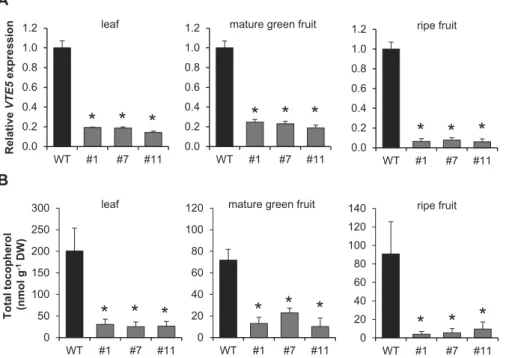
In order to obtain experimental evidence regarding SlVTE5 function in tocopherol biosynthesis, transgenic SlVTE5-knockdown plants were generated by RNAi-mediated silenc-ing. Out of eight primary transformants that showed reduced levels of SlVTE5 mRNA (see Supplementary Fig. S3 at JXB online), three lines with a reduction of >80% were selected for further analyses; SlVTE5-RNAi#1, SlVTE5-RNAi#7, and
SlVTE5-RNAi#11 (Fig. 2A). Under normal growth condi-tions, these transgenic lines exhibited no evident morphologi-cal alterations and an apparently unaltered pattern of fruit degreening (Supplementary Fig. S3B).
HPLC analysis revealed that down-regulation of SlVTE5 resulted in a dramatic reduction (80–90%) of total tocoph-erol contents both in leaves and in fruits (Fig. 2B). Overall, no differences in tocopherol composition were observed (Supplementary Table S2 at JXB online) except for line #7 at the mature green stage. Notably, we detected only traces of tocotrienols in SlVTE5-RNAi lines (data not shown). These results ruled out the possibility that depletion of tocopherols could be compensated by tocotrienol production in these plants.
The VTE5 deficiency in transgenic lines would be expected to increase free phytol content (Valentin et al., 2006). We therefore assayed the amount of this metabolite by GC-MS. While in mature leaves and ripe fruits of wild-type tomato
plants the amount of free phytol ranged from 100 nmol g−1
DW to 190 nmol g−1 DW, in the counterparts from
SlVTE5-RNAi lines this prenyl alcohol accumulated four to five times more (Fig. 3). Interestingly, the molar amount of free phytol that accumulated in leaves was of the same order of magni-tude as the reduction observed in total tocopherol contents. Strikingly, the increase in the amounts of free phytol in trans-genic ripe fruits was 10 times higher than the decrease in tocopherol (Supplementary Table S3 at JXB online), suggest-ing differential regulation in the response of phytol metabo-lism perturbations in source and sink tomato organs.
Due to sequence similarity between the tomato phosphati-date cytidylyltransferases proteins SlVTE5 and SlFOLK, and the lack of a complete functional characterization of the latter, the putative impact of SlFOLK on tocopherol metabolism was also explored. In this case, a TILLING-based molecular screening was applied to identify a loss-of-function mutation in SlFOLK using an EMS-mutagenized tomato collection. Among the identified mutants, one, named
folk-1, displayed a G to A substitution disrupting the 3′
splic-ing site of intron 4. Sequence analyses of folk-1 cDNA from homozygous mutant plants revealed that this lesion led to the use of a cryptic splicing site in intron 4, producing an mRNA that lacks exon 4 and contains a fragment of intron 4 (see Supplementary Fig. S4A at JXB online). This abnor-mally spliced transcript of FOLK, which is the only isoform
detected in the mutant, contains an in-frame premature stop codon that presumably leads to a truncated protein (Fig. 4A; Supplementary Fig. S4A, B). mRNA harboring premature termination codons can be recognized by the RNA surveil-lance machinery as aberrant; these transcripts may be tar-geted by the nonsense-mediated decay pathway, being rapidly degraded (Filichkin et al., 2015). Expression analysis by qPCR showed that the amount of the abnormal mRNA in
folk-1 corresponded to only 10% of the fully spliced
tran-script found in control plants (Supplementary Fig. S4C). Tocopherol levels and composition in plants homozygous for the folk-1 allele were much the same as those in control plants, suggesting a small, if any, contribution of SlFOLK to tocopherol biosynthesis in both leaves and fruits (Fig. 4B;
Supplementary Table S2). Having demonstrated the major role of VTE5 in tomato tocopherol metabolism, we further performed a comprehensive phenotypic characterization of
SlVTE5-RNAi lines.
Down-regulation of SlVTE5 boosted phytyl ester synthesis in leaves
Free phytol can be esterified directly with fatty acids derived from activated acyl groups. FAPEs increase during stress-associated Chl degradation (e.g. nitrogen deprivation) and
senescence (Gaude et al., 2007; Lippold et al., 2012). To
address the question of whether the increased phytol levels affect FAPE contents in the SlVTE5-RNAi lines, the level of
Relative VTE5 expression 0.0 0.2 0.4 0.6 0.8 1.0 1.2 WT #1 #7 #11
*
*
*
0 20 40 60 80 100 120 140 WT #1 #7 #11 A B 0 50 100 150 200 250 300 WT #1 #7 #11 0 20 40 60 80 100 120 WT #1 #7 #11 0.0 0.2 0.4 0.6 0.8 1.0 1.2 WT #1 #7 #11*
*
*
0.0 0.2 0.4 0.6 0.8 1.0 1.2 WT #1 #7 #11*
*
*
leaf mature green fruit ripe fruit
Total tocopherol (nmol
g
-1
DW)
*
*
*
*
*
*
*
*
*
leaf mature green fruit ripe fruit
Fig. 2. Down-regulation of SlVTE5 expression and tocopherol content in SlVTE5-RNAi transgenic lines. (A) Relative expression of the SlVTE5 gene in the
wild-type (WT) and SlVTE5-RNAi lines (#1, #7 and #11). Data are means ±SEM of five biological replicates. The asterisks denote statistically significant differences (permutation test, P<0.05). (B) Total tocopherol was measured in leaves, mature green, and ripe fruits of SlVTE5-RNAi lines. Data represent the mean ±SD of five biological replicates. The asterisks denote significant differences between the WT and the transgenic lines (ANOVA/Dunnett’s test,
P<0.05). 0 200 400 600 800 1000 1200 1400 1600 1800 WT #1 #7 #11
Free phytol (nmol g
-1 DW)
*
*
*
WT #1 #7 #11*
*
*
leaf ripe fruit
Fig. 3. Free phytol content in leaves and ripe fruits of the SlVTE5-RNAi transgenic lines. Data represent the mean ±SD of at least three biological
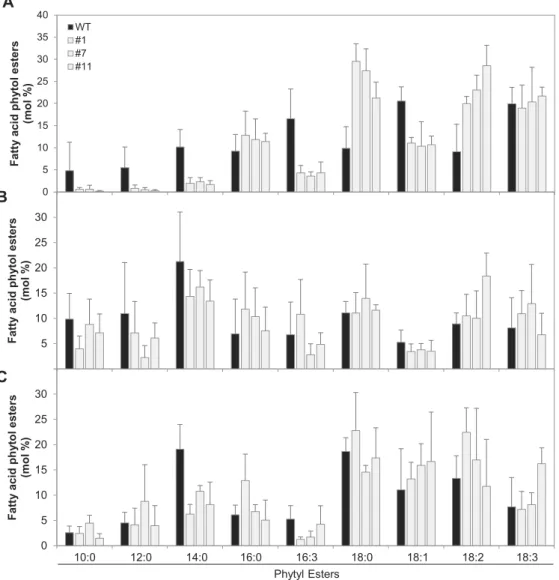
these compounds was measured by direct infusion Q-TOF MS/MS. Notably, SlVTE5 knockdown resulted in a dramatic increase of FAPE content up to 10-fold in leaves. In contrast, fruits from SlVTE5-RNAi lines exhibited levels of FAPE identical to those of wild-type plants (Fig. 5). In addition to the total amount, FAPE composition was also highly affected in transgenic leaves (Fig. 6A). With the exception of palmitic (16:0) and linolenic (18:3) acids, analysis of the lipid profiles showed that the contribution of the different acyl chains was not proportional to the increment in total FAPE con-tent observed in SlVTE5-RNAi lines. In particular, FAPEs containing oleic acid (18:1), hexadecatrienoic acid (16:3), and medium-chain fatty acids (10:0, 12:0, 14:0) exhibited a reduc-tion in their relative content, while FAPEs containing stearic acid (18:0) and linoleic acid (18:2) became the predominant
forms, increasing at least 2-fold in transgenic leaves compared with the wild-type. In SlVTE5-RNAi fruits, the FAPE com-position at mature green and ripe stages remained almost unchanged (Fig. 6B, C).
Chlorophyll content is not affected in SlVTE5-RNAi lines
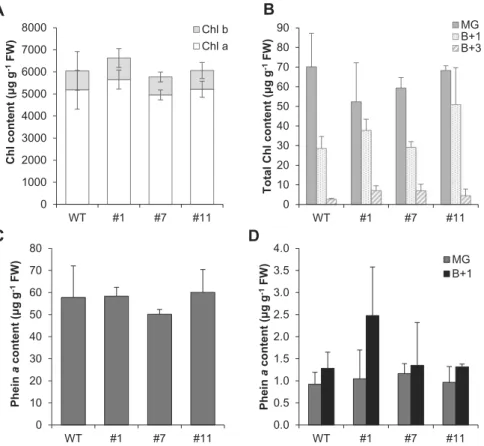
To examine whether SlVTE5 knockdown affects Chl metabo-lism, we determined Chl a, Chl b, and pheophytin a (Phein a) levels in leaves and fruits at three different ripening stages by HPLC. The contents of these compounds were largely unal-tered in both tested organs, suggesting that accumulation of phytol did not significantly affect Chl and Phein a levels in tomato (Fig. 7).
1 2 3 4 5 6
folk-1 mRNA
fully spliced WT mRNA
TGA ATG FOLK
A
B
0 40 80 120 160 200 240 0 150 300 450 600 750 0 25 50 75 100 125 150 control folk-1 Total tocopherol (nmol
g
-1
DW)
control folk-1 control folk-1
leaf mature green fruit ripe fruit
Fig. 4. Total tocopherol content in the folk-1 mutant. (A) Diagram showing the SlFOLK gene and fully spliced mRNA found in the wild-type (WT) and
abnormally spliced mRNA found in the folk-1 mutant. Boxes and solid lines represent exons and introns, respectively. The premature stop codon is indicated by a black hexagon. (B) Total tocopherol was measured in leaves, mature green, and ripe fruits of M4 plants homozygous for the folk-1 allele. The corresponding segregating individuals homozygous for the FOLK WT allele were used as control. Data represent the mean ±SD of five biological replicates. No significant differences were observed (Student’s t-test, P>0.05).
0 500 1000 1500 2000 2500 3000 3500 4000 4500 WT #1 #7 #11 Fatty acid phy ty l esters (nmol g -1 DW )
*
*
*
leaf WT #1 #7 #11 WT #1 #7 #11*
mature green fruit ripe fruit
Fig. 5. Total fatty acid phytyl ester (FAPE) content in SlVTE5-RNAi transgenic lines. Data represent the mean ±SD of at least three biological replicates.
SlVTE5 knockdown alters prenyllipid metabolism in fruits
In addition to tocopherols, the plastidial antioxidant net-work includes a variety of prenyllipids derived from the MEP isoprenoid pathway with strong antioxidant proper-ties, such as carotenoids, prenylquinones (PQ-9), and other tocochromanols (e.g. PC-8) (Nowicka et al., 2013). To investigate whether tocopherol deficiency in SlVTE5-RNAi lines is compensated by any other non-enzymatic antioxi-dant mechanism, we performed a comprehensive profiling of prenyllipids (Table 1). For determination of prenylqui-none and their derivative compounds, a targeted analysis of lipidomic profile obtained by the UHPLC-QTOF MS method was performed, whereas carotenoids were quanti-fied by HPLC. In leaves and ripe fruits of the transgenic plants, depletion of tocopherol was accompanied by a decrease of α-tocopherolquinone, an oxidized interme-diate of the tocopherol redox cycle; yet, the level of this metabolite remained unchanged in mature green fruits.
Remarkably, the levels of the photosynthetic electron car-rier phylloquinone (vitamin K), another product of phy-tyl diphosphate-dependent biosynthesis, did not change between SlVTE5-RNAi lines and the wild-type control.
The presence of the reduced and oxidized forms of PQ-9 in wild-type tomato leaves has already been reported (Jones et al., 2013), and our data showed that PC-8 is also detected in
S. lycopersicum, in both leaves and fruits (see Supplementary Fig. S5 at JXB online). PC-8 was less abundant than toco-pherols in wild-type tomato leaves, as described for other species (Kruk et al., 2014). In fruits, however, the amount of these tocochromanols was similar (Fig. 2; Supplementary Fig. S5).
The comparison of prenyllipid profiles between wild-type and SlVTE5-knockdown leaves revealed that PQ-9 forms
(PQ-9, PQH2-9, and PQ-OH) remained unchanged. In
con-trast, a reduction to 50% of PC-8 content was observed in
SlVTE5-RNAi lines, which was accompanied by lower levels
of its oxidation product, PC-OH (Table 1). In sharp contrast, the prenylquinone pool of transgenic fruits was significantly
5 10 15 20 25 30 Fatty acid phy tol esters (mol % ) 0 5 10 15 20 25 30 Fatt y acid phy tol esters (mol % ) A C 0 5 10 15 20 25 30 35 40 Fatty acid phy tol esters (mol % ) WT #1 #7 #11 10:0 12:0 14:0 16:0 16:3 18:0 18:1 18:2 18:3 Phytyl Esters B
Fig. 6. Molecular species composition of fatty acid phytyl esters (FAPEs) in SlVTE5-RNAi transgenic lines. FAPEs were measured in leaves (A), mature
increased. PQ-9 levels were >2-fold higher in the
SlVTE5-RNAi lines, although the levels of the reduced form PQH2-9
were unchanged. Intriguingly, the levels of the mitochondrial prenylquinone UQ-10 were also ~2-fold increased in SlVTE5-RNAi fruits. In addition, PC-8 accumulated up to 2-fold in both mature green and ripe fruits of the transgenic lines (Table 1). These results suggest that the pool of PQ-9 and PC-8 contributes to fulfilling an antioxidant function in the transgenic fruits.
Carotenoid contents in leaves and mature green fruits remained largely unaltered in the SlVTE5-RNAi lines (Table 1). Although no differences in visual appearance were identified (see Supplementary Fig. S3B at JXB online), at the ripe stage, silenced fruits exhibited 30% less lycopene than those of wild-type plants, which was also accompanied by an equivalent reduction in levels of lycopene precursors
(phy-toene, phytofluene, and ζ-carotene).
Considering the differences observed in prenyllipid profiles, the total antioxidant capacity of SlVTE5-RNAi and wild-type tomato plants was evaluated in non-polar extracts by the TEAC assay. Transgenic ripe fruits showed a reduction in TEAC values in lines #1 and #11 (see Supplementary Fig. S6 at JXB online). These results emphasize the role of tocoph-erol and/or carotenoids in antioxidant protection, since the increase in prenyllipid contents exhibited in the fruits of the
SlVTE5-RNAi lines did not compensate the TEAC values up
to the values observed in wild-type plants.
VTE5 deficiency affects the expression of tocopherol metabolism-related genes
The biochemical profile described above showed that SlVTE5 knockdown results in an adjustment in prenyllipid and FAPE metabolism in an organ-specific manner. In order to under-stand whether these changes could be associated with dif-ferential gene expression regulation, mRNA levels of genes encoding proteins involved in MEP, shikimate, tocochro-manol, carotenoid, and Chl metabolism (Quadrana et al., 2013; Lira et al., 2014; Almeida et al., 2015), as well as in prenylquinone and FAPE synthesis were measured by qPCR (Fig. 1). Genes that showed significantly different mRNA lev-els in at least two transgenic SlVTE5-RNAi lines and, when applicable, the third followed the same trend are shown in Fig. 8. The complete set of data is shown in Supplementary Table S4 at JXB online.
Genes of tocochromanol biosynthesis did not exhibit a consistent expression tendency in leaves of SlVTE5-RNAi lines. In fruit, the elevated expression of HPPD(1) and
HPPD(2) is consistent with the increased prenylquinone
content in silenced plants. Moreover, in transgenic ripe fruit,
VTE3(1) up-regulation also coincided with the higher
con-tent of PC-8 and PQ-9. Intriguingly, the expression of the gene encoding the solanesyl diphosphate synthase (SPS), which catalyzes the production of the PQ-9 or PC-8 prenyl side chain, was decreased in transgenic mature green fruits, suggesting a negative feedback regulatory mechanism.
0 1000 2000 3000 4000 5000 6000 7000 8000 WT #1 #7 #11 Chl c ontent (μg g -1 FW) Chl b Chl a A B 0 10 20 30 40 50 60 70 80 90 WT #1 #7 #11 T o tal Ch l c ontent (μg g -1 FW) MG B+1 B+3 0.0 0.5 1.0 1.5 2.0 2.5 3.0 3.5 4.0 WT #1 #7 #11 Phei n a content (μg g -1 FW) MG B+1
C
D 0 10 20 30 40 50 60 70 80 WT #1 #7 #11 Phei n a content (μg g -1 FW)Fig. 7. Chlorophyll (Chl) and pheophytin a (Phein a) content in SlVTE5-RNAi transgenic lines. (A, C) Quantification of Chl and Phein a in leaves. (B, D)
Quantification of Chl and Phein a in fruits at mature green (MG), breaker+1 (B+1), and breaker+3 (B+3) stage. Data represent the mean ±SD of at least three biological replicates. No significant differences were observed (ANOVA/Dunnett’s test, P>0.05).
In leaves, an apparent reduction in the Chl degrada-tion pathway was observed in SlVTE5-RNAi lines, as indi-cated by a down-regulation of STAY-GREEN1 (SGR1) and
PHEOPHORBIDE A OXYGENASE (PAO) expression.
Although Chl contents remained invariant, the observed transcriptional down-regulation may reflect a response
to phytol accumulation. This scenario contrasts with that observed in fruits where SGR1 was up-regulated in trans-genic plants compared with the wild-type. Additionally, ripe fruit of SlVTE5-RNAi lines showed higher mRNA levels of
PHEOPHYTINASE (PPH).
Regarding carotenoid biosynthesis, only certain genes showed significant changes in their mRNA levels in leaves and mature green fruits of the SlVTE5-RNAi lines, although the biochemical profiles of these compounds remained unal-tered when compared with the wild-type. In contrast, in ripe fruits, the increased levels of CHROMOPLAST-SPECIFIC
β-LYCOPENE CYCLASE (CYC-β) transcripts could
account for the reduction in lycopene and its immediate pre-cursors verified in the transgenic lines.
Finally, the PALE YELLOW PETAL 1 (PYP1) gene, the ortholog of Arabidopsis PHYTYL ESTER SYNTHASE1 (PES1) (Ariizumi et al., 2014), showed increased levels of transcripts in the leaves of the SlVTE5-RNAi lines, in agree-ment with the higher FAPE contents observed in these organs. Thus, the analysis of transcriptional profiles reinforces the specific regulation occurring in leaves and fruits.
Measurements of carbohydrate metabolism,
photosynthesis, and yield parameters suggest carbon export impairment in SlVTE5-knockdown plants
To evaluate whether the observed tocopherol deficiency in
SlVTE5-RNAi lines affects carbon fixation and
partition-ing, the starch and soluble sugar content, photosynthetic performance, and yield parameters were assessed. Leaves of 5-week-old transgenic plants showed up to a 4.5-fold increase in starch content accompanied by a 20% decrease in sucrose levels compared with the wild-type control in the middle of the light period (Fig. 9). Concomitantly, the carbon assimi-lation rates were reduced in SlVTE5-RNAi lines, while the
efficiency of PSII activity (ΦPSII) displayed moderate
reduc-tion (Fig. 10). The chloroplast ultrastructure was mostly preserved in SlVTE5-knockdown plants (see Supplementary Fig. S7 at JXB online).
In agreement with carotenoid profiling and the gene expres-sion pattern, transgenic plants displayed a delay in fruit devel-opment and ripening as indicated by the frequency of red and green fruits, as well as the red fruit yield compared with the control genotype at harvest time (Table 2). Moreover, they displayed a yield penalty evidenced by a modest reduction in the harvest index. These results suggest that efficiency in pho-tosynthate partitioning is compromised by the tocopherol deficiency in transgenic lines.
Discussion
Several reports have dissected tocopherol biosynthesis, iden-tified quantitative trait loci (QTLs) that determine VTE accumulation, and characterized regulatory mechanisms that control the tocopherol biosynthetic pathway (Almeida et al., 2011; DellaPenna and Mène-Saffrané, 2011; Martinis et al., 2013, 2014; Quadrana et al., 2013, 2014; Zhang et al., Table 1. Changes in prenyllipid contents in leaves and fruits of
SlVTE5-RNAi transgenic lines compared with the wild-type
Data were normalized to sample DW and expressed relative to the wild-type (WT) in each tissue.
Prenyllipids (relative amounts) WT SlVTE5-RNAi #1 #7 #11 Leaf α-TQ 1.00 ± 0.18 0.23 ± 0.03 0.22 ± 0.08 0.24 ± 0.01 PC-8 1.00 ± 0.30 0.52 ± 0.19 0.54 ± 0.19 0.36 ± 0.07 PQ-9 1.00 ± 0.18 0.83 ± 0.15 0.87 ± 0.20 0.63 ± 0.12 PQH2-9 1.00 ± 0.66 1.27 ± 0.59 1.02 ± 0.43 0.86 ± 0.37 PC-OH 1.00 ± 0.21 0.65 ± 0.18 0.72 ± 0.24 0.51 ± 0.11 PQ-OH 1.00 ± 0.20 1.01 ± 0.26 1.04 ± 0.27 0.70 ± 0.19 UQ-10 1.00 ± 0.24 0.83 ± 0.23 0.81 ± 0.12 0.81 ± 0.10 Phylloquinone 1.00 ± 0.16 0.87 ± 0.12 0.84 ± 0.12 0.81 ± 0.12 β-Carotene 1.00 ± 0.07 0.89 ± 0.04 0.91 ± 0.02 0.91 ± 0.07 Lutein 1.00 ± 0.07 0.97 ± 0.06 0.96 ± 0.03 0.95 ± 0.03 Violaxanthin/neoxanthin 1.00 ± 0.06 0.97 ± 0.06 1.00 ± 0.02 0.99 ± 0.06 Mature green fruit
α-TQ 1.00 ± 0.15 1.11 ± 0.48 1.20 ± 0.47 1.13 ± 0.10 PC-8 1.00 ± 0.15 1.89 ± 0.26 1.78 ± 0.05 1.88 ± 0.19 PQ-9 1.00 ± 0.15 2.11 ± 0.46 2.22 ± 0.42 2.22 ± 0.26 PQH2-9 1.00 ± 0.30 0.77 ± 0.23 1.24 ± 0.36 1.16 ± 0.36 PC-OH 1.00 ± 0.42 0.89 ± 0.34 1.10 ± 0.30 1.02 ± 0.29 PQ-OH 1.00 ± 0.26 1.31 ± 0.49 1.74 ± 0.47 1.52 ± 0.32 UQ-10 1.00 ± 0.13 2.13 ± 0.24 1.76 ± 0.28 1.93 ± 0.34 Phylloquinone 1.00 ± 0.27 1.23 ± 0.18 1.25 ± 0.32 1.32 ± 0.16 β-Carotene 1.00 ± 0.22 0.96 ± 0.16 0.92 ± 0.15 1.00 ± 0.16 Lutein 1.00 ± 0.22 0.98 ± 0.10 1.09 ± 0.11 1.31 ± 0.15 Violaxanthin/neoxanthin 1.00 ± 0.34 0.85 ± 0.16 0.85 ± 0.07 1.28 ± 0.20 Ripe fruit α-TQ 1.00 ± 0.25 0.54 ± 0.04 0.64 ± 0.17 0.64 ± 0.15 PC-8 1.00 ± 0.15 2.29 ± 0.34 1.67 ± 0.20 2.07 ± 0.50 PQ-9 1.00 ± 0.17 2.40 ± 0.54 2.24 ± 0.20 1.76 ± 0.26 PQH2-9 1.00 ± 0.29 1.55 ± 0.39 1.77 ± 0.55 1.92 ± 1.06 PC-OH 1.00 ± 0.27 1.26 ± 0.51 1.35 ± 0.46 0.99 ± 0.42 PQ-OH 1.00 ± 0.07 2.27 ± 1.03 2.24 ± 0.80 2.10 ± 0.94 UQ-10 1.00 ± 0.14 2.40 ± 0.38 1.96 ± 0.53 2.13 ± 0.24 Phylloquinone 1.00 ± 0.18 1.11 ± 0.18 1.32 ± 0.50 1.41 ± 0.50 Phytoene 1.00 ± 0.09 0.68 ± 0.11 0.72 ± 0.19 0.62 ± 0.10 Phytofluene 1.00 ± 0.14 0.72 ± 0.13 0.66 ± 0.14 0.64 ± 0.08 Neurosporene 1.00 ± 0.22 0.73 ± 0.24 0.97 ± 0.18 0.60 ± 0.20 ζ-Carotene 1.00 ± 0.20 0.44 ± 0.17 0.33 ± 0.19 0.39 ± 0.18 Lycopene 1.00 ± 0.06 0.78 ± 0.14 0.70 ± 0.08 0.74 ± 0.13 β-Carotene 1.00 ± 0.06 0.87 ± 0.20 0.86 ± 0.16 0.90 ± 0.14 Lutein 1.00 ± 0.13 1.07 ± 0.13 1.02 ± 0.09 1.19 ± 0.25
Values are represented as means ±SD. Terms in bold indicate a statistically significant difference by ANOVA/Dunnett’s test (P<0.05). α-TQ, α-tocopherolquinone; PQ-9, plastoquinone-9; PQH2
-9, plastoquinol-9; PQ-OH, hydroxy-plastoquinone; PC-8, plastochromanol-8; PC-OH, hydroxy-plastochromanol; UQ-10, ubiquinone-10.
2013; Zhang et al., 2014). One well-defined metabolic con-straint is the availability of phytyl diphosphate precursor for tocopherol biosynthesis, which can be derived from de
novo biosynthesis via the MEP pathway and from Chl phytol
tail recycling (Ischebeck et al., 2006; Quadrana et al., 2013; Zhang et al., 2013). The phytol hydrolysis of Chl is the pri-mary source of prenyl chain for tocopherol biosynthesis in Arabidopsis seeds (Valentin et al., 2006). However, functional analysis of the phytol salvage pathway has been limited to this species. In this study, we investigated the contribution of VTE5-mediated phytyl diphosphate synthesis for tocopherol production and its impact on plant physiology in tomato. The comprehensive metabolite profiling, expression analy-ses, and evaluation of photosynthetic parameters performed in tomato SlVTE5-knockdown plants allowed us to gain insights into the interactions between phytol recycling, and
lipid and carbon metabolism, exposing distinct metabolic adjustment in source and sink organs.
Even with an active de novo synthesis of phytyl diphosphate, down-regulation of SlVTE5 dramatically reduces tocopherol content in leaves and fruits in comparison with the wild-type genotype. These data demonstrated that in tomato, tocoph-erol production is mostly dependent on the Chl-linked path-way for phytyl diphosphate synthesis in both vegetative and reproductive organs. Furthermore, these findings suggest that
SlVTE5 is the main—if not the sole—contributor to VTE5
activity. The analysis of the tomato folk-1 mutant suggested that SlFOLK is not involved in reactivation of free phytol.
Coincident with SlVTE5 down-regulation, free phy-tol, the substrate of the phytol kinase reaction, accumu-lates in leaves of transgenic lines. Interestingly, the amount of free phytol accumulated corresponds to the decrease in
mRNA relative expression (log 2 fold-change ) -3.0 -2.5 -2.0 -1.5 -1.0 -0.5 0.0 0.5 1.0 1.5 VTE2 VTE3(1)
VTE4 VTE5 SGR1 PAO
PYP/PES(1) PDS CYC-β -3.0 -2.5 -2.0 -1.5 -1.0 -0.5 0.0 0.5 1.0 1.5 SPS HPPD(1) HPPD(2) VTE5 SGR1 PSY(1) PDS CYC-β -4.5 -3.5 -2.5 -1.5 -0.5 0.5 1.5 2.5 HPPD(1) HPPD(2) VTE3(1)
VTE5 FOLK SGR1 PPH
CYC-β
leaf mature green fruit ripe fruit
Fig. 8. Changes in gene expression levels of some key isoprenoid metabolism-related genes resulting from SlVTE5 down-regulation in both leaves
and fruits.The amount of mRNA of the enzyme-encoding genes shown in Fig. 1 was quantified. Expression data are means ±SEM of three biological replicates of log2-fold changes compared with the corresponding organ of the wild-type control. Only genes that showed significantly different mRNA levels in SlVTE5-knockdown lines are shown (permutation test, P<0.05). For simplicity, solely data from SlVTE5-RNAi#7 are represented. The complete data set is available in Supplementary Table S4 at JXB online.
0 5 10 15 20 25 30 35 WT #1 #7 #11 Sucrose (μg mg -1 DW )
*
*
*
0 10 20 30 40 50 WT #1 #7 #11 Glucose (μg mg -1 DW )*
0 10 20 30 40 50 60 70 WT #1 #7 #11 Fructose (μg mg -1 DW )*
0 20 40 60 80 100 120 WT #1 #7 #11 Starch (μg mg -1 DW )*
*
Fig. 9. Starch and soluble sugar levels in source leaves in SlVTE5-RNAi transgenic lines. The first fully expanded leaves were harvested from 5-week-old
plants in the middle of the light cycle. Starch is given in µg glucose equivalents. Data are means ±SD of five biological replicates. The asterisks denote significant differences between the wild-type (WT) and the transgenic lines (ANOVA/Dunnett’s test, P<0.05).
tocopherol content, suggesting that a large proportion of phytol diphosphate derived from the phytol phosphoryla-tion pathway is used for tocopherol biosynthesis in tomato. Furthermore, FAPEs are strongly increased in the mature leaves of SlVTE5-RNAi lines, although the Chl levels remain unchanged. FAPEs are plastogobule compounds that repre-sent a class of stress-induced lipids in higher plants, which may act as plastidial transient sinks for the deposition of fatty acids and phytol (Gaude et al., 2007). Since the phytol moiety of FAPEs is mostly derived from Chl degradation (Lippold et al., 2012), our findings raise an intriguing issue concern-ing the origin of the phytol that sustains FAPE synthesis in
SlVTE5-knockdown plants. One possible explanation may
be that perturbations in phytol metabolism caused by the lack of VTE5 activity promote an increase in Chl turnover in transgenic lines. In leaves, the increased steady-state phy-tol levels were channeled to FAPE synthesis, while in fruits phytol remained as the free form. Alternatively, the origin of FAPE-associated phytol might be explained by the impair-ment in catabolism, which in plants involves the production of phytenoyl-CoA in chloroplasts that is further degraded by α-oxidation in peroxisomes and mitochondria, similar to that described in animals (Araújo et al., 2011). Notably, levels of phylloquinone, another phytyl diphosphate chain-containing molecule, were unchanged in both leaves and fruits, indicat-ing that the VTE5-dependent phytol pathway does not affect vitamin K synthesis in tomato. This result coincides with the previous observation of feeding experiments of Arabidopsis seedlings with radiolabeled phytol (Ischebeck et al., 2006).
Even under permissive growing conditions, VTE5-tocopherol deficiency not only impacts the lipid profile but also carbon metabolism and photosynthesis, having conse-quences on the tomato plant physiology. SlVTE5-RNAi lines showed higher starch accumulation in mature leaves that
correlated with a lower CO2 assimilation rate and the
reduc-tion in PSII operating efficiency. This scenario suggests car-bohydrate-mediated feedback inhibition rather than a direct impact of tocopherol deficiency on photosynthetic capacity (Adams et al., 2013; Asensi-Fabado et al., 2014). Moreover, a subtle reduction in the number of harvestable fruits and the harvest index was observed. These results could be indicative of sugar export blockage from leaves towards sink organs in
SlVTE5-knockdown tomato plants. Photoassimilate export
impairment mediated by tocopherol deficiency has been reported in the literature, such as in potato VTE1-RNAi
lines (Hofius et al., 2004; Asensi-Fabado et al., 2014) and
vte2 A. thaliana during low-temperature adaptation (Maeda et al., 2006, 2008), where carbon accumulation was verified in source leaves at the end of the light period. How tocopherol influences photoassimilate partitioning has not been precisely addressed yet. However, Song et al. (2010) provided robust genetic evidence that alterations in extra-plastidic lipid metab-olism are upstream of the defect in photoassimilate export in VTE-deficient plants, which is mediated by fatty acid desatu-rases (FADs). In particular, it was reported that VTE deple-tion led to increased linoleic acid (18:2) content and a reduced level of linolenic acid (18:3). Consistent with this, one of the acyl groups that mostly contribute to the increase in the total FAPEs in the chloroplasts of the SlVTE5-RNAi lines was 18:2. Additionally, our lipidomic data revealed that the plastidial digalactosyldiacylglycerol (DGDG), which mainly consists of pairs including 18:3 species, was reduced in leaves of SlVTE5-RNAi lines compared with the wild-type (see Supplementary Table S5 at JXB online), resembling the lipid
alterations previously reported (Maeda et al., 2006, 2008).
It has been proposed that changes in membrane lipid com-position as a result of tocopherol deficiency might affect the properties of the secretory membrane systems (Maeda et al., 2008, 2014). Since tomato has been described as an apoplastic phloem loader (Muller et al., 2014), we could speculate that the alteration of endomembrane vesicle formation affects the sucrose efflux mediated by SWEET proteins, which have been described as key players in phloem transport (Chen et al., 2012; McCurdy and Hueros, 2014). Alternatively, the carbon export impairment observed in SlVTE5-knockdown tomato plants could be the result of the interaction between lipid and sugar metabolism by an as yet unidentified mechanism prob-ably involving sugar sensing proteins, as proposed by Asensi-Fabado et al. (2014).
VTE5 deficiency triggered different metabolic responses in fruits compared with those described for leaves, reflecting the intrinsic physiological differences between organs and their corresponding plastids. First, fruits of SlVTE5-knockdown plants accumulated phytol in the free form rather than chan-neled into synthesis of FAPEs. This might be explained by the lowered availability of acyl donors inherent to fruit-specific lipid metabolism (Domínguez et al., 2010). Secondly, the obser-vation that the non-tocopherol prenylquinone pool, including PQ-9 and PC-8, is increased in fruits of SlVTE5-knockdown plants suggests that a regulatory compensation mechanism between the tocopherol and prenylquinone pathways exists in
this organ. The ability of plastoquinol (PQH2-9), ubiquinol
Table 2. Yield-associated traits of SlVTE5-RNAi transgenic lines
Trait WT SlVTE5-RNAi
#1 #7 #11
Number of total fruits 36.2 ± 5.8 37.4 ± 4.7 40.8 ± 4.3 35.8 ± 1.5 Frequency red fruits (%) 63.9 ± 6.9 49.6 ± 7.8 54.0 ± 11.5 53.3 ± 8.8 Frequency green fruits
(%)
37.3 ± 6.9 50.4 ± 7.8 46.0 ± 11.5 46.7 ± 8.8 Vegetative plant weight
(g FW)
30.0 ± 8.3 34.3 ± 8.0 39.4 ± 6.9 34.0 ± 7.3 Total yield per plant
(g FW) 114.4 ± 17.2 115.9 ± 11.3 125.9 ± 28.8 101.6 ± 16.9 Harvest index 0.79 ± 0.02 0.77 ± 0.04 0.76 ± 0.02 0.75 ± 0.03 Red yield/aerial biomass ratio 0.57 ± 0.08 0.47 ± 0.11 0.50 ± 0.09 0.52 ± 0.15
Vegetative plant weight was determined by weighing only the vegetative tissue (after harvesting the fruits) without the root. Harvest index was calculated as the ratio between total fresh yield per plant (red and green fruit mass) and aerial biomass (total yield+vegetative plant weight).
Values indicate the mean ±SD of phenotypic values (n=5) determined for 15-week-old plants. Statistically significant differences between the wild-type (WT) control and transgenic lines are indicated in bold (Student’s t-test, P<0.05).
(UQH2-10), the reduced forms of PQ-9 and UQ-10, respec-tively, and PC-8 to scavenge ROS and inhibit lipid peroxida-tion has been demonstrated before (Kruk and Trebst, 2008; Nowicka et al., 2013; Rastogi et al., 2014). Moreover, PQ-9 and PC-8 have already been associated with inhibition of lipid
peroxidation and 1O
2 scavenging in VTE-deficient Arabidopsis
vte2 mutants (Mène-Saffrané et al., 2010). Likewise, in tomato leaves, the reduction of PQ-9 content by the virus-induced gene silencing approach resulted in increased tocopherol and UQ-10 levels (Jones et al., 2013). Interestingly, the favora-ble biochemical environment for the accumulation of PQ-9 and PC-8 is supported not only by reduced flux through the
tocopherol competing pathway but also by the HPPD and
VTE3 up-regulation in this organ. Finally, SlVTE5-RNAi
ripe fruits exhibited perturbations in the carotenoid path-way. The reduced amount of lycopene and its biosynthetic precursors can be explained by the higher transcript levels of SGR1 found at the mature green and ripe stages. Besides having an important role in the regulation of plant Chl deg-radation and senescence (Hörtensteiner, 2009), SGR1 also regulates lycopene and β-carotene biosynthesis by direct inter-action with PSY(1), thereby inhibiting its activity (Luo et al., 2013). Simultaneously, the failure of co-ordinate
transcrip-tional repression of the CYC-β gene in SlVTE5-knockdown
0.0 0.1 0.2 0.3 0.4 0.5 0.6 0.7 0.8 WT #1 #7 #11 Fv '/F m '
*
0.0 0.1 0.2 0.3 0.4 0.5 0.6 WT #1 #7 #11 ΦPSII*
*
0.00 0.02 0.04 0.06 0.08 0.10 0.12 WT #1 #7 #11 gs (μ mol m -2.s -1) 0.0 1.0 2.0 3.0 4.0 5.0 WT #1 #7 #11 Rd (μ mol m -2.s -1)A
B
C
D
E
-4.0 -2.0 0.0 2.0 4.0 6.0 8.0 10.0 12.0 14.0 0 100 200 300 400 500 600 A ssimilation (μmol CO 2 m -2 s -1)Photosynthetic photon flux density (μ mol m-2s-1)
WT #1 #7 #11
*
**
*
Fig. 10. Gas-exchange and PSII efficiency parameters in SlVTE5-RNAi transgenic lines. (A) The response of carbon assimilation (A) to light intensity. (B)
Leaf stomatal conductance (gs). (C) Leaf dark respiration (Rd). (D) Light-adapted PSII maximum quantum efficiency (Fಿv/Fಿm). (E) PSII operating efficiency (ΦPSII). Data correspond to measurements in the first fully expanded leaf of 5-week-old plants and represent the means ±SD of five biological replicates.
ripe fruits could also account for the reduced abundance of acyclic carotenoids. The amounts of β-carotene and lutein in transgenic fruits were similar to those in the wild-type at the expense of the preceding carotenoids. Additionally, it has been demonstrated that the level of PPH transcripts decreases dur-ing tomato fruit ripendur-ing (Lira et al., 2014); however, SlVTE5-RNAi ripe fruits displayed higher levels of PPH transcripts than the wild-type. Thus, the comprehensive analysis of the biochemical and transcriptional data together with the results of the yield experiment indicates that the ripe profiled trans-genic fruits are indeed less ripe than wild-type fruits. The reduction in carbohydrate export described above might be in part responsible for the delay in fruit development and ripen-ing, resulting in a reduced proportion of mature fruits at har-vest time in SlVTE5-knockdown plants.
The results presented here clearly show that in tomato VTE biosynthesis is largely dependent on the salvage path-way for phytyl diphosphate synthesis rather than the de novo synthesis from the MEP pathway in both leaves and fruits. VTE5 deficiency affected lipid metabolism, evidenced by the abundance and composition of FAPEs in leaves and prenylquinones in fruits. Together, these results exposed the complexities of the metabolic regulation that emerge from the isoprenoid pathway network, which involves a tight con-trol between precursor supply and utilization highly depend-ent on the plastid type. Moreover, our data highlighted the cross-talk between lipid and carbon metabolism mediated by tocopherol that resulted in the impairment of carbon export in SlVTE5-knockdown tomato plants compromising fruit development and ripening.
Supplementary data
Supplementary data are available at JXB online. Table S1. Primers used for each experiment.
Table S2. Tocopherol content and composition of SlVTE5-RNAi transgenic lines and the folk-1 mutant.
Table S3. Moles of prenyllipids found in SlVTE5-RNAi transgenic lines.
Table S4. Transcriptional profile of genes encoding isopre-noid metabolism-related enzymes.
Table S5. Changes in fatty acid-derived lipids in leaves of
SlVTE5-RNAi transgenic lines compared with the wild-type.
Fig. S1. Phylogenetic analysis of VTE5 and FOLK proteins. Fig. S2. Expression of SlVTE5 and SlFOLK.
Fig. S3. Fruit phenotype of SlVTE5-RNAi transgenic lines. Fig. S4. Analysis of the folk-1 mutation.
Fig. S5. Plastoquinone (PQ-9) and plastochromanol (PC-8) levels in SlVTE5-RNAi transgenic lines.
Fig. S6. Trolox equivalent antioxidant capacity (TEAC) in leaves and fruits of SlVTE5-RNAi transgenic lines.
Fig. S7. Chloroplast ultrastructure resulting from SlVTE5 down-regulation.
Acknowledgements
This work was supported by grants from FAPESP (Brazil), CNPq (Brazil), the European Union (European Solanaceae Integrated Project
FOOD-CT-2006-016214), and Swiss National Science Foundation grants 31003A_127380, 31003A_144156, and IZEBZO-143169/1.
References
Abbasi AR, Hajirezaei M, Hofius D, Sonnewald U, Voll LM. 2007.
Specific roles of α- and γ-tocopherol in abiotic stress responses of transgenic tobacco. Plant Physiology 143, 1720–1738.
Adams WW, Muller O, Cohu CM, Demmig-Adams B. 2013. May
photoinhibition be a consequence, rather than a cause, of limited plant productivity? Photosynthesis Research 117, 31–44.
Almeida J, Asís R, Molineri VN, Sestari I, Lira BS, Carrari F, Peres LE, Rossi M. 2015. Fruits from ripening impaired, chlorophyll degraded
and jasmonate insensitive tomato mutants have altered tocopherol content and composition. Phytochemistry 111, 72–83.
Almeida J, Quadrana L, Asís R, et al. 2011. Genetic dissection of
vitamin E biosynthesis in tomato. Journal of Experimental Botany 62, 3781–3798.
Amaral LIV, Gaspar M, Costa PF, Aidar MPM, Buckeridge MS. 2008.
Novo método enzimático rápido e sensível de extração e dosagem de amido em materiais vegetais. Hoehnea 34, 425–431.
Araújo WL, Ishizaki K, Nunes-Nesi A, et al. 2011. Analysis of a range
of catabolic mutants provides evidence that phytanoyl-coenzyme A does not act as a substrate of the electron-transfer flavoprotein/electron-transfer flavoprotein, ubiquinone oxidoreductase complex in Arabidopsis during dark-induced senescence. Plant Physiology 157, 55–69.
Ariizumi T, Kishimoto S, Kakami R, et al. 2014. Identification of the
carotenoid modifying gene PALE YELLOW PETAL 1 as an essential factor in xanthophyll esterification and yellow flower pigmentation in tomato (Solanum lycopersicum). The Plant Journal 79, 453–465.
Asensi-Fabado MA, Ammon A, Sonnewald U, Munné-Bosch S, Voll LM. 2014. Tocopherol deficiency reduces sucrose export from
salt-stressed potato leaves independently of oxidative stress and symplastic obstruction by callose. Journal of Experimental Botany 66, 957–971.
Botella-Pavía P, Besumbes O, Phillips MA, Carretero-Paulet L, Boronat A, Rodriguez-Concepcion M. 2004. Regulation of carotenoid
biosynthesis in plants, evidence for a key role of hydroxymethylbutenyl diphosphate reductase in controlling the supply of plastidial isoprenoid precursors. The Plant Journal 40, 188–199.
Chen LQ, Qu XQ, Hou BH, Sosso D, Osorio S, Fernie AR, Frommer WB. 2012. Sucrose efflux mediated by SWEET proteins as a key step for
phloem transport. Science 335, 207–211.
Chun J, Lee J, Ye L, Exler J, Eitenmiller RR. 2006. Tocopherol and
tocotrienol contents of raw and processed fruits and vegetables in the United States diet. Journal of Food Composition and Analysis 19, 196–204.
DellaPenna D, Mène-Saffrané L. 2011. Vitamin E. Advances in
Botanical Research 59, 179–227.
DellaPenna D, Pogson BJ. 2006. Vitamin synthesis in plants:
tocopherols and carotenoids. Annual Review of Plant Biology 57, 711–738.
Demmig-Adams B, Stewart JJ, Adams WW. 2014. Multiple feedbacks
between chloroplast and whole plant in the context of plant adaptation and acclimation to the environment. Philosophical Transactions of the Royal Society B: Biological Sciences 369, 20130244.
De Souza AP, Arundale RA, Dohleman FG, Long SP, Buckeridge MS.
2013. Will the exceptional productivity of Miscanthus×giganteus increase further under rising atmospheric CO2? Agricultural and Forest Meteorology
171–172, 82–92.
Di Mascio P, Devasagayam TP, Kaiser S, Sies H. 1990. Carotenoids,
tocopherols and thiols as biological singlet molecular oxygen quenchers. Biochemical Society Transactions 18, 1054–1056.
Di Rienzo JA. 2009. Statistical software for the analysis of experiments
of functional genomics. RDNDA, Argentina. http://sites.google.com/site/ fgStatistics/.
Domínguez T, Hernández ML, Pennycooke JC, Jiménez P, Martínez-Rivas JM, Sanz C, Stockinger EJ, Sánchez-Serrano JJ, Sanmartín M. 2010. Increasing ω-3 desaturase expression in tomato
results in altered aroma profile and enhanced resistance to cold stress. Plant Physiology 153, 655–665.