Knowledge,
Resources and Markets: What Economic
System
of Valuation?
HUGUES
JEANNERAT* and LEÏLA KEBIR†
* Institute of Sociology, University of Neuchâtel, Fbg de l’Hôpital 27, CH-2000 Neuchâtel, Switzerland. Email: [email protected]
†Ecole des ingénieurs de la Ville de Paris, 80 rue Rébeval, F-75019 Paris, France. Email: [email protected]
JEANNERATH. and KEBIRL. Knowledge, resources and markets: what economic system of valuation?, Regional Studies. Exploring in ever more detail learning processes at the root of economic change, main territorial innovation models (TIMs) remain focused on production today. Thus consumption is most often assessed as an abstract demand expressed by exogenous market mechanisms. In a socio-institutional approach, this article conceptualizes an economic system in which knowledge is a constructed resource valued in a market through the co-evolution of a production and a consumption system. From a meta-synthesis of various case studies, the paper draws four ideal types of economic systems and their related territorial knowledge dynamics (TKDs): knowledge marketization, knowledge improvement, knowledge adaptation and knowledge co-development.
Territorial innovation models (TIMs) Territorial knowledge dynamics (TKDs) Resources Markets Economic system of valuation EURODITE
JEANNERATH. and KEBIRL.知识、资源与市场:什麽样的评价经济系统?区域研究。目前探讨经济变迁的根源内更为 细緻的学习过程中,主要的领域创新模式(TIMs)仍然维持聚焦于生产面向。因此,消费多半经常被评估为抽象的需 求,并由外生的市场机制表达之。本文在社会—制度方法中,概念化一个经济系统,其中知识是在市场上透过生产与 消费系统共变所建构的资源。本文从各种案例研究的综合集成中,汲取四种经济系统的理想型,以及相关的领域知识 动态(TKDs):知识市场化、知识促进、知识调适与知识共同发展。
领域创新模式(TIMs) 领域知识动态(TKDs) 资源 市场 评价经济系统 EURODITE
JEANNERAT H. et KEBIR L. Connaissance, ressources et marchés: quel système économique de valuation?, Regional Studies. Examinant toujours plus en détail les processus d’apprentissage à l’origine du changement économique, les modèles territoriaux d’innovation en vigueur (territorial innovation models; TIMs) sont centrés sur la production. La consommation reste souvent une demande abstraite exprimée par des mécanismes exogènes de marché. Dans une perspective socio-institutionnelle, cet article conceptualise un système économique dans lequel la connaissance est une ressource construite et valorisée, au sein d’un marché, par une co-évolution des systèmes de production et de consommation. Quatre types de systèmes économiques et différentes dyna-miques territoriales de connaissance sont ensuite esquissés à travers une méta-synthèse de plusieurs études de cas: la marchéisation, l’amélioration, l’adaptation et le co-développement de la connaissance.
Modèles de l’innovation territoriaux (TIM) Dynamique des connaisances territoriales (TKDs) Ressources Marchés Système économique d’évaluation EURODITE
JEANNERAT H. und KEBIR L. Wissen, Ressourcen und Märkte: welches wirtschaftliche Bewertungssystem?, Regional Studies. Die wichtigsten territorialen Innovationsmodelle der Gegenwart untersuchen immer ausführlicher die Lernprozesse, die dem wirtschaftlichen Wandel zugrundeliegen, und konzentrieren sich dabei auf die Produktion. Auf diese Weise wird der Konsum meist als abstrakte, durch exogene Marktmechanismen ausgedrückte Nachfrage bewertet. In diesem Beitrag wird in einem sozioinstitutionellen Ansatz ein Wirtschaftssystem konzeptualisiert, in dem das Wissen eine konstruierte Ressource darstellt, die auf dem Markt durch die gemeinsame Entwicklung eines Produktions- und Konsumsystems bewertet wird. Ausgehend von einer Metasynthese verschiedener Fallstudien werden in dem Beitrag vier Idealtypen von Wirtschaftssystemen und ihrer zugehörigen territorialen Wissensdynamik entwickelt: Wissensvermarktung, Wissensverbesserung, Wissensanpassung und gemeinsame Wissensentwicklung.
Territoriale Innovationsmodelle (TIM) Territoriale Wissensdynamik Ressourcen Märkte Wirtschaftliches Bewertungssystem EURODITE
JEANNERATH. y KEBIRL. Conocimientos, recursos y mercados: ¿qué sistema económico de valoración?, Regional Studies. Los principales modelos actuales de innovación territorial estudian cada vez más a fondo los procesos de aprendizaje en los cimientos del cambio económico y se concentran en la producción. De este modo, se evalúa con más frecuencia el consumo como una demanda abstracta exprimida por los mecanismos exógenos del mercado. Desde una perspectiva socio-institucional, en este artículo se conceptualiza un sistema económico donde el conocimiento es un recurso construido que se valora en el mercado a través de la coevolución de un sistema de producción y consumo. A partir de una metasíntesis de varios estudios de casos, se analizan cuatro tipos ideales de sistemas económicos y sus dinámicas territoriales de conocimiento relacionadas: la comercialización, la mejora, la adaptación y el codesarrollo del conocimiento.
Modelos de innovación territorial Dinámicas territoriales de conocimiento Recursos Mercados Sistema económico de valoración EURODITE
JEL classifications: R1, R5, R10, R58
INTRODUCTION
In 1982, NATHAN ROSENBERG published his book Inside the Black Box: Technology and Economics. Through various researched cases, he demonstrated, against domi-nant economic theories, that scientific and technological learning is not exogenous, but endogenous, to econ-omic change. Beyond its specific contribution to inno-vation theory, Rosenberg’s title symbolizes a general research agenda that has since developed within regional studies and economic geography. This agenda has been to investigate and explain how knowledge is a constitu-tive resource of economic change in time and space.
Over the last 30 years, territorial innovation models (TIMs) (MOULAERT and SEKIA, 2003) have high-lighted how geographical proximity can shape localized knowledge processes and enhance regional endogenous development. In various ways, these models have emphasized how different regional production systems may derive competitive advantage in the global market from a cumulative generation and exploitation of knowledge resources.
By further exploring Rosenberg’s black box, TIMs have primarily focused on production processes to explain economic and territorial innovation. Con-sumption has tended to be approached as an abstracted demand relayed by a market conceived as a mechanism of selection or information that is exogenous to the investigated knowledge processes. In this sense, the place of consumption in economic valuation still remains an unexplored black box in regional studies and economic geography (BERNDT and BOECKLER, 2011).
This article revisits the traditional approach to terri-torial innovation by introducing a systematic reflection on role of production and consumption in the market valuation of knowledge. It is argued that territorial knowledge dynamics (TKDs) are not only shaped by the cumulative reproduction and renewal of knowledge resources taking place within specific regions and sectors, but also that they develop across those regions and sectors, organized across interdependent production – consumption processes and institutionalized on various scales (CREVOISIER and JEANNERAT, 2009).
Adopting a relational and institutional approach, the first part of this paper conceptualizes the general frame-work of an economic system of valuation whereby knowledge is turned into an economic resource through the co-evolution of a production and a sumption system. This conceptual framework is con-structed in discussion with established theories and recent debates in regional studies. Drawing upon differ-ent case studies realized within the European project EURODITE, particular economic systems of knowl-edge valuation are distinguished. Through the ideal types of knowledge marketization, knowledge improvement, knowledge adaptation and knowledge co-development various TKDs are examined.
WHAT KIND OF ECONOMIC SYSTEM OF KNOWLEDGE VALUATION?
Knowledge, production and territorial innovation
Knowledge, in its various forms, contents and dynamics has, since the late 1990s, received specific scientific and policy attention as the fundamental social lever of inno-vation in a ‘knowledge economy’. Not merely a factor of change, knowledge has also been increasingly con-sidered as the key resource valued in a ‘knowledge-based economy’ (LUNDVALL and JOHNSON, 1994; COOKE and LEYDESDORFF, 2006).
There are two different ways of looking at this resource: knowledge can be regarded either as a substan-tive resource (or given factor), with inherent and prede-termined consequences in production and market competition, or as a constructed resource developed, maintained and valued within particular relational and institutional configurations embedding and evolving in time and space (KEBIR and CREVOISIER, 2004, 2008; BATHELT and GLÜCKLER, 2005).
In this second approach, knowledge is not‘by nature’ an economic resource. It has its own material and imma-terial ‘raison d’être’, embodied in objects (e.g., machines, books or technology), embrained in people (e.g., a personal experience or competence) and embedded in social relations and practices (e.g.,
language, culture and tradition). It is shared and trans-formed within social communities and, in turn, contrib-utes to the building of these communities and their meaning and identity (WENGER, 1998; AMIN and COHENDET, 2004; AMIN and ROBERTS, 2008). Knowledge develops in an on-going dynamic of repro-duction and renewal over time and is generated, used and combined in a dialectical process of creation (learn-ing) and destruction (forgetting) (GREGERSEN and JOHNSON, 1997).
Knowledge becomes an economic resource when exploited within a production system (KEBIR and CREVOISIER, 2007). In a knowledge-based economy, the production system turns knowledge into an economic resource by incorporating it into innovative goods and services or commodifying it as a private good (through patent trading, for example)(ANTONELLI, 2005). Yet the development of knowledge and knowledge resources is not a finite process, but one that continues over time, co-evolving along with the production system (NORGAARD, 1994). Furthermore, knowledge and knowledge resources are constantly transformed according to the context in which they develop, in response, for example, to market changes, cultural evolution and new social or economic practices. Such changes can either reinforce or weaken the relation between knowledge and production processes and may have various effects, therefore, such as renewable growth, erosion, depletion, setting off or shortage (KEBIR and CREVOISIER, 2007).
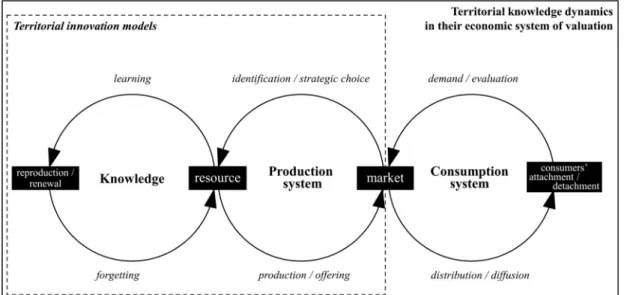
Regional studies have widely investigated how terri-torial development draws on the social construction of particular knowledge resources (Fig. 1). Numerous studies have highlighted the fact that innovation is not the by-product of an exogenous knowledge change but emerges from endogenous learning processes
taking place within particular production systems orga-nized in time and space. The TIMs (MOULAERT and SEKIA, 2003) developed since the mid-1980s have high-lighted the particular learning processes driving regional competitiveness.
Originally attached to the analysis of industrial change and technological innovation, the early ‘indus-trial district’ (BECATTINI, 1990) and ‘innovative milieu’ (AYDALOT, 1986) TIMs have pointed to the cumulative and diffusive learning processes that underlie the flexible specialization of milieus able to innovate in a post-Fordist economy characterized by the evolution of a more specific and changing demand (SIMMIE, 2005). Learning processes have subsequently become the subject of more specific investigations and systematic conceptualizations, and innovative regions have increas-ingly been regarded as ‘learning regions’ able to adapt local production through a continuous renewal of knowledge resources (MORGAN, 1997). Conceptual models such as ‘regional innovation systems’ (BRACZYK et al., 1998) and ‘clusters’ (PORTER, 1998) have proposed operational understandings of these learning processes and have actively contributed to per-forming regional innovation policies (DOLOREUX, 2002; MARTIN and SUNLEY, 2003; COOKE, 2008).
From various perspectives, TIMs have emphasized how geographical proximity can foster the reproduction and renewal of knowledge resources, particularly in local production systems. They have also pointed to technological change as the elementary lever of inno-vation. Regional innovation has been illustrated through the capacity of a local production system to reproduce and renew knowledge resources through cumulative learning processes along sectoral and tech-nological trajectories, or by the implementation of local scientific research into a (new) production
Fig. 1 Conceptualizing an economic system of knowledge valuation Source: Authors’ own elaboration
system. This approach to regional development has inspired various technological and innovation policies, most of which have been translated into public support for local research and development activities (ASHEIM et al., 2011).
In the past decade, TIMs have been the object of further investigation and conceptual reconsiderations in a context of more open and permanent learning pro-cesses. Various works have pointed to the rise of an immaterial economy, where knowledge-intensive business services (KIBS) and cultural industries lead to new forms of spatial agglomeration and of regional/ urban competitiveness (e.g., POWER and SCOTT, 2004; SIMMIE and STRAMBACH, 2006; COOKE and LAZZERETTI, 2008; DOLOREUX and SHEARMUR, 2012).
Primary to techno-scientific innovation, ‘creativity’ is regarded as the driver of the constant reproduction and renewal of knowledge resources for local production systems (FLORIDA, 2002). In contrast to the cumulative knowledge trajectories described in early TIMs, local creativity and innovation are increasingly perceived through a new mode of knowledge production based on ad hoc processes of combination and exploitation (GIBBONS et al., 1994). Local production systems have increasingly been regarded as ‘project arenas’ (GRABHER, 2002; QVORTRUP, 2006) or as multi-sectoral ‘platforms’ (ASHEIM et al., 2011 combining different types of knowledge base (e.g., analytic, synthetic and symbolic) in a creative and reactive manner, according to both short and perpetual cycles of development.
Besides renewed considerations regarding the repro-duction and renewal of knowledge resources in particu-lar local production systems, a growing literature has also emphasized the importance of understanding territorial development beyond the boundaries and scales of specific regions. Various works have pointed to the fact that regional innovation is not only driven by endogenous dynamics of knowledge use, generation and combination, but also fuelled by external knowl-edge flows (OINAS and MALECKI, 2002; BATHELT et al., 2004; LAGENDIJK and OINAS, 2005). Certain studies have, for instance, highlighted how innovation occurs through the global production networks (GPNs) of multinational companies (COE et al., 2004) or through the circulation of skilled workers (SAXENIAN, 2006). Local production systems appear more than ever as interacting milieus producing and renewing knowledge resources in relation with other distant milieus within global innovation networks (CHEN, 2007).
Territorial knowledge dynamics (TKDs) in a broader economic system of valuation
In this attempt to explain in ever more detail the complex learning processes that are at the root of econ-omic change, older and newer TIMs have mostly
remained focused on production (MALMBERG and POWER, 2005; GRABHER et al., 2008). In this ‘produc-tionist’ approach (COE et al., 2008), the economic value of knowledge is generally assessed as the (global) compe-titiveness of specific (regional) innovation systems. Ter-ritorial competitiveness is the function of localized production factors (e.g., enterprises, labour forces, research and education facilities and investments) and is measured in terms of productivity, employment, export-based revenues and standard of living (STEINLE, 1992; PORTER, 2000; CAMAGNI, 2002; GARDINER et al., 2004; KITSON et al., 2004). In such an approach, the socio-economic foundations of the market economy remain largely unexplored (PECK, 2005; BERNDT and BOECKLER, 2011): the economic value of knowledge and innovation is seen as the observed result of an exogenous market mechanism of information and selection. To put it in another way, regional studies and economic geography have analysed in ever more complex ways the endogenous knowledge processes driving economic change in production, but have usually left aside the question of how this change is endogenously valued in and related to market construction.
Analysing a knowledge-based economy from a socio-economic and territorial perspective consists not merely in depicting how knowledge is turned into production resources across time and space. It also consists in under-standing how such resources are valued within a market, rather than by the market. The market is to be regarded not as an economic end to or from which learning, technologies and production processes are oriented, but as being endogenously constructed within a particular economic system of valuation. Economic valuation encompasses here the relational and institutional dynamics by which different objects and activities are socially valorized (i.e. transformed and commercialized) and evaluated (interpreted, recognized, legitimated and appraised) in the market (DEWEY, 1939; A SPERS and BECKERT, 2011; KJELLBERG et al., 2013; VATIN, 2013). The market is thus not taken for granted as an exogenous force, but conceived as a social order of uncertainty that must be dealt with by the actors of the economic system (BECKERT, 2009). In this sense, com-petitiveness is not per se a state of economic value, inherent to a particular productive configuration, or given by an auto-regulated market mechanism. Instead, it reflects a dynamic and perpetual process of market ‘qualification and requalification’ (CALLON et al., 2002) taking place within and between a pro-duction and a consumption system (Fig. 1).
In a production system, actors coordinate their actions with regard to the market signals provided by a demand and by the strategic positioning of other pro-ducers (WHITE, 2002). Thus knowledge resources are turned into goods or services that are to be compared with and distinguished from others in a market. In a consumption system, actors coordinate their actions in
order to influence and express the ‘attachment and detachment’ of consumers to these different objects (CALLON et al., 2002). Thus different market objects are made identifiable, understandable, comparable, dis-tinguishable, and appropriable through complex and influential distribution processes (COCHOY, 2008). These processes include, for instance, activities under-taken by end consumers and other intermediaries (e.g., distributors, retailers, the media, opinion leaders and groups of interest) to create, enable, motivate, mediate or legitimate a consumptive attachment to or detach-ment from various market offerings. This attachment or detachment is in turn expressed by consumer demand and evaluation, and is relayed, aggregated or enhanced by different actors and technical devices (through consumer protection organizations, online participative forums, social movements and civil lobbies, for example). Thus, at different stages of the valuation process, the same market actor may be involved both in the production and the consumption systems.
Markets also build upon instrumentalized, consoli-dated and transforming institutions that both pre-exist and outlast individual actor relations (HODGSON, 2007). Institutions are mobilized and arranged by market actors to coordinate their activities and to deal with the uncertainty of ‘unsatisfactory innovation’ (LUNDVALL, 1988). They build on institutionalized quality conventions (FAVEREAU et al., 2002) against which different market offerings are compared and dif-ferentiated (e.g., technical/security standards and norms of authenticity) and also establish equivalency principles, against which actors justify, legitimate, adjust and direct their activity of production, consumption and interme-diation. In addition, institutions frame market cooperation and competition (through regulations or property rights, for example) and at the same time act as constraints and opportunities for action (LOASBY, 2000). These are the rules of game that the actors of an economic system have to play with. These rules are subject to political power and potential conflicts in their establishment, control and transformation (FLIGSTEIN, 1996), and are also instrumentalized according to strategic choices. For instance, intellectual property rights (IPRs) may be utilized to protect a market offer-ing or, on the contrary, to give access to new resources in production.
In a relational and institutional approach, a market does not appear as a disruptive mechanism of selection or information between production and consumption. Productive strategies occurring within the production system imply the establishment and/or control of par-ticular distribution/diffusion channels within the con-sumption system and, in turn, the evaluation constructed within the consumption system provides feedback. This contributes to the institutionalization of particular strategic choices within the production system (ARTHUR, 1990). The production and
consumption systems thus co-evolve interdependently in time and space, according to various relational con-figurations and institutional arrangements. In such a view, the mobilization of knowledge resources in pro-duction is not ‘pulled’ by the market or ‘pushed’ by science. Rather, it is constitutive of market construction: it shapes, and is shaped by, the continuous (re)qualifica-tion of market goods (CALLON et al., 2002) and is part of the socio-institutional coordination of market actors. In such an economic system of valuation, socio-economic actors face important uncertainty in establishing, main-taining and organizing a relational and institutional con-tinuum between the reproduction/renewal of particular knowledge resources and the final consumers’ attach-ment to or detachment from particular market goods and services. This leads to the question of how such a continuum is socially and institutionally organized in time and space.
Dealing with a similar question, LUNDVALL (1988) laid the early conceptual foundations of a knowledge economic system within which organized markets and user – producer interactions are endogenous to techno-logical change and are institutionalized in particular national systems of innovation. Beyond technological and national contexts, this conceptualization of market construction should now, more than ever, be pursued, broadened and consolidated within regional studies. Studying TKDs in their embedding economic system should not be limited to analysing particular technologi-cal, sectoral and regional cumulative trajectories of inno-vation. Instead, it is important to consider how knowledge resources are increasingly used and gener-ated through combinatorial knowledge dynamics taking place within and across various places and sectors (CREVOISIER and JEANNERAT, 2009). This in turn leads naturally to a consideration of how TKDs shape and are shaped by their economic valuation in a market, and how they develop and evolve in different economic systems of valuation.
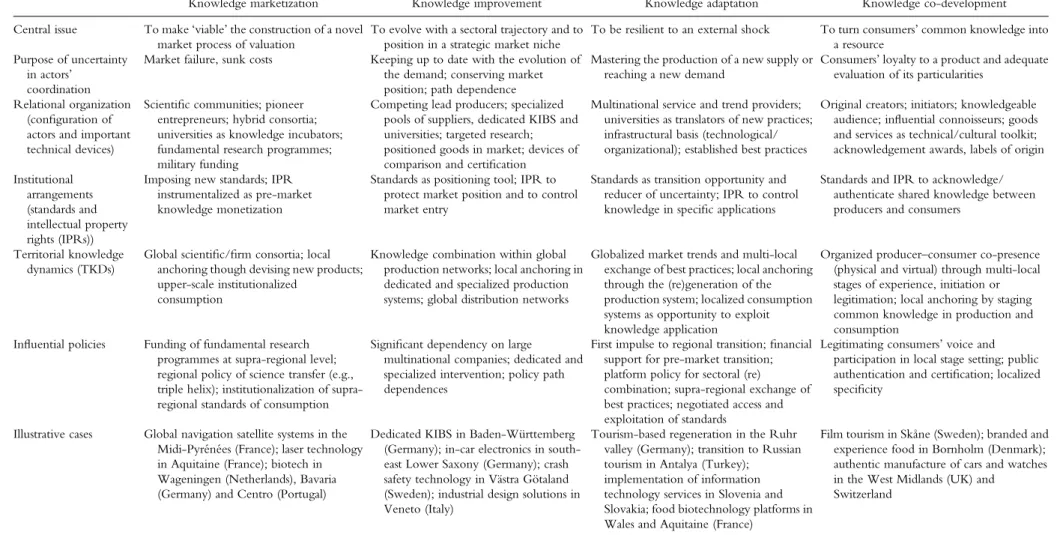
CONTRASTING DIFFERENT ECONOMIC SYSTEMS OF KNOWLEDGE VALUATION Drawing upon various empirical illustrations, the next sections highlight the particular relational and insti-tutional configurations and the prevailing TKDs that characterize different economic systems of knowledge valuation. Four different systems are distinguished and typified: the economic systems of knowledge marketi-zation, knowledge improvement, knowledge adap-tation and knowledge co-development (Table 1).
This typology has been built from a qualitative meta-synthesis (SANDELOWSKI et al., 1997) of 23 case studies realized in the framework of the European Commission FP6-funded project EURODITE led between 2005 and 2010.1 This project explored the particularities of knowledge dynamics in the contemporary economic
Table 1 Contrasting economic systems of knowledge valuation
Knowledge marketization Knowledge improvement Knowledge adaptation Knowledge co-development Central issue To make‘viable’ the construction of a novel
market process of valuation
To evolve with a sectoral trajectory and to position in a strategic market niche
To be resilient to an external shock To turn consumers’ common knowledge into a resource
Purpose of uncertainty in actors’
coordination
Market failure, sunk costs Keeping up to date with the evolution of the demand; conserving market position; path dependence
Mastering the production of a new supply or reaching a new demand
Consumers’ loyalty to a product and adequate evaluation of its particularities
Relational organization (configuration of actors and important technical devices)
Scientific communities; pioneer entrepreneurs; hybrid consortia; universities as knowledge incubators; fundamental research programmes; military funding
Competing lead producers; specialized pools of suppliers, dedicated KIBS and universities; targeted research; positioned goods in market; devices of comparison and certification
Multinational service and trend providers; universities as translators of new practices; infrastructural basis (technological/ organizational); established best practices
Original creators; initiators; knowledgeable audience; influential connoisseurs; goods and services as technical/cultural toolkit; acknowledgement awards, labels of origin Institutional
arrangements (standards and intellectual property rights (IPRs))
Imposing new standards; IPR instrumentalized as pre-market knowledge monetization
Standards as positioning tool; IPR to protect market position and to control market entry
Standards as transition opportunity and reducer of uncertainty; IPR to control knowledge in specific applications
Standards and IPR to acknowledge/ authenticate shared knowledge between producers and consumers
Territorial knowledge dynamics (TKDs)
Global scientific/firm consortia; local anchoring though devising new products; upper-scale institutionalized
consumption
Knowledge combination within global production networks; local anchoring in dedicated and specialized production systems; global distribution networks
Globalized market trends and multi-local exchange of best practices; local anchoring through the (re)generation of the production system; localized consumption systems as opportunity to exploit knowledge application
Organized producer–consumer co-presence (physical and virtual) through multi-local stages of experience, initiation or legitimation; local anchoring by staging common knowledge in production and consumption
Influential policies Funding of fundamental research programmes at supra-regional level; regional policy of science transfer (e.g., triple helix); institutionalization of supra-regional standards of consumption
Significant dependency on large
multinational companies; dedicated and specialized intervention; policy path dependences
First impulse to regional transition;financial support for pre-market transition; platform policy for sectoral (re) combination; supra-regional exchange of best practices; negotiated access and exploitation of standards
Legitimating consumers’ voice and participation in local stage setting; public authentication and certification; localized specificity
Illustrative cases Global navigation satellite systems in the Midi-Pyrénées (France); laser technology in Aquitaine (France); biotech in Wageningen (Netherlands), Bavaria (Germany) and Centro (Portugal)
Dedicated KIBS in Baden-Württemberg (Germany); in-car electronics in south-east Lower Saxony (Germany); crash safety technology in Västra Götaland (Sweden); industrial design solutions in Veneto (Italy)
Tourism-based regeneration in the Ruhr valley (Germany); transition to Russian tourism in Antalya (Turkey);
implementation of information technology services in Slovenia and Slovakia; food biotechnology platforms in Wales and Aquitaine (France)
Film tourism in Skåne (Sweden); branded and experience food in Bornholm (Denmark); authentic manufacture of cars and watches in the West Midlands (UK) and
Switzerland
development of European regions (MACNEILL and COLLINGE, 2010). The case studies report on the way knowledge is generated, used and combined within and across different firms, sectors and regions through specific entrepreneurial projects or policy initiatives.
Contrary to other forms of meta-analysis or compara-tive studies, the objective of the meta-synthesis per-formed here was not to aggregate, summarize and compare the various reported cases, but to deconstruct the case studies and use them as idiographic material from which to reconstruct a new theoretical interpret-ation (SANDELOWSKIet al., 1997). Building on the con-ceptual reflection provided in the first part of this paper, elements of specific economic systems of knowledge have been reconstructed around five major issues:(1) the form of uncertainty characterizing the system;(2) the types of actor and relation involved in the system; (3) the institutional arrangements governing the system (in particular IPR, technical standards and public regulations); (4) the territorial organization of the system (in various locations and on various spatial scales); and (5) the influential policies at stake in the system.
These particular qualitative elements were then ‘translated’ from one case to another (THORNE et al., 2004) in order to create a set of contrasting ideal types of economic systems of knowledge valuation, which were then discussed with regard to established socio-economic theories in relation to markets, technical change and territorial innovation. These four ideal types cover the diversity of the case studies examined.
The empirical illustrations emphasized in the typol-ogy discussed below provide a selective account of the case studies. They are not used as empirical evidence of the existence of the different economic systems of knowledge valuation highlighted here, but represent emblematic examples reflecting different issues that came across in a certain number of cases. They are used in a heuristic and comprehensive way to illuminate different aspects of thefive issues highlighted above and to contrast the four proposed ideal types.
The economic system of knowledge‘marketization’
The term ‘marketization’ here designates the general process by which knowledge generation and renewal are given a market orientation through the construction of a new production system and a new consumption system. In this kind of valuation process, there is often uncertainty relating to the potential market failure that may occur when turning previously non-commercia-lized or publicly funded knowledge resources into market-based production and consumption. Marketiza-tion also implies managing the sunk costs inherent to the fundamental temporal lag between knowledge explora-tion and market exploitation (AMENDOLA and GAFFARD, 1994; MARCH, 1991). The relational, institutional and territorial dynamics of the economic system
thus reflect a need to make ‘viable’, in time and space, the construction of a novel market process of knowl-edge valuation.
Different aspects of this type of knowledge valuation can be highlighted through the French cases of the Global Navigation Satellite System (GNSS) developed in the Midi-Pyrénées (BALLAND and VICENTE, 2009; VICENTE et al., 2011) and the fundamental laser tech-nology developed in Aquitaine (CARRINCAZEAUX et al., 2009a, 2009b). Elements of this are also high-lighted in the cases of the biotech start-ups in the regions of Wageningen (the Netherlands) (VISSERS and DANKBAAR, 2009), Bavaria (Germany) (KAISER et al., 2008; K AISER and LIECKE, 2009) and Centro (Portugal) (VALE et al., 2009; VALE and CARVALHO, 2012).
In all these cases, new fundamental knowledge is essentially generated within transnational techno-scien-tific communities. Public funding through national and supranational research, education and military pro-grammes (e.g., the European Framework Program, the European Regional Development Fund and mobility grants for researchers) is determinant in the develop-ment and maintenance of these communities. These cases also demonstrate multinational and hybrid research consortia, which are archetypal forms of cooperation. They provide coordinated solutions to cover sunk costs and to share complementary knowledge, and also promote a multilateral configuration of public and private actors that enable companies to invest in joint research beyond their traditional sectors.
Mobile knowledge generated within transnational scientific communities and hybrid consortia is locally anchored through the construction of particular pro-duction systems organized around a ‘selective devising’ process (AMENDOLA and GAFFARD, 1994). Devising implies here the development of new market appli-cations based on the ‘productive options’ offered by the creation of new potential knowledge resources. For instance, the productive valuation of the GNSS or of the laser technologies developed in Midi-Pyrénées and Aquitaine relies on the devising development of new market products such as in-car devices or telecom-munication services in the former case (BALLAND and VICENTE, 2009; V ICENTE et al., 2011), and new medical or imagery applications in the latter (C ARRIN-CAZEAUX et al., 2009a, 2009b).
In this local devising process, university research lab-oratories are determinant players participating in an emerging local production system as well as contributing to the creation of mobile knowledge. As illustrated by the devising of new biotech applications in the Centro region, the pioneer entrepreneurs driving economic change most often do so from within scientific commu-nities. They are therefore able both to understand new fundamental knowledge and to identify it as a potential resource for a new market offering. Policy support to local devising and knowledge anchoring operates
primarily in a classical ‘triple helix’ configuration: it intermediates local synergies and knowledge transfers between science and industry (ETZKOWITZ and L EY-DESDORFF, 2000; ETZKOWITZ, 2006).
In the various aforementioned cases, localized public intervention is crucial in the emergence of a production system. It provides strategic and financial backup for pre-competitive knowledge development (e.g., the provision of venture capital, military spending, strategic research funding and the creation of strategic science parks and incubators) and promotes the projects of pioneer entrepreneurs (through start-up grants and awards, for example).
Knowledge marketization does not lead only to the productive organization and promotion of potential radical innovations or new technological trajectories (DOSI, 1982; NELSON and WINTER, 1982), but also consists in implementing a new consumption system that incites consumers to attach to the new devised offerings. This implies integrating, within knowledge and production dynamics, the negative or positive social predispositions of a new potential demand. For instance, ecological lobbies and critical press coverage constitute influential forces that reinforce and relay public suspicion regarding genetically modified organisms (GMOs) within Europe. Biotech firms willing to exploit genetic sciences in agro-food and plant production thus have to deal with this negative predisposi-tion. As a result, communication campaigns are launched to promote a more favourable opinion and to advocate the need to adopt new consumption stan-dards. In a similar view, the adoption of the new GNSS technology requires the adoption of new techni-cal standards not only in the production of new goods and services but also in their consumption within local contexts.
Institutions frame the possibility of‘marketizing’ new goods and services within the overall economic system. For instance, the institutionalization of supranational standards and their adoption by local providers of tailor-made applications condition the future economic success of GNSS knowledge and technology. In a similar way, national or European moratoria on
GMOs compel biotech companies to combine
leading-edge genetic science with more conventional seed-breeding techniques and practices. Institutions also make possible the marketization of knowledge upstream to its implementation into goods or services. IPR, for instance, enables biotech companies in the Bavarian region to develop fundamental knowledge by ‘in-licensing’, which consists in buying existing licences in order to develop and resell them to other companies.
Regulations, standards and structures institutiona-lized at national, European and international levels cannot be dissociated from the economic success of local productive innovations (HAMDOUCH and M OU-LAERT, 2006). In other words, TKDs operate beyond a
local productive devising of new knowledge resources. Their economic valuation draws upon transnational
knowledge flows and extra-local consumption
dynamics that take place across multi-local relations and multi-scalar institutions.
The economic system of knowledge‘improvement’
In contrast to knowledge marketization, knowledge improvement occurs in an established market context, in which production and consumption processes are stabilized around identified goods, services and industrial processes. In such contexts, production resources are well-identified and mastered within a dominant design (ABERNATHY and UTTERBACK, 1978) and evolve in an integrative life cycle of product and process inno-vations (KLEPPER, 1997).
The case studies from the automotive industry are particularly illustrative of such an economic system of knowledge valuation. These include the develop-ment of specialized KIBS in Baden-Württemberg (Germany) (STRAMBACH et al., 2009), of in-car elec-tronics in south-east Lower Saxony (Germany) (BLÖCKER and JÜRGENS, 2009), of crash safety tech-nology in Västra Götaland (Sweden) (LARSSON, 2009), and of designed solution for mature industries (e.g., car manufacturing) in Veneto (Italy) (STOCHETTI et al., 2009). Complementary aspects to this valuation process can also be emphasized by the knowledge investments of large pharmaceutical companies in the biotech activities of Wageningen (VISSERS and D ANK-BAAR, 2009).
In this archetypal economic system, the production system is governed by leading producers competing within similar knowledge resources. For instance, the automotive industry is organized around multinational car manufacturers, all competing on the basis of similar products (cars) and basic technologies (airbag technol-ogy, fuel injection systems, and so on), and all relying on the same original equipment manufacturers (OEM). These lead producers and suppliers are multina-tional corporate principals and investors, which domi-nate the overall economic system of knowledge valuation. They accompany, orient and control new knowledge generation from the early stages of develop-ment (BLÖCKER and JÜRGENS, 2009) and rely on highly specialized and dependent research institutes, subcontractors and KIBS (STRAMBACH et al., 2009).
Within the consumption system, distribution chan-nels are established and specialized right to the end con-sumer (e.g., through specialized retailers and press coverage). Various intermediaries relay and express opinions regarding the evolution of an aggregated demand (e.g., consumer organizations and critical groups of interest), and regulated quality standards insti-tutionalize this aggregated demand and influence product and process innovations (e.g., security or environmental norms).
Uncertainty in knowledge valuation thus relates to the capacity of producers to keep up with the evolution of their basic technology, to adapt to general demand changes and to defend their market niche (WHITE, 2002). New knowledge, meanwhile, is developed within the cumulative trajectory of a specific sector (MALERBA, 2002) – for instance, the generalization of electronics in automotive engineering or the adoption of new environmental regulations lead all car manufac-turers to integrate new knowledge into their core tech-nology (BLÖCKER and JÜRGENS, 2009; MACNEILL et al., 2009). New knowledge may also be generated in order to reinforce or maintain a strategic market posi-tioning. Volvo, for instance, developed new pioneer crash safety technology in order to maintain its market position as a highly reliable and safe car manufacturer (LARSSON, 2009).
TKDs are thus organized primarily around pro-duction issues. Production is strongly standardized and organized by multinational companies in GPNs (HESS and YEUNG, 2006) in which knowledge circu-lates across space. Stable and standardized quality con-ventions established on supranational scales support the creation of distant distribution channels and the global aggregation of a demand, while technical/ security standards and IPR reinforce and protect the strategic positioning of producers in a market. For instance, in the mature pharmaceutical industry, large leading companies purchase strategic patents to maintain, reinforce or secure their market position against other competitors (VISSERS and DANKBAAR, 2009).
On the local scale, public and private initiatives seek to provide specialized solutions within such production processes. In the home regions of lead producers, tech-nological policies, education programmes and structural interventions support specialized knowledge dynamics and designed solutions (STRAMBACH et al., 2009). For instance, strategic support is given to electronic research in collaboration with Volkswagen in south-east Lower Saxony, and to the development of safety solutions with Volvo in Västra Götaland (Sweden)(BLÖCKER and JÜRGENS, 2009; LARSSON, 2009). Affiliated regions organized around major international suppliers also develop specialized and complementary knowledge resources. For instance, various public and private initiatives have taken place in the Veneto region to develop particular specialized solutions for international mature industries (e.g., nanotech or design for large international production companies)(STOCHETTI et al., 2009). KIBS are specialized inter-mediaries able to tap extra-regional and extra-sectoral knowledge and to turn it into dedicated resources for the production system (STRAMBACH et al., 2009). Innovation policies are here confronted with the challenge of positioning, specializing and maintaining particular regions within GPNs while preventing the over-specialization – and potential lock-in – of local
knowledge dynamics and reducing dependency on single lead producers.
The economic system of knowledge adaptation
Knowledge adaptation occurs when the production system undertakes a reactive transition to adapt with regard to an expressed demand and identified knowledge resources. It differs from knowledge marketization, as adaptation occurs within an existing production system, as well as from knowledge improvement, as new knowl-edge resources in production are oriented towards a new demand. Knowledge adaptation can be induced by an ‘external shock’ (a sudden change in demand, new regu-lations, industrial or financial crisis, etc.) that challenges the resilience capacity of the production system (PENDALL et al., 2010; SIMMIE and MARTIN, 2010).
Various cases studies illustrate such a situation. For instance, increased global competition has led the indus-trial production system of the Ruhr region (Germany) to mobilize new knowledge resources in tourism and event organization (BUTZIN and WIDMAIER, 2009). Furthermore, the sudden increase of Russian tourists in the Antalya region has led the local production system to adapt its practices (e.g., languages, skills and services) to the new demand (DULUPÇU et al., 2009). Similarly, in Slovakia and Slovenia, local information technology service providers have had to adapt in response to the opening of borders and the rapid increase in domestic demand for new information and communication technologies (REHAK et al., 2009; STANOVNIK and MUROVEC, 2009).
Knowledge adaptation can also be motivated by a new identified market opportunity. This is the case, for instance, in Aquitaine (France) and Wales, where new knowledge combinations are occurring between biotech and agro-food activities in response to the increasing demand for green and healthy food (C AR-RINCAZEAUX et al., 2009a, 2009b; DE LAURENTIS and COOKE, 2009). In such cases, the emergence of new consumption trends leads to the development of new knowledge platforms (HARMAAKORPI, 2006; ASHEIM et al., 2011).
Within such an economic system, uncertainty may be introduced by an inability of actors involved in the con-struction of the new production system to implement productive continuity between new identified knowl-edge resources and a new identified demand. Such a knowledge economic system primarily implies a process of change in the production system, such as the regeneration of industrial activities through tourism, or the adoption of new technological solutions. As knowl-edge adaptation often implies a preliminary phase of tran-sition before the new resources become competitive in a market, public incentives are particularly influential. It is vital to have technical backup for this phase, in the form of specific programmes supporting cross-sectoral collab-orations and exchanges of best practice.
There are many kinds of actor involved in knowl-edge adaptation. Large multinational companies form one kind, and are often the providers of new generic knowledge. For instance, in Bratislava (Slovakia), inter-national consultancy firms are major players in the importation of information technology knowledge (REHAK et al., 2009). Likewise, in Antalya (Turkey), large European tour operators play a strategic role in the adoption of new tourism business models (DULUPÇU et al., 2009). More particular small and medium-sized enterprises attempt to appropriate generic knowledge in order to implement particular sol-utions, while universities or KIBS tap into existing knowledge and contribute to the design of tailored applications in the production system.
On the territorial level, knowledge adaptation to European or international institutionalized standards, best practices or new consumption trends facilitate the identification of new potential knowledge resources or market opportunities. For instance, standardized or branded events such as international conferences, exhi-bitions, fairs, sport tournaments and cultural events are often used to boost the adaptation of traditional econ-omic activities (BUTZIN and WIDMAIER, 2009). At the same time, the establishment and control of these institutions are subject to political power. For instance, in Slovenia and Slovakia, multinationals mastering information technology standards are determinant for the development on new local KIBS.
Local production systems adapt to their changing socio-economic environment, to new potential knowl-edge resources or to new market opportunities in various ways. In some cases, they may adapt in a generic way by mobilizing standardized resources and by implementing generic activities addressed by the demand. Imagine, for instance, that a region adopts a standardized tourism strategy to promote new economic activities (e.g., organization of mainstream events). Such a generic adaptation is quite fragile, as it relies on common undifferentiated knowledge (e.g., cost differ-entiation). For this reason, the adaptation of the regional production system most often relates to specific adap-tation and, of course, regional specification takes various forms, as will be shown below.
In some cases, specification consists in mobilizing generic knowledge through best practices and combin-ing it with the local production system (e.g., a tourism initiative related to the manufacturing heritage of the Ruhr area). In other cases, it is based on a specific demand (e.g., specification to Russian tourists in the Antalya region (Turkey), or to the domestic information and communication technology demand in the Brati-slava region (Slovakia). Specification can also be orga-nized through the combination of two or more existing local production systems in the context of an identified generic demand (e.g., bio-food production in Aquitaine or Wales). In all these cases, local public support plays an important initiating role, and local
research structures provide access to mobile knowledge and anchor it in a specific way. A regional innovation policy is thus here more about partaking to knowledge flows and to standard definition than instigating new cutting-edge knowledge resources.
The economic system of knowledge co-development
In knowledge marketization, improvement and adap-tation, the consumption system expresses either positive or negative feedback regarding a general demand: in other words, producers know about consumers. In some cases, however, the very knowledge that consumers have and develop becomes a resource. In such cases, the products are usually not finished goods or services, but ‘toolkits’ co-developed in the market by the consump-tion system (VON HIPPEL, 2005). The case of open-source software development is often mentioned as an iconic example of this. However, the notion of co-devel-opment should not only be restrained to sophisticated and technical use. With the rise of cultural and leisure indus-tries, consumer knowledge is also increasingly engaged in the symbolic valuation of goods and services.
It is the socio-cultural dimension of knowledge co-development that is emphasized by various case studies. This is the case, for instance, in Skåne (Sweden), where specific tourism activities capitalize on the knowledge of readers of Wallander detective novels (DAHLSTRÖM et al., 2009). Additionally, on the island of Bornholm, local food producers promote branded products based on particular imaginaries and songs learned at school by Danish pupils (MANNICHE et al., 2009; M ANNICHE and LARSEN, 2013). In another example, car manufacturers in the West Midlands (UK) and Swiss watch manufacturers seek to evade mass competitors with authentic products that rely on consumer knowledge about their specific cul-tural and technical value (MACNEILL et al., 2009; JEANNERAT et al., 2009; JEANNERAT, 2013).
Consumers’ knowledge about mechanical watches enables Swiss watch manufacturers to establish their legitimacy through the development of new mechanical complications (JEANNERAT, 2013), while the new cars developed by Morgan Motors conserve certain histori-cal particularities recognized by consumers as authentic, such as flowing wings, a flat windscreen and an ash frame (MACNEILL et al., 2009). In such cases, inno-vation in production is oriented by the identification of consumers’ common knowledge, which is turned into a resource that enables producers to build a specific authenticity or to sell a ‘memorable experience’ (PINE and GILMORE, 1999).
In the case of knowledge co-development, uncer-tainty is about the capacity that the actors of the econ-omic system have to develop and exploit consumer’s knowledgeability. Companies organize initiation pro-cesses for consumers, such as training activities, visits to production sites or pedagogical exhibitions. They also
set up experiential stages to merge consumers within their production environment and create a context in which consumers can learn about the particularities of their products (visit of production sites or of places of historical imaginaries).
Thus the socio-institutional organization of the system supports the initiation of intermediaries and end consumers who become ‘connoisseurs’ (JEANNERAT, 2013). In this context, particular ‘hybrid communities’ develop and evolve around shared knowledge (GRABHER et al., 2008). These are funded either by producers (as with the exclusive Aston Martin and Morgan car clubs) (MACNEILL et al., 2009) or by con-sumers (e.g., an online community of watch aficiona-dos) (JEANNERAT et al., 2009). In addition, specific collaborations between complementary producers sharing similar imaginaries may be established to reinforce common knowledge (e.g., joint events between luxury car and watch brands). At such events, intermediaries such as journalists, product ambassadors and event organizers ensure the initiation into and legit-imation of common knowledge within market evalu-ation (JEANNERAT et al., 2009; MACNEILL et al., 2009; MANNICHE and LARSEN, 2013).
Public intervention can also legitimate common knowledge by providing formally independent voices (e.g., public patronage of awards or public labelling). In addition, institutions such as copyrights or quality labels (‘Bornholm food’ or ‘Swiss Made’) are not merely mobilized to protect production processes, but are also utilized to recognize the common knowledge shared by producers, consumers and intermediaries regarding valuation criteria (e.g., certification of authenticity).
On the territorial level, knowledge resources are mainly mobilized within GPNs (standard solutions), while specified relations with consumers are organized through various forms of co-presence between produ-cers and consumers. Such co-presence may be virtual, as in the case of online forums, or geographical, through the physical proximity of producers to consu-mers. In the cases examined in this study, geographical co-presence remains within and is ritualized through the stages of (1) production, for example through the promotion of food products through tourism activities or visits to factories by strategic consumers or ambassa-dors; (2) consumption, through experiential retailing, initiation programmes and travelling exhibitions, for example; and (3) intermediation, as was the case with the Le Man racing cup for Aston Martin, for instance. Such multi-local knowledge dynamics support knowl-edge exchange about specific products and production contexts, and through consumers’ experience.
CONCLUSIONS
The analytical focus progressively placed on knowledge by regional studies has enabled an understanding of the
complex dynamics of territorial development. Never-theless, the shift from innovation to knowledge in the conceptualization of economic change has still left unanswered the question of market valuation. Schema-tically, knowledge is studied as the main resource of innovation, while the economic value of innovation is revealed as the competitiveness of a production process (GARDINER et al., 2004). In this approach, com-petitiveness tends to be not only an elusive (KITSON et al., 2004), but also an eluding, concept, which fails to answer the question of how innovation and knowl-edge are actually valued within a market.
In line with critical theories developed by the econ-omic sociology of markets, we have advocated in this paper the need to conceptualize TKDs within a broader economic system. In particular, we have argued that knowledge is economically valued through the co-construction and co-evolution of a pro-duction and a consumption system. This approach echoes the fundamental theories, largely retrieved from regional studies, which advocate the need to go beyond a linear model of innovation (e.g., KLINE and ROSENBERG, 1986; LUNDVALL, 1988). Introducing a systematic approach to production and consumption processes in order to understand TKDs
provides the opportunity to extend and
complement established TIMs.
On the one hand, the industrial paradigm upon which TIMs have been built primarily highlights the technological and sectorial trajectories driving firms and their upstream relations of supply and R&D activi-ties. Downstream processes of innovation related to consumption processes have largely been neglected, however (GRABHER et al., 2008). (Re)introducing con-sumption to the core analysis and core conception of innovation does not necessarily mean that end consu-mers are always the first drivers of economic change and of territorial development, but may encourage more generally a consideration of the actors and insti-tutional arrangements influencing and intermediating the consumer’s voice and participation in the economic valuation of knowledge. Their influence may be rea-lized through general (negative or positive) feedback on potential radical changes in production. In other cases, consumers may influence incremental changes in production through the aggregated voice of an estab-lished community of users. Sometimes, they might stimulate new production processes by expressing and making identifiable a new demand; in some other con-texts, they may contribute more directly to the econ-omic value of innovation by mobilizing their knowledgeable skills in the co-production, interpret-ation or experimentation of goods and services.
Nonetheless, the increasing prominence of cultural activities and symbolic knowledge bases in innovation, as well as the new centrality of interactive communi-cation platforms (e.g., online media, communities or networks) enhances the role of consumers’ engagement
in economic valuation today. In this perspective, not only is knowledge co-development called to become central in future economic systems: knowledge market-ization, improvement and adaptation also develop an ‘economy of qualities’ (CALLON et al., 2002), built on complex and influential consumption systems.
On the other hand, the increasing focus on knowl-edge as the object of analysis and comprehension has progressed some distance from the meso-level interpret-ation of territorial development in favour of ever more microprocesses taking place at the level of firms and actors (LAGENDIJK, 2006). This cognitive emphasis placed on innovation processes has blurred the broader context within which knowledge use and generation make economic sense (MARTIN and SUNLEY, 2001). It will be important for future research to consider the market not as an external device but as a constitutive element of a learning system (POTTS, 2001), in order to enable the interpretation of knowledge, innovation and creativity in their broader economic context.
Through the archetypal economic systems of knowl-edge marketization, improvement, adaptation and co-development (Table 1), this paper proposes that knowl-edge valuation is not merely assimilated to knowledge exploration and exploitation (MARCH, 1991). It also advocates the need to go beyond policy approaches tra-ditionally focused on techno-science transfers. Territor-ial innovation must be understood in a broader economic system of valuation institutionalized on various spatial scales (GERTLER, 2010) and organized across interdependent milieus of production, control, intermediation and consumption. These four analytical
categories are not mutually exclusive, but shed light in different ways on different regional policies conceived not only in terms of technological and sectoral develop-ment, but also in terms of market organization: an organization not passively left to an ‘invisible hand’ but actively handled as a matter of complex relational and institutional constructions.
Acknowledgements – The authors gratefully acknowl-edge the European Commission for its support to the FP6 research project EURODITE (Contract Number 006187) as well as all the researchers who were involved in this project. This paper would not have been possible without them. The authors thank all those who have commented on a previous version of this paper, in particular Christoph Carrincazeaux, Olivier Crevoisier, Gernot Grabher and Simone Strambach. Thanks also to the four anonymous refer-ees and to Arnoud Lagendijk for their precious advice. They significantly clarified our intentions. Of course, the responsi-bility for the interpretation proposed in this paper remains entirely that of the authors alone.
Funding – L. Kebir undertook the writing of this paper under a fellowship from the Swiss National Science Foun-dation at UMR SAD-APT/INRA, France.
NOTE
1. EURODITE– Regional Trajectories to the Knowledge Economy: A Dynamic Model (EU-FP6, Contract Number 006187).
REFERENCES
ABERNATHY W. and UTTERBACK J. (1978) Patterns of industrial innovation, Technology Review 80, 4 0 –47.
AMENDOLA M. and GAFFARD J.-L. (1994) Markets and organizations as coherent systems of innovation, Research Policy 23, 627–635.
AMIN A. and COHENDET P. (2004) Architectures of Knowledge. Firms, Capabilities and Communities. Oxford University Press, Oxford. AMIN A. and ROBERTS J. (2008) Knowing in action: beyond communities of practice, Research Policy 37, 353–369. doi:10.1016/j.
respol.2007.11.003
ANTONELLI C. (2005) Models of knowledge and systems of governance, Journal of Institutional Economics 1, 5 1 –73. doi:10.1017/
S1744137405000044
ARTHUR W. B. (1990) Positive feedbacks in the economy, Scientific American 262, 9 2 –99. doi:10.1038/scientificamerican0290-92 ASHEIM B., BOSCHMA R. and COOKE P. (2011) Constructing regional advantage: platform policies based on related variety and
differentiated knowledge bases, Regional Studies 45, 893–904. doi:10.1080/00343404.2010.543126
ASPERS P. and BECKERT J. (2011) Value in markets, in BECKERT J. and ASPERS P. (Eds) The Worth of Goods: Valuation & Pricing in the Economy, pp. 3–38. Oxford University Press, Oxford.
AYDALOTP. (1986) Milieux innovateurs en Europe. Groupe de Recherche Européen sur les Milieux Innovateurs (GREMI), Paris.
BALLANDP.-A. and VICENTEJ. (2009) The Structural Properties of the Midi-Pyrenean Knowledge Dynamics in the GNSS Technological
Field. EURODITE Internal Report (D5c). LEREPS, University of Toulouse, Toulouse.
BATHELTH. and GLÜCKLERJ. (2005) Resources in economic geography: from substantive concepts towards a relational perspective,
Environment and Planning A 37, 1545–1563. doi:10.1068/a37109
BATHELT H., MALMBERG A. and MASKELL P. (2004) Clusters and knowledge: local buzz, global pipelines and the process of
knowl-edge creation, Progress in Human Geography 28, 3 1 –56. doi:10.1191/0309132504ph469oa
BECATTINI G. (1990) The Marshallian industrial district as a socio-economic notion, in PYKE F., BECATTINI G. and SENGENBERGER
W. (Eds) Industrial Districts and Inter-firms Cooperation in Italy, pp. 37–51. International Labour Organisation (ILO), Geneva. BECKERT J. (2009) The social order of markets, Theory and Society 38, 245–269. doi:10.1007/s11186-008-9082-0
BERNDT C. and BOECKLER M. (2011) Geographies of markets: materials, morals and monsters in motion, Progress in Human Geogra-phy 35, 559–567. doi:10.1177/0309132510384498
BLÖCKER A. and JÜRGENS U. (2009) Automotive TKDs in Southeast Lower Saxony. EURODITE Internal Report (D5c).
Wissenschaftszentrum Berlin für Sozialforschung GmbH, Berlin.
BRACZYKH., COOKEP. and HEIDENREICHM. (1998) Regional Innovation Systems: The Role of Governances in a Globalized World. UCL
Press, London.
BUTZINA. and WIDMAIERB. (2009) Tourism-Based TKDs in the Ruhr Area. EURODITE Internal Report (D5c). Institut Arbeit und
Technik, Gelsenkirchen.
CALLON M., MÉADEL C. and RABEHARISOA V. (2002) The economy of qualities, Economy and Society 31, 194–217. doi:10.1080/
03085140220123126
CAMAGNI R. (2002) On the concept of territorial competitiveness: sound or misleading?, Urban Studies 39, 2395–2411. doi:10.
1080/0042098022000027022
CARRINCAZEAUX C., GASCHET F. and BECUE M. (2009a) Lasers and Photonic TKDs in Aquitaine. EURODITE Internal Report
(D5c). Université Montesquieu– Bordeaux IV, Bordeaux.
CARRINCAZEAUX C., GASCHET F. and BECUEM. (2009b) Pharma-food TKDs in Aquitaine. EURODITE Internal Report (D5c).
Université Montesquieu– Bordeaux IV, Bordeaux.
CHEN Y.-C. (2007) The upgrading of multinational regional innovation networks in China, Asia Pacific Business Review 13,
373–403. doi:10.1080/13602380701291941
COCHOY F. (2008) Du lien au coeur de l’échange, Sciences de la société 73, 105–121.
COE N. M., DICKEN P. and HESS M. (2008) Global production networks: realizing the potential, Journal of Economic Geography 8, 271–295. doi:10.1093/jeg/lbn002
COE N. M., HESS M., YEUNG H., DICKEN P. and HENDERSON J. (2004) ‘Globalizing’ regional development: a global production networks perspective, Transactions of the Institute of British Geographers 29, 468–484. doi:10.1111/j.0020-2754.2004.00142.x COOKE P. (2008) Regional innovation systems: origin of the species, International Journal of Technological Learning, Innovation and
Development 1, 393–409. doi:10.1504/IJTLID.2008.019980
COOKE P. and LAZZERETTI L. (Eds) (2008) Creative Cities, Cultural Clusters and Local Economic Development. Edward Elgar, Cheltenham.
COOKEP. and LEYDESDORFFL. (2006) Regional development in the knowledge-based economy: the construction of advantage,
Journal of Technology Transfer 31, 5 –15. doi:10.1007/s10961-005-5009-3
CREVOISIER O. and JEANNERAT H. (2009) Territorial knowledge dynamics: from the proximity paradigm to multi-location milieus, European Planning Studies 17, 1223–1241. doi:10.1080/09654310902978231
DAHLSTRÖM M., ÖSTBERG S., DYMÉN C., HEDIN S., HENRIKSSON S. and SMED OLSEN L. (2009) Film tourism TKDs in Skåne. EURO-DITE Internal Report (D5c). Nordregio, Stockholm.
DELAURENTISC. and COOKEP. (2009) TKDs in the Welsh Agro-food and Biotechnology Activities. EURODITE Internal Report
(D5c). Cardiff University, Cardiff.
DEWEY J. (1939) Theory of valuation, International Encyclopedia of Unified Science 2, 1 –67.
DOLOREUX D. (2002) What we should know about regional systems of innovation, Technology in Society 24, 243–263. doi:10.1016/
S0160-791X(02)00007-6
DOLOREUX D. and SHEARMUR R. (2012) Collaboration, information and the geography of innovation in knowledge intensive
business services, Journal of Economic Geography 12, 7 9 –105. doi:10.1093/jeg/lbr003
DOSI G. (1982) Technological paradigms and technological trajectories: a suggested interpretation of the determinants and
direc-tions of technical change, Research Policy 11, 147–162. doi:10.1016/0048-7333(82)90016-6
DULUPÇU M. A., SEZGIN A., DEMIREL O., CEVHER E., GÖKHAN O., SUNGUR O., ÇIFTLIKLI B. and GÖÇEN S. (2009) Tourism-Based
TKDs in the Antalya Region. EURODITE Internal Report (D5c). Suleyman Demirel University, Isparta.
ETZKOWITZH. (2006) The new visible hand: an assisted linear model of science and innovation policy, Science and Public Policy
33, 310–320. doi:10.3152/147154306781778911
ETZKOWITZ H. and LEYDESDORFF L. (2000) The dynamics of innovation: from national systems and ‘Mode 2’ to a triple helix of
university–industry–government relations, Research Policy 29, 109–123. doi:10.1016/S0048-7333(99)00055-4
FAVEREAU O., BIENCOURT O. and EYMARD-DUVERNAY F. (2002) Where do markets come from? From (quality) conventions!, in
FAVEREAUO. and LAZEGAE. (Eds) Conventions and Structures in Economic Organization: Markets, Networks, and Hierarchies, pp. 213–
252. Edward Elgar, Cheltenham.
FLIGSTEINN. (1996) Markets as politics: a political–cultural approach to market institutions, American Sociological Review 61, 656–
673. doi:10.2307/2096398
FLORIDAR. (2002) The Rise of the Creative Class. And How It’s Transforming Work, Leisure and Everyday Life. Basic, New York, NY.
GARDINERB., MARTINR. and TYLERP. (2004) Competitiveness, productivity and economic growth across the European regions,
Regional Studies 38, 1037–1059. doi:10.1080/0034340042000292638
GERTLER M. S. (2010) Rules of the game: the place of institutions in regional economic change, Regional Studies 44, 1 –15. doi:10.
1080/00343400903389979
GIBBONS M., LIMOGES C., NOWOTNY H., SCHWARTZMAN S., SCOTT P. and TROW M. (1994) The New Production of Knowledge. The Dynamics of Science and Research in Contemporary Societies. Sage, London.
GRABHER G. (2002) The project ecology of advertising: tasks, talents and teams, Regional Studies 36, 245–262. doi:10.1080/
00343400220122052
GRABHERG., IBERTO. and FLOHRS. (2008) The neglected king: the customer in the new knowledge ecology of innovation,