Effectiveness of development cooperation 1
How is effectiveness assessed?
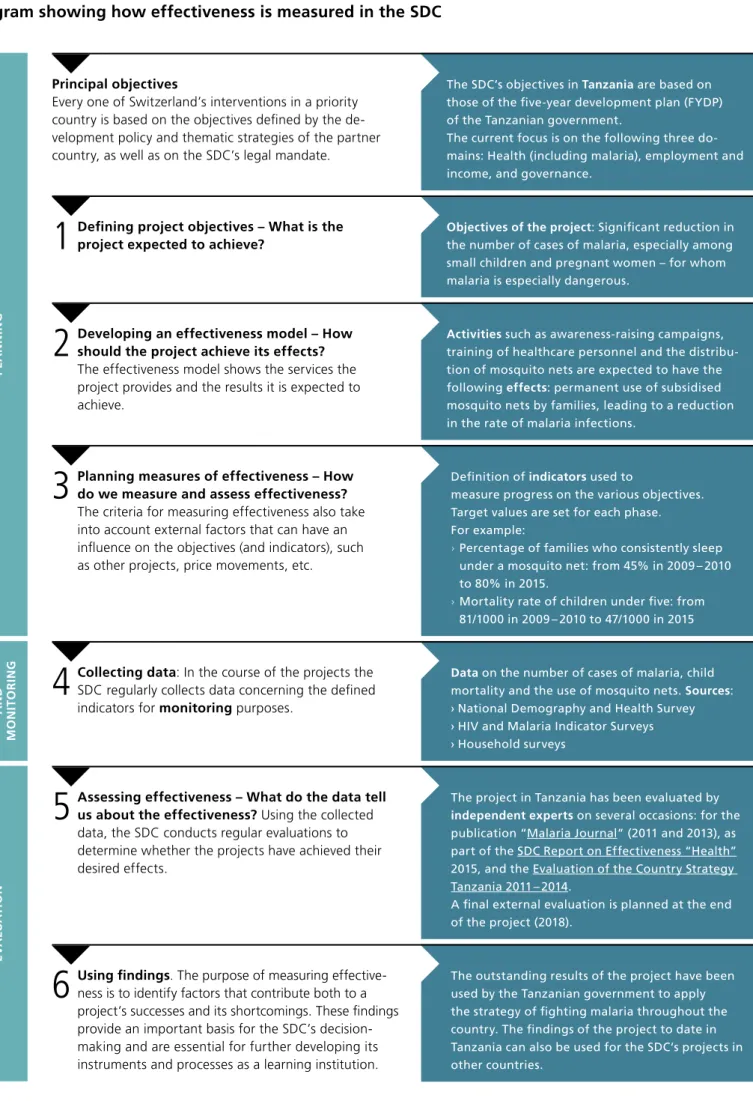
Measuring effectiveness begins at the planning stage of the SDC’s and its part-ners’ projects. This involves determining how the achievement of the objectives is to be assessed. The following overview ex-plains how the SDC prepares the measure-ment of effectiveness of its projects and how the various steps are actually put into practice, using the project in Tanzania as an example.
Measuring effectiveness at the Swiss Agency
for Development and Cooperation (SDC)
Fourteen years ago the SDC started an ambitious project in Tanzania
together with the Tanzanian government, other donors and non-
governmental organisations. Its goal: to help people throughout the
country protect themselves from malaria – one of the most serious
diseases in Tanzania. The project set up a national system for distributing
mosquito nets, along with an information campaign to raise aware-
ness among the population about this dangerous disease and ways to
prevent it.
To date more than 28 million mosquito nets have been distributed.
Thanks to the successful campaign, 80% of Tanzanian families
now sleep under mosquito nets. Between 2000 and 2010, the infant
mortality rate in the country fell by 48%, malaria-infection rates
decreased in the south of the country by 85%, and an estimated
60,000 deaths among small children (under 5) were prevented through
the consistent use of mosquito nets.
EFFECTIVENESS
OF DEVELOPMENT
COOPERATION
Pregnant women and children are especially threatened by malaria. They can better protect themselves against the disease by using mosquito nets. A project supported by the SDC contributed to a major reduction in cases of malaria in Tanzania.
What does effectiveness
in development cooperation
mean?
The SDC’s mandate is to contribute to worldwide poverty reduction and improve the living conditions of the target groups in its partner countries. Therefore, the SDC must demonstrate that its various projects are properly implemented and that all appropriate measures have been taken to ensure this is the case. In addi-tion, the SDC must show how these meas-ures have improved the living conditions of the intended beneficiaries. To prove their effectiveness and find out why some projects have a greater impact than oth-ers, measuring effectiveness is an integral part of the SDC’s and its partners’ work. The aim is to show both the short- and the long-term effects of the projects in question. The term ‘effects’ is used to re-fer to concrete changes brought about by individual projects. Taken together these concrete changes constitute the basis for measuring the effectiveness of the SDC’s development cooperation.
Effectiveness of development cooperation 2 PL A N N IN G IM PL EM EN TA TI O N A N D M O N IT O RIN G EV A LU A TI ON
The SDC’s objectives in Tanzania are based on those of the five-year development plan (FYDP) of the Tanzanian government.
The current focus is on the following three do-mains: Health (including malaria), employment and income, and governance.
Objectives of the project: Significant reduction in
the number of cases of malaria, especially among small children and pregnant women – for whom malaria is especially dangerous.
Activities such as awareness-raising campaigns,
training of healthcare personnel and the distribu-tion of mosquito nets are expected to have the following effects: permanent use of subsidised mosquito nets by families, leading to a reduction in the rate of malaria infections.
Definition of indicators used to
measure progress on the various objectives. Target values are set for each phase. For example:
› Percentage of families who consistently sleep under a mosquito net: from 45% in 2009 – 2010 to 80% in 2015.
› Mortality rate of children under five: from 81/1000 in 2009 – 2010 to 47/1000 in 2015
Data on the number of cases of malaria, child
mortality and the use of mosquito nets. Sources: › National Demography and Health Survey › HIV and Malaria Indicator Surveys › Household surveys
The project in Tanzania has been evaluated by
independent experts on several occasions: for the
publication “Malaria Journal” (2011 and 2013), as part of the SDC Report on Effectiveness “Health” 2015, and the Evaluation of the Country Strategy Tanzania 2011 – 2014.
A final external evaluation is planned at the end of the project (2018).
The outstanding results of the project have been used by the Tanzanian government to apply the strategy of fighting malaria throughout the country. The findings of the project to date in Tanzania can also be used for the SDC’s projects in other countries.
Principal objectives
Every one of Switzerland’s interventions in a priority country is based on the objectives defined by the de-velopment policy and thematic strategies of the partner country, as well as on the SDC’s legal mandate.
1
Defining project objectives – What is theproject expected to achieve?
6
Using findings. The purpose of measuringeffective-ness is to identify factors that contribute both to a project’s successes and its shortcomings. These findings provide an important basis for the SDC’s decision-making and are essential for further developing its instruments and processes as a learning institution.
2
Developing an effectiveness model – Howshould the project achieve its effects?
The effectiveness model shows the services the project provides and the results it is expected to achieve.
3
Planning measures of effectiveness – Howdo we measure and assess effectiveness?
The criteria for measuring effectiveness also take into account external factors that can have an influence on the objectives (and indicators), such as other projects, price movements, etc.
4
Collecting data: In the course of the projects theSDC regularly collects data concerning the defined indicators for monitoring purposes.
5
Assessing effectiveness – What do the data tellus about the effectiveness? Using the collected
data, the SDC conducts regular evaluations to determine whether the projects have achieved their desired effects.
Effectiveness of development cooperation 3
In addition, the SDC carries out approxi-mately five independent evaluations each year. These are coordinated by the Evaluation and Corporate Controlling Division of the Directorate Staff Unit and mandated to external experts. The division works independently from the SDC’s operational departments. These comprehensive evaluations cover an
en-tire portfolio of projects, mostly in one of the thematic priorities of the Dispatch on International Cooperation. All inde-pendent evaluations are published on the FDFA website. The SDC’s senior manage-ment takes a position on every independ-ent evaluation and decides on an action plan to implement the recommendations of the evaluation.
In addition, the SDC’s work is regularly reviewed by the Development Assistance Committee (DAC) of the OECD. The re-sults are published in the DAC Peer Re-view.
How can the contributions to
international organisations be
evaluated?
Contributions to international organisa-tions, such as UNICEF and the United Na-tions Development Programme (UNDP), are also systematically evaluated. The SDC subjects its contributions to international organisations to regular monitoring and has developed its own instrument for this purpose, the Core Contribution Manage-ment tool. Evaluations are designed and carried out together with other donors within the framework of the Multilateral Organisation Performance Assessment Network (MOPAN).
Is it always possible to prove
effectiveness?
Yes. The SDC has a wide range of instru-ments to measure and demonstrate the effectiveness of its projects. The method used for measuring is tailored to the type of project and the environment in which it is carried out. This can be challenging: On the one hand, the influence of external
What instruments
does the SDC use to prove
effectiveness?
Proving effectiveness is not an end in itself but a means to improving the work of the SDC and its partners on an ongoing basis. There are two distinct types of instru-ments: Monitoring and evaluation. > Monitoring: Monitoring involves
regularly collecting data on predefined indicators to measure how well the objectives are being achieved. It allows the SDC to know whether the project is on track and to react quickly if it is not progressing in the intended way. Occasionally activities have to be ad-justed in order to achieve the planned objectives.
> Evaluation: An evaluation is an external perspective on one or more projects or strategies. It assesses the results and indicates the effectiveness of the project, but also assesses its relevance, efficiency and sustainability. Evaluations therefore use the data from the monitoring and often collect more evidence through visits to pro-jects and discussions with implicated actors and beneficiaries.
Every year, the SDC carries out approxi-mately 120 project evaluations, cor-responding to roughly 10% of the total portfolio of projects. They are carried out by project implementers of the SDC (self-evaluation) or mandated to an exter-nal party (invitation procedure or public tender).
As a donor country Switzerland has committed itself with the 2005 Paris Declaration on Aid Effectiveness to base its strategies on the needs and priorities of its partner countries. For example, in the case of Tanzania, the government’s priority is on the health, employment and income, and governance domains. Consequently, the SDC also bases its country strategy, which is defined for four years, on these domains and sets corresponding objectives.
The quality of its evaluations is crucial for the SDC.
All the independent evaluations are carried out according to the international evaluation criteria of the OECD-DAC. The SDC also complies with the directives and standards of the Swiss Evaluation Society (Seval). The most important evaluation criteria are:
> Relevance: Is the right thing being done in this context?
> Effectiveness: Are the project’s objectives, e.g. consistent use of mosquito nets, being achieved?
> Efficiency: Is the least amount of resources used to achieve the desired objectives?
> Sustainability: Will the results have a lasting positive impact? > Impact: Are the overall goals, e.g. fewer cases of malaria in Tanzania,
being achieved?
The SDC Evaluation and Corporate Controlling Division regularly produces Reports on Effectiveness that show the effectiveness of the SDC
(and in certain cases SECO) in a specific field over a prolonged period (c. 10 years). So far, Reports on Effectiveness have been produced on the water, agriculture, climate and health sectors. The next report is expected to be published in 2017 on the effectiveness of the SDC’s and SECO’s international cooperation in the field of employment.
Effectiveness of development cooperation 4
factors (changing prices, political insta-bility, natural disasters) must always be taken into account. On the other hand, the complexity of measuring effectiveness as such varies, since effects are not always quantifiable. For example, the effects of the SDC’s projects for improving human rights are more difficult to measure and prove than a reduction in cases of malaria as a result of the health project in Tanza-nia. While the number of cases of malaria is recorded in national statistics, improve-ments in human rights have to be assessed through qualitative estimations.
Contact
Federal Department of Foreign Affairs FDFA
General Secretariat GS-FDFA
FDFA Information Federal Palace West Wing 3003 Bern, Switzerland +41 31 322 31 53 [email protected] www.eda.admin.ch
More links
Effectiveness reports and reports on the SDC’s results:
> www.deza.admin.ch › Results and impact
› Effectiveness and annual reports
Video on the Effectiveness Report “Health”:
> youtube.com
› EDA-DFAE-FDFA health
All SDC evaluations:
> www.deza.admin.ch › Publications and services › Publications
› Range of publications › Evaluations
Scientific studies have shown that the free distribution of mosquito nets has a bigger impact than the sale of subsidised nets. The International Initiative for Impact Evaluation (3ie) aims to ensure that such findings are used in the planning of development cooperation projects.
OECD-DAC – Peer Reviews:
> www.oecd.org
› Peer reviews of DAC members › Peer reviews by country
OECD-DAC evaluation criteria:
> oecd.org › search
› DAC Criteria for Evaluating › Development Assistance
SEVAL
> seval.ch