HAL Id: hal-00316779
https://hal.archives-ouvertes.fr/hal-00316779
Submitted on 1 Jan 2001
HAL is a multi-disciplinary open access
archive for the deposit and dissemination of
sci-entific research documents, whether they are
pub-lished or not. The documents may come from
teaching and research institutions in France or
abroad, or from public or private research centers.
L’archive ouverte pluridisciplinaire HAL, est
destinée au dépôt et à la diffusion de documents
scientifiques de niveau recherche, publiés ou non,
émanant des établissements d’enseignement et de
recherche français ou étrangers, des laboratoires
publics ou privés.
Letter to the Editor Low-frequency electric field
fluctuations and field-aligned electron beams around the
edge of an auroral acceleration region
W. Miyake, R. Yoshioka, A. Matsuoka, T. Mukai, T. Nagatsuma
To cite this version:
W. Miyake, R. Yoshioka, A. Matsuoka, T. Mukai, T. Nagatsuma. Letter to the Editor Low-frequency
electric field fluctuations and field-aligned electron beams around the edge of an auroral acceleration
region. Annales Geophysicae, European Geosciences Union, 2001, 19 (3), pp.389-393. �hal-00316779�
Annales Geophysicae (2001) 19: 389–393 c European Geophysical Society 2001
Annales
Geophysicae
Letter to the Editor
Low-frequency electric field fluctuations and field-aligned electron
beams around the edge of an auroral acceleration region
W. Miyake1, R. Yoshioka2, A. Matsuoka2, T. Mukai2, and T. Nagatsuma3
1Communications Research Laboratory, 4–2–1, Nukui-kita, Koganei, Tokyo 184–8795, Japan 2Institute of Space and Astronautical Science, 3–1–1, Yoshinodai, Sagamihara 229–8510, Japan 3Hiraiso Solar Terrestrial Research Center, CRL, 3601 Isozaki, Hitachi-naka 311–1202, Japan
Received: 6 November 2000 – Revised: 5 February 2001 – Accepted: 8 February 2001
Abstract. Electron beams narrowly collimated to the
mag-netic field line were observed continuously from a down-ward current region to an auroral acceleration region (i.e., upward current region). They were well correlated with low-frequency electric field fluctuations in the auroral accelera-tion region as well as in the adjacent downward current re-gion. Magnetic field fluctuations were found only in the downward current region. The analysis suggests that static field-aligned electric fields are not fully responsible for the filed-aligned electron acceleration; the ac electric field, pre-sumably associated with Alfvenic fluctuations, should also be involved in the acceleration of ionospheric electrons.
Key words. Ionosphere (particle acceleration) –
Magneto-spheric physics (auroral phenomena; magnetosphere-iono-sphere interactions)
1 Introduction
Upgoing, counterstreaming, and downgoing field-aligned electron beams (FEB) are often associated with upflowing ions with conical pitch angle distribution (i.e., ion conics) over the auroral region (Sharp et al., 1980; Collin et al., 1982; Miyake et al., 1998). FEB are also found with upflowing ion beams in the auroral acceleration region (Hultqvist et al., 1991; Lundin and Eliasson, 1991; Yoshioka et al., 2000).
Upward acceleration of ionospheric electrons by a down-ward electrostatic field (Gorney et al., 1985) associated with a downward field-aligned current was presented from recent FAST observations (Carlson et al., 1998). The field-aligned electrostatic field is developed along the magnetic field line in order to supply the charge carrier to the current. This is even true for the downward current regions (Elphic et al., 1998).
An alternative explanation for the generation of FEB was provided by Viking observations (Hultqvist et al, 1991). Low-frequency electric field fluctuations (LEF) are found to be
Correspondence to: W. Miyake ([email protected])
well correlated with FEB. The LEF are supposed to propa-gate down from the magnetosphere (Lundin et al., 1990) and, therefore, to be Alfvenic. The possible parallel component of LEF (Goertz and Boswell, 1979) may generate FEB.
We present here an event of FEB extended from the down-ward current region to the adjacent auroral acceleration re-gion (i.e., upward current rere-gion). The event analyzed here is the same as the example of co-existence of FEB and upflow-ing ion beams presented in Yoshioka et al. (2000). This re-port focuses on electromagnetic aspects of the event in terms of the generation mechanism of FEB.
2 Observations
Data presented here come from the polar-orbiting Akebono (Exos-D) satellite (Oya and Tsuruda, 1990; Tsuruda and Oya, 1991). The satellite was launched with an initial apogee and perigee, respectively, of 10482 km and 272 km in 1989. The Low Energy Particle (LEP) instrument on board (Mukai et al., 1990) was designed to observe energy-pitch angle distri-butions of auroral electrons and ions. We also use electric field (Hayakawa et al., 1990) and magnetic field (Fukunishi et al., 1990) data in this study.
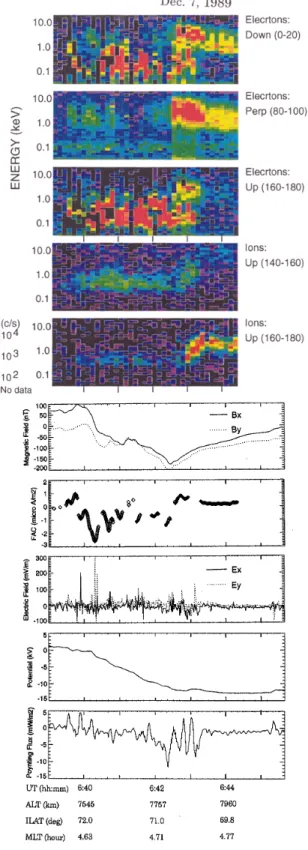
Figure 1 shows an Akebono equatorward pass through the auroral oval around 4.6 MLT on 7 December 1989. Counter-streaming FEB with energies below 1 keV are observed for most of the interval. Discrete electron precipitation begins at 6:42:30 and the field-aligned current (FAC) derived from magnetic field data changes direction from downward to up-ward. Ion conics, with low-energy cutoff, are observed in the downward FAC and upflowing ion beams with a field-aligned peak of flux beginning at 6:43:00 in the upward FAC. The FEB show a rapid variation but are continuously observed into the edge of the ion beam region. A statistical study on the co-existence of FEB and ion beams is presented in Yosh-ioka et al. (2000).
Intense LEF, perpendicular to B0 (the Earth’s magnetic
390 W. Miyake et al.: Electric field fluctuations and electron beams in an aurora
Fig. 1. Overview of a field-aligned electron event observed with
Akebono on 7 December 1989. From top to bottom: Energy-time diagrams of downgoing (pitch angle of 0–20◦), perpendicu-lar (80–100◦), and upgoing (160–180◦) electrons, and of upgoing (140–160◦and 160–180◦) ions. Two components of magnetic field. Field-aligned current derived from the magnetic field observation. Two components of electric field. Electric potential calculated by the integration of the observed electric field along the satellite path. Poynting flux along the geomagnetic field line.
Fig. 2. From top to bottom: Spectral density of the two components
of electric field and magnetic field measured by Akebono satellite.
E/Bratios for fluctuations of 6 wave periods. Height-integrated Pederson conductivity and Vsp=1/µ06p.
along the magnetic field line. X and Y denote here the east (-west) and north(-south) direction, respectively. The FEB terminated at 6:43:16 and the intensity of LEF decreased then. The electric potential is calculated from the integration of an electric field component along the satellite path.
Akebono measures the electric field in two dimensions perpendicular to the spin axis. We assume no parallel elec-tric field (i. e., EZ= 0) to derive the EXand EY. Even when
there is a substantial parallel field accelerating electrons, it is just a small fraction of the total electric field and does not significantly affect EXand EY.
8-sec averaged Poynting flux in the direction of B0 are
fluctuated and there is a large-scale negative peak around the current reversal. The negative peak implies a downward flux associated with the dc current circuit of the high-latitude downward and low-latitude upward current system.
W. Miyake et al.: Electric field fluctuations and electron beams in an aurora 391
3 Analysis on LEF
It is known that there are two origins of low-frequency elec-tric fluctuations measured by a moving probe in the auroral zone: static structure of FAC and Alfven waves (see, for ex-ample, Sugiura et al., 1982; Gurnett et al., 1984; Weimer et al., 1985; Knudsen et al., 1990; Nagatsuma et al., 1996; Aikio et al., 1996). When we take the electric perturbation E and magnetic perturbation B perpendicular each other, there is a difference in the ratio of E to B between the two cases. If the fluctuations are due to static structures, then
E B = 1 µ06p + k 2 µ0a (1) where 6p is the height-integrated Pederson conductivity, k
is the characteristic spatial wave number, and a = Jk/Vk
(field-aligned conductivity). Alfven waves give the relation E
B =VA (2)
When upgoing and downgoing waves are interfering, then the ratio can be different from VA.
Figure 2 shows the results of spectral analysis of the elec-tric and magnetic field fluctuations. As pointed out in Fig. 1, LEF continue beyond the current reversal at 6:43:00 while magnetic field fluctuations stop before 6:43:00.
We take the ratio of EY (north) to BX (east) here. Vsp
(=1/µ06p) stands for the static structures of FAC with no
field-aligned potential drop and is derived from precipitating electrons (Robinson et al., 1987).
The observed ratio is generally higher for fast fluctuations. VAis estimated to be 104–105km/s at the altitude of 7000–
8000 km. The ratio is smaller for static structures. Knudsen et al. (1990) reported that fast fluctuations are more Alfvenic and slow fluctuations are due to static structures.
The observed ratio is about 103km/s in the downward cur-rent region and about 104–105 km/s in the upward current region. Vspis 100–200 km/s in the downward current region
and 20–100 km/s in the upward current region. The E/B ra-tio in the downward FAC is close to Vsp. Since a in Eq. (1)
can be assumed from the observations (Jkand the energy of
FEB) and k = 2π/VsT where Vsis the satellite velocity and
T is the wave period, the second term of the right-hand of Eq. (1) is estimated to be about 104km/s for a period of 10 sec. Therefore, taking into account the effect of field-aligned po-tential drop below the satellite, the observed magnetic field fluctuations can be basically interpreted in terms of static cur-rent structure. The FAC, derived from MGF data in Fig. 1, actually contains large fluctuations. Elphic et al. (1998) re-ported that the spatial scale of static structure of downward FAC is smaller than that of the upward FAC.
We also examined the phase difference between the elec-tric and magnetic fluctuations. No phase difference is ex-pected for pure static structures regardless of the presence of the parallel potential drop and for Alfven waves traveling to-ward the field line direction. The difference should be 180◦ for Alfven waves traveling toward the inverse direction of the
field line. It can be different from the ideal case for both the static structures superposed by Alfven waves and the inter-fering downcoming/upgoing Alfven waves. The phase dif-ference scatters over all the wave periods analyzed here in both the upward and downward current regions.
The E/B ratio is increased in the upward current region, while Vspis decreased there. Although the potential drop
be-low the satellite may be able to account for the E/B ratio, the large deviation of the phase difference there can be only attributed to the presence of Alfven waves. The large fluctua-tions of Poynting flux (the bottom of Fig. 1), especially at the edge of the auroral acceleration region, can also result from the downcoming and upgoing Alfven waves interfering with one another. Nagatsuma et al. (1996) reported large fluctu-ations of Poynting flux due to the interfering Alfven waves often found around the poleward region of the auroral oval.
4 Discussion
LEF are well correlated with FEB in the downward current region as well as in the upward current region. Magnetic field fluctuations are only found in the downward current re-gion. The analysis of the E/B ratio suggests that the low-frequency magnetic fluctuations in the downward current re-gion are mostly due to static structure of the FAC while the LEF in the upward current region come mostly from Alfven waves. Yoshioka et al. (2000) argued that wave ac electric field is most likely to accelerate ionospheric electrons up-ward below the auroral acceleration regions.
The origin of the downward component of the counter-streaming FEB in downward current regions is still an open question. Carlson et al. (1998) suggested that the upward FEB originated in the conjugate auroral region coming down along the field line. Since some pitch angle scattering is ex-pected during the travel from the other hemisphere, the elec-tron beams originating from the other hemisphere can hardly explain the narrow pitch angle distribution of the downward component, almost equivalent to that of the upward compo-nent. The continuous extension of FEB from the downward current to the upward current regions and the deviation of the phase difference from both the pure static structures and traveling Alfven waves indicate that parallel ac electric field associated with Alfven waves, not only field-aligned electro-static field, may be responsible for some part of field-aligned electron acceleration and reflection in the downward current region.
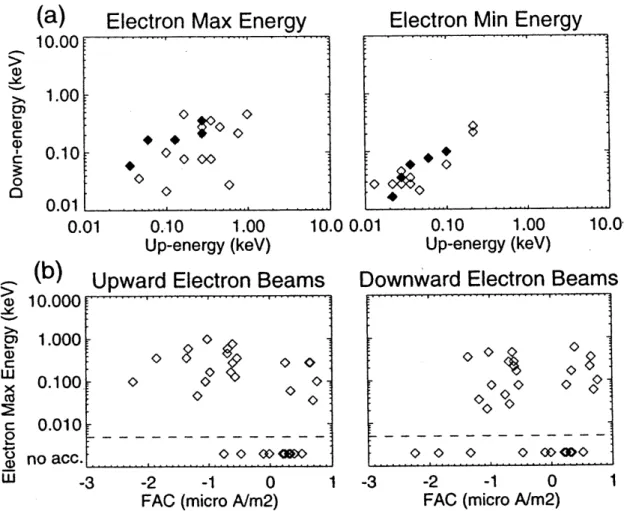
If the reflection of FEB, on the same auroral field line just above the satellite really takes place, there should be some relationship between the downward and upward components since both the components have the same origin. Figure 3a compares the upward and downward energies of coun-terstreaming electrons. The filled diamonds represent data in the upward FAC after 6:42:30. The minimum energies (right) are almost identical (correlation coefficient: 0.88) while the maximum (left) show rather a large scatter (correlation coef-ficient: 0.45).
392 W. Miyake et al.: Electric field fluctuations and electron beams in an aurora
Fig. 3. (a) Comparison of upward and downward energies of counterstreaming electrons. The filled diamonds stand for the data after
6:42:30. (b) Relationship between the intensity of field-aligned current and the maximum energy of upward (left panel) and downward (right) field-ligned electron beams.
In the upward current region, a parallel ac field is expected below the electrostatic auroral acceleration region. A strong upward dc field in the auroral acceleration region completely reflects the ionospheric electrons accelerated upward by the ac field and symmetrical counterstreaming FEB are formed (Yoshioka et al., 2000).
Parallel ac field above the satellite is expected to reflect the upgoing FEB in the downward current region. Since the net current is downward, the ac field at high altitude is assumed to be smaller than the downward dc field at low altitude. The ac field reflects only the lower-energy portion of the FEB in this case and the downgoing FEB is not just a mirror image of the upgoing FEB. The minimum energies of both compo-nents of FEB are quite similar.
Figure 3b shows the relation between the magnitude of field-aligned current (FAC) and the maximum energy of FEB. Elphic et al. (1998) reported the current-voltage relation of downward FAC. The event analyzed here supports the rela-tion with a large scatter. The accelerarela-tion modified by a su-perposed ac field may result in the large scatter.
The lower energy cutoff of ion conics is rather stable (the forth panel of Fig. 1) while the maximum energy of FEB
is quite variable. The lower energy cutoff of ion conics cor-responds to the downward potential drop below the satellite (Carlson et al., 1998). The inconsistency of the lower cut-off energy of ion conics and the upward energy of FEB also agrees with the idea of the coexistence of both ac and down-ward dc electric fields on the same field line. The electrons are accelerated by both the ac and dc fields, while the ions are accelerated only by the dc field (Hultqvist et al., 1991).
The Alfven waves probably propagate down from the mag-netosphere and are reflected back at the ionosphere. Ivchenko et al. (1999), however, reported that the motion of discrete electron precipitation, which modifies the ionospheric con-ductance and current, leads to the launch of Alfven waves upward from the ionosphere. We do not know the motion of the discrete electron precipitation region in the event, but it is possible that a part of upward-propagating waves are gener-ated by the modification of the conductance around the edge of the intense precipitation.
It has also been suggested that electromagnetic ion cy-clotron waves generate FEB (Temerin et al, 1986), but they accelerate electrons downward. The ion cyclotron waves are excited by electron beams of inverted-V precipitations
(Er-W. Miyake et al.: Electric field fluctuations and electron beams in an aurora 393 landson and Zanetti, 1998). Therefore, it is difficult to
ac-count for the upward acceleration of electrons below the au-roral acceleration regions and downward acceleration in the diffuse precipitation regions.
In summary, the low-frequency electric field fluctuations observed around the edge of an auroral acceleration region are Alfvenic, suggesting that the parallel component of the wave electric field in the confined region may be responsible for the generation of FEB. The FEB in the adjacent down-ward current region are, on the other hand, basically acceler-ated upward by the downward field-aligned electrostatic field below the satellite as proposed by FAST observations. The origin of the associated downward FEB there is still an open question. One possibility is that the same ac acceleration mechanism as that around the edge of auroral acceleration regions is also operative, superposed over the acceleration by field-aligned static potential drop.
Acknowledgements. We thank all the members of Exos-D project team, especially K. Tsuruda and H. Oya, for their extensive support. Topical Editor G. Chanteur thanks R. Pottelette for his help in evaluating this paper.
References
Aikio, A. T., Blomberg, L. G., Marklund, G. T., and Yamauchi, M., On the origin of the high-altitude electric field fluctuations in the auroral zone, J. Geophys. Res., 101, 27157, 1996.
Carlson, C. W. et al., FAST observations in the downward auroral current region: energetic upgoing electron beams, parallel poten-tial drops, and ion heating, Geophys. Res. Lett., 25, 2017, 1998. Collin, H. L., Sharp, R. D., and Shelley, E. G., The occurrence and characteristics of electron beams over the polar regions, J. Geo-phys. Res., 87, 7504, 1982.
Elphic, R. C. et al., The auroral current circuit and field-aligned currents observed by FAST, Geophys. Res. Lett., 25, 2033, 1998. Erlandson, R. E. and Zanetti, L. J., A statistical study of auro-ral electromagnetic ion cyclotron waves, J. Geophys. Res., 103, 4627, 1998.
Fukunishi, H. et al., Magnetic field observations on the Akebono (EXOS-D) satellite, J. Geomag. Geoelectr., 42, 385, 1990. Goertz, C. K. and Boswell, R. W., Magnetosphere-ionosphere
cou-pling, J. Geophys. Res., 84, 7239, 1979.
Gorney, D. J., Chiu, Y. T., and Droley Jr., D. R., Trapping of ion conics by downward parallel electric fields, J. Geophys. Res., 90, 4205, 1985.
Gurnett, D. A., Huff, R. L., Menietti, J. D., Burch, J. L., Winning-ham, J. D., and Shawhan, S. D., Correlated low-frequency elec-tric and magnetic noise along the auroral field lines, J. Geophys. Res., 89, 8971, 1984.
Hayakawa, H. et al., Electric field measurement on the Akebono (EXOS-D) satellite, J. Geomag. Geoelectr., 42, 371, 1990. Hultqvist, B., Vo, H., Lundin, R., Aparicio, B., Lindqvist, P.-A.,
Gustafsson, G., and Holback, B., On the upward acceleration of electrons and ions by low-frequency electric field fluctuations observed by Viking, J. Geophys. Res., 96, 11609, 1991. Ivchenko, N., Marklund, G., Lynch, K., Pietrowski, D., Torbert, R.,
Primdahl, F., and Ranta, A., Quasiperiodic oscillations observed at the edge of an auroral arc by Auroral Turbulence 2, Geophys. Res. Lett., 26, 3365, 1999.
Knudsen, D. J., Kelley, M. C., Earle, G. D., Vickrey, J. F., and Boehm, M., Distinguishing Alfven waves from quasi-static field structures associated with the discrete aurora: sounding rocket and HILAT satellite measurements, Geophys. Res. Lett., 17, 921, 1990.
Lundin, R. and Eliasson, L., Auroral energization processes, Ann. Geophysicae, 9, 202, 1991.
Lundin, R., Gustafsson, G., Eriksson, A. I., and Marklund, G., On the importance of high-altitude low-frequency electric field fluc-tuations for the escape of ionospheric ions, J. Geophys. Res., 95, 5905, 1990.
Miyake, W., Mukai, T., and Kaya, N., A statistical study of field-aligned electron beams associated with ion conics events, Ann. Geophysicae, 16, 940, 1998.
Mukai, T. et al., Low energy charged particle observations in the ‘auroral’ magnetosphere: First results from the Akebono (Exos-D) satellite, J. Geomag. Geoelectr., 42, 479, 1990.
Nagatsuma, T., Fukunishi, H., Hayakawa, H., Mukai, T., and Mat-suoka, A., Field-aligned currents associated with Alfven waves in the poleward boundary region of the nightside auroral oval, J. Geophys. Res., 101, 21715, 1996.
Oya, H. and Tsuruda, K., Introduction to the Akebono satellite ob-servations, J. Geomag. Geoelectr., 42, 367, 1990.
Robinson, R. M., Vondrak, R. R., Miller, K., Dabbs, T., and Hardy, D., On calculating ionospheric conductances from the flux and energy of precipitating electrons, J. Geophys. Res., 92, 2565, 1987.
Sharp, R. D., Shelley, E. G., Johnson, R. G., and Ghielmetti, A. G., Counterstreaming electron beams at altitude of 1 Re over the auroral zone, J. Geophys. Res., 85, 92, 1980.
Sugiura, M., Maynard, N. C., Farthing, W. H., Heppner, J. P., and Ledley, B. G., Initial results on the correlation between the mag-netic and electric fields observed from the DE-2 satellite, Geo-phys. Res. Lett., 9, 985, 1982.
Temerin, M., McFadden, J., Boehm, M., Carlson, C. W., and Lotko, W., Production of flickering aurora and field-aligned electron flux by electromagnetic ion cyclotron waves, J. Geophys. Res., 91, 5769, 1986.
Tsuruda, K. and Oya, H., Introduction to the Exos-D (Akebono) project, Geophys. Res. Lett., 18, 293, 1991.
Weimer, D. R., Goertz, C. K., Gurnett, D. A., Maynard, N. C., and Burch, J. L., Auroral zone electric fields from DE 1 and 2 at magnetic conjunctions, J. Geophys. Res., 90, 7479, 1985. Yoshioka, R., Miyake, W., Mukai, T., and Ito, M., Field-aligned
electron beams observed simultaneously with upflowing ion beams in the auroral acceleration region, J. Geophys. Res., 105, 7679, 2000.