HAL Id: insu-01406447
https://hal-insu.archives-ouvertes.fr/insu-01406447
Submitted on 1 Dec 2016
HAL is a multi-disciplinary open access
archive for the deposit and dissemination of
sci-entific research documents, whether they are
pub-lished or not. The documents may come from
teaching and research institutions in France or
abroad, or from public or private research centers.
L’archive ouverte pluridisciplinaire HAL, est
destinée au dépôt et à la diffusion de documents
scientifiques de niveau recherche, publiés ou non,
émanant des établissements d’enseignement et de
recherche français ou étrangers, des laboratoires
publics ou privés.
Stationary and nonstationary behaviour within the
geomagnetic polarity time scale
Y. Gallet, G Hulot
To cite this version:
Y. Gallet, G Hulot.
Stationary and nonstationary behaviour within the geomagnetic polarity
time scale. Geophysical Research Letters, American Geophysical Union, 1997, 24, pp.1875-1878.
�10.1029/97GL01819�. �insu-01406447�
GEOPHYSICAL RESEARCH LETTERS, VOL. 24, NO. 15, PAGES 1875-1878, AUGUST 1, 1997
Stationary
and nonstationary
behaviour
within
the geomagnetic
polarity time scale
Y. Gallet and G. Hulot
D6partement
de G6omagn•tisme
et Pal•omagn•tisme
URA 729 CNRS, Institu{ de Physique du Globe de ParisAbstract. We analyse the geomagnetic polarity time scale
(GPTS) since the Upper Jurassic by displaying the successive
lengths of polarity intervals as a function of their order of
occurrence. The sequence consists of three segments. Between
the Upper Jurassic and the Lower Cretaceous, segment "A" comprises intervals of short duration, with a mean duration of
about 0.29 My, and no clear long-term evolution. Segment
"B" begins around 130 Ma, displays a sudden increase of the
duration of the magnetic intervals, an interval of maximum duration, the normal Cretaceous superchron, and a long and erratic sequence of inteivals with decreasing average duration
between 85 Ma and about 25 Ma. From 25 Ma to the present,
segment "C" consists of intei-vais of short duration with a
mean value of 0.23 My. This description
suggests
that the
Earth's magnetic field could have experienced a fairly stationary regime until slightly befoie the onset of the
Cretaceous superchron, when the regime has been rapidly and
strongly perturbed before progressively returning to another
stationary
regime about 25 Ma ago. A geophysical
explanation for this sequence of e9ents could be that the geodynamo has been perturbed by the arrival of some cold
material at the core mantle boundary. As this material would have heated up, the geodynamo would have been brought back to its stationary regime.
1. Introduction
The origin of the numerous polarity changes of the geomagnetic field over the geological time scale is still poorly
understood. Marine magnetic anomalies clearly display large
changes in reversal frequency since the Upper Jurassic, suggesting a long time constant of about 150 My (McFadden and Merrill, 1984), and magnetostratigraphic results from the Upper Permian to the Middle Jurassic roughly confirm this suggestion since approximately 320 My (Gallet et al., 1992). This type of long-term behaviour reflects either an intrinsic property of the dynamo process itself or a response of the dynamo to some external forcing (e.g. McFadden and Merrill,
1984; 1986; Gubbins, 1987). Recently, Gallet and Courtillot
(1995)
proposed
to complete
the commonly
used
analysis
in
frequency by displaying the successive lengths of polarity
intervals as a function of their order of occurrence in the
sequence. In the present study we further consider this representation and point out that it provides new insights on the description of the GPTS since the Upper Jurassic (about
160 Ma).
Copyright 1997 by the American Geophysical Union. Paper number 97GL01819.
0094-8534/97/97GL-01819505.00
2. The GPTS as a function of order of occurence
The GPTS, which displays
no statistical
difference
between
the normal and reverse polarity states (McFadden and Merrill,1984; Merrill and McFadden, 1994), can be described in terms
of a Gamma process (i.e. an alteration of a Poisson process, which is a random process with no memory of its past behaviour). One can write the Gamma density probability following the convention of McFadden and Merrill (1986):
P(x)= 1 2?xt,_le_XX
(1)
where F(k) is the Gamma function of k and •, is an inherent rate of reversals associated with the unaltered Poisson process. A Gamma process reduces to a Poisson process when k is equal to one. A value for k greater than one can be interpreted either as
an artefact linked to some short intervals missing in the GPTS
or to some short term memory within the dynamo that would inhibit a second reversal just after a first ohe has occurred (McFadden and Merrill, 1993). In any case, the Gamma process describing the GPTS is known to be non stationary on time scales of 100 My, essentially because of some variation within
the inherent rate •, (k displaying little significant variations
except at the time of the Cretaceous superchron; where the reversal process seems to have been completely frozen; e.g., Merrill and McFadden, 1994).
The GPTS can therefore be viewed as the result of a time
varying Gamma process, mainly controlled by the mean
duration ],t =k/f,, an estimate of which is given by the
average
duration/,tN(i)
=(1/N)•xj of N intervals
of duration
xj
about the interval number i. This estimate, which has a
variance
Var(ktN(i))--(ktN(i)
2/kN) (McFadden,
1984),
can
be plotted
as a function
of i to characterize
the evolution
of the
process creating the GPTS.We have considered a composite GPTS constituted by the Upper Cretaceous to Cenozoic polarity sequence recently proposed by Cande and Kent (1995) and the Upper Jurassic to Lower Cretaceous sequence suggested by Harland et al. (1990). The whole sequence contains 284 intervals, 99 intervals before
the Cretaceous superchron and 184 after. We acknowledge that
the uncertairities which remain in the precise absolute dates of
the Mesozoic
GPTS render
delicate
the detailed
analysis
of the
GPTS,
but we believe
that they would
not notably
modify
the
broad description we intend to do hereafter. The polarity
interval dt•rahons for both polarities are shown as a function of
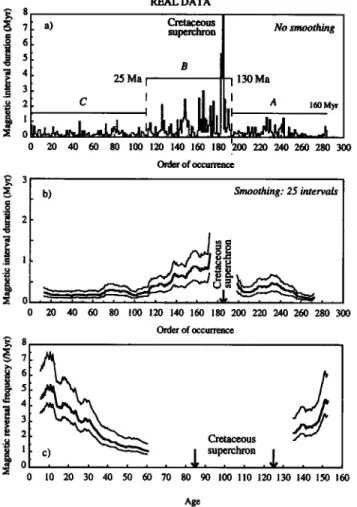
order of occurrence on Figure 1. The raw data is plotted on Figure l a, and the corresponding estimates ktN(i) for N=25 on Figure lb (except when they involve the Cretaceous superchron). We have arbitrarily chosen N=25 in order to smooth most of the ambiguous short-term fluctuations. We
1876 GALLET AND HULOT: STATIONARY AND NONSTATIONARY BEttAVIOIIR
REAL DATA
a) Cretaceous
superchron
No
smoothing
25
Ma
I B • I 130Ma
' I , r 0 20 40 60 80 100 120 140 160 180 1200 220 240 260 280 300 Order of occurrence b) Smoothing: 25 intervals 20 40 60 80 100 120 140 160 180 200 220 240 260 280 300 Order of occurrence Cretaceous, , •L
,superchron
l0 20 30 40 50 60 70 80 90 100 ll0 120 130 140 150 160 AgeFigure 1. Polarity interval durations as a function of order of occurrence (Fig. l a,b). The first interval is Brunhes. The raw data is shown on Fig. la, and gN(i) for N=25 and k=l is plotted
with its 2(5N=25
errors
((SN(i)=gN(i)/x/N)
on Fig. lb (except
those involving the Cretaceous superchon). Fig. l c shows7.*50 since
approximately
160 Myr. We also
plotted
the
curves
7.+(i)=1/(g50(i)+2(550(i))
and 7._(i)=1/(g50(i)-2(550(i)
)
within
which
7.*50
is expected
to fluctuate.
also have considered k=l to compute the errors associated with
•, although k is usually slightly larger (and thus the
uncertainties smaller). Both diagrams support the idea that a
difference exists in reversal behaviour before and after the
Cretaceous
superchron
(the Cretaceous
superchron
#185 is
preceeded by only 2 intervals that last longer than 1.5 My,
whereas
at least 9 such intervals follow it; Fig. l a). They
further suggest
that the GPTS can essentially
be described
by
three segments. Between intervals #284 and #193 (segment A: Upper Jurassic-Lower Cretaceous), the magnetic reversals a/'e
of short duration
with no clear long-term
evolution,
•tN(i)
being roughly constant within error bars ([t A=0.29 _+ 0.03
My). Between intervals #192 and #110 (segment B), the
average
duration
first increases
quickly (in less than 10 My),
reaches
a maximum
with the Cretaceous
superchron
(35 My;
Cande and Kent, 1995), and then decreases
slowly between
intervals #184 and approximately #110 (from about 85 Ma to
25 Ma). A third segment (C) finally characterises intervals
#110 to #1. The magnetic
intervals
are then again of short
duration,
with gC=0.23 _+ 0.02 My. As previously
suggested,
the observed
behaviour
resembles
fiat white
noise
(Dubois
and
Painbrun, 1990; Gallet and Courtillot, 1995).
We next plotted histograms of the duration of the magnetic intervals for the 3 segments (Fig. 2a). Each number of intervals has been divided by the total number of intervals withit/the respective segment. Whereas segments A and C are indeed very similar, segment B clearly differs eventhough we did not take the onset of B and the Cretaceous superchron into
accoufit.
Plotting
histograms
of the relative
duration
of the
magnetic
intervals
with respect
to the time varying
estimate
of
[t gives a different picture (Fig. 2b). The lengths of the magnetic intervals have been divided by their respective mean duration tbr segments A (gA) and C (gC), and by a varying
valu• [t B(i) defined by a linear trend adjusted
to the one
observed
in Figur6
lb (between
the value
of 1.0 My for interval
#18• and 0.23 My for interval #111) for segment B. The three distributions are now very close to one another (Fig. 2b; giventhe small riumber of intervals in each segment). This confirms
that the GPTS can be interpreted as the result of one process essentially characterized by the parameter la (except during the
onset
of B and
the Cretaceous
superchron).
3. Discussion
ß
Previous analyses have shown that the GPTS is the result of
a Gamma
process
defined
by equation
(1) and characterized
by
the two parameters
k and 7., or alternately
k and la=k/7..
Because
k clearly displays little significant
variations
through the
sequence. changes in the GPTS are essentially due to variations
either
in 7. or g. But neither
7. nor la are readily
accessible
to
r i Segment
A [
.-.r• Segment B [ I71 Segment C ]I I
0 -- 0.4 -- 0.8 -- 1.2 -- 1.6 -- 2.0 -- 2.4 -- 2.8 -- 3.2 -- 3.6 -- 4.0 Intervals of duration (My)
I .-.Y73?l Seg .... B I
• 0.3 F
I
0 .... :'•
04 08 12 16 20 24 28 32- 3.6 -4.0 Normalised intervals of duration
Figure 2. Histograms of duration of the intervals defining
the three segments A,B,C. Only the intervals following the
Cretaceous superchron have been considered for the segment
B. The histograms have been normalized to the total number of
intervals within each segment (Fig. 2a). Fig. 2b: same except
that the duration of the magnetic intervals has been divided by
GALLET AND HULOT: STATIONARY AND NONSTATIONARY BEHAVIOUR 1877
measurement. The only parameter which can be recovered with some good statistical understanding is the estimator gN(i)of g (McFadden, 1984). Plotting gN(i) as a function of i (order of occurrence) treats each realization of the process with equal weight (Fig. lb). This representation underlines the different nature of the non-stationarity of the reversal process before and after the Cretaceous superchron. It also shows the close similarity between segments A and C, together with their fiat white noise-like behaviour. This latter characteristic suggests that during the corresponding periods of time the geodynamo experienced a fairly stationary regime characterized by the random occurrence of short magnetic polarity intervals (Dubois and Pambrun, 1990; Gallet and Courtillot, 1995). The
onset of the Cretaceous superchron at the beginning of
segment B, in about 5 My (Harland et al., 1990), shows that the stationary regime defined by segment A rapidly ended
slightly before the superchron. In contrast the second part of
segment B, between 85 Ma and 25 Ma, indicates a progressive return to another stationary regime (segment C).
This interpretation of the GPTS represents an alternative to the one of McFadden and Merrill (1984) which is based on the
curve
derived
from
the
GPTS
by plotting
X*50(i)=l/g50(i)
as
a
function of the age (and no longer as a function of i). The
parameter
X*50 provides
an estimate
of ),./k
and
as
k changes
little,
variations
in X*50 can
be interpreted
as changes
in the
true reversal rate ),, (McFadden, 1984). The corresponding curve
is shown on Figure l c together with the bands within which
the
estimator
X*50 is expected
to fluctuate
about
X/k.
For
the
last 100 My, this curve suggests that the reversal rate has gradually increased from the end of the Cretaceous superchron to the present. This interpretation is compatible with the data but is strongly guided by the way the data is presented. The time when the process is clearly non-stationary (our segment B) corresponds to a long period on Figure l c and invites to extrapolate this behaviour up to the present. Also the choice of N=50 strongly smoothes the curve and short term changes in the trend are impossible to see (only three averages are statistically independent over the last 100 My). On the contrary, our curve (Fig. lb) closely sticks to the original data (Fig. la), involves twice less averaging and provides a better chance of assessing the non-stationarity within the GPTS. It suggests with equal statistical value that changes in behaviour could have indeed occurred about 25 Ma and 130 Ma ago. For
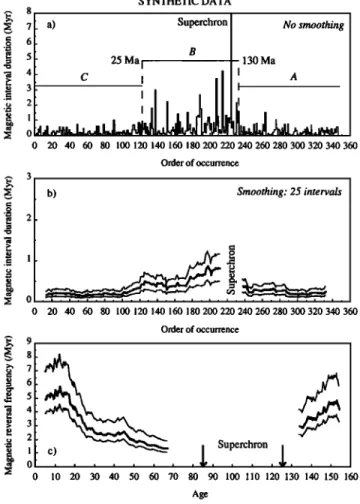
further confirmation, we have generated a synthetic magnetic
polarity sequence with the help of a Poisson process controlled by a parameter g equal to gA during enough intervals to cover
the length of segment A (from 160 to 130 My), stopped during
a fictitious superchon, reinitiated with g=gB(i) during the time
of segment B, and finally made stationary again with g=gc
during the time of segment C (Fig. 3). Whereas Figure 3c shows the same trends as Figure l c that led McFadden and
Merrill (1984) to their interpretation, Figure 3b properly
recovers the three segments we had input and looks very similar to Figure lb.
Interpreting the reversal behaviour in terms of physical process is notoriously speculative, because little is known about what controls the reversals. Boundary conditions imposed by the core-mantle boundary (CMB) certainly influence the geodynamo and may thus control changes in the
GPTS. Here we explicitely assume that changes in p result from
some changes within the CMB boundary conditions. The most
8
• o
SYNTHETIC DATA a) Superchron No smoothing B 25 Ma I 130 Ma I Ac
I
I
I
0 20 40 60 80 100120140160180200220240260280300320340360 Order of occurrence Smoothing: 25 intervals 0 20 40 60 80 100 120 140 160 180 200 220 240 260 280 300 320 340 360 Order of occurrence 9 • 8 • 6 3 e 2 • 0 0 10 20 30 40 50 60 70 80 90 100 110 120 130 140 150 160 AgeFigure 3. Synthetic magnetic polarity sequence generated as
described in the text. Same representations as in Fig. 2.
important conditions are believed to be the thermal ones at the CMB which control the heat flux extracted from the core.
Gubbins (1987) pointed out the possible influence of mantle
thermal lateral variations
on the behaviour
of the magnetic
field. Stacey (1991) further suggested
that there might be
crypto-continents drafting and inducing additional lateral
thermal variations at the CMB. But changes produced in this
way are slow and can hardly account
for the rapid tYeezing
of
the reversal process in less then 10 My. Several other authors
underlined
the fact that the heat flux is controlled
by the
thickness
of the D" layer (assumed
to be a thermal
boundary
layer) at the base
of the mantle
and that this thickness
is likely
to change every time a plume erupts as a result of some
instabilities
within D" (e.g., Loper and McCartney, 1986;
Courtillot and Besse, 1987; Larson and Olson, 1991). But
Loper (1992) showed
that partially
emptying
D" only leads to
slow changes within the heat flux (on time scales of a billionyears). A plume leaving D" would therefore not better account tbr the A, B, C sequence.
In contrast,
if some
cold material
could
be brought
quickly
in direct
contact
with
the
core,
the
heat
flux
would
be
promptly
and drastically
altered.
Such
a thermal
anomaly
could
possibly
explain the sudden onset of segment B. For a slab-like structure
with a thermal
diffusivity
k=10-6m2s-1
that
arrives
in contact
with the core, the flux below this structure
is proportional
at
any subsequent
time
t to the temperature
gradient
AT/(krct)
1/2,
where AT is the initial temperature contrast between the core1878 GALLET AND HULOT: STATIONARY AND NONSTATIONARY BEHAVIOUR
and the cold anomaly (e.g., Turcotte and Schubert, 1982). This
temperature gradient goes back to a value comparable to the
one the thermal boundary layer enjoyed before the arrival of
the cold material (VT), after a relaxation time of the order of
b2/krc,
where
b=AT/VT is the distance
from the CMB within
the thermal boundary corresponding to a temperature drop of
AT. This can be assumed to be of the order of the thickness of
the thermal boundary layer itself (say 100 km). A relaxation
time of about 100 My is found, which is the order of magnitude of the duration of our segment B. A possible interpretation of
the A,B,C sequence is then that the thermal boundary
conditions could have remained stable during A, have been
perturbed at the onset of B by the arrival of some cold material
at the CMB, and have settled back as the cold material was heated back to some thermal equilibrium. The mechanism that
could push cold material at the CMB remains uncertain. An
efficient candidate could be a mantle avalanche. Indeed, 3-D numerical models of mantle convection incorporating an endothermic phase transformation at the 660 km discontinuity
all display hybrid convection. This type of convection is
mainly two-layered but occasionnally may experience flushing
events during which cold material suddenly sinks from the upper mantle into the lower mantle (e.g., Machetel and Weber,
1991). As an alternative, a subducted slab could have
penetrated into the lower mantle and landed at the CMB (e.g.,
Christensen, 1996; Eide and Torsvik, 1996). Such events seem to be rare enough to account for the fact that just one is being seen in the 160 My long GPTS, and quick enough for the
material to remain significantly cold when it reaches the CMB.
This interpretation of the GPTS assumes that reversals of the geomagnetic field are strongly inhibited by the local
increase in the heat flux associated with the arrival of cold
material at the CMB. We note that such local changes would modify the boundary conditions. Altering the boundary conditions in rotating convective systems clearly impose strong and global constraints on the nature of the solution
chosen by the system (e.g., Zhang and Gubbins, 1993). 'We
therefore suggest that these changes could prevent the system from going through intermediate states that would normally lead to a reversal. At the onset of B, the perturbation would have been particularly strong and the system would have remained stuck in one polarity. As the cold material would have progressively heated up, the perturbation would have been weaker, only proportionnally impeding the reversals. This further suggests that the size of the cold anomaly arriving at the CMB could provoke and determine the duration of the subsequent superchron. This could explain the longer duration of the Kiaman superchron occurring during the Late Paleozoic (Harland et al., 1990). This scenario does not preclude some correlations with plume eruptions possibly triggered by the
arrival of the cold material within D".
References
Cande, S., and D. Kent, Revised calibration of the geomagnetic polarity
timescale for the Late Cretaceous and Cenozoic, J. Geophys. Res., 100, 6093-6095, 1995.
Courtillot, V., and J. Besse, Magnetic field reversals, polar wander, and
Core-Mantle coupling, Science, 237, 1140-1147, 1987.
Christensen, U., The influence of trench migration on slab penetration
into the lower mantle, Earth Planet. Sci. Lett., 140, 27-39, 1996. Dubois, J., and C. Pambrun, Etude de la distribution des inversions du
champ magn6tique terrestre entre -165 Ma et l'actuel (6chelle de
Cox). Recherche d'un attracteur dans le systeme dynamique qui les g6n•re, C. R. Acad. Sci. Paris, 311,643-650, 1990.
Eide, E., and T. Torsvik, Paleozoic supercontinental assembly, mantle flushing, and genesis of the Kiaman superchron, Earth Planet. Sci.
Lett., 144, 389-402, 1996.
Gallet, Y., J. Besse, L. Krystyn, J. Marcoux, and H. Th6veniaut,
Magnetostratigraphy of the Late Triassic Bolticektasi Tepe section (northwestern Turkey): implication for changes in magnetic reversal frequency, Phys. Earth Planet. lnt., 73, 85-108, 1992.
Gallet, Y., and V. Courtillot, Geomagnetic reversal behaviour since 100 Ma, Phys. Earth Planet. lnt., 92,235-244, 1995.
Gubbins, D., Mechanism for geomagnetic polarity reversals, Nature,
326, 167-169, 1987.
Hadand, W., R. Armstrong, A. Cox, L. Craig, A. Smith, and D. Smith, A
geologic time scale, Cambridge University Press, 263 pp, 1990.
Larson, R., and P. Olson, Mantle plumes control magnetic reversal frequency, Earth Planet. Sci. Lett., 107, 437-447, 1991.
Loper, D., and K. McCartney, Mantle plumes and the periodicity of magnetic field reversals, Geophys. Res. Lett., 13, 1525-1528, 1986. Loper, D., On the correlation between mantle plume flux and the
frequency of reversals of the geomagnetic field, Geophys. Res. lett.,
19, 25-28, 1992.
Machetel, P., and P. Weber, Intermittent layered convection in a model
with an endothermic phase change at 670 km, Natttre, 350, 55-57,
1991.
McFadden, P., Statistical tools for the analysis of geomagnetic reversal
sequences, J. Geophys. Res., 89, 3363-3372, 1984.
McFadden, P., and R. Merrill, Lower Mantle convection and
geomagnetism, J. Geophys. Res., 89, 3354-3362, 1984.
McFadden, P., and R. Merrill, Geodynamo energy source constraints fi'om paleomagnetic data, Earth Planet. Sci. Lett., 42, 22-33, 1986. McFadden, P.L., and R.T. Merrill, Inhibition and geomagnetic field
reversals, J. Geophys. Res., 98, 6189-6199, 1993.
Merrill, R.T., and P.L. McFadden, Geomagnetic field stability: Reversal
events and excursions, Earth Placket. Sci. Lett., 121, 57-69, 1994.
Stacey, F., Effect on the core structure within D", Geophys. Astrophys.
Fhtid Dymtm., 60, 157-163, 1991.
Turcotte, D., and G. Schubert, Geodynamics. Applications of continuum physics to geological problems, J.Wiley and Sons eds., New York,
450 pp., 1982.
Zhang, K., and D. Gubbins, Convection in a rotating spherical fluid shell with an inhomogeneous temperature boundary condition at infinite
Prandtl number, J. Fluid. Mech., 250, 209-232,1993.
Y. Gallet and G. Hulot, IPGP, D•partement de G•omagn•tisme et
Pal•omagn•tisme, 4 Place Jussieu, 75252 Paris Cedex 05, France.
Acknowledgments. We thank J. Besse, J. Carlut, V. Courtillot, S. Gilder and L.E. Ricou for their help. IPGP Contribution no. 1480 and INSU, program "Terre Profonde" Contribution no. 87.
(Received August 14, 1996; revised March 25, 1997;