TECHNICAL REPORT
The development and implementation of an outcomes database
for imaging-guided therapeutic musculoskeletal injections
Cynthia K. Peterson&Christian W. A. Pfirrmann& Juerg Hodler
Received: 27 November 2013 / Revised: 5 February 2014 / Accepted: 23 March 2014 / Published online: 16 April 2014 # ISS 2014
Abstract
Objectives To present the process of creating an imaging-guided injections outcomes database and to reflect on how this database has affected the scientific activities of the radi-ology department.
Materials and methods The literature was searched to identify studies on the effectiveness of musculoskeletal therapeutic injections, areas where research is lacking, and relevant out-come measures. Validated outout-come measures were chosen and tested in a pilot study. Data collection time points of 1 day, 1 week and 1 month post-injection were determined and the post-pilot study postal questionnaires were created. The data collection process began and has been ongoing for over 4 years. Critical reflection on the process and outcomes from the database occurred.
Results The 9 steps to creating this outcomes database are presented. The numerical rating scale for pain (NRS) and the Patient’s Global Impression of Change (PGIC) were identified as the most valid, reliable, and time-effective outcome mea-sures. At most, 50 % of patients return their postal question-naire. The database has facilitated the publication of numerous research projects.
Conclusions Setting up an outcomes database is straightfor-ward and productive. The NRS and PGIC were considered the most useful outcome measures. This database facilitated crit-ical reflection on current practice and provides the foundation for several research studies.
Keywords Intra-articular injection . Pain assessment . Outcomes . Database . Numerical rating scale
Introduction
Medicine is currently being pressed to contain soaring health-care costs without compromising the quality of health care delivered [1–3]. Increasing pressure will be placed on clinicians to monitor their performance and provide evidence to governments, insurers, and patients with regard to the outcomes and costs related to their various treatments [1, 2]. Some countries have already started this process with the goals to improve quality of care and encourage practice according to national stan-dards and guidelines [2, 4, 5]. In the future, physicians will likely see at least some of their pay based on the quality and efficiency of their services.
Measuring patient outcomes from medical interven-tions could and perhaps should become a routine part of daily clinical practice. This would provide a quality assurance program to help clinicians, departments or practices monitor, analyze, and improve patient out-comes on a continuous basis [6]. Many validated out-come measures (questionnaires) are available in a vari-ety of languages, specific to the condition or anatomical region treated [1, 2, 7]. Some of these questionnaires are quite long, however, and clinicians, their office staff, and patients are often reluctant to use them in daily clinical practice because of the time required for com-pletion. Still, these longer outcome measures are used routinely in research studies to evaluate the effective-ness of medical treatments, with the results often having profound positive consequences for patients and physi-cians. Finding the right balance of appropriate, respon-sive, yet short outcome measures for daily clinical C. K. Peterson (*)
:
C. W. A. PfirrmannDepartment of Radiology, Orthopaedic University Hospital of Balgrist, University of Zürich, Forchstrasse 340, 8008 Zürich, Switzerland
e-mail: [email protected] J. Hodler
Department of Radiology, University Hospital, University of Zürich, Rämistrasse 100, 8091 Zürich, Switzerland
practice is critical if the implementation of such a quality assurance program is to be successful.
Recognizing the likely eventuality that providing outcome data for the treatments used would become mandatory, the radiology department at this specialized orthopedic/ rheumatology university hospital was proactive and began the process of implementing a database assessing the out-comes of patients receiving all imaging-guided musculoskel-etal (MSK) therapeutic injections in 2009. A review of the relevant literature on databases or quality assurance assess-ment measures for interventional pain manageassess-ment found only two recent papers addressing this issue [4,6] with pain levels only measured immediately after the procedures. No longer term outcomes were measured.
The original purposes for creating a database for outcomes from imaging-guided therapeutic injections were to:
1. Document and assess the outcomes from the various injection sites for quality assurance purposes
2. Reflect on and compare the outcomes from our hospital with those published in available research studies to iden-tify areas needing improvement or areas of good practice 3. Provide a large database for more specific and detailed
research projects
Once this database had obtained outcome data for several thousand patients, it was decided to assess its value and critically examine what has been learned. Therefore, the pur-poses of this paper are to present the process undertaken to create the database for imaging-guided therapeutic musculo-skeletal injections at this hospital, and to reflect upon how this database has affected the scientific activities of the radiology department in the hopes that other institutions may decide to implement a similar project.
Materials and methods
In 2008–2009 the radiology department recognized the need to document outcomes of patients undergoing the thousands of imaging-guided musculoskeletal injections being carried out yearly at this university’s orthopedic/rheumatology hospi-tal. The first step in the process of creating this outcomes database was to obtain funding. Therefore, a grant proposal was written because the current radiologists, technologists, and other staff did not have the time necessary to devote to this project as well as perform all of their other job require-ments. The grant application was successful primarily because of the recognition by the funding agency of the direction that the Swiss government and indeed those of other countries are going in terms of reimbursement for various treatments in healthcare based on outcomes. Once funding had been obtain-ed, the second step in this process involved hiring a radiology
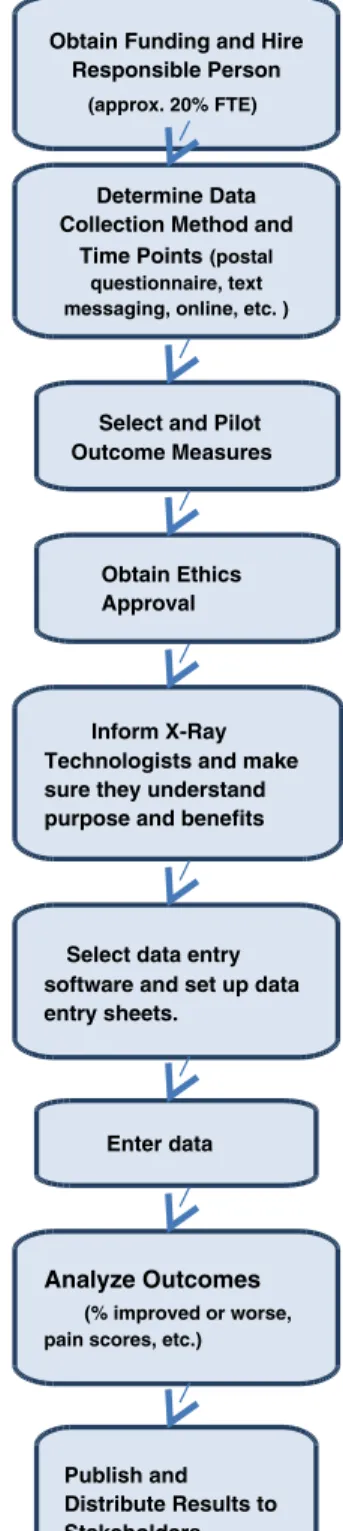
research fellow with over 20 years of diagnostic imaging and research experience to take charge of the project (Fig.1). This position represented only 20 % of a full-time job (i.e., 1 day per week).
Ethics approval was obtained from the hospital and county ethics committees, and all patients signed informed consent.
Obtain Funding and Hire Responsible Person
(approx. 20% FTE)
Determine Data Collection Method and
Time Points(postal questionnaire, text messaging, online, etc. )
Select and Pilot Outcome Measures
Inform X-Ray Technologists and make sure they understand purpose and benefits
Select data entry software and set up data entry sheets.
Enter data
Analyze Outcomes
(% improved or worse, pain scores, etc.)
Publish and Distribute Results to Stakeholders
Obtain Ethics Approval
Fig. 1 Flow chart of steps to create the outcomes database for imaging-guided therapeutic musculoskeletal injections
Prior to collecting any data, literature searches were carried out to:
1. Collect and evaluate the research evidence supporting the various musculoskeletal therapeutic injections [8–10] 2. Identify areas in the literature where evidence is lacking
[8–14]
3. Collect and evaluate appropriate questionnaire outcome measures (available and validated in German) for the various regions of the body treated
PubMed and the Cochrane databases were used for the literature search with the key words“intra-articular injection,” “musculoskeletal injection,” “outcomes,” “effectiveness,” “database,” and “quality assurance” inserted alone and in various combinations. The references for the relevant articles obtained were also hand searched. In order to find relevant outcome measures, each anatomical region was inserted sep-arately into these search engines.
Several MSK outcome measures, translated into and vali-dated in German, were identified for each bodily region. The Oswestry questionnaire for low back pain patients receiving lumbar facet injections, lumbar nerve root block injections or epidural injections was selected as most applicable for this bodily region and was piloted in patients receiving these injections. Similarly, the neck disability index was piloted for patients receiving cervical facet joint injections or the new procedure of indirect nerve root blocks [11]. These were the only outcome measures piloted as spinal injections are the most frequent MSK therapeutic injections performed at this hospital. Additionally, all patients in these pilot studies com-pleted the numerical rating scale for pain (NRS), where 0=no pain and 10 = unbearable pain, and the ‘Patient Global Impression of Change’ (PGIC) scale to evaluate over-all “im-provement” [15].
After piloting these outcome measures, only the numerical rating scale for pain and the PGIC scale to evaluate over-all “improvement” [15] were used for all MSK injection sites. Patients were requested to use the NRS to rate the severity of their pain relevant to the site to be injected or the site that was injected specifically at the time of questioning. The PGIC scale is a seven-point scale and incorporates factors such as disability and over-all well-being. It has been validated as a “gold standard” for “improvement” [16] and has been used as the primary outcome measure in several recent studies [17–21]. Only patients responding“much better” or “better” (scores of 1 or 2) were categorized as“improved.” This was considered the primary outcome for all imaging-guided injec-tion procedures. Patients were instructed to use the PGIC scale specifically for the anatomical site that had received the imaging-guided injection.
Pain levels were measured immediately prior to the injec-tion procedure, and at 20 min after the injecinjec-tion procedure
while the patient was in the radiology department. Each pa-tient was then handed an outcomes questionnaire from the radiological technologist to obtain NRS pain levels and PGIC outcome data at 1 day, 1 week, and 1 month after the injection procedure for all musculoskeletal injection sites. These spe-cific time periods were selected as nearly all of the patients were injected with both an anesthetic and a corticosteroid medication. It was desired to assess very short-term outcomes (i.e., 1 day), which may be due to the effect of the anesthetic, as well as medium-term outcomes (i.e., 1 month) that may be the result of the corticosteroid. This questionnaire was in a self-addressed and postage pre-paid envelope and the patients were instructed to return it to the hospital upon completion of the 1-month outcome data. Additionally, it was particularly desired to collect longer term outcome data for two specific injection sites (lumbar inter-laminar epidural injections and cervical indirect nerve root block injections [11]). The re-search fellow identified these specific patients weekly by accessing the information stored in the hospital computer and their contact information was provided to one of the radiology receptionists. The radiology receptionist was in charge of telephoning these particular patients to collect addi-tional data at 3 months and 1 year after injection. Although desirable, staffing resources did not allow for all patients receiving musculoskeletal injections at other sites to receive follow-up telephone calls 3 months and 1 year after the start of the database.
Data from the returned postal questionnaires and telephone interviews were entered by the research fellow into the Statistical Package for Social Sciences (SPSS) each week according to anatomical injection site. Direct data entry into SPSS provided the opportunity for quick statistical analyses as the data did not have to be copied from another software program and then pasted into SPSS. A weekly calculation of the proportion of patients reporting clinically relevant “im-provement” or “worsening” for each injection site was pre-pared and made available digitally under the name “Pain Database” on the radiology site of the hospital’s computer system. No patient identifying features were available on this weekly report. Patients were only identified by number, age, and gender in the SPSS database.
Results
Figure1shows the nine steps used to set up this database for therapeutic imaging-guided MSK injections. The Oswestry questionnaire and the Neck Disability Index, although rela-tively short outcome measures, were found to take up too much time to complete in the pilot studies without disrupting the normal patient flow through the radiology department. Therefore, Fig.2shows the two short outcome measures used at all follow-up time points.
The database has been growing for the past 4.5 years and continues to grow weekly, with over 5,500 patients included as of November 2013. However, it was found that at the most, 50 % of the patients who are handed these outcome question-naires actually return them in the post.
Since its inception, 12 scientific papers relating to the database have been published or accepted for publication [8–14,17,21–24]. Additionally, 4 medical students have been able to use the database as the foundation for their doctoral research projects and 4 other medical students have used it for their masters’ degree research projects. Collaborative research studies with the orthopedic, rheumatological, and chiropractic departments at this hospital have been published using some of the data [17,22, 23]. One international collaborative re-search project is nearing completion using data from the lumbar facet injection patients.
Discussion
This paper presents nine steps that can be used to create an outcomes database, not only for imaging-guided MSK injec-tions, but also for other therapeutic interventions. To our knowledge, this is the first paper to present such a process and to routinely collect outcomes for all MSK therapeutic injections beyond the immediate post-injection period [4–6]. Once a substantial number of patients had been included in this database and experience in using it for a few years had been gained, it was desired to share the process of developing this database and to reflect on what worked well and what could work better with this process in the hope that it may stimulate other institutions to create similar databases. A search of the literature found few publications on the routine evaluation of outcomes from these injections, and when avail-able, outcomes were only collected immediately after the procedures [4–6].
The two short outcome measures that were selected for use in developing this database did not disrupt the scheduling and flow of procedures in this busy radiology department and
were easy for patients to complete. The NRS for pain is a frequently used outcome measure and the advantages of the PGIC are becoming well recognized. The PGIC has been shown to be a valid and reliable outcome measure in several studies [16–21]. It has also been shown to be a“gold standard” for measuring clinically relevant “improvement” compared with longer outcome measures, including the Oswestry ques-tionnaire [16]. Furthermore, recent studies have shown that other, shorter outcome measures are actually more sensitive to change over time compared with the more traditionally used Oswestry and Neck Disability Index questionnaires [25,26]. Thus, the department was satisfied with the selection of the outcome measures as the critical information was obtained and it was not taxing for the patient or disruptive to the department.
The radiology department was not satisfied, however, with the fact that half or less than half of the patients returned their 1-month outcomes questionnaires [21,24]. The research fel-low discovered this problem by comparing the number of patients returning their questionnaires with the list of patients having particular injections listed in the computer records. Therefore, it was recognized early on in the development of the database, that the first of any follow-up studies needed to explore whether or not the outcome results obtained from patients who returned these postal questionnaires were an accurate reflection of the outcomes from the various injection procedures. Two of the three studies investigating this have been published [21, 24]. Thus, it was learned that better communication with the patient at the time of giving them the postal questionnaire may have improved the return rate. Alternatively, other data collection methods such as text mes-saging may be a better way of collecting this type of data [27]. The department also discovered a couple of years into the project that some of the technologists were not routinely handing these questionnaires to all patients as they somehow thought that the project was completed. Better communication between the research fellow and the technologists may have prevented this problem. Certainly, the return rate improved dramatically from a low of only 6 returned questionnaires one 1. Please rate the severity of your pain at this time.
(0/10 = no pain, 10 /10 = unbearable pain)
0/10 | | | | | | | | | | |
10/10
0 1 2 3 4 5 6 7 8 9 10
1. PGIC
Since your injection,how would you describe the change (if any) in ACTIVITY
LIMITATIONS, SYMPTOMS, EMOTIONS, and OVERALL QUALITY OF LIFE, related to your painful condition? Please tick only one box.
much better better slighty better unchanged slightly worse worse much worse Fig. 2 The two outcome
measures consisting of the Numerical Rating Scale (NRS) for pain and the Patient’s Global Impression of Change (PGIC) scale used to collect data after imaging-guided therapeutic injections
particular week to a consistent 40–50 questionnaires per week immediately after the research fellow made a formal presen-tation to the technologists covering the results obtained from the database and research studies published relating to it. It is critical to ensure that the technologists fully understand why a database project is started and the potential benefits for the patients in order for them to feel that their contribution to the project is vital. This was an important lesson that was learned. Since starting this project, 12 research papers using data from this database have been published and several more are currently under review. Eight medical students to date have used the database for their required masters’ or doctoral re-search studies and there has been an increase in collaborative research projects between the various departments in this hospital. The data that are currently available will provide many more opportunities for other research studies in the future in all areas of the musculoskeletal system, with ideas for additional projects continuing to grow.
Because the radiology department has found that the out-comes from these imaging-guided MSK injections vary wide-ly depending upon the injection site, the current focus of the research studies is to compare specific abnormalities found on imaging with patient outcomes. One such study already started is comparing abnormalities found on lumbar spine MRI scans with outcomes from patients who have imaging-guided lumbar nerve root blocks. Another study is looking at specific degenerative changes of the hip on routine radio-graphs and outcomes from imaging-guided hip injections. The goal is to help referring clinicians and their patients make more informed decisions concerning which patients are more or less likely to have a positive outcome from a particular injection. Other studies are also in process, with the first already published [17]. Future studies plan to investigate whether or not there is a link between specific abnormalities found on the physical examination and outcomes from injections.
Comparison of the outcomes from this hospital with those of other hospitals has not been made at this point, other than looking at studies previously published. Comparing the out-comes from this hospital with those reported in the literature is problematic for two reasons. One is that this hospital, being a specialized orthopedic/rheumatology hospital, attracts more difficult patients who have often been seen by many different physicians and health care professionals before being referred here. The other difficulty in comparing our results with those of other research studies is that many facilities are not rou-tinely administering these injections under imaging guidance, as recommended in the guidelines [8,9]. Searching for other hospitals with a similarly established database in Europe has just started.
The 1-month and 3-month outcomes obtained from this database have allowed the radiology department to focus on quality assurance issues such as considering why the
outcomes for certain anatomical sites are much better than those for other sites, and comparing the outcomes from this hospital with those published from other locations. This has been very advantageous in stimulating ideas for many follow-up research projects, as elaborated follow-upon above, provid-ing data for medical students to complete their research requirements and facilitating collaboration between var-ious medical specialties at this hospital. It is also an advantage that the research fellow is available to super-vise the medical students in their various projects using this database, thus removing part of the burden of more senior radiologists. The database will also provide an opportunity for the department in the future to compare outcomes based on the experience of the radiologist, as this is also a teaching hospital.
An obvious disadvantage of starting an outcomes database for any therapeutic intervention is the cost of hiring someone to manage it. At this particular hospital a trained clinician and researcher were chosen rather than a secretary or research assistant. The cost may be somewhat higher for this type of employee, but the advantages lie in the fact that a trained research fellow can write papers, carry out statistical analyses, and supervise post-graduate students. It was found that the job could be done on a 20 % contract. Other associated costs included the printing of the questionnaires and envelopes as well as the postage for the return envelopes. This cost could be avoided if another means of data collection, such as e-mail or text messaging, was used rather than postal questionnaires [27]. As many of the patients in our database are older, it was thought that they may not be as familiar with electronic data collection methods as they would be with traditional paper questionnaires. This will certainly change in the future, however.
Conclusions
The creation and implementation of this outcomes database for imaging-guided musculoskeletal injections has facilitated critical reflection on performance and consideration of ways to improve through additional research studies focusing on specific imaging or clinical findings that may be linked with outcome [28]. It also provides valuable information for refer-ring clinicians and has been a resource for masters and doc-toral students to complete their research requirements. The NRS and PGIC were determined to be the most useful out-come measures in terms of time efficiency, validity, and the breadth of information provided, and can even be used in a busy department.
Acknowledgements Funding for the development of the database was provided by the Vontobel-Stiftung, Tödistrasse 17, 8002 Zürich, Switzerland.
Conflict of interest The authors declare that they have no conflict of interest.
References
1. O’Brien JM, Corrigan J, Reitzner JB, et al. Will performance mea-surement lead to better patient outcomes? What are the roles of the National Quality Forum and Medical Specialty Societies? Chest. 2012;141:300–7. doi:10.1378/Chest.11-1942.
2. Spencer A. The white papers, quality indicators and clinical respon-sibility. Clin Med. 2012;12:19–22.
3. World Health Organization. The world health report 2000. Health systems: improving performance. Geneva: WHO; 2000.
4. Zhou YL, Thompson S. Quality assurance for interventional pain management procedures in private practice. Pain Physician. 2008;11: 43–55.
5. Ryan A, Blustein J. Making the best of hospital pay for performance. N Engl J Med. 2012;366:1557–9. doi:10.1056/NEJMp1202563. 6. Zhou YL, Furgang FA, Zhang YP. Quality assurance for
interven-tional pain management procedures. Pain Physician. 2006;9:107–14. 7. Chapman JR, Norvell DC, Hermsmeyer JT, et al. Evaluating com-mon outcomes for measuring treatment success for chronic low back pain. Spine. 2011;36(21 Suppl):S54–68. doi:10.1097/BRS. 0b013e31822ef74d.
8. Peterson C, Hodler J. Evidence-based radiology. I. Is there sufficient research to support the use of therapeutic injections for the spine and sacroiliac joints? Skeletal Radiol. 2010;39:5–9. doi: 10.1007/s00256-009-0783-x.
9. Peterson C, Hodler J. Evidence-based radiology. II. Is there sufficient research to support the use of therapeutic injections into the periph-eral joints? Skeletal Radiol. 2010;39:11–8. doi: 10.1007/s00256-009-0784-9.
10. Peterson C, Hodler J. Adverse events from diagnostic and therapeutic joint injections: a literature review. Skeletal Radiol. 2011;40:5–12. doi:10.1007/s00256-009-0839-y.
11. Sutter R, Pfirrmann CWA, Hodler J, Zanetti M, Peterson C. CT-guided cervical nerve root injections: comparing the immediate post injection anesthetic-related effects of the transforaminal injection to a new indirect technique. Skeletal Radiol. 2011;40:1603–8. doi:10. 1007/s00256-011-1288-y.
12. Buck FM, Pfirrmann CWA, Brunner F, Hodler J, Peterson C. The posterolateral fluoroscopy-guided injection technique into the subtalar joints: description of the procedure and pilot study on patient outcomes. Skeletal Radiol. 2012;41:699–705. doi: 10.1007/s00256-011-1278-0.
13. Peterson C, Buck F, Pfirrmann CW, Zanetti M, Hodler J. Fluoroscopically guided diagnostic and therapeutic injections into the foot articulations. Report of short-term patient responses and comparison of outcomes between various injection sites. Am J Roentgenol. 2011;197:949–53. doi:10.2214/AJR.10.5364. 14. Peterson CK, Saupe N, Buck F, Pfirrmann CWA, Zanetti M, Hodler J.
CT-guided sternoclavicular joint injections: description of the proce-dure, reliability of imaging diagnosis and short-term patient responses. Am J Roentgenol. 2010;195:W435–9. doi:10.2214/AJR.10.4501. 15. Fischer D, Stewart AL, Bloch DA, Lorig K, Laurent D, Holman H.
Capturing the patient’s view of change as a clinical outcome measure. JAMA. 1999;282:1157–62.
16. Newell D, Bolton J. Responsiveness of the Bournemouth question-naire in determining minimal clinically important change in sub-groups of low back pain patients. Spine. 2010;35:1801–6. doi:10. 1097/BRS.0b013e3181cc0066.
17. Dietrich T, Peterson CK, Brunner F, Hodler J, Pfirrmann CW. Imaging-guided subacromial therapeutic injections: prospective study comparing abnormalities on conventional radiographs with patient outcomes. Am J Roentgenol. 2013;201:865–7. doi:10.2214/ AJR.12.10094.
18. Humphreys BK, Peterson C. Comparison of outcomes in neck pain patients with and without dizziness undergoing chiropractic treat-ment: a prospective cohort study with 6 month follow-up. BMC Chiropr Man Ther. 2013;21:13. doi:10.1186/2045-709X-21-3. 19. Peterson CK, Bolton J, Humphreys BK. Predictors of outcome in
neck pain patients undergoing chiropractic care: comparison of acute and chronic patients. Chiropr Man Ther. 2012;20:27. doi:10.1186/ 2045-709X-20-27.
20. Peterson C, Bolton J, Humphreys BK. Predictors of improvement in acute and chronic low back pain patients undergoing chiropractic treatment. J Manipulative Physiol Ther. 2012;35:525–33. doi:10. 1016/jmpt.2012.06.003.
21. Kremer S, Pfirrmann CWA, Hodler J, Peterson CK. Imaging-guided lumbar facet injections: is there a difference in outcomes between low back pain patients who remember to return a postal questionnaire and those who do not? Insights Imaging. 2012;3:411–8. doi:10.1007/ s13244-012-0178-8.
22. Peterson CK, Pfirrmann CWA, Hodler J, Humphreys BK. Gender differences in pain levels before and after treatment: a prospective outcomes study on 3,900 Swiss patients with musculoskeletal com-plaints. BMC Musculoskelet Disord. 2012;13:241. doi:10.1186/ 1471-2472-13-241.
23. Peterson CK, Leemann S, Lechmann M, Pfirrmann CW, Hodler J, Humphreys BK. Symptomatic magnetic resonance imaging-confirmed lumbar disk herniation patients: a comparative effective-ness prospective observational study of 2 age- and sex-matched cohorts treated with either high-velocity, low- amplitude spinal ma-nipulative therapy or imaging-guided lumbar nerve root injections. J Manipulative Physiol Ther. 2013;36:218–25. doi:10.1016/j.jmpt. 2013.04.005.
24. Lechmann M, Peterson C, Pfirrmann CW, Hodler J. Lumbar nerve root injections: a prospective cohort outcomes study comparing age and gender matched patients who returned an outcomes-based postal questionnaire with patients who did not return the postal question-naire. Skeletal Radiol. 2013;42:1429–35. doi: 10.1007/s00256-013-1673-9.
25. Soklic M, Peterson C, Humphreys BK. Translation and validation of the German version of the Bournemouth Questionnaire for neck pain. BMC Chiropr Man Ther. 2012;20:2.
26. Blum-Fowler C, Peterson C, Forrer-McChurch J, LeClech Y, Humphreys BK. Translation and validation of the German version of the Bournemouth Questionnaire for low back pain. BMC Chiropr Man Ther. 2013;21:32.
27. Axén I, Bodin L, Bergström G. The use of weekly text messaging over 6 months was a feasible method for monitor-ing the clinical course of low back pain in patients seekmonitor-ing chiropractic care. J Clin Epidemiol. 2012;65:454–61. doi:10. 1016/j.jclinepi.2011.07.012.
28. Jka AK, Joynt KE, Orav EJ, Epstein AM. The long-term effect of premier pay for performance on patient outcomes. N Engl J Med. 2012;366:1606–15. doi:10.1056/NEJMsa1112351.