Publisher’s version / Version de l'éditeur:
Vous avez des questions? Nous pouvons vous aider. Pour communiquer directement avec un auteur, consultez la
première page de la revue dans laquelle son article a été publié afin de trouver ses coordonnées. Si vous n’arrivez pas à les repérer, communiquez avec nous à [email protected].
Questions? Contact the NRC Publications Archive team at
[email protected]. If you wish to email the authors directly, please see the first page of the publication for their contact information.
https://publications-cnrc.canada.ca/fra/droits
L’accès à ce site Web et l’utilisation de son contenu sont assujettis aux conditions présentées dans le site LISEZ CES CONDITIONS ATTENTIVEMENT AVANT D’UTILISER CE SITE WEB.
Report (National Research Council of Canada. Division of Building Research), 1956-06-01
READ THESE TERMS AND CONDITIONS CAREFULLY BEFORE USING THIS WEBSITE.
https://nrc-publications.canada.ca/eng/copyright
NRC Publications Archive Record / Notice des Archives des publications du CNRC :
https://nrc-publications.canada.ca/eng/view/object/?id=da71bb76-a89f-4178-b4e1-aba03115dd84 https://publications-cnrc.canada.ca/fra/voir/objet/?id=da71bb76-a89f-4178-b4e1-aba03115dd84
NRC Publications Archive
Archives des publications du CNRC
For the publisher’s version, please access the DOI link below./ Pour consulter la version de l’éditeur, utilisez le lien DOI ci-dessous.
https://doi.org/10.4224/20338149
Access and use of this website and the material on it are subject to the Terms and Conditions set forth at
Tests for Durability of Terrazzo Flooring
NATIONAL RESEARCH COUNCIL CANADA
DIVISION OF BUILDING RESEARCH
TESTS FOR DURABILITY OF TERRAZZO FLOORING
by
P.J. Sereda and H.F. Slade
ANALYZED
(This Report has been prepared for Information and Record Purposes and is not to be
Referenced in any Publication)
Report No. 87
of the
Division of Building Research
Ottawa
PREFACE
The Division of Building Research has for several years been studying certain features of hospital operating room safety. Assistance was requested, in the first instance, by
a
prominent architectural firm specializing in hospital work, in the selection of suitable conducting floors toassist in the elimination of electrostatic charges. Work has been carried out on various aspects of this special flooring requirement, with assistance from the Division of Radio and Electrical Engineering on all matters electrical in character.
Since it is necessary in most cases to add an
ingredient such as acetylene black to make a flooring suitably conducting, it is quite proper to question whether the dura-bility will be adversely affected, particularly in the case of the cemented materials such as terrazzo. This report describes an apparatus devised to simulate the wetting and drying conditions to which floors are subjected when washed, and records some experience in the use of the apparatus in an examination of terrazzo-type materials.
Ottawa
TESTS FOR DURABILITY OF TERRAZZO FLOORING by
P.J. Sereda and H.F. Slade
In the course of its investigation of the use of conductive flooring for the elimination of electrostatic
charges in hospital operating rooms, the Division of Building Research was called upon to consider the durability of the various conductive floorings proposed. The durability of the more permanent cementitious types of flooring was most
difficult to assess and no suitable short-term evaluation
tests were available. An attempt was made to design セ machine based on the durability test worked out by Kessler (I), This report describes this work and some of the ーイ・ャゥュャョ。イセ results.
The purpose of the test was to observe the effect of washing with detergents on the performance of terrazzo and other cementitious flooring materials. The apparatus was designed to produce a cycle of conditions consisting of washing with a cleaning solution, and rinsing with キ。エ・イセ
followed by partial drying.
Deterioration of these types of flooring is believed to be due to the crystallization of salts in the interstices of the surface and especially at the interfaces of marble chips and matrix. The alkaline salts of trisodium phosphate and sodium carbonate are most commonly used in cleaning
solution and are chiefly responsible for the action. This action is slow initially and progresses more rapidly as cracks develop, and is dependent upon the rate and the extent of
drying of the surface. Thus a large number of repeated cycles are required before this action can be noted in the case of reasonably dense and durable materials, especially if the material is dried only partially. The number of cycles required to produce a noticeable degree of deterioration of the surface is a measure of the relative durability of the given material compared with similar material under the same conditions. This test and the apparatus is only useful to rate materials of similar character: it can be used to compare the effect of different sealers on the surface of a given
terrazzo flooring or to compare the durability of various marble aggregates 'in a given terrazzo matrix.
Floorometer Design
The basic unit of the apparatus was a circular tray 2 feet in diameter which carried the samples. This tray was mounted on a ウセ・・、Mイ・、オcゥョァ gear box driven by
t
h.p. motor. The tray made 2 revolution per hour. The arrangement of2
Samples were cut to the same size and thickness to fit the rack mounted in the tray. All samples were merely fitted into spaces provided by the rack and were otherwise loose and could be lifted for examination. A free space of about 1/8 inch was provided around each sample. The space above the samples was divided into two segments of about 90° and 270°. In the 90° segment two sponges were mounted on arms so arranged that the first one was saturated with 0.5 per cent solution of trisodium phosphate and the other with distilled water. The liquids were pumped to the sponges at the rate of about 3 cc./min., so that a total of about 15 cc. was fed to each sample as it passed under the sponges. The
liquids were pumped by a pump designated as a Sigmamotor Model T-6.
A bank of six equally spaced infra-red lamps was arranged in the 270° segment and served to partially dry the samples as they passed under the lamps.
Figure 2 shows the entire assembly as viewed from the top.
Results
To investigate the operation of the Floorometer, a series of samples of terrazzo were put through a total of 4500 cycles. The composition of the samples is given in Table I. The moisture contents of the samples under various
conditions are given in Table II.
The surface temperature of samples during the drying cycle did not exceed 160°F.
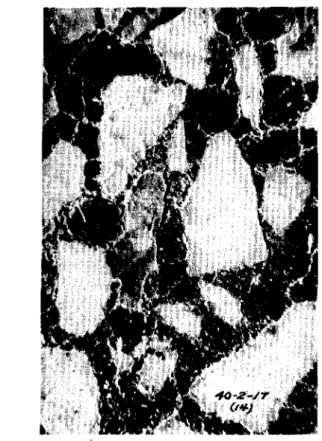
Photomicrographs at low magnification were made of the· surface of the samples showing the original and final
appearance of the samples (Figs. 3 to 20). Conclusions
The samples showed a considerable deterioration after 4500 cycles in this machine. There was also marked difference in the extent of deterioration between different samples.
This can be seen from the photomicrographs. The deterioration was characterized by veining which was first observed at the
interfaces between matrix and marble chips. When veining had progressed beyond a certain point there was a tendency for the matrix to chip away so that the end effect was one of removal
of matrix below the level of the chips. In some instances the chips showed some veining. There was a general tendency for the samples to assume a convex shape on the surface which is evidence of expansion of the top layers due to crystallization of salts.
3
There appears to be some correlation between the moisture content change between wet and dry cycles and rate of deterioration. This is what would be expected. Samples with 2 per cent acetylene black appeared to undergo the highest moisture content change per cycle and they
deter-iorated the most.
At present there is no basis for the establishment of the optimum cycle limits corresponding to the maximum rate of deterioration. Even if there was some basis for this, it is expected that these optimum conditions would differ for
different samples. The conditions now employed were chosen on the basis of such factors as surface temperature during drying
(which was kept reasonably low), and the period of wetting, (which was arranged to simulate that experienced by the floor during washing). The drying cycle was accelerated.
It is believed that the cycle simulated reasonably well the moisture content changes encountered at the surface of terrazzo flooring in normal service. Although most samples lost less than セ per cent in moisture content per cycle, based on the whole sample, the loss at the surface is believed to have been much greater, because of the accelerated rate of drying induced by infra-rea radiation.
Figures 3 to 20 reveal カ。セゥッオウ stages of deterioration of surfaces with repeated cycling in the machine described. It may be noted that those samples having a coarse matrix structure showed much more deterioration than those having a dense, well polished surface.
The work is still being carried on and this report is therefore one of progress only.
Acknowledgments
The authors gratefully acknowledge the interest and assistance of Mr. P.M. Keenleyside of the architectural firm of gッカ。セL Ferguson, Lindsay, Kaminker, Maw, Langley and
k・・ョャ・ケウセ、・L who supplied samples for this investigation.
References
Kessler, D.W. Terrazzo as affected by cleaning materials. Proc. of A.C.I. 45: 33 -
40, 1949.
4
TABLE I
Composition of Samples
Sample Composition
'No.
(%
of ingredients based on weight of cement)1 Portland cement terrazzo
2 Terrazzo with 20% copper concentrate from Noranda
3 Terrazzo with 20% Noranda pyrite
4 Terrazzo with white cement and 2.5% copper powder (V54345) and 2.5% bronze filings
5 Terrazzo with white cement and 10% bronze filings
6 Terrazzo with white cement and 20% copper powder (V54345)
7
Terrazzo with 2% acetylene black8
Terrazzo with white cement, green pigment, and 2% acetylene black9 Terrazzo with white cement and 2% acetylene black
10 Terrazzo with white cement and 10% copper powder (V54345) 11 Terrazzo with white cement and 5% copper powder (V54345)
and 5% bronze filings
12 Terrazzo with white cement, yellow pigment and 2% acetylene black 13 14 15
16
24Terrazzo with 20% Noranda smelter calcine Terrazzo with 2% acetylene black
Terrazzo with 25% steel filings Terrazzo with, 10% bronze filings
Terrazzo with 2% acetylene black removed from a sample floor at Neurological Institute, Montreal
-5
I
TABLE I I
Moisture Contents of Samples
Per cent moisture content (average) Sample
No. Equilibrium After the After the Loss during
at 50% R.H. wetting cycle drying cycle drying
1 1.35 1.9 1.4 0.5 2 1.34 3.05 3.4 0.35 3 1.52 4.15 3.75 0.40 4 1.14 2.4 2.15 0.25 5 1.01 2.45 2.1 0.35 6 1.05 2.44 2.24 0.20 7 0.93 3.41 2.9 0.51 8 0.95 3.7 2.9 0.8 9 1.16 3.4 2.9 0.5 10 1.09 2.6 2.4 0.2 11 1.41 2.8 2.6 0.2 12 0.85 2.0 1.75 0.25 13 1.35 3.6 3.0 0.6 14 3.2 2.2 1.0 15 1.37 2.05 1.7 0.35 16 1.67 4.1 3.6 0.5 24 1.44 3.95 3.0 0.95
Fig. 1 Installation of conductive flooring samples
(BR-496o).
Fig. 2 Floorometer
Before test
(mag. x 6) After 4500 cycles
(mag. x
4)Fig.
3
Portland cement terrazzo (sample No.1)Before test
(mag. x 6) After 4500 cycles(mag. x 4)
Fig. 4 Terrazzo with 20% copper
concentrate from Noranda (sample No.2)
Before test (mag. x
6)
After 4500 cycles (mag. x 4)
Fig. 5 Terrazzo with 20%
Noranda pyrite (sample No.3)
Before test
(mag. x 6) After 4500 cycles(mag. x 4)
Fig.
6
Terrazzo with white cementand 2.5% copper powder (V54345) and 2.5%
bronze filings Hウセューャ・ No.4)
Before test
(mag. x 6) After 4500 cycles(mag. x 4)
Fig.
7
Terrazzo with white cementand 10% bronze filings (sample No.5)
Before test
(mag. x 6) After(mag. x 4)
4500
cyclesFig.
8
Terrazzo with white cement and20%
copper powder(V54345)
(sample No.6)Before test
(mag. x
6) After 4500 cycles(mag. x 4)Fig.
9
Terrazzo with 2%acetylene black (sample No.7)
Before test
(mag. x 6) After 4500 cycles(mag. x 4)
Fig. 10 Terrazzo with white cement, green
pigment, and 2% acetylene black (sample No.8)
Before test
(mag. x 6) After 4500 cycles(mag.
x
4)Fig. 11 Terrazzo with white cement
and 2% acetylene black (sample No.9)
Before test
(mag. x 6) After 4500 cycles
(mag. x
4)Fig. 12 Terrazzo with white cement and
10% copper powder (V54345) (sample No. 10)
Before test
(mag. x 6)
After
4500
cycles(mag. x 4)
Fig.
13
Terrazzo with white cementand
5%
copper powder(V54345)
and5%
bronzefilings (sample No. 11)
Before test (mag. x 6)
After 4500 cycles (mag. x
4)
Fig. 14 Terrazzo with white cement and yellow pigment and 2% acetylene black (sample No. 12)Before test
(mag. x 6) After 4500 cycles(mag. x 4)
Fig. 15 Terrazzo with 20% Noranda
smelter calcine (sample No. 13)
Fig. 16 Terrazzo with 2% acetylene black (after 4500 cycles, mag. x 4) (sample No. 14)
Before test
(mag. x 6) After 4500 cycles
(mag. x
4)Fig. 17 Terrazzo with 25%
steel filings (sample No. 15)
87-Before test
(mag. x 6) After 4500 cycles
(mag. x
4)Fig. 18 Terrazzo with 10% bronze filings (sample No. 16)
Before test
(mag. x 4) After 2950 cycles(mag. x 4)
Fig. 19 Terrazzo with 2% acetylene black removed from a sample floor at Neurological Institute, Montreal (sample No. 24)
:Before test
(mag. x 6) After 4500 cycles(mag. x 4)
Fig. 20 Ceramic conductive tile (sample No. 25)
RAe" FOR セamplNeNセ
MADE. F"ROM Y4'cu.
TUBI"''''
P LAN (\JITH セamplNeNU Rf.MOVE..D)
_ \ I -L 19 SAMPL.eS, E.ACH セT TH"
Y8'
TWIG" RUB8E.R,,.L..NNNLセセ ...-"....,,_ _ GROMMe.TS uセ・Nd aセ セpag・Nrs Se.n/EEN EAC.U t;AMPL.f. P LAN (c;セo|カingN ARRAI-JG.E.ME..NT OF UamplNeNセI