HAL Id: hal-00677800
https://hal.archives-ouvertes.fr/hal-00677800
Submitted on 11 Mar 2012
HAL is a multi-disciplinary open access
archive for the deposit and dissemination of
sci-entific research documents, whether they are
pub-lished or not. The documents may come from
teaching and research institutions in France or
abroad, or from public or private research centers.
L’archive ouverte pluridisciplinaire HAL, est
destinée au dépôt et à la diffusion de documents
scientifiques de niveau recherche, publiés ou non,
émanant des établissements d’enseignement et de
recherche français ou étrangers, des laboratoires
publics ou privés.
Towards Production-level Cardiac Image Analysis with
Grids
Ketan Maheshwari, Tristan Glatard, Joel Schaerer, Bertrand Delhay, Sorina
Camarasu-Pop, Patrick Clarysse, Johan Montagnat
To cite this version:
Ketan Maheshwari, Tristan Glatard, Joel Schaerer, Bertrand Delhay, Sorina Camarasu-Pop, et al..
Towards Production-level Cardiac Image Analysis with Grids. HealthGrid 2009, Jun 2009, Berlin,
Germany. pp.31-40, �10.3233/978-1-60750-027-8-31�. �hal-00677800�
Towards Production-level Cardiac Image
Analysis with Grids
Ketan MAHESHWARIa,1, Tristan GLATARDb
, Joël SCHAERERb , Bertrand DELHAYb , Sorina CAMARASU-POPb , Patrick CLARYSSEb and Johan MONTAGNATa a
University of Nice – Sophia Antipolis / CNRS, I3S laboratory, 06903 Sophia Antipolis, France.
b
University Lyon 1, CREATIS-LRMN; CNRS UMR5220; Inserm U630; INSA-Lyon; France.
Abstract. Production exploitation of cardiac image analysis tools is hampered by the lack of proper IT infrastructure in health institutions, the non trivial integration of heterogeneous codes in coherent analysis procedures, and the need to achieve complete automation of these methods. HealthGrids are promising technologies to address these difficulties. This paper details how they can be complemented by high level problem solving environments such as workflow managers to improve the performance of applications both in terms of execution time and robustness of re-sults. Two of the most important important cardiac image analysis tasks are consid-ered, namely myocardium segmentation and motion estimation in a 4D sequence. Results are shown on the corresponding pipelines, using two different execution environments on the EGEE grid production infrastructure.
Keywords. Cardiac image analysis, workflow enactment, grid computing, production.
1. Production-level Cardiac Image Sequences Analysis
Cardiac diseases are one of the major causes of death in industrial countries. Cardiac di-agnosis is increasingly relying on temporal sequences of 3D images acquired using fast Magnetic Resonance Imaging (MRI) sequences. Such sequences, routinely acquired in hospitals, represent wealth of imaging data which require processing to extract mean-ingful quantitative parameters useful for diagnosis. Cardiac image analysis procedures are applied to analyze the patient heart status, through e.g. studies of the heart shape (myocardium segmentation) and heart motion (myocardial motion estimation).
Although analysis methods are actively developed and tested in research, image se-quences are still often exploited manually in clinics, despite the extremely tedious work involved, such as the delineation of the myocardial contours in complete time series of MR slice stacks. Usage of analysis tools in production is hampered by several factors including (F1) the integration of heterogeneous codes to conduct the analysis, (F2) the need to fine-tune analysis parameters to adapt to the variability among images and (F3)
the associated computing and data storage requirements when dealing with large image databases.
HealthGrids are appealing to address those challenges. Concerning (F1), workflow technology can be considered. Pipeline-based image processing tools with a visual pro-gramming interface, such as the commercial Khoros and AVS tools, have been widely used by non-expert end users. In the medical image analysis community, the ITK2open
source library has become a de facto standard providing a pipeline design API. In our work, we study workflow technology to provide similar functionality in a HealthGrid production environment. Unlike Khoros or AVS, the workflow managers are intrinsically parallel execution engines able to outsource computations on distributed units, as well as exploiting local resources. In addition, the model adopted for pipelines description is a loosely coupled workflow of application services. Unlike ITK, this does not require code integration and compilation in a single unit. Heterogeneous application codes are em-barked in the workflows, thus maximizing flexibility and providing easy reconfiguration for pipeline prototyping and parameter sweep studies set up.
Regarding (F2), complete automation is a complex problem due to the difficulty to automatically tune algorithms to adapt to various images and the need for expert valida-tion. Parameter-sweeps can be considered to cope with this issue. In HealthGrids, they al-ready have been used to perform validation (e.g, in [8] for functional MRI) or large-scale population studies for instance in neuroimaging [10]. Such experiments are naturally ex-pressed in workflow languages and executed in a distributed infrastructure with engines like Taverna [7], MOTEUR [4] or Nimrod-G [15]. Wrapper tools such as GASW [3] or Soaplab [14] facilitate the integration of tools in those environments.
Finally, (F3) can be addressed by leveraging the resources made available by pro-duction grids like EGEE3 which provides a computational back-end that is often
lack-ing in clinical centers to support secured and data intensive applications. However, those platforms also provide high latencies and low reliability as a downside of the comput-ing power and storage capacity. For instance, [1] reports a 55% error ratio on a metage-nomics application. In this context, exploiting local computing resources for part of the experiment can yield better performance.
In this paper we study the ability of HealthGrids to support production-level diac image analysis. First, pipelines implementing myocardium segmentation and car-diac motion estimation are described. Then, parameter-sweep experiments are shown on the segmentation pipeline to tune initialization and deformation parameters with the aim to go towards an automatic method. Finally, a performance comparison of the motion estimation pipeline running on EGEE versus local resources is presented, evaluating the trade-off between grid and local execution.
2. Cardiac Image Sequence Analysis Pipelines
Two cardiac analysis pipelines developed in the context of the GWENDIA4project are
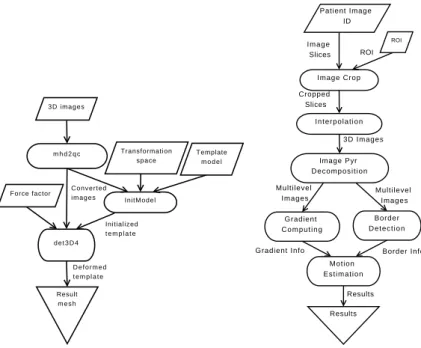
considered for experimentation (see figure1). The myocardium segmentation pipeline is
2Insight ToolKit,http://www.kitware.com/
3Enabling Grids for E-sciencE,http://www.eu-egee.org
4Grid Workflows Enactment of Data Intensive Applications project,http://gwendia.polytech.
3D images m h d 2 q c InitModel d e t 3 D 4 Result m e s h Transformation space
Force factor Converted i m a g e s Initialized t e m p l a t e D e f o r m e d t e m p l a t e Template m o d e l Patient Image ID Border D e t e c t i o n Image Crop Interpolation Gradient C o m p u t i n g Motion Estimation Image Pyr Decomposition Results Image Slices Cropped Slices 3D Images Multilevel Images Border Info Gradient Info Results Multilevel Images ROI ROI
Figure 1. Myocardium segmentation (left) and motion estimation (right) pipelines.
an elastic template-based left and right myocardium extraction procedure. Segmentation is a process sensitive to initial conditions and which needs to be tuned to take into account the patient specific image properties. The heart Motion Estimation pipeline is a multi-step workflow extracting a dense vector field for each time instant of the sequence which estimates the heart structure motion between successive image pairs. This pipeline fea-tures a computer intensive algorithm and is used for performance tuning. Both pipelines are designed to process the same multislice and multiphase Cine MRI databases.
2.1. Myocardial Segmentation
To achieve automated batch processing of patient data, the segmentation pipeline steps should require as little human intervention as possible. Segmentation traditionally in-volves manual steps for initialization and results checking. Grid technology can help by providing workflows management tools to perform sweeps on application parameters as exemplified in [11] for brain segmentation.
In this study, we consider the myocardium segmentation pipeline represented in fig-ure1(left), composed of three steps:
• mhd2qc is a conversion step working on 3D volumes produced by the interpola-tion step;
• InitModel is the initialization, during which an a priori heart model is posi-tioned close to the heart using affine transform;
• det3D4 is the segmentation step itself, which deforms the model to fit the my-ocardial borders.
The two last steps usually require human intervention: initialization is performed under user control by interactively positioning the model in the 3D space close to the heart. The correctness of the segmentation is visually checked and validated by a physician.
In addition to the data itself (3D images), this workflow requires a volumetric prior template mesh model representing the geometry of the heart interfaces and cavities. This template also carries mechanical properties of the heart tissues. It is first placed within the image close to the structure to be extracted. To achieve an automated procedure for initialization, a random search was implemented. A transformation space (i.e. min/max values for the 7 parameters describing translation and rotation in 3D as well as isotropic scaling) is randomly browsed, computing a closeness measure (energy) between the model and the myocardium for each candidate transformation. Parameters leading to the best energy are kept to initialize the template model for the segmentation step.
The segmentation algorithm is based on a Deformable Elastic Template [12,13]. The template mesh is deformed iteratively by applying a force field so that its edges stick to the borders of the targeted structure. Gradient and edge information is first extracted from the 3D images composing the cardiac image sequence. Edge maps are derived into Gra-dient Vector Fields that guide the deformation process through a classical energy mini-mization procedure. The force field is weighted w.r.t the template prior with a parameter coined force factor: the higher the force factor, the higher influence the data has during the deformation process. To improve convergence speed and accuracy, a multi-resolution approach is implemented for both the model and the image.
2.2. Cardiac Motion Estimation
The Motion Estimation pipeline is graphically represented in Figure1(right). The first step is a cropping applied to a series of DICOM slices identified by a patient ID. A Region Of Interest (ROI) is used to crop all the images around the heart region. Next, 3D images are assembled and the data set is isotropically interpolated. To speed-up and improve robustness of the Motion Estimation process, the isotropic images are under-sampled into a multi-resolution pyramid. Gradient and edges are then extracted at each resolution level. Finally, the motion inside the region of interest is estimated through-out the sequence based on non rigid registrations between consecutive image pairs (free form deformations with the sum of squared difference as similarity measure) [2]. Motion estimation is a compute intensive process which execution time is unacceptable when dealing with large data sets.
2.3. Workflow Managers
Workflows presented above can be executed by MOTEUR and Taverna. In these frame-works, a workflow is described as a collection of processors connected by data links, which establish a dependency between the output(s) of a processor and the input(s) of a subsequent one. The engine orchestrates the execution of the processors in a way that is consistent with the dependencies. It manages the flow of data through the processors. The execution is driven by a push model: a processor’s execution is started as soon as all of its inputs are available. It is important to note that the pipelines pictured in figure1are designed for processing multiple patient image databases. Computation tasks are gener-ated for all processing steps and all images considered in the experiments. The
execu-tion of the workflows is optimized by exploiting coarse level parallelism: independent computing tasks and independent data sets can be processed concurrently.
MOTEUR. MOTEUR5 is a data-intensive workflow manager interfaced to EGEE through a Grid Application Service Wrapper (GASW). It was designed for maximal per-formance and it exploits three levels of parallelism that are implicitly expressed in the workflow and its data sets. First, MOTEUR concurrently enacts independent branches of the workflow. Second, it performs pipelining: the workflow stages are pipelined with different data items to be processed. Third, MOTEUR exploits data parallelism: a same stage is concurrently enacted for all independent data items to be processed.
Taverna. Taverna6version 2, is a dataflow manager developed by themyGrid
consor-tium. It includes a GUI-based rich-client workbench for workflow design and a workflow enactment engine. The default enactment mode of Taverna 2 is pipelining. In addition Taverna 2 provides a so called "super-pipelining" execution mode that corresponds to MOTEUR’s data parallelism. Taverna 2 supports various processor types invocation, in-cluding local execution and Web Services. The core of Taverna 2 was extended through an EGEE plugin that automates grid jobs submissions and data transfers to the grid nodes.
2.4. Data
A set of 10 MRI examinations on patients has been collected for this study. Cardiac cine MR images were acquired with a 1.5 T magnetic resonance Sonata scanner (Siemens, Er-langen) at the Cardiology Hospital of Lyon, France. An ECG-gated True-Fisp sequence was used to acquire 5 to 11 short-axis cine slices covering the heart with 208-240×256 pixel matrix, 5-7 mm slice thickness, 10-12 mm slice-spacing. Each sequence was com-posed of 11 to 30 frames over the cardiac cycle.
3. Parameter-sweeps for Segmentation Automation
3.1. Infrastructure setup
Experiments described in this section were performed using the MOTEUR workflow manager for execution [4] and the VBrowser interface for data management [9]. The EGEE Logical File Catalog (LFC) was used for data management, all the files being stored on a single Storage Element (SE). To ease prototyping for those early experiments, jobs were submitted on a local server featuring an Intel Xeon 5410 (2.33 GHz quad core) that also hosted the workflow manager. We dedicated 3 of the 4 cores to computing jobs and 1 to the workflow manager. The server ran an SL4 EGEE User Interface with no pre-installed software (dependencies were all downloaded from the SE). Jobs were thus running in similar conditions than on EGEE. Scaling those experiments to the grid just requires to switch a flag in the setup configuration.
5MOTEUR workflow manager:http://modalis.i3s.unice.fr/softwares/moteur/start 6Taverna workflow manager:http://taverna.sf.net
(a) (b) (c) (d) 100 / 150 / 20◦/ 2.1 100 / 200 / 20◦/ 1.9 100 / 150 / 10◦/ 2.1
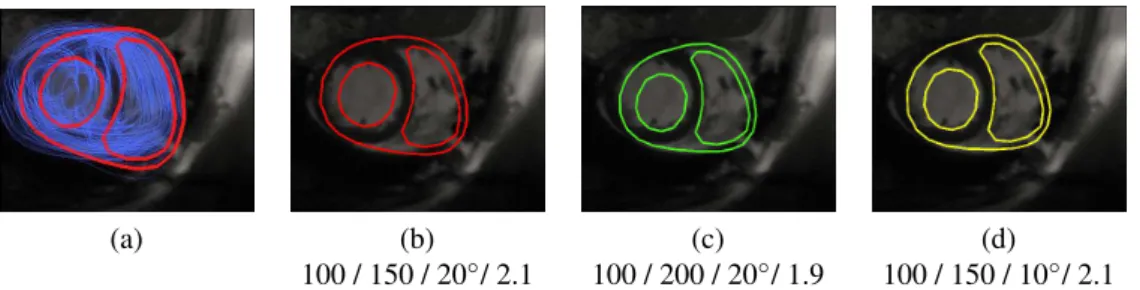
Figure 2. Parameter sweep on initialization parameters. (a) 75 parameter have been tested ; (b),(c) and (d) initialization results kept for segmentation. Parameter values for Txmin / Txmax / Rzmax / Smin are shown. Image slices are in an xy plane.
3.2. Experiments and results
Using this setup, two parameter-sweep experiments have been conducted to study au-tomatic segmentation of the database. First, the bounds of the transformation space to use for initialization were investigated. Second the influence of the force factor in the deformation process was looked into.
Experiment #1. Bounds of the transformation space are defined by 14 parameters, namely the minimal and maximal values of the translation vector coordinates, the rota-tion angles and the scaling factor. Early tests showed that the bounds of the translarota-tion along x (Txmin and Txmax), the maximal rotation angle w.r.t z-axis (Rzmax) and the min of the scaling factor (Smin) had significant importance on the quality of the result-ing initialization. Consequently, in this experiment, Txmin was varied among 3 values, Txmaxand Rzmax among 2 and Smin among 6 for one volume of a patient, leading to 72 initializations. Figure2-(a) shows in blue the 72 computed initializations. Among those, a couple only could be considered correct from a visual check. We kept the red, green and yellow results shown in (b), (c) and (d) for the segmentation step. Execution time statistics are reported in table1for the InitModel workflow processor.
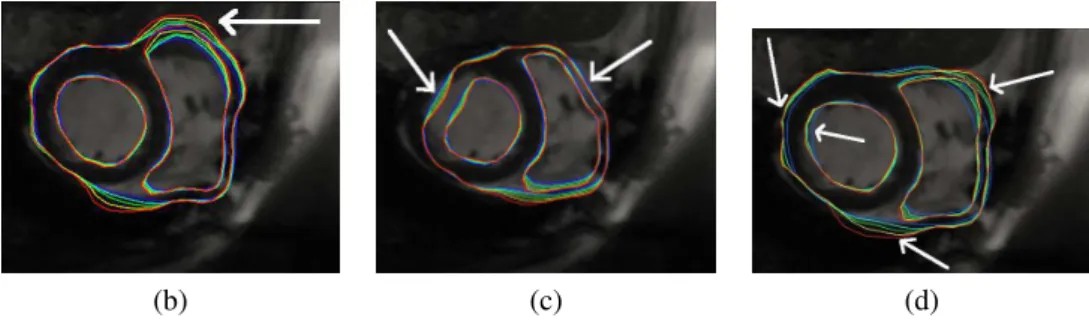
Experiment #2. The force factor was varied from 0.1 to 0.5 by steps of 0.1. For each initialization, 5 segmentations were thus performed. Due to issues with workflow iter-ation strategies, this experiment had to be performed independently from the previous one, running the workflow once for each initialization selected for segmentation. Fig-ure3shows segmentation results obtained from selected initialization results. Colors de-note the force factor value. Table1shows the corresponding execution statistics for the det3D4workflow processor.
3.3. Discussion
Experiment #1. Figure2demonstrates a significant influence of the swept parameters on the initialization results. As shown on part (a) of the figure (blue edge lines), the set of initialization results is quite widely spread. Among those, a couple of results can be considered as correct initializations. The selected ones for this study ((b), (c) and (d) part of the figure) have subtle but visually noticeable differences. Execution times reported on table1show a significant importance of data transfers, representing more than 50%
#jobs workflow step Elapsed CPU Download Upload (see Fig.1) (total ; µ ± σ) (total ; µ ± σ) (total ; µ ± σ) Exp.#1 72 InitModel 2h19’ 3h53’ ; 3’14”±59” 1h53’ ; 1’34”±29” 37’42” ; 31”±4” Exp.#2 - (b) 5 det3D4 39’16” 32’2” ; 6’24” ±5” 2’50” ; 34”± 1” 59” ; 12” ± 1”
- (c) 5 det3D4 59’5” 32’21” ; 6’28” ± 4” 2’48” ; 33” ± 1” 58” ; 12” ± 1” - (d) 5 det3D4 16’41” 32’41” ; 6’32”±13” 2’57” ; 35”±2” 59” ; 12”±1” Table 1. Execution statistics for the segmentation experiments. Mean (resp. standard-deviation) is denoted by µ(resp. σ). Data transfers are performed between our local server and an EGEE Storage Element. Italicized elapsed time values have been measured in shared conditions.
of the CPU time. Still, a fair speed-up of about 2 (on 3 processors) is obtained comparing the elapsed time to the total CPU time. In the future, data transfer optimizations specific to parameter sweeps could be envisaged since most of the jobs share the same set of input files.
Experiment #2. Although differences among initializations (b), (c) and (d) are quite subtle, segmentation results significantly differ, (d) being the only acceptable result from a visual point of view (see figure3). Segmentation of the left ventricle is acceptable on (b) but the right ventricle is overestimated (see white arrow). Result (c) clearly under-estimates the myocardium, both in left and right ventricles. The force factor also has a strong influence on the quality of the results. On (d), a high force factor (red edge) better segment the left ventricle (leftmost arrows) whereas a small one (blue edge) better fits the right ventricle contours (rightmost arrows). On this slice, a force factor of 0.2 (cyan edges) seems to be the optimal. Execution times reported on table1show a better trade-off between CPU and transfer times, the latter representing an eighth of the former. Job times are still short though compared to usual latency values on EGEE. To execute this workflow on EGEE, latency reduction solutions such as pilot-jobs [6] will be considered.
(b) (c) (d)
Figure 3. Parameter sweep on segmentation parameters. Five force factors have been tested for each initial-ization, as denoted by the color scale (blue: 0.1 ; cyan: 0.2 ; green: 0.3 ; yellow: 0.4 ; red: 0.5). Letters refer to figure2.
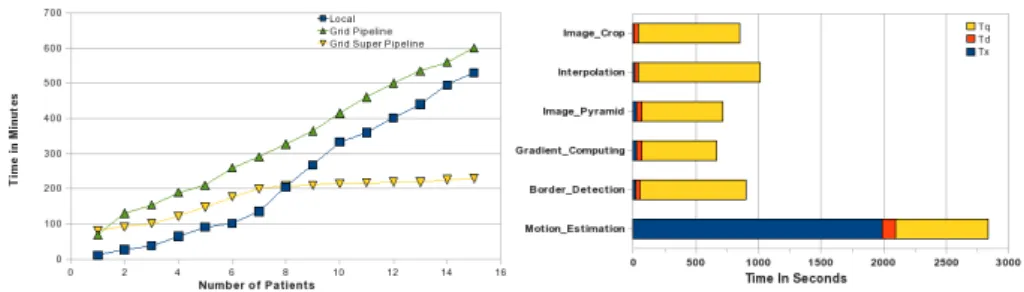
Figure 4. Cardiac Motion Estimation Results. Left: makespan when processing an increasing number of data. Right: average grid profile of each pipeline stage.
4. Performance Study for Motion Estimation
4.1. Infrastructure setup
Experiments presented in this section have been executed on EGEE, using Taverna 2 to orchestrate the workflow execution. EGEE is a premiere grid infrastructure federat-ing 250 computfederat-ing centers and dedicated to scientific production. Our experiments ex-ploit the significant share of the infrastructure (≈ 20000 CPU cores) accessible to the "biomed" Virtual Organization. In the context of our experiments, EGEE provides the computing resources that are usually not available for processing inside clinical centers. However, the grid is a batch infrastructure that introduces submission overheads in the tasks execution time. The tasks submitted and the data they depend on have to be trans-ported to remote grid nodes. In addition, tasks are queued in multi-user queues and may experience unbounded delay, depending on the uncontrollable workload experienced by the infrastructure at the time of submission.
Furthermore, such a large scale infrastructure exhibits low reliability and job fre-quently fail due to network, system or middleware faults. During workflow execution, the frequency of job failures are magnified with the increased number of tasks, lowering the probability to succeed in executing a complete workflow. The following faut recovery measures were implemented in Taverna’s EGEE plugin in order to increase its robust-ness: (i) a job resubmission policy (after a certain waiting time the jobs are resubmitted [5]), (ii) a Round-Robin selection policy for EGEE Workload Manager Services, and (iii) resubmitting the data transfer requests in case of failures.
4.2. Results
The left graph of figure 4 presents the scalability results for the Motion Estimation pipeline executed on the EGEE grid through the Taverna 2 plugin. The blue "local" curve corresponds to a sequential execution on a mono-processor local machine, used as a baseline. The entire workflow is submitted for an increasing number of patients (hence an increasing number of image sequences) and the makespan of the application is mea-sured. It can be seen that the sequential execution scales with the number of patients. The application behavior is not completely linear though. The optimization algorithm used for motion estimation has a non-guaranteed execution time (the number of iterations depends on the data content), and therefore each patient processing time differs slightly.
The green "pipeline" curve reports the grid execution makespan using a Taverna reg-ular pipelined execution. Unexpectedly, grid execution does not improve performance in this case, even when processing the complete data base. This result is expected when pro-cessing few data: a production grid overhead is non negligible as illustrated in the right graph of figure4which shows the average grid profile of main processes involved in the workflow. The tasks execution time Tx is impacted by the additional overhead composed of Td, the data transfer time from grid storage to the computing units, and Tq, the time spent inside the job queue after the job has been submitted and before the start of its execution. However, the overhead is expected to be compensated by parallel execution for a sufficiently large database processing. This does not happen in pipelined execution for this experiment because of the unbalanced computation time of the pipelines stages: the motion estimation execution time (Tx) largely dominates in this workflow and it is worsen by a high data transfer time (Td) which owes to the growth of data through the pipeline (around 0.5 GB from around 1 MB on an average). In pipelined mode, the multi-ple instances of motion estimation (one per patient) are not parallelized. The parallel gain is limited by the concurrent execution of motion estimation and other pipeline stages, thus leading to a high makespan.
Finally, the "super pipeline" curve shows the performance when enabling Taverna 2 "superscalar" pipeline submission.The concurrent execution of all workflow processes significantly increases overall application performance. The application performance is then mostly impacted by grid overhead. As soon as two or more patient datasets are pro-cessed, performance improves as compared to regular pipelining. Finally it beats the lo-cal execution after the 8th patient is processed. After this "cut-off" stage the performance dramatically improves as the concurrently executing processes start returning results al-most simultaneously.
5. Conclusions
Production-level cardiac sequences analysis is made difficult by the lack of proper IT infrastructure in health institutions, the non trivial integration of heterogeneous compo-nents in tools analysis procedures, and the need to achieve complete automation. To-day, HealhGrids provide a production stable environment serving as a foundation for tackling the higher level difficulties. In this paper we complement the grid infrastructure with high level workflow enactment tools that help to interface heterogeneous codes and benefit from grid performances. Alternative solutions exists such as MOTEUR and Tav-erna workflow managers, both interfaced to the EGEE infrastructures. Care should be taken in the parameterization of such tools though, as can be seen through the inefficient performance of the motion estimation experiment in simple pipelined mode.
Parameter sweep appears to be a good way to improve the robustness of the seg-mentation pipeline, for the initialization step as well as for the deformation. A few other parameters of the segmentation algorithm could be similarly be considered for sweeping. Using grids to support this kind of experiment is promising to go towards an automation of the segmentation pipeline required for mass image processing. From a performance point of view, pilot-job frameworks will be exploited in this pipeline since segmentation tasks are still short w.r.t the average grid latency. Data transfer optimisation strategies will also be considered since many jobs have the same set of input files in this kind of parameter-sweep experiment.
Grid computing power and flexible pipelines management capability are a promising combination to reach production-level cardiac image analysis with HealthGrids. Acknowledgments. This work is supported by the French ANR GWENDIA under con-tract number ANR-06-MDCA-009. The Région Rhônes-Alpes is gratefully acknowl-edged for its support through the project Simed of the cluster ISLE. We are grateful to MD-PhD P. Croisille for providing the MR examinations exploited in this study.
References
[1] Gabriel Aparicio, Ignacio Blanquer Espert, and Vicente Hernández García. A Highly Optimized Grid Deployment: the Metagenomic Analysis Example. In Global Healthgrid: e-Science Meets Biomedical
INformatics (Healthgrid’08), pages 105 –115, Chicago, USA, May 2008. Healthgrid, IOS Press. [2] B. Delhay, P. Clarysse, J. Lötjönen, T. Katila, and I. E. Magnin. Evaluation of two free form deformation
based motion estimators in cardiac and chest imaging. In Functional Imaging and Modeling of the Heart
(FIMH), volume 3504, pages 467–476, Barcelona, Spain, 2005. Springer.
[3] Tristan Glatard, Johan Montagnat, David Emsellem, and Diane Lingrand. A Service-Oriented Archi-tecture enabling dynamic services grouping for optimizing distributed workflows execution. Future
Generation Computer Systems, 24(7):720?–730, July 2008.
[4] Tristan Glatard, Johan Montagnat, Diane Lingrand, and Xavier Pennec. Flexible and efficient workflow deployement of data-intensive applications on grids with MOTEUR. International Journal of High
Performance Computing and Applications (IJHPCA), 22(3):347–360, August 2008.
[5] Diane Lingrand, Johan Montagnat, and Tristan Glatard. Estimating the execution context for refining submission strategies on production grids. In Assessing Models of Networks and Distributed Computing
Platforms (ASSESS / ModernBio) (CCgrid’08), pages 753 – 758, Lyon, May 2008. IEEE.
[6] Jakub T. Mo. Distributed analysis environment for HEP and interdisciplinary applications. Nuclear
Instruments and Methods in Physics Research A, 502:426–429, 2003.
[7] Tom Oinn, Matthew Addis, Justin Ferris, Darren Marvin, Martin Senger, Mark Greenwood, Tim Carver, Kevin Glover, Matthew R. Pocock, Anil Wipat, and Peter Li. Taverna: A tool for the composition and enactment of bioinformatics workflows. Bioinformatics journal, 17(20):3045–3054, 2004.
[8] Silvia Olabarriaga, Piter T. de Boer, Ketan Maheshwari, Adam Belloum, Jeroen Snel, Aart Nederveen, and Maurice Bouwhuis, editors. Virtual Lab for fMRI: Bridging the Usability Gap, Amsterdam, Decem-ber 2006. IEEE.
[9] Silvia Olabarriaga, Tristan Glatard, Kamel Boulebiar, and Piter T. de Boer. From ’low-hanging’ to ’user-ready’: initial steps into a healthgrid. In HealthGrid’08, pages 70–79, Chicago, June 2008. [10] Michael J. Pan and Arthur W. Toga. A grid enabled workflow management system for managing
pa-rameter sweep applications in neuroimaging research. In Fourth International Workshop on Biomedical
Computations on the Grid (Biogrid’06), Singapore, May 2006.
[11] Erik Pernod, Jean-Christophe Souplet, Javier Rojas Balderrama, Diane Lingrand, and Xavier Pennec. Multiple Sclerosis Brain MRI Segmentation Workflow deployment on the EGEE Grid. In Silvia Olabar-riaga, Diane Lingrand, and Johan Montagnat, editors, MICCAI-Grid Workshop (MICCAI-Grid), New York, NY, USA, September 2008.
[12] Q.-C. Pham, F. Vincent, P. Clarysse, P. Croisille, and I. E. Magnin. A FEM-based deformable model for the 3D segmentation and tracking of the heart in cardiac MRI. In 2nd International Symposium on
Image and Signal Processing and Analysis (ISPA 2001), volume 1, pages 250–254, Pula, Croatia, 2001. [13] Y. Rouchdy, J. Pousin, J. Schaerer, and Patrick Clarysse. A nonlinear elastic deformable template for soft structure segmentation: application to the heart segmentation in MRI. Inverse Problems,, 23:1017–1035, 2007.
[14] Martin Senger, Peter Rice, and Tom Oinn. Soaplab - a unified Sesame door to analysis tool. In UK
e-Science All Hands Meeting, pages 509–513, Nottingham, September 2003.
[15] Wibke Sudholt, Kim K. Baldridge, David Abramson, Colin Enticott, Slavisa Garic, Chris Kondric, and Duy Nguyen. Application of grid computing to parameter sweeps and optimizations in molecular mod-eling. Future Generation Computer Systems, 21(1):27–35, 2005.