HAL Id: insu-01864308
https://hal-insu.archives-ouvertes.fr/insu-01864308
Submitted on 29 Aug 2018
HAL is a multi-disciplinary open access
archive for the deposit and dissemination of
sci-entific research documents, whether they are
pub-lished or not. The documents may come from
teaching and research institutions in France or
abroad, or from public or private research centers.
L’archive ouverte pluridisciplinaire HAL, est
destinée au dépôt et à la diffusion de documents
scientifiques de niveau recherche, publiés ou non,
émanant des établissements d’enseignement et de
recherche français ou étrangers, des laboratoires
publics ou privés.
Strain transfer between disconnected, propagating rifts
Afar Manighetti, P. Tapponnier, V. Courtillot, Y. Gallet, E. Jacques, P.-Y
Gillot
To cite this version:
Afar Manighetti, P. Tapponnier, V. Courtillot, Y. Gallet, E. Jacques, et al.. Strain transfer between
disconnected, propagating rifts. Journal of Geophysical Research : Solid Earth, American Geophysical
Union, 2001, 106 (B7), pp.13613-13665. �insu-01864308�
JOURNAL OF GEOPHYSICAL RESEARCH, VOL. 106, NO. B7, PAGES 13,613-13,665, JULY 10, 2001
Strain transfer between disconnected, propagating rifts
in Afar
I. Manighetti, P. Tapponnier, V. Courtillot, and Y. Gallet
Institut de Physique du Globe de Paris, Paris, France
E. Jacques
institut de Physique du Globe de Strasbourg, Strasbourg, France
P.-Y. Gillot
Universit• Paris-Sud, Orsay, France
Abstract. We showed
before that both the Aden and Red Sea plate boundaries
are currently rifting and propagating
along two distinct paths into Afar through
the opening of a series of disconnected,
propagating
rifts. Here we use new
geochronological,
tectonic,
and paleomagnetic
data that we acquired
mostly in the
southeastern
part of Afar to examine
the geometry,
kinematics,
and time-space
evolution
of faulting related to strain transfer
processes.
It appears
that transfer of
strain is accommodated
by a bookshelf
faulting mechanism
wherever
rifts or plate
boundaries
happen
to overlap
without
being
connected.
This mechanism
implies
the
rotation about a vertical
axis of small rigid blocks
along
rift-parallel
faults that are
shown
to slip with a left-lateral
component,
which is as important as their normal
component
of slip (rates
of-•2-3 mm/yr). By contrast,
where
rifts do not overlap,
either
a classic
transform
fault (Maskali)
or an oblique
transfer
zone
(Mak'arrasou)
kinematically
connects
them. The length
of the Aden-Red
Sea
overlap
has
increased
in the last -•0.9 Myr, as the Aden plate boundary
propagated
northward
into Afar.
As a consequence,
the first-order
blocks
that we identify
within
the overlap
did not
all rotate
during
the same
time-span
nor by the same
amounts.
Similarly,
the major
faults
that bound
them
did not necessarily
initiate
and grow
as their neighboring
faults
did. Despite
these
variations
in strain
distribution
and
kinematics,
the overlap
kept accommodating
a constant
amount
of strain
(7 to 15%
of the extension
amount
imposed
by plate driving forces),
which remained
distributed
on a limited number
(seven
or eight)
of major
faults,
each
one
having
slipped
at constant
rates
(-•3 and
2 mm/yr for vertical
and lateral
rates,
respectively).
The fault propagation
rates
and the block
rotation
rates
that we either
measure
or deduce
are so fast (30-130
mm/yr
and 15-38ø/Myr,
respectively)
that they
imply
that strain
transfer
processes
are transient,
as has been
shown
to be the case
for the processes
of tearing,
rift
propagation, and strain jumps in Afar.
1. Introduction
The Red Sea and Aden ridges
have been propagat-
ing toward one another for the last 30 Myr, as a re-sult of the separation
of Arabia away
from Africa [e.g.,
Courtillot
et al., 1987; Manighetti
et al., 1997] (Plate
1, inset). However,
foregoing
what might seem
to be
an easy linkage through the Bab E1 Mandeb Strait, the two plate boundaries did not directly connect and bothCopyright 2001 by the American Geophysical Union.
Paper number 2000JB900454.
0148-0227 / 01 / 2000JB 900454509.00
have penetrated into Afar where they now are actively
opening
and propagating
through
the development
of a
series
of disconnected,
propagating
rift segments
(Plate
1, inset) [e.g.,
Barberi
et al., 1972, 1975;
Schaefer,
1975;
Barberi and Varet, 1977; Varet and Gasse, 1978; Cour-tillot, 1980, 1982; Courtillot
et al., 1980; Tapponnier
et
al., 1990; Manighetti
et al., 1998]. As a consequence,
transfer of extension between them, as well as betweentheir
rift segments,
is presently
taking
place
on dry land
in the Afar depression. That situation makes Afar aunique
testing
ground
where
one is able to directly ob-
serve and measure
processes
that usually operate be-
low ocean waters, that is, the mechanisms that allow strain transfer, either at large scale between two dis-13,614 MANIGHETTI ET AL- STRAIN TRANSFER BETWEEN RIFTS IN AFAR •RABi "=!"" 1 I
BLOCK
lie,
H
SOMALIA
'•'•
I.. [ . ,-- i• i•
ZU•,4R .'!
4ON
•. r ' •'% -'•,- ß ß HANISH • OBOCK , 41•E ß 42-E TADJOURA DJIBOUT1' •. '•-•,•
ß / 43OE , \ 'x 44"EMANIGHETTI ET AL.: STRAIN TRANSFER BETWEEN RIFTS IN AFAR 13,615
tinct, propagating plate boundaries or at smaller scale
between two successive, propagating rift segments.
In Afar the two plate boundaries fail to form a clean cut lithospheric break, causing faulting to spread over
hundreds of thousands of square kilometers [Consiglio Nazionale delle Richerche (CNR) and Centre National de la Recherche $cientifique (CNR$), 1975, Plate 1].
However, two zones of localized rifting have been recog-
nized through that dense network of crosscutting faults,
and interpreted as the subaerial continuations of the
Aden and Red Sea ridges [e.g., CNR and CNR$, 1975;
Barberi and Varet, 1977; Varet and Gasse, 1978; Tap-
ponnier et al., 1990, Manighetti et al., 1998] (Plate 1). The onland continuation of the Aden ridge (" Aden rifting zone") is a narrow, NNW trending zone of ac-
tive volcanism and tectonics that inciuues the north-
western tip of the Tadjoura rift, the Asal-Ghoubbet rift, the Mak'arrasou fault system, and the Manda In-
akir rift (Plate 1). It extends along the western side
of the Danakil block, at the northeastern edge of the Afar depression. The whole zone has been propa-
gating northward into Afar over the last 2 Myr [e.g., Manighetti et at., 1998]. The subaerial continuation of the Red Sea ridge ("Red Sea rifting zone") also is a narrow, NW trending zone of intense active faulting,
fissuring and volcanism, hugging at the southwestern
edge of the depression (Plate 1). That zone comprises
the Erta'Ale, Tat'Ali, Alayta and Manda Hararo rifts
and ends near lake Abhe through the Manda Hararo- Goba'ad rift [CNR and CNR$, 1975]. The whole Red Sea rifting zone is taken to have propagated southward
into Afar in the last 20 Myr [e.g., Courtillot
et at., 1987;
Manighetti et al., 1998; Audin, 1999]. Thus the two rift-ing zones face each other and overlap over more than
120 km in length (i.e., perpendicular to the Arabia- Africa relative motion vector, which is -• N40øE, 16 + 1
mm/yr [e.g., Chase,
1978; Chu and Gordon,
1998])
and
-•100 km in width (Plate 1). The Quaternary basalts that cover central Afar ("stratoid basalts", Plate 1, in- set) are cut by a dense network of parallel, NW-SE strik- ing normal faults, with high scarps (over I km in some places). Faulting that would directly connect the two facing rifting zones is not observed. In particular, the familiar orthogonal ridge-transform geometry that onemight expect between two plate boundaries is nowhere
apparent. One main goal of the paper is to investigate which deformation mechanisms may allow rift-parallel
normal faults to accommodate strain transfer between
the two exposed, propagating plate boundaries. At a smaller scale the two plate boundaries occur as
a series of disconnected NW striking rifts along which
most current strain and volcanic activity are localized. These rifts are currently propagating, northwestward
along the Aden rifting zone and southeastward along
the Red Sea rifting zone [Manighetti
et at., 1997, 1998]
(Plate 1, inset). What are the mechanisms operatingto transfer extension between these propagating rifts?
Are these mechanisms comparable to those operating at
the larger scale, between the two emerged ridges? Can we clarify the way transfer zones function and evolve
•+• to rift .... prop•6• +;•'•? In •th ... ... • , could +•-
sient zones transfer propagating deformation, in con- trast with the more common steady state transform
faults?
Models advocated until now to account for the tec- tonics of Afar do not allow one to fully answer these fundamental questions because they are based on "end- member" models, such as rigid steady state plate tec-
tonics [e.g., Barberi and Varet, 1975, 1977] or contin-
uum deformation
of thin viscous
sheets
[e.g., Souriot
and Brun, 1992]. In reality, deformation mechanismsare expected to vary with observation scale. At the
largest scale (-•1000 km), Arabia, Nubia, and Soma- lia are three rigid plates in relative motion, and plate
tectonic concepts provide a good first-order fit to ob-
servations
(Plate 1, inset). At a smaller scale (-•100
km) deformation in Afar seems to have involved the rotation of at least two microplates (Danakil and Ali Sabieh blocks, Plate 1; [Sichler, 1980; Courtillot, 1980; Souriot and Brun, 1992; Manighetti, 1993; Chu and Gordon, 1998; Audin, 1999]), and rigid plate kinemat-ics may still partly provide a consistent second-order
picture of deformation in that area. Finally, looking at
the Afar depression
more closely
(tens of kilometers),
it appears that the whole area is dissected by a densenetwork
of crosscutting
active faults (Plate 1), making
deformation so distributed that rigid plate kinematicsno longer apply in the interior of Afar.
In order to understand deformation mechanisms at the latter scale, we tried to establish a hierarchy among
Plate 1. Topographic
and
structural
map
of the
Afar
depression
[from
Manighetti,
1993].
Topo-
graphic
curves
are
redrawn
from
ONC
K5, 1:1,000,000,
1977
and
Ethiopian
1:250,000
topographic
maps;
Active
faults
and volcanic
areas
are identified
and mapped
from satellite
Landsat
and
SPOT
images;
U.B., Uddummi
Bad;
Ge.B.,
GSra
Bad. Inset
sketches
position
of Afar depres-
sion
between
Arabia,
Nubia
and Somalia
plates;
ARA-AF
motion
vector
is from
Manighetti
et
al. [1997];
unstretched
areas
are in pale
orange;
Stratoid
series
are in pale
green;
ridges
and
rifts are in violet'
EA, Erta'Ale;
TA, Tat'Ali;
AL, Alayta;
MH, Manda
Hararo;
MH-G, Manda
Hararo-Goba'ad;
T, Tadjoura;
AG, Asal-Ghoubbet;
MI, Manda
Inakir. Arrows
indicate
direction
of propagation;
Mak., Mak'arrasou;
GA, Gamarri-Alol
tear zone
(note
that grey
lines
are not
faults);
BM, Bab E1 Mandeb
Strait. Only main faults
in central
Afar and northern
East African
13,616 MANIGHETTI ET AL.: STRAIN TRANSFER BETWEEN RIFTS IN AFAR
the faults and fault systems from a geometrical, kine-
matic, and dynamic
point of view. Our approach
con-
sisted
of considering
any fault or fault system
as an indi-
vidual object expected
to have its own behavior.
Each
fault or fault system was therefore analyzed in detail in order to specify its particular behavior. Between 1989 and 1993 we acquired a bulk of new geochronological, tectonic, and paleomagnetic data in the Republic of Dji- bouti, the analyses of which are presented in sections 2to 4.
The complete, stereoscopic, panchromatic, satellite SPOT image cover of the Republic of Djibouti at a scale of 1:100,000, combined with satellite Landsat im- ages and air photographs at various scales (1:50,000 to 1:15,000), allowed us to investigate the geometry of cu-
mulative Quaternary faulting at different scales down to a few meters. That finite, cumulative geometry
indicates the nature of movements on faults. Faults
offsetting
mid-late Pleistocene
and Holocene
(<10 4--
105 years) basalts and sediments or exhibiting youthfulmorphology were the main focus of detailed analysis. Structural and morphological evidence was gathered in the field to constrain offsets on faults. Accurate digi- tal mapping and topographic leveling of offset morpho- logical surfaces or basaltic flows, combined with their
radiometric dating (section 2), allowed measurements
of fault slip rates. Such morphometric measurements
were made on most accessible faults and on temporal
markers of various ages, so that we could also uncover changes in those rates in the interior of Afar, over a
period covering the last 2 Myr (section 3).
Since much of Afar is floored by P lio-Quaternary volcanism (most <2 Myr [e.g., Courtillot et al., 1984; Lahitte, 2000]), paleomagnetism is particularly well suit- ed to detect and measure rotational motions at a scale larger than that allowed by structural analysis. As a matter of fact, the very existence of large and fast rota- tions near the tip of the oceanic Aden ridge was discov-
ered by paleomagnetism
[Courtillot et al., 1984], prior
to detailed structural analysis of the type discussed in this paper or in previous ones [e.g., Tapponnier et al.,1990]. Courtillot
et al. [1984]
showed
that since
,ol.8 +
0.4 Ma, the Stratoid basaltic series between lakes Asal and Abhe (Plate 1) has been rotated clockwise with re-spect to stable Africa by -0 14.5 ø 4- 7.5 ø when taken as
a whole. In order to better constrain the distribution, amounts, and rates of such rotations and to understand their relationships with Quaternary faulting, we carried out additional paleomagnetic sampling of volcanic units
in the still unexplored northern and eastern parts of the
Republic of Djibouti. More than 1000 cores were col-
lected through basalts of different ages, the analysis of
which is presented in section 4.
The combined analysis of these three data sets allows
us to show in section 5 that strain transfer between overlapping rifts or plate boundaries is, at all scales, accommodated by a bookshelf faulting mechanism that induces clockwise block rotations about a vertical axis
along rift-parallel, normal-left lateral faults.
2. Geochronology
2.1. Basaltic SeriesThe Afar depression is almost entirely filled with Quaternary, mainly basaltic lavas. In particular, the
1-2 km thick Stratoid basaltic series covers more than
70% of the Afar floor. This series was originally dated
between 0.4 and 4.4 Ma, using the conventional K-Ar
technique
[Barberi
et al., 1975; Varet and Gasse,
1978].
Using both updated K-Ar and 4øAr-3øAr
data, Cour-
tillot et al. [1984] reduced this range to 1.3-2.2 Ma (mean 1.8 4. 0.4 Ma) for Stratoid basalts sampled inthe southeastern Djiboutian part of the central Afar depression. Numerous, new K-Ar determinations were
recently performed by Kidane [1999] and Lahitte [2000] using the Cassignol-Gillot technique [e.g., Cassignol and Gillot, 1982] on a bulk of Stratoid basalt samples taken
in the whole depression and south of it in the north- ern East African Rift termination. The obtained ages suggest that the 1-2 km thick, trap-like Stratoid series erupted rapidly between •3.5 and I Ma. Moreover, the series seems to become younger from SW to NE, be- ing -03.5 Ma in the northern termination of the East African Rift, •02-1.5 Ma in central Afar, and •01 Ma in
the northeastern part of Afar, close to the Manda Inakir
rift [Lahitte, 2000]. As we performed the present study
in the southeastern Djiboutian part of the central Afar
depression, in what follows, we will consider the mean
age of 1.8 4. 0.4 Ma for the surface of the Stratoid series
[Courtillot et al., 1984].
The Danakil and Ali Sabieh blocks are overlain with
older basaltic and rhyolitic series, the younger and dom-
inant one being the Dahla basaltic series [Varet and Gasse, 1978]. This series was originally dated between
4.3 and 8.3 Ma, using the conventional K-Ar technique,
with most ages clustering between 6 and 8 Ma [Varet and Gasse, 1978]. A udin [1999] recently obtained four
new K-Ar ages for this series, using the Cassignol-Gillot
technique. The samples were taken along the western
edge of the Ali Sabieh block. The ages range between 4.8 and 7.7 Ma, with three of them having a similar age
of 7.2 4. 0.6 Ma.
In the frame of the present work we sampled and
dated, also using
the Cassignol-Gillot
technique
[Cas-
signol and Gillot, 1982] two other basaltic
series
that
crop out in the southeastern
part of Afar (Table 1). The
petrologic characteristics of the basalts, as well as de- tails on the analysis procedure, are given by Manighetti et al. [1998].We performed seven age determinations on the "north-
ern recent basalt series" that has erupted from the
Manda Inakir rift and the Mous& Alli volcano [e.g., Manighetti et al., 1998]. The obtained ages suggest that
the northern recent basalts were emplaced from ,ol Ma on, most of them between •0.6 and I Ma, after Stratoid basalt emplacement.
We also sampled the "gulf basalt series", which crop
out on either side of the Asal-Ghoubbet rift and of the
MANIGHETTI ET AL.: STRAIN TRANSFER BETWEEN RIFTS IN AFAR 13,617
Table 1. K/Ar Analysis
Results
for Gulf Basalts
Cropping
Out Between
Asal-Ghoubbet
and Tadjoura
Rifts and on Asal-Ghoubbet Rift Southern Shoulder, and for Northern Recent Basalts Erupted From Manda
Inakir Rift Segment
and Moussa
Ali Volcano
a
Sample K, % 4øAr,
%
4øAr,
Age
+ 2er,
10 TM at./g ka
Gulf
Basalts:
Between
Asal-Ghoubbet
and Tadjoura
BG13 G59-I1 G59-I2 G55-P1 G55-F1 0.360 0.62 1.361 362 4- 58 0.327 1.16 1.237 362 4- 30 0.138 1.09 0.515 357 4- 32 0.346 0.79 1.207 334 4- 43 0.318 0.60 1.048 315 4- 53
Gulf Basalts: Asal-Ghoubbet Rift, Southern Margin G55-N 0.340 1.57 1.714 482 4- 32
G55-S1 0.412 7.28 3.700 858 4- 35
Northern Recent Basalts
122 0.777 1.49 7.251 893 4- 60 G55-X 0.985 4.80 7.690 747 4- 17 G55-AE2 2.398 1.80 14.820 592 4- 33 G55-V 1.391 21.50 15.800 1087 4- 13 G55-W1 0.532 3.41 1.927 347 4- 10 G55-W2 0.894 0.37 1.577 187 4- 19 G55-AA 1.490 12.60 13.580 872 4- 15
aSee Manighetti et al. [1998] for precise location, and
Figure 11 for synthesis.
All analyses
were performed
at
the CFR, Gif Sur Yvette, Laboratory. Each result is mean
value of at least two replicated independent analyses for both
potassium and argon. Errors are 2a.
stages
of rifting in the western
Aden Gulf [Richard,
1979]. Five samples
were taken between
the Asal-
Ghoubbet and the Tadjoura rifts, and two others were taken on the southern shoulder of the Asal-Ghoubbet
rift. The gulf basalts
sampled
between
the Asal-Ghoub-
bet and the Tadjoura rifts seem to belong to an homo-geneous
series,
the last flows
of which were emplaced
at 350 q- 40 ka. Those south of the Asal-Ghoubbet rift appear older, with a maximum age of 858 q- 35 ka. The gulf basalts east of Tadjoura town had previously been dated between I and 2 Ma [Gasse, 1991; Gasse and Fournier, 1983; Office de la Recherche $cientifique et Technique d'Outre-Mer, ORSTOM, 1985]. Those ex- posed on the southern coast of the Gulf of Tadjourawere previously determined to be older, with an age be-
tween .ol and 3 Ma [Richard,
1979; ORSTOM, 1985].
2.2. SedimentsAlthough rare, sediments exist in Afar, mainly in
the form of Quaternary lacustrine deposits and alluvial
fans. Gasse
[1991] showed
that the deposition
periods
of these two types of sediments are correlated with re- gional climate changes. Micropaleontological analysesand •4C dating revealed
that four more humid (lacus-
trine) stages
separated
by arid periods
occurred
since
30
ka. During the wetter stages, lacustrine limestones were
deposited within fault-bounded basins (e.g., Goba'ad,
Hanle, Gaggade-Der'Ela, and Asal depressions, Plate 1), while large alluvial fans, fed by rivers, were de- posited at the base of the major fault escarpments. In contrast, incision became predominent during the dry periods, the alluvial fans were dissected, and the basins
were drained.
Four alluvial fan generations could therefore be de-
posited
in succession,
with ages of 30-20 ka, 10-8 ka,
7.5-4.5 ka, and 2-1.5 ka, respectively, each displaying a distinctive incision pattern. Gasse [1983] identified an additionnal fan generation, the deposition of which isdated between .o18 and 12-10 ka. Coupled with mor-
phological criteria, these ages are used in our kinematic
analyses
of the youngest,
late Quaternary
faults.
3. Strain Distribution
Plates I and 2 are topographic and structural maps of the whole Afar depression and of southeastern Afar
(Republic
of Djibouti), respectively,
based
on Landsat
and SPOT satellite images, aerial photos, topographic(ONC maps, 1:1 000,000; Institut G•ographique
Na-
tional (IGN) topographic
maps, 1:100,000)and
geolog-
ical maps
[CNR and CNRS,
1975].
In the southern
half
of Afar, site of the present study, most strain is localized along the two narrow Aden and Red Sea rifting zones that face each other on either side of the depression[Barberi
and Varet,
1977; Tapponnier
et al., 1990].
The
-0 120 x 100 km 2 area between
them (Asal-Manda
In-
akir/Manda Hararo-Goba'ad
overlap
zone, hereinafter
referred to as AMI/MHG overlap) is cut by a network of distributed, parallel, NW-SE striking normal faults. Outside of the two rifting zones (i.e., outside of the cen- tral depression), the regions that bound southeasternAfar (i.e., the Danakil block to the north and the Ali
Sabieh block to the SE) are little deformed and show lit-tle evidence of Quaternary tectonic activity. South and
southwest of the depression, faulting belonging to the
northern termination of the East African Rift is either
offset by, or merges with, the southern Manda Hararo-
Goba'ad rift faults. The East African Rift is therefore
kinematically coupled with the southern Manda Hararo
fault systems and does not extend north of Manda
Hararo into central Afar.
In the Aden rifting zone, rifts are disconnected, sep-
arated by zones of distributed faulting [e.g., CNR and
CNRS, 1975; Tapponnier and Varet, 1974; Manighetti
et al., 1998]. The Tadjoura and Asal-Ghoubbet rifts
overlap in the Arabia-Somalia motion vector direction,
whereas the Asal-Ghoubbet and Manda Inakir rifts do
not (Plates I and 2). The -• 30 x 30 km
2 overlap
zone between the Asal-Ghoubbet and the Tadjoura rifts
(Tadjoura/Asal-Ghoubbet overlap zone, hereinafter re-
ferred to as TAG overlap) is dissected by a dense net-
work of distributed, NNW striking, parallel, normal
faults. The Asal-Ghoubbet and Manda Inakir rifts are
15,618 MANIGHETTI ET AL.: STRAIN TRANSFER BETWEEN RIFTS IN AFAR
spaced, NNW striking normal faults (Mak'arrasou fault zone).
In sections 3.1 to 3.3, we attempt to determine the strain field in the southern half of Afar by analyzing the
geometry, kinematics, and organization of Quaternary faulting in the different regions defined above, between
rifts and rifting zones.
3.1. Tadjoura/Asal-Ghoubbet (TAG) Overlap
Zone
The Tadjoura rift is the westernmost and youngest
underwater segment of the Aden ridge, from which the ridge starts encroaching into Afar [Manighetti et al.,
1997] (Plates I and 2). The Asal-Ghoubbet
rift follows
•80 km farther SW, being the first emerged segment
of the ridge, although its southeastern half still lies un- der the shallow Ghoubbet waters [e.g., Manighetti et al., 1998; Audin et al., 2001]. The Asal-Ghoubbet and
Tadjoura rifts face each other and overlap in the direc-
tion of the Arabia/Somalia motion vector without being
connected by any perpendicular or nearly perpendicular faults that could act as transform faults. The overlap zone, where strain transfer between the two rifts must
occur, is ..• 35-+-5 km wide between the two inner rift
shoulders and ..•26 km long between the two rift tips
(Plate 2). The northwestern and southeastern parts
of the zone are emerged, showing "old" volcanic units
(Mabla rhyolites, Dahla and Stratoid basalts), whereas
the Ghoubbet coasts are overlain with the young gulf basalt series (..•350 ka old to the north, Table I and
Figure 1). These northern gulf basalts are sliced by a
dense network of closely spaced, NW to NNW striking
normal faults (Figure 1). Most of these faults dip NE
and exhibit vertical throws a few tens of meters high
(..•150 m maximum). Most faulted basaltic blocks are
tilted by a few degrees toward the SW. Some faults,
such as those indicated with white arrows in Figure 2a,
offset Pleistocene and Holocene alluvial fans or terraces,
or reef limestones [ORSTOM, 1985], evidence of their
ongoing tectonic activity since ..•350 ka.
Figure 2b focuses on the central part of the overlap
(with an interpretation in Figure 2c). The whole area
appears cut by two normal fault sets: a dominant one
forming a dense network of closely spaced, 130ø-160 ø striking, NE dipping, several kilometers long, straight
scarps, slicing and tilting the basalts to the SW. These scarps have small vertical throws and are often under- lined by flesh-looking spatter cones, which are either elongated along the fault strikes or left-laterally off- set by the faults; a secondary set of sparse, shorter,
70ø-120 ø striking faults and open fissures. These faults
exhibit the highest scarps, suggesting they are mostly
normal. At sites "1" (Figure 2c) the NNW faults offset
the more easterly striking ones and bend them clock-
wise at some places. At sites "2" reverse chronological
relationships are observed. This implies that the two
fault sets are coeval. Moreover, at many places (such as those noted "3"), the 70ø-120 ø faults join one or both
terminations of the NNW faults, so that the latter ex-
hibit horsetail terminations. Such terminations indi-
cate a left-lateral component of slip on the NNW faults,
compatible with all other observations above. The two
fault sets combine to slice the basalts in rhomb-shaped
blocks, a few kilometers long and a few hundred meters
wide. These blocks display a parallel, domino arrange-
ment (see
"4" in Figure 2c), which
suggests
they might
have rotated clockwise in the horizontal plane.Going farther east, the faults continue under the Gulf
of Tadjoura waters [Manighetti et al., 1997; Audin, 1999] (Plate 2). The aftershock distribution in the latest stages of the 1978 Asal seismic sequence [L•pine et al., 1980] (Figure 3) shows that the easternmost, main af-
tershock swarm, which is also the latest, strikes •140 ø,
parallel to the faults described farther west, and contin-
ues southward onland, where it coincides with the Daba
Liba fault scarp. This suggests that the swarm outlines
an active, underwater, 140ø-striking fault, as confirmed
by dive observations [Cyaden Scientific Team, 1986] and
recent analysis of accurate sonar imagery and bathy-
metric data [Audin, 1999]. Jacques
[1995]
showed
that
the Daba Liba fault was indeed broken during the latestsequence and left-laterally slipped by •20 cm. The fault
plane solutions calculated for one main shock of the last swarm and for another one farther west [L•pine et al., 1980; L•pine and Him, 1992] are compatible with left- lateral slip on steep NNW-SSE striking faults (Figure 3). These activated faults are estimated to have left- laterally slipped by 35 cm at the most [Jacques, 1995].
Strain transfer between the Asal-Ghoubbet and the
Tadjoura overlapping rifts therefore appears to be ac-
Plate 2. Topographic
and structural
map of southeastern
Afar (Republic
of Djibouti) [from
Manighetti, 1993]. Topographic curves are redrawn from Institut G•ographique National 1:100,000 topographic maps; Active faults are identified and mapped from satellite SPOT imagesand aerial photos
onland and bathymetric
maps under water (from Manighetti et al. [1997]).
Evidence of recent and Holocene faulting comes from field observations and aerial picture analy- sis. Dotted line to the west is Ethiopia-Djibouti border; F for fault; D.F., Der'Ela fault; D.G.F., Der'Ela-Gaggade fault; S. Gaggade F., Southern Gaggade fault; E.D.F., Eounda DSbi fault; U.B.,Uddummi Bad; Ge. B., G•ra Bad. Small black arrow indicates Figure 5a; other arrows indicate
Figures 7a and 8. Cross sections A-B, C-D, E-F of Figure 9 are indicated; note that E is located slightly farther south than indicated, out of the figure. ARA-SOM plate motion vector is from Manighetti et al. [1997].
!5,620 MANIGHETTI ET AL.: STRAIN TRANSFER BETWEEN RIFTS IN AFAR
MANIGHETTI ET AL.- STRAIN TRANSFER BETWEEN RIFTS IN AFAR 13,621
ß .
..•
.. .:.%:
ß .•..•!. ":.(•i• ... • .... ß •. .. :::!•*i".'i::;:.:.::...•:•'"
Figure 2a. Aerial picture (box a in Figure 1) showing three recent normal fault scarps (white arrows) cutting Holocene, alluvial terraces (standing just a few meters above present river bed). This attests to ongoing tec- tonic activity of faults within Asal-Ghoubbet/Tadjoura overlap.
commodated
through a dense,
rather equidimensional
network of parallel, active, normal-left-lateral faults,oblique
both to the bounding
rifts and to the Arabia-
Somalia motion vector, by ~20 ø and 70 ø, respectively.That fault network slices the overlap zone in elongated,
parallel
blocks,
the domino
geometry
of which suggests
they might have rotated clockwise
in the horizontal
plane.
3.2. The Mak'arrasou Fault Zone
Located ~70 km apart, the Asal-Ghoubbet and the
Manda Inakir rifts do not overlap in the Arabia-Somalia
motion vector direction (Plate 2). They are separated
by a ~10-25 km wide, northerly striking zone of closely
spaced, NNW normal faults (Mak'arrasou fault zone, [CNR and CNRS, 1975; Manighetti et al., 1998]) (Plates I and 2) that has been interpreted as a continental transform fault connecting the two rifts [Tapponnier
and Varet, 1974]. The Mak'arrasou fault zone slices the
Stratoid basalts, up to the Manda Inakir rift where it cuts less than 600 ka lava flows erupted from the Inakir
and Mousa Eali volcanoes (Table 1).
The Mak'arrasou zone is composed of two fault sets
(Plate 2 and Figure 4). The prominent set, which struc-
tures the overall topography of the area, is made of
closely spaced, straight, 10 to 40 km long, normal faults, the strike of which rotates from ~150 ø to 180 ø as one progresses from SW to NE. These faults are arranged en
•chelon in a left-lateral sense, on a mean NNE direction
(Plate 2). They exhibit steep
scarps
(dips •70ø-80ø),
all major ones facing east but for the easternmost ones
(Plate 2), with vertical throws
decreasing
from south
(100-200
m) to north (a few tens of meters). Most
of these faults have tilted westward the basaltic blocks that they slice (Figure 4) by amounts which increaseas one goes
from east to west (up to ~20ø). The sec-
ond fault set is made
of shorter
(a few kilometers
long)
and smaller normal faults (vertical throws less than a few tens of meters), striking'~135 ø. •At some sites ("1",
Figure 4), the approximately
N-S faults offset
the sec-
ondary ones. At other sites (" 2"), reverse relationshipsare observed. Ii• most cases, the secondary 135 ø faults branch to the northern termination of the northerly
striking
faults, forming
horsetail
terminations
on the
latter, or connect two successive N-S scarps (Figure 4).
This implies that the two fault sets are coeval and that the northerly striking faults have a left-lateral compo- nent of slip in addition to their more obvious normal
one [see also Tapponnier and Varet, 1974; Abbate et al., 1995]. The Mak'arrasou fault zone ends in the north
with a spectacular, --10 km wide horsetail termination
(Plate 2• that attests to the existence of a left-lateral
component of movement on the whole northerly striking
fault zone. The quasi-systematic offset of the western-
most faults by their eastern neighboring faults suggests
a northeastward fault migration [e.g., Manighetti et al., 1998]. The overall northward decrease in the vertical
throw and the eastward decrease of fault-related tilt amounts support that view. The observation, both on aerial photographs and in the field, of fresh, light col- ored scarplets at the base of most faults in the north-
ern part of the Mak'arrasou zone suggests that recent
(•~200 years)
seismic
activity
took place
on the latter
[Tapponnier et al., 1990], which also supports the idea
of strain localization to the north.
The rooster tail geometry of the whole Mak'arrasou
fault zone, which arises from the gradual clockwise ro-
tation of fault strike from SW to NE (from ~135 ø near Asal to 170ø; Plate 2), results from the northward prop-
agation of faulting from Asal-Ghoubbet to Manda In-
akir in response to the general northward propagation
of the Aden ridge into Afar [Manighetti et al., 1998]. 3.3. Asal-Manda Inakir/Manda
Hararo-Goba'ad Overlap Zone
The Asal-Manda Inakir/Manda Hararo-Goba'ad over- lap region strongly contrasts with its two bounding
Aden and Red Sea rifting zones. About 10 times wider
(~100 km), it is fully overlain with the thick series of Quaternary Stratoid basalts and characterized by a lack
of younger volcanism. The Stratoid surface is dissected
by ~10 major 130ø-150 ø striking, normal fault systems
with high, steep,
cumulative
escarpments
(100-1000
m;
•70 ø, respectively), and numerous smaller, parallel, normal faults in between (Plates I and 2). The major faults bound NW trending basaltic blocks, ~20-30 km wide and 50-80 km long, so that the whole area appears as a succession of horsts and grabens. The overall geom- etry of these fault systems, horsts and grabens, leads to a division of the overlap zone into three parts.The southeastern part of the overlap, east of a line
that would join lake G•ra (GeB in Plates I and 2)
to southern Alol, is dominantly sliced by NE dipping, 130ø-150 ø striking normal faults scarps, the major onesbeing several hundred meters to 1000 m high. Five
13,622 MANIGHETTI ET AL.: STRAIN TRANSFER BETWEEN RIFTS IN AFAR
Figure •b. Mosaic of aerial photos (scale 1.:30,000), corresponding to box b in Figure 1.
major fault systems can be distinguished, each sepa-
rating a large southwestward tilted block to the SW
(tilt •10ø; blocks
dubbed
Gamarri-Dakka,
Data Yager-
Hanle, Der'Ela-Gaggade, Dat'Ali and Garbi, from SW
to NE; Plates I and 2), from a sediment-filled half graben to the NE (Hanle, Der'Ela-Gaggade, Habsou- Dika, Asal and southern Alol, from SW to NE). Most
major fault scarps are continuous over a few tens of kilometers, with an average length of 50 km. Others are made of disconnected, more easterly striking seg- ments, each .•10 to 30 km long, that form a left-lateral •chelon along the mean strike of the fault zones. Most of the major fault systems exhibit sigmoidal traces, striking .•130ø-150 ø in their central part, then curv-
MANIGHETTI ET AL.' STRAIN TRANSFER BETWEEN RIFTS IN AFAR 13,623 11 ø 34' Star Bay -- 10 km I ß 42 ø 38'
ß
..•
Present
sediments
Reef
...
limestones
of Middle
to Late
Holocene
age
'•
...
Reef
limestones
of Upper
Pleistocene
age
•
Gulf basalts
• Normal
and tilted blocksfaults
Small,
aligned
spatter cones Open fissures
Figure 2c. Structural
interpretation
of Figure
2b. See
text.
ing counterclockwise at both terminations which strike more easterly (Plates I and 2). Such terminations are
interpreted
to be horsetails
[Tapponnier
et al., 1990],
implying that movements on the major, NW strikingfaults must have a left-lateral component in addition to
their normal one. Analysis of air photographs reveals
similar and additional fault geometries at smaller scales,
such as horsetail terminations, right-stepping segmen-
tation, extensional jogs and pull-aparts between faults,
all implying a left-lateral component
of shear on the
NW striking faults [e.g., Manighetti,
1993; Abbate
et
al., 1995]. The southeastern
part of the overlap
zone
is thus characterized
by overall oblique
faulting with
composite
movements,
both normal
and left-lateral,
on
most NW faults. A different, secondary fault set can
13,624 MANIGHETTI ET AL.' STRAIN TRANSFER BETWEEN RIFTS IN AFAR 42040 ' Asa! [3 o o [30 o 11ø40 ' o DABA HORREY LIBA o
I , 10km
I
oo•ooE•oo•
ø
o
o
Figure 3. Distribution
of seismicity
from November
9 to December
31, 1978 [from Lipine et al.,
1980]. Faults are from Manighetti
[1993];
the most recent
swarms
underly
the Horrey and Daba
Liba fault scarps; focal mechanisms are compatible with normal-left lateral slip on these faults.at the southeastern edge of the overlap, along the Ali Sabieh block (Plate 2). These secondary faults strike -•150ø-170 ø. They exhibit a straight, continuous trace
over several tens of kilometers, with no or little vertical
throw. Small, fresh-looking
spatter cones
are aligned
en •chelon along the fault traces, which usually curvecounterclockwise at both ends, to join the 130 ø domi-
nant fault systems.
Such a geometry
also suggests
the
existence of a left-lateral component of slip on these150ø-170 ø secondary faults.
The northwestern part of the overlap, west of a line
that would
join lake Uddummi
(Ub in Plates
I and 2)
to northern
Alol, exhibits
a smoother
overall
topogra-
phy. It is structured
by a few approximately
thousands
of meters
high scarps,
antithetic,
-• 130
ø striking,
fault
systems that slice the Stratoid basalts into four ma-jor, horizontal
blocks
(Gamarri,
Isso,
Siyyarou,
Amhera
Rasu; Plate 1) with narrow full grabens
in between
(D6bi, Immino,
Ab'a). Most fault escarpments
(ex-
cept
those
bounding
the Immino
graben)
are straighter
and more continuous
than farther east, and their cu-
mulative
geometry
does
not reveal any clear evidence
of oblique movements. The curved trace of the Imminobounding
faults and the lack of significant,
kinemat-
ically related
faulting
in the surrounding
blocks
sug-
gest that these latter faults formed with such a curvedtrace,
maybe
around
a preexistent
volcanic
center
(pos-
sibly
marked
by the Humbab
rhyolitic
outcrop
[CNR
and CNRS, 1975]). The northwestern
part of the over-
lap therefore
seems
characterized
by predominant
nor-
mal faulting, without any clear evidence of left-lateralmovements
in the cumulative
Quaternary
geometry.
Between
the eastern
and western
parts of the overlap
lies an approximately
NE trending,
20 km wide strip of
closely
spaced,
more easterly
striking
(90ø-120ø),
small,
normal faults (vertical
throws <100 m), running
from
lakes
Uddummi
and G•ra to the Alol basins
("Gamarri-
Alol zone"; Plate I and inset, and Plate 2). These
smaller faults connect the major eastern and western fault systems. Their finite geometry does not revealany clear evidence of composite movements on them.
Most exhibit light colored scarplets at the base of their free-face, suggesting they may have been the sites of
earthquakes
in the last few hundreds
years
[Tapponnier
et al., 1990] (Plate 2).
The cumulative
Quaternary
geometry
of faulting
the-
refore
suggests
that strain
kinematics
inside
the AMI/
MHG overlap
is more complex
than that expected
for
purely normal
faulting and involves
distributed
oblique
movements.
Strain kinematics
also seem
to vary within
the overlap between its southeastern and northwestern
parts. In order to quantitatively assess the evolution of
strain in that area we performed a detailed kinematic
analysis
of faults, wherever
possible.
As Ethiopia
was
then inaccessible
for field work,
we mostly
worked
in the
Djiboutian
southeastern
part of the overlap.
Our pur-
pose was to solve,
for the maximum
number
of faults,
the following,
related three questions:
How have the
faults been slipping
in the last -•2 Myr? At what
rat•es?
Have
these
movements
and
rates
changed
with
time? Such
analyses
could
therefore
only be performed
on faults
where
the four following
conditions
were
met:
(1) At least
one Quaternary
marker
clearly
offset
by
MANIGHETTI ET AL.: STRAIN TRANSFER BETWEEN RIFTS IN AFAR 13,625 42ø28'E 11ø55'N lkm • I I lO52'N 42ø28'E
the fault scarps of normal throw
Figure 4. Tectonic map of central part of Mak'arrasou transfer zone based on aerial photo analysis. Most approximately N-S striking normal faults exhibit horsetail terminations indicating an additional left-lateral component of slip.
preserved in the present morphology on both sides of
the fault scarp. (3) The marker could be dated. (4)
Its offset could be precisely measured. The low rates of erosion and deposition prevailing in Afar make the
surface of the Stratoid basalts a good first-order, dated
Quaternary marker (1.8 + 0.4 Ma), likely to provide a well-preserved record of subsequent Quaternary fault-
ing. However, the hanging walls of most major faults
are now buried under the sediments that fill the full
or half-grabens developed at their base. This led us to
search for other Quaternary markers subsequently off-
set by faults, such as alluvial fans, lacustrine deposits etc. As a result, only a limited number of faults could be subjected to detailed kinematic analyses.
3.3.1. Holocene kinematics. In the following, we
present these kinematic analyses for five of the major
faults or fault zones in eastern Afar.
3.3.1.1. Der'Ela fault: The Der'Ela fault forms a ..-135 ø striking scarp <80 m high, separating the Der'Ela and the Gaggade depressions (Plate 2). The
13,626 MANIGHETTI ET AL.: STRAIN TRANSFER BETWEEN RIFTS IN AFAR I 300m I
'/••- Present
sediments
•
...
Upper
Holocene
• ...
Middle
Holocene
• ... Upper
Pleistocene
't:...:'•".iiii•..'.:•?.ii Middle to Upper Pleistocene (G)
! v v V
I Basalts
•
Triangular
facets
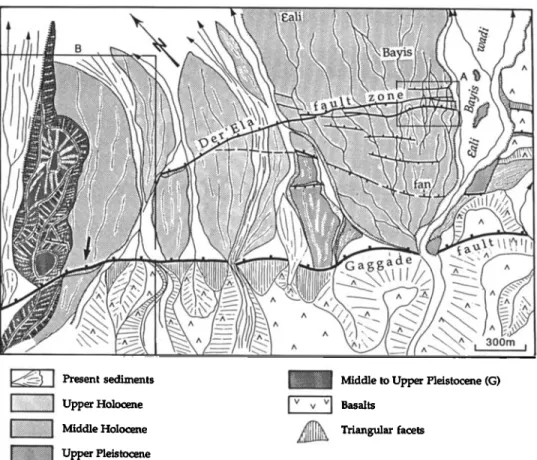
Figure 5a. Geological and structural map of the western termination of the Der'Ela fault (location indicated with black arrow in Plate 2), interpreted from aerial picture analysis. Box A
is Figure 5b; box B is discussed in text.
j Present
river
beds
-',•'-'-
..'.:..•
_Younger,
fan portions and terracesperched
20m
i i
Figure 5b. Morphotectonic map of a close up of Eali Bayis fan portion (box A in Figure 5a), interpreted from aerial picture enlargement. A, B, C are fault scarps; numbers indicate identified river beds (general water flow toward NE); solid lines indicate leveled, topographic profiles, either transverse to scarps (a-d), or along river flanks; dashed lines outline unleveled river flanks.
MANIGHETTI ET AL.- STRAIN TRANSFER
BETWEEN
RIFTS IN AFAR
13,627
(m) 80- 60- 40- 20- O-•
2.4m
(A)
••"•"•• (A)
'••rrace
riser)
I i i I I
0 50 100 150 200 (m)
Figure 6a. Topographic profiles a-d perpendicular to A, B1, B2 Der'Ela fault segments (loca- tion in Figure 5b). Crosses are measurements; thin straight lines indicate mean terrace slopes;
measured vertical offsets are in italic.
scarp is actually made of disconnected, en •chelon,
125 ø q- 5 ø striking, normal fault segments, a geome-
try that may suggest a left-lateral component of slip
on the Der'Ela fault. The segments join with the ma-
jor, more northerly striking Gaggade fault farther to
the west (Plate 2). For that reason, we refer to the fault zone as the "Der'Ela-Gaggade fault" at and north of that junction and as the "southern Gaggade fault" south of it. Figure 5a based on the analysis of air pho-
tographs at a scale of 1:15,000 shows that the west- ernmost Der'Ela segments offset at least four alluvial
fan generations
younger
than Upper Pleistocene
[Gasse,
1991] that were deposited
at the base of the Gaggade
escarpment. These segments form small scarps, the dips
of which often reverse along strike, a feature usually ob- served along steep, strike-slip fault planes. They merge
to the west into a unique fault trace.
Figure 5b, mapped from an air photo enlargement
(box A, Figure 5a), focuses
on a portion of the up-
per Pleistocene-Holocene Eali Bayis alluvial fan. Thefan is cut by three main parallel,
NE dipping,
normal
fault scarps
(A, B, C) that strike
130ø-135
ø, nearly
per-
pendicular to the dry river runoff that dissects the fan
surface. Most seasonal channels exhibit a left-lateral
bayonet pattern as they cross the scarps. Some dry
river beds incise the fault hanging walls, although no
clear counterparts can be found in continuity in the
footwalls. Such overall drainage pattern hence suggests that the channels and river beds have been offset by
faults A, B, C, with a combination of left-lateral and normal slip. In order to estimate amounts and rates of
such composite movements we leveled a series of topo- graphic profiles across the main A and B scarps (a-d; Figures 5b and 6a) and along some of the offset terrace risers (continuous solid lines; Figure 5b), using a high-
precision, digital-recording total station. Numbers 1-12 distinguish the different offset channels that we could
identify. We were able to level numerical profiles along only nine of them (1-9; Figures 5b and 6b), following the base of their western banks (western edges are ex- pected to be less eroded than eastern ones, according to the left-lateral sense of offset). Lateral and vertical
offset amounts that we could measure across A, B, C,
either on the leveled profiles and map (Figures 6a and
6b), or on the photo enlargement
(Figure 5b), are listed
in Table 2. The results can be summarized as follows:13,628 MANIGHETTI ET AL' STRAIN TRANSFER BETWEEN RIFTS IN AFAR
'•ø'øø1
(m)• A
t40.00 ß tO0.00 9 5 60 oo 4 d 3 zo oo C 2 -20.00 -60.00 II -120.00 -80.00 -40.00 0.00• A (m)
40.00 80.00 - ! 60.00Fiõure 66. All leveled profiles in map view (location in Figure 5b). Dots are measurements.
Fault A top and base were leveled along strike; a-d are transverse profiles of Figure 6a; 1-9 are
profiles leveled along river flanks as identified in Figure 5b.
1. The slip distribution is not uniform across the fault
zone. Some segments are mostly dip slip with no clear
left-lateral component (e.g., B1 and B3), while others
show composite movements. B1 and B3, which splay
from B, are likely to mark the near-surface partitioning
of the oblique slip that is apparent on B [e.g., Armijo et al., 1986]. For that reason, we only consider the cumulative slip on B.
2. Left-lateral offset amounts seem to vary with fault strike, with maximum lateral slip occurring across 130 ø
striking sections of the scarps, and negligible lateral slip
occurring across the more easterly striking sections. 3. Lateral offset amounts also vary along strike on 130 ø segments. The highest, oldest terraces are typ- ically offset by the largest amounts. This attests to
ongoing activity of the fault zone throughout the late
Pleistocene-Holocene.
These measurements allow us to characterize slip on
faults A and B only. Both faults display similar maxi- mum slip amounts, of the order of 21-22 m and 3-6 m for
the lateral and vertical components, respectively (the
two -•30 m lateral offset values measured on B along profiles 8 and 10 are likely to be overestimated owing
to the weathered pattern of the two channels). The
Der'Ela fault segments are arranged en •chelon at the
regional scale (Plate 2), and the similarity of maximum
offset amounts on A and B suggests that the latter are
actually themselves arranged en 6chelon, so that both are likely to slip at the same rate, i.e., at the rate of
the whole Der'Ela fault. Their maximum lateral slip
amount is up to 4 times greater than their maximum
normal one, which suggests that A and B are, at the sur-
face, mainly left-lateral strike-slip faults. Concurrently, the long-term morphology of the Gaggade escarpment, <1 km farther south, with a cumulative, Quaternary
vertical throw up to several hundred meters (Figure 5a),
reveals that the latter is in contrast mostly normal. In box B of Figure 5a, an upper Pleistocene alluvial fan indeed appears vertically offset by the Gaggade fault
(arrow) by a maximum of -•30 m (estimated from field
observation), while no evidence of lateral displacement
can be found. Note that the Gaggade fault strikes about
parallel to the Der'Ela fault segments where it offsets
the fan (arrow, Figure 5a). Together these observations
suggest that slip around the Der'Ela-Gaggade junction
is partitioned at the surface into two subparallel faults with different kinematics that would splay from one sin-
gle master fault at depth (Der'Ela-Gaggade fault, Fig- ure 6c). According to Gasse [1991], the two offset fans
formed between -•18 and 12 ka. As offsets are unlikely to remain preserved in the morphology until the allu- vial deposition period is over, we deduce that the cu- mulative offsets were built up in <12 kyr. Taking the
measured maximum lateral and vertical offset amounts
into account, Figure 6c illustrates a way to estimate the
components of slip on the presumed 135 ø (local direc- tion), single, Der'Ela-Gaggade fault plane at depth in



![Figure 3. Distribution of seismicity from November 9 to December 31, 1978 [from Lipine et al., 1980]](https://thumb-eu.123doks.com/thumbv2/123doknet/14717156.569093/13.942.173.775.86.436/figure-distribution-seismicity-november-december-lipine-et-al.webp)


![Figure 6c. Model of fault bifurcation [from Armijo et al., 1956]. The coeval Gaggade and Der'Ela faults with parallel traces and different kinematics (normal and left-lateral slip, respec- tively) splay from single Der'Ela-Gaggade f](https://thumb-eu.123doks.com/thumbv2/123doknet/14717156.569093/18.942.150.786.86.605/figure-bifurcation-armijo-gaggade-parallel-different-kinematics-gaggade.webp)