Designing Sanitation Projects in Rural Ghana
MASSACHUSETS INSTTT
by OF TECHNOLOGY
Jonathan Lau
JUN
2 't2011
Bachelor of Environmental Engineering
Stanford University, USA, 2010
LIBRARIES
Submitted to the Department of Civil and Environmental Engineering
ARCVES
in Partial Fulfillment of the Requirements for the Degree ofMaster of Engineering in Civil and Environmental Engineering at the
Massachusetts Institute of Technology June 2011
( 2011 Jonathan Lau. All rights reserved.
The author hereby grants to M.I.T. permission to reproduce and
to distribute publicly paper and electronic copies of this thesis document in whole and in part in any medium now known or hereafter created.
Signature of Author
Certified By
Accepted By
Jonathan Lau Department of Civil and Environmental Engineering May 6, 2011
Susan Murcott enior Lecturer of Civil and Environmental Engineering Thesis Supervisor
I I
IAl
r
/
Heidi M. Nepf
Designing Sanitation Projects in Rural Ghana
by
Jonathan Lau
Submitted to the
Department of Civil and Environmental Engineering May 6, 2011
In Partial Fulfillment of the Requirements for the Degree of Master of Engineering in Civil and Environmental Engineering
ABSTRACT
Providing sanitation to rural areas in Ghana remains a huge challenge. Government funding is scarce while many international donor projects are ineffective. This thesis explores the difficulties with rural sanitation projects through the implementation of two pilot projects based on a co-evolutionary design and planning process. Additionally, qualitative and quantitative information provided by an NGO partner field surveys in the Northern Region, Ghana, as well as relevant literature are presented and analyzed.
Two pilot Ecological Sanitation (EcoSan) latrine designs were tested on the ground by MIT researchers during January 2011. The pilot EcoSan latrines are cheaper than single-pit Ventilated-Improved-Pit (VIP) latrines built in Northern Region, Ghana. The Bin-Bin design and the Pure Home Water design have a construction cost of GHS 537 (USD $384) and GHS 943 (USD $674) respectively. However, social acceptability of EcoSan technology remains uncertain. In an assessment matrix, which includes five different latrine designs, the Bin-Bin and Sanergy latrine designs receive the highest scores (19 out of 27) for a given set of design and evaluation criteria. Potential areas for cost reductions and design improvements are identified.
The following is recommended for organizations working in sanitation in rural Ghana:
e Shift away from heavily subsidized, top-down sanitation projects:
Investigate the local demand and willingness to pay for latrines and experiment with for-profit models such as the Sanergy/Easy Latrine models.
* Investigate low-cost building materials and supply chains that can reduce latrine costs:
Pilot and test rammed-earth blocks, mud-bricks and any other suitable, locally-available building materials. Investigate centralized latrine manufacturing processes.
* Explore innovative design options:
Move away from single-pit VIP latrine designs; Pilot and scale-up other designs, including the Bin-Bin, Sanergy and Easy latrines, in order to assess their social acceptability and costs.
e Consolidate the work of organizations involved with sanitation:
Create an easily accessible online database that summarizes various sanitation projects conducted
by different organizations in Ghana to allow for effective collaboration and idea-sharing.
Thesis Supervisor: Susan Murcott
Acknowledgements
Writing this thesis was one of the most enriching experiences of my life. I am very thankful to the M.Eng program for providing such a wonderful opportunity to experience Ghana and to conduct a hands-on design and engineering project. Additionally, I would like to offer my deepest gratitude to the following:
-My parents and my sister, who have always been there for me.
-Susan Murcott, who has inspired me to strive for the greatest and to never give up.
-Musah Suale and Shani Alhassan, who taught me how to build things as well as how to live life. -The PHW factory staff, who made me feel at home in rural Ghana.
-Manny Hernandez, whose stories I will never forget. -Ernest Akkakia, who was the best local partner ever.
-Joanna Cummings, Joshua Hester, Samantha O'Keefe and Shanti Kleiman (the 2011 Ghana MIT Team), who made the month in Ghana truly epic.
-Mette Andersen who provided an invaluable, complementary perspective on latrine design in Ghana.
-The CEE M.Eng Class of 2011, who made me smile in the M.Eng room and motivated me to work harder.
-Eric Adams, who oversaw the wonderful M.Eng program. -Lauren McLean, who helped coordinate all the M.Eng activities.
-Zachary Dearing, Stephen Hendel, and Mitch Westwood (the Chi Phi guys), who gave the PHW factory a big energy boost, and helped me build my latrine.
-Marcus Parrish and Dan Christensen, my roommates at MIT, who kept me sane throughout this school year.
-All the MIT students working on sanitation, who gave me hope. -My SEALNet friends, who fueled my adventurous spirits in Ghana.
-My undergraduate friends from Stanford, who inspired me to take-on the challenges of sustainable development.
Table of Contents
LIST O F FIGURES...9 LIST O F TABLES...---...10 ABBREVIATION S AN D ACRON YM S... 11 1 IN TRO DU CTION ...---...---...--... 13 1.1 PROJECT BACKGROUND...131.2 RESEARCH GOALS AND M OTIVATION... ... 13
2 AN OVERVIEW OF SAN ITATION ... 15
2.1 UN ICEF STATISTICS...15
2.2 SANITATION IN GHANA...18
2.2.1 Com m unity W ater and Sanitation Agency (CWSA) ... 19
2.2.2 Government Spending in WASH (Water, Sanitation and Hygiene) Sector ... 20
2.2.3 Donors and Aid Organizations...21
2.3 SANITATION TECHNOLOGIES...22
2.3.1 Ecological Sanitation (EcoSan)... 23
2.3.2 Urine as
fertilizer...
242.3.3 Hum an feces as fertilizer... 25
2.3.4 Advantages and Disadvantages with EcoSan ... 25
3 BACKGROUN D FOR PILOT PROJECTS... 27
3.1 INTRODUCTION TO PURE HOME W ATER... 27
3.1.1 PHW Project Background... 27
3.2 INTRODUCTION TO NEW LONGORO ... 28
3.2.1 New Longoro Project Background... 28
3.3 FIELD SURVEYS...---...31
4 D ESIGN M ETH OD OLOGY... 33
4.1 THE D ESIGN M ETHODOLOGY...34
4.1.1 The Design Process...34
4.1.2 The Dem and-Driven Approach ... 36
4.1.3 Co-evolutionary design and Hum an-Cen tered Design ... 36
4.2 ESTABLISHING A DESIGN PROCESS...37
5 LEARN IN G TH ROUGH LO CAL PARTN ERSH IP ... 39
5 .1 R E V S O D E P ... 3 9 5.1.1 Ventilated-Improved-Pit (VIP) Latrine Projects ... 40
5.1.2 Ecological Sanitation (EcoSan) Projects... 45
5.2 PROBLEM IDENTIFICATION ... 49
6 ASSESSMENT CRITERIA AND LATRINE DESIGN ... 51
6.1 D ESIGN FACTORS...51
6.1.1 Superstructure and appropriate materials ... 51
6.1.2 Groundwater and Soil Conditions ... 53
6.1.3 Pit stability and lining ... 54
6.1.4 Fecal m aterial m anagem ent... 54
6.2 PHW PRELIMINARY D ESIGNS...55
6.2.1 Design Schem atics ... 56
6.3 BIN -BIN DESIGN ...----...-..--...--...- - . --... 59
6.3.1 Design Schematics...--....--...---... 59
7 PILOT PROJECT RESULTS ... 61
7.1 PHW PROJECT SUMMARY...61
7.1.1 Final Costs ... ... ...---.---... ... 63
7.1.2 F ollow -up ... ... ... ---. 64
7.2 D-LAB DESIGN CLASS PROJECT SUMMARY... ... 64
7.2.1 Final Costs...---..---..----... 66 8 DISCUSSION ...-...---.-...---.-... 67 8.1 ALTERNATIVE DESIGNS ...---....--... 67 8.2 LESSONS LEARNT ...---...---... 69 8.3 COST COMPARISON...---...70 8.4 ASSESSMENT MATRIX...---. ---... 71
8.5 REFINING ECOSAN DESIGNS ...---.---... 72
9 CON CLUSIONS AND RECOM M ENDATIONS... 75
9.1 RECOMMENDATIONS ...---... ... 75
9.2 F IN A L R EM A RK S ... ... ---... 76
APPEN DIX I: PHW RAM M ED-EARTH BLOCKS ... 79
APPEN DIX II: COST SURVEY... 80
List of Figures
Figure 2-1 Four-step ladder for sanitation coverage (Source: UNICEF 2010)... 16
Figure 2-2 Trends in sanitation (UN ICEF 2010) ... 17
Figure 2-3 Access to improved sanitation in Ghana (WHO/UNICEF 2010) ... 18
Figure 2-4 Major institutions and actors relevant to water resources management in Ghana (Fuest et a l. 2 0 0 5) ... 1 9 Figure 2-5 Ghanaian Government Expenditure (Grants & Loans) in WASH Sector... 21
Figure 2-6 Major donors in water and sanitation in Ghana (Fuest et al. 2005) ... 22
Figure 2-7 Sum m ary of Sanitation O ptions... 23
Figure 3-1 Inside of a public latrine, New Longoro (Photo credit: Mette Anderson)... 29
Figure 3-2 Close-up view of public pit-latrine, New Longoro (Photo credit: Mette Anderson) ... 29
Figure 3-3 Public toilets at the bus-stop near New Longoro (Photo credit: Mette Anderson)... 30
Figure 3-4 Household Water Source (O'Keefe 2011)... 31
Figure 3-5 Household Sanitation Practices and Technologies (O'Keefe 2011)... 31
Figure 4-1 Pit latrine mud superstructure in Chirifoyili (Photo credit: UNICEF)... 33
Figure 4-2 IDEO Design Process (Chapin,
J.,
Guest Lecture at MIT, 2011)... 35Figure 4-3 Project and Community Interaction in a Demand-Responsive Model (MacDonald et al. 2 0 0 6 ) ... 3 6 Figure 4-4 Co-Evolutionary Design for Development (Murcott 2007)... 37
Figure 5-1 The benefit ladder from latrine provision (Chapin,
J.
2011) ... 39Figure 5-2 VIP Latrine designs used in IRISH AID pilot projects... 41
Figure 5-3 REVSODEP Pilot Project locations ... 43
Figure 5-4 Latrine built for the Chief of Taha, Abukari Neindow ... 44
Figure 5-5 Latrine built for the home of Mahamud Sugli in Taha Village... 44
Figure 5-6 Interior of REVSODEP EcoSan pilot latrine showing urine-diverting toilet seat with a c o v e r... 4 5 Figure 5-7 Three-Compartment Composting Pit next to the EcoSan pilot latrine... 46
Figure 5-8 Removal Bucket at the back of the EcoSan latrine and urine diverting pipe... 47
Figure 5-9 Drama Group Performance at Taha Village explaining the concepts of hygeine and san itatio n ... 4 8 Figure 6-1 Mud-brick huts in Giana Village, Northern Region, Ghana... 53
Figure 6-2 PH W Latrine D esign Process ... 55
Figure 6-3 PHW Design Schematic (Sustainable Settlements 2011) ... 56
Figure 6-4 3-D PHW latrine, front view (Eric Chen 2011)... 57
Figure 6-5 3D PHW latrine, top view (Eric Chen, 2011)... 57
Figure 6-6 3D PHW latrine, back view (Eric Chen 2011)... 58
Figure 6-7 Available m aterials for superstructure... 58
Figure 7-1 The type of urine-diverting seat used for the composting latrine... 61
Figure 7-2 The finished structure with the construction team ... ... 62
Figure 7-3 The Bin-Bin composting box with Mary Xu, Mette Andersen and Mr. Manu (Photo credit: M ette A n d erson)... 65
Figure 7-4 Interior of latrine structure in mid-construction (Photo credit: Mette Anderson) ... 65
Figure 8-1 Components and Assembly of the Sanergy Latrine (Source: Ani Vallabhaneni)... 68
Figure 8-2 The Easy Latrine (Source: Jeff Chaplin) ... 69
Figure 8-4 Prototype urine-separating toilet-seat using a bucket (side view) ... 73
Figure 8-5 Prototype urine-separating toilet-seat using a bucket (top view) ... 74
List of Tables
Table 2-1 Global Water and Sanitation Expenditure (Rogers 2008) ... 20Table 5-1 REVSODEP/IRISH AID projects ... 42
Table 5-2 Estimated REVSODEP pilot project costs from surveys... 44
Table 6-1 Particle Size Analysis at Pure Home Water ... 54
Table 6-2 Comparison of Rammed-Earth Block to Concrete Block (adapted from UN-Habitat 2009) ... 5 9 Table 7-1 PHW Latrine final costs (GHS)... 63
Table 7-2 Bin-Bin Latrine Design Construction Costs... 66
Abbreviations and Acronyms
AfDCEE
CIDA CWSA DA EU EcoSan GHS IDE IDA JICA MIT MEng NGO SIDA REVSODEP UNDP UN-HABITAT UNICEF USD VIP WHOWSP
Agence Francaise de D~veloppement
Civil and Environmental Engineering
Canadian International Development Agency
Community Water and Sanitation Agency
District Assemblies
European Union
Ecological Sanitation
Ghana Cedis (US $1 = GHS 1.4, January 2011)
International Development Enterprises
International Development Association
Japanese International Cooperation Agency
Massachusetts Institute of Technology
Master of Engineering
Non-Governmental Organization
Swedish International Development Cooperative Agency
Rural Education Volunteer and Social Development Programme
United Nations Development Programme
United Nations Human Settlements Programme
United Nations Children's Fund
United States Dollar (US $1 = GHS 1.4, January 2011)
Ventilated-Improved Pit
World Health Organization
1
Introduction
1.1 Project Background
As part of the Masters of Engineering Program in Civil and Environmental Engineering at MIT, the author was fortunate enough to have the opportunity to explore the world of sanitation engineering under the supervision of Susan Murcott. Her non-profit, Pure Home Water (PHW), is based in Tamale, Ghana and provided much of the resources, knowledge and context for the work behind this thesis.
In January 2011, the author traveled to Ghana with a team of students and faculty to work with Pure Home Water. During that month, he conducted a pilot Ecological Sanitation (EcoSan) latrine project at the site of the PHW factory as well as sanitation surveys around the area. These field experiences have provided a basis for understanding the current sanitation situation in rural Northern Region, Ghana.
At the same time, by coincidence, another group of MIT students was working in New Longoro, Ghana, and were conducting another Ecological Sanitation (EcoSan) project. Their differing approach, background and project objectives have provided a complementary perspective, which will also be described in this thesis.
Last, but not least, the author and his thesis supervisor, Susan Murcott, were able to connect with social workers at a local non-profit Rural Education Volunteer and Social Development Programme (REVSODEP). Their insights into the local culture and experiences working in the sanitation have been invaluable throughout this project planning and implementation process.
1.2 Research Goals and Motivation
Providing sanitation to rural areas in developing countries remains a difficult challenge. Governments, NGOs, and the private sector need to make decisions on how to approach the issue of sanitation and how best to allocate resources. Currently, the rural sanitation sector is fragmented, as there are many different actors involved, all with differing approaches and attitudes towards the issues of sanitation.
For example, the government of Ghana and some NGOs advocate the Community-Led-Total-Sanitation and local financing method; some parties endorse high-end ventilated-improved-pit (VIP) latrines provided for free by the public sector; some researchers are interested in low-cost
composting toilets that can be built using local materials.
This thesis investigates the major challenges with rural sanitation in Ghana and how best to design effective and appropriate sanitation projects. Information from the current literature, experiences from project implementation on the ground, as well as qualitative and quantitative survey data are presented. The following questions are addressed:
* What type of planning process and project financing should be adopted?
* What latrine designs are appropriate for rural areas in Ghana? What design adjustments can be
made to reduce latrine costs?
e How can we improve collaboration between international aid agencies, local NGOs and
2 An Overview of Sanitation
The five key messages from the International Year of Sanitation organized by the United Nations in
2008 are (UN-Water 2008):
- Sanitation is vital for human health,
- Sanitation generates economic benefits,
- Sanitation contributes to dignity and social development,
- Sanitation helps the environment,
- Sanitation is achievable.
Moreover, it is indisputable that providing sanitation and management of human waste has wide-ranging benefits to a community, whether in a rural village or in a peri-urban slum. However, approaches to implementing sanitation are more debatable, wide-ranging, and often, as evidenced in many projects, unsuccessful.
Many challenges remain in the sanitation sector, especially in rural areas where there are lower population densities, more poverty, poor literacy rates, difficulties of access and transportation, lower fiscal power and less political interest.
This chapter will present general statistics regarding the sanitation sector, sanitation technologies, as well as country and location-specific information, in order to provide an overview of sanitation in
rural Northern Region, Ghana where the pilot projects will be conducted.
2.1 UNICEF statistics
UNICEF uses a four-step ladder to categorize sanitation coverage (Figure 2-1). The higher up the
ladder, from "open defecation" up to "improved sanitation", the better. According to UNICEF data, open defecation is declining in regions across the world. From 1990 to 2008, rates of open defecation in rural areas across the world reduced by almost a one-third (Figure 2-2). Improved sanitation coverage in rural areas increased from 28% to 40% of people living in developing countries. However, statistics for sub-Saharan African countries are much gloomier (Figure 2-2).
Figure 2-1 Four-step ladder for sanitation coverage (Source: UNICEF 2010)
Open Dcfcation Unimproved Shared
lanpnwed
Figure 2-2 Trends in sanitation (Adapted from UNICEF 2010)
---2.2 Sanitation in Ghana
Although Ghana ranks 152 out of 182 on the Human Development Index, it has the 4th lowest rate of sanitation coverage worldwide (UNICEF/WHO 2010). While the WHO and UNICEF Joint Monitoring Programme reports gradual improvements, over the last 20 years, in access to improved sanitation in Ghana (Figure 2-3), huge challenges remain with providing rural sanitation.
During the author's site visits over January 2011, it was observed that many rural communities with populations ranging from several hundred to several thousand have been donated pit latrines. Oftentimes, organizations would provide 10 or 20 pit latrines to a community of several hundred households.
According to the WHO/UNICEF Joint Monitoring Programme's metrics, these latrines would represent "improved sanitation" in that area. We must remember that in reality, there is little correlation between health improvements and the provision of sanitation unless there is adequate provision. Even if 10 percent of a neighborhood defecates in the open, the health of the whole community may suffer (Pickford 2001).
20 18 16 0 14 12 1o Urban a * Rural 6 4 2 1990 1995 2000 2005 2008
Figure 2-3 Access to improved sanitation in Ghana (WHO/UNICEF 2010)
Additionally, the institutional actors and mechanisms relevant to the water and sanitation sector in Ghana are laid out in Figure 2-4. The major governmental agency involved with rural water and sanitation is the Community Water and Sanitation Agency (CWSA), originally founded in 1994. While government spending on the rural sanitation sector remains low (Section 2.2.2), there are
Figure 2-4 Major institutions and actors relevant to water resources management in Ghana (Fuest et al. 2005)
2.2.1 Community Water and Sanitation Agency (CWSA)
The CWSA is an autonomous agency in charge of implementing the National Community Water and Sanitation Program (NCWSP) in rural areas. They operate ten regional offices, besides its head office in Accra, and their major objectives include safe water supply, hygiene education, and improved sanitation ("CWSA" 2011).
CWSA helps coordinate with public sector organizations, local communities, private sector
organizations, and NGOs to provide rural water and sanitation services. It is also expected to oversee financial donations from development partners.
Typically, rural communities work together with CWSA to contract external actors, such as private sector consultants or NGOs, to provide technical assistance, goods, or services. Local companies and artisans are often hired by CWSA to provide boreholes, hand-dug wells, and latrines. Each rural community is then expected to form their own Water and Sanitation Board and independently operate and maintain their water supply systems. They receive additional technical assistance by
District Water and Sanitation Teams (DWST), consisting of engineers, hygiene experts, and community workers ("CWSA" 2011).
2.2.2 Government Spending in WASH (Water, Sanitation and Hygiene) Sector
In terms of percentage of government budget allocated to the WASH sector, the Ghanaian
government is typical of a developing country (approximately 1.7%) and much higher than the
average spending in African nations.
Table 2-1 Global Water and Sanitation Expenditure (Rogers 2008) Water & Sanitation Expenditure
Region (% of government budget)
Typical developing country 1%
Ghana (2008) 1.7% (0.1% on rural sanitation)
Europe 4.50%
US & Canada 3.60%
Africa 0.20%
Middle East 0.20%
A closer look at the Ghanaian government budget (Ghanaian Ministry of Finance 2011) reveals that
only 0.1% of the government budget is spent on rural sanitation (Figure 2-5). Yet more than 2/3 of the Ghanaian population lives in rural areas. Between the years 2000-2008, the Ghanaian government spending on rural sanitation projects has fluctuated between $0.5-20 million (2008 dollars) (Figure 2-5).
The majority of the water and sanitation spending by the government has been allocated, instead, to urban water projects such as the Accra treatment plant and various drainage and sewer projects.
IO) 160.01 *Ibtal =Spending soAm) Rural Sanitation Spending 40,00 2)1.111 2000 2001 2002 2003 2004 2005 2006 2007 2008 Year
Figure 2-5 Ghanaian Government Expenditure (Grants & Loans) in WASH Sector 2.2.3 Donors and Aid Organizations
Many international organization and donors work in rural sanitation in Ghana. Figure 2-6 shows the major aid organizations working in the field of water and sanitation in Ghana. In the Northern Region, major donors include the Canadian International Development Agency (CIDA), the European Union (EU), Agence Frangaise de D6veloppement (AfD), the World Bank funded International Development Association (IDA) as well as the Japanese International Cooperation Agency (JICA) (Figure 1-3). Out of all these agencies, CIDA and IDA have been the most significant contributors to the work of CWSA and the implementation of the NCWSP (Fuest et al.
2005).
-Figure 2-6 Major donors in water and sanitation in Ghana (Fuest et al. 2005) 2.3 Sanitation Technologies
There are a myriad of different sanitation technologies and approaches that have been developed over the history of humankind. From flush toilets of the Indus Valley Civilization in 35h -12th century BC, to the first latrines and sewers of ancient Rome built between 800 and 735 BC, to the modern centralized wastewater treatment systems, sanitation has played an important role throughout the development of human civilization. Yet, in many rural areas in Ghana, the most primitive form of sanitation, open defecation, remains the common practice.
Over the past few decades, the international development community has amassed a range of technologies and practices in providing appropriate sanitation to developing nations. A survey of low-cost sanitation technologies and experiences can be found in John Pickford's "Low-Cost Sanitation" (Pickford 2001). The two most commonly used sanitation technologies today are the pit-latrine and the flush toilet, which spans the low-end and the high-end of the improved sanitation ladder (SIDA 1998).
Typically, decentralized sanitation options are categorized as follows:
Figure 2-7 Summary of Sanitation Options
Importantly, the Kumasi Ventilated Improved Pit Latrine (KVIP) is a popular latrine design throughout Ghana (Thrift 2008). This design was developed by Albert Wright at the Kumasi University of Science and Technology (now the Kwame Nkrumah University of Science and Technology) in the early 1970s. The KVIP is a twin-pit VIP latrine, which allows the contents of one pit to compost while the other pit is in use. By the time the second pit is full, it is expected that the contents of the first pit can be removed manually and spread on fields without health risks.
However, reports suggest that, even after a year, contents in the pit are often not composted and not safe to be spread on agricultural fields (Thrift 2008). KVIPs are currently the most common technology used by urban households, and the second most common technology used by rural households (Thrift 2008). It must be noted that there is often confusion between VIPs and KVIPs. During the author's field surveys during January 2011, many NGO workers and contractors mistook
single-pit Ventilated Improved Pit (VIP) latrines for KVIPs.
2.3.1 Ecological Sanitation (EcoSan)
Ecological sanitation is based on the idea that urine, feces and water are resources in an ecological loop. It is an approach that seeks to protect the human health, prevents pollution of the environment, reduces the use of water in sanitation systems and recycles nutrients to help to reduce the need for artificial fertilizer in agriculture. The EcoSanRes (Ecological Sanitation Research) Programme, funded by the Swedish International Development Agency is a major contributor to EcoSan research (SEI 2004).
There are generally three processes that enable re-use of human fecal material:
1) Dehydration
In a dehydrating toilet, feces are dropped into a processing chamber where they are stored for a period of 6-12 months, while the urine is diverted using specialized collection devices or toilet seats. Ash, lime and/or urea are added to the chamber after each defecation to lower the moisture content and raise the pH to 9 or higher, providing conditions for pathogen die-off.
After storage, the fecal material is then removed from the processing chamber and subjected to one of the four secondary treatments (high temperature composting, alkaline treatment, further storage, carbonization/incineration) before application as fertilizer. Since urine contains most of the nutrients but generally no pathogens, it may also be used directly as a fertilizer (SEI 2004).
2) Composting
In a composting toilet, human excreta and sometimes urine, along with additional substances such as vegetable scraps, peat moss, or wood shavings, are deposited into a processing chamber where microorganisms decompose the solids. The humus produced by the process is an excellent soil conditioner (better than simply dehydrated and stored fecal material), free of human pathogens.
A composting toilet requires many conditions to work: Sufficient oxygen should be able to penetrate
the compost heap to maintain aerobic conditions; the material in the composting vault should have a moisture content of 50 to 60%; the Carbon:Nitrogen (C:N) ratio should be within the range 15:1 to
30:1; the temperature of the composting vault should be above 15'C. The composting process can
take anywhere from several weeks to several years, depending on the design and local climate (SEI 2004).
3) Soil Composting
In a soil composting system, feces, in some cases feces and urine, are deposited in a processing chamber. Soil and wood ash are added after each use. Most pathogenic bacteria are destroyed within 3-4 months as a result of competition with soil-based organisms and unfavorable environmental conditions (SEI 2004). The material is then removed and can be subjected to secondary treatments, and in some cases can be directly spread on fields and worked into the existing soil (SEI 2004).
2.3.2 Urine as fertilizer
Most of the plant nutrients in human excreta are found in the urine. Based on data from five countries (China, Haiti, India, South Africa and Uganda), it is estimated that on average each person produces about 5 kg of elemental Nitrogen, Potassium and Phosphorus in excreta per year, about 4
kg in the urine and 1 kg in the feces (SEI 2004).
When urine is collected for use as a fertilizer, it is important to store it in such a way as to prevent odors and the loss of nitrogen to the air. Research indicates that most of the nitrogen in urine, which is initially in the form of urea, is quickly converted to ammonia within a collection and storage device. However, ammonia loss to the air can be minimized by storage in a covered container with restricted ventilation (SEI 2004).
When urine is applied on open soil it can be undiluted; if used on plants it must be diluted to prevent scorching, typically one part to 2-5 parts of water. In a series of experiments carried out in Harare, Zimbabwe, during 2002, it was shown that by periodically adding a 3:1 water:urine mixture
to different vegetables planted in 10-litre containers, crop yield was vastly improve, compared to irrigation with water only (SEI 2004).
2.3.3 Human feces as fertilizer
Human feces consist mainly of undigested organic matter such as fibers made up of carbon. The total amount of fecal material per person per year is estimated to be 25-50 kg, containing up to 0.55
kg of nitrogen, 0.18 kg of phosphorus and 0.37 kg of potassium (SEI 2004). After pathogen
destruction through dehydration and/or decomposition the resulting inoffensive material may be applied to the soil to increase the organic matter content, improve water capacity and increase the availability of nutrients. Humus from the decomposition process also helps to maintain a healthy population of beneficial soil organisms that protect plants from soil-borne diseases.
2.3.4 Advantages and Disadvantages with EcoSan
EcoSan has many advantages when compared with VIP latrines. Firstly, pit latrines cannot be used in many areas due to high water tables and groundwater pollution potential, seasonal flooding, a hard, rocky surface, lack of space, and potential for groundwater infiltration. This is not the case with above-ground dehydration or composting toilets.
Secondly, VIP latrines require regular, expensive, and often unhygienic emptying, whereas the removal of the small, dehydrated volume of feces from the dehydration toilet is much easier and more hygienic. If pit emptying is not possible, as is often the case in rural areas, the structure VIP latrines will need to be relocated. Lastly, EcoSan toilets can also provide valuable fertilizer material.
However, there are major barriers to successful implementation of Ecological Sanitation, including behavioral change and cost (McCann 2005). Some communities are more accepting to the idea of re-use of human waste, and in some regions availability of materials can affect the total costs to construct an EcoSan latrine. Additionally, many EcoSan projects in developing countries have failed to achieve long-term sustainability because of misuse of facilities and poor maintenance. Materials from EcoSan toilets are often not reused even when composted/dehydrated properly due to a lack of training and education (McCann 2005). Pilot projects need to be conducted in order to assess the viability of EcoSan in that region.
3 Background for Pilot Projects
This chapter introduces the two pilot projects that were conducted during January 2011 to assess the feasibility of EcoSan in rural Northern Region, Ghana: The PHW Project and the New Longoro Project.
Initiated in response to a need for sanitation facilities on the Pure Home Water (PHW) factory site, the PHW Project was led by the author, Jonathan Lau. The New Longoro Project was conducted by Mette Andersen and Amy Xu as part of the "D-Lab: Design" SP.722 course at MIT. New Longoro is located in the Brong Ahafo Region of Ghana, about 260 km from Tamale, where PHW is based.
3.1 Introduction to Pure Home Water
Founded in 2005 by MIT Senior Lecturer Susan Murcott with local partners, Pure Home Water (PHW) is a non-profit organization in Ghana whose mission is to provide safe drinking water to
the people of Northern Ghana - the poorest part of the country. Having considered bio-sand
filters, household and community chlorination systems, and SODIS, PHW determined that ceramic pot filters (CPFs) with safe storage containers was the best performing and most appropriate household drinking water treatment and safe storage method for Northern Ghana. Therefore from 2005-2009, PHW focused on distributing CPFs that were made in Accra, Ghana, teaching people how to use them, and monitoring how effective and durable they were over time.
As PHW grew, importing filters from Accra became less efficient. Filters were broken on the 12-hour road trip from Accra to Tamale, and PHW had trouble with the supplier providing pots on schedule and/or of consistent quality. In order to reduce or eliminate these problems in the supply chain and better serve Northern Ghana, PHW began constructing its own factory near Tamale in late 2009. Construction is still ongoing, but the factory currently has the molds, supplies, and kiln necessary for full-scale production.
In January of 2010, a two-person team of MIT students began work on developing a set of best production recipes for the PHW-produced filter using the locally available clay and combustible materials. Reed Miller and Travis Watters established recommended clay recipes based on flow rate and strength of the filters made with different proportions of combustible material and clay. Over the summer of 2010 and 2011, research was conducted to ensure that filters being produced at the new factory consistently perform well. The factory currently has orders pending from several large NGO groups to supply filters for Northern Ghana that can be supplied once quality controls are established.
3.1.1 PHW Project Background
In September 2010, Pure Home Water was looking to expand its safe drinking water work to the sanitation sector. Additionally, the PHW factory did not have sanitation facilities and it was decided that as part of the MIT Civil and Environmental Engineering Department Masters of Engineering program, the author Jonathan Lau would pilot an EcoSan latrine design on the Pure Home Water factory site. The project would serve the dual purpose as both the sanitation facility for the factory workers as well as an investigation into potential for implementing ecological
sanitation in villages around the factory and beyond. It would be an opportunity to show case PHW factory-produced rammed earth blocks.
This pilot project would provide essential data and experience for future sanitation-related work. Pure Home Water is currently finalizing a new contract sponsored by several Rotary Clubs (Medford, Cambridge, Tamale, Dunwoody), which includes an intended sanitation program in 2011-2012. In the future, EcoSan-related products could potentially be sold to higher-income communities and to non-profit organizations. Additionally, a partnership was established with REVSODEP (see chapter 5), an NGO with sanitation education experience in the area.
3.2 Introduction to New Longoro
The population of New Longoro is approximately 2,000. The dominant mother tongue spoken is Deg and the majority of the New Longoro inhabitants are Christians. A small Muslim community
(approximately 100) also resides in New Longoro.
The majority of the people in New Longoro are farmers. The main crops cultivated are yam and cassava. Other crop like maize, groundnuts, beans of different kinds, tomatoes, okra and agushie (melon seeds) are grown. Both women and men work on the farm fields. The average incomes earned by the people from the farming activities are between 2011 GHS 120-200/month. There are 4 carpenters, 6 masons and 10 teachers in this village ("Habitat for Humanity" 2011).
The New Longoro area has two rainfall patterns, the major season (March to July) and minor
season (September -November). There is a dry spell in August, which divides the two rainfall
seasons. A major dry season starts from November to March. The prevailing temperature ranges
between 300C to 40'C while rainfall amounts to between 55" and 70". The dry Harmattan winds
originating from the Sahara desert blow over the area during the major dry season (November to March) characterized by hazy dusty conditions and dry winds ("Habitat for Humanity" 2011). The community has serious housing problems ranging from poor roofing, heavily cracked walls causing serious health hazards to the people. Often the mud-brick houses collapse during rainy seasons, while leakage occur during the same season. Houses with thatch grass roofing also pose a fire and air quality hazard as many people cook inside their houses ("Habitat for Humanity" 2011).
3.2.1 New Longoro Project Background
New Longoro currently has four sets of public ventilated-improved-pit latrines, each set containing 4 individual latrines (Figure 3-1, 3-2). Only several households have private pit latrines. Intense smell and flies plague the public latrines in the village. One of the public latrines has reached full pit capacity and can no longer be used, as there is no easy way to empty the pit. Additionally, there are also no hand-washing facilities at the public latrines and people are expected to go home and wash their hands. However, it was reported that people often do not wash their hands afterwards. Many children continue with open defecation despite the availability of public latrines.
Figure 3-1 Inside of a public latrine, New Longoro (Photo credit: Mette Anderson)
Figure 3-2 Close-up view of public pit-latrine, New Longoro (Photo credit: Mette Anderson)
The public latrines at the nearby rest stop for buses are in better condition and of a more expensive design (Figure 3.3). There are flush toilets that drain into a pit. These toilets are cleaned regularly and have few flies and little odor. A mechanized pump draws water from a nearby stream and serves the water needs for this public latrine as well as the restaurant next to it. Additionally, there is a separate urinal facility associated with these toilets, and both men and women are expected to use the urinal unless they need to use the flush toilets. However the New Longoro community does not often use these toilets.
Apart from the piped water source at the bus-stop toilet facility, there is no piped water source in New Longoro. People collect water from one of three boreholes in the village. New Longoro is also situated next to a small river, but that water is heavily contaminated and is only drawn for
non-potable uses.
The goal for the MIT D-Lab Design team was to set up a working prototype of an EcoSan latrine. Mr. Manu, a respected elder of the community, serves as the local coordinator and advisor of the latrine project.
Figure 3-3 Public toilets at the bus-stop near New Longoro (Photo credit: Mette Anderson)
3.3 Field Surveys
During January 2011, Samantha O'Keefe, an MIT M.Eng student, conducted a field survey and interviewed 86 households in 15 different villages within a 10km radius of Tamale/Pure Home Water. The majority (~70%) of household water consumption comes from open dugouts (Figure 2-4), and over 85% of the households interviewed have no access to sanitation facilities and practice open defecation (Figure 3-4, 3-5).
Municipal Piped Water
Local Dug Well (Unprotected)
Figure 3-4 Household Water Source (O'Keefe 2011) 100 90 80 70 60 50 40 30 20 10 0
Household Pit Community Open
Defecation Latrine in
Construction
Figure 3-5 Household Sanitation Practices and Technologies (O'Keefe 2011) Details of the survey methodology and data can be found in her 2011 M.Eng thesis "Establishing
H2S Producing Bacteria as a Fecal Coliform Indicator: A Case of Science-Policy Controversy in
Public Health" (O'Keefe 2011).
Borehole (Protected) Dugout -.- .. ... - - "I'll, 111111111111 --- ---- -- ------ . ... - I - .- - - - - - a - -- !t - - ---- - -- -- - -- - - I I Household Pit Latrines Community Latrine Open Defecation
4 Design Methodology
"Go to the people. Live with them. Learn from them. Love them. Start with what they know. Build with what they have. But with the best leaders, when the work is done, the task accomplished, the people will say: 'We have done this ourselves.' "
-Lao Tzu (Chinese Philosopher, founder of Taoism, author of "Tao Te Ching", c. 600 B.C.E)
Do the words of Lao Tzu apply in the context of sanitation? Should we build latrines only with the local knowledge and materials, or should we build more durably but costly improved-pit latrines, or perhaps explore more advanced designs? Is there a compromise solution?
On the one hand, a low-cost, locally made and built pit latrine has many advantages. It can be easily scaled up, and there is no problem with materials sourcing and construction oversight. On the other hand, a higher end pit latrine with a ventilation pipe and concrete superstructure is more durable and less unpleasant to use, but more difficult to build.
UNICEF-Ghana has recently been promoting their Community Led Total Sanitation (CLTS) campaign in Chirifoyili in Northern Ghana as a big success. UNICEF worked with the local community and motivated them to built simple pit latrines using local materials and labor through the CLTS method (Figure 4-1) (Williams 2010).
Figure 4-1 Pit latrine mud superstructure in Chirifoyili (Photo credit: UNICEF)
After the initial pilot project at the house of the chief of the village, it was reported that many villagers in the community are now building similar latrines. According to UNICEF, "This safe, simple innovation was built for villagers, by villagers. Besides being practical, the latrines will go a long way to helping Ghana meet the United Nations Millennium Development Goals targets related to safe water and sanitation."
From practical experience and reports from without ventilation and reinforced pit walls continually. Without ventilation pipes, odor is
local Ghanaian NGOs, locally made pit latrines usually do not last long and will not be used likely to surround the pit, the interior of the
-cost superstructure is likely to deteriorate, and flies and mosquitoes will be attracted to the pit unless the covering slab is well designed and sealed. Once the unlined pit collapses during the rainy season in Ghana, or the conditions of the latrine become unbearable, the local community may stop using it. Can this project be considered as contributing to meeting any sanitation target?
On the other hand, the implementation of more upscale designs, such as Ventilated-Improved-Pit (VIP) latrines, can reduce some of the negative aspects of using an unimproved, local design seen in the UNICEF campaign. Unfortunately improved designs are costly. Given budget constraints, it is often unrealistic to expect a widespread implementation of these latrines.
Without extensive coverage of an entire community, simply building a few VIPs here and there will not help improve the public health of that community. Simply providing a few VIPs in a community with hundreds of villagers (which is frequently observed!) without the plan for scaling up cannot be considered as contributing to meeting a sanitation target.
4.1 The Design Methodology
In the field of sanitation, the term "design" incorporates the technical design of the latrine as well as the project planning and implementation methodology. Successful and sustainable sanitation projects require good technical design and installation, as well as substantial investment in community sensitization, mobilization and participation. A comprehensive list of technical latrine designs can be found in John Pickford's "Low Cost Sanitation: A survey of practical experience"
(Pickford 2001).
Ignoring technical, cultural or behavioral factors will compromise the sustainability of the sanitation project. If communities do not regard the system as theirs, as per the opening quote from Lao Tzu, and management and cost-sharing arrangements are not adequately dealt with, the system is more likely to fail. If a latrine is poorly constructed, or poorly designed, costs could escalate and durability could become an issue.
Yet discussion around sustainability of sanitation projects is often polarized. Technical discussions of the design of latrines sometimes omit any commentary on the community and social aspects of implementation, and vice versa (MacDonald et. al 2004).
The key to good project design lies in recognizing the multiple dimensions of sustainability. Engineering design for sustainable development needs to take into account the following factors:
e Economic: Financing, costs, subsidies, taxes, profitability, employment
* Social and Cultural: Local customs and practices, customer demands and expectations,
community acceptance, behavioral aspects, ease of use
* Environmental: Impact on the natural environment
* Engineering: Technical design, standards and guidelines, quality control, operations and
maintenance, materials availability, durability, carbon footprint, ease of construction
* Political: Role of government, NGOs, private sector, local community
4.1.1 The Design Process
Each of these factors, and potentially others, need to be taken into account when designing for the developing world. It is also common for engineers and designers to follow a design process. In
Everett Rogers' well-known book Diffusion of Innovation (Rogers 2003), 6 major stages are identified in the process of innovation:
Needs/Problem Identification Research
Development Commercialization Diffusion and Adoption Consequences
However, many other design/innovation processes have been proposed. Depending on the people and the type of project, different processes and schemes may be more suitable.
IDEO, a design and innovation consulting company (www.ideo.com), which promotes
"human-centered design", recently conducted a sanitation project in Cambodia in order to help improve pit latrine designs. Their design process for that project is presented as follows:
HOW WE
WORK:
DESIGN PROCESS
0102 03 04
0IGPSTO & SRT5 OTONAG u .IRCEMNATIOh f
96PMT1 STRATEGY XT EVAWMT01 00MMU CATIONI
Figure 4-2 IDEO Design Process (Chapin,
J.,
Guest Lecture at MIT, 2011)The steps and procedures, seen in Figure 4-2, are not to be followed in a strict order, and a more complex interaction between each procedure/step is more common. Often, an iterative design process is needed, whereby designers return to certain steps in the process in order to refine their
designs.
For example, in the IDEO Cambodia sanitation project, designers met challenges during their prototyping stage that forced them to reevaluate their strategy. The IDEO team initially tried to communicate their prototypes through CAD drawings and various visual tools, but the locals were not able to understand these drawings, particularly the presentation of scaled models. As a result, the IDEO team had to return to their original strategy and change their approach to communicating ideas and community outreach. The IDEA project is presented in section 8.2.
4.1.2 The Demand-Driven Approach
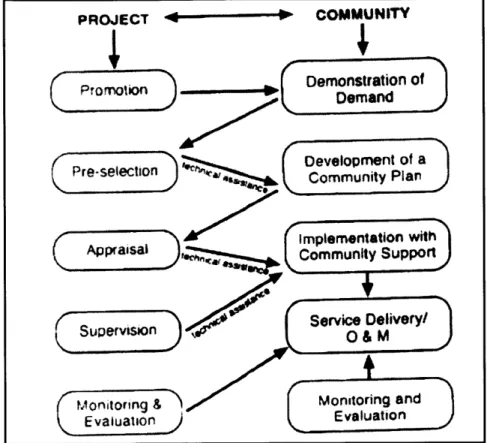
In the 1990s, there was a movement towards demand-driven or participatory development, where the consumer needs drive the investment and design decisions (Whittington 1998). This approach allows the user community to be at the center stage of the design process. The project process and the community interaction are shown in figure 2-3.
Figure 4-3 Project and Community Interaction in a Demand-Responsive Model (MacDonald et al. 2006)
However, there are many challenges to a demand-driven approach. For example, issues of gender and wealth can lead to positions of authority and influence to be held by those who have more money or are in power. Additionally, in many cases, the private sector is unable to match the local demand (see section 8.2).
4.1.3 Co-evolutionary design and Human-Centered Design
More recently, terminology has emerged to highlight the importance of local participation in the design process. Human-Centered Design (HCD) or User-Centered Design (UCD) are design philosophies and processes in which the needs and concerns of the end users of a product are
given extensive attention throughout each stage of the design process. The IDEO project in
Cambodia is also based on the philosophy of HCD and involves the local communities right at the beginning of the design process.
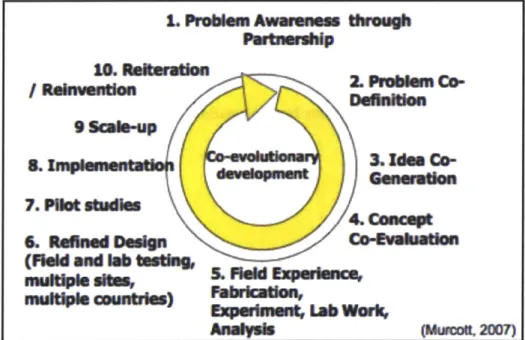
"Co-evolutionary design for development" is a process that goes beyond the dualism of the project vs. the community seen in the Demand-Responsive Model (Figure 4-3) (Murcott 2007).
PROJECT 4COMMUNITY
Demonstration of
jDevelopment of a
Communities are not just the consumers, but are now the partners and experts in their local conditions and contribute to the project management and design process. Designs are no longer "top down" from developed countries to developing countries, but instead the design process is iterative and collaborative, making use of local resource experts who can inform the design process, forming a mutually beneficial relationship with the developed world experts.
Co-evolutionary design also emphasizes the importance of field research and the local environment as the living laboratory through which effective designs get tested and realized. This process is illustrated in Figure 4-4. The MIT Nepal Water Project (Murcott 2007) is an example of the implementation of the Co-evolutionary Design process.
1.
Probem A
Uthrough
Pwtnanhp
10. Roetio n .Po o /Reinwe"ti "1'009 Scal--up
7. PROt StuIM 4. Concept 6. ROUWe D0" nMDE~hetolpemdanndk
Lab Woon
neultiplepf eeunries 2ensDuo
Figure 4-4 Co-Evolutionary Design for Development (Murcott 2007)
However, real-world projects are often subject to additional constraints that affect the design process. Project funding, scheduling, language barriers and resource constraints are some of the many factors that can affect the design process.
4.2 Establishing a design process
This thesis is a part of the MIT 9-month Masters of Engineering program, which includes a fall and spring semester, as well as a month of fieldwork during January between the semesters. Because fieldwork is limited to that month, constant communication with local partners throughout the design process is not possible. In many student-led groups and projects, such as Engineers Without Borders (EWB) or Engineers for a Sustainable World (ESW), similar constraints exist.
However, there exists a wealth of research on the issues of sanitation that is available on the Internet, and in books and journal articles. Drawing from the experiences of other researchers, students can gain insight into a local community, their needs and knowledge. Often times, it is unlikely that research will be published on the specific community that they are working with, but extrapolation of data and information can be helpful in guiding the design process. While this
process is still more top-down than is ideal, a strong literature review can often help make up for what is lost through difficulties in communicating with the local partner.
I propose the following 8-step design process and schedule, which is an adaptation of the Co-Evolutionary Design process to the structure of the MIT Master of Engineering program and the resource constraints that students at MIT face:
Fall Semester
1) Problem co-definition through literature review
2) Idea co-generation and constraints co-identification through establishing a local partnership (in the author's case, communicating with REVSODEP representatives through email and Skype)
3) Preliminary Designs
Independent Activities Period (IAP)
4) Field Experience and Pilot Projects Implementation
Spring Semester
5) Projects Evaluation 6) Refined Design Summer and beyond
7) Additional Pilots
8) Scale Up and Co-implementation
The remainder of this thesis will explore this design process and the possibilities for implementing Ecological Sanitation and other innovative designs in rural Northern Ghana.
5 Learning through Local Partnership
While it has been established in Chapter 1 that proper management of human waste can improve public health, latrine provision has other important benefits to the local community. Household surveys in Cambodia by an IDEO team showed that people wanted latrines primarily for the convenience, status, safety and privacy. The health concerns were not necessarily at the top of their list (Figure 5-1)
Cost
55
Figure 5-1 The benefit ladder from latrine provision (Chapin,
J.
2011)The goal of every sanitation project should be, at minimum, to improve the public health of the people living in that area. However, designers need to bear in mind other needs and wants of the local communities. It is therefore important to talk to the local community right at the beginning of the design process to understand their needs. In order to better understand the local needs and conditions, the author decided to seek assistance from a local non-profit that had experience in water and sanitation work. This information is presented below.
5.1 REVSODEP
The Rural Education and Volunteer and Social Development Programme (REVSODEP) is a local NGO in Ghana with its headquarters in Tamale in the Northern Region. Their mission
statement is as follows ("REVSODEP" 2011):
"We strive to mitigatepoverty in the three Northern Regions of Ghana by adopting relevant measures with the aim to increase access to education, health, food, clean water and improved sanitation, with priority on the most vulnerable in the societ. We will do this by developing stronger relationship with both the local and international community through volunteer and cultural exchanges."
Originally focused on rural education, it has recently expanded its mission to other aspects of development, including public health, clean water and sanitation. Currently, REVSODEP has six major departments:
1. Water and sanitation 2. Health 3. Education 4. HIV/AIDS 5. Micro Finance 6. Sustainable Agriculture
They run internship programs in Northern Ghana for students from other countries and have strong ties with European countries, especially Belgium, Austria, Sweden, Finland and Germany where there are regional coordinators and major donors. A significant part of their revenue comes from internship programs, where foreign students join REVSODEP on a temporary basis, pay program fees, and work on rural development projects at one of the REVSODEP sites. In January 2011, their assistant director, Ernest Akakia, offered his kind help to MIT and introduced us to REVSODEP's work, as well as generously providing the survey data, qualitative information, and pilot project reports that will be presented below.
5.1.1 Ventilated-Improved-Pit (VIP) Latrine Projects
REVSODEP was awarded a grant from IRISH AID to provide household
Ventilated-Improved-Pit latrines in six communities over period of three years, starting in 2008. A total of 50 latrines were constructed over a period of two years (Table 5-1). Standard contractor drawings, for their single-pit, dual-seater VIP latrine design, are shown in Figure 5-2. Key highlights of the latrine design include:
e Rectangular or square pits lined with concrete blocks;
* Steel re-bar reinforced pit cover slabs;
e Concrete block superstructure with corrugated metal roof;
e 4" PVC ventilation pipes;
front elevat ion
section X-X
I-
---1A"as tOLE
side elevation
ground floor
plan
Figure 5-2 VIP Latrine designs used in IRISH AID pilot projects (All dimensions in millimeters)
(Photo Credit: Ernest Akkakia)
Table 5-1 REVSODEP/IRISH AID projects Number of latrines built by REVSODEP (as of January 2011) Contractor hired Mbalai Wovogumah Giana 1,000 1,780 400 Construction Solutions Consult 5 Limited Awakwa 10 Construction Awakwa 10 Construction
REVSODEP's startegy is to first sensitize people through the use of drama and role-plays, whereby local village Drama Groups act out different everyday life scenarios to convey the messages of sanitation and hygeine. After village sensitization and acceptance of the latrines, REVSODEP would then facilitate the formation of a village sanitation group to help guide the planning process. Finally, construction of VIP latrines begins.
The Taha and Gbalahi communities (Figure 5-3) were chosen for pilot projects in 2008 for the start of the project. Five household latrines in each of the two communities were completed on 24th August, 2009. REVSODEP reported the successes and failures with their pilot projects in their yearly reports (Akkakia 2010):
* "Through the use of Drama Groups, there is widespread awareness among the villages to avoid defecating in the open." Most villagers understand the connections between sanitation and public health.
e Households that have been provided latrines feel "privileged to have them" and as a
result "a lot more people are applying for sanitation facilities." Total Population (2010 Census) Village
TOta
e In Mbalai and several other villages, there was frequent theft of the project materials. During the project, aggregate, sand and cement were left at individual households to be taken care of. However, members in the community used the cement and sand for different purposes without request and permission.
* Severe rains coupled with the unavailability of fine and coarse aggregates caused delays in latrine construction.
* Community members had originally agreed to provide manual labor for the
construction. However, these agreements were not always met "due to farming activities." The skilled construction workers often would have to wait until the manual labor was completed and on certain days would have to return home without working because of delays.
Figure 5-3 REVSODEP Pilot Project locations (Source: Pure Home Water Map Collection)
Additionally, the author collected data from two construction companies, Awakwa Construction and Construction Solutions Consult Limited, to determine the costs for various latrine projects (Table 5-2). The detailed cost breakdown, design of sanitation facilities, and project management will be analyzed in the chapter 6. Some pictures of REVSODEP pilot project latrines provided in Taha Village are shown in the Figures 5-4 and 5-5.
Table 5-2 Estimated REVSODEP pilot project costs from surveys
Average cost to construct a household dual-seat VIP latrine
Estimated Total Cost (50 dual-seat larnes built)
Cost (USD)
$2,661
$133,000
Figure 5-4 Latrine built for the Chief of Taha, Abukari Neindow (Photo Credit: Ernest Akkakia)
Figure 5-5 Latrine built for the home of Mahamud Sugli in Taha Village (Photo Credit: Ernest Akkakia)
5.1.2 Ecological Sanitation (EcoSan) Projects
REVSODEP began piloting EcoSan latrines in 2005, funded by an anonymous Belgian donor.
Originally their goal was to build a total of five EcoSan latrines for two different communities, however, funding shortages led to only one being built in Giana Village, near Tamale.
Their EcoSan latrine design used urine-diverting toilet seats to separate the liquid (diverted into the ground) and the human feces (diverted into a bucket). The solids are then emptied into a composting box twice per week as the bucket fills up and ash and lime are added (Figure 3-6, 3-7,
3-8). The urine is piped directly several feet into the ground. Details on latrine designs are
presented in Chapter 6.
Figure 5-6 Interior of REVSODEP EcoSan pilot latrine showing urine-diverting toilet seat with a cover