HAL Id: hal-00601850
https://hal.archives-ouvertes.fr/hal-00601850
Submitted on 20 Jun 2011HAL is a multi-disciplinary open access archive for the deposit and dissemination of sci-entific research documents, whether they are pub-lished or not. The documents may come from teaching and research institutions in France or abroad, or from public or private research centers.
L’archive ouverte pluridisciplinaire HAL, est destinée au dépôt et à la diffusion de documents scientifiques de niveau recherche, publiés ou non, émanant des établissements d’enseignement et de recherche français ou étrangers, des laboratoires publics ou privés.
Alessandro Morbidelli
To cite this version:
Alessandro Morbidelli. Dynamical evolution of planetary systems. P. Kalas & L. French. Planets, Stars and Stellar Systems, Springer, 2011. �hal-00601850�
Alessandro Morbidelli
Dep. Cassiopee, University of Nice - Sophia Antipolis, CNRS, Observatoire de la Cˆote d’Azur; Nice, France
ABSTRACT
The apparent regularity of the motion of the giant planets of our solar system sug-gested for decades that said planets formed onto orbits similar to the current ones and that nothing dramatic ever happened during their lifetime. The discovery of extra-solar planets showed astonishingly that the orbital structure of our planetary system is not typical. Many giant extra-solar planets have orbits with semi major axes of ∼ 1 AU, and some have even smaller orbital radii, sometimes with orbital periods of just a few days. Moreover, most extra-solar planets have large eccentricities, up to values that only comets have in our solar system. Why such a big diversity between our solar system and the extra-solar systems, as well as among the extra-solar systems themselves? This chapter aims to give a partial answer to this fundamental question. It’s guideline is a discussion of the evolution of our solar system, certainly biased by a view that emerges, in part, from a series of works in which I have been involved. According to this view, the giant planets of the solar system suffered radial migration while they were still embed-ded in a proto-planetary disk of gas and presumably achieved a multi-resonant orbital configuration, characterized by smaller inter-orbital spacings and smaller eccentricities and inclinations with respect to the current configuration. The current orbits of the giant planets have been achieved during a phase of orbital instability, during which the planets acquired temporarily large-eccentricity orbits and all experienced close encoun-ters with at least another planet. This instability phase occurred presumably during the putative “Late Heavy Bombardment” of the terrestrial planets, approximately ∼ 3.9 Gy ago (Tera et al., 1974). The interaction with a massive distant planetesimal disk (the ancestor of the current Kuiper belt) eventually damped the eccentricities of the planets, ending the phase of mutual planetary encounters and parking the planets onto their cur-rent, stable orbits. This new view of the evolution of the solar system, makes our system not very different from the extra-solar ones. In fact, the best explanation for the large orbital eccentricities of extra-solar planets is that the planets that are observed are the survivors of strong instability phases of original multi-planet systems on quasi-circular orbits. The main difference between the solar system and the extra-solar systems is in the magnitude of such an instability. In the extra-solar systems, encounters among giant planets had to be the norm. In our case, the two major planets (Jupiter and Saturn) never had close encounters with each other: they only encountered “minor” planets like Uranus and/or Neptune. This was probably just mere luck, as simulations show that Jupiter-Saturn encounters in principle could have occurred. Another relevant
difference with the extra-solar planets is that, during the gas-disk phase, our planets avoided to migrate permanently into the inner solar system, thanks to the specific mass ratio of the Jupiter/Saturn pair and the rapid disappearance of the disk soon after the formation of the giant planets. This chapter ends on a note on terrestrial planets. The structure of a terrestrial-planet system depends sensitively on the dynamical evolution of the giant planets and on their final orbits. It appears clear that habitable terres-trial planets, with moderate eccentricity orbits, cannot exist in systems where the giant planets became violently unstable and developed very elliptic orbits. Thus, our very existence is possible only because the instability phase experienced by the giant planets of our solar system was of “moderate” strength.
1. Introduction
It is now clear that the planetary systems that we observe did not form in their current configuration, but they have been heavily modified by a non-trivial dynamical evolution. Processes like planet migration, resonant trapping, planet-planet scattering, mutual collisions, hyperbolic ejections have sculpted the structure of planetary systems since the formation of the planets; some of these processes might also have played a crucial role in the accretion of the planets themselves. The observational evidence that planetary systems can be very different from each other, suggests that their dynamical evolutions have been very diverse, probably as a result of a strong sensitivity of the dynamics on environmental parameters or initial conditions.
The goal of this chapter is to review our current understanding of the possible dynamical evolutions of planetary systems and of the open problems that we face. The main focus will be on our solar system, because this is the system that we can best model, thanks to the vast number of observational constraints. We will see that the dynamical history of our planetary system followed step-wise generic processes, but was also characterized by a number of specific “events” that act like bifurcation points in the evolution of planetary systems. I will then discuss what would have happened if these events had occurred differently. This will give us some guidance in understanding the origin of the diversity of planetary systems.
This chapter is divided in three parts. The first is devoted to the early evolution of giant planets when they are still embedded in the gas-disk, i.e. during the first few millions of years following the formation of the central star. The second discusses the evolution of the giant planets after the disappearance of the gas, when they interact with a still massive planetesimal disk; this is the era of debris disks, which are commonly observed around stars even as old as 1Gy. The third part will focus on terrestrial planets and on how their accretion and evolution depend on the evolution of the giant planets discussed before.
2. The gas-disk era
2.1. The formation of the giant planets
There are two possible mechanisms by which we envision that giant planets can form. The first is nicknamed the “core-accretion mechanism”: the coagulation of solid particles forms a core typically of about 10 Earth masses (M⊕) while the gas is still present in the proto-planetary disk;
the core then traps by gravity a massive atmosphere of hydrogen and helium from the disk (Pollack et al., 1996) and becomes a giant planet. The second mechanism invokes the gravitational instability of the gaseous component of the disk (Cameron, 1978): a cold, massive proto-planetary disk can break into a number of self-gravitating gas-clumps, which then contract forming giant gaseous planets (Cassen et al., 1981; Boss, 2000, 2001, 2002; see Durisen et al., 2007 for a review).
The debate to discriminate between these two models has been very intense over the last 10 years. Now, several direct or indirect observations suggest that the core-accretion mechanism is predominant for the formation of the planets detected so far. First, interior structure models of the giant planets of the solar system predict that all of them have massive solid cores (Guillot, 2005; Militzer and Hubbard, 2009; however see Nettelmann et al., 2008 for a model arguing for a core-less Jupiter). Second, there is a clear correlation between the metallicity of stars and the probability that said stars have giant planets around them (Fisher and Valenti, 2005). Third, transiting extra-solar planets are inferred to have solid cores whose relative mass is correlated with the metallicity of the host star (Guillot et al., 2006). All these features suggest that solids have a crucial role in giant planet formation, an aspect that is difficult to explain in the framework of the gravitational instability model (Boss, 2002). Moreover, new hydro-dynamical simulations which model more accurately the thermodynamics in the proto-planetary disk find that formation of long-lived self-gravitating clumps of gas is likely only at large distances from the central star (> 50–100 AU; Boley, 2009). It is still unclear, though, whether the end-products of these clumps can be giant planets or must be brown-dwarf-mass objects (Stamatellos and Whitworth, 2008).
Thus, there is a growing consensus that the giant planets observed within a few AUs from their parent stars formed by the core-accretion process. The planets found at large distances from their parent stars (for instance around HR 8799 - Marois et al., 2008- or Fomalhaut - Kalas et al., 2008) are the best candidates to be the outcome of the gravitational instability process. There is still a possibility, though, that they are giant planets formed closer to the star by core-accretion, which subsequently achieved large orbital distances through planet-planet scattering (Veras et al., 2009) or outwards migration (Crida et al., 2009). I will return to this, further down in the chapter. The core-accretion model, nevertheless, has its own problems. The main difficulty is to under-stand how a ∼ 10M⊕ core could form within a few million years (which is the typical survival time
of a gas disk; Haisch et al., 2001). In the classical view, these cores form by collisional coagulation from a disk of planetesimals (small bodies of sizes and compositions similar to current asteroids or comets). In this environment, gravity starts to play a fundamental role, bending the trajectories of
the colliding objects; this leads to an effective increase of the collisional cross-section of the bodies by the so-called gravitational focussing factor (Greenzweig and Lissauer, 1992). At the beginning, if the planetesimal disk is dynamically very cold (i.e. the orbits have tiny eccentricities and incli-nations), the dispersion velocity of the planetesimals vrel may be smaller than the escape velocity
of the planetesimals themselves. In this case, a process of runaway growth begins, in which the relative mass growth of each object is an increasing function of its own mass M , namely:
1 M dM dt ∼ M1/3 v2 rel ,
(Greenberg et al., 1978; Wetherill and Stewart, 1989). However, as growth proceeds, the disk becomes dynamically heated by the scattering action of the largest bodies. When vrel becomes of
the order of the escape velocity from the most massive objects (i.e. vrel ∝ Mbig1/3), the runaway
growth phase ends and the accretion proceeds in an oligarchic growth mode, in which the relative mass growth of the largest objects d log Mbig/dt is proportional to M
−1/3
big (Ida and Makino, 1993;
Kokubo and Ida, 1998).
In principle, the combination of runaway and oligarchic growths should continue until the largest objects achieve an isolation mass, which is a substantial fraction of the initial total mass of local solids. In the outer Solar System, beyond the so-called snowline1 (Podolak and Zucker,
2004), if the initial disk is sufficiently massive (about 10 times the so-called Minimal Mass Solar Nebula or MMSN; Weidenschilling, 1977; Hayashi, 1981) it is expected that the end result is the formation of a few super-Earths (Thommes et al., 2003; Goldreich et al., 2004; Chambers, 2006), as required in the core-accretion model for giant planet formation. N -body simulations, though, show that reality is not so simple. When the cores achieve a mass of about 1 M⊕ they start to scatter
the planetesimals away from their neighborhood, instead of accreting them (Ida and Makino, 1993; Levison et al. 2010), which slows their accretion rate significantly. It has been proposed that gas drag (Wetherill and Stewart, 1989) or mutual inelastic collisions (Goldreich et al., 2004) prevent the dispersion of the planetesimals by damping their orbital eccentricities, but in this case the cores open gaps in the planetesimal disk (Levison and Morbidelli, 2007; Levison et al., 2010), like the satellites Pan and Daphis open gaps in Saturn’s rings. Thus the cores isolate themselves from the disk of solids. This effectively stops their growth. It has been argued that planet migration (Alibert et al., 2004) or the radial drift of small planetesimals due to gas drag (Rafikov, 2004) break the isolation of the cores from the disk of solids but, again, N -body simulations show that the relative drift of planetesimals and cores simply collects the former in resonances with the latter (Levison et al., 2010); this prevents the planetesimals from being accreted by the cores.
In summary, the accretion of massive cores is still an open problem, and I am suspicious of synthetic models where simple formulæ for the mass-growth of the cores are made up to achieve
1The orbital radius beyond which temperature is cold enough that water condenses into ice. The snowline is
the desired result, without any correspondence with the outcomes of N -body simulations (which should be considered as a sort of “ground truth” for dynamical processes).
Another problem of the core-accretion model originates from Type-I migration. Type-I migra-tion is the label denoting the radial drift of planetary cores (with masses ranging from that of Mars to several Earth masses) due to their gravitational interaction with the gaseous component of the disk. Analytic and numerical studies have shown that a planetary core generates a spiral density wave in the disk (Goldreich and Tremaine,1979,1980; Ward, 1986, 1997; Tanaka et al. 2002). In the outer part of the disk, the wave trails the core. Thus, the gravitational attraction that the wave exerts on the core results in a negative torque that slows the core down. In the inner part of the disk, the wave leads the core, and therefore it exerts on it an acceleration torque. The net effect on the core depends on the balance between these two torques of opposite signs. Ward (1997) showed that in general cases, i.e. for disks with power-law radial density profiles, the negative torque ex-erted by the wave in the outer disk wins. Consequently the core has to lose angular momentum, and its orbit shrinks: the planetary core migrates towards the central star, with a speed:
da/dt ∝ MpΣg(a/H)2 ,
where a is the orbital radius of the planet, Mp is its mass, Σg is the surface density of the gas disk
and H is its height at the distance a from the central star.
Precise calculations show that an Earth-mass body at 1 AU, in a MMSN with scale height H/a = 5%, migrates into the star in 200,000y. Thus, planetary cores should fall onto the central star well before they can attain the mass required to capture a massive atmosphere and become giant planets.
Several mechanisms that might weaken or prevent Type-I migration have been investigated. First, turbulence may turn inward Type-I migration into a random walk (Nelson and Papaloizou, 2003; Nelson, 2005), which could save at least some of the cores. Second, if there is a steep positive dΣg/da at some location in the disk, for instance at the outer edge of a partially depleted central
cavity, inward Type-I migration should stop there (Masset et el. 2006). Finally, it has been recently shown that migration can be outwards in the inner part of the disk, which transports and dissipates heat inefficiently due to its large opacity (Paardekooper and Mallema, 2006; Baruteau and Masset, 2008; Kley and Crida, 2008; Paardekooper et al., 2010). In this case, all cores would migrate towards an intermediate region of the disk, where Type-I migration is effectively erased (Lyra et al., 2010).
A particularly puzzling aspect of the core-accretion process is the evidence that in our solar system massive cores of ∼ 10M⊕ formed in the giant planets region, whereas in the inner solar
system the planetary embryos resulting from the runaway/oligarchic growth process presumably had masses smaller than the mass of Mars (Wetherill and Stewart, 1993; Wetherill, 1992; Weidenschilling et al., 1997). This jump of two orders of magnitude in the masses of embryos/cores from the inner to the outer solar system is difficult to understand. In fact, the surface density of solids in the disk should have had a ’jump’ at the snowline of only a factor of ∼ 2, given the revised solar C/O
abundance (Lodders, 2003). Moreover, the orbital frequency (that sets the speed of all dynamical processes, including accretion) decreases with increasing distance from the star. So, what makes the outer solar system so favorable for the formation of massive cores? To answer this question, several investigators searched for mechanisms that can concentrate a large amount of solids (well above the initial surface density) in some localized region of the disk, so to achieve a sweet spot for the formation of a massive object. Some proposed mechanisms still give a pivotal role to the snowline (Morfill and Volk, 1984; Ida and Lin, 2008), but others are based on the concentration of boulders in long-lived vortices (Barge and Sommeria, 1995; Lyra et al., 2009a, 2009b), or on halting migration of planetary embryos at a given orbital radius (Masset et al., 2006; Morbidelli et al., 2008a; Paardekooper and Papaloizou, 2009; Sandor et al, 2011), which are independent of the snowline location. Obviously more work is needed to understand which mechanism is relevant and dominant. Depending on future results, it might turn out that the wide-spread expectation that giant planets form by the core-accretion mechanism only beyond the snowline is naive; instead, some giant planets might have formed in the warmer regions of the disk (Bodenheimer et al., 2000).
2.2. Once giant planets are formed: Type II migration and its consequences By the action-reaction principle, the torques exerted by the disk onto the planet are symmet-rically exerted by the planet onto the disk. Thus, the planet exerts a positive torque onto the outer disk, i.e. it pushes the outer disk outwards, while it exerts a negative torque onto the inner disk, i.e. it pushes it inwards. For small mass objects, such as the planetary cores considered in the previous section, these torques are overcome by the internal torques of the disk, due to viscosity and pressure, so that the mass distribution in the disk -averaged over the azimuthal coordinate- is not significantly affected by the presence of the planet. However, this is no longer true if the planet is sufficiently massive (several tens of Earth masses for typical values of the disk’s parameters); in this case the internal torques of the disk cannot oppose the torques suffered from the planet. Consequently, the inner and outer parts of the disk are effectively repelled, and a gap in the gas distribution opens around the planet’s orbit (Lin and Papaloizou, 1986a; Crida et al., 2006).
Once a giant planet has opened a gap in the disk, it is condemned to stay in the middle of the gap. In fact, if it approached the inner edge of the gap, the distance of the planet from the inner disk would decrease and that from the outer disk would increase, so that the torque felt from the inner disk would become stronger than that felt from the outer disk. Thus the planet would be pushed back towards the center of the gap. The symmetric situation would occur if the planet approached the outer edge of the gap. Consequently, any radial migration of the planet has to follow the radial migration of the gap. The global evolution of the disk occurs on a viscous timescale Tν = a2/ν, where ν is the disk viscosity (Lynden-Bell and Pringle, 1974). So, the radial
displacement of the gap and the migration of the planet have to occur on this timescale (Lin and Papaloizou, 1986b). Unless the planet is close to the outer edge of the disk (Veras and Armitage, 2004), the planet has to migrate towards the star, because this is the natural direction of evolution
Fig. 1.— An illustration of the dynamical evolution of Jupiter and Saturn in the gas-disk, as in Masset and Snellgrove (2001). The black and grey curves show the evolutions of the semi major axes of Jupiter and Saturn, respectively. Capture in the 2/3 mean motion resonance occurs when the migration of Saturn is reversed.
of an accretion disk (Lynden-Bell and Pringle, 1974; Lin and Papaloizou, 1986b). The migration of a planet associated with a gap is called “Type II migration”.
Type II migration explains in a natural way the presence of giant planets on orbits very close to the parent stars (Lin et al., 1996), which is a very common characteristic in the population of extra-solar planets discovered to date. However, in our solar system the giant planets have orbital radii of several AUs, comparable to the orbital radii at which said planets are expected to have formed (see sect. 2.1). Moreover, several extra-solar planets have also been discovered on orbits with semi major axes larger than ∼ 3 AU. What happened in these cases? Why is Type II migration sometimes ineffective?
For our solar system, the key to answer this question seems to be the co-existence of Jupiter and Saturn, with their specific mass ratio. In fact, hydro-dynamical simulations, where Jupiter and Saturn are simultaneously taken into account with fixed masses, show that Saturn migrates the fastest, due to it smaller mass; therefore, it has no trouble in approaching Jupiter until the two planets are caught in resonance (Masset and Snellgrove, 2001). In disks with mass comparable to the MMSN, the most likely end-state is the capture in the mutual 2/3 mean motion resonance, where the orbital period of Saturn is 1.5 that of Jupiter. This occurs even if Saturn is initially beyond the 1/2 resonance or locked into the 1/2 resonance (Pierens and Nelson, 2008). Stable capture into the 1/2 resonance is possible only for disks with surface density decaying less steeply than 1/r or in low-mass disks (Zhang and Zhou, 2010). Once locked in the 2/3 resonance, the inward migration of Jupiter and Saturn stops (Masset and Snellgrove, 2001; Morbidelli and Crida, 2007), which explains why Jupiter did not migrate all the way close to the Sun. These results hold both for disks with constant viscosity and for the so-called α-disks (Shakura and Surayev, 1973) and do not depend critically on the value of the viscosity.
However, things may not be so simple in reality. All the hydrodynamical simulations that show that Saturn captures Jupiter in resonance, assume fixed masses for the planets. A natural question arises: is it still reasonable to expect resonance capture if the migration histories of the planets are coupled with their accretion histories? At first sight the answer is negative. If the second planet forms later than the first one, its migration history should just replicate that of the first planet, but later in time. More simply, the second planet should always lag behind the first one, as it is just repeating the evolution of the first planet, just at a later time. Thus, it appears that Saturn could catch Jupiter in resonance only if the accretion histories of the two planets were different. In particular, if Jupiter grew very rapidly to its current mass, it would have passed very quickly to a Type-II migration mode, which is relatively slow. Instead, if Saturn grew more gradually than Jupiter and spent more time near a Saturn-mass, it would have undergone fast migration for a longer period and hence could have trapped Jupiter in resonance. It is unclear why Saturn should have grown more slowly than Jupiter. Possibly, the opacity of the disk increased from the time of accretion of Jupiter to that of Saturn, thus slowing down the gas-accretion rate onto the planet.
Interestingly, among the collection of extra-solar planets, we see at least three systems where the Saturn-analog did not capture in resonance the Jupiter-analog (HD 12661, HD 13498, HIP 14810). But in these cases, the inner, more massive planet is closer than 1 AU to the star and the outer, lighter planet is more than three times further away. This is obviously very different from the orbital architecture of Jupiter and Saturn, or of the system OGLE-06-109L (which is a sort of twin of the Jupiter-Saturn system), which suggests that a different evolution occurred in these cases. I argue that the capture in resonance between a Jupiter-analog and a Saturn-analog is an event that may or may not happen, according to the accretion histories of these planets; depending on this binary possibility, the systems evolve along clearly different paths.
Let’s admit now that Jupiter and Saturn got captured in their mutual 2/3 resonance. Mor-bidelli and Crida (2007) showed that the subsequent dynamical evolution of these planets depends on the properties of the disk, particularly the scale height. For thick disks (about 6% in scale height for a typical viscosity), the migration is very slow, and the planets remain at effectively constant distance from the central star. But for disks with decreasing thickness, outward migration becomes increasingly fast. In principle, in thin disks outward migration can bring the planets up to ten times further than their initial location in a few thousands orbital periods (Crida et al., 2009), which might explain the orbits of some of the planets discovered by direct imaging beyond several tens of AUs from their parent stars. Until now, outward migration of Jupiter and Saturn from inside ∼ 4 AU was considered incompatible with the existence of the asteroid belt - therefore only proto-Solar disk models which prohibited outward migration were considered viable (Morbidelli et al., 2007). However, as shown by Walsh et al. (2011) and discussed in Sect. 4.1, this is not true, releasing the constraints against Jupiter’s outward migration. This opens a new degree of freedom to model the evolution of the solar system, as it will be shown at the end of this chapter.
For two giant planets to avoid inward migration as discussed above, it is essential that the mass of the outer planet is a fraction of the mass of the inner planet, as in the Jupiter-Saturn
case (Masset and Snellgrove, 2001; Morbidelli and Crida, 2007). I provide here an heuristic, but intuitive explanation of this statement. When two giant planets are close enough to each other, they evolve inside a common gap of the gas-density distribution. The inner planet, being closer to the inner edge than to the outer edge of the common gap, feels a positive torque and would tend to migrate outwards; the outer planet, being closer to the outer edge of the common gap, feels a negative torque and would tend to migrate inwards. If the planets are locked in resonance their relative orbital separation cannot change (if they are not yet in resonance they move towards each other until they are captured and locked into a resonance). Thus, the direction of migration of the pair of planets depends on which of the two torques dominates. Each torque is proportional to the surface density of the disk adjacent to the planet and to the square of the mass of the planet itself (Goldreich and Tremaine, 1979). Because the planets deplete partially the disk in the region between the star and their innermost orbit (a partial cavity; Crida and Morbidelli, 2007), the surface density in the outer disk is typically larger than in the inner disk; so, a necessary condition to avoid inward migration (i.e. to make the torque felt by the inner planet larger than that felt by the outer planet) is that the inner planet is more massive.
Therefore, this mechanism predicts that no pair of resonant giant planets with narrow orbital separation, with the outer planet significantly lighter than the inner one, should ever be found close to the parent star. In fact, planets in this configuration should have avoided inward migration. So far, this prediction is validated by observation. I fact, there are many pairs of planets in resonance (or close to), near their star, but none of these cases exhibits a Jupiter/Saturn mass ratio. The absence of this configuration, which is statistically significant if one assumes that the mass ratio should be random, strongly supports the theoretical result that resonant planets in Jupiter/Saturn mass ratio move outwards, and therefore cannot be found within the range of stellar distances that can be probed by radial velocity observations (OGLE-06-109L system was in fact discovered by micro-lensing).
There is an intriguing aspect in this view of the evolution of Jupiter and Saturn. When the two planets do not migrate inwards at the nominal Type II migration rate, there is necessarily an inward flow of gas, from the outer disk to the inner disk, through the common gap. Thus, the outer planet should presumably accrete more of the incoming material, narrowing the mass difference with the inner planet. This raises the question of why Saturn remained smaller than Jupiter. The answer may be that the gas disk was rapidly disappearing while Jupiter and Saturn were undergoing the dynamical evolution described above, so that Saturn failed to grow further. There are several lines of evidence in favor of a formation of Jupiter and Saturn in a dissipating disk. First, Jupiter’s atmosphere is enriched in elements heavier than helium by a factor of 3-4 relative to solar composition (Wong et al., 2004), while Saturn is enriched by a factor 11 in Carbon (Fouchet et al., 2009). Guillot and Hueso (2006) have argued that the easiest explanation for this fact is that hydrogen and helium had been already depleted by a factor of 3-4 in the disk by the time Jupiter captured its atmosphere (and, following this logic, by a factor of 11 by the time Saturn captured its atmosphere). Second, the favored model for the accretion of the regular satellites of
the giant planets also requires that said satellites formed in gas-poor circum-planetary disks (Canup and Ward, 2006). Third, the common explanation for why Uranus and Neptune failed to accrete massive atmospheres is that the gas disappeared before they had a chance to do so (Pollack et al., 1996). All these arguments suggest that the 4 giant planets formed in a temporal sequence, from Jupiter to Saturn and then to Uranus and Neptune, while the disk was being dispersed. Finally, recall that the Solar composition is at the low-end of the metallicity range for planet-bearing stars. In the core-accretion model of giant planets, the metallicity of the star is correlated with the speed of accretion of the cores, so that stars that are too poor in metals fail to form giant planets before the disappearance of the disk (Ida and Lin, 2004). This suggests that the solar system barely made its giant planets, while the disk was being dispersed.
If this explanation may be satisfying for our solar system, it is nevertheless interesting to discuss what would have happened if Jupiter and Saturn had formed earlier, when the disk was still massive. The issue is not only academic, as it can be pertinent for systems with a higher initial metal content which, as suggested above, should form planets faster. In a gas rich disk, Saturn would have eventually become as massive, or even more massive, than Jupiter. Thus, the two planets would have resumed an inward migration (Morbidelli and Crida, 2007). The orbital eccentricity of two planets migrating in resonance tends to increase monotonically (Ferraz-Mello et al., 2003; Kley et al., 2004). This effect is contrasted by the action of the disk, which tends to damp the planets’ eccentricities (Kley and Dirksen, 2006). A crucial role is played by the disk inside the orbit of the inner planet. This inner disk tends to be partially depleted due to the presence of the planet(s). The level of depletion depends on several parameters such as the viscosity of the disk, its scale height, its inner radius, the mass of the planet(s) relative to the disk etc. (Crida and Morbidelli, 2007). If the inner disk is depleted substantially, the damping effect on the eccentricity of the inner planet is strongly reduced. In this situation, the eccentricity of the inner planet keeps growing, until the pair of planets becomes dynamically unstable and mutual close encounters are triggered (Kley et al., 2005). This may be the case of many, if not most, of the planetary systems. In fact, mutual scattering seems to be the major mechanism responsible for the eccentricity distribution observed in the extra-solar planets collection (see sect. 2.3 for a more complete discussion). However, if the inner disk is not very depleted, the eccentricities of the planets grow until a limit value is achieved (Crida et al., 2008; see Fig. 2). This process can leave the planets at the disappearance of the disk on stable resonant orbits with moderate eccentricities and thus it can explain the pairs of planets in resonance observed to date.
In conclusion, we have seen in this section the first crucial “bifurcations” in planetary evolution that can account for at least part of the great diversity observed in planetary systems. In fact, assuming that giant planets form in sequence at increasing distances from the central star, most of the observed diversity of planetary systems could stem from the occurrence or avoidance of two events: (i) the capture in resonance of the first, inner planet by the second, initially smaller one, which stops inward migration (often triggering outward migration) and (ii) the growth of the outer planet beyond the mass of the inner one, which causes inward migration of both planets to resume.
Fig. 2.— The evolution of the eccentricities of planets b and c around GJ876 during their putative inward resonant migration. The eccentricity of the interior planet is labelled e1, that of the exterior planet e2. The
evolutions labelled “no inn.” assume that no disk is present inside the orbit of the interior planet; in this case the eccentricities seem to grow indefinitely. The evolutions labelled “ref.” and “p=0.8” account for an inner disk, and differ just for the value of a technical simulation parameter. In these cases the eccentricities attain equilibrium values. In the “ref” case, the final eccentricities reproduce the eccentricities inferred from observations (horizontal lines). From Crida et al., 2008.
The Solar System structure results from the occurrence of (i) and avoidance of (ii). Systems like HD 12661, with a close-in massive planet and a distant smaller planet, result from the avoidance of (i). Resonant giant planets close to their stars, like those in the GJ876 system, result from the occurrence of both (i) and (ii). Unstable systems, ultimately leaving behind one giant planet on an eccentric orbit, may also result from the occurrence of both (i) and (ii), but in cases where there was not enough eccentricity damping because of a depleted inner disk.
Here, the case with two planets was the only one considered; obviously, the tree of possible evolutions can only become more complicated if more giant planets are involved, and the final outcomes can be even more diverse.
2.3. Planet-planet scattering as the dominant orbital excitation process
One of the greatest surprises that came with the discovery of extra-solar planets is the realiza-tion that most planets have orbital eccentricities much larger than those characterizing the planets of our solar system. Eccentricities of about 0.4 are quite common in the extra-solar planets collec-tion; some planets have eccentricities larger than 0.6, values that in our solar system are common only for comets!
Whatever the preferred model of giant planet formation (core-accretion or gravitational insta-bility; see sect. 2.1), it is expected that planets have originally small orbital eccentricities, because
Fig. 3.— Final eccentricity distribution of simulated ensembles of planetary systems that underwent a dynamical instability sometime during the full simulation time-span of 108
y. The color bands correspond to different ensembles, characterized by different initial conditions. The histogram shows the observed eccentricity distribution of extra-solar planets with orbital period longer than 20 d, according to Butler et al. (2006). The observed distribution and the final distributions resulting from the simulations agree very well, with the exception of an excess of observed planets with e < 0.2. This is probably due to planets that never underwent a significant dynamical instability. From Juric and Tremaine (2008).
they form from a circum-stellar disk whose streamlines are basically circular. There has been a lively debate on whether subsequent planet-disk interactions can raise the planets’ eccentricities up to the observed values. Papaloizou et al., (2001) concluded, with numerical experiments and theoretical considerations, that eccentricity growth is not possible for planetary masses below 10-20 Jupiter masses. Instead, Goldreich and Sari (2003) argued with theoretical considerations that, un-der some conditions, depending mostly on disk’s thickness, giant planets of more moun-derate masses could have their orbital eccentricity excited, although they could not estimate the magnitude of this excitation. More recent hydro-dynamical simulations (D’Angelo et al., 2006; Kley and Dirksen, 2006) showed that planets with masses larger than ∼2–3 Jupiter masses, under some conditions, can have eccentricities excited by the disk, but only to moderate values (∼ 0.1–0.2), definitely lower than those characterizing many, if not most, of the extra-solar planets. In most cases, the planet-disks interactions rather seem to lead to eccentricity damping. Thus, a more generic orbital excitation mechanism seems to be required to explain the observations.
Soon after the discovery of the first eccentric planets, it was pointed out that mutual encounters between planets can easily provide strong orbital excitation (Rasio and Ford, 1996; Weidenschilling and Marzari, 1996; Lin and Ida, 1997; Levison et al., 1998; Ford et al., 2001; Marzari and Wei-denschilling, 2002; Adams and Laughlin, 2003). More recent studies (Juric and Tremaine, 2008; Chatterjee et al., 2008; Ford and Rasio, 2008; Raymond et al., 2009) show that random systems of giant planets initially on unstable, quasi-circular orbits evolve through close encounters until a dynamical relaxation state is achieved with the ejection or collision of some planets. In these models the final eccentricity distribution of the surviving planets is remarkably similar to that of
Fig. 4.— The final semi major axis vs. eccentricity distribution of extra-solar planets (squares) in the simulations of Moorhead and Adams (2005) which account for (i) inward migration, (ii) eccentricity damping due to the disk (with an assumed timescale of 0.3 My) (iii) tidal circularization and (iv) radial velocity detection biases. The stars show the distribution of the extra-solar planets known at the time.
known extra-solar planets (see Fig. 3). Moreover, Juric and Tremaine (2008) and Raymond et al. (2009) showed that the final orbital spacing of the surviving planets is also in good agreement with the observations of extra-solar systems of two or more non-resonant planets. These systems typically look “packed”, in the sense that the orbital separation (apocenter to pericenter) between neighboring planets is not much larger than what is required by the Hill-stability criterion (Barnes and Greenberg, 2006). All these quantitative results give strong support to the idea that planet-planet scattering is the main mechanism sculpting the orbital distribution of extra-solar planet-planets. In addition, Veras et al. (2009) pointed out that planet-planet scattering can propel a planet in the region beyond 100 AU, which can explain some of the extra-solar planets imaged at large distances from their parent stars2.
It is important to remember that, assuming giant planets formed beyond an hypothetical snowline at 3–5 AU, the planet-planet scattering mechanism alone cannot explain the observed semi major axis distribution of extra-solar planets (see for instance Marzari and Weidenschilling, 2002). In fact, through scattering events, planets can have difficulty reaching orbits with semi major axis smaller than half of the initial value of the inner planet, with the exception of those objects scattered onto orbits with very large eccentricities and small periastron distances, which may then become circularized by tidal dissipation. Thus, migration is still required to explain
2In summary, three mechanisms have been proposed to move planets from the snowline region to large distances
from the central star: (i) outward Type-II migration of planets originally formed in the outer part of a disk in rapid viscous spreading (Veras and Armitage, 2004); (ii) outward migration of a pair of resonant planets with a Jupiter-Saturn mass hierarchy (Crida et al., 2009); (iii) scattering of a planet to a wide elliptic orbit (Veras et al., 2009). These mechanisms are potential alternatives to the possibility that distant planets formed in-situ, by the gravitational instability mechanism (Boley et al., 2009)
the presence of a large number of planets on orbits with small semi major axes. Adams and Laughlin (2003) and Moorhead and Adams (2005) modeled the interplay between migration and scattering. They used N-body simulations, with fictitious forces to mimic the effect of the disk on the planets, for what concerns both semi major axis decay and eccentricity damping. After tuning a few parameters (the lifetime of the disk, the timescale of the eccentricity damping, etc.) and accounting for observational biases, Moorhead and Adams obtained a very good reproduction of the two-dimensional (a, e) distribution of the exoplanets detected by the radial velocity technique (Fig. 4). Although very appealing, this result may be questioned because the numerical recipes used to mimic migration and damping have been based on simple analytic estimates. Reality may be more complicated. For instance, as we have seen above, a system of two planets in resonance may migrate at a very different speed than a single planet in Type II migration (Morbidelli and Crida, 2007); the disk may not always damp the eccentricity of a planet, but could also sustain it, depending on the planet mass and initial eccentricity (Kley and Dirksen, 2006); migration direction could be reversed for eccentric planets (D’angelo et al., 2006); finally mass accretion onto the planets is neglected in the Moorhead and Adams model.
For all these reasons, I think that two key questions have not yet been answered in a definitive way: why do giant planets become unstable in the first place? And when do they become unstable, relative to the gas disk lifetime? I speculate a bit on both issues below.
Concerning the first question, there are in principle two answers: either planetary systems become unstable because the planets grow in mass, or because the planets are brought too close to each other by migration processes. I would tend to exclude the first case as a dominant mechanism to explain the large eccentricities of extra-solar giant planets, for the following reason. Imagine a system of cores close to each other (maybe brought by Type I migration into mutual resonances of type n/(n + 1), with quite large n). Given that the time required to trigger the runaway accretion of a massive atmosphere is much longer than the accretion of the atmosphere itself (Pollak et al., 1996), it is unlikely that all the cores would accrete massive atmospheres and become giant planets simultaneously. More realistically one core would start the accretion of the atmosphere first, and it would acquire a mass much larger than those of the other planets at that time. The system would become unstable, because it is too closely packed to stand the newly born giant planet. However, the scattering phase would bring the cores onto orbits with large eccentricities but it would leave the newly born giant planet onto a quasi-circular orbit: this does not correspond to the orbital distribution of the extra-solar planets that we see. Moreover, the orbital eccentricities of the cores would be damped very fast by the disk (Cresswell et al., 2007; Bitsch and Kley, 2010) and, by the time these cores become in turn giant planets, they would be again on quasi-circular orbits. I’m not denying that this kind of evolution can occur. A system of multiple giant planets probably forms through several repetitions of the events described above3. My claim is that this is probably
3The reader should remember that two planets are stable if their orbital separation is a few times their mutual
0.8 1 1.2 1.4 1.6 1.8 2 2.2 2.4 2.6 0 500 1000 1500 2000 2500 3000 3500 q,Q (arbitrary units)
time (orbital periods at a=1)
Fig. 5.— The evolution of a pair of giant planets initially on unstable orbits. For each planet, the pair of curves shows the evolution of the periastron (q) and apoastron (Q) distances. Thus, when the two curves are close, the orbit is almost circular and q ∼ Q ∼ a, where a is the orbital semi major axis. The light curves at the bottom are for the inner planet, with a 3 Jupiter mass; the thick curves at the top are for the outer planet, with one Jupiter mass. Notice that the orbits become very eccentric and separate from each other at the time of the instability, after about 500-700 orbits of the inner planet. Subsequently, the eccentricities of the planets are damped and the inward migration of the outer planet brings it in the 1/2 resonance with the inner one (t = 1, 000). Once in resonance, the eccentricity increases again and starts to have long-period oscillations. A relatively stable configuration is achieved. From Morbidelli and Crida (2007).
not the process that sculpts the final orbital distribution of giant planet systems. I think that a more generic mechanism to achieve the ultimate dynamical instability (the one responsible for the final orbits) is that two or more giant planets, once fully formed, are brought in resonance with each other by Type II migration, which causes a subsequent increase of their orbital eccentricities (Ferraz-Mello et al., 2003; Kley et al., 2004, 2005; Crida et al., 2008).
This brings us to the second question, on the timing of the instability. In the Adams and Laughlin (2003) and Moorhead and Adams (2005) models, the planets become unstable while they are still migrating in the gas disk. However, our limited experience with hydro-dynamical simulations of giant planets scattering each other in gas-disks shows that the evolution can be quite different from the one modeled in those works. Scattered planets tend to acquire orbits which are more separated in semi major axis and more eccentric, but then the eccentricities are damped by the disk and the planets migrate back into a new, more stable resonant configuration, with moderate
semi major axis, while MS is the mass of the star. Suppose now that planets tend to acquire orbits whose mutual
separation is not much larger than this Hill-stability limit. If a planetary system is made of two planetary cores, when one of two objects becomes a giant planet, the system is likely to be destabilized because RH increases by a
factor 3–4 as the mass of one planet grows by a factor 30–60. Instead, a stable system made of one giant planet and one core is not likely to be strongly destabilized when the core grows to the status of a giant planet, because RH
increases only by a factor ∼ 2(1/3)= 1.25. Similarly, in a system made of one giant planet and two cores, the growth
eccentricities (see for instance Fig. 5 or Moekel et al., 2008). It is possible that systems with more planets develop more violent instabilities that extend also longer in time. However, new simulations with three planets, presented in Marzari et al. (2010), again show that the planets surviving at the end of the instability phase have low-eccentricity orbits. Until we know more from hydro-dynamical simulations about the dynamics of eccentric planets, it is premature to conclude whether instabilities produced during the gas-disk phase would lead to the observed orbital distribution of extra-solar planets. The other possibility is that during the gas disk phase planets acquire stable resonant and eccentric orbital configurations, which become unstable when the gas is removed. This is the approach of Lin and Ida (1997), Levison et al. (1998), Juric and Tremaine (2008), Chatterjee et al. (2008), to quote just a few works.
The facts that most extra-solar planets have quite large eccentricities and that there are only a few pairs of stable resonant planets, suggest that orbital instability in planetary systems is more the rule than the exception. I think that it would be quite surprising if most planet configurations achieved through migration were stable in presence of gas and unstable in absence of gas. In fact, the gas has some stabilizing effect due to the eccentricity damping that it exerts, but it also drives migration, which in turn excites the eccentricity. The two effects cancel out when a limit eccentricity is attained (Fig. 2). At this point, the gas should not play any longer any crucial role in maintaining stability. One possibility is that most resonant configurations achieved through migration are unstable in both cases (with gas and without gas), but the instability manifests itself on timescales of several millions of years, i.e. well after that the gas has been removed. To have a better appreciation of reality, we need more systematic hydro-dynamical simulations of the dynamics of sets of giant planets embedded in gas-disks, followed by the investigation of their subsequent long-term evolutions after the gas removal. A work of this kind has been done for the planets of our solar system (Morbidelli et al., 2007; see sect 2.4), but it is obviously more demanding in general, given the volume of parameter space that needs to be explored.
Naively, I would have expected that planets that develop instabilities and mutual encounters after having migrated to the vicinity of the central star acquire smaller eccentricities than those that do so further away from the star. This is because the eccentricity acquired in an encounter is proportional to the ratio between the velocity kick received during said encounter and the orbital velocity. The former depends on the escape velocities from the surface of the planets and is independent of the orbital radius, while the latter is larger for the close-in planets. Instead, Juric and Tremaine (2008) showed numerically that the eccentricity distribution achieved at dynamical relaxation (i.e. after many encounters) is essentially independent of the semi major axes of the planets. Given that we do not see any clear correlation between distance and eccentricity in the extra-solar planets collection (apart from the tidal circularization zone) this result gives a quite strong support to the idea that planets first migrate towards the central star and then, after gas removal, become unstable.
Fig. 6.— Sketch of the possible migration and accretion histories of the giant planets of the solar system, while they were embedded in the disk of gas. Both scenarios assume that: (i) Saturn was eventually caught Jupiter in their mutual 2/3 resonance (see sect. 2.2 for conditions) and (ii) planets with masses smaller than ∼ 50 Earth masses do not migrate in radiative disks. In the left panel, Jupiter and Saturn do not migrate after resonance capture. This leaves a large gap between the Jupiter/Saturn pair and the Uranus/Neptune pair, that cannot be reconciled (to our current knowledge) with the current orbital structure of the planets. In the right panel, Jupiter and Saturn migrate outwards. This leads to the capture of Uranus and Neptune in resonance with Saturn and with themselves. This resonant configuration is consistent with the current orbits of the planet via a phase of dynamical instability after the dispersal of the disk of gas (see sect. 3.2).
2.4. A plausible evolution of the four giant planets of the solar system
I now come back to our solar system, to outline a plausible scenario for the evolution of the 4 major planets during the gas-disk phase. As we have seen above (sect. 2.2), hydro-dynamical simulations strongly suggest that Jupiter and Saturn rapidly reached a 2/3 resonant orbital config-uration and that this prevented them from migrating further towards the Sun. Once in resonance, these giant planets either remained on non-migrating orbits or migrated outwards.
What about Uranus and Neptune? According to the latest models on migration of planetary cores in radiative disks, Uranus and Neptune, or their precursors, should have evolved on non-migrating orbits in the intermediate part of the disk (Lyra et al., 2010). If Uranus and Neptune did not migrate while Jupiter and Saturn achieved non-migrating orbits after a period of inward migration, eventually the giant planets system should have been characterized by a large separation between the Jupiter/Saturn pair and the Uranus/Neptune pair (see left panel of Fig. 6). How to reconcile this peculiar orbital structure with the current structure of the solar system is unknown. Instead, if Jupiter and Saturn migrated outwards, Uranus and Neptune would have been caught in
mean motion resonances with the two major planets (see right panel of Fig. 6). The same would have occurred also in the case where Jupiter and Saturn remained on non-migrating orbits but Uranus and Neptune started to migrate inwards due to a change of the thermal properties of the disk over time (Lyra et al., 2010). What matters, in fact, is the convergent migration between the Jupiter/Saturn pair and the Uranus/Neptune pair, not which pair of planets is moving.
A search for possible resonant configurations that could have been achieved by the two pairs of planets in convergent migration has been done in Morbidelli et al. (2007), using hydro-dynamical simulations, and in Batygin and Brown (2010), using N-body simulations with fictitious forces that mimic the effect of the disk. The search is probably not complete, in the sense that other relative resonant configurations might have been achieved, depending on disk properties, migration speed and initial Uranus/Neptune configuration. Three results, however, seem robust. First, in case of convergent migration, each planet ends up in resonance with its neighbor. Thus, the planets should have been in a 4-body-resonance, the most complex multi-resonant configuration in the solar system4. Second, because distant resonances are weak and have a low probability to
capture a migrating body, the four planets most likely should have achieved a very compact orbital configuration. Third, the eccentricities of the planets should have remained small (less than 0.005 for Jupiter, 0.02 for Saturn, 0.06 for Uranus and 0.015 for Neptune in Morbidelli et al. simulations). Thus Jupiter and Saturn should have been on orbits significantly more circular than now.
Morbidelli et al. also investigated the long-term stability of resonant orbital configurations that they found. This was done by continuing each hydro-dynamical simulation for 1,500 Jupiter’s orbits, while removing uniformly the gas, exponentially in time, down to a factor of 1/1,000. This procedure was just instrumental for changing adiabatically the potential felt by the planets, and was not intended to mimic the real process of evaporation of the disk. The final orbits of the planets were then passed to a symplectic N-body code, and integrated for 1 Gy, without additional perturbations (for instance from a planetesimal disk). Morbidelli et al. found that only one configuration was stable for 1 Gy. This result was actually affected by an error of the integrator, which was discovered only later. In reality, 4 of the 6 configurations found in Morbidelli et al. are stable for 1 Gy. The only unstable configurations are the two most compact ones, with Uranus in the 3/4 resonance with Saturn and Neptune in either the 4/5 or 5/6 resonances with Uranus. These configurations lead to very violent instabilities, with close encounters of all the planets with each other, including close encounters of Jupiter with Saturn. In these cases, orbital relaxation is achieved when all planets except Jupiter are ejected on hyperbolic or distant eccentric orbits. Obviously this is not what happened in our solar system. But, in these simulations, the final orbit of Jupiter, with an eccentricity of 0.4, is similar to those of the extra-solar planets discovered to date at a distance of 4–5 AU from their parent stars. This suggests that these extra-solar planets might be the survivors of systems that avoided Type II migration, possibly through a mechanism like the Jupiter-Saturn
4Currently the record for the most complex resonance chain is detained by Jupiter’s satellites Io, Europa and
one, but which achieved orbital resonant configurations so compact to undergo a violent instability involving encounters between gas-giant planets. Our solar system was more lucky, and picked up a less compact multi-resonant configuration, so that encounters between Jupiter and Saturn could be avoided.
We will see in the next section that the least compact resonant configurations, which are stable when only the 4 planets (Jupiter to Neptune) are considered, can become unstable when the interactions of the planets with a remnant planetesimal disk are taken into account. I will argue that the solar system must have passed through such an instability phase, to reconcile the current orbits with those that the planets should have had when they emerged from the gas-disk phase (see also Thommes et al., 1999).
3. The planetesimal-disk era
3.1. Brief tutorial of planetesimal-driven migration
A planet embedded in a planetesimal disk has repeated close encounters with the objects that come close to its orbit. Each of these encounters modifies the trajectory of the incoming planetesimal and, consequently, the planet has to suffer a small recoil. In this way, if the planetesimal disk is sufficiently massive, significant angular momentum exchange may occur between the planet and the planetesimals, enough to cause a rapid, long-range migration of the planet (Ida et al., 2000). A review of planetesimal-driven migration has been presented in Levison et al. (2007). In this section, I discuss the basic concepts that are relevant to understand the evolution of our solar system and, possibly, of planetary systems in general.
For a system of giant planets, planetesimal-driven migration is relevant only after the disap-pearance of the gas. The reason is that the gas contains typically ∼ 100 times more mass than the planetesimals and therefore it exerts the dominant gravitational forces on the planets. Conse-quently, planetesimal-driven migration was not mentioned in the previous part of this chapter. It should be remembered, though, that for small planets gas-driven migration is proportional to the planet’s mass (Ward, 1997), whereas planetesimal-driven migration is, at first order, independent of the planet’s mass (Ida et al., 2000; Kirsh et al., 2009); thus, for small planets, such as plane-tary embryos of an Earth-mass or smaller, planetesimal-driven migration may rival, under some conditions, Type-I migration (Levison et al., 2010; Capobianco et al., 2011).
One may naively think that planetesimals scattering is a purely random process, which con-sequently cannot force a planet to migrate in a specific direction. This is not true. To zeroth order, during an encounter the planetesimal is in a Keplerian orbit about the planet. Since the energy of this orbit must be conserved, all the encounter can do is to rotate the relative velocity vector. Thus, the consequences of such an encounter can be effectively computed in most of the cases using an impulse approximation (Opik, 1976; Ida et al., 2000). With this approach, it is easy
to compute that on average (that is averaged on all impact parameters and relative orientations) the planetesimals that cause a planet to move outward are those whose z-component of the specific angular momentum H =pa(1 − e2) cos i is larger than that of the planet (H
p). In fact, during the
encounter these planetesimals have an azimuthal angular velocity faster than that of the planet: thus, they tend to be slowed down, propelling in turn the planet along its orbit. The opposite is true for the planetesimals with H < Hp (Valsecchi and Manara, 1997). In these formulæ a, e and
i are the semi major axis, eccentricity and inclination of the planetesimal.
The direction of migration for a single planet in principle depends on the angular momentum distribution of objects on planet-encountering orbits. Nevertheless, the direction of migration does not simply depend on the sign of ¯H − Hp, where ¯H denotes the mass-weighted value of H of
the planet-crossing particles: there is a bias in scattering timescales on either side of the planet’s orbit which leads to a very strong tendency for the planet to migrate inwards (Kirsh et al., 2009). Consequently, outward migration is found only in systems where ¯H − Hp is strongly positive, such
as for planetesimal disks with surface density distribution proportional to rk with k > 1 (the value of k for the real disks is expected to be between −2 and −1, definitely giving inward migration).
In order to understand the basic modes of migration, imagine defining a function F of the H-distribution of the planet-crossing particles, such that the planet’s migration rate dap/dt is
proportional to F (which implies that migration is inwards if F is negative, while it is outwards otherwise). For a given orbital distribution of the planetesimals in the planet-encountering zone (i.e. for a fixed value of F), the rate of migration in the local units of length and time must be proportional to the total mass M of the planet-encountering planetesimals (Ida et al., 2000; Gomes et al., 2004; Levison et al., 2007). Thus, we can write
dap/ap
dt/T ∼ M F ,
where T is the planet’s orbital period. When a planet migrates, several concomitant processes occur. (a) The planetesimals that are scattered in the direction opposite to that of planet migration (e.g. onto an orbit with a larger semi major axis, for an inward migrating planet) can be “left behind”, in the sense that they can find themselves on orbits which do not cross the planet’s orbit any more (because the orbit of the planet has drifted away; see Fig. 7). Conversely, other planetesimals, originally situated on stable orbits in the disk through which the planet is moving, start to be scattered. Thus, planetesimals both enter and leave the planet-encountering region as a result of the radial drift of the planet’s orbit through the disk. This orbital drift tends to leave F unchanged, but changes M ; the latter increases or decreases depending on the gradient of the disk’s surface density. (b) The planet encounters tend to re-arrange the angular momentum distribution of the planetesimals to an equilibrium configuration that would induce no-migration; this decreases |F| towards zero, while preserving M . (c) Some planetesimals may be eliminated from the system through collisions with the planet or ejections onto hyperbolic orbit, which decreases M . Depending on whether, as a net result of all these processes, |M F| increases or decreases, radial migration accelerates exponentially or decays to zero. The former case is called forced or
8 6 4 2 0 eH t=1e4 8 6 4 2 0 eH t=3e4 8 6 4 2 0 16 18 20 22 24 26 28 30 eH a [AU] t=6e4
Fig. 7.— The migration of a 2.3 M⊕ planet in a planetesimal disk of 230 M⊕. Each panel shows the
eccentricity vs. semi major axis distribution of the planetesimals (dots) at the time marked in the top left corner. The dashed curves delimit the planet crossing region. The planet is situated at the point of intersection of these curves. Notice how planetesimals are “left behind” on eccentric orbits as the planet migrates inwards. Adapted from Kirsh et al. (2009).
self-sustained migration; the latter is called damped migration. Whereas processes (b) and (c) inexorably tend to damp the planet’s migration (because they reduce either |F| or M ), process (a) can sustain the migration if it leads to an increase of M . Thus self-sustained migration occurs if two conditions are met: first, process (a) has to give a positive feedback on migration, which translates into a condition on the gradient of the surface density of the disk; second, the mass M has to be large enough so that the timescale of process (a), which is proportional to 1/M , is faster than those of (b) and (c), which are independent of M .
The dynamical evolution is qualitatively different if there are two planets. In this case, plan-etesimals can be scattered by one planet onto an orbit that has close encounters with the other planet. This transfer of particles from the “control” of one planet to the other tends to increase the orbital separation between the planets. However, the planets can effectively move away from
each other only if they are not locked in a mutual mean motion resonance (the orbital response of resonant planets is different and will be discussed in Sect. 3.2). Assuming no resonance lock-ing, under some conditions, this orbital divergence can lead the outer planet to migrate outwards, even in planetesimal disks in which a single planet would normally migrate inwards. In particu-lar, this is the case for a Neptune-mass planet on an orbit exterior to a Jupiter-mass planet. In fact, the planetesimals that the Neptune-mass planet scatters inwards onto orbits crossing that of the Jupiter-mass planet, are rapidly ejected onto hyperbolic orbits by the latter; conversely, the planetesimals that the Neptune-mass planet scatters outwards, remain on orbits crossing that same planet, and have repeated encounters with it: sooner or later, most of them will be eventually scattered inwards and then removed by an encounter with the Jupiter-mass planet. In conclusions, the net work of the Neptune-mass planet is to transfer planetesimals inwards to the control of the Jupiter-mass planet, and consequently the Neptune-mass planet has to move outwards.
The case of the giant planets of our solar system, with Jupiter in the innermost orbit, two Neptune/Uranus-mass planets on the outermost orbits and one intermediate-mass planet (Saturn) in between, is somewhat analog to the simple Jupiter-Neptune system described above (if, again, the planets are not in resonance and are free to migrate relative to each other). With N -body simulations, Fernandez and Ip (1984) showed for the first time that Jupiter migrates inwards, while Saturn and, particularly, Uranus and Neptune move outwards. Malhotra (1993, 1995) elaborated on this kind of evolution to explain the observed orbital properties of the Kuiper belt (a population of planetesimals, including Pluto, with semi major axes beyond that of Neptune). The original version of the “Nice model”5 (Tsiganis et al., 2005; Gomes et al., 2005), that aimed to build a
coherent scenario of the late orbital evolution of the outer solar system, was also based on this process of divergent migration of the giant planets. Given our current understanding that the giant planets, at the end of the gas-disk era, had to be in resonance with each other (see previous section), these models are not strictly valid any more, and consequently I won’t discuss them further. A new version of the “Nice model”, which starts from a multi-resonant orbital configuration of the giant planets, is instead illustrated in sects. 3.2 and 3.3.
There are nevertheless some important results of general relevance that these studies brought to light. The concepts of self-sustained migration and damped migration apply to the multi-planet case as well. In the case of self-sustained migration, Neptune tends to migrate to the outer edge of the planetesimal disk, or at least up to a large distance (∼ 100 AU) from the Sun (Gomes et al., 2004). In the case of damped migration, the planets attain a final orbital configuration after having removed all planetesimals in between them and leaving a massive disk of objects a few AUs beyond the final orbit of Neptune (Gomes et al., 2004). Given that the Kuiper belt contains very little mass (probably less than 0.01 M⊕; Fuentes and Holman, 2008) and excluding, from considerations
based on its orbital and size distributions, that said little mass is the result of collisional grinding (Morbidelli et al., 2008b; see however Kenyon et al, 2008 for an opposite view), my conclusion
is that the original planetesimal disk in our solar system had to have an effective outer edge at ∼ 30 AU, close to the current location of Neptune (Gomes et al., 2004; Morbidelli et al., 2008b).
Another general result is that, during planetesimal-driven migration, the eccentricities of the planet are damped. This is related to a process called dynamical friction, well known in models of planet formation. In essence, dynamical friction is the mechanism by which gravitating objects of different masses exchange energy so as to evolve towards an equipartition of energy of relative motion (Saslaw, 1985): as a general rule, for a system of planets embedded in a massive population of small bodies, the eccentricities and inclinations of the former are damped, while those of the latter are excited (Stewart & Wetherill, 1988). Thus, during planetesimal-driven migration, the only possibility for the enhancement of the planets’ eccentricities is that the planets pass through mutual resonances as their orbits diverge from each other (Chiang, 2003; Tsiganis et al., 2005).
3.2. Multi-resonant planet configurations and planetesimal scattering: the Solar System case
When two planets are in a mutual mean motion resonance, their orbits cannot move freely relative to each other: the resonance holds constant the ratio between the orbital periods, i.e. between the orbital semi major axes. Thus, both planets have to migrate at the same relative rate. In this case, the differential forces that act on the planets from the planetesimals disk modify instead the orbital eccentricities of the planets. More precisely, if the interaction with the planetesimals is such that, in absence of the mean motion resonance, the planets would suffer divergent migration (i.e. the ratio between the semi major axes of the outer and the inner planets would increase), the eccentricities of the planets decrease (Henrard, 1993). When the eccentricities are low enough, the planets can eventually exit their resonance. At this point, if the planets are still stable, normal divergent migration, as discussed in the previous section, can start.
Let’s consider now the case of the solar system. Assume for instance that the planets were in the least compact of the multi-resonant configurations found in Morbidelli et al. (2007): Saturn is in the 2/3 resonance with Jupiter, Uranus is in the 2/3 resonance with Saturn and Neptune is in the 3/4 resonance with Uranus. Assume that the system, at the disappearance of the gas, is still embedded in a planetesimal disk, of about 50 M⊕, with an outer edge at ∼ 30 AU. Fig. 8
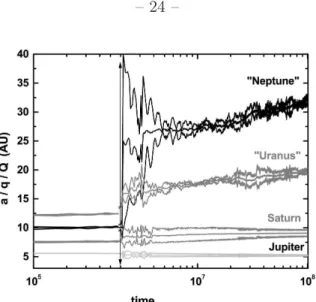
shows what happens: after a short time, the planets are extracted from their multiple resonance. Resonances have a strong stabilizing effect for close orbits (a clear example is that of Pluto which, despite it crosses the orbit of Neptune, is stable because it is in the 2/3 resonance with it). Once the planets are extracted from their mutual resonances, this stabilizing effect ends. The planets rapidly become unstable, because they are too close to each other. In the simulation illustrated in Fig. 8, the onset of the instability occurs at t ∼ 2 My. Uranus and Neptune start to have close encounters with each other and with Saturn. As a result, the orbits of all the planets become more eccentric; Uranus and Neptune are propelled outwards by encounters with Saturn, onto very eccentric orbits. Their orbital eccentricities are then strongly damped by dynamical friction, which stabilizes the
Fig. 8.— The evolution of the 4 giant planets of the solar system, starting from a 4-body resonance and embedded in a 50 M⊕ planetesimal disk. Here, each planet is represented by three curves, showing the
perihelion distance q, the semi major axis a and the aphelion distance Q, respectively. Initially Saturn is in the 2/3 resonance with Jupiter, Uranus is in the 2/3 resonance with Saturn and Neptune is in the 3/4 resonance with Uranus. The vertical arrow marks the time of the instability, when the orbits of the planets are extracted from the original 4-body resonance and become eccentric. In this simulation, Uranus and Neptune are scattered outwards by encounters with Saturn and between themselves. The final orbits are quite similar to the current orbits. From Morbidelli et al. (2007).
motion of the planets and prevents further mutual close encounters; the eccentricities of Jupiter and Saturn are also damped, but to a lesser extent. At the same time, planetesimal-driven migration, which can operate once the planets are extracted from resonance, increases further the orbital separations between each pair of planets. At the end of the simulation, the planets have acquired orbits very similar to their current ones: the semi major axes are within 10% of the real values, and the eccentricities and inclinations are also comparable. Most of the planetesimal disk has been dispersed by then, so that little orbital evolution is expected to occur after 100 My.
This simulation shows that the multi-resonant configuration, which the giant planets should have been driven into during the gas-disk phase, is not incompatible with the current orbital config-uration: the interaction with the planetesimals disk and the temporary phase of global instability, which the planets experience after extraction from their original resonances, can very well lead the system to its current dynamical state (Thommes et al., 1999). More examples of this kind of successful evolution, starting also from different multi-resonant orbital configurations, can be found in Batygin and Brown (2010).