Publisher’s version / Version de l'éditeur: Technical Report, 2012-06-01
READ THESE TERMS AND CONDITIONS CAREFULLY BEFORE USING THIS WEBSITE.
https://nrc-publications.canada.ca/eng/copyright
Vous avez des questions? Nous pouvons vous aider. Pour communiquer directement avec un auteur, consultez la
première page de la revue dans laquelle son article a été publié afin de trouver ses coordonnées. Si vous n’arrivez pas à les repérer, communiquez avec nous à [email protected].
Questions? Contact the NRC Publications Archive team at
[email protected]. If you wish to email the authors directly, please see the first page of the publication for their contact information.
NRC Publications Archive
Archives des publications du CNRC
For the publisher’s version, please access the DOI link below./ Pour consulter la version de l’éditeur, utilisez le lien DOI ci-dessous.
https://doi.org/10.4224/21268045
Access and use of this website and the material on it are subject to the Terms and Conditions set forth at
International Joint Commission model selection and implementation
guidelines
Jenkinson, Robert Wayne (Wayne)
https://publications-cnrc.canada.ca/fra/droits
L’accès à ce site Web et l’utilisation de son contenu sont assujettis aux conditions présentées dans le site
LISEZ CES CONDITIONS ATTENTIVEMENT AVANT D’UTILISER CE SITE WEB.
NRC Publications Record / Notice d'Archives des publications de CNRC: https://nrc-publications.canada.ca/eng/view/object/?id=8cd799bd-7bb4-40d1-8987-f72c40f32a4c https://publications-cnrc.canada.ca/fra/voir/objet/?id=8cd799bd-7bb4-40d1-8987-f72c40f32a4c
International Joint Commission
Model Selection and
Implementation Guidelines
R. W. Jenkinson
National Research Council of Canada (NRC)
1200 Montreal Road
Ottawa, Ontario, K2P 1C3
Technical Report: OCRE-TR-2012-006
June 2012
Prepared for the International Joint Commission (IJC)
234 Laurier Avenue West 22nd Floor
Contents
1 Introduction ... 1
1.1 Background ... 1
1.2 Context ... 1
1.3 IWI Modelling Workshops ... 1
1.4 Review of Model Selection Approaches ... 4
1.5 Considerations for Model Selection by IJC Boards ... 6
1.6 Modelling Implementation Guidelines – Workflow and Document Structure ... 7
2 Project Objectives and Requirements ... 9
3 Model Selection and Implementation ... 12
4 Modelling Review and Lessons Learned ... 15
5 Summary ... 17
6 References ... 18 Appendix A. IJC Supported Model Evaluations ... A-1 Hydraulic / Hydrodynamic Models ... A-1 Hydrological Models ... A-2 Water Quality Models ... A-3 Appendix B. Case Study: Rainy River Hydrodynamic Model ... B-1 Project Objectives and Requirements ... B-1 Model Selection and Implementation ... B-3 Modelling Review and Lessons Learned ... B-5
i
List of Tables
Table 1 - Example Issue / Objectives Statement – Rainy River Study ... B-1 Table 2 – Example Engineering and Scientific Requirements – Rainy River Study ... B-2 Table 3 - Example Communication Requirement - Rainy River Study ... B-2 Table 4 - Example Stewardship Requirement - Rainy River Study ... B-3 Table 5 - Model Evaluation Summary - Rainy River Project ... B-3
ii
List of Acronyms
BMP GLERL
Beneficial Management Practices
Great Lakes Environmental Research Laboratory HEC Hydrologic Engineering Centre
HMS Hydrologic Modelling System IJC International Joint Commission IWI International Watersheds Initiative JIP Joint Industry Partnership
LIDAR Light Detection and Ranging
MESH Modélisation Environnementale - Surface et Hydrologie MS Microsoft
MSP NOAA
Model Selection Protocol
National Oceanic and Atmospheric Organization NRCan Natural Resources Canada
NRC National Research Council Canada OS Operating System
PMIP Planning Model Improvement Program SAS Statistical Analysis Software
SPARROW SPAtially Referenced Regressions On Watershed attributes SWAT Soil and Water Assessment Tool
USACE US Army Corps of Engineers USGS United States Geological Survey
WATFLOOD Hydrological Model Routing and Flow Forecasting System WFD Water Framework Directive
1
1
Introduction
1.1
Background
The International Joint Co issio ’s (IJC) International Watersheds Initiative (IWI) is an approach to addressing transboundary water issues that examines watersheds as a whole and takes an integrated, ecosystem approach rather than addressing boundary water issues in isolation (IJC, 2009). The IWI Boards work to resolve water-related issues within the watershed at the local level through an integrated approach. In support of their work, the Boards initiate studies to investigate issues of concern and many of the studies include modelling as part of the scientific investigation. Many of the Boards have common issues among their jurisdictions and the IWI helps to facilitate the sharing of knowledge and expertise among the Boards as these issues are addressed.
For numerical modelling projects, the model selection and application process has largely been driven by the Boards themselves. The Boards tend to decide on which model to use based on the knowledge of those participating in the process and the skill sets available to the Board undertaking the activity, either from an agency affiliation or a contractor petitioning to supply the modelling services. This overall process has not been as scientifically rigorous as it could be and the numerical modelling projects could benefit from more support and guidance from the IJC and other experts. Additionally, issues have arisen with regard to ownership of data and modelling results developed for a project. Often model implementations, collected data and results are summarized in a report, but the data and model files themselves are not made available to meet future Board needs for which numerical modelling may be helpful.
For the above reasons, and in an effort to improve the quality of the IJC modelling studies, the IJC planned a series of IWI modelling workshops with the goal of addressing needs that may exist with numerical model selection, implementation and model data stewardship beyond the life of the projects themselves.
1.2
Context
This document was developed to provide guidelines to the IJC and the Boards to improve the quality of individual modelling studies and to improve the long-term impact of the modelling work conducted under the auspices of the IJC. Adoption of these guidelines will introduce transparency into the model selection and implementation process for the IJC, and provide support for the adaptive management framework employed in transboundary studies. Additionally, the process suggested in these guidelines should, over time, provide a documented modelling implementation track record for the IJC. This track record will in itself provide value to the Boards as members can see the approaches taken in the past and the successes and difficulties that stemmed from those decisions.
1.3
IWI Modelling Workshops
The IJC has encouraged the application of sound modelling practices with its Boards. Since the inception of the IWI, much expertise has been accumulated within the IJC and its partner agencies in the
2
assist the Boards with model selection and implementation to help ensure that modelling activities are optimized to address current and future needs.
A series of three workshops were held to determine the modelling needs of the Boards, the data requirements for some of these modelling needs, and to provide to the Boards information and expertise on approaching modelling projects and guidelines for model selection in the future. The first workshop was held in Winnipeg, Manitoba from June 28th to 30th, 2010 to determine modelling needs of the Boards (SLMcleod Consulting and R. Halliday & Associates, 2010). The Boards, with assistance from a number of the modelling experts who have contributed to IWI-funded projects, outlined their
modelling needs as well as their interests in and use of hydrological, hydraulics and water quality models.
The second IWI modelling workshop was held in Chicago, IL on November 17th to 19th, 2010 where Board data requirements for modelling efforts were reviewed (R. Halliday & Associates, 2011). This workshop provided an overview of the data required for hydraulic, hydrological and water quality models. The workshop also reviewed the IWI initiatives to produce a harmonized hydrographic dataset along the Canadian/US border.
The third IWI modelling workshop was held in Vancouver, BC on March 13th to 15th, 2012 to synthesize the findings from the previous workshops, to share some research findings into other model selection and implementation methodologies, and to develop a coherent set of guidelines. A draft set of guidelines was developed in advance of the workshop for review, and this current document follows directly from those draft guidelines with modifications based on feedback from the workshop participants.
Taken together, the three workshops revealed some key issues and objectives relating to numerical modelling conducted by the IJC Boards:
Boards should establish thorough modelling objectives and requirements at the earliest stages of project formulation.
It was clear from discussions at the workshops that the Boards value the process of defining objectives, requirements and deliverables before a modelling study is implemented. However, it was also clear that this process is generally not given the attention it merits, and often Boards move too quickly into
commencing the modelling study before adequate definition of the objectives. A set of guidelines that help to formalize or encourage this process would be of significant value to ensure the requirements specification phase is given appropriate attention.
Numerical modelling is an important component of the activity of the Boards.
It was evident from all three workshops that numerical modelling has emerged as an important tool for the Boards. Most Boards represented at the workshops were actively involved in numerical modelling activities, and all Boards identified some recent modelling work or had highlighted the need for modelling work in the near future. The numerical modelling work done by the Boards has been
3
predominantly hydraulic/hydrodynamic modelling, but more work is expected in both the hydrological processes and water quality fields in the near future.
Modelling expertise varies among Boards.
It was found in the workshops that the degree of numerical modelling expertise varied greatly among the Boards. It also became apparent that the Boards tended to decide on which model to use based on the skill sets available to the Board, either from an agency affiliation or a contractor. This process has not been as scientifically rigorous as it should be, and could benefit from access to expertise found in other Boards, within the IJC itself, or from other partner agencies.
Guidance regarding numerical model selection would benefit the Boards.
One of the suggested outcomes from the workshop series was the creation of a list of acceptable models for use by the Boards. Providing such a list, although in theory desirable, was somewhat contentious as numerical model codes continuously evolve and a particular model may add value in certain applications and not in others. There were also questions raised as to the implications of the IJC endorsing a small collection of core models. A list of model requirements or guidelines was seen as a preferred alternative, allowing for newer or unknown models to be considered if they met the
requirements as set out by the IJC. It was clear that certain requirements could be common or typical for a model, including a proven track-record in comparable applications. Other requirements could be specific to model type (e.g., hydraulic vs. hydrological vs. water quality), available expertise or the required study outcomes. Finally, it was noted that modelling is not always the best course of action, although it can be an instinctual response in addressing a water resources problem. Other courses of action, including basic monitoring or the application of other interpretative tools, could provide more reliable and cost-effective results.
Communication and visualization of results is an important and common requirement identified by the IJC Boards.
The IJC Boards interface regularly with the public and non-governmental groups, and as such have a particular need for communication tools that elucidate the issues, present results and propose actions in a clear and less technical manner. Modelling can be an opportunity to present current conditions and forecast scenarios visually, thereby helping the public and others understand the decisions that are being made. Considering the importance of this communication mandate, an IJC modelling project plan should provide some forethought to visualization capabilities and the options available with a particular model. In many cases good visualization may be a requirement of a modelling project, depending on the circumstances, and may influence model selection or how the model results could be processed to produce the required communication deliverable. In the workshops it was generally agreed that the visualization and communication requirements need to be specified early, during the requirements gathering phase.
4
Data availability can be a key factor in a successful modelling effort.
All models require data: data to construct the models themselves, data to act as input or forcing data and data for model validation. The availability of data of known quality is a key controlling factor when determining which type of model is appropriate or even if a modelling effort should be undertaken. Data collection, review and integration into a model typically represent a very large portion of the total modelling work effort. Once implemented, modelling efforts themselves can point to key data
deficiencies and highlight areas for further data collection. The transboundary regions can be very data-sparse environments both temporally and spatially, particularly within Canada, which produces unique challenges. Data harmonization efforts initiated by the IJC have helped to facilitate
transboundary model development. It was identified in the workshops that data requirements of models vary substantially and that the model selection process and the data review process are intrinsically linked and should be conducted concurrently.
Stewardship of the model codes and model data is an important consideration when embarking on a numerical modelling project.
During the workshops a concern that was raised repeatedly by the Boards relating to the practical isolation and legacy of a typical numerical modelling project. A typical project progression runs as follows: a question is asked and objectives are identified, data are collected to start a modelling project, the model is constructed and calibrated, results are generated, a report is published and
communications are provided. The lifecycle of the project often ends at that point without provision of model ownership and stewardship. It can be difficult to retrieve a model and its data without a
persistent storage and access facility, resulting in loss of data or duplication of effort. The stewardship plan of a model implementation should be clearly specified at the outset of a project and be included as part of the modelling study requirements.
Additionally it was found that some numerical model codes, particularly those originating from within Canada, are lacking an institutional caretaker or dedicated steward. Many of these codes have developed from within academia and have been adopted by industry in various forms but without rigorous quality assurance, or a development team that can ensure model currency. The US tends to have more institutional model support with the USACE and USGS active in this role. Stewardship and sustained development of a model is of paramount importance to the Boards as it signifies engagement of communities of model developers and practitioners as well as promoting model performance and stability.
1.4
Review of Model Selection Approaches
A number of researchers and organizations have investigated the issue of model evaluation, selection and certification in the fields of water resources engineering, planning and management. This section outlines a number of the methodologies identified in the literature and provided from government institutions.
In 2003 the USACE implemented the Planning Model Improvement Program (PMIP) to help ensure that only high quality methods and tools were used in Corps planning studies (USACE, 2005). The task
5
involved listing model-related problems, a survey of the planning models and producing papers on model-related issues. It was stated that to improve the quality of planning studies, the use of certified models would be mandatory. District commanders are responsible for providing high quality, objective and defensible planning products which in turn require tested and defensible models. The process of assessing the quality and effectiveness in planning models was based on a number of principles including model transparency and documentation, model currency, model flexibility and ease of use (USACE, 2011). For consideration a model must meet standards of technical quality, system quality, and usability. Technical quality refers to the employment of good science, adequate precision and accuracy, correct formulations and appropriate means for model solutions, as well as documentation to support all the above. The system quality refers to the availability of the model platform, the code quality, and the tracking and solution of bugs and issues associated with the model code. Model usability refers to the availability of data, technical support, user documentation, and usability of model results and export files.
Saloranta et al. (2003) developed a model selection process designed to be suitable for the European U io ’s Water Fra e ork Dire ti e WFD . The authors highlighted ertain issues in water resources model application, including the prevalence of models and their increasing use by non-experts. The sele tio pro ess as outli ed ide tifies e h ark riteria a d suggests that u eri al odes should
ot e lassified as good or ad ut fit for purpose or u fit for purpose . The authors also consider the unique considerations in applying models to policy decisions. Whereas for academic models a priority may be processes representation, for modelling application in policy decision making issues of uncertainty and relevance take precedence (Saloranta et al., 2003). The model selection process was designed to assist the layperson, or a person not considered an expert in the field, with numerical model selection.
A model evaluation process including a series of questions and scoring system for the responses against a specified benchmark requirement was suggested (Saloranta et al. 2003). The integer scores ranged from 0 to 2: 0 being unacceptable score that does not meet the benchmark, 1 being an adequate score that meets the benchmark and 2 being a good score that exceeds the benchmark. The scoring of
responses allowed for model comparison based on total score. Three question groups were constructed relating to: 1) model applicability and relevance, 2) model uncertainty and sensitivity, and 3) model transparency, ease of use, and understanding. The entire rubric can be found in the appendix to the original paper.
Boorman et al. (2007) similarly investigated water resources model selection in the European context and the WFD, although unlike Saloranta et al. (2003), they included roles of the modellers and experts in the model selection process. For this study the modelling outcome was the ultimate goal. They
identified that an important factor influencing appropriate model selection was the expertise of those involved. A typical process for model selection involves the water manager choosing the modeller and then the modeller choosing the model, which may keep the most appropriate model from being
selected. However, if the modelling experts are consulted as part of the process, what may be identified as an obstacle by a non-expert may in fact be overcome with a modest effort as part of the modelling exercise.
6
A number of concepts from the above studies were included and adapted for use in an IJC-specific context outlined in the following sections.
1.5
Considerations for Model Selection by IJC Boards
As a binational organization, the IJC has particular requirements for model selection that may be distinct from other agencies. This section suggests some unique modelling requirements that should be
considered by the Boards and for all types of modelling efforts. Cross-Board review of model selection
The IJC represents a very large network of experts in water resources and related fields. Although the depth and variety of modelling experience in specific Boards may vary, when the IJC and their partner agencies are considered as a whole, the depth and breadth of experience in numerical modelling is extensive. Boards should take advantage of this IJC resource and consider it an important step in adding expertise to the model selection process. The IJC should endeavour to provide the Boards with easy and timely access to experts to review modelling proposals.
Binational collaboration as an objective
The IJC is a binational organization with many federal, provincial and state contributors to the projects it conducts. Direct cross-border collaboration on projects has been limited, often with partner agencies from one country contracted to do the work independently from agencies in the other. The benefits from collaboration are great, including an implicit review of the process as a project progresses as well as professional technology transfer between individuals and institutes. Cross-border collaboration should be encouraged which may in turn improve model selection and the modelling approach. Model review, model transparency, and an open source mandate
Projects conducted under the IJC aegis are now commonly subjected to peer-review. This suggests that the model codes employed in an IJC study should be open source to reflect the IJC policy of
transparency and to facilitate peer review. However, some high quality numerical models with excellent track records are not open source (particularly the HEC models developed by the USACE), and should not be excluded from consideration. Model transparency is therefore not strictly associated with code availability but to a combination of model development and performance transparency evaluated through model documentation, model testing and track record. The IJC is an open and transparent agency, and there should be few barriers to the public or an expert third-party agency to acquire and use the results developed from the studies. Similarly, there should be few barriers to the public or expert agencies in acquiring the models and model implementations to independently evaluate the simulations.
Reliable model selection
The IJC is not a research organization; IJC projects are not a test-bed to develop new modelling approaches or methods. The IJC’s responsibilities to its stakeholders should preclude the use of
7
proven track record in applications similar to the one being proposed in the modelling project. It is understood that many of the science and engineering problems that the IJC seeks to solve will require newer and less-tested modelling technologies. For instance, in some cases the models may be well tested in one jurisdiction but untested in the transboundary context. In cases such as these the possible benefits that can be gained from using a newer, less-tested models should be closely examined before proceeding with the modelling exercise.
Inter-Model Compatibility
For many of the IJC Boards, modelling studies will follow one after the other as new issues arise and new solutions are required. In some cases several models may be constructed within the same watershed, possibly of different type (hydrological, hydraulic) or of a similar type but differing capabilities (HEC-RAS, TELEMAC). It is a goal of the IJC that these models are able to interface with each other, so that results from one could provide input to another. Although most models will not natively connect (the USACE HEC models being an obvious exception) an inter-model feedback capability would be of substantial value in some instances and should be considered. Highlighting this IJC goal may guide researchers and model developers to develop models using more open communication frameworks and standard file types.
1.6
Modelling Implementation Guidelines – Workflow and Document
Structure
The model implementation workflow will follow the following sequence: 1. Setting project objective and requirements;
2. Model selection and implementation; and 3. Modelling review and lessons learned;
The process is somewhat linear although there is potential iteration between setting the objectives and requirements and reviewing the models and what can be delivered through their application. A brief description followed by more detailed information on these three areas follows.
Project Objectives and Requirement (Section 2)
This section discusses an approach for the Boards to outline the key project objectives, notwithstanding any preconception that a model will be required. The focus is on establishing desired project outcomes or questions to be answered. These will help to determine what modelling approach is necessary or even if modelling is required when weighed against other options (e.g., data collection). In addition requirements for communication deliverables and eventual model use and stewardship should also be outlined. Some common objectives relating to IJC projects are suggested for inclusion. The
consideration or review of modelling options should not be conducted until the objectives and requirements are well defined.
8 Model Selection and Implementation (Section 3)
This section outlines an approach for model selection and implementation based on the list of objectives and requirements previously defined. Data availability to be used in the modelling study should be conducted in this phase in parallel with model review. The goal of this phase is to help determine if a model is required, if a selected model is of appropriate complexity, if the data available matches the model choice, and if the level of effort matches the foreseen benefits. The deliverable from this phase will be a modelling recommendation which includes the approaches considered, the approach selected, the selection rationale and a statement of scope, timeline and resources.
Modelling Review and Lessons Learned (Section 4)
This section outlines an approach for evaluating the overall modelling approach against stated
requirements. The review should include an assessment of lessons learned from the model selection in terms of performance and issues encountered, how the communication procedure performed, and a record of the stewardship arrangements and model/data hand-off. The deliverable from this phase will be a statement for the IJC that accompanies project-related documents representing a complete life-cycle review of the model selection and performance.
Appendices
There are two appendices associated with this report. Appendix A outlines a number of models employed in IJC-related studies, and evaluates them against IJC model requirements. Appendix B includes a case study of the Rainy River Hydrodynamic Model project, including the development of project objectives and requirements, model evaluation and selection, and a modelling evaluation and lessons learned.
9
2
Project Objectives and Requirements
Before decisions about a modelling approach can be made, it is incumbent on the Boards to provide a clear summary of the issues to be addressed and how a modelling effort is expected to address the issues. The Board should elucidate in detail:
1) The issues that require action and the project objectives;
2) The engineering and scientific requirements or deliverables of the study; 3) The specific communication deliverables of the study;
4) A detailed stewardship plan;
5) A socio-political impacts statement; and
6) The resources and costs required to complete the study.
The Board should also develop key project statements outlined below prior to soliciting or reviewing specific modelling approaches.
Issue/Objectives Statement
The first task associated with a project is a clear identification of the issue and the objectives by the Board. The outstanding issue should be clearly articulated and a list of objectives should be produced by the Boards in advance of model selection, or even the decision of whether or not to conduct a modelling exercise. The objectives may be presented as a series of questions for which answers are sought. Some objectives may be essential to the project, others may be optional: beneficial to have addressed but not essential to the success of the project.
Engineering and Scientific Requirements
Based on the objectives, the available data and the expectations of the Boards, there should be some understanding within the Board of what the study effort should be able to deliver. That is, the Boards will have some list of requirements that a study should meet, whether the study is solved using a model or by other means. Having these expectations articulated will provide more detailed criteria for model selection. The functionality may be related to:
Temporal results resolution (hourly, daily, monthly, annual reporting, etc.); Spatial resolution;
Physical, chemical, biological process representation;
Speed of data/results availability (e.g., for operational use or ensemble forecasting); Spatial extent or coverage;
Dimensionality (0D, 1D, 2D, 3D);
Data / model input capabilities (e.g., point data, distributed data); and Data / model output capabilities (e.g., visualization, post-processing).
In some cases the Boards may not be able to specify what model functionality is required, and may only have key questions that are to be answered by the study. It may be through discussions with experts or
10
modellers that details as to the model functionality are determined, or even if a model is required to answer the questions posed. Nevertheless, some of the above may be clearly definable from the Boards’ perspe ti e.
Communication Requirements
Considering the importance of stakeholder communication to the IJC and its Boards, inclusion of a communications requirement statement should be mandatory. Although the exact nature of the communication deliverable cannot be known at the outset of a project, some clear expectations should be outlined that explain the vision of the Boards in terms of eventual communication to stakeholders. These could include:
Approach (maps, animations, reports, etc.);
Content (flooding extent, rating curves, habitat risk maps, etc.); Media (internet-based, print-based, interactive etc.);
Communication Plan (how, when and in what manner the results will be communicated); and Communication Partners (specify partner agencies to assist in communication including
conservation authorities, etc.). Stewardship Requirements
Should the study result in data collection and model development, it is incumbent on the boards to articulate a stewardship plan before the study is to proceed. The objective of the stewardship plan is to identify the institutions or organizations who will take over the data and model once the study is
complete. The requirements should indicate the type of data that are expected to be part of the stewardship arrangement and may include:
Datasets employed (with metadata); Datasets developed (with metadata); Modelling input files;
Modelling parameter sets; and
Procedures or scripts used to modify data (with documentation).
The stewardship requirements should also state upfront who the responsible steward will be, when the data are expected to be delivered for stewardship, and the terms of the stewardship itself. The
stewardship plan should identify:
Who (individuals or organizations) will be managing the model implementation, data and metadata?
How long are these data to be held in stewardship?
What are the requirements for access to the models and data, who will be provided access and by what means will the data be accessed?
11 Anticipated Socio-political Impacts
Before the studies are embarked upon, the Boards should consider potential socio-political impacts that may be generated by the results. The goal of identifying potential socio-political issues at an early stage is to avoid potentially difficult or politically sensitive situations. It is advisable to have a communication or action plan in place for such eventualities. Questions that could be asked include:
Does the IJC have the mandate to address this particular issue? What are the anticipated outcomes of the study?
Who will be potentially impacted by the findings?
How are the proper agencies and stakeholders to be kept abreast of progress?
How are the impacts to be managed politically or considered in the defined communication plan?
Resources and Timelines
As part of the project definition, a statement as to the expected deliverable timelines and the resources available should be prepared. Resources should include both the human resources available at the boards and the partner agencies, as well as financial resources for third-party developers, data collection, communication deliverables and stewardship plans.
A sample issue and objectives statement, data availability statement and model functionality statement are outlined in the Rainy River project case study (see Appendix B).
12
3
Model Selection and Implementation
The selection of a model or other technical approach to address project objectives involves
consideration of several factors. First, if a modelling approach is recommended, it should adequately address the project objectives and it should also be compared to the set of model guidelines set out by the IJC in terms of stewardship, openness, track record, etc. Candidate models should be compared against the availability of data in the study region and determine if the model is data appropriate considering the available data and whether supplementary data needs to be collected. Time and resources need to be estimated for both of these data collection activities. During the process of model selection, the project requirements may need to be modified to match the modelling capabilities that science, expertise, resources and timelines allow. Finally, the selection process should be detailed and reported to the IJC for review and referenced for future use by the Boards.
Matching Project Objectives
The proposed IJC approach to model selection borrows from a number of other approaches to water resources model selection (Boorman et al., 2007, Booty and Benoy 2010, Cunderlik, 2003, Saloranta et al., 2003, USACE, 2011) with modifications to meet specific needs of the IJC. It is designed to tie model selection primarily to modelling objectives and IJC model guidelines. Each answer is scored on a scale of two to zero: two is a perfect score; one is a passing score, but requiring extra effort, cost or vigilance; and zero is a failing score, nominally excluding the model from contention. A scoring scale was selected as it allows for model comparison, should multiple models be up for consideration. The answers to the questions require a good deal of model familiarity and should be provided by individuals who have extensive experience using the models or have worked in developing the models.
An important component of model evaluation includes the determination of the data availability required to operate the model. This will involve participation of the modelling experts and the Board members themselves. The data identified should include data from previous scientific studies, monitoring systems, geospatial data availability, historical modelling efforts, etc. These data sources should be identified and listed as part of the model review.
In some cases a data collection exercise will be required for a particular model to be considered appropriate to address the project objectives. In such a case the data gaps should be identified and some estimate of the time and resources required to obtain the required data should be ascertained. With the data availability ascertained, the modelling approach should be evaluated against the project requirements. The model suitability questions below relate specifically to the project requirements and modelling expectations. The questions are designed to evaluate how well the model could provide the needs of the Board. The model suitability questions are:
1. Could a simpler or different approach provide better or comparable results?
2. Can the model provide information suitable and sufficient to answer the management objectives and questions?
13
3. Is the model data appropriate? Can it produce the required output with the available data? Is the overall cost (in time and funds) to acquire necessary data for this modelling exercise sufficiently low?
4. Does the model match the required process representation? 5. Can the model match the dimensional requirements?
6. Can the model operate at the required spatial and temporal resolutions? 7. Can the model operate at the required scale (temporal and spatial)?
8. Can the model readily employ the available data and output data in compliance with the requirements?
9. Does the model have a history of success in similar applications?
10. Does the model have the appropriate complexity for the modelling task? 11. Is there adequate model expertise available to conduct the study?
12. Are there adequate resources (human, financial) to conduct the modelling study within the stated timelines?
The first question to be asked is critical as it queries whether a modelling effort is required at all or if another approach (monitoring, etc.) could provide better or comparable results. The remaining questions evaluate the model against the requirements outlined previously.
IJC Modelling Guidelines
In order to ensure that quality modelling approaches are being considered by the Boards, the IJC
provides model selection guidelines to assist the Boards in model selection. IJC model guidelines relate to the history, track record, architecture, and maintenance of the model and the code itself. Together they represent the overall quality of the model with regard to IJC requirements irrespective of the particular modelling application being considered. The IJC requirements relate to the following questions:
1. Is the model code maintained by an institution which ensures code quality, version control, etc.? 2. Is the model sufficiently transparent? (i.e., source code is open-source or thoroughly
documented and tested)?
3. Does the model have a substantial peer-reviewed and/or operational track record (as appropriate)?
4. Is the model well documented with both a current user manual and technical manual? 5. Is the model set-up relatively simple and/or automated?
6. Is there technical support for the model?
7. Can the model be run on a common computer platform?
8. Does the model provide a user interface adequate for the objectives? 9. Is the model available at a reasonable cost?
The model selected by the Boards may not meet all of the above guidelines. However, all model options should be evaluated against the IJC guidelines.
14
There will not be an appro ed list of odels, ut through the pro esses outli ed i this do u e t, models that have been selected by the Boards will be identified, and the selection process documented. A number of models have been employed in previous IJC studies are discussed and evaluated in
Appendix A. This highlights those models that have shown utility in past endeavours and meet most of the IJC suggested requirements.
Model Selection Review
It is advisable that after the Boards conduct a review of one or more modelling proposals that the selection results be circulated to various members of the IJC outside of the Board. The summary review will provide the objectives, data summary, requirements, and the summary responses to the template for each model in context along with notes and identified concerns. It is hoped that a concise review such as this would allow for external reviewers to provide their feedback in a timely manner.
15
4
Modelling Review and Lessons Learned
In order to evaluate the model selection process a modelling review should be conducted after the project has been closed. This review will be designed primarily to evaluate the model selection process and to outline the lessons learned regarding model selection, implementation, communication plans and model implementation and data stewardship.
The review document should address the following broad headings: 1. Objectives and Requirements
Were the objectives and requirements adequately described before the model selection took place?
What could have been done better? 2. Model Selection
Was the selected model adequate for the purposes of this study?
How did the model perform as compared to the engineering / scientific objectives? Could a simpler model have been considered?
Were there unanticipated complications that could have been overcome with another model or approach?
What could have been done better? 3. Stewardship
Is a stewardship plan in place?
How does the current stewardship plan perform as compared to the stewardship objectives?
Were the participants adequately prepared to hand-off the models and/or modelling data for stewardship at project-end?
What could have been done better? 4. Communication
What was the eventual communication plan that was executed?
How well did the communication plan perform as compared to the communication objectives?
What could have been done better? 5. Socio-Political Impacts
What were the socio-politi al i pa ts of the study’s fi di gs? Were the impacts managed adequately?
What could have been done better? 6. Resources and Timelines
Was the study completed within the original time and resources budget? What were the biggest resourcing issues associated with the study?
Was there a particular aspect of the modelling study that had a substantial timeline or resource impact?
16 What could have been done better?
The modelling review and lessons learned should be summarized in a short report or letter and submitted to the IJC. Together with the original objectives and the modelling selection methodology, the modelling review provides a complete life-cycle picture of the study with regard to model selection. Reports such as these will help guide the Boards with future modelling efforts. A sample modelling review is outlined in Appendix B.
17
5
Summary
The IJC, in support of the modelling work conducted by the Boards, has developed this set of guidelines for model selection and implementation in transboundary studies. These guidelines represent the synthesis of input and feedback from three dedicated workshops on the topics of modelling
requirements by the boards, data availability and the IJCs experience in the field of numerical modelling. The resulting approach is designed to provide a clear and straightforward approach for setting
requirements, selecting a odelli g approa h a d the e aluati g the pro ess at the study’s completion. This approach is designed to provide both immediate assistance to the studies being launched, but also, through reporting and referencing the model selection outcomes and performance, to provide a valuable reference for future studies conducted by the Boards and the IJC.
18
6
References
Boorman, D. B., Williams, R. J., Hutchins, M. G., Penning, E., Groot, S. & Icke, J. (2007) A model selection protocol to support the use of models for water management. Hydrology and Earth System Sciences 11(1), 634-646.
Booty, W.G. & Benoy, G.A. 2010. Multi criteria review of non-point source water quality models for nutrients, sediment and pathogens. Water Quality Research Journal of Canada, 44: 365-377. Cunderlik, J. M. (2003) Hydrologic model selection for the CFCAS project: Assessment of Water
Resources Risk and Vulnerability to Changing Climatic Conditions.
IJC. (2009) The International Watersheds Initiative (IWI): Implementing a New Paradigm for Transboundary Basins.
NRC-CHC. (2010) Rainy River 2D Hydrodynamic Model Conveyance Study. Ottawa, Ontario.
R. Halliday & Associates. (2011) IWI Modelling Initiative Workshop: Data Requirements in Support of Modelling And Hydrological Analysis - Chicago, IL, November 17-19, 2010.
SLMcleod Consulting and R. Haliday & Associates. (2010) IWI Modelling Initiative - Needs Assessment Workshop. Winnipeg, Manitoba.
Saloranta, T. M., Kamari, J., Rekolainen, S. & Malve, O. (2003) Benchmark Criteria: A Tool for Selecting Appropriate Models in the Field of Water Management. Environmental Management 32(3), 322-333.
USACE. (2005) Planning Models Improvement Program: Model Certification. Washington, D.C. USACE. (2011) Assuring Quality of Planning Models. Washington, D.C.
A-1
Appendix A.
IJC Supported Model Evaluations
A number of models that have been supported by the IJC in the past are reviewed in this appendix. Short model descriptions, answers to the support and stewardship questions and scores are listed below for hydraulic/hydrodynamic models, hydrological models and water quality models.
Hydraulic / Hydrodynamic Models
HEC-RAS
The hydraulic 1D model HEC-RAS, developed by the USACE, has been extensively used by the IJC. It has a long track record, strong stewardship by the USACE, a sophisticated user interface, is well documented and is free for use. The model is not strictly open source in that the code is only available to the USACE. Support is also available, but again through the USACE only or through independent
experts/consultants.
http://www.hec.usace.army.mil/software/hec-ras/
Questions Responses Score
1 Is the model code maintained by an institution which ensures code quality, version control, etc.?
Yes 2
2 Is the model sufficiently transparent? (I.e. source code is open-source or thoroughly documented and tested)?
Only within the USACE
1 3 Does the model have a substantial peer-reviewed and/or
operational track record (as appropriate)?
Yes 2
4 Is the model well documented with both a current user manual and technical manual?
Yes 2
5 Is the model set-up relatively simple and/or automated? Yes 2 6 Is there technical support for the model? Within the USACE 1 7 Can the model be run on a common computer platform? Yes 2 8 Does the model provide a user interface adequate for the
objectives?
Yes 2
9 Is the model available at a reasonable cost? Yes, free 2 16/18
TELEMAC
TELEMAC is a suite of hydrodynamic modelling codes developed by LNH and SOGREAH used often by the IJC for 2D hydrodynamic modelling. The code has been open source since January 2011 and is
maintained by a consortium of institutions that controls code quality, versioning and documentation. The model has a long track record, especially in Europe. The model has no native user interface but other free interfaces exist for pre- and post- processing. Support is available through partner organizations and an active online community. The model will run on most systems however larger models may require a multiple machines/processors in a parallel configuration for timely execution requiring a more sophisticated platform setup.
A-2
http://www.opentelemac.org/
Questions Responses Score
1 Is the model code maintained by an institution which ensures code quality, version control, etc.?
Yes 2
2 Is the model sufficiently transparent? (I.e. source code is open-source or thoroughly documented and tested)?
Yes 2
3 Does the model have a substantial peer-reviewed and/or operational track record (as appropriate)?
Yes 2
4 Is the model well documented with both a current user manual and technical manual?
Yes 2
5 Is the model set-up relatively simple and/or automated? Yes 2 6 Is there technical support for the model? Yes 2 7 Can the model be run on a common computer platform? Yes, but if the model
is very large a parallel processor environment may be required
1
8 Does the model provide a user interface adequate for the objectives?
Yes, with Blue Kenue 2 9 Is the model available at a reasonable cost? Yes, free 2
17/18
Hydrological Models
HEC-HMS
HEC-HMS is the semi-distributed hydrological modelling system and has been used by the IJC in the St. Croix watershed. Like HEC-RAS, HEC-HMS has an established track record, strong stewardship by the USACE, a sophisticated user interface, is well documented and is free for use. The model is not strictly open source in that the code is only available to the USACE. Support is also available, but again through the USACE only or other expert organizations.
http://www.hec.usace.army.mil/software/hec-hms/
Questions Responses Score
1 Is the model code maintained by an institution which ensures code quality, version control, etc.?
Yes 2
2 Is the model sufficiently transparent? (I.e. source code is open-source or thoroughly documented and tested)?
Only within the USACE
1 3 Does the model have a substantial peer-reviewed and/or
operational track record (as appropriate)?
Yes 2
4 Is the model well documented with both a current user manual and technical manual?
Yes 2
A-3
6 Is there technical support for the model? Within the USACE 1 7 Can the model be run on a common computer platform? Yes 2 8 Does the model provide a user interface adequate for the
objectives?
Yes 2
9 Is the model available at a reasonable cost? Yes, free 2 16/18
WATFLOOD
WATFLOOD is a distributed hydrological modelling package developed at the University of Waterloo and maintained by the original author, Prof. Nick Kouwen. The model is not institutionally maintained, although Environment Canada maintains an earlier version of the code, and NRC is in the process of becoming the ongoing steward of the model in 2012. If the maintained version of the code is considered then the model would currently be approved. Without institutional support and
stewardship the model would not be. The model is not yet available as open source, but can be made available by request. It has a substantial track record and up to date user manual. Model setup can be somewhat complex for a layperson but benefits from free third party pre- and post-processors to facilitate setup. The model is freely available and operates on Windows and Linux platforms.
http://watflood.ca
Questions Responses Score
1 Is the model code maintained by an institution which ensures code quality, version control, etc.?
EC has access to a version (1). Otherwise no institutional support currently (0). 0
2 Is the model sufficiently transparent? (I.e. source code is open-source or thoroughly documented and tested)?
On request 1 3 Does the model have a substantial peer-reviewed and/or
operational track record (as appropriate)?
Yes 2
4 Is the model well documented with both a current user manual and technical manual?
Yes 2
5 Is the model set-up relatively simple and/or automated? Yes, for standard configurations
1 6 Is there technical support for the model? Yes 2 7 Can the model be run on a common computer platform? Yes 2 8 Does the model provide a user interface adequate for the
objectives?
Yes, with Green Kenue
2 9 Is the model available at a reasonable cost? Yes, free 2
14/18
A-4 SPARROW
SPARROW is a regional, regression water quality model developed by the USGS. The model is currently being applied in the Red-Assiniboine watershed by the IJC. The model is maintained and developed actively by the USGS and has a history of application in the US and one application in New Zealand. The source code is available, although it requires the proprietary statistical package SAS to operate. Support is available through the USGS. Setup appears to be straightforward provided applications are being done in the US as it leverages heavily the NHD+ national dataset. Applications in other countries require significant effort to provide similar required input.
http://water.usgs.gov/nawqa/sparrow/
Questions Responses Score
1 Is the model code maintained by an institution which ensures code quality, version control, etc.?
Yes 1
2 Is the model sufficiently transparent? (I.e. source code is open-source or thoroughly documented and tested)?
Yes 2
3 Does the model have a substantial peer-reviewed and/or operational track record (as appropriate)?
Yes 2
4 Is the model well documented with both a current user manual and technical manual?
Yes 2
5 Is the model set-up relatively simple and/or automated? Yes within the US. No elsewhere.
1 6 Is there technical support for the model? Yes 2 7 Can the model be run on a common computer platform? Yes 2 8 Does the model provide a user interface adequate for the
objectives?
No interface, but strong links to ArcGIS
1 9 Is the model available at a reasonable cost? Yes, although
supporting software (SAS, ArcGIS) is quite costly
1
14/18
SWAT
The SWAT model is a processed based water quality model supported by the USDA. The IJC is using the SWAT model in the International Mississquoi Bay Study identifying critical source areas of phosphorus within the basin. The model is stewarded by the USDA and has a long track record in the US. Source code and documentation are readily available as are GIS, and pre- and post-processing tools. Support is available through training and workshops if required.
http://swatmodel.tamu.edu/
Questions Responses Score
A-5 code quality, version control, etc.?
2 Is the model sufficiently transparent? (I.e. source code is open-source or thoroughly documented and tested)?
Yes 2
3 Does the model have a substantial peer-reviewed and/or operational track record (as appropriate)?
Yes 2
4 Is the model well documented with both a current user manual and technical manual?
Yes 2
5 Is the model set-up relatively simple and/or automated? Yes 2 6 Is there technical support for the model? Yes 2 7 Can the model be run on a common computer platform? Yes 2 8 Does the model provide a user interface adequate for the
objectives?
Not natively, although linked to ArcGIS via AVWAT
1
9 Is the model available at a reasonable cost? Yes, although supporting software (ArcGIS) is quite costly
1
B-1
Appendix B.
Case Study: Rainy River Hydrodynamic Model
In 2009 and 2010 a hydrodynamic project was conducted at Rainy River to simulate the operation of the dam/powerhouse configuration at Fort Frances/International Falls and to determine how conveyance varies in the system for various lake levels as well as the state-of-nature (i.e., pre-project) conditions (NRC-CHC, 2010). For the purposes of this guideline the project has been re-visited to determine how the model selection process would have worked in this case.
Project Objectives and Requirements
Issue/Objective Statement
A proposed example of an issue/objectives statement for the Rainy River project is shown below. These were taken and adapted from the original project proposal.
Table 1 - Example Issue / Objectives Statement – Rainy River Study
Issue: Issues have been raised with the Rainy River Boards relating to dam operation under the new rule curve (2001). In reaction to the 2002 flooding, one of the highlighted concerns was cited:
That the Rai y Lake da should have bee fully ope ed soo er a d that the delay i ope i g the last 8 gates…resulted i ore da age o Rai y Lake.
An investigation into the effects of the delayed dam gate openings suggested the delay had only a minor impact on rising lake levels which was
compensated for by employing extra storage in Namakan Lake. Considering the possible impact of upstream river constrictions, it is not definitively clear how the operation of the dam impacts on the lake levels under all flow conditions.
Objective 1: Determine how different opening configurations of the dam gates affect lake levels, particularly during periods of lake level rise.
Objective 2: Assess how quickly the water level can drop if the dam gates are opened/closed.
Objective 3: Evaluate how flow capacity (conveyance) of the Rainy River can vary with lake level.
Objective 4: Determine under what conditions the lake levels are controlled by the entrance to the river (i.e., not by dam operational rules), if at all.
Objective 5 (optional): Determine when local flooding can be expected in the International Falls/Fort Frances area due to dam operation or lake level variation.
Objective 6: Estimate how the river rea h ould perfor i a “tate-of-Nature i.e., if no dam or bridges have been built).
Objective 7: Communicate findings to stakeholders using non-technical approach (visualization or similar).
B-2
An example of an abbreviated model functionality statement is shown in for the Rainy Lake Project. As with the objectives, these were taken and adapted from the original project proposal.
Table 2 – Example Engineering and Scientific Requirements – Rainy River Study
Functional Requirement
1 Model will be able to reproduce daily water levels within Rainy Lake and at the Fort Frances Dam forebays.
2 The model will be able to simulate the conveyance changes due to dam operation, and be able to simulate discharge from waste gates and powerhouses and reproduce associated upstream water levels.
3 The model should be able to simulate changes in conveyance due to bathymetric adjustment.
4 The model should be able to simulate water levels both longitudinally and laterally within the upper Rainy River.
5 The model will be able to simulate supercritical flow conditions. 6 The model will produce graphical output that will be useful in
representing the scenarios to stakeholders
Communication Requirements
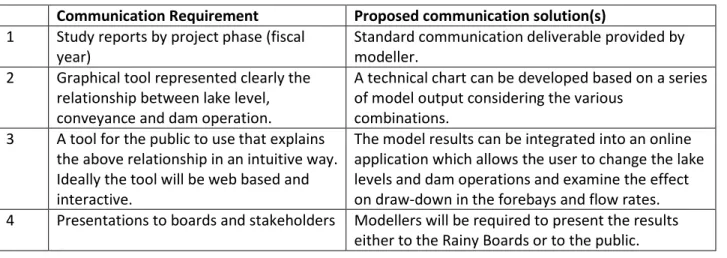
There was no communication plan prepared per-se in advance of this project as implemented. However a number of communications objectives were identified during the study itself. The following list represents the communication requirements as understood at the completion of the project.
Table 3 - Example Communication Requirement - Rainy River Study
Communication Requirement Proposed communication solution(s) 1 Study reports by project phase (fiscal
year)
Standard communication deliverable provided by modeller.
2 Graphical tool represented clearly the relationship between lake level, conveyance and dam operation.
A technical chart can be developed based on a series of model output considering the various
combinations. 3 A tool for the public to use that explains
the above relationship in an intuitive way. Ideally the tool will be web based and interactive.
The model results can be integrated into an online application which allows the user to change the lake levels and dam operations and examine the effect on draw-down in the forebays and flow rates. 4 Presentations to boards and stakeholders Modellers will be required to present the results
either to the Rainy Boards or to the public.
Stewardship Requirements
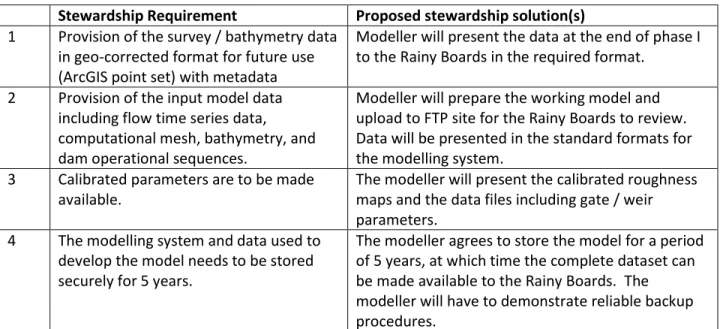
There was no stewardship requirement specified as part of this project. This list represents some stewardship requirements that would have been beneficial to the study and could have been considered at the outset.
B-3
Table 4 - Example Stewardship Requirement - Rainy River Study
Stewardship Requirement Proposed stewardship solution(s) 1 Provision of the survey / bathymetry data
in geo-corrected format for future use (ArcGIS point set) with metadata
Modeller will present the data at the end of phase I to the Rainy Boards in the required format.
2 Provision of the input model data including flow time series data, computational mesh, bathymetry, and dam operational sequences.
Modeller will prepare the working model and upload to FTP site for the Rainy Boards to review. Data will be presented in the standard formats for the modelling system.
3 Calibrated parameters are to be made available.
The modeller will present the calibrated roughness maps and the data files including gate / weir parameters.
4 The modelling system and data used to develop the model needs to be stored securely for 5 years.
The modeller agrees to store the model for a period of 5 years, at which time the complete dataset can be made available to the Rainy Boards. The modeller will have to demonstrate reliable backup procedures.
Model Selection and Implementation
During the pre-model development stage for this project both the HEC-RAS and TELEMAC models were considered. Eventually TELEMAC was chosen because it was thought there would be predominantly 2D flow patterns that would be difficult to simulate in HEC-RAS. In this case study both the TELMEAC and HEC-RAS models would be deemed acceptable for IJC use (see Appendix A). TELEMAC receives a slightly higher score than HEC-RAS in the evaluation as the TELEMAC model is completely open-source whereas HEC-RAS source code is not open-source, though the model itself is quite transparently developed. If either one of these models had not been evaluated and approved by the IJC then a model review would be required. If approved then the model could be evaluated for the project, otherwise another
modelling solution (or other solution) would have to be considered.
For this exercise both the HEC-RAS and TELEMAC models are evaluated against the selected criteria. In fa t the de isio as ade earlier ased o odeller judge e t that the TELEMAC odel ould e the best choice in the circumstances. This is in fact borne out in the evaluation () with the HEC-RAS model unable to simulate the required processes or dimensional representation to capture the a ti ipated 2D flo patter s. The s ores illustrate that ith t o zero s ores for HEC-RAS resulted in rejection from consideration for this study.
Model evaluation summary
Table 5 - Model Evaluation Summary - Rainy River Project
TELEMAC HEC-RAS
Questions Response Score Responses Score
B-4
management objectives? relevant to objectives relevant to objectives. Is the model data appropriate?
Can it produce the required output with the available data?
Yes. The model is data appropriate, provided the bathymetric data is collected as planned
2 Yes. As with TELEMAC
2
Does the model match the required processes
representation?
Yes, although some coding of the structures (rating curves) is likely required
1 No. Differential levels across the river cannot be simulated
0
Can the model match the dimensional requirements?
Yes – 2D seems to be required
1 No. 0
Can the model operate at the required spatial and temporal resolutions?
Yes 2 Yes 2
Can the model operate at the required scale (temporal and spatial)?
Yes 2 Yes 2
Can the model ingest and output data in compliance with the requirements?
Yes, the 2D output should also be useful for visualization
2 Yes 2
Does the model have the appropriate complexity for the modelling task?
Yes. Likely more complex than required for lake modelling, but required for hydraulics around the dam
2 Yes 2
Is there adequate model
expertise available to the Boards to conduct this study?
Yes. 2 Yes. 2
Model evaluation details
The model evaluation details tabulate the rationality of model selection against each of the requirements categories.
Issues / Objectives
Both the HEC-RAS and TELEMAC models will be able to meet most of the objectives listed. The exceptions are likely the dam gate operations (Objective 2) and the flooding extent (Objective 5 – optional) which may have some difficulty being met by the HEC-RAS model.
Engineering and Scientific Requirements
As above, the HEC-RAS model will likely have difficulty simulating the waste-gates considering the 2D nature of the flow regime near the dam. Also the requirement for longitudinal and lateral water level simulations cannot be met with a 1D model like HEC-RAS.
B-5 Communication Requirements
The communication requirements do not impact model selection. Stewardship Requirements
The stewardship requirements do not impact model selection. Anticipated Socio-Political Impacts
The anticipated socio-political impacts will not influence model selection in this case. Resources and Timelines
As both models are free there are no direct up-front financial costs for these models. The TELEMAC model is more time-consuming to set-up and calibrate, but can be developed within the time and cost requirements.
Modelling Review and Lessons Learned
Objectives and Requirements
The objectives were well laid out in the original project proposal.
Some communication deliverables were identified (which were a good starting point but changed as the project evolved).
Detailed requirements relating to stewardship, socio-political impacts, and resources were not well defined.
Model Selection
The selected model was adequate and a good-fit model for this task.
It performed very well for the engineering / scientific objectives. All requirements were met. A simpler model (1D) would not have been adequate to account for the 2D flow near the dams,
and some modelling was required to generate the number of simulations that were not observed in the flow record.
Stewardship
Stewardship was not set as a requirement and no contract-supported arrangement for stewardship currently exists.
The relationship with the modeller is ongoing so data are available upon request. Communication
Ultimately the communication deliverables (a flash animation of conveyance vs dam operation and lake level) were very useful and well received.
Adapting to the model results and working through a best solution with the Boards and the modellers produced a high-quality result.
Socio-political Impacts
None were explicitly considered here. Resources and Timeline
B-6 Project delivered for the resources available.
Two phases were required. If communication between the Boards and the modellers was more thorough during the first phase of model development the timelines may have been reduced. The second phase had the Boards more involved so that as issues came up, the Boards could set priorities and redirect efforts if possible or feasible.