SPECIAL FEATURE: INVITED REVIEW DOI 10.1007/s10310-006-0261-4
I. Brunner (*)
Swiss Federal Institute for Forest, Snow and Landscape Research (WSL), Zürcherstrasse 111, Birmensdorf CH-8903, Switzerland Tel. +41-44-739-2284; Fax +41-44-739-2215
e-mail: [email protected] D.L. Godbold
School of Agricultural and Forest Sciences, University of Wales, Bangor, Gwynedd, UK
Abstract Globally, forests cover 4 billion hectares or 30% of the Earth’s land surface, and 20%–40% of the forest biomass is made up of roots. Roots play a key role for trees: they take up water and nutrients from the soil, store carbon (C) compounds, and provide physical stabilization. Estima-tions from temperate forests of Central Europe reveal that C storage in trees accounts for about 110 t C ha−1
, of which 26 t C ha−1
is in coarse roots and 1.2 t C ha−1
is in fi ne roots. Compared with soil C, which is about 65 t C ha−1
(without roots), the contribution of the root C to the total below-ground C pool is about 42%. Flux of C into soils by plant litter (stemwood excluded) compared with the total soil C pool, however, is relatively small (4.4 t C ha−1
year−1
) with the coarse and fi ne roots each contributing about 20%. Elevat-ed CO2 concentrations and N depositions lead to increased plant biomass, including that of roots. Recent analysis in experiments with elevated CO2 concentrations have shown increases of the forest net primary productivity by about 23%, and, in the case of poplars, an increase of the standing root biomass by about 62%. The turnover of fi ne roots is also positively infl uenced by elevated CO2 concentrations and can be increased in poplars by 25%–45%. A recently established international platform for scientists working on woody root processes, COST action E38, allows the ex-change of information, ideas, and personnel, and it has the aim to identify knowledge gaps and initiate future collabo-rations and research activities.
Key words Fine root turnover · Global change · Root carbon · Root morphology and physiology · Soil carbon
Forests under changing environment
Across the biosphere, rapid and accelerating changes in land use, climate, and atmospheric composition driven pri-marily by anthropogenic forces are known to exert major infl uences on the productivity, biodiversity, and sustainable provision of ecosystem goods and services. Among the terrestrial ecosystems, forests are considered as the most important terrestrial reservoirs of biological diversity, con-taining as much as two thirds of all plant and animals spe-cies. Globally, forests cover 4 billion hectares or 30% of the Earth’s land surface (FAO 2006).
As more scientifi c information about global warming accumulates, climate change is emerging as perhaps the greatest environmental challenge of the twenty-fi rst century (FAO 2006). Global threats such as hunger, poverty, popu-lation growth, armed confl ict, displacement, air pollution, soil degradation, desertifi cation, and deforestation are in-termingled with each other and all contribute to climate change. Forests have four major roles in climate change: (1) they currently contribute about one sixth of global carbon (C) emissions when cleared, overused, or degraded; (2) they react sensitively to a changing climate; (3) when managed sustainably, they produce wood fuels as a benign alternative to fossil fuels; and (4) they have the potential to absorb about one tenth of global C emissions projected for the fi rst half of this century into their biomass, soils, and products and store them – in principle in perpetuity (FAO 2006). However, the total forest area continued to decrease by about 13 million hectares per year within the past decade, mainly due to the conversion of forests to agricultural land (FAO 2006). South America, followed by Africa, suffered the largest net loss of forests from 2000 to 2005.
The world’s forests have been estimated to contain up to 80% of all aboveground C and 40% of all belowground terrestrial C (soils, litter, roots), although the C pool in forest soils (787 Gt) is about double that in the forest vege-tation (359 Gt) (Dixon et al. 1994). Projected total future forest C emissions from climate-induced land-use change was predicted to be 4–6 Gt year−1
(Dixon et al. 1994). Ivano Brunner · Douglas L. Godbold
Tree roots in a changing world
Received: June 12, 2006 / Accepted: September 19, 2006
New methods, skills, and terminology will be necessary in the future to assess C stocks and their changes in forests. The “clean development mechanism” (CDM) allows indus-trialized countries to offset part of their C emissions and to contribute toward sustainable development of a developing country through reforestation projects (FAO 2006). Esti-mating and accounting for the C in the aboveground and belowground compartments, dealing with forest degrada-tion, sink enhancement through global warming, nitrogen (N) emissions, carbon dioxide (CO2) fertilization, and the natural effect of aging remain issues that are diffi cult to resolve. In this context, the contribution of tree roots is essential and indispensable, and, thus, efforts have to be undertaken to improve the methodology in order to inves-tigate roots and to include root data in future studies and scenarios.
Roots of forest trees
Root systems of forest trees are important, but often poorly investigated elements in ecosystems. Roots take up water and nutrients from the soil, they store C compounds, and they provide physical stabilization. While the fi ne roots are evident in the uptake of water and nutrients, both fi ne and structural roots are relevant in tree stability. Furthermore, fi ne roots of trees undergo constant replacement in root turnover and provide a large biomass input to the soil con-taining both C and mineral nutrients. Hence, fi ne roots, in-cluding the structures of mycorrhizal fungi, are important in C fl uxes to soils and thus C storage in soils, as well as in belowground recycling of nutrients such as N, phosphorus (P), magnesium (Mg) and calcium (Ca).
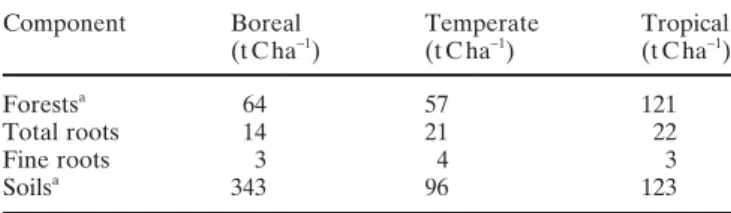
The mean amount of C in temperate and boreal forests is estimated to be 57–64 t C ha−1, while that for tropical eco-systems is estimated to be about 121 t C ha−1
(Table 1; Dixon et al. 1994). Roots account for about 20%–40% of the total forest C. The C content in roots is higher in tropical and temperate forests (21–22 t C ha−1), and is lower in boreal forests (14 t C ha−1
) (Table 1; Jackson et al. 1997). The C data of Jackson et al. (1997) were calculated by dividing the total root biomass by the land area and by considering a C concentration of 48.8% in living fi ne roots. In all forest types, tree fi ne root C accounts for about 10%–20% of the total amount of tree root C, with the highest values in the temperate and boreal forests and the lowest values in the tropical forest ecosystems (Table 1; Jackson et al. 1997). The amount of C in forest soils (soils, litter, roots) strongly depends on the latitudinal zones with 100–120 t C ha−1
in tropical and temperate forests and 340 t C ha−1
in boreal for-ests (Table 1; Dixon et al. 1994). Thus, tree roots in forest soils make up about 4%–20% of the total C in the soils.
Estimations from temperate forest stands of Central Europe showed that about 82 t C ha−1
is aboveground tree parts (stemwood, branches, foliage), 26 t C ha−1 is coarse tree roots, and 1.2 t C ha−1
is fi ne tree roots (Table 2; Perruchoud et al. 1999). Compared with the soil C, which is about
65 t C ha−1
(litter, soil humus; Table 2), the contribution of the root C to the total belowground C pool is about 42%. Flux of C into soils by plant litter (stemwood excluded) compared with the total soil C pool, however, is relatively small with 4.4 t C ha−1
year−1
of which the fi ne roots contrib-ute about 0.9 t C ha−1 year−1 (Table 2).
Root dynamics and global change
In recent decades, humans have strongly affected ecosys-tems due to atmospheric and climatic changes, such as rising atmospheric CO2 concentrations, elevated temperatures, altered precipitation, or N deposition (Norby and Jackson 2000). Soils of forest ecosystems, in particular, have been affected by high atmospheric inputs of acidifying pollutants (S and N compounds) originating from the combustion of fossil fuels in power generation, industry, and transpor-tation (Fowler et al. 1999; Nadelhoffer et al. 1999; Rennenberg and Gessler 1999). These inputs have led to an acceleration of soil acidifi cation, loss of basic cations, and release of Al ions into soil solution as a consequence of proton-buffer processes (Blaser et al. 1999). Besides its ef-fect on soil acidifi cation, excessive inputs of atmospheric N result in nitrate leaching and relative shortage of other nu-tritional elements for plants (Magill et al. 1997; Högberg et al. 2006). Nevertheless, a trend of increasing aboveground growth of trees in European forests over a long term can be observed (Spiecker 1999). These positive trends are
at-Table 1. Mean C content of forests and forest soils of various
latitudi-nal zones
Component Boreal Temperate Tropical (t C ha−1) (t C ha−1) (t C ha−1)
Forestsa 64 57 121
Total roots 14 21 22
Fine roots 3 4 3
Soilsa 343 96 123
Data from Dixon et al. (1994) and Jackson et al. (1997)
a Including roots
Table 2. Mean C pools and C fl uxes of forests and forest soils of
tem-perate zones in Central Europe
Component Pool (t C ha−1) Flux (t C ha−1 year−1)
Trees aboveground 82 2.3a Stemwood 60 nd Branches 19 1.0 Foliage 3.3 1.3 Trees belowground 27 1.7 Coarse roots 26 0.8 Fine roots 1.2 0.9
Soil (without roots) 65 0.4
Litter 16 0.1
Soil humus 49 0.3
Data from Perruchoud et al. (1999) nd, not determined
tributed mainly to the increased contents of CO2 in the at-mosphere and to enhanced N depositions. Both elevated CO2 concentrations and N depositions lead to increased plant biomass, including that of roots (Tingey et al. 2000; Nadelhoffer 2000). Recent analysis in experiments with el-evated CO2 concentrations have shown increases of the forest net primary productivity (NPP) by about 23% (Norby et al. 2005), and, in the case of poplars, an increase of the standing root biomass between 47%–76% (Lukac et al. 2003) and 113% (King et al. 2002).
Fine root turnover
Assuming that fi ne roots turn over once a year, as much as 33% of the global annual NPP is used for the production of fi ne roots, which, after death, begin to decompose (Jackson et al. 1997). It seems, therefore, that the turnover of the fi ne roots is a key component of the C and nutrient cycling in ecosystems and that it is sensitive to many global change factors (Gill and Jackson 2000; Eissenstat et al. 2000). Turn-over rates of fi ne roots in forests increase exponentially with the mean annual temperature (Gill and Jackson 2000; Pregitzer et al. 2000). Under elevated CO2 concentrations, the mean turnover rates of fi ne roots of poplars increased from 1.4–1.6 year−1
to 1.8–2.3 year−1
by about 25%–45% (Table 3; Lukac et al. 2003). In addition, there is evidence that soil acidifi cation also enhances fi ne root turnover in coniferous forests (Godbold et al. 2003).
Root turnover varies widely within and among species and across ecosystems, but the ability to predict root life span for particular species or systems is still poor (Majdi et al. 2005). Understanding the factors controlling root pro-duction and mortality, which is collectively called turnover, is therefore important for understanding element fl uxes in ecosystems. Several methods have been used to calculate rates of root production and mortality (e.g., sequential cor-ing, minirhizotrons, isotopes) and, thus, no standard ap-proach for defi ning root turnover is accepted and applied (Gill and Jackson 2000; Hertel and Leuschner 2002; Tierney and Fahey 2002; Majdi et al. 2005). As a result, the contribu-tion of fi ne root turnover and associated mycorrhiza to total ecosystem C and nutrient budgets remains uncertain (Trumbore and Gaudinski 2003).
Recently, advanced ecosystem models such as Biome-BGC, which require indispensable fi ne root parameters such as annual fi ne root turnover rate, C/N ratio of fi ne roots, or fi ne root labile/cellulose/lignin proportions, have been developed and parameterized (White et al. 2000). Thus, Biome-BGC allows the simulation of fl uxes and pools of C and N of ecosystems aboveground and belowground. Recent applications of that model in forest ecosystem stud-ies (e.g., Hibbard et al. 2005; Pietsch et al. 2005) have used fi ne root turnover rates which were set to 1.0 year−1
for de-ciduous broadleaf and dede-ciduous needleleaf trees, to 0.18– 0.25 year−1
for evergreen needleleaf trees, and to 0.5 year−1 for juniper woodland. However, it would be of advantage if future studies included turnover rates measured in situ. In particular, when deciduous needleleaf trees such as Larix
decidua are investigated, fi ne root turnover rates are likely
to be similar to the rates for evergreen needleleaf trees, and, thus, distinctly lower than the proposed 1.0 year−1
.
Root morphology and physiology
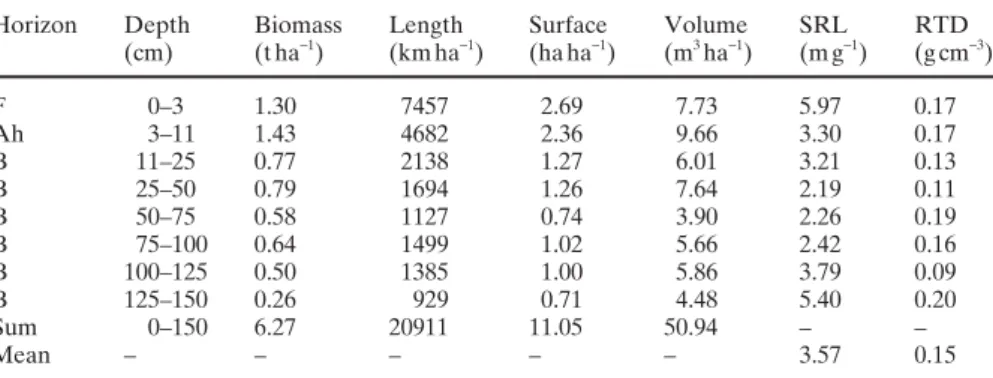
While roots vary widely in morphology and physiology, little is known about what environmental factors govern this variation or how this variation may be related to plant function. Several theories on plant growth strategies exist to explain the variation in tissue morphology and metabolic activity (Comas and Eissenstat 2004). An underlying as-sumption is that allocation of resources to tissue structure and function is governed by biotic and abiotic selection pressures. Whereas in leaves, tissue structure and function clearly correlate with the growth rate, in roots it is more or less unknown because broad studies of root traits are limit-ed (Comas and Eissenstat 2004). However, preliminary in-vestigations have shown that roots of fast-growing species, constructed for fast growth into new soil areas, have a high specifi c root length (SRL) but a low root-tissue density (RTD) (Comas et al. 2002). However, SRL and RTD can vary widely within one tree species depending on the hori-zons at various soil depths (Table 4; Brunner et al. 2004a). Mechanical stresses, on the one hand, can initiate a strong change in the structure of the roots (e.g., Danjon et al. 2005), and chemical and physical stresses, on the other hand, can initiate a strong change in the physiology of the roots, such as the induction of the 1,3-b-glucan callose with toxic Al (Hirano et al. 2006) or the strong reduction of the activity of the respiratory chain by drought (Richter et al. 2006). The value of the Ca/Al molar ratio of the fi ne roots is used to indicate the degree of soil acidifi cation because it refl ects the occurrence of toxic Al (Cronan and Grigal 1995; Brunner et al. 2004b).
Direct measurements of coarse roots are in general re-source demanding and destructive and require large-scale facilities. To obtain coarse root data, either trees are exca-vated (e.g., Soethe et al. 2006; Oppelt et al. 2005) or the roots investigated by ground penetrating radar (e.g., Barton and Montagu 2004; Butnor et al. 2003). While radar imaging can mainly be used for biomass estimation in specifi c types
Table 3. Mean annual fi ne root production and turnover (calculated
as the ratio of fi ne roots production in ingrowth cores and maximum standing fi ne root biomass per year) of three Populus species under ambient and elevated CO2 concentrations
Species Condition Production Turnover
(g m−2 year−1) (year−1)
Populus alba Ambient 159 1.6
Elevated 226 2.3
Populus nigra Ambient 165 1.6
Elevated 311 2.0
Populus × euramericana Ambient 219 1.4
Elevated 356 1.8
of soils, a large number of parameters can be computed as a result of digitizing data after root excavation. These pa-rameters include basal root cross sectional areas (CSA), bulk root volume distribution, and root volume in the root compartments (Danjon et al. 2005). A high correlation is documented between CSA and root weight, allowing the prediction of the root biomass. A recent improvement of that model utilized site-specifi c data in order to reduce the stand bias (Nielsen and Hansen 2006). A new approach for the representation and modeling of root architecture was reported by Dupuy et al. (2005). This model is based on the mathematical representation of the distribution of root properties such as number, angle, or diameter. Recent ap-plications using three-dimensional digitizing methods en-abled the link between three-dimensional root architecture and tree stability (Danjon et al. 2005).
International platform and knowledge gaps
One of the main objectives of the research on tree roots is to enhance the knowledge base and to improve the meth-odology of measuring root processes in relation to environ-mental change. Further needs in this area are to collect, evaluate, and categorize the available data on the response of root processes to global environmental change, to com-pare and evaluate methods and models for estimating fi ne root dynamics and coarse root structure, to establish the value of fi ne roots and coarse root structure as indicators of global environmental change, and to develop new method-ologies for studying roots.
Starting in 2003, an international platform on the re-search of roots of woody plants was initiated as a common base for scientists working on woody root processes, which has allowed the exchange of information, ideas, and person-nel [European Cooperation in the fi eld of Scientifi c and Technical Research (COST action E38), www.cost38.net]. The platform provides workshops and symposia to bring together researchers, allowing integration of research from the cellular scale to the ecosystem scale. Beyond this, the platform identifi es knowledge gaps, determines current and future research needs, and analyzes how they may be
incor-porated into research programs. The aim is the establish-ment of a core network of scientists operating at the cutting edge of woody root processes. Three areas were identifi ed for which activities of research should be focused on to im-prove knowledge: (1) to identify properties of roots that can be used as indicators for environmental change, (2) to mea-sure the dynamics of fi ne roots to assess C fl uxes to soils, and (3) to model the coarse roots to estimate the biomass of the root systems. These issues are currently addressed within three working groups of the COST action E38.
Literature cited
Barton CVM, Montagu KD (2004) Detection of tree roots and deter-mination of root diameters by ground penetrating radar under opti-mal conditions. Tree Physiol 24:1323–1331
Blaser P, Zysset M, Zimmermann S, Luster J (1999) Soil acidifi cation in southern Switzerland between 1987 and 1997: a case study based on the critical load concept. Environ Sci Technol 33:2383–2389 Brunner I, Ruf M, Lüscher P, Sperisen C (2004a) Molecular markers
reveal extensive intraspecifi c below-ground overlap of silver fi r fi ne roots. Mol Ecol 13:3595–3600
Brunner I, Zimmermann S, Zingg A, Blaser P (2004b) Wood-ash re-cycling affects forest soil and tree fi ne-root chemistry and reverses soil acidifi cation. Plant Soil 267:61–71
Butnor JR, Doolittle JA, Johnsen KH, Samuelson L, Stokes T, Kress L (2003) Utility of ground-penetrating radar as a root biomass sur-vey tool in forest systems. Soil Sci Soc Am J 67:1607–1615
Comas LH, Eissenstat DM (2004) Linking fi ne root traits to maximum potential growth rate among 11 mature temperate tree species. Funct Ecol 18:388–397
Comas LH, Bouma TJ, Eissenstat DM (2002) Linking root traits to potential growth rate in six temperate tree species. Oecologia 132:34–43
Cronan SC, Grigal DF (1995) Use of calcium/aluminum ratios as indi-cators of stress in forest ecosystems. J Environ Qual 24:209–226 Danjon F, Fourcaud T, Bert D (2005) Root architecture and
wind-fi rmness of mature Pinus pinaster. New Phytol 168:387–400 Dixon RK, Brown S, Houghton RA, Solomon AM, Trexler MC,
Wisniewski J (1994) Carbon pools and fl ux of global forest ecosys-tems. Science 263:185–190
Dupuy L, Fourcaud T, Stokes A, Danjon F (2005) A density-based approach for the modelling of root architecture: application to Mari-time pine (Pinus pinaster Ait.) root systems. J Theor Biol 236:323– 334
Eissenstat DM, Wells CE, Yanai RD, Whitbeck JL (2000) Building roots in a changing environment: implications for root longevity. New Phytol 147:33–42
Table 4. Mean vertical biomass distribution of fi ne roots of Abies alba in Switzerland and its
morphological properties
Horizon Depth Biomass Length Surface Volume SRL RTD (cm) (t ha−1) (km ha−1) (ha ha−1) (m3 ha−1) (m g−1) (g cm−3) F 0–3 1.30 7457 2.69 7.73 5.97 0.17 Ah 3–11 1.43 4682 2.36 9.66 3.30 0.17 B 11–25 0.77 2138 1.27 6.01 3.21 0.13 B 25–50 0.79 1694 1.26 7.64 2.19 0.11 B 50–75 0.58 1127 0.74 3.90 2.26 0.19 B 75–100 0.64 1499 1.02 5.66 2.42 0.16 B 100–125 0.50 1385 1.00 5.86 3.79 0.09 B 125–150 0.26 929 0.71 4.48 5.40 0.20 Sum 0–150 6.27 20911 11.05 50.94 – – Mean – – – – – 3.57 0.15
Data from Brunner et al. (2004a) and Brunner (unpublished results) SRL, specifi c root length; RTD, root-tissue density
Food and Agriculture Organization of the United Nations (FAO) (2006) Global forest resources assessment 2005. FAO Forestry Paper 147, FAO, Rome
Fowler D, Cape N, Coyle M, Flecaard C, Kuylenstierna J, Hicks K, Derwent D, Johnson C, Stevenson D (1999) The global exposure of forests to air pollution. Water Air Soil Pollut 116:5–32
Gill RA, Jackson R (2000) Global patterns of root turnover for ter-restrial ecosystems. New Phytol 147:13–31
Godbold DL, Fritz HW, Jentschke G, Meesenburg H, Rademacher P (2003) Root turnover and root necromass accumulation of Norway spruce (Picea abies) are affected by soil acidity. Tree Physiol 23: 915–921
Hertel D, Leuschner C (2002) A comparison of four different fi ne root production estimates with ecosystem carbon balance data in a Fagus–Quercus mixed forest. Plant Soil 239:237–251
Hibbard KA, Law BE, Reichstein M, Sulzman J (2005) An analysis of soil respiration across northern hemisphere temperate ecosystems. Biogeochemistry 73:29–70
Hirano Y, Walthert L, Brunner I (2006) Callose in root apices of European chestnut seedlings: a physiological indicator of aluminium stress. Tree Physiol 26:431–440
Högberg P, Fan HB, Quist M, Binkley D, Tamm CO (2006) Tree growth and soil acidifi cation in response to 30 years of experimental nitrogen loading on boreal forest. Global Change Biol 12:489–499 Jackson RB, Mooney HA, Schulze ED (1997) A global budget for fi ne
root biomass, surface area, and nutrient contents. Proc Natl Acad Sci USA 94:7362–7366
King JS, Albaugh TJ, Allen HL, Buford M, Strain BR, Dougherty P (2002) Seasonal dynamics of fi ne roots relative to foliage and stem growth in loblolly pine (Pinus taeda L.) as affected by water and nutrient availability. New Phytol 154:389–398
Lukac M, Calfapietra C, Godbold DL (2003) Production, turnover and mycorrhizal colonization of root systems of three Populus species grown under elevated CO2 (POPFACE). Global Change Biol 9:
838–848
Magill AH, Aber JD, Hendricks JJ, Bowden RD, Melillo JM, Steudler PA (1997) Biogeochemical response of forest ecosystems to simulated chronic nitrogen deposition. Ecol Appl 7:402–415 Majdi H, Pregitzer K, Morén AS, Nylund JE, Ågren GI (2005)
Measur-ing fi ne root turnover in forest ecosystems. Plant Soil 276:1–8 Nadelhoffer KJ (2000) The potential effects of nitrogen deposition on
fi ne-root production in forest ecosystems. New Phytol 147:131–139 Nadelhoffer KJ, Emmett BA, Gundersen P, Kjonaas OJ, Koopmans
CJ, Schleppi P, Tietema A, Wright RF (1999) Nitrogen deposition makes a minor contribution to carbon sequestration in temperate forests. Nature 398:145–148
Nielsen CCN, Hansen JK (2006) Root CSA-root biomass prediction models in six tree species and improvement of models by inclusion of root architectural parameters. Plant Soil 280:339–356
Norby RJ, Jackson RB (2000) Root dynamics and global change: seek-ing an ecosystem perspective. New Phytol 147:3–12
Norby RJ, DeLucia EH, Gielen B, Calfapietra C, Giardina CP, King JS, Ledford J, McCarthy HR, Moore DJP, Ceulemans R, De Angelis P, Finzi AC, Karnosky DF, Kubiske ME, Lukac M, Pregitzer KS, Scarascia-Mugnozza GE, Schlesinger WH, Oren R (2005) Forest response to elevated CO2 is conserved across a broad range of
pro-ductivity. Proc Natl Acad Sci USA 102:18052–18056
Oppelt AL, Kurth W, Godbold DL (2005) Contrasting rooting pat-terns of some arid-zone fruit tree species from Botswana. 2. Coarse root distribution. Agrofor Syst 64:13–24
Perruchoud D, Kienast F, Kaufmann E, Bräker OU (1999) 20th cen-tury carbon budget of forest soil in the Alps. Ecosystems 2:320– 337
Pietsch SA, Hasenauer H, Thornton PE (2005) BGC-model parame-ters for tree species growing in central European forests. Forest Ecol Manag 211:264–295
Pregitzer KS, King JS, Burton AJ, Brown SE (2000) Response of tree fi ne roots: effects on growth, life span and turnover. New Phytol 147:105–115
Rennenberg H, Gessler A (1999) Consequences of N deposition to forest ecosystems – recent results and future research needs. Water Air Soil Pollut 116:47–64
Richter AK, Frossard E, Brunner I (2006) Polyphenols in woody roots of Norway spruce and European beech reduce TTC. Tree Physiol 27:155–160
Soethe N, Lehmann J, Engels C (2006) Root morphology and anchor-age of six native tree species from a tropical montane forest and an elfi n forest in Ecuador. Plant Soil 279:173–185
Spiecker H (1999) Overview of recent growth trends in European for-ests. Water Air Soil Pollut 116:33–46
Tierney G, Fahey T (2002) Fine root turnover in a northern hardwood forest: a direct comparison of the radiocarbon and minirhizotron methods. Can J Forest Res 32:1692–1697
Tingey DT, Phillips DL, Johnson MG (2000) Elevated CO2 and conifer
roots: effects on growth, life span and turnover. New Phytol 147:87– 103
Trumbore SE, Gaudinski JB (2003) The secret lives of roots. Science 302:1344–1345
White MA, Thornton PE, Running SW, Nemani RR (2000) Para-meterization and sensitivity analysis of the Biome-BGC terrestrial ecosystem model: net primary production controls. Earth Interact 4:1–85