Foreign Retailers’ Localisation
Attempts to the Domestic Market
The Influence of Consumer Ethnocentrism, Local CSR
Activities and Perceived Brand Localness on Consumer
Behaviour at Foreign Retailers
THESIS
presented to the Faculty of Economics and Social Sciences at the
University of Fribourg (Switzerland),
in fulfilment of the requirements for the degree of
Doctor of Economics and Social Sciences
by
Marta Keane
from Poland
Accepted by the Faculty of Economics and Social Sciences on 22.05.2017 at the proposal of
Prof. Dr. Dirk Morschett (First Supervisor) and Prof. Dr. Olivier Furrer (Second Supervisor)
The Faculty of Economics and Social Sciences of the University of Fribourg (Switzerland) does not intend either to approve or disapprove the opinions expressed in a thesis: they must be regarded as specific to the author (decision of the Faculty Council of 23 January 1990).
Writing this thesis was like preparing for and running a long-distance run. It was not easy, and there were times when I thought achieving the end-goal was impossible. In the same spirit as my biggest role model a few years ago, who was acknowledging the help of very special people in his long-distance survival run, I want to say thank you to those who have supported me along the way and helped me to cross the finish line. Foremost, I want to express my gratitude to my coach, my first supervisor, Professor Dr. Dirk Morschett. I want to thank him for sharing his knowledge with me and for his patience in discussing the diverse topics within this thesis. His wisdom and encouragement have been invaluable to completing this work. I also want to thank him for his supportive attitude, which I sincerely appreciated, especially during the most challenging times, when the results were less than desirable.
I also want to thank Professor Dr. Olivier Furrer for agreeing to be an assistant coach – my second supervisor, as well as Professor Dr. Bernhard Swoboda, the editor of a journal where I submitted two of the essays. I want to thank him for the time he has invested to help improve the manuscripts and for many helpful remarks.
I must thank my friends: My training partner, Adela Wyncoll, who was often faced with similar challenges; Johan Foster, who, like a physiotherapist, was always there to help, listen and make me stronger, especially after injuries (i.e., unsuccessful submissions); and Gosia Budnikowska, who was cheering me on during this long journey and who was always on my side. I also want to thank all the other spectators, my friends, who have supported me, motivated me, cheered me on and who helped me continue with this journey.
A special thanks goes to my whole family, in particular to my brother Michał Kramarek, who was always ready to meet me along the way, to provide me with advice and to correct my technique when necessary. Also thanks to the strongest women I know – my mom, my sister and my aunt – Maria Kramarek, Maja Teleńczuk and Aldona Kramarek – for their continuous support and for always having the time to listen. Finally, I want to express my special gratitude to the two most important men in my life. First, to my husband, Dave Keane, my biggest supporter, for his positive attitude and for helping me to keep my sanity. I am blessed to be going through this journey with you. Most importantly, a word of gratitude goes to my dad, Maciej Kramarek, my constant source of inspiration. Dad, many people would have been lucky to have met you, but I have been blessed with being your daughter. Thank you for your undivided attention, advice and for teaching me (and sometimes trying to teach me) so much. You are in my heart and are the reason why your youngest child has finally finished her secondary education.
Table of Contents
List of Figures ... VIII
List of Tables ... IX
List of Abbreviations ... X
Part I: Introduction ... 1
1. Introduction ... 1
1.1. Research Objectives ... 6
1.2. Outline of the Thesis ... 9
2. Theoretical Background of Consumer Ethnocentrism ... 9
2.1. Social Identity Theory ... 9
2.2. Ethnocentrism ... 11
2.3. Consumer Ethnocentrism ... 11
2.4. Antecedents, Moderators and Mediators of Consumer Ethnocentrism ... 14
2.5. Scales to Measure Consumer Ethnocentrism ... 20
2.5.1. Consumer Ethnocentric Tendencies Scale ... 20
2.5.2. Consumer Ethnocentrism Scale ... 23
2.5.3. Consumer Ethnocentrism Extended Scale ... 25
2.6. Consumer Ethnocentrism in Services ... 26
2.6.1. Retailing ... 28
2.6.2. Differences in Selling Services vs. Products to Domestic Consumers and Appealing to Ethnocentric Consumers ... 29
2.6.3. Consumer Ethnocentrism in Retailing ... 30
3. Corporate Social Responsibility ... 34
3.1. Overview of Socially Responsible Consumer Behaviour and Corporate Social Responsibility in the Retail Context ... 34
3.2. Corporate Social Responsibility Literature with Local Focus in the Retail Context ... 37
3.2.1. Study by Russell and Russell (2010) ... 37
3.2.2. Study by Kim, Ha, and Fong (2014) ... 38
3.3. Scales to Measure Corporate Social Responsibility ... 38
3.3.1. Consumer Perception of Corporate Social Responsibility Scale ... 38
3.3.2. Corporate Social Irresponsibility Scale ... 40
3.4. Link between Corporate Social Responsibility Consumer Ethnocentrism ... 43
4. Perceived Brand Localness ... 45
4.1. Overview of the Literature on Perceived Brand Localness ... 45
4.2. The Literature on Perceived Brand Localness with a Focus on Retailing ... 47
4.3. Scales to Measure Perceived Brand Localness ... 48
4.3.1. Brand as Icon of Local Culture Scale ... 48
4.3.2. Perceived Brand Localness Scale ... 49
4.4. Link between Perceived Brand Localness and Consumer Ethnocentrism ... 49
Part II: Reducing the Negative Effect of Consumer Ethnocentrism on Patronage Behaviour at Foreign Retailers (Essay 1) ... 52
1. Introduction ... 52
2. Theory and Hypotheses ... 54
2.1. Theory and Conceptual Framework ... 54
2.2. Hypotheses Development ... 56
3. Empirical Study ... 59
3.1. Sample ... 59
3.2. Method ... 61
3.3. Results ... 63
4. Discussion and Implications ... 68
5. Limitations and Future Research ... 73
Part III: The Influence of Localised Corporate Social Responsibility and Perceived Brand Localness on Willingness to Buy from a Foreign Grocery Retailer (Essay 2) ... 75
1. Introduction ... 75
2. Theory and Hypotheses ... 78
2.1. Theory and Conceptual Framework ... 78
2.2. Hypotheses Development ... 80
3. Empirical Studies ... 83
3.1. Study 1: The Influence of Localised CSR ... 83
3.1.1. Experimental Design and Process ... 83
3.1.2. Pre-test ... 85
3.1.3. Sample... 85
3.1.4. Results ... 86
3.2.1. Experimental Design and Process ... 87
3.2.2. Pre-test ... 88
3.2.3. Sample... 88
3.2.4. Results ... 88
3.3. Study 3: The Influence of Localised CSR and Perceived Brand Localness .... 91
3.3.1. Experimental Design and Process ... 91
3.3.2. Sample... 91
3.3.3. Results ... 91
4. Discussion and Implications ... 94
5. Limitations and Future Research ... 98
Part IV: Social and Socio-demographic Influences on Ethnocentric Consumer’s Behaviour at Foreign Retailers (Essay 3) ... 101
1. Introduction ... 101
2. Theory and Hypotheses ... 103
2.1. Conceptual Framework and Theory ... 103
2.2. Hypotheses Development ... 104 3. Empirical Study ... 110 3.1. Sample ... 110 3.2. Measurements ... 111 3.3. Method ... 113 3.4. Results ... 115
4. Discussion and Managerial Implications ... 119
5. Limitations and Further Research ... 121
Part V: Overall Conclusion ... 124
1. Core Results ... 124
2. Managerial Implications ... 135
3. Limitations, Challenges and Future Research ... 138
Reference ... 145
List of Figures
Figure 1: Local and Non-local CSR Activities of Foreign Retailers ... 5
Figure 2: Lidl Logos ... 6
Figure 3: Conceptual Framework by Sharma, Shimp, and Shin (1995) Extended by de Ruyter, van Birgelen, and Wetzels (1998) ... 14
Figure 4: Overview of Antecedents, Moderators and Mediators of Consumer Ethnocentrism... 15
Figure 5: Marketing Communication of Retailers’ CSR Activities ... 36
Figure 6: Retailers’ Adaptation of Marketing Communications to Domestic Market ... 51
Figure 7: Conceptual Framework ... 56
Figure 8: Conceptual Framework ... 79
Figure 9: Conceptual Framework ... 105
List of Tables
Table 1: Overview of the Revenue and Number of Countries of Operation of
Large International Retailers ... 2
Table 2: Selected Antecedents, Mediators, Moderators and Consequences of Consumer Ethnocentrism ... 15
Table 3 A: Consumer Ethnocentric Tendencies Scale ... 20
Table 3 B: Consumer Ethnocentrism Scale ... 23
Table 3 C: Consumer Ethnocentrism Extended Scale ... 25
Table 4: Comparison of the Hypotheses on Product Level – Sharma, Shimp, and Shin (1995) and on Service Level – de Ruyter, van Birgelen, and Wetzels (1998) ... 27
Table 5 A: Consumers’ Perceptions of Corporate Social Responsibility ... 39
Table 5 B: Corporate Social Irresponsibility Scale ... 41
Table 5 C: The Socially Responsible Purchase and Disposal Scale ... 43
Table 6: Scales to Measure Perceived Brand Localness ... 48
Table 7: Overview of the Sample ... 60
Table 8: Descriptive Statistics and Measurement Constructs... 65
Table 9: Correlations ... 67
Table 10: Measurement Invariance Assessment for Aldi and IKEA ... 67
Table 11: Results ... 69
Table 12: Overview of the Sample ... 85
Table 13: Correlations and VIF’s ... 86
Table 14: Results ... 89
Table 15: Correlations and VIF’s ... 90
Table 16: Correlations and VIF’s ... 92
Table 17: Overview of the Sample ... 111
Table 18: Reliability and Validity of Measurement ... 112
Table 19: Descriptive Statistics ... 114
Table 20: Correlations Matrix ... 114
Table 21: Measurement Invariance for United Kingdom, Switzerland and Germany ... 115
Table 22: Results ... 117
Table 23: Summary of Key Conclusions and Contributions ... 132
List of Abbreviations
$ American dollars
β beta
% percentage
AVE average variance extracted
CETSCALE consumer ethnocentric tendencies scale CO2 carbon dioxide
CSR corporate social responsibility df degrees of freedom
e.g. for example et al. and others etc. et cetera
H&M Hennes and Mauritz i.e. that is Inc. incorporation mln million N sample size No. number ns not significant p significance level p. page pp. pages
plc. public limited company PLS partial least squares
(r) reversed
S.A. Société anonyme
se standard error
SEM structural equation modelling US United States
USA United States of America VIF variance inflation factor
Part I: Introduction 1. Introduction
The retail landscape is undergoing an unprecedented change. Many retailers, in particular large chains, continue to globalise and expand their services beyond the national borders (Burt, Dawson, and Sparks 2003). This expansion is challenging because “[i]n retailing the market is local, even for large international retailers. (…) The local nature of the market requires retailers to be aware of local aspects of consumption and of local attributes of culture” (Dawson and Mukoyama 2006, p. 20). A successful positioning of a retail store in the home market does not always translate to a successful positioning in the foreign markets. Foreign retail managers may fail to understand local consumers’ needs due to the cultural differences (de Mooij and Hofstede 2002). This may lead to a poor adaptation of the store positioning, which can result in serious losses and even in divestment of the foreign units (Burt, Dawson, and Sparks 2003). Some of the well-known examples of international retail divestments include Boots’ withdrawal from Russia (2007), Kingfisher exiting Germany, Canada, Poland and France (2003), Laura Ashley fleeing from Austria, Italy, Switzerland and Germany (2003) and Carrefour leaving Switzerland (2007) (Allen 2007; Cairns et al. 2010).
Retailers who expand internationally face both opportunities and threats. On the one side, some of the world’s leading retailers gain a significant proportion of their profits from international sales and are present in many countries (see Table 1). For example, Wal-Mart, the largest retailer, increased the number of countries of operation between 2009 and 2014 from 16 to 28. Moreover, the revenue generated during this time increased by about 19 percent (including both foreign and domestic revenues). On the other side, one of the key challenges that retailers face nowadays is intense competition from domestic and foreign counterparts, which in recent years has resulted in a higher number of retailers facing a problem of international divestment (Cairns et al. 2010).
International expansion can result in various consumer reactions, therefore companies should make an effort to understand what can cause consumer bias (Samiee 1994). This is important because local consumers’ reactions and, in particular, their patronage behaviour determines retailers’ success in foreign markets (Alexander and Doherty 2010).
Table 1: Overview of the Revenue and Number of Countries of Operation of Large International Retailers Retailer Country of origin 2014 2009 No. of countries Revenue (US $ mln) No. of countries Revenue (US $ mln) Wal-Mart Stores Inc. US 28 485,651 16 408,214 Costco Wholesale Corporation US 10 112,640 9 71,422 Schwarz Unternehmenstreuhand KG Germany 26 102,694 25 77,221 Tesco PLC United Kingdom 13 99,713 13 90,435 Carrefour S.A. France 34 98,497 36 121,861 Metro Germany 32 85,570 33 91,389 The Home Depot Inc. US 4 83,176 5 66,176 Amazon.com Inc. US 14 70,080 7 24,509 Groupe Auchan France 13 69,622 14 55,326
Source: Adapted from NRF (2011) and NRF (2016)
For customers, the trend toward openness has resulted in many positive changes, such as a larger choice between domestic and foreign products, goods and services (Netemeyer, Durvasula, and Lichtenstein 1991). However, it has also raised awareness that free access to goods and services brings along. Some literature suggests that consumers have become increasingly concerned about the expansion of foreign products into local markets (Granzin and Painter 2001). This concern can also be observed in everyday life. For example, in the 2016 United States presidential election campaign, Donald Trump stated that “Globalization (…) left millions of our workers with nothing but poverty and heartache” (Jackson 2016). Pew Research Centre1 found that one month prior to Donald Trump launching his presidential
campaign Make America Great Again, 51 percent of Republican voters believed that free-trade agreements were good for their country, whereas 39 percent stated the opposite. Only 14 months after the presidential campaign was launched, Pew Research Centre found that among Republican voters, 32 percent stated that free-trade agreements have helped the economy, whereas 61 percent believed that they have hurt the country (Pew Research Center 2016b). This indicates a huge change in some consumers’ perception regarding foreign goods and services.
Consumer ethnocentrism is a concept that is closely related to consumers’ concern for protecting the domestic economy by purchasing domestic products instead of foreign ones (see chapter 2.3., part I). Consumers with higher ethnocentric tendencies believe that buying foreign products is immoral. They perceive that purchasing foreign-made products has negative repercussions on the domestic economy, because these purchases result in domestic job losses and harm the economy (Shimp and Sharma 1987). Most research in the ethnocentric marketing literature focuses on the antecedents of consumer ethnocentrism in indirect models or in models that examine the direct effect of consumer ethnocentrism on behavioural variables (e.g., Nijssen and Douglas 2011; Zeugner-Roth, Žabkar, and Diamantopoulos 2015). However, there is only a handful of studies that examine the relevance of consumer ethnocentrism in the retail sector (see chapter 2.6.3., part I).
Conducting research in the retail sector is relevant, because products and services differ substantially. As explained in a subsequent part of this thesis, retailers can do more to better integrate into the domestic market than product manufacturers (see chapter 2.6.2., part I). Retailers, to a large extent, deliver their service in the domestic market with domestic employees, which may soften the negative perception of harm to the domestic economy.
A theory often used to explain consumer ethnocentrism is social identity theory (see chapter 2.1., part I). In short, social identity theory offers explanations for inter-group conflict. Consistent with this theory, individuals distinguish between in-groups and out-groups (in favour of the in-group) (Turner 1999). In ethnocentric marketing literature, in-group often relates to the domestic country and domestic products/services, whereas out-groups relate to the foreign countries and foreign products/services (Zeugner-Roth, Žabkar, and Diamantopoulos 2015). It is plausible, therefore, that foreign retailers may be perceived as an out-group by local consumers.
Understanding consumer patronage behaviour is crucial to retailers’ success (Seock and Lin 2011); understanding how ethnocentric consumers behave towards foreign retailers may aid foreign retailers in positioning their stores in ways that help ensure their success. This investigation is important, in fact, because consumer ethnocentrism can be a curb on globalisation and can also pose a barrier to a successful internationalisation of services (de Ruyter, van Birgelen, and Wetzels 1998; Guo 2013). As explained by Siamagka and Balabanis (2015, p. 66), ethnocentrism may “act as a self-defense reflex of local economies, governments, organizations, and individuals against the threat of imports and foreign competition”.
Consistent with the social identity theory, this thesis also argues that by adopting local corporate social responsibility (CSR) activities (see chapter 3., part I) and by having
high perceived brand localness (see chapter 4., part I), retailers can alter consumers' in-group and out-group perceptions. This thesis conceptualises local CSR2 activities
as CSR activities that are directed to the host country and local community surrounding a retail store, whereas perceived brand localness captures consumers’ perceptions of a foreign retailer acting like a local actor and being accepted as a symbol of the local culture. As Zarkada-Fraser and Fraser (2002) observed, many international retailers use patriotic appeals to influence consumer perceptions, while they increasingly globalise. The relevance of both concepts (i.e., local CSR activities and perceived brand localness) can be linked with consumer ethnocentrism not only through the social identity theory but also through other associations. For example, foreign retailers who carry out local CSR activities are likely to be seen as contributing to the well-being of the country (i.e., in-group) and, as a result, to the domestic economy. Retailers’ CSR actions, which are localised may become personally relevant to the consumers (Russell and Russell 2010), which may positively influence both consumer perceptions and behaviour. Moreover, these appeals may be especially appreciated by ethnocentric consumers and may positively influence those whose perception is that foreign retailers harm the domestic economy. An example is Aldi Ireland (2016), a subsidiary of a German store, which organises a colour run that aids an Irish Cancer Society. The run is organised for the whole family and is located in at least four cities across the country every year (see Figure 1 A for a sample marketing communication). Foreign retailers who conduct non-local CSR activities are less likely to create a link between CSR activities and the personal relevance of these activities for the consumers. For example, Lidl Ireland (2016), a subsidiary of a German store, communicates that the stores support the Fairtrade system and that these stores only source from Fairtrade certificated producer organisations in Africa, Asia and Latin America (see Figure 1 B for the sample marketing communication). The store encourages Irish consumers to support foreign farmers, workers and their families by doing this. Although this approach sends a positive message to those consumers, consumers, particularly ethnocentric consumers, may perceive that this message is not as convincing, as it does not show retailers’ commitment to the domestic economy, with the result that it may not exert as strong an effect on consumer behaviour as the local CSR activities do.
Figure 1: Local and Non-local CSR Activities of Foreign Retailers
Source: Aldi Ireland (2016); Lidl Ireland (2016)
Foreign retailers that achieve a higher perceived brand localness may influence consumer perceptions of foreign retailers’ commitment to the country and as result alter their perception of whether the foreign retailer is a part of the in-group. For example, Lidl in Austria, Switzerland and Denmark integrate a national flag in the shape of a heart into their logo (see Figure 2 A for examples). A brand with connections to the local culture is more emotionally appealing (Xie, Batra, and Peng 2015) and should have a stronger influence on consumer behaviour (Steenkamp, Batra, and Alden 2003), in contrast to a brand with no local connections, which instead might be seen as part of an out-group. The brand with the local connections should be particularly appreciated by consumers with higher ethnocentric tendencies who view national symbols with pride (Siamagka and Balabanis 2015). For example, Lidl’s logo in Poland does not create a link with the host country, as the logo is standardised. In fact, Lidl uses the same logo across different countries, for example Poland, Germany, Belgium and Finland (see Figure 2 B for an example).
Figure 2: Lidl Logos
Source: Lidl Denmark (2017), Lidl Switzerland (2016), Lidl Austria (2017), Lidl Poland (2016); Lidl Germany (2017), Lidl Belgium (2017) and Lidl Finland (2017)
1.1. Research Objectives
Swoboda, Pennemann, and Taube (2012) observed that there is lack of research investigating how the origin information of a store influences international retailer’s evaluation. Darden and Lusch (1983) point out that successful positioning of a store requires retail managers to possess knowledge about consumers’ needs, values, shopping orientations, socio-economic characteristics and lifestyles. Therefore, the first objective of this thesis is to investigate the role of consumer ethnocentrism in international retailing, a research setting that has often been neglected, not only in the direct effect models but also in the indirect models (Shankarmahesh 2006).
It is important to highlight that this thesis does not presume that consumer ethnocentrism is a key factor that drives consumers’ patronage behaviour. There are many studies that show that functional attributes such as product quality, low price, store atmosphere and friendliness of salespeople (see Pan and Zinkhan 2006) determine consumers’ retail choices. However, as in the case of products and brands, extrinsic factors, such as the country of origin, not only may impact quality signalling but also may have a symbolic and emotional meaning to consumers (Botschen and Hemetsberger 1998; Verlegh and Steenkamp 1999). An extant literature exists that attempts to identify the antecedents, moderators, mediators and consequences of consumer ethnocentrism (for an overview see Shankarmahesh (2006)), but most (not all) of the studies are carried out on the product and brand level.
The main objective of this thesis is to investigate whether retailers’ attempts to localise certain activities to the domestic market and whether certain consumer characteristics directly and indirectly influence consumers’ behaviour. Although the precise research objectives and research gaps are identified in each of the three essays in the subsequent part of the thesis, the thesis aims to address the following research questions:
(1) Does consumer ethnocentrism have a direct negative influence on patronage behaviour at foreign retailers?
(2) (a) Do the activities of foreign retailers (i.e., adapting assortment to the domestic market, perceived brand localness and carrying out local CSR activities) reduce the negative influence of consumer ethnocentrism on patronage behaviour? (b) Do certain consumer attributes, that is, price consciousness and adherence to (ethnocentric) social norms, reduce/strengthen (respectively) the negative influence of consumer ethnocentrism on patronage behaviour?
(3) Do the localised activities of a foreign retailer (i.e., local CSR activities and activities affecting perceived brand localness) positively influence patronage behaviour at foreign retailers and consumers’ willingness to buy from a foreign grocery retailer3?
(4) Does the influence of local CSR activities and of perceived brand localness on willingness to buy from a foreign grocery retailer vary depending on the level of consumer ethnocentrism?
A short description follows of each of the three essays.
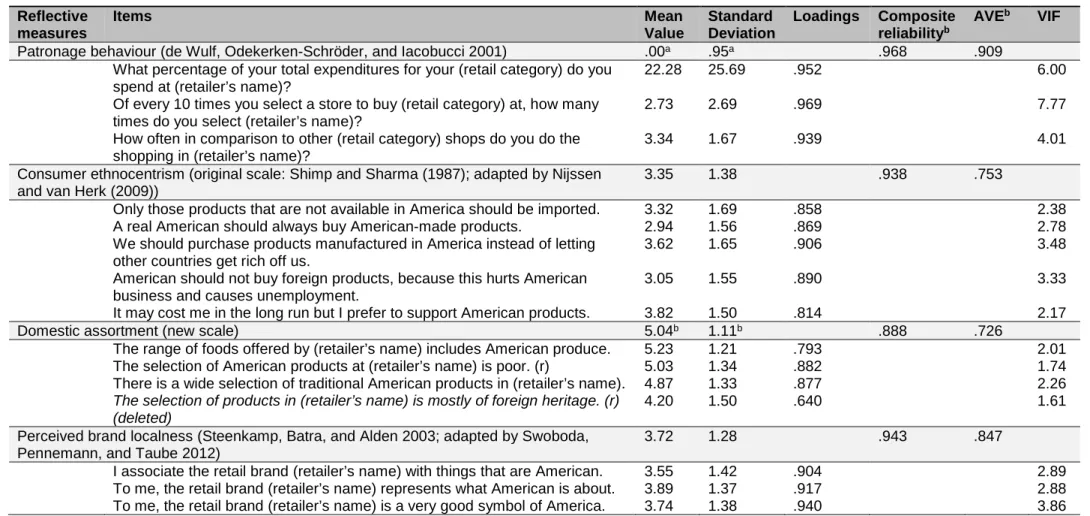
Essay 1’s’ main purpose is to examine whether and how consumer ethnocentrism influences patronage behaviour at existing foreign retailers (IKEA and Aldi) in the United States. Essay 1 is the first study (as far as the author is aware) that investigates the direct effect of consumer ethnocentrism on consumers’ self-reported patronage behaviour at foreign retailers. In contrast to products, foreign stores can more strongly influence consumer perceptions of whether they are perceived as part of the in-group or of the out-group. These influences have not been previously investigated in the literature. This presents an interesting research gap of whether and how foreign retailers’ activities, which can be adapted to the domestic market, affect the relationship between consumer ethnocentrism and patronage behaviour at foreign stores. These activities include consumers’ perception of adaptation of the assortment to the local market, local positioning of the retail brand (i.e., perceived brand localness) and consumer perception of local CSR activities. It also examines whether these activities directly influence consumers’ patronage behaviour, because, higher local CSR activities may have a higher relevance for local consumers.
3 The terms willingness to buy from a foreign grocery retailer and willingness to buy at a foreign grocery
Essay 2 aims to examine the influence of localised domestic appeals (i.e., localised CSR activities and perceived brand localness) on the willingness to buy from a foreign fictitious grocery retailer in the United States. By integrating both of these activities to the local market, foreign retailers are likely to positively influence consumers’ willingness to buy due to a stronger and more positive influence on the domestic country and due to a higher integration perception that this retailer is part of the country. The essay further analyses whether both of these appeals interact together and enhance the effect further. Lastly, as the purpose of this thesis is to investigate the role of consumer ethnocentrism in international retailing, the author of the thesis tests whether consumer ethnocentrism acts as a moderator. The moderation is tested between each of the three relationships; that is, between the localised CSR activities and willingness to buy from a foreign grocery retailer, between perceived brand localness and willingness to buy from a foreign grocery retailer, and whether it positively influences an interaction between localised CSR activities and perceived brand localness. Answering these research questions is interesting, because there is scant literature that deals with these issues. Moreover, there are no studies (as far as the author is aware) that answer these questions in the context of a fictitious foreign grocery retailer. An advantage of using a fictitious retailer is that consumers are not familiar with the retailer brand; therefore, only the influence of the selected stimuli is investigated, which allows to avoid the noise of the pre-existing knowledge that consumers have about an existing store.
Essay 3 examines the direct influence of consumer ethnocentrism on the patronage behaviour at foreign retailers in three European countries: the United Kingdom, a German-speaking part of Switzerland and in Germany, in two retail categories: food and fashion, based on three existing retailers: Lidl, H&M and Zara. This research setting is interesting, as many studies have been conducted in the United States. As in the first two essays, the third essay captures consumer ethnocentrism in the framework of social identity theory and, additionally, conceptualises consumer ethnocentrism as a social construct and examines the role of social influences, which are an important predictor of consumer behaviour. The study investigates the direct influence of social norms on consumer ethnocentrism and, additionally, its moderating role on the relationship between consumer ethnocentrism and patronage behaviour at foreign retailers. It also tests the influence of two demographic antecedents: income and social class. Furthermore, price consciousness, a variable associated with social variables, is examined as a moderator of the relationship between consumer ethnocentrism and patronage behaviour at foreign stores.
1.2. Outline of the Thesis
The thesis has five parts. Part I introduces the topic and provides a broad overview of the thesis. The introductory part has a two-fold purpose. The first purpose is to provide an overview of the existent scientific literature and to review the literature by providing the key concepts. These concepts are conceptualised in a subsequent part as independent variables that exert an influence on consumers’ patronage behaviour at foreign retailers or on their willingness to buy from a foreign grocery retailer (i.e., consumer ethnocentrism, local CSR activities and perceived brand localness). Part I also provides the overview of the main theory – social identity theory – that is used as a framework throughout the thesis. The second purpose is to link theoretical concepts and to give practical examples illustrating the relevance of the topic. Parts II, III and IV present the three essays, which are the fundamental part of the thesis. Part V summarises the thesis and provides core conclusions, managerial implications and the major limitations of the thesis and proposes avenues for the future research.
2. Theoretical Background of Consumer Ethnocentrism 2.1. Social Identity Theory
Social identity perspective was first introduced by Henri Tajfel in the early 1970’s. It is described as “a social psychological analysis of the role of self-conception in group membership, group processes, and intergroup relations” (Hogg 2006, p. 111). The theory is anchored in an individual’s efforts to distinguish one’s group in relation to other groups.
Social identity theory aims to help facilitate an understanding of the social-psychological process of inter-group discrimination. It underlies both the development and the maintenance of one’s social identity (Hogg 2006), where social identity is described as part of a person’s self-concept that stems from membership in a social group (or groups) and that consists of the value and the emotional significance attached to that membership (Tajfel 1981). In the context of social identity theory, social group refers to “two or more individuals who share a common social identification of themselves or, which is nearly the same thing, perceive themselves to be members of the same social category” (Turner 2010, p. 15). Tajfel and Turner (1979) propose that individuals can belong to different groups depending, for example, on their social class, family and religion. The nation is a common reference group in the marketing literature (Zeugner-Roth, Žabkar, and Diamantopoulos 2015).
According to social identity theory, two significant psychological processes underlie the formation of the social identity. Social categorisation is the first significant psychological process, which is the cognitive basis of social identity (Turner et al. 1987) that captures similarities and differences between the groups. These similarities and differences are related in a meaningful way and can be based on attributes such as perceptions, feelings and behaviours. Moreover, individuals impose boundaries on the groups they affiliate with; these groups are referred to as in-groups, whereas, everything else is referred to as out-groups (Turner 2010). It is important to note that self-categorisation not “only transforms self-conception and generates a feeling of belonging and group identification, but also transforms how we actually feel and behave to conform to the group prototype. Self-categorization causes our thoughts, feelings, perceptions, and behaviour to conform to our prototype of the in-group” (Hogg and Reid 2006, p. 11).
Social comparison is the second significant psychological process that underlies the formation of the social identity. Social comparison strives to make and maintain the favourable distinction between one’s own group and other groups (Hogg 2006; Tajfel 1981) in order to acquire or enhance one’s own self-esteem and a positive social identity.
The groups to which individuals belong, or with which they identify, are an important source of pride and self-esteem. Group membership can provide a sense of social identity and belonging to the social world. It is important to note, however, that group membership does not always lead to inter-group behaviour (such as conflict, cooperation and social change), as this depends on the degree of the individual’s identification with the group (Hogg and Reid 2006; Zeugner-Roth, Žabkar, and Diamantopoulos 2015).
Buying Behaviour in the Framework of Social Identity Theory
Consistent with social identity theory, individuals’ perceptions that they belong to an in-group can influence their behaviour (Hogg, Terry, and White 1995). General findings of the research on social identity suggest that consumers engage in behaviours that are consistent with their identity (Forehand, Deshpandé, and Reed II 2002). For example, Homburg, Wieseke, and Hoyer (2009) argued that when individuals perceive that a company belongs to the in-group, they are more likely to engage in buying behaviour. They argued this based on three reasons. First, because such behaviour reinforces the feeling of belonging and fulfils their need for self-definition. Second, because people want to increase the status of the group to which they belong, so purchasing from a company may be viewed as helping the company. Third,
identification with a company that belongs to the in-group may fulfil an emotional need for consumers, which, in turn, will influence buying behaviour.
2.2. Ethnocentrism
Ethnocentrism is a sociological concept focused on individuals’ personality, cultural and social frameworks (Shimp and Sharma 1987). The ethnocentrism concept was pioneered by William Sumner (1906, p. 13), who defined it as “the technical name for (…) view of things in which one’s own group is the center of everything, and all others are scaled and rated with reference to it (…) Each group nourishes its own pride and vanity, boasts itself superior, exalts its own divinities, and looks with contempt on outsiders”.
Ethnocentric individuals see and interpret the world from the point of view of the group with which they identify, and they see the in-group members as the centre of the universe (Shimp and Sharma 1987). The in-group members are assumed to be friendly, trustworthy and safe and are placed at the centre in relationship to other groups. The in-group’s symbols and practices are objects of attachment and pride. The out-groups’ members are assumed to be unfriendly, not trustworthy and dangerous until proven otherwise (Kinder and Kam 2009) and, therefore, are negatively evaluated and are often rejected (Adorno et al. 1950; Shimp and Sharma 1987).
Social environment plays an important role in the development of ethnocentric tendencies, which have been shown to be transmitted from significant others, for example, adults and peers in the early years of an individual’s life (Pearl 1954; Siamagka 2010).
The level of ethnocentrism varies depending on the individual, and it can shape their attitudes towards their nation and foreign nations. Higher levels of ethnocentrism can result in both holding positive attitudes towards one’s own country and negative attitudes towards other countries (Siamagka 2010). This means that ethnocentric individuals reject culturally different individuals, while they accept those who are culturally similar (Shimp and Sharma 1987).
The ethnocentrism concept was introduced to the literature over a century ago and is still widely used across diverse research disciplines, such as consumer behaviour or political science (Siamagka 2010).
2.3. Consumer Ethnocentrism
Consumer ethnocentrism builds on the ethnocentrism concept. Shimp introduced the term in the marketing literature in 1984; three years later, it was defined as “the beliefs
held by [American] consumers about the appropriateness, indeed morality, of purchasing foreign-made products” (Shimp and Sharma 1987, p. 280). The literature associates consumer ethnocentrism with consumers’ tendency to fear that buying imported products is morally inappropriate and unpatriotic, as it hurts the domestic economy and results in the loss of the domestic jobs (Fischer and Zeugner-Roth 2016; Siamagka and Balabanis 2015; Zeugner-Roth, Žabkar, and Diamantopoulos 2015). Consumer ethnocentrism provides individuals with a sense of identity and a feeling of belonging (Shimp and Sharma 1987). It results in standardised perceptions of how individuals should behave and provides them with a sense of direction of which buying behaviour is appropriate (Siamagka 2010). For example, a vast number of studies have shown that, on the one hand, consumer ethnocentrism results in the rejection of foreign brands (Nijssen and Douglas 2004; Siamagka and Balabanis 2015), negatively influences foreign product purchase intentions (Fischer and Zeugner-Roth 2016), and results in the rejection of foreign-owned stores (Good and Huddleston 1995; Zarkada-Fraser and Zarkada-Fraser 2002). On the other hand, it has a positive influence domestic product purchase intentions (Fischer and Zeugner-Roth 2016), positively affects domestic brand preferences (Balabanis and Diamantopoulos 2011) and positively influences preferences for local products (Steenkamp and de Jong 2010) (see Table 2 for consequences of consumer ethnocentrism).
Some scholars note that ethnocentric sentiments are embedded in human values, consumer decision making and strong moral and social considerations. These moral considerations are embedded in moral values or actions, which are likely to be either helpful or harmful to others in the long run (Siamagka and Balabanis 2015; Smith 1992).
Shimp and Sharma (1987) highlight that consumer ethnocentrism is described as a tendency rather than an attitude, because tendency “captures the more general notion of a disposition to act in some consistent fashion toward foreign products in toto” (p. 281). Attitude, however, is associated with a specific feeling toward a particular object, such as a consumer product, for example, a car. The distinction between tendency and attitude is important, because it means that demonstrated behaviour caused by consumer ethnocentric tendencies may vary depending on the circumstances. For example, ethnocentric tendencies are not demonstrated when a domestic alternative (to the foreign product) is unavailable (Nijssen and Douglas 2004). Shankarmahesh (2006) points out that consumer ethnocentrism represents both the affective and normative aspects of consumers’ buying behaviour. The affective aspect consists of the sense of belonging and identity with the country and the fear that
societal forces and how consumers should behave towards imported products. Vida and Reardon (2008) add a third aspect – cognition. The cognitive aspect includes the knowledge of the possible negative effects of foreign competition on the domestic market, such as domestic job loss by purchasing foreign products.
In the extent ethnocentric literature, consumer ethnocentrism has been found to be important in global positioning (Magnusson et al. 2014; Nijssen and Douglas 2011; Westjohn, Singh, and Magnusson 2012), branding (Alden et al. 2013) and in making market entry mode decisions (Fong, Lee, and Du 2013).
Interestingly, some research found that consumer ethnocentrism can exert a stronger influence on the purchase decision of the foreign products than do other factors, such as traditional marketing mix. For example, Herche (1994) found that consumer ethnocentrism and, particularly, perceptions of the morality of purchasing imported products, impacted purchasing decisions of imported products more strongly than lower prices, intense distribution, etc.
Consumer Ethnocentrism in the Framework of Social Identity Theory
Social identity theory (see chapter 2.1., part I) is the most prominent and agreed-upon theory that explains consumer ethnocentrism, because it offers a conceptual umbrella that gives a sound foundation for the construct (Zeugner-Roth, Žabkar, and Diamantopoulos 2015). The core value of the theory stems from the theoretical notion of social categorisation and social comparison, which provide an underlying psychological mechanisms allowing to understand ethnocentric tendencies.
As previously stated social categorisation results in the formation of the in-groups and out-groups. Social comparison results in in-group favouritism (i.e., positive attitudes) and out-group discrimination (i.e., negative attitudes) (Hogg 2006). Consumer ethnocentrism is also considered a pro-in-group and anti-out-group construct. Consistent with the social identity theory individuals with higher ethnocentric tendencies want to protect the domestic economy (i.e., the in-group) by purchasing domestic products (Sharma 2011) and by rejecting foreign ones (i.e., the out-group; Sharma, Shimp, and Shin 1995; Zeugner-Roth, Žabkar, and Diamantopoulos 2015). This is based on the idea that the out-group (i.e., what is foreign), is perceived as a threat to the in-group.
The marketing literature that deals with consumer ethnocentrism often considers nations as a common criterion for making an in-group/out-group distinctions (Orth and Firbasová 2003). From this perspective, the home country is the focal in-group and
foreign countries are considered as the out-group (Shankarmahesh 2006; Verlegh 2007).
2.4. Antecedents, Moderators and Mediators of Consumer Ethnocentrism
The studies on the antecedents of consumer ethnocentrism have dominated the empirical research with the aim of gaining a better understanding of the concept. The cross-cultural analyses show that there are differences regarding the direction and the strength of the effects, which could be attributed to both external environmental variables and differences in the methodological approach (Siamagka 2010).
Sharma, Shimp, and Shin (1995) proposed the original model that provided the foundation for the antecedents’ model. They divided the antecedents of consumer ethnocentrism into two categories: socio-psychological and demographic (see Figure 3). The scholars also included potential moderators of the concept.
Since the model was introduced, many researchers have examined the influence of the variables across countries and cultures to gain a better understanding of the phenomenon. Many researchers have also extended the framework to understand other factors relating to consumer ethnocentrism. This vast research prompted Shankarmahesh (2006) to carry out an integrative review of the antecedents and consequences of consumer ethnocentrism.
Figure 3: Conceptual Framework by Sharma, Shimp, and Shin (1995) Extended by de Ruyter, van Birgelen, and Wetzels (1998)
Source: Sharma, Shimp, and Shin (1995, p. 28) adapted by de Ruyter, van Birgelen, and Wetzels (1998, p. 190)
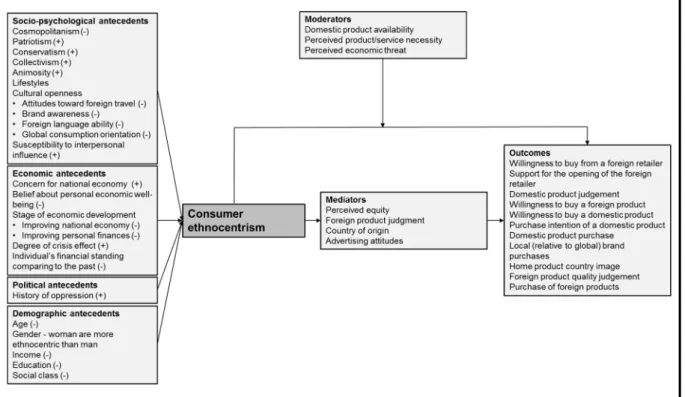
the antecedents into four broad categories: socio-psychological, political, economic and demographic. In the review the author also identified the mediators and moderators of the concept. An extended Figure (see Figure 4) with selected antecedents, mediators, moderators and outcomes is presented below to give a better overview of the focal concept in this thesis. Table 2 provides definitions of these concepts and sample studies that have dealt with each construct.
Figure 4: Overview of Antecedents, Moderators and Mediators of Consumer Ethnocentrism
Source: Adapted and extended from Shankarmahesh (2006)
Table 2: Selected Antecedents, Mediators, Moderators and Consequences of Consumer Ethnocentrism
Variable and definition Sign Examples of studies Socio-psychological antecedents
Cosmopolitanism – captures the extent to which “a consumer (1) exhibits an
open-mindedness towards foreign countries and cultures, (2) appreciates the diversity brought about by the availability of products from different national and cultural origins, and (3) is positively disposed towards consuming products from foreign countries”
(Riefler, Diamantopoulos, and Siguaw 2012, p. 287).
(–) Vida and Reardon (2008); Siamagka and Balabanis (2015); Cleveland, Laroche, and
Papadopoulos (2009); Riefler and Diamantopoulos (2009)
Variable and definition Sign Examples of studies Socio-psychological antecedents
Patriotism – “is commitment - a readiness
to sacrifice for the nation” (Druckman 1994,
pp. 47–48).
(+) Klein and Ettenson (1999); Balabanis et al. (2001); Javalgi et al. (2005); de Ruyter, van Birgelen, and Wetzels (1998);Vida and Reardon (2008); Sharma, Shimp, and Shin (1995); Shimp and Sharma (1987); Fernández-Ferrín et al. (2015)
Conservatism – is “a tendency to cherish
traditions and social institutions that have survived the test of time, and to introduce changes only occasionally, reluctantly, and gradually” (Sharma, Shimp, and Shin 1995,
p. 28).
(+) Javalgi et al. (2005); de Ruyter, van Birgelen, and Wetzels (1998); Sharma, Shimp, and Shin (1995); Shimp and Sharma (1987); Kottasz and Bennett (2006)
Collectivism – “stands for a society in which
people from birth onwards are integrated into strong, cohesive in-groups, which throughout people’s lifetime continue to protect them in exchange for unquestioning loyalty” (Hofstede 2001, p. 225).
(+) Javalgi et al. (2005); de Ruyter, van Birgelen, and Wetzels (1998); Sharma, Shimp, and Shin (1995); Kottasz and Bennett (2006) Animosity – is “the remnants of antipathy
related to previous or ongoing military, political, or economic events-will affect consumers' purchase behavior in the international market-place” (Klein, Ettenson,
and Morris 1998, p. 90).
(+) Klein and Ettenson (1999); Nijssen and Douglas (2004)
Lifestyles – “relates to how people live, how
they spend their money, and how they allocate their time among different types of activities” (Kaynak and Kara 2001, p. 458).
Kucukemiroglu, Harcar, and Spillan (2006); Kaynak and Kara (2001) Cultural openness – Individuals’
“experience with and openness toward the people, values, and artifacts of other cultures” (Sharma, Shimp, and Shin 1995,
p. 28).
0 / (–) Javalgi et al. (2005); Sharma, Shimp, and Shin (1995); Suh and Kwon (2002); Nijssen, Douglas, and Bressers (1999); Vida and Fairhurst (1999); de Ruyter, van Birgelen, and Wetzels (1998); Strizhakova, Coulter, and Price (2008); Kottasz and Bennett (2006) Attitudes toward foreign travel – Attitudes
towards any travel outside the borders of the country of an individual.
(–) Nijssen, Douglas, and Bressers (1999)
Brand awareness – “An individual’s
awareness of or familiarity with international brands served as an indicator of the individual’s cultural openness” (Vida and Fairhurst 1999, p.
325).
(–) Witkowski (1998); Vida and Fairhurst (1999)
Foreign language ability – Ability to speak any language used in a country other than one's own.
(–) Witkowski (1998)
Variable and definition Sign Examples of studies
Global consumption orientation – “four
sets of attitudinal responses to the global diffusion on consumption choices (1) assimilation/homogenization/
convergence; (2) separation/polarization; (3) hybridization/creolization/
glocalization; (4) lack of interest/
marginalization” (Alden, Steenkamp, and
Batra 2006, p. 228).
(–) Alden, Steenkamp, and Batra (2006); Guo (2013)
Susceptibility to interpersonal influence – It is “a general trait that varies across persons
and that a person's relative influence ability in one situation tends to have a significant positive relationship to his or her influence ability in a range of other social situations”
(Bearden, Netemeyer, and Teel 1989, p. 473).
(+) Siamagka and Balabanis (2015)
Economic antecedents
Concern for national economy (+) Klein and Ettenson (1999); Fernández-Ferrín et al. (2015); Festervand and Sokoya (1994) Belief about personal economic well-being (–) Klein and Ettenson (1999);
Festervand and Sokoya (1994) Stage of economic development Good and Huddleston (1995); Zhou
and Hui (2003); Supphellen and Grønhaug (2003); Klein and Ettenson (1999)
Improving national economy (–) Klein and Ettenson (1999) Improving personal finances (–) Klein and Ettenson (1999)
Degree of crisis effect (+) Witkowski (1998); Festervand and Sokoya (1994); Saffu and Walker (2005); Ang et al. (2004)
Individual’s financial standing comparing to the past
(–) Klein and Ettenson (1999)
Political antecedents
History of oppression (+) Good and Huddleston (1995)
Demographic antecedents
Age 0 / (–) Josiassen, Assaf, and Karpen (2011); Klein and Ettenson (1999); Good and Huddleston (1995); Sharma, Shimp, and Shin (1995); Javalgi et al. (2005); Vida and Fairhurst (1999); Ruyter, van Birgelen, and Wetzels (1998); Cleveland, Laroche, and
Papadopoulos (2009); Saffu and Walker (2005); Chryssochoidis, Krystallis, and Perreas (2007); Fernández-Ferrín et al. (2015)
Variable Sign Examples of studies
Gender Woman are more ethnocentric than man / no effect
Josiassen, Assaf, and Karpen (2011); Klein and Ettenson (1999); Kaynak and Kara (2001); Vida and Fairhurst (1999); Good and Huddleston (1995); Ruyter, van Birgelen, and Wetzels (1998); Sharma, Shimp, and Shin (1995); Saffu and Walker (2005);
Chryssochoidis, Krystallis, and Perreas (2007); Fernández-Ferrín et al. (2015)
Income 0 / (–) Josiassen, Assaf, and Karpen (2011); Klein and Ettenson (1999); Javalgi et al. (2005); Good and Huddleston (1995); Ruyter, van Birgelen, and Wetzels (1998); Cleveland, Laroche, and Papadopoulos (2009); Sharma, Shimp, and Shin (1995); Chryssochoidis, Krystallis, and Perreas (2007)
Education 0/(–) Javalgi et al. (2005); Good and Huddleston (1995); Ruyter, van Birgelen, and Wetzels (1998); Cleveland, Laroche, and Papadopoulos (2009); Sharma, Shimp, and Shin (1995); Saffu and Walker (2005); Chryssochoidis, Krystallis, and Perreas (2007); Fernández-Ferrín et al. (2015) Social class (–) Klein and Ettenson (1999);
Caruana (1996)
Mediators
Perceived equity Olsen, Granzin, and Biswas (1993) Foreign product judgement Klein, Ettenson, and Morris (1998);
Suh and Kwon (2002)
Country of origin Kucukemiroglu, Harcar, and Spillan (2006); Chryssochoidis, Krystallis, and Perreas (2007; Olsen, Granzin, and Biswas); Orth and Firbasová (2003); Balabanis and
Diamantopoulos (2004) Advertising attitudes Reardon et al. (2005)
Moderators
Perceived product/service necessity Sharma, Shimp, and Shin (1995); de Ruyter, van Birgelen, and Wetzels (1998)
Domestic product availability Nijssen, Douglas, and Bressers (1999)
Perceived economic threat Sharma, Shimp, and Shin (1995); de Ruyter, van Birgelen, and Wetzels (1998); Jo (1998)
Variable Sign Examples of studies Outcomes
Willingness to buy from a foreign retailer (–) Good and Huddleston (1995) Support for the opening of the foreign
retailer
(–) Zarkada-Fraser and Fraser (2002) Domestic product judgement 0 / (+) Huddleston, Good, and Stoel Leslie
(2001); Josiassen, Assaf, and Karpen (2011); Strizhakova and Coulter (2015); Verlegh (2007); Dmitrovic, Vida, and Reardon (2009); Fernández-Ferrín et al. (2015)
Willingness to buy domestic products 0 / (+) Verlegh (2007); Balabanis and Diamantopoulos (2004); Josiassen, Assaf, and Karpen (2011); Sharma (2011); Strizhakova and Coulter (2015); Fernández-Ferrín et al. (2015); Klein, Ettenson, and Krishnan (2006)
Willingness to buy foreign products 0 / (–) Josiassen, Assaf, and Karpen (2011); Shoham and Gavish (2016); Klein, Ettenson, and Morris (1998); Suh and Kwon (2002); Balabanis and Diamantopoulos (2004); Klein, Ettenson, and Krishnan (2006); Oberecker and Diamantopoulos (2011); Sharma (2011); Verlegh (2007)
Purchase intention of domestic products (+) Wang and Chen (2004) Domestic product purchase (+) Dmitrovic, Vida, and Reardon
(2009) Local (relative to global) brand purchases Supported in
high (vs. low) symbolic product categories
Strizhakova and Coulter (2015)
Foreign product judgement (–) / 0 Huddleston, Good, and Stoel Leslie (2001); Klein, Ettenson, and Krishnan (2006); Klein, Ettenson, and Morris (1998); Oberecker and Diamantopoulos (2011); Verlegh (2007); Oberecker and
Diamantopoulos (2011); Sharma (2011)
Home product country image (+) Jin et al. (2015)
Foreign product quality judgement (–) Shoham and Gavish (2016) Purchase of foreign products (–) / 0 Witkowski (1998)
2.5. Scales to Measure Consumer Ethnocentrism
Three scales in the literature (as far as the author is aware) measure consumer ethnocentrism. The first scale, developed by Shimp and Sharma (1987), is the most commonly applied tool in research to measure consumer ethnocentrism. The second and third scales are the new instruments proposed in the literature as multi-dimensional measurements of consumer ethnocentrism. The first recent scale is by Sharma (2015) and the second is by Siamagka and Balabanis (2015).
2.5.1. Consumer Ethnocentric Tendencies Scale
Shimp and Sharma (1987) observed that researchers only investigated the level of ethnocentrism in the studies that dealt with consumer behaviour. As a result there was no psychometrically rigorous scale that measured consumer ethnocentrism, and concretely, research was missing that jointly focused on the marketing phenomenon and consumer behaviour. Shimp and Sharma (1987) developed a scale to address this gap, which is currently the most commonly applied scale in the literature that deals with consumer ethnocentrism. They entitled the instrument CETSCALE, which stands for Consumer Ethnocentric Tendencies Scale.
The original CETSCALE was developed to measure consumers’ ethnocentric tendencies related to purchasing foreign as opposed to American-made products. In four separate studies, authors provided support that CETSCALE is reliable and has convergent and discriminant validity. The scale comprises 17 items (see Table 3 A for details on the measurement).
Table 3 A: Consumer Ethnocentric Tendencies Scale Scale items
American people should always buy American-made products instead of imports. Only those products that are unavailable in the US should be imported.
Buy American-made products. Keep America working. American products, first, last, and foremost.
Purchasing foreign-made products is un-American.
It is not right to purchase foreign products, because it puts Americans out of jobs. A real American should always buy American-made products.
We should purchase products manufactured in America instead of letting other countries get rich off us.
It is always best to purchase American products.
There should be very little trading or purchasing of goods from other countries unless out of necessity.
Americans should not buy foreign products, because this hurts American business and causes unemployment.
Scale items
Curbs should be put on all imports.
It may cost me in the long-run but I prefer to support American products. Foreigners should not be allowed to put their products on our markets. Foreign products should be taxed heavily to reduce their entry into the US.
We should buy from foreign countries only those products that we cannot obtain within our own country.
American consumers who purchase products made in other countries are responsible for putting their fellow Americans out of work.
Source: Shimp and Sharma (1987, p. 282)
Numerous studies were conducted after the CETSCALE was introduced to test the CETSCALE’s validity outside of the United States and to show that it is psychometrically valid across cultures. Reliability and one-dimensionality of the scale were established, for example, in the United States, France, Japan and West Germany by Netemeyer, Durvasula, and Lichtenstein (1991); in Korea by Sharma, Shimp, and Shin (1995); in Poland and in Russia by Good and Huddleston (1995) and in Malta by Caruana (1996).
The CETSCALE has been also used in a reduced form and has been proven to be a reliable and stable indicator across countries, for example, as a ten-item version by Steenkamp and Baumgartner (1998); as a six-item version by Klein, Ettenson, and Morris (1998) and as a five-item version by Nijssen and van Herk (2009).
Limitations of Consumer Ethnocentric Tendencies Scale
Despite its popularity and the rigorous psychometric and nomological tests, some scholars criticised the CETSCALE. They pointed out that the scale suffers from a number of limitations. This thesis notes three criticisms4.
The first criticism of the CETSCALE relates to its one-dimensionality. Although several scholars provided evidence that CETSCALE has only one dimension (see reference above), there are also studies that found that CETSCALE should be multi-dimensional (e.g., Hsu and Nien 2008; Acharya and Elliott 2003; Sharma 2015; Siamagka and Balabanis 2015; Upadhyay and Singh 2006). For example, in Australia Acharya and Elliott (2003) suggested that CETSCALE should be a two-dimensional construct and include emotional and rational ethnocentrism. In India Upadhyay and Singh (2006) established a four-dimensional structure comprising nationalism, socio-economic conservatism, protectionism and ultra-nationalism. In the Netherlands Douglas and
Nijssen (2003) found that a two-dimensional model consisting of one dimension dealing with the core ethnocentrism and the other with domestic product availability provided a better fit than the one-dimensional model. Similarly, Vida and Reardon (2008) claim that consumer ethnocentrism consists of three attitude elements (see chapter 2.3., part I): affective – the sense of belonging to one’s beloved country; cognitive – an individual’s knowledge about the effects of foreign competition on the domestic economy; and, lastly and most prevalent, normative – the consumption practices that are appropriate to prevent the negative effect on the domestic economy and domestic job market. As a result there is no consensus on the empirical structure of consumer ethnocentrism and its applicability.
Sharma (2015) proposed that scholars should apply a shorter version of the original CETSCALE to overcome the problem with dimensionality. However, Lindquist, Vida, and Plank (2001) tested whether a reduced ten-item CETSCALE is valid in the Czech Republic, Hungary and Poland. The authors found that a reduced version of the CETSCALE did not have a universal good fit. The best fit of the CETSCALE for Czech Republic included a seven-item scale, for Hungary a five-item scale and for Poland a six-item scale.
The second criticism pointed out by the scholars is the disconnect between the operationalisation of consumer ethnocentrism and its definition. Scholars argue that although consumer ethnocentrism is conceptualised as a set of beliefs, tendency and a trait-like property, this description is not reflected in the CETSCALE. CETSCALE mostly focuses on the socio-normative and economic aspects, in which the key focus is on rejecting foreign products due to their negative influence on the (American) economy (Sharma 2015; Siamagka and Balabanis 2015). Sharma (2015) observed that only one item (i.e., “it may cost me in the long run but I prefer to support American products”) out of 17 item scale captures the beliefs of an individual consumer. Siamagka and Balabanis (2015) also made this critique. The authors question whether the fact that CETSCALE only captures the general normative aspects and fails to capture believe systems and personal values does not raise a concern about the CETSCALE's validity.
The third and final major criticism of the CETSCALE that emerged from the literature relates to the response style bias and the social desirability bias (de Ruyter, van Birgelen, and Wetzels 1998). Social desirability refers to the tendency of respondents to present themselves favourably, while answering the survey in regards to the cultural norms. De Ruyter, van Birgelen, and Wetzels (1998) observe that the scores of the CETSCALE may be higher than the actual scores, because it is socially desirable to support the domestic economy and own country. Siamagka and Balabanis (2015)
further observe that some of the items in the CETSCALE are extreme, and some have strong leading statements (e.g., “foreigners should not be allowed to put their products on our markets” or “American products, first, last, and foremost”), which can lead to such a response bias.
2.5.2. Consumer Ethnocentrism Scale
The Consumer Ethnocentrism Scale, the first of the two recent scales, was developed by Piyush Sharma (2015)5, who recognised the weaknesses of the CETSCALE.
Contrary to Shimp and Sharma’s (1987) concept, this scholar reconceptualised consumer ethnocentrism into a multi-dimensional attitude construct. The proposed new construct contains three dimensions and, in total, comprises 18 items (see Table 3 B for details on the measurement). The first dimension is affective reactions: This captures emotional reactions to the domestic and foreign products and services. The second dimension is cognitive bias: It represents the evaluation bias in favour of the domestic products and services. The third dimension is behavioural preference: This represents acceptance of domestic products and services and more favourable buying intentions for these products and services.
Table 3 B: Consumer Ethnocentrism Scale Scale items
Affective reaction
I love the products and services from (home country).
I am proud of the products and services from (home country). I admire the products and services from (home country).
I feel attached to the products and services from (home country). I hate the products and services from foreign countries.
I despise the products and services from foreign countries.*
Cognitive bias
East or West, the products and services from (home country) are the best. Products from (home country) are examples of best workmanship.
Service providers from (home country) have the best work attitudes.
Products and services from foreign countries are no match for those from (home country). (Home country) has the hardest working people in manufacturing industry.
Service providers from (home country) are more caring than those in any foreign country.*
5 Subhash Sharma developed the original CETSCALE not Piyush Sharma.
Scale items
Behavioural preference
For me, it’s always the products from (home country) first, last and foremost. If I have a choice, I would prefer buying products and services from (home country). I prefer being served by service providers from (home country).
As far as possible, I avoid buying products and services from foreign countries. I often refuse to buy a product or service because it is from a foreign country.
I would much rather not buy a product or service, than buy one from a foreign country.*
* Items do not show metric invariance (equal factor loadings) across the groups Headings in bold relate to the name of the dimension within the scale
Source: Sharma (2015, p. 384)
Sharma (2015) followed the established scale development procedures to develop and test the revised scale and conducted two empirical consumer studies across four countries (China, India, United Kingdom and the United States) to prove scale’s reliability, validity and cross-cultural measurement invariance. He also tested the influence of consumers’ evaluations and behaviour in five product categories (family car, notebook computer, home furniture, luxury watch, and fine wine) and five service categories (air travel, retail banking, call centre, holiday resort, and personal healthcare). This allowed him to develop and validate a multi-dimensional revised scale. Sharma (2015) argues that the new scale is a more comprehensive and meaningful structure to measure consumer ethnocentrism than a one-dimensional scale, because it allows researchers to differentiate between the influences of the affective, cognitive and behavioural components of consumer ethnocentrism on consumers’ perceptions and evaluations of the foreign and domestic products and services. Moreover, the scale has both convergent and discriminant validity and cross-cultural measurement invariance, as it has been tested across diverse cross-cultural and socio-economic backgrounds.
Limitation of Consumer Ethnocentrism Scale
Sharma (2015) notes two limitations of the Consumer Ethnocentrism Scale. The first is that the instrument has been developed and tested based on adult shoppers in four countries that have varying cultural and socio-economic backgrounds. The second is that a potential limitation may arise from using double-barrelled items to capture consumer ethnocentrism towards products and services. Double-barrelled questions touch upon more than one issue but allow for only one answer. For example, one item reads, “as far as possible, I avoid buying products and services from foreign countries”; in this case, respondents with different attitudes towards products than towards services cannot properly express their answer on one Likert-like scale.