DOI 10.1007/s00221-007-1095-9
R E S E A R C H A R T I C L E
In
Xuence of galvanic vestibular stimulation on egocentric
and object-based mental transformations
Bigna Lenggenhager · Christophe Lopez · Olaf BlankeReceived: 1 November 2006 / Accepted: 1 August 2007 / Published online: 24 August 2007 © Springer-Verlag 2007
Abstract The vestibular system analyses angular and lin-ear accelerations of the head that are important information for perceiving the location of one’s own body in space. Vestibular stimulation and in particular galvanic vestibular stimulation (GVS) that allow a systematic modiWcation of vestibular signals has so far mainly been used to investigate vestibular inXuence on sensori-motor integration in eye movements and postural control. Comparatively, only a few behavioural and imaging studies have investigated how cognition of space and body may depend on vestibular pro-cessing. This study was designed to diVerentiate the inXu-ence of left versus right anodal GVS compared to sham stimulation on object-based versus egocentric mental trans-formations. While GVS was applied, subjects made left-right judgments about pictures of a plant or a human body presented at diVerent orientations in the roll plane. All sub-jects reported illusory sensations of body self-motion and/ or visual Weld motion during GVS. Response times in the mental transformation task were increased during right but not left anodal GVS for the more diYcult stimuli and the larger angles of rotation. Post-hoc analyses suggested that the interfering eVect of right anodal GVS was only present in subjects who reported having imagined turning them-selves to solve the mental transformation task (egocentric
transformation) as compared to those subjects having imag-ined turning the picture in space (object-based mental trans-formation). We suggest that this eVect relies on shared functional and cortical mechanisms in the posterior parietal cortex associated with both right anodal GVS and mental imagery.
Keywords Spatial cognition · Mental rotation · Subjective visual vertical · Strategy · Human
Introduction
The vestibular system detects angular and linear accelera-tions of the head in space. Even though most previous stud-ies on the human vestibular system focus on sensori-motor control of eye movements and posture, various studies in patients and healthy human subjects also suggest an impor-tant contribution of the vestibular system to cognitive aspects such as spatial and bodily cognition. Nevertheless, the underlying mechanisms are still largely unknown.
Clinical evidence suggests that peripheral vestibular loss leads to deWcits in spatial cognition such as spatial naviga-tion, learning or memory abilities (Brandt et al. 2005; Smith et al. 2005). Thus, patients with unilateral peripheral vestibular loss suVer from deWcits in path integration during active goal-directed locomotion (Glasauer et al. 2002; Peruch et al. 2005) and navigation in virtual environments (Peruch et al. 1999, 2005) suggesting that vestibular processing contributes to spatial cognition. Vestibular mechanisms have also been shown to be important for own body processing. For example a functional and anatomical relationship between spatial neglect subsequent to right hemispheric brain damage—leading to deWcits in spatial and bodily processing—and vestibular disturbances Electronic supplementary material The online version of this
article (doi:10.1007/s00221-007-1095-9) contains supplementary material, which is available to authorized users.
B. Lenggenhager · C. Lopez · O. Blanke (&)
Laboratory of Cognitive Neuroscience, Brain Mind Institute, Ecole Polytechnique Fédérale de Lausanne (EPFL), Station 15, 1015 Lausanne, Switzerland
e-mail: [email protected] B. Lenggenhager
has previously been discussed (for an overview see Karnath and Dietrich 2006). This link is supported by the fact that caloric vestibular stimulation and galvanic vestibular stim-ulation (GVS) may temporarily decrease symptoms of spa-tial neglect such as rightwards bias in visuo-spaspa-tial tasks (Cappa et al. 1987; Rode et al. 1992; Bottini et al. 2005) as well as symptoms of disturbed bodily awareness (Vallar
1998; Fink et al. 2003). Vestibular dysfunctions have also been reported in neurological patients with disturbed own body perceptions due to damage in the temporo-parietal cortex (Devinsky et al. 1989; Blanke et al. 2004). Direct electrical stimulation of this region may also induce out-of-body experiences (PenWeld and Erickson 1941; Blanke et al. 2002) as well as vestibular illusions (Blanke et al.
2002; Kahane et al. 2003) at similar stimulation sites. Col-lectively these Wndings suggest an important vestibular contribution to spatial and bodily processing (for review see Lenggenhager et al. 2006; Lopez and Blanke 2007).
Similarly, several studies have reported vestibular con-tributions to spatial and bodily processing in healthy sub-jects. Thus, it has been shown that visuo-spatial judgments such as line-bisection, visual vertical judgment and body orientation judgment (Fink et al. 2003; Mars et al. 2005), spatial memory (Bächtold et al. 2001), and mental transfor-mation (Mast and Meissner 2004; Mast et al. 2006) can be inXuenced by vestibular stimulation. Mast et al. (2006) showed that caloric vestibular stimulation leads to impaired performance in mental transformation tasks, but not in a control task using mental imagery.
Here we will focus on mental transformation since it is a spatial cognitive ability that may also rely on bodily pro-cessing. At least two diVerent kinds of mental transforma-tion have initially been described, object-based mental
transformation (Shepard and Metzler 1971) and egocentric
mental transformation (Parsons 1987). Only a few studies have directly investigated the inXuence of vestibular pro-cessing on either type of mental transformation (Mast et al.
2006; Mast and Meissner 2004). Mast and colleagues (2006) showed that performance in mental transformation is generally decreased during caloric vestibular stimulation. More interestingly for the scope of the present study, they showed that in an egocentric mental transformation task performance can be modiWed in a direction-speciWc way by vestibular stimulation during physical body rotations (Mast and Meissner 2004). In this study, subjects were more accu-rate when the direction of physical rotation and egocentric mental transformation were congruent, suggesting that ego-centric mental transformation shares mechanisms with physical body rotation. Thus, both actual and mental body transformation seem to rely on vestibular cues. This is fur-ther corroborated by the Wnding that egocentric mental transformations (imagined sensation of body motion) may induce a direction-speciWc vestibulo-ocular reXex
(Rodio-nov et al. 2004) and that performance in mental transforma-tion of pictures of human bodies and body parts decreases in microgravity (Grabherr et al. 2007). Collectively, these data suggest that egocentric mental transformation depends partly on vestibular processing.
The present study was designed to investigate the eVects of GVS on mental transformations. First, we were interested whether there is an overall decrease in performance in men-tal transformation tasks during GVS as compared to sham stimulation. Mast et al. (2006) reported impaired perfor-mance in a mental transformation task, but not in a non-spa-tial control task during caloric vestibular stimulation. GVS may interact with mental transformation due to overlapping and interfering neural mechanisms between GVS and mental transformation. The comparison to sham stimulation was chosen to control for attentional eVects due to skin/pain sen-sation. Second, we also investigated whether the direction of the illusory body motion induced by right and left GVS inXuences diVerently clockwise and counterclockwise men-tal transformations. Using binaural bipolar GVS it is possible to evoke illusory body motion to the right or the left by reversing electrode polarity (Fitzpatrick and Day 2004). Therefore, based on the results of Mast and Meissner (2004), we hypothesized that mental transformation performance might improve when the direction of the illusory body motion and mental transformation are congruent, but deterio-rate when incongruent. Third, we investigated whether object-based and egocentric mental transformations are diVerently inXuenced by GVS. Previous literature suggests that subjects tend to use an object-based mental transforma-tion (imagined rotatransforma-tion of the picture in space) when pictures of non-human objects are presented, but use an egocentric perspective-based mental transformation (imagined turning of oneself in space) for pictures of human bodies (Zacks and Tversky 2005). Based on these results and observations that egocentric perspective-based mental transformation seems to interact with vestibular processing (Rodinov et al. 2004; Mast and Meissner 2004), we hypothesized that the eVect of
GVS would be stronger for pictures representing a human body than a non-human object. Finally, we were interested whether left and right GVS would inXuence mental transfor-mation diVerently. Fink et al. (2003) found diVerent cerebral
activation patterns for left versus right GVS. During right anodal stimulation they found bilateral activations in supe-rior temporal, postesupe-rior insular and infesupe-rior parietal regions as well as right lateral occipito-parietal activations, whereas activations during left anodal GVS were conWned to the right hemisphere only (superior temporal gyrus, posterior insular cortex, anterior inferior parietal cortex). Therefore, based on the above-mentioned assumption of common and interfering neural mechanisms we hypothesised that left and right GVS could diVerently inXuence cortical mental transformation processes.
Material and methods Subjects
Eleven right-handed (Edinburgh handedness inventory; OldWeld 1971) volunteers (Wve females–six males,
23.3 § 4 years) without a history of neurological, psychiatric or vestibular disorders (as veriWed by questioning) partici-pated in this study. They all had normal or corrected-to-normal vision. Subjects had no prior experience with galvanic or caloric vestibular stimulation. Informed consent was obtained from all subjects prior to their inclusion in the study. The study protocol was approved by the local ethics research committee at the University of Lausanne and has been performed in accordance with the ethical standards laid down in the Declaration of Helsinki.
Galvanic vestibular stimulation
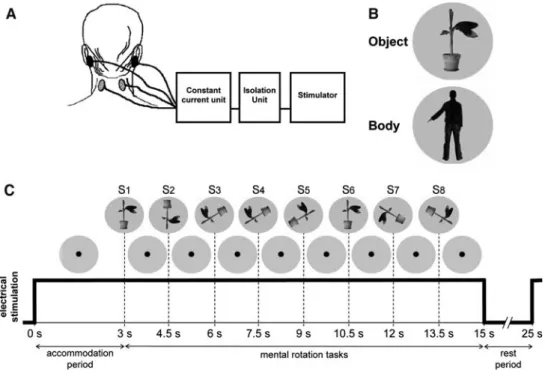
Galvanic vestibular stimulation (GVS) was applied using a bipolar, binaural conWguration. A stimulator (Model Grass S48, Astor-Med Inc, West Warwick, RI, USA) was used to deliver a square wave pulse through an isolation unit (Model Grass SIU5) and a constant current stimulus unit (Model Grass CCU1) to the electrodes (diameter, 10 mm; Grass Gold Electrodes). This setting provides a safe and constant current output with the anode on one side and the cathode on the other side (Fig.1a). For the GVS, the elec-trodes were placed on the left and right mastoid processes. We also introduced the principle of sham stimulation, as it is often used in transcranial magnetic stimulation (TMS)
studies (George et al. 1996; Pascual-Leone et al. 1996). The electrodes were placed on the left and right side of the neck »5 cm below the GVS electrodes. Right GVS refers to right anodal stimulation, and left GVS to left anodal stimu-lation. Using such a binaural bipolar conWguration, GVS is known to increase the Wring rate in vestibular aVerents on the cathodal side and to decrease the Wring rate on the anodal side (Goldberg et al. 1984). This change in the Wring rate has been associated with illusory movements of both own body (Mars et al. 2005; Fitzpatrick et al. 2002) and visual Weld (Zink et al. 1998).
The individual threshold for stimulation was determined by progressively increasing the current amplitude (step size of 0.1 mA) separately for right and left GVS as well as for sham stimulations. For GVS, the current amplitude was Wrst pro-gressively increased until the subjects (who were naïve to the eVects of GVS) reported vestibular sensations. Then, account-ing for the fact that higher current amplitudes lead to stronger vestibular eVects, the amplitude was further increased to the maximal current amplitude at which skin sensations were still judged as tolerable. The mean current amplitude was 1.0 § 0.2 mA and did not diVer between right and left GVS. For the sham stimulation no vestibular sensation was elicited and thresholds were Wxed so that subjects reported approxi-mately the same intensity of pain or heat sensation on the skin as during the GVS. The mean current was 0.6 § 0.2 mA. Visual stimuli
All stimuli were presented on a high-resolution computer screen (1,280 £ 1,024 pixels) at 1 m distance from the subject
Fig. 1 Stimuli and experimen-tal set-up. a For bipolar, binaural galvanic vestibular or sham stimulation an electrical stimula-tor was used to deliver a square wave pulse through an isolation unit and a constant current stim-ulus unit to the two output elec-trodes. b Object and body stimuli presented during the mental transformation task. c Each trial consisted of a 15 s galvanic stimulation. After an accommodation period of 3 s (with Wxation point), eight pictures of either the plant or the body were shown
in a completely darkened and noise-isolated room. The frame of the computer screen was covered in order to nar-row the visual Weld to the intended visual scene and to elim-inate any horizontal and vertical reference cues.
To measure the subjective visual vertical, a white dotted line (15 cm in length subtending 8.6° of the visual Weld) was presented on the screen. The initial position in which the line was shown was either tilted counterclockwise (two trials) or clockwise (two trials) at a randomly chosen angle (in the range of §4° with respect to the gravitational verti-cal).
In the mental transformation task, greyscale pictures of a plant and of a human body (seen from the back) were used (Fig.1b). The plant had a big leaf extended to the right or to the left alternatively while the human body showed either an extended left or right arm. Both stimuli subtended 9° and 11.3° of visual Weld in the horizontal and vertical direc-tions, respectively. Matlab (Mathworks Inc., Natick, MA, USA) with Psychophysics Toolbox v2.54 (Brainard 1997; Pelli 1997) was used for stimulus presentation. Stimuli were presented in six diVerent orientations (0°, 60°, 120°, 180°, 240°, and 300°) in the picture plane. We chose trans-formation in the roll plane because GVS is known to pre-dominantly evoke illusory motion of both body and visual Weld in the roll plane (Fitzpatrick and Day 2004). Picture rotations of 240° and 300° correspond to counterclockwise rotations of 120° and 60°, respectively.
Experimental procedures
One experimental session lasted about one hour and con-sisted of 4 blocks. Each block concon-sisted of a diVerent type of stimulation (GVS with anode left or right; sham stimula-tion with anode left or right). The sequence of blocks varied randomly across subjects. Within each block the following procedure was used:
First, the subjective visual vertical was measured. The line was presented four times while a rectangular current of 10 s was applied. During these 10 s, subjects were asked to move the line (in 0.2°-steps) clockwise or counterclockwise by pressing a corresponding right or left keyboard button until they judged the line to be vertically oriented. After the 10 s trial ended, subjects closed their eyes until the start of the next trial to avoid any kind of visual feedback of their previous visual vertical judgment that could have inXu-enced the subsequent trial.
Next, we carried out the mental transformation task (six trials with body pictures; six trials with plant pictures). During each trial, GVS was applied for 15 s (during which the visual stimuli were presented) and followed by a 10 s rest period without galvanic stimulation (Fig.1c). Each trial contained 8 pictures. The Wrst stimulus was presented after an accommodation phase of 3 s in each trial (see Mars et al.
2005). Each stimulus was presented for 300 ms and a Wxa-tion point was shown between stimuli (interstimulus inter-val: 1.5 s). Blocks of body and plant pictures as well as the sequence of pictures within the trial were randomized. In total, this design led to eight stimuli repetitions for each angle of each object per stimulation (total of 96 stimulus presentations per block). Subjects had to indicate with their right hand as fast and as accurately as possible if the right or left hand/leaf was extended. Response time and accuracy were collected with a response box. Two practice sessions were done at the beginning of the experiment to minimize training eVects during the diVerent blocks of the experi-mental session.
Questionnaires
After the experimental sessions, participants Wlled out a questionnaire focused on determining the strategies they used in the mental transformation task (modiWed after Zacks and Tversky 2005). For body and for plant pictures, subjects were asked whether they had performed an object-based transformation (I imagined the picture turning), an egocentric transformation (I imagined myself turning), another strategy, or no strategy at all.
Subjects were also given a detailed questionnaire that inquired about the subjective experiences during GVS (modiWed and extended after Stephan et al. 2005; MacDou-gall et al. 2006, see electronic supplementary material). This questionnaire included questions about strength, direc-tion and temporal characteristics of the illusory visual Weld and own body movements as well as the aVected body part(s) in the latter. Additionally, we asked subjects about the strength of the experienced side eVects during GVS as previously described in the literature (the questionnaire included a modiWed version of the Simulator Sickness Questionnaire of Lane and Kennedy 1988). In total, sub-jects answered 65 questions.
Data acquisition and processing
The mean subjective visual vertical (in degrees) was calcu-lated by averaging the four consecutive values for each type of stimulation and each participant.
For the mental transformation task, two dependent vari-ables were measured: the error rate and the response time (in ms). Since the mean error rate over all conditions was less than 2.5%, only response times were further analysed. Response times of correct trials were analysed using repeated-measures analyses of variance (ANOVAs) with the variables Type of Stimulation (GVS, sham stimulation), Side of Stimulation (right, left), Object (body, plant), Stim-ulus Orientation (clockwise, counterclockwise) and Angle of Rotation (0°, 60°, 120°, 180°) as within-subject factors.
Supplementary ANOVAs were performed with the mental transformation Strategy (object-based transformation, ego-centric transformation) used by the subjects as a between-subject factor and the above mentioned within-between-subject fac-tors. Post-hoc paired t tests were used to further analyse the signiWcant eVects on the ANOVAs. Results were consid-ered statistically signiWcant for P < 0.05.
Results
Subjective experiences during GVS and side eVects All subjects reported vestibular eVects during GVS. Most subjects reported a sensation of body tilt in the roll (72%) or yaw (18%) planes, mainly felt for the head. Motion of the visual Weld was experienced either as swaying (36%), translation to a Wxed distance (36%), or rotation to a Wxed angle (55%). With respect to the temporal characteristics of the perceived body motion, subjects reported GVS sensa-tions as continuous (36%), progressive (27%), intermittent (18%), decreasing (18%), or other (55%).
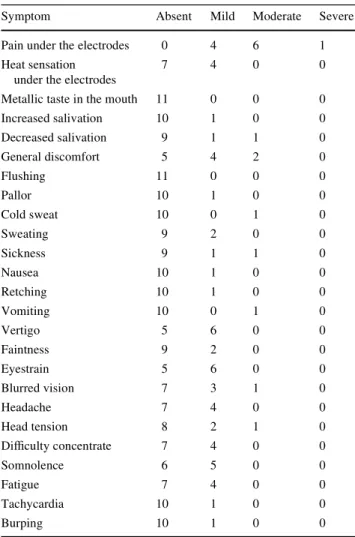
Concerning side eVects of GVS (Table1), 91% of the subjects reported mild or moderate sensations of pain on the skin at the site of the anode. Frequent side eVects were general discomfort (55%), mild vertigo (55%), eyestrain (55%), blurred vision (36%), headache (36%), head full-ness (36%) and diYculty concentrating (36%).
Subjective visual vertical
Without stimulation, the subjective visual vertical was judged at 0.4° § 0.9°. This was systematically changed by right (0.5° clockwise) and left GVS (0.4° counterclockwise, Fig.2). Repeated-measures ANOVA on the visual vertical deviations showed a main eVect of the Side of Stimulation [F(1,10)= 8.4, P < 0.05] and an interaction eVect of Type of Stimulation £ Side of Stimulation [F(1,10)= 5.7, P < 0.05] indicating that the diVerent types of stimulation inXuenced the perceived visual vertical diVerently as function of the stimulated side. Detailed analyses showed that right GVS caused a signiWcant tilt of the perceived visual vertical towards the anode (clockwise tilt) compared to the right sham stimulation (t = 3.13, P < 0.05) as well as to the con-dition without stimulation (t = 3.07, P < 0.05). Finally, right and left sham stimulations did not signiWcantly inXu-ence the perception of the visual vertical.
Performances in the mental transformation tasks
To test our hypotheses we Wrst employed a Wve-way ANOVA with the within-subject factors Type of Stimula-tion (GVS, sham stimulaStimula-tion), Side of StimulaStimula-tion (left,
right), Object (human, plant), Stimulus Orientation (clockwise, counterclockwise) and Angle of Rotation (60°, 120°).1
InXuence of the angle of stimuli rotation
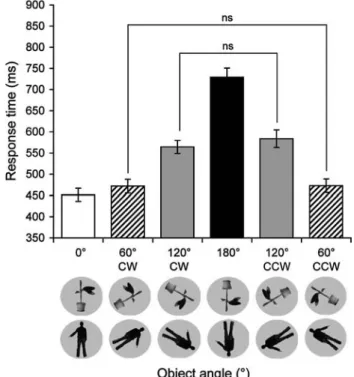
We found a signiWcant eVect of Angle of rotation [F(1,10)= 83.82, P < 0.001] showing longer response times for 120° compared to 60° rotations. No main eVect of Stimulus Orientation was observed suggesting symmetrical response times for clockwise and counterclockwise rotations [F(1,10)= 3.00, P = 0.12]. The main eVect of the Angle of Rotation remained highly signiWcant when all six angles were taken
1 The upright (0°) and the upside-down conditions (180°) were not
included in this Wrst ANOVA since they cannot be assigned to either a clockwise or counterclockwise Stimulus Orientation and subjects reported having used other strategies than mental rotation for the 180°angle (see below).
Table 1 Side eVects of galvanic vestibular stimulation
The table shows the side eVects of galvanic stimulation assessed by questionnaire. The values refer to the absolute number of subjects reporting a side eVect
Symptom Absent Mild Moderate Severe
Pain under the electrodes 0 4 6 1
Heat sensation under the electrodes
7 4 0 0
Metallic taste in the mouth 11 0 0 0
Increased salivation 10 1 0 0 Decreased salivation 9 1 1 0 General discomfort 5 4 2 0 Flushing 11 0 0 0 Pallor 10 1 0 0 Cold sweat 10 0 1 0 Sweating 9 2 0 0 Sickness 9 1 1 0 Nausea 10 1 0 0 Retching 10 1 0 0 Vomiting 10 0 1 0 Vertigo 5 6 0 0 Faintness 9 2 0 0 Eyestrain 5 6 0 0 Blurred vision 7 3 1 0 Headache 7 4 0 0 Head tension 8 2 1 0 DiYculty concentrate 7 4 0 0 Somnolence 6 5 0 0 Fatigue 7 4 0 0 Tachycardia 10 1 0 0 Burping 10 1 0 0
into account [F(1,10)= 81.18, P < 0.001] (Fig.3). The men-tal rotation rates were 653°/s for bodies and 680°/s for objects which are similar to previously reported rates for mental transformation tasks (Cooper 1975).
InXuence of the object presented
Our data indicate that mental transformation of the plant (mean response time: 553 § 50 ms) was more diYcult than mental transformation of the body [538 § 49 ms;
F(1,10)= 31.21, P < 0.001]. This is also in agreement with results of our questionnaire, showing that 55% of the sub-jects considered mental transformation of the plant more diYcult than that of the body while only 18% reported the opposite.
InXuence of the type and side of stimulation
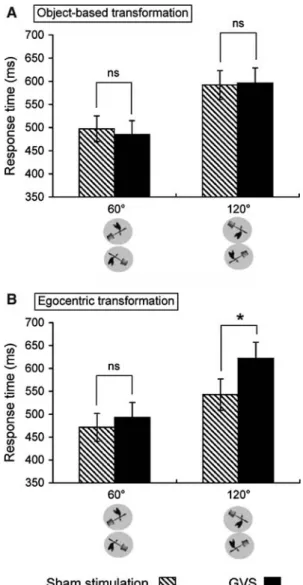
Figure4 represents the eVects of right and left GVS as
compared to sham stimulations on response times in the conditions requiring larger mental transformations. Data show that response times signiWcantly increased only dur-ing right GVS and for angles of 120°. No comparable eVect was found for left GVS or right GVS at 60°. This was re X-ected in a signiWcant four-way interaction of Type of stimulation £ Side of stimulation £ Object £ Angle of rotation [F(1,10)= 8.92, P < 0.05]. For the plant, post-hoc tests showed that response times were signiWcantly increased during right GVS (as compared to right sham
stimulation), especially for large angles of rotation [F(1,10)= 8.05, P < 0.05, Fig.4a]. Left GVS did not induce such an eVect [F(1,10)= 0.46, P = 0.51, Fig.4b]. Together, these data suggest that only the right GVS interferes with mental transformation and that this eVect is observed only for the most diYcult object (plant) and angle of rotation (120°).
InXuence of the mental transformation strategy
As vestibular processing has been linked to egocentric-per-spective changes and our subjects showed individual diVer-ences with respect to the strategy that was employed for mental transformation, we also tested whether interference of GVS with mental transformation diVered in subjects employing an egocentric mental transformation than in sub-jects employing an object-based mental transformation.
In the questionnaire on mental transformation strategies 55% of the subjects (n = 6) described that they performed an object-based mental transformation (imagined turning of the image) for pictures of body and plant. The remaining subjects (n = 5) reported an egocentric mental transforma-tion (imagined turning of themselves). All subjects reported having used the same strategy for the pictures of the body and the plant. In addition, 45% of the subjects (n = 5) reported spontaneous use of a diVerent strategy for pictures Fig. 2 InXuence of GVS on the subjective visual vertical. Mean
sub-jective visual vertical (§standard error to the mean, vertical bars) are shown for each type and side of stimulation. Positive values are corre-sponding to a counterclockwise deviation (in degree), negative values
to a clockwise deviation. * SigniWcant statistical diVerence (P < 0.05) Fig. 3 Inmean response time in milliseconds (§standard error to the mean, ver-Xuence of the angle of rotation. The histogram shows the tical bars) averaged over body and plant stimuli for each angle of rota-tion (CW clockwise, CCW counterclockwise). The main eVect of angle revealed a typical mental rotation function
presented upside-down (180°) than for the other angles by just mirroring the body/plant in respect to the median verti-cal axis of the picture and pressing on the left button if the arm/leaf was on the right, and vice-versa.
We thus analyzed the performance of both subpopula-tions of subjects by including Strategy as a between-subject factor in the above-described ANOVAs. For right GVS, we found a signiWcant interaction Strategy £ Type of stimula-tion [F(1,9)= 7.10, P < 0.05] for pictures of plant (Fig.5), and a trend for pictures of body [F(1,9)= 4.10, P = 0.074]. Post-hoc analyses suggest that the described interfering eVect of right GVS on the mental transformation exists mainly in subjects employing an egocentric mental trans-formation strategy because only this subpopulation showed
a signiWcant diVerence between GVS and sham stimulation (t = 2.9, P < 0.05, compared to t = 0.6, P = 0.55).
Discussion
This study investigated the inXuence of vestibular process-ing and illusory own body motion on mental transforma-tion. Performance in mental transformation tasks during GVS were compared to performance during sham stimula-tion (a control condistimula-tion for attenstimula-tional inXuence). We tested whether there is an eVect of right versus left GVS on mental transformation, whether a diVerent inXuence of GVS exists for egocentric versus object-based mental trans-formation, and whether speciWc directional eVects exist when the direction of illusory self-motion and mental trans-formation are congruent.
General inXuence of galvanic vestibular stimulation versus sham stimulation
Our data show increased response times for objects pre-sented at larger angles of rotation when applying right anodal GVS. We could not observe the directional eVects of GVS on mental transformation as reported by Mast and Meissner (2004). This speaks for a more general eVect of
GVS on mental transformation due to overlapping and interfering cortical networks. A similar decrease in perfor-mance due to vestibular-spatial interaction eVects has been found in other studies that used vestibular stimulation in combination with speciWc cognitive tasks (Fink et al. 2003; Mars et al. 2005). Brain imaging studies suggest that areas in the posterior parietal cortex involved in mental transfor-mation (Kosslyn et al. 1998; Zacks et al. 1999) are also activated during GVS-induced illusory body motion (Lobel et al. 1998; Stephan et al. 2005). Therefore, GVS activation of these areas presumably interferes and impairs mental transformation, corroborating Wndings of Mast et al. (2006) who showed that caloric vestibular stimulation had a dis-ruptive eVect on mental transformation but not on a cogni-tive control task not involving spatial imagery.
InXuence of the mental transformation strategy
Our data suggest that the disturbing eVects of GVS are only present in subjects who performed egocentric mental trans-formation and not object-based mental transtrans-formation. This suggests that mental transformation simulates the proper-ties of physical egocentric transformation, since real body movements involve vestibular processes whereas physical object transformation does not. The results are in line with previous observations showing that egocentric mental transformation is inXuenced by actual vestibular stimula-Fig. 4 InXuence of the side of stimulation. The histograms show the
mean response time in milliseconds (§standard error to the mean, ver-tical bars) for the plant presented at 60° and 120° (averaged over clock-wise and counterclockclock-wise stimuli) during (a) right and (b) left anodal galvanic vestibular stimulation compared to right and left sham stimu-lation
tion during physical body rotations (Mast and Meissner
2004) and that egocentric mental transformation inXuences
vestibulo-ocular functions (Rodinov et al. 2004). DiVering
from earlier Wndings (Parsons 1987; Zacks and Tversky
2005), the strategy our subjects used did not depend on the visually presented stimuli (plant or human body). Our sub-jects indicated the use of either an object-based mental transformation (55%) or an egocentric perspective-based mental transformation (45%) for both types of pictures. This suggests that mental transformation depends more on idiosyncratic selection of a strategy involving either ego-centric or alloego-centric references, thereby corroborating evidence from studies on spatial navigation (Wraga et al.
2005) and theories of vicarious processing in spatial cogni-tion (Ohlmann and Marendaz 1991).
What are the anatomical substrates of speciWc interac-tions between GVS and egocentric mental transformation? Several neuroimaging studies in healthy subjects have shown that cerebral activations associated with egocentric and object-based strategies can be diVerentiated during spa-tial navigation (Jordan et al. 2002; Hartley et al. 2003) and mental transformation (Zacks and Tversky 2005). The exact anatomical location of these mental transformation processes is still controversial and seems to depend on additional variables such as sex, handedness, task diYculty and the control task (Kosslyn et al. 1998; Jordan et al.
2002). Nevertheless, as described in a meta-analysis by Zacks and Michelon (2005), object-based transformation would rely predominantly on unilateral right fronto-parietal cortex, while egocentric transformation would involve a more bilateral network (temporo-parieto-occipital junc-tion; superior parietal lobule) with either right or left hemi-spheric predominance (Vallar et al. 1999; Zacks et al. 1999; Creem et al. 2001; Vogeley and Fink 2003; Blanke et al.
2005). Thus, the more bilateral cortical network activated by right GVS (see below) may interfere more strongly with mental transformation employing egocentric transformation. DiVerences between right and left galvanic
vestibular stimulations
The results of this study indicate that only the right GVS interfered with mental transformation. This Wnding was fur-ther conWrmed by the eVects on the subjective visual vertical (only right GVS led to a signiWcant deviation, see below). This selective eVect was not due to diVerent current ampli-tudes applied during right versus left GVS. We therefore sug-gest that either a functional asymmetry of the peripheral vestibular apparatus exists or, more likely, a set of common neural mechanisms between right GVS and mental transfor-mation exists that may be responsible for this eVect.
Concerning the functional asymmetry of the peripheral vestibular system, several studies have suggested asymmet-rical eVects of left and right GVS even on basic parameters such as eye movements and postural control (Quark et al.
1998; Bent et al. 2000). However, the data on such periph-eral asymmetries are contradictory, with some authors reporting a dominance of the left (Lacour et al. 1974), some the right (Quark et al. 1998) vestibular apparatus, or even a symmetrical sensitivity for both ears (Zink et al. 1998).
With respect to the hypothesis of a set of common neural mechanisms between right GVS and mental transformation, our result may be due to more extensive overlap and inter-ference of brain regions activated by right GVS (as opposed to left) with brain regions involved in mental transforma-tion. In an fMRI study, Fink et al. (2003) compared the cortical activation associated with right versus left GVS using a similar stimulation protocol as in the present study. Fig. 5 InXuence of the mental transformation strategy. The
histo-grams show the mean response time in milliseconds (§standard error to the mean, vertical bars) for the plant presented at 60° and 120° (averaged over clockwise and counterclockwise stimuli) for subjects using (a) an object-based versus (b) an egocentric mental transforma-tion strategy
These authors found that right anodal GVS involved a bilat-eral hemispheric activation of the superior temporal gyrus, posterior insula, anterior inferior parietal cortex, as well as right lateral occipito-parietal activation, whereas activa-tions during left anodal GVS were conWned to the right hemisphere only (superior temporal gyrus, posterior insula, anterior inferior parietal cortex). As mental transformation has been shown to rely on bilateral parietal and temporo-occipital activations (bodies: Zacks et al. 1999; Creem et al.
2001; Blanke et al. 2005, objects: Kosslyn et al. 1998; Vingerhoets et al. 2001), we speculate that bilateral activa-tions due to right GVS interfere more strongly with bilat-eral activations during mental transformation in superior temporal gyrus, posterior insula, and inferior parietal cor-tex. Interference of right GVS at these sites might thus lead to the observed decrease in task performance.
The diVerential eVects between left and right GVS on mental transformations in the present study were conWrmed by the results of the visual vertical judgments. Only right anodal GVS inXuenced the perception of the vertical signiW-cantly, evidenced by a clockwise deviation of the subjective visual vertical. Given that the amplitude of the visual vertical deviation depends on current intensity (Mars et al. 2005), and that we used small current amplitudes compared to previous studies, our values appear to be consistent with that of previ-ous Wndings (Zink et al. 1998; Mars et al. 2005). A
signiW-cantly stronger inXuence of right GVS on the subjective visual vertical has also been reported in patients with right parietal damage (Saj et al. 2006). Moreover, the brain regions involved in the visual vertical judgment [a bilateral fronto-parieto-occipital network including inferior frontal cortex, anterior insula and posterior parietal cortex (Lopez et al.
2005)] would be more aVected by right than left GVS.
Limitations
While this study revealed disruptive eVects of GVS on men-tal transformation, the eVects were rather small and speciWc. We believe that this is mainly due to the low intensity and heterogeneous eVects of GVS and/or due to a too low task diYculty (error rate smaller than 2.5%). The large number of stimulus repetitions required the use of a relatively weak mean current of about 1 mA, probably resulting in a reduced strength of overall illusory body motion. The two previous studies that showed vestibular inXuence on mental transformation used actual body rotation (Mast and Meiss-ner 2004) or caloric vestibular stimulation (Mast et al.
2006), both of which yielded stronger vestibular sensations. Additionally, important inter-individual diVerences in the direction, amplitude and temporal characteristics of the illu-sory movements due to GVS were reported. MacDougall et al. (2002) suggested that these diVerences result from the unnatural stimulation of all semicircular and otolith organs
simultaneously and from individual diVerences in the inter-pretation of these uncommon vestibular stimuli. The fact that not all subjects reported illusory movement could also account for the lack of direction-speciWc eVects in this study. This is further confounded by the fact that subjects used diVerent mental rotation strategies, and that the direc-tion of the mental transformadirec-tion diVered across subjects. For example, for a stimulus angle of 60° clockwise, subjects using an egocentric strategy would imagine turning their body rightwards while subjects using an object-based trans-formation would imagine turning the picture leftwards.
Conclusion
Although the interaction between GVS and mental transfor-mation was not as strong as assumed based on previous lit-erature, this study reveals novel results concerning the contribution of the vestibular system to high level spatial and bodily processing. The results suggest that GVS may impair demanding mental transformation tasks. This is mainly true for right GVS and for egocentric mental trans-formation, suggesting a shared neural processing in the pos-terior parietal cortex.
Based on these results several implications for further studies can be derived: Studies on the eVects of GVS and bodily and spatial processing should consider sham lation as it is routinely used in transcranial magnetic stimu-lation studies. Task complexity should generally be high enough in order to observe potential GVS eVects, and these eVects should further be investigated by systematically manipulating task diYculty. Since we found diVerences between left and right GVS, future studies should also investigate GVS over both mastoids separately. Moreover, for mental transformation tasks it would be interesting to assess and manipulate mental transformation strategies, since they seem to rely on diVerent neural processes. Finally, to test our hypothesis of a shared brain mechanism between right GVS and mental transformation it would be important to combine neuroimaging with GVS as done pre-viously to demonstrate this common neural substrate between GVS and line bisection (Fink et al. 2003).
Acknowledgments This work was supported by the Cogito Founda-tion, the Fondation de Famille Sandoz, the Fondation Odier de Psych-ophysique, and the Swiss National Science Foundation. We thank Pär Halje for the programming of the stimuli and Dr. Raphaël Holzer for technical assistance.
References
Bächtold D, Baumann T, Sandor PS, Kritos M, Regard M, Brugger P (2001) Spatial- and verbal-memory improvement by cold-water caloric stimulation in healthy subjects. Exp Brain Res 136:128–132
Bent LR, McFadyen BJ, Merkley VF, Kennedy PM, Inglis JT (2000) Magnitude eVects of galvanic vestibular stimulation on the trajec-tory of human gait. Neurosci Lett 279:157–160
Blanke O, Landis T, Spinelli L, Seeck M (2004) Out-of-body experi-ence and autoscopy of neurological origin. Brain 127:243–258 Blanke O, Mohr C, Michel CM, Pascual-Leone A, Brugger P, Seeck
M, Landis T, Thut G (2005) Linking out-of-body experience and self processing to mental own-body imagery at the temporopari-etal junction. J Neurosci 25:550–557
Blanke O, Ortigue S, Landis T, Seeck M (2002) Stimulating illusory own-body perceptions. Nature 419:269–270
Bottini G, Paulesu E, Gandola M, LoVredo S, Scarpa P, Sterzi R, Sant-illi I, Defanti CA, Scialfa G, Fazio F, Vallar G (2005) Left caloric vestibular stimulation ameliorates right hemianesthesia. Neurol-ogy 65:1278–1283
Brainard DH (1997) The psychophysics toolbox. Spatial Vision 10:443–446
Brandt T, Schautzer F, Hamilton DA, Bruning R, Markowitsch HJ, Ka-lla R, Darlington C, Smith P, Strupp M (2005) Vestibular loss causes hippocampal atrophy and impaired spatial memory in hu-mans. Brain 128:2732–2741
Cappa S, Sterzi R, Vallar G, Bisiach E (1987) Remission of hemine-glect and anosognosia during vestibular stimulation. Neuropsych-ologia 25:775–782
Cooper L (1975) Mental rotation of random two-dimensional shapes. Cogn Psychol 7:20–43
Creem SH, Downs TH, Wraga M, Harrington GS, ProYtt DR, Downs JH 3rd (2001) An fMRI study of imagined self-rotation. Cogn AVect Behav Neurosci 1:239–249
Devinsky O, Feldmann E, Burrowes K, BromWeld E (1989) Autoscop-ic phenomena with seizures. Arch Neurol 46:1080–1088 Fink GR, Marshall JC, Weiss PH, Stephan T, Grefkes C, Shah NJ,
Zil-les K, Dieterich M (2003) Performing allocentric visuospatial judgments with induced distortion of the egocentric reference frame: an fMRI study with clinical implications. Neuroimage 20:1505–1517
Fitzpatrick RC, Day BL (2004) Probing the human vestibular system with galvanic stimulation. J Appl Physiol 96:2301–2316 Fitzpatrick RC, Marsden J, Lord SR, Day BL (2002) Galvanic
vestib-ular stimulation evokes sensations of body rotation. Neuroreport 13:2379–83
George MS, Wassermann EM, Post RM (1996) Transcranial magnetic stimulation: a neuropsychiatric tool for the 21st century. J Neuro-psychiatry Clin Neurosci 8:373–382
Glasauer S, Amorim MA, Viaud-Delmon I, Berthoz A (2002) DiVer-ential eVects of labyrinthine dysfunction on distance and direction during blindfolded walking of a triangular path. Exp Brain Res 145:489–497
Grabherr L, Bach S, Indermaur K, Metzler S, Mast F (2007) Mental transformations of bodies and body-parts in microgravity. J Vest Res (in press)
Hartley T, Maguire EA, Spiers HJ, Burgess N (2003) The well-worn route and the path less traveled: distinct neural bases of route fol-lowing and wayWnding in humans. Neuron 37:877–888 Jordan K, Wustenberg T, Heinze HJ, Peters M, Jancke L (2002)
Wom-en and mWom-en exhibit diVerWom-ent cortical activation patterns during mental rotation tasks. Neuropsychologia 40:2397–2408 Kahane P, HoVmann D, Minotti L, Berthoz A (2003) Reappraisal of
the human vestibular cortex by cortical electrical stimulation study. Ann Neurol 54:615–624
Karnath HO, Dieterich M (2006) Spatial neglect-a vestibular disorder? Brain 129:293–305
Kosslyn SM, DiGirolamo GJ, Thompson WL, Alpert NM (1998) Mental rotation of objects versus hands: neural mechanisms re-vealed by positron emission tomography. Psychophysiology 35:151–161
Lacour M, Bonnet M, Roll JP (1974) [Spinal eVects of electric vestib-ular stimulation in man. Demonstrated evidence of vestibvestib-ular prevalence and role in motion laterality]. Acta Otolaryngol 78:399–409
Lane NE, Kennedy, RS (1988) A new method for quantifying simula-tor sickness: development and application of the simulasimula-tor sick-ness questionnaire (SSQ). Technical Report No. EOTR 88-7, Essex Corporation, Orlando
Lenggenhager B, Smith S, Blanke O (2006) Functional and neural mechanisms of embodiment: Importance of the vestibular system and the temporal parietal junction. Rev Neurosci 17:643–657 Lobel E, Kleine JF, Bihan DL, Leroy-Willig A, Berthoz A (1998)
Functional MRI of galvanic vestibular stimulation. J Neurophys-iol 80:2699–2709
Lopez C, Blanke O (2007) Neuropsychology and neurophysiology of self-consciousness. Multisensory and vestibular mechanisms. In: Holderegger A, Sitter-Liver B, Hess CW (eds) Hirnforschung und Menschenbild. Beiträge zur interdisziplinären Verständigung. Schwabe, Basel
Lopez C, Lacour M, Ballester M, Dumitrescu M, Anton J-L, Nazarian B, Roth M, Borel L (2005) Brain activations during subjective vi-sual vertical judgment: a functional magnetic resonance imaging study. Gait and Posture 21(Suppl 1):13
MacDougall HG, Brizuela AE, Burgess AM, Curthoys IS (2002) Be-tween-subject variability and within-subject reliability of the hu-man eye-movement response to bilateral galvanic (DC) vestibular stimulation. Exp Brain Res 144:69–78
MacDougall HG, Moore ST, Curthoys IS, Black FO (2006) Modeling postural instability with Galvanic vestibular stimulation. Exp Brain Res 172:208–220
Mars F, Vercher JL, Popov K (2005) Dissociation between subjective vertical and subjective body orientation elicited by galvanic vestibular stimulation. Brain Res Bull 65:77–86
Mast FW, Meissner F (2004) Mental transformations of perspective during whole-body roll-rotation. J Vestib Res 14:113
Mast FW, Merfeld DM, Kosslyn SM (2006) Visual mental imagery during caloric vestibular stimulation. Neuropsychologia 44:101– 109
Ohlmann T, Marendaz C (1991) Vicarious processes involved in spa-tial perception. In: Wapner S (ed) Bio-psycho-social factors in cognitive style. Lawrence Erlbaum, Hillsdale, pp 106–129 OldWeld RC (1971) The assessment and analysis of handedness: the
Edinburgh inventory. Neuropsychologia 9:97–113
Parsons LM (1987) Imagined spatial transformation of one’s body. J Exp Psychol Gen 116:172–191
Pascual-Leone A, Rubio B, Pallardo F, Catala MD (1996) Rapid-rate transcranial magnetic stimulation of left dorsolateral prefrontal cortex in drug-resistant depression. Lancet 348:233–237 Pelli DG (1997) The VideoToolbox sotware for visual psychophysics:
transforming numbers into movies. Spat Vis 10:437–442 PenWeld W, Erickson T (1941) Epilepsy and Cerebral Localization,
Charles C. Thomas, SpringWeld
Peruch P, Borel L, Gaunet F, Thinus-Blanc G, Magnan J, Lacour M (1999) Spatial performance of unilateral vestibular defective patients in nonvisual versus visual navigation. J Vestib Res 9:37–47
Peruch P, Borel L, Magnan J, Lacour M (2005) Direction and distance deWcits in path integration after unilateral vestibular loss depend on task complexity. Brain Res Cogn Brain Res 25:862–872 Quarck G, Etard O, Normand H, Pottier M, Denise P (1998) Low
intensity galvanic vestibulo-ocular reXex in normal subjects. Neu-rophysiol Clin 28:413–422
Rode G, Charles N, Perenin MT, Vighetto A, Trillet M, Aimard G (1992) Partial remission of hemiplegia and somatoparaphrenia through vestibular stimulation in a case of unilateral neglect. Cortex 28:203–208
Rodionov V, Zislin J, Elidan J (2004) Imagination of body rotation can induce eye movements. Acta Otolaryngol 124:684–689 Saj A, Honore J, Rousseaux M (2006) Perception of the vertical in
pa-tients with right hemispheric lesion: EVect of galvanic vestibular stimulation. Neuropsychologia 44:1509–1512
Shepard RN, Metzler J (1971) Mental rotation of three-dimensional objects. Science 171:701–703
Smith PF, Zheng Y, Horii A, Darlington CL (2005) Does vestibular dam-age cause cognitive dysfunction in humans? J Vestib Res 15:1–9 Stephan T, Deutschlander A, Nolte A, Schneider E, Wiesmann M,
Brandt T, Dieterich M (2005) Functional MRI of galvanic vestib-ular stimulation with alternating currents at diVerent frequencies. Neuroimage 26:721–732
Vallar G (1998) Spatial Hemineglect in Human. Trends Cogn Sci 2:87–97
Vallar G, Lobel E, Galati G, Berthoz A, Pizzamiglio L, Le Bihan D (1999) A fronto-parietal system for computing the egocentric spa-tial frame of reference in humans. Exp Brain Res 124:281–286 Vingerhoets G, Santens P, Van Laere K, Lahorte P, Dierckx RA, De
Reuck J (2001) Regional brain activity during diVerent paradigms
of mental rotation in healthy volunteers: a positron emission tomography study. Neuroimage 13:381–391
Vogeley K, Fink GR (2003) Neural correlates of the Wrst-person-per-spective. Trends Cogn Sci 7:38–42
Wraga M, Shephard JM, Church JA, Inati S, Kosslyn SM (2005) Imag-ined rotations of self versus objects: an fMRI study. Neuropsych-ologia 43:1351–1361
Zacks JM, Michelon P (2005) Transformations of visuospatial images. Behav Cogn Neurosci Rev 4:96–118
Zacks JM, Tversky B (2005) Multiple systems for spatial imagery: transformations of objects and bodies. Spatial Cognit Comput 5:271–306
Zacks J, Rypma B, Gabrieli JD, Tversky B, Glover GH (1999) Imag-ined transformations of bodies: an fMRI investigation. Neuro-psychologia 37:1029–1040
Zink R, Bucher SF, Weiss A, Brandt T, Dieterich M (1998) EVects of galvanic vestibular stimulation on otolithic and semicircular canal eye movements and perceived vertical. Electroencephalogr Clin Neurophysiol 107:200–205