HAL Id: hal-03216672
https://hal.archives-ouvertes.fr/hal-03216672
Submitted on 4 May 2021HAL is a multi-disciplinary open access
archive for the deposit and dissemination of sci-entific research documents, whether they are pub-lished or not. The documents may come from teaching and research institutions in France or abroad, or from public or private research centers.
L’archive ouverte pluridisciplinaire HAL, est destinée au dépôt et à la diffusion de documents scientifiques de niveau recherche, publiés ou non, émanant des établissements d’enseignement et de recherche français ou étrangers, des laboratoires publics ou privés.
Copyright
A pyrolysis study on C4–C8 symmetric ethers
Zeynep Serinyel, Guillaume Dayma, Valentin Glasziou, Maxence Lailliau,
Philippe Dagaut
To cite this version:
Zeynep Serinyel, Guillaume Dayma, Valentin Glasziou, Maxence Lailliau, Philippe Dagaut. A pyrol-ysis study on C4–C8 symmetric ethers. Proceedings of the Combustion Institute, Elsevier, 2021, 38 (1), pp.329-336. �10.1016/j.proci.2020.06.261�. �hal-03216672�
1
A pyrolysis study on C
4–C
8symmetric ethers
Zeynep Serinyel1,2, Guillaume Dayma1,2, Valentin Glasziou1,2, Maxence Lailliau1,2, Philippe Dagaut1 1 CNRS, Institut de Combustion, Aérothermique, Réactivité et Environnement 1C, Avenue de la recherche
scientifique, 45071 Orléans cedex 2, France
2 Université d’Orléans, 6 Avenue du Parc Floral, 45100 Orléans, France
Abstract
Pyrolysis of diethyl (C4), di-n-propyl (C6), di-iso-propyl (C6) and di-n-butyl (C8) ethers were studied in
a jet-stirred reactor between 720 and 1140 K, at 10 atm with an initial ether mole fraction of 0.1%. Major common pyrolysis products were observed to be CO, CH4, H2, and C2H4. All ethers produced the n/2 alcohol
and olefin as products of molecular reaction to a small extent. Under pyrolysis conditions at 10 atm, hydrogen abstraction reactions by H atoms and CH3 radicals were found to be important. Acetylene and benzene were
formed for all ethers when T > 1000 K. A kinetic mechanism is used to represent these results. This study shows that there is need of systematic studies in determining site specific rate constants of important fuel related reactions of ethers.
Keywords: ethers, kinetics, jet-stirred reactor, pyrolysis 1. Introduction
In the search for biofuels ethers have attracted attention recently. Symmetric ethers such as diethyl ether and dibutyl ether have been studied in various experimental set-ups in oxidative conditions, although fewer studies are available in pyrolysis. Among the symmetric ethers pyrolysis of diethyl ether was recently studied in a jet-stirred reactor [1] and shock tubes [2, 3]. All three studies reported species profiles as a function of temperature and were performed at rather lower pressures (between 1 and 3 atm). Our team has been working on the oxidation of ethers as these molecules present interesting low-temperature chemistry [4, 5], while on the other hand, chemistry at very rich conditions and pyrolysis is not well known. These parts of the kinetic mechanism therefore remain uncertain and unvalidated. This study, hence is an attempt to widen our condition range and understand how these fuels decompose in pyrolytic conditions, highlighting some specific channels. To the best of our knowledge no such data exist for di-n-propyl, di-iso-propyl and dibutyl ethers.
The aim of this study is to provide new kinetic data through a detailed product analysis of the pyrolysis of 4 symmetric ethers; namely, diethyl (DEE), di-n-propyl (DPE), di-iso-propyl (DIPE) and di-n-butyl (DBE) ethers in a jet-stirred reactor at 10 atm, for the first time. A chemical kinetic mechanism is developed based on our previous studies [4-6] and used to represent the present data.
2. Experimental
The jet-stirred reactor (JSR) used in this work has been described previously [7]. It consists in a fused silica jet-stirred reactor located inside a regulated electrical resistance oven of ≈3kW surrounded by insulating ceramic wool and a stainless-steel pressure-resistant jacket. The liquid fuel is brought by an HPLC pump to the entrance of a vaporization system where it is atomized by a nitrogen flow (50L/h) and then vaporized in a heated chamber. The fuel+N2 mixture is carried to the reactor by a quartz capillary, while the N2 stream is conveyed
independently to the reactor. All gaseous flowrates are regulated by thermal mass flow controllers (Brooks 5850E). The two flows merged right ahead of the reactor, in which they are injected by four nozzles that ensure stirring. The sampling system, which consists in a thermocouple attached to a low-pressure sonic probe, can be moved along a vertical axis to check the temperature and the composition homogeneity inside the reactor. Residence time distribution studies have shown that under the conditions of the present study the reactor is operating under macro-mixing conditions [7]. Samples are analyzed online by means of FTIR and stored at low pressure for offline GC analysis. The fuels (> 99.5 % purity) were supplied by Sigma Aldrich (DEE, DBE) and
2
TCI Chemicals (DPE, DIPE), and high purity N2 (Air Liquide) was used. Uncertainties on the species mole
fractions is due to several factors described in [8] and are very difficult to evaluate precisely. These are estimated to be around ±15 %. All experiments were performed at 10 atm operating pressure and between 750 and 1140 K with an initial fuel mole fraction of 0.1 % and a residence time of 0.7 s.
3. Kinetic modeling
The kinetic model used in the simulations is obtained by introducing a sub-mechanism representing DIPE pyrolysis into our current mechanism on ethers. The thermochemical parameters of the fuel (DIPE) and related species were evaluated using Thergas [9], which uses the group additivity methods proposed by Benson [10]. Other species (related to DEE, DPE, DBE) are already present in the mechanism and in the thermochemistry file. Kinetic simulations were performed using the PSR module from Chemkin-II [11]. Structures of the ethers are presented in Figure 1. The pyrolysis sub-mechanism of DIPE was constructed similarly to other ethers, and includes unimolecular pathways and H-abstraction reactions, consistent with the other ether sub-mechanisms as well as an iso-propanol sub-mechanism. For the moment no oxidation mechanism is included but this will be the scope of a future study and hence this sub-mechanism will be detailed then. The kinetic model gathering all ethers and the references therein are provided as supplementary material as well as the thermochemistry.
4. Results and discussion
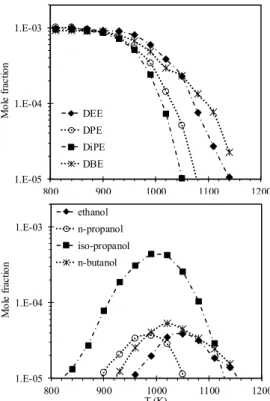
Figure 1 illustrates the experimental reactivity of the ethers in order to compare easily. In pyrolytic conditions the order of reactivity is different than that in oxidation. DIPE and DPE show higher (and similar) reactivity at lower temperatures, while DBE shows the lowest reactivity at higher temperatures. At lower temperatures, reactivity is quite similar as the experimental points are within their uncertainty, the difference can be seen at higher temperatures where propyl ethers are more reactive then the rest. The simulation results are provided in supplementary material showing similar reactivities for dipropyl and dibutyl ethers while DEE appears to be the least reactive due to its smaller chain, at a given temperature > 950 K. Figure 1 shows also the evolution of the specific alcohols from the molecular reaction of the ether, which follows the same tendency. For example, iso-propanol formed via DIPE ⇌ C3H6 + iso-C3H7OH, appears at lower temperatures and reaches
a higher peak than ethanol (DEE ⇌ C2H4 + C2H5OH), n-propanol (DPE ⇌ C3H6 + n-C3H7OH) and n-butanol
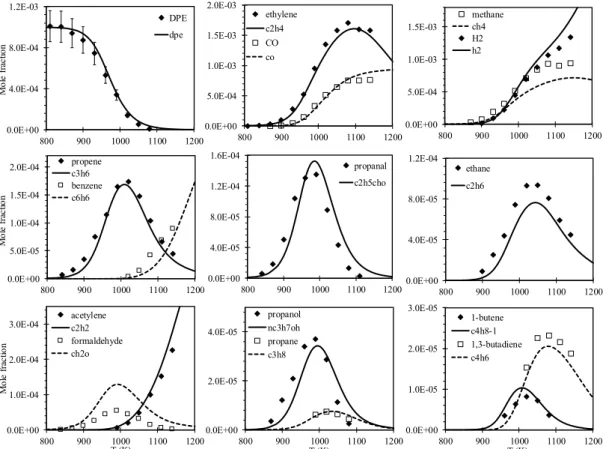
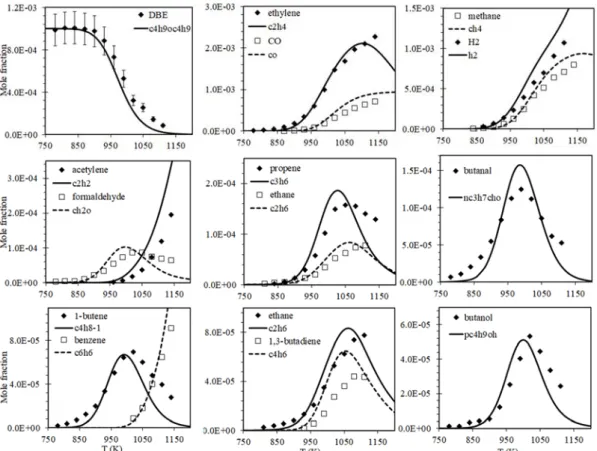
(DBE ⇌ 1-C4H8 + n-C4H9OH). Evolution of the pyrolysis intermediates are shown separately for each ether in
Figures 2–5. One can observe that all ethers have common pyrolysis intermediates such as CO, C2H4, H2 and
CH4, which means H-abstraction reactions by H and CH3 and -scission reactions of primary radicals are
3
Figure 1. Experimental reactivity of the ethers and evolution of the specific alcohols
Figure 2. Mole fractions of intermediate species from DEE pyrolysis
1.E-05 1.E-04 1.E-03 800 900 1000 1100 1200 M ol e fra ct io n T (K) DEE DPE DiPE DBE 1.E-05 1.E-04 1.E-03 800 900 1000 1100 1200 M ole f ra ct io n T (K) ethanol n-propanol iso-propanol n-butanol 0.0E+00 5.0E-04 1.0E-03 1.5E-03 800 900 1000 1100 1200 H2 h2 0.0E+00 2.0E-05 4.0E-05 800 900 1000 1100 1200 ethane c2h6 propene c3h6 0.0E+00 5.0E-05 1.0E-04 1.5E-04 2.0E-04 800 900 1000 1100 1200 acetaldehyde ch3cho acetylene c2h2 0.0E+00 2.0E-04 4.0E-04 6.0E-04 8.0E-04 800 900 1000 1100 1200 Mo le f ra ct io n methane ch4 0.0E+00 4.0E-04 8.0E-04 800 900 1000 1100 1200 ethylene c2h4 0.0E+00 2.0E-05 4.0E-05 800 900 1000 1100 1200 T (K) formaldehyde ch2o 0.0E+00 3.0E-04 6.0E-04 9.0E-04 800 900 1000 1100 1200 CO co 0.0E+00 4.0E-04 8.0E-04 1.2E-03 800 900 1000 1100 1200 Mo le f ra ct io n DEE c2h5oc2h5 0.0E+00 2.0E-05 4.0E-05 800 900 1000 1100 1200 M ole f ra ct io n T (K) ethanol c2h5oh benzene c6h6
4
Figure 3. Mole fractions of intermediate species from DPE pyrolysis
Figure 4. Mole fractions of intermediate species from DIPE pyrolysis
0.0E+00 4.0E-04 8.0E-04 1.2E-03 800 900 1000 1100 1200 Mo le f ra ct io n DPE dpe 0.0E+00 5.0E-04 1.0E-03 1.5E-03 2.0E-03 800 900 1000 1100 1200 ethylene c2h4 CO co 0.0E+00 5.0E-05 1.0E-04 1.5E-04 2.0E-04 800 900 1000 1100 1200 M ole f ra ct io n propene c3h6 benzene c6h6 0.0E+00 4.0E-05 8.0E-05 1.2E-04 800 900 1000 1100 1200 ethane c2h6 0.0E+00 1.0E-04 2.0E-04 3.0E-04 800 900 1000 1100 1200 Mo le f ra ct io n T (K) acetylene c2h2 formaldehyde ch2o 0.0E+00 5.0E-04 1.0E-03 1.5E-03 800 900 1000 1100 1200 methane ch4 H2 h2 0.0E+00 2.0E-05 4.0E-05 800 900 1000 1100 1200 T (K) propanol nc3h7oh propane c3h8 0.0E+00 4.0E-05 8.0E-05 1.2E-04 1.6E-04 800 900 1000 1100 1200 propanal c2h5cho 0.0E+00 1.0E-05 2.0E-05 3.0E-05 800 900 1000 1100 1200 T (K) 1-butene c4h8-1 1,3-butadiene c4h6 0.0E+00 4.0E-05 8.0E-05 800 900 1000 1100 1200 ethane c2h6 acetaldehyde ch3cho 0.0E+00 2.0E-04 4.0E-04 6.0E-04 800 900 1000 1100 1200 iso-propanol ic3h7oh 0.0E+00 3.0E-05 6.0E-05 9.0E-05 800 900 1000 1100 1200 T (K) benzene c6h6 propyne c3h4-p allene c3h4-a 0.0E+00 4.0E-05 8.0E-05 1.2E-04 800 900 1000 1100 1200 T (K) acetone ch3coch3 1,3-butadiene c4h6 0.0E+00 4.0E-04 8.0E-04 1.2E-03 800 900 1000 1100 1200 M ole f ra ct io n methane ch4 H2 h2 0.0E+00 4.0E-04 8.0E-04 1.2E-03 800 900 1000 1100 1200 ethylene c2h4 propene c3h6 0.0E+00 2.0E-04 4.0E-04 6.0E-04 8.0E-04 800 900 1000 1100 1200 CO co H2O h2o 0.0E+00 4.0E-04 8.0E-04 1.2E-03 800 900 1000 1100 1200 M ole f ra ct io n DIPE dipe 0.0E+00 5.0E-05 1.0E-04 1.5E-04 800 900 1000 1100 1200 M ole f ra ct io n T (K) 1-butene c4h8-1 acetylene c2h2
5
Figure 5. Mole fractions of intermediate species from DBE pyrolysis
Reaction path analyses are performed at 1000 K for all ethers (Figs. 6–9). Note that at this temperature the fuels do not all have the same conversion.
Figure 6. Reaction path analysis for DEE pyrolysis at 1000 K
According to in Fig. 6, at 1000 K, the fuel is mainly consumed by hydrogen abstraction reactions by H atoms (71 %) and CH3 radicals (17 %) to yield the two primary radicals. The C2H5OC2H5s radical is formed in
preference given the lower bond energy of the C–H bond adjacent to the ether oxygen [6]. A small part of the flux forms ethanol and ethylene via molecular reaction. This is the only formation route of ethanol (40 ppm peak at 1050 K) and corresponds to 10% of ethylene formation. Ethylene is one of the major pyrolysis species of DEE and 80 % of its formation is via C–H scission of ethyl radicals, which are formed via -scission of the primary fuel radical C2H5OC2H5s, also forming acetaldehyde. Other major products are CO, methane and H2.
All major and minor species are well-predicted by the model except ethane, which is under-predicted by a factor of 2. This species owes half of its formation to the recombination of methyl radicals and the other half to H-abstraction reactions by ethyl radicals, from formaldehyde and acetaldehyde mainly. Although not shown in Fig. 3, some H2O formation is observed and predicted at T > 1000 K, via dehydration of ethanol.
O O O OH O + + O + C2H5 + H + CH3 75 % 13 % 10 % ‒H 13 % ‒ CH 2O 87 % C2H2 C2H3 ‒H + CH3 (47 %) + C2H5(12 %) + H (38 %) CH3 ‒H C2H6 +CH3(+M) 12 % CH4 H2 38 % 50 % + HCO H + CO + H + CH3 C2H5OC2H5p C2H5OC2H5s
6
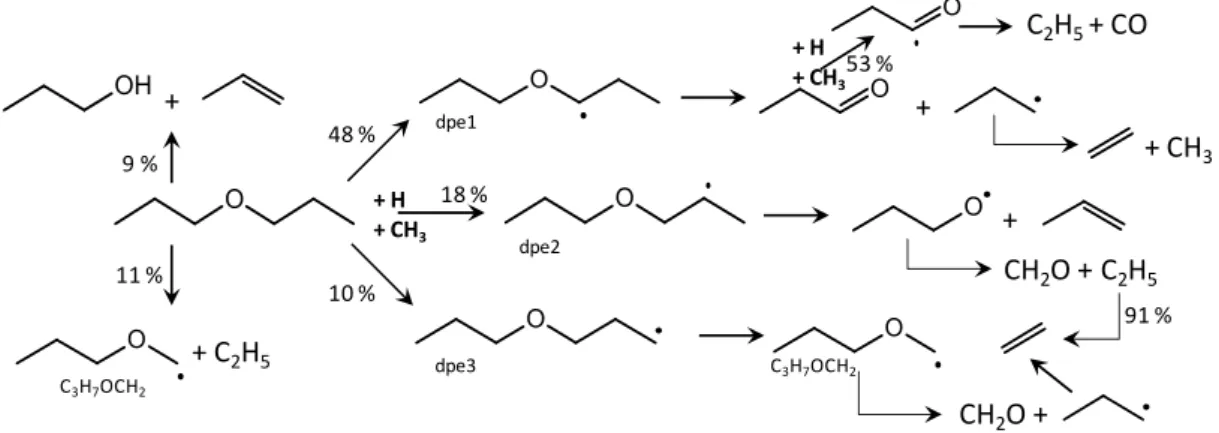
Figure 7. Reaction path analysis for DPE pyrolysis at 1000 K
Fig. 7 illustrates the main decomposition pathways of DPE and subsequent intermediates. A small part of the fuel (9%) forms propanol and propene via molecular reaction, similarly to DEE. Also, formation of ethyl radicals and C2H5OCH2 is possible to a small extent. The decomposition of DPE most takes place through
H-abstraction reactions by H atoms (62 %) and CH3 radicals (14 %) forming three primary radicals, with dpe1
favored. Formation of propanal is almost exclusively (97%) due to the -scission of dpe1. Acyl radicals that can easily be formed from propanal decompose into CO and ethyl radicals by -scission, representing 28 % of
•C
2H5 formation at 1000 K. The remaining part of the formation of •C2H5 radicals is the -scission of propoxy
radicals (dpe2 ⇌ nC3H7O + C3H6) and unimolecular decomposition of the fuel, to 46 % and 19 %, respectively.
Formation of ethylene, a major intermediate, is due to •C
2H5 radicals (37 %), nC3H7 radicals (52 %) and to dpe3
radicals to smaller extent (8 %), and is well predicted by the model. The biggest discrepancy is observed with a minor product, formaldehyde, overpredicted by about a factor of 2.5. Formaldehyde is produced by the -scission of C3H7OCH2 and nC3H7O radicals, and is consumed by H-abstraction by H and CH3. Note that
possible isomerization reactions among DPE radicals are not considered as any analogy would have been probably very uncertain. In the case of DEE, we have included the rate constant calculated by Sakai for DEE radicals because it was calculated specifically for DEE, and the impact on overall predictions is very small.
Figure 8. Reaction path analysis for DIPE pyrolysis at 1000 K
Fig. 8 illustrates the main decomposition pathways of DIPE and subsequent major intermediates. DIPE can yield two primary fuel radicals, namely dipe1 and dipe2. DIPE is the most reactive of all ethers investigated in this study (Fig. 2), its major pyrolysis products include C3H6, C2H4, H2, CH4 and iso-propanol. This latter alcohol
peaks at a higher mole fraction, around 450 ppm (Fig. 2). To the best of our knowledge there is no direct measurement or a theoretical investigation of the rate constant of this molecular reaction, which we estimated in analogy with methyl tertiary butyl ether by Choo et al. [12], which is a study conducted at very low pressures. This resulted in a rate constant higher than those assumed for the molecular reactions of DEE, DPE and DBE, which are estimated as fits from NIST values, also note that there are more H-atoms available in DIPE. There are only two equivalent tertiary H-atoms available for abstraction while 12 primary C–H sites (slightly stronger than primary C–H in alkanes) are present for the molecular reaction, which is probably why this fuel decomposes mainly this way and the H-abstraction reaction appear less important. One could expect, hence this
O O O O dpe1 dpe2 dpe3 + H + CH3 48 % 10 % 18 % OH + O + C2H5 9 % 11 % O O O CH2O + C2H5 + CH3 CH2O + O C2H5 + CO + H + CH3 53 % + + C3H7OCH2 C3H7OCH2 91 % O O O O + + O + CH3 + dipe1 dipe2 + H + CH3 14 % 7 % 77 % OH OH OH O O 75 % 25 % + CH3 O + + H + CH3CHO + H + H/‒H2 + CH2CHO 16 % 46 % 38 % 30 % 70 % ‒H2O 73 % 15 % 6 %
7
fuel to be less reactive than other ethers in oxidative conditions, but this will be the scope of a further study. An important flux of the fuel hence forms propanol and propene. This is the only formation route of iso-propanol, while it is responsible for 68 % of propene formation. The rest of the propene formation is due to the dehydration of iso-propanol (14 %), -scission of n-propyl radicals (10 %) and of dipe2 radicals (5 %). Ethylene, another major intermediate, is mainly formed by the ipsoaddition of H to propene (40 %) and -scission reactions of n-propyl (41 %) and ethyl radicals (14 %), to a lesser extent. Formation of the n-propyl radicals is the result of both H addition to propene and isomerization of iso-propyl radicals, which are abundantly produced from the -scission of dipe1 radical. Acetone can be counted among the minor pyrolysis intermediates, its formation is mostly via -scission of the dipe1 radical (80 % at 1000 K, and this goes down to 60 % at 1100 K) as well as the C–H -scission of the iso-propanol tertiary radical. The main consumption pathway of acetone is by C–C scission yielding CH3CO and CH3 radicals. The discrepancy with acetone mole
fraction and the model is within 15 % between 900 and 1050 K and 30 % when T > 1050 K. Note that in DIPE sub-mechanism, like in DPE, we did not consider any isomerization of the fuel radical, for the same reason explained above.
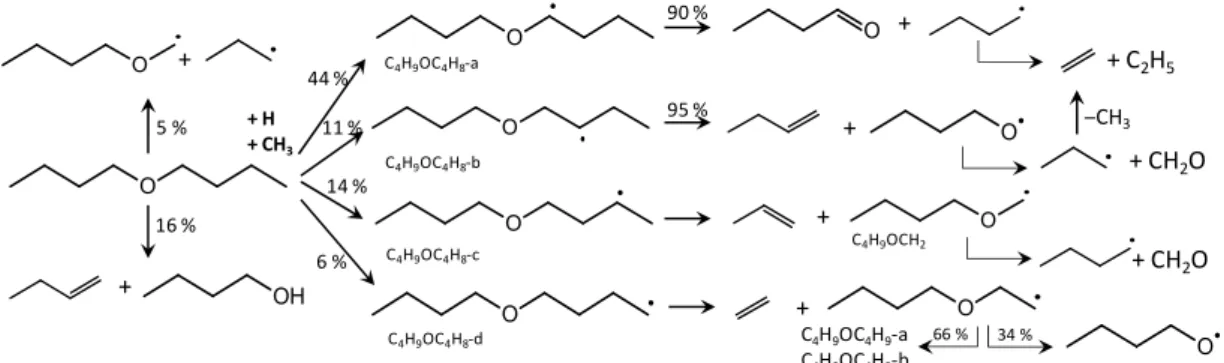
Figure 9. Reaction path analysis for DBE pyrolysis at 1000 K
Pyrolysis of DBE follows similar pathways as the other ethers (Fig. 9). Given its longer chain, 4 primary fuel radicals can be formed by H-abstraction by H atoms (64 %) and CH3 radicals (11 %). Among these, the most
abundant is the a-radical, which forms butanal (92 % of butanal formation) and butyl radicals. The formation of butyl radicals proceeds to 68 % via this pathway, the rest is the result of the -scission of the C4H9OCH2
radicals. They decompose exclusively to ethylene and ethyl radicals by -scission, which represents 38 % of ethylene formation at 1000 K. Because the fuel reactivity is over-estimated above 990 K, one can see in Fig. 6 that the mole fractions of major intermediates are overestimated as well, such as H2 and CH4. About half of CH4
formation is due to H-abstraction from DBE and butanal, as this aldehyde is very reactive in this temperature range. Butanal is therefore an important intermediate both in oxidation [4] and pyrolysis, and in these conditions its decomposition takes place mostly by H-abstraction reactions by H and CH3 (as opposed to OH in oxidation)
as well as unimolecular reactions to a lesser extent.
It is to be noted that some benzene formation is observed at temperatures higher than 1000–1050 K with mole fractions around 90 ppm for DPE, DPE and DBE, and around 20 ppm for DEE at 1140 K. The formation pathways of benzene are the same for all ethers and mainly go through via reactions allene/propyne and propargyl radicals: C3H4 + C3H3 ⇌ C6H6 + H and also via the reaction between 1-buten-3-yne (vinyl acetylene)
and acetylene: C4H4 + C2H2 ⇌ C6H6 according to the mechanism. Vinyl acetylene is formed by C–H scission of
butadienyl radicals and acetylene via vinyl radicals produced from ethylene, a common abundant high temperature reaction intermediate for all ethers investigated.
5. Conclusion and Perspectives
Pyrolysis of 4 symmetric ethers were performed in a JSR at 10 atm. In these high-pressure conditions bimolecular reactions such as H-abstraction reactions by H atoms and CH3 radicals are found to be dominant in
fuel decomposition as well as the in the decomposition of the intermediate species. Although these reactions are always considered in oxidation mechanisms, they are hardly ever the dominating ones except at very rich
O O O O O O + O + 95 % 90 % O + O + + C2H5 + CH2O + CH2O O 34 % C4H9OC4H8‐a C4H9OC4H8‐b C4H9OC4H8‐c C4H9OC4H8‐d OH C4H9OC4H9‐a C4H9OC4H9‐b 66 % + + H + CH3 44 % 11 % 14 % 6 % 16 % O + 5 % ‒CH3 C4H9OCH2
8
conditions. As oxidation studies are more common, emphasis is always given to the H-abstraction reactions by OH and HO2 radicals. This study shows that an attempt in evaluating the rate constants of these reactions for
ethers could be useful for a complete understanding of ether oxidation. Moreover, at lower pressures isomerization of ether radicals can become important, implying a better assessment of thermochemistry and rate constants of these reactions. As a perspective, pyrolysis at 1 atm can reveal more importance in the unimolecular decomposition pathways both for ethers themselves and their intermediates. In this study, the molecular reaction yielding the alcohol was found to be more important among the unimolecular pathways as ethanol, n- and iso-propanol and butan-1-ol were quantified and are only formed by this reaction, the rate constant of which is only estimated. This study, along with the previous oxidation studies, represents another step in our understanding of ether chemistry and brings up the need of a systematic approach in determining site specific rate constants of important fuel related reactions of ethers.
6. Acknowledgements
The authors would like to acknowledge the funding received from Labex Caprysses (convention ANR-11-LABX-0006-01)
References
[1] N. Vin, O. Herbinet, F. Battin-Leclerc, Diethyl ether pyrolysis study in a jet-stirred reactor, Journal of Analytical and Applied Pyrolysis, 121 (2016) 173-176.
[2] K. Yasunaga, F. Gillespie, J.M. Simmie, H.J. Curran, Y. Kuraguchi, H. Hoshikawa, M. Yamane, Y. Hidaka, A Multiple Shock Tube and Chemical Kinetic Modeling Study of Diethyl Ether Pyrolysis and Oxidation, The Journal of Physical Chemistry A, 114 (2010) 9098-9109.
[3] P. Sela, Y. Sakai, H.S. Choi, J. Herzler, M. Fikri, C. Schulz, S. Peukert, High-Temperature Unimolecular Decomposition of Diethyl Ether: Shock-Tube and Theory Studies, The Journal of Physical Chemistry A, 123 (2019) 6813-6827.
[4] S. Thion, C. Togbé, Z. Serinyel, G. Dayma, P. Dagaut, A chemical kinetic study of the oxidation of dibutyl-ether in a jet-stirred reactor, Combustion and Flame, 185 (2017) 4-15.
[5] Z. Serinyel, M. Lailliau, G. Dayma, P. Dagaut, A high pressure oxidation study of di-n-propyl ether, Fuel, accepted, in press (2019).
[6] Z. Serinyel, M. Lailliau, S. Thion, G. Dayma, P. Dagaut, An experimental chemical kinetic study of the oxidation of diethyl ether in a jet-stirred reactor and comprehensive modeling, Combustion and Flame, 193 (2018) 453-462.
[7] P. Dagaut, M. Cathonnet, J.P. Rouan, R. Foulatier, A. Quilgars, J.C. Boettner, F. Gaillard, H. James, A jet-stirred reactor for kinetic studies of homogeneous gas-phase reactions at pressures up to ten atmospheres (≈1 MPa), Journal of Physics E: Scientific Instruments, 19 (1986) 207.
[8] Z. Serinyel, C. Togbé, A. Zaras, G. Dayma, P. Dagaut, Kinetics of oxidation of cyclohexanone in a jet-stirred reactor: Experimental and modeling, Proceedings of the Combustion Institute, 35 (2015) 507-514.
[9] C. Muller, V. Michel, G. Scacchi, G.M. Côme, Thergas - A computer program for the evaluation of thermochemical data of molecules and free radicals in the gas phase, Journal de chimie physique et de physico-chimie biologique, 92 (1995) 1154-1178.
[10] S.W. Benson, Thermochemical Kinetics, Wiley, New York, 1976.
[11] P. Glarborg, R.J. Kee, J.F. Grcar, J.A. Miller, PSR: A Fortran Program for Modeling Well-Stirred Reactors, Report No. SAND86-8209, Sandia National Laboratories, Albequerque, NM 1986.
[12] K.Y. Choo, D.M. Golden, S.W. Benson, Very low-pressure pyrolysis (VLPP) of t-butylmethyl ether, International Journal of Chemical Kinetics, 6 (1974) 631-641.