?~c
Econ. Dev. Program Project No, 7674 NPA
Competitive Coexist,-ence Study
PRELIMINARY DRAFT
EAST AID XST IN INDIA 'S ECONOMIC IEVELOPMENT
BY
Wilfred Malenbaum
Center for International Studies Massachusetts Institute of Technology
Cambridge, Massachusetts January, 1958
TABIE OF CONTETS-I Competition Between East and West in India
The Political Setting for Competition . . . . . The Need for Foreign Assistance for Development Contrasting Goals of East and West . . . .
II The Plans for Economic Growth
The Possibilities for Effective Aid . . . . . The Arithmetic of the Plans . . . . Estimated Net Imports . . .
. . . . . . . . 1
. . . 11
. . . 0 0 * 1 . . 0 . . 0. 3 . 0 0 0 . . 13
III The Prospects for Economic Growth Savings--Investment Flows 00 . .0 0 0 . 0 0 . 4 . . . . Investment Performance 1951-56 . . . . . .. . . . .. .. Implications for Investment 1956-61 . * . . . . . . . Importance of Action by GOT 0. . 0 . .. . . . 0 0 .a a . . 1
5
10 16 1V Aid from East and West Pre-Second Plan Position 0 .0. . . . . .. . . .. a 1 Participation by Communist Bloc. . . .*... . . . 2Participation by Western Countries . . . . . . . . . . . . 10
The Respective Contributions to Economic Growth . . . . . . . . . 17
Additional Contributions Required . . . . . . . 19
V Conclusions Alternative Possibilities .0. . . . .. .. . . . 1
4 Project No, 7674 Draft--for NPA Competitive Coexist-ence Study Chapter I
Competition between East and West in India
1ncliz today is wnl into her second five-year plan period, Over the past decade, from the very creation of an independent India in 1947, top priority has been given by government to the formulation and implementation of plans for accelerating India gs economic development, For generations
economic stagnation was the norm in Indian economic life. Prime Minister Nehru and his Congress Party have determined to pursue a conscious and planned
course to build the habit of economic growth into the static structure0 In
this respect, India is far ahead of most other low-income countries in Asia, Africa and even Latin America0 While some of these, especially in South
Am-erica, are experiehcing dynamic forces in their economies and may even have entered upon a long-run path of economic expansion, few have yet formulated an explicit and comprehensive program for inducing systematic growth0 For
the economically underdeveloped lands of Asia and Africa in particular, pro= gram formulation is now in process, or still in prospect. Inevitably,
Indian experience serves as a possible model,
The sole relevant alternative model is provided by the Chinese
ex-perience. Communist China has also been engaged over the past seven to eight years in program formulation and implementation, again for the task of con-= verting stagnation at a low level of living into a dynamic process of economic
I-2
expansion. The parallels in the two pre-plan positions are striking. Equally striking is the contraSt between the totalitarian schemes in China
and the democratic progrems in India. Given today's world, third countries, especially in Africa and Asia will be influenced in their own programs by what seems to be happening in these two lands However much India and China disavow a state of competition between alternative paths for the transforma-tion to growth, comparisons will be made everywhere, and lessons put into practice0
The leaders of India's independence movement, some of whom are key
leaders of India today, were devoted to democratic forms and processes. These ideas are incorporated in the Indian Constitution; their hold is clearly visible today in the conduct of political life in India. 6urt procedures, the process of popular elections, the methods of plan formulation--to list but a few important activities--reveal how deeply convinced are Indian leaders of the importance of respecting the rights and privileges of each Indian, An important part of India's leadership was educated in England at a time when interest in Fabian socialism was high. Small islands of tremendous wealth in India stand out in striking contrast to the broad sea of extreme poverty. Gandhi was concerned about social as against private objectives, about cooperation rather than competition in the social
or-ganization; he considered socialism "a beautiful word." In these circum-stances, it is not surprising to find that Indian democracy tends readily to acquire a mild and gentle socialistic veneer.
There has been rnuch talk of a growing public sector especially in industr, of income equality within India, of large-scale cooperative movements and similar attributes that might be associated with such a social order. On the whole, however, Indian performance in this direction has been limited0
Cooperatives are still of relatively small importance--Income equalization is still for the future, The private big industry sector has continued its rapid expansion into the Second Plan0 Indias record on servicing foreigt investment and on capital repatriation finds few peers anywhereo To date,
Socialistic Socialistic
at any rate, Indiat/actions have not matched Indid s/words0
In a world of growing military strength, polarized in two groups under the U. S0 and the USSR, India has chosen nonalignment. A neutral position has permitted those Indian leaders who command a world audience, Nehru and Krishna Menon particularly, to condemn power blocs and armament races gen. erally and to side with either group on the merits of specific questions With af socialistic tinge, with a tendency to give more attention to the word Ahan to performance, Indian nonalignment has occasionally struck the West as being somewhat less than neutral. Again, however, this is a show a
words0 In deeds, the government of India, has taken unequivocal action
against all manifestations of foreign interference with Indiags domestic communist party, It continues to demonstrate its attachment to the conter and method of democracy.
Finally, India l' development aims are beyond what India's domestic resources can accomplish, The development plans will long require a net import surplus. There is scope for large amounts of technical assistance in many fields0 India needs sympathetic, flexible and continuous
goods and services of varied kinds0 The U. S. is able to do this; the USSR has indicated that it is prepared to do so also.
All the factors summarized above serve to provide in India a unique setting for- competition between the West and the East. In no other non-committed underdeveloped land is there comparable determination and action for economic expansion. Assistance by Russia and the communist nations, or by the United States and the democratic nations, might well be reflected in recognizable contributions to the growth India seeks. Inevitably these actions and contributions will have important influences upon the course of action of other nations seeking to transform their economies into modern forms. It would not be realistic to assume that these respective
contributions will alter India's international posture in any direct way.
Yet, India's present economic situation and prospects justify careful con-sideration, on the part of the U. S. and the USSR, of the possible roles which West and East should be playing there. To appraise these one needs first to examine the scope for such efforts as presented in Indiav~s devel-opment plars
On the eve of the First Plan in 1951, national income per capita was about $55, near the bottom of the range of available national observations 0 Population density was one of the highest among the poor countries, while the percentage of population directly dependent upon the land for liveli-hood was a high 70 per cent. From this resource point of view, therefore, Indian prospects for accelerating growth might not be as favorable as those in economically underdeveloped lands, even in Asia and Africa, to say naught of Latin America. But unlike most others, India has had a long history of modern industrial developmento 'While modern industry by 1951 had not become
' I-5
verr
a/iportant contributor to total national product, it has given India sig-nificant groups of people skilled in modern business enterprise. Indeed, India 's intellectual leadership, including the top ranks of an outstanding
civil service, finds few equals in the underdeveloped countries of the world0 Such leadership may perhaps explain the Indian head-start among the nations newly aspiring to improved economic conditionso
Domestic savings, generally estimated at 5 per cent of the not product prior to the 1951, have served only to maintain the level and composition of per capita income over the preceding two or three decades. The low level of income seemed to provide but a limited base for the additional savings needed to step up the rates of capital creation. Moreover, at these low lev-els of per capita income, India was an essentially self-sufficient country. There was small opportunity for any large unexpected saving through favorable shifts in the terms of foreign tradeo One component of a plan for acceler-ating development therefore had to be a sizeable increase in investible re-sources through net imports from abroad. In addition to increased savings from domestic product, India did plan for significant deficits in her current international accounts.
For the first plan, domestic savings were originally viewed as providing only 75 per cent of total net investment, private as ell as public Net
imports of some $1o7 billion were anticipated, and only $610 million of these, it was felt, could be paid for through a reduction in Indiags foreign ex-change reserves. The remaining $1.1 billion was never explicitly mentioned as the target for foreign grants, loans and other investments0- Rather it was always anticipated that some part of this could be met through additional savings that would be generated domestically. In the present plan, domestic
I-6
resources, estimated more generously than in the above figures for the 1951-1956 plan, were counted upon for 8245 per cent of the (much larger) total net investment. Net imports of some $2.3 billion were thus implied, of which India's own foreign reserves could be counted upon for only $420 million, The residual $1.9 billion was set as a target for new re-sources from abroad; about $1,7 billion was designated as the "resources
to be raised externallf for the public sector, while account was taken of net foreign investment on private account of some $200 million.
These were India's estimates of net needs from abroad=-in terms of over-all financial magnitudes-for her development plans. hile there was considerable detail on probable imports over the plan periods, especially for second plan years, the Plans did not request assistance in the form of a specific bill of commodities and services from abroad. 1 Indeed, the
First Plan specifically stated that the balance of payments concept of the program required "that external assistance is received in a form which allows flexibility in the use of the foreign exchange resources provided by it " 4 (p. 63)
The absence of a specific estimate of the external assistance required, and of any list of items, can probably be attributed to two major facts,
First is the obvious point that, however carefully the estimates ware made, they involved use of data on domestic savings which are not syste-matically collected in India. They involved guesses of the effectiveness of procedures for mobilizing domestic resources never before tried by Indian institutions. Moreover, the Indians were well aware that payments for any particular import could be met in a number of ways-ranging from export rez-ceipts to foreign loans or grants. In neither plan did India anticipate any
2Such particulars were of course provided later in the course of specific negotiations for loans and other forms of not transfers to India.
I-7
problems of the convertibility of the currencies of different countries. For the first plan, at any rate, there was also the belief that the imported capital goods essential for development could really be financed through India's own resources. Additional requirenents (for food, for example)
could then be met either through further expansions in domestic resources or through net imports. For these reasons, therefore, and they were sound ones from an economic point of view, the planners did not particularize a bill of specific import
goods that foreign sources were being requested to finance.
This reason complemented the second: India did not wish to adopt the posture of a nation seeking essential assistance from other lands. Both plans indicated the level of development India could achieve primarily with its own resources. This floor was preferred to a higher level which migh in any way impinge upon the independence of India as a sovereign nation.2
Thus, loans were generally preferred to grants, despite the interest and repayment obligations which would seem to make the grant a much more helpful measure of foreign assistance. The lender-borrower relationship was accepted
as one in which the privileges and responsibilities of each party were broadly recognised, and could be legally defined. In addition, India was most anxious to keep the door for foreign finance open to anyone willing to assist on these termes An artificial definition of a particular list of imports that were
1Actually, the developments from 1951 to date were far different from
those foreseen in the Plan. See Quip. =i, pp.
5-7.
2n. . . external assistance is acceptable only if it carries with it no conditions, explicit or implicit, which might affect even remotely the country')s ability to take an independent line in international affairs," First Five
I-8 needed, above and beyond India's current ability to pay, might seem to pre-clude some nations as possible contributors. India, nonaligned politically, was not prepared to seek aid only from the West, or the East.
Yet, given the certain'y that Indian development programs, as planned', would require external assistance, the request for such aid in the two plans does appear casual'-however defensible India's formulation on technical economic grounds. Mile the Indian request implied the provision of re-sources from abroad in "un-tied formn," i.e., essentially as foreign exchange to be spent as India 's development needs dictate, the logic of the presenta-tion might also permit a different interpretapresenta-tion. Capital exporting countries able or anxious to provide only specific services and commodities-whether food, technology, or steel mills--could make them available against their own interpretation of the requirements of the Indian plans. The requests for assistance, in other words, might be considered an invitation to foreign countries to see for themselves in what way their net exports could play a role in Indian development. And this is in keeping with the openness of the entire Indian scheme of planning. There was an implicit and explicit desire to have the problems of and possibilities for Indian economic growth discussed and improved not only through domestic efforts, but also through the interest of competent foreigners. The process of accelerating the rate of development-from stagnation to the point where economic growth was self= sustaining at a politically acceptable level-was scarcely an obvious one. India's planners were well aware that India's effort, pioneer among 20th century democracies, might need improvemento Moreover, the first Plan ap-peared early in the period when the nations of the world had decided that the
I-9 acceleration of the rate of economic growth in the poorer lands was a matter of the highest international policy. There was broad interest everywhere in the problems, and a growing awareness of the possibilities of international assistance in their solutiono
About $625 million of foreign assistance for the public sector was in fact made available to India over the period of the First Plan, two thirds of which India actually used in those years. Some new investment in India also was financed by private foreign companiesel All this assistance cam-from the west, including in small measure (about 4 per cent) the International Bank, The United States alone provided about 80 per cent of the total. The
USSR and other communist lands provided no assistance whatsoever
Very little of the assistance to India took the form of foreign currency to be used as and how the Indians determined. Rather, a very large part was made available as foodstuffs, following statements by India of specific needs for grain imports. The bulk of U, S. assistance excluding the food compo-nents was allocated to a relatively large number of specific projects, worked out with Indian officials and institutions but reflecting U. S. views on priorities for Indian development. The emphasis was clearly toward an ex-pension in Indian agricultural output, and in production in rural areas generally. The U. S. became closely identified with India's path-breaking program for community developmento Assistance was specifically marked for the
GOI Planning Commission, Review of the First Five Year Plan, May 1957, p. 31. In considerable measure, these "net" imports were offset by capital outflows
on private account; India's current accounts were almost in balance over the first plan period. See Chap, III, p. 2-4.
I-10o
tube-wel program, fertilizers, and various goods and equipment for rural areas. Admittedly, the First Five Year Plan -was a plan for agriculture and irrigation; there was little question but that this emphasis made good sense to the U, S. Government and its officials involved in aid in this region.
The USSR did not provide assistance during this period,1 but it did make amply clear its development emphasis for India, In August and Septem-ber, 1954, as the ftrst plan began to show signs of life, the Soviet Government let the Indian Government know (through a Bombay businessman*) that it was agreeable to supplying "machinery and equipment as well as technical assist-ance in the setting up of a steel plant. . . .2 Russian steel e)p erts arrived in India in late November, 1954 and submitted a report within eight weeks. On February 2, 1955, the two Governments signed an agreement in Delhi for the construction of a steel plant of one million ingot ton capacity at a total cost of $210 million, almost half of which would need to be spent abroad, The agreement included a Soviet loan, on very favorable terms, for meeting foreign exchange costs, The East thus dramatically entered upon the Indian development scene; it made unmistakably clear its views on the
importance of rapid and heavy industrialization in Indian economic growth, Well before the formulation of Indiags Second Plan, the USSR was attempting to
identify itself with the inevitable emphasis of that program, The official end the public reaction in India to this entrance of the East into Indiagne development efforts -as extensive and enthusiastic, The Ruesian Steel
1Russian wheat did come to India in the ncar-panic years from 1949 into
late 1951 and 1952, What came wa paid for, and usually at higher prices than other purchases . Russian offers of additional shipments were
unaccept-able in price terms, see Aagnavan, u. N. s, .nia and itussia (A report pre-pared in India for the Center for International Studies, 1957.) pp. 4-5
2From a statement in Parliament on September 24., 1954, by Mr. K. C. Reddy, Minister of Production, as quoted by Raghavan, G. N. S., op. cit., p. 9.
offer appeared to compre muost faorably wi an fr ogeement the establ ment of a .tee1 plant reachecd about one year earlier by the Government of India and the West German firms of Krupps and Demagz
Sincue then, Russian schemes for aiding the Indian program have multipl ie They retain the big-industry emphasis which Indians so clearly associ1ate with the achievement of the Russian economy, As of present writing, Russian com= mitments of assistance for the Second Five Year Plan period are of an order of magnitude about one-third that of the United States l East and West are actively involved in the Indian development effort. There is reason to believe that both will continue to provide assistance-perhaps even to
ex-appear to be
pand their roles. However much both
/
directed toward a common end-graoth in the Tndian economy--the activities of the U, S. and USSR in India mwst still be considered as competitive rather than comnplemsntaryc Their ,,iAnt role imore apparent than realYet, it would see~ that the policy gains to the East and to the West from participation in the Indian development effort are .asymmetrical2 Wiatever the relative contributions=-in amount or in kind-U. So interests wouLd be enhanced, not those of the USSR, as a consequence of success in India -s devel-opment effort, For India today is a democracy, with top political letdership and top bureaucracy basically devoted to such organization of politic;l life,.
as yet direct
There isflittle/evidence of any desire for a shift away from democracy on the part of this leadership, Indeed, India-Soviet cooperation is explicit with
See Chap, IV, ppo 10-12c
2The discussion in this paper on possible Indian views of action by the U. S. and the USSR is confined essentially to action more or less directed to problems of economic development0 It is simply assumed that irternaticnal ac=
tions of the two major powers with respect to other countries--Hungary or Egypt, for example-or with respeot to major international issues such as disar.Amament
1-12 respect to the firm intent of India to proceed without recourse to the
totalitarian or authoritarian methods of Russia and her satellites. One must could
therefore ask about the conditions whichfalter present policy orientations, What could bring new kinds of leaders, or new views to present leadership?
Today there is room for considerable optimism, if not complacency, with respect to the possibility for such a change in leadership forced from below, whether by parliamentary or revolutionary processes. The Congress party habit is so ingrained, and the strength of other groups, including Communist, so limited, that such shifts in response to popular pressures seem unlikely for the next five to ten years, at any rate. This may be questioned if economic events affecting the bulk of India's people take a marked and obviously persistent turn for the worse beginning in the very near future. Still,so long as per capita incomes remain essentially as they are
these
or even if they decline somewhat, / political prospects do remain favorable--the "promise" of favorable--the Plans and stepped-up ,domestic communist activity notwith-standing. In India, the link between levels of living for the mass of people and political activity is a tenuous one at best, Decades of subsisting dim expectations in this- regard
On the other hand, really significant reversals in the prospect for economic growth may well bring important changes in the Congress leadership s attitude toward the functioning of the Indian economy and toward the role of the private citizen in the economyo One can anticipate a break in the con-tinuity of past policy and action in this regard should it become clear that the Second Plan will fall significantly short of its objectives. Indian leadership will find it difficult to accept obvious failure, or even lack of
1-13
appreciable success, before a watching world. India will not enjoy being a poor second beside China-however much Mr, Nehru disapproves of Chinese methods for achieving economic expansion. It seems fair to assume that the possibilities for a shift toward more authoritarian and totalitarian methods in the conduct of economic and political life in India are more allied to this leadership view than to any broad.popular pressures0
Through this route, faltering progress on the economic front-whatever the major contributory 'causes-can result in significant change2, in
form or in practice, in Indian political institutions with which WE air familiar today, One might then appropriately ask whether there will be : popular electiors in iR which state' and national legislatures are actually chosen by all the people of voting age in India. Governmental processes which respect and protect the democratic prerog tives of individual citizens may become less virile. Governmental development policies will seek other ends than the improvement year by year Is rapidly as possible,
in the standards of living of all the people of India. Clearly, it is in the preservation of these characteristics of Indian society that the Wstern and American policy interests lie. 'While the prospects for their preservation are favorable, the risk lies in the growth of a conviction on the part of Indian leadership that present methods and associations are not sufficient to India's needso
Acceptance of this challenge by the United States and western democracy still leaves the basic problem of what role on the part of foreigh countries can best contribute to Indian economic development. First, however, there is need for some remarks on USSR objectives and possibilities in India, If
I-14
the above discussion is relevant, Russia has little to gai.n politically from attempting to assure a successful Indian development effort, The benefit will probably be the Westas even if the U. S. were to play a minor role in Indiaas development activities, and perhaps even if the East played a very large one.l In other economically underdeveloped lands, where governmental orientation or tradition is not so clearly committed to democracy, the situa-tion would probably not be the same. There, the scale and nature of foreign cooperation, particularly where one country (the USSR) is economically so much less capable than the other (the U. S.), might well be of decisive im-portance in influencing attitudes toward the recipient country and its
political philosophy.2 In India, perhaps in contrast, the Russian program serves Russia best if it serves to deter or to limit western assistance.
Assistance from the USSR is large and significant enough to leave a distinct impression of Russian sincerity and cooperation with respect to ,India's efforts. Russian aid may not fill priority development needs; it
does induce popular interest and support in India for Russia's role. A neutralist India which seems to enjoy Russian assistance so fully may not elicit adequate cooperation from the West and especially from the United States. Whether or not this has been the explicit objectives of Soviet ac-tion, it is certainly true that these attitudes in India have served to
'This last presents problems in that a large eastern role must inevitably be accompanied by institutiona] developments in India which would render more difficult the maintenance of the pr Sent trend of social evolution. Thus, state trading might have to become 1)rge enough to interfere considerably with freedom of individual action. More Russian-built machinery will tie more parts of the Indian economy to the Soviet way of doing business, etc. Still, the generalization remains that it is the end-product, over-all achievement on the development program which will be decisive rather than the specific means by which this product was obtained.
2In fact, the quantitative aspect of the programs in India might have precisely this kind of influence in other countries of Asia and Africao
aggravate the prospects for establishing a broad basis for cooperativ;e ac-tion by the United States with India. In these circumstances, Russia stands to gain: without significant foreign assistance, the Indian development progress so important to American policy interest will not succeed.
Of course, it is not enough that a United States program simpl con-tinues in the face of the apparent unattractiveness of some Indian policies and actions to iraportant groups in America. The program must alse be larger than in the pau;e It must concern itself with the Indian develop nent effort in the broad, rather than focus on any specific part of the program in which. the U, S. iu involved through financial, technical, and other assistance. The U. S. -ole must be flexible enough to shift its emphasis aid intensity. The process of economic growth is relatively smooth only in te economists models, In countries where much of the product is dependent upon man and clima;e rather than machine, annual fluctuations can be larp; essential tasks
to .acilitate growth will vary. In sum, the U. S0 needs t formulate a program usose objectives are to complement Indian effort in orde7 to achieve given
devel-apment goals0
The specific possibilities for U. S. action to hel) assure economic achievement in India needs to be assayed against the E tcific problems there, and the extent to which they are being dealt with by :'dia and by other
cooperating nations0 This last is ~aF major task of i iis study. Here,
how-ever, it needs to be made clear that this problem of U. S, assistance is an immediate and critical one0 While the economgy of Indj.i duri g the First Plan
years, 1951-1956, evolved quite differently from the way the Pian anticipated, development goals were essentially achieved. In fact, the over-%ll growth
I-16 far exceeded what was planned. Comparable results cannot now be anticipated for the current plan. Rather, it is becoming increasingly clear that sig-nificant and basic changes in the Indian program will be required if anything like the Plan'3s general targets are to be achieved. The Government and the people of India face major tasks if there is to be success or even if there is not to be failure. In the Indian context, the role for a cooperating capital-exporting nation has undoubtedly become even larger as a result of these unhappy developments, The U. S. has to define this role with the Indians; it has then to implement it.
Chapter II
The Plans for Economic Growth
The role which countries of the east and the west play on the Indian development scene depends initially, of course, upon their desire to be.cme associated with the Indian effort, as well as their capacity to provide as-sistanceo Inevitably, however, the help these countries do give and the ef= factiveness of their roles rest upon the political, the philosophical and the technical fraiework which has been established for the economic developmant of the country. The First and Second Five Year Plans do provide such a framework for development, even though relatively little is said explicit-ly with respect to the roles that foreign countries could play in the progriam Presumably each would-be donor nation interested in the development of the Indian economy would want to assess the purely technical feasibility of 1the effort with which it will become associated, This would raise questions about the relationship envisaged in the Plan between new investment and aew output, Thus, an incorrect or unreal relationship might indicate that cop=-eration to assure that the program of investment were fully implemented% night still yield a significant short-fall in the output targets, fundamental
measures of the success of the program.
The prospective donor might not respond instinctively to the philo-sophical approach to the problem of accelerating economic growth in India, as presented by the planners and officialdom. An obvious illustration con-cerns the relative roles of the private and public sectorso Countries
II-2 could be expected to feel quite differently about the appropriateness of heavy public ownership of industry, for example. This reaction would be apart from problems of the economic implications of this policy; could a rapid shift to a large public sector actually be accomplished, for example? In this category too, are such aspects of the Plan as the extent to which India expects to emerge in a decade or so as a land able to be self-sufficient with respect to the products of heavy industry. Here, there is both the
question of an approach which reflects the conviction that only a country with such a heavy industry sector can be"truly independent," and the more familiar question as to whether the implicit level of output of these capital
goods can be economic,
Actually, there may be important limits as to what is apt to happen, or could be made to happen over a five-year period in a long-static c
economy like India s Does the Plan adhere to the laws of behaviour of the Indian economy; does it assume that these change gradually as people and in-stitutions can be encouraged to alter them under the Plan; or does it take a new course from the very beginning? Answers here throw further light on the realism of the plans and upon the extent to which the program postulates achieving development within a democratic framework.
To appraise the possible influence of the United States, the Soviet, or other countries upon Indian achievement with respect to economic growth, the present chapter will set forth the technical aspects of the Plans, while subsequent chapters will be concerned with the degree of realism in the schemes and the attitudes underlying Indian planning. Such examination is essential if we are to assess the possible range and effectiveness of coun-tries of the East and the West in the Indian development schemes.
II-3
Both the First and the Second Plan volumes present projections of
India's national income and consumption over a twenty to thirty year period. These can be derived mathematically from a simple Keynesian aggregetive model for the economy as a whole. Net national income is divided between consump= tion and net investment. It grows both because the net investment in any year expands capacity and because progressively larger proportions of the increased income are allocated to investment. The two models differ simply on account of revisions in the estimating parameters as between the First and Second Plans. In the latter, calculations are on the whole more favorable, with national income at twice the 195o/51 level by 1967/68, as against -the 1971/72 of the First Plan; per capita. income is doubled by 1973/74 in com-parison with the earlier 1977/780l
Complete and detailed statements of the Indian plans .are fully available, primarily in Government of India publications. For present purposes therefore
it will suffice to describe only some outstanding characteristics of the current program. The objectives of the Plan were explicit--and bold. Na-tional income was to show a "sizable increase"--about
5
per cent annually, or, on a per capita basis, at least 3 per cent each year. This. is clearly an impressive target, not only when compared to the favorable performancein the First Plan (to say nothing of the stagnant situation which prevailed earlier), but also when compared with achievement over a period of years of other countries-as the United Kingdom, the United States, and even the USSR.
'These points are developed in my forthcoming study, "The Prospects for Indian Development," Center for International Studies, Chapter 2.
Moreover, this increase was to be reflected in improvements in living standards. Perhaps 70% to 80% of the growth in per capita national income would, according to Plan, go for an improvement in individual consumption,
Indeed, the major theme underlying this Plan was that the program constitute a conscious governmental step toward achieving the objective of a "socialist pattern of societyo" The Hindu religion, the Indian rural tradition, and the Fabian doctrine to which the leaders of independent India were exposed
in their English education and experience-all combine in their dedication to relatively small, essentially equal units of social organization, with emphasis upon cooperative effort and equalized returns.
In most ways, the social goals of this pattern were those of a democracy, with its stress upon equalizing the opportunities for the social and economic progress of all citizens. The socialistic pattern was"not rooted in any doctrine or dogma." It was simply a pleasant way of advancing the objective: a conscious expansion in the relative status of the vast bulk of the Indian people. The new emphasis may have differed from the democratic pattern as practiced in the United States, for example, primarily in the deliberate effort to expand the capacity and activities of government in India--a step taken with great concern and fear of the dangers of large bureaucracy. None-theless, the Planning Commission felt that this was a justifiable risk as
the only means, in present-day India, of countering and combatting the ex-isting concentrations of economic and social power0 Only the actions of a powerful state could assure a reasonably rapid shift of income and wealth in
favor of the mass of Indiana, now so limited in means and opportunities.
While the socialistic emphasis speaks of a broader scope "forthe expression and application of diverse faculties and urges," the Second Plan focused most
II-5
immediately upon the broadening of economic opportunity. The Plan specifically seeks reductions in the existing inequalities of private income and wealth, not only among people but among the regions of India. It recognizes growing unemployment in India as counter to these aims, and sets as a'. goal a lcrge expansion in employment opportunities. 1 Finally, the Plan is to achieve
rapid industrialization, with particular emphasis on basic and heavy indudtriese This group of objectives raises problems of mutual compatability. Mort employment, at least above a calculable level, may compete with more national income. Regional equality of income may be economically less efficient than concentration. A society in which income is more evenly distributed may con-sume more and invest less than one with greater inequalities. On the whole, therefore, these additional objectives may have made India's over-all output targets more difficult to achieve.
In some measure, this difficulty was "met" by Planning Commission
op-timism in its calculations on the costs of and the gains from new investment.2 Still, high output targets were essential if there was to be both an improve-ment in the levels of personal well-being and reasonably rapid achieveimprove-ment
of a steady rate of economic growth based essentially upon India's own in-vestment. The Planning Commission felt that the process of continuous growth should be self-sustaining sometime in the 'seventies--in the period of the
1More specifically, the Plan suggests that this
new expansion will at least match the natural growth in the labor force. There is optimism with regard to possible reductions in the degree of underemployment, and hope for the removal of some unemployment.
2Developments during 1951-56
may have facilitated this optimism. See Chap. II, pp. 6-7.
fifth plan, more or less. This accounted in considerable part for the heavy industry emphasis of the Plan. The plight of the bulk of the popu-lation, however inured to privation, justified the high priority given to a schedule of continuous improvement, however small each year, in the av-erage level of living of the poorer people. This also provided justifica-tion for the emphasis upon employment and upon income equalizajustifica-tion. Finally, the Government of India recognised that Indian and Chinese economic progress would inevitably be contrasted--by its people, by other countries in Asia, and generally throughout the world,
These reasons plus the fact that India s national income over the first plan period grew by about 18%, really meant that over-all targets for 1961 could not have been significantly smaller than the 25% actually established, Furthermore, with the drive and excitement of a transformation from
stagna-tion to growth, with the resource potentiql of India and especially the know~ ledge and ability of Indian business and governmental leadership, it seemed sound judgment that such targets were essentially attainable. It was im-portant only that the plan for their achievement take full and realistic
account of how Indian material and human resources could be marshalled for this effort and how these could best be in augmented from abroad.
To accomplish the over-all income targets, the Second Plan e nvisaged a net investment of about $13 billion-about twice the level actually achieved in the First Plan (and the $7.5 billion planned for 1951-56). Implied in the Second Plan was a capital-output ratio of 2.3:1, as against the 3:1 assumed for the First Plan. However, actual developments in the earlier period yielded a much more favorable relationship between additional investment and
.4
II-7
additional income-;better than 2:1. That period was featured by two yeers of favorable monsoons, which were responsible, by Planniig Commission es-timate, for at least half the increase in agricultural output, Moreover, a significant percentage of India's installed industrial capacity was not in use in the period prior to 1953, Both these factors provided an unusual op, portunity for favorable returns in income, granting even some short-falls in investment.
The Second Planes use of the 2-3:1 ratio reflected two beliefs0 First. these underlying conditions of the First Plan could to some extent be ex-pected to continue to prevail; and second, that allowance had to be made for a deliberate shift to industry and to heavy industry with its large require-ments of initial investment relative to output. Indeed, the Planning Com-mission visualized a further trend in this direction, so that its rough calculations for the third, fourth, and fifth plans respectively were made with capital coefficients of 2,62, 3.36, and 3,70. These arguments on trend are reasonable; but it still remains true that, for planning, a ratio significantly below 3:1 must be considered rather optimistic0
Comparison with figures of historical experience suggests strongly that a program with the orientation industry-wise of the Second Plan might more appropriately plan for a ratio in the neighborhood of 3-5:1 (i.e., about
50
per cent more investment wculd be required to achieve the output target the Plan anticipated) Indeed even with a significant reformulation of the investment priorities, it seems hard to find support in experience elsewhere for a ratio as low as the figure in the Second Plan. This is of course not an area in which one can be too categoric, especially with reference4
II-8
to countries with large underemployed resources, and where year-to-year weather fluctuations bear importantly upon the level of the total national product. Yet, such evidence as there is does suggest a wishful component in the Indian estimates,
With respect to the pattern of this investment, two aspects are particu-larly noteworthy. First is the shift of investment to the public sector; second is the greater emphasis placed upon transportation and industry, These are revealed clearly in the accompanying Table I which compares the estimated actual figures for the last pre-plan year, 1950-51, with certain allocation figures for the two Plans0 The very difficulty of presenting such compari-sons is a reflection of the problem of accelerating growth in India: too little is yet known about what is invested, and where01
All the figures shown are approximations to monetized investment only. For the private sector, the totals are more official than the breakdowns by sectors. Indeed, the allocation pattern of private investment for the 1951-56 period is essentially that for 1950/51. In the Second Plan, some official estimates permit the approximations given for (monetized) private investment by sectors0 The Table represents the allocation picture for all monetized investment as envisaged at the time each plan was initiated. Ac-tually, as will be seen in the next chapter, the separation of private mone-tized investment from all private investment is not meaningful at least for
1The figures of Table I embody all official material available. The
Plans give "development outlays" for the public sector, and either a general totl or a rough breakdown of private investment. Neither can be used
directly The data of the tables are not inconsistent with these official materials0 For a discussion of these data and their problems, see my CENIS
I1-9
some important sectors of the economay. Private investment--in 1950-51, in 1951-56, and without doubt for 1956-61--has different totals and emphases than those in Table I.
Table I shows the striking growth envisaged for net investment, from about $900 million in 1950/51, to an average of $1.5 billion for the First Plan, and $2.6 billion for the current program, Relative to the figures of total net income (actual for 1950/51 and projected for the two plans) mone-tized investment increased from less than
5
per cent , to 7.5 per cent and more than 10 per cent01 Equally striking is the essential doubling of public investment on the average for 1951-56 as compared with 1950/51, and againfor 1956-61 as compared to the First Plan. The public sector accounted for some 45 per cent of net monetized investment before the plans. It was sched-uled to increase to about
52.5
per cent and further to more than 60 per centin the two successive plans,
With respect to the allocation by industries, it must again be made clear that available plan data refer primarily to the public sector. To this, the government commits itself0 Private investment can be measured with reasonable precision only in a few parts of the economy, notably large industry. As was indicated above, the allocation of private investment planned (as in
Table I) is clearly arbitrary, and especially for the 1951-56 period, Not only do the plans not provide these estimates, but there is little in offi. cial documents to clarify the quantitative relationships assumed between
lndia was a net investor abroad in 1950/51. In the two plans, India was supposed to be a net importer; nearly 20 per cent of all investment was to be provided through net imports financed abroad.
TABIE I: Net Investment, 1950/51, 1951-56, 1956-61 (Monetized Investment Only)
(Millions of Dollars) 1950/51 (Actual) Total 3 1951-56 (Planned) Public Private
4
5
Total6
1956-61 (Planned)Public Private Total
7 8 9 Agriculture Commun. Dev. Irrigation Large Industry (incl. mining) Power Small Industry 126.0 42.0 168.0 21.0 178.5 199.5 35.7 10.5 6.3 6.3 46.2 12.6 4137 8.0 777.0 228.9 367.5 l,642.2 709,8 957.6 587.5 210.0 1,297.31,167.6 1,782.9 1,407.0 1,417.5 2,824.5 94.5
52.5
600.6 94.5 854.752.5
252.042o.o
Transp. and Communication Social Services
Residential Construction Miscellaneous
Net Investment Abroad TOTAL Annual Average 94.5 52.5 147.0 109.2 224.7 1,117.2 451.5 1,568.? 2,803.5 310.0 3,113.5 716.1 .- 945.0 1,661.1
995.4 2,052.5
3,047.9
94.5 399,0 493.5 892.5 399.0 493.5 892.5 3,885.0 3,465.0 7,350.0 777.o 693.o 1,470.0 7,9800 5,050.0* 13,03Q.0* 1,596.0 1,0100* 2,606.0**Includes $850 million ($170 million p. a.) for a growth in stocks. These are allocated very roughly by
sectors above,
SOURCES:
1950/51: Based on 14. Mukherjee and A. K. Oho
Indian Union: A Tentative Study,"
sh, "The Pattern of Income and Expenditure in the
Bulletin of the International Statistical Institute,
Public Private 1 2 907.2 672.o H H '-a 0
Vol, XXXIII, Pt. III, pp. 64-65; GoI Planning Commission First Five Year Plan, pp. 105-107.
Based on GOI Planning Cinission, The Second Five Year Plan, Delhi, 1956, pp. 51-52. Data
there are for "outlays" in public sector; these have been adjusted to a net investment
basis (cf. First Plan, p. 48). Private investment total is from official estimates (First
Plan, p. 48) that total investment 1951-56 would aggregate $7.35 billion (Rs. 3500 crore7.
Sectoral patterns for private investment are based on 1950/51 ratios.
01 Second Plan, pp. 56-57. Private investment allocations are estimates in part.
1951-56:
II-'.i2
public and private investment. Traditionally, of course, the public sector Yw iredominant in such overhead activities as transportation, irrigation,
and social services. Private investment generally complemented this, and
was in some measure induced by public activity. As the essentially traditional types of government investment expanded, growth might therefore be expected in private investment. At any rate, so it would be in a society which is motivated toward economic improvement and expansion. Limitations to such complementary exparsion in the private sector would not ordinarily arise from a shortfall in resources, at least in sectors which could avail them-selves of bank credit. Actually, any "shortfall" would in fact oe expected
generally to-inhibit the public sector in first instance, due to its -con-cern about the price rises which would threaten where investment desires began to encroach upon what the economy preferred to consume. Where
gov-ernment expanded its investment not only in the traditional fields, but also moved increasingly into industry and trade, the effects upon private invest-ment activity would of course be different, notably in the directly competi-tive settors. These apart, however, each expansion in the public sector should still serve to encourage some degree of private activity.
For India, the sequence was different, partly because motivations for growth are less straightforward, especially in the small-scale sectors0
However, these relationships are not developed in the plans;1 nor can they be deduced from plan figures. Thus, it is not at all clear why the ratios of
'The GOI has of course issued explicit statements on industrial policy; these are not helpful for other sectors0 See
Il-13
public and private investment by industrial categories should be expected to work out over the years as to yield the marked over-all change in ratios of Table I Wherever there is some complementarity, as in public and
private investment in agriculture and irrigation, for example, the ratios between the two investor groups should tend to remain the same, Bu- this is not likely to be -consistent with the Plan, given the over-all increase planned in the level of public investment. 1
In the public sector, agriculture and irrigation accounted for 31 per cent of the governmental investment of
1950/51.
It was projected at about 33 per cent for the First Plan, and only 21 per cent in the Second. Onl the other hand, the comparable figures for public industry (and min.ng) are5,
6, and 18 per cent; and for transportation and communications of 2!), and 35 per cent, respectively The government's changing emphases are per:fectly clear. These, however, are altered significantly when private investment is also taken into accounto On the basis of the private allocations assumed inTable IL, these time patterns in the public sector are less striking foreconomy as a wholec For all modern industry and mining, for example, the three ra-tios are 22%, 24%, and 22%, respectively. There is no compa:-able increase in industrial concentration in the economy; only in the public sector.
As has already been stated, the Plans were not explicit on the industrial sectors where assistance from abroad would be needed. The 3ase for foreign financing rests upon an over-all assessment of India 's rescarces for in= vestment, and only to a limited extent upon the particular patterns of foemign
trade that are projected. For the total of some $5 billion of net investmrent
'The logical temptation is to assume the public progr'am cannot be ful-filled. See Chapter III, ppo 7-94
'V
II-1h
involved in the private sector, direct investment is of basic importance, The saver (or his friends and relatives) invests in his own enterprise
without benefit of any financial intermediary. However, for the big private concerns, expected to make not investments of almost $1.5 billion over the five years, the Plan does give a rough breakdown of the sources of invest-ment funds. Relevant here is an estimate of some $210 million for "foreign capital including supplier's credit." Since this is a net inflow over the five years, suppliers credit can be assumed to exclude short-term trade fi-nancing. This, therefore, is the official judgment on the level of new foreign investment in private Indian industry. Actually the sources of finance sug& gested by the Commission for these big business enterprises did not balance. Some $100-8200 million more ill be needed to achieve the investment targets, either from domestic sources (perhaps through delayed replacement) or from abroad. In any event, little of these amounts could be expected from the USSR and other communist countries where large enterprise tends to be in the public sector. Presumably, therefore, the Planning Commission did envisage that a number of foreign firms, in the U. S. and the U. K. primarily, would be investing in Indian steel, heavy engineering metals, chemical, jute,
pe-troleum refining, and other industries 1
lIn the first plan, there were roughly similar expectations, and in a sense these were essentially fulfilled, since some $150 million of new for-eign private investment may actually have been made. "In a sense" refers to the fact that these were more or less offset by the (diminishing) return
flow of foreign investment, largely British, which has been taking place
dar-ing the past decade or so. As is pointed out below, some of the private in-vestment opportunities mentioned are being met in part through the contribu-tion of public funds. Thus, there was a Russian offer to finance some
II-15
There is also an uncovered gap in the program for the public sector which involves about $8 billion of new investment. Despite an expansion in tax revenues averqging about $335 million annually (an amount equal to 21%
of total tax receipts in 1955/56) public authorities were not expected to have a net surplus above current expenditures. Essentially all domestic financing was to be dependent upon borrowing internally--to a total of about $5 billion over the Plan period. Half of this was expected to come from vol-untary investment of real savings by the people of India; the other half was to be raised through Reserve Bank note issures. The "resources to be raised externally" aggregated less than $2 billion, after allowance for a reduction in foreign reserves of about $400 million. However, some $800-900 million more would still be needed in order to balance the public investment accounts of the Plan. These are listed with the designation: a "gap to be covered
by additional measures to raise domestic resources." Given the obvious
difficulties in this respect, one might consider that the government wuld
be. happy to have foreign loans, and grants in excess of the level specific-.
ally indicated. Both on private and on public account, therefore, the Plan-ning Commission left ample scope for foreign participation--by international institutions, by governments, or by private firms--in Indiags development effort. Neither the specific bill of goods was defined nor the precise total of net imports needed,
It should perhaps be noted here that, however, difficult the expansion in domestic savings appeared in the light of the specific channels for mo-bilization used in the Plan, the levels seem less high when placed against the growth anticipated in national income'. In 1955/56, net investment was
11-16
about 7% of net income; by 1960/61 it was to expand to 11%. Given the in--vestment to be financed from abroad, these figures imply an average domestic
savings rate of 8.2%, with some 16% of the annual increase in net income after 1955/56 going to savings. An average savings rate of 8-9% is actually quite general in the countries of the area0 The marginal increases in
savings are in line with what was actually achieved in the 1951-56 period. The seeming inability of the Planning Commission to program a balanced in-vestment account stems actually from an unwillingness to take adequate measures for resource mobilisation--in the rural sector, for example.
It should be possible to relate foreign needs as discussed above to a difference between a projected flow of imports of goods and services, and the corresponding export flows, as anticipated for the period of the plan. This exercise comes somewhat closer to the problem of specific types of assistance from abro d.
Indian exports from 1956-61 were estimated at an annual average of $1.25 billion, or a total $6.25 billion (f.o.b.). Comparable import es-timates were $1.82 billion and $9.10 billion (c.i.f.). From this trade de-ficit of $2.85 billion was subtreted the anticipated not earnings on service
account over the five years--some $535 million. There was thus a current de-ficit of about $2.3 billion, which does correspond essentially with the
stated foreign resources gap and the estimated reductions in foreign exchange reserves0
The export estimate is based primarily upon the level actually attained in 1955 with but a small increase projected over the five years--from $1.2 bil-lion in 1956/57 to less than $1.3 bilbil-lion in 1960/61. The bulk of Indiat s exports receipts is derived from a few commodities, the three most important
V
II-17
of which are confronted with increasing competition ,in world markets. Thus tea, jute manufactures and cotton goods comprise about half of all exports, the remainder being a broad miscellany of goods-from sporting goods to iron ore, Of the three main products, prospect) for tea alone may be termed those of normal growth; for jute and cotton, maintenance of even the 1955/56 levels promises to be difficult, There will of course be some expansion in Indian mineral exports, notably iron ore, but this cannot bring about a marked change in total receipts. On the whole, the scope for significant expansion of exports must await the general expansion and diversification of the economy. While this is true, some expansion can be visualized which would bare special significance to the Indian economy over this period, even though they could not alter appreciably the above projections, Thus, special programs could result in handloom fabrics finding a larger foreign market.notably in the United States. Similarly, special programs could expand Indian export of handmade shoes-as in a recent Russian agreement, Foreign cooperation for these kinds of purchases in India are particularly important since expanded exports would presumably mean expanded output from existing capacity and from indigenous materials--resources which might other-wise remain unutilized or less importantly used.
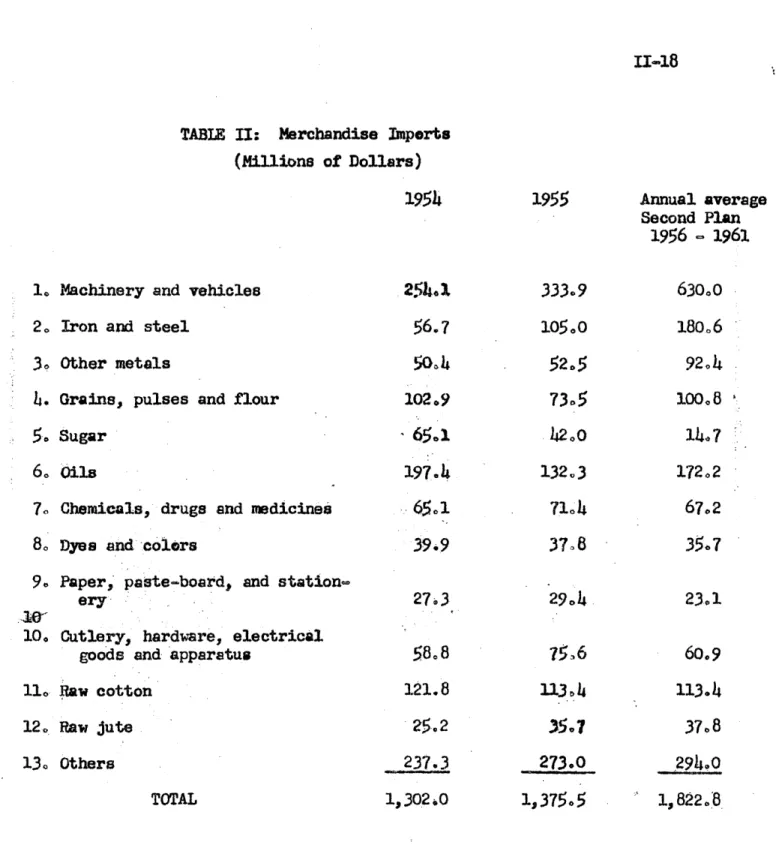
On the import side, the average level projected ($1.8 billion) is sig-nificantly above the high 1955 estimate of $1.5 billion, the latest figures available at the time the Plan was formulated. The expansion is concentrated
in the three categories which include most of the imported capital goods, as Table II makes clear. Thus, the increase in the average of all imports, 1956-61,
II-18
TABLE II: Merchandise Imports (Millions of Dollars)
1954 1955 Annual average
Second Plan
1956 - 1961
1. Machinery and vehicles 254.1 333.9 630.0
2. Iron and steel 56.7 105.0 180.6
3. Other metals 50.4 52,5 92.4
h. Grains, pulses and flour 102.9 73.5 100*8
5.
Sugar 65.1 42.0 14.76. Oils 197.4 132.3 172.2
7. Chemicals, drugs and medicines 65.1 7104 67.2
8. Dyes and colors 39.9 37.8 35.7
9. Paper, paste-board, and station-2
ery 273 29 23.1
10. Cutlery, hardware, electrical
goods and apparatus 58.8 75,6 60.9
11. Raw cotton 121.8 113 4 113.4
12. Raw jute 25.2 35,7 37.8
13. Others 237.3 273.0 294.0
TOTAL 1,302.0 1,375.5 1,822.8
II-19
over the 1955 figure was $M48 million; the comparable increase for the three capital goods categories was $12 million, or some $2.1 billion over the five year period. Over 90% of the total net import surplus anticipated in the Second Plan arises from this planned expansion in capital
imports.-In fact, with the possible exception of the smaller increases shown for grains, there were no other expansions anticipated in broad categories of import over the Second Plan period, The Planning Commission expected
domes-tic demand for consumer good pardomes-ticularly to be met principally through an increase in domestic production; indeed import controls were to prevent tny appreciable expansion in the level of such imports.
About 75% of all the capital goods imported were expected to be on government account. Since the private sector would need much larger amounts of capital goods§ an even larger share of the capital goods for new investment were to be on behalf of government. This again corresponds roughly with the fact that most of the over-all deficit on current international account was due to development activities in the public sector,
Finally, imports and exports were phased in the Plan so that the total deficit reached a peak in 1958/59. Two thirds of the deficit was to be in-curred in the first three years of the program. It was made clear that this lump was attributable to the steel, machinery and equipment needed to "devel-op industries which make machines to make the machines needed for further development." India s new program was formulated at a time when world demand for steel and for capital goods generally was high; many items, particularly heavy electrical goods produced to specification, could become available only after long delays. Government procurement agents did not have long-standing
Indeed, the 1955 imports already involved, it was estimated, s current account deficit of some $50 million, also attributable to an expansion in capital good imports (above the increase in all exports) over those of 1954. This might attribute some $250 million more of over-all deficit to the