Digital Cinema
An Environment for Multi-threaded Stories
by
Mark David Halliday
B. A. Computer Science
Dartmouth College
Hanover, NH
1985
Submitted to the Program in Media Arts and Sciences, School of
Architecture and Planning in Partial Fulfillment of the requirements of the
degree of
MASTER OF SCIENCE IN MEDIA ARTS & SCIENCES
at the
Massachusetts Institute of Technology
September 1993
© Massachusetts Institute of Technology, 1993
All rght reserved
Signature of Author v %V 4
Media Arts & Sciences August 7, 1993
Certified by
Glorianna Davenport Associate Professor of Media Technology Thesis Supervisor
Accepted by ,Stephen
A. Benton
Chairperson Departmental Committee on Graduate Students
RotCh
MASSACHUSETTS INSTITUTE OF TFC4NOI McY
OT 18 1993
Digital Cinema
-
An Environment for Multi-threaded Stories
by
Mark David Halliday
Submitted to the Program in Media Arts and Sciences, School of Architecture and Planning
on August 7, 1993
in partial fulfillment of the requirement of the degree of MASTER OF SCIENCE IN MEDIA ARTS & SCIENCES
at the
Massachusetts Institute of Technology
Abstract
This thesis explores how simple interactive narratives can be constructed from a large collection of digital video clips described in a database. Constructing such narratives means encoding story structures that can allow the computer to choose appropriate clips from the database as the story progresses over time, referred to as orchestration, and establishing rules controlling how and where images appear on-screen, referred to as positional editing. The aim of this thesis is to use
orchestration and positional editing to create an environment within which it is possible to view, interact with and understand multi-threaded narratives.
Thesis Supervisor: Glorianna Davenport Title: Associate Professor of Media Technology
Digital Cinema
An Environment for Multi-threaded Stories
by
Mark David Halliday
The following people served as rArs for this thesis:
Reader: Errol Morris Film Director
Reader: Janet Murr '
Senior R earch Scientist
Director, Laboratory for Advanced Technology in the Humanities
Acknowledgments:
The work described in this document would have been impossible without the encouragement, support and patience of many people. Thanks to all of them.
Glorianna Davenport for believing in me from beginning to end and giving me the freedom to experiment with images and stories over the last two years.
Janet Murray for your invaluable commentary in shaping this document and your enthusiastic support over the past two years.
Errol Morris, watching your latest edits on the Avid reminded me what I'm really trying to achieve with moving images.
Ryan Evans you've been a great friend and wonderfully patient when it comes to showing me what computers can really do. I hope we can work together again someday.
Betsy Brown and David Tames are real friends for suffering through early drafts of the document and scribbling lots of comments. James Seo, thanks for the late nights that yielded the latest and greatest interface code. Thomas Aguierre Smith, Kevin Brooks, Amy Bruckman, Stuart Cody, Eddie Elliott, Stephan Fitch, Scott Higgins, Gilberte Houbart, Hiroaki Komatsu, David Kung, Lee Morgenroth, Brian Robertson, Kiochi Yamagata, Hoony Youn have been great friends to work with in Macondo, our beloved lab.
The lab would have been very different without the musical tastes of David Kung, John Shipple, and James Seo. Thanks for all the taping opportunities.
My roommates Paul and Henrietta took me hiking and cooked great meals and made
my 2 years at the Lab a wonderful living experience.
Finally, Alessandra Prosperi thanks for supporting me emotionally and otherwise over the past two years.
How to read this document
This document is designed in a modular fashion. There are a number of different ways you can read it:
The 1 Minute Reading
The 5 Minute Reading
The 30 Minute Reading
The 2 Hour + Reading
The Fun Reading
The Mystical Reading
Read the abstract on page 2 and look at all the pictures.
Read the abstract on page 2, read the summaries at the beginning of each chapter and look at the pictures. If you are a fast reader, you might also have time to read the conclusion on page 83.
Read the abstract, and Chapter 1. This will give you a detailed outline of the problems addressed by this thesis. Follow this by a reading of the summaries at the beginning of each chapter. You might then go on to Chapter 6 which presents the results of the research and finish with Chapter 7, the conclusion.
Read the whole document from beginning to end. There is a summary at the beginning of each chapter that gives an overview of what each chapter is about. With 2 hours, you'll have enough time to get into a
detailed account of all the experiments that were carried out as part of the research.
Appendix A gives an account of the production process and includes a bio of all the people who worked on the various shoots. If you have time, read Chapters 1, 6 and 7 for an overview of the research.
Throw document in the fireplace and contemplate the ashes.
Table of Contents
1. Introduction ... 9
1.1. The Digital Age...10
1.2. T he A im ... 11
1.3. The R oad... 12
1.3.1 Process...12
1.3.2 The Stages...12
2. The First Experiment -IC Portrait...15
2.1. C oncept... 15
2.1.1 Unstructured positional editing and orchestration ... 15
2.2. Background and a little theory...17
2.2.1 A Definition of a Story...17
2.2.2 The Maker's Activity...18
2.2.3 The Viewer's Activity...18
2.2.4 The Frame ... 19
2.2.5 The Viewer Becomes Maker ... 20
2.3. Interaction, Interactive Cinema and Previous Work ... 21
2.3.1 Aspen (1979-1981)...22
2.3.2 New Orleans (1982-1987)...22
2.3.3 Elastic Charles (1988-1989)... 22
2.3.4 Rowes Wharf Intrigue (1988-1989)...23
2.3.5 The Electronic Scrapbook (1990-1991)...23
2.3.6 Homer (1991-1992)...23
2.3.7 Windows on the World (1981) ... 23
2.3.8 The Video Streamer (1991-1993)...24
2.3.9 LogBoy Meets FilterGirl (1992-1993)...24
2.4. Where does my research fit in?...24
3. Digital Micromovie Orchestration -An Endless Conversation ... 26
3.1. Concept... . ... 26
3.1.1 A Filter-Based Turn Taking Conversation...26
3.2. Production ... 27
3.2.1 Software...27
3.2.2 The Logging Process...27
3.2.3 Filtering...29 3.2.4 Scripting ... 30 3.2.5 Additive Construction...31 3.2.6 Interface...32 3.2.7 Extensibility ... 34 3 .3 . C riticism ... 34 3.3.1 Results ... 34 3.3.2 Problems...35
4. Orchestration through Linked Story Structures ... 36
4.1. C oncept... 36
4.1.1 An impressionistic collage through a linked story structure ... 36
4.1.2 A Multi-threaded Structure ... 36
4.1.3 Granularity ... 36
4.1.4 An Inspiration for Content and Structure ... 37
4.1.5 Sequencing Story Units... 37
4.1.6 Documentary Content ... 38
4.1.7 Fictional Content...38
4.2.1 An Impressionistic Collage...39
4.2.2 The Story ... 40
4.2.3 Casting & Shooting ... 41
4.2.4 Softw are ... 42
4.2.4 1 L inks...42
4.2.5 The Interface: a visual context for the viewer ... 45
4.3. Criticism... ... ... 47
4.3.1 The Experience... 47
4.3.2 What works ... 48
4.3.3 Feedback from selected users ... 48
4.3.31 Perspective...48
4.3.32 Two choices ... 48
4.3.33 Content and Structure...49
4.3.34 Problematic links...49
4.3.4 Lessons Learned...49
5. Story Models and Story Agents -Train of Thought v 2.0...51
5.1. Concept... 51
5.1.1 A linked story model and a filter-based story agent ... 51
5.1.2 Thoughts on Structure ... 52
5.1.3 Story Template...52
5.1.4 Quantifiable Structure Exists in Films... 53
5.2. Production ... 54
5.2.1 Software ... 54
5.2.2 Data Structures...55
5.2.3 Sequencing the Story...56
5.2.4 The Story Agent ... 57
5.2.5 Logging...58 5.2.6 Inference...58 5.2.7 The script...60 5.2.8 The Interface ... 62 5.2.81 Two Modes...62 5.2.82 Annotation Browsing...64 5.2.83 Inferred Material... 65 5.3. Criticism... .. ... 65 5.3.1 The Experience... 65
6. Results -Insights on Content and Structure...67
6.1. A Brief Review...67
6.2. Story Models ... 68
6.2.1 Kernels and Satellites ... 68
6.3. Interface -Story Visualization through Positional Editing ... 71
6.3.1 Non-interactive...71
6.3.2 Interactive... 71
6.3.3 D esign ... 72
6.4. The Interactive Experience ... 73
6.4.1 Exploration in Fictional Narratives ... 73
6.4.2 Exploration in Documentaries...74
6.4.3 Thoughts on Dreams, Emotions and Interaction...75
7. The Future... 77
7.1. New kinds of distribution, new kinds of stories ... 77
7.1.1 Broadcasting ... 77
7.1.2 Networking...77
7.1.3 Personalizing...78
7.1.4 Open Ended ... 79
7.2. Research directions ... 80
7.2.1 Scalable Story Structures...80
7.2.2 Interfaces ... 81
7.2.3 Interaction ... 82
8 C onclusion ... 83
References...85
Appendix A - Digital Guerrilla Movie making...87
On Guerrilla Filmmaking ... 88 W riting ... 88 A ctors ... 89 Shooting ... 89 Sound ... 90 Post-production ... 91 In C losing... 92 8
1. Introduction
This chapter introduces the main problem addressed by this thesis: how can digital technology enhance cinematic story-telling? We look at how computation can assist the movie maker in two ways: positional editing, which refers to how the
positioning of story-elements within the frame can provide a way to visualize a multi-threaded story, and orchestration which refers to how the computer can control the sequencing of cinematic material. The chapter concludes with a detailed outline of the four experiments carried out as part of the research that will be described in the rest of the paper.
On two deaths and three births
My movie is born first in my head, dies on paper; is
resuscitated by the living persons and real objects I use, which are killed on film but, placed in a certain order and projected on to a screen, come to life again like flowers in water.
Robert Bresson
The ultimate goal of any filmmaker is to tell a story to an audience. In traditional film, the creator weaves images and sounds into a complex but fixed tapestry that grabs the viewers and draws them into an engaging display of sounds and images. The experience can be very powerful and absorbing.
The process of making a movie is a collaborative effort that involves the talents of many people and the use of complex equipment and tools. In a fictional film, a
screenwriter lays down the plot, dialog and action, creating a detailed template of the entire story. During production, the director works with the actors,
cinematographer, art director, sound person and production manager to capture on film or video the material that will shape the story. They use cameras, sound recorders, lights, dollies and other sophisticated equipment to record the material. During post-production, the director works with the editor, sound editor, composer and other crafts people to shape the images and sound into a cinematic narrative using editing machines, mixers and special effects equipment to bring the movie to life. The production of a movie is an iterative process that involves the constant give and take of many people as they slowly bring the story to life. In some cases, the makers will realize that the movie is missing certain crucial elements and they will rewrite and re-shoot entire scenes to make the story flow. The final product is a movie.
Linear movies, whether created and released on film or video, are made from a collection of shots and sounds arranged along one unchanging strip. The structure, style and content will remain the same every time it is seen by an audience, although the interpretation of the events happening on screen is different for each viewer. It is an experience that draws the viewer into a state of reverie, completely absorbing them into the events happening on-screen.
1.1. The Digital Age
Digital technology gives the movie maker new capabilities and tools. It is possible to start thinking of different kinds of narrative environments that give the viewer new ways to experience stories.
The frame can be broken down to encompass multiple streams of video. The decision of where to position those streams on the screen, an activity we call positional editing, becomes as important as temporal editing, deciding how to sequence images out over time.
Digital video stored on a hard disk is just like any other piece of data that can be accessed immediately by the computer. This gives the movie maker options for deciding how to orchestrate the images and sounds on the screen. Computation can be used to help this process.
Viewing has traditionally been a passive activity. The viewer has no control over the playout of a movie. The mind is active as the eyes and brain process the
incoming audio-visual signal, but there is no activity in reshaping the playout of the story. In the digital domain, the viewer can affect the viewing experience through interaction, thereby becoming an active participant. This is a novel feature that requires new ways of writing, filming and structuring cinematic stories. This thesis explores how movie making and movie viewing change when the activities take place in a digital environment. Digital technology makes it easier to do things that were difficult or impossible to do before. I want to explore how the instant access of video frames and the ease of positioning them on-screen changes the making and the viewing of movies. The research is motivated by my desire to create cinematic narratives that involve the active participation of the viewer.
1.2. The Aim
The research presented in this thesis looks into two ways in which digital
technology can change the way we can arrange audio-visual information over time to tell stories. Two organizing principles are investigated:
- Positional Editing looks at how to break out of the frame-based presentation of movies. The computer can display multiple streams of video on the same screen, offering the maker new ways to position story elements so as to structure a story in a visual manner that can help the viewer's story building activity.
* Orchestration explores the ways in which computation can be used to assist the
story construction process. As computer technologies convert video into digital data that can be easily accessed through computation, what used to be a linear strip of frames can be broken up and recombined to form new sequences. Computational orchestration offers the maker flexible ways to structure the content and the playout of a story.
Technology has always been a driving force behind the art of cinema. "Each new medium modifies and extends the linguistic possibilities of the moving image, subsuming the syntaxes of previous media without negating them" (Youngblood,
1970). The digital medium gives the movie-maker new options for manipulating the
moving image to communicate to an audience. Things that were possible but difficult to accomplish become easier; images can be accessed within a split second and multiple images can be displayed on the same screen. The problem is to find out how to effectively use these capabilities to tell engaging stories. Movie makers have always used the latest technological advances to push their art forward. Color,
sound and special effects have all extended the art of cinematic story telling. Computation pushes movie making in new directions.
In 1980, Aspen investigated the use of computation to present a collection of video frames in a spatial context. This videodisk-based movie allows the viewer to travel around the city of Aspen by driving up and down the streets (Lippman, 1980). Aspen literally puts the viewer into the driver's seat. It is a pioneering experiment
that took advantage of instantaneous access to any frame of video and of simple computer graphics, to create an active cinematic experience. Aspen was the first of many experiments at the Media Lab, including Windows on the World, New
Orleans, Elastic Charles, and many others 1 that all explore the problem of using computation to create new kinds of viewing experiences.
The research in this thesis grows out of these experiments. I use computation to assist in the positional editing and the orchestration of cinematic material to drive the viewing experience. The viewer should be able to sit back and enjoy the show or to change what is happening on-screen in a fluid manner. My hope is that the
computer can be used to put viewers into the driver's seat, but not to require them to drive all of the time.
1.3. The Road
1.3.1 Process
I am a filmmaker by training. The process I follow during my research is very
much like the iterative process of producing a linear movie. In collaboration with other researchers, I make movies using digital technology. I start with a concept of what I want to see on the screen. I then move on to the production stage where the concept is brought to life. This stage often involves changes and rethinking the concept; just as in a linear movie, certain things are found to work and others are found to fail. The final outcome is invariably an experience in which an audience can participate. During this stage, criticism feeds back information to the maker on
what works and what doesn't. This criticism often motivates the maker to go back and change the concept, initiating new production and criticism. It is through this iterative process of creative feedback that movies are made and it is through this iterative process that I research the production of digital cinematic experiences. 1.3.2 The Stages
This thesis tracks the production of four experimental interactive movies, outlining each production as it goes through the three stages mentioned above: concept, production and criticism. The four movies each explore varying degrees of structure
in the way they are displayed and played out using computation. They range from little structure in either positional editing or orchestration, as in IC Portrait, to more structure in both orchestration and positional editing as in Train of Thought v 2.0.
1
Figure 1 - A subjective representation of the amount of structure present in the positional editing and orchestration of each of the four experiments.
Chapter 2 introduces the two main problems tackled in this thesis, orchestration and positional editing, by analyzing the first experiment, IC Portrait, a multi-threaded movie about students in the Interactive Cinema Group created by my colleague Ryan Evans and myself. What new factors have to be taken into account when creating for the digital environment and for interaction? How have other experiments tackled the problem?
Chapter 3 looks at how the second experiment, An Endless Conversation,
addresses the problem of creating a cinematic sequence from a collection of digital video clips. How can we achieve real-time shot selection to build movies?
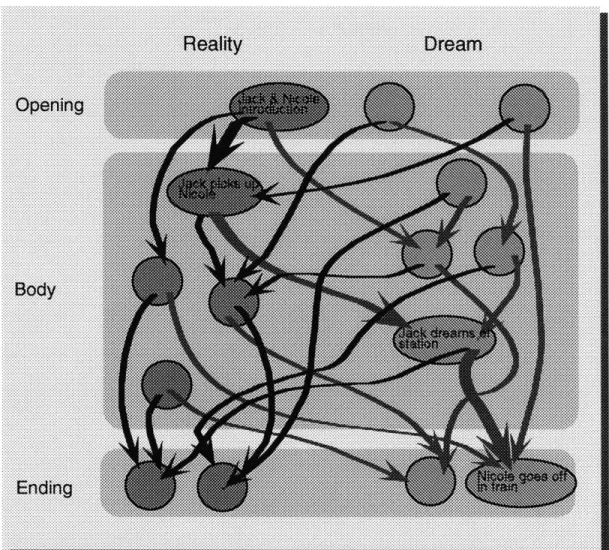
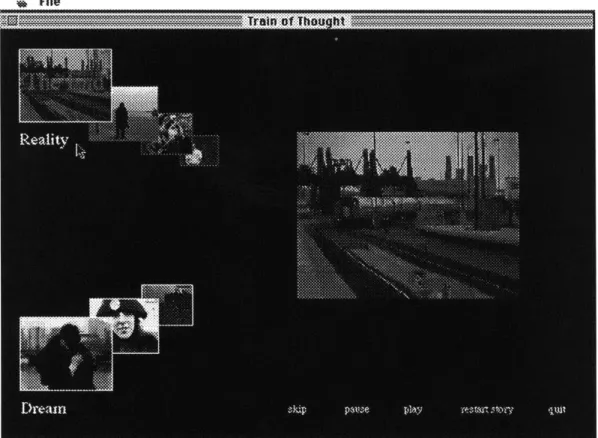
Chapter 4 analyses Train of Thought, a fictional multi-threaded narrative, filmed with the help of Ryan Evans and Lee Morgenroth, that tells the story of the separation of Jack and Nicole as she leaves him for a job on the other side of the world. It is a multi-threaded story where links are used to build the narrative structure. A 2 1/2 D interface attempts to give the viewers a sense of where they are
and where they are going in the story. Links did not serve our purposes, but the interface is an interesting structured approach.
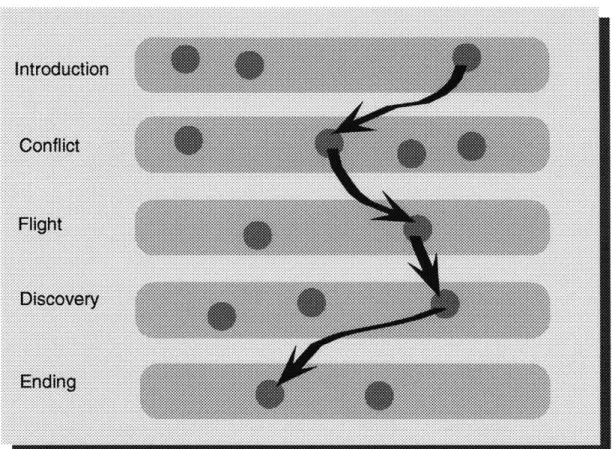
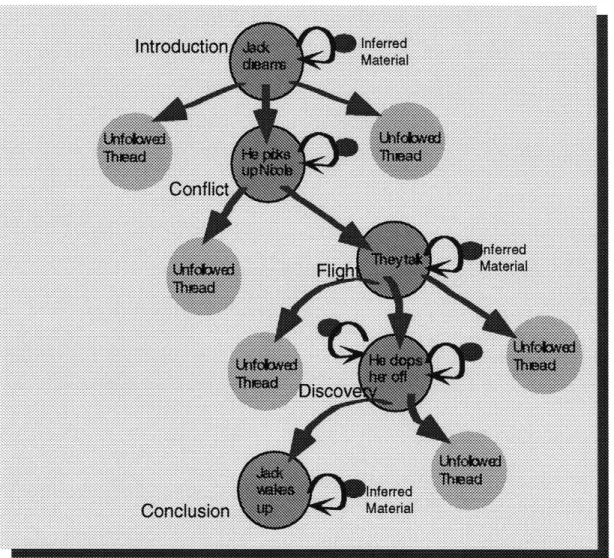
Chapter 5 tracks the process of creating the second iteration of Train of Thought, Train of Thought v 2.0. A formal story structure is developed and the interface becomes more dynamic.
Chapter 6 discusses what was discovered from the whole process of trying to tell alternative stories in the digital domain. What does the viewer want? What does the maker have to take into account? What does interaction mean?
Chapter 7 talks a little about the future and frames some of these ideas in the context of what is happening with the distribution technology. What kinds of new viewing experiences might emerge from a networked digital cinema environment?
2. The First Experiment
-IC Portrait
This chapter looks at the first experiment, IC Portrait, carried out by Ryan Evans and myself. IC Portrait used unordered positional editing and orchestration to build a cinematic sequence on-screen. The lack of structure in IC Portrait created a difficult viewing experience but identified the problems to be dealt with in subsequent research. This chapter goes on to define what is meant by story, and how the maker's and viewer's roles affect the structure and content of interactive movies. It also places this research in the context of other work that has been carried out in the area of interactive cinema.
2.1. Concept
2.1.1 Unstructured positional editing and orchestration
IC Portrait was a first attempt at creating a multi-threaded experience out of a large collection of digital video clips. The movie is about Interactive Cinema; what is it? who is it? what does it mean? We filmed all the members of the Interactive Cinema Group talking about themselves, interactive cinema and various objects that were part of the lab environment. They were filmed against a black background and were encouraged to make funny and wild statements. The video was then converted to the digital format and edited by hand to create coherent statements from each character.
This database of clips was then incorporated into a multi-threaded presentation. The system was based on a message-passing structure where the encoded representation of each character could send and receive messages to other encoded characters within the movie world. There was also a "master story teller" who coordinated the
overall playout by broadcasting messages into the environment at specific time intervals. It was a rather primitive system where we were attempting to create a flexible environment within which a range of events could unfold. We wanted to create a multi-threaded story that the viewer could mediate by clicking on a particular character or object.
IC Portrait addressed a couple of issues. It tried to create a multi-threaded structure where events are not pre-scripted to replay in one particular order. Instead, certain actions such as an utterance from a character or intervention from the viewer were supposed to trigger other events, such as an utterance from another character or the
appearance on-screen of an object. This environment was loosely modeled around a micro-world2 model where a collection of objects influence each other's activities in a closed environment. It was not a strict interpretation of a micro-world however, because the master story-teller guided the conversation in a predetermined way. Another issue addressed by IC Portrait was the display environment. All characters and objects were filmed against a black background. This was done so that all the visual material could then be smoothly incorporated into a black background to allow us great flexibility in positioning elements within the screen. We were thinking of the environment as a non-linear collage of shots in space. This model takes the idea of a movie a step back in the direction of theater: we are experiencing a narrative where the characters are interacting with each other and with the viewer within the confines of a defined space, the screen.
IC Portrait was a first attempt at breaking away from a pre-scripted linear display of audio-visual material. What were the results?
Watching and interacting with IC Portrait was a rather confusing experience. Characters and objects appeared in various parts of the screen in a seemingly random manner. There was no narrative flow. As I said at the time:
Some basic elements of a narrative are missing from
IC Portrait. There is no conflict between the
characters. The interaction between them is quite limited. One character might say one thing and cause
another to come up and respond in a different part of the screen. Unfortunately, the reaction is not always
obvious. The result on-screen is of a somewhat random collage of characters saying various things about themselves and about interactive cinema. It does not quite add up to a story. (Halliday, 1991)
IC Portrait got things going on the right track, and identified the problems to be dealt with in subsequent research.
Keeping IC Portrait in mind, it is useful to analyze the problems we were trying to address. There are two basic areas of interest:
The position of movie elements on-screen, which we refer to as positional editing
2The term micro-world was originally coined by Seymour Papert in his book "Mindstorms". The use of the
* The sequencing of movie elements in time, referred to as orchestration.
The basic question being addressed is this: How do I get the computer to assist in the story building activity by positioning and orchestrating digital video such that a random-access, on-the-fly playout can make narrative sense?
2.2. Background and a little theory
IC Portrait tried to maintain the fluidity of the linear medium while still allowing the viewer to intervene in what was happening on-screen. It was possible to sit back and just watch what was happening because the experience played out without prompting from the viewer. The computer was orchestrating the experience, but not in a narrative way. The data representing the video did not help the computer select segments to build a coherent narrative. Similarly, the video clips were being positioned in different parts of the screen, but not in a cinematic way. A brief look at some of the theory behind stories, makers and viewers will give us a good perspective on what I am trying to accomplish.
2.2.1 A Definition of a Story
The first important point to clarify is to define what constitutes a story. What are the necessary components -and only those -of a narrative? Structuralist theory argues that each narrative has two parts: a story (histoire), the content or chain of events (actions, happenings) plus what may be called the existents (characters, items of setting); and a discourse (discours), that is, the expression, the means by which the content is
communicated. In simple terms, the story is the what in the narrative that is depicted, discourse, the how. The following diagram suggests itself:
Actions
Events
Happenings
Story Existents Characters
Narrative Settings
Text
Discourse (Chatman, 1978, p. 19)
I take Chatman's definition -of a narrative as the basis upon which to build stories using computation. The basic elements of a story (actions, happenings, characters
and settings) are organized into a narrative. The organization of these elements (the discourse) is at the heart of this research. I want to use computation to create this organization.
"A narrative is a communication; hence it presupposes two parties, a sender and a
receiver. [...] Whether the narrative is experienced through a performance or through a text, the members of the audience must respond with an interpretation: they cannot avoid participating in the transaction" (Chatman, 1978, p. 28). This relationship of the sender to the receiver is central to my approach. It is the synthesis of their activities that creates the flowing cinematic experience. 2.2.2 The Maker's Activity
The movie maker will carefully build a sequence of images and sounds to draw the viewer into a state of reverie and in so doing, is able to communicate something to the audience. Using cinematic conventions that have evolved over time, the maker constructs a story. A script clearly delineates the actions and scenes required for the story that needs to be told. The cinematic material is gathered using a camera and a sound recording device. This material is then edited together using specific rules that allow the maker to articulate a story. The finished product is a collection of shots that have characters carrying out actions in various settings. These shots play out and build a narrative experience for the viewer. The essence of the maker's activity involves building up this experience and then passing it on for viewing. What does the viewer do?
2.2.3 The Viewer's Activity
"In comprehending a narrative film, the spectator seeks to grasp the filmic
continuum as a set of events occurring in defined settings and unified by principles of temporality and causation" (Bordwell, 1985, p. 34). The viewer "grasps the filmic continuum" by taking the incoming visual and auditory information and processing it to build up a story. "For schooled perceivers in contemporary Western culture, narrative comprehension and recall are centrally guided by the goal of creating a meaningful story out of the material presented." (Bordwell, 1985, p. 34). This goal of building up a meaningful story is a continuous and subconscious activity, something the audience does as soon as they see a sequence of shots play out in front of them, whether on a movie screen or on a television tube. The viewer's story building activity is part of the viewing experience. This is where a
skilled filmmaker will provide the necessary clues at the right point in time such that the viewer is able to construct a narrative out of the separate events appearing on-screen.
If we are to create engaging experiences in the digital medium, we have to start on
familiar ground. I would like to take some of the features of the linear medium that we understand and see if we can extend them to the digital medium. We understand how stories are built up in movies; images and sounds are carefully selected and sequenced to build an engaging experience. Although IC Portrait did attempt to create a flowing experience on-screen, there was no narrative in the flow. This was one of the fundamental elements lacking from the experience. The viewer was not able to create any kind of meaningful story out of the material presented on the computer screen. The experience resembled a collage of unrelated utterances. One of the aims of this thesis is to demonstrate how the computer may orchestrate a meaningful sequence that builds up a narrative from a collection of clips that have been assembled by the movie maker.
2.2.4 The Frame
The digital video sequences presented to the viewer in IC Portrait appeared in different parts of the screen. One character might say: "Hi my name is Thomas" as he pops up into the middle of the frame. The image of a light might then appear on one side of the frame. While these digital video clips played out in various parts of the frame, they did not provide any visual cues to the viewer as to what was happening in the narrative. If anything, there was a general feeling of surprise anytime a new clip appeared, because it popped up in an unexpected place. This was a little confusing. The experience would probably have been more coherent if the video had been displayed within a frame as linear video separated by cuts. In a movie, every transition is motivated. A cut, a dissolve, or a wipe each signify something to the viewer (as long as they have become accustomed to the basics of cinematic language). In a digital environment, the positioning of multiple video streams can be used to add meaning to the playout of the story. Instead of just positioning video in different areas of the screen, the way in which a particular piece of video is displayed can help the viewer's activity. In particular, I am interested in using perspective to show what is happening over time. Since
story-telling is an inherently time-based activity, representing time in a graphical manner might enhance the viewing activity. In an interactive environment visual cues that
show where one is in the story and where one can go next will help the viewer make decisions. It will help the story construction process.
2.2.5 The Viewer Becomes Maker
The viewer's activity and the maker's activity as described above are quite distinct from each other. Once a fflm is made, it is handed over to the marketing and distribution people rarely to be touched again by the filmmaker. What happens when the viewer suddenly is given a chance to intervene in the on-screen activities?
... ...
... ... ...
... ...
... ... Shows how the
Figure 2
... ...
... ... ...... ... ...viewer's and the maker's
M, ...
_ ... ... ... ... ... * ... ... ... ...* ...... ... ... .. ...... ... ...roles m erge w hen
...
... ... ... ... ... ...... ...... ...... ...... ... _ _ .... interaction is introduced.
... ...
... ... ... ... ... ... ... ... ... ......... ...
... ...... ......The viewer becomes an ...
... ... ... ... ...editor. This changing
... ...
... ... ... .... ...... ... .... ..._ _ _ . role happens over a
...
... ... . ...
...... ...
... ... ... ... .. ...... continuum as the view er ... ... ... ... ... ... ... ............
... ... ...
... ... ... is able to affect in
... ... ... ... ...
... ... ... ... ... ... ... ... ...... ... ...... ... ...___ ......... different ways what is ... ... ... ......
... ... ... ... ... ...... ... ... .........occurring on-screen. ... ... ... ... ... ...... ... _
... ... ... ... ... ... ... --... ............ The viewer might only
... ... ...
... ... ... _ .... ... ...... --- ... --- ... ... --- ... .. ... . .. ...... -...
... ... ... ... . ... ....... .. ... ...... decide w here to go next ... .... ... . ... ... .........
... T .. ..... .. .........in an interactive movie
... but might shoot and kill a
...
...... .. . ...... ... ...
... ... ... ... ... ... ... ...... .. ... .... .. .........character in a video ... ... ...... ... .. .... .... ......
...... .. .. .... ...game. In both cases, the
... ...
......
... . .. ... view er is m aking
...... ... ......
... ... .. ......decisions about what
... ... .. ...... ... ... ... -_ ... .. . ......... occurs next. ... ..... .. ... ... ... ... ............ ... AL ... ... ... ... ... : ... ... .... ... ......I ...... . ...... ... ... . ..... . ... ... . ......... ... ... ... ... I ...... ... ... ... ... ...... ... ......... ... ... ... ... ...... ... ...... * ... ... ... ...... - ---... ... ... ... ... ... ... ... ... --... ... ... ... ... ... ...... ... ... ... ... ... ... I ... ... . ... . . ....: ... .. ...... ..... ... ... ... .. .... .. ...... ... ...... ... ... ... ... ... .. ... ... ... ... ... ... ...... .... 0 ......... ...... ... ... ... ......I ... ... ... ... ... ...... ... ... ...... ... .. ... ... ... ... ... ... ... .... .... ...... ... ... ... .. ...... ... .. ..... .... ... .. ... ... ... ... ...... ... ... ... ... ... .. .... ... ... ... ..... ... ... .... ... \ -' -... .. ...... ... ...... ......... ... ... ...... ... ......... ...... .... X X ... ... ... ... .... .... .. ... . ... ..... ... ... ... ... ... ... ... ...... ... _ ... ... ... ... ... ... ... 1- ...... _ _ _ ... ... ... ...... ... --... ... ... ... ... ... ... ... --- ...... --- --- ...... -- _ % ... ...... -1 .... I ....
The viewer's activity and the maker's activity begin to overlap. As the viewer starts making choices about what to watch or which thread to follow, he starts making choices that have traditionally been part of the maker's activity. A big difference between the maker and the viewer is that the maker usually has a clear idea of the story and how to tell it. A filmmaker knows what material has been shot and how to
edit it all together to tell a story. A viewer does not usually think about these things. Giving the viewer a visual representation of the story can help make sense of where in the story they are and where they are going.
2.3. Interaction, Interactive Cinema and Previous Work
Until the advent of computers, story telling had largely been a one way activity. The audience, reader or listener had very little control over the arrangement of what plays out on TV or in a book. An exception might be found in environments where the oral tradition still prevails. A child listening to a parent tell a story will often interrupt to ask to hear more about the elephant or to ask why the ham is green. These interruptions redirect the narrative flow. This usually happens in a fluid manner because the parent is able to process the child's request and adapt the story in real time.
A completely different kind of experience is a video game where the player is
constantly deciding what should happen next. If he stops playing, the action usually comes to a rapid end (usually through death). In games, there is usually very little story building activity (in the context that I have laid out). There is a lot of
interaction largely aimed at controlling split-second actions -like throwing a punch or shooting a bullet.
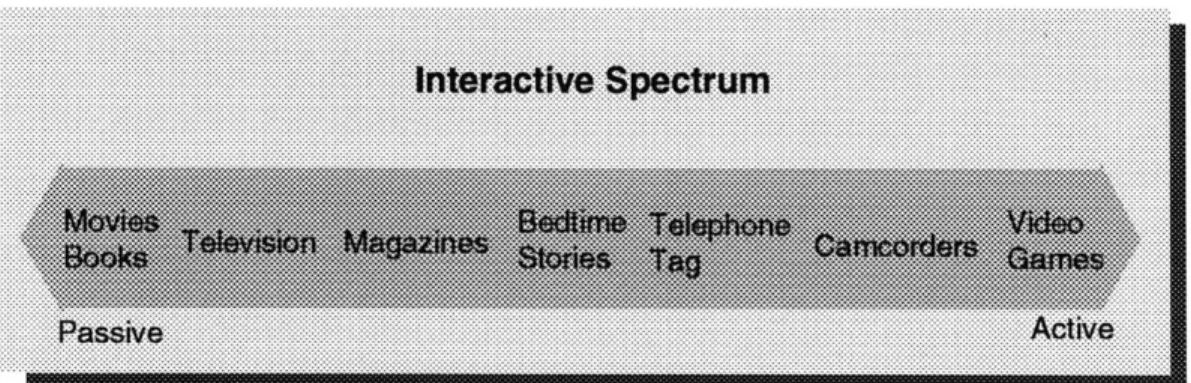
Figure 3 -Shows how some interactive activities relate to each other along an interactive spectrum
Figure 3 shows an interactive spectrum along which different story activities might spread according to the kind and amount of viewer activity (interaction). At one end are books and movies, where viewing is the primary task. At the other end are games where interaction is the main task. In between, we find magazines which invite non-linear reading, bedtime stories which invite interruption, telephone tag
which demands some story construction, and camcorders which require story acquisition and construction. Where does digital cinema fit in? Much research has been done in different areas of the interactive spectrum. A brief introduction to some of the work will help frame the research of this thesis in the context of what has been done before.
A brief overview of some of the projects follows. Some investigate the way
audio-visual material is displayed. Others look into how the computer might help arrange the material as it plays out over time.
First, we take a look at various models for building stories. 2.3.1 Aspen (1979-1981)
Aspen is a video-disk based application that was described in Chapter 1. It is an early example of an environment that allows the viewer complete control over what is seen. A story is created in the sense that Aspen creates a spatially-referenced narrative where the viewer traveled through a visual representation of a space. Short video pieces could be seen upon entering certain buildings, such as a police officer talking in the police station.
2.3.2 New Orleans (1982-1987)
New Orleans Interactive is a documentary which begins to explore the importance of attaching computer readable content descriptions to video clips (Davenport,
1987). While watching a linear movie about New Orleans as the city prepares for,
holds and concludes the 1984 Louisiana World Exposition, it is possible, using keywords attached to people, places and themes, to get more information relating to what is currently being watched in the linear movie. Multiple narrative threads are created through the material through the use of thematic and chronological filters. 2.3.3 Elastic Charles (1988-1989)
Elastic Charles is an example of a hypermedia journal that uses micons as dynamic representations of video segments. The viewer experiences different stories along the Charles River that are each represented by micons and can be accessed by clicking on them. The choice of which micons to bring forth to the screen is based on a pre-defined, fixed table of contents and on dynamic links that can be made by the viewer or the author (Davenport & Brondmo, 1990). One of the important research issues to emerge from Elastic Charles was the demonstration that a
significant amount of information about the content of a video sequence can be packed into a short segment of repeating frames: a micon. An arrangement of these micons on the screen provided an intuitive way for the viewer to interact with new material related to what is currently being viewed on screen. The micons appear and disappear as the viewers travels along the river, allowing the viewer to follow links to related material.
2.3.4 Rowes Wharf Intrigue (1988-1989)
Ben Rubin explored the use of layered filters for building a personalized movie. His constraint-based editing system selects shots based on limited input from the viewer and builds an edit list to create a linear story for subsequent viewing (Rubin, 1989). This is an example of how the computer might select shots based on user input to build a story. In this system, the processing is done ahead of time, precluding any real-time interaction on the part of the viewer.
2.3.5 The Electronic Scrapbook (1990-1991)
Amy Bruckman developed a system to help the editing of home videos. Computer readable descriptions are attached to the video material using Arlotje, a knowledge representation system developed by Ken Haase (Haase, 1992). This representation allows material to be retrieved from the database using complex queries that might be able to find all shots of a character at a particular location, or all "important firsts" made up of key events in a child's development. A story-model is then used to process the raw list based on a set of criteria. "The goal is to transform a long, unorganized list into something that is enjoyable to watch in sequence."
(Bruckman, 1991, p. 62). 2.3.6 Homer (1991-1992)
Homer is a system designed by Lee Morgenroth that uses a specific story model created by the movie maker to create a video story from a supplied database of logged video (Morgenroth, 1992). The aim is to automatically build a coherent narrative from video that has been extensively described either by an automatic logging system or manually by the movie maker.
The following projects explore the display of moving images: 2.3.7 Windows on the World (1981)
Dr. Richard Bolt developed a project called World of Windows that simulates the display of multiple streams of video on a large screen (Bolt, 1981). The viewers
controls the size and audio level of each stream by looking at a particular stream for long enough. The aim was to help the viewer make sense of a large collection of
audio-visual material through a more passive interface (pointing and looking). This experiment looks into how the arrangement of multiple streams of video material on-screen can assist the viewer's activity.
2.3.8 The Video Streamer (1991-1993)
The Video Streamer is a powerful visualization tool that uses the z-axis of the screen to represent a sequence of video over time (Elliott, 1993). It is an intuitive environment that allows the viewer to watch video as it streams off the top left portion of the screen in a 2 1/2 D manner and then to grab chunks of it. Simple manipulation tools allow the viewer to grab video blocks and to drop these blocks into a collage environment where it is possible to arrange the video by creating categories for the grabbed material. The Video Streamer demonstrates the intuitive nature of a 2 1/2 or 3D representation of time-based media such as video. It also demonstrates how a simple technical leap (displaying the video in a streamed fashion) can mean a huge conceptual leap for the viewer who can now see an order of magnitude more information.
2.3.9 LogBoy Meets FilterGirl (1992-1993)
LogBoy and FilterGirl together form a tool kit that enables a movie maker to create personalizable movies suited to the digital environment. LogBoy is a logging module that allows movie elements to be logged in a graphical manner; the entire
database can be viewed at once, making it easy to see how content is distributed throughout the database. FilterGirl is a filter-based real-time shot selection system
that uses the descriptions logged using LogBoy. The system builds sequences on-the-fly based on viewer preferences and is a powerful environment for the creation of interactive cinematic experiences (Evans, 1993).
2.4. Where does my research fit in?
The research described above covers many areas of the interactive spectrum, from the making of home-movies in Bruckman's system to the viewing of multiple streams of Bolt's system. My research concentrates on the viewer's activity as it relates to narrative movies. The situation I am interested in is one where the
cinematic material is collected and annotated by the maker and the story models are generated by the maker. The maker is very much in control of what appears on screen and the manner in which it appears. The viewer interacts during playback by
constructing the story and controlling playout. I like to think of the viewer as being in the position of the child listening to a parent (the maker) tell a story. The child can interrupt and redirect the playout and build a story in its mind as it hears and sees the narrative material. It does not originate the story in any way, but rather listens to and redirects what the parent is telling. Likewise, the viewer of the movies
I want to make can redirect and review what is playing out on-screen, but does not
actually originate or build the story.
IC Portrait tries to create a flowing narrative with multiple clips of digital video that appear in different parts of the screen. The viewer navigates the clips by choosing which one to view. Both the orchestration and the positional editing occur in an unstructured manner. The experience lacks narrative and visual structure. The rest of this thesis looks at one way of creating structure to help the viewer's story building activity.
3. Digital Micromovie Orchestration - An Endless
Conversation
One of the problems with IC Portrait is its lack of narrative structure. We realized this at the time and decided that the next step in the research agenda was to tackle a
simpler problem rather than to try and solve all the problems at once. This meant concentrating on orchestration and getting the computer to build a simple
conversation between two characters on-the-fly. The result of this effort is a movie called An Endless Conversation and a system called the Digital Micromovie
Orchestrator (DMO). The DMO uses a system of layered filters to create a "turn-taking" conversation between two characters. This chapter outlines the process used to create this movie and delineates the positive and negative features of the
approach. The DMO works well at the micro level of building sequences, but makes it difficult to build more complex narrative structures.
3.1. Concept
Instead of working with ten or more characters, we decided to narrow our cast down to two. The aim was to create a conversation between two characters. An Endless Conversation is composed of a collection of utterances by David Kung and Thomas Aguierre Smith, two students from the Interactive Cinema group. The computer decides how to sequence their utterances so as to build a conversation. Even though a conversation between two characters is not considered a story, it is a good narrative structure with which to start. Cinematically, it need not be that complicated, yet the content can be interesting because we rely on the scripted dialog of two characters to entertain the viewer.
3.1.1 A Filter-Based Turn Taking Conversation
We wanted to create a cinematic sequence where the decision about what to show next is decided on-the-fly computationally. If we want an environment where the narrative can adapt itself to changing circumstances, it is important to achieve
on-the-fly shot selection. The full sequence of clips cannot be scripted ahead of time if we eventually want to give the viewer some control over what happens on-screen. As a first step toward achieving this, the machine needs to know what a cinematic sequence is and how to string it together. This knowledge is encoded by the Digital
Micromovie Orchestrator (DMO), a system that uses machine readable annotations and a layered filter structure to sequence digital video clips.3
3.2. Production
3.2.1 Software
The DMO has two elements: the video database which consists of video clips with sketchy descriptions bound to them, and a layered filter structure that uses the descriptions to sequence the video clips in a cinematic manner. A sketchy description is an annotation, determined by the maker based on the needs of the story, that contains the minimum amount of information for use in a particular movie (for example, there is no need to describe the weather in a particular shot if the system is not going to use this information to build a sequence). The video is shot by the movie maker and edited down into coherent clips with beginnings and endings that make sense (they do not cut off a character in mid-sentence for example). A logger designed as part of the system by Ryan Evans is then used to bind the sketchy descriptions to the video clips. The shot selection module makes use of these descriptions to filter out unwanted clips using a collection of filters designed by the maker. It is the layering of multiple filters, each filtering the database of clips according to its own particular rules, that gives the system its sophistication and allows it to build coherent cinematic sequences on-the-fly. 3.2.2 The Logging Process
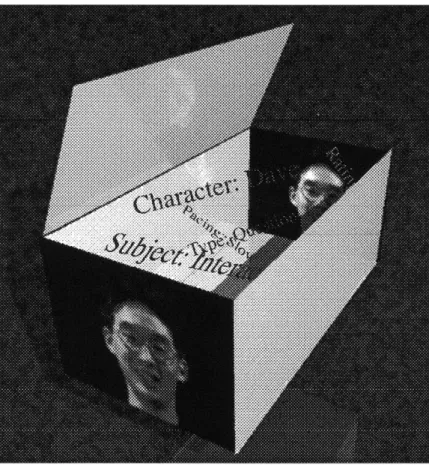
Descriptions are attached to the clips in the form of slots and values using keywords as descriptive elements. Each clip has several slots associated with it and each slot can have one or more values. The slots used in An Endless Conversation include: - character
e type of utterance e subject of utterance e pacing
- rating.
3 The original DMO system was developed by Ryan Evans and Mark Halliday. The work was supervised by
Glorianna Davenport and sponsored by the Kansa Corporation. The DMO extends previous research on automatic assembly carried out in the Interactive Cinema Group. The system assumes that the movie maker explicitly designs a story for interactive playout using simple annotations and layered filters. The concepts were worked out by Mark Halliday and Ryan Evans. Most of the initial coding was done by Ryan, with later additions being carried out by Mark. (Davenport, Evans, & Halliday, 1993).
Figure 4 - A visual
representation of a clip with slots and values attached. For example, the slot Character has the value Dave
attached. The slot Type has a value Question. The values are
attached using a
. .. logging module.
(This video box representation of a clip was inspired
by Eddie Elliott's
Streamer).
To indicate that a particular shot has Dave in it for example, the character slot has Dave as its value. To indicate that Dave is talking about a light, the subject slot has the value light bound to it. Only those values determined to be important to the filtering process are logged. The filmmaker manually binds these descriptions to all the clips using the logging module. At this stage, it is a manual process, and quite a laborious
job,
but at some time in the future, as image recognition technologies improve, logging may be partially automated. It is these kinds of sketchy descriptions that form the basis of the video annotations.Other researchers in the Media Lab have been looking at more comprehensive descriptive schemes. Thomas Aguierre Smith, working on an anthropologist's video notebook, developed a description system called stratification, a context-based layered annotation method which treats the descriptions of video as objects.
Stratification encodes thick descriptions (Smith, 1992), meaning that a video clip is extensively described for multiple uses, as opposed to the DM0 which uses sketchy
descriptions for use in a single domain. Marc Davis has created video annotations that seek to describe a large subset of all the recognizable features of a video clip
DMO relies only on the descriptions that are used by the filter structure. All other annotations are superfluous. This is closer to the kinds of descriptions used in Amy Bruckman's Electronic Scrapbook (Bruckman, 1991), which seeks to describe
home movie footage that will be used only in the context of a home movie editing system. A limitation inherent in the sketchy description approach is that the video can only be described for a single purpose. It is not intended for re-use by any other application because the descriptions are specific to the DMO movie they were created for.
From the perspective of a movie maker there is little demand for re-using video to tell stories. The images that most movie makers include in their films are carefully shot to tell a particular story. I am taking a similar approach to the construction of multi-threaded stories by working with a collection of clips that have been shot and edited specifically for the movie being made.
3.2.3 Filtering
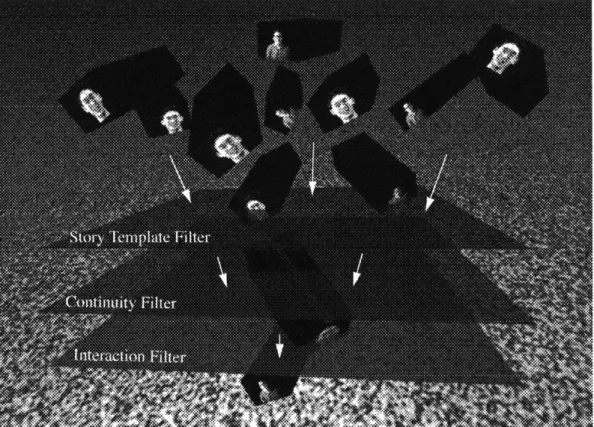
An Endless Conversation uses three filters for orchestrating the sequences:
e a story template filter which defines a conversation as a question followed
by an answer and then a rebuttal
e a character filter that makes sure that if Dave asks the question Thomas answers it and vice-versa
e a continuity filter that makes sure the subject of the answer matches that of the question.
These filters make use of the sketchy descriptions to select appropriate shots. Just as a human editor uses logs that have been created by an assistant to find clips and uses knowledge of story structure, cinematic rules and available video to create sequences which build up to stories, the layered filter structure mimics this process in a primitive way. It takes as its input the entire database of video and successively filters out clips that do not meet the specification of each filter. At the end of the filtering process, assuming the database is complete, the system returns a list of one
or more appropriate clips. If there is more than one choice, it randomly chooses one of them. This process is carried out each time a new cut is needed. It is true real-time shot selection.
Figure 5 - A visual representation of the filtering process. Individual filters successively narrow down the list of possible shot to only those that satisfy the constraints of each of the filters.
An individual filter is actually quite simple. Each one contains a simple rule or a description against which a clip description is matched. For example when Dave asks a question about the light ("What's this light?"), the continuity filter saves the subject of the question; the saved value light is then used to filter out all other subject values when the story template filter is at an answer. Every time a new clip is needed, each filter is successively applied to the database in this way, narrowing the list of clips down each time. As long as the database has the right material for the filter set, and as long as the material has been described in the correct manner, the DMO system will orchestrate a sequence on-the-fly.
3.2.4 Scripting
Making a movie that fits within the constraints of the DMO is very different from making a fixed linear movie. It has to be scripted to take into account the new ways in which it will be watched. We have constructed a multi-threaded narrative
structure that the viewer can traverse in various ways. The structure of the content has to be flexible because the shot selection system needs to have a variety of clips to choose from for each part of the movie. A question from one character could
have many possible answers and an answer can elicit many responses. The movie is different each time it is watched. Eventually, interaction should be able to change what is happening and it should change things in real-time, creating an interaction mode that we call "fluid interaction".
The actual structure of An Endless Conversation is a question and answer dialog session. Dave and Thomas are asking each other questions about interactive cinema. A typical interchange follows:
Thomas: "Hi, what's your name?" David. "David Kung"
Thomas: "I like that"
David: "What are you doing here?"
Thomas: "I'm a graduate student in the Interactive Cinema Group." David: "That's true"
Thomas: "What's this light here?"
David: "Well this light fixture actually comes from the first movie-house in Beijing and my grandfather took it as a souvenir when the theater closed down"
Thomas: "Don't listen to this guy. He's an undergraduate. He doesn't know anything."
Not the most riveting of conversations, but it can be followed and it makes sense. This conversation will go on forever, hence the title, An Endless Conversation. Dave and Thomas can make three different kinds of utterances: ask a question, give a response or give a rebuttal. They can talk about a variety of different subjects, including interactive cinema, the light, the pterodactyl and various other objects and
subjects remotely associated with the Interactive Cinema Group4. The database of content is made up of approximately 120 clips which are accessed by the DMO
system.
3.2.5 Additive Construction
The success of the playout relies on having a rich database of material. When we first ran An Endless Conversation, we had a large number of questions from David but we only had two questions from Thomas. This meant that when we ran the movie, the system only had the choice of two questions from Thomas which
severely restricted the breadth of the conversation. To remedy this, we shot Thomas asking the missing questions. After adding these new clips to the database and
4The light was a bathroom fixture introduced to the lab by Thomas during his tenure at the Media Lab. The
pterodactyl was a graduation present that Stephan Fitch, another graduate student, bought when he graduated from NYU Film School. The lab, which we called Macondo was littered with various objects introduced by different graduate students during their residencies. An Endless Conversation provided an introduction to many of the obscure but interesting features of the lab where we spent two years of our lives.
describing them using the logger, the movie changed dramatically as Dave's responses, which had lain dormant in the database, suddenly appeared on-screen automatically. This was one of the most exciting moments for me as a filmmaker. This means that a movie can now be an open structure into which new clips can be easily incorporated (as long as they have been described correctly for automatic
playout). The movie accommodates this new material without scripting or re-cutting.
3.2.6 Interface
The look and feel of this digital movie is very different from a traditional linear film. The video is small, the frame rate is slow and the sound is of poor quality 5. This is an unfortunate temporary limitation. The DMO system is entirely separate from the display environment and as the quality of the image improves, the filter-based shot selection scheme can be adapted to any new display environment.
To establish an understandable environment, as well as to mask the poor quality of the video and to compensate for it's small size, we designed an interface that frames the image in a familiar environment: a television monitor. The effect is to set up certain expectations for the viewer, who sees a representation of a television and expects a linear movie because the device is familiar. Those expectations are met because the presentation on-screen is a linear sequence (even if it is a little small and slow). It goes on and on no matter what the viewer does, which is similar to what happens on television. The small size of the image is less apparent because it is placed in the context of a larger image and is motivated by being framed within in the image of a TV set.
5 This is a limitation of the digital compression scheme being used to display the video (Apple's
QuickTimeTM). Another noticeable limitation of the system is the delay between shots as the filtering takes place. This makes totally seamless cuts between clips difficult, but there are schemes that will make this possible. Simple parallel processing is one; one processor can be used to display the digital video and another can be used to compute the sequencing of the content using the DMO software.
R
RE
Figure 6 - The interface to An Endless Conversation. Clicking on the + or - of the remote controls the pacing. Clicking on the rating card changes the pacing. Clicking on the plug quits the program.There is one major difference with what happens on television: interaction. Because shot selection is happening in real-time, we are able to take one small step toward making fluid interaction possible. Fluid interaction in this case means that the viewer can intervene in what is happening on-screen at any point during the
experience. In An Endless Conversation, the viewer can control pacing and rating. To do this, we added two filters to the layered filter structure: a pacing and a rating filter. We then added two kinds of controls to the interface: a remote with a '+' and a - on it, and an MPAA rating card that can switch between PG and R 6. When the pacing is on +, the filter rejects all shots that have been logged as slow. When the rating is on PG, the filter rejects all shots that have been logged as R. With these two controls, the viewer can exert limited control over what happens on-screen by changing the rating and the pacing of the sequence. It is a simple form of fluid interaction. The significant feature of the interface is the fact that the flow is never interrupted and that the interaction can happen at any time.
6 The Motion Picture Association of America rates movies to restrict their viewing to certain age groups.
PG is for children accompanied by adults. R is for adults only. The system is based on subjective decisions