HAL Id: hal-00511320
https://hal.archives-ouvertes.fr/hal-00511320
Submitted on 26 Aug 2010
HAL is a multi-disciplinary open access archive for the deposit and dissemination of sci-entific research documents, whether they are pub-lished or not. The documents may come from teaching and research institutions in France or abroad, or from public or private research centers.
L’archive ouverte pluridisciplinaire HAL, est destinée au dépôt et à la diffusion de documents scientifiques de niveau recherche, publiés ou non, émanant des établissements d’enseignement et de recherche français ou étrangers, des laboratoires publics ou privés.
Interferometry: Requirements for Hot Jupiter-like
Planet Detection
Alexis Matter, Bruno Lopez, Stéphane Lagarde, William C. Danchi, Sylvie
Robbe-Dubois, Romain G. Petrov, Ramon Navarro
To cite this version:
Alexis Matter, Bruno Lopez, Stéphane Lagarde, William C. Danchi, Sylvie Robbe-Dubois, et al.. Parasitic Interference in Long Baseline Optical Interferometry: Requirements for Hot Jupiter-like Planet Detection. The Astrophysical Journal, American Astronomical Society, 2009, 706 (2), pp.1299-1308. �10.1088/0004-637X/706/2/1299�. �hal-00511320�
A. Matter1, B. Lopez, S. Lagarde
Laboratoire Fizeau, UMR 6525, UNS - Observatoire de la cˆote d’azur, BP 4229, F-06304 Nice Cedex 4, France
W.C. Danchi
NASA/GSFC, Greenbelt, MD 20771, USA
S. Robbe-Dubois, R.G. Petrov
Laboratoire Fizeau, UMR 6525, UNS - Observatoire de la cˆote d’azur, 06108 Nice cedex 02, France
and
R. Navarro
NOVA-ASTRON, P.O. Box 2, 7990 AA Dwingeloo, The Netherlands
Abstract
The observable quantities in optical interferometry, which are the modulus and the phase of the complex visibility, may be corrupted by parasitic fringes superimposed on the genuine fringe pattern. These fringes are due to an interference phenomenon occurring from straylight effects inside an interferometric instrument. We developed an analytical approach to better understand this phenomenon when straylight causes crosstalk between beams.
We deduced that the parasitic interference significantly affects the interferometric phase and thus the associated observables including the differential phase and the closure phase. The amount of parasitic flux coupled to the piston between beams appears to be very influential in this degradation. For instance, considering a point-like source and a piston ranging from λ/500 to λ/5 in L band (λ = 3.5 µm), a parasitic flux of about 1% of the total flux produces a parasitic phase reaching at most one third of the intrinsic phase. The piston, which can have different origins (instrumental stability, atmospheric perturbations, ...), thus amplifies the effect of parasitic interference.
According to specifications of piston correction in space or at ground level (respectively λ/500 ≈ 2nm and λ/30 ≈ 100nm), the detection of hot Jupiter-like planets, one of the most challenging aims for current ground-based interferometers, limits parasitic
radiation to about 5% of the incident intensity. This was evaluated by considering different types of hot Jupiter synthetic spectra. Otherwise, if no fringe tracking is used, the detection of a typical hot Jupiter-like system with a solar-like star would admit a maximum level of parasitic intensity of 0.01% for piston errors equal to λ/15. If the fringe tracking specifications are not precisely observed, it thus appears that the allowed level of parasitic intensity dramatically decreases and may prevent the detection. In parallel, the calibration of the parasitic phase by a reference star, at this accuracy level, seems very difficult. Moreover, since parasitic phase is an object-dependent quantity, the use of a hypothetical phase abacus, directly giving the parasitic phase from a given parasitic flux level, is also impossible. Some instrumental solutions, implemented at the instrument design stage for limiting or preventing this parasitic interference, appears to be crucial and are presented in this paper.
Subject headings: parasitic interference, mid-infrared interferometry, phase, hot Jupiter
1. Introduction
Stellar optical interferometry has substantially evolved in terms of instrument and operation since Fizeau’s idea to use this technique for measuring the diameter of stars (Fizeau 1868). Since Michelson’s interferometer, where separated mirrors were fixed on the same telescope mounting (Michelson 1920), interferometry with independent telescopes has allowed access to very long base-lines (Labeyrie 1975) and consequently high angular resolution. In this case, which corresponds to most current interferometers, the beams coming from each telescope, are carried through tunnels up to a combining device. The beams are often reduced in size for practical reasons, and the cur-rent instruments are characterized by optical modules performing various functions such as spatial filtering, spectral band separation, and spectral resolution. The transport of these beams through multiple optical modules can be problematic.
A parasitic interference may occur because of diffraction effects associated with beam propagation along finite size optics. This diffraction can then produce a cross-talk between beams. The result is the superposition on the detector of several fringes systems having different phases. Therefore the interferometric signal of the independent beams is affected. While the intrinsic interferometric fringe pattern corresponds to Fizeau-like fringes, the parasitic interference induces two further com-ponents to the signal: Fizeau-like mirror fringes and Young-like fringes. The latter contribution is independent of the object position in the sky. We will develop this description in the article. This interference corrupts the value of interferometric observables : modulus and phase of the complex visibility. The understanding of this phenomenon is of general interest for optical long baseline interferometers which combine multiple beams and often require some ”compactness” in the opto-mechanical elements.
In Section 2, a simple formalism is developed, explicitly showing the different contributions of the parasitic interference. In Section 3, the resulting interferometric observables are written for the
general case of an extended source. Then the theoretical cases of an unresolved source and of a stellar system with a hot Jupiter are highlighted. Sections 4 and 5 quantify the impact of the parasitic interference on the theoretical phase signal of these types of sources. The parameters involved in this quantitative study are the factor of parasitic flux between beams, the piston, and the photometric imbalance between interferometric arms. The impact of the parasitic interference on hot Jupiter detection is evaluated by using different synthetic spectra of such extrasolar planets. Requirements on the straylight level limits are also given.
2. Formalism of the problem
2.1. Overview
In general, long-baseline stellar interferometry consists of sampling an incident wave packet by means of telescopes at different locations. These coherent waves are combined and the resulting interference pattern is extracted in order to measure the complex degree of coherence of the radiation field. Then the brightness distribution of the source can be recovered thanks to the Van Cittert and Zernike theorem. This complex degree of coherence corresponds to the covariance of the electric fields collected by the telescopes. If a parasitic interference occurs between the collection and the recombination steps, the ’intrinsic’ coherence between beams and consequently the resulting interferometric observables will be perturbed.
To our knowledge, the issue of parasitic interference has never been formalized except for the digital wave-front measuring interferometry technique. This well-established technique, described in Bruning et al. (1974), allows testing of optical surfaces and lenses, and measurement of wave-front deviations in the λ/100 range. Some systematic error sources such as ’extraneous’ fringes, that is parasitic interference, were examined in the same paper and more extensively in Schwider et al. (1983). In our case, the theoretical description of this perturbation is hereafter detailed in the framework of a simple two-telescope interferometer.
2.2. Interferometric framework
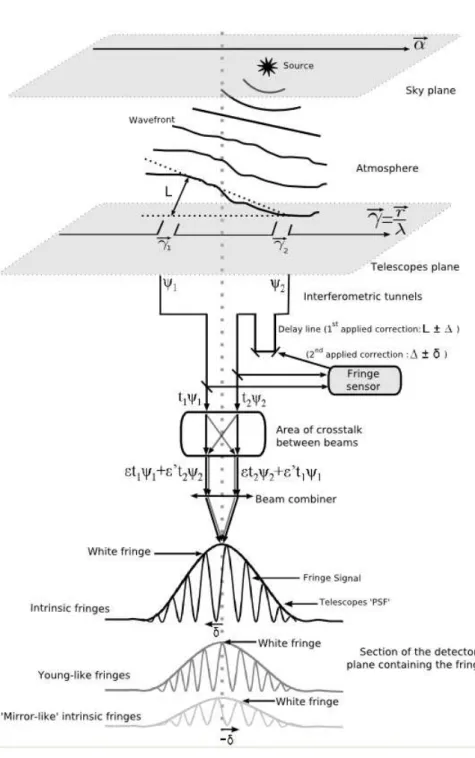
To create a model of parasitic interference, we use a two-telescope interferometer characterized by a multi-axial scheme and an image plane recombination. Fig. 1 gives an illustration of such an interferometer observing an unresolved astrophysical source. For a general description of the output response of a single baseline interferometer, see also Elias et al. (2007).
First we write the complex amplitudes collected by both telescopes, i.e. the two samples of the wavefront, that we respectively note ψ1 and ψ2. We multiply each of them by a real transmission
factor noted t1and t2, which represents the transmission of electrical fields through the instrument.
Let us define ǫ to be the main fraction of ψ1 propagating towards the path 1, and ǫ′ to be the small
shows two examples of cross-talk between beams. A possible imbalance of parasitic flux between paths, not presented in this paper, was considered in the study but appeared to be a second order parameter. All the cross-talk occuring inside the instrument produces a resulting parasitized pattern in a conjugate of the pupil plane, located just before the recombination on the detector. This is described in the following equation giving the complex amplitude preceding the recombination :
ψpup(x, y) = [ǫt1ψ1+ ǫ′t2ψ2]P(x − b 2, y) + [ǫt2ψ2+ ǫ ′t 1ψ1]P(x + b 2, y). (1)
Here x and y are the coordinates in the pupil plane. b is the distance between the pupils of both telescopes, which are reduced in size at the entrance of the interferometer, D being the diameter of these pupils. Since in a Michelson configuration the collection and correlation steps are separated, b, the ’reduced’ baseline which forms the fringe pattern, is different from B, the real interferometric baseline which samples the incident wavefront. P(x, y) = Π(
√
x2+y2
D ), where Π(x, y)
is the transmission function of a circular aperture with a uniform transmission of 1 inside and 0 outside. From Eq.(1), we discuss how parasitic fringes are formed on the detector.
As we will see later, the complex degree of coherence between both parasitized beams will become < [ǫt1ψ1+ ǫ′t2ψ2][ǫt2ψ2+ ǫ′t1ψ1]∗ >, instead of the ’intrinsic’ coherence term < ψ1ψ∗2 >.
2.3. Interference and formation of parasitic fringes
In order to describe the formation of parasitic fringes, we consider the most general case of the observation of an extended source. The vector α is the angular coordinate in the plane of the sky. The telescopes are located at γ1 and γ2, γ being the coordinate in the plane containing the
telescopes and counted in units of wavelength (γ = λr) (see Fig. 1). B
λ = γ1 − γ2 with B the
interferometer baseline. The electric field emitted by each point of the extended source, located at α, is represented by its amplitude A(α) and its phase φ(α, t) :
ψS(α) = A(α)ei[ωt+φ(α,t)]dα. (2a)
In the plane of the telescopes, the phase shift of the wavefront emitted by each point of the source and measured on the γ position is ∆Φ = −2πα · γ. Therefore, when considering the contributions of all the emitting points of the source, each telescope observes a packet of wavefronts (respectively ψ1 and ψ2) :
ψ1 =R A(α)ei[ωt+φ(α,t)]ei2πα·γ1dα, (2b)
ψ2 =R A(α)ei[ωt+φ(α,t)]ei2πα·γ2dα. (2c)
W can now write the expression of the complex amplitude in the detector plane by performing the Fourier transform of Eq.(1) with respect to x and y. In the detector plane, where β and η are the conjugate angular coordinates linked to x and y, and ˆP(β, η) is the pupil diffraction function, we obtain : W (β, η) = (ǫt1ψ1+ ǫ′t2ψ2)ˆP(β, η)e −iπbβ λ + (ǫt2ψ2+ ǫ′t1ψ1)ˆP(β, η)e iπbβ λ = X1+ X2. (3)
(ǫt1ψ1+ǫ′t2ψ2) and (ǫt2ψ2+ǫ′t1ψ1) are not affected by the Fourier transform since ψ1and ψ2can be
considered, in a good approximation, as constant over the aperture telescope area. This assumption is equivalent to the requirement that the source is not resolved by the telescopes themselves or that the field of view is small. In Eq.(3), X1 = (ǫt1ψ1 + ǫ′t2ψ2)ˆP(β, η)e
−iπbβ
λ and X2 = (ǫt2ψ2 +
ǫ′t
1ψ1)ˆP(β, η)e
iπbβ
λ represent the Fourier transform of the parasitized complex amplitudes of each
beam. On the detector, we observe the following intensity pattern :
I(β, η) =< |X1|2 > + < |X2|2 > +2Re < X1X2∗ > . (4a)
The photometric terms, < |X1|2> and < |X2|2 >, are equal to:
< |X1|2 > = Pˆ2(β, η) < |ǫt1ψ1+ ǫ′t2ψ2|2 >
= Pˆ2(β, η)[ǫ2t21 < |ψ1|2 > +ǫ′2t22< |ψ2|2 > +2ǫǫ′t1t2Re < ψ1ψ2∗>]
= Pˆ2(β, η)[(ǫ2t21+ ǫ′2t2
2) ˆO(0)] + 2ǫǫ′t1t2Re( ˆO(γ1− γ2)), (4b)
and
< |X2|2 > = Pˆ2(β, η)[(ǫ2t22+ ǫ′2t21) ˆO(0)] + 2ǫǫ′t1t2Re( ˆO(γ2− γ1))]. (4c)
Here O(α) = A2(α) is the intensity distribution of the source. The Fourier transform of the intensity distribution of the source at the spatial frequency (γ1−γ2), also called the complex degree
of mutual coherence, is : ˆO(γ1− γ2) =< ψ1ψ2∗ >= R O(α)e−i2πα·(γ1−γ2)dα. In this covariance
operation, one of the integrals disappears because astrophysical sources are spatially incoherent when time averaged. We also note that ˆO(0) =< |ψ1|2 >=< |ψ2|2 >= R O(α)dα is the total
energy radiated by the source and collected by each telescope.
The term O(α) is a real function, so its Fourier transform, noted ˆO(γ1 − γ2) = ρ12eiΦ12, is a
complex function with an even real part and an odd imaginary part. Finally, the addition of both photometric terms gives :
< |X1|2 > + < |X2|2 >= ˆP2(β, η)[(t21+ t22)(ǫ2+ ǫ′2) ˆO(0) + 4ǫǫ′t1t2ρ12cos(Φ12)]. (4d)
In order to highlight the different fringe patterns appearing in the interferogram, let us explicitly show the real part of the correlation term, < X1X∗2>, containing the coherent flux and the spatial
modulation : Re < X1X∗2> = Re(< ˆP 2 (β, η)[(ǫt1ψ1+ ǫ′t2ψ2)e −iπbβ λ ][(ǫt2ψ∗ 2+ ǫ′t1ψ∗1)e −iπbβ λ ] >) = Pˆ2(β, η)Re[[ǫǫ′(t2 1+ t 2 2) ˆO(0) + ǫ 2
t1t2O(γˆ 1− γ2) + ǫ′2t1t2Oˆ∗(γ1− γ2)]e−2iπb
β λ] (4e) = Pˆ2(β, η)[ǫ2t1t2ρ12cos(2πbβ λ + Φ12) + ǫǫ ′(t2 1+ t 2 2) ˆO(0) cos( 2πbβ λ ) + ǫ ′2t 1t2ρ12cos(2πbβ λ − Φ12)].
In this expression, each cosine modulation factor has a physical meaning. The first modulation in cos(2πλ bβ + Φ12) is the intrinsic fringe pattern. The second modulation in cos(2πλ bβ) corresponds
to Young fringes created by the interference between each of the beams and their corresponding diffracted part. The position of these fringes is fixed and does not depend on the object position in the sky. The last modulation in cos(2πλ bβ − Φ12) is due to the interference between the diffracted
part of both beams. Mirror-like fringes are thus created with an opposite phase with regard to the intrinsic fringe pattern. Fig. 1 shows these different fringe patterns in the case of an unresolved source. Each pattern has a different amplitude depending on the nature of the object and the amount of parasitic flux.
3. Highlight of the interferometric observables
3.1. Resolved source
After describing the different fringe patterns due to the parasitic interference, we highlight the resulting interferometric observables that have been degraded. From the general correlation term < X1X∗2>, we extract the resulting parasitized coherent flux ρext and parasitized phase χext :
< X1X∗2> = ˆP2(β, η)[ǫǫ′(t21+ t22) ˆO(0) + ǫ2t1t2O(γˆ 1− γ2) + ǫ′2t1t2O(γˆ 2− γ1)]e−2iπb
β λ
= ˆP2(β, η)[ρexteiχext] e−2iπb
β
λ = ˆP2(β, η)ρexte−i(2πb β
λ−χext). (5a)
The resulting interferogram in the detector plane is :
I(β, η) = ˆP2(β, η)[(t2 1+ t
2 2)(ǫ
2+ ǫ′2) ˆO(0) + 4ǫǫ′t
1t2ρ12cos(Φ12)] + 2ˆP2(β, η)ρextcos(2πb
β
λ− χext) = I0,ext[1 + Vextcos(2πb
β λ− χext)], (5b) where I0,ext= ˆP2(β, η)[(t21+ t 2 2)(ǫ 2 + ǫ′2) ˆO(0) + 4ǫǫ′t 1t2ρ12cos(Φ12)], (5c) Vext= 2ˆP2(β, η)ρ ext I0,ext = 2 q [ǫ′′(1 + t2
12) ˆO(0) + t12(1 + ǫ′′2)ρ12cos(Φ12)]2+ [t12(1 − ǫ′′2)ρ12sin(Φ12)]2
(1 + ǫ′′2)(1 + t2 12) ˆO(0) + 4ǫ′′t12ρ12cos(Φ12) , (5d) χext= arctan[ t12(1 − ǫ′′2) sin(Φ12) ǫ′′(1 + t2 12) ˆO(0) + t12(1 + ǫ′′2)ρ12cos(Φ12) ]. (5e)
t12= tt12 is the transmission ratio between both arms. ǫ” = ǫ
′
ǫ represents the percentage of parasitic
contribution, evaluated with respect to ǫ which is the fraction of the electric field passing through the right path. ǫ”2 = (ǫǫ′)2 is the equivalent ratio in terms of flux (or intensity), later called ’par-asitic flux factor’. I0,ext is the photometric factor containing the parasitic contribution. Similarly,
Vext and χext are the parasitized visibility and phase. As a result, the parasitic phase, representing
the parasitic contribution added to the intrinsic phase Φ12, is χext− Φ12.
To summarize, the photometry, visibility and phase of a resolved source are degraded. This degra-dation depends on the complex degree of coherence of the source expressed by ρ12 and Φ12. The
coherent flux ρext can not be calibrated by using the parasitized photometry even without any
3.2. Unresolved source
In this subsection let us consider the parasitic interference effect while observing a point-like source. The unresolved object is described by its angular position in the sky noted αpoint, with
respect to the line of sight, and its monochromatic flux noted Ipoint(λ). The chromatic brightness
distribution can be represented in the same way as in the resolved source case, such that only one tilted wavefront originates from the source :
Opoint(α, λ) = Ipoint(λ)δ(α − αpoint). (6a)
ˆ
Opoint(ω, λ) is the Fourier transform of the brightness distribution, in the plane of spatial frequency
ω(u, v) covered by a single-baseline interferometer. The u-axis is chosen along the interferometric baseline defined above and takes the value u = Bλ. Therefore we have :
ˆ
Opoint(u, λ) = Ipoint(λ)ei2πu·αpoint. (6b)
The fringe phase is the argument of ˆOpoint(u, λ) :
Φpoint(λ) = 2πu · αpoint. (6c)
Normally, Φpoint(λ) should be defined with an additionnal unknown constant. The reason is that
the measurement of the interferometric phase is affected by an ambiguity on the zero-delay point, that is the origin of the fringes, and by an unknown integer number of 2π phase rotation. Therefore the phase can only be addressed in a relative point of view, either between the source and a reference object, or between several spectral channels. The latter constitutes the differential approach which allows to remove the phase ambiguity thanks to a colour difference with an appropriate reference wavelength. Φpoint(λ) is considered to be such an unambiguous differential phase, where the phase
reference has been taken as the phase averaged on all the spectral channels of the observing band. Next the coherent flux is the amplitude of ˆOpoint(u, λ) :
ρpoint(λ) = Ipoint(λ). (6d)
The parasitized photometry, visibility, and phase of an unresolved source are deduced by replacing Φ12, ρ12 and ˆO(0) in Eqs.()()() Replacing Φ12, ρ12and ˆO(0) by Φpoint(λ), ρpoint(λ) and Ipoint(λ) in
Eq.(5c), Eq.(5d) and Eq.(5e), allows us to deduce the parasitized photometry, visibility and phase of an unresolved source1 :
I0,point(λ) = IpointPˆ2(β, η)[(ǫ2+ ǫ′2)(t21+ t 2
2) + 4ǫǫ′t1t2cos(Φpoint)], (6e)
Vpoint(λ) = 2
p(1 + ǫ′′2)2t2
12− 4ǫ′′2t212sin 2(Φ
point) + ǫ′′2(1 + t212)2+ 2t12(1 + ǫ′′2)ǫ′′(1 + t212) cos(Φpoint)
(t2
12+ 1)(ǫ′′2+ 1) + 4ǫ′′t12cos(Φpoint)
, (6f)
χpoint(λ) = arctan( sin(Φpoint)(1 − ǫ ′′2)t
12
t12(1 + ǫ′′2) cos(Φpoint) + ǫ′′(1 + t212)
). (6g)
1The λ dependency of Φ
point(λ), ρpoint(λ) and Ipoint(λ) has been removed in Eq.(6e), Eq.(6f), and Eq.(6g), for
Here γ1− γ2 = Bλ and α are considered to be colinear so we have : Φpoint(λ) = 2πBαλ . Regardless
of the angular position of the star in the sky, other sources can contribute to the phase term, Φpoint(λ), such as instrumental and/or atmospheric perturbations. As shown in Fig. 1, the total
piston noted L and resulting from these different causes, is first corrected by the delay lines with an OPD model depending only on the angular distance between the source and the zenith. Then the remaining piston, noted by ∆ in Fig. 1, may be corrected by a fringe tracker which commands the delay lines to adjust to a value of ∆ with an accuracy defined by the fringe tracking specifications. This accuracy is noted δ and represents the residual piston that will affect the fringes within the signal envelope. Therefore the generalized expression of the phase term will be : Φpoint(λ) = 2πδλ .
Similarly to the resolved case, we consider χpoint(λ) − Φpoint(λ) as the parasitic phase.
According to Eq.(6f), Vpoint= 1 if t12=1, and depends neither on ǫ′′ and ǫ′′2, nor on the piston. In
the case of an unresolved source, the degradation due to the parasitic light can thus be corrected if we divide the parasitized coherent flux by the parasitized photometry. Though, this correction is effective only if the photometric imbalance t12 is close or equal to 1.
3.3. Hot Jupiter-like source
The direct detection of Earth-like extrasolar planets and the determination of their atmospheric features by means of stellar interferometry is a very challenging objective. Nowadays the observation of hot Jupiter-like planets constitutes an intermediate step in terms of difficulty. These planets are giant gaseous planets similar in size to Jupiter except that they orbit very close to their star. This proximity provides planet temperatures warm enough to allow significant infrared excess. The planetary flux can be decomposed in this way :
fpl(λ) = fpl,refl(λ) + fpl,abs(λ) + fpl,int(λ), (7)
where fpl,refl(λ) is the component of the stellar light reflected by the planet, fpl,abs(λ) the absorbed
and thermally re-emitted component, and fpl,int(λ) the intrinsic contribution of the planet. For
non-irradiated objects, the main contribution would be limited to the intrinsic flux fpl,int= σTint4 ,
where fpl,int is now the bolometric intrinsic flux and Tint is the intrinsic temperature of the planet
(Tint = Teff in this case). For an irradiated planet, Teff is not relevant because it is difficult to
separate photons which are thermally radiated by the planet from those of the star itself reflected by the planet. Another temperature, describing the equlibrium state of the planet’s dayside and separated from the reflected component, is thus defined : σTeq4 = σTint4 + fpl,abs, where fpl,abs is a
bolometric flux.
In the near and mid-infrared domain, the major contribution of the flux of hot Jupiter-like exoplan-ets is the absorbed, then re-emitted, component at the thermal equilibrium. In purely quantitative terms, the equilibrium temperature of such a planet approximately ranges from 500 to 1500 K. For the closest objects, the corresponding flux ratio between the planet and the star is about 10−5 to
10−4 in J band, 10−4 to 10−3 in K band, and several 10−3 in N band. In addition these planets
In this context let us consider a stellar system with a planet. We respectively note I∗(λ) and Ipl(λ)
the monochromatic flux of the two components separated by an angular distance αpl. The angular
position of the center of the star is α∗. We first assume that the spatial location and extension of each component is independent of the wavelength. The star appears as a disc of constant angu-lar diameter D∗, defined by the normalized function Π(α
D∗) equal to one inside the disc and zero
outside. The planet appears as a point-like source defined by δ(α). Both spatial distributions are respectively weighted by I∗(λ) and Ipl(λ). The chromatic brightness distribution of this system is
:
Osyst(α, λ) = I∗(λ) Π(
α− α∗
D∗ ) + Ipl(λ) δ(α − (α∗+ αpl)). (8a)
The Fourier transform of the brightness distribution of the system in the plane of spatial frequency ω(u,v), covered by a single-baseline interferometer, is :
ˆ
Osyst(u, λ) = κ∗(u)I∗(λ)ei2πu·α∗+ Ipl(λ)ei2πu·(α∗+αpl). (8b)
The u-axis is chosen along the interferometric baseline defined above, and takes the value u =
B
λ = γ1 − γ2. The intrinsic visibility of the star is κ∗(u) = C∗(u) eiΦstar = 2
J1(πD∗u)
πD∗u , with J1
the Bessel function of the first kind of order one and D∗ the stellar angular diameter. Since we are in a regime where the star is partly resolved or even unresolved by the interferometer, the stellar complex visibility is always real and positive, with κ∗(u) = C∗(u) (or identically C∗(λ)) and Φstar= 0. Otherwise, if the star was resolved, Φstar could be equal to π.
In principle, visibility and phase carry complementary informations, and both might be useful for detecting and characterizing extrasolar planets. Nevertheless, considering the current possibilities of calibration of both quantities in terms of instrumental and atmospheric effects (Vannier et al. 2006), we prefer focussing our attention on the differential phase observable. The fringe phase is the argument of ˆOsyst(u, λ)2:
Φsyst(λ) = arctan
C∗I∗sin(Φ∗) + Iplsin(Φ∗+ Φpl)
C∗I∗cos(Φ∗) + Iplcos(Φ∗+ Φpl)
, (8c)
with Φpl(λ) = 2πu · αpl and Φ∗(λ) = 2πu · α∗. Identically to the unresolved case, we chose to
define Φsyst(λ) as a zero-mean differential phase in order to remove the ambiguity related to the
measurement of the phase fringes. We also generalize the expression of Φ∗(λ) by taking into account other sources like instrumental instabilities or atmospheric perturbations that may contribute to this phase term. We thus have : Φ∗(λ) = 2πλ δ∗, where δ∗ is the same residual piston shown in Fig. 1 and described in the unresolved case.
The coherent flux is the modulus of ˆOsyst(u, λ):
ρsyst(λ) =
q C2
∗I∗2+ Ipl2 + 2C∗I∗Iplcos(Φpl). (8d)
2The λ dependency of Φ
pl(λ), Φ∗(λ) Ipl(λ), I∗(λ) and C∗(λ) has been removed in Eq.(8c), Eq.(8d), and Eq.(8e),
Finally, replacing Φ12and ρ12by Φsyst(λ) and ρsyst(λ) in Eq.(5e), allows us to deduce the parasitized
phase of a stellar system with a hot Jupiter, χsyst(λ) :
χsyst(λ) = arctan
t12(1 − ǫ′′2)[C∗I∗sin(Φ∗) + Iplsin(Φ∗+ Φpl)]
ǫ′′(1 + t2
12)(I∗+ Ipl) + t12(1 + ǫ′′2)[C∗I∗cos(Φ∗) + Iplcos(Φ∗+ Φpl)]
. (8e)
The parasitized phase, χsyst(λ), contains the intrinsic and parasitic contributions of the phase.
We thus consider χsyst(λ) − Φsyst(λ) as the parasitic phase since it represents the parasitic phase
contribution added to the intrinsic phase of the source, Φsyst(λ). This parasitic term clearly depends
on Φ∗(λ) and Φpl(λ), which appears both in Φsyst(λ) and χsyst(λ) and does not disappear during
the subtraction. The parasitic phase contribution appears to be object-dependent.
4. Quantitative study of the ’unresolved source’ case
In this Section, we evaluate the impact of parasitic fringes for a tilted wavefront originating from an unresolved source having a projected angular distance to the zenith different from zero. This very common situation can imply an uncorrected residual path difference between both telescopes. The principle of astrometric measurement of the position of an off-centre star via the phase of fringes may be affected by this situation.
The L band is chosen in this study since it corresponds to the most favourable band for detection of several astrophysical sources including hot Jupiter-like exoplanets (Vannier 2003). The parameters involved here are the parasitic flux factor ǫ”2, which describes the percentage of parasitic flux, and
the piston δ. This piston will be hereafter expressed in fraction of the L band central wavelength, namely 3.5 µm.
A typical baseline of 100 meters, and a range of piston values, from λ/500 to λ/5, are considered for calculating the phase signal of the source Φpoint(λ). In this range, two piston values are especially
of interest : λ/500 and λ/30; they approximately correspond to the typical specifications of piston correction achieved by a fringe tracking device in the case of space and groud-based interferometers (respectively 2 and 100 nm). In parallel, for each piston value, a range of parasitic flux factors, from 0 to 10 %, is used for evaluating the parasitized phase signal χpoint(λ).
Finally we calculate aΦ = max(Φpoint(λ))−min(Φpoint(λ)), and apar∗= max(χpoint(λ)−Φpoint(λ))−
min(χpoint(λ)−Φpoint(λ)). These quantities represent the amplitude, on the extent of L band, of the
intrinsic and parasitic phases. They are used for comparing the overall amplitude of the intrinsic and parasitic phases in L band, instead of comparing both phases at all the wavelengths. As the value of the parasitic phase depends on two independent parameters and varies with respect to the wavelength, this overall amplitude gives a typical value of the expected measurable phase signal in L band. Then this typical value can be plotted in a readable 2D representation as a function of the parasitic flux level. In Fig. 3, we plotted these two amplitudes in function of ǫ”2, considering different values of the piston parameter. We can notice that for all the piston values, the amplitude of the parasitic phase, apar∗, is a smooth crescent function of the parasitic flux factor. Regarding the evolution of the intrinsic and parasitic phase amplitudes as a function of the piston value, it
appears that apar∗ always lies below 10−2 radians while the amplitude of the phase signal of the
star, aΦ, increases up to 0.5 radians.
Several conclusions can be drawn from this, depending on the context and the objectives of the observation :
• First we place in a classical interferometric context where the piston error has to be corrected before the addition of frames. A reasonable parasitic flux contribution of about 1%, and an amount of uncorrected piston within the specifications of fringe tracking (λ/500 and λ/30 in L band) are assumed. In this case, the additional parasitic phase amplitude always lies below the intrinsic signal, and ranges from one third to one fifth of this intrinsic phase amplitude.
• Second we consider an ’astrometric’ approach, where the aim is to measure the phase signal created by an off-centre star, with respect to an on-axis one. It appears here that the mea-surement of the intrinsic phase amplitude is not degraded by the additional parasitic phase contribution especially for large piston values. The ratio between the intrinsic and parasitic phase amplitudes ranges from 3 to 13.
5. Hot Jupiter signal and magnitude of parasitic fringes in L band
5.1. Characterization of planetary fluxes
The fine study of the atmosphere of hot Jupiter-like exoplanets requires a characterization of their spectra since they may show significant differences from black body models. Contrary to the giant planets of our solar system, hot Jupiters are subject to an extremely intense stellar irradiation. Consequently, the temperature-pressure profile of the atmosphere is modified and a radiative area is going to develop and govern the cooling and contraction of the planet interior (Guillot et al. 1996). These structural changes of the atmosphere, compared to an isolated planet, strongly depend on how the stellar irradiation penetrates the planet interior. The albedo and the sources of opacity, related to the presence of different types of dust, are two important parameters allowing us to characterize and classify the theoretical spectra of hot Jupiter-like exoplanets. Sudarsky et al. (2000) distinguished five categories of theoretical spectra classified according to a range of effective temperatures, from T≤150K to T≤1500K. The albedo of the objects belonging to these classes, exhibits similar features directly related to the chemical composition of the planet. In our case, the main criterion we use is the presence or absence of dust in the high layers of the atmosphere. For example, in a ’condensed’ atmosphere model, dust has been settled down by the gravitational field or by the precipitations linked to the condensation and the formation of clouds. From a global point of view, this hypothesis is presumably more realistic for substellar objects with low temperatures, including the irradiated giant planets (Chabrier and Baraffe 2000). Therefore, for modelling and estimating the variability of the parasitic phase produced during the observation of a hot Jupiter-like extrasolar planet, we use eight ”condensed” synthetic spectra
describing the planetary flux fpl(λ). They have been extracted from Barman et al. (2001). Each
spectrum corresponds to a given angular separation and intrinsic temperature Tint of the planet,
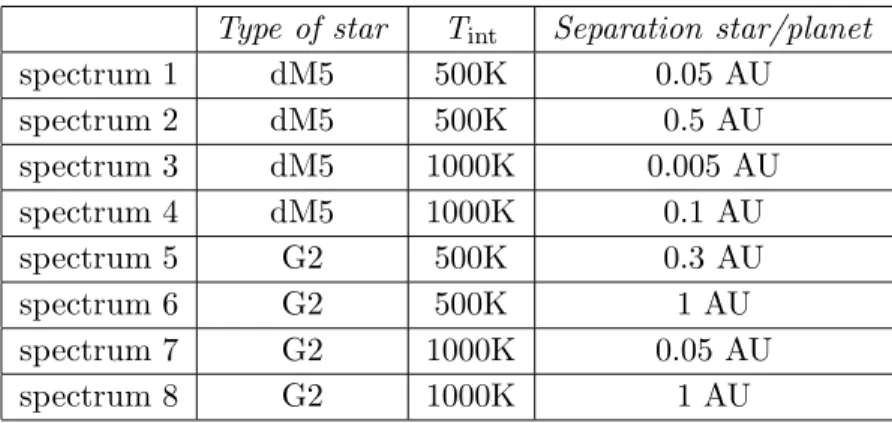
which is irradiated either by a G2 or a M5 star respectively located 15 and 5 AU from the Sun. The flux of these stars is a simple black body law with temperatures of 5600 and 3000 K. Table 1 summarizes the values of the different parameters discriminating each synthetic spectrum.
5.2. Parasitic phase estimation
In this Section, we estimate the impact of parasitic fringes in the context of the observation of different ’synthetic’ stellar systems with a hot-Jupiter. According to Sub-Section 3.3, the intrinsic phase Φsyst(λ), and the parasitized phase χsyst(λ), depend on the flux ratio between the planet and
the star, the separation ρ between both components, and the interferometric baseline B; B being considered to be colinear with ρ, and equal to 100m. Φsyst(λ) and χsyst(λ) are thus calculated for
each spectrum. The ranges of values taken for the piston δ∗ and the parasitic flux factor ǫ”2 are
the same as those of the ’unresolved source’ case.
As detailed in Fig. 1, δ∗ can be seen as the remaining piston uncorrected by the fringe tracking device. This residual piston creates a linear-like phase term, added to the intrinsic phase signature from the planet. Consequently, a further parasitic phase term will be added to the parasitic phase term due to the planet phase signal. It is therefore important to place this issue in the framework of a classical interferometric measurement since different contributions from the atmosphere and the instrument can affect the measurement of the interferometric phase and especially the first-order linear term via the residual piston (or piston error) δ∗. Basically without any phase reference, the first-order linear term of the astrophysical signal is lost during the data reduction step estimating and removing this residual piston. This is the case with most current interferometers. Finally, the total phase, including the object phase and the parasitic contribution, contains only the higher order terms. Henceforth the effect of the parasitic interference has to be examined after removing the linear component of Φsyst(λ) and χsyst(λ), which consequently become ’unpistoned’ phases.
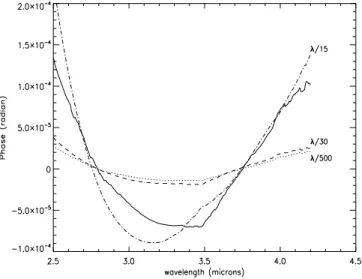
For a clear illustration of this point, we plotted in Fig. 4 both ’unpistoned’ quantities, Φsyst(λ) and
χsyst(λ)-Φsyst(λ), with respect to the wavelength, using the very smooth number 7 spectrum (see
Table 1). χsyst(λ) has been calculated for two values of piston (λ/500 and λ/30) corresponding to
the fringe tracking specifications, and a quite large parasitic flux factor of 10%. First we can note a great similarity between both differential phases, highlighting the fact that the additional parasitic phase is an object-dependent quantity. It is quite low and anyway below the intrinsic term in both cases. However when the beams undergo a greater piston (here λ/15), the parasitic signal exceeds the intrinsic one and the phase signature from the planet is lost.
Identically to the ’unresolved source’ case, we consider the amplitude in L band of the phase sig-nature from the planet, asyst = max(Φsyst(λ)) − min(Φsyst(λ)), and of the corresponding parasitic
phase, apar= max(χsyst(λ) − Φsyst(λ)) − min(χsyst(λ) − Φsyst(λ)). These quantities are calculated
for a large range of δ∗ values and are represented with respect to the parasitic flux factor ǫ′′2 in
distinguished for the spectra 5, 6 and 7. Here a detection is considered to be possible only if, for given values of δ∗ and ǫ′′2, the parasitic phase amplitude lies below the horizontal solid line
repre-senting the amplitude of the planet signal. Following this criteria, it appears that if typical fringe specifications are observed, the planet signal always lies above the parasitic phase amplitude; a hot Jupiter detection, with an intrinsic phase amplitude exceeding by a factor of three the parasitic one, is thus achieved with a parasitic intensity equal to 5% of the total intensity.
However, when no fringe tracking is used, the expected constraint on the parasitic flux level appears to be much stronger. For instance, let us consider the case of a solar-like star (G2 type) and a 500K planet (spectra 5, 6). If the piston error is greater or equal to λ/15, a detection, with a planet phase amplitude standing at a factor three above the parasitic one, is achieved with a tolerance of not more than 0.01% on the parasitic flux. On the contrary, the spectra 3 and 4 constitute very favourable cases. If the piston error lies below λ/10, a similar detection level admits a tolerance of 5% on the parasitic flux. Therefore it appears that as soon as the fringe tracking specifications are relaxed or not precisely observed, the parasitic phase signal dramatically increases. In this case, planetary detection may be prevented if the parasitic flux level is not accurately monitored. Nevertheless in some cases where the flux ratio between the planet and the star is sufficiently large (≈ 10−2 to 10−2), this assertion has to be moderated given that a non-respect of fringe tracking
specifications is less influential. In those cases, the tolerance on the parasitic flux level is similar to the one achievable with a fringe tracker.
6. Discussion
In this work we have described the phenomenon of parasitic interference occuring inside an interferometric device. This interference degrades the modulus and the phase of the complex visibility. Two further components are added to the intrinsic fringe pattern, the former assimilated to Young-like fringes and the latter assimilated to mirror-like fringes with respect to the intrinsic pattern. The phase and the amplitude of these ’parasitic’ fringes depend on the piston between beams, including the piston due to the object position. In an ’object-image’ approach, it would mean that the point spread function of the interferometer is no longer invariant by translation and that the object-image relation is anyway destroyed.
In quantitative terms, we have shown that the parasitic phase is very sensitive to a piston between the interferometric beams. In fact a perfect unresolved source, observed at a projected angular distance from the zenith equal to zero, would not produce any parasitic phase. On the contrary, for an unresolved source undergoing an additional piston due to the atmosphere and the instrument, a parasitic flux factor of 1% would create a parasitic phase reaching at most one third of the intrinsic phase amplitude.
This effect is not negligible in the perspective of hot Jupiter-like planet observations. In this paper the feasibility study has been done in L band. We considered synthetic hot Jupiter spectra providing different flux ratios between the planet and the star, and different values of piston error within the
specifications expected for fringe tracking devices. A hot Jupiter detection, with a planet phase signal three times larger than the parasitic phase amplitude, is possible if the parasitic flux reaches at most 5% of the total incident flux. Without any fringe tracking device, only hot-Jupiter like planetary systems with a quite large flux ratio between the planet and the star, for instance a dM5 star with a hot planet at 1000K, would admit such a tolerance of 5%; however the values of piston error have to be equal or smaller than λ/10 in this case. For less advantageous planetary systems, the maximum admitted tolerance decreases up to 0.01% for residual pistons equal to λ/15.
To summarize, we can see that the detection of astrophysical objects providing weak signatures in the interferometric phase, such as hot Jupiter-like extrasolar planets, requires careful attention to various fine instrumental effects such as parasitic fringes. This constitutes an important motivation for optimizing the design of future planet-detecting interferometers like the future ground-based instrument of the VLTI, MATISSE, or the future NASA spatial nulling interferometer, FKSI. In fact the calibration of this parasitic effect by reference star seems very difficult at this level of required precision. Moreover the use of a phase abacus is not possible since the parasitic phase is an object-dependent quantity. Nevertheless in the marginal case of an unresolved source, it appears that the parasitized coherent flux can be calibrated by the parasitized photometry. Therefore we propose some solutions to prevent parasitic interference effects, and which should be taken into account during the design stage of a future instrument.
We suggest the following design solutions :
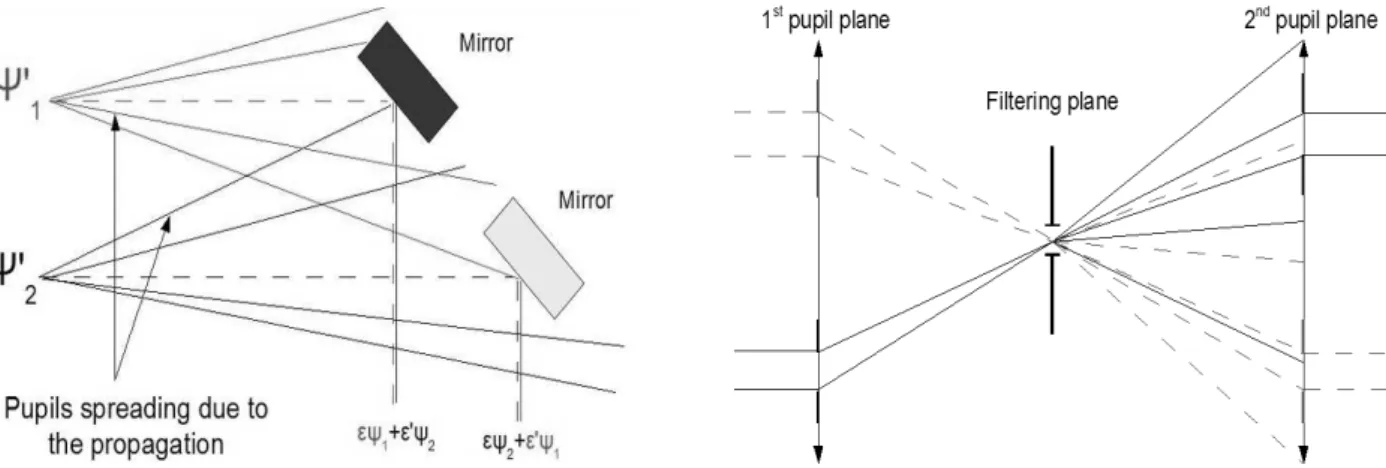
• To maintain the beams independence in certain parts of the instrument. For example, the left panel of Fig. 2 shows the crosstalk occuring if a spatial filtering plane is common to all beams. The solution would be to use an independent pinhole for each beam.
• To separate the paths of each beam by a careful baffling everywhere it is possible inside the instrument.
• To transport the beams in a non-co-phased way except just before the recombination. These fixed path differences maintain the beams out of the coherence length in order to prevent any parasitic interference when cross-talk is occuring.
As a final conclusion, it appears that, up to now, little attention has been paid on the phenomenon of parasitic interference. This issue has been formalized here in a general multi-axial recombination scheme, with special attention on the differential phase. This work has been conducted in the framework of the AMBER instrument (Petrov and Amber Consortium 2003) and especially of its successor, the MATISSE instrument (Lopez, et al. (2008); Lagarde, et al. (2008)).
In the case of other instrumental configurations (co-axial scheme, nulling interferometry, ...), com-plementary work would need to be performed in order to define requirements adapted to a larger range of interferometers.
We thank our colleague, Pierre Antonelli, for the attention brought to the parasitic light issue, and for the fruitfull discussion motivated by the MATISSE instrument design study. We also thank
the referee for his valuable comments that improved the article.
REFERENCES
T. S. Barman, P. H. Hauschildt, and F. Allard. Irradiated Planets. ApJ, 556:885–895, Aug. 2001. doi: 10.1086/321610.
J. H. Bruning, D. R. Herriott, J. E. Gallagher, D. P. Rosenfeld, A. D. White, and D. J. Brangaccio. Digital wavefront measuring interferometer for testing optical surfaces and lenses. Appl.
Opt., 13:2693–2703, 1974.
G. Chabrier and I. Baraffe. Theory of Low-Mass Stars and Substellar Objects. ARA&A, 38: 337–377, 2000. doi: 10.1146/annurev.astro.38.1.337.
N. M. Elias, II, M. Harwit, D. Leisawitz, and S. A. Rinehart. The Mathematics of Double-Fourier Interferometers. ApJ, 657:1178–1200, Mar. 2007. doi: 10.1086/510878.
H. Fizeau. C.R. Acad. Sc. Paris, 66:932, 1868.
T. Guillot, A. Burrows, W. B. Hubbard, J. I. Lunine, and D. Saumon. Giant Planets at Small Orbital Distances. ApJL, 459:L35+, Mar. 1996. doi: 10.1086/309935.
A. Labeyrie. Interference fringes obtained on VEGA with two optical telescopes. ApJ, 196:L71–L75, Mar. 1975. doi: 10.1086/181747.
S. Lagarde, et al. MATISSE: concept analysis. In Society of Photo-Optical Instrumentation
Engi-neers (SPIE) Conference Series, volume 7013 of Society of Photo-Optical Instrumentation Engineers (SPIE) Conference Series, July 2008. doi: 10.1117/12.789391.
B. Lopez, et al. MATISSE: perspective of imaging in the mid-infrared at the VLTI. In Society of
Photo-Optical Instrumentation Engineers (SPIE) Conference Series, volume 7013 of Society of Photo-Optical Instrumentation Engineers (SPIE) Conference Series, July 2008. doi: 10.
1117/12.789412.
A. A. Michelson. On the Application of Interference Methods to Astronomical Measurements. ApJ, 51:257–+, June 1920. doi: 10.1086/142550.
R. G. Petrov and T. Amber Consortium. The near infrared VLTI instrument AMBER. In G. Perrin and F. Malbet, editors, EAS Publications Series, volume 6 of EAS Publications Series, pages 111–+, 2003.
J. Schwider, R. Burow, K.-E. Elssner, J. Grzanna, R. Spolaczyk, and K. Merkel. Digital wave-front measuring interferometry: some systematic error sources. Appl. Opt., 22:3421–3432, 1983. URL http://ao.osa.org/abstract.cfm?URI=ao-22-21-3421.
D. Sudarsky, A. Burrows, and P. Pinto. Albedo and Reflection Spectra of Extrasolar Giant Planets.
ApJ, 538:885–903, Aug. 2000. doi: 10.1086/309160.
M. Vannier. Interf´erom´etrie et astrom´etrie diff´erentielle chromatiques et observation de plan`etes
extra-solaires g´eantes chaudes avec le VLTI et le NGST. PhD thesis, Laboratoire
Universi-taire d’Astrophysique de Nice/Universit´e de Nice-Sophia Antipolis, mai 2003.
M. Vannier, R. G. Petrov, B. Lopez, and F. Millour. Colour-differential interferometry for the ob-servation of extrasolar planets. MNRAS, 367:825–837, Apr. 2006. doi: 10.1111/j.1365-2966. 2006.10015.x.
Table 1: Values of various parameters discriminating each phase spectrum extracted from Barman et al. (2001).
Type of star Tint Separation star/planet
spectrum 1 dM5 500K 0.05 AU spectrum 2 dM5 500K 0.5 AU spectrum 3 dM5 1000K 0.005 AU spectrum 4 dM5 1000K 0.1 AU spectrum 5 G2 500K 0.3 AU spectrum 6 G2 500K 1 AU spectrum 7 G2 1000K 0.05 AU spectrum 8 G2 1000K 1 AU
Fig. 1.— Principle diagram representing the observation of an unresolved source by a 2-telescope interferometer. Fringes are obtained in the detector plane within a fixed fringe envelope corresponding to the point spread function of the telescopes. δ represents the residual achromatic piston that will affect the fringes within the signal envelope. The area where crosstalk between beams occurs, thus causing a parasitic interference, is simply represented by a ’module’ located just before the beam recombiner. The fringe envelopes and patterns are normally overlapped at the same place on the detector but discriminated here for a matter of clarity.
Fig. 2.— Two examples of straylight and cross-talks between beams producing a parasitic interference : The left figure showing a beam overlapping due to diffusion effects, and the right one showing a cross-talk in a pupil plane due to the diffraction introduced by a common spatial filter.
Fig. 3.—Comparison between aΦ, the amplitude in L band of Φpoint(λ) (noted ’intrinsic’ in the figure), and apar∗,
the amplitude in L band of χpoint(λ) − Φpoint(λ) (noted ’parasitic’ in the figure), with respect to ǫ′′2. Each panel
corresponds to a piston value (noted δ in the paper) which is written in fraction of the central wavelength of the L band (λ = 3.5µm). The λ/500 and λ/30 cases correspond approximately to the typical specifications that would be respectively achieved by a spatial and ground-based fringe tracking device (δ ≈ 5nm and 100nm).
Fig. 4.— Comparison between the ’unpistonned’ intrinsic phase Φsyst(λ) (solid line) calculated from the number
7 spectrum, and different ’unpistonned’ parasitic phases χsyst(λ) − Φsyst(λ) calculated with different values of δ∗
expressed in fraction of λ = 3.5µm. The λ/500 and λ/30 cases correspond approximately to the typical specifications that would be respectively achieved by a spatial and ground-based fringe tracking device (δ∗≈ 2nm and 100nm). A
Fig. 5.— Amplitude, in L band, of the intrinsic phase of a stellar system with a hot Jupiter, asyst (horizontal
solid line), and amplitude in L band of the related parasitic phase, apar(other dashed and dotted lines), plotted with
respect to ǫ′′2. Different values of δ
∗ranging from λ/500 to λ/5 are considered, and each panel is related to a different
hot Jupiter spectrum. The λ/500 and λ/30 cases correspond approximately to the typical specifications that would be respectively achieved by a spatial and a ground-based fringe tracking device (δ∗≈ 2nm and 100nm).