
Performance of Arrhenotokous and Thelytokous Thrips tabaci
(Thysanoptera: Thripidae) on Onion and Cabbage and Its
Implications on Evolution and Pest Management
XIAO-WEI LI,1,2JOZSEF FAIL,3PING WANG,1JI-NIAN FENG,2ANDA. M. SHELTON1,4
J. Econ. Entomol. 107(4): 1526Ð1534 (2014); DOI: http://dx.doi.org/10.1603/EC14070
ABSTRACT Onion thrips, Thrips tabaci Lindeman (Thysanoptera: Thripidae), is an important pest on onion and cabbage. Two reproductive modesÑarrhenotoky and thelytokyÑare found in this species and co-occur in the Þeld. We compared life table traits between arrhenotokous and thely-tokous T. tabaci on cabbage and onion. Experiments were conducted in cages to determine which reproductive mode is more competitive. Additionally, host adaption of the arrhenotokous and the-lytokous T. tabaci between onion and cabbage was investigated. On onion, arrhenotokous T. tabaci performed better than thelytokous T. tabaci, while on cabbage the opposite occurred. When com-paring life table and demographic growth parameters (net reproductive rates R0, mean generation time T, the intrinsic rate of natural increase rm, Þnite rate of increase, and population doubling time
Td) on different host plants, we found that arrhenotokous T. tabaci performed better on onion than on cabbage, whereas thelytokous T. tabaci performed better on cabbage than on onion. Host-related performance differences in this species suggest that the divergence between two reproductive modes might be associated with host adaption. Pest management strategies for this global pest should recognize that the two reproductive modes can impact population dynamics on different crops.
KEY WORDS onion thrips, onion, cabbage, life table trait
Onion thrips, Thrips tabaci Lindeman (Thysanoptera: Thripidae), is a global pest on many important agri-cultural crops including onion, leek, cabbage, tobacco, tomato, and cotton. T. tabaci has become an increasing concern in commercial onion (Allium cepa L.) due to resistance to many insecticides, its transmission of plant viruses, and rapid development and high repro-ductive capacity (Diaz-Montano et al. 2011). In North America and many other parts of the world, T. tabaci is also a consistent and severe pest on cabbage,
Bras-sica oleracea capitata(L.) (Wolfenbarger and Hibbs 1958; Shelton et al. 1998; Trdan et al. 2007, 2008).
There are two reproductive modes in T. tabaci: thelytoky (asexual reproduction) and arrhenotoky (sexual reproduction; Jenser and Sze´na´si 2004). In thelytokous populations, only females exist and they are parthenogenetically developed from unfertilized eggs. Arrhenotokous populations consist of both males and females: diploid females are produced from fer-tilized eggs and haploid males from unferfer-tilized eggs (Moritz 1997).
These two reproductive modes may coexist in pop-ulations collected in the Þeld (Nault et al. 2006), but it is difÞcult to distinguish between thelytokous and arrhenotokous female adults morphologically (Jenser and Sze´na´si 2004). However, the two reproductive modes differ ecologically and genetically, including having different host preferences. Arrhenotokous T.
tabaci collected from tobacco proliferated well on both tobacco and onion, whereas both arrhenotokous and thelytokous populations from leek could not sur-vive on tobacco (Chatzivassiliou et al. 2002). Strong host speciÞcities of T. tabaci have been reported for populations in North America and the Southern Hemi-sphere (Sakimura 1962).
Based on host adaption, reproductive modes, and mitochondrial DNA sequences, T. tabaci are divided into two types: the arrhenotokous tobacco type, which is found on tobacco (Zawirska 1976, Brunner et al. 2004, Toda and Murai 2007), and the leek type, which is polyphagous and has both reproduction modesÑ arrhenotoky and thelytoky (Brunner et al. 2004, Toda and Murai 2007, Kobayashi and Hasegawa 2012). The two reproductive modes of the leek type can be dis-criminated using reproductive mode-speciÞc primers based on sequence differences in the mitochondrial cytochrome c oxidase subunit I (COI) gene between the arrhenotokous and thyletokous strains (Kobayashi and Hasegawa 2012).
1Department of Entomology, Cornell University, New York State
Agricultural Experiment Station, Geneva, NY 14456.
2Key Laboratory of Plant Protection Resources and Pest
Manage-ment, Ministry of Education, Northwest A&F University, Yangling, Shaanxi 712100, China.
3Department of Entomology, Faculty of Horticultural Science,
Corvinus University of Budapest, Budapest, 1118, Hungary.
4Corresponding author, e-mail: [email protected].
The parthenogenetic and sexual populations of T.
tabacidiffer in their ability to transmit plant viruses. Arrhenotokous populations collected from tobacco were highly effective in transmitting tomato spotted wilt virus (TSWV; Chatzivassiliou et al. 2002), whereas arrhenotokous populations from leek transmit TSWV inefÞciently (Wijkamp et al. 1995, Chatzivassiliou et al. 1999, 2002). By contrast, thelytokous populations did not transmit (Wijkamp et al. 1995, Chatzivassiliou et al. 2002) or transmitted TSWV poorly (Tedeschi et al. 2001), although recent studies reported that some thelytokous specimens were fairly efÞcient vectors (Jacobson and Kennedy 2013, Westmore et al. 2013). Although there is strong host adaption for tobacco and nontobacco host plants in different strains of T.
tabaci(Chatzivassiliou et al. 2002, Fekrat et al. 2009), there are no comparative life table data for polypha-gous arrhenotokous and thelytokous populations and their host adaption. T. tabaci of the two reproductive modes were found to coexist in the Þeld, and the frequency of these two reproductive modes varied temporally (Nault et al. 2006). Comparative life table data of arrhenotokous and thelytokous T. tabaci can help explain their biological differences and provide important information about their population dynam-ics in the Þeld.
In our study, we examined the development and reproduction of arrhenotokous and thelytokous T.
tabacion two important host plants, onion and cab-bage. Life table and demographic growth parameters were compared between the two reproductive modes, and competition experiments were conducted to de-termine which reproductive mode is more competi-tive. In addition, host adaption of arrhenotokous and thelytokous T. tabaci on two different host plants was investigated by comparing the life table and demo-graphic growth parameters.
Materials and Methods
Population Maintenance and Insect Rearing. The
arrhenotokous and thelytokous populations used in this study were established in 2011 from adult T. tabaci collected from cabbage in a research Þeld (GPS co-ordinates: 42.873621,⫺77.029556) of Cornell Univer-sity, New York State Agricultural Experiment Station, Geneva, NY. Populations were maintained on potted onion plants or cabbage heads in environmental growth chambers at 20⫾ 1⬚C, 60 ⫾ 5% relative hu-midity (RH), and a photoperiod of 16:8 (L:D) h. To test whether the source host plants had effects on T.
tabacidevelopment and reproduction, arrhenotokous and thelytokous T. tabaci on onion were collected from onion Þelds in Peru, NY, and onion Þelds in Penn Yan, NY, respectively.
Host Plants. Two host plants, onion and cabbage,
were used in this study. Onion sets and cabbage seeds were planted in plastic pots in a thrips-free growing chamber under conditions of 25⫾ 2⬚C, 70 ⫾ 5% RH, and a photoperiod of 16:8 (L:D) h. Onion plants 3 wk old and cabbage plants 2 mo old were used in both life table studies and cage experiments.
Treatments. Four treatments were established to
test arrhenotokous and thelytokous T. tabaci life table parameters and host adaption using lab-maintained colonies (T. tabaci collected from cabbage): 1) arr-henotokous T. tabaci on onion, 2) arrarr-henotokous T.
tabacion cabbage, 3) thelytokous T. tabaci on onion, and 4) thelytokous T. tabaci on cabbage.
To test whether source host plants had effects on development and reproduction of T. tabaci in their two reproductive modes, two additional treatments were added: 5) arrhenotokous T. tabaci collected from onion on onion and 6) thelytokous T. tabaci collected from onion on onion. Fitness and demographic growth parameters were compared between treatments 1) and 5) and between treatments 3) and 6).
Life Table Studies. For life table experiments, T. tabaciin each treatment were incubated individually in 1.7-ml microcentrifuge tubes and held at 20⫾ 1⬚C, 60⫾ 5% RH, and a photoperiod of 16:8 (L:D) h. To start experiments, female adults were collected from arrhenotokous and thelytokous populations and left in tubes with a single piece of onion or cabbage leaf tissue (6 by 6 mm) for oviposition. The number of eggs in the leaves was counted using the bottom light of a stereomicroscope (ZEISS, Stemi 2000, Carl Zeiss Mi-croscopy, Jena, Germany). Leaf tissues with eggs were checked every 12 h for newly emerged larvae. First instars were transferred individually to new tubes with fresh leaf tissue. Egg durations and hatching rates were recorded. Thrips in immature stages were checked every 12 h for development, but the sex could not be determined until adulthood. Survivorship and devel-opmental times at different stages were recorded. When adults emerged, arrhenotokous and thelytokous females were contained individually in tubes with leaf tissues. Arrhenotokous females were paired with males for 2 d. Leaf tissues were changed at 24-h in-tervals and the number of eggs produced by each female was recorded. For arrhenotokous females, leaf tissues with eggs were moved into new tubes for anal-ysis of daily sex ratios when the eggs developed into adults. Longevity, lifetime fecundity, and mean daily fecundity (lifetime fecundity divided by longevity) were calculated for each female.
Demographic Growth Parameters. Immature
dura-tion (egg laying to adult emergence), survival rate, daily fecundity, and daily sex ratio of offspring (in arrhenotokous treatments) were used to construct
lmlife tables (lmis the net female maternity, lis the percentage of females alive at age, and mis the mean number of female offspring produced by a fe-male at age) from which the following demographic growth parameters were calculated: net reproductive rates (R0 ⫽ 兺lm), mean generation time (T ⫽ 兺lm /R0), the intrinsic rate of natural increase (rm⫽ ln R0/T), Þnite rate of increase [ ⫽ exp(rm)], and population doubling time [Td⫽ ln(2)/rm] (Carey 1993).
Mean demographic parameter estimates with stan-dard errors were generated using the jackknife tech-nique (Meyer et al. 1986, Maia et al. 2000). To apply the jackknife technique, we Þrst calculated the
pop-ulation parameters based on all (n) individuals in each treatment. For example, we calculated the intrinsic rate rall based on all individuals. We then omitted individual i and used the other n⫺ 1 individuals to calculate the jackknife value of ri-jack. Next, we cal-culated pseudovalue ri-pseudoas ri-pseudo⫽ n ⫻ rall⫺ (n⫺ 1) ⫻ ri-jack. We repeated this process until pseu-dovalues were calculated for all n possible omissions from the original data set. Then we used n pseudovalue
ri-pseudoto calculate means and standard errors. The same method was used for R0, T,, and Td.
Competition Experiments in Cages Between Arr-henotokous and Thelytokous T. tabaci. Cage
experi-ments were set up to observe changes in the relative ratios of two reproductive modes in mixed populations on onion and cabbage. Experiments were conducted in thrips-proof insect rearing cages (BugDorm-44545F Insect Rearing Cage, 47.5 by 47.5 by 47.5 cm with 150 mesh Nylon) with three cages (replications) per treat-ment. On each host plant, three treatments were set up: arrhenotokous T. tabaci single population; arrhe-notokous and thelytokous T. tabaci mixed population; thelytokous T. tabaci single population. Cages were kept in environmental growth chambers at 20⫾ 1⬚C, 60⫾ 5% RH, and a photoperiod of 16:8 (L:D) h, the same conditions as life table experiments. To start the mixed cages, 10 arrhenotokous (mated, paired with males for 2 d) and 10 thelytokous 3- to 5-d-old females were released into each cage. For the control single cages, 20 arrhenotokous (mated, paired with males for 2 d) or thelytokous 3- to 5-d-old females were released into each cage. Each cage contained Þve pots of green onion plants at the 6 Ð 8 leaf stage or two pots of cabbage plants at the 10 Ð12 leaf stage.
Sampling started one month after placing the in-sects in the cages; two of Þve pots of onions in the onion cages or one of two pots of cabbage in the cabbage cages were replaced with new plants. All the adults on removed plants were collected and pre-served in 70% ethanol. Sampling was conducted every 20 d for Þve times. Twenty adults were randomly selected from each sample and were examined by PCR (polymerase chain reaction) analysis for molecular identiÞcation of their reproductive mode using repro-ductive mode-speciÞc COI gene primers. The per-centage of thelytokous T. tabaci in each sample was calculated.
Identification of Reproductive Mode by PCR Analysis.
To verify the reproductive mode-speciÞc single nu-cleotide polymorphisms (SNPs) in the COI gene iden-tiÞed by Kobayashi and Hasegawa (2012) in the T.
tabacicolonies used in this study, the COI fragment was ampliÞed by PCR from Þve individuals from the arrhenotokous colony and Þve individuals from the thelytokous colony and sequenced. DNA from indi-vidual thrips was prepared using a rapid DNA extrac-tion method (Tiewsiri and Wang 2011). A single thrips was homogenized in 20l tissue lysis buffer (10 mM Tris-HCl, pH 8.3, 50 mM KCl, 2.5 mM MgCl2, 0.45% Nonidet P-40, 0.45% Tween 20, 0.01% gelatin, and 60 g proteinase K) and incubated at 65⬚C for 30 min, followed by an incubation at 95⬚C for 15 min to
inac-tivate the proteinase K. The lysate was used directly for PCR ampliÞcation of the COI fragment, using the universal COI primer pair, LepF: 5⬘-ATTCAACCAAT CATAAAGATATTGG-3⬘ and LepR: 5⬘-TAAACTTC TGGATGTCCAAAAAATCA-3⬘ (Hebert et al. 2004). The PCR product was processed using a one-step enzy-matic puriÞcation procedure (Dorit et al. 2001) and subject to DNA sequencing.
PCR analysis to differentiate the arrhenotokous and thelytokous T. tabaci was designed based on the re-productive mode-speciÞc SNPs in the COI gene in T.
tabaci (Kobayashi and Hasegawa 2012), and con-Þrmed by our DNA sequencing of the COI fragment from Þve arrhenotokous and Þve thelytokous T. tabaci from our lab colonies. A reproductive mode diagnostic PCR analysis was established to include in the PCR reaction three primers, the arrhenotokous-speciÞc primer (5 ⬘-AACAGCTATTCTCCTTCTTTTATCTC-3⬘) and thelytokous-speciÞc primer (5⬘-GAACAGTA TATCCACCTTTATCAACG-3⬘; Kobayashi and Hase-gawa 2012) and a generic primer (5⬘-TAAACTTCT GGGTGACCAAAAAATCA-3⬘). A PCR product of 161 bp is diagnostic for the arrhenotokous strain and 351 bp for thelytokous strain.
Statistical Analysis. All data analyses were
per-formed in SPSS (SPSS Inc., 2007 Chicago, IL,). Before analysis, data were checked for normality using non-parametric KolmogorovÐSmirnov test (P⬍ 0.05) and all percentage data were arcsine or square root trans-formed, as necessary, but untransformed means are presented. For the data that were not normal (devel-opmental times and survival rates at each immature stage between two host plants in each reproductive mode and between two reproductive modes on each host plant), direct estimates were compared using the nonparametric MannÐWhitney U test (P⬍ 0.05). For the data that followed normal distribution (female adult longevity, total fecundity, daily fecundity, and Þve demographic growth parameters), a two-way ANOVA was used to analyze the effects of host plants, reproductive modes, and their interactions (P⬍ 0.05). Pairwise comparisons among main effects were per-formed using LSD test for multiple comparisons (P⬍ 0.05).
In cage experiments, percentage changes of thely-tokous T. tabaci in samples on two host plants over time were compared using one-way repeated mea-sures ANOVA.
Results
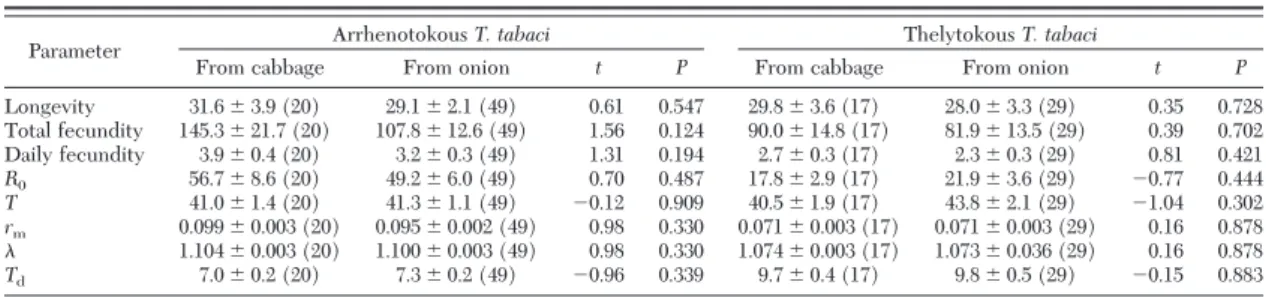
The Effects of Thrips Sources on Fitness and De-mographic Growth Parameters of Arrhenotkous and Thelytokous T. tabaci. Thrips sources had no effects
on Þtness and demographic growth parameters in ar-rhenotokous and thelytokous T. tabaci. There were no statistical differences in longevity, total fecundity, daily fecundity, and Þve demographic growth param-eters between arrhenotokous T. tabaci collected from onion and cabbage (Table 1). The same result was also found in thelytokous T. tabaci (Table 1), so the data
were pooled from treatments 1) and 5) and data from treatments 3) and 6).
Comparison of Life Table Parameters Between Ar-rhenotokous and Thelytokous T. tabaci on Onion and Cabbage Plants. Mean Developmental Times of Imma-ture Arrhenotokous and Thelytokous T. tabaci on Two Different Host Plants. On onion, except for the egg stage (P⫽ 0.146), developmental times of Þrst instar, second instar, prepupa, and pupa stages in thelytokous
T. tabaciwere signiÞcantly longer than those in arr-henotokous thrips (P⬍ 0.0001; Table 2). Noticeably, the duration of the second instar in thelytokous T.
tabaciwas⬇1 d longer than in arrhenotokous thrips and the entire immature duration was⬇2 d longer in thelytokous T. tabaci on onion (Table 2). By contrast, on cabbage, no signiÞcant differences were found in the durations of any stage or the entire immature stage between the two reproduc-tive modes (P⬎ 0.05; Table 2).
Survival Rates of Immature Arrhenotokous and The-lytokous T. tabaci on Two Different Host Plants. On onion, the egg hatching rate (P⫽ 0.781), the survival rates of the Þrst instar (P⫽ 0.066), and pupal stage (P⫽ 0.377) were not signiÞcantly different between the two reproductive modes (Table 3). However, survival rates in the second instar and prepupa stages in thelytokous T. tabaci were signiÞcantly lower than those in arrhenotokous thrips (P⬍ 0.05; Table 3). On cabbage, except for a signiÞcantly lower egg-hatching rate (P⫽ 0.006) in thelytokous
T. tabaci,there was no signiÞcant difference in
sur-vival rates in each stage between the two reproduc-tive modes (P⬎ 0.05; Table 3).
Fitness and Demographic Parameters of Arrhenotok-ous and ThelytokArrhenotok-ous T. tabaci on Two Different Host Plants. No interactions between host plant and the reproductive mode effects were found on female lon-gevity of T. tabaci (Table 4). Host plant signiÞcantly affected the longevity of T. tabaci while the repro-ductive mode had no effects (Table 4). By contrast, the total fecundity, daily fecundity, and Þve demo-graphic parameters had signiÞcant host plantÐrepro-ductive mode interactions (Table 4).
On onion, there was no difference in female lon-gevity between the two reproductive modes (Table 5). However, arrhenotokous T. tabaci had signiÞcantly greater total fecundity and daily fecundity (Table 5). Mean R0, rm, and were all signiÞcantly greater in arrhenotokous T. tabaci (Table 5). In addition, T and
Tdin arrhenotokous T. tabaci were signiÞcantly lower than those in thelytokous T. tabaci.
By contrast, except for longevity between the two reproductive modes, totally opposite results were found on cabbage. Total fecundity and daily fecundity in thelytokous T. tabaci were much greater on cabbage (Table 5). Mean R0, rm, and were all signiÞcantly greater in thelytokous T. tabaci (Table 5). T and Tdin thelytokous T. tabaci were signiÞcantly lower than those in arrhenotokous T. tabaci.
Identification of Arrhenotokous and Thelytokous T.
tabaci by a Diagnostic PCR Analysis. Sequencing of a 706 bp COI fragment from Þve arrhenotokous and Þve
Table 1. Comparisons of fitness and demographic growth parameters [meanⴞ SE (n)] of arrhenotokous and thelytokous T. tabaci collected from cabbage and onion when they were reared on onion
Parameter Arrhenotokous T. tabaci Thelytokous T. tabaci
From cabbage From onion t P From cabbage From onion t P
Longevity 31.6⫾ 3.9 (20) 29.1⫾ 2.1 (49) 0.61 0.547 29.8⫾ 3.6 (17) 28.0⫾ 3.3 (29) 0.35 0.728 Total fecundity 145.3⫾ 21.7 (20) 107.8⫾ 12.6 (49) 1.56 0.124 90.0⫾ 14.8 (17) 81.9⫾ 13.5 (29) 0.39 0.702 Daily fecundity 3.9⫾ 0.4 (20) 3.2⫾ 0.3 (49) 1.31 0.194 2.7⫾ 0.3 (17) 2.3⫾ 0.3 (29) 0.81 0.421 R0 56.7⫾ 8.6 (20) 49.2⫾ 6.0 (49) 0.70 0.487 17.8⫾ 2.9 (17) 21.9⫾ 3.6 (29) ⫺0.77 0.444 T 41.0⫾ 1.4 (20) 41.3⫾ 1.1 (49) ⫺0.12 0.909 40.5⫾ 1.9 (17) 43.8⫾ 2.1 (29) ⫺1.04 0.302 rm 0.099⫾ 0.003 (20) 0.095⫾ 0.002 (49) 0.98 0.330 0.071⫾ 0.003 (17) 0.071⫾ 0.003 (29) 0.16 0.878 1.104⫾ 0.003 (20) 1.100⫾ 0.003 (49) 0.98 0.330 1.074⫾ 0.003 (17) 1.073⫾ 0.036 (29) 0.16 0.878 Td 7.0⫾ 0.2 (20) 7.3⫾ 0.2 (49) ⫺0.96 0.339 9.7⫾ 0.4 (17) 9.8⫾ 0.5 (29) ⫺0.15 0.883
Normal data. Means within the same rows in each reproductive mode were compared by StudentÕs t-test at P⬍ 0.05 level.
n, number of replications in each treatment; R0, net reproductive rates; T, mean generation time; rm, the intrinsic rate of natural increase;
, Þnite rate of increase; Td, population doubling time.
Table 2. The mean developmental times [d, meanⴞ SE (n)] of immature arrhenotokous and thelytokous T. tabaci on two different host plants
Stage Onion Cabbage
Arrhenotokous Thelytokous Arrhenotokous Thelytokous
Egg 6.6⫾ 0.03 (256) 6.7⫾ 0.04 (187) 6.5⫾ 0.47 (112) 6.5⫾ 0.53 (109) L1 2.9⫾ 0.04 (247) 3.2⫾ 0.05 (166) 2.9⫾ 0.45 (108) 2.8⫾ 0.40 (102) L2 4.4⫾ 0.09 (210) 5.5⫾ 0.15 (102) 3.7⫾ 0.10 (103) 3.6⫾ 0.06 (101) PP 1.6⫾ 0.03 (192) 1.9⫾ 0.05 (64) 1.6⫾ 0.02 (101) 1.5⫾ 0.02 (100) P 3.6⫾ 0.03 (170) 3.8⫾ 0.06 (48) 3.4⫾ 0.03 (100) 3.5⫾ 0.02 (99) Egg to adult 18.9⫾ 0.12 (170) 20.7⫾ 0.23 (48) 18.0⫾ 0.13 (100) 17.8⫾ 0.10 (99) Nonnormal data. Means at each stage between two host plants in each reproductive mode and between two reproductive modes on each host plant were compared using the nonparametric MannÐWhitney U test at P⬍ 0.05 level.
thelytokous T. tabaci showed one haplotype of the
COIfragment in the arrhenotokous colony (GenBank KJ495744) and two haplotypes in the thelytokous col-ony (GenBank KJ495742 and KJ495743). The COI sequences from the two colonies contained the characteristic reproductive mode-speciÞc SNPs as observed by Kobayashi and Hasegawa (2012). Con-sequently, our diagnostic PCR analysis using two re-productive mode-speciÞc primers (Kobayashi and Hasegawa 2012) and a general primer accurately dif-ferentiated the individuals of the two reproductive modes (Fig. 1).
Competition Experiments in Cages Between Arr-henotokous and Thelytokous T. tabaci. In the control
cages of two reproductive modes on two different host plants, no contamination occurred (Fig. 2). In mixed cages, changes in patterns of thelytokous T. tabaci percentages on two host plants over time were sig-niÞcantly different (Fig. 2; F⫽ 109.62; df ⫽ 1; P ⬍ 0.0001). SpeciÞcally, on onion, the proportion of the-lytokous T. tabaci decreased over time (F⫽ 363.48; df⫽ 1; P ⫽ 0.003) and arrhenotokous T. tabaci out-competed thelytokous thrips by the Þrst sampling date. At the Þfth sampling time, only⬇10% of the samples were thelytokous T. tabaci (Fig. 2). By con-trast, on cabbage, the proportion of thelytokous T.
tabaci increased over time (F⫽ 11.50; df ⫽ 1; P ⫽ 0.001) and thelytokous T. tabaci were more abundant after the Þrst sampling date. At the Þfth sampling time, ⬎90% of samples were thelytokous T. tabaci (Fig. 2).
Host Adaption of Arrhenotokous and Thelytokous
T. tabaci Between Onion and Cabbage. Arrhenotokous
T. tabaci. Except the Þrst instar and prepupa stages (P⫽ 0.711 and P ⫽ 0.121, respectively), the durations
of egg stage, second instar, and pupae were signiÞ-cantly longer on onion compared with cabbage (P⬍ 0.05; Table 2). The entire immature developmental time on onion was⬇1 d longer than that on cabbage (Table 2). There were no signiÞcant differences in egg hatching rate (P⫽ 0.922) and Þrst instar survival rate (P⫽ 0.774) between arrhenotokous T. tabaci on onion and cabbage (Table 3). However, the survival rates in the second instar, prepupa, and pupa stages were sig-niÞcantly lower on onion (P⬍ 0.05; Table 3). Female longevity on cabbage was signiÞcantly longer than on onion, but the total fecundity and daily fecundity on onion was signiÞcantly greater than on cabbage (Table 5).
There were no differences in mean R0and T be-tween two different host plants (Table 5). However, arrhenotokous T. tabaci on onion had a signiÞcantly greater rmand and lower Td(Table 5).
Thelytokous T. tabaci. The durations of egg, Þrst instar, second instar, prepupa, and pupa stages were signiÞcantly longer on onion compared with those on cabbage (P⬍ 0.0001; Table 2). The entire immature developmental time on onion was⬇3 d longer than that on cabbage (Table 2). The egg-hatching rate (P⬍ 0.0001) on onion was higher than that on cabbage (Table 3). Except for the Þrst instar (P⫽ 0.156), the survival rates in the second instar, prepupa, and pupa stages were signiÞcantly lower on onion (P⬍ 0.0001; Table 3). Thelytokous T. tabaci females had signiÞ-cantly greater longevity and higher total fecundity and daily fecundity on cabbage (Table 5).
There were signiÞcant differences in all Þve demo-graphic parameters between thelytokous T. tabaci on onion and cabbage (Table 5). SpeciÞcally, mean R0,
Table 3. The survival rates [%, meanⴞ SE (n)] of immature arrhenotokous and thelytokous T. tabaci on two different host plants
Stage Onion Cabbage
Arrhenotokous Thelytokous Arrhenotokous Thelytokous
Egg 94.4⫾ 1.5 (42) 90.7⫾ 2.8 (47) 88.8⫾ 0.5 (18) 76.0⫾ 6.1 (37)
L1 96.2⫾ 1.6 (39) 84.0⫾ 4.6 (42) 97.1⫾ 1.7 (18) 92.9⫾ 3.6 (33)
L2 83.6⫾ 3.6 (39) 61.6⫾ 5.2 (39) 97.6⫾ 1.4 (18) 96.0⫾ 1.0 (32)
PP 91.4⫾ 2.2 (38) 57.8⫾ 7.0 (35) 96.8⫾ 2.8 (18) 96.0⫾ 1.0 (32)
P 86.0⫾ 4.5 (38) 75.7⫾ 6.9 (28) 99.6⫾ 0.4 (18) 96.0⫾ 1.0 (32)
Nonnormal data. Means at each stage between two host plants in each reproductive mode and between two reproductive modes on each host plant were compared using the nonparametric MannÐWhitney U test at P⬍ 0.05 level.
n, number of replications in each treatment; L1, Þrst instar; L2, second instar; PP, prepupae; P, pupae.
Table 4. Effects of host plant and reproductive mode on fitness and demographic growth parameters of T. tabaci (two-way ANOVA, P < 0.05)
Longevity Total fecundity Daily fecundity R0 T rm Td
R F 0.62 0.06 0.05 0.71 0.67 0.97 0.71 10.81 P 0.433 0.815 0.825 0.400 0.414 0.326 0.399 0.001 H F 10.42 0.06 0.48 20.65 7.31 88.60 89.26 66.55 P 0.001 0.815 0.488 ⬍0.0001 0.008 ⬍0.0001 ⬍0.0001 ⬍0.0001 H⫻ R F 0.10 8.43 17.11 43.63 14.53 165.85 167.23 116.90 P 0.759 0.004 ⬍0.0001 ⬍0.0001 ⬍0.0001 ⬍0.0001 ⬍0.0001 ⬍0.0001
H, host plant; R, reproductive mode; R0, net reproductive rates; T, mean generation time; rm, the intrinsic rate of natural increase;, Þnite
rm, and were much higher on cabbage, while T and
Tdwere signiÞcantly lower on cabbage (Table 5).
Discussion
Co-occurrence of sexual and asexual reproduction is found in various insect species, including parasitoid wasps (Day and Hedlund 1988, Stouthamer et al. 1990, Arakaki and Kinjo 1998, Huigens et al. 2000, Schneider et al. 2002, Copeland et al. 2010), ants (Kellner and Heinze 2011), honey bees (Greeff 1996), aphids (Si-mon et al. 2002), cockroaches (Corley and Moore 1999), and thrips (Mound 1992, Nakao and Yabu 1998, Nault et al. 2006). Sympatric sexual and asexual pop-ulations offer excellent models to evaluate the relative costs and beneÞts of sex. Theoretically, compared with asexual individuals, sexual ones are less competitive due to the cost of producing males (Maynard Smith 1978). Asexual (e.g., thelytokous) populations have potential advantages, as they do not waste eggs pro-ducing males and can establish populations more eas-ily (Stouthamer 1993). However, based on long-term processes, sexual reproduction (e.g., arrhenotoky) has the advantage of preventing deleterious mutation ac-cumulations and increasing environmental adaption (Hurst and Peck 1996).
However, practically, the relative performance of each mode of reproduction varies remarkably and may depend on different factors, including temperature (Wang and Smith 1996), hosts (Day and Hedlund 1988), habitat (Schneider et al. 2002), and infection of
endosymbiotic bacteria (Miura and Tagami 2004), and there are no general patterns of increased or de-creased Þtness parameters in thelytokous populations. Differences in life table traits between arrhenoto-kous and thelytoarrhenoto-kous races have been reported in different insect species. In the parasitoid
Tricho-gramma minutumRiley (Hymenoptera: Trichogram-matidae), thelytokous lines required more time to develop from eggs to adults than arrhenotokous lines. Despite their similar adult life span, thelytokous para-sitoids produced signiÞcantly fewer offspring than arrhenotokous ones (Wang and Smith 1996). In
Trichogramma kaykaiPinto & Stouthamer reared on
Trichoplusia ni(Hu¨bner) (Lepidoptera: Noctuidae) eggs, arrhenotokous wasps produced more progeny and lived longer than their thelytokous counterparts (Hohmann et al. 2001). When reared on Apodemia
mormo(C. Felder & R. Felder) (Lepidoptera: Rio-dinidae) eggs, thelytokous Tr. kaykai had relatively greater longevity but lower values of R0and rm(Miura and Tagami 2004). In Thrips nigropilosus Uzel (Thy-sanoptera: Thripidae), there was no difference in the duration of preovarial maturation, oviposition periods, and egg hatch whereas the arrhenotokous race laid more eggs than the thelytokous race under the same conditions (Nakao and Muraji 2007).
In our study, the performance of arrhenotokous and thelytokous T. tabaci was very different on two host plants. On onion, in thelytokous T. tabaci, the devel-opment of the Þrst and second instars, prepupae and pupae was much slower and the mortality of second instars and prepupae was much higher when com-pared with arrhenotokous thrips. Additionally, thely-tokous T. tabaci had signiÞcantly lower total and daily fecundity. Lower mean R0, rm, and and greater T and
Tdsuggested thelytokous T. tabaci is less competitive than its arrhenotokous counterpart on onion. The op-posite results were found on cabbage. Although there was no difference in development and survivorship of immature stages between the two reproductive modes (except lower egg hatching rate in thelytokous T.
tabaci), thelytokous T. tabaci performed better on cabbage in total and daily fecundity and Þve demo-graphic parameters. Additionally, the results of cage experiments were consistent with life table traits. On onion, arrhenotokous T. tabaci outcompeted thelytokous T. tabaci, while on cabbage the opposite occurred.
Table 5. Summary of fitness and demographic growth parameters of arrhenotokous and thelytokous T. tabaci on two different host plants
Treatment N Longevity Total fecundity Daily fecundity R0 T rm Td
A on onion 69 29.8⫾ 1.9bc 118.7⫾ 11.0a 3.4⫾ 0.2a 55.4⫾ 5.0b 39.0 ⫾ 0.8b 0.103⫾ 0.002b 1.109 ⫾ 0.002b 6.7 ⫾ 0.2c T on onion 46 28.7⫾ 2.4c 84.9⫾ 10.0b 2.4⫾ 0.2b 19.8⫾ 2.3c 42.4 ⫾ 1.5a 0.071⫾ 0.002d 1.073 ⫾ 0.003d 9.8 ⫾ 0.3a A on cabbage 35 38.3⫾ 3.0a 84.9⫾ 6.1b 2.3⫾ 0.1b 45.6⫾ 3.6b 40.3 ⫾ 1.2ab 0.095 ⫾ 0.002c 1.100 ⫾ 0.003c 7.3 ⫾ 0.2b T on cabbage 36 35.7⫾ 2.2ab 113.6⫾ 8.4a 3.2⫾ 0.2a 73.2⫾ 5.2a 35.0 ⫾ 0.8c 0.123⫾ 0.002a 1.131 ⫾ 0.002a 5.6 ⫾ 0.1d Normal data. Means within the same column followed by the same letters are not signiÞcantly different at P⬍ 0.05 level according to LSD test for multiple comparisons.
A, arrhenotokous T. tabaci; T, thelytokous T. tabaci; N, number of replications in each treatment; R0, net reproductive rates; T, mean generation
time; rm, the intrinsic rate of natural increase;, Þnite rate of increase; Td, population doubling time.
Fig. 1. Reproductive mode-speciÞc PCR products of T.
tabaci. M, DNA Marker; A, arrhenotokous T. tabaci (161 bp); T, thelytokous T. tabaci (351 bp).
Different performance of two reproductive modes on different hosts, as noted above for Tr. kaykai on two different Lepidopteran hosts, might be due to a dif-ference in host adaption. Indeed, different host adap-tion of arrhenotokous and thelytokous populaadap-tions was reported in other insects (Day and Hedlund 1988). In our case, the results showed that arrheno-tokous T. tabaci is better adapted to onion. Although the rates of development in egg, second instar, and pupa stages; survivorship in second instar, prepupa, and pupa stages; and female adult longevity were sig-niÞcantly lower on onion than on cabbage, greater fecundity on onion still allowed the arrhenotokous T.
tabacion onion to have a signiÞcantly greater rm,, and lower Td. By contrast, thelytokous T. tabaci is better adapted to cabbage. Except for a lower egg-hatching rate and the similar Þrst instar survival rate, thelytokous T. tabaci had signiÞcantly shorter devel-opmental times and dramatically greater survival rates in all immature stages on cabbage. Furthermore, the-lytokous T. tabaci female adults lived signiÞcantly lon-ger and laid more eggs on cabbage. Comparison of Þve demographic parameters between onion and cabbage suggested thelytokous T. tabaci is more adapted to cabbage than to onion.
It is worth noting that there were no signiÞcant differences in longevity between the two reproduc-tive modes both on onion and cabbage. However, both arrhenotokous and thelytokous T. tabaci females had shorter longevity on onion. Additionally, T. tabaci from both reproductive modes had lower survival rates during immature stages on onion than on cab-bage. This suggests that onion had some negative ef-fects on the development of both arrhenotokous and thelytokous T. tabaci. Thelytokous T. tabaci was more sensitive to onion and the mortality was⬇60% during second instar and prepupa stages.
Host-related performance differences and distinc-tive genetic differences between arrhenotokous and thelytokous T. tabaci suggest that these two reproduc-tive modes have different evolutionary histories. Based on host-plant adaption and genetic differenti-ation, T. tabaci was divided into three major evolu-tionary lineages; two were clearly associated with leek and the third with tobacco and they had an ancient origin and long-term isolation (Brunner et al. 2004). An analysis of the rate of evolution suggested that an ancient arrhenotokous strain differentiated into two types, the tobacco and leek types, and then the leek type diverged into an arrhenotokous type and a the-lytokous type (Brunner et al. 2004, Toda and Murai 2007). The two populations we used in this study belong to the latter two lineages, arrhenotokous leek type and thelytokous leek type. A previous study sug-gested that the tobacco type and leek types had strong host-speciÞc adaptations to tobacco and leek (Chatzi-vassiliou et al. 2002). In our study, two leek types, arrheotokous and thelytokous T. tabaci, showed dif-ferences in host adaption to onion and cabbage. The phylogenetic and evolution rate analysis suggested the tobacco type diverged earlier (around 28 million years ago) from the leek type (Brunner et al. 2004). This divergence is likely due to different host adaption. Around 7 million years later, the leek type diverged into two types (Brunner et al. 2004). This subsequent diversiÞcation might also be associated with host adap-tion. Better performance of arrhenotokous T. tabaci on onion and better performance of thelytokous T. tabaci on cabbage provide evidence for this hypothesis. However, the taxa of these three lineages are still not clear. Genetic variability and pairwise FST statistics
suggested these three T. tabaci lineages might be con-sidered different cryptic (sub) species (Brunner et al. 2004), and phylogeny based on nuclear genes conÞrms
Fig. 2. Changes of thelytokous T. tabaci proportions in mixed populations on onion and cabbage in the laboratory. A, arrhenotokous T. tabaci; T, thelytokous T. tabaci.
that the sexual and asexual leek lineages, i.e., the ar-rhenotokous and thelytokous lineages, are genetically isolated (Kobayashi et al. 2013). However, evidence only based on pairwise genetic differences (i.e., FST)
is not sufÞcient for the estimation of actual gene ßow or hybridization (Dres and Mallet 2002) and addi-tional gene ßow studies are required to clarify rela-tionships of these sympatric taxa.
Differences in performance by arrhenotokous and thelytokous T. tabaci on onion and cabbage provide useful knowledge about the roles of two reproductive modes in the population dynamics on different crops. Based on the crops and T. tabaci population structure in the Þeld, it should be possible to use this knowledge to predict their potential population dynamics and associated crop damage. For example, studies have reported the increasing incidence of insecticide re-sistance in T. tabaci (Diaz-Montano et al. 2011). Dif-ference in reproduction may affect insecticide-resis-tant alleles in the population, and hence the ability to control T. tabaci populations using speciÞc insecti-cides. Additionally, the increasing incidence of virus diseases transmitted by T. tabaci has been documented (Diaz-Montano et al. 2011). Arrhenotokous and the-lytokous populations have been shown to differ in their ability to transmit some of these plant viruses (Chatzivassiliou et al. 1999, 2002; Tedeschi et al. 2001; Westmore et al. 2013). Consequently, the population structure of T. tabaci on different crops can affect the overall risk of crop damage as well as affect the tactics used to mitigate such damage.
In conclusion, the performance of arrhentokous and thelytokous T. tabaci was host-plant dependent. Re-sults from life table and cage experiments showed that on onion, arrhenotokous T. tabaci performed better than thelytokous T. tabaci, while on cabbage the op-posite occurred. When comparing life table and de-mographic growth parameters on different host plants, we found that arrhenotokous T. tabaci was better adapted to onion, whereas thelytokous T. tabaci was better adapted to cabbage. Our results provide im-portant knowledge about the relationships and evo-lution of these two reproductive modes and their pop-ulation dynamics on different crops. We suggest that this knowledge will also be useful for pest manage-ment strategies.
Acknowledgments
We thank Beth Cole, Hobart and William Smith Colleges, for her assistance conducting this study, and H. L. Collins (Cornell University) for help in editing the manuscript. This project was supported by the China Scholarship Council (CSC) and New York State Cabbage Research Association.
References Cited
Arakaki, N., and K. Kinjo. 1998. Notes on the parasitoid
fauna of the serpentine leafminer Liriomyza trifolii (Bur-gess) (Diptera: Agromyzidae) in Okinawa, southern Ja-pan. Appl. Entomol. Zool. 33: 577Ð581.
Brunner, P. C., E. K. Chatzivassiliou, N. I. Katis, and J. E. Frey. 2004. Host-associated genetic differentiation in
Thrips tabaci (Insecta; Thysanoptera), as determined from mtDNA sequence data. Heredity 93: 364 Ð370.
Carey, J. R. 1993. Applied demography for biologists with
special emphasis on insects. Oxford University Press, New York, NY.
Chatzivassiliou, E. K., T. Nagata, N. I. Katis, and D. Peters. 1999. Transmission of tomato spotted wilt tospovirus by Thrips tabaci populations originating from leek. Plant Pathol. 48: 700 Ð706.
Chatzivassiliou, E. K., D. Peters, and N. I. Katis. 2002. The
efÞciency by which Thrips tabaci populations transmit Tomato spotted wilt virus depends on their host prefer-ence and reproductive strategy. Phytopathology 92: 603Ð 609.
Copeland, C. S., M. A. Hoy, A. Jeyaprakash, M. Aluja, R. Ramirez-Romero, and J. M. Sivinski. 2010. Genetic
characteristics of bisexual and female-only populations of
Odontosema anastrephae(Hymenoptera: Figitidae). Fla. Entomol. 93: 437Ð 443.
Corley, L. S., and A. J. Moore. 1999. Fitness of alternative
modes of reproduction: developmental constraints and the evolutionary maintenance of sex. Proc. R. Soc. Biol. Sci. Ser. B 266: 471Ð 476.
Day, W. H., and R. C. Hedlund. 1988. Biological
compari-sons between arrhenotokous and thelytokous biotypes of
Mesochorus nigripes [Hym.: Ichneumonidae]. Ento-mophaga 33: 201Ð210.
Diaz-Montano, J., M. Fuchs, B. A. Nault, J. Fail, and A. M. Shelton. 2011. Onion thrips (Thysanoptera: Thripidae):
a global pest of increasing concern in onion. J. Econ. Entomol. 104: 1Ð13.
Dorit, R. L., O. Ohara, C. B.-C. Hwang, J. B. Kim, and S. Blackshaw. 2001. Direct DNA Sequencing of PCR
Prod-ucts. Curr. Protoc. Mol. Biol. 15.2: 1Ð15.
Dres, M., and J. Mallet. 2002. Host races in plant-feeding
insects and their importance in sympatric speciation. Phi-los. Trans. R. Soc. Lond. B. Biol. Sci. 357: 471Ð 492.
Fekrat, L., P. Shishehbor, S. Manzari, and E. S. Nejadian. 2009. Comparative development, reproduction and life
table parameters of three populations of Thrips tabaci (Thysanoptera: Thripidae) on onion and tobacco. J. En-tomol. Soc. Iran 29: 11Ð23.
Greeff, J. M. 1996. Thelytokous versus arrhenotokous
worker reproduction in the cape honeybee and other eusocial Hymenoptera. Hereditas 124: 99 Ð103.
Hebert, P.D.N., E. H. Penton, J. M. Burns, D. H. Janzen, and W. Hallwachs. 2004. Ten species in one: DNA barcoding
reveals cryptic species in the neotropical skipper butter-ßy Astraptes fulgerator. Proc. Natl. Acad. Sci. U.S.A. 101: 14812Ð14817.
Hohmann, C. L., R. F. Luck, and R. Stouthamer. 2001. Host
deprivation effect on reproduction and survival of
Wolba-chia-infected and uninfected Trichogramma kaykai Pinto & Stouthamer (Hymenoptera: Trichogrammatidae). Neotrop. Entomol. 30: 601Ð605.
Huigens, M. E., R. F. Luck, R.H.G. Klaassen, M. Maas, M. Timmermans, and R. Stouthamer. 2000. Infectious
par-thenogenesis. Nature 405: 178 Ð179.
Hurst, L. D., and J. R. Peck. 1996. Recent advances in
un-derstanding of the evolution and maintenance of sex. Trends Ecol. Evol. 11: A46 ÐA52.
Jacobson, A. L., and G. G. Kennedy. 2013. SpeciÞc
insect-virus interactions are responsible for variation in com-petency of different thrips tabaci isolines to transmit different tomato spotted wilt virus isolates. PLoS ONE 8: e54567.
Jenser, G., and A´ . Sze´na´si. 2004. Review of the biology and
(Thys-anoptera: Thripidae). Acta Phytopathol. Entomol. Hung. 39: 137Ð155.
Kellner, K., and J. Heinze. 2011. Mechanism of facultative
parthenogenesis in the ant Platythyrea punctata. Evol. Ecol. 25: 77Ð 89.
Kobayashi, K., and E. Hasegawa. 2012. Discrimination of
reproductive forms of Thrips tabaci (Thysanoptera: Thripidae) by PCR with sequence speciÞc primers. J. Econ. Entomol. 105: 555Ð559.
Kobayashi, K., J. Yoshimura, and E. Hasegawa. 2013.
Coex-istence of sexual individuals and genetically isolated asex-ual counterparts in a thrips. Sci. Rep. 3: 3286.
Maia, A.D.N., A.J.B. Luiz, and C. Campanhola. 2000.
Statis-tical inference on associated fertility life table parameters using jackknife technique: Computational aspects. J. Econ. Entomol. 93: 511Ð518.
Maynard Smith, J. 1978. The evolution of sex. Cambridge
University Press, Cambridge, MA.
Meyer, J. S., C. G. Ingersoll, L. L. McDonald, and M. S. Boyce. 1986. Estimating uncertainty in population growth rates:
jackknife vs. bootstrap techniques. Ecology 67: 1156 Ð 1166.
Miura, K., and Y. Tagami. 2004. Comparison of life history
characters of arrhenotokous and Wolbachia-associated thelytokous Trichogramma kaykai Pinto and Stouthamer (Hymenoptera: Trichogrammatidae). Ann. Entomol. Soc. Am. 97: 765Ð769.
Moritz, G. 1997. Structure, growth and development, pp.
15Ð 64. In T. Lewis (ed.), Thrips as Crop Pests. CAB International, New York, NY.
Mound, L. A. 1992. Patterns of sexuality in Thysanoptera.,
pp. 2Ð14. In E. A. Cameron, D. A. Teulon, L. H. Mc-Cormick and T. E. Kolb (eds.), The 1991 Conference on Thrips (Thysanoptera): Insect and Disease Consider-ations in Sugar Maple Management. U.S. Dep. Agric. Forest Service, General Technical Report, University Park, PA.
Nakao, S., and S. Yabu. 1998. Ethological and chemical
dis-crimination between thelytokous and arrhenotokous
Thrips nigropilosusUzel, with discussion of taxonomy. Jpn. J. Appl. Entomol. Zool. 42: 77Ð 83.
Nakao, S., and M. Muraji. 2007. Life history traits and
nu-cleotide sequences of mt-DNA of thelytokous and arr-henotokous races of Thrips nigropilosus uzel. J. Insect Sci. 7: 27Ð28.
Nault, B. A., A. M. Shelton, J. L. Gangloff-kaufmann, M. E. Clark, J. L. Werren, J. C. Cabrera-la Rosa, and G. G. Kennedy. 2006. Reproductive modes in onion thrips
(Thysanoptera: Thripidae) populations from New York onion Þelds. Environ. Entomol. 35: 1264 Ð1271.
Sakimura, K. 1962. The present status of thrips-borne
vi-ruses, pp. 33Ð 40. In K. Maramorosch (ed.), Biological transmission of disease agents. Academic, New York, NY.
Schneider, M. V., L. W. Beukeboom, G. Driessen, L. Lapchin, C. Bernstein, and J.J.M. Van Alphen. 2002.
Geographi-cal distribution and genetic relatedness of sympatriGeographi-cal thelytokous and arrhenotokous populations of the para-sitoid Venturia canescens (Hymenoptera). J. Evol. Biol. 15: 191Ð200.
Shelton, A. M., W. T. Wilsey, and M. A. Schmaedick. 1998.
Management of onion thrips (Thysanoptera: Thripidae) on cabbage by using plant resistance and insecticides. J. Econ. Entomol. 91: 329 Ð333.
Simon, J. C., C. Rispe, and P. Sunnucks. 2002. Ecology and
evolution of sex in aphids. Trends Ecol. Evol. 17: 34 Ð39.
SPSS Inc. 2007. SPSS for Windows, Version 16.0. SPSS Inc.
Chicago, IL.
Stouthamer, R. 1993. The use of sexual versus asexual wasps
in biological control. Entomophaga 38: 3Ð 6.
Stouthamer, R., J. D. Pinto, G. R. Platner, and R. F. Luck. 1990. Taxonomic status of thelytokous forms of Tricho-gramma(Hymenoptera: Trichogrammatidae). Ann. En-tomol. Soc. Am. 83: 475Ð 481.
Tedeschi, R., M. Ciuffo, G. Mason, P. Roggero, and L. Tavella. 2001. Transmissibility of four tospoviruses by a
thelyto-kous population of Thrips tabaci from Liguria, North-western Italy. Phytoparasitica 29: 37Ð 45.
Tiewsiri, K., and P. Wang. 2011. Differential alteration of
two aminopeptidases N associated with resistance to Ba-cillus thuringiensis toxin Cry1Ac in cabbage looper. Proc. Natl. Acad. Sci. U.S.A. 108: 14037Ð14042.
Toda, S., and T. Murai. 2007. Phylogenetic analysis based on
mitochondrial COI gene sequences in Thrips tabaci Lin-deman (Thysanoptera: Thripidae) in relation to repro-ductive forms and geographic distribution. Appl. Ento-mol. Zool. 42: 309 Ð316.
Trdan, S., N. Valicˇ, and D. Zˇnidarcˇicˇ. 2007. Field efÞcacy of
deltamethrin in reducing damage caused by Thrips tabaci Lindeman (Thysanoptera: Thripidae) on early white cab-bage. J. Pest Sci. 80: 217Ð223.
Trdan, S., D. Znidarcic, M. Kac, and M. Vidrih. 2008. Yield
of early white cabbage grown under mulch and non-mulch conditions with low populations of onion thrips (Thrips tabaci Lindeman). Int. J. Pest Manage. 54: 309 Ð 318.
Wang, Z. Y., and S. M. Smith. 1996. Phenotypic differences
between thelytokous and arrhenotokous Trichogramma
minutum from Zeiraphera canadensis. Entomol. Exp. Appl. 78: 315Ð323.
Westmore, G. C., F. S. Poke, G. R. Allen, and C. R. Wilson. 2013. Genetic and host-associated differentiation within
Thrips tabaci Lindeman (Thysanoptera: Thripidae) and its links to Tomato spotted wilt virus-vector competence. Heredity 111: 210 Ð215.
Wijkamp, I., N. Almarza, R. Goldbach, and D. Peters. 1995.
Distinct levels of speciÞcity in thrips transmission of to-spoviruses. Phytopathology 85: 1069 Ð1074.
Wolfenbarger, D., and E. T. Hibbs. 1958. Onion thrips
(Thrips tabaci Lind.) infesting cabbage. J. Econ. Entomol. 51: 394 Ð396.
Zawirska, I. 1976. Untersuchungen u¨ber zwei biologische
Typen von Thrips tabaci Lind. (Thysanoptera, Thripidae) in der VR Polen. Arch. Phytopathol. Plant Prot. 12: 411Ð 422.
![Table 3. The survival rates [%, mean ⴞ SE (n)] of immature arrhenotokous and thelytokous T](https://thumb-eu.123doks.com/thumbv2/123doknet/14906987.656573/5.742.57.687.833.972/table-survival-rates-mean-ⴞ-immature-arrhenotokous-thelytokous.webp)

