
Strain-hardening Ultra-high Performance Fibre Reinforced Concrete:
Deformability versus Strength Optimization
E. Denarié and E. Brühwiler
Maintenance, Construction et Sécurité des ouvrages, (MCS-IIC-ENAC), Ecole Polytechnique Fédérale de Lausanne (EPFL), Switzerland
Corresponding author: E. Denarié, e-mail: [email protected]
Abstract
High Performance Cement-based composites such as some UHPFRC or SHCC exhibit a tensile strain hard-ening response associated to the progressive formation of finely distributed microcracks. Strain Hardhard-ening (SH) - UHPFRC with suitable fibrous mixes have a dense matrix, a very low capillary absorption of liquids, significant viscoelastic potential and limited shrinkage. They exhibit a tensile strain hardening response up to 0.3 ‰. Strain hardening materials are candidates for improving existing or new structures to increase their durability and mechanical performance. With this aim in view, the impact of macro and microcracking on the protective function and corrosion mechanisms in cementitious materials has to be critically weighed to choose adequate materials in terms of strength and deformability, to fulfil durability requirements. From this basis, the mechanical response (strength, deformability and associated crack formation) can be tailored according to the applications. Finally, future steps for the development and applications of these advanced contemporary materials can be defined.
E. Denarié and E. Brühwiler
1
Introduction
The emergence of new materials or combinations of materials, with improved properties, has always been a source of progress in civil engineering. Classical examples are the development of binders and fibre reinforced composites from very ancient times, and more recently the inventions of rein-forced concretes, prestressed concretes and fibre reinforced concretes in the 19 and 20th centuries. During the last 30 years, three major developments took place:
• The first one is, starting with the pioneering works of Bache [1], the increase of the com-pressive strength and to a lower extend of the tensile strength to achieve cementitious com-posites capable of 200 MPa in compression and up to more than 20 MPa in direct tension with on one hand DSP, CRC® [1], and later UHPFRC [2-6], and on another hand Slurry Infiltrated Cementitious composites [7-9]. • The second one is the increase of the
deform-ability to achieve cementitious composites with a tensile strain hardening from several ‰ (for some Strain hardening UHPFRC) [3, 5] to several % (for SHCC and Slurry infiltrated Fibre or Mat Reinforced Compos-ites) [10-12], and [7-9].
• The third one is the improvement of the workability to achieve self-compacting con-cretes [13].
From a more fundamental point of view, the associ-ated progresses were linked to: (1) a deeper under-standing of the rheological behaviour of cementi-tious materials, the optimization of their granular packing and their interactions [14-15], (2) the development of criteria for strain hardening [10, 16], (3) the optimized design of fibre reinforce-ments [3], with multilevel fibre combinations. All developments on the improvement of deforma-bility of cementitious composites with tensile strain hardening (SH) are uniquely associated with the progressive creation of very finely distributed microcracks (SHCC and SH-UHPFRC). It is thus of primary importance to determine how those materials can be used at Serviceability (SLS) also in their strain hardening - finely microcracked domain.
Cracks and their influence on durability have been a matter of interest for many years. Many construc-tion codes still impose crack width limitaconstruc-tions for reinforced concrete structures according to the severity of the exposure. However, it is now clear that the relevant transport mechanism for durability of reinforced concrete structures exposed to aggres-sive environments such as XD2 or XD3 after EN 206 is capillary absorption of water with dis-solved de-icing salts and its interaction with mois-ture and chloride diffusion. Limitation (decrease) of crack width is rather a concern with respect to capillary absorption. In the extreme case, the multi-plication of cracks even if they are extremely nar-row is increasing dramatically capillary absorption [17]. In this respect, the very high tensile strength of SH-UHPFRC, their limited shrinkage due to their very dense matrix and their significant viscous response to relax eigenstresses are a major advan-tage to totally avoid cracking (micro and macro) at serviceability.
This paper gives first an overview of more funda-mental issues related to effects of cracking (micro or macro) on durability of cementitious materials with relevant conclusions for the selection of suita-ble materials for durasuita-ble structures. In a second step, the mechanical performance under tension of SH-UHPFRC is described in terms of strength and deformability and examples of optimized formula-tions are given. Finally recent successful applica-tions of SH–UHPFRC to the maintenance of exist-ing RC structures are briefly presented and an out-look for future development needs is proposed.
2
Effects of Cracking on Durability
2.1 General
Cracking in reinforced concrete structures has con-sequences on durability at two levels. At the first level, one needs to determine the effect of the pres-ence of cracks, distribution, type (through crack or bending cracks) and opening (microcracks, macro-cracks) on transport phenomena (diffusion, perme-ation under pressure gradients or capillary absorp-tion). At the second level, the influence of cracking on corrosion phenomena (or more generally on deterioration mechanisms) has to be examined. Practice has shown that most detrimental cracks for reinforced concrete structures are through cracks (i.e. they fully cross a structural member) [18-19], often induced under direct tensile loading such as thermomechanical effects at early age on concrete
at different ages. Keller [18] studied over 400 con-crete cores taken on bridges throughout Switzer-land. Over 6600 measurement values, no correla-tion was found between crack width and corrosion progress. A similar trend was found by other authors [20-22]. The presence of through cracks was the major cause of severe corrosion damage to rebars.
2.2 Effects on Transport Mechanisms
2.2.1 Permeability to Liquids under Pressure Gradients
All studies on the effect of crack width on permea-bility with respect to liquids of cementitious mate-rials, whatever their type, converge on a similar result: after 0.05 to 0.1 mm crack width the perme-ability to water under pressure starts increasing at a much faster rate with increasing crack width [23-26]. The results of all those investigations are obviously very much linked to the crack features and patterns and to a lesser extend to the investi-gated materials.
2.2.2 Capillary Absorption
The effect of crack width on capillary absorption is reversed compared to permeability under pressure gradients: finer cracks lead to higher capillary absorption and are thus more detrimental. Lunk et al. [27] investigated the effect of various configu-rations of crack surfaces and different curing of concrete on the capillary absorption. These authors showed that finer cracks induce higher capillary absorption and also that a cover concrete with a limited curing (prevented from desiccation) of 2 days has much more capillary absorption than a concrete with a longer curing. This effect, linked to microcracking induced by premature exposure to desiccation, was also observed by Hearn [28]. Similarly, François et al. [29-30] observed that the stress level in rebars had a clear influence on the apparent chloride diffusion in reinforced concrete members, also due to the progressive damage induced in the surrounding concrete by increasing stress levels in the reinforcement bars. The trend was similar for normal, high performance or very high performance concrete.
Sahmaran et al. [17] studied the effect of the pro-gressive development of microcracking in SHCC on the capillary absorption and sorptivity with and without a water repellent agent added to the fresh mix. Without water repellent agent, in the strain hardening range, the increasing number of finely distributed microcracks severely increased the
cap-illary absorption of the tested materials. With a water repellent agent however, the increase of the number of microcracks had a small influence on capillary absorption of SHCC.
These capillary absorption effects are likely to be amplified under cyclic loading encountered in structures, with possible “pumping” of liquids dur-ing “crack opendur-ing and partially closdur-ing” cycles. Capillary absorption of water (pure or with dis-solved detrimental substances) combined with moisture and ion diffusion appears to be the rele-vant transport mechanisms with respect to the dura-bility of reinforced concrete structures. Finer crack width and multiple microcracks are more detrimen-tal for this transport process. Thus limitation of crack width and multiplication of microcracks are not a suitable way to prevent water penetration.
2.3 Effects on Corrosion Processes
The corrosion of reinforcement bars, induced by chlorides in de-icing salts, is one of the major causes of deterioration of reinforced concrete (RC) structures in many countries. Fig. 1 schematically represents (a) the critical factors necessary to trig-ger and fuel corrosion and (b) the evolution with time of the chloride-induced corrosion process in cracked and uncracked concrete, adapted from [30]. In uncracked concrete, curve (1), after Tuutti [31], the initiation phase is followed by the propa-gation phase. In cracked concrete with non-through cracks, within limits of crack open-ings up to 0.4 mm, curve (2), the corrosion propa-gation has three phases. In phase (2a) the corrosion mechanism starts at the crack tip with a high rate of propagation. In phase (2b), the corrosion rate is mostly controlled by the permeability of the cover concrete, nearby the crack, above the cathodes, to oxygen and moisture, and not by the crack open-ing. If the permeability of the cover concrete is low, the ingress of water and oxygen is slow and the corrosion rate is slowed down at the cathode. Further, the permeability of cover concrete in rein-forced concrete is significantly influenced by the stress level of the reinforcement bars and the asso-ciated microcracking [24, 29, 30]. In phase (2c), once chlorides have reached the reinforcement bar in uncracked zones, nearby the crack, in a suffi-cient concentration, there is general corrosion propagation and the corrosion rate significantly increases. In through-cracked concretes, curve (3), no beneficial phenomena can decrease the corro-sion rate once corrocorro-sion is initiated.
E. Denarié and E. Brühwiler
The transport properties of the cover concrete appear to be the decisive parameter for the resist-ance to corrosion, not only in the case of non-cracked concretes, but also in the case of cracked concretes with non-through cracks and crack openings up to around 0.4 mm.
All deterioration phenomena require the presence of moisture and/or oxygen. It is thus clear that the resistance to penetration (combination of depth and transport properties such as water and gas transport under pressure as well as capillary absorption of liquids) of the cover concrete is the most important parameter for the durability of reinforced concrete structures in corrosive environments.
a)
b)
Figure 1: (a) necessary factors for corrosion, (b) schematic evolution of the chloride induced-corrosion process as a function of time and cracking, adapted from [30]
3
Mechanical Performance of
SH-UHPFRC
3.1 Introduction
UHPFRC were originally developed with focus on the optimization of their ultra dense matrix, with a special attention to the increase of the compressive strength, above 200 MPa [1, 2, 14, 32]. This led automatically to a dramatic decrease of the intrin-sic permeability and capillary absorption, by opti-mization of the packing of grains with micro fillers such as quartz flour and silica fume and decrease of the water/binder ratio.
Many different types of UHPFRC recipes with vari-ous matrices and fibrvari-ous mixes are currently applied or under development worldwide. Very few or almost none, however, satisfy at the same time the conditions of tensile strain hardening, low permea-bility, high tensile and compressive strength and self compacting character needed for cast in situ applica-tions.
The trend is currently clearly to use local materials and by-products of the industry such as fly ash, Ground Granulated Blast Furnace Slag - GGBFS and combinations of them to replace large quanti-ties of cement. However, most often, the workabil-ity barrier linked to cement/superplasticiser com-patibility issues remains an obstacle to the use of an efficient fibrous mix to achieve true tensile strain hardening and/or other drawbacks are encountered (higher shrinkage, limited availability of the mate-rials, variability of the composition of the industrial by-products, high scatter of properties due to an insufficient fibrous mix).
Denarié et al. [33] proposed a general methodology for the formulation of SH-UHPFRC from local components, based on the massive use of limestone filler to replace clinker, which is not used for hydra-tion. Thanks to the dramatic improvement of work-ability provided by limestone filler, SH-UHPFRC recipes based on local components become possi-ble in most countries. Finally, the global warming impact by CO2 emission of these “ECO-UHPFRC” is significantly reduced, and over the whole life cycle, rehabilitations with ECO-UHPFRC have a much lower impact than traditional methods. [34]. This method of formulation has been applied suc-cessfully to the rehabilitation of a bridge in Slove-nia in 2009 [34], and is now spreading in Switzer-land.
3.2 Optimization of Strength
As shown by Rossi [3-5], a combination of differ-ent types of fibres (length, geometry, aspect ratio, dosages and materials) gives most freedom to opti-mize strength, deformability and workability of UHPFRC. Micro fibres (like steel wool – length of a few mm) act at the material level and increase the apparent tensile strength. They have a dominant influence on the resistance of the material. Macro fibres (10 mm and over), act at the structural level, they increase the deformability of the composite. Note that microfibers also contribute indirectly to the deformability of the composite by improving the pull-out response of the macro fibres [6]. The synergetic effect of multiple fibre types is illus-trated in Fig. 2 after [35]. The uniaxial tensile behaviour of two different recipes of the UHPFRC CEMTECmultiscale® type [5], has been determined by means of a rigid fixed ends tensile test, on un-notched dumbbell specimens with a cross sec-tion of 50 x 100 mm in their central part of 350 mm length. The scatter range and average curve are shown on Fig. 2a for mix CM23, with emphasis on the strain-hardening domain. One can note the high tensile strength of the material, over 10 MPa and the low scatter of the results.
The average curves from five tests for each material are represented on Fig. 2b showing a range of pos-sible strain hardening responses for SH-UHPFRC. Both recipes are self-compacting.
- Recipe CM0 is reinforced with 468 kg/m3 of a single type of 10 mm long steel fibres with an aspect ratio of 50. It has a water/binder ratio of 0.140, 1051 kg/m3 cement, a fluid consistency (slump-flow = 700 mm) and is self-levelling.
- Recipe CM23 has more binder (1437 kg/m3 cement) and a lower water-binder ratio (0.125). It is reinforced by a multilevel fibrous mix of macro steel fibres (10 mm long, aspect ratio 50) and microfibres (steel wool) with a total dosage of 705 kg/m3. It can hold a slope of the substrate up to 2.5 %. The effect of the addition of microfibres is revealed by three aspects: (1), the significant increase of the pseudo-elastic domain from 8 to above 11 MPa, (2) the increase of the strain hard-ening domain, (3) the increase of the load carrying capacity in the descending branch due to the indi-rect action of the microfibres on the progressive pull-out of the macro fibres [6].
E. Denarié and E. Brühwiler
3.3 Deformability
The sensitivity of the tensile strain hardening response to the chosen fibrous mix is illustrated by the results of the meso-mechanical model from Wuest [36], that can simulate the tensile response of a UHPFRC as a function of its matrix (specific frac-ture energy and statistical variation of tensile strength), and fibrous mix (fibre type, dosage and
coefficient of orientation). This model is able to pre-dict very accurately the response observed in uniax-ial tensile tests for different kinds of SH-UHPFRC and also SHCC with synthetic fibres. In a further step, the model was applied to investigate the effect of the fibre dosage on the extend of the tensile hard-ening response
ε
u,max for different fibre types.a)
b)
Figure 2: Tensile behaviour of two UHPFRC recipes, CEMTECmultiscale®, unnotched tensile tests on dumbbell
speci-mens, fixed rigid boundary conditions, average curves at 28 days [35], (a) scatter and average curve for mix CM23, (b) comparison of average curves for mixes CM0 and CM23
The coefficients of orientation of the macro fibres were determined experimentally by stereological methods applied to cuts in the specimens cross sec-tions [37]. Both cases correspond to the same dumbbell geometry and casting conditions. The results are illustrated on Fig. 3 for two types of fibres that lead a priori, according to [16], to a ten-sile strain hardening response for respectively between 5 and 7 % and 3 and 5 % vol fibres. The mix with less fibres with a higher aspect ratio (13 mm length, diameter 0.16 mm), case (b), although it delivers a larger strain hardening for a high dosage, is much more sensitive to a variation of the fibre dosage, in its applicability range of workability (mixes up to 3.5 % Vol.). For a dosage of 3.5 %, a change of 0.5 % vol., fibres in the mix can decrease the extent of hardening by a factor of two and eventually make it vanish completely. At the contrary, for fibres 10 mm long, aspect ratio 50, with a dosage of 6 % (totally compatible with a wide range of workability) a decrease of 0.5 % of the fibre dosage does not significantly decrease the hardening domain, however, before 5.2 % vol. fibres, no tensile hardening is expected.
This illustrates the fact that the most robust fibre mix to achieve SH-UHPFRC is not the one with the lowest fibre dosage and very high aspect ratio of fibres. At the contrary, the absolute amount of fibres is also a critical parameter to guarantee a low scatter and thus high design values (fractile) of mechanical performances [3].
Finally, the deformability of the SH-UHPFRC pre-sented in Fig. 2b can be compared to the yield strain of steel rebars for B500 and B700 steels. In the strain hardening domain of SH-UHPFRC, their ten-sile load carrying capacity can be superimposed to that of steel rebars to obtain a high performance Reinforced UHPFRC i.e. R-UHPFRC [38-39]. UHPFRC can be used advantageously at SLS up to
any detrimental effect on their protective function. Considering their elastic modulus in the range of 45 to 50 GPa, one gets a potential elastic deformability in the range of 0.2 ‰, more than double of that of ordinary concrete (the same actually applies to a SHCC with a tensile strength of 4 MPa and elastic modulus around 20 GPa).
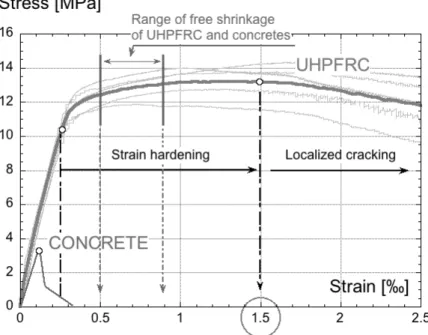
This value should be compared with the maximum free shrinkage of SH-UHPFRC in the range of 0.6 to 0.8 ‰ and their stress relaxation capacity of a factor of 2 at least (creep coefficient of 0.8 to 1 at 28 days, without thermal treatment), Fig. 4. Consid-ering the degree of restraint (ratio of the eigen-stresses developed in the structural member with respect to the eigenstresses in the case of total restraint of all axial and flexural degrees of free-dom) of most structural applications of cast on site SH-UHPFRC, in the range of 50 to 80 %, the strength of SH-UHPFRC only and their relaxation capacity almost guarantees that they prevent crack-ing under the eigenstresses imposed by their maxi-mum shrinkage. This demonstrates that, at least for SH-UHPFRC, at SLS, the relevant aspect of the mechanical response with respect to durability is firstly a high tensile strength, and secondly a sig-nificant deformability as an extra benefit. In con-trast to ordinary concrete, SH-UHPFRC has a favourable deformational balance between restrained deformations under shrinkage and vis-cous and strain hardening deformation capacity that helps to obtain crack free structures [40-43]. From the point of view of fatigue loading and also at Ultimate Limit State (ULS), the extra deforma-bility offered by the tensile response of SH-UHP-FRC, in the range of several ‰ is also very wel-come and useful, especially in combination with rebars. The range of their strain hardening response is actually exactly in the useful domain for most structural applications.
a) b)
Figure 3: Extend of the tensile strain hardening domain as a function of fibre dosage for two fibre types with different length and aspect ratio, calculated, after [36] – COR=coefficient of orientation. Both cases correspond to the same casting in a dumbbell specimen form
E. Denarié and E. Brühwiler
4
Structural Applications
4.1 Concept of Application and Valida-tions
The concept of application of SH-UHPFRC for the rehabilitation of structural members, proposed by Brühwiler in 1999 [44], is schematically illustrated on Fig. 5a. An "everlasting winter coat" is applied on the bridge superstructure in zones of severe environmental and mechanical loads (exposure classes XD2, XD3) and only where the UHPFRC is worth using. Critical steps of the construction proc-ess such as application of waterproofing mem-branes or compaction by vibration can be pre-vented, and the associated sources of errors avoided. The construction process becomes sim-pler, quicker, and more robust, with an optimal use of composite construction.
The waterproofing capabilities of SH-UHPFRC exempt from applying a waterproofing membrane. Thus, the asphalt pavement can be applied after only 8 days of moist curing of the UHPFRC. This constitutes a very significant time saving with respect to the drying period of up to 3 weeks neces-sary prior to the application of a waterproofing membrane for a usual mortar or concrete.
Further, the thickness of the asphalt layer can be limited to the absolute minimum required for the traffic loads. It is not needed to increase it to apply
weight on the waterproofing membrane to prevent the formation of air pockets.
When it is required, the combination of the protec-tive properties and deformation capability of SH-UHPFRC (Fig. 5b) with the mechanical per-formance of reinforcement bars (normal or high grade) provides a simple and efficient way of increasing the stiffness and load-carrying capacity with compact cross sections.
This original conceptual idea has been validated by means of extensive research aimed at characteriz-ing UHPFRC materials and the structural behavior of composite structural members [38, 39].
This concept is very well suited for bridges and reinforcement of slabs in buildings and can also be implemented for galleries, tunnels or retaining walls.
4.2 Applications
By December 2011, 14 applications of SH-UHP-FRC to protect or reinforce bridges or slabs in industrial buildings, alone or combined with rebars, have been performed successfully since 2004 in Switzerland and one in Slovenia in 2009 as men-tioned above [34, 44].
Fig. 6 shows one of the most recent applications of SH-UHPFRC in Switzerland close to Geneva; in late fall 2010 with slopes of 5 % of the bridge deck. Figure 4: Extend of the tensile strain-hardening domain of SH-UHPFRC (CEMTEC CM23) and comparison with
The mix, based on local components, has 650 kg/m3 cement and an equal quantity of limestone filler. The optimized fibrous mix has 353 kg/m3 of 10 mm long, 0.16 mm diameter straight steel fibres. The mix is self-compacting and can be cast on slopes from 5 to 10 % inclination, in all seasons. This application of SH-UHPFRC helped the owner to save 30 % on con-struction costs by avoiding a costly and long re-pro-filing procedure of the concrete road in front and behind the bridge, to accommodate the challenging position of the rebars, unexpectedly close to the road surface in the upper face of the deck.
Another application was realized in 2011 with simi-lar SH-UHPFRC mixes in Switzerland on the steep road to a pass with slopes over 10 % and very limited disturbances for road users thanks to the
5
Conclusions and Outlook
- Within a range of up to 0.4 mm, crack width is not the relevant parameter to control dura-bility of structures. It is rather the presence of through cracks or the resistance to penetration of liquids and gases of the concrete cover adjacent to non-through cracks.
- For non through cracks, the resistance to pene-tration of liquids and gases of the cover con-crete in uncracked zones or nearby macro cracks is the most important parameter for the propagation of corrosion phenomena with time.
- It is thus better to avoid cracks by using suita-ble materials such as SH-UHPFRC, or
con-a)
b)
Figure 5: (a), Concept of application of the local "hardening" of bridge superstructures with SH-UHPFRC [44], (b), Applications of SH-UHPFRC for protection “P”, or reinforcement, combined with rebars, “R”
E. Denarié and E. Brühwiler
0.4 mm and guarantee the lowest possible permeability to gases and water sorptivity of cover concrete by any means (suitable combi-nation of density of cover concrete and thick-ness of cover).
- SH-UHPFRC with their very dense matrix, high tensile strength, limited shrinkage and significant relaxation potential are most suita-ble to avoid cracks in structures, thanks to their high tensile strength and deformability. - SH-UHPFRC, with their extremely low
per-meability to water and gases and very low sorptivity, applied in thin layers of 25 to 50 mm offer compact cross sections with limited dead weight for an impervious covercrete with necessary covers over rebars of only 20 mm in most aggressive conditions.
- SH-UHPFRC can be developed with a wide range of matrices using local components, a large quantity of Supplementary Cementi-tious Materials (SCM) as clinker replace-ment, and a fibrous mix to offer a tensile strain hardening capacity of several per mille and a tensile strength from 10 to 20 MPa. - SH-UHPFRC have been applied successfully
since 2004 cast on site or prefabricated in fif-teen construction sites in Switzerland or Slov-enia, to rehabilitate bridges or buildings, in
most challenging conditions of climate and slopes of substrates.
- Combination of SH-UHPFRC with rebars offers an efficient way to produce highly durable R-UHPFRC tensile membranes to reinforce existing structures.
- The next step and challenge is to link all progress from the last 30 years on strength, deformability, durability and rheology of cementitious composites with the latest developments in chemistry of binder to develop very fast hardening materials for “stealth” construction sites, and making extensive use of SCM to remain sustainable.
Acknowledgements
We gratefully acknowledge contributions of the following current and former members of the UHPFRC team of MCS-EPFL: Prof. J.P. Charron, Dr. K. Habel, Dr. A. Herwig, Dr. A. Kamen, Mr. H. Kamyab, Mrs T. Noshiravani, Dr. C. Oesterlee, Dr. H. Sadouki, Dr. A. Switek, Dr. J. Wuest, and also of our partners in EU project Arches WP 5: Dr A. Šajna, Mrs J. Šuput, Mrs L. Res i , Dr. P. Rossi, Mrs L. Cernilogar. Figure 6: Underpass “Creux de Genthod” – nearby Geneva (CH), 2010, rehabilitation of a bridge deck with SH-UHPFRC,
slope 5 %, average external temperature 5 °C
Financial support of Swiss National Science Foun-dation, Swiss Secretary of Education and Research (EU 5th FP), Committee of Technology and Innova-tion, Cemsuisse, Holcim, Swiss Steel AG, the Swiss Federal Roads Office, the European Union (EU 6th FP) is gratefully acknowledged.
The willingness of cooperation of the road admin-istrations of Swiss cantons Aargau, Geneva, Graubünden, Luzern, Vaud, Wallis, Zürich, and of the municipality of Bovec (Slovenia), as well as of the representatives of the town of Geneva, made the SH-UHPFRC applications described or mentioned in this contributions possible.
References
1. H. H. Bache, Fracture Mechanics in Inte-grated Design of New, Ultra-Strong materi-als and Structures, in Fracture Mechanics of Concrete Structures - From Theory to Appli-cations, Report of RILEM Committee TC
90/FMA - Fracture Mechanics Applications,
L. Elfgren Ed., Chapman & Hall, London, 382-398 (1989)
2. P. Richard and M. Cheyrezy, Composition of Reactive Powder Concretes, Cement and Concrete Research 25, 1501-1511 (1995) 3. P. Rossi, High-Performance Multimodal
Fiber Reinforced Cement Composites (HPMFRCC): The LCPC Experience, ACI Materials Journal 94, 478-483 (1997) 4. P. Rossi, Ultra-high performance fibre
rein-forced concretes (UHPFRC): an overview, P. Rossi and G. Chanvillard Editors, Pro-ceedings of the Fifth International RILEM Symposium on Fibre-Reinforced Concretes,
BEFIB’2000, Lyon, France , 87-100 (2000)
5. P. Rossi, A. Arca, E. Parant, P. Fakhri, Bend-ing and compressive behaviours of a new cement composite, Cement and Concrete Research 35, 27 – 33 (2005)
6. E. Parant, Mécanismes d’endommagement et comportements mécaniques d’un composite cimentaire fibré multi-échelles sous sollicita-tions sévères: fatigue, choc, corrosion, Ph.D. thesis, Ecole nationale des Ponts et Chaussées, Paris (2003)
7. D. R. Lankard, Slurry Infiltrated Fiber Con-crete (SIFCON): Properties and Applica-tions, in Very High Strength Cement-Based Materials, Proceedings Materials Research Society Symposium, edited by J.F. Young,
42, MRS Pittsburgh, 277-286 (1985)
8. J. Zeng, P. Klingenberg and Z. Bayasi, Slurry Infiltrated Mat Concrete (SIMCON) for Rehabilitation of Bridges and Pavements, N. Krstulovic-Opara and Z. Bayasi Editors, ACI publication SP 185, High Performance Fiber-Reinforced Concrete in Infrastructural Repair and Retrofit, ACI, USA, 55-68 (2000)
9. S. Hauser and J. D. Wörner, DUCON, a Durable Overlay, H.W. Reinhardt and A.E. Naaman Editors, RILEM Proceedings of The Third International Workshop on High Performance Fibre Reinforced Cement Composites (HPFRCC 3), Mainz, Germany, 603-615 (1999)
10. V.C. Li, From micromechanics to structural engineering - The design of cementitious composites for civil engineering applica-tions, Structural engineering/earthquake engineering 10, 37-48 (1993)
11. M. Maalej and V. Li, Introduction of Strain Hardening Engineered Cementitious Com-posites in design of Reinforced Concrete Flexural members for Improved Durability, ACI Structural Journal 92, 167-176 (1995) 12. V.C. Li, H. Horii, P. Kabele and Y.M. Lim,
Repair and retrofit with Engineered Cemen-titious Composites, Engineering Fracture Mechanics 65, 317-334 (2000)
13. G. De Schutter, P. J. M. Bartos, P. Domone, J. Gibbs, Self-Compacting Concrete, CRC Press, Wiley, Taylor & Francis group (2008) 14. F. de Larrard and T. Sedran, Optimization of
Ultra-High-Performance Concrete by the Use of a Packing Model, Cement and Con-crete Research 24, 997-1009 (1994)
15. F. de Larrard, Concrete Mixture Proportion-ing – A Scientific Approach, Modern Con-crete Technology Series, 9, E & FN SPON (1999)
16. A. Naaman, Strain hardening and deflection hardening fibre reinforced cement compos-ites, A.E. Naaman and H.W. Reinhardt Edi-tors, Proceedings HPFRCC 4, RILEM publications, Pro 30, 95-113 (2003)
17. M. Sahmaran and V. Li, Influence of micro-cracking on water absorption and sorptivity of ECC, Materials and Structures 42, 593-603 (2009)
18. T. Keller, Dauerhaftigkeit von Stahlbeton-tragwerken - Transportmechanismen und Auswirkung von Rissen, Bericht ETH-IBK Zürich N° 184, Birkhäuser Verlag, Basel
E. Denarié and E. Brühwiler
19. G. Hartl and W. Lukas, Untersuchungen zur Chlorideindringung in Beton und zum Ein-fluss von Rissen auf die Chloridinduzierte Korrosion der Bewehrung, Betonwerk + Fer-tigteiltechnik 7, 497-506 (1987)
20. K. Tuutti, Cracks and Corrosion, CBI fors-kning Fo, research report n° 6:78, Stock-holm, Sweden (1978)
21. G. Rehm, U. Nürnberger., B. Neubert, Chlo-ridkorrosion von Stahl in gerissenem Beton, Deutscher Ausschuss für Stahlbeton 390 (1988)
22. P. Schiessl and M. Raupach, Laboratory studies and calculations on the influence of crack width on Chloride induced corrosion of steel in concrete, ACI Material Journal 94, 56-62 (1997)
23. M. Hoseini, V. Bindiganavile, N. Banthia, The effect of mechanical stresses on permea-bility of concrete: A review, Cement and Concrete Composites 31, 213-220 (2009) 24. C. Desmettre and J. P. Charron, Novel water
permeability device for reinforced concrete under load, Materials and Structures 44, 1713-1723 (2011)
25. M. Lepech and V. C. Li, Water Permeability of cracked cementitious composites, Pro-ceedings ICF11, 11th International Confer-ence on Fracture, Paper 4539 in Compendium of Papers CD-ROM, Turin, Italy, March 20–25 (2002)
26. J.-P. Charron, E. Denarié, E. Brühwiler, Transport properties of Water and Glycol in an Ultra High Performance Fiber Rein-forced Concrete (UHPFRC) under high ten-sile deformation, Cement and Concrete Research 38, 689–698 (2008)
27. P. Lunk, T. Müller, F. H. Wittmann, Feuch-tigskeits-und Ionentransport in gerissenen Stahlbetonbauteilen, Forschungsauftrag 85/90 auf Antrag der Arbeitsgruppe Brük-kenforschung, Bericht OFROU N° 538, VSS, Schweiz (1998)
28. N. Hearn, Effect of shrinkage and load-induced cracking on water permeabil-ity of concrete, ACI Materials Journal 96, 234-241 (1999)
29. R. François and G. Arliguie, Reinforced Con-crete: Correlation between Cracking and Corrosion, in Proceedings of the Second International CANMET Conference on the Durability of Concrete, Montréal, Canada, V.M. Mahlotra ed., 1221-1238 (1991)
30. R. François and G. Arliguie, Effect of micro-cracking and micro-cracking on the development of corrosion in reinforced concrete members, Magazine of Concrete Research 51, 143-150 (1999)
31. K. Tuutti, Corrosion of Steel in Concrete, CBI forskning research, report fo 4.82, Stockholm, Sweden (1980)
32. N. Roux, C. Andrade, M. A. Sanjuan, Etude Expérimentale sur la durabilité des Bétons de Poudres Réactives, Annales de l'Institut Technique du Bâtiment et des Travaux Pub-lics (ITBTP), Les Bétons de Poudres Réac-tives (BPR) à Ultra Haute Résistance (200 à 800 MPa), 532, Série Béton 320, 133-141 (1995)
33. E. Denarié, Recommendations for the tai-loring of UHPFRC recipes for rehabilita-tion, Deliverable ARCHES D06, http://arches.fehrl.org (2009)
34. E. Denarié, G. Habert, A. Šajna, Recommen-dations for the use of UHPFRC in composite structural members – rehabilitation Log ezsoški bridge. Deliverable ARCHES D14, http://arches.fehrl.org (2009)
35. E. Denarié and E. Brühwiler, Structural rehabilitations with Ultra High Performance Fibre Reinforced Concretes, International Journal for Restoration of Buildings and Monuments, Aedificatio 12, 453-465 (2006) 36. J. Wuest, E. Denarié, E. Brühwiler, Model for predicting the UHPFRC tensile harden-ing response, UHPC-2008: The Second International Symposium on Ultra High Per-formance Concrete, E. Fehling, M. Schmidt, S. Stürwald ed., Structural Materials and Engineering Series, 10, Kassel University Press, Germany, 153-160 (2008)
37. J. Wuest, E. Denarié, E. Brühwiler, L. Tama-rit, M. Kocher, E. Galluci, Tomography Analysis of Fibre Distribution and Orienta-tion in Ultra-High Performance Fibre Rein-forced Concrete with High Fibre Dosages, Experimental techniques 33, 50-55 (2009) 38. K. Habel, E. Denarié, E. Brühwiler,
Struc-tural response of elements combining Ultra-High Performance Fiber Reinforced Concretes (UHPFRC) and reinforced con-crete, ASCE Structural journal, November, 1793-1800 (2006)
39. C. Oesterlee, E. Brühwiler, E. Denarié, Tragverhalten von Verbundbauteilen aus bewehrtem UHFB und Stahlbeton, Beton-und Stahlbetonbau 104, 462-470 (2009)
40. K. Habel, E. Denarié, E. Brühwiler, Time Dependent Behaviour of Elements Combin-ing UHPFRC and Concrete, Materials and Structures 39, 557-569 (2006)
41. A. Kamen, E. Denarié, E. Brühwiler, UHP-FRC tensile creep at early age, Materials and Structures 42, 113-122 (2009)
42. A. Kamen, E. Denarié, H. Sadouki, E. Brüh-wiler, Thermo-mechanical response of UHP-FRC at early age - experimental study and numerical simulation, Cement and Concrete Research 38, 822-831 (2008)
43. A. Switek, Time-Dependent Response of Ultra High Performance Fibre Reinforced Concrete (UHPFRC) under Low to High Tensile Stresses, thèse EPFL n° 4899, Lausanne, Suisse (2010)
44. E. Brühwiler and E. Denarié, Rehabilitation of concrete structures using Ultra-High Per-formance Fibre Reinforced Concrete, UHPC-2008: The Second International Sym-posium on Ultra High Performance Con-crete, Kassel, Germany, March 05 – 07, 895-902 (2008)
Received October 31, 2011
Dr. Emmanuel Denarié is a civil engineer, with a PhD in Materials Science. He worked for 3 years in a civil engineering company where he was in charge of the design of struc-tures and the maintenance of bridges. He has 20 years experience on research and appli-cations in the field of building materials, advanced concretes, and rehabilitation of reinforced concrete structures. He is since 2000 research associate in the Laboratory for Maintenance and Safety of structures, at Ecole Polytechnique Fédérale de Lausanne (EPFL), in charge of research activities on the application of concretes and advanced cementitious materials to the improvement of existing and new structures.
Address : Ecole Polytechnique Fédérale de Lausanne (EPFL), ENAC – MCS, GC B2 435, Station 18, CH-1015 Lausanne, Switzerland. E-mail: [email protected]
Professor Dr. Eugen Brühwiler is a Professor at the Ecole Polytechnique Fédérale de Lausanne (EPFL) and director of MCS (Division of Maintenance and Safety of Struc-tures) since 1995. He received his civil engineering diploma and PhD from respectively ETH Zürich (1983) and EPFL (1988). After a two years post-doctoral stay at the Univer-sity of Colorado in Boulder USA, he was with the Swiss Federal Railways in Zurich for four years working in the domain of maintenance and safety of railway bridges. His research interests include the behaviour of cementitious materials and their applica-tion for the improvement of concrete structures, durability and safety issues of existing structures, in particular bridges.
Address : Ecole Polytechnique Fédérale de Lausanne (EPFL), ENAC – MCS, Station 18, CH-1015 Lausanne, Switzerland. E-mail: [email protected]
![Figure 2: Tensile behaviour of two UHPFRC recipes, CEMTEC multiscale ®, unnotched tensile tests on dumbbell speci- speci-mens, fixed rigid boundary conditions, average curves at 28 days [35], (a) scatter and average curve for mix CM23, (b) comparison of av](https://thumb-eu.123doks.com/thumbv2/123doknet/14909471.657787/6.892.179.672.152.943/tensile-behaviour-multiscale-unnotched-dumbbell-boundary-conditions-comparison.webp)
![Figure 3: Extend of the tensile strain hardening domain as a function of fibre dosage for two fibre types with different length and aspect ratio, calculated, after [36] – C OR =coefficient of orientation](https://thumb-eu.123doks.com/thumbv2/123doknet/14909471.657787/7.892.165.770.139.349/figure-extend-hardening-function-different-calculated-coefficient-orientation.webp)
![Figure 5: (a), Concept of application of the local "hardening" of bridge superstructures with SH-UHPFRC [44], (b), Applications of SH-UHPFRC for protection “P”, or reinforcement, combined with rebars, “R”](https://thumb-eu.123doks.com/thumbv2/123doknet/14909471.657787/9.892.238.693.127.767/concept-application-hardening-superstructures-applications-protection-reinforcement-combined.webp)

