Plenary Speeches
Putting the Common European Framework of Reference to
good use
Brian North EAQUALS; Eurocentres Foundation, Switzerland
[email protected]; [email protected]
This paper recapitulates the aims of the CEFR and highlights three aspects of good practice in exploiting it: firstly, taking as a starting point the real-world language ability that is the aim of all modern language learners; secondly, the exploitation of good descriptors as transparent learning objectives in order to involve and empower the learners; and thirdly, engaging with theCOMMUNALITYof the CEFR Common Reference Levels in relating assessments to it. The
second part of the paper focuses on good practice in such linking of assessments to the CEFR. It outlines the recommended procedures published by the Council of Europe for linking language examinations to the CEFR and the adaptation of those procedures for teacher assessment in language schools that has recently been undertaken by EAQUALS. The paper concludes by discussing certain aspects of criterion-referenced assessment (CR) and standard setting that are relevant to the linking process.
1. Purpose of the Common European Framework of Reference
First, let us remind ourselves what the Common European Framework of Reference (CEFR) (Council of Europe 2001) is about. Published in 2001 after a period of piloting, it consists of a descriptive scheme, common reference points expressed as six proficiency levels, descriptor scales for many aspects of that descriptive scheme, advice on curriculum scenarios and considerations for reflection. The aim of the CEFR is to stimulate reflection on current practice and to provide common reference levels to facilitate communication, comparison of courses and qualifications, plus, eventually, personal mobility as a result. In this process, in relation to assessment, the CEFR descriptors can be of help:
For the specification of the content of tests and WHAT IS ASSESSED
examinations:
For stating the criteria to determine the attainment of a HOW PERFORMANCE IS
learning objective: INTERPRETED
For describing the levels of proficiency in existing HOW COMPARISONS
tests and examinations, thus enabling comparisons to CAN BE MADE
be made across different systems of qualifications: (Council of Europe 2001: 178)
Revised version of a plenary address given at the seminar ‘Putting the CEFR to good use’ held jointly by EALTA (www.ealta.org) and the IATEFL TEA (Testing, Evaluation and Assessment) Special Interest Group, Barcelona, Spain, 29 October, 2010.
Before the CEFR there was a practical ‘Tower of Babel’ problem in making sense of course certificates and test scores. A teacher, school or examination body would carry out a test and report a result in their own way as ‘19’, ‘4.5’, ‘516’, ‘B’, ‘Good’, etc. It is no exaggeration to say that twenty years ago a teacher of Spanish in a secondary school in southern France, a teacher of French to Polish adults and a teacher of English to German businessmen would have taken ten to twenty minutes to establish any common ground for a discussion. The CEFR labels help.
In taking notice of the CEFR, most people therefore start with the levels. In contrast to those used in other language proficiency scales, the CEFR descriptors and levels are the product of serious validation in pre-development studies (North 1995: 2000a; North & Schneider 1998) and post-development studies (Jones 2002; Kaftandjieva & Takala 2002; North 2002). These confirmed that language teachers and learners interpret the descriptors consistently across a sample of educational contexts, regions and target languages. However, the existence of a scale of levels does not mean that situating learners, courses and examinations on that scale is straightforward. Experimentation with the CEFR descriptors contained in checklists for each level in the European Language Portfolio, of which more than 100 versions have now been produced (Schneider, North & Koch 2000; Little 2005; www.coe.int/portfolio), has helped schools to become reasonably confident in their judgement as to the level of their learners and courses. But relating examinations and test scores to the levels is a more serious matter that people have had more difficulty with. Therefore, in response to requests from member states, the Council of Europe put together a working party to develop a Manual for relating language qualifications to the CEFR, which after publication in pilot form in 2003 is now available on the Council of Europe’s website (Council of Europe 2009) accompanied by further material on exploiting the scaling of teacher assessments (North & Jones 2009), a reference supplement (Takala 2009), and sets of case studies from the piloting now published by CUP (Martyniuk 2010). I will come back to the procedures recommended in the Manual later in the paper.
The pre-CEFR Tower of Babel problem masked a second, more theoretical problem: the relation of assessment results to real-world practical language ability. Tests each reported their own scale and left users to work out what different bands/scores on the scale meant in terms of real-life ability. As Jones, Ashton & Walker (2010: 230) point out, the CEFR Manual helps language testers to address this central concern of
criterion-referenced assessment. The CEFR promotes an ACTION-ORIENTED APPROACH: seeing the
learner as a language user with specific needs, who needs to ACTin the language in
world domains. The CEFR descriptor scales can provide the vertical continuum of real-life ability needed as an external criterion for valid criterion-referenced assessment. The Manual offers sets of procedures to help in this process. This point is returned to later the paper.
However, it is important to remember that the prime function of the CEFR is not to get all tests reporting to the same scale but to encourage reflection on current practice, and thus to stimulate improvement in language teaching and learning (and testing). The CEFR was developed to contribute to reform and innovation and to encourage networking; it is certainly not a harmonisation project, as we made very clear:
We haveNOTset out to tell practitioners what to do or how to do it. We are raising questions not answering them. It is not the function of the CEF to lay down the objectives that users should pursue or the methods they should employ. (CEFR 2001: xi)
Nor is the CEFR a panacea. It is a heuristic model intended to aid communication, reflection and focused research. This fact was recognised in various articles in the special issue of the journal Language Testing on the CEFR, best summarised by Norris in his introduction:
. . .in Chapter 2, the principal intended uses of the CEFR are made clear: though arbitrary, proficiency
descriptions and scales provide an essential heuristic for understanding and communicating about language learning and use, and such a heuristic is needed in a contemporary Europe that seeks to promote mutual understanding, tolerance and knowledge of its rich linguistic and cultural diversity. (Norris 2005: 400)
Neither has the Council of Europe or any of the authors ever claimed the CEFR to be perfect or complete. The Council has, in fact, repeatedly stated that all the lists and sets of descriptors are open-ended. No descriptors at all were published for several important aspects of the descriptive scheme and some 10% (40) of those that were published are not based on research, half of those being at C2. I was in a position in which I just had to create most of the descriptors for communicative language activities at C2. The English Profile Project is currently focusing on bringing more precision to descriptors for the C levels. I personally find it disappointing that we have had to wait 15 years for a follow-up project to further extend the calibrated descriptor bank.
In any case, as Alderson once pointed out (personal communication), the descriptors are designed to describe learner behaviour, not test tasks. Operationalising them into a specification for a test task requires a process of interpretation that is not always straightforward. As Weir (2005) and Alderson (2007) state, a lot of work is involved in that process and the CEFR (2001) is of only limited help in this respect. This need for further specification, development and underpinning was underlined by various contributors to a series of articles in a special edition of Perspectives in The Modern Language Journal (Byrnes 2007). The CEFR cannot just be applied; it must be interpreted in a manner appropriate to the context and further elaborated into a specification for teaching or testing.
Personally, I think that the two biggest dangers with the CEFR are, firstly, a simplistic assumption that two examinations or courses placed at the same level are in some way interchangeable and, secondly, a rigid adoption – rather than adaptation – of the descriptors. A label such as ‘A2’ serves only as a convenient summary of a complex profile. The
CEFR/ELP descriptors are intended for orienting learning and PROFILING developing
competence, not just for determining what overall level someone is considered to be. Every person and every test that is said to be A2 is said to be A2 for different reasons. As regards the descriptors, I deliberately kept these as context-neutral as possible, so that the scale value of each individual descriptor would be more stable across contexts. The descriptors must be adapted and further elaborated to suit the context, as in the 100 versions of the European Language Portfolio that have been endorsed by the Council of Europe. Fortunately, adapting things is not something teachers are shy about doing. A rich bank of such adapted descriptors is now available on the Council of Europe’s website as a source of inspiration
(www.coe.int/portfolio). A recent project in EAQUALS (European Association for Quality Language Services) reviewed that bank in order to further develop and fill the gaps in a set of general language descriptors for the main levels (criterion levels) and for the plus levels (levels between the main levels). The results are also available at the same web site.
2. Good uses of the CEFR
What might, then, be regarded as good use of the CEFR? Apart from the question of a
serious engagement with theCOMMUNALITYof the reference levels, which is the subject of
the second half of this paper, I think there are two main points: firstly, taking as a starting point the real world language ability that is the aim of all modern language learners and, secondly, the exploitation of good descriptors as transparent learning objectives in order to involve and empower the learners.
2.1 The ‘real world’ criterion
The CEFR sees the learner as a language user with specific needs, who needs to act in the language. It provides a descriptive scheme that, in what was at the time an innovative manner (North 1997), encompasses both categories used by applied linguistics and categories familiar to teachers. It outlines domains and communicative language activities (organised under Reception, Interaction, Production and Mediation), with related communicative language strategies, communicative language competences (organised under Linguistic, Pragmatic and Socio-linguistic), and socio-/inter-cultural competences and skills. It is commonplace to pay lip service to this idea of teaching towards communicative needs, but unfortunately many teachers, publishers and testers still appear to think just in terms of Lado’s (1961) pre-communicative and pre-applied linguistics model of the four skills plus three elements (grammatical accuracy, vocabulary range and pronunciation), and pop a CEFR level label on top. Such a perspective can lead to a continuation of the kind of airy-fairy statements of communicative aims unconnected to classroom reality that were common before the CEFR. In such a model, needs analysis tends to be interpreted only in terms of a deficit model of remedial linguistic problems, so teachers usually ignore the official aims and just follow the book, teaching ‘the language’.
It really is quite another matter to orient a curriculum consciously through a balanced
set of appropriate (partly CEFR-based) CANDO DESCRIPTORSas communicative objectives
and then to provide opportunities for learners to acquire/learn the communicative language competences and strategies necessary for success in the real-world tasks concerned. Keddle (2004) hit a chord when she commented that whilst authentic materials were common in
EFL in the 1980s and early 90s, the MEGA COURSE BOOKSled to a decline in their use in
class during the 1990s. As she pointed out, the CEFR descriptors of reading and listening of different types can motivate a selection of authentic materials for all levels. Fortunately, the advent of YouTube, data projectors and interactive whiteboards is now starting to change things again at a classroom level.
However, there seems to be an unfortunately common misconception that descriptors form some kind of teaching menu, that they are in some way discrete items that should be taught one after another. That might possibly be true at A1, or in terms of emphasising the difference
between search reading (CEFR 2001= Reading for Orientation) and careful reading (CEFR
2001 = Reading for Information and Argument), but otherwise it is simplistic nonsense.
Any real-world or classroom activity will almost certainly involve tasks and competences represented by clusters of descriptors. One fruitful way of exploiting the CEFR descriptors in this way is to design CEFR-scenarios. Scenarios are a way of working from real-world contexts in order to integrate relevant descriptors, both as objectives for activities and as quality criteria for performance, with the enabling aspects of pragmatic and linguistic competence that underlie the performance, including target language points. This CEFR scenario model,
shown in Appendix 1, was developed by ´Angeles Ortega (North, Ortega Calvo & Sheehan
2010: 13–17; Ortega Calvo 2010: 72). It consists of two tables, each on an A4 landscape page in North et al. (2010): the first page (Appendix 1a to this page) a specifies the objectives for a learning module and/or an assessment, and the second page (Appendix 1b) defines a teaching sequence intended to help learners achieve those objectives. In the top row in Appendix 1a, global aspects such as the domain, context, real-world tasks and language activities involved are defined. On the left are listed CEFR-based descriptors appropriate
to the specific scenario, both CANDO DESCRIPTORSselected or adapted from CEFR (2001)
Chapter 4 (Language use and the language user/learner) and CRITERIA, from CEFR (2001)
Chapter 5 (The competences of the user/learner). On the right-hand side are listed relevant competences (strategic, pragmatic, linguistic, etc.). The advantage of the scenario concept is the top-down analysis of the context in terms of the enabling competences needed, and the promotion of the teaching and assessment of relevant aspects of those competences without losing sight of their relationship to the overall framework offered by the scenario.
A scenario is not a test specification because concrete assessment tasks, expected responses and assessment conditions are not defined. A teacher will probably not want to go into such detail, preferring instead to focus on identifying the steps necessary for the acquisition of the competences concerned and their integration into a pedagogic sequence. The sequencing of such pedagogic steps is the subject of the second part of the scenario. In the example reproduced here as Appendix 1b, developed by Howard Smith, a particular sequencing model is employed (Harmer 1998). Different teachers will have different preferences for operational sequencing and for how they describe it. In addition, different approaches suit particular groups and different levels. The template for describing objectives (Appendix 1a) is likely to be more standard than the description of how to achieve them (Appendix 1b). That was certainly the case in the scenarios for different levels produced by members of the EAQUALS project team. Whereas the scenario overviews all took the approach illustrated in Appendix 1a, the teaching sequences differed radically. In that respect, I should emphasise two points. Firstly, a scenario approach does not necessarily involve task-based teaching. The target real-life activity might not be simulated in the classroom as it is in Smith’s suggested sequence of activities, shown in Appendix 1b. The purpose of the classroom role-play may be only to give the learner the competences to be successful, rather than to simulate the actual activity. Alternatively, the scenario may involve a chain of simulated real-world tasks, especially at lower levels. Secondly, the degree of standardisation may be affected by whether or not
the scenarios involve more formal assessment. Developing the scenario concept further into task templates for such formal classroom assessment is the subject of the current EAQUALS Special Interest Project in this area.
2.2 Learner empowerment
As demonstrated with the scenario model, descriptors are primarily a communication tool. They are very useful – in moderation – for needs analysis and consultation with learners about progress. ‘Can Do’ descriptors (see CEFR 2001: Chapter 4 for inspiration) can be used as signposts in syllabuses, course planning, needs analysis forms, classroom displays, evaluation checklists, personal profiles and certificates. In addition, transparent use of descriptors for aspects of competence (see CEFR 2001: Chapter 5 for inspiration) as assessment criteria helps learners to know what to focus on and facilitates tutorials, peer-assessment and self-assessment. Self-directed learning can only start if you know roughly where you are – from reasonably accurate self-assessment. The scenario concept outlined above lends itself to this approach. The teacher can focus the learners’ attention on the two different types of descriptors (action; quality) plus, perhaps, the language of skills that he or she wants the learners to pay attention to.
Many teachers have come across descriptor checklists for different levels in the European Language Portfolio. Unfortunately, the rather heavy format of the Portfolio has, to my mind, hindered its widespread adoption, but this may change in the age of Facebook, with the web versions of portfolios that are starting to appear (for example, www.eelp.org and www.ncssfl.org/links/index.php?linguafolio). It is also a shame that most Portfolios, unlike the prototype, do not include descriptors for qualitative aspects of competence (Schneider, North & Koch 2000), since this encourages a simplistic association of the CEFR with a functional approach, while the CEFR is really a competence-based approach. In CEFR terms, functional competence is one half of pragmatic competence, the other half being discourse competence, with two other aspects of language competence (linguistic and socio-linguistic), plus socio-cultural and intercultural competences. Descriptors are available for all these aspects except the cultural ones. The confirmation and further elaboration of criterial features in projects such as ENGLISHPROFILE(www.englishprofile.org) will help to enrich the
model.
Such use of descriptors forSIGNPOSTINGis common in EAQUALS, from a Greek primary
school (which makes use of an aims box on the whiteboard in each lesson, checklists for teachers and report cards for parents), through language schools providing intensive courses in-country and extensive courses at home (syllabus cross-referencing, checklists for teacher/self-assessment), to a Turkish university (which defines exit levels and detailed objectives, communication within faculty and with parents, and continuous teacher- and self-assessment). Such signposting treats learners as partners in the learning and teaching process. In Eurocentres intensive courses, every classroom has a standardised display of (a) the scale of CEFR levels, with defined sub-levels, (b) the detailed learning objectives for the CEFR level in question (‘Our Aims’) and (c) the communicative and related linguistic objectives of the actual week’s work (‘Weekly Plan’). The weekly plan is introduced by the teacher on the
Monday, and a review lesson at the end of the week combines a quiz on the main linguistic content with a small group discussion of achievement of the week’s objectives, and the need for further class or individual work. At the end of the recent CEFR core inventory for general English project that produced the scenario concept (North et al. 2010), the British Council and EAQUALS team have summarised, for a similar purpose, using classroom posters, the main descriptors, strategies, language points and sample exponents at each level.
3. Procedures for relating assessments to the CEFR
More and more schools and teachers are using the CEFR levels to communicate with learners, and examination boards increasingly refer to them. It is clear that what exactly is meant in practice by a set of verbally defined levels of proficiency like the CEFR Common Reference Levels cannot be entirely separated from the current process of implementation, training workshops, calibration of illustrative samples, adaptation of CEFR descriptors, and linking of tests to the CEFR. However, the levels are not intended as a free-for-all for users to define as they wish. As was emphasised at the 2007 intergovernmental Language Policy Forum held to take stock of the implementation of the CEFR, the levels should be applied responsibly, especially if national systems and international certificates are being aligned to them (Council of Europe 2007: 14). This means taking account of established sets of procedures, such as those recommended in the Manual, when designing any linking project.
The fact that good practice guidelines are necessary for linking high-stakes assessment to the CEFR can be demonstrated by a simple example. In response to the plethora of proficiency standards that have developed in the UK, two British researchers were commissioned to produce a so-called alignment of all the different language proficiency scales, including the CEFR. The study, called ‘Pathways to Proficiency’, claimed a relationship between CEFR Level B1 and the British National Language Standards (BNLS) Level 2. As the authors state (Department for Education and Skills 2003: 12–14), this alignment was done on the basis of no more research than placing the documents on a table next to each other and eyeballing the descriptors. Even then, to my mind, the authors do not always seem to have selected the most appropriate CEFR descriptor scales to compare to the British ones. If this rather intuitive approach had been taken by a language education provider or publisher, this would be a minor issue: their interpretation would be confirmed or adjusted over time. However, in a nationally commissioned, high-stakes project, things are more serious. The English school-leaving certificate, the GCSE, is placed at BNLS Level 2. The unsubstantiated suggestion
that BNLS Level 2= GCSE = B1 is by no means entirely unconnected to the fact that in
February 2010 the UK Border Authority declared B1 to be the minimum for a UK student visa (required for a stay of more than six months). As reported in the EL Gazette at the time, GCSE was the comparison used in both the British Parliament and the press to justify the measure. In fact a pass at GCSE (Grade C) is probably A2. The top Grade A – supposedly representing the standard of the previous O Level – may be B1. Nobody knows exactly, because nobody has bothered to do a study. However, the identification of GCSE with B1 helped to deny tens of thousands of language students the opportunity to come to the UK and cost the British English Language teaching industry 10% of its business quite literally
overnight – and almost certainly erroneously. Even worse, the UK Border Authority has since proposed raising the minimum for a student visa from B1 to B2, a step which would have dire consequences for the number of international students at UK universities.
The Manual recommends four sets of procedures for linking to the CEFR:
FAMILIARISATION, SPECIFICATION, STANDARDISATION and VALIDATION. In the context of
operational school assessment one could also put a special emphasis on MODERATION, to
limit and/or adjust for subjectivity in assessments by teachers.
3.1 Familiarisation
Familiarisation with the CEFR levels through training and awareness-raising exercises is always necessary, as people tend to think they know the levels without consulting the descriptors or official illustrative samples. Instead they often associate the CEFR levels with levels they already know. Familiarisation exercises normally involve descriptor sorting tasks, but the most useful initial form of familiarisation is to see the levels in action – in video sequences such as those available online for English, French, Spanish, German and Italian at www.ciep.fr/en/publi_evalcert/dvd-productions-orales-cecrl/index.php.
3.2 Specification
Specification in this context includes defining the coverage of the course or examination in relation to the CEFR descriptor scales, in terms of both the curriculum and the assessment tasks and criteria used to judge success in them. This involves selecting communicative activities, perhaps guided by the descriptor scales in Chapter 4 of the CEFR (2001), summarised in CEFR (2001: Table 2), designing tasks and writing items. Valid assessment requires the sampling of a range of relevant discourse. For speaking, this normally means combining interaction (spontaneous short turns) with production (prepared long turns); for writing it may mean eliciting written-spoken language (interaction: email, SMS, personal letter) as well as prose (production: essay, report). For listening and reading it may mean some short pieces for identifying specific information (listening/reading for orientation) and one or two longer pieces for detailed comprehension.
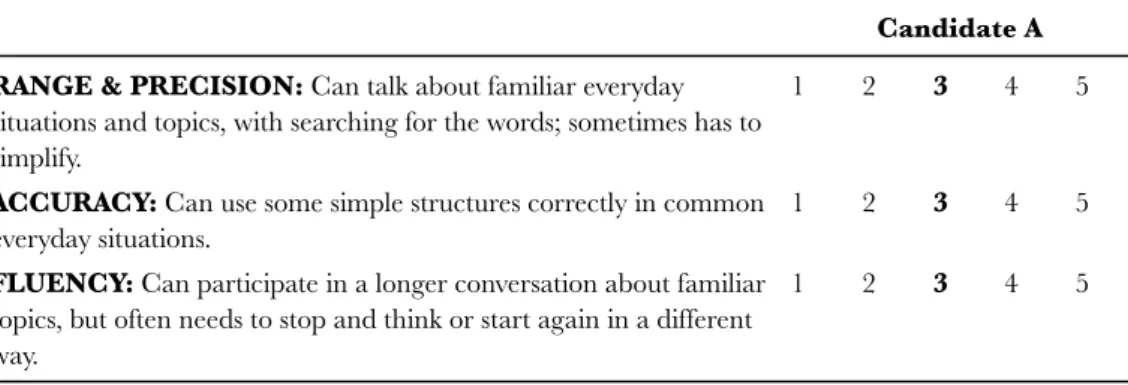
The formulation of criteria may or may not be related to the descriptors in Chapter 5 of the CEFR (2001), which are summarised in CEFR (2001: Table 3). However, the criteria should be balanced in terms both of extent of knowledge and degree of control and of linguistic competence and pragmatic competence, as CEFR (2001: Table 3) attempts to do. The assessment instrument might be a single grid of categories and levels, such as CEFR (2001: Table 3), especially for standardisation training or a programme in which teachers teach classes at different levels. Alternatively, it might focus only on the target level, with one descriptor per chosen category; a simple example is given in Table 1. The advantage of this approach is the ease with which the criteria can be explained to learners. This makes it easier
to highlight theCOMPETENCESthey must acquire for communicative success, rather than just
Table 1 Assessment at one level
Candidate A RANGE & PRECISION: Can talk about familiar everyday
situations and topics, with searching for the words; sometimes has to simplify.
1 2 3 4 5
ACCURACY: Can use some simple structures correctly in common everyday situations.
1 2 3 4 5
FLUENCY: Can participate in a longer conversation about familiar topics, but often needs to stop and think or start again in a different way.
1 2 3 4 5
Note: 3 is the mark given if the learner exactly meets the criterion-descriptor; no more and no less.
3.3 Standardisation
Standardisation involves, firstly, training in a standard interpretation of the levels, using the illustrative samples provided for that purpose and, secondly, the transfer of that standardised interpretation to the benchmarking of local reference samples. It is important that these two processes are not confused. In standardisation, participants are trainees being introduced to or reminded of the levels, the criteria, the administration procedures, etc. External authority is represented by the workshop leader, the official criteria and the calibrated samples. Standardisation training is not an exercise in democracy. The right answer, in terms of standardising to an interpretation of the levels held in common internationally, is not necessarily an arithmetic average of the opinions of those present, if they all come from the same school or pedagogic culture. This is a tricky issue which needs to be handled delicately. Personally, I have found it simplest to start by showing a calibrated, documented video, allowing group discussion, handing out the documentation and then animating a discussion of why (not whether) the learner is A2, B1 or whatever. The next stage can have group discussions reporting views to a plenary session, and finally individual rating – checked with neighbours and then with the documentation.
In benchmarking, on the other hand, participants are valued, trained experts (although very possibly the same people who did the standardisation training in the morning!). Here it is important to record individual judgements before they are swayed in discussion by over-dominant members of the group. Ideally, the weighted average of the individual judgements, preferably corrected for inconsistency and severity/lenience with the IRT program FACETS, (Linacre 1989; 2008) would yield the same result as the consensus reached in discussion. This was the preferred method in the series of benchmarking seminars that produced most of the CEFR illustrative video samples (Jones 2005; North & Lepage 2005).
3.4 Moderation
Moderation counteracts subjectivity in the process of rating productive skills. Even after standardisation training has been implemented, moderation will always be necessary. Some
assessors can be quite resistant to training, and, in any case, the effects of standardisation also start to wear off immediately after the training. In addition, some assessors persist in using personal concepts rather than the official criteria as their reference. Many are also unconsciously over-influenced by one criterion (e.g. accuracy or pronunciation), and most refuse to give a top or bottom grade (central tendency error). Moderation techniques can be divided into collective and quality control techniques. Collective techniques involve some form of double marking, perhaps of a structured sample of candidates (e.g. every fifth candidate, or (after rank ordering) the top three, middle three and bottom three candidates. Rather than live double marking, recordings might be sent to chief examiners for external monitoring. Administrative quality control techniques may involve studying collateral information on the candidates on the one hand, or developing progress norms from representative performance samples sent to the chief examiners on the other. Such norms can then be used to identify classes whose grades differ significantly from the norm, for further investigation. These grades might genuinely be due to an unusually good/bad teacher or an unusually strong/weak class – but an apparent anomaly is worth following up. Alternatively, scores from a standardised test may be used to smooth the results from teacher assessment, in one form of statistical moderation.
3.5 EAQUALS Scheme
These techniques (familiarisation, specification, standardisation, moderation) have recently been operationalised in a scheme under which EAQUALS-accredited language schools issue EAQUALS CEFR Certificates of Achievement to learners at the end of a course. The scheme requires the school to send the following materials for inspection by an expert panel, and the school’s assessment system is then checked in practice during the three-yearly EAQUALS external inspections:
• curriculum and syllabus documents with learning objectives derived from the CEFR • a coherent description of the assessment system
• written guidelines for teachers
• CEFR-based continuous assessment instruments
• sample CEFR-based assessment tasks, tests and guidelines • CEFR-based criteria grids
• a set of locally recorded, CEFR-rated samples to be double-checked by an EAQUALS expert panel
• samples of individual progress records
• the content and schedule of staff CEFR standardisation training • details of the moderation techniques employed
3.6 Validation
Validation has two aspects: INTERNAL VALIDATIONof the intrinsic quality of the assessment
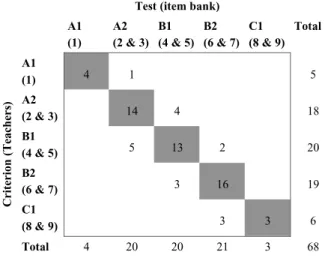
Table 2 A CEFR Manual ‘Decision Table’ for validation of cut-scores on a Eurocentres item bank for German (North 2000b)
Test (item bank) A1 (1) A2 (2 & 3) B1 (4 & 5) B2 (6 & 7) C1 (8 & 9) Total A1 (1) 4 1 5 A2 (2 & 3) 14 4 18 B1 (4 & 5) 5 13 2 20 B2 (6 & 7) 3 16 19 C1 (8 & 9) 3 3 6 Cri teri o n ( T each ers) Total 4 20 20 21 3 68
ability operationalised in the CEFR descriptor scales. For reasons of space I shall only discuss the latter, since the entire language testing literature concerns the former. Many of the moderation techniques referred to above are simple forms of external validation: the fundamental principle is to exploit collateral information and independent sources of
evidence. The advice in the Manual is to use two independent methods of setting theCUT
SCORESbetween levels. Then, if necessary, one can use a cyclical process of adjusting the cut
scores, examining them in the light of aDECISION TABLElike that shown in Table 2 in order to
arbitrate between two provisional results. The table shows a low-stakes (Eurocentres) worked example cited in the Manual (Council of Europe 2009: 111–113). Here the pattern was very regular, with 73.5% matching classifications, so no correction from the provisional cut scores set for the item bank on the basis of item-writer intention seemed necessary.
This contrastive technique can be exploited in many different ways: for example, contrasting the original claim based on item-writer intention against the result from formal
STANDARD SETTING (=ways of setting the cut scores); contrasting the results from two
independent setting panels; contrasting the results from two different standard-setting methods (e.g. between a test-centred and a candidate-centred method), and finally confirming the result from standard-setting (or the original claim based on item-writer intention) with a formal external validation study. For teacher assessment, the external criterion could be operationalised in CEFR-related examination results for the same students; for a test under study the external criterion could be ratings by CEFR-trained teachers of the same students in relation to CEFR descriptors. In fact, many of the Manual case studies recently published (Martyniuk 2010) did successfully use two methods in order to confirm their claim to CEFR linkage. Both the ECL study (Szabo 2010) and the TestDaf study (Kecker & Eckes 2010) contrasted original item-writer intention with formal standard-setting; both the City & Guilds study (O’Sullivan 2010) and the ECL study (Szabo 2010) contrasted the mean average difficulty of their own items with that of the illustrative items; both
TestDaf study (Kecker & Eckes 2010) and the Bilkent COPE study (Thomas & Kantarcio˘glu 2009; Kantarcio˘glu et al. 2010) contrasted panel-based standard-setting results with external teacher judgements of the candidates in relation to CEFR descriptors. The Surveylang study
(Verhelst 2009) contrasted results from a sophisticated data-based panel CITO BOOKMARK
METHOD(Council of Europe 2009: 82–83) with external teacher CEFR judgements. Finally,
both the Pearson Test of English – Academic (De Jong 2010) and the Oxford On-line Test (Pollitt 2009) also contrasted item-writer intentions with external teacher judgements.
In contrast to these sensible approaches, Cizek & Bunch (2007), the current US text book on standard-setting, explicitly advises against using two methods of standard-setting, because these might yield different results. They state that ‘a man with two watches is never sure’ and ‘use of multiple methods is ill advised’ (Cizek & Bunch 2007: 319–320). Yet replication is the basis of Western academic thought: if you cannot replicate a result you do not have a result. Good practice would dictate corroboration of what is, for a high-stakes test, an important decision that will affect many people’s lives.
4. Criterion-referencing and standard-setting
This reluctance to question the decision of a single panel highlights a general confusion about standard-setting and criterion-referenced assessment. STANDARD-SETTINGis very often
undertaken by a panel of experts who estimate the difficulty level of items in order to set the cut-score for pass/fail or different grades in a test. In EALTA, this conventional approach to standard-setting seems to be considered essential for relating assessments to the CEFR. Eli Moe, for example, in her paper at the EALTA standard-setting seminar in The Hague began by saying:
Although everyone agrees that standard-setting is a must when linking language tests to the CEFR, we hear complaints about the fact that standard-setting is expensive both in respect to time and money. In addition, it is a challenge to judges not only because the CEFR gives little guidance on what characterises items mirroring specific levels, but also because time seldom seems to increase individual judges’ chances of success in assigning items to CEFR levels. (Moe 2009: 131)
However, neither I myself nor Neil Jones nor John De Jong, to name but three people present, would agree that panel-based standard-setting is a must when linking tests to the CEFR. The preliminary Manual (Council of Europe 2003) made it clear that it was perfectly feasible to jump from the specification phase direct to the kind of empirical, external validation discussed in the previous section without bothering with panel-based standard-setting at all. It recommended using the judgements of CEFR-trained teachers for validation and presented box plots and bivariate decision tables provided by Norman Verhelst, the Cito statistical expert from the DIALANG project, as useful tools in that process. When I met Norman at the first meeting of the Manual group, we actually had a one-hour discussion in which I expressed my difficulty in buying the idea that someone with his experience of ITEMRESPONSE
THEORY(Rasch modelling, henceforth IRT) could seriously believe that such guesstimation by panels really worked.
Validating the relationship of a test to the CEFR requires what is technically known as
LINKINGto the continuum of ability acting as the criterion. In our current discussion, the
validated CEFR descriptor scale provides that continuum. Criterion-referenced assessment (CR) places persons on such a continuum, independent of the ability of others. This is in contrast to norm-referenced assessment, in which the ability of candidates is evaluated relative to that of their peers, or to a standard set in relation to their peer cohorts over many years. CR was developed by Robert Glaser in a seminal article from which the crucial passage is the following:
Along. . . a continuum of attainment, a student’s score on a CR measure provides explicit information as toWHAT THE INDIVIDUAL CAN AND CANNOT DO.
CR measures indicate (. . .) the correspondence between what an individual does and theUNDERLYING CONTINUUM OF ACHIEVEMENT. Measures which assess student achievement in terms of a criterion standard thus provide information as to the degree of competence attained by a particular student which is INDEPENDENT OF REFERENCE TO THE PERFORMANCE OF OTHERS. (Glaser 1963: 519–520; emphasis added)
This is not at all where the conventional, US-style standard-setting represented by Cizek & Bunch (2007) is coming from. In the US, CR started in the 1960s, at almost exactly the same time as the behaviourist instructional objectives movement, so unfortunately the two
concepts merged in setting thePERFORMANCE STANDARDforMASTERY LEARNING in the US
MINIMUM COMPETENCEapproach (Glaser 1994a: 6; 1994b: 9; Hambleton 1994: 22). Such a performance standard is actually a norm: a definition of what it might be reasonable to expect from a newly qualified professional, or from a ninth-year high school student in a specific subject in a specific context. Over time that norm-referenced standard became confused with the criterion – which is supposed to be the continuum of real-world ability. This is an important point, because it means that the referencing of the assessment became entirely internal; the link to the continuum of ability in the area concerned in the world outside had been lost. Standard-setting in North America then became the process of setting the pass/fail norm for minimum competence on a multiple-choice test assessing a given body of knowledge in the subject concerned for the particular school year or professional qualifying exam.
Since it was the subject experts (panel of expert nurses; committee of ninth-year teachers) who defined that body of knowledge, they were also in a position to give an authoritative
judgement on whether the test was fair. FAIRNESS relates to what such experts feel it is
reasonable to expect from a specific cohort of candidates in relation to the closed domain of knowledge concerned. Whether an individual’s result is considered to be good or bad therefore depends entirely on how that result relates to the score set as the expected norm for their cohort. This is fair enough. However, it is neither criterion-referenced assessment nor
PROFICIENCY ASSESSMENTin the sense in which the word ‘proficiency’ is used in the expression LANGUAGE PROFICIENCY. There is no relationship to an external criterion: the continuum of
ability. The referencing is purely internal: to what is fair; to what was taught.
As Jones (2009: 36) pointed out in his paper at the EALTA standard-setting seminar, there really is almost nothing in common between setting such a pass norm for a closed domain of subject knowledge, on the one hand, and linking a language test to the continuum of language proficiency articulated by the CEFR, on the other. In addition, as Reckase (2009:
18) suggested in his EALTA presentation, panel-based methods were not designed for the multiple cut-scores necessary for linking results to different language proficiency levels; there is an inevitable dependency between the decisions.
Nevertheless, 23 out of the 26 articles on case studies of relating tests to the CEFR in Martyniuk (2010) and Figueras & Noijons (2009) took a panel-based standard-setting approach, mostly citing Cizek & Bunch (2007). Fortunately, as mentioned earlier, many also replicated their panel-based findings with a second method. However, the predominance of panel-based standard-setting demonstrates the extent to which many language testers and many people involved in linking assessments to the CEFR are not aware of the confusion between criterion-referencing and mastery learning described above, nor that panel-based standard-setting is a norm-referencing technique, nor that it is not innately suitable as a means for setting multiple cut-scores on a test. Nor are many language testers aware that there is 30 years of literature suggesting that such panel-based standard-setting is flawed, even within its own context (e.g. Glass 1978: 240–242; Impara & Plake 1998: 79).
These problems with estimations by panels have recently been rediscovered in an EALTA
context (Kaftandjieva 2009) in the evaluation of the so-calledBASKET METHODused in the
DIALANG project and included in the preliminary, pilot version of the Manual. The basket
method is one of many variants on the classic ANGOFFMETHODof standard-setting through
estimation of item difficulty by a panel. Whereas the Angoff Method asks panellists to estimate percentages, the Basket Method takes a simpler approach. It asks each panel member to decide which basket (A1, A2, etc.) to put the item in, by posing and answering a question like ‘At which CEFR level will a candidate first be able to answer this question correctly?’ Many variants of the Angoff method feed data to panellists between rounds of estimation.
Usually data is provided onITEM DIFFICULTY(facility values or IRT theta values) and then
onIMPACT(‘How many people would fail if we said this?’) and the provision of such data was in fact recommended in the preliminary Manual. As Kaftandjieva (2009: 30) indicates, such a modified basket method works much better. But to my mind this approach really amounts to little more than an exercise in damage limitation. If people cannot accurately guess the difficulty of items without being given empirical data, why not use the empirical data to determine difficulty in the first place? If, in order to avoid excessive strictness or leniency and arrive at a sensible result, panellists need data on what percentage of the candidates fail as a result of their guesswork, can one place any faith at all in the judgements?
This point is illustrated by the attempts made by ETS to relate TOEFL to the CEFR. After a 2004 panel-based standard-setting project to relate ETS exams to the CEFR using a classic Angoff method (Tannenbaum & Wylie 2004), TOEFL reported that 560 on the paper-based TOEFL (PBT), the equivalent of 83 on the internet-based test (iBT), was the cut-score for C1 (ETS 2004). On their website, ETS currently report equivalences based on a second panel-based study (Tannenbaum & Wylie 2008) and state that iBT 57–86 (PBT 487–567) is B1 (ETS 2008). That is to say, according to the guesstimates of the first panel, PBT 560–567 is B1 and according to the guesstimates of the second panel, PBT 560–567 is C1. A similar switch occurs with the claimed equivalences for TOEIC. Common sense, the corroboration technique from the CEFR Manual illustrated in Table 1, the comparative
scores that ETS publish on their website for IELTS (IELTS 6.5= iBT 79–93/PBT 550–583)
would all suggest that 560–567 might well be somewhere between the two results, i.e. B2. But Tannenbaum & Wylie are not interested in corroboration. They fail to mention the results of the first study, though they refer to its existence (2008: 11); they cite Cizek & Bunch’s (2007) dismissal of comparing two results as grounds for not undertaking an external validation study using teacher ratings of CEFR proficiency to obtain convergent evidence, as recommended in CEFR Manual (2008: 30). They even see no need to demonstrate through the specification procedures recommended in the CEFR manual that TOEFL has any content link to the CEFR either (2008: 3).
The ETS approach to CEFR linking was heavily criticised at the EALTA meeting in Sitges in 2007 because it completely ignored the procedures recommended in the Manual (specification and external validation in addition to conventional standard-setting) and their own experience of linking TOIEC to the American ILR (Interagency Language Roundtable) scale through ratings of candidates with descriptors from the scale. This criticism appears to have prompted the second study but not, unfortunately, an understanding of the need to corroborate claims, lay open findings and resolve contradictions. Above all there is a complete
failure to appreciate thatCALIBRATING TO A COMMON CRITERIONrequires a different approach
from traditional US methods for setting a pass score on a test. In a context in which the UK Border Authority is using the CEFR to set the proficiency threshold needed in order to receive a student visa to undertake higher education in the UK, knowing whether TOEFL 560–567 is B1, B2 or C1 is not an academic matter.
5. Calibrating to a common criterion
The fundamental problem is that the panel-based approach normally estimates the difficulty of the items in a single form of the test by a single panel. Yet examination institutes should be
relating theirREPORTING SCALEto the external criterion provided by the CEFR descriptor
scale so as to guarantee the link over different test administrations. They should not be relating items on one particular test form on the basis of the views of one particular panel. This is essentially the problem with the TOEFL projects. Best practice in linking a high-stakes test
to the CEFR involvesCALIBRATING THE SCALE BEHIND THE TESTor suite of tests to the CEFR
with what is technically called VERTICAL SCALING or vertical equating using IRT. Simple
introductions to IRT are offered by Baker (1997), McNamara (1996) and Henning (1987). Cizek & Bunch (2007), however, devote just 7% of their text to the issue of standards at different stages on a continuum of ability – only to then reject the concept. They discuss
what they describe asVERTICALLY MODERATED STANDARD-SETTING(VMSS), which is a way
of smoothing out infelicities when stringing together a series of norms for different school years, each determined independently by standard-setting panels. They conclude that ‘none (of the VMSS methods) have any scientific or procedural grounding to provide strong support for its use’ (Cizek & Bunch 2007: 297). Vertical scaling to a continuum of ability (IRT) they reject out of hand on the basis of a study by Lissitz & Huynh (2003). Yet Lissitz & Huynh cited six
specific reasons why vertical scaling with IRT was inappropriateFOR THEIR CONTEXT. Only
one of them – the fact that it is technically complicated – actually applies to the context of relating language assessments to the CEFR.
There is a literature on linking assessments, and Angoff’s (1971) article – which initiated conventional panel-based standard-setting – was part of this literature. It was entitled ‘Scales, norms and equivalent scores’. The so-called Angoff standard-setting method was in fact a remark in a footnote. That footnote was written 15–20 years before computer development made practicable the scaling and the establishment of equivalent scores that IRT promised. But there were other equating methods before IRT became widespread.
Before becoming involved in the development of the Manual, I wrote a modest article (North 2000b) which described how over the years various people in Eurocentres had addressed the question of equating tests and linking them to the Eurocentres scale of proficiency, a precursor of the CEFR descriptor scale. I had read most of the then standard-setting literature in bibliographic research before the development of the CEFR descriptor scale, but didn’t see how panel-based, judgemental methods were relevant to a common framework scale of levels, except for rating spoken and written samples. Even then it seemed clear that the many-faceted variant of IRT scaling (Linacre 1989, 2008) would be needed to handle inconsistency and subjectivity on the part of the experts operating as raters. This was the approach applied – after extensive qualitative research on the descriptors – in the CEFR research project (North 2000a) and in calibrating the CEFR illustrative spoken samples (North & Lepage 2005; Breton, Lepage & North 2008).
I certainly think that the experience of participating in standard-setting seminars is a very enriching one. It is good and very valuable practice for a team of test developers and item writers to consciously evaluate and judge the difficulty of items and then be confronted with empirical data on item difficulty. As Moe (2009: 137) suggests, this process may also help make the levels more concrete by teasing out their criterial features. But why use such guesstimation to set cut-scores? There is a data-based alternative that exploits vertical scaling and the assessments of learners by CEFR-trained teachers. As mentioned above, the technique has been used in several CEFR linking projects (Oxford Online Placement Test: Pollitt 2009; Pearson Tests of English: De Jong 2010; the UK Languages Ladder project: Jones et al. 2010; the TestDaf study: Kecker & Eckes 2010; and the European Survey of Language Competence: Verhelst 2009). The technique is explained in the Further Material (North & Jones 2009) provided to accompany the Manual, which is buried in the small print on the Council of Europe’s website (www.coe.int/lang), sandwiched between the link to the Report of the CEFR Forum underneath the presentation of the Manual and the text introducing the Reference Supplement. I thoroughly recommend it to you.
6. Conclusion
The CEFR is a useful heuristic tool, but it is not the answer to all problems. It is an inspiration, not a panacea. It needs further exemplification, as in the banks of illustrative descriptors and samples on the Council of Europe’s website and the more elaborated C2 descriptors that one hopes will be provided by English Profile. It requires the elaboration of content for different
languages, as in the REFERENCELEVELSfor German, French, Spanish and Italian and in the
et al. 2010), not to mention the insights that one again hopes will be provided by the corpus-based English Profile.
The CEFR is also considerably more than just a set of proficiency levels, even though it is the levels that tend to gain the most attention. In fact, whilst remaining as methodologically neutral as possible, the CEFR presents a distinct philosophy of language teaching and learning. This focuses on analysing the real-world future needs of the learner as a language user and on developing the different competences, including intercultural competences, which will be helpful in meeting those needs. It further suggests treating learners as partners, firstly by defining learning aims clearly in terms of the most relevant activities (CEFR 2001: Chapter 4) and competences (CEFR 2001: Chapter 5) and, secondly, by discussing with learners their priorities and achievement in relation to those communicated aims.
As regards the levels, there is no official way of linking tests to them. There is a Manual; there is what is in effect a minority report from the Manual team (see North & Jones 2009), and there is a further impressive body of work undertaken by ALTE, by Cambridge ESOL (e.g. Khalifa & Weir 2009; Khalifa, ffrench & Salamoura 2010) and by members of EALTA. Fundamentally the CEFR, the Manual, the Further Material, the Reference Levels,
the descriptor banks and the illustrative samples are all reference toolsTO BE CRITICALLY
CONSULTED,NOT TO BE APPLIED. The boxes at the end of each CEFR chapter invite users toREFLECTon their current practice and how it relates to what is presented in the CEFR.
The authors of many of the case studies published in Martyniuk (2010) on relating tests to the CEFR state that the activity of undertaking the project led them into such a process of reflection and reform. It is just such a process that the CEFR was designed to stimulate. References
Alderson, J. C. (ed.) (2002). Case studies in the use of the Common European Framework. Strasbourg: Council of Europe.
Alderson, J. C. (2007). The CEFR and the need for more research. The Modern Language Journal 91.4, 659–662.
Angoff, W. H. (1971). Scales, Norms and Equivalent Scores. In R. L. Thorndike (ed.) Educational
measurement. Washington DC: American Council on Education, 508–600.
Baker, R. (1997). Classical test theory and item response theory in test analysis. Extracts from an investigation of the
Rasch model in its application to foreign language proficiency testing. Language Testing Update Special Report
No 2. Lancaster, CRILE, Department of Linguistics and Modern English Language.
Breton, G., S. Lepage & B. North (2008). Cross-language benchmarking seminar to calibrate examples of spoken
production in English, French, German, Italian and Spanish with regard to the six levels of the Common European Framework of Reference for Languages (CEFR). CIEP, S`evres, 23–25 June 2008. Strasbourg: CIEP/Council
of Europe, www.coe.int/lang.
Byrnes, H. (ed.) (2007). The Common European Framework of Reference. The Modern Language Journal 91.4, 641–685.
Cizek, G. J. & M. B. Bunch (2007). Standard setting: A guide to establishing and evaluating performance standards
on tests. Thousand Oaks: Sage.
Council of Europe (2001). Common European Framework of Reference for Languages: Learning, teaching, assessment. Cambridge: Cambridge University Press.
Council of Europe (2003). Relating language examinations to the Common European Framework of Reference for
Languages: Learning, teaching, assessment (CEFR). DGIV/EDU/LANG (2003) 5, Strasbourg: Council of
Europe.
Council of Europe (2007). The Common European Framework of Reference for Languages (CEFR) and
Forum, Strasbourg, 6–8 February 2007. www.coe.int/t/dg4/linguistic/Forum07_webdocs_EN. asp
Council of Europe (2009). Relating language examinations to the Common European Framework of Reference for
Languages: Learning, teaching, assessment (CEFR). Strasbourg: Council of Europe. www.coe.int/t/dg4/
linguistic/Manuel1_EN.asp
De Jong, J. (2010). Aligning PTE Academic score results to the Common European Framework of Reference for
Languages. http://pearsonpte.com/research/Documents/AligningPTEtoCEF.pdf
Department for Education and Skills (2003). Pathways to proficiency: The alignment of language proficiency scales
for assessing competence in English language. QCA/DfES Publications. http://rwp.excellencegateway.
org.uk/readwriteplus/bank.cfm?section=549
ETS (2004). Mapping TOEFL, TSE, TWE, and TOIEC on the Common European Framework, Executive summary. 18 March, 2011. www.besig.org/events/iateflpce2005/ets/CEFsummaryMarch04.pdf
ETS (2008). Mapping TOEFL iBT on the Common European Framework of Reference, Executive summary. 18 March, 2011. www.ets.org/toefl/research
Figueras, N. & J. Noijons (eds.) (2009). Linking to the CEFR levels: Research perspectives. Arnhem: Cito-EALTA.
Glaser, R. (1963). Instructional technology and the measurement of learning outcomes: Some questions. American Psychologist 18.8, 519–521.
Glaser, R. (1994a). Instructional technology and the measurement of learning outcomes: Some questions. Educational Measurement: Issues and Practice 13.4, 6–8.
Glaser, R. (1994b). Criterion-referenced tests: Part 1. Origins. Educational Measurement: Issues and Practice 13.4, 9–11.
Glass, G. V. (1978). Standards and criteria. Journal of Educational Measurement 15.4, 237–261.
Hambleton, R. K. (1994). The rise and fall of criterion-referenced measurement? Educational
Measurement: Issues and Practice 13.4, 21–26.
Harmer, J. (1998). How to teach English. Harlow, UK: Longman.
Henning, G. (1987). A guide to language testing. Development, evaluation, research. New York: Newbury House. Impara, J. C. & B. S. Plake (1998). Teachers’ ability to estimate item difficulty: A test of the assumptions
in the Angoff standard-setting method. Journal of Educational Measurement 35.1, 69–81.
Jones, N. (2002). Relating the ALTE Framework to the Common European Framework of Reference. In Alderson, (ed.), 167–183.
Jones, N. (2005). Seminar to calibrate examples of spoken performance. CIEP, S`evres, 2–4 December, 2004.
Report on analysis of rating data, final version. 1 March, 2005. www.coe.int/lang.
Jones, N. (2009). A comparative approach to constructing a multilingual proficiency framework constraining the role of standard-setting. In Figueras & Noijons, (eds.), 35–44.
Jones, N., K. Ashton & T. Walker (2010). Asset languages: A case study of piloting the CEFR manual. In Martyniuk, (ed.), 227–248.
Kaftandjeva, F. (2009). Basket procedure: The breadbasket or the basket case of standard-setting methods? In Figueras & Noijons, (eds.), 21–34.
Kaftandjieva, F. & S. Takala (2002). Council of Europe scales of language proficiency: A validation study. In Alderson, (ed.), 106–129.
Kantarcio˘gu, E., C. Thomas, J. O’Dwyer & B. O’Sullivan (2010). Benchmarking a high-stakes proficiency exam: The COPE linking project. In Martyniuk, (ed.), 102–118.
Kecker, G. & T. Eckes (2010). Putting the manual to the test: The TestDaf–CEFR linking project. In Martyniuk, (ed.), 50–79.
Keddle, J. S. (2004). The CEF and the secondary school syllabus. In K. Morrow (ed.), Insights from the
Common European Framework. Oxford: Oxford University Press, 43–54.
Khalifa, H. & C. Weir (2009). Examining reading: Research and practice in assessing second language reading. Studies in Language Testing 29. Cambridge: Cambridge University Press.
Khalifa, H., A. ffrench & A. Salamoura (2010). Maintaining alignment to the CEFR: The FCE case study. In Martyniuk, (ed.), 80–102.
Lado, R. (1961). Language testing. London: Longman.
Linacre, J. M. (1989). Multi-faceted measurement. Chicago: MESA Press.
Linacre, J. M. (2008). A user’s guide to FACETS, Rasch model computer program. www.winsteps.com. Lissitz, R. W. & H. Huynh (2003). Vertical equating for state assessments: Issues and solutions in
determination of adequate yearly progress and school accountability. Practical Assessment: Research &
Little, D. (2005). The Common European Framework and the European Language Portfolio: Involving learners and their judgements in the assessment process. Language Testing 22.3, 321–336.
Martyniuk, W. (ed.) (2010). Aligning tests with the CEFR: Reflections on using the Council of Europe’s draft manual. Studies in Language Testing 33. Cambridge: Cambridge University Press.
McNamara, T. (1996). Measuring second language performance. London and New York: Longman. Moe, E. (2009). Jack of more trades? Could standard-setting serve several functions? In Figueras &
Noijons, (eds.), 131–138.
Norris, J. M. (2005). Common European Framework of Reference for Languages: Learning, teaching, assessment. Language Testing 22.3, 399–406.
North, B. (1995). The development of a common framework scale of descriptors of language proficiency based on a theory of measurement. System 23, 445–465.
North, B. (1997). Perspectives on language proficiency and aspects of competence. Language Teaching 30, 92–100.
North, B. (2000a). The development of a common framework scale of language proficiency. New York: Peter Lang. North, B. (2000b). Linking language assessments: An example in a low stakes context. System 28,
555–577.
North, B. (2002). A CEF-based self-assessment tool for university entrance. In Alderson, (ed.), 146–166.
North, B. & N. Jones (2009). Relating language examinations to the Common European Framework of Reference
for Languages: Learning, teaching, assessment (CEFR): Further material on maintaining standards across languages, contexts and administrations by exploiting teacher judgment and IRT scaling. Strasbourg: Council of Europe.
www.coe.int/t/dg4/linguistic/Manuel1_EN.asp
North, B. & S. Lepage (2005). Seminar to calibrate examples of spoken performances in line with the scales of the
Common European Framework of Reference for Languages. CIEP, S`evres, 2–4 December, 2004. Strasbourg:
Council of Europe, www.coe.int/lang.
North, B. & G. Schneider (1998). Scaling descriptors for language proficiency scales. Language Testing 15.2, 217–262.
North, B., ´A. Ortega Calvo & S. Sheehan (2010). British Council–EAQUALS core inventory for General
English. London: British Council/EAQUALS. www.teachingenglish.org.uk and www.eaquals.org
Ortega Calvo, ´A. (2010). ‘Qu´e son en realidad los niveles C? Desarrollo de sus descriptores en el
MCER y el PEL’. In Ortega Calvo (ed.), Niveles C: Curr´ıculos, programaci´on, ense˜nanza y certificaci´on. Madrid: IFIIE – Ministerio de Educaci´on, 21–85.
O’Sullivan, B. (2010). The City & Guilds Communicator examination linking project: A brief overview with reflections on the process. In Martyniuk, (ed.), 33–49.
Pollitt, A. (2009). The Oxford Online Placement Test: The meaning of OOPT scores. Oxford: Oxford University Press. www.oxfordenglishtesting.com.
Reckase, M. D. (2009). Standard-setting theory and practice: Issues and difficulties. In Figueras & Noijons, (eds.), 13–20.
Schneider, G., B. North & L. Koch (2000). A European language portfolio. Berne: Berner Lehrmittel- und Medienverlag.
Szabo, G. (2010). Relating language examinations to the CEFR: ECL as a case study. In Martyniuk, (ed.), 133–144.
Takala, S. (2009) (ed.). Relating language examinations to the Common European Framework of Reference for
Languages: Learning, teaching, assessment (CEFR): Reference supplement. Strasbourg: Council of Europe.
www.coe.int/t/dg4/linguistic/Manuel1_EN.asp
Tannenbaum, R. J. & E. C. Wylie (2004). Mapping test scores onto the Common European Framework: Setting standards of language proficiency on the Test of English as a Foreign Language (TOEFL), the Test of Spoken English (TSE), the Test of Written English (TWE) and the Test of English for International Communication (TOEIC). Princeton NJ: Educational Testing Service, April 2004. 18 March, 2011. www.ets.org/Media/Tests/TOEFL/pdf/CEFstudyreport.pdf
Tannenbaum, R. J. & E. C. Wylie (2008). Linking English language test scores onto the Common European Framework of Reference: An application of standard-setting methodology. Princeton NJ: Educational Testing Service, TOEFL iBT Research Report RR–08–34, June 2008. 18 March, 2011. www.ets.org/Media/Research/pdf/RR-08-34.pdf
Thomas, C. & E. Kantarcio˘glu (2009). Bilkent University School of English language COPE CEFR linking project. In Figueras & Noijons, (eds.), 119–124.
Verhelst, N. (2009). Linking multilingual survey results to the Common European Framework of Reference. In Figueras & Noijons, (eds.), 45–58.
Weir, C. (2005). Limitations of the Common European Framework for developing comparable language examinations and tests. Language Testing 22.3, 281–300.
BRIANNORTHis Head of Academic Development at Eurocentres, the Swiss-based foundation with
language schools in countries where the languages concerned are spoken. He was co-author of the CEFR and prototype European Language Portfolio, developer of the CEFR descriptor scales and coordinator of the CEFR Manual team. From 2005 to 2010 he was Chair of EAQUALS (European Association for Quality Language Services). He has led the EAQUALS Special Interest Projects (SIPs) in the areas of Curriculum and Assessment since 2007. Both EAQUALS and Eurocentres are NGO consultants to the Council of Europe Language Policy Division.
248
PLENARY
S
PEECHES
Appendix 1a Scenario: Business meeting
DOMAIN CONTEXT TASKS ACTIVITIES TEXTS
Occupational Organisation: Multinational corporation
Location: Office Persons: Colleagues
Attending meeting
Contributing opinion on other proposal
Making own proposal
Listening as member of live audience Spoken Production Spoken Interaction Sustained monologue PowerPoint presentation Formal discussion LEVEL B2 COMPETENCES
CAN-DOS* Follow the discussion on matters related to his/her field, and understand in detail the points given prominence by the speaker.
Contribute, account for and sustain his/her opinion, evaluate alternative proposals, and make and respond to hypotheses. Give clear, detailed descriptions and presentations on a wide range of subjects related to his/her field of interest. Develop a clear argument, expanding and supporting his/ her points of view at some length with subsidiary points and relevant examples.
STRATEGIC Intervene appropriately, using a variety of expressions to do so. Follow up what people say, relating contribution to those of others. Overcome gaps in vocabulary with paraphrases and alternative expressions. Monitor speech to correct slips and mistakes.
CRITERIA* PRAGMATIC Functional Expressing abstract ideas
Giving precise information Speculating
Developing an argument Justification
APPROPRIATENESS Can express himself / herself appropriately in situations and avoid crass errors of formulation.
COHERENCE Can use a variety of linking words efficiently to mark clearly the relationships between ideas.
Discourse Formal Speech Markers Complex sentences
Addition, sequence and contrast
(although; in spite of; despite; on the one hand…) Summarising
FLUENCY Can produce stretches of language with a fairly even tempo; although he/she can be hesitant as he/she searches for patterns and expressions, there are few noticeably long pauses.
LINGUISTIC Grammatical Modals of deduction in the past All passive forms
All conditionals Collocation of intensifiers Wide range of (complex) NPs RANGE Has a sufficient range of language to be able to give clear
descriptions, express viewpoints and develop arguments without much conspicuous searching for words, using some complex sentence forms to do so.
Lexical Work-related collocations Extended phrasal verbs Phonological Intonation patterns
.
https://doi.org/10.1017/S0261444811000206
https:/www.cambridge.org/core
. University of Basel Library
, on
11 Jul 2017 at 11:27:36
BRIAN NORTH: P UTTING THE C EFR T O GOOD USE 249
Appendix 1b : Scenario implementation
Competence(s) Learning context Activity Materials
Engage
Formal speech markers.
Intervene appropriately, using a variety of expressions to do so. Follow up what people say, relating contribution to those of others.
Classroom – whole class /group discussion
Watch TV business reality show discussion – discuss which contestant they find more persuasive – analyse language to identify features marking formal discussion, relating contribution and persuasion.
Recorded/online episode of reality show. Grammar: conditionals Speculating Developing an argument Justifying Classroom – group/whole class
Play online ‘Tycoon”-style game collaboratively either groups with individual PCs or projected onto board – discussing strategy between ‘turns’.
Online/downloaded ‘Tycoon” game. (Data-projector/IWB)
Lexis: work/business related collocations Phonology: Intonation
Discourse: Intervention/reaction language
Home/self-study Web-quest – Note lexis and collocation; listen to business news/transcribe and learn a short stretch of speech
Webquest directing learners to sites including business training sites and business news radio. Discourse markers Classroom - groups ‘Just a minute’ style discussion/game – learners assigned discourse markers
and try to include them unobtrusively into rapid discussion on a variety of topics.
Discourse markers on cards.
Study
Passive forms Home Grammar activity – practise form and function of passive Grammar activity Passive forms
Business/work related lexis
Classroom - pairs Business news article, rewritten with all passives made active – learners reconstruct original text.
Discuss reasons for opting for passive over active form.
Article (rewritten)
If clauses/conditionals Speculating Justifying
Classroom Language analysis followed by micro-discussions of possible consequences of various business decisions
Situation>decision cards – invented or based on real business scenarios.
Extended phrasal verbs Home/Self study Exercise introducing and practising phrasal verbs in a business context Exercise/dictionary Discourse markers
Formal speech markers
Home Classroom Listen to business news and note language features in context – peer teach Radio/internet connection Intonation
Giving opinion persuasively
Classroom Text from business press – mark ideas for opinion and fact. Guided discovery – tonality/tonicity
Mark up text with tone units/tonic stresses and practise reading aloud.
Text (opinion piece) from business press.
Activate
Intonation
Giving precise information Being persuasive Developing an argument Responding to contributions
Home Classroom Devil’s advocacy: Mini-presentations – learners write mini-presentation at home advocating an point of view –
Deliver presentation using PowerPoint and answer questions.
Laptop/desktop computer and data-projector Presentation software
All Groups (classroom) Meeting simulation, either completely imaginary or ‘pseudo-real’ (e.g. meeting to make suggestions re: college’s social programme or canteen)
Role cards (if appropriate) Agenda
Computer/projector All Real world Participate in a real meeting (either in learners’ own working environment or
e.g. a ‘college council’) and report back.
Report could take the form of a further presentation or a formal written report.
(report could take the form of a further presentation or a formal written report
Possible activities brainstormed into a familiar lesson-planning model – in this case Jeremy Harmer’s Engage – Study – Activate (See Harmer, How to Teach English, Longman, 1998). This model chosen in part due
to its resemblance to the CEFR general competences:savoir ˆetre, savoir, savoir faire. However, any model familiar to teachers could be used; stages can then be fitted into normal lesson planning.
.
https://doi.org/10.1017/S0261444811000206
https:/www.cambridge.org/core
. University of Basel Library
, on
11 Jul 2017 at 11:27:36