CONTAINING POLY(ARYLENE ETHYNYLENE)S by
Kathleen R. White B.S. with Highest Distinction
Chemistry and Biochemistry The University of Iowa, 2013
SUBMITTED TO THE DEPARTMENT OF CHEMISTRY
IN PARTIAL FULFILLMENT OF THE REQUIREMENTS FOR THE DEGREE OF
DOCTOR OF PHILOSOPHY IN CHEMISTRY
AT THE
MASSACHUSETTS INSTITUTE OF TECHNOLOGY SEPTEMBER 2018
0 2018 Massachusetts Institute of Technology. All rights reserved.
Signature of Author:
Signature redacted
Department of Chemistry
Signature redacted
August5,2018Certified by:
Timothy M. Swager John D. MacArthur Professor of Chemistry
Signature redacted
Thesis Supervisor
Accepted by: ____________ _____
MASSACHUSETTS INSTITUTE Robert W. Field
OF TECHNOLOGY Haslam and Dewey Professor of Chemistry Chair, Departmental Committee on Graduate Students
NOV
1421
Signature redacted
Professor Jeremiah A. JohnsonDepartment of Chemistry Thesis Committee Chair
Signature redacted
Professor Timothy M. SwagerDepartment of Chemistry U
Thesis Supervisor
Signature redacted
Professor Stephen L. Buchwald __
Department of Chemistry Committee Member
BY
KATHLEEN R. WHITE
SUBMITTED TO THE DEPARTMENT OF CHEMISTRY
ON AUGUST 15, 2018
IN PARTIAL FULFILLMENT OF THE REQUIREMENTS FOR THE DEGREE OF
DOCTOR OF PHILOSOPHY IN CHEMISTRY
ABSTRACT
In Chapter 1, we provide an overview of the properties and applications of conjugated polymers, with a particular focus on poly(arylene ethynylene)s. We discuss the synthesis and photophysical properties of poly(arylene ethynylene)s, as well as their behavior in the solid state and at the air-water interface. We also provide a brief overview of the synthesis and properties of conjugated polymer networks and nanoparticles of poly(arylene ethynylene)s. Finally, we discuss the synthesis of benzodithiophene and benzodithiophene-containing conjugated polymers and poly(arylene ethynylene)s.
In Chapter 2, we describe the design and synthesis of amphiphilic benzodithiophene-containing poly(arylene ethynylene)s for the synthesis of 2D-conjugated 2D polymers. We explore the behavior of the 1D-conjguated linear polymers at the air-water interface of a Langmuir-Blodgett trough, and describe our synthetic efforts toward the cross-polymerization of these polymers into 2D-conjugated 2D polymers.
In Chapter 3, we explore the synthesis of conjugated polymer networks of benzodithiophene-containing poly(arylene ethynylene)s via the electrochemical and chemical crosslinking of two different 1 D-conjugated precursor polymers. We describe the characterization of the conjugated polymer network thin films and bulk materials and discuss the differences in the material properties depending on the starting polymer.
In Chapter 4, we describe the synthesis and characterization of a series of benzodithiophene-containing poly(arylene ethynylene)s and poly(arylene butadiynylene)s for magneto-optical applications.
Thesis Supervisor: Timothy M. Swager
T itle P ag e ... 1 Signature Page ... 3 D ed icatio n ... 5 A b stract ... 7 Table of Contents...9 List of Figures... 13
List of Schem es...21
List of Tables...23
List of Abbreviations ... 25
CHAPTER 1 INTRODUCTION...27
1.1 Conjugated Polym ers... 28
1.2 Poly(arylene ethynylene)s... 29
1.3 Poly(arylene ethynylene)s in the Solid State and at the Air-Water Interface ... 30
1.4 Conjugated Polymer Networks and Nanoparticles of Poly(arylene ethynylene)s...32
1.5 Benzodithiophene and Benzodithiophene-Containing Polymers... 33
1.6 References...36
1.7 Appendix for Chapter 1 ... 39
1.7.1 Langmuir-Blodgett Barrier Compression Diagram ... 39
CHAPTER 2 TOWARD THE SYNTHESIS OF 2D-CONJUGATED 2D POLYMERS... 41
2.1 Introduction...42
2.2 Synthetic Strategy to Access 2D-Conjugated 2D Polym ers... 44
2.3 Results and Discussion ... 46
2.3.1 Synthesis of iD-Conjugated Polym ers ... 46
2.3.2 Characterization and Langmuir-Blodgett Studies of Polymers ... 48
2.3.3 Electrochemical Studies of Pl and P2 and Synthesis of a Model Compound...50
2.3.4 Transfer of Monolayers of Pl and P2 and Electrochemical Studies ... 53
2.3.6 Langmuir-Blodgett Studies and Electrochemistry of P5 Monolayers ... 57
2 .4 C o n clu sio n ... 6 0 2.5 Experim ental Details ... 62
2.5.1 M aterials and M ethods... 62
2.5.2 Synthetic Procedures... 64
2.6 References...76
2.7 Appendix for Chapter 2... 78
2.7.1 NM R Spectra... 78
2.7.2 Comparison of UV-Vis Emission Spectra for Monolayers of P1 and P2...89
2.7.3 Cyclic Voltammograms of Pl and P2 on ITO-Coated Glass Working Electrodes...90
2.7.4 Pressure-Area Isotherm Studies for P5 Polymer ... 92
2.7.5 Electrochemistry of Monolayers of P5 Transferred Using the Langmuir-Schaefer Technique... 93
2.7.4 Theoretical Space-Filling Visualization of Target 2D Polymers ... 94
CHAPTER 3 ELECTROCHEMICAL AND CHEMICAL SYNTHESIS OF CONJUGATED POLYMER NETWORKS FROM ID-CONJUGATED POLYMERS...95
3.1 Introduction...96
3.2 Conjugated Polymer Networks from iD-Conjugated Polymers... 97
3.3 Results and Discussion ... 98
3.3.1 Synthesis and Characterization of ID-Conjugated Polymers ... 98
3.3.2 Electrochemical Synthesis and Characterization of Conjugated Polymer Networks ... 100
3.3.3 Chemical Synthesis and Characterization of Conjugated Polymer Networks .... 104
3.4 Conclusion ... 106
3.5 Experim ental Details ... 108
3.5.1 M aterials and M ethods... 108
3.5.2 Synthetic Procedures... 110
3.7.1 NM R Spectra... 119
3.7.2 UV-Vis Absorption and Emission of Polymer P1-BT in Solution and Thin F ilm ... 12 2 3.7.3 Electropolymerization and Cyclic Voltammetry of PI-BT and P2-T on Platinum Button Electrodes... 123
3.7.4 Linear Relationship Between Cathodic Peak Current and Cyclic Voltamm ogram Scan Rate ... 124
3.7.5 Electropolymerization and Cyclic Voltammetry of Pl-BT and P2-T on ITO-Coated Glass Electrodes... 125
CHAPTER 4 DESIGN AND SYNTHESIS OF CONJUGATED POLYMERS FOR FARADAY ROTATION...127
4.1 Introduction... 128
4.2 Design Principles and Polymers of Interest... 130
4.3 Results and Discussion ... 132
4.3.1 M onom er and Polymer Synthesis... 132
4.3.2 Characterization of Polymers ... 136
4.3.3 Faraday Rotation M easurements of Polymer P4... 139
4.4 Conclusion ... 139
4.5 Experim ental Details ... 141
4.5.1 M aterials and M ethods... 141
4.5.2 Synthetic Procedures... 142
4.6 References... 151
4.7 Appendix for Chapter 4 ... 153
4.7.1 NM R Spectra... 153
4.7.2 Additional Characterizations for M onomer 8 ... 156
4.7.3 UV-Vis Absorption of P1 Homopolymers in Solution and Thin Film... 157
4.7.4 UV-Vis Absorption of P2 and P3 Copolymers in Solution and Thin Film ... 158
4.7.5 TGA and DSC of Polymers... 159
Figure 1.1 Common classes of conjugated polymers: (a) polyacetylene, (b) polythiophene, (c) polypyrrole, (d) polyaniline, (e) poly-p-phenylene, (f) poly(p-phenylene vinylene), and (g) poly(p-phenylene ethynylene)... 28 Figure 1.2 (a) Diagram of a Langmuir-Blodgett trough. A Langmuir-Blodgett trough is used
to compress monolayers of amphiphilic molecules on a surface. Molecular behavior is assessed through changes in the surface pressure. Compressed monolayers can be transferred from the surface to substrates. (b) An example pressure-area isotherm. Molecules or polymers pass through 'gas,' 'liquid,' and 'solid' phases before collapsing into m ultilayers. See appendix Figure 1.7... 31 Figure 1.3 Poly(arylene ethynylene)s can adopt 'edge-on' or 'face-on' conformations on the
water surface depending on the nature of the substituents on the polymer backbone. Polymers that adopt an 'edge-on' conformation have been found to occupy a smaller area-per-repeat unit (-32-37 A2 per phenylene ethynylene) in the solid-condensed phase in comparison to polymers that adopt a face-on conformation (-175-230 per two phenylene ethynylenes).28 . . . . ... 3 1 Figure 1.4 Common benzodithiophene structures found in conjugated polymers for
photovoltaic applications... 33 Figure 1.5 Benzodithiophene is typically incorporated into polymers via connections at the
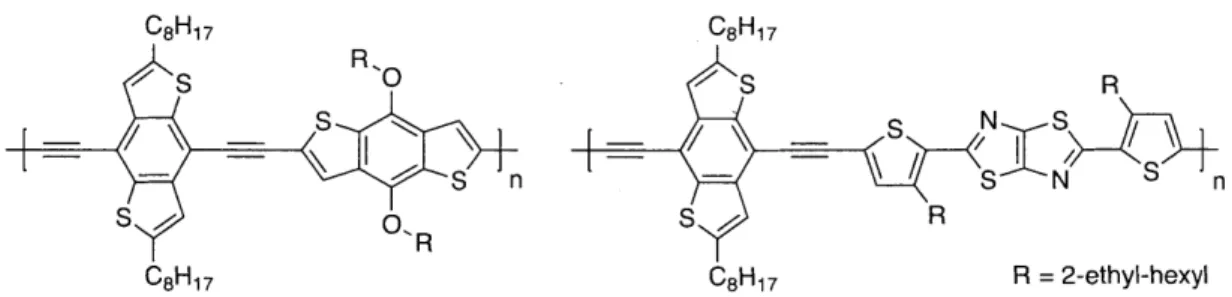
thiophene subunits (left). Significantly fewer examples of polymers containing vertically-oriented benzodithiophene (right) have been reported... 34 Figure 1.6 Poly(arylene ethynylene)s containing vertically-oriented benzodithiophene
reported by Y ang and cow orkers. ... . ... ... ... ... ... ... .. . . . 34 Figure 1.7 Compression of amphiphilic molecules at the air-water interface of a
Langmuir-Blodgett trough. Pressure-area isotherms provide information about molecular interactions on the surface, as monolayers of the molecules pass through 'gas,' 'liquid,' and 'solid' phases before collapsing into multilayers ... 39
Figure 2.2 Target polymer structures. Hydrophilic and hydrophobic side-chains, as well as the rigid rod backbone of the poly(arylene ethynylene) will aid in orientation at the air-water interface of the Langmuir-Blodgett trough and in nematic alignment of the polymers. The perpendicularly appended thiophenes provide an orthogonal handle for a 2D cross-polym erization. ... 45
Figure 2.3 UV-visible absorption and emission spectra of P1 and P2 in chloroform solution an d th in film ... 4 8 Figure 2.4 (a) UV-visible absorption and emission maxima of P1 and P2 in chloroform
solution and thin film, and solution quantum yields. (b) P2 in solution and thin film in regular lighting and under longwave UV lamp excitation. ... 48 Figure 2.5 Pressure-area isotherms for P1 and P2. Monolayers were compressed three times
on the trough surface. P1 occupies a smaller area per repeat unit that P2, which correlates with expectations based on the larger molecular weight per repeat unit and longer alkyl ch ain s o f P 2 ... 4 9 Figure 2.6 Cyclic voltammetry of P1 spin-coated onto an ITO-coated glass working
electrode, 10 scans at 100 mV/s in acetonitrile with 0.1 M NBu4PF6 as the supporting electrolyte and a platinum coil counter electrode. Following a large, irreversible oxidation peak on the first scan, the electroactivity decreases on each subsequent scan. Additional
CVs of P1 and P2 to different potential ranges can be found in the Appendix. ... 50 Figure 2.7 (a) Electropolymerization of model compound 8 on an ITO-coated glass working
electrode. Conditions: acetonitrile, 0.1 M NBu4PF6 supporting electrolyte, platinum coil
counter electrode, 100 mV/s scan rate. (b) A clear red shift in the absorption of the film of 8 on ITO-coated glass, before and after electropolymerization. The red shift can likely be attributed to the increase in conjugation following polymerization...52 Figure 2.8 Cyclic voltammetry of monolayers of P1 and P2 on ITO-coated glass working
electrodes. Electrochemistry carried out in a 0.1 M solution of NBu4PF6 in acetonitrile at
a scan rate of 100 mV/s, with a platinum coil counter electrode...53 Figure 2.9 New target polymer structures. The pendant ProDOT and bithiophene moieties
70
A
per repeat unit. (b) The monolayer of P5 is still fluorescent at maximumcompression, suggesting a face-on orientation on the water surface...57
Figure 2.11 Cyclic voltammetry of a monolayer of P5 on an ITO-coated glass working electrode. Cycled from 0.0 V to 1.5 V versus Ag/AgNO3 at a rate of 100 mV/s in 0.1 M NBu4PF6 in acetonitrile, with a platinum coil counter electrode...58
Figure 2.12 UV-vis absorption of the monolayer of P5 on ITO-coated glass before and after cyclic voltammetry. No significant shift in the absorption spectrum is visible after electrochemistry, but the magnitude of the absorbance appears to decrease. The decrease may indicate the polymer became detached from the ITO-coated glass electrode or decom posed in som e other w ay... 59
Figure 2.13 Compound 2 'H NMR and 13C NMR (CDC13)...78
Figure 2.14 Compound 3 'H NMR and "C NMR (CDCl3)...79
Figure 2.15 Compound 4a 'H NMR and 1"C NMR (CDCl3)...80
Figure 2.16 Compound 5a 1H NMR and "C NMR (CDCl3)...81
Figure 2.17 Compound 5b 'H NMR and "C NMR (CDCl3)...82
Figure 2.18 Compound 6a 1H NMR and "C NMR (CDCl3)...83
Figure 2.19 Compound 6b 'H NMR and "C NMR (CDCl3)...84
Figure 2.20 Polym er P1 'H NM R (CDC13)... 85
Figure 2.21 Polym er P2 'H NM R (CDCl3)... 85
Figure 2.22 Compound 8 'H NMR and "C NMR (CDCl3)...86
Figure 2.23 Compound 11 'H NMR and 13C NMR (CDCl3)...87
Figure 2.24 Compound 16 'H NMR and "C NMR (CDCl3)...88
Figure 2.25 Fluorescence spectra for solutions, monolayers, and thin films of polymers P1 and P2. As expected, the fluorescence trace of the monolayer falls in between that of the solution and thin film for both polym ers... 89
Figure 2.26 Cyclic voltammograms of P1 spin-coated onto ITO-coated glass working electrodes. Conditions for electrochemistry: scan at 100 mV/s in 0.1 M NBU4PF6 in acetonitrile versus Ag/AgNO3, with a platinum coil counter electrode. (a) 10 cycles from -0.2 V to 1.3 V versus Ag/AgNO3. (b) 10 cycles from -0.2 V to 1.5 V versus Ag/AgNO3.... 90
Figure 2.27 Cyclic voltammograms of P2 spin-coated onto ITO-coated glass working electrodes. Conditions for electrochemistry: scan at 100 mV/s in 0.1 M NBu4PF6 in acetonitrile versus Ag/AgNO3, with a platinum coil counter electrode. (a) 10 cycles from -0.2 V to 1.1 V versus Ag/N03. (b) 10 cycles from -0.2 V to 1.3 V versus Ag/AgNO3. (c)
10 cycles from -0.2 V to 1.5 V versus Ag/AgNO3. ... 91 Figure 2.28 P5 pressure-area isotherm reversibility investigation. P5 was compressed to a
minimum area of 25 A2 (black), 55
A2 (red), and 65 A2 (blue) and cycled three times. The
reversibility of the pressure-area isotherm does not show significant improvement with compression to a larger total area, suggesting that once pressure has been applied to P5 the polymer prefers to remain aggregated or entangled with itself...92 Figure 2.29 Cyclic voltammetry of monolayers of P5 transferred to HOPG and
platinum/titanium on glass electrodes using the Langmuir-Schaefer transfer technique. Electrochemistry was carried out in a glovebox. (a) Electrochemistry of P5 on HOPG. Cycled lOx from -0.5 V to 1.5 V versus Ag/AgNO3 at a rate of 100 mV/s in 0.1 M NBu4PF6 in acetonitrile. (b) Electrochemistry of P5 on platinum/titanium on glass. Cycled lOx from 0.0 V to 1.5 V versus Ag/AgNO3 at a rate of 100 mV/s in 0.1 M NBU4PF6 in aceto n itrile . ... 9 3 Figure 2.30 Face-on and edge on views of a space-filling model of a simplified version of the
2D polymer that could theoretically be made from P1 or P2. The structure was modeled optimized using Avogadro, with universal force field... 94
Figure 3.1 Polymerizations of P1-BT (a) and P2-T (c) at 0.02 cm2 Pt button electrodes in 0.1 M NBu4PF6/DCM at a scan rate of 100 mV/s, 0.3 mM polymer concentration in DCM, 10
scans; cyclic voltammograms of electropolymerized P-P1-BT (b) and P-P2-T (d) in starting-polym er-free fresh electrolyte... 100 Figure 3.2 Cyclic voltammograms of P-P1-BT (a) and P-P2-T (b) at different scan rates
ranging from 5 mV/s to 200 mV/s in fresh 0.1 M NBu4PF6/DCM electrolyte solution. The
polymerized films were prepared as described in Figure 3.1... 101 Figure 3.3 In-situ conductivity versus oxidation potential for crosslinked P-P1-BT on 5 Pim
interdigitated platinum electrodes in 0.1 M NBu4PF6 at a scan rate of 2 mV/s with an offset
1.0 V at 2 mV/s: no significant loss of conductivity is observed on the reverse sweep. (b) Scan from 0.0 to 1.5 V at 2 mV/s: some loss of conductivity is observed on the reverse sw eep ... 10 2 Figure 3.4 UV-vis absorption spectra of P1-BT (a) and P2-T (b) in chloroform solution, thin
film on a glass substrate, and post-electrochemical crosslinking and deposition onto
transparent ITO -coated glass substrates...103
Figure 3.5 TGA of P1-BT and crosslinked C-P1-BT (a) and TGA of P2-T and crosslinked C-P2-T (b). Both crosslinked polymers begin to undergo decomposition at higher temperatures than the un-crosslinked linear polymers... 104
Figure 3.6 FTIR spectra of polymers before and after chemical crosslinking with iron(III) chloride. (a) Polymer P1-BT and crosslinked polymer C-P1-BT. (b) Polymer P2-T and crosslinked polym er C -P2-B T ... 105
Figure 3.7 Compound 4 'H NMR and 13C NMR (CDCl3)... 119
Figure 3.8 Compound 5 'H NMR and 13C NMR (CDCl3)... 120
Figure 3.9 Polym er P1-BT 'H NM R (CDCl3)... 121
Figure 3.10 Absorption and emission of polymer P1-BT in solution and thin film. The solution extinction coefficient per polymer repeat unit at %Amax (374 nm) = 5.00 x 10⁴ M-. . ... 12 2 Figure 3.11 (a) Polymerization of P1-BT onto a Pt button working electrode in 0.1 M NBu4PF6/DCM at a scan rate of 100 mV/s, 0.3 mM polymer concentration in DCM, 50 scans. (b) Cyclic voltammogram of electropolymerized P1-BT in fresh electrolyte... 123
Figure 3.12 (a) Polymerization of P2-T onto a Pt button working electrode in 0.1 M NBu4PF6/DCM at a scan rate of 100 mV/s, 0.3 mM polymer concentration in DCM, 50 scans. (b) Cyclic voltammogram of electropolymerized P2-T in fresh electrolyte... 123
Figure 3.13 Linear relationship between cyclic voltammogram scan rate and baseline-corrected cathodic peak current for electrochemically crosslinked P-P1-BT (a) and P-P2-T (b). Full cyclic voltammograms at varying scan rates are shown in Figure 3.2... 124
Figure 3.14 (a) Polymerization of P1-BT on an ITO-coated glass working electrode in 0.1 M NBu4PF6/DCM at a scan rate of 100 mV/s, 0.3 mM polymer concentration in DCM, 10 scans. (b) Cyclic voltammogram of electropolymerized P1-BT in fresh electrolyte... 125
Figure 3.15 (a) Polymerization of P2-T on an ITO-coated glass working electrode in 0.1 M NBu4PF6/DCM at a scan rate of 100 mV/s, 0.3 mM polymer concentration in DCM, 10 scans. (b) Cyclic voltammogram of electropolymerized P2-T in fresh electrolyte... 125
Figure 4.1 Faraday rotation diagram. As a magnetic field (B) is applied in the direction of light propagation, plane-polarized light is passed through a material (of thickness d); the degree to which the plane of polarization is rotated (P) is directly related to the Verdet constant of the m aterial (V, in units of /T.m).2... . . . 128 Figure 4.2 Polymers with high Verdet constants. Many examples of substituted
polythiophenes have been reported to have high Verdet constants.8-10 In contrast, only a
single poly(arylene ethynylene) type polymer with a high Verdet constant has been reported.13 Polymer Verdet constants vary with wavelength and sample preparation;
regioregular polythiophenes have higher Verdet constants than regiorandom samples, and chiral poly-3-(alkylsulfone)thiophenes have been found to change the sign of their Faraday rotation upon thermal annealing (from positive to negative or negative to positive).2 . . . . ... . . . ... 129 Figure 4.3 (a) Poly(arylene butadiynylene) and poly(arylene ethynylene) polymer structures
of interest: a benzodithiophene-based homopolymer and copolymers of benzodithiophene and substituted and unsubstituted benzothiadiazoles. (b) Long alkyl side chains promote the form ation of lam ellar structures. ... 130 Figure 4.4 IR spectroscopy of monomer 8 and P1 polymers. Absence of a C-H alkyne stretch
at 3270 cm-1 in the spectra for P1-Plc provides evidence for polymer formation... 137 Figure 4.5 IR spectroscopy of polymers P2, P3, and P4. The appearance of a band at 2180
cm -1 corresponds to C-C alkyne stretch... 137 Figure 4.6 (a) UV-vis-NIR absorption spectrum of P4 in chloroform solution and thin film.
(b) Absorption maxima of P4 in chloroform solution and thin film; molar absorptivity per polymer repeat unit in solution. (c) P4 in chloroform solution; the polymer is deep green
in c o lo r... 13 8 Figure 4.7 Compound 7 'H NMR and 13C NMR (CDCl3)... 153 Figure 4.8 Compound 8 'H NMR and 13C NMR (CDCl3)... 154 Figure 4.9 Polym er P4 'H N M R (CDCl3)... 155
chloroform solution ... 156
Figure 4.11 FTIR spectrum of m onom er 8... 156
Figure 4.12 UV-vis absorbance of P1 in THF. The solubility of P1 in THF was extremely poor and the absorbance spectrum shows the effects of significant scattering. Efforts to filter out particulates resulted in a polymer solution that was too dilute to have detectable absorbance. Attempts to cast thin films of P1 from hot o-dichlorobenzene were unsuccessful: the polymer precipitated from solution immediately upon cooling. ... 157 Figure 4.13 UV-vis absorbance of Plb (2.5% end-capper) and Plc (5% end-capper) in THF
solution and thin film. Solution absorbance corresponds to the portion of the polymer that w as solub le in T H F . ... 157 Figure 4.14 UV-vis absorbance of P2 in chloroform solution and thin film. Solution
absorbance corresponds to the fraction of P2 that is soluble in the solvent... 158 Figure 4.15 UV-vis absorbance of P3 in chloroform solution and thin film. Solution
absorbance corresponds to the fraction of P3 that is soluble in the solvent...158 Figure 4.16 Thermogravimetric analysis (TGA) of P1. P1 begins to undergo rapid
decom position after 305 *C . ... 159
Figure 4.17 Differential scanning calorimetry (DSC) of P1. ... 159 Figure 4.18 Thermogravimetric analysis (TGA) of P3. P3 begins to undergo rapid
decom position after 205 'C . ... 160 Figure 4.19 Differential scanning calorimetry (DSC) of P3. P3 does not appear to undergo
any therm al transitions prior to decomposition. ... 160 Figure 4.20 Thermogravimetric analysis (TGA) of P4. P4 begins to undergo decomposition
at 16 0 C . ... 16 1 Figure 4.21 Differential scanning calorimetry (DSC) of P4. P4 does not appear to undergo
any therm al transitions prior to decomposition. ... 161 Figure 4.22 Measurement of Faraday rotation in polymer thin films. The degree of rotation
is determined by the relationship between the input light intensity and the change in output intensity. The Verdet constant is calculated after correcting for the thickness of the sample. ... 1 6 2
Scheme 1.1 Retrosynthetic analysis of a model poly(arylene ethynylene). PAEs are generally synthesized via Pd/Cu-catalyzed Sonogashira coupling polymerization between dialkyne-substituted monomers and dibromo- or diiodo-dialkyne-substituted monomers...29 Scheme 1.2 Synthesis of benzodithiophene-4,8-dione, the precursor to most
benzodithiophene m onom ers ... 33
Scheme 2.1 Synthetic route to thiophene-substituted monomers. Conditions to yield 5a: Pd(PPh3)4, Toluene/DMF (4/1, v/v), 120 0C; 5b: Pd(PPh3)4, 1 M Na2CO3, THF, 60 C...46
Scheme 2.2 Synthesis of polymers P1 and P2 via Sonogashira coupling polymerization...47 Scheme 2.3 Synthesis via Sonogashira coupling and electropolymerization of model
co m p ou n d 8 . ... 5 1 Scheme 2.4 Attempted synthetic routes to ProDOT-substituted monomer 13.
TIPS-substituted monomer 12 did not appear to be sufficiently stable to isolate and purify...55 Scheme 2.5 Attempted synthetic route to bithiophene-substituted monomer 17...56 Scheme 2.6 Synthesis of polymer PS via Sonogashira coupling between bithiophene
monomer 21 and comonomer 7. Monomer 21 was synthesized in three steps starting from 3,3'-dihexyl-2,2'-bithiophene (see Chapter 3). ... 56
Scheme 3.1 Poly(arylene ethynylene) polymers substituted with bithiophene and thiophene moieties that could provide a handle for electrochemical or chemical crosslinking to form conjugated polym er netw orks... 97 Scheme 3.2 Synthesis of bithiophene-substituted dialkyne monomer 5 via Stille coupling
between benzodithiophene 3 and tin-substituted bithiophene 2 and subsequent deprotection w ith TB A F... 98 Scheme 3.3 Sonogashira coupling polymerization of monomer 5 and comonomer 6 to
produce bithiophene-substituted polymer P1-BT... 99 Scheme 3.4 Idealized chemical structures of crosslinked conjugated polymer networks of
Scheme 4.1 Synthesis of monomer 8 in four steps starting from 1,4-dibromobenzene (1) and benzodithiophene-dione (4)... 132 Scheme 4.2 Synthesis of poly(arylene butadiynylene) homopolymers of benzodithiophene
m on om er 8 ... 13 3 Scheme 4.3 Synthesis of homopolymers of monomer 8 with the incorporation of methyl
4-ethynylbenzoate as an end-capping reagent. Although the reaction time was reduced and the end-capping reagent was anticipated to reduce the average molecular weight of the polymers, the majority of the material produced by the polymerization method was still mostly insoluble. GPC analysis of the polymer in THF showed a decrease in the number-average molecular weight of the soluble fraction of each polymer that correlated with the m ol% of end-capping reagent added... 134 Scheme 4.4 Synthesis a copolymer (P2) of monomer 8 and dibromo-benzothiadiazole 10 via
Sonogashira coupling polym erization... 135 Scheme 4.5 Synthesis of copolymers of monomer 8 and substituted benzothiadiazoles 11 and
12. P4 was found to be significantly more soluble than any of the other polymers of in terest...13 6
Table 3.1 Absorption and emission wavelength maxima in chloroform solution and thin film for p olym er P 1-B T . ... 122
OD ID 2D B Bu3SnCl CV d d D DART dba DCM DMF dppf DSC ESI FTIR GPC HOPG HRMS i-Pr2NH IR ITO LB LS m MALDI-TOF MEG Mn n-BuLi NBu4PF6 NIR NMP NMR p PAE PPE PPh3 ppm ProDOT zero dimensional one dimensional two dimensional
magnetic field strength in the direction of light propagation (Faraday rotation)
tributyltin chloride cyclic voltammogram doublet (NMR)
distance traveled or sample thickness (Faraday rotation) dispersity
Direct Analysis in Real Time dibenzylideneacetone
dichloromethane dimethylformamide
1,1 '-bis(diphenylphosphino)ferrocene differential scanning calorimetry electrospray ionization
Fourier-transform infrared spectroscopy gel permeation chromatography
highly oriented pyrolytic graphite high-resolution mass spectrometry
diisopropylamine infrared
indium tin oxide Langmuir-Blodgett Langmuir-Schaefer multiplet (NMR)
matrix-assisted laser desorption/ionization time-of-flight magnetoencephalography
number-average molecular weight n-butyl lithium
tetrabutylammonium hexafluorophosphate near-infrared
N-methyl-2-pyrrolidinone nuclear magnetic resonance pentet (NMR)
poly(arylene ethynylene) poly(phenylene ethynylene) triphenylphosphine
parts per million
r.t. RBF rcf s STM t TBAF TGA TGG THF TIPS TLC UV V v/v vis wt. YIG room temperature round-bottom flask relative centrifugal force singlet (NMR)
scanning tunneling microscop triplet (NMR)
tetrabutylammonium fluoride thermogravimetric analysis terbium-doped gallium garnet tetrahydrofuran
triisopropylsilyl
thin layer chromatography ultraviolet
Verdet constant (Faraday rota volume/volume
visible weight
yttrium iron garnet
y
ion)
P
degree of rotation (Faraday rotation) 8 chemical shift& extinction coefficient or molar absorptivity
Note: In Chapters 2, 3, and 4, some of the same small molecules and polymers are referred to by different abbreviations between chapters.
Compound 3 in Chapters 2 and 3 is referred to as compound 6 in Chapter 4. Polymer P1 in Chapter 2 is referred to as polymer P2-T in Chapter 3. Polymer P5 in Chapter 2 is referred to as polymer P1-BT in Chapter 3.
CHAPTER 1
Introduction
1.1 Conjugated Polymers
Since the first discovery of electrical conductivity in an organic conjugated polymer,] conjugated polymers have been extensively studied and used in a wide array of applications based on their electronic and optical properties.2 Conjugated polymers have been employed in
light-emitting devices and displays,3 photovoltaics,4 and sensors,5 among other applications. While high
conductivity was first found in polyacetylene, other common classes of conjugated polymers that have since been investigated for their electronic or electrooptical and photoluminescence properties include polythiophenes,6 polypyrroles,7 polyanilines,8 poly(p-phenylene)s,9
poly(p-phenylene vinylene)s,10 poly(p-phenylene ethynylene)s,1 and others (Figure 1.1). While these
polymers appear to have relatively simple chemical structures, the tools and techniques of organic synthesis have enabled the production of many more complex conjugated polymer structures with finely tuned properties. Furthermore, the superior flexibility and processability of organic conjugated polymers affords an advantage over inorganic materials with comparable electronic properties, paving the way for the development of light-weight, flexible, printed, or transparent devices. Although significant focus been directed toward the synthesis of linearly conjugated polymers, in recent years, interest has also grown in investigating the synthesis and properties of
H H
n N n
a b C d
-
n - + ne f n
Figure 1.1 Common classes of conjugated polymers: (a) polyacetylene, (b) polythiophene, (c) polypyrrole, (d) polyaniline, (e) poly-p-phenylene, (f) poly(p-phenylene vinylene), and (g) poly(p-phenylene ethynylene).
conjugated polymer networks, and, particularly following the isolation and characterization of graphene in 2004,12 2D-polymers with conjugation in two dimensions.13
1.2 Poly(arylene ethynylene)s
Poly(arylene ethynylene)s are a class of conjugated polymers that are well known for their unique electrooptical and luminescence properties.14 These polymers have been used in a number
of applications including chemo- and bio-sensors5, 1s,16 light-emitting diodes,'7 and organic thin
film transistors.'8 Structurally, poly(arylene ethynylene)s are composed of alternating aryl or phenyl rings and alkyne bonds, which results in a rigid polymer backbone. Substituents on the main polymer chain assist in polymer solubility and processing, and the polymers can be made soluble in water with appropriate hydrophilic substituents.14 Poly(arylene ethynylene)s are most
commonly synthesized via step-growth palladium/copper-catalyzed Sonogashira coupling polymerizations between dialkyne-substituted monomers and dihalide-substituted monomers (generally iodide or bromide). The polymers can also be synthesized via molybdenum-catalyzed alkyne metathesis.19
R R' R R'
--- _
+ x
x
n
R R' R R'
Scheme 1.1 Retrosynthetic analysis of a model poly(arylene ethynylene). PAEs are generally synthesized via Pd/Cu-catalyzed Sonogashira coupling polymerization between dialkyne-substituted monomers and dibromo- or diiodo-dialkyne-substituted monomers.
Poly(arylene ethynylene)s are often highly fluorescent, with average solution quantum yields of approximately 50% and some approaching unity."I As is the case for many conjugated
Introduction
molecular weight, up to the effective conjugation length.20 For poly(arylene ethynylene)s, the
effective conjugation length has been demonstrated to be equal to approximately five arylene-ethynylene repeat units (where the aryl unit is an alkyl-substituted phenyl ring).2 1 The absorbance spectra of thin films of poly(arylene ethynylene)s may show a further red shift due to planarization of the polymer backbone (and any substituents conjugated to the main chain), a-stacking interactions between individual polymer chains, or a combination of both phenomena.
1.3 Poly(arylene ethynylene)s in the Solid State and at the Air-Water Interface
In the solid state, poly(arylene ethynylene)s are capable of forming organized lamellar structures, with n-stacking between the polymers and high degrees of order possible depending on the substituents on the main polymer backbone and the nature of the backbone.2 2 Direct
interactions between the polymer chains in the solid state can lead to a reduction in polymer fluorescence in thin films. The presence of bulky aryl groups such as iptycenes can have the effect of isolating individual polymer chains in the solid state, allowing the polymers to retain high fluorescence quantum yields and enabling the use of the polymers in fluorescence-based sensors. 2 3,24,2 5
The behavior of amphiphilic poly(arylene ethynylene)s has also been extensively studied at the air-water interface using a Langmuir-Blodgett trough. Langmuir-Blodgett techniques can provide unique information about the behavior of monolayers of amphiphilic small molecules or polymers on a water surface (Figure 1.2 and Appendix Figure 1.7). Changes in the water surface pressure upon compression of trough barriers can be used to draw conclusions about molecular arrangement and conformation. For the case of amphiphilic poly(arylene ethynylene)s, our group has demonstrated that polymers of this type tend to occupy 'edge-on' or 'face-on' conformations
(a) movable (b) 40 - multilayers barriers surface pressure E
i sensor
30
-20 - 'solid'
~~ 10 'liquid''gs
n10 - 4 s
liquid subphase 0 ,re
(usually water) 0 40 80 120 160
Area WA)
Figure 1.2 (a) Diagram of a Langmuir-Blodgett trough. A Langmuir-Blodgett trough is used to compress monolayers of amphiphilic molecules on a surface. Molecular behavior is assessed through changes in the surface pressure. Compressed monolayers can be transferred from the surface to substrates. (b) An example pressure-area isotherm. Molecules or polymers pass through 'gas,' 'liquid,' and 'solid' phases before collapsing into multilayers. See appendix Figure 1.7.
on the water surface of the Langmuir-Blodgett trough, depending on the nature and position of the substituents on the polymer backbone (Figure 1.3).26,27,28 The polymer conformation on the surface also was found to have a significant effect on the photophysical behavior: compression of polymers with an edge-on orientation resulted in quenching of fluorescence, while compressed polymers in a face-on orientation retained their fluorescence.2 8 Compression of poly(arylene ethynylene)s on
'edge-on' 'face-on'
air air
wa rter
Figure 1.3 Poly(arylene ethynylene)s can adopt 'edge-on' or 'face-on' conformations on the water surface depending on the nature of the substituents on the polymer backbone. Polymers that adopt an 'edge-on' conformation have been found to occupy a smaller area-per-repeat unit (-32-37 A2 per phenylene ethynylene) in the solid-condensed phase in comparison to polymers
Introduction
the surface results in the formation of a nernatic liquid crystalline phase with alignment of the rigid-rod polymer backbones.27,28 Aligned polymer monolayers are also able to be transferred to
hydrophilic or hydrophobic substrates using either the Langmuir-Blodgett vertical dipping or Langmuir-Schaefer horizontal touching transfer techniques.2 8
1.4 Conjugated Polymer Networks and Nanoparticles of Poly(arylene ethynylene)s
Apart from linear polymers, poly(arylene ethynylene)s have also been used as the core structure in conjugated polymer networks. Conjugated polymer networks have drawn interest for their high degrees of microporosity and improved charge transport capabilities in comparison to the parent linear polymers.29 The properties of conjugated polymer networks have enabled their
use in applications including gas separation and storage, light harvesting, catalysis, energy storage, and optoelectronics. 30,31
Conjugated polymer networks composed of poly(arylene ethynylene)s have been synthesized in solution from dialkyne- and dihalide-substituted monomers with the addition of a trifunctional comonomer (alkyne- or halide-substituted).3 2 3 3 These conjugated networks are
generally insoluble, which can limit their processability and applications. To address these issues, poly(arylene ethynylene) networks have been synthesized as nanoparticles in an aqueous
surfactant solution and processed as a dispersion.3
' Aqueous dispersions of other conjugated
polymer nanoparticles have been demonstrated to be more readily processable into thin films than bulk solution-synthesized conjugated polymer networks. 3 Electropolymerization has also been
demonstrated to be a useful technique to produce thin films of conjugated polymer networks, though this technique has not previously been used to produce conjugated networks of poly(arylene ethynylene)s. 36
1.5 Benzodithiophene and Benzodithiophene-Containing Polymers
Benzodithiophene was first used in the synthesis of photovoltaic polymers in 2008."7 The rigid and planar conjugated structure of benzodithiophene has made it useful for achieving tunable band gaps and high hole mobilities in conjugated polymers .38 Benzodithiophene subunits are
Si R ArR S SS SS S S S S -S~ 4 S R R'0 R'Ar Si R = alkyl
Ar = thiophene, benzene, furan, or other aromatic groups
Figure 1.4 Common benzodithiophene structures found in conjugated polymers for photovoltaic applications.
typically synthesized from benzodithiophene-4,8-dione through the addition of various alkyl lithium or Grignard reagents and subsequent rearomatization with tin(II) chloride. A general synthetic route to benzodithiophene-4,8-dione is shown in Scheme 1.2.39 Benzodithiophene is generally incorporated into polymers horizontally, connected through the thiophene subunits (Figure 1.5). To date, examples of polymers with benzodithiophene oriented vertically and connected through the phenyl ring are far less common.40,41
,4 2
0 000
OH oxalyl chloride Cl diethyl amine N
\- 1. n-BuLi, THF S
DCM, 0 "C to r.t. DCM, O*C to r.t. 2. H20 S
S S S 0
Scheme 1.2 Synthesis of benzodithiophene-4,8-dione, the precursor to most benzodithiophene monomers.
Introduction R R /s S R S R = alkyl or aryl R
Figure 1.5 Benzodithiophene is typically incorporated into polymers via connections at the thiophene subunits (left). Significantly fewer examples of polymers containing vertically-oriented benzodithiophene (right) have been reported.
Only a few examples of benzodithiophene incorporated into poly(arylene ethynylene)s have been reported,43 and to our knowledge, only one publication reports the synthesis of
poly(arylene ethynylene)s containing benzodithiophene in a vertical orientation. In 2013, Yang and coworkers described the synthesis and characterization of benzodithiophene-based poly(arylene ethynylene)s for applications in organic solar cells (Figure 1.6).40
C8H17 C8H17 RR /S R, / S R n -- Nn S /0, S SZ S R R CBH17 C8H17 R = 2-ethyl-hexyl
Figure 1.6 Poly(arylene ethynylene)s containing vertically-oriented benzodithiophene reported by Yang and coworkers.40
Our interest in the synthesis of vertically-oriented benzodithiophene-containing poly(arylene ethynylene)s stems from the ability to incorporate new cruciform structural components while maintaining full electronic conjugation with the main polymer backbone. In the following chapters, we will explore the synthesis and investigate the properties of a variety of benzodithiophene-containing poly(arylene ethynylene)s. In Chapter 2, we describe the design and synthesis of benzodithiophene-containing poly(arylene ethynylene)s as precursor polymers to access 2D-conjugated 2D polymers and explore their behavior at the air-water interface of a
Langmuir-Blodgett trough. In Chapter 3, we report the synthesis of crosslinked conjugated polymer networks from benzodithiophene-containing poly(arylene) ethynylenes through electrochemical and chemical methods and investigate the properties of the resulting networks. Finally, in Chapter 4, we describe the design and synthesis of poly(arylene ethynylene)s for magneto-optical applications.
Introduction
1.6 References
(1) Shirakawa, H.; Louis, E. J.; MacDiarmid, A. G.; Chiang, C. K.; Heeger, A. J. J. Chem. Soc.,
Chem. Commun. 1977, 578.
(2) Swager, T. M. Macromolecules, 2017, 50, 4867.
(3) Grimsdale, A. C.; Chan, K. L.; Martin, R. E.; Jokisz, P. G.; Holmes. A. B. Chem. Rev. 2009,
109, 897.
(4) Coakley, K. M.; McGehee, M. D. Chem. Mater. 2004, 16, 4533.
(5) McQuade, D. T.; Pullen, A. E.; Swager, T. M. Chem Rev. 2000, 100, 2537
(6) Perepichka, I. F.; Perepichka, D. F. Handbook of Thiophene-based Materials: Applications
in Organic Electronics and Photonics; Wiley: Chichester, 2009.
(7) Wang, L.-X.; Li, X.-G.; Yang, Y.-L. React. Funct. Polym. 2001, 47, 125.
(8) Bhadra, S.; Khastgir, D.; Singha, N. K.; Lee, J. H. Prog. Polym. Sci. 2009, 34, 783.
(9) Li, C.; Liu, M.; Pschirer, N. G.; Baumgarten, M.; Millen, K. Chem. Rev. 2010, 110, 6817. (10) Grimsdale, A. C.; Holmes, A. B. Synthesis and Properties of Poly(arylene vinylene)s. In
Handbook of Conducting Polymers, 3rd ed.; Skotheim, T. A.; Reynolds, J. R., Eds. CRC
Press: Boca Raton, 2007.
(11) Bunz, U. H. F. Chem. Rev. 2000, 100, 1605.
(12) Novoselov, K. S.; Geim, A. K.; Morozov, S. V.; Jiang, D.; Zhang, Y.; Dubonos, S. V.; Grigorieva, I. V.; Firsov, A. A. Science 2004, 306, 666.
(13) Sakamoto, J.; van Heijst, J.; Lukin, 0.; Schl ter, A. D. Angew. Chem. Int. Ed. 2009,48, 1030. (14) Bunz, U. H. F. Macromol. Rapid. Commun. 2009, 30, 772.
(15) Swager, T. M.; Zheng, J. Poly(arylene ethynylene)s in Chemosensing and Biosensing. In
Poly(arylene ethynylene)s; Weder, C., Ed.; Springer-Verlag: Berlin, 2005; pp 151-179.
(16) Thomas, S. W.; Joly, G. D.; Swager, T. M. Chem. Rev. 2007, 107, 1339.
(17) Tasch, S.; List, E. J. W.; Hochfilzer, C.; Leising, G.; Schlichting, P.; Rohr, U.; Geerts, Y.; Scherf, U.; MUllen, K. Phys. Rev. B. 1997, 56, 4479.
(18) Voskerician, G.; Weder, C. Electronic Properties of PAEs. In Poly(arylene ethynylene)s; Weder, C., Ed.; Springer-Verlag: Berlin, 2005; pp 209-248.
(19) Kaneta, N.; Hikichi, K.; Asaka, S.; Uemara, M.; Mori, M. Chem. Lett. 1995, 24, 1055.
(20) Ma, J.; Li, S.; Jiang, Y. Macromolecules 2002, 35, 1109.
(21) Meier, H.; Stalmach, U.; Kolshorn, H. Acta Polym. 1997, 48, 379 (22) Ofer, D.; Swager, T. M.; Wrighton, M. S. Chem. Mater. 1995, 7, 418. (23) Yang, J.-S.; Swager, T. M. J. Am. Chem. Soc. 1998, 120, 5321.
(24) Yang, J.-S.; Swager, T. M. J. Am. Chem. Soc. 1998, 120, 11864. (25) Williams, V. E.; Swager, T. M. Macromolecules 2000, 33, 4069.
(26) McQuade, D. T.; Kim, J.; Swager, T. M. J Am. Chem. Soc. 2000, 122, 5885. (27) Kim, J.; Swager, T. M. Nature, 2001, 411, 1030.
(28) Kim, J.; Levitsky, I. A.; McQuade, D. T.; Swager, T. M. J. Am. Chem. Soc. 2002, 124, 7710.
(29) Weder, C. Chem. Commun. 2005, 5378.
(30) Chen, L.; Honsho, Y.; Seki, S.; Jiang, D. J. Am. Chem. Soc. 2010, 132, 6742.
(31) Gu, C.; Huang, N.; Chen, Y.; Qin, L.; Xu, H.; Zhang, S.; Li, F.; Ma, Y.; Jiang, D. Angew.
Chem. Int. Ed 2015, 46, 13594.
(32) Mendez, J. D.; Schroeter, M.; Weder, C. Macromol. Chem. Phys. 2007, 208, 1625.
(33) Jiang, J.-X.; Su, F.; Trewin, A.; Wood, C. D.; Campbell, N. L.; Niu, H.; Dickinson, C.; Ganin, A. Y.; Rosseinsky, M. J.; Khimyak, Y. Z.; Cooper, A. I. Angew. Chem. Int. Ed 2007, 46, 8574.
(34) Hittinger, E.; Kokil, A.; Weder, C. Angew. Chem. Int. Ed. 2004, 43, 1808. (35) Pecher, J.; Mecking, S. Chem. Rev. 2010, 110, 6260.
(36) Palma-Cando, A.; Scherf, U. Macromol. Chem. Phys. 2016, 217, 827.
(37) Hou, J. H.; Park, M. H.; Zhang, S.
Q.;
Yao, Y.; Chen, L. M.; Li, J. H.; Yang, Y.Introduction
(39) Slocum, D. W.; Gierer, P. L. J. Org. Chem. 1976, 41, 3668.
(40) Wen, S.; Bao, X.; Shen, W.; Gu, C.; Du, Z.; Han, L.; Zhu, D.; Yang, R. J. Polym. Sci. Part
A: Polym. Chem. 2014, 52, 208.
(41) Chakravarthi, N.; Gunasekar, K.; Kim. C. S.; Kim, D.-H.; Song, M.; Park, Y. G.; Lee, J. Y.;. Shin, Y.; Kang, I.-N.; Jin, S.-H. Macromolecules, 2015, 48, 2454.
(42) Tao,
Q.;
Liu, T.; Duan, L.; Cai, Y.; Xiong, W.; Wang, P.; Tan, H.; Lei, G.; Pei, Y.; Zhu, W.; Yang, R.; Sun, Y. J. Mater. Chem. A. 2016, 4, 18792.(43) Braunecker, W. A.; Oosterhout, S. D.; Owczarczyk, Z. R.; Larsen, R. E.; Larson, B. W.; Ginley, D. S.; Boltalina, 0. V.; Strauss, S. H.; Kopidakis, N.; Olson, D. C. Macromolecules 2013, 46, 3367.
1.7 Appendix for Chapter 1
1.7.1 Langmuir-Blodgett Barrier Compression Diagram
I
hydrophobic -4- hydrophilic air water 40 -30 -20 -10 -0 0 40 80 120 160 Area (A2) 'gas' phase bar~k comproHonJ~V
40 -Z 30 -20 -10 -0 0 40 80 120 160 Area (A') air 'liquid' expanded phase water ba7 compreffonI
Ii-
I-oi
i\
LO
40 30 -20 10 0 0 40 80 120 160 Area (A) airWWUI 'solid' condensed
phase
Figure 1.7 Compression of amphiphilic molecules at the air-water interface of a Langmuir-Blodgett trough. Pressure-area isotherms provide information about molecular interactions on the surface, as monolayers of the molecules pass through 'gas,' 'liquid,' and 'solid' phases
Introduction
CHAPTER 2
TOWARD
THE
SYNTHESIS
OF
Toward the Synthesis of 2D-Conjugated 2D Polymers
2.1 Introduction
The synthesis of true two-dimensional (2D) polymers has been a target of synthetic chemists for many years, and to date, few successful syntheses have been reported. With the discovery of graphene and its superior strength, conductivity, and mechanical properties, interest has grown in recent years in bottom-up synthetic approaches to other 2D-conjugated materials.1 ID-conjugated polymers have been synthesized for and used in a variety of applications for the past few decades.2 Conjugated polymers are particularly well known for their useful light absorption and luminescence properties, charge transport and energy transfer abilities, and ready processability.3 Furthermore, the ability to employ modular strategies for polymer synthesis allows precise control over polymer structure and properties. 2D-conjugated polymers could combine the advantages of iD-conjugated polymers and known 2D-conjugated materials such as graphene to form a useful new class of materials with unique properties.
Although interest in the investigation of new 2D-conjugated polymers is high, a relative lack of viable synthetic routes to these types of materials has limited their ability to be studied experimentally. Theoretical studies have allowed for some predictions of the anticipated properties of these types of polymers, however precise understanding of their merits and characteristics will be inaccessible until improved synthetic pathways are available.'5 The development of new
synthetic pathways to these materials is also necessary to enable their more widespread use and employment in various applications.
Generally, two major synthetic strategies have been employed to access 2D polymers: growth in all dimensions starting from "zero-dimensional" (OD) small molecules to form a 2D polymer (resulting in more isotropic materials), and lateral extension or expansion of ID polymers to form 2D polymers (yielding relatively anisotropic materials).6 Successful 2D polymer syntheses
have made use of both of these approaches, and in many cases, careful effort has been directed toward precise control of precursor orientation to ensure the production of true, 2D polymers. We define a true 2D polymer in the same terms as Schltiter and coworkers in their comprehensive review of 2D polymer synthetic strategies: a material that is one-repeating unit thick, possessing long range order, and covalently bonded.6
A few successful 2D polymer syntheses have been based on the pre-organization of monomers into crystals prior to polymerization. Reports by Sakamoto7 and coworkers and King' and coworkers have successfully demonstrated the synthesis of 2D polymers through a light-induced crosslinking of monomers organized into layered crystals, followed by the separation of the crystal layers into individual 2D polymer sheets. While both of these approaches produced 2D polymers, the resulting materials were not conjugated in two dimensions, precluding the polymers from possessing many of the properties that could make them useful for technological applications. A more recent report by Quek and Loh and coworkers also employed the crystal strategy to align monomers prior to polymerization but made use of a C-C coupling reaction to produce 2D polymers that were also conjugated in two dimensions.9
Other successful syntheses have relied on the uses of surface supports or interfaces to achieve the correct monomer orientation prior to 2D polymerization. Hecht and Grill and coworkers synthesized fully conjugated 2D polymers from orthogonally functionalized porphyrin monomers deposited on a gold surface and visualized the sequential coupling and formation of 2D polymers using low-temperature STM techniques.'0 SchlUter and coworkers made use of the air-water interface of a Langmuir-Blodgett trough to align amphiphilic monomers prior to polymerization and cross-linked the monomers via photoirradiation." 2
Toward the Synthesis of 2D-Conjugated 2D Polymers
Recently, Bai and Bai and coworkers synthesized a conjugated 2D polymer in water without the aid of interfacial organization or other surface supports, relying instead on association due to hydrophobic and hydrophilic interactions to bring together 1D polymers for photopolymerization to form 2D polymers." While the number of reports of the syntheses of 2D polymers has grown in recent years, there is still a need for the development of additional modular synthetic routes that provide access to these types of materials.
2.2 Synthetic Strategy to Access 2D-Conjugated 2D Polymers
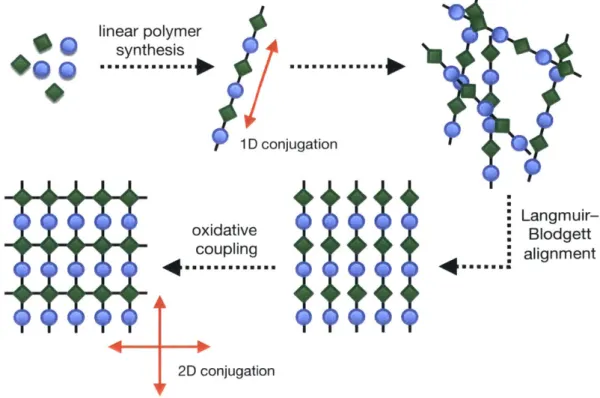
In order to access true 2D-conjugated, 2D polymers, we propose a two-stage synthetic strategy, relying first on the synthesis of iD-conjugated linear polymers, and secondly on the organization and cross-polymerization of those polymers to yield a 2D-conjugated, 2D polymer network (Figure 2.1). Organization of the linear polymers would be carried out using a
Langmuir-*0
H
14
H
'4
H
'4
H
0
'4"
linear polymer synthesisH
'4
H
'4
H
'4
1 Zcnjugation 11111.... LI oxidative coupling n... 2D conjugation4
4
4
4
4
4
H
'4
H
'4
H
'4
~F4H
'4
H
'4
H
'4
'4
I
I
won Langmuir-Blodgett alignmentFigure 2.1 Proposed synthetic strategy to access 2D-conjugated 2D polymers.
4
""
Blodgett trough, a powerful tool that enables precise control of molecular orientation at the air-water interface.
Our initial target ID polymer structures are shown in Figure 2.2. The rigid-rod type poly(arylene ethynylene) conjugated polymers would be well-suited to alignment at the air-water interface of a Langmuir-Blodgett trough, with hydrophilic poly(ethylene glycol) and hydrophobic alkyl sidechains facilitating orientation of the polymer at the interface. Previous studies from our group have demonstrated that compression of rigid-rod type poly(arylene ethynylenes) on a Langmuir-Blodgett trough produces a nematic liquid crystal phase with aligned polymer chains,
electropolymerizable sites /R 0hydrophilic s sidechains S 0 n hydrophobic R
s
R = C1H25 sidechains R= C8H1 R R \ / SS S SR R'R R'O I R'R' OR'Figure 2.2 Target polymer structures. Hydrophilic and hydrophobic side-chains, as well as the rigid rod backbone of the poly(arylene ethynylene) will aid in orientation at the. air-water interface of the Langmuir-Blodgett trough and in nematic alignment of the polymers. The perpendicularly appended thiophenes provide an orthogonal handle for a 2D cross-polymerization.
Chapter 2 Toward the Synthesis of 2D-Conjugated 2D Polymers
and the resulting pressure-area isotherm can be used to determine the conformation of the polymer backbone relative to the air-water interface. 1,16
The incorporation of electroactive thiophene moieties perpendicular to the main polymer backbone provides a handle to access 2D-conjugated, 2D materials through electrochemical cross-linking. Following the alignment of the polymers at the air-water interface of the Langmuir-Blodgett trough, the polymers will be transferred to indium tin oxide (ITO) coated glass working electrodes for electrochemical cross-polymerization of the iD-polymers to yield 2D-conjugated 2D polymers.
2.3 Results and Discussion
2.3.1 Synthesis of 1D-Conjugated Polymers
Synthesis of the thiophene-substituted monomers was carried out as shown in Scheme 2.1. Benzodithiophene-4,8-dione (1) was synthesized in three steps according to literature
TIPS TIPS
S 1. TIPS MgCI .l S 1. n-BuLi, THF, -78'C N S
~i 1/ w Br I / Br S 2. SnC2 in HCI S 2. 1,2-dibromotetrachlorethane, S 1-78 0C to r.t. 0 61% yield 70% yield TIPS TIPS 2 3 TIPS TIPS S R
IR
B B conditions S S TBAF C Br /I /Br-* -/ / \ S R RH,0-MR R S TIPS TIPS R 4a R = C117 MR'= SnBu3 3 4b R = C12H15, 5a R = C8H17 (47% yield) 6a R = C8H17 (89% yield)MR'= Bpin 5b R = C12H25 (82% yield) 6b R = C12H25 (90% yield)
Scheme 2.1 Synthetic route to thiophene-substituted monomers. Conditions to yield 5a: Pd(PPh3)4, Toluene/DMF (4/1, v/v), 120 'C; 5b: Pd(PPh3)4, I M Na2CO3, THF, 60 'C.
procedures.'7 (Triisopropyl)acetylene was converted to the Grignard reagent using a solution of isopropylmagnesium chloride. Double addition of the Grignard reagent to compound I followed by re-aromatization with tin (11) chloride in HCl afforded compound 2 in good yield on a gram scale. Compound 3 was obtained through the double deprotonation of 2 with n-BuLi, followed by the addition of 1,2-dibromotetrachloroethane.'8 Compound 4b was synthesized in one step from
2-bromo-3-dodecylthiophene according to a literature procedure.'9 Compounds 5a and 5b were obtained through Stille and Suzuki coupling reactions with 4a and 4b, respectively, and deprotected with TBAF to give monomers 6a and 6b. Although monomers 6a and 6b contain the same electroactive thiophene moieties, the monomers vary in the length of their hydrophobic alkyl chains. We hypothesize that the eight-carbon alkyl chains of monomer 6a will facilitate effective orientation of the polymer strands at the air-water interface of a Langmuir-Blodgett trough, with a reduced likelihood of chain aggregation upon barrier compression. We also hypothesize that the longer twelve-carbon alkyl chains of monomer 6b may enhance polymer solubility and processability, while still being short enough in length to be studied on the Langmuir-Blodgett trough without significant chain aggregation.
Polymers P1 and P2 were synthesized via a Sonogashira coupling polymerization between monomers 6a or 6b and comonomer 7 as shown in Scheme 2.2. Comonomer 7 was synthesized according to a literature procedure.'6
S R 0 S R Ss
R
S3 S 10 Pd(PPh3)4 S 0 - I Cui -i-Pr2NH, n S toluene, 65 C S 0 S0 R R 0 RR 0 6a R = CBH17 7 P1 R = CBH17 6b R = C12H25 P2 R = C12H25Chapter 2 Toward the Synthesis of 2D-Conjugated 2D Polymers
2.3.2 Characterization and Langmuir-Blodgett Studies of Polymers
Polymers P1 and P2 were characterized by gel permeation chromatography (GPC), NMR spectroscopy (see Appendix), UV-vis spectroscopy, and fluorescence spectroscopy. After purification, P1 was found to have a molecular weight of 13,100 g/mol with a dispersity of 1.77 (GPC in THF), while P2 was found to have a molecular weight of 30,000 g/mol with a dispersity of 1.81 (GPC in THF). Both polymers are highly soluble in chloroform, THF, dichloromethane, and toluene. P1 and P2 are both dark red, shiny solids that form orange-colored solutions. The polymers are highly fluorescent in solution (quantum yields of 44+2% and 87 1% for P1 and P2, respectively) and also display weaker red-shifted fluorescence in thin films (Figures 2.3 and 2.4).
1.0 P1 1.0 (1.0 . P2 1.0 0 0' 0.8 0.8 0.8 - 0.8 0a N N~( M 0.6 0.6 0.6 0.6 0.4 solution abs 0.4 rA 0.4 0.4 -A
---sltin em- -solution
abs-E... solution em 0
0.2 - thin film abs 00 0.2 0.2 solution 0.2
-thin film abs. 02
C ...thin film em -. -... ...-thin film em 0
0.0 "' O.0 0.0 0.0 0
300 400 500 600 700 800 300 400 500 600 700 800
wavelength (nm) wavelength (nm)
Figure 2.3 UV-visible absorption and emission spectra of P1 and P2 in chloroform solution and thin film.
absorption emission quantum maxima maximum yield
(nm) (nm) (%) solution 510 559 44 2 P_ thin film 553 614 -solution 517 555 87 1 P2 thin film 567 614
-Figure 2.4 (a) UV-visible absorption and emission maxima of P1 and P2 in chlorolorm solution and thin film, and solution quantum yields. (b) P2 in solution and thin film in regular lighting and under longwave UV lamp excitation.
12 - P1 -Cycle 1 - 20 P2 -Cycle 1 ---- Cycle2 C ._ Cycle 2 10 - -Cycle3 1 . -. Cycle 3 E 15 8 0)6 10 2 -0 0 0 50 100 150 0 50 100 150
area/repeat unit WA) area/repeat unit WA)
Figure 2.5 Pressure-area isotherms for P1 and P2. Monolayers were compressed three times on the trough surface. P1 occupies a smaller area per repeat unit that P2, which correlates with expectations based on the larger molecular weight per repeat unit and longer alkyl chains of P2.
Following characterization of polymer optical properties, we investigated polymer behavior at the air-water interface using a Langmuir-Blodgett trough. P1 or P2 was deposited onto the water surface from a 1.0 mg/mL solution of polymer in chloroform. The chloroform solution was allowed to evaporate for 15 minutes before the polymers were slowly compressed to a target surface pressure of 25 mN/m. The pressure-area isotherms for the polymers indicated a collapse of the monolayers into multilayers at surface pressures of 10 mN/mn for P1 and 17 mN/m for P2, a slightly unexpected result as we had previously anticipated that the eight carbon alkyl chains of P1 would be better suited to the conditions of the Langmuir-Blodgett trough. Isotherm cycling (to a target surface pressure
just
below multilayer formation) was performed to mechanically anneal the polymers chains on the interface (Figure 2.5). Extrapolation of the isotherm trace to the X-axis gave estimated areas per polymer repeat unit of 74 A2 for P1 and 93S2
for P2. Although the pressure-area isotherms for both P1 and P2 appear to be reversible, the reverse or expansion section of isotherms does not match the compression or forward portion of