HAL Id: halshs-01230219
https://halshs.archives-ouvertes.fr/halshs-01230219
Preprint submitted on 18 Nov 2015
HAL is a multi-disciplinary open access
archive for the deposit and dissemination of sci-entific research documents, whether they are pub-lished or not. The documents may come from teaching and research institutions in France or abroad, or from public or private research centers.
L’archive ouverte pluridisciplinaire HAL, est destinée au dépôt et à la diffusion de documents scientifiques de niveau recherche, publiés ou non, émanant des établissements d’enseignement et de recherche français ou étrangers, des laboratoires publics ou privés.
Data
Ariane Tichit, Clément Mathonnat, Diego Sébastien Landivar
To cite this version:
Ariane Tichit, Clément Mathonnat, Diego Sébastien Landivar. Classifying Non-banking Monetary Systems using Web Data. 2015. �halshs-01230219�
C E N T R E D'E T U D E S E T D E R E C H E R C H E S S U R L E D E V E L O P P E M E N T I N T E R N A T I O N A L
SÉRIE ÉTUDES ET DOCUMENTS
Classifying Non-banking Monetary Systems using Web Data
Ariane Tichit
Clément Mathonnat
Diego Landivar
Études et Documents n° 30
November 2015
To cite this document:
Tichit A., Mathonnat C., Landivar D., (2015) “Classifying Non-banking Monetary Systems using Web Data ”, Études et Documents, n° 30 , CERDI.
http://cerdi.org/production/show/id/1760/type_production_id/1
CERDI
65 BD. F. MITTERRAND
63000 CLERMONT FERRAND – FRANCE TEL.+33473177400
FAX +33473177428
2
The authors
Ariane Tichit Associate Professor
CERDI – Clermont Université, Université d’Auvergne, UMR CNRS 6587, 63009 Clermont-Ferrand, France
Email: [email protected]
Clément Mathonnat PhD Student
CERDI – Clermont Université, Université d’Auvergne, UMR CNRS 6587, 63009 Clermont-Ferrand, France
Email : [email protected]
Diego Landivar Associate Professor
France Business School Campus Clermont, 63000 Clermont-Ferrand, France Email: [email protected]
Corresponding author: Ariane Tichit
This work was supported by the LABEX IDGM+ (ANR-10-LABX-14-01) within the program “Investissements d’Avenir” operated by the French National Research Agency (ANR).
Études et Documents are available online at: http://www.cerdi.org/ed
Director of Publication: Vianney Dequiedt Editor: Catherine Araujo Bonjean
Publisher: Mariannick Cornec ISSN: 2114 - 7957
Disclaimer:
Études et Documents is a working papers series. Working Papers are not refereed, they constitute
research in progress. Responsibility for the contents and opinions expressed in the working papers rests solely with the authors. Comments and suggestions are welcome and should be addressed to the authors.
3
Abstract
This paper develops a new classification of non-banking currencies projects based on a lexical analysis from web data. The advantage of this method is to derive an endogenous typology of monetary projects, based on how currencies are depicted on the internet. Therefore, it allows to by-pass issues face for now in the literature to uncover a clear classification of non-banking currencies projects from exogenous elements. Our textual corpus consists in 320 web pages, corresponding to 1210 text pages. We first applied to our data a downward hierarchical clustering, which enables us to endogenously derive five different classes, allowing us to operate distinctions not only between non-banking currencies projects, but also between these latter and the standard monetary system. Then, we resorted to a similarity analysis and according to our results; all non-banking currencies projects define themselves in relation to the standard monetary system, with the exception of Local Exchange Trading Systems (LETs).
Key words
Non-banking money ; Text mining ; Web data ; Downward hierarchical clustering ; Similarity analysis.
JEL codes O35 ; E42 ; C38
Acknowledgment
This article was prepared as part of the Research-Action program in Social Innovation financed by the Region Auvergne. Usual disclaimers apply.
4
1. Introduction
What is money? Or should we rather say what currencies are? It is now very difficult to give a clear answer to this question, as the current surge in various monetary forms around the world calls for a re-conceptualization of this economic and social object. In the literature, money is usually defined by the following three functions: (i) a medium of exchange, (ii) a reserve value and (iii) a unit of account. However, what is exceptional in the current historical period is the fact that these three functions are gathered in one unique national (our supranational) official currency. Indeed, in most previous historical periods, several currencies were used to serve these three functions separately (Douthwaite, 1996; Greco, 2001; Lietaer, 2001, 2013). Hence, complementary currencies are not a new phenomenon. They only resurface in a crisis time, where the lack of liquidity and the need for finding new reserve of values, call for a redefinition of money, where its three traditional functions could be embodied by different currencies.
To understand what complementary currencies are, and better analyze their issues, their impacts and better manage and support their development, it seems necessary to establish a clear classification of the latter. In this regard, the literature on complementary currencies classification, initiated by Kennedy & Lietaer (2004) and Bode (2004), currently represents a rapidly-growing research field (see, Blanc, 2011, 2013; Schroeder, 2011; Slay 2011; Martignoni, 2012; Bindewald et al., 2013; Seyfang & Longhurst, 2013). Because of the massive surge in complementary currencies in recent years and their puzzling diversity, researchers have realized the need for better understanding what they truly are and what are their similarities and discrepancies. Overall, authors deal mainly with questions such as, what kinds of exchange they aim at promoting? between who? for what purposes?
Bode (2004) suggests a classification of complementary currencies according to the following two criteria: (i) theirs compensations schemes and (ii) the type of co-contracting parties involved; and within this typology, further distinguishes between “services based complementary currencies“ and “monetary based complementary currencies”. Here, we notice a clear dividing line between barter’s clubs and other Local Exchange and Trading systems (LETs), independent from standard moneys, and citizen’s currencies, anchored to national or supranational currencies. Kennedy & Lietaer (2004) propose a more detailed and
5
complex typology, including technical features of complementary currencies, and define five main classification factors: (i) the objectives they served, (ii) theirs functions, (iii) their medium of exchange, (iv) their underlying process of monetary creation and (v) their cost recovery schemes. Starting from this basis, the current evolution of this literature aims at clarifying and deepening these initial classifications by accounting for a larger set of characteristics (see Blanc, 2011; Martignoni, 2012; Seyfang & Longhurst, 2013; Bindewald et al., 2013; Place & Bindewald, 2013).
Indeed, relying on Derruder & Lepesant (2011) and Dittmer (2013), which mainly divide complementary currencies according to their objectives (characterized from a microeconomic point of view for the former and a meso/macroeconomic one for the latter), Bindewald et al. (2013) put forward a typology of complementary currencies projects based on four categories, namely (i) politic, (ii) economic, (iii) social and (iv) environmental; which are then subdivided according to their respective scope (meta, macro, meso and micro).1
Therefore, the current trend in this literature seems to be in search of a growing number of complementary currencies features, with a more and more complex division into sub-fields. However, we believe that these developments make the understanding of complementary currencies projects trickier, and in this perspective, classifications seem to gradually lose their goal of simplification and clarification of a given phenomenon.
In this respect, Blanc (2013), in the introduction of his paper, acknowledges the relative failure of the literature for now to define a clear-cut typology of complementary currencies, and we believe this will be even more difficult by following the current trend consisting in increasing classifications criteria. First, the problem lies in the fact that authors do not seek to classify the same object. Some of them want to account for all existing currencies, whereas some others only want to account for a limited set of these latters. According to Blanc (2011), the current heterogeneity of complementary currencies is so important that it turns out to be unavoidable to resort to several classifications. Moreover, if the literature has difficulties in defining a clear and efficient typology of complementary currencies, it might come from their focus on moneys only, while emphasis should rather be placed on systems.
1
Place and Bindewald (2013) also subdivide the « politic » category between two further distinct categories, namely “culture” and “governance”.
6
As a result, Blanc (2011) suggests a classification based on projects rather on objects and determines three main systems classes: (i) local currencies (territorial/geographical-based projects), (ii) community currencies (originating from preexisting communities) and (iii) complementary currencies (economic-based projects focused on production and exchange activities into markets). Going one step further by broadening his previous analysis, Blanc (2013), drawing upon Polanyi’s works, proposes a typology of monetary projects according to three “ideal types”: (i) public currency, (ii) profit-making currency and (iii) citizen’s currency and six subcategories (state, sub-state, captative, community and trade). This taxonomy has the clear advantage to enable the characterization, qualification and classification of all types of currencies, with the only exception of crypto-currencies. According to us, it represents the most successful typology to date.
Seyfang & Longhurst (2013) define a classification of 3428 monetary projects from 23 countries located across 6 continents. Their sources come from the compilation of existing database and field information. In order to classify these projects, they assume that three distinct types of monetary projects appear in the literature: (i) credits services, (ii) mutual exchange systems and (iii) local currencies. They then add a fourth category to the previous ones, namely (iv) barter’s clubs. According to Seyfang & Longhurst (2013), the first two classes gather 91.5% of all recorded initiatives, whereas barter’s clubs only account for 1.4% of monetary projects in their database. Therefore, local currencies and barter’s clubs seem to account for a very limited number of complementary currencies projects over the world.2
Consequently, in light of this brief literature review, classification and structuration of complementary currencies clearly appears as a thorny issue and has not yet succeeded in finding a clear-cut typology. For us, this relative failure might come from two main factors. One the one hand, authors have focused on different monetary objects or projects: their functioning, the actors they involve, the types of goods and services exchanged, in what conditions, through what medium of exchange and in order to serve what goals. Yet, although these various elements are strongly interrelated, each author favors some specific features of monetary projects he believes more significant and representative, carries out his own subdivision within each element, which makes the existing classifications very hard to compare. On the other hand, database on complementary currencies are still poorly organized
2
Unless if it comes from a bias arising from the database itself, as well as the classification method used by the authors. Indeed, we believe their choice to differentiate between barter’s clubs and mutual exchange systems is questionable. When we look at the definitions the authors provide for these two categories, they seem to be almost equivalent and separation between them is only based on the fact that projects call themselves “barter’s clubs” or “mutual exchange system”, without any significant difference in terms of functioning, structure and goals.
7
and available. As a result, it proves to be very challenging to form an exhaustive and efficient database, which further complicates the classification of complementary currencies according to their characteristics. Since authors resort to different and partial database, they obviously find different results.
In order to circumvent these problems, we think that a relevant way to classify complementary currencies could be to neither resort to a classification based on recorded objective data, nor according to a priori factors, but instead, to endogenously categorize the largest possible set of monetary projects using web data. Indeed, internet abounds of web pages dedicated to complementary currencies, articles presenting their characteristics, blogs talking about them, which represents an invaluable source of information on these social objects, albeit these data are in a textual form. Yet, for more than two decades, we notice an important development in statistical methods for text analysis, especially regarding endogenous classification of textual corpus according to their content. A clear benefit of this methodology is to neither resort to a priori hypotheses about factors driving the typology, nor focusing on specific subsets of monetary projects. Hence we use the term “non-banking” to qualify most of the existing monetary projects.
The rest of this paper is organized as follows. Section 2 presents our lexical corpus data, as well as our statistical methodology. Section 3 displays the main results regarding the endogenous classification of non-banking currencies using a top-down hierarchical clustering. Section 4 explores the relationships between the various estimated classes in section 3 using a similarity analysis and section 5 concludes.
2. Methodology
According to Gerin-Pace (1997), statistical methods for text analysis were born in the eighties and since that time they have followed two mains development paths: a first set of methods aims at analyzing writing style (texts comparisons and evolutions), while a second set deals with the analysis of the meaning of a given textual corpus. Our paper draws upon this latter set of methods.
2.1. The design of the textual corpus
We initially set 38 keywords related to complementary currencies. They were chosen in order to cover most of the actual diversity of these projects. We also decided to keep 10 results for each keyword, so as to end up with a textual corpus including around 300 web pages. Then,
8
our raw data underwent three types of “cleaning” procedures. The first one, consisted in testing for each keyword, results obtained with the Google search engine. Here, we chose to withdraw a given keyword from our initial list if: (i) its first ten URLs results gave webpages not related to complementary currencies or (ii) its URLs results were exactly the same as some other keywords in the list (our textual corpus does not include duplication webpages). The second “cleaning” procedure deals with the selection of data collected from the crawled webpages. To do this, we decided to focus only on webpages including informative data directly available in a textual form on each webpage we have crawled. As a result, we dropped URL corresponding to multimedia supports (for instance, videos, radio programs), those leading only to homepages without any informative content, and finally those related to translated webpages. Likewise, in order to keep our textual corpus balanced, we chose to drop URL leading to pdf files. Moreover, we also canceled URL referring to book (for example, e-commerce sites, google books and editors webpages). Therefore, our textual corpus is constituted from four main sources: (i) newspapers and magazines, (ii) blogs, (iii) free online encyclopedias and (iv) webpages from different actors of complementary currencies projects. Finally, the third “cleaning” procedure was based on the crawled webpages themselves, and consisted in keeping only text data from each webpages (meaning, dropping terms only dedicated to web navigation such as tags, signs and pictures). We additionally removed internet user’s comments, since they often reached an extremely huge size and rather consist in values judgments than in an objective description. Since our goal in this paper is to derive a classification of complementary currency through the way they are presented on the web, we believe the inclusion of such user’s comments in our textual corpus irrelevant.
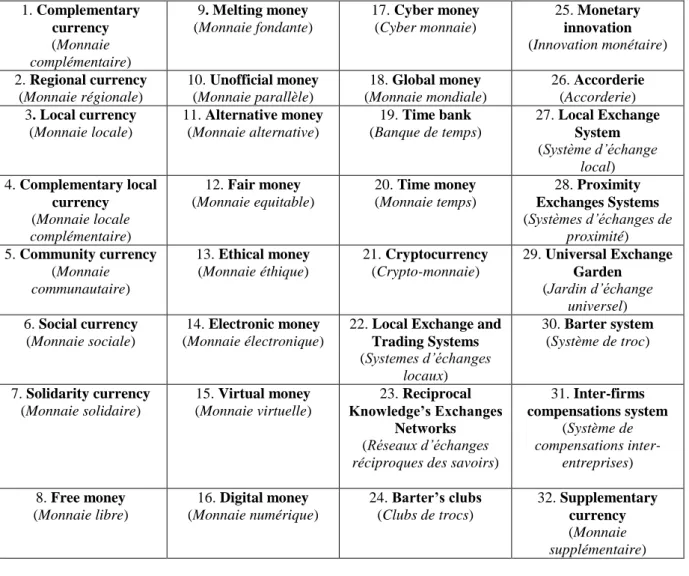
In the end, our textual corpus includes 1210 webpages coming from the crawling of the URLs of the first ten results in the search engine Google associated to each of the 32 final keywords used to depict non-banking currencies systems.3
2.2. Descriptive statistics of the textual corpus
Our textual corpus is formed by 320 distinct texts. Starting from these raw data, we resorted to a corpus lemmatization. In order to reduce vocabulary diversity and so better emphasize semantic proximities within a given corpus, this method implements an identification process of forms corresponding to the different flexions of the same lemma (Beaudoin & Lahlou,
3
9
1993).4 In other words, lemmatization can be viewed as a way to “undress” words from their grammatical shape, so as to gather them in one family. For instance, all conjugations of the “have” verb will be gathered in the same lemma “have”. This seems to be especially relevant in our context, since we are only interested in the informative content of texts and not their forms.
Furthermore, when importing our corpus, this latter was divided in segments of 20 consecutive occurrence terms. Consequently, the final partition of our corpus is the following:
320 Initial Context Units (ICU).
17939 Elementary Contexts Units (ECU), also called text segments, which represents subsets of 20 successive occurrences in a given ICU.
359223 occurrences and 22369 forms after lemmatization (i.e. distinct terms).5
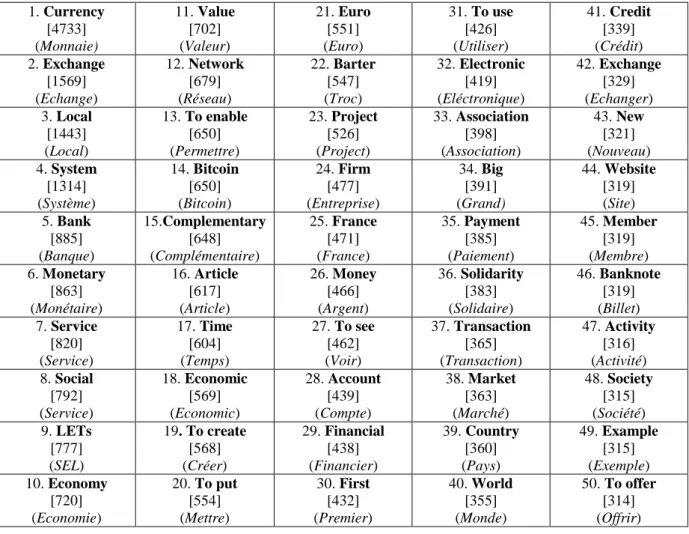
Appendix 2 gives the 50 most frequent active forms in our corpus, with their respective total frequency.6 Since webpages were crawled with keywords including the term “currency”, it seems logical that this term is the most frequent word included in our corpus, with 4733 occurrences. Then, the three other most frequent forms are “exchange” (1569 occurrences), “local” (1443 occurrences) and “system” (1314 occurrences).
2.3. Downward hierarchical clustering and similarity analysis 2.3.1. Downward hierarchical clustering
In order to implement our downward hierarchical clustering, we used the Reinert’s (1983, 1990) ALCESTE (Analyse des Lexèmes Cooccurrents dans un Ensemble de Segmentation du Texte Etudié) method with the software IramuteQ.7 The downward hierarchical clustering (henceforth DHC) is an algorithm which starts by assuming that all active forms initially belong to the same class. A DHC applies to a binary lexical table (0: absence; 1: presence) combining ECU in raws and active forms (after lemmatization) in columns. Then, for each algorithm iteration, we derive the two most distinct classes of words from our corpus. That is to say, we determine a partition of active forms from our corpus maximizing inter-class inertia
4
Here we considered the term form as graphical form, that is to say “any minimal concatenation of non-separator types, including information and delimited to the left and to the right by defined separators.” Michel Demonet (1975), Des tracts en mai 1968, Paris Presses de Sciences Po, p.21.
5
A form may appear many times, i.e. corresponds to several occurrences.
6
Active forms are those containing most information (e.g. nouns, adjectives and verbs) and the remaining other are called supplementary forms (e.g. adverbs, articles and pronouns).
7
10
and minimizing intra-class inertia.8 This iterative process stops when the extracted inter-class inertia is not improved by a new partition of data. From this perspective, the final number of classes is a priori undetermined, which in our case is especially relevant for deriving an endogenous classification of non-banking currencies systems without ex ante hypotheses.9
When the algorithm comes to its end, we obtain a binary lexical table depicting the repartition of active forms according to the estimated k classes. Then, once we have divided our corpus in k classes, we need to determine features related to each estimated class, which consists in analyzing active forms included in each class, and especially the contribution of each active form j to a given class k. For this purpose, we rely on a Chi-square statistic, which involves assessing the extent of connection between each active form and each class. Afterwards, from these estimated connections, the use of a Factor Component Analysis (henceforth FCA) enables us to characterize similarities and oppositions between estimated classes by pooling them in factors delimiting theirs respective outlines.
Furthermore, it is also possible to implement a DHC on segments, texts or pooled segments. On the one hand, our classifications tests based on texts (each webpage is processed as a whole) were not conclusive, since the estimated classes were somewhat dispersed and uninformative. This comes from the fact that most of the time each webpage contains several topics, so that considering it as a whole does not make any sense from a semantic point of view. Therefore, text partitioning into segments turns out to be essential in order to carry out an efficient text analysis. On the other hand, our classifications tests based on simple texts segments proved to be more significant. However, one obvious issue here is to define the length of segments to be considered. When importing corpus, IramuteQ offers different type of segmentations based on the size of occurrences (i.e. the number of successive forms needed to be considered), signs or paragraphs. In our case, a classification based on successive occurrences seems to be the most suited, given that webpages are not necessary structured in paragraphs and classification based on signs would not make any sense. We did several tests for different segments size (40, 30, 20 and 10 occurrences) and the most clear-cut results were obtained from a classification based on 20 successive occurrences, albeit few discrepancies appeared between classification based on 20 and 10 successive occurrences. However, classification with more than 30 occurrences led to poorer results, which means that
8
This amounts to determine a k class’s partition of our data, such as maximizing the variance proportion (inertia) from all active forms in our corpus accounted by the k classes. Recall that the total inertia of our data (all active forms) = the extracted inertia (i.e. accounted by the k classes) + the residual inertia (i.e. not accounted by our k classes).
9
11
too long segments includes too much heterogeneous information and makes classification less efficient.
Lastly, we have implemented a DHC for both simple segments and pooled segments. Classification leading to the most convincing results is the one based on pooled segments. This latter consists in a two parts classification. In a first step, we specify a given number of active forms to be pooled and then, with a first DHC, the algorithm aggregates segments in order to end up with the ex ante specified number of segments. As a result, it enables to gather similar segments in terms of included active forms. In a second step, the algorithm implements another DHC on segments, but this time by considering an aggregated number of active forms, different from the first step. Then the algorithm combines these two classifications in order to finally keep, for each class, the pooling of segments which maximizes inter-class inertia. With this method, the estimated classes are much more cohesive and significant than those obtained on simple segments, which is logical since the final classification is derived from groups of active forms generated according to their proximity, and not only according to a given size of successive occurrences (like classification on simple segments does).10 Hence, we decided to keep classification estimates obtained through the implementation of a DHC on pooled segments of 20 occurrences.
2.3.2 Similarity analysis
Similarity analysis allows measuring distances between different semantic territories. In our case, this identification work is required if we want to highlight differences or similarities in the relationship between lexical representations of money. Therefore, what we seek to gauge is the distance between the k estimated classes? To do this, once we have done our DHC, we undertake an identification work of semantic categories. Indeed, despite a DHC enables to endogenously estimate a given number of classes according to relative factors, this latter is unable to depict the relationship between close semantic territories, as well as combinatory territories between several classes.
To assess distances between semantic territories, we chose to work with a method coming from applied graphs theory to lexical corpus. This method allows depicting nods and
10
For robustness purpose, we also changed these parameters: increasing and decreasing the number of successive active forms to be accounted for in each step compared with the default setting of IramuteQ. Overall, the number of derived classes increases with the decreased in the number of active forms accounted for. Nevertheless, our baseline classification is robust to changes in these parameters and only the number of classes is sometimes divided in a more precise way. It is also possible to change the number of pooled segments in the first step (the default setting being 10). Again, estimated classes are more numerous, but this does not call into question our baseline classification estimates derived with a threshold of 20.
12
links from a modularity calculation, based on Blondel et al. (2008) and Lambiotte et al. (2009), to determine statistically, and so endogenously, groups of nods (in this case semantic continents) gather several nods sharing commons features. This method also permits to endogenously identify central and peripheral entities. A nod is said to be central when most of possible paths connecting the graph pass through it. Here, the Betweness Centrality algorithm from Brandes (2001) allows computing the point where most of possible paths in the graph pass through. In terms of interpretation, the more nods are at the center of the graph, the more they are central. Conversely, the more nods are far away from the center of the graph, the more they are peripheral. When applying to lexical data, this centrality algorithm leads to the identification of reference classes, that is to say classes which serve as origin point (or centre of gravity) for the definition of other classes.
3. Results from the downward hierarchical clustering
When applying a DHC to our corpus with IramuteQ, we derived 5 classes. The following dendrogram helps to better visualize this result:
Graphic 1. Dendrogram
This dendrogram shows that our five estimated classes are well-balanced in terms of texts segments they respectively include, since each of them covers around 20% of all segments. In order to see which classes have been endogenously created, we now turn to
13
analyze the lexical content of each of them. To this end, the following table 1 gives the first 20 most specific terms from each estimated class (according to their Chi-square statistic).11
Table 1. The first 20 most specific terms of each estimated class12
Class 1. “Bank” Class 2. “Crisis” Class 3. “LETs” Class 4. “Local” Class 5. “Bitcoins”
% of segments : 20.73 % of segments: 18.33 % of segments: 20.84 % of segments: 20.84 % of segments: 19.27 Bank (Banque) Crisis (Crise) LETs (SEL) Local (Local) Bitcoin (Bitcoin) Value (Valeur) Global (Mondial) Accorderie (Accorderie) Project (Projet) Transaction (Transaction) Money (Monnaie) Economist (Economiste) Exchange (Echange) Sol (Sol) Virtual (Virtuel) Banknote (Billet) Bernard Lietaer (Bernard Lietaer) Barter (Troc) Solidarity (Solidaire) Crypto (Crypto) Issue (Emettre) Monetary (Monétaire) Service (Service) Citizen (Citoyen) Payment (Paiement) Price (Prix) Capitalism (Capitalisme) Member (Membre) Social (Social) Satoshi Nakamoto (Satoshi Nakamoto) Debt (Créance) Reform (Réforme) Network (Réseau) Violet13 (Violet) Electronic (Electronique) Contract (Contrat) Inflation (Inflation) Club (Club) Association (Association) Card (Carte) Free (Libre) Country (Pays) Accorderies (Accorderies) Economy (Economie) Bloc (Bloc) Monetary (Monétaire) People (Peuple) Adherent (Adhérent) Territory (Territoire) Mining14 (Minage) Reserve (Réserve) War (Guerre) Accordeur (Accordeur) Complementary (Complémentaire) User (Utilisateur) Mass (Masse) Depression (Dépression) REN15 (RERS) Toulouse (Toulouse) Software (Logiciel) Credit (Crédit) Communism (Communisme) Skill (Compétence) Development (Développement) Register (Registre) Circulation (Circulation) Politics (Politique) Argentinian (Argentin) MLC (MLC) Publish (Publier) Private (Privé) Big (Grand) Offer (Offrir) Service-provider (Préstataire) MTGOX (MTGOX) Case (Cas) Cause (Cause) Quebec (Québec) Charter (Chartre) Platforms (Plateformes) Fonte (Fonte) Current (Actuel) Exchange (Echanger) Firm (Entreprise) Computer science (Informatique) Valorimeter16 (Valorimètre) Poor (Pauvre) Knowhow (Savoir-faire) Regional (Régional) Decentralize (Décentraliser)
Central Population Reunion Ethical Calculation
11 Forms related to the same lemma and recursive segments have been pooled together. 12
Corresponding French words in parenthesis.
13
We did not translated the French word « violet » in « purple » because this term directly refers to a complementary currency used in the French town Toulouse and is called « Sol Violette».
14
In the cryptocurrencies context, mining refers to the process by which computers’ calculation power is partly allocated to make easier and secure virtual moneys transactions from computer; and this service provided is paid in virtual moneys.
15
REN stands for Reciprocal Exchanges Networks.
16
14
(Central) (Population) (Réunion) (Ethique) (Calcul)
Melting (Fondant) Society (Société) Mutual (Réciproque) Sustainable (Durable) Computer (Ordinateur)
Class 1 is associated with the traditional representation of the standard monetary system. Indeed, in this first class, we massively find vocabulary depicting monetary creation, banks, currencies and their uses. There is also terms dealing with free and private moneys, such as the “fonte” for instance. This is not surprising since this class is the result of presentation of the standard monetary system by web sources related to non-banking currencies. Therefore, some segments from this class oppose free and private moneys to standard moneys.
Class 2 refers to the recent financial and economic crisis, with a lot of terms related to its causes and consequences. This result is especially interesting since it supports previous works emphasizing the countercyclical dimension of complementary currencies (Lietaer, 2012, 2013; Herlin, 2012, 2015). Therefore, non-banking currencies are clearly defined in our corpus as an alternative way to deal with the consequences of financial and economic crises. For instance, recent experiments, such as in Europe (e.g. France, Germany, Japan and Belgium) and Latin America (Argentina and Brazil), and older ones, like the Swiss’s WIR during the great depression of the 30’s, show that surges in complementary currencies often arise in trouble financial and economic times, with increasing difficulties for people to access to liquidity.
Class 3 is clearly related to Local Exchange and Trading systems (LETs) and barter’s clubs, since it gathers all currencies representing ways of exchanging directly goods or services between people, without resorting to intermediaries, such as accorderies, LETs, REN (Reciprocal Exchanges Networks). As a result, these organizations operate outside the traditional market system.
Class 4 depicts social moneys projects, located in a specific territory and based on ethical and social values. They are distinct from the LETs category since they take part in the traditional market system, albeit they share most of their values with this former.
Finally, class 5 is clearly related to virtual currencies, where bitcoin is without contest the most famous representative. In this class, the most recurrent vocabulary deals with all
15
references associated to computer monetary creation and also to the presumed bitcoin creator, namely Satoshi Nakamoto.
Now, we need to go one step further and study factors behind the separation between estimated classes, in order to derive classifications criteria at the roots of non-banking currencies systems. To this end, we used a Factor Component Analysis (henceforth FCA) which enables to interpret factors giving rise to our classification with the DHC. Given that the first two factors are those contributing most to our classification (they account together for 61% of the total variance in our data), and are also the most meaningful in terms of classes division, we focus our interpretation on these two factors only. In order to get better insights on the distribution of our five estimated classes according to factors 1 and 2, as well as their respective distance to these factors, graphic 2 gives on the horizontal axis factor’s 1 values and on the vertical axis factor’s 2 values. Each class is depicted with a specific color and forms belonging to each class are located according to their respective coordinates with respect to these two factors.
Graphic 2. Factor Component Analysis of the classified segments
Graphic 3 clearly shows that classes 1 (in red, to the North-West) and 2 (in black, in a more central position) are closed to each other, whereas classes 4 (in blue, to the North-East),
16
5 (in purple, to the South-West) and 3 (in green, to the South-East) are opposed to classes 1 and 2.
Classes 1 and 2 appear to be embedded in each other. This result seems logical since they correspond respectively to the standard monetary system and the recent financial and economic crisis. As a result, local currencies stand out from standard monetary system through factor 1, but are linked together through factor 2. Moreover, it is worthwhile to note that class 2, referring to the recent financial and economic crisis, makes the link between standard moneys and social moneys. Indeed, since most of the time, the perceived failure of the standard system in time of crises gives rise to a surge in social moneys projects; it seems relevant to see class 2 located in between classes 1 and 4, which are respectively associated to the standard monetary system and local currencies. As for, class 3 (LETs), it appears to be the most distant class from the standard system, since it differentiates from this latter through both factors 1 and 2. Then, class 5 (Bitcoin) and class 4 (Local currencies) are the two other most opposing classes. Putting together these results, it is therefore possible to derive the signification of the two factors behind our five estimated classes.
On the one hand, classes 1 and 2 with respect to class 4, as well as class 3 compared to class 5; are opposed to each other’s through factor 1. As a result, factor 1 enables to distinguish local moneys from standard money, as well as between bitcoin and other crypto-currencies from LETs and barter’s clubs. Therefore factor 1 could be related to objectives and values of the existing moneys: whether (i) profit-making and speculative (negative values of factor 1), or (ii) social (positive value of factor 1). We can also note that all new non-banking currencies projects own 2 of the 3 classical functions of money, namely medium of exchange and unit account; despite they do not necessarily have a reserve value function. If we get a closer look at data distribution according to factor 1, bitcoin and standard moneys share a common feature, since they are both reserve moneys; contrary to LETs and local currencies. Hence, we believe factor 1 to be composed of an additional characteristic related to the ability of moneys to be a value reserve. Indeed, this additional feature is found in negative values of factor 1, whereas it is absent in its positive values.
On the other hand, class 3 and class 5, compared to classes 1, 2 and 4, are opposed to each other’s through factor 2. As a result, factor 2 enables to distinguish standard and local money from LETs and bitcoins. We believe this separation based on a more functional criterion, namely the anchoring to national or supranational moneys. Indeed, to our
17
knowledge, the similarity between bitcoins and most of the LETs and barter’s clubs is their independence with respect to national or supranational currencies. As a result, negative values of factor 2 can be related to independence from national or supranational currencies, i.e. monetary creation outside any anchoring to standard money, whereas positive values corresponds to reliance on national or supranational currencies.
Consequently, by pooling results coming from the implementation of a DHC to our lexical corpus, we had endogenously derived two structural features of non-banking currencies projects than enable to classify all existing currencies projects in a rather simple way. The following table 2 gives our resulting classification of non-banking currencies.
Table 2. Classification of non-banking currencies
Goals/values/reserve function
Profit/commercial
value/ reserve function
Non profit/social value/ no reserve function Conn exion /taxe s Connected to
standard currencies National and
supranational legal currencies Complementary local currencies, citizen’s currencies, social currencies… Disconnected from standard currencies Transaction currencies like bitcoin,
crypto-currencies
LETs, barter’s clubs, Accorderies, Reciprocal Exchange of Knowledge
Networks…
Table 2 allows us to derive some interesting conclusions. First, local currencies seem mainly contest standard money values (speculation, concentration of wealth; see Blanc, 2013). So it makes sense if they are opposing on this issue, while at the same time they are linked to standard money owing to their convertibility in national or supranational currencies, their liability to the same taxes for transactions they support and their monitoring by monetary authorities. Furthermore, local currencies are completely in opposition to cryptocurrencies, not only with regard to their respective values, but also in terms of dependence with respect to standard moneys; bitcoin being independent from the standard monetary system. By the way, cryptocurrencies were born precisely from a search for independence compared to monetary
18
authority. However, we can see that virtual currencies share common values with standard moneys such as profit seeking, speculation and wealth accumulation.
As we have already seen with graphic 2, LETs and barter’s clubs are the most opposing monetary projects to the standard ones. They share with virtual currencies the feature of being not reliant on the standard monetary system, without any relationship with this latter, neither regarding monetary creation, nor on the liability to taxes. Nevertheless, LETs and barter’s clubs are distinct from cryptocurrencies when dealing with their respective values, since the former ones advocate social, mutual, ethic and environmental values, whereas the latter does not.
Finally, one additional interesting feature of our results comes from the fact that they strongly echo complementary currencies classification from Blanc (2013). Indeed, like the author, we find the same partition between LETs and barter’s clubs on one side and local currencies on the other side; and surprisingly according to the same criteria.17 However, contrary to Blanc (2013), our typology does not enable us to differentiate between public and profit-making moneys within the standard money class. This result could stem from a lack of data regarding this class in our corpus.18 Yet, our classification accounts for cryptocurrencies, when Blanc’s (2013) classification does not.
4. Results from the similarity analysis
In this section, we go one step further and resort to a similarity analysis in order to better understand the outlines associated to our five previously estimated classes, their semantic similarities and discrepancies. To do this, we draw upon the lexicometrical litterature dealing with the distance measurement between lexical fields from different documents.
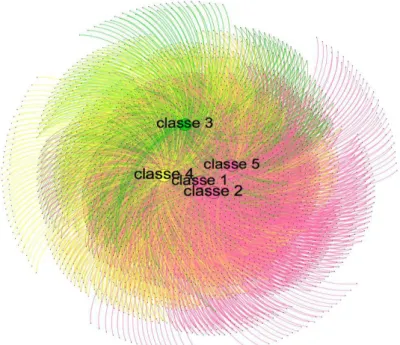
Graphic 3 below displays results from our similarity analysis. First of all, we notice that class 1 is at the center of this graphic, hence representing the center of gravity of the other classes. Furthermore, this statistical method allows us to identify three distinct “communities” that we will henceforth call “continents”. The two first continents related to classes 3 and 4 are mono-classes. However, classes 1, 2 and 5 belong to the same continent. We can therefore interpret results from our similarity analysis in the following way: (i) banking moneys are the
17
Blanc (2013) gathers behind the ideal-type « citizen currency » all non-profit monetary projects and divides the latter according to whether they are anchored or not to national or supranational currencies.
18
On this purpose, one relevant extension of our paper would be to crawl more institutional data relative to central banks, monetary authorities and commercial banks in order to study the standard money class in a finer way and analyze to what extent we find the distinction suggested by Blanc (2013).
19
center of gravity, the central semantic reference to non-banking currencies. This reference might therefore justify the denominations “complementary currencies” or “non-banking currencies”, since these two terms rely on a same reference norm: standard money; (ii) only LETs currencies types seem to be not reliant on this reference to standard money, this former being the most far away from the center of the graphic; (iii) cryptocurrencies, crisis and standard money classes belong to the same semantic community, and therefore to the potentially same system of values and social representations. This latter result can also be interpreted as a semantic oppositional expression formulated by people’s knowledge stemming from the local or complementary currencies projects. Indeed, the latter define themselves in reaction to behaviors and values associated to the standard monetary system. In addition, we can further extend this same conclusion to currencies related to class 3.
20
5. Conclusion
This paper offers a new classification of non-banking currencies projects based on a lexical analysis from web data. Starting from the issue that it is often difficult to access to exhaustive and factual data on complementary currencies, we decided to circumvent this drawback by using lexical web data. In light of the recent literature, the structuration of existing complementary currencies clearly appears as a thorny issue and has not yet succeeded in finding a clear-cut classification (see also Blanc, 2013). From our point of view, the existing classification are very hard to compare, because the authors focus on different monetary objects or projects, favor some specific features of projects they believe more significant and representative and carry out their own subdivision within each element.
In order to avoid these pitfalls, we built a vast lexical corpus covering the largest possible set of these new monetary objects and then resorted to an endogenous classification method, enabling to derive structural factors behind our lexical data. The corpus was created from 32 French keywords referring to complementary currencies. We kept the first 10 Urls results for each keyword with the Google search engine, and then we extracted their respective content. As a result, our corpus is formed by 320 webpages, corresponding to 1210 text pages and 342 585 words, that is to say 17 939 segments of 20 successive occurrences.
Then, in the first step we ran a downward hierarchical clustering (DHC) on text segments. This algorithm recursively finds the best way to divide data into cohesive groups and derives the optimal number of monetary projects classes. Afterwards, the implementation of a Factor Component Analysis (FCA) allows determining the latent factors behind the previously estimated classes with the DHC. This classification method enabled us to derive 5 consistent and significant classes from our lexical corpus: (i) standard moneys, (ii) the recent financial and economic crisis, (iii) local currencies, (iv) LETs and barter’s clubs and (v) cryptocurrencies. One clear advantage of this method is to neither resort to a priori subjective
21
hypotheses about factors driving the typology, nor focusing on specific subsets of monetary projects. Our results lead to a simple, clear-cut and exhaustive classification of all existing current monetary forms and uncover two fundamentals sources of differentiation between them, namely: (i) connection or dependence to national or supranational currencies and (ii) values and goals behind monetary projects. Afterwards, the implementation of a similarity analysis allowed us to better understand the outlines associated to our five estimated classes, their semantic similarities and discrepancies. Results derived from this method show that, except for LETs and barter’s clubs, all new monetary forms define themselves with respect to the standard monetary system.
Therefore, we believe that this paper clarifies in a relevant and fresh way the research fields on non-banking currencies, representing an essential contribution to the current literature. Moreover, since our results strongly echo theoretical classification from Blanc (2013), our paper can be viewed, to a certain extent, as an empirical test of its non-banking currencies typology.
We acknowledge that this paper has focused only on French lexical data. Hence, one relevant extension of this work would be to apply the same approach and methodology to other languages, such as English, German and Spanish, so as to foster lexical comparisons between monetary projects according their geographic origins or the language used to describe them.
Finally, we think that this paper opens a new methodological field of research, by showing the possibility of deriving relevant typologies from various economic or social phenomenon through the analysis of lexical data from the internet. Consequently, we hope that beyond our conclusions relative to non-banking currencies, this paper will contribute to the increased diffusion and use of textual statistics in economic and social studies.
22
References
Beaudoin V. & Lahlou S. (1993) L’analyse lexicale : outil exploratoire des représentations, CRÉDOC, Cahier de recherche, n°48.
Bindewald L. Nginamau M. & Place C. (2013) Validating complementary and community currencies as an efficient tool for social and solidarity economy networking and development: The deployment of theory of change approach and evaluation standards for their impact
assessment, NGLS Working Paper, disposable on :
http://www.unrisd.org/80256B42004CCC77/(httpInfoFiles)/76F6B4A60CE7843BC1257B74 00314493/$file/Bindewald%20et%20al.pdf[accessed in January 2014].
Blanc J. (2013) Penser la pluralité des monnaies à partir de Polanyi : Un essai de typologie. In: Hillenkamp, I. et Laville, J-L., Socioéconomie et démocratie: l’actualité de Karl Polanyi, Érès, Toulouse, p. 241-269.
Blanc J. (2011) Classifying “CCs”: Community, complementary and local currencies’ types and generations, International Journal of Community Currency Research, vol. 15, p. 4-10. Blanc J. (2007) Les monnaies sociales: Dynamiques et logiques des dispositifs, Revue Internationale de l’Economie Sociale, n°303, p. 30-43.
Blanc J. & Fare M. (2014) Les modèles économiques des monnaies locales complémentaires. Rapport pour la Région Rhône Alpes, mimeo.
Blanc J. & Fare M. (2013) Chartes et comités d’agrément dans les dispositifs de monnaies citoyennes : une spécificité française ? In: Congrès de l’AFS 2013 Les dominations RT12 Sociologie économique. Nantes, 2-5 septembre.
Blondel V.D., Guillaume J-L., Lambiotte R. & Lefebvre E. (2008) Fast unfolding of communities in large networks, Journal of Statistical Mechanics: Theory and Experiment,n°10, p.1008.
Bode S. (2004) Potentiale regionaler Komplementar währungen zur Förderung einer endogenen Regionalentwicklung. Freie wissenschaftliche Arbeit zur Erlangung des Hochschulgrades einer Diplom Geographin, Universität Osnabrück, Fachbereich Kultur und Geowissenschaften, Osnabrück.
DeMeulenaere S. (2007) 2006 Annual Report of the Worldwide Database of Complementary Currency Systems, International Journal of Community Currency Research, vol. 11, p. 23-35.
23
Demonet M. (1975) Des tracts en mai 1968. Paris: Presses de Sciences Po.
Douthwaite R. (1996) Short Circuit: Strengthening Local Economies for Security in an Unstable World, Green Books, Totnes, UK.
Evans M. (2003) What’s Local About Local Currencies? Mimeo.
Evans M. (2009) Zelizer’s Theory of Money and the Case of Local Currencies, Environment and Planning A, vol. 41, n°5, p. 1026-1041.
Evans Michael (2014) A Computational Approach to Qualitative Analysis in Large Textual Datasets. PLoS ONE vol9, n°2: e87908. doi:10.1371/journal.pone.0087908.
Greco T. (2001) Money: Understanding and Creating Alternatives to Legal Tender, Vermont: Chelsea Green.
Guérin-Pace F. (1997) La statistique textuelle : un outil exploratoire en sciences sociales, Population, vol. 4, p. 865-888.
Herlin P. (2012) Repenser l’économie. Paris: Eyrolles.
Herlin P. (2015) Apple, Bitcoin, Paypal, Google La fin des banques? Comment la technologie va changer votre argent. Paris : Eyrolles.
Holmes D. I. (1985) The analysis of literary style: a review, Journal of the Royal Statistical Society, vol. 148, n°4, p. 328-341.
Kennedy M. & Lietaer B. (2004) Regionalwährungen: Neue Wege zu nachhaltigem Wohlstand. München: Riemann.
Lambiotte R., Delvenne J.-C.,3 & Barahona M. (2009) Laplacian Dynamics and Multiscale Modular Structure in Networks. Arxiv preprint arXiv:0812.1770. Available at: < http://arxiv.org/pdf/0812.1770.pdf>. [Accessed October 2015].
Lebart L. & Salem A. (1994) Statistique textuelle, Paris: Dunod. Lietaer B. (2001) The future of money. London: Random House.
Lietaer B. (2012) Halte à la toute puissance des banques ! Paris : Odile Jacob. Lietaer B. (2013) Au cœur de la monnaie. Gap: Yves Michel Editions.
Martignoni J. (2012) A new approach to a typology of complementary currencies, International Journal of Community Currency Research, vol. 16, p. 1-17.
Place C. & Bindewald L. (2013) Validating and improving the impact of complementary currency systems: impact assessment frameworks for sustainable development. In: proceedings of 2nd International Conference on Complementary Currency Systems. Hague, Netherlands, 19-23 June, p.1-27.
24
Ratinaud P. & Marchand P. (2012) Application de la méthode ALCESTE à de « gros » corpus et stabilité des « mondes lexicaux : analyse du « CableGate » avec IRaMuTeQ. In : Actes des 11eme Journées internationales d’Analyse statistique des Données Textuelles, JADT 2012, Liège, p. 835-844.
Reinert M. (1983) Une méthode de classification descendante hiérarchique : application à l’analyse lexicale par contexte, Les cahiers de l’analyse des données, vol 8, n°2, p. 187-198.
Reinert M. (1990) ALCESTE : Une méthodologie d’analyse des données textuelles et une application : Aurélia de Gérard de Nerval, Bulletin de méthodologie sociologique, vol 26, p. 24-54.
Schroeder R. F.H., Miyazaki Y. & Fare M. (2011) Community currency research: An analysis of the literature, International Journal of Community Currency Research, vol. 15, Section A, p. 31-41.
Schussman A. (2005) Remaking Money: Local Currency and the Meaning of Money in the United States. In: the annual meeting of the American Sociological Association. Marriott Hotel, Loews Philadelphia Hotel, Philadelphia.
Seyfang G. & Longhurst N. (2013) Growing green money? Mapping community currencies for sustainable development, Ecological Economics, vol. 86, p. 65–77.
Slay J. (2011) More than money. Literature review of the evidence base on Reciprocal Exchange Systems. Nesta discussion paper. Available at:
<http://www.nesta.org.uk/sites/default/files/more_than_money_literature_review.pdf>. [Accessed January 2014].
Williams C.C. (1996) Local Purchasing Schemes and Rural Development: an Evaluation of Local Exchange and Trading Systems (LETS), Journal of Rural Studies, vol. 12, n°3, p. 231-244.
25
Appendix
Table 1. Final keywords used to crawl web data19
1. Complementary currency (Monnaie complémentaire) 9. Melting money (Monnaie fondante) 17. Cyber money (Cyber monnaie) 25. Monetary innovation (Innovation monétaire) 2. Regional currency (Monnaie régionale) 10. Unofficial money (Monnaie parallèle) 18. Global money (Monnaie mondiale) 26. Accorderie (Accorderie) 3. Local currency (Monnaie locale) 11. Alternative money (Monnaie alternative) 19. Time bank (Banque de temps) 27. Local Exchange System (Système d’échange local) 4. Complementary local currency (Monnaie locale complémentaire) 12. Fair money (Monnaie equitable) 20. Time money (Monnaie temps) 28. Proximity Exchanges Systems (Systèmes d’échanges de proximité) 5. Community currency (Monnaie communautaire) 13. Ethical money (Monnaie éthique) 21. Cryptocurrency (Crypto-monnaie) 29. Universal Exchange Garden (Jardin d’échange universel) 6. Social currency (Monnaie sociale) 14. Electronic money (Monnaie électronique)
22. Local Exchange and Trading Systems (Systemes d’échanges locaux) 30. Barter system (Système de troc) 7. Solidarity currency (Monnaie solidaire) 15. Virtual money (Monnaie virtuelle) 23. Reciprocal Knowledge’s Exchanges Networks (Réseaux d’échanges
réciproques des savoirs)
31. Inter-firms compensations system (Système de compensations inter-entreprises) 8. Free money (Monnaie libre) 16. Digital money (Monnaie numérique) 24. Barter’s clubs (Clubs de trocs) 32. Supplementary currency (Monnaie supplémentaire) 19
26
Table 2. The 50 most recurrent terms in the lexical corpus with their respective frequency20 1. Currency [4733] (Monnaie) 11. Value [702] (Valeur) 21. Euro [551] (Euro) 31. To use [426] (Utiliser) 41. Credit [339] (Crédit) 2. Exchange [1569] (Echange) 12. Network [679] (Réseau) 22. Barter [547] (Troc) 32. Electronic [419] (Eléctronique) 42. Exchange [329] (Echanger) 3. Local [1443] (Local) 13. To enable [650] (Permettre) 23. Project [526] (Project) 33. Association [398] (Association) 43. New [321] (Nouveau) 4. System [1314] (Système) 14. Bitcoin [650] (Bitcoin) 24. Firm [477] (Entreprise) 34. Big [391] (Grand) 44. Website [319] (Site) 5. Bank [885] (Banque) 15.Complementary [648] (Complémentaire) 25. France [471] (France) 35. Payment [385] (Paiement) 45. Member [319] (Membre) 6. Monetary [863] (Monétaire) 16. Article [617] (Article) 26. Money [466] (Argent) 36. Solidarity [383] (Solidaire) 46. Banknote [319] (Billet) 7. Service [820] (Service) 17. Time [604] (Temps) 27. To see [462] (Voir) 37. Transaction [365] (Transaction) 47. Activity [316] (Activité) 8. Social [792] (Service) 18. Economic [569] (Economic) 28. Account [439] (Compte) 38. Market [363] (Marché) 48. Society [315] (Société) 9. LETs [777] (SEL) 19. To create [568] (Créer) 29. Financial [438] (Financier) 39. Country [360] (Pays) 49. Example [315] (Exemple) 10. Economy [720] (Economie) 20. To put [554] (Mettre) 30. First [432] (Premier) 40. World [355] (Monde) 50. To offer [314] (Offrir) 20