DeepStream.tv: Designing Informative and Engaging Live
Streaming Video Experiences
by
William Gordon Mangum
B.A. Philosophy and Religious Studies University of Virginia, 1998
MAS-SKCHS OF TECHNOLOGYL INSTITUTE
MAY 17
2016
LIBRARIES
ARCHIVES
SUBMITTED TO THE PROGRAM IN COMPARATIVE MEDIA STUDIES/WRITING IN
PARTIAL FULFILLMENT OF THE REQUIREMENTS FOR THE DEGREE OF MASTER OF SCIENCE IN COMPARATIVE MEDIA STUDIES
AT THE
MASSACHUSETTS INSTITUTE OF TECHNOLOGY JUNE 2016
2016 Massachusetts Institute of Technology. All rights reserved.
Signature of
Author:
Signature redacted
Program in Corparative Media Studies/Writing May 6, 2016
Certified by:
_Signature
redacted
Director, MIT 5, Accepted by: I
\
1
I
Signature redacted
Ethan Zuckerman Center for Civic Media Thesis SupervisorHeather Hendershot Professor of Comparative Media Studies/Writing Director of Graduate Studies, Comparative Media Studies/Writing
1'e), 11
DeepStream.tv: Designing Informative and Engaging Live
Streaming Video Experiences
by
William Gordon Mangum
Submitted to the program in Comparative Media Studies/Writing on May 6, 2016 in Partial Fulfillment of the Requirements for the Degree of Master of Science
in Comparative Media Studies/Writing
ABSTRACT
This thesis will explore whether live streaming video from public events, which I call civic livestreams, can be more engaging and informative if relevant contextual information is added to the viewing experience. I focus on the continuing emergence of livestreams as a source of news and information, and address questions about the nature of the
medium, and the social norms that guide its production and consumption. I address the fundamental question of whether engagement with livestreams can be increased through the opinionated design and deployment of a new online platform,
DeepStream.tv, which can be used to curate livestreams by adding contextual information to them. I present ethnographic design research into livestreaming
production and consumption, detail the design process, and analyze results of usage of this platform as a way to test several hypotheses about viewer behavior to try to
determine whether engagement was increased. I conclude that while there is some evidence for increased engagement, watching a civic livestream may be a cinematic experience, with viewers being less inclined toward interactive or analytical activities, which would disrupt the immersive experience.
As part of a critical making process, I also explore three concepts that influenced the design of DeepStream.tv. First, I explore the democratization of live broadcast video by tracing historical changes in infrastructure that have altered the ability to broadcast from one based on scarce resources and high costs, to one based on abundant resources and low costs. Second, I consider historical examples of adding context to video as a way to establish norms of practice that are relevant to using the DeepStream.tv platform. I link these to a larger theoretical question about the epistemology of livestreaming as a way to reconsider the tradeoff between speed of information and depth of information. Third, I analyze curation as an activity performed by people in the specific roles of journalist, fan, and activist. Through these situated activities, I examine potential reasons for, and ethical challenges with, curating livestreams.
Thesis Supervisor: Ethan Zuckerman Title: Director, MIT Center for Civic Media
Acknowledgments
First and foremost, I would like to thank my thesis advisor, Ethan Zuckerman, for enabling and encouraging my deep dive into the wild world of livestreams. His
sagacious advice, deep knowledge, calming influence, and kind words helped me produce not only this paper, but also the DeepStream platform itself. I feel extremely fortunate to have had two years to work with you!
My thesis committee, Jim Paradise, has been one of the key figures during my time at
MIT, and opened up new possibilities for me through class time and discussions. Thank you, Jim, for your invaluable feedback on what turned out to be a much larger project than I ever imagined.
I could never had built DeepStream myself, and the people who contributed along the
way, including Joe, Caio, Loubna, Keisuke, Abdulrahman, David and Vivian have taken up the cause with great enthusiasm. Thank you for all of your help on many different aspects of the platform.
I would like to thank my CMS '16 classmates, who have functioned as my extended
family these last two years, and who have always been ready with amazing intelligence, wit, smiles, and compassion.
I also owe deep gratitude to the Civic Media crew for feedback and support on this
project, but also for being so committed to the "civic sauce." It's been amazing to work with a group of people so focused on enabling change through media in so many different ways. I feel very fortunate to have spent time with you all!
My family has been wonderfully supportive and encouraging these last two years, and
for much longer. I am who I am in large part because of them, and it has been a joy to share this experience with them, and to unveil some of the mystique surrounding MIT. Lastly, and most importantly, I would like to thank my wife, Roma. I would not have embarked on this journey without your encouragement, and I would not have made it to the end without your constant support and love. Your ready willingness to participate in my hopes and dreams, and your strength of character for making the world a better place, have been a constant source of inspiration that has allowed me to undertake this large task.
Table of Contents
Acknow ledgm ents ... 3
Introduction ... 6
Brief Description of DeepStream .tv... 9
Overview of Thesis ... 13
Chapter 1: Infrastructure Changes and Live Broadcast Video ... 15
Terrestrial Broadcasting ... 16
Satellite Television... 18
M obile Phones and the Internet ... 20
Anyone can be a Broadcaster... 23
Chapter 2: Using Context to Explain Video ... 29
Silent Film and Narrative Gaps... 30
Television News Infographics... 31
Speed versus Depth... 35
Can Livestreaming be an Effective Medium for News and Information?...... . . 38
New M edia, New Potential... 42
Chapter 3: Curatorial Personas and Ethical Considerations ... 45
Curation as an Act of Journalism ... 46
Curation as an Act of Fandom ... 47
Curation as an Act of Advocacy... 49
Legal, M oral and Ethical Issues with Curating Livestream s... 51
Sum m ary ... 54
Chapter 4: Understanding the Uses of Livestreams...56
Interview M ethodology... 58
Viewer Interviews... 60
Broadcaster Interviews... 66
Exam ples of Livestream Curation ... 72
New M edia, New Uses?... ... . . 78
Chapter 5: Design Process for DeepStream.tv ... 80
Problem Statem ent ... 80
Analysis of Existing Platform s ... 81
Personas/Use Cases... ... 83
Ethnographic Research ... 84
Early Prototyping Sessions ... 85
Design Goals and Constraints... 86
W irefram es and Usability Testing... 87
Process Origins ... 89
Design Influences ... 90
Chapter 6: Description of the DeepStream Platform... 99
Overview of a DeepStream W ebpage ... 100
Overview of the DeepStream Homepage...103
User Experience Creating a DeepStream W ebpage ... 106
S u m m a ry ... 1 11 Chapter 7: Results of DeepStream .tv Usage...112
How Measurements were Performed...113
Quantitative Measurements ... 114
Qualitative Feedback...122
Chapter 8: Discussion of Results for Usage of DeepStream...127
Points of Comparison...127
Hypothesis 1: Viewers will consume additional information on a topic while watching a livestream ... 128
Hypothesis 2: Contextual information will increase the duration of viewer engagement with a livestream ... 135
Hypothesis 3: Some viewers will suggest content for DeepStream webpages or create new DeepStream webpages...138
Hypothesis 4: curators will create narratives around events that are different than mainstream media narratives of the same events...141
Summary ... 142
Chapter 9: Conclusion and Future Steps...144
Appendix A: Original Design Brief ... 148
Appendix B: Paper Prototype Usability Testing Script...204
Appendix C: Usability Heuristic Evaluation ... 208
Introduction
On the night of November 24, 2014 hundreds of people gathered outside the police station in Ferguson, Missouri, awaiting an announcement about whether a jury would indict Darren Wilson, the police officer who fatally shot Michael Brown, an
unarmed black teenager. I watched hours of live footage, as protestors expressed their anger and frustration in front of barricades and police in riot gear, until they were
dispersed by tear gas and tanks. The live video I watched that night wasn't from a news organization, however, as most had been cordoned off in a safer area. The video was from a community member participating in the protest, who was using his mobile phone and a free app to stream live video to over 80,000 viewers, including me. This audience was only a part of the more than 1.5 million people who watched livestreams from
Ferguson that night (Chen 2014).
While the livestreams from Ferguson conveyed powerful images, there was also
a I I IgUI I pu I.JUIIL. UIsla urse about struCtural racism I and p olicingU puii-ily,
iniludiPly In
UW LIt
Black Lives Matter movement might be an extension of the civil rights movement. Many people were also connecting Michael Brown's death and Trayvon Martin's fatal shooting to highlight a tragic trend in the US. This crucial background information was essential to understand the protestors' anger and frustration on the night of November 24, but it was difficult to convey through live video broadcast via mobile phone on West Florissant Avenue.
This thesis will explore whether livestreams from public events like the one I describe above, which I call civic livestreams, can be more engaging and informative if
relevant contextual information is added to the viewing experience. I will focus on the continuing emergence of civic livestreams as a source of news and information, and address questions about the nature of livestreaming, as well as the social norms that guide its production and consumption. I will discuss several reasons that civic
livestreams are less informative and engaging than they could be, and will address these problems by describing a rigorous design process that led to the deployment of a new online platform, DeepStream.tv. The DeepStream platform lets users enhance livestreams by adding contextual information from many different types of media, which can be explored without leaving the live video experience. I will analyze quantitative and qualitative data from usage of the DeepStream platform to determine whether
engagement with civic livestreams was increased.
The design process for the DeepStream platform draws partly from the critical making tradition (Ratto 2011), and utilizes several theories and concepts, including historical media analysis. The emergence of livestreaming as a medium is partly due to extraordinary changes in infrastructure that have reshaped the means of production for
live broadcast video. Yet despite these recent changes, civic livestreaming is still a medium that can be historically situated. By examining news and informational videos in other formats, I will show that these videos have frequently been accompanied by graphics and other elements that provide contextual information. This contextual
information serves to frame such videos, both literally and figuratively.
The act of contextualizing video is itself a situated activity, and is guided by social practices. I connect the process of adding context to activities performed by curators,
and explore several specific personas that could motivate people to act as curators. I
use curation in the sense of a recently democratized activity in which qualitative
judgments are applied to content so as to group and organize it (Rosenbaum 2011). I further examine the act of curation by discussing some of the ethical considerations for this activity.
I designed the DeepStream platform as a way to increase engagement with civic
livestreams. I use the term engagement as a precondition for impact that is based on assessing consumption dynamics (Napoli 2014, 8). The primary indicator I use to assess consumption is time spent watching (Schiffrin and Zuckerman 2015). I define
civic livestreams as those that relate to public, community affairs'.
I have long been interested in exploring how public information is shared and
broadcast, including in my previous work with public radio stations in the US, and with international media development projects globally. Livestreaming has democratized live video broadcasting, and created new expectations about how people inform themselves during breaking news events. While exploring civic livestreams as a relatively new form of public broadcasting, I have watched protests in South Africa against university tuition hikes, fear in the streets of Paris after coordinated terrorist attacks, and demonstrators outside a US military base in Okinawa, Japan. One of the lasting impressions from watching these live videos was a personal desire for a deeper understanding of the events they captured, so as to be a more informed viewer. The research that stemmed from these experiences resulted in DeepStream.tv, which draws on the history of how
broadcast newsrooms have contextualized video in the past, while exploring the potential in both the democratization of live video broadcasting and curation to explore forms of media engagement with curated livestreams.
My design process for DeepStream.tv included working with web developer Joe
Goldbeck to build the platform, which would not have been possible without a research grant from YouTube. This grant was given to the Center for Civic Media with the
understanding that the platform would be released as open source software2. Some
YouTube employees also provided feedback on the design brief and the deployed platform.
Brief Description of DeepStream.tv
DeepStream.tv is a publishing platform that addresses a number of limitations on the ability to add contextual information to livestreams that are broadcast on services such as YouTube and Ustream. These services often only provide a single text box where users can add relevant information about a livestream. In contrast,
DeepStream.tv users can add many different kinds of media to a livestream, including maps, images, news stories, and tweets. DeepStream.tv users can also group relevant livestreams together, showing different livestreams from the same event, for example.
A main goal of the DeepStream.tv platform is to examine the nature of
livestreaming as a contemporary participatory medium through a rigorous design
process. While examining social practices in livestreaming today, I have looked for ways
to greatly expand the potential for the new voices and perspectives of online publics to discover, explore and engage with current events through livestreams.
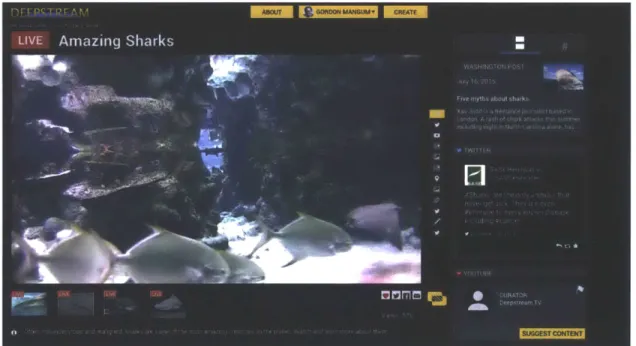
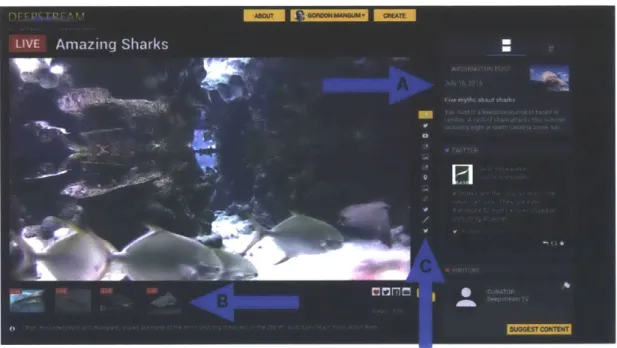
The DeepStream.tv platform was designed for the primary activity of letting users create new webpages where they can add contextual information to livestreams and publish the result for public viewing. I refer to this act as "creating a DeepStream webpage" (see reference terminology below), and it can be performed by anyone who creates a user account on the DeepStream.tv platform. Figure 1 shows the basic components of a DeepStream webpage. Creating a DeepStream webpage involves finding a primary livestream (marked (A) in Figure 1) and adding relevant information to
it. This information can either be interactive context cards (marked (C) in Figure 1), or additional related livestreams (marked E in Figure 1). I refer to users who have created a DeepStream webpage as curators.
B. vertical context
card stack
A. primary livestream C. context
cards
D. context card navigator
E. related livestreams
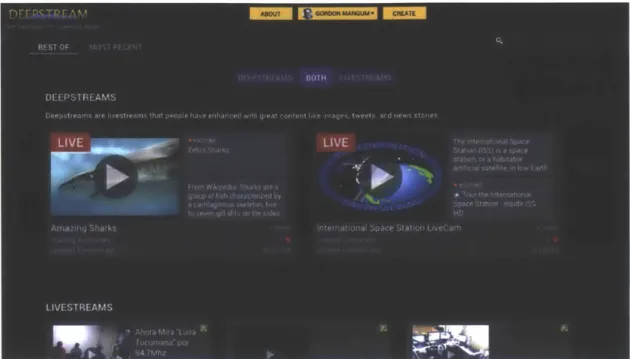
Viewers find DeepStream webpages through two methods. One is by visiting the DeepStream.tv homepage, where viewers have the ability to search and browse
DeepStream webpages, as well as livestreams that have not been curated. The second method is by curators sharing their DeepStream webpages on social media, or
embedding the DeepStream webpage on a different website. Both of these actions are facilitated by dedicated buttons, which are placed on all DeepStream webpages.
The terminology discussed above will be used throughout this thesis and is summarized below:
DeepStream.tv or the DeepStream platform:
The DeepStream platform refers to all of the functionality and content available on the DeepStream.tv website, including the DeepStream homepage and all DeepStream webpages that have been published by users.
A DeepStream webpage:
A DeepStream webpage (Figure 1) can be created by anyone who makes a user
account, and is composed of one primary livestream surrounded by relevant information displayed as interactive context cards and related livestreams. I will also refer to this as a curated livestream. A DeepStream webpage must be published by the user who created it before other people can view it. Once
published, any visitor can see a DeepStream webpage, whether they have a user account or not.
The DeepStream homepage:
The DeepStream homepage is the primary method for discovering individual DeepStream webpages. It is located at www.deepstream.tv and provides the ability to search and browse DeepStream webpages, as well as livestreams that have not been curated.
Creating a DeepStream webpage:
A DeepStream webpage can be created by anyone who makes a user account,
and involves finding a primary livestream and adding relevant information to it. This information can either be interactive context cards (marked (C) in Figure 1), or additional related livestreams (marked E in Figure 1). I refer to users who have created a DeepStream webpage as curators.
Curator:
On the DeepStream platform, a curator is a visitor who has created a user account and has also created a DeepStream webpage.
Context cards:
Context cards (marked (C) in Figure 1) are interactive elements on a
DeepStream webpage that contain a preview of a single piece of media content. This content can be an image, a map, a news article, a tweet, a video, an audio clip, or a text block. When viewers click a context card they are shown the full content, for example they can watch the full video or see a large, interactive map. Viewer:
A viewer is any person who visits any DeepStream webpage. Because the featured livestream on a DeepStream webpage starts playing automatically, viewers watch some of this live video, but may also interact with context cards (marked (C) in Figure 1), or watch related livestreams (marked E in Figure 1). The DeepStream platform is built with the JavaScript web framework Meteor.js, and leverages Meteor's publish/subscribe model so that changes a curator makes to a page are quickly propagated to viewers. It formats context cards as html elements that are placed in a vertical stack next to the video player (marked (B) in Figure 1). To add context cards, the interface allows users to search popular content providers such as YouTube and Flickr without leaving the authoring page, by using API access to find and display search results.
A practical goal of the DeepStream.tv platform is to facilitate the discovery and exploration of livestreams across multiple platforms. Currently, potential livestream viewers often do not know which platform to look on for desired content. This platform fragmentation is a problem because there are also no cross-platform search engines that index live video quickly enough to provide up-to-date search results. The current
difficulty of searching for and finding livestreams therefore makes people less likely to engage with this form of media.
To address the problem of platform fragmentation and improve livestream searching, the DeepStream platform was built so that API search results from major livestreaming platforms such as YouTube and Twitch are combined with elastic search results from a local database. This database is populated by API-accessed data
scraping of platforms such as Ustream and Bambuser. By combining API search results and data scraping, users can perform a single search query that effectively searches multiple platforms at once, lowering the time and effort required to find relevant livestreams.
Overview of Thesis
The following chapters explore the history of several key concepts that influenced the design of DeepStream.tv, present ethnographic design research into livestreaming production and consumption, detail the design process, and present and analyze results of usage. Chapter one seeks to explore the democratization of live broadcast video by tracing historical changes in infrastructure that have altered the ability to broadcast live video from one based on scarce resources and high costs to one based on abundant resources and low costs. Chapter two considers several historical examples of adding context to video as a way to establish norms of practice that are relevant to using the DeepStream platform. I link these considerations to a larger theoretical question about the epistemology of livestreaming as a way to reconsider the tradeoff between speed of
information and depth of information. Chapter three looks at who might curate
livestreams. By considering curation as an activity performed by people in the specific roles of journalist, fan, and activist, I examine potential reasons for, and ethical
challenges with, curating livestreams. In chapters four I present my design ethnography, an examine interviews with livestream viewers and broadcasters to understand why they use the medium. I also look at several examples of civic livestream curation that exist on the web today as evidence that some people already perform the activities that the DeepStream platform allows. Chapter five details the design process I used for DeepStream.tv, including influences on the process and specific steps that were taken. Chapter six explains how the DeepStream platform works, with a detailed explanation of both a DeepStream webpage and the DeepStream homepage. I also detail the user experience when creating a DeepStream webpage. Chapter seven explains how evaluation of the platform was carried out using both quantitative and qualitative
methods, and discusses some of the basic findings from that data. Chapter eight looks at the results of this data through a series of testable hypotheses, presenting evidence that might support or negate the ideas that form the core of the platform. Chapter nine summarizes these findings and considers possible future directions.
Chapter 1: Infrastructure Changes and Live Broadcast Video
Over the last 100 years the methods used to transmit live video have changed from those based on scarce resources, high deployment costs and significant technical
barriers, to methods based on abundant resources, low associated costs, and ease-of-use. This change has had a significant impact on the social practices of video
transmission and the quantity of live content people broadcast and consume. Tracing these changes can provide historical perspective on the present moment, even if it does not constitute a formal history, per se. As media historian Raymond Williams pointed out, the sequence of innovations that led to television spans impressive advancements in electricity, telegraphy, photography, motion picture and radio (2003). Focusing on significant technological advancements in video transmission and broadcast risks ignoring many smaller but important contributions to these changes, and glossing over the many ways in which history is contingent and could have been otherwise. The achievements I would like to highlight below were not a predetermined march through time, as if one technology inevitably led to the next. Instead, what I want to highlight with this brief summary is a sense of the rate of change and the impact of the broad trend toward lower-cost delivery methods, including examples of non-professional and community uses of video transmission infrastructure to illustrate some of the consequences of this increasing abundance and lower cost.
The history of video transmission can be thought of as having three major periods, based on the infrastructure that was used: terrestrial, satellite and Internet. While these three methods of transmission are not mutually exclusive, and all three are
still used today, each period led to changes in who could broadcast live video, the content that was broadcast, and the social practices of production and transmission. These changes in turn increased access to live footage from important events around the world for many viewers. Whether this was a positive or negative development will be discussed in the next chapter.
Terrestrial Broadcasting
The first successful long-distance terrestrial video transmission used pre-existing broadcast infrastructure designed and built for shortwave radio stations. In 1928 John Baird, the Scottish inventor, demonstrated what is likely the first technical solution for broadcasting live images over great distance. Baird was able to use a two-kilowatt shortwave radio station to transmit a signal from London to New York that he could transform into moving images and display on his "televisor" device. As the story carried
by several major newspapers reported, the images were "crude, imperfect, broken, but
they were images none the less... transatlantic television was a demonstrated reality, and one more great dream of science was on the way to eventual complete realization" (Chaplin 1928). The "televisor" acted as encoder and decoder, turning moving images into a signal that could be placed on shortwave radio and receiving the signal at a remote location, where it was converted back into moving images. This basic concept was the foundation for terrestrial television broadcasting, and persists to this day.
During the early period of television transmission, nearly all television was live, but this greatly constrained what could be shown to viewers. Programming such as
variety shows like The Texaco Star Theater, dramas and news shows were filmed and broadcast simultaneously, with set changes happening during commercial breaks. For newscasts, video from non-local events were added by using footage from newsreel companies (Stephens 2016).
From the perspective of infrastructure, terrestrial television and its required broadcast facilities are a scarce resource with high costs. Broadcast frequencies have to be assigned by coordinating bodies and regulated to prevent interference, which limits the number of broadcasters. The equipment needed for a broadcast facility is substantial and expensive, requiring significant space and technical expertise. Even once a television station is built, terrestrial broadcast techniques are constrained in their effective distance by the way VHF and UHF waves propagate, with a maximum reach of roughly 60-80 miles, depending on terrain and other factors.
With this limited broadcast range, terrestrial television infrastructure did not solve the problem of long-distance video transmission that John Baird worked on. While telephone lines could be used to increase point-to-point transmission distance over
land, it did not address the problem of oceans. The airborne electro-magnetic
frequencies used by terrestrial broadcasters simply could not reach that far, and cables on the ocean floor with sufficient bandwidth did not exist until the 1970s. Sending video from one continent to another typically required physically transporting reels of recorded video by airplane, so that it could eventually be aired on distant television stations. This was still the case in the early 1960s, when broadcasters started covering the Vietnam war, considered the first televised war (Hallin 1986). The footage from Vietnam had to
be flown to the US for processing before it could be broadcast on US television, which meant that it was at least five days old when it aired (Hallin 2016). The challenge of transmitting video over large distances in less time would only be solved when television looked in a new direction: toward the sky.
Satellite Television
Because of the physical limitations on range inherent in terrestrial broadcasting, intercontinental video transmission was not an established reality until the invention of satellite communication, the second major period for the infrastructure of transmission. The first satellites, Sputnik / and // launched by Russia in 1957, and Explorer! launched
by the United States in 1958, could transmit radio signals to earth. They conveyed
scientific data such as internal and external temperature and the detection of cosmic rays in the case of Explorer / ("Stories of Missions Past: Early Explorers" 2011).
Where radio went, television quickly followed. AT&T's Telstar satellite was launched on July 10, 1962, and broadcast its first image - a video of a flag outside a TV station in Andover, Maine - on July 11, 1962 (Mann 2012). The first transatlantic satellite video broadcast was less than two weeks later, on July 23, 1962 (Klein 2015). This was followed by the first international live satellite TV broadcast on June 25, 1967, featuring live video from the UK, Canada, the US, Australia, and Japan. It included a performance of All You Need Is Love by The Beatles and an interview with the media scholar Marshall McLuhan. ("Our World - The World's First Ever Live Satellite TV Broadcast (1967) Included The Beatles & Marshall McLuhan" 2015). Early satellite
communication was still analog, utilizing a higher frequency band that improved
transmission distance and the amount of information that could be sent, but which was susceptible to interference from precipitation (European Space Agency 2013).
Once satellite video transmission was technically possible, it did not become an increasingly common delivery method until stations were able to lease time on existing satellites, obviating the need to deploy their own. The cost of building and launching satellites is obviously high, making them scarce resources. But once in orbit, satellite owners could monetize this asset by leasing access to it, creating a new transmission
infrastructure that was available to broadcasters large and small. The ability to lease satellite transmission capability increased accessibility to the technical means of transmitting video so that ... an era of competition, diversity, and choice eventually
replaced scarcity, public interest obligations (however ignored), and centralized control" (Hilmes 2011, 327). The geostationary satellite "made an enormous revolution in
communications possible in the 1970s... The effect of satellite technology on media, not just in the United States but centrally to its global interconnections, is one of the least
recognized but most significant developments of the latter half of the twentieth century" (Hilmes 2011, 287-88).
Lowering the cost of satellite video transmission by letting broadcasters lease it created new opportunities for grassroots organizations to use the technology. As
DeeDee Halleck observed in 1993, "the electronic technology of distribution on a wholesale level is now available for a relatively low price" (416). One of the earliest examples dates from "the late 1980s and early 1990s, when Deep Dish TV organized
satellite uplinks for live feeds from anti-nuclear and anti-war demonstrations" (Costanza-Chock 2012, 382). Deep Dish TV also gathered material from thousands of content creators to create shows which it regularly distributed to community access television stations via satellite and other methods (Halleck 1993, 417). While satellite transmission solved the challenge of real-time transmission over large distances, and its low costs allowed more broadcasters to widely distribute their content, it is the most recent period of change in video transmission infrastructure that has radically lowered both the financial and the technical barriers to transmitting live video globally.
Mobile Phones and the Internet
The third major period of infrastructure change for video transmission happened when video began to move online. In 1992 researchers at Xerox PARC and USC were working on how to efficiently multicast large amounts of data over the wired internet (Thyagarajan, Casner, and Deering 1995). The result of these experiments was called the Mbone (or multicast backbone), which was the first protocol that enabled a many-to-many audio broadcast over a data connection. The protocol was tested at scale in 1994 when a Rolling Stones concert in Dallas, Texas was one of the first major Internet multicasts (ibid). The Mbone protocol was expanded to include video and other audio/video multicast applications that were also developed prior to 1995.
A significant step toward increasing the availability and lowering the cost of
broadcasting and receiving video over the Internet occurred in 1997 when RealNetworks launched RealVideo. This application used proprietary video
compression codecs, allowing streaming video to reach a significantly wider audience. Importantly, this also lowered the cost factors related to the technical challenge of sending and receiving video, making it accessible to non-technical users through a graphical user interface. In conjunction with increasingly available bandwidth, this would make watching video over the Internet possible for many more people, and lowered the financial and technological barriers to broadcasting as well.
In the early 1990s changes were also happening in mobile telephony that would eventually have a huge impact on video broadcasting. Radiolinja, a Finnish company that developed mobile technology based on the GSM standard, launched the first digital wireless phone transmission network in Finland in 1991. The 2G system included the ability to send and receive data over a cellular network for the first time. While 2G networks reached maximum data speeds of 150 kbps in optimal conditions (Kumar, Liu, and Sengupta 2010, 70), subsequent improvements resulted in significantly higher data transmission rates.
The convergence of increasing mobile data speeds with developments in phone capabilities and features such as cameras in the 1990's and 2000's enabled
transmission of streaming video to and from a mobile phone, further lowering costs and technical barriers. In 2000 the first camera phone was sold in Japan, and in 2002 this feature started gaining traction in the US (Thorn 2013). Efficiency improvements in video transmission over data connections coupled with improving speeds in mobile networks meant video could soon thereafter be sent over a mobile data connection. The
increased data transfer rates. Early mobile 3G networks, such as the Verizon Wireless network in the US and the SK Telecom network in South Korea (both deployed in 2002, still five years before the iPhone), used video services largely based on the H.263 and MPEG-4 compression codecs (Schierl, Stockhammer, and Wiegand 2007), which reduced the size of video files for faster transmission. Today codecs continue to
improve (scalable video coding with subset bit streams capable of graceful degradation are all the rage), and the next generation of faster mobile data networking, 5G, is due around 2020. Continued advances also mean that functional older technology can be purchased at very low cost. As of this writing a consumer could purchase a 3G
smartphone with a 0.3 megapixel camera running the Android operating system for $40
USD.
If increasing bandwidth and better codecs meant transmitting video via the
Internet was possible with a smartphone, another major development that impacted cost was new commercialization strategies that changed how people paid for services. For example, due to the decreasing cost of storage it became viable for companies to give users "free" access to large amounts of storage on their servers in exchange for
monetization through ads, personal data, or both. YouTube remains the most well known video platform based on this model.
While YouTube has been the dominant website for uploading prerecorded video, they did not initially provide the ability to broadcast live video. Other companies have attempted to establish market share in this broadcast space, with a wide variety of business models based on dominating niche content markets (for example, eSports on
platforms like Twitch and Abuzu). Even more recently, some platforms have tried to turn live video broadcasting into a social network (Meerkat, Periscope), although their
monetization strategies are less clear. There are also now open source projects that allow video transmission based on the WebRTC protocol, opening up the possibility of broadcasting video without the need for proprietary platforms.
One consequence of these wide-ranging efforts to capture market share is that many video broadcasting platforms do not cost money to use, and this has had a significant impact on content. As of this writing there are many free mobile apps that allow you to start broadcasting live video within a few seconds, including Ustream, Bambuser, Periscope and Meerkat. This has resulted in an explosion of live content, and new debates about the social practice of broadcasting live video, which I will discuss below.
Anyone can be a Broadcaster
The changes in infrastructure that have made live video transmission increasingly easy to access and almost free to use have significantly changed the social practices related to this activity. Because broadcasting live video from a mobile phone is now extremely easy and essentially free, if the price of a phone, a mobile data plan, and the willingness to trade personal data and/or ad views for services are considered sunk costs, anyone with a smart phone can now be a broadcaster, and share video of his or her immediate experience with anyone who is interested in watching.
If anyone can be a broadcaster, it is interesting to consider how social practices
have evolved around what should be broadcast, and how the people who broadcast should be regarded, especially in relation to journalism and activism. Because of the costs that used to be associated with the transmission of live video, the content that was sent over this medium was often of global significance, such as major political
developments, including war. As cost came down and access increased, a wider variety of voices could use this infrastructure, sometimes representing local perspectives. With the move to ubiquitous live broadcasting there is now a huge amount of content from many perspectives. Fixed position animal livestreams allow viewers to watch eagles, owls, bears, puppies and kittens, just to name a few. It is now common for one or more people to livestream from political demonstrations and events such as Earth Day, regardless of whether there is mainstream media coverage of the event. People livestream their commutes to work, their video game playing, and their thoughts on topics profound and mundane.
While live broadcasting used to be accessible to only the wealthiest news
organizations and their journalists, now people who livestream from events in the public interest are performing important journalistic activities, and designating who is a
journalist has significant implications. Some individual broadcasters think of themselves as independent journalists, or citizen journalists, or perhaps simply citizens performing a dutiful action. These individuals are sometimes recording and broadcasting events that have a major impact on public discourse about important topics, such as Ramsey Orta, who recorded the death of Eric Garner in New York, which led to large protests against
police violence and was an important contribution to the nationwide discussion of structural racism. There are particularly salient issues at stake with how these
individuals are designated because of the protections afforded to journalists in many countries, such as shield laws designed to protect reporter's privilege in the US.
Livestreaming from activist-related events has also increased significantly due to the prevalence of smartphones and fast data networks, but it is a contested activity.
Sasha Costanza-Chock notes that "the broader availability of smartphones with the ability to stream live via the net thus vastly expands, although does not provide the first
instance of, the capacity of movement media makers to produce live video coverage of mobilizations" (2012, 382). But livestreaming from mobilizations is not without
controversy in some social movements. For example, We Cop Watch
(www.wecopwatch.org) has a post that details bad streaming etiquette and notes that police often watch livestreams of protests to monitor the event ("Live Streamers Make Great Informants" 2014). In an interview with a livestreamer who considers herself an independent journalist covering (and participating in) the Black Lives Matter and Occupy movements, the streamer's response to this argument was to note that most
livestreamers are very aware of proper streaming etiquette (such as not showing people's faces unless you ask permission, and being mindful of ambient conversations in case participants are discussing tactics), and felt strongly that having livestreamers on the ground actually protected participants from more violent treatment by the police
Despite concerns by some participants, it is increasingly common to find one or more livestreams from notable civic actions in the US. Watching these livestreams may also be increasingly popular. During the Occupy movement "up to 80,000 unique viewers per day tuned in to watch DIY real-time streams from Occupations around the country and around the world" (Costanza-Chock 2012, 382). Just a few years later "live-streams from the Ferguson protests on a single service - Livestream.com - attracted
1.5 million views the day of the grand jury decision that let police officer Darren Wilson
off the hook without an indictment" (Chen 2014).
Television dominated video transmission and broadcast infrastructure for decades, and influences the way people think about and practice livestreaming as an activity. Clay Shirky uses the term "amateurization" to describe the shift from scarcity to abundance of media resources that has enabled, among other things, so many people to broadcast live video: "Our social tools remove older obstacles to public expression, and thus remove the bottlenecks that characterized mass media. The result is the mass amateurization of efforts previously reserved for media professionals" (2008, 55). But amateurization may not be the most useful way to conceptualize what has changed with
live broadcast video. For example, the use of small handheld cameras is common for both livestreamers and highly produced television such as reality shows and breaking news. Additionally, companies are now introducing products into the market that are designed to make livestreams more professional, including multi-camera setups. It is also problematic to frame livestreaming as amateur television because the conventions of use, including format and content, are different. Rather, if livestreaming is a
popularization of live broadcasting, it is an evolutionary one, and is a different form of media with its own conventions and uses.
It is clear that this is the very beginning of livestreaming becoming a truly
common and "normalized" activity, which limits the reflective distance of history that will eventually show how the widespread availability of broadcasting live video is used in the future. I would argue that it is only since the 2014 launch of Meerkat and Periscope that
livestreaming is becoming a common activity. Users can only broadcast on these platforms by using a mobile phone and a free app designed for ease-of-use. These stand in contrast to platforms like YouTube and Twitch, which have more complicated setups requiring video encoders on powerful computers, and consequently don't work with mobile phones. In between these extremes are platforms like Ustream and Bambuser, which both have free, easy-to-use apps as well as paid desktop-based encoders with more advanced features.
Meerkat and Periscope were designed primarily as social networks, in contrast to Ustream and Bambuser, and we are now starting to see what more widespread
adoption of livestreaming might look like. Just as "selfie" norms and practices emerged after front-facing cameras and photo sharing apps, this may be the point where
livestreaming norms and practices are starting to form. This is an intriguing moment because, as Shirky notes, "communications tools don't get socially interesting until they get technologically boring. The invention of a tool doesn't create change; it has to have been around long enough that most of society is using it. It's when a technology
becomes normal, then ubiquitous, and finally so pervasive as to be invisible, that the really profound changes happen" (2008, 105).
The changes in infrastructure that have shifted live video broadcasting from terrestrial towers to satellites, and now to the Internet, are making livestreaming a
ubiquitous, and increasingly invisible, communications tool. The consequences of this development are difficult to anticipate, but historical trends in other forms of video, which
Chapter 2: Using Context to Explain Video
The wide availability of mobile data networks and the low cost of devices capable of transmitting live video have contributed to the normalization and popularization of livestreaming as an activity, but the history of other forms of video suggest that the narratives conveyed through livestreams would benefit from additional contextual
information. By examining conventions in early film and television news, I will argue that the inherent properties and social conventions of civic livestreaming present an
interesting opportunity to reconsider the trade-off between speed of information and depth of information.
If livestreaming does create the possibility of changing the way people report and
are informed about events as they happen, it is largely unrealized on existing
livestreaming platforms. This is because there are few affordances designed to allow people to add and discover context, which could provide a deeper level of information that would frame the live video. As a result, it can be difficult for the viewer to
understand where a livestreamer is broadcasting from, who is broadcasting, or what the broadcast is about. Yet adding context to video in a way that would answer these
questions has a long and rich history across multiple forms of media, creating many possible precedents for combining livestreams with rich contextual information. I will look at some of these precedents before considering the similarities and differences between livestreams and television news in order to gain insight into how to
conceptualize this emergent medium and its potential for information-gathering activities.
Silent Film and Narrative Gaps
While the clich6 that a picture is worth a thousand words might suggest that video, at 24 frames per second, is worth 1.4 million words per minute, the reality is that text and other elements have been used to help viewers understand and contextualize what is happening in video since the dawn of cinema. During the silent film era, one
method to explain what was happening on screen or to fill narrative gaps was the use of intertitles. One of the earliest known uses of intertitles was in the 1901 silent film
Scrooge, Or Marley's Ghost by W. R. Booth (Elliott 2003, 117). Examining the use of
intertitles from 1908-17, Elliott notes that "In this period, intertitles continue to function as scene headings or verbal explications of filmed scenes, increasingly appearing only to represent what images could not specify or what would require too many images to delineate" (ibid, 118).
The method of contextual explication for silent film varied in different cultures. For example, Japan developed the rich tradition of the benshi or narrator:
Japanese 'silent movies' were never silent. From the very first showing of motion pictures in Japan in 1896 until the end of the silent era in 1939, a person, or a group of people, always supplied a verbal component to the motion picture show.
Benshi formed a central part of the 'silent movie' experience in Japan by
explaining what the motion picture was about, either before, during, or after the show. While one can find examples of similar motion picture narration elsewhere in the world, Japan is the only place where narrators proved to be an influential and integral part of silent cinema. (Dym 2008)
Similar practices were used in parts of the United States as well: "In ethnic
Narration as an act of explanation and contextualization would of course become a key aspect of plot advancement in nearly all films with the emergence of "talkies," causing live in-theater narration to largely disappear.
Television News Infographics
Television news is a major format in which video has often been augmented with additional contextualizing elements. The first TV news broadcasts featured a presenter who was responsible for providing relevant context for each news item, and voiceovers were used to explain what was happening in video footage of important events. Much like narration in film, video by itself is not assumed to be fully self-explanatory in this format. Even video clips that included a narrator in the form of a reporter explaining a situation were generally wrapped in a further layer of contextualization by a news presenter who might introduce the topic, or explain where the video that viewers were about to watch was filmed.
As it became easier to add background images to nightly newscasts, context was not only provided through narration. Pre-computer graphics were hand-designed and typically consisted of background images such as maps or graphs (Ponce de Leon
2015). Machines made by the Chyron Corporation sped up the process of overlaying
text, starting in the late 1960s. Once computers could be used to generate images, television news programs began increasingly experimenting with graphics and lower third overlays to provide a new layer of information deemed relevant and important to
the news story. Adding these graphics was possible because of video editing systems such as the Commodore Amiga and Avid.
The choice between these two early systems had both financial implications and rhetorical significance. The Commodore Amiga, first sold in 1985, holds a place of honor in the history of hardware and software used to overlay graphics due to its low cost. "The Amiga chipset can genlock, which is the ability to adjust its own screen refresh timing to match a [...] video signal. When combined with setting transparency, this allows an Amiga to overlay an external video source with graphics. This [...] provides the ability to do character generation and CGI effects far more cheaply than earlier systems" ("Amiga" 2015). In contrast to the consumer-focused Amiga, which sold for less than $1000, Avid developed expensive video editing systems designed for professional film and television studios. The Avid Media Composer system, first
released in 1989, cost between $50,000 and $80,000 ("History of Avid Technology Inc."
2016). The systems used to produce television overlays made a visual and rhetorical
statement about production values. The higher-quality graphics that could be achieved with Avid systems were one way for television programs to assert seriousness.
In addition to the visual and rhetorical impact that high-quality graphics could have on viewers, news broadcast graphics were often used in ways that added contextual information:
Information graphics have been a common form of visual storytelling in news broadcasts for many years. Numerical displays or explanatory illustrations are often used to enhance a news broadcast by taking the viewer where the video cameras cannot. In particular, maps have served an important function in broadcast news reporting for stories related to weather, politics, and war. The integration of maps into the presentation of broadcast news often enhances a
viewer's ability to conceptualize and understand the importance and impact of a story. Broadcast graphics are often developed as a portion of a news story that works to complement the video and audio. (Quinn and Filak 2005, 82-83)
The use of maps and other graphics to fill narrative gaps in news stories illustrates how they can function to expand the spatial, temporal or narrative constraints of video,
adding important contextual information that frames the story, literally and figuratively. Graphics rapidly became standard elements in television news broadcasts, and became ubiquitous as television broadcasts were influenced by conventions of website layout. Foote and Saunders conducted a study on the use of graphics in network television news in 1988 and found 78% of stories used some kind of graphic
enhancement such as maps, diagrams, or even cartoons (1990, 501). The percentage of stories using graphics has undoubtedly increased since this study. Some argue use of overlaid information has now gone too far: "Some news channels, like CNN's
Headline News, have astons on the lower third, a story graphic on the upper left third, and the anchor squeezed in the upper right two-thirds. [...] The result is a look more like a web page than television" (Edsall 2008). This convergence of style has accelerated as content increasingly spreads across mediums: "The visual distinction between print, television, and the internet are rapidly dissolving as presentation styles seamlessly traverse media boundaries" (Cooke 2005, 23). Television news now regularly features multiple layers of visual imagery around the typical news anchor shot, including video insets of on-location footage or interview subjects, information tickers, permanent time/temperature displays, graphical teasers for upcoming stories, and more.
While the combination of video with graphics and text is becoming increasingly common as visual styles on the Internet influence (and are influenced by) TV and print, these added visual elements must be considered as not only literal ways that video is framed by surrounding graphics, but as contributions to rhetorical framing that impact how viewers understand the video. We know from media framing research that the choices made about additional visual elements (and, of course, the language used during narration, and video editing choices) are not neutral: "By framing social and political issues in specific ways, news organizations declare the underlying causes and likely consequences of a problem and establish criteria for evaluating potential remedies of the problem" (Nelson, Clawson, and Oxley 1997, 567-68). Through close reading and frame analysis we can "see how a situation or event is named/defined, and how that naming shapes public opinion... by highlighting the inherent biases in all storytelling, namely selectivity (what is included and excluded in the story?), partiality (what is emphasized and downplayed in the story?), and structure (how does the story formally play out?)" (Ott and Aoki 2002, 485). Adding information to video in the form of graphics and text can therefore be viewed as an act of non-neutral rhetorical framing.
The potential effect of well-chosen news graphics can be powerful, and can serve many rhetorical purposes, including satire, on television news shows such as The Daily
Show. "The haphazard composites, exaggerated typography and Photoshop 101
effects served as The Daily Show's unofficial branding of political satire wrapped in a subtle, underlying message. And the ones that made it to air excelled in the purpose of great graphic design - it enhanced the content (Stewart, in this case) without distraction,
but also told its own story" (Seamon 2015). Graphics such as those used on The Daily
Show can also go beyond satire and provide background information that helps viewers
situate a story in a large narrative, or explain important aspects of the story. But despite the increasingly frequent use of graphic elements in television news, a major criticism of the format is that as viewers are increasingly shown events in near-real time thanks to affordable live video transmission, they are not provided with sufficient depth of
information and context to understand the significance of these events (Douglas 2006).
Speed versus Depth
Both live television and livestreams can be characterized by the speed at which information is delivered, but the effect of this speed has been disputed, and the
relationship between real-time information and depth of information may not be the same for live television news and livestreaming. By exploring some of the inherent aspects of livestreams, as well as some social practices emerging in its use, I will compare this medium to television news to better understand how speed and depth might work in both types of media.
One of the longstanding debates in media scholarship is whether specific forms of media do in fact have inherent properties that cause them to have specific effects on consumers of that media, or whether social conventions about media use in a given culture have a more determinative effect (Smith and Marx 1994). These two positions are referred to as technological determinism and social constructivism.
While there are many variations of these two approaches, I take the view that the effect of media can be determined both by its inherent properties and by social
conventions of use. For example, and inherent property of livestreaming is the fact that it is live, and "liveness" has a different effect on viewers than pre-recorded material. The live aspect of some media has itself been a focus in media theory. "Liveness" as a category in media scholarship is often related to social connection, and those
connections are changing as the ability to create and consume live media is popularized (Couldry 2004). I will explore both the inherent properties and norms of use through social connection in livestreaming as a way to compare it to television news.
If an inherent property of "liveness" (and consequently livestreaming) is that it
tends to emphasize social connection, this is in tension with social uses of live media that can make us feel isolated. In her critique of Marshall McLuhan's technological
determinism, and specifically how McLuhan thought advances in communication technology would usher in a new "global village," Susan Douglas posits the idea that
even if inherent properties of media suggest a particular effect, social norms can cause media to have a very different effect. Douglas calls this the "irony of technology," that "communications technologies can often have the exact opposite consequences of what we think and hope they might be" (2006, 625).
In Douglas's view, technologies like satellite TV and broadcasting over mobile networks have allowed us to see live video from anywhere in the world, which McLuhan theorized should bind us together through shared empathy. In reality, the social
clips of conflict and disaster, possibly provoking instead isolationist and ethnocentric attitudes in US viewers (ibid, 625-27). As Douglas notes: "In other words, the speed and
new mobility of news reporting technology, and the graphics in the newsroom, worked in opposition to depth, and thus in opposition to global awareness and empathy" (ibid,
627). Douglas thus argues that live video with contextual graphics may have had a
detrimental effect on viewers because of social conventions about how these technologies are used and combined.
If livestreaming follows similar conventions of use to television news, in that
viewers often use it to watch short video footage from conflict and disaster without context, it could also have a detrimental effect on viewers. While conventions of use are difficult to establish for livestreaming because it is so new, some media organizations like Deep Dish TV, a grassroots federation of independent video producers, have consciously tried to counteract the decontextualizing tendency that Douglas identified. As one critic notes:
By compiling local reactions to specific issues, Deep Dish demonstrates how
national in scope the issues are. The programs begin to do the opposite of what decontextualized fragments of mainstream network news does. On Deep Dish,
issues are contextualized and made coherent. In addition, by working with activist organizations, the participation is extended into the community. (Halleck 1993, 418).
But current livestreaming platforms have very limited feature sets for adding depth through context. The affordances of these interfaces simply do not provide much
might make them coherent and relevant and potentially encourage global awareness and empathy in viewers.
Can Livestreaming be an Effective Medium for News and Information?
The strengths and weaknesses of livestreaming as a medium for news and information can be analyzed in relation to television. Neil Postman argued that the epistemology of television is best understood in the context of entertainment and emotional impact, rather than coherent models of linear thinking or rational argument
(1986). Postman argued that this approach undermines attempts to convey complex
information on a television program. Postman's articulation is thus an attempt to argue from a position of technological determinism that television as medium for news and information tends to bias programming toward entertainment, not depth of contextual information.
While there are certainly livestreams that literally show entertainment, such as concerts and sports, the genre of livestreams intended to share information about an event may have may different effects on viewers. First, livestreams tend to consist of one long, continuous shot. Livestreamers at a protest, for example, sometimes
broadcast for two or three hours continuously. Contrasted with the high-frequency cuts found in most television shows, and the constant focus on highlight clips, watching a livestream of a newsworthy event is a substantially different experience.
Second, in contrast to highly produced television news, livestreams tend to be perceived as authentic. Indeed, part of the "crisis in journalism" today is related to a loss
of audience trust because of the perceived inauthenticity of the journalistic stance of objectivity. Discussing "point of view" journalism, Van der Haak, Parks and Castells
note, "not objectivity, but transparency and independence are vital for journalism to be credible in the 21st century. Journalism with a clear perspective is more convincing than
neutral narrative, and there is increasing value placed on the voice or vision embedded in the story-that is, on a point of view" (2012, 2931). Livestreams are inherently issuing from a perspective, and there is no pretense to, or expectation of, objectivity. In fact, it is the experience of seeing the world through someone else's real and immediate
perspective that is one reason livestreams are compelling.
Compared to television, livestreams are also perceived as more authentic because they often contain unplanned action. "TV is something that has happened in the past, something that has been prepared in advance. Periscope [a popular
livestreaming platform] is life, real things, real places, with real people" (James 2016). I do not read this as a claim that livestreaming is somehow closer to reality, but rather that the word "real" is used here as a synonym for "authentic." I would add that even when television news is live, there is frequently a sense of advanced preparation, because there has been: live broadcast television requires many people working in a coordinated manner, equipment trucks on location, and planning to move from one camera to another, just to name a few examples. Livestreaming only requires that someone decide to use a smartphone and a free app.
As a final note on the authenticity of livestreams, the production quality of this live video may also be perceived as a marker of authenticity. John Fiske observes that