Computer-Assisted De-Identification of Free-text
Nursing Notes
by
Margaret Douglass
Submitted to the Department of Electrical Engineering and Computer
Science
in partial fulfillment of the requirements for the degree of
Master of Engineering in Computer Science and Engineering
at the
MASSACHUSETTS INSTITUTE OF TECHNOLOGY
February 2005
©
Massachusetts Institute of Technology 2005. All rights reserved.
MASSACHUSETTS INSTITUTE OF TECHNOLOGY
JUL 18 2005
Author ...
...
LJRARIES
Department 'of Fctric Engineering and Computer Science
28 January, 2005
Certified b y . . .. :... . . . ... . .. .
.. ....
....
.. . .. . .. . . ... .
Roger G. Mark
Professor of Electrical Engineering
Distinguished Professor in Health Sciences and Technology
/
Thesis Supervisor
Accepted by ... ...
Arthur C. Smith
Chairman, Department Committee on Graduate Theses
Computer-Assisted De-Identification of Free-text Nursing
Notes
by
Margaret Douglass
Submitted to the Department of Electrical Engineering and Computer Science on 28 January, 2005, in partial fulfillment of the
requirements for the degree of
Master of Engineering in Computer Science and Engineering
Abstract
Medical researchers are legally required to protect patients' privacy by removing per-sonally identifiable information from medical records before sharing the data with other researchers. Different computer-assisted methods are evaluated for removing and replacing protected health information (PHI) from free-text nursing notes col-lected in the hospital intensive care unit. A semi-automated method was developed to allow clinicians to highlight PHI on the screen of a tablet PC and to compare and combine the selections of different experts reading the same notes. Expert adjudica-tion demonstrated that inter-human variability was high, with few false positives and many false negatives. A preliminary automated de-identification algorithm generated few false negatives but many false positives. A second automated algorithm was de-veloped using the successful portions of the first algorithm and incorporating other heuristic methods to improve overall performance. A large de-identified collection of nursing notes was re-identified with realistic surrogate (but unprotected) dates, serial numbers, names, and phrases to form a "gold standard" reference database of over 2600 notes (approximately 340,000 words) with over 1800 labeled instances of PHI. This gold standard database of nursing notes and the Java source code used to evaluate algorithm performance will be made freely available on the Physionet web site in order to facilitate the development and validation of future de-identification algorithms.
Thesis Supervisor: Roger G. Mark Title: Professor of Electrical Engineering
Contents
1 Introduction 11
1.1 Patient Privacy . . . . 12
1.2 Legal Guidelines . . . . 13
1.3 De-Identification and MIMIC II . . . . 16
1.4 De-Identification Solutions . . . . 17
1.4.1 Latanya Sweeney's Scrub system and Datafly system . . . . . 17
1.4.2 Natural Language Processing techniques . . . . 18
1.4.3 Other Methods . . . . 19
1.4.4 LCP Method . . . . 20
2 Software Tools 21 2.1 Overview of the Deid Program . . . . 21
2.2 De-Identification Mode . . . . 24
2.3 Aggregate Mode . . . . 25
2.3.1 Create and Revise Consensus . . . . 25
2.3.2 Evaluate User . . . . 28
2.4 Re-Identification Software . . . . 30
2.4.1 Making Suggestions . . . . 30
2.4.2 Human Approval . . . . 32
2.4.3 Replacements . . . . 34
3 Development of "Gold Standard" and Evaluating Performance 37 3.1 C orpus . . . . 37
3.2 3.3 3.4 3.5 Human De-Identification . . . . Algorithm . . . . Evaluation of Performance . . . . Concerns . . . .
4 Results for De-Identification
4.1 Human Performance . . . . 4.2 Algorithm Performance . . . . 4.3 Re-Identified Nursing Note Collection 4.4 Discussion . . . . 4.5 Future Work for Reference Databases
5 Next Step: New De-Identification Algorithm 5.1 Strategy of De-Identification Algorithm . . . .
5.1.1 Finding Names . . . .
5.1.2 Finding Locations . . . .
5.1.3 Finding Numeric PHI . . . . 5.1.4 Checking for Repeated Occurrences of PHI .
5.1.5 Data Sources . . . .
5.2 Perform ance . . . .
5.2.1 Performance on Non-Medical Texts . . . . .
5.2.2 Performance on Nursing Notes . . . .
5.3 Future Work for De-Identification Algorithm . . . .
5.4 Conclusions . . . .
A Data from Human De-Identification
A .1 Single Clinicians . . . .
A.2 Teams of 2 Clinicians . . . . A.3 Teams of 3 Clinicians . . . . B Sample Nursing Notes
. . . . 3 8 . . . . 3 9 . . . . 4 0 . . . . 4 1 43 . . . . 4 3 . . . . 4 5 . . . . 4 6 . . . . 4 7 . . . . 4 9 51 51 52 53 53 55 55 55 58 59 60 . . . . 61 63 63 64 64 65
List of Figures
2-1 The dialog for choosing the user and set of notes in the De-identification M ode. . . . . 25
2-2 The display for the De-identification Mode. . . . . 26 2-3 The dialog for switching between modes and tasks. . . . . 26
2-4 The display for creating a consensus in the Aggregate Mode. The top half of the screen has a listing for every instance of identified PHI. At the bottom of the list, not shown in the figure, is an "OK" button that
is pressed after the user has finished classifying all the selections. . . . 28
2-5 The display for evaluating user performance in the Aggregate Mode. The top half of the screen has a listing for every instance of PHI. At the bottom of the list, not shown in the figure, is an "OK" button that
is pressed after the user has finished classifying all the selections. . . . 29
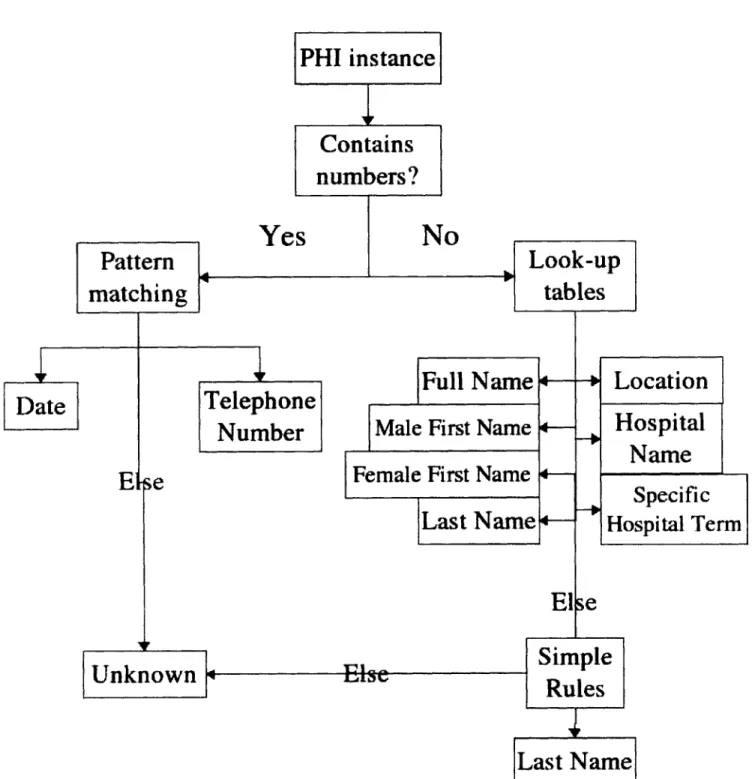
2-6 Classification of a single instance of PHI in the suggest-reid.pl script. 33 2-7 The display for reviewing and changing the suggested surrogate data
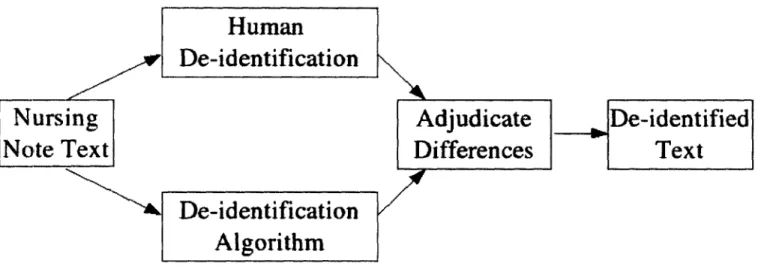
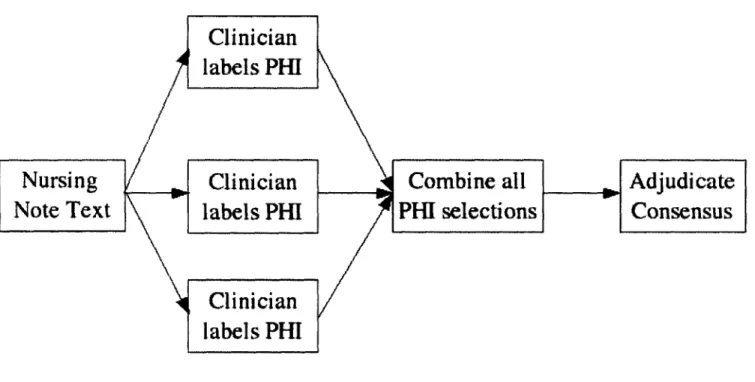
for re-identification. . . . . 35 3-1 Overview of the creation of the "Gold Standard" reference database. . 38 3-2 The human de-identification process. . . . . 40
List of Tables
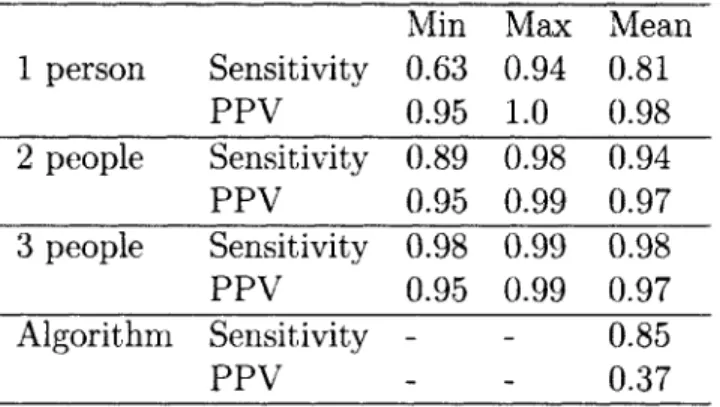
4.1 De-identification Performance for humans and for an automated algo-rithm. The "gold standard" is the adjudicated union of the algorithm and three independent human experts. PPV = Positive Predictive V alue. . . . . 44
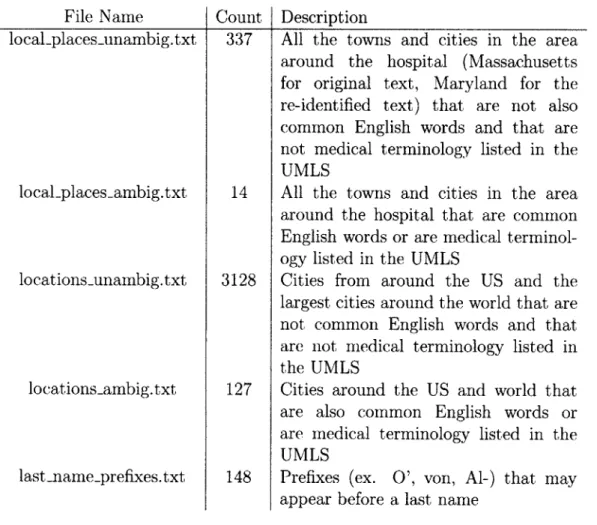
5.1 File names, number of entries, and description of the data files needed by the de-identification algorithm. All the files are available in a large
archive file, and they should be put in their own directory when running the algorithm. UMLS = Unified Medical Language System [26]. List of common English words come from Spell Checking Oriented Word Lists at size 35 [13]. . . . . 56 5.2 File names, number of entries, and description of the data files needed
by the de-identification algorithm. All the files are available in a large
archive file, and they should be put in their own directory when running the algorithm . . . . 57 5.3 Results for initial tests for the algorithm on structured, non-medical
data. TP = True Positive, FP = False Positive, FN = False Negative.
PPV = Positive Predictive Value . . . . 58
5.4 Results for initial tests for the algorithm on a collection of 747 nurs-ing notes, containnurs-ing 99,443 words. TP = True Positive, FP = False
A. 1 Performance statistics for a single clinician de-identifying the text. The
results for clinicians 4 and 9 are actually from two separate sessions for the sam e clinician. . . . . 63
A.2 Performance statistics for two clinicians de-identifying the text. . . . 64
Chapter 1
Introduction
Patients expect their personal medical data to be shared only among the clinicians and others directly concerned with their case. When using the medical data for research purposes, we must continue to respect and preserve patient confidentiality. The de-identification process removes all explicit personal health information in order to dissociate the individual from his medical record, while still preserving all the medically relevant information about the patient.
Software tools were developed in this project to facilitate human expert de-identification of free-text nursing notes. Those tools were used to create a large collection of completely de-identified free-text nursing notes for use as a "gold stan-dard" reference database. That database was used to characterize the performance of human de-identification and to evaluate the performance of a preliminary automated algorithm. Finally, a second fully-automated de-identification algorithm was devel-oped based on the successes and short-comings of the preliminary algorithm, and it was tested on the gold standard reference database.
This first chapter will discuss the general problem of preserving patient privacy in biomedical research and the de-identification guidelines used. The second chapter will describe the software tools developed. The third chapter will describe how those tools were used in the creation of a gold standard de-identified database and in the evaluation of the performance of different de-identifiers. The fourth will cover the results found from the human de-identification and the preliminary de-identification
algorithm. The final chapter will discuss the work done on a new, improved de-identification algorithm and the project's conclusions.
1.1
Patient Privacy
For as long as physicians have been treating patients, patient privacy has been an important concern. The Indian physician Charaka in the sixth century B.C. highly praised the trust between physician and patient, and he advocated patient confiden-tiality in physician-patient relationship [21]. The Hippocratic oath from 400 B.C., Greece, includes: "Whatever, in connection with my professional service, or not in connection with it, I see or hear, in the life of men, which ought not to be spoken of abroad, I will not divulge, as reckoning that all such should be kept secret" [22]. The American Medical Association's original Code of Ethics from 1847 includes in the description of the duties of physicians: "Secrecy and delicacy, when required by peculiar circumstances, should be strictly observed; and the familiar and confiden-tial intercourse to which physicians are admitted in their professional visits, should be used with discretion, and with the most scrupulous, regard to fidelity and honor" [12]. Modern professional ethics codes and federal and state laws still insist on doctor-patient confidentiality.
The general public is, rightfully, very concerned about who has access to their personal medical data. Some uses of such data are benign and helpful to society, such as the collection of children's immunization records by state and local governments.
A child's immunization history is made available in some states to local public health
departments, the child's physician, school, and/or child-care facility [34]. Ensuring that everyone is properly immunized is a public health concern, and immunization registries are generally accepted as necessary.
Other types of personal medical data need to be kept strictly confidential between the patient and her physician. People with a history of serious medical problems complain of difficulties securing jobs with life and health insurance benefits once their employers become aware of their previous illnesses [24]. The Americans with
Disabilities Act of 1990 says that employers cannot make personal medical inquiries until after a job offer has been made, but insecure medical databases could allow job interviewers improper access to potential employees' medical records and prevent a survivor of childhood cancer, for example, from getting a job he would otherwise be offered. A 1996 survey of 84 Fortune 500 companies found that 35% of the companies use medical records of personnel in making employment-related decisions [27].
The right to privacy comes into conflict with the medical community's need for large collections of patient medical records for monitoring the outcome of care, eval-uating treatments, and conducting follow-up studies [29]. The complications and illnesses that patients may suffer years after the initial procedure was performed pro-vide useful information that can be used in future clinical decision making. Large collections of patient medical records are important tools in epidemiological research, retrospective studies, and observational outcome studies.
The concern for patient privacy has led to a cautious, sometimes distrustful view of medical research. According to a 1996 poll, only 57% of Americans find the use of their patient records in medical research to be either "very" (18%) or "somewhat" (39%) acceptable, with 31% saying it would be "not at all" acceptable [1]. Guaranteeing the privacy of medical records used in research is the only way we can expect to gain the cooperation and consent of patients.
1.2
Legal Guidelines
In the United States, the guidelines for protecting the confidentiality of health care information have been established in the Health Information Portability and Account-ability Act (HIPAA) of 1996 [4]. Records are said to be de-identified when the risk is very small that the information can be used alone or in combination with other reasonably available information to identify who the patient is. This risk can be cal-culated and documented statistically for all the records, or we can use the safe harbor approach and show that every record is free of the 18 types of identifiers listed in the law. Those identifiers are:
1. Names, including that of the patient, visiting relatives, and hospital staff;
2. All geographic subdivisions smaller than a state, including street address, city, county, precinct, zip code, and their equivalent geocodes, except for the initial three digits of a zip code if, according to the current publicly available data from the Bureau of the Census:
(a) The geographic unit formed by combining all zip codes with the same three initial digits contains more than 20,000 people; and
(b) The initial three digits of a zip code for all such geographic units containing
20,000 or fewer people is changed to 000.
This includes all references to which hospital the patient is being treated in;
3. All elements of dates (except year) for dates directly related to an individual,
including birth date, admission date, discharge date, date of death; and all ages over 89 and all elements of dates (including year) indicative of such age, except that such ages and elements may be aggregated into a single category of age 90 or older.
(We removed the year for all patients, though that is not required by the law);
4. Telephone numbers, including pager numbers;
5. Fax numbers;
6. Electronic mail addresses;
7. Social security numbers;
8. Medical record numbers;
9. Health plan beneficiary numbers; 10. Account numbers;
12. Vehicle identifiers and serial numbers, including license plate numbers;
13. Device identifiers and serial numbers;
14. Web Universal Resource Locators (URLs);
15. Internet Protocol (IP) address numbers;
16. Biometric identifiers, including finger and voice prints;
17. Full face photographic images and any comparable images; and
18. Any other unique identifying number, characteristic, or code (Section 164.514 b of [4]')
Such data is known as protected health information (PHI).
HIPAA came into effect April 2003, and as of September 2004, the Department of
Health and Human Service's Office of Civil Rights had received and initiated reviews of over 7,577 complaints of HIPAA violations [18]. The law has already come under attack by biomedical researchers, who complain that the constraints on the use of human data and the fear of litigation have caused time delays, increased the admin-istrative cost of studies, introduced bias towards the type of patient who understands and supports medical research, and have blocked important research from being even suggested [23].
Medical researchers must obey the US Common Rule 45CFR46, which states that all research involving human subjects requires informed consent from subjects. A study can be exempt from the rule if it is: "Research involving the collection or study of existing data, documents, records, pathological specimens, or diagnostic specimens, if these sources are publicly available or if the information is recorded
by the investigator in such a manner that subjects cannot be identified, directly or
through identifiers linked to the subjects" [3]. Research must also be approved by the Institutional Review Board. At MIT, the Committee on the Use of Humans as Experimental Subjects's requirements for using human medical data is the same as
HIPAA's, in that de-identified human data is permissible to be used without patient consent [2].
There are privacy laws in other countries. In Canada, there is the Personal In-formation Protection and Electronic Documents Act [9]. The European Union has adapted the European Union Directive on Data Privacy [7]. The Organization for Economic Co-operation and Development, which has members from 30 countries and has active relationships with another 70, has established Guidelines on the Protection of Privacy and Transborder Flows of Personal Data [8]. Like HIPAA, all these laws aim to protect sensitive personal data.
1.3
De-Identification and MIMIC II
The Laboratory for Computational Physiology (LCP) is participating in a project to create an advanced intensive care unit (ICU) patient monitoring system that would report all relevant patient data to clinicians and that would automatically generate pathophysiologic hypotheses that best explain the observed data [28]. MIMIC II is a multi-parameter database of patient medical data developed to support that on-going research project [31]. The database now contains waveforms, trend plots, lab results, and other types of medical data for over three thousand patients from the ICUs of a local hospital, and it is growing to contain records from even more patients. Because of privacy concerns, we are unable to use that data outside our lab without first removing all personally identifiable information from the records. This necessity makes outside collaboration difficult. Eventually we would like to have the entire MIMIC II database in a fully de-identified form so that all the medical data can be made publicly available to the entire research community.
Removing PHI by hand is a time-consuming and expensive task which may be prone to serious error. Our group wants to develop algorithms to perform the de-identification task automatically. As a first step towards that goal, another student working with the LCP developed a preliminary de-identification algorithm discussed in Section 1.4.4 (see [25]). The focus of my project is the creation of methods to test
and verify the performance of de-identification algorithms on free-text nursing notes from the MIMIC II database.
1.4
De-Identification Solutions
Various methods have been developed to remove personally identifiable information from different types of medical text. None of the algorithms developed outside our group is designed to work on data as unstructured as the free-text nursing notes we are focusing on, but the different approaches provide ideas for how we can improve our own de-identification methods.
1.4.1
Latanya Sweeney's Scrub system and Datafly system
One of the leaders in the field of medical record privacy is Dr. Latanya Sweeney, now the director of the Laboratory for International Data Privacy at Carnegie Mel-lon University. Her Scrub system [32] is designed to remove the PHI from clinical correspondence and clinical notes. Her software looks for PHI using "common-sense" templates and look-up tables. It uses probability tables for template matching, de-tectors for medical terms to reduce false positives, tools to identify words that sound like other words to account for spelling variations, and detectors for re-appearing terms. Her system found 99-100% of the PHI in her test set, though the test set is not rigorously described and no statistics are given of her false positive rate.
Sweeney's Datafly system [33] adjusts medical databases to render them anony-mous enough to be released. The system generates a profile for each user based on the user's access to external information and the probability that he will use the out-side sources to re-identify the individual based on information from the fields in the database. The user tells the system the specific fields and records wanted from the database, and the system uses the user's profile to determine what form of the data to return to him in order to guarantee anonymity. The minimum level of anonymity is given and used to calculate value b, such that every value in each field will occur at least b times, except for one-to-one replacement values like Social Security number.
The biggest disadvantage to Sweeney's de-identification tools to us is that they are all closed-source. The Datafly system is licensed to Privacert, Inc. [6]. That company targets organizations that want to share person-specific data without revealing iden-tities and other sensitive information about individuals, companies, or other groups. The "Privacert Appliance" claims to fully de-identify databases containing personal information, presumably using the Datafly system, but no technical details are given.
1.4.2
Natural Language Processing techniques
Some de-identification algorithms use natural language processing (NLP) tools for processing the text. Many NLP tools have been developed for non-medical texts, so they must be adjusted to deal with medical terminology, abbreviations, and the different types of numeric data to be effective on medical records.
Ruch [30]'s technique uses sophisticated NLP techniques to tag words with ap-propriate parts of speech and a specialized MEDTAG semantic category. After the text has been tagged, it uses contextual rules based on those tags to identify PHI. It matches templates for small groups of up to five words, and it implements some "long-distance" rules as finite state machines. The technique looks for PHI around words marked as IDM (IDentity Markers). The software was developed for post-operative reports, laboratory and test results, and discharge summaries written primarily in French, though some documents were in German and English. The system found
98-99% of all PHI in their test corpus.
Taira [35] has created an algorithm to identify patient name references in clinical correspondence, discharge summaries, clinical notes, and operative/surgical reports for pediatric urology patients. He uses a lexicon with over 64,000 first and last names and a set of semantic selectional restrictions to assign probabilities for a given word being a name. It attempts to classify every sentence according to the type of logical relation it contains, then extracts the potential name based on that logical relation. For example, the sentence "John is a 5 year old male" would be classified as containing "Patient-age" and "Patient-gender" logical relations, with the patient name being "John" for both. This technique to classify names according to their
semantic use had a sensitivity of 99.2%, but it was limited only for patient names and not for any other type of PHI.
1.4.3
Other Methods
Another method to extract names from patient records was developed by Thomas [36]. This method uses a lexicon of 1.8 million proper names to identify potential names and a list of Clinical and Common Usage words from the Unified Medical Language System (UMLS) and Ispell spell-checker dictionary to reduce false positives. If a word is on both lists, there are a few simple context rules to classify the word. This method has been tested on pathology reports and found 98.7% of all names.
Berman [14] developed a technique for removing all PHI from pathology reports by removing all terms that do not appear in the UMLS. His algorithm parses sentences into coded concepts from the UMLS and stop-words, which are high-frequency struc-tural components of sentences like prepositions and common adjectives. All other words, including names and other personally identifiable information, are replaced
by blocking symbols, so the output is totally stripped of non-medical and extraneous
information. This technique depends on knowing the standard structure of the input text, and the final output may not be readable if the sentence structure deviates from what is expected.
Gupta [20] recently published a de-identification system for pathology reports. It implements a set of rules and dictionaries designed to identify the presence of PHI, uses the UMLS for the identification of medical phrases not to be removed, and replaces identifiable text with de-identified but specific tags. The most interesting part of this study was the measures taken to verify and improve the quality of the de-identification software. The de-identified files were linked to the original file on a secure server, then only the de-identified versions were distributed to four pathologists with training in pathology and informatics. These examiners looked for text that should have been de-identified and was not, and for instances where the program removed clinical text that should not have been removed. The examiners did not have access to the original reports, but the labels on the tag could be checked with
the context of the removed text to look for misclassification of text. The developers used the feedback from the human reviewers to improve the software in three separate evaluations. By the final evaluation, the false positive and false negative rates had been drastically improved to have a final sensitivity of 99.1%. Systematic human reviews continue for quality assurance tests as the software continues being improved.
1.4.4
LCP Method
The other de-identification methods discussed were developed for specialized, highly structured data sets. My project focused on nursing notes, described in more detail in Section 3.1. A simple Perl automated de-identification algorithm for nursing notes was developed for in-house use by another student [25]. First it uses pattern-matching to identify potential dates, telephone numbers, social security numbers, and other protected types of identification numbers. Next it uses look-up tables to identify potential locations and patient, clinician, and hospital names. Finally the algorithm applies several simple context-based rules, such as the word following "Dr" will often be the doctor's last name. See [25] for further details. Preliminary tests showed the algorithm has a high false positive rate, but its overall sensitivity is high. We used this algorithm on our notes, as described in Section 3.3.
Chapter 2
Software Tools
Software was developed to gather the PHI selections of human experts, to combine the PHI selections of multiple de-identifiers looking at the same text in order to form an adjudicated consensus, to evaluate the performance of individual de-identification methods, and to re-identify text by replacing the PHI with authentic-looking surro-gate data. Java and Perl programs were written for these tasks.
2.1
Overview of the Deid Program
The Deid program is used for human de-identification of text. It has two main modes: the De-identification Mode, in which a single clinician views and selects the PHI in each note; and the Aggregate Mode, in which the selections of multiple de-identifiers are used to create an adjudicated consensus and to evaluate individual performance compared to that consensus.
Deid is a Java-based graphical user interface. It is run from the command-line in the directory with the source code.1 The code contains these major classes:
* Deid.java: Used in both the De-identification and Aggregate modes. Sets up
the graphical display. Controls changes between users, modes, and tasks within
'Usability Note: The code was designed to run on Java 2 Platform, v1.4.2. To run the software:
1. Move to the directory with the source code. 2. Compile the Java code: "javac Deid.java"
each mode. Keeps track of the current state of what is being displayed to the user.
" NoteManager.java: Used in both modes. Loads the text from the raw data
files. Organizes the text according to which patients the text were written about and when the text was recorded. Groups patients into sets. Returns the appropriate text when given a patient and note number.
" FileManager.java: Used in both modes. Reads and writes files with the
lo-cations of PHI. Reads files for lists of users and the headers used in organizing the text according to the appropriate patient and note number.
" NoteText.java: Used in the De-identification Mode. Returns the part of the
text to be displayed by the Deid display. Returns the character index boundaries of that section of the text. Used to avoid scrollbars.
" HighlightManager.java: Used in both modes. Stores all the PHI selections in
the text made by each user. Returns the locations of the selections made by a given user for a specified patient and note number.
" CompareWindow.java: Used in the Aggregate Mode. Controls the JPanel
display on the top half of the display when forming and revising a consensus. Displays all the selections. Collects and processes the user input for adjudicating consensus formation. (See Section 2.3.1 for more information.)
" EvaluationWindow.java: Used in the Aggregate Mode. Controls the JPanel
display on the top half of the display when evaluating the performance of an individual de-identifier. Displays all the selections. Collects and processes the user input for evaluating user performance. (See Section 2.3.2 for more infor-mation.)
Deid uses many smaller classes for displaying specialized dialog menus and for handling action events. Those classes are:
" ChooseUserAndNoteGroupDialog.java: Used in both modes. Displays the
list of recognized user names, and the different groups of notes (#1-5) to be looked at. Returns the selected user name and group of notes.
" ChooseConsensusDialog.java: Used in the Aggregate mode. Displays the list
of recognized user names and the different groups of notes (#1-5) to be looked at. Returns one or more names and a single set of notes.
* ChooseModeDialog.java: Displays the choice of modes, tasks, and exit.
Re-turns the user's choice.
" ChooseNoteDialog.java: Used in the De-identification Mode. Displays the
current patient and note number being displayed. Allows the user to input a new patient and note number to view. Returns the specified patient and note number.
" CheckBoxListener.java: Used in many dialog boxes and windows to track
whether a check box is marked.
" KeyboardAction.java: Used in the De-identification Mode. Allows the user to
select words using keyboard commands.
" MouseAction.java: Used in the De-identification Mode. Allows the user to
select words using mouse clicks.
* WindowHandler.java: Allows user to close the program by closing the window.
Deid also depends on several data files. Headers.txt contains the mapping of the note headers to the corresponding patient number and note number2. The actual
nursing notes are in text files listed in a field in the NoteManager.java code (see the comments in the actual code). For this project, we used notes from three text files:
note-enents1.csv, noteset2.csv, and enriched - all.txt.
2
Usability Note : The format of the file is,
1102=018-07-26 03:30:00=2018-07-26 03:52:00=Nursing/Other=1102= 1102 1
2.2
De-Identification Mode
Deid's De-identification mode is used to gather the PHI selections of a single clinician. New users are added manually to the user.txt file3. The user selects her name and
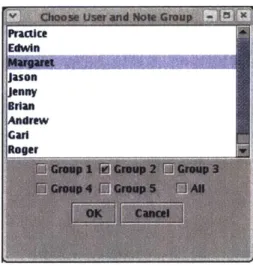
the set of notes she wants to de-identify in the dialog box shown in Figure 2-1. The first screen of text for the first patient in that set of notes is then displayed in the main window of the graphical display, as shown in Figure 2-2.
The user labels words as PHI by clicking once on the word or by selecting part of the word or a series of words. When selecting entire words at a time, the program automatically selects all the text between spaces, including punctuation around the text and any words that may not be properly separated from the desired text. (For example, in the text: "pt was visited by significant other wil,updated on her condi-tion.", clicking on the name "wil" will cause "wil,updated" to be selected.) The PHI that the user selects is highlighted on the screen and is automatically saved in the HighlightManager when the user presses the "Next" button.
Every user has her own file (username.deid) listing the locations of PHI she selected in the notes.4 All the selected PHI locations are written to that file every
time the patient number changes.
The display on the top left of the screen tells which patient and note number is being displayed on the screen. The user can go forward or backward in the text using the "Next" and "Previous" buttons at the bottom of the screen. A dialog box will appear when she has completed the last patient that is part of the set. The user can skip to a different part of the set of notes by clicking on the "Note" button on the top of the screen. Other options include changing the color of the highlighted text, changing the user, switching modes, and showing the original text or the enriched
3
Usability Note : To add a new user "Crystal", for example, to the user.txt file, add the line
"User: Crystal" at the end of the file.
4Format of username.deid:
Patient 1001 Note 1
764 764 768 895 895 901
The first number is the character index of the beginning of the word with the PHI. The second number is the index of the beginning of the PHI selection. The third number is the index of the last character selected as PHI.
Figure 2-1: The dialog for choosing the user and set of notes in the De-identification Mode.
version (only applicable in the fourth set of notes, explained in Section 3.1).
2.3
Aggregate Mode
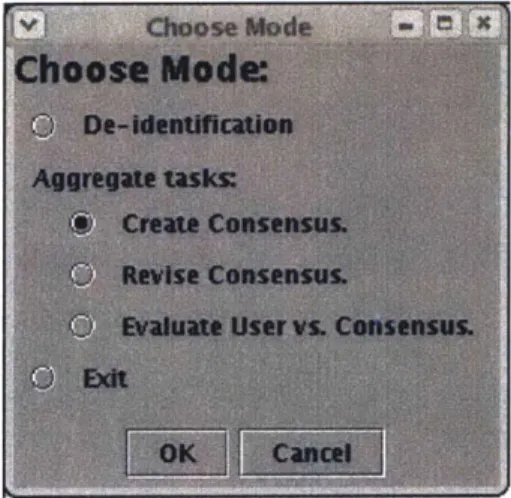
The user can switch to the tasks in the Aggregate Mode in the dialog shown in Figure
2-3. That dialog appears when the user presses the "Change Mode" button in the
De-identification Mode or when the user completes or cancels a task in the Aggregate Mode.
The Aggregate Mode combines the selections made by the separate human de-identifiers to create and revise a consensus of what should be marked as PHI and to evaluate how well an individual de-identifier performs compared to that consensus.
2.3.1
Create and Revise Consensus
The PHI selections of multiple doctors looking at the same notes are combined in the Aggregate Mode's "Create Consensus" and "Revise Consensus" tasks. In the Java interface as shown in Figure 2-4, the selections of all clinicians for each note are displayed, and a suggestion for the correct text is generated based on the majority response. A clinician referee from our group reviewed all the selected PHI and made the final decision as to whether a word should be classified as PHI.
-gu: reevaluated foley
catheter
and placed an additional 20cc
h2o
in bulb secondary to bladder spasms and leaking around
foley. patient now draining
adequate amounts
of clear
yellow
urine
>50cc/hr.
notified
wound nurse,
and Dr
of
decubitus to left buttock and kinaire bed ordered and wound
nurse will be by tomorrow to see patient and
stated
to
continue to use the wet to
wet
dsg change. no family/friends
in to visit patient nor no phone calls.
Figure 2-2: The display for the De-identification Mode.
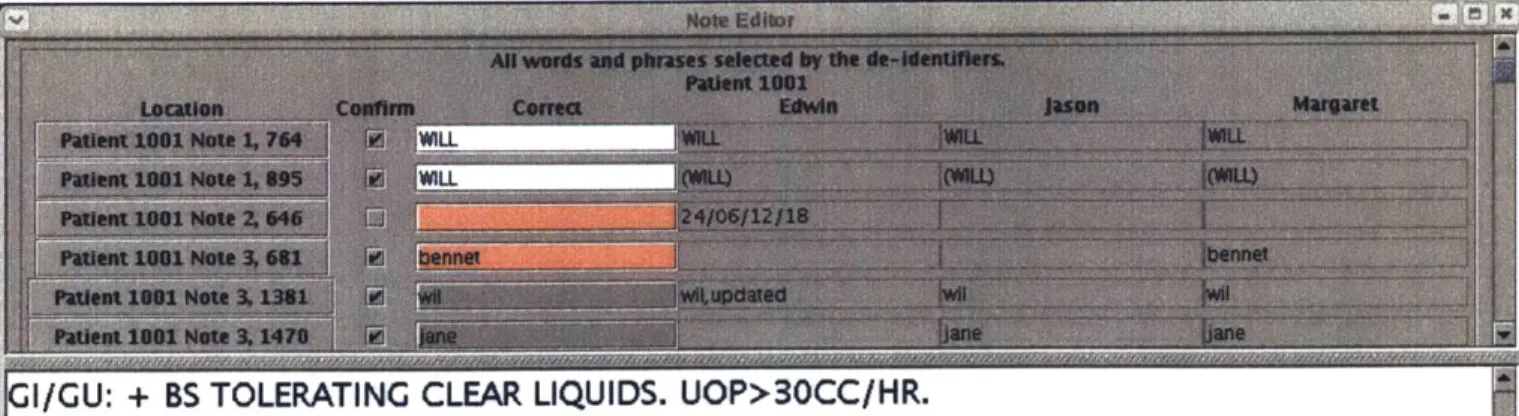
The user selects a set of notes and the individual de-identifiers who reviewed that section in a dialog box very similar to that shown in Figure 2-1 in the De-identification Mode. The selections for all the individuals chosen for the specified group of notes are combined and displayed. The first column is the location of the potential instance of PHI (Patient number, Note number, the character index of the start of the word). Clicking on the button changes the text on the bottom half of the screen to that specific note with the potential PHI instance highlighted, so the adjudicator can see the original context to evaluate whether the instance should be counted as PHI. The next column of check boxes indicates whether that instance should be counted as PHI. When the consensus is being first created, the box is checked only if a majority of the human de-identifiers selected the word as PHI. The "Correct" text column is an edit-able text field of the exact text that should be labeled as PHI. The leading and trailing punctuation is automatically removed. The "Correct" text is by default the text selected by the majority of human de-identifiers. If the majority did not select the text or if different parts of the word were selected by different de-identifiers, that text field is empty and must be manually filled in by the adjudicator. The "Correct" text field's background is colored white if all the de-identifiers agree, gray if a majority agree on a selection, and pink if less than a majority made the selection. The remaining columns display the complete text selected by each human de-identifier at that location. If no selection was made, that field is left blank. If the potential instance of PHI is not true PHI, the confirmation check box can be left unchecked and it will not be saved in the consensus file.
The instances of PHI that have been confirmed with a mark in the check box and have the "Correct" text field filled in will have the locations saved in a file (by default Consensus.deid). The consensus file can be altered in the "Revise Consensus" display, with all the confirmation boxes and text field filled out according to what has already been saved, or the user can directly alter the Consensus file in the De-identification Mode with the user "Consensus".
GI/GU: + BS TOLERATING CLEAR LIQUIDS. UOP>30CC/HR.
SOCIAL: SISTER & .(SIGNIFICANT OTHER) INTO VISIT. MULTIPLE PHONE CALLS FROM CO-WORKERS. ATTEMPT MADE TO LIMIT PHONE CALLS TO ONE CONTACT PERSON (WILL) PLAN: MONITOR HEMODYNAMICS. CONT TO WEAN NIPRIDE WHEN APPROPRIATE. PAIN
MANAGEMENT. REASURANCE WiTH PROCEDURES. ENCOURAGE CDB/IS USE. ENCOURAGE OOB.
Figure 2-4: The display for creating a consensus in the Aggregate Mode. The top half of the screen has a listing for every instance of identified PHI. At the bottom of the list, not shown in the figure, is an "OK" button that is pressed after the user has finished classifying all the selections.
2.3.2
Evaluate User
The selections of a single de-identifier are compared to the completely de-identified gold standard to calculate the sensitivity and positive predictive value of that de-identifier's performance. We adjudicated the evaluation to decide when to count agreements and disagreements as separate instances. The software initially parses every word as a separate instance of PHI.
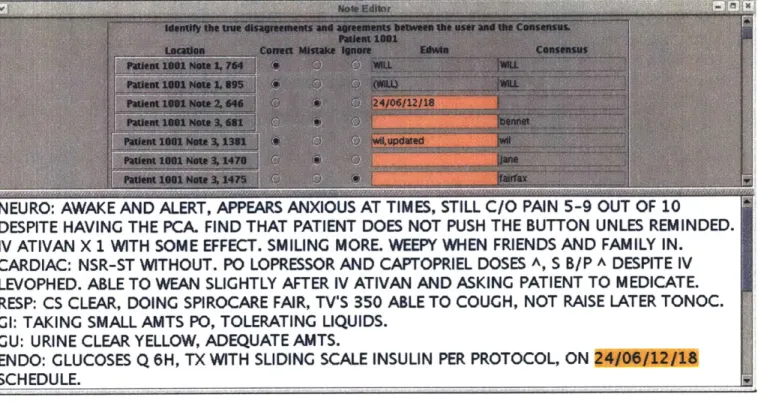
The user selects which identifier she is evaluating and the set of notes the de-identifier read through. All the selections made by the user and all the selections in the Consensus file for that set of notes are displayed in the interface shown in Figure 2-5. The first column displays the location of the selection. As with the Creating and Revising Consensus tasks, clicking on the button changes the text in the bottom half of the screen to that note text with the selected PHI highlighted. This allows the adjudicator to see the context of where the PHI appears when she is deciding whether multiple selections should be considered as one or multiple instances of PHI. The next three columns of radio buttons are the classifications for the PHI. By
NEURO: AWAKE AND ALERT, APPEARS ANXIOUS AT TIMES, STILL C/O PAIN 5-9 OUT OF 10
DESPITE HAVING THE PCA. FIND THAT PATIENT DOES NOT PUSH THE BUTTON UNLES REMINDED. IV ATIVAN X 1 WITH SOME EFFECT. SMILING MORE. WEEPY WHEN FRIENDS AND FAMILY IN. CARDIAC: NSR-ST WITHOUT. PO LOPRESSOR AND CAPTOPRIEL DOSES A, S B/P A DESPITE IV LEVOPHED. ABLE TO WEAN SLIGHTLY AFTER IV ATIVAN AND ASKING PATIENT TO MEDICATE. RESP: CS CLEAR, DOING SPIROCARE FAIR, TV'S 350 ABLE TO COUGH, NOT RAISE LATER TONOC.
GI: TAKING SMALL AMTS PO, TOLERATING LIQUIDS. CU: URINE CLEAR YELLOW, ADEQUATE AMTS.
ENDO: GLUCOSES Q 6H, TX WITH SLIDING SCALE INSULIN PER PROTOCOL, ON SCHEDULE.
Figure 2-5: The display for evaluating user performance in the Aggregate Mode. The top half of the screen has a listing for every instance of PHI. At the bottom of the list, not shown in the figure, is an "OK" button that is pressed after the user has finished classifying all the selections.
default, perfect agreements (except for leading and trailing punctuation) between the user and selection are counted as "Correct", disagreements (including different parts of the same word being selected) are counted as "Incorrect", and nothing is classified
"Ignore". The next column is the text selected by the de-identifier at that location. The text field is colored pink if there is a disagreement with the consensus. The last column displays the text labeled as true PHI by the consensus at that location.
After all the selections have been classified, the user clicks the "OK' button and the number of true and false positives and false negatives are counted and displayed in a dialog box. Those statistics are also written to the file username.stats. Those values are then used in calculating the sensitivity and positive predictive values for the de-identifier.
2.4
Re-Identification Software
The tools used for re-identifying the text were separate from the Deid package. The main components of the Re-Identification software are:
* suggest-reid.pl: Perl script that uses the list of locations of PHI to make
sug-gestions for text to replace the PHI. Calculates the random offsets for dates to be shifted.
* ReidDialog.java: Java graphical user interface that displays the suggestions to
the user and allows changes to those suggestions to be made.
* Reidentifier.java: Java code that reads the initial suggestions from the file
created by suggest reid.pl and saves the user's final selections in a different record file.
" ReidFile1)ialog.java: Java dialog for entering the file names needed for the
ReidDialog software.
" NoteManager.java and FileManager.java: Same as for the Deid software
described in Section 2.1.
* replace reid.pl: Perl script that uses the output from the Java program to
remove the PHI and replace it with the surrogate data, as well as record the new locations of the surrogate PHI.
2.4.1
Making Suggestions
The Perl script suggest-reid.pl takes as arguments the file with the locations of the PHI and the output file that records the suggestions of surrogate text to replace the PHI5. The script uses the Headers.txt file and all the raw data files (note-events1.csv,
"Usability Note: The code was designed to run on Perl v5.8.1. To run suggest reid.pl, assuming
that the file with PHI locations is Consensus.deid and the file with the record output is record.txt:
1. Move to the directory with the script.
2. Type into the command-line: "perl suggest-reid.pl Consensus.deid record.txt"
3. The output is written on record.txt, and you can use that file for running the ReidDialog Java
noteset2.csv, enriched - all.txt) to locate the notes with PHI and to extract the text
for each PHI instance.
The process for classifying each instance is summarized in Figure 2-6. For in-stances containing numbers, the script uses pattern-matching to look for dates and telephone numbers. If it does not match those patterns, it is given the label "UN-KNOWN". For instances comprised of only letters, the script groups instances that appear next to each other as complete phrases and uses look-up tables of common first and last names, locations, local hospital names, and hospital-specific terms. If the instance does not appear in any of the tables, it looks at the word preceding the PHI instance to see whether it is preceded by a title (i.e. "Dr") or a first name or an initial. That allows the code to properly label unusual last names. If a multi-word phrase is not, able to be labeled, the individual words in the phrase are classified separately.
Each instance is labeled as a type (ex. "Month/Day", "Last Name") and given a replacement. The dates in each patient's record are shifted by a random number of days calculated using code taken from [25]. The date is shifted by a random, non-zero number of years between -25 and 25. The year offset is converted to days and rounded to the nearest multiple of 7 to preserve the day of the week. Then the date is shifted
by a random, non-zero number of weeks between -2 and 2. By shifting all the dates by the same random offset, the patient's age is preserved, as are the time of year and
the day of the week.
The replacement names are randomly selected from lists generated based on lists of names of Boston and Chicago residents with the first and last names randomly switched. This way unusual or oddly spelled names can appear in the re-identified notes. Each name can only be used once in the entire collection of notes, even if only a first or last name is used. There are separate lists for female and male names, and when only a last name is needed, both lists are used for choosing a random name. The references to local areas are replaced with references to small towns in the Baltimore, MD area. The original hospital names are replaced with hospitals in Maryland. The direct references to parts of the hospital where the patient is being
treated at are replaced by references to fictitious buildings and wards in a fictitious hospital ("General Hospital", "GH", "Quartermain building", "floor q2"). Other types of PHI are not given suggestions. Capitalization of the suggested data is based on the capitalization of the original text.
Text that appears multiple times in the same patient's notes will always be given the same replacement text. So if a patient's friend Jennifer visits and the algorithm replaces the name "Jennifer" with "Eva", future occurrences of "Jennifer" will also
be replaced with "Eva". However, if her name appears as "Jenny" or misspelled
as "Jenifer", the algorithm will treat it as a new name and assign it a different replacement.
The output record file lists the start and end indices of the original PHI, the suggested replacement text, the original text, and the category the original text was given.
The suggest-reid.pl script shifts the dates in the headers for all the notes, whether
the note contained PHI or not. The new dates are recorded in the file offsets.txt and are used in the replace-reid.pl script.
2.4.2
Human Approval
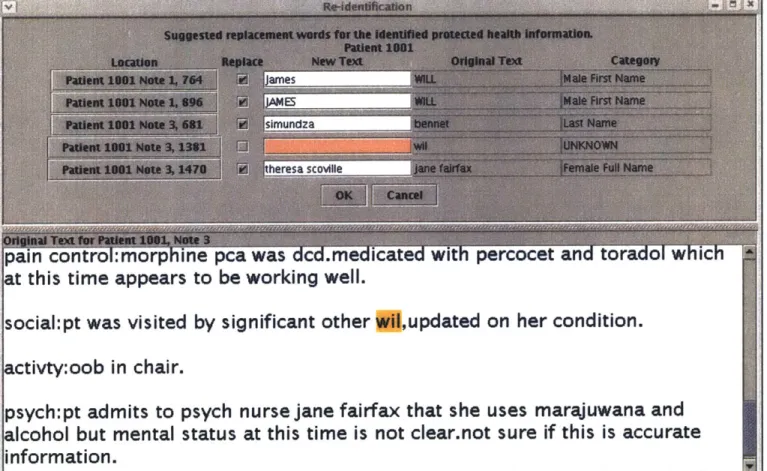
The ReidDialog Java graphical user interface6 allows the user to look over and edit the suggestions made by suggest-reid.pl. The ReidDialog software requires the user to input the names for the file with the locations of the PHI and suggestions for re-placements, which can be the output of suggest-reid.pl or the normal username.deid
file generated by the Deid software with no suggestions made for replacements; and
for the output file to record the approved suggestions. The ReidDialog main win-dow, shown in Figure 2-7, displays the location of the PHI, an edit-able text field with the suggested replacement text from suggest-reid.pl's output (or blank if the
suggestLreid.pl script was not used), the original text of the PHI instance, and the
6
To run the ReidDialog software:
1. Move to the directory with the source code.
2. Compile the Java code: "javac ReidDialog.java"
Date
Ele
Unknown
Ye
Telephone
Number
PHI instance
Contains
numbers?
s
N
0
Full Name
Male
First Name
Female First Name
Last Name
Look-up
tables
Location
Hospital
Name
Specific
Hospital Term
Else
Simple
Rules
Last Name
Figure 2-6: Classification of a single instance of PHI in the suggest-reid.pl script.
Pattern
matchingr
-category of the text that was assigned by suggest-reid.pl. If the -category was
"UN-KNOWN" from suggest-reid.pl, the background of the test field with the suggested
surrogate data is colored pink and the text field is left blank. The suggested surrogate data can be directly edited by the user to insert spelling mistakes or to use different
terms than those suggested. Clicking on the location of the PHI displays the original note text on the bottom half of the display and highlights the PHI text. Users can
then check that the surrogate text is reasonable in context. The approved suggestions
will be incorporated in the re-identified version of the text.
The approved replacements are written to a file (by default temp - replace.txt7)
after the user presses the "OK" button.
2.4.3
Replacements
The suggestions made by suggest-reid.pl and approved in the ReidDialog software are
inserted by replace -reid.pl. The script can be run from the command-line. The text
to be re-identified is specified in the patients.txt file. Each patient and the number of notes for that patient is listed in that file.' The original PHI is removed from all
the notes specified, the new surrogate data is inserted in the text, and the locations of the new PHI are recorded in the same format as a usual Consensus.deidfile. The dates in each note's header are replaced with the shifted dates from offsets.txt.
The final re-identified database has the characteristics of the original nursing note
7
Format of temp - replace.txt: Patient 1003 Note 4
27 32 GH 36 40 7/11
The first number is the character index of the beginning of the original PHI text. The second number is the index of the last character selected as PHI. All the text between those indices will be removed and replaced by the text in the third column.
8
Usability Note : To run replace-reid.pl, assuming that the file with PHI locations and
sugges-tions is suggest ions.txt, the file that will have the re-identified text is reid-notes.txt, and the file that will have the locations of the surrogate PHI in the re-identified text is reidilocs.deid:
1. Move to the directory with the script.
2. Type into the command-line: "perl replace-reid.pl suggestions.txt reid-notes.txt reid-locs.deid"
9Format of patients.txt:
Patient 1000: 1 Patient 1001: 5
pain control:morphine pca was aca.medlcatea wIan percocet ana toraaol wnIcn at this time appears to be working well.
social:pt was visited by significant other ,updated on her condition.
activty:oob in chair.
psych:pt admits to psych nurse jane fairfax that she uses marajuwana and alcohol but mental status at this time is not clear.not sure if this is accurate information.
Figure 2-7: The display for reviewing and changing the suggested surrogate data for re-identification.
text, but all the protected health information has been removed and replaced by authentic-looking surrogate data. The new Consensus.deid file generated by the script can be used for evaluating de-identification methods running on the re-identified version of the database. An algorithm that performs well on the re-identified database will also perform well on the original data.
Chapter 3
Development of "Gold Standard"
and Evaluating Performance
We need a large collection of nursing notes with many instances of different types of PHI for testing the performance of different methods of de-identification. Our "gold standard" reference database would have the locations of all its PHI recorded. To find the PHI we used both human and algorithmic methods of de-identification, as summarized in Figure 3-1. We used that gold standard database to evaluate the performance of different methods of de-identification.
3.1
Corpus
Medical data is collected as part of the MIMIC II project from patients admitted to the intensive care units of a local hospital [31]. The nursing progress notes are un-structured free text typed by the nurses at least twice a day, and include observations about the patient's medical history, his current physical and psychological state, med-ications being administered, laboratory test results, notes about visitors, and other information about the patient's state. In these notes, the nurses frequently em-ploy technical terminology, non-standard abbreviations, ungrammatical statements, misspellings, and incorrect punctuation and capitalization. Some sample notes are included in Appendix B.
Nursing
Note Text
Human
De-identification
Adjudicate
De-identified
Differences
Text
De-identification
Algorithm
Figure 3-1: Overview of the creation of the "Gold Standard" reference database.
The corpus we used includes notes from 166 randomly selected patients. There are a total of 2,785 notes, with a total word count of 356,103. Of those notes, 119 have been manually "enriched" to include PHI that is especially difficult to identify (such as "foley catheter" and "Parkinson's disease") and to include more instances of infrequently appearing types of PHI.
To determine the approximate corpus size needed, a standard sample size estimate
[17
can be used.(3.1)
where E is the margin of error, p is the population proportion, and Z(1 - 2) reflects
the desired level of confidence. Since we wish to distinguish between a 90% and 93% accuracy level, E = 0.03 and Z(1 - a) = 1.96 (from tables). A conservative value
for p is 0.5, which maximizes the value of N in equation 3.1 (see [17]). Following this formula, at least 1068 instances of PHI are required in our testing database.
3.2
Human De-Identification
Medical house officers from local hospitals were recruited to locate and label the PHI in the nursing note corpus. Every clinician came in for a 3 to 6 hour time block, including breaks. They were paid $50 per hour, with the additional incentive of a
Z(1 - a)
$200 bonus for the best performer in a group of 6 de-identifiers.
Each clinician was given a text definition and examples of what is defined by
HIPAA as PHI. They were encouraged to make a best guess for ambiguous cases. A
Java application (described in Section 2.1) displayed the nursing note text in an easily readable format and recorded the locations of the PHI identified by each clinician. The software was run on a tablet PC, and clinicians located PHI by tapping the word on the screen with the tablet's pen. The locations of the PHI in every note were written to a file.
The entire process of human de-identification is summarized in Figure 3-2. The nursing notes corpus was separated into four sets approximately equal in size, and each set of notes was de-identified by three clinicians independently. A subset of the data was de-identified by four clinicians, but no advantage was found by adding the fourth person.
For comparison purposes, consensuses without an outsider adjudicator were
cre-ated for two clinician subsets and for three clinicians subsets using the simple createUnions.pl Perl script. The unadjudicated consensuses were created by taking the union of all
selections. Most, of the errors made during human de-identification are false negatives, so taking the union minimizes the number of missed false negatives.
In the Java interface described in Section 2.3.1, the selections of all clinicians for each note are combined and displayed, and a suggestion for the correct text is generated based on the majority response. A clinician referee from our group reviewed the selected PHI and checked the context of each selection in the original note text in order to make the final decision as to whether a word should be classified as PHI.
3.3
Algorithm
The algorithm described in Section 1.4.4 [25] was used to locate PHI in the entire collection of nursing notes. The output of the algorithm was not in the format of what the Deid code accepted as input, so extra processing had to be done to the algorithm's output so that it would be compatible with the testing software. The
Clinician
labels PHI
Nursing
Clinician
Combine all
Adjudicate
Note Text
labels PHI
PHI
selections
Consensus
Clinician
labels
PHI
Figure 3-2: The human de-identification process.
get-indices.pl Perl script was able to extract the indices of most of the labeled PHI,
then I manually went through the list of errors detected by the script to add those indices to the list of found PHI by the algorithm. Once the algorithm's results were converted into the same format as the selections made by humans using the rest of my software, the Deid software could be used to compare its PHI with that of the humans.
Of the PHI that only the algorithm found, I removed obvious false positives from
the list and had a clinician verify all the reasonable-looking new PHI found only by the algorithm and not by the human de-identifiers.
3.4
Evaluation of Performance
The selections made by a given de-identifier are compared with the "gold standard" selections. (The software to do so is described in Section 2.3.2.) An adjudicator must decide when to count agreements and disagreements as separate instances. By default every word is counted as a separate instance, so finding the name "Dr. Everard van
Tijlen" would weigh more heavily than the name "Charity Dawson", and locating the place "New York City" would count more than finding "Newton".
The de-identifier is given credit or penalized only once for each instance of PHI, no matter how many words that instance consists of. If a de-identifier found part of a multi-word PHI phrase, she was not penalized for missing the rest of it. The PHI instance is counted as successfully located. If a de-identifier selects additional words around the actual PHI, like the title "Dr" before "Everard van Tijlen" or "Medical Center" after "Baystate", she is not penalized.
If the de-identifier systematically marks the same text incorrectly as PHI, such as
the name of a ward, she is only penalized once even if she continues to mark subsequent appearances of the term. The additional occurrences are ignored. Finally, there were instances when the de-identifier was uncertain and asked about how to classify a term.
If we later change our mind about that classification of that ambiguous case, we do
not penalize them for marking it as we told them when they asked.
3.5
Concerns
By the time a note is pronounced completely de-identified, four different clinicians
and one algorithm have looked at the text.
The evaluation process was very time-consuming and subjective. We were consis-tent in our enforcement of what to count as separate instances for all de-identification schemes for comparison purposes, but we may have been overly lenient in excusing missed parts of phrases.