Community Memory
Building multimedia archives on the Internet
by
Ingeborg Loni Endter
A.B. Extension Studies, Social Sciences Harvard University, 1977
Submitted to the Program in Media Arts and Sciences, School of Architecture and Planning,
in partial fulfillment of the requirements for the degree of Master of Science in Media Arts and Sciences
at the
Massachusetts Institute of Technology February 2000
@ 1999 Massachusetts Institute of Technology All rights reserved
Signature of author
Certified by
Senior Research
Progam i l dia Arts and Sciences September 30, 1999
Walter Bender Scientis Media s and Sci nces Su rvisor Accepted by
u ZO
tephen A. Benton Chair, Departmental Committee on Graduate Studies Program in Media Arts and Sciences
Community Memory
Building multimedia archives on the Internet
byIngeborg
Loni Endter
A.B. Extension Studies, Social Sciences Harvard University, 1977
Submitted to the Program in Media Arts and Sciences, School of Architecture and Planning,
on September 30, 1999 in partial fulfillment of the requirements for the degree of
Master of Science in Media Arts and Sciences
ABSTRACT
Can we use technology to build and strengthen bonds within communities? Can we build technology that will help to elaborate and preserve the shared history of a community? Can we make the technology easy to use, even for beginning computer users?
Community Memory is an attempt to answer those questions. It is a Web-based environment where a community can collaborate to build an electronic scrapbook. Narrative expression, both as stories and as photographs, is the tool with which the
communities elaborate their shared history and identity. Two communities, an extended family and a high school reunion class, have begun using the tools, and data was collected on their interactions during a period of several months. The communities were given an email list to use as well as the Web-based tools of the scrapbook.
The data show that communities approach the project quite differently and that strong preferences emerged both between the two groups and within one of the groups for different modes of communicating their stories.
Thesis Supervisor: Walter Bender
Title: Senior Research Scientist, MIT Media Arts and Sciences
This work was supported in part by the MIT Media Laboratory's News in the Future research consortium and Telecom Italia.
Community Memory
Building multimedia archives on the Internet
by
Ingeborg Loni Endter
The following people served as readers for this thesis:
Reader
Glorianna Davenport Principal Research Associate MIT Media Laboratory
Readr
John S. Driscoll Editor-in-Residence, News in the Future Research Consortium, MIT Media Laboratory
/
(x
Brian Smith Assistant Professor of Media Arts and Sciences LG Career Development Professor of Media Arts and Sciences MIT Media Laboratory Reader
Acknowledgements
My heartfelt thanks go to the following people, who got me to the day:
My husband, Juern Juergens, who carried more than his share of the household chores while I was otherwise occupied, and who gave unstintingly of his love, moral support, logistical support, and advice. And my children who never thought it was unusual that Mom was back in school. (I love it when they say, "I'm so proud of you, Mom.")
My advisor, Walter Bender, who always reminded me to "keep it simple," and whose criticism and advice was always "spot on," thus keeping me on the right path.
My readers: Jack Driscoll, who is ever a sure source of encouragement and wisdom-for both the academic and practical aspects of this thesis; Brian Smith, who continually found new ways to look at problems and issues, and Glorianna Davenport, who urged me to push the envelope and who had many fresh ideas I hadn't thought of.
Many thanks to the Endter extended family and to the Melrose High School '49ers who were cooperative, enthusiastic, and kind as they jumped into using my software. Special thanks to Don Norris, who connected me to the '49ers and who was a loyal evangelist for the project.
Professor Justine Cassell gave me insights from the field of linguistics and discourse and helped me to formulate the measurement of my data.
My work-buddy, Jennifer Smith, kept me on track when I would rather be gardening and also provided numerous tips for my research, reading, and programming. Many other colleagues at the Lab gave generously of their
technical advice, helped to solve programming problems and gave moral support when that was needed: Tara Rosenberger Shankar, Pengkai Pan, Doug Koen, Janet Cahn and others too numerous to mention. You know who you are.
Joanna Berzowska was my artist-angel, who helped me improve the aesthetics of my web pages.
Marina Umaschi Bers helped get me started by sharing the experience of her Kaliedostories project.
My undergraduate research assistants, Tuyet Nguyen, Arnold Kim, and Dennis Quan, who kept everything running smoothly so I could finish this thesis.
The memory of my parents, Paul and Anna Endter, contributed immensely to my ideas for this project. Their courage and wisdom motivated me to care about family and community. And to care about memories..
Table of Contents
I
ntroduction... ... 11Impact of technology on the life of a community ... 1
Disintegration of community and d sense of alienation in individuals 1... The HomeNet study ... 1 3 2 The questions this research is trying to answer ... 1 5 3 Definitions and theory ... 1 6 What do we mean by community? ... 1...6...1 6 Sharing Our History: Narrative and Photography ... 17
Narrative... .7...17
Photography ... 20
4 The State of Community on the Internet ... 22
Geographic communities... 22
Virtual
Community
Sites ... 23Demographic Community Sites ... 23
Ethnic or political communities ... 24
Sites For telling stories ... 24
Photo Albums, Memories ... . ... 24
5 Related research... 26
The Silver Stringers ... 26
Te Melrose Miror and Sdtte ts... . . .. 27
The unlor ourn./...30
MUSiC ... 32
SAGE ... 33
Kaleidostories ... 33
6 Community Memory: design and implementation ... 34
Goals and design requirements ... 34
The software ... 35
The architecture ... . ... . 36
Database design ... 37
Functional ty ... 38
User Interface ... ... 40
A Tour of the Scrapboo ... 44
The participants ... 49
The Endter extended Family ... 49
Melrose High School reunion cass oF 1949 ... ... 50
Getting started ... 51...51 Email lists ... 51 Registration ... 51 Start-up Questionnaire ... 52 Evaluation oF data... . ... 54 Sources of data...55... 5
Comparison of the two groups and the modes of interaction ... 55
Participants' reactions ... 60
Discussion and conclusions... ... 63
Differences between communities ... 63
Further /ark ... 66
7 Bibliography... 68
8 Appendix A: Start-up Questionnaire ... 73
9 Appendix B: Follow-up Questions ... 79
List of Figures
Figure 5 1 From Te Me/rose M11ror series on the Great Depression ... 28Figure 5 2 From the Sdttere-/ihts series Featuring stories about Active Seniors 29 Figure 5 3 The Front page of the August 1999 edition of the Junior Joum. 31 Figure 6 1 Server, clients inked by Internet ... 36
Figure 6-2 Database and application server ... 37
Figure 6 3 The login page ... 44
Figure 6 4 The welcome page ... 44
Figure 6 5 Browsing the database ... 45
Figure 6 6 Viewing a picture ... 45
Figure 6-7 Viewing a story... . ... 46
Figure 6-8 Adding a comment to a picture ... 47
Figure 6 9 The story editor ... 48
Figure 6-10 The mail page ... 48
Figure 6 11 Melrose and Endter group compared by activity ... 56
Figure 6-12 Melrose participants: logins to scrapbool compared with email messages ... 58
1
Introduction
When Emerson was told that the installation of the Trans-Atlantic Cable would in the future permit someone in London to speak to someone in New York, he is said to have remarked, "But will he have anything to say?"'
If we assume that the Web will someday be an everyday phenomenon, then I feel we should think ahead to ways that it can contribute to the social environment in a positive way.
I hope that my research can shed light on at least one narrow area where the technology of the Internet can have an effect on how we think about community, how we can interact within a community, and how we can help communities to communicate.
Impact of technology on the life
of
a community
It seems to us that we are getting perilously near the ideal of the modern Utopian when life is to consist of sitting in armchairs and pressing a button. It is not a desirable prospect; we shall have no wants, no money, no ambition, no youth, no desires, no individuality, no names and nothing wise about us.
-The Electrician, 11 February 18922
Disintegration of community and a sense
of
alienation in individuals
Many voices have been raised in the press and in the academy about how new media, particularly the Internet, affect an individual's sense of identity and level of social interaction. (Birkerts, 1994, Grodin and Lindlof, 1996, Turkle, 1995). Their concerns have a familiar ring. Technology has been of concern to thescholarly and political communities since the Industrial Revolution in the 19th
Century. As early as 1829 Thomas Carlyle wrote, "The machine represents a change in our whole way of life because 'the same habit regulates not our modes of action alone, but our modes of thought and feeling. Men are grown mechanical in head and in heart, as well as in hand."' (quoted in Marx, 1964 p.174)
The concern for the future of community life has become particularly acute since World War II. There has been a profound change in the fields of psychiatry and sociology as the country began to recover from the social and economic upheavals of the 1930s Depression, the War, and a revitalized post-war economy. Just after
Briggs, 1977, p. 50. I presume the author is referring to the poet and essayist Ralph Waldo Emerson, 1803-1882.
WWII there began a new emphasis on community psychology and community psychiatry as a side-effect of returning veterans' needs and the vast changes in communities during and after the war.
Some might agree that the absence or dilution of the psychological sense of community is the most frequent and poignant feature of life in our communities, that in the context of social living it gives rise to the intrapersonal and interpersonal dynamics that heighten rather than lessen the sense of aloneness, that it acts as both cause and effect of disordered thinking and acting, that it nourishes the experience and strength of ineffable anxiety-and while agreeing that all of this may be true, as countless writers have maintained, they may still ask, what can the psychologist or psychiatrist do except help individuals cope more effectively with this problem? Who can listen to our patients describe their desperate efforts, through work or play, to feel part of some larger entity, to break through the barrier of aloneness, to feel part of and wanted by others-who can listen without agreeing that all of this in some ways reflects how our communities have changed, diluting rather than reinforcing a sense of community? But what can we do about it?
This was the question which in the past two decades came to haunt psychology and gave rise to the new field of community psychology. The question was answered in different ways by different people , but there were, nevertheless, some underlying agreements: focus had to shift from an emphasis on intrapsychic factors to understanding and changing larger social contexts; adapting such a focus would require new conceptualizations and tactics; and the major criterion by which these new efforts would be judged was the degree to which they led to a greater psychological sense of community. (Sarason, 1974 p.154-155)
The age of the automobile and the economic growth of the 1950s spurred the growth of suburbs, the decline of inner cities, and increasing mobility of workers and their families. A few observers spoke eloquently about the impact of policies and trends in urban design and suburban development. (Jacobs, 1961, Mumford,
1968). The impact of radio and television went further than altering our
geography. They began to change the balance between the public and the private spheres, our sense of public and private roles and places (Meyrowitz, 1985). As more and more people began to spend more time in front of radios and then televisions, fewer and fewer opportunities for informal public socializing were available.
Ray Oldenburg in The Great Good Place argues that modern American society lacks "third places," places distinguished from one's home, where personal and family relationships are nurtured, and one's work, where at best one pursues career and professional goals-or at worst joins the "rat race." Our politics put little value or priority on enhancing shared social spaces that are free and available to the public. Social trends emphasize the acquisition of things like entertainment systems and outdoor play equipment for one's own home that used to be shared by a community at local theaters or playgrounds. Politically and socially Americans place more value on owning one's own pool than spending time at the community pool in the neighborhood. As a consequence, opportunities for informal social encounters are becoming rarer. Third places are neutral ground where social distinctions are leveled, where a playful mood is a hallmark, and where regular visitors engage in conversation as one of the main activities. They
are the underpinning of community life, and, as Oldenburg points out, they are rapidly disappearing.
Can Internet technology, while it presents to some a bleak picture of individuals retreating from face-to-face social interaction, actually provide some form of a third place? I do not by any means advocate replacing real, tangible third places with virtual ones. But the possibilities presented by an enriched form of
communication within communities are intriguing. The Internet has created many opportunities for virtual communities to form around common topics of interest (Rheingold 1993). Chat rooms already fit Oldenburg's definition of a third place rather well: they provide an informal social space, a playful atmosphere, a neutral ground where conversation is the primary activity. But the quality of interaction in chat rooms differs immensely from the face-to-face encounters in cafes, coffee shops and community centers (Turkle 1995). I'm concerned with a different problem of real communities that technology might alleviate. Sarason's description of people's desperate efforts to feel a part of some larger entity reminds us that most of us do have communities to which we nominally belong: extended families, school communities, even religious and ethnic communities. But often for one reason or another we have become distanced from these
communities. In addition to the disappearance of third places where communities can meet informally and coalesce, many communities, formerly kept together by physical proximity, are now scattered geographically and losing touch with their identity as a community, and with each other as individuals.
The
HomeNet study
I suspect that in the not-too-distant future, the worship of technology will be widely recognized as a destructive force, responsible for the extirpation of family,
community, and nature on a global scale.
-Harvard alumna, in a letter to the editor,
Harvard Magazine, September-October 1999
Given the inevitable impact upon communities of new media and communication technology, is there hope that we can avoid the fate predicted by the doomsayers (Birkerts 1994, Henderson 1996, Stoll 1995) and actually improve the life of communities? What can designers and creators of new technology contribute to such an optimistic goal? The HomeNet study provides some intriguing results and challenges.
Researchers at Carnegie Mellon University conducted an ambitious study on the social and psychological impact of Internet use. Beginning in 1995, a total of 93 families in the Pittsburgh area were provided with computers, a free phone line, free access to the Internet, and a basic suite of applications including an email program, a Web browser, and Claris Works Office. They were monitored for a period of up to two years. Data gathered by monitoring Internet use and following up with psychological measurement tests revealed that greater use of the Internet
was associated with declines in social involvement and increases in depression and loneliness.
The authors offer some remarks on implications for policy and design: Designing technology and policy to avoid negative outcomes will depend on a more complete understanding of the mechanism through which use of the Internet influences social involvement and psychological well-being. If we assume, for example, that the negative consequences of using the Internet occur at least partly because people spend more time and attention on weak ties and less time and attention on strong ties, then some design and policy solutions come easily to mind. Most public policy discussion of the Internet has focused on its potential benefits as an information resource and as a medium for commercial exchange. Research funding also heavily favors the development of better resources for efficient information delivery and retrieval. Both policy and technology interventions to better support the Internet's uses for interpersonal communication could right this imbalance. (Kraut et al 1998)
2
The
questions
this research is trying to answer
People capable of afflicting anybody, anything or anyplace with a name like "cyberspace" surely cannot have the spiritual and esthetic delicacy essential to creation of a magical, irresistible playground, can they?-Russell Baker, A Little Cyber Grouch3
Taking up Baker's gauntlet, I offer the Community Memory project as an inquiry. If we disregard for the purpose of this thesis the problems and dilemmas posed by communities that exist only as virtual communities, I pose the following
questions:
1. Can we use technology to build and strengthen bonds within physical
communities that are becoming fragmented in our postmodern era? Can such technology actually influence the psychological sense of community?
2. Can we build technology that will help to elaborate and preserve the shared history of a community? Does the power of a shared history of stories and images translate to the Internet? Can technology facilitate the storytelling process, the image sharing -- and the discussions that come about when sharing is possible?
3. Can we create technology that is easy enough to use so that we lower the barriers for those who are uncertain about whether they can master the technology?
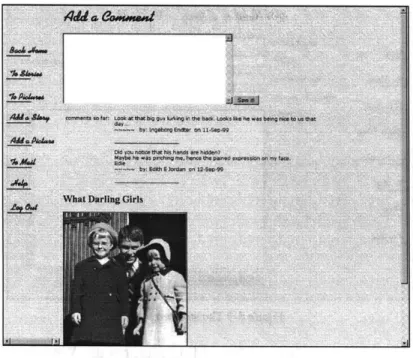
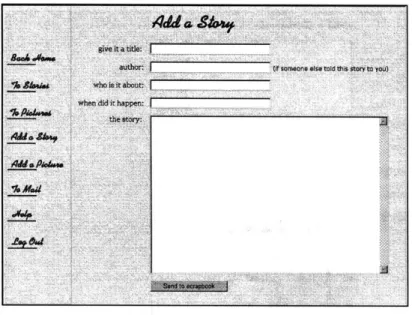
To try to answer those questions I have built a Web-based environment where a community can collaborate to build an electronic scrapbook. Since I believe that storytelling is a powerful means by which a community can pull together, I provide tools for narrative expression, both as stories and as photographs. The tools are designed to help the members of the community to elaborate and explore
their shared history and identity.
Two communities, an extended family and a high school reunion class, have begun using the tools. Both communities were given an email list to use as well as the Web-based tools of the scrapbook. Trying to discover whether the tools and the process of building the scrapbook accomplished the goals I had set for the project, I collected data on each community's interactions during a period of several months. I present details of the project's design and functioning, and my analysis of the data in section six.
3
Definitions
and
theory
What do we mean
by
community?
"Community" now has become a buzzword, a bandwagon concept, but what does it mean?
First let's try to define what we'll be talking about when we say "community" in the context of this paper. What is a community? What are the aspects of a healthy community? Sarason's (1974) seminal work, The Psychological Sense of
Community: Prospects for a Community Psychology, made a beginning. He was
not referring to a geographic unit, although people in a town or neighborhood could be defined as a community in his sense. He described the properties of a community: its members have a perception of similarity to others in the group, they acknowledge an interdependence among members of the group, and the members feel that they are a part of a larger dependable and stable structure. McMillan and Chavis (1986) refined Sarason's definition. They emphasized four main characteristics that distinguish a community:
e Membership - members have a feeling of belonging
e Influence - members have a sense that the group matters, that as a group they
can make a difference
e Integration and fulfillment of an individual's needs (reinforcement) - the
association with the community must be rewarding for its members. "A strong community is able to fit people together so that people meet each others' needs while they meet their own." Shared values make it possible for
communities to provide the necessary balance of priorities to be successful at meeting members' needs.
" Shared emotional connection - in particular, a shared history
Ten years later, McMillan (1996) reflected upon his earlier definition and reformulated the four characteristics as:
e Spirit - a setting where we can have connections to others, but where we can
be ourselves. There should be a sense of "emotional safety," "boundaries," and a "sense of belonging."
e Trust - there should be some sense of order. We know that some in the
community have more power than others, but we acknowledge and trust that structure.
e Trade - a sense of how members benefit one another and the community. The
ideal is to "transcend score-keeping and.. enjoy giving for its own sake."
e Art - "a shared history that becomes the community's story symbolized in
Jacobs (1961), Oldenburg (1989), and Sarason (1974) are among the many voices in the fields of urban design, sociology, and psychology who point out that when changes-physical, political, or social-are made in a geographic community it is important for community leaders and social scientists to evaluate the impact upon the community and to design the changes to minimize the negative and maximize the positive effects on the community.
One could argue that the positive sense of belonging to the larger community was easier to achieve in the past because communities were so much smaller, more face-to-face contact was possible, it was not difficult to know a lot about how the community worked, and it was not hard to see with one's own eyes everything that existed within the community's boundaries. But this argument begs the most important question: how did it happen that our communities permitted a type and rate of growth that destroyed for many people the psychological sense of community? It was not growth per se but a type of growth not governed by the value of maintaining or bolstering the psychological sense of community. (Sarason, 1974 p.153)
In thinking about what sort of online environment would support and enrich community life, the four aspects of the psychological sense of community provide some guidelines. An ideal environment would be one where community members could participate, because they feel that they belong. It would provide a sense of security and emotional safety. Members of the community could establish some form of order if they chose, but they would all have opportunities to make contributions and share the benefits of those contributions. And finally, there would be an opportunity to explore their shared history in what McMillan (1996) calls Art-storytelling and pictures.
Together these elements [Spirit, Trust, Trade] create a shared history that becomes the community's story symbolized in ART. A picture is truly "worth a thousand words" and stories represent a people's tradition. Song and dance show a community's heart and passion. Art represents the transcendent values of the community. But the basic foundation of art is experience. To have experience, the community's members must have contact with one another. Contact is essential for
sense of community to develop. (p.322)
Sharing
Our History: Narrative and Photography
Narrative
"Looks like this old city finally learnt how to have fun," Rashid grinned. "But why," Haroun asked. "Nothing's really changed, has it? Look, the sadness factories are still in production, you can see the smoke; and almost everybody is still poor..."
"I'll tell you what to be happy about," said a policeman who chanced to be floating by on an upturned umbrella ."We remembered the city's name."
"Kahani," said the policeman brightly as he floated off down the flooded street. "Isn't it a beautiful name for a city? It means 'story', you know."
-Salman Rushdie, Haroun and the Sea of Stories
Rushdie's characters are marveling at the change in a community-brought about by a change in the community's attitude toward stories. The identity and character of communities are defined and shaped by the stories that make up their shared histories. A community's history is constructed by the passing down of stories from generation to generation. And as new generations come into the community, they define how they fit into the ongoing history based on what they know and assimilate of the collected stories.
The last 20 years have seen a resurgence of interest in integrating narrative into a variety of disciplines. There are many complex reasons for this but an important factor is the disenchantment with mechanistic models of thought about human behavior and a backlash against the scientific and technical search for ultimate
"truth." The loss of meaning in modern life can be (and has been) attributed to the replacement of narrative knowledge by other more technical forms of cognition. Practitioners are seeking methods that, unlike the more traditional quantitative methods, allow them "to reconstruct social phenomena in their full richness and complexity." (Hinchman and Hinchman, 1997)
Of particular interest to my research is the role of narrative in exploring
community and personal identity. The psychologist Dan McAdams (1993) uses the concepts of narrative and personal myth to build on Erik Erikson's life cycle theory of human development. He maintains that beginning in infancy we start to collect images, symbols, and attitudes (hopefulness, optimism, pessimism) from which we later fashion our personal myths. In adolescence we use our arsenal of images and symbols to try to formulate meaningful answers to the cosmic
ideological questions which are awakening in youthful minds. In adulthood we try to give meaning to the lives we are living, and as we grow older we struggle with the myth's denouement and strive to leave a legacy that will survive us. McAdams maintains that we create our identities, our personal myths, much as we fashion stories. We build on the characters that we have internalized and we use them and the images and attitudes of our personal myths to give meaning to the events of our lives.
The continuing activity of building stories of personal history and meaning is not only a solitary activity. McAdams emphasizes that individual stories are
interrelated with other individuals' stories. "The stories we create influence the stories of other people, those stories give rise to still others, and soon we find meaning and connection within a web of story making and story living. Through our personal myths we help to create the world we live in, at the same time that it is creating us." (1993, p.37)
From the viewpoint of moral philosophy, Alasdair MacIntyre (1984) contends that all attempts to explain the notion of personal identity independently of the
notions of narrative, intelligibility, and accountability have failed. He, like
McAdams, describes the correlative aspects of what he calls "narrative selfhood:" I am not only accountable, I am one who can ask others for an account, who can put others to the question. I am part of their story as they are part of mine. The narrative of any one life is part of an interlocking set of narratives. Moreover this asking for and giving of accounts itself plays an important part in constituting narratives. Asking what you did and why, pondering the differences between your account of what I did and my account of what I did, and vice versa, these are essential constituents of all but the very simplest and barest of narratives. (p.256)
The psychologists Kenneth Gergen and Mary Gergen (1983) present a social constructionist view of narrative. They too maintain that we do not simply arrive
at a sense of identity, but that we engage in an ongoing effort to understand ourselves through stories. Over a lifetime of social interaction we develop a capacity for this understanding and a capacity for communicating it to others. The social utility of narrative is important to the entire community. Our society affects us as we affect it. In their view, "those people with an extensive background in the history of their culture or subculture, or with an elaborated sense of their place in history, may possess more coherence among narratives than those with a superficial sense of their historical position." (p.172) In society hardly any individual action is without an effect on others. We rely on each other to
understand our actions and react appropriately. "This delicate interdependence of constructed narratives suggests that a fundamental aspect of social life is a reciprocity in the negotiation of meaning." (p.178)
Finally, the communication theorist Walter Fisher (1997) goes farthest into the discussion of the importance of narrative to communities. He argues that "the constitution of communities requires the existence of certain modes of
communication." He proposes a narrative paradigm for formalizing and
understanding the experience of human communication. His paradigm has five presuppostions (p.314):
1. Humans are essentially storytellers
2. The definitive modes of human decision and action are "good reasons" (elements that provide warrants for accepting or adhering to the advice fostered by any form of human communication that can be considered rhetorical).
3. The production and use of good reasons are ruled by matters of history, culture, and character along with the specific constraints of time and place of representation.
4. Rationality is grounded in the nature of persons as narrative beings, in their inherent awareness of narrative coherence-whether or not a story hangs together, and narrative fidelity-whether or not the stories they experience ring true to the stories they know or believe to be true.
5. The world as we live it is a series of stories that must be chosen among in order for us to live life in a process of continual re-creation.
Fisher's communities adhere to sets of values that might (and often do) conflict with the values of other communities to which the same person might belong. We all strive in our lives to bring coherence to these conflicting sets of values. The process of exploring and understanding these common values through the exchange of stories is a key element in the life of a community.
Photography
Anyone who knows what the worth of family affection is among the lower classes, and who has seen the array of little portraits stuck over a labourer's fireplace ... will perhaps feel with me that in counteracting the tendencies, social and industrial, which every day are sapping the healthier family affections, the sixpenny photograph is doing more for the poor than all the philanthropists in the world.
-Macmillan's Magazine [London], September 187 14
We may think the journalist's conclusion goes too far, but few would dispute the idea that family photographs have a power and value far beyond their physical representation as snapshots. The photographic medium was quickly adopted as a
domestic, popular medium in the 19th century. It became easily available and widely used with the introduction by George Eastman of the "Kodak" box camera in 1888. Eastman's motto "You push the button, we do the rest," brought
photography to the masses (Newhall, 1964). Today, more than a hundred years later, we are surrounded by images, moving and still, on all the media except radio. The Internet as we know it today (really, the World Wide Web) has become
a multimedia experience rather than exclusively a text medium. Since we have this new affordance in the realm of Internet communication, we can take
advantage of the narrative qualities of photography and include it as an important mode of communication that we can offer to communities.
Susan Sontag (1977) wrote about how families (and other groups) use photographs to construct a chronicle of themselves. Photographs are a way of documenting experience, certifying that this or that event did happen.
Furthermore, in families photography has become so commonplace that not taking pictures of one's children could be construed as parental indifference. But the real power of personal5 photographs is their content and meaning, which can change on each viewing and for each viewer. Roland Barthes (1981), in sorting through his mother's papers and photographs after her death, found only one that he felt really allowed him to recognize his mother. It is a photo of her as a child, in the garden with her brother. All the other pictures, he contends, show only aspects of his mother. Despite his pages and pages of reflection on the nature of reality-of the photograph and the scene that was photographed-and on different
4 Quoted in Sontag, 1977.
5 What I call "personal" photographs are those that have some personal connection to the viewer, either as
family photographs or photographs relating to some group to which the viewer belongs. I shall confine this discussion to personal photographs.
ways of seeing, we never really know why this photograph and not others moved him so. It is significant that while he shows us many other photographs in his essay, he never shows the childhood photo of his mother. While we as readers and
strangers to Barthes can understand the significance of the other photos he
chooses to show, we could never share his experience of viewing the photo of his mother as a child.
Exactly because of their ability to carry special meaning within a community, photographs, like stories, document and shape the collective memory of
communities. Like McAdams' and the Gergens' belief that our stories shape us as we shape them, William Mitchell (1992) uses similar language to talk about photography:
We make our tools and our tools make us: by taking up particular tools we accede to desires and we manifest intentions. Specifically, the tools and media of traditional photography.. .represent the desire to register and reproduce fragments of visual reality.. .They characterize a way in which we have wanted to see the world, and in the world since 1839 they have played a crucial role in the creation of collective memory and the formation of belief. (p.59)
Marianne Hirsch (1997) discusses the role of photography in postmodern society. She probes the acts of looking and being looked at, what she calls the "familial gaze" and its effects upon how we construct meaning from the collaboration of looking and being observed in the family context. "Photographs offer a prism through which to study the postmodern space of cultural memory composed of leftovers, debris, single items that are left to be collected and assembled in many ways, to tell a variety of stories, from a variety of often competing perspectives." (p.13) We are not only shaped by our stories and the memories evoked by photographs, we are also influenced by our experience of the memories of others-what Hirsch calls "postmemory." Postmemory is distinguished from memory by generational distance (my generation's memory of World War II is through the memories, photos, and stories of my parents, not my own) and from
history by deep personal connection.
It is precisely this deep personal connection that makes photographs an important tool for probing and understanding communities' values-those they share and those they reject-and their shared history.
4
The State
of Community on the
Internet
It is not possible to provide an exhaustive guide to sites on the Web that claim to create, support, or target communities. For the purpose of putting my research in context, I will give a selective review of sites that are based on community ties-geographic, demographic, or virtual-and those that emphasize communication or community memory via stories or photographs.
The earliest forms of communities of interest on the Internet, the newsgroup and the listserv, are alive and well. They are probably still one of the most successful forms of electronic community and they serve to illustrate that communication is the most important feature of Internet technology for communities.
Geographic communities
The Community Network movement began in the 1970s. A project called "Community Memory,"6 begun in the mid-1970s in Berkeley, California was
probably the first attempt to create a computer network within a geographical community (Schuler, 1994). It and many of the community sites that followed it were bulletin-board systems with a text-only user interface. Most were
community-supported projects that offered free access to the service via a local dial-in phone number.
When I tried to discover whether any of the early free-nets had made the transition to the Web, I found the Public Access Network Directory,
(http://www.clir.org/pand/pandhome.html). The Council on Library and
Information Resources (CLIR) now hosts the directory. The main page leads to a nationwide list of public access sites. The home page announces that in 1996 CUR was awarded a two-year grant to improve and maintain the directory. Most of the access information on individual sites lists a dial-in telephone number and sometimes an FTP address. There is no sign that the site is being actively
maintained. Although exploring the fate of the early free-nets is not in the scope of my research project, it would be interesting to investigate for those who are studying geographic communities online.
One geographic community that has a very successful presence on the Web is the
Blacksburg Electronic Village (Cohill and Kavanaugh, 1997, Carroll and Rosson,
1996) (http://www.bev.net/). Blacksburg Electronic Village was begun as an attempt to share some of the computing resources of Virginia Tech with the citizens of Blacksburg, many of whom were students, faculty, or staff of the
6 When I named my project Community Memory, I had not heard of the Berkeley project. However, I hope
University. Today it is a collaboration with the university and private community resources.
The developers of KOZ.com -"Reinventing Communities Online" (http://www.koz.com/), sell a software system called CPS-Community Publishing System-that allows communities-towns, schools, alumni groups, extended families, to create web sites for their community. From their main page there are links to many sites for small communities, schools, and organizations.
Planet Alumni (http://www.planetalumni.com/) provides free site hosting for high
schools, colleges, and fraternities/sororities. The sites are used for alumni to keep in touch, for organizing alumni events like reunions, and to post alumni news.
VWrtual Community Sites
Sites like Geocities (http://geocities.yahoo.conhome/) and its imitators claim to be creating an electronic community by offering free hosting for individuals or groups who want to create their own web pages. These sites are organized into thematic neighborhoods. With the exception of a few activist "monitors" who are available to other members for advice-few of the members of these
neighborhoods are in contact with each other-it is hard to imagine how these loosely related sites could form a community.
Chatrooms and virtual worlds are online sites where a community of people meet much as they might in a real-life social setting. AOL chatrooms, the Palace, MUDs and MOOs (see the site for Musenet at http://www.musenet.org/ for links to some educational MUDs), allow people to meet and chat and in some cases in the MUDs, to build projects together. These are probably the most social in the sense that people actually communicate with the other readers/viewers of the site. The collaborative community-building aspect of some MUD sites offer many very rich possibilities for interaction among the users and for forming communities. But in many sites that rely only on chat, the contacts are ephemeral, and often
shallow.
Forum sites like Delphi.com (www.delphi.com) allow visitors to the site to create discussion forums for their own company or groups. Most of the forums are organized around topics of interest like investing, sports, religion. Lusenet (http://greenspun.com/bboard/) is a site that supports database-backed threaded discussions and Q&A forums as a free service for web publishers.
Demographic Community Sites
Web sites that are based upon a demographic community are growing in popularity.
Some examples:
e SeniorNet (http://www.seniornet.com!), and
e Third Age (http://www.thirdage.com/) for over-55s.
e Women.com Network (http://www.women.com/),
e iVillage (http://www.ivillage.com/), and many others for women.
There are too many sites of this nature to review or list. The best of these sites encourage participation from their readers, who often contribute stories, pictures, letters and often create a community, participatory atmosphere. The worst are simply forms of highly targeted programming with little opportunity for interaction.
Ethnic or political communities
There are some sites based on an ethnic or political community which try to pull together a geographically scattered group of people to support a common cause or to reinforce an ethnic identity.
One excellent example is a site on Kurdistan (http://www.akakurdistan.com/). This site relies heavily on stories and pictures from readers and emphasizes the
shared history and community of Kurds, although individuals contributing material to the site are usually not in direct contact with each other.
Sites
for
telling stories
Based on a series of Digital Storytelling Festivals held since 1995, Abbe Don organized a Digital Story Bee in February 1998 in San Francisco. The results are posted on her site, Bubbe's Back Porch (http://www.bubbe.com/).
the [fray] (http://www.fray.com/), also based in San Francisco, is a site built
around storytelling. Readers are invited to send stories.
Other story sites like San Francisco Stories (http://www.sfstories.com/) are filled with fine stories by their authors but allow no interaction with visitors to the sites.
Photo Albums, Memories
One of the earliest sites that I found that is built around photographs and stories is
Collected Visions (http://cvisions.cat.nyu.edu/), a project at the NYU Center for
Advanced Technology. The site collects photographs and stories from visitors. Visitors may also send stories inspired by photographs on the site. There is a related site called Connecticut Visions at http://www.ctvisions.org/.
"A grassroots effort to preserve the stories of Humanity, one person at a time," is how its founder describes Infinite Humanity (http://www.123456789.net/).
Anyone can send stories, and eventually photographs and sound will also be accepted. It is a privately funded site.
In recent months there has been a proliferation of commercial album sites. They have advertising and sell products but provide free Web space for creating albums. For example:
e PhotoLoft (http://www.photoloft.com/)
* PhotoIsland (http://www.photoisland.com/)
" Yahoo's Briefcase (http://briefcase.yahoo.com/bc/)
Kodak's PhotoQuilt page (http://alts1.kodak.com/US/en/corp/further/photoQuilt/) invites visitors to send photos and stories to the site to create a gigantic
5
Related research
As we have seen, there is considerable research in the fields of both community building and narrative. However, not much attention has been paid in the field of electronic communication to studying how we can exploit what we know about the power and importance of narrative to build richer forms of communication, particularly ones that support community life. Several projects at the Media Laboratory have explored one or another of these aspects in recent years. I describe the Silver Stringer project at some length, because my work on that project inspired much of what I have tried to do with Community Memory. The fact that the project exists in a real world context and has been running for three years has given us a perspective that is rare in laboratory research projects. Its participants were drawn from a geographic community, but through their participation in the project they have become a tightly-knit community on their own. The MUSIC project applies social constructionist theories to the creation of technology that supports real life activism and participation within a local
community. SAGE and Kaliedostories are of interest because they both used narrative tools to allow participants to explore issues of values and identity. SAGE concentrated on individuals, but Kaleidostories involves collaboration among a group of geographically dispersed participants.
The
Silver
Stringers
"When someone goes on a trip, he has something to tell about," goes the German saying, and people imagine the storyteller as someone who has come from afar. But they enjoy no less listening to the man who has stayed at home, making an honest living, and who knows the local tales and traditions.
-Walter Benjamin, The Storyteller
The News-in-the-Future Consortium (NiF) of the MIT Media Lab began the Silver Stringers project in 1996, working with a group of senior citizens in
Melrose, Massachusetts. The intention was to experiment with a new community-centric approach to news coverage and presentation, to train and equip members of a group to be reporters, photographers, illustrators, editors, and designers of a localized Web-based publication. Two important goals were to enable people in a community to become producers as well as consumers of news, and to create an environment for collective activity, learning, and collaboration among the members. (Driscoll, 1999)
As its name implies, the project was concerned from the start with a population of older adults.7 Realizing that people over the age of 50 have a vast store of history and understanding and contacts within the communities where they have lived and worked, we wished to tap into those strengths in our effort to develop new paths for community journalism. The collaborative and social aspects of the project were intended to help to reduce social isolation and to provide older adults with meaningful and rewarding opportunities to continue to be active and
valuable members of their communities, as well as enriching themselves by continuing to learn new skills.
The project affords a number of interesting areas to investigate: the learning styles of older adults, attitudes toward computer technology, investigations of how technology can be used to enable community journalism, to name just a few. One of the most interesting aspects for my research is that it provides opportunities for members to use narrative and images to explore meaning in their own lives and the shared history of their community.
The Merose Mirror and
Satter-ks'hts
Most of the original group of Silver Stringers in Melrose had never used
computers before, and, of the two or three that had been exposed to computers in a workplace, none had ever used the Internet. So the approach to using computers had to be simple, straightforward, and easy to maintain. The software developed for this project was designed to automate as much of the publishing process as possible.
In the summer and fall of 1996 a start-up core of 10 members had increased to 14 and produced 28 submissions for the first edition of The Melrose Mirror. Of these, only two were coverage of current events in Melrose -- and one of those involved the celebration of the 150th anniversary of the Sisters of the Holy Child Jesus, and so also included some history of the order and their work in Melrose. There were 12 offerings in poetry, and about half of those involved telling personal stories. Travel was a popular topic (six articles) as was a form of
personal commentary (five articles) on topics ranging from national politics to the Bible to neighborliness in Melrose.
The original band of 14 has swelled to almost twice that, and in the course of the three years nine of the original members are still active in the group. Today's membership even includes two former Melrosians living in Florida and California who participate remotely. There is an email mailing list for the 14 members who are now online.
7 The word stringer comes from the old newspaper practice of paying free-lance writers by the length of their articles as they were typeset. The length was usually measured with a piece of string. The term is still used in journalism to mean a free-lance writer. The Media Lab's designation of Silver Stringers pays homage to older adults in their "silver" years.
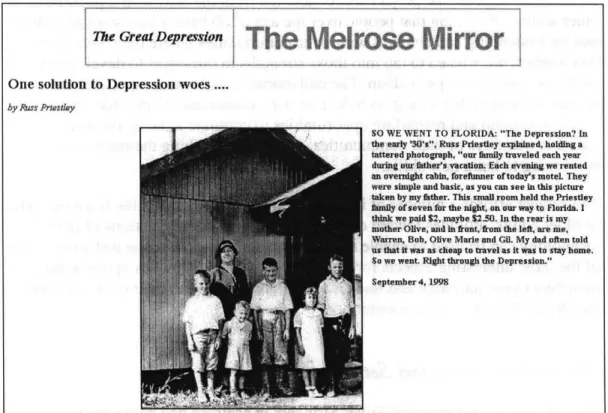
Figure 5-1 From The Melrose Mirror series on the Great Depression
If we analyze the output of The Melrose Mirror in terms of McAdams' theory of narrative and generativity, we have ample evidence that to these Silver Stringers telling their stories is a high priority.
When we look at The Melrose Mirror of 19998, we can see the maturing of writing styles, the flowering of new talent, and a proliferation of personal stories. The publication is divided into 16 sections9 of which eight'0 can definitely be characterized as personal narrative, personal reflection, or an exploration of
shared history. A ninth section, Features, contains a mixed bag of types of articles. But of the 127 articles only 32 can be described as being objective
8 Visit the Melrose Mirror at http://silverstringer.media.mit.edu. You'll also see a link to the Satter-lights,
another Silver Stringer publication created by a group of seniors in Revere, MA. The Satter-lights came online about a year after the group in Melrose. A group of residents (called the Modem Mavens) of the Jack Satter House was looking for worthwhile projects using the computers in their new residence's computer room. They found The Melrose Mirror online and asked to join the project also. Everything I have said about the Melrose group, apart from specific statistics, can be said to be true for the Revere group as well.
9 Features, Tales of the Open Road, Travel, Poetry, Art, Random Thoughts, Looking Ahead (the monthly bulletin of the Melrose Council on Aging), FAQ (Frequently Asked Questions about the Mirror), Food/Recipes, Letters to..., Movies, The Great Depression, Saving $$$ in Retirement, Remembering World War II, Melrose Centennial, City of Homes.
1 Tales of the Open Road, Travel, Poetry, Art, Random Thoughts, The Great Depression, Remembering WWII, City of Homes.
[
heGra*epi~siniThe
Meirose Mirror
One solution to Depression woes
by Russ Priestley
SO WE WENT TO FLORIDA: "The Depression? In the early '30's", Russ Priestley explained, holding a tattered photograph, "our family traveled each year
during our lkther's vacation. Each evening we rented an overnight cabin, forenumer of today's motel. They were simple and basic, as you can see in this picture taken by my father. This small room held the Priestley
onily of seven for the night, on our way to Florida. I think we paid $2, maybe S2.50. In the rear is my mother Olive, and in front, from the left, are me, Warren, Bob, Olive Marie and Gil. My dad often told us that it was as cheap to travel as it was to stay home.
So we went. Right through the Depression."
reporting or notices about current news or events all the rest fall into the categories of personal stories, reflection, or community history. Add to those statistics the fact that members have worked hard to learn new skills in using computers and in writing so that they could present the stories to a very wide audience and save them for posterity. I believe that we have a compelling example of late-life adult urge for generativity. Says Kay McCarte, one of the founding members, "We don't see this replacing newspapers, but it lets us be involved in the creative process. It gives us a voice." (quoted in Lasica, 1999)
Acav Smesei
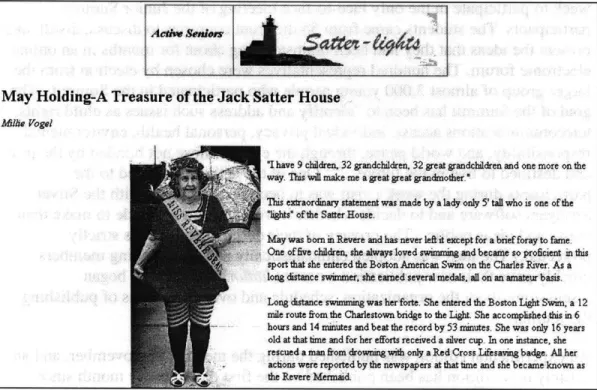
May Holding-A Treasure of the Jack Satter House
alhe Vogel
I have 9 children. 32 grandchildren, 32 great grandchildren and one more on the way. This will make me a great great grandnother.
This extraordinary statement was made by a lady only tall who is one of the "lihts of the Satter House.
May was born in Revere and has never leftit except for a briefforay to fame. One of five children, she always lQved swimming and became so proficient in this sport that she entered the Boston American Swan on the Charles River. As a long distance swimmer, she earned several medals, all on an amateur basis. Long distance swimmng was her forte. She entered the Boston Ight Swim, a 12 mile route from the Charlestown bridge to the Light. She accomplished this in 6 hours and 14 minutes and beat the record by 53 minutes. She was only 16 years old at that time and for her efforts received a silver cup. In one instance, she rescued a man from drowning with only a Red Cross Liesavig badge. All her actions were reported by the newspapers at that time and she became known as the Revere Mermaid.
Figure 5-2 From the Satter-lights series featuring stories about Active Seniors
Socially, the project affords individuals many opportunities for collaboration with other members of the group. At a recent meeting one of the members pointed out, with great pride, that the recent series of articles on Victorian homes in Melrose had involved nearly everyone in the group. Several had helped out with
architectural research on the homes. At least two people worked on taking the photographs. Another had helped to create the map. The author wrote the story and was helped by several of the editors in the polishing. One member of the group is a composer and just composed some music for a poem written by one of the group's wittiest poets. A tenor in the group offered to sing the tune for us to record and put on the site. And the group's cartoonist drew a cartoon to
accompany the poem.
Personal growth is another enduring result of the Silver Stringers project. One contributor began writing stories about the days of "riding the rails" in his youth during the Depression. He had never been a professional writer - had never
thought of himself as a writer at all. Yet once he began writing down his stories it became clear that here was an untapped talent. He's now preparing his stories to appear in a book. Others have discovered talents and interests in writing,
photography, historical research, and even HTML programming.
The
Junior Journal
In November of 1998, a new group of Stringers began to use the Silver Stringer software. 92 students between the ages of 9 and 16 visited the Media Lab for a week to participate in the only face-to-face meeting of the Junior Summit
participants. The students came from 54 different countries to discuss, distill, and present the ideas that they had been brainstorming about for months in an online electronic forum. The hundred representatives were chosen by election from the larger group of almost 3,000 young people who participated in the Summit. The goal of the Summit has been to "identify and address such issues as child rights, telecommunications access, individual privacy, personal health, environmental responsibility, and world peace, through the eyes of those not blinded by the past and destined to live in the future...'" One of the activities offered to the
participants during the week's visit was to become acquainted with the Silver Stringers software and to decide whether it would afford a vehicle to make their views and ideas public. (The privacy of their online discussion is strictly
protected.) The idea was adopted enthusiastically and the founding members quickly gave their new publication a name (Junior Journal) and began
discussions about the organization, schedule and overall logistics of publishing the journal.
An experimental edition was published during the meeting in November, and an entirely new edition has been published on the first day of every month since
January, 1999.12
The Junior Summit web site: http://www.jrsummit.net/. Quote is from the page "About the Junior Summit".
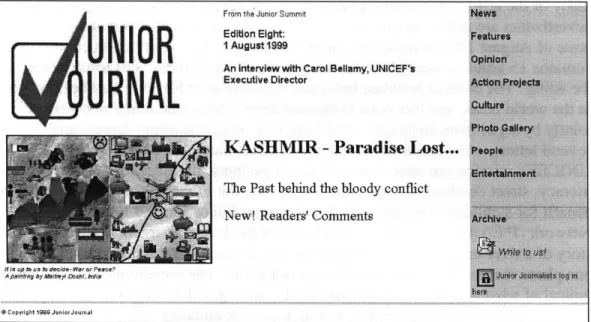
From the Junior Summit News
Edition Eight:
Features
1 August 1999
An Interview with Carol Bellamy, UNICEF's
Executive Director
ortProjects
KASHMIR -Paradise Lost... P
The Past behind the bloody conflict
New! Readers' Comments
Itlauptotoecid.-r o Peuce
A puinfteg kyh Aft.y Doahl kidpjno JCmlssfi
4 Copyright 10Q0 Junior Journal
Figure 5-3 The front page of the August 1999 edition of the Junior Journal
The social organization of the Junior Journal is very different from that of The
Melrose Mirror or Satter-lights. Since the participants are scattered around the
world, they conduct all the logistical planning and organizing of new issues entirely on the Junior Summit online email system. They discuss ideas for new stories, plan themes for entire issues, and discuss many policy issues about how the Journal will be managed and designed. In the original planning sessions for the early issues, the children decided that their group of fifteen editors would take rotating monthly turns as "Edition Editor." The edition editor each month makes the ultimate decision (after some discussion among the writers and other editors) about that month's theme and the design of the front page. He or she rallies the contributors and asks for stories to be submitted. Once commitments to write stories are in, the edition editor reminds, cajoles, and sometimes even scolds to make sure that writers and artists send in their contributions. He or she then assigns editors (two for each story) to edit each submission, to prepare for the end-of-the-month publishing deadline.
When the children have a perplexing issue to decide or when they need technical help with the software, adult mentors (about three of us) from NiF are available to provide help. Otherwise, the achievement is entirely theirs. And it is a remarkable social and organizational achievement - for youngsters in this age group to have continued this level of interest for nine months (so far) outside the sustaining environment of a physical organization such as a school or community center. It is also remarkable for the diversity of the participants: in the course of seven
monthly issues 58 children from 32 countries participated in the policy and planning discussions. Of the 58 discussants, 50 submitted articles to be published. Analyzing the content of the stories in the Junior Journal, compared to The
many of the articles are indeed told from a very personal perspective, the themes nevertheless are about current world events and pressing social problems. The issue of August 1999 is typical of the other issues in the variety of its content. It contains 15 articles, three photo features in the Photo Gallery, and some letters to the editor. The conflict between India and Pakistan over Kashmir had been much in the world news, and this issue contained three stories (including one written jointly by a girl from India and a girl from Pakistan), one photo feature and several letters to the editor about that topic. Eight more articles are about UNICEF's mission (an interview with Carol Bellamy, the Executive Director), literacy, street children in Sao Paolo, the life of Ann Frank (from an Indian girl), a benefit for a children's hospital, the International Education and Resource
Network (I*EARN) conference (which one of the Junior Journalists attended), the story of a river and its environmental past and future, classical dance in India, plus one photo feature of historic architecture in Lahore. The remaining items are more typical of what we usually think kids will be talking and writing about: one photo and one poem about favorite pets, a compilation of amazing facts, a Canadian family vacation, and the medicinal uses of gems (that one was hard to categorize). The overwhelming number of stories are on topics relating to ideology,
exploration of their own and other cultures, and ideas and projects directed toward changing the world. They are exploring their identity and their place in the world. According to McAdams (1993), "We first become self-conscious myth-makers in our late-adolescent years, when we confront head-on the problem of identity in human lives. ... A fundamental challenge in mythmaking in adolescence and young adulthood is to formulate personally meaningful answers to ideological questions so that one's identity can be built on a stable foundation."
MUSIC
Alan Shaw's project, MUSIC (Multi-user sessions in community), is relative to my research because it has built tools to empower social construction within a local community. Originally begun in the Four Corners neighborhood of Boston, the project has been expanded to Newark, New Jersey. The system consists of a
server and a limited number of clients (18 in the Boston system) hosted on local at-home computers. In the Newark project, the client machines are in the homes of "captains" who agree to share access with least four community members outside the captain's family. The system supports real-time text and voice communication, as well as electronic mail and bulletin board facilities.
Participants have used the system for debating community issues, as a publishing vehicle for poetry and drawings, and for organizing events from birthday parties to neighborhood apprenticeship programs. (Bender et al, 1996, Shaw, 1995)