HAL Id: tel-01618806
https://hal.archives-ouvertes.fr/tel-01618806
Submitted on 18 Oct 2017HAL is a multi-disciplinary open access
archive for the deposit and dissemination of sci-entific research documents, whether they are pub-lished or not. The documents may come from teaching and research institutions in France or abroad, or from public or private research centers.
L’archive ouverte pluridisciplinaire HAL, est destinée au dépôt et à la diffusion de documents scientifiques de niveau recherche, publiés ou non, émanant des établissements d’enseignement et de recherche français ou étrangers, des laboratoires publics ou privés.
Decentralized Data Management for the Semantic Web
Hala Skaf-Molli
To cite this version:
Hala Skaf-Molli. Decentralized Data Management for the Semantic Web. Computer Science [cs]. Université de Nantes, 2017. �tel-01618806�
Hala S
KAF
-M
OLLI
Mémoire présenté en vue de l’obtention du
Habilitation à diriger des recherches de l’Université de Nantes Label européen
sous le sceau de l’Université Bretagne Loire
École doctorale : Sciences et technologies de l’information, et mathématiques Discipline : Informatique et applications, section CNU 27
Unité de recherche : Laboratoire des Sciences du Numérique de Nantes (LS2N) Soutenue le 6 Octobre 2017
Decentralized Data Management for the
Semantic Web
JURY
Présidente : MmePascale KUNTZ, Professor, University of Nantes
Rapporteurs : M. Bernd AMANN, Professor, University of Pierre et Marie Curie (Paris 6)
M. Fabien GANDON, Director de recherche, INRIA Sophia-Antipolis Mediterranée
M. Philippe LAMARRE, Professor, INSA Lyon
Examinateurs : MmeMaria ESTHER-VIDAL, Professor, University of Simón BolívarVenezuela and Fraunhofer IAIS, Germany
M. Abdelkader HAMEURLAIN, Professor, University of Paul Sabatier, Toulouse
Contents
1 Introduction 4
2 Distributed Semantic Wikis 9
2.1 Swooki: Highly available semantic wikis . . . 10
2.1.1 System Model . . . 11
2.1.2 Data Model . . . 12
2.1.3 Consistency Model . . . 14
2.1.4 Algorithms . . . 18
2.2 DSMW: Decentralized social semantic wikis . . . 20
2.2.1 System Model . . . 20
2.2.2 Data Model . . . 21
2.2.3 Consistency Model . . . 24
2.2.4 Algorithms . . . 25
2.3 Conclusion . . . 27
3 Co-Evolution between Social and Semantic Web 32 3.1 Problem Statement . . . 35
3.2 A collaborative Recommender System For Wikipedia Conventions . . . 36
3.3 Evaluation . . . 40
3.4 Conclusion . . . 43
4 SPARQL Queries over Linked data and Deep Web 46 4.1 semLAV Approach . . . 47
4.2 Algorithms. . . 50
4.3 Evaluation . . . 54 2
CONTENTS 3
4.4 Conclusion . . . 59
5 Read/Write Linked Open Data 61 5.1 SU-Set: a Conflict-Free Replicated Data Type for RDF Graph . . . 63
5.1.1 Algorithms . . . 63
5.1.2 Evaluating and Optimizing SU-Set. . . 64
5.2 Col-Graph: A Synchronization Algorithm for RDF Fragments . . . 68
5.2.1 Fragment Consistency . . . 68
5.2.2 Algorithms . . . 71
5.3 Conclusion . . . 77
6 Federated SPARQL Queries Processing with Replicated Fragments 80 6.1 Problem Statement . . . 81 6.2 Algorithms. . . 83 6.3 Experimental Study. . . 85 6.4 Conclusion . . . 89 7 Research Directions 92 8 Bibliography 95 8.1 Publications by Hala Skaf-Molli (Categorized) . . . 95
1
Introduction
The semantic web is an extension of the web where information has precise meaning, and ma-chines are able to understand the information and perform sophisticated tasks for the users [B+01]. The World Wide Web Consortium (W3C) has defined foundation standards for the Semantic Web: (i) the graph based data model defined by the Resource Description Framework (RDF) [MM04] for representing information. (ii) the SPARQL web based protocol and query language for querying RDF data [P+08], and (iii) the Ontology Languages RDFS, and OWL [P+04] for defining shared knowledge.
The semantic web moves the web from purely syntactic pages to semantic ones that describes precisely entities mentioned in web pages using W3C standards as presented in Figure1.1.
Many semantic data have been published in the last years using W3C standards, e.g, more than 149,945,033,382 RDF triples are available from 2832 datasets1. Different kind of data have been published by different data providers: Scientific Publications, e.g. the DBLP Bibliography Database2, media, e.g., the Jamendo music repository3, government agencies, e.g., the UK transport
1. stats.lod2.eu, September, 2016
2. http://dblp.l3s.de/d2r/, September, 2016. 3. http://dbtune.org/jamendo/, September, 2016.
5
Figure 1.1 – Semantic Web, Social Web and Social Semantic Web: Source [Bre+09]
dataset4, the Pays de la loire dataset5, Life Science, e.g., the UniProt dataset6, Social Networking, e.g., FoaF profiles7 and the general knowledge dataset, e.g. DBpedia8.
The published datasets follow the Linked Open Data (LOD) principles [BVS; BHB09]. RDF and ontology are used for representing and linking data from different sources. Linked data forms a decentralized global data graph that could be queried using SPARQL query language [PAG09].
The social web [BPD09] has largely help to bootstrap the semantic web, for instance, DBpe-dia [Biz+09] knowledge base is built from data extracted from Wikipedia infoboxes and categories. However, the social web does not really benefit from the semantic web. The co-evolution between social and semantic web is an open issue. Among problems to solve are: Issue1: Which social tools
can be used for collaborative production of semantic data? Issue2 : How the social web can take
benefits of the semantic web?.
Despite a great effort has been done by the semantic web community to integrate datasets into the LOD cloud and make these data accessible through SPARQL servers. There are still a large number of data sources and Web APIs that are not part of the LOD cloud. The Deep Web which has around 500 times the size of the Surface Web [He+07] has not been integrated as part of LOD cloud. Performing SPARQL queries without considering the Deep Web can potentially deliver incomplete
4. http://openuplabs.tso.co.uk/sparql/gov-transport, September 2016. 5. http://lodpaddle.univ-nantes.fr/lodpaddle, September 2016.
6. http://sparql.uniprot.org/, September 2016.
7. http://www.w3.org/People/Berners-Lee/card.rdf, September 2016. 8. http://dbpedia.org/sparql, September 2016.
6 CHAPTER 1. INTRODUCTION results. Issue3: How to answer SPARQL query over Linked Data and Deep Web?.
LOD data has intrinsic issues related to data quality [Aco+13]. If a data consumer finds a mistake or inconsistency, how can she fix it? This raises the issue of the quality of Linked Data, Issue4: How
to improve LOD quality?.
Federated SPARQL query engines [Sch+11;Aco+11] allow data consumers to execute SPARQL queries against a federation of SPARQL servers. In presence of replication, the state-of-art federated query engines [Sch+11; Aco+11] may retrieve data from every relevant server, and produce a large number of intermediate results. Therefore, federated query engines may exhibit poor performance while availability of the selected SPARQL servers is negatively impacted. Issue5: How to ensure
performance of federated SPARQL query engines with replicated data?.
In this HDR thesis, I will present my contributions to the above highlighted issues. Chapters 2-6 details these contributions. Each chapter describes motivations, scientifiques contributions, and related thesis, publications and projects. The last chapter presents my ongoing research project. The thesis is organized as follows.
Chapter 2 (Distributed Semantic Wikis). This chapter presents my contributions
concern-ing Issue1. I proposed distributed semantic wiki systems for collaborative editconcern-ing of RDF data. These systems rely on optimistic replication approach. Semantic wikis define a new datatype: wiki text that embeds RDF data. The research questions concern consistency criteria for this new datatype. The Causality, Consistency and Intention (CCI) consistency criterion used in collaborative editing systems is not tailored for RDF data model. This chapter details replication models, consistency criteria and algorithms for my two contributions: Swooki and DSMW. Swooki is an unstructured peer-to-peer semantic wiki and DSMW is a decentralized social semantic wiki.
Chapter 3 (Co-Evolution between Social and Semantic Web). This chapter details my
contributions related to Issue2. Despite DBpedia data are retrieved from Wikipedia, the semantic ca-pacities of DBpedia enable SPARQL queries to retrieve information that are not present in Wikipedia. A SPARQL query that retrieves people born in a place could include more people than those ob-tained by navigating from the place article in Wikipedia. The integration of missing navigational paths in Wikipedia is very challenging, it requires to respect the complex Wikipedia conventions. I formulate this problem as a recommendation problem, the recommander suggests possible links be-tween wikipedia articles based on similar articles linked by the Wikipedia community. I proposed a
7
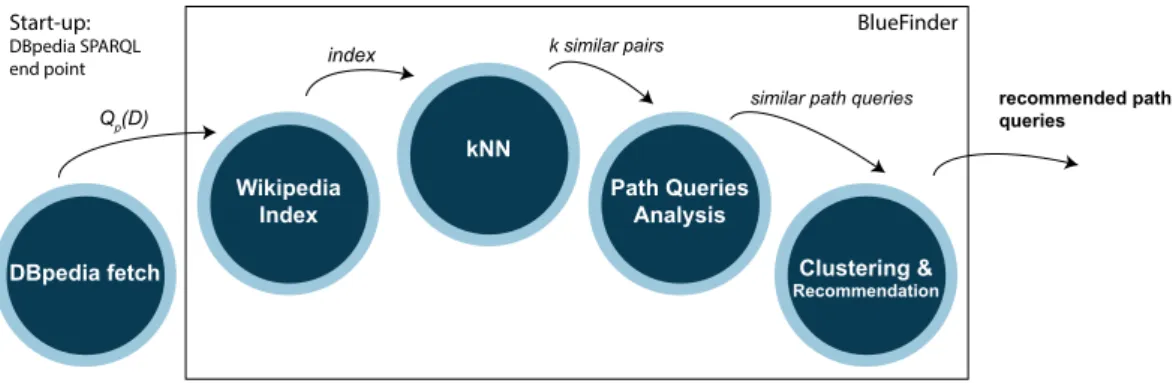
collaborative recommender system for enriching the social web with the semantic web. BlueFinder is
a collaborative recommender system that enhances the content of Wikipedia with knowledge inferred in DBpedia and contributes to complete the virtuous cycle of information flow between Wikipedia and DBpedia. This chapter presents the information gap between DBpedia and Wikipedia, details the BlueFinder algorithm and an empirical evaluation.
Chapter 4 (Querying Deep web and Linked Data). This chapter details my contributions
related to Issue3. This chapter details semLAV, the first scalable LAV-based approach for SPARQL query processing. Contrary to traditional LAV approaches, semLAV does not require query rewrit-ings. In semLAV relevant views are ranked according to their possible contribution to the answers, and they are loaded into a graph instance, built during query execution, to answer SPARQL queries. The challenge is to define the order in which query relevant views should be loaded to outperform the traditional LAV query rewriting techniques in terms of number of answers produced by a time unit. This chapter presents semLAV approach, algorithms and experimental evaluation.
Chapter 5 (From Read-Only to Read/Write LOD). For handling Issue4, I proposed to
transform the Read-Only LOD into Read/Write LOD. A data consumer can improve LOD quality by editing the data and push the enhanced data to the data provider. To support a Read/Write LOD, we follow an optimistic replication approach. The scientific problem is to propose new consistency criteria and synchronization algorithms for RDF data and SPARQL updates. This is challenging because of the autonomocity of data providers and data consumers. For instance, a data provider could not accept an update of untrusted data consumer. This chapter details SU-Set and Col-Graph two replication models for Read/Write LOD, their correction criterion and the synchronization algorithm. SU-Set is a Conflict-Free Replicated Type (CRDT) for RDF Graph, it designed for large scale replication of RDF graphs with strong eventual consistency, and Col-Graph is designed for partial (fragment) data replication, it uses annotated RDF graphes and Updates to achieve fragments consistency.
Chapter 6 (Replication-aware Federated Query Engine). This chapter adresses Issue5.
The research questions are: Can the knowledge about replicated data fragments be used to reduce the number of selected sources by federated query engines while producing the same answers? Does considering groups of triple patterns to be executed together, instead of individual triple patterns, produce source selections that lead to transfer less data from endpoints to the federated query engine?
8 CHAPTER 1. INTRODUCTION This chapter presents Fedra, the first source selection strategy for a replicated-aware federated query engine. Fedra uses fragment containment to prune sources that provide redundant data, and an heuristic for set covering to reduce the number of selected data sources.
Chapter 7 (Conclusion and perspectives). Finally, I present my forthcoming work, Linked
Data in the Fog. The objective is to build a decentralized federated SPARQL query engine for the fog.
This engine will run on a network of end-user browsers sharing CPU, caches resources and common interests. The new engine will break the state-of-art tradeoffs between availability and performances thanks to the federation of data consumers.
2
Distributed Semantic Wikis
Motivations : Semantic wikis are a new generation of social editing tools. They allow users
to add semantic annotations in the wiki pages. Users collaborate not only for writing the wiki pages but also for writing semantic annotations. Usually, this is done by annotating the links between wikis pages. Links in semantic wikis are typed. For instance, a link between the wiki pages ”France” and ”Paris” may be annotated by ”capital”. Semantic wikis provide a better structuring of wikis by providing a means to navigate and search based on annotations. These annotations express relationships between wikis pages, they are usually written in a formal syntax so they are processed automatically by machines and they are exploited by semantic queries. Many semantic wikis are proposed [Krö+07; Buf+08]. Despite their success, they suffer from many issues, such as: (i) Scalability and cost: as the number of users and contributions increase, so do the storage and bandwidth requirements. (ii) Centralized control/single point of failure: a centralized wiki is controlled by a single organization. If the organization disappears all the knowledge contributed to the wiki may disappear as well; (iii) No offline access: if a user’s internet connection or the central wiki system are temporarily unavailable, the user cannot work; (iv) Handling transactional changes: a user cannot modify multiple pages simultaneously before making modifications visible to other users. All incremental modifications are immediately visible to other users. In some cases,
10 CHAPTER 2. DISTRIBUTED SEMANTIC WIKIS users may observe inconsistent states of the wiki, as in a database system without transactional support [Rah+09a]; (v) Handling disagreements: even when changes to a page are not made with malicious intent, they can still lead to “edit wars” when different groups of users disagree on the content that is being contributed and they attempt to cancel or override the other groups’ input.
Contributions : I defined two distributed semantic wikis models: Swooki and DSMW. Swooki
is the first a peer-to-peer semantic wiki and DSMW is the first socially distributed semantic wikis. Swooki mainly tackles issues traditionally related to distributed systems and DSMW is tailored for social topologies.
(1) Swooki a Highly available semantic wiki. In Swooki [Rah+09b;RSM09b;SRM08;RSM08a;
RSM09b] the infrastructure is decentralized between the participants, but for the users, the system’s functionality is identical to that of a traditional wiki. The decentralized infrastructure allows the participants to share the cost of storage, bandwidth, and maintenance and provides availability, scalability, and fault-tolerance for the wiki.
(2) DSMW a Decentralized social semantic wikis. DSMW relies on an explicit social network of participants and aims to support the multi-synchronous collaboration model [Dou95] and offline access. In these systems, the collaborative editing process follows cycles of divergence/convergence, where users publish their changes, and acquire those published by others, at the time of their choosing. In addition, users can be selective in the subset of changes that they integrate. However, these changes are integrated automatically by algorithms that enforce particular consistency models, which limit the freedom of the users to select changes from others.
In the following sections, I will detail Swooki, and DSMW.
2.1
Swooki: Highly available semantic wikis
Swooki [SRM09] is the first peer-to-peer semantic wiki. Swooki relies on a self-organized unstructured peer-to-peer network. The collection of wiki pages is fully replicated across all the par-ticipants’ sites. The total replication scheme requires that all peers have the same storage capability. The users are connected to one peer and interact with the local page replicas as with traditional wikis. Users are able to work even when their node is disconnected from the rest of the network. When the network is connected, changes are automatically propagated to the other nodes.
Swooki combines advantages of P2P wikis and semantic wikis. The main problem for building such a system is to maintain consistency of replicated semantic wiki pages.
2.1. SWOOKI: HIGHLY AVAILABLE SEMANTIC WIKIS 11
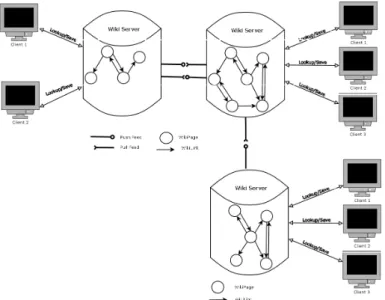
Figure 2.1 – Swooki, Replicated graph in an unstructured P2P wiki
2.1.1
System Model
An unstructured highly available wiki is conceptually similar to a set of n interconnected and automatically synchronized wikis.
Definition 2.1.1. A highly available unstructured wiki is a tuple, hΩG, N i where:
— ΩG = {G1, G2, . . . , Gn} is a set of wiki graphs;
— N = hS, Ci is a graph representing an unstructured and self-organized overlay network: the
nodes S = {S1, . . . , Sn} are participants, each participant is uniquely identified and the edges
C ⊂ S × S represent their physical interconnections. Participant Si hosts Gi;
— The wiki graphs Gi are eventually consistent: this notion is defined below.
The wiki appears centralized because the participant directly interacts only with the local system, which is the wiki hSi, Gii. Propagation of updates happens behind the scenes, and to the user is
indistinguishable from operations that might happen concurrently on the local wiki if it was an isolated system. Eventually, the set of local page replicas at each node should converge to be identical. As we will see further, ensuring that this happens is difficult. In order to define eventual consistency, we must consider a highly available unstructured wiki to be a system that evolves over time as a result of the user’s actions. We note G(t)
i the state of a graph Gi at time t.
12 CHAPTER 2. DISTRIBUTED SEMANTIC WIKIS
hΩG, N i as defined in 2.1.1. We consider a finite sequence of (arbitrary) user actions, occurring at
times t1, t2, . . . tk.
The wiki graphs {Gi}i∈[1...n] are eventually consistent if at some time later than the last action
Atk, all of the graphs Gi are identical. Formally,
∃tf > tk, ∀i, j ∈[1 . . . n] G
(tf)
i = G (tf)
j
A highly available unstructured Wiki follows the optimistic replication model [SS05a], with the hypothesis of eventual delivery of operations; this is generally achieved by using the gossiping algo-rithm. An anti-entropy algorithm supports intermittent connections. Figure 2.1 shows an example of an unstructured wiki. In this figure, the wiki graph is replicated on each wiki server. Each wiki server hosts a copy of all semantic wiki pages and an RDF store for the semantic data. When a peer updates its local copy of data, it generates a corresponding operation. This operation is processed in four steps:
1. It is executed immediately against the local replica of the peer, 2. it is broadcasted through the P2P network to all other peers, 3. it is received by the other peers,
4. it is integrated to their local replica. If needed, the integration process merges this modification with concurrent ones, generated either locally or received from a remote server.
The system is correct if it ensures the CCI (Causality, Convergence and Intention Preserva-tion) [Sun+98] consistency model.
2.1.2
Data Model
The data model of Swooki is an extension of Wooki [WUM07] data model to take in consideration semantic data. Every semantic wiki peer is assigned a global unique identifier named NodeID. These identifiers are totally ordered. As in any wiki system, the basic element is a semantic wiki page and every semantic wiki page is assigned a unique identifier P ageID, which is the name of the page. The name is set at the creation of the page. If several servers create concurrently pages with the same name, their content will be directly merged by the synchronization algorithm. Notice that a URI can be used to unambiguously identify the concept described in the page. The URI must be global and location independent in order to ensure load balancing. For simplicity, I use a string as page identifier.
2.1. SWOOKI: HIGHLY AVAILABLE SEMANTIC WIKIS 13 Definition 2.1.3. A semantic wiki page P age is an ordered sequence of lines
LBL1, L2, . . . LnLE where LB and LE are special lines. LB indicates the beginning of the page and
LE indicates the ending of the page.
Definition 2.1.4. A semantic wiki line L is a four-tuple < LineID, content, degree, visibility >
where
— LineID is the line identifier, it is a pair of (NodeID, logicalclock) where NodeID is the identifier of the semantic wiki server and logicalclock is a logical clock of that server.
— content is a string representing text and the semantic data embedded in the line.
— degree is an integer used by the synchronization algorithm, the degree of a line is fixed when the line is generated, it represents a kind of loose hierarchical relation between lines.
— visibility is a boolean representing if the line is visible or not. Lines are never really deleted they are just marked as invisible. For instance, suppose there are two lines in a semantic wiki page about ”France" , ”France" is the identifier of the page.
France i s l o c a t e d in [ l o c a t e d I n : : Europe ] The c a p i t a l of France i s [ hasCapital : : Paris ]
Suppose these two lines are generated on the server with NodeID = 1 in the above order and there are no invisible lines, so the semantic wiki page will be internally stored as.
LB
((1,1),France is located in [locatedIn::Europe], 1, true) ((1,2), The capital of France is [hasCapital::Paris], 2, true)
LE
Text and semantic data are stored in separate persistent storages. Text can be stored in files and semantic data can be stored in RDF repositories, as described in the next section.
Semantic data storage model RDF is the standard data model for encoding semantic data. In
P2P semantic wikis, every peer has a local RDF repository that contains a set of RDF statements extracted from its wikis pages. A statement is defined as a triple (Subject, Predicate, Object) where the subject is the name of the page and the predicates (or properties) and the objects are related to that concept. For instance, the local RDF repository of the above server contains: R = {("France", "locatedIn", "Europe"), ("France", "hasCapital", "Paris") }. As for the page identifier, a global URI
14 CHAPTER 2. DISTRIBUTED SEMANTIC WIKIS can be assigned to predicates and objects of a concept, for simplicity, we use a string. We define two operations on the RDF repositories:
— insertRDF(R,t): adds a statement t to the local RDF repository R. — deleteRDF(R,t): deletes a statement t from the local RDF repository R.
These operations are not manipulated directly by the end user, they are called implicitly by the editing operations as shown later.
Editing operations
A user of a P2P semantic wiki does not edit directly the data model. Instead, she uses traditional wiki editing operations, when she opens a semantic wiki page, she sees a view of the model. In this view, only visible lines are displayed. As in a traditional semantic wiki, she makes modifications i.e. adds new lines or deletes existing ones and she saves the page(s). To detect user operations, a diff algorithm is used to compute the difference between the initial requested page and the saved one.
2.1.3
Consistency Model
This section defines causal relationships and intentions of the editing operations of P2P semantic wiki data model.
Causality preservation
The causality property ensures that operations ordered by a precedence relation will be executed in the same order on every server.
We define causality for editing operations that manipulate text and RDF data model as:
Definition 2.1.5. insert Preconditions Let P age be the page identified by P ageID, let the
op-eration op=Insert(P ageID, newline, p , n), newline =< LineID, c, d, v> generated at a server
N odeID, R is its local RDF repository. The line newline can be inserted in the page P age if its previous and next lines are already present in the data model of the page P age.
∃i ∃j LineID(P age[i]) = p ∧ LineID(P age[j]) = n
Definition 2.1.6. Preconditions of delete operation Let P age be the page identified by P ageID,
2.1. SWOOKI: HIGHLY AVAILABLE SEMANTIC WIKIS 15
identified by dl can be deleted (marked as invisible), if its dl exists in the page.
∃i LineID(P age[i]) = dl
When a server receives an operation, the operation is integrated immediately if its pre-conditions are evaluated to true else the operation is added to a waiting queue, it is integrated later when its pre-conditions become true.
peer1 peer2 peer3
Text
RDFRepository RDFRepositoryText RDFRepositoryText op1= Insert(1, "France is located..")
22
op2= Insert(1, "France is a country... ")
pp
$$
France is located in [locatedIn::Europe] {(France, locatedIn, Europe)}
France is a country in [locatedIn::Europe] {(France, locatedIn, Europe)}
op2 op1
France is located in [locatedIn::Europe] France is a country in [locatedIn::Europe]
{(France, locatedIn, Europe)}
France is located in [locatedIn::Europe] {(France, locatedIn, Europe)}
op3 = delete(1)
rr
Text
op3 op2
France is a country in [locatedIn::Europe] { }
France is a country in [locatedIn::Europe] {(France, locatedIn, Europe)}
Figure 2.2 – Semantic inconsistency after integrating concurrent modifications
Intentions and Intentions preservation
The intention of an operation is the visible effect observed when a change is generated at one peer, the intention preservation means that the intention of the operation will be observable on all peers, in spite of any sequence of concurrent operations. We can have a naive definition of intention for insert and delete:
— The intention of an insert operation op= Insert(P ageID, newline, p , n) when generated at site NodeID, where newline =< nid, c, d, v> is defined as: (1) The content is inserted between the previous and the next lines and (2) the semantic data in the line content are added to the RDF repository of the server.
— The intention of a delete operation op= delete(pid, l) when generated at site S is defined as : (1) the line content of the operation is set to invisible and (2) the semantic data in the line content are deleted from the RDF repository of the server.
16 CHAPTER 2. DISTRIBUTED SEMANTIC WIKIS Unfortunately, it is not possible to preserve the previous intention definitions. We illustrate a scenario of violation of these intentions in figure 2.2. Assume that three P2P semantic wiki servers,
peer1, peer2and peer3 share a semantic wiki page about ”France”. Every server has its copy of shared
data and has its own persistence storage repository. At the beginning, the local text and the RDF repositories are empty. At peer1, user1 inserts the line "France is located [located In::Europe]" at the
position 1 in her copy of the "France" page. Concurrently, at peer2 user2 inserts a new line ”France
is a country in [located In::Europe]” in her local copy of "France" page at the same position and finally at peer3 user3 deletes the line added by user1. When op2 is integrated at peer1, the semantic
annotation is present two times in the text and just one time in the RDF repository. In fact, the RDF repository cannot store twice the same triple. When op3 is finally integrated on peer1, it deletes
the corresponding line and the semantic entry in the RDF repository. In this state, the text and the RDF repository are inconsistent. Concurrently, peer3 has integrated the sequence [op1;op3;op2]. This
sequence leads to a state different than the state on peer1. Copies are not identical, convergence is
violated.
The above intentions cannot be preserved because the effect of executing op3 changes the effect
of op2 which is independent, of op3 i.e. op3 deletes the statement inserted by op2, but op3 has not
seen op2 at generation time.
Model for Intention preservation
It is not possible to preserve intentions if the RDF store is defined as a set of statements. However, if we transform the RDF store into multi-set of statements, it becomes possible to define intentions that can be preserved.
Definition 2.1.7. RDF repository is the storage container for RDF statements, each container
is a multi-set of RDF statements. Each RDF repository is defined as a pair (T, m) where T is a set
of RDF statements and m is the multiplicity function m: T → N where N = 1, 2...
For instance, the multi-set R = { ("France", "LocatedIn", "Europe"),("France", "LocatedIn", "Eu-rope"),("France", "hasCapital", "Paris") } can presented by R = { ("France", "LocatedIn", "Europe" )2, ( "France", "hasCapital", "Paris" )1 } where 2 is the number of occurrence of the first statement
and 1 is this of the second one.
2.1. SWOOKI: HIGHLY AVAILABLE SEMANTIC WIKIS 17
local RDF repository and P age is a semantic wiki page. The intention of an insert operation op=
Insert(P ageID, newline, p , n) when generated at site S, where newline =< nid, c, d, v> and T
is the set (or multi-set) of RDF statements in the inserted line, is defined as: (1) The content is inserted between the previous and the next lines and (2) the semantic data in the line content are added to R.
∃i ∧ ∃ iP < i LineID(P age[iP]) = p (2.1) ∧ ∃ i ≤ iN LineID(P age[iN]) = n (2.2)
∧ P age0[i] = newline (2.3)
∧ ∀j < i P age0[j] = P age[j] (2.4)
∧ ∀j ≥ i P age0[j] = P age[j − 1] (2.5)
∧ R0 ← R ] T (2.6)
Where P age0 and R0 are the new values of the page and the RDF repository respectively after
the application of the insert operation at the server S and ] is the union operator of multi-sets. If a statement in T already exists in R so its multiplicity is incremented else it is added to R with multiplicity one.
Definition 2.1.9. Intention of delete operation Let S be a P2P semantic wiki server, R is the
local RDF repository and P age is a semantic wiki page. The intention of a delete operation op=
delete(P ageID, ld) where T is the set (or multi-set) of RDF statements in the deleted line, is defined
as: (1) the line ld is set to invisible and (2) the number of occurrence of the semantic data embedded in ld is decreased by one, if this occurrence is equal to zero which means these semantic data are no more referenced in the page then they are physically deleted from the R.
∃i ∧ P ageID(P age0[i]) = ld (2.7)
∧ visibility(P age0[i]) ← f alse (2.8)
18 CHAPTER 2. DISTRIBUTED SEMANTIC WIKIS Where P age0 and R0 are the new values of the page and the RDF repository respectively after the
application of the delete operation at the server S and − is the difference of multi-sets. If statement(s) in T exists already in R so its multiplicity is decremented and deleted from the repository if it is equal to zero.
Peer 1 Peer 2 Peer 3
Text
RDFRepository RDFRepositoryText RDFRepositoryText op1= Insert(1, "France is located..")
22
op2= Insert(1, "France is a country... ")
pp
$$
France is located in [locatedIn::Europe] {(France, locatedIn, Europe,1)}
France is a country in [locatedIn::Europe] {(France, locatedIn, Europe,1)}
op2 op1
France is located in [locatedIn::Europe] France is a country in [locatedIn::Europe]
{(F rance, locatedIn, Europe, 2)}
France is located in [locatedIn::Europe] {(F rance, locatedIn, Europe, 1)}
op3= delete(1)
rr
Text
op3 op2
France is a country in [locatedIn::Europe] {(F rance, locatedIn, Europe, 1)}
France is a country in [locatedIn::Europe] {(F rance, locatedIn, Europe, 1)}
Figure 2.3 – Convergence after integrating concurrent modifications
Let us consider again the scenario of the figure2.2. When op2 is integrated on peer1, the
multiplic-ity of the statement (”F rance”, ”locatedIn”, ”Europe”) is incremented to 2. When op3 is integrated
on peer1, the multiplicity of the corresponding statement is decreased and the consistency between
text and RDF repository is ensured. We can observe that P eer1 and P eer3 now converge and that
intentions are preserved.
2.1.4
Algorithms
As any wiki server, a P2P semantic server defines a Save operation which describes what happens when a semantic wiki page is saved. In addition, it defines Receive and Integrate operations. The first describes what happens upon receiving a remote operation and the second integrates the operation locally. In the following, I detail the integration operation.
2.1. SWOOKI: HIGHLY AVAILABLE SEMANTIC WIKIS 19
Algorithm 1 IntegrateDel operation
Require: id: LineID;
1: procedure IntegrateDel(id) 2: IntegrateDelT(id)
3: IntegrateDelRDF(id)
4: end procedure
Algorithm 2 IntegrateIns Operation
Require: p: PageID, l,lP , lN: LineID;
1: procedure IntegrateIns(p, l, lP , lN)
2: IntegratedInsT(p, l, lP , lN)
3: IntegrateInsRDF(l)
4: end procedure
Algorithm 3 IntegrateDelRDF operation
Require: id: LineID;
1: procedure IntegrateDelRDF(id) 2: let S ← ExtractRDF(LineID)
3: if S 6= ∅ then
4: for each triple ∈ S do 5: triple.counter– 6: if triple.counter = 0 then 7: deleteRDF(R,triple) 8: end if 9: end for 10: end if 11: end procedure Algorithm 4 IntegrateInsRDFOp
Require: line: LineID;
1: procedure I(n)tegrateInsRDF(line) : 2: let S ← ExtractRDF(line)
3: if S 6= ∅ then
4: for each triple ∈ S do 5: if Contains(triple) then 6: triple.counter++ 7: else 8: insertRDF(R,triple) 9: end if 10: end for 11: end if 12: end procedure
Integrate operation The integration of an operation is processed in two steps as described in
Algorithm1): (1) text integration and (2) RDF statements integration.
For text integration, we use integration algorithm defined in [WUM07]. To integrate RDF state-ments a counter is used to implement a multi-set RDF repository. A counter is attached to every RDF triple, the value of the counter corresponds to the number of occurrence of the triple in the repository.
During the delete operation, the counter of the deleted statements is decreased, if the counter is zero the statements are physically deleted from the repository as described in Algorithm 3
During the insert operation, the RDF statements of the inserted line are extracted and added to the local RDF repository. If the statements exist already in the repository, their counter is incremented, otherwise, they are inserted into the RDF repository with a counter value equals to one as described in Algorithm 4.
I have integrated this algorithm in Swooki. Swooki is implemented in Java as servlets in a Tomcat Server and uses Sesame 2.0 as RDF store. Swooki is available at: http://sourceforge. net/projects/wooki/files/.
20 CHAPTER 2. DISTRIBUTED SEMANTIC WIKIS
Figure 2.4 – DSMW, a Decentralized Social Wiki
2.2
DSMW: Decentralized social semantic wikis
Decentralized social semantic wikis [Rah+09a] aim to support a social collaboration network and adapt many ideas from decentralized version control systems (DVCS) used for software development. They promote the multi-synchronous collaboration model [Dou95], in which multiple streams of activity proceed in parallel. The main structure of a decentralized social wiki is similar to that of a replicated wiki; however, the unstructured overlay network is a social collaboration network: its edges represent relationships between users who have explicitly chosen to collaborate.
The synchronization of the nodes is not fully automated; instead, users can choose pages to replicate and manually publish changes, including sets of changes affecting multiple pages. The changes are propagated along the edges of the social network, and users can select which changes to integrate.
As the published changes are propagated through the network, each wiki graph incorporates a subset of the global sequence of changes, filtered through the participants’ trust relationships. The task of integrating selected changes can be automated by algorithms that may enforce different consistency models, as in highly available wikis.
The explicit collaboration network and the manual publishing and integration of changes define the class of decentralized social wikis, an extension to the main wiki concept.
2.2.1
System Model
2.2. DSMW: DECENTRALIZED SOCIAL SEMANTIC WIKIS 21
— ΩG = {G1, G2, . . . , Gn} is a set of wiki graphs, as in a highly available unstructured wiki;
— N = hS, Ci is a graph representing a socially organized overlay network: the nodes S =
{S1, . . . , Sn} are uniquely identified participants, and the edges C ⊂ S × S represent social
connections through which operations are exchanged. Each participant Si hosts Gi.
The social connections can be defined as “follow and synchronize" relationships [Rah+09a], in which a user can follow the changes made by specific peers and periodically integrate some or all of these changes. Decentralized social wiki systems may provide a full-blown publish-subscribe protocol (e.g., DSMW, which uses “feeds,” shown in figure 2.4), or simply a social acquaintance relationship that underlies the fact that the “follower” regularly “pulls” (in DVCS terminology) and integrates changes from the “followed” user.
In decentralized social wikis, the content of a wiki graph could be different from one wiki to the next; there is no expectation of consistency at the level of the full wiki. However, automatic synchronization algorithms can still be used; I discuss the consistency issues that they raise in section
2.2.3.
2.2.2
Data Model
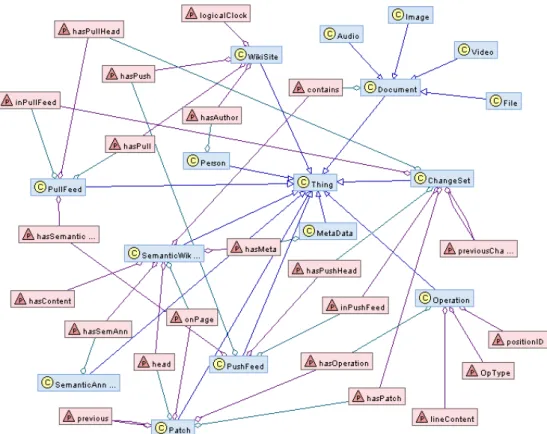
The data model of multi-synchronous semantic wikis (M2SW) is defined as an extension of existing ontologies of semantic wikis. Defining the data model as an ontology allows to provides reasoning and querying capabilities on the model itself. In this section, I present the M2SW ontology and detail only its main concepts and their properties.
— Wiki site : this concept corresponds to a semantic wiki server. A site has the following properties:
— siteID : this attribute contains the URL of the site.
— logicalClock : this attribute has a numeric value. Every semantic wiki server maintains a logical clock, this clock used to identify patches and operations in an unique way in the whole network.
— hasP ush : the range of this property is push feed. A wiki site has several push feeds. — hasP ull : the range of this property is pull feed. A wiki site has several pull feeds. — Document : a document can be an image, an audio or a video file or any type of file that can
22 CHAPTER 2. DISTRIBUTED SEMANTIC WIKIS
Figure 2.5 – Mutli-synchronous ontology
— Semantic Wiki page : this concept corresponds to a normal semantic wiki page. It has the following properties:
— pageID : this attribute contains the URL of the page. — hasName : this attribute contains the title of the page.
— hasContent the range of this property is a String, it contains text and the semantic data embedded in the semantic wiki page.
— hasP ageHead : this property points to the last patch applied to the page.
— Operation : represents a change in a line of a wiki page. In our model, there are two editing operations : insert and delete. An update is considered as a delete of old value followed by an insert of a new value. An operation has the following properties:
— operationID: this attribute contains the unique identifier of the operation. operationID is calculated by: operationID = concat(Site.siteID,Site.logicalClock++). The function
concate concatenates two strings.
— opT ype this attribute contains the type of the operation, it can be either an insert or a
2.2. DSMW: DECENTRALIZED SOCIAL SEMANTIC WIKIS 23 — positionID denotes the position of the line in the wiki page. This identifier is calculated
by the Logoot algorithm1.
— lineContent is a string representing text and the semantic data embedded in the line. — Patch : a patch is a set of operations. A patch is calculated during the save of the modified
semantic wiki page using the Logoot algorithm. A patch has the following properties: — patchID a unique identifier of the patch. Its value is calculated by :
patchID = concat(Site.siteID, Site.logicalClock + +)
— onP age the range of this property is the page where the patch was applied.
— hasOperation this property points to the operations that generated during the save of the page.
— previous points to the precedent patch.
— ChangeSet : A change set contains a set of patches. This concept is important in order to support transactional changes. It allows to regroup patches on multiple semantic wiki pages. Therefore, it is possible to push modifications on multiple pages. ChangeSet has the following properties:
— changSetID: a unique identifier of a change set. Its value is calculated as :
changeSetID = concat(Site.siteID,Site.logicalClock + +)
— hasP atch property points to the P atches generated since the last push. — previousChangeSet points to the precedent change set.
— inP ushF eed the range of this property is a P ushF eed. This property indicates the
P ushF eed that publishes a ChangeSet.
— inP ullF eed the range of this property is a P ullF eed. This property allows indicates the
P ullF eed that pulls a ChangeSet.
— Push Feed : this concept is used to publish changes of a W ikisite. It is a special semantic wiki page. It inherits the properties of the Semantic Wiki Page concept and defines its own properties:
1. Stéphane Weiss, Pascal Urso, and Pascal Molli. « Logoot : a Scalable Optimistic Replication Algorithm for Collaborative Editing on P2P Networks ». In: 32nd International Conference on Distributed Computing Systems. IEEE Computer Society, 2009, pp. 404–412.
24 CHAPTER 2. DISTRIBUTED SEMANTIC WIKIS — hasP ushHead : this property points to the last published changeSet.
— hasSemanticQuery : this property contains a semantic query. This query determines the content of the push feed. For instance, the query can be ”find all Lessons”, this will return all the page in the class (category) Lessons. To answer hasSemanticQuery reasoning and querying capabilities of semantic wikis are used.
— Pull Feed : this concept is used to pull changes from a remote W ikisite. A pull feed is related to one push feed. In the sense that it is impossible to pull unpublished data. A pull feed is also a special semantic wiki page. It inherits the properties of the Semantic Wiki Page concepts and defines it own properties:
— hasP ullHead : this property points to the last change set pulled in the pull feed.
— relatedP ushF eed: this property relates a pull feed to the URL of its associated push feed. We can use this ontology to query and reason on the patches, ChangeSet, PushFeed, . . .. For instance, we can find published patches on a push feed.
P ublished ≡ ∃(hasP atch−1).∃(inP ushF eed−1).P ushF eed
The unpublished patches is defined by:
unP ublished ≡ P atch u ¬(∃(hasP atch−1).∃(inP ushF eed−1).P ushF eed)
2.2.3
Consistency Model
The replication of data and the communication between servers is made through channels (feeds). To make local changes available to the others, she pushes them to channels. The channel usage is restricted to few servers with simple security mechanisms that requires no login and complex access control. The key point is that channels are read-only for consumers and can be hosted on hardware of users. Trusted servers can pull these modifications. During the first pull operation local copies of pulled pages are created, for the following pull operations concurrent modifications are merged with pulled ones.
When a semantic wiki page is updated on a server, it generates a corresponding operation. This operation is processed in four steps as in the case of peer-to-peer semantic wikis.
2.2. DSMW: DECENTRALIZED SOCIAL SEMANTIC WIKIS 25 The system is correct if it ensures the CCI consistency model [Sun+98]. In DSMW, I extend the Logoot [WUM09] synchronization algorithm to be used with the M2SW ontology. Logoot ensures convergence and preserves the intentions of operations if the causality of the operations is preserved.
2.2.4
Algorithms
As any semantic wiki server, a DSMW server defines a Save operation which describes what happens when a semantic wiki page is saved. In addition, we have define special operations : Create
Push, Push, Create Pull, Pull and Integrate for the multi-synchronous semantic wiki. We will use
the Logoot [WUM09] algorithm for the generation and the integration of the insert and delete operations.
In the following, I detail these operations for a semantic wiki server called site.
Save Operation During the saving a wiki page, the Logoot algorithm computes the difference
between the saved and the previous version of the page and generates a patch.
Algorithm 5 Save Operation
Require: page, page : Wiki Page; 1: procedure On Save(page, page) 2: let Patch p ← Logoot(page,page );
3: p.patchID ← concat(site.siteID,site.logicalClock + +); 4: for each op ∈ p do 5: op.operationID ← concat(site.siteID,site.logicalClock+ +); 6: hasOperation(p,op) 7: Integrate(op,page) 8: end for 9: previous(p,page.hasPageHead); 10: hasPageHead(page,p); 11: onPage(p,page); 12: end procedure
A patch is the set of delete and insert operations on the page
(Op = (opT ype, operationID, positionID, lineContent)). The Logoot algorithm calculates the positionID,
lineContentand the opT ype of the operation. These operations are integrated locally and then
even-tually published on feed patches.
CreatePushFeed Operation The communication between DSMW servers is made through feeds.
The CreatePushFeed operation allows the creation of a push feed. A push feed is a special semantic wiki page that contains a query that defined the pushed data.
26 CHAPTER 2. DISTRIBUTED SEMANTIC WIKIS
Algorithm 6 Create Push Feed Operation
Require: pfname : FeedName, request : Request 1: procedure on CreatePushFeed(pfname, request) 2: PushFeed(pfname)
3: hasSemanticQuery(pfname,request)
4: P(u)sh(pfname)
5: end procedure
Algorithm 7 Create Pull Feed
opera-tion
Require: pullfeedName: FeedName, url: URL; 1: procedure On CreatePull(pullfeedName, url) 2: PullFeed(pullFeedName)
3: relatedPushFeed(pullfeedName,url)
4: Pull(pullfeedName)
5: end procedure
A push feed is used to publish changes of a wiki server. Therefore, authorized sites can access the published data. CreatePushFeed operation calls the Push operation.
Push Operation The P ush operation creates a change set corresponding to the pages returned
by the semantic query and adds it to the push feed. First, it executes the semantic query, the patches of the pages returned by the query are extracted. These patches are added to the change set if they have not been published on this feed push yet.
Algorithm 8 Push Operation
Require: pfname : FeedName 1: procedure On Push(pfname) 2: ChangeSet(chgSet); 3: chgSet.changSetID ← concat(site.siteID,site.logicalClock+ +); 4: inPushFeed(chgSet, pfname); 5: let pg ← execQuery(pfname.hasSemanticQuery) ; 6: let qt ← ∅; let pt ← ∅; 7: for each p ∈ pg do 8: qt ← qtS∃ (onPage−1).pg;
9: pt ← ptS∃ onPage.p.∃ (hasPatch−1).∃( inPushFeed−1).pfname;
10: end for
11: ∀ patch ∈ pt - qt: hasPatch(chgSet, patch);
12: previousChangeSet(chgSet, pfname.hasPushHead);
13: hasPushHead(pfname,chgSet);
14: end procedure
CreatePullFeed Operation As the replication of data and the communication between DSMW
servers are made through feeds, pull feeds are created to pull changes from push feeds on remote peers to the local peer (see Algorithm 7). A pull feed is related to a push feed. In the sense that it is impossible to pull unpublished data.
Pull Operation The Algorithm 9 details the pull operation. This operation fetches for published
change sets that have not pulled yet. It adds these change sets to the pull feed and integrate them to the concerned pages on the pulled site.
Integration operation The integration of a change set is processed as follows. First all the patches
of the change set are extracted. Every operation in the patch is integrated in the corresponding semantic wiki page thanks to the algorithm Logoot detailed in [WUM09] .
2.3. CONCLUSION 27
Algorithm 9 Pull operation
Require: pullfeedName: FeedName 1: procedure On Pull(pullfeedName)
2: while ((cs ← pullfeedName.PageID.get(pullfeedName.headPullFeed, pullfeedName.relatedPushFeed)<>null) do 3: inPullFeed(cs,pullfeedName); 4: Call Integrate(cs); 5: hasPullHead(pullfeedName,cs); 6: end while 7: end procedure
Correction model
Theorem 2.2.2. Our algorithms ensure the causality.
Theorem 2.2.3. Our algorithms ensure the CCI model (Causality, Convergence, Intention). The proofs of theorems are detailed in [Rah+09a]. DSMW is implemented as an extension of
Semantic MediaWiki. Demos of DSMW [SCM10b] are presented at the conference ESWC2010
Extended Semantic Web Conference and DocEngine Conference [SCM10a].
2.3
Conclusion
In this chapter, I presented my contributions on decentralized semantic wikis: Swooki and DSMW. Swooki mainly tackles issues traditionally related to distributed systems and DSMW is tailored for social topologies. In Swooki and DSMW, semantic data is modified as a side effect of text modification. The advantage is that the text is kept synchronized with semantic data embed in the text, but the drawback is the semantic data cannot be modified directly. Consequently, other authoring tools for semantic web such as Protégé or SPARQL update cannot be used safely on the same semantic data authored through a semantic wiki. For future works, I want to develop new synchronization algorithms dedicated for RDF data and Linked Data.
Supervised Master Thesis associated with this chapter
[Tor09] Diego Torres. « Semantic Wikis using Folksonomies ». MA thesis. licenciature (bac+5) Université de la Plata, Argentine, July 2009.
Supervised PhD Thesis associated with this chapter
[Rah10] Charbel Rahhal. « Wikis sémantiques distribués sur réseaux pair-à-pair ». PhD thesis. Université Henri Poincaré, Nancy1, Nov. 2010.
28 CHAPTER 2. DISTRIBUTED SEMANTIC WIKIS
Publications associated with this chapter
Book chapters
[Cor+14] Amélie Cordier, Valmi Dufour-Lussier, Jean Lieber, Emmanuel Nauer, Fadi Badra,
Julien Cojan, Emmanuelle Gaillard, Laura Infante-Blanco, Pascal Molli, Amedeo Napoli, and Hala Skaf-Molli. « Taaable: a Case-Based System for personalized Cooking ». In:
Successful Case-based Reasoning Applications-2. Vol. 494. Studies in Computational
In-telligence. Springer, Jan. 2014, pp. 121–162. isbn: 978-3-642-38735-7. doi:10.1007/ 978-3-642-38736-4_7. url: http://hal.inria.fr/hal-00912767.
International peer-reviewed journals
[Dav+15] Alan Davoust, Hala Skaf-Molli, Pascal Molli, Babak Esfandiari, and Khaled Aslan.
« Distributed Wikis: A Survey ». In: Concurrency and Computation: Practice and
Ex-perience 27 (2015), pp. 2751–2777. doi: 10.1002/cpe.
[Naj+09] Hala Naja-Jazzar, Nishadi Desilva, Hala Skaf-Molli, Charbel Rahhal, and Pascal Molli. « OntoRest: A RST-based Ontology for Enhancing Documents Content Quality in Col-laborative Writing ». In: INFOCOMP Journal of Computer Science 8.3 (2009), pp. 1– 10.
National peer-reviewed journals
[RSM09b] Charbel Rahhal, Hala Skaf-Molli, and Pascal Molli. « SWooki: Un Wiki Sémantique
sur réseau Pair-à-Pair ». In: Ingénierie des Systèmes d’Information 14.1 (Feb. 2009), pp. 117–140.
International peer-reviewed conferences
[Le+13] Anh-Hoang Le, Marie Lefevre, Amélie Cordier, and Hala Skaf-Molli. « Collecting
in-teraction traces in distributed semantic wikis ». In: 3rd International Conference on
Web Intelligence, Mining and Semantics, WIMS ’13, Madrid, Spain, June 12-14, 2013.
INTERNATIONAL PEER-REVIEWED CONFERENCES 29
[BBS10] Anne Boyer, Armelle Brun, and Hala Skaf-Molli. « Human Computer Collaboration
to Improve Annotations in Semantic Wikis ». In: 6th Conference on Web Information
Systems and Technologies (Webist 2010). Valencia, Spain, Apr. 2010, p. 8. url:https:
//hal.inria.fr/inria-00378416.
[BSB10] Armelle Brun, Hala Skaf-Molli, and Anne Boyer. « Raising up Annotations In
Ped-agogical Resources by Human-Computer Collaboration ». In: European Distance and
E-learning Network (EDEN 2010). Budapest, Hungary, Oct. 2010. url: https : / /
hal.inria.fr/inria-00597285.
[SCM10a] Hala Skaf-Molli, Gérôme Canals, and Pascal Molli. « DSMW: a distributed infrastruc-ture for the cooperative edition of semantic wiki documents ». In: ACM Symposium
on Document Engineering (DocEng 2010) (Demo). Manchester, Royaume-Uni: ACM,
2010, pp. 185–186.
[SCM10c] Hala Skaf-Molli, Gérôme Canals, and Pascal Molli. « DSMW: Distributed
Seman-tic MediaWiki ». In: 7th Extended SemanSeman-tic Web Conference (ESCW 2010) (Demo). Vol. 6089. Lecture Notes in Computer Science. Heraklion, Gréce: Springer, 2010.
[Rah+09a] Charbel Rahhal, Hala Skaf-Molli, Pascal Molli, and Stephane Weiss. « Multi-Synchronous Collaborative Semantic Wikis ». In: 10th International Conference on Web Information
Systems Engineering (WISE 2009). Vol. 5802. Lecture Notes in Computer Science.
Poz-nan, Pologne: Springer, Oct. 2009, pp. 115–129.
[SRM09] Hala Skaf-Molli, Charbel Rahhal, and Pascal Molli. « Peer-to-peer Semantic Wikis ». In:
20th International Conference on Database and Expert Systems Applications - DEXA 2009. Vol. 5690. Lecture Notes in Computer Science. Linz, Autriche: Springer-Verlag,
Aug. 2009, pp. 196–213.
[Tor+09b] Diego Torres, Hala Skaf-Molli, Alicia Diaz, and Pascal Molli. « Supporting Personal Semantic Annotations in P2P Semantic Wikis ». In: 20th International Conference on
Database and Expert Systems Applications - DEXA 2009. Vol. 5690. Lecture Notes in
Computer Science. Linz, Autriche: Springer Berlin / Heidelberg, Aug. 2009, pp. 317– 331.
30 CHAPTER 2. DISTRIBUTED SEMANTIC WIKIS
International peer-reviewed workshops
[Cha+12] Pierre-Antoine Champin, Amélie Cordier, Elise Lavoué, Marie Lefevre, and Hala Skaf-Molli. « User assistance for collaborative knowledge construction ». In: Workshop on
Semantic Web Collaborative Spaces (SWCS), in conjunction with the World Wide Web
2012 International Conference. Lyon, France: ACM, Apr. 2012, pp. 1065–1074. url:
https://hal.archives-ouvertes.fr/hal-00692091.
[Bla+10a] Alexandre Blansche, Julien Cojan, Valmi Dufour-Lussier, Jean Lieber, Pascal Molli, Emmanuel Nauer, Hala Skaf-Molli, and Yannick Toussaint. « TAAABLE 3: Adapta-tion of ingredient quantities and of textual preparaAdapta-tions ». In: 18h InternaAdapta-tional
Con-ference on Case-Based Reasoning - ICCBR 2010, Computer Cooking Contest
Work-shop Proceedings. Alessandria, Italie, 2010. url:
http://hal.inria.fr/inria-00526663.
[Bla+10b] Alexandre Blansche, Hala Skaf-Molli, Pascal Molli, and Amedeo Napoli. «
Human-machine Collaboration for Enriching Semantic Wikis using Formal Concept Analysis ». In: 5th Workshop on Semantic Wikis Linking Data and People - SemWiki2010. 2010. [Bad+09] Fadi Badra, Julien Cojan, Amélie Cordier, Jean Lieber, Thomas Meilender, Alain Mille,
Pascal Molli, Emmanuel Nauer, Amedeo Napoli, Hala Skaf-Molli, and Yannick Tous-saint. « Knowledge acquisition and discovery for the textual case-based cooking system WIKITAAABLE ». In: 8th International Conference on Case-Based Reasoning -
IC-CBR 2009, Workshop Proceedings. Seattle, USA, July 2009, pp. 249–258.
[Cor+09a] Amélie Cordier, Jean Lieber, Pascal Molli, Emmanuel Nauer, Hala Skaf-Molli, and
Yannick Toussaint. « WIKITAAABLE: A semantic wiki as a blackboard for a textual case-based reasoning system ». In: SemWiki 2009 - 4rd Semantic Wiki Workshop at the
6th European Semantic Web Conference - ESWC 2009. Heraklion, Grèce, May 2009.
[Rah+09b] Charbel Rahhal, Stéphane Weiss, Hala Skaf-Molli, Pascal Urso, and Pascal Molli. « Undo in Peer-to-peer Semantic Wikis ». In: SemWiki’ 2009 - 4rd Semantic Wiki
Workshop at the 6th European Semantic Web Conference - ESWC 2009. Heraklion,
NATIONAL PEER-REVIEWED WORKSHOPS 31 [Tor+09a] Diego Torres, Alicia Diaz, Hala Skaf-Molli, and Pascal Molli. « Personal Navigation in Semantic Wikis ». In: International Workshop on Adaptation and Personalization for
Web 2.0 - AP-WEB 2.0 2009. Vol. 485. CEUR Workshop Proceedings. Trento, Italie:
CEUR-WS.org, June 2009, pp. 148–151.
[RSM08a] Charbel Rahhal, Hala Skaf-Molli, and Pascal Molli. « SWOOKI: A Peer-to-peer
Se-mantic Wiki ». In: 3rd SeSe-mantic Wiki Workshop (SemWiki’2008) at the 5th European
Semantic Web Conference (ESWC 2008). Ed. by Christoph Lange, Sebastian Schaffert,
Hala Skaf-Molli, and Max Völkel. Vol. 360. CEUR Workshop Proceedings. Tenerife, Espagne: CEUR-WS.org, June 2008, pp. 124–126.
[RSM08b] Charbel Rahhal, Hala Skaf-Molli, and Pascal Molli. « SWOOKI: A Peer-to-peer
Se-mantic Wiki ». In: The 3rd SeSe-mantic Wikis workshop, co-located with the 5th Annual
European Semantic Web Conference (ESWC), Tenerife, Spain. 2008.
National peer-reviewed workshops
[Cor+09b] Amélie Cordier, Jean Lieber, Pascal Molli, Emmanuel Nauer, Hala Skaf-Molli, and Yan-nick Toussaint. « WikiTaaable, un wiki sémantique utilisé comme un tableau noir dans un système de raisonnement à partir de cas textuel ». In: 17ème atelier de
Raison-nement à Partir de Cas - RàPC 2009. Ed. by Béatrice Fuchs and Amedeo Napoli.
3
Co-Evolution between Social and
Semantic Web
Motivations : Semantic web technologies facilitate search and navigation on the web, while they
can be additionally used to extract data from the social web, e.g., DBpedia is built with data extracted from Wikipedia infoboxes and categories. Wikipedia links are translated into properties in DBpedia, and they are semantically described using RDF vocabularies, i.e., DBpedia encodes semantics that is not represented in Wikipedia and provides a more expressive representation of Wikipedia links. Therefore, DBpedia allows for retrieving information that is not available in Wikipedia [Tor+12b]. To illustrate, Listing3.1apresents a SPARQL query named Q1 to retrieve people and their born place using db-prop:birthplace. A place could be a country, province, city, or state. Nevertheless, if
s e l e c t ? c i t y ? p e r s o n where { ? p e r s o n a db−o : P e r s o n . ? c i t y a db−o : C i t y . ? p e r s o n b i r t h p l a c e ? c i t y }
(a) Q1: is birth palce of
s e l e c t ? p ( c o u n t ( d i s t i n c t ? o ) a s ? c o u n t where { ? s ? p ? o . ? s r d v : t y p e dbo : P e r s o n . ? o r d v : t y p e dbo : P l a c e . } g r o u p by ? p o r d e r by ? c o u n t
(b) Q2: Relevant properties of the classes Person and Place
Figure 3.1 – DBpedia Queries 32
33
DBpedia extracts information and stores it in a semantic representation.
All pairs (Place,Person) where <Place> is birthplace of <Person>
Querying DBpedia, for example:
1 2
(a) Information flow from Wikipedia and DBpedia
DBpedia extracts information and stores it in a semantic representation.
All pairs (Place,Person) where <Place> is birthplace of <Person>
Querying DBpedia, for example:
(Paris, Henri_Alekan) (Rosario, Lionel_Messi) (Boston, Robin_Moore)
{
221,788 1 2 3 4(b) Complete cycle of information flow between Wikipedia and DBpedia
Figure 3.2 – Information flow between social web and semantic web
Q1 is executed against the DBpedia endpoint1, the answer includes more people than those obtained
by navigating from the Wikipedia place article. The evaluation of query Q1 retrieves 409,812 (place, person) pairs from the DBpedia endpoint. Meanwhile, if we navigate from places to people in Wikipedia, we only obtain 221,788 connected pairs. Two Wikipedia articles are connected if a regular Wikipedia user can navigate from one article to another through a navigational path. A navigational path with a length larger than five is unreachable by a regular user [LN85; LC98; OJ00]; so those articles are considered as disconnected. Thus, only 54 % of places in Wikipedia have a navigational path to those people who were born there.
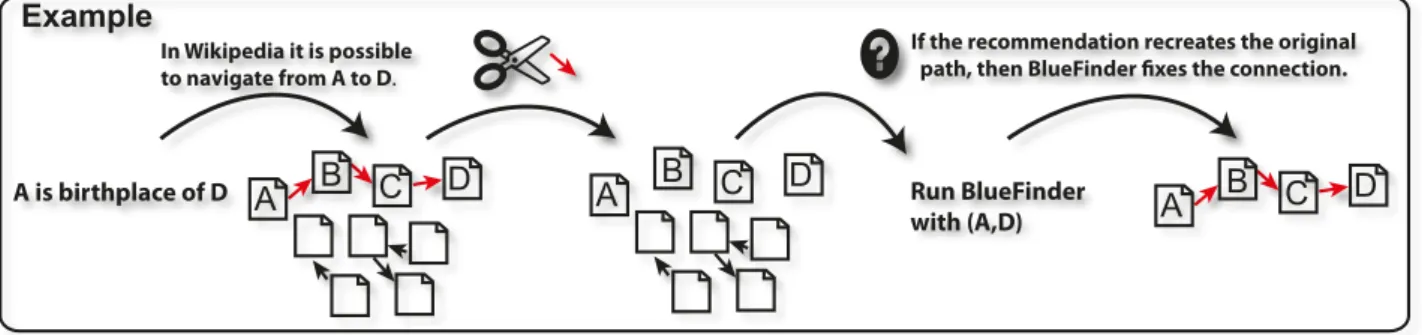
Contributions : In this work, I propose to add missing navigational paths in Wikipedia to
enhance Wikipedia content. This is will complete the virtuous cycle of information flow between Wikipedia and DBpedia as illustrated in Figure 3.2b. To measure how important the gap between Wikipedia and DBpedia, we choose the most popular classes of DBpedia defined in [Leh+15], and the properties with the highest number of triples. We call these properties relevant properties. Listing
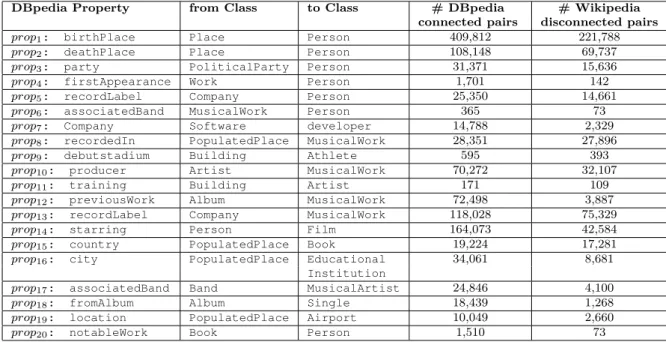
3.1b shows the SPARQL query Q2 that retrieves the relevant properties that relate instances of the classes dbo:Person and dbo:Place. We observe the same phenomenon when querying DBpedia using relevant properties of other classes, e.g., dbo:Person, dbo:Place, or dbo:Work, as shown in Table 3.1. The last two columns of the table provide the number of connected pairs obtained by a SPARQL query and the amount of disconnected pairs in Wikipedia for a specific property, respectively.
34 CHAPTER 3. CO-EVOLUTION BETWEEN SOCIAL AND SEMANTIC WEB
DBpedia Property from Class to Class # DBpedia # Wikipedia connected pairs disconnected pairs
prop1: birthPlace Place Person 409,812 221,788
prop2: deathPlace Place Person 108,148 69,737
prop3: party PoliticalParty Person 31,371 15,636
prop4: firstAppearance Work Person 1,701 142
prop5: recordLabel Company Person 25,350 14,661
prop6: associatedBand MusicalWork Person 365 73
prop7: Company Software developer 14,788 2,329
prop8: recordedIn PopulatedPlace MusicalWork 28,351 27,896
prop9: debutstadium Building Athlete 595 393
prop10: producer Artist MusicalWork 70,272 32,107
prop11: training Building Artist 171 109
prop12: previousWork Album MusicalWork 72,498 3,887
prop13: recordLabel Company MusicalWork 118,028 75,329
prop14: starring Person Film 164,073 42,584
prop15: country PopulatedPlace Book 19,224 17,281
prop16: city PopulatedPlace Educational 34,061 8,681 Institution
prop17: associatedBand Band MusicalArtist 24,846 4,100
prop18: fromAlbum Album Single 18,439 1,268
prop19: location PopulatedPlace Airport 10,049 2,660
prop20: notableWork Book Person 1,510 73
Table 3.1 – Results of 20 SPARQL queries for 20 properties and different classes.
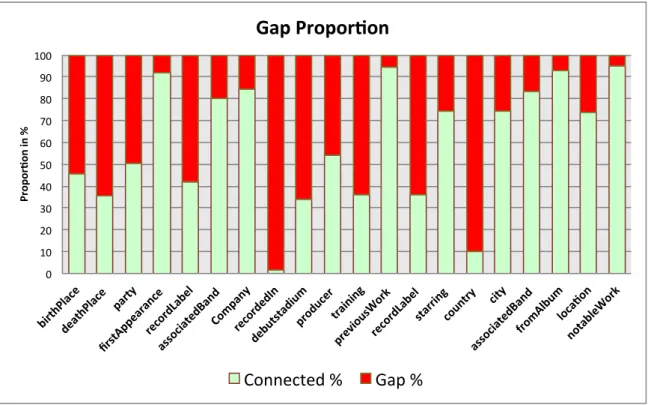
Some connected resources in DBpedia are disconnected in their corresponding Wikipedia articles, i.e., resources can be navigated in DBpedia while it is not possible to navigate equivalent resources in Wikipedia. We call this missing navigational paths information gap between Wikipedia and DBpedia. Figure3.3 details the number of information gap between Wikipedia and DBpedia for the properties detailed in Table3.1.
In order to evaluate the usefulness of adding these navigational paths, we carry out a social evalua-tion [Tor+12a]. In this evaluation, we have manually added missing navigational paths for 211 discon-nected pairs and after one month, we analyzed the number of navigational pairs accepted or rejected by the Wikipedia community. As detailed in [Tor+12a], 90% of new navigational paths were accepted and 10% were rejected. Although the rejected navigational paths had respected the semantics of the relation, they were more general than those used by the community. For example, the proposed navi-gational path to connect (Edinburgh, Charlie Aitken)2with the DBpedia property is birthplace of was
Edinburgh / Category:Edinburgh / Category:People_from_Edinburgh / Charlie_Aitken3.
Wikipedia community argued that the category People from Edinburgh is too general and the more specific category Sportspeople from Edinburgh is a more appropriate link.
For adding missing navigational paths, it is mandatory to study how the Wikipedia articles are connected respecting the Wikipedia conventions4. How to find the Wikipedia convention for a
2. Charlie Aitken (footballer born 1942)
3. It must be read as from Edinburgh article, the user navigates through a link to the category Edinburgh then he
or she navigates to People from Edinburgh category, and then to Charlie Aitken article".
3.1. PROBLEM STATEMENT 35 0 10 20 30 40 50 60 70 80 90 100 birthP lace deathP
lace party firstAp peara nce record Label assoc iatedBand Comp any reco rded In debutstadium produc er training previou sWor k reco rdLabel starring coun
try city assoc
iatedBand fromAl bum loca? on notab leWor k Pr op or ?o n in %
Gap Propor?on
Connected % Gap %Figure 3.3 – Gap proportion for the twenty DBpedia properties of Table 3.1
navigational path? We formulate the problem of predicting the best representation of missing links
in Wikipedia as a collaborative recommender system problem and define BlueFinder, a collaborative recommender system as a solution to this problem. In the following, I detail problem statement and BlueFinder approach and algorithms.
3.1
Problem Statement
According to Adomavicioius and Tuzhilin [AT05], "collaborative recommender systems try to
pre-dict the utility of items for a particular user based on the items previously rated by other users".
BlueFinder predicts links between Wikipedia articles based on links previously rated by the Wikipedia community. Thus, BlueFinder can be considered as a collaborative recommender system for enhanc-ing content of Wikipedia.
More formally, the utility function u(c, s) of item s for user c is estimated based on the utilities
u(cj, s) assigned to item s by those users cj ∈ C who are “similar” to user c. In the context of
Wikipedia, BlueFinder does not directly apply recommenders to suggest Wikipedia articles to users but to suggest links between articles. BlueFinder predicts the utility of path queries for a particular pair of Wikipedia articles based on those rated by the Wikipedia community. In other words, the pairs of articles (from,to) will play the role of users and the path queries will be the items. Then, the
![Figure 1.1 – Semantic Web, Social Web and Social Semantic Web: Source [Bre+09]](https://thumb-eu.123doks.com/thumbv2/123doknet/14705067.747756/6.892.180.710.82.450/figure-semantic-web-social-web-social-semantic-source.webp)