HAL Id: tel-01226540
https://tel.archives-ouvertes.fr/tel-01226540
Submitted on 9 Nov 2015HAL is a multi-disciplinary open access archive for the deposit and dissemination of sci-entific research documents, whether they are pub-lished or not. The documents may come from teaching and research institutions in France or abroad, or from public or private research centers.
L’archive ouverte pluridisciplinaire HAL, est destinée au dépôt et à la diffusion de documents scientifiques de niveau recherche, publiés ou non, émanant des établissements d’enseignement et de recherche français ou étrangers, des laboratoires publics ou privés.
Maqsood Ahmad
To cite this version:
Maqsood Ahmad. Mathematical models and methods based on metaheuristic approach for timetabling problem. Other [cs.OH]. Université Blaise Pascal - Clermont-Ferrand II, 2013. English. �NNT : 2013CLF22393�. �tel-01226540�
U
NIVERSITEB
LAISEP
ASCAL–
C
LERMONT-F
ERRANDII
E
COLED
OCTORALE DESS
CIENCESP
OUR L’I
NGENIEUR DEC
LERMONT-F
ERRANDTHESE
présentée par
Maqsood AHMAD
en vue d’obtenir le grade de
D
OCTEUR D
’U
NIVERSITÉ
Spécialité : INFORMATIQUE
___________________________________
Mathematical Models and Methods Based
on Metaheuristic Approach for Timetabling Problem
___________________________________
Soutenue publiquement le 15 novembre 2013 devant le jury :
ALPAN Gulgun, rapporteur ARTIBA Hakim, examinateur
CAUX Christophe, co-directeur de thèse GOURGAND Michel, directeur de thèse QUILLIOT Alain, examinateur
AKNOWLEDGEMENT
I would like to express my gratitude to my supervisors Michel Gourgand and Christophe Cuax without their help it was impossible to complete this work. I am really thankful to them for their precious time, guidance, patience, motivation and enthusiasm. They were always available for my help whenever I found any difficulty. They were really helpful to solve my administration related problems as well.
Besides my supervisors, I would like to thank Michel Chabrolle for her care and interest in my work. Her comments and guidance played a vital role in the completion of this work. I would also pay my gratitude to my jury members Gulgun Alpan and Ameur Soukhal for their comments and corrections which made this thesis more accurate and give us more ideas for our future work. I am grateful to my examiners for their comments and suggestions. I would like to extend my gratitude to our Montlucon team for their support. I would never forget their cooperation. I am also thankful to my colleagues of LIMOS with whom I passed a very good time.
My profound gratitude is also for my friends, who were always with me in any time of difficulty. Their company was a source of inspiration and pleasure for me. I would always miss their company and talks.
I would like to extend my gratitude to my parents, brothers, sisters and all relatives whose prayers and good wishes were really important for me while staying abroad.
Last but not least, my profound gratitude is for my wife and daughter who helped me a lot to do this work and facilitated (especially in form of time) me during this work.
Table of Contents
SUMMARY OF THESIS...1
AKNOWLEDGEMENT ... III
1
INTRODUCTION ... 7
1.1
Brief introduction of timetabling problems ... 7
1.2
Main categories of educational timetabling problems ... 9
1.2.1
High school timetabling ... 9
1.2.2
University timetabling ... 9
1.2.2.1 Characteristics of university timetabling ... 10
1.2.2.2 Structure of university courses ... 10
1.2.2.3 Types of university courses ... 10
1.2.2.4 Availability of resources ... 11
1.2.2.5 Rules for timetabling in the university ... 11
1.2.3
Examination timetabling ... 12
1.3
Different types of constraints ... 12
1.3.1
Hard constraints ... 13
1.3.2
Soft constraints ... 13
1.4
Categorization of constraints into five main classes ... 13
1.4.1
Unary constraints ... 13
1.4.2
Binary constraints ... 13
1.4.3
Capacity constraints ... 14
1.4.4
Event spread constraints ... 14
1.4.5
Agent constraints ... 14
1.5
Objective Functions ... 15
1.6
Neighbourhood Structures ... 16
1.6.1
Simple swap ... 16
1.6.3
Time swap neighborhood ... 17
1.6.4
Kempswap neighborhood ... 18
1.7
Graph colouring and timetabling problem ... 20
1.8
Resolution techniques ... 24
1.8.1
Exact methods ... 24
1.8.1.1 Integer programming techniques ... 25
1.8.2
Metaheuristic methods ... 27
1.8.2.1 Local search based algorithms ... 28
1.8.2.1.1 Tabu search algorithms ... 28
1.8.2.1.2 Local search algorithms ... 29
1.8.2.1.3 Simulated annealing algorithms ... 31
1.8.2.1.4 Great deluge algorithms ... 32
1.8.2.2 Population based algorithms ... 33
1.8.2.2.1 Ant colony algorithms ... 33
1.8.2.2.2 Partical swarm optimization algorithm ... 34
1.8.2.2.3 Genetic algorithms ... 35
1.8.2.2.3.1 Initialization ... 35
1.8.2.2.3.2 Selection ... 38
1.8.2.2.3.3 Cross over ... 39
1.8.2.2.3.4 Reproduction... 41
1.8.2.2.3.5 Genetic algorithms in educational timetabling ... 42
1.8.2.2.3.6 A simple example of genetic algorithm ... 45
1.8.2.2.4 Memetic algorithms ... 48
1.8.2.2.5 Honey bee algorithms ... 49
1.8.2.2.5.1 Review of Honey bee algorithms... 51
1.8.3
Brief review of RCPSP ... 55
1.9
Conclusion ... 56
2
TRANSFORMATION
OF
COURSE
TIMETABLING
PROBLEM TO RCPSP ... 58
2.1
The resource constrained project scheduling problem
(RCPSP) ... 58
2.2
Basic single-mode RCPSP and course timetabling ... 59
2.3
Transformation of timetabling problem to RCPSP ... 60
2.3.1
General features of the models ... 60
2.3.2
Proposed mathematical model 1 ... 62
2.3.3
Proposed mathematical model 2 ... 63
2.4
Conclusion ... 64
3
A
GENERIC
MODEL
OF
UNIVERSITY
COURSE
TIMETABLING PROBLEM ... 66
3.1
General features of the proposed model ... 66
3.1.1
Used entities of the model ... 66
3.1.2
Notations, sets, sub sets and parameters ... 67
3.1.3
Decision variables ... 70
3.1.4
Objective function ... 70
3.2
Integer programming formulation for generalized problem
70
3.2.1
Hard constraints ... 70
3.2.2
Period related constraints ... 71
3.2.3
Room related constraints ... 72
3.2.4
Class related constraints ... 72
3.2.5
Course related constraints ... 75
3.2.6
Teacher related constraints ... 77
3.3
Discussion on Objective functions... 78
3.4
An example of timetabling problem ... 80
3.5
Conclusion ... 82
4
GENERIC MODEL FOR EXAMINATION TIMETABLING
PROBLEM ... 84
4.1
Most frequently used constraints for examination
timetabling ... 85
4.2
Features of the generic model ... 85
4.2.1
Entities for the model... 86
4.2.2
Notations, sets, sub sets and parameters ... 86
4.2.3
Decision variables ... 88
4.2.4
Objective function ... 88
4.3
Integer programming model for generalized examination
timetabling problem ... 89
4.4
Conclusion ... 93
5
DIFFERENT INSTANCES OF GENERIC MODELS FOR
UNIVERSITY COURSE AND EXAMINATION TIMETABLING
PROBLEMS ... 95
5.1
Instances of our generalized course timetabling problem .... 95
5.1.1
Pasquale Avella and Andigor Vasil’ev model ... 96
5.1.2
International timetabling competition 2007 (ITC 2007) ... 98
5.1.2.1 Post enrollment based course timetabling ... 98
5.1.2.1.1 Used constraints and difference with ITC 2002 ... 99
5.1.2.1.2 Difference of our model with Post enrolment based course timetabling 100 5.1.2.2 Curriculum based course timetabling problem ... 102
5.1.2.2.1 Evaluation procedure for solutions ... 103
5.1.2.2.2 Used sets for the problem ... 105
5.1.2.2.3 Purpose of the competition ... 106
5.1.3
Original timetabling problem of Udine University ... 106
5.1.4
Constraints different from previous scenarios ... 109
5.1.5
Constraints not found in the literature ... 109
5.2
Examination Timetabling Instances ... 112
5.2.1
University of Toronto Benchmark instances ... 112
5.2.2
University of Melbourne Benchmark instances ... 113
5.2.3
ITC- 2007 Benchmark instance (Examination Timetabling Track)
113
5.2.4
Constraints different from previous benchmark instances ... 114
5.2.5
Constraints not found in the literature ... 115
5.3
Conclusion and Discussion... 115
6
PROPOSITION OF RESOLUTION METHODS ... 117
6.1
Solution representation of Algorithms ... 117
6.1.1
Reduction of search space ... 119
6.1.2
Benefits of using this representation ... 120
6.2
Initial solution ... 122
6.2.1
Pre-processing or division of search space ... 122
6.2.2
Random initialization... 124
6.2.3
Repair strategies ... 124
6.2.4
Set forming heuristics ... 126
6.3
Memetic Algorithm ... 126
6.3.1
Classic genetic algorithm ... 127
6.3.2
Genetic operators ... 127
6.3.2.1 Selection ... 127 6.3.2.2 Cross over ... 128 6.3.2.3 Mutation ... 1286.3.3
Infection ... 130
6.3.4
Replacement ... 131
6.3.5
Proposed Local search ... 132
6.3.6
Pseudo code of memetic algorithm ... 133
6.4.1
Honey bee colony Algorithm ... 135
6.4.2
Honey bee mating algorithm ... 135
6.4.3
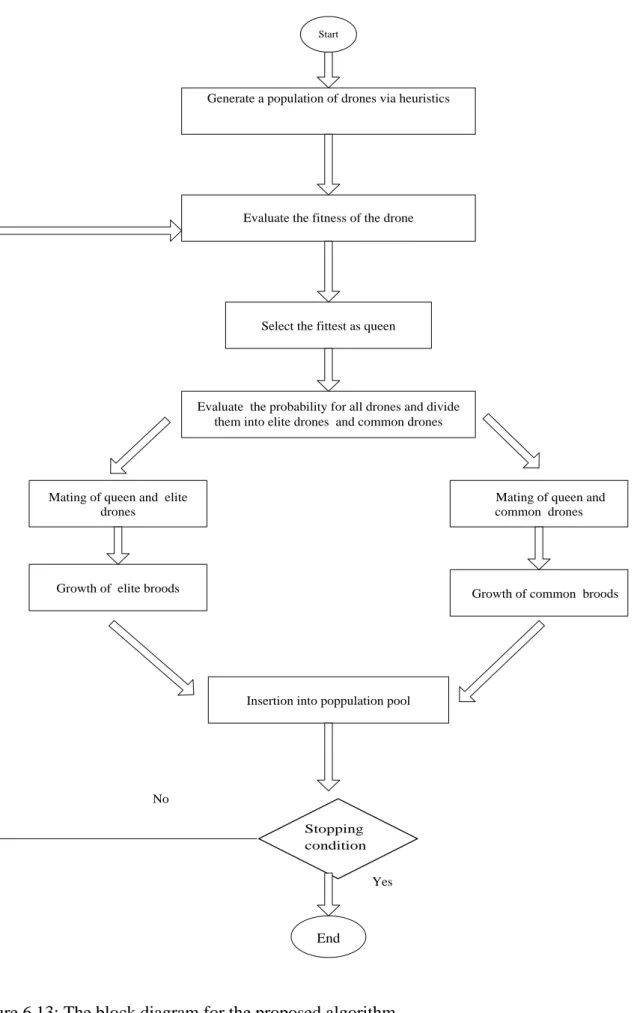
Proposed honey bee mating algorithm ... 136
6.5
Termination criteria ... 144
6.6
Conclusion ... 144
7
EXPIREMENTS AND RESULTS ... 147
7.1
Course timetabling problem ... 147
7.1.1
Benchmark solved by proposed memetic algorithm ... 148
7.1.2
Description of the generalized course timetabling problem ... 153
7.1.3
Data generation for course timetabling problem ... 155
7.1.4
Results of course timetabling Problem.1 datasets ... 158
7.1.4.1 Memetic algorithm ... 159
7.1.4.2 Honey bee mating algorithm ... 161
7.1.4.3 Genetic algorithm ... 162
7.1.4.4 Tabu search algorithm ... 164
7.1.4.5 Minimum cost Comparison of all algorithms ... 166
7.1.4.6 Maximum cost Comparison of all algorithms ... 168
7.1.4.7 Average cost Comparison of all algorithms ... 169
7.1.5
Results of course timetabling Problem.2 datasets ... 170
7.1.5.1 Memetic algorithm ... 171
7.1.5.2 Honey bee mating algorithm ... 171
7.2
Examination timetabling problem ... 172
7.2.1
Data generation for Examination timetabling problem ... 172
7.2.2
Results of examination timetabling problem datasets ... 176
7.2.2.1 Minimum cost comparison of all algorithms ... 176
7.2.2.2 Maximum cost comparison of all algorithms ... 177
7.2.2.3 Average cost comparison of all algorithms ... 178
7.2.2.4 Standard deviation comparison of all algorithms ... 179
REFERENCES ... 189
List of Figures
Figure 1.1: a and b: Illustration of simple swap ... 16Figure 1.2: Illustration of room swap neighborhood ... 17
Figure 1.3: Illustration of time swap neighborhood ... 18
Figure 1.4: Kemp chain illustration ... 19
Figure 1.5: Describing the relationship between the graph colouring problem and a simple timetabling problem (only considering lesson conflict constraint). ... 22
Figure 1.6: Associated conflict graph of lessons ... 24
Figure 1.7: Repair procedure for Course’s conflict ... 36
Figure 1.8: Repair procedure for teacher’s conflict ... 37
Figure 1.9: Build procedure Lewis thesis [102] ... 38
Figure 1.10: Picture expressing roulette wheel selection ... 39
Figure 1.11: Picture expressing one point crossover ... 40
Figure 1.12: Picture expressing two point crossover ... 40
Figure 1.13: Picture expressing uniform crossover ... 41
Figure 1.14: Original HBMO for SAT [68] ... 50
Figure 6.1: Example of a single room timetable ... 118
Figure 6.2: An entire university timetable ... 119
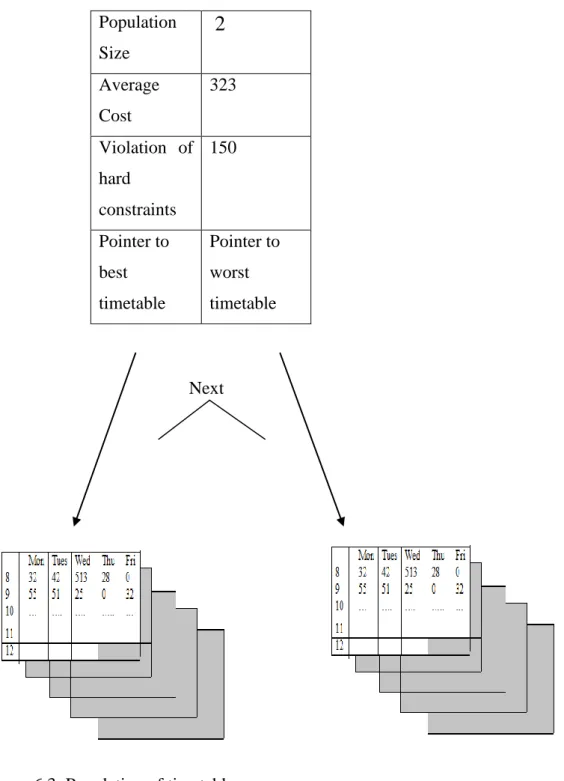
Figure 6.3: Population of timetables ... 123
Figure 6.4: Procedure for room repair strategy ... 125
Figure 6.5: Two step verification strategy (Repair procedure for violation of two hard constraints) ... 125
Figure 6.6: Procedure for crossover ... 128
Figure 6.7: Procedure for random mutation ... 129
Figure 6.8: Procedure for mutation by neighbourhood ... 130
Figure 6.9: Infection ... 131
Figure 6.10: The pseudo code for Local Search ... 132
Figure 6.11: The pseudo code for memetic algorithm ... 134
Figure 6.12: Pseudo Code for Honey Bee Mating Algorithm ... 139
Figure 7.1: is showing the behaviour of the algorithms for medium sized dataset. These algorithms are run for 5000 iterations. X-axis represents number of iterations and Y-axis represents the cost at each iteration. The mutation rate is set to 7, kill colony 20 percent and population size 100. ... 181 Figure 7.2: Showing the comparison of different selection operators for memetic algorithm ... 182 Figure 7.3: Time and cost comparison of all algorithms ... 183
List of Tables
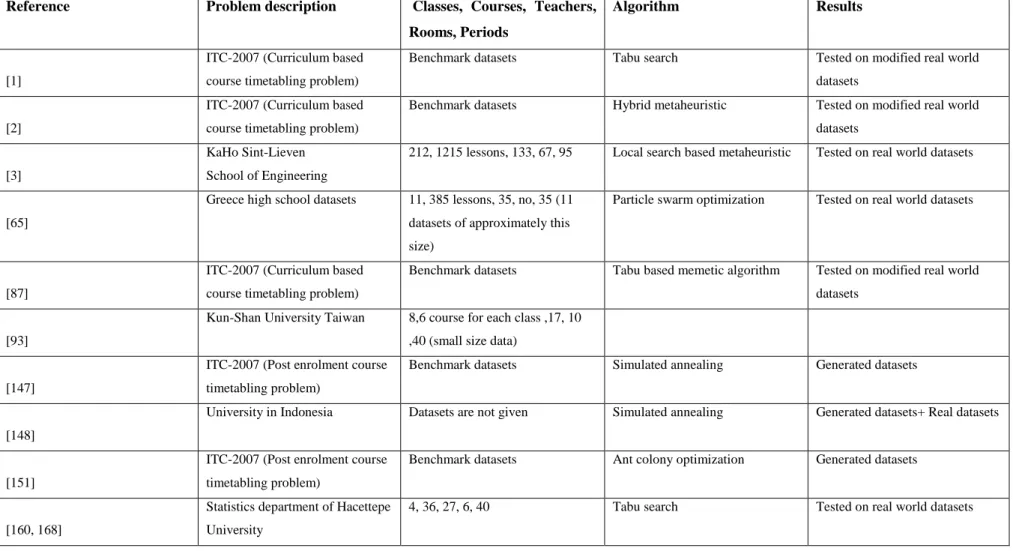
Table 1.1: Lists papers related to course and examination timetabling problem ... 54
Table 3.1: Solution of timetabling example by CPLEX ... 81
Table 5.1 : Score matrix ... 104
Table 5.2: Rank matrix and mean ranks ... 104
Table 6.1: Differences and similarities between our HBM algorithm and previous population based algorithms. ‘‘–’’ means the method did not use the corresponding operator. ... 137
Table 6.2: Differences and similarities between our HBM algorithm, HBMO [68] and HBMO-ETP [48] ... 140
Table 6.3: Parameter settings for our HBM algorithm’s computational experiments ... 142
Table 7.1: Showing dataset number, dataset name, total number of rooms, total number of periods, total number of courses, the sum of their events in a week and the number of curricula. ... 149
Table 7.2: Frequency or the portion of period-room slots in use, utilisation in terms of used seats in percentage, numbers of edges in conflict graphs (CG), density in conflict graphs (CG) with vertices representing courses rather than events and total unavailability constraints. ... 150
Table 7.3: Aaverage number of conflicts (Co), average teacher availability (TA), average number of lessons per curriculum per day (CL) and average room occupation (RO) ... 150
Table 7.4: Our memetic algorithm’s (Our MA) results (minimize objective function value) in comparison with some other used techniques for International timetabling competition datasets (ITC-2007). ... 152
Table 7.5: Showing constraints for Problem.1 and provides details about every constraint whether it is used as hard or soft. If it is used as a soft constraint then it also tells about the amount of penalty used in case of violation. ... 154
Table 7.6: Showing additional constraints used for Problem.2 ... 155
Table 7.7: Numerical results for small datasets obtained by memetic algorithm ... 159
Table 7.8: Numerical results for medium datasets obtained by memetic algorithm ... 160
Table 7.9: Numerical results for large datasets obtained by memetic algorithm ... 160
Table 7.11: Numerical results for medium datasets obtained by honey bee mating algorithm
... 162
Table 7.12: Numerical results for large datasets obtained by honey bee mating algorithm .. 162
Table 7.13: Numerical results for small datasets obtained by genetic algorithm... 163
Table 7.14: Numerical results for medium datasets obtained by genetic algorithm ... 163
Table 7.15: Numerical results for large datasets obtained by genetic algorithm ... 164
Table 7.16: Numerical results for small datasets obtained by tabu search algorithm ... 165
Table 7.17: Numerical results for medium datasets obtained by tabu search algorithm... 165
Table 7.18: Numerical results for large datasets obtained by tabu search algorithm ... 166
Table 7.19: Minimum cost comparison of honey bee mating, memetic, genetic and tabu search algorithms for small datasets. ... 167
Table 7.20: Minimum cost comparison of honey bee mating, memetic, genetic and tabu search algorithms for medium datasets. ... 167
Table 7.21: Minimum cost comparison of honey bee mating, memetic, genetic and tabu search algorithms for large datasets. ... 167
Table 7.22: Maximum cost comparison of honey bee mating, memetic, genetic and tabu search algorithms for small datasets. ... 168
Table 7.23: Maximum cost comparison of honey bee mating, memetic, genetic and tabu search algorithms for medium datasets. ... 168
Table 7.24: Maximum cost comparison of honey bee mating, memetic, genetic and tabu search algorithms for large datasets. ... 169
Table 7.25: Average cost comparison results of honey bee mating, memetic, genetic and tabu search algorithms for small datasets. ... 169
Table 7.26: Average cost comparison results of honey bee mating, memetic, genetic and tabu search algorithms for medium datasets. ... 170
Table 7.27: Average cost comparison results of honey bee mating, memetic, genetic and tabu search algorithms for large datasets. ... 170
Table 7.28: Numerical results for large datasets obtained by memetic algorithm ... 171
Table 7.29: Numerical results for large datasets obtained by honey bee mating algorithm .. 172
Table 7.30: Constraints for examination timetabling problem... 175
Table 7.31: Minimum cost comparison of all algorithms for small datasets ... 176
Table 7.32: Minimum cost comparison of all algorithms for medium datasets ... 176
Table 7.34: Maximum cost comparison of all algorithms for small datasets ... 177
Table 7.35: Maximum cost comparison of all algorithms for medium datasets ... 177
Table 7.36: Maximum cost comparison of all algorithms for large datasets ... 178
Table 7.37: Average cost comparison of all algorithms for small datasets ... 178
Table 7.38: Average cost comparison of all algorithms for medium datasets ... 178
Table 7.39: Average cost comparison of all algorithms for large datasets ... 178
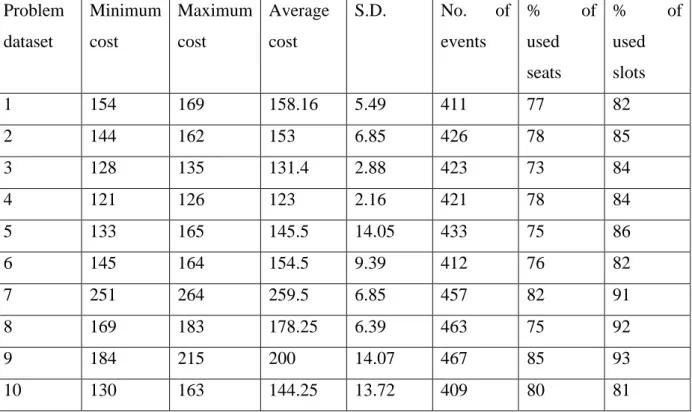
Table 7.40: Standard deviation comparison of all algorithms for small datasets... 179
Table 7.41: Standard deviation comparison of all algorithms for medium datasets ... 179
SUMMARY
OF
THE
THESIS
In this thesis we have concerned ourselves with university timetabling problems both course timetabling and examination timetabling problems. Most of the timetabling problems are computationally NP-complete problems [159, 161], which means that the amount of computation required to find solutions increases exponentially with problem size. These are idiosyncratic nature problems, for example different universities have their own set of constraints, their own definition of good timetable, feasible timetable and their own choice about the use of constraint type (as a soft or hard constraint).
Unfortunately, it is often the case that a problem solving approach which is successfully applied for one specific problem may not become suitable for others. This is a motivation, we propose a generalized problem which covers many constraints used in different universities or never used in literature. Many university timetabling problems are sub problems of this generalized problem. Our proposed algorithms can solve these sub problems easily, moreover constraints can be used according to the desire of user easily because these constraints can be used as reference to penalty attached with them as well. It means that give more penalty value to hard constraints than soft constraint. Thus more penalty value constraints are dealt as a hard constraint by algorithm. Our algorithms can also solve a problem in two phases with little modification, where in first phase hard constraints are solved. In this work we have preferred and used two phase technique to solve timetabling problems because by using this approach algorithms have broader search space in first phase to satisfy hard constraints while not considering soft constraints at all.
Two types of algorithms are used in literature to solve university timetabling problem, exact algorithms and approximation algorithms. Exact algorithms are able to find optimal solution, however in university timetabling problems exact algorithms constitute brute-force style procedures. And because these problems have the exponential growth rates of the search spaces, thus these kinds of algorithms can be applied for small size problems. On the other side, approximation algorithms may construct optimal solution or not but they can produce good practically useable solutions. Thus due to these factors we have proposed approximation algorithms to solve university timetabling problem.
We have proposed metaheuristic based techniques to solve timetabling problem, thus we have mostly discussed metaheuristic based algorithms such as evolutionary algorithms, simulated annealing, tabu search, ant colony optimization and honey bee algorithms. These algorithms have been used to solve many other combinatorial optimization problems other than timetabling problem by modifying a general purpose algorithmic framework. We also have presented a bibliography of linear integer programming techniques used to solve timetabling problem because we have formulated linear integer programming formulations for our course and examination timetabling problems.
We have proposed two stage algorithms where hard constraints are satisfied in first phase and soft constraints in second phase. The main purpose to use this two stage technique is that in first phase hard constraints satisfaction can use more relax search space because in first phase it does not consider soft constraints. In second phase it tries to satisfy soft constraints when maintaining hard constraints satisfaction which are already done in first phase.
As mentioned above, our scientific investigations are related to linear integer programming formulations for generalized university course and examination timetabling problems, transformation of course timetabling problem models to resource constrained project scheduling problem (RCPSP) and metaheuristics to solve timetabling problem. A major part of thesis consists of examining proposed algorithms. From our studies of these mathematical models and algorithms, the following scientific work is made.
• We have proposed two mathematical formulations of course timetabling problem which are the prototype of single-mode RCPSP. The main benefit of these formulations is that these give us the idea of using different durations for lessons in course timetabling and the implementation of precedence constraints through RCPSP to timetabling problem. This work equates the two different problems through mathematical formulation.
• We have proposed a new 0-1 linear integer programming formulation for university course timetabling problem. The mathematical model for the problem provides many operational rules and requirements which are needed in many universities. We have discussed how different objective functions can be deduced from this formulation by using these mathematical relations as a soft constraint.
• Different university environments have been shown as a sub problem of our generalized model. Sub problem mathematical formulations have been deduced from generic model. We have written mathematical equations of objective functions of these problems.
• A new 0-1 linear integer programming formulation for examination timetabling problem is proposed. This generic model is made by gathering many constraints from different university environments in a single problem and by adding some extra constraints which were never used in literature according to our knowledge.
•We have proposed two algorithms to solve course and examination timetabling problem. Our first algorithm is memetic algorithm. Memetic algorithm is a genetic algorithm with local search; we also have proposed a local search for our memetic algorithm. Our second algorithm is honey bee mating algorithm, use of this algorithm in educational timetabling problems is not common. We have discussed in detail differences and similarities between our algorithms and previously used algorithms.
Our thesis is structured as follows.
In Chapter 1 we have given an introduction to the university timetabling problem. We have explained what is timetabling problem and what kind of constraints are used in university timetabling problem. We have discussed similarities of graph coloring problems with educational timetabling problems. We also have given a review of different solution techniques used to solve this kind of problems, concentrating mainly on metaheuristics.
In Chapter 2, we have given a connection of single mode RCPSP with course timetabling problem. This chapter transforms course timetabling problem to RCPSP through two equivalent mathematical formulations proposed by us.
In Chapter 3, we have proposed a generic model for university course timetabling problem. We have defined different sets, sub sets and parameters to formulate a generalized mathematical model.
In Chapter 4, we have proposed a generic model for examination timetabling problem, this model resembles to the generic model for course timetabling but its structure is different from course timetabling problem.
In Chapter 5, we have discussed about different instances from literature. The formulations of these instances can be made by our generic model for university course timetabling problem. We have also discussed instances used in literature for examination timetabling problem. We have shown in detail how these instances can be obtained from our model.
In Chapter 6, we have explained in detail our proposed memetic algorithm and honey bee mating algorithm. We have explained how these algorithms work. We have explained in detail our chromosome representation, different operators used and different repair functions.
In Chapter 7, we have solved dataset instances of ITC-2007 with our proposed memetic algorithm and compared our results with the results of techniques used in literature. We have generated data for our generalized problem for both course and examination timetabling. We solve these datasets with our proposed algorithms. After getting results we have discussed about the performance of these algorithms. We have also tested the effect of different parameters and operators on the performance of algorithm.
At the end, we have given summary of the main conclusions which can be drawn from this thesis. Moreover, future research perspectives have been discussed which can give the good ideas for further possible research directions.
We want to keep this thesis at a reasonable length and we write this thesis considering that the reader has some basic knowledge of university timetabling problem and used solution techniques especially metaheuristics. Readers who do not have prerequisite knowledge are invited to study some good texts about these topics. We refer these works for basic understanding of the domain.
• One can find good articles on various different timetabling problems from the website of ASAP group (http://www.asap.cs.nott.ac.uk/?q=bibliography). This website also contains many good publications of the PATAT series (The Practice and Theory of Automated Timetabling).
• One can also find good overviews on the basic principles of metaheuristics on website http://en.wikipedia.org/wiki/Metaheuristic.
• We have given reference of some good surveys on educational timetabling problems, which can be found in the bibliography at the end of this thesis.
Chapter 1
1
INTRODUCTION
This chapter presents the general overview of timetabling problems, what actually these problems are, how much trouble they can create for scheduler and how many different ways can be used to solve them. In the next Section 1.1, we have discussed different timetabling problems used by research community and expressed how these problems have a significant effect on user’s life. In Section 1.2, we have presented different types of educational timetabling problems. In Section 1.3, we have spoken about major types of constraints used in educational timetabling problems. In Section 1.4, we have a categorization of these constraints. In Section 1.5, we have brief detail of different objective functions used in literature. In Section 1.6, we have talked about different neighbourhood structures used for educational timetabling as a part of different metaheuristics. In Section 1.7, we have shown a comparison between simple timetabling problem and another combinatorial optimization problem: graph colouring. In Section 1.8, we have included a detailed review of different methods used to solve various university timetabling problems proposed by researchers in the literature. This chapter’s conclusion is given in Section 1.9.
1.1 Brief introduction of timetabling problems
Wren [117] defines timetabling as follows: ‘‘Timetabling is the allocation, subject to constraints, of given resources to objects being placed in space time, in such a way as to satisfy as nearly as possible a set of desirable objectives’’.
Timetables have become very important part of our daily life such as transport, work, sports and education. It is very hard to imagine and organize life in modern society without them. The construction of workable and attractive timetables is not an easy task in real world cases where one has limited resources like people, space and time. Using limited resources it becomes a challenging problem even for the experienced designers. These timetables have a significant effect on the people who use them. These timetables construction should be as best as one can. Often such type of timetables will be updated or completely rescheduled. School
or university timetables will be rescheduled at the beginning of the new academic year, similarly bus or train timetable will be modified to cope with new road layouts and stops. So this is a problem which people and institution will face on regular basis.
Train or railway timetabling is the planning of arrivals and departures of trains at stations and from stations. The objective is to minimize travel times, satisfy user requirements and solve conflicts between different trains. This is the simple theoretical view but in real situation there are many more problems to solve. There could be many additional constraints like when some trains are standing on tracks, some platforms are not available etc. Bus or train timetables show that when a journey will be conducted on any particular routes or paths. It does not tell about which driver or which vehicle will be used. The allocation of derivers and vehicles is the part of scheduling process. So railway scheduling means design of pattern journeys [5, 6]. Employee timetabling is very important when one wants to produce goods to meet some demand in any production system. This type of schedule will take into account the availability of the human resources. So with production schedule an employee schedule should be made simultaneously [7]. Employee timetabling will minimize labor costs while production scheduling should insure that production can be done on time.
Nurse rostering problems will arise in hospital practice. This is about personal scheduling and this generates daily schedules for nurses by assigning shifts according to their skills and predefined hard and soft constraints. It can be defined this way “ Given a set of shifts and set of nurses over a certain period, assign each shift of nurse subject to a set of constraints” [8]. The main purpose of this scheduling is to make a plan for nurses who can satisfy nurses and patients. Due to many constraints of conflicting nature and requirements (like coverage demand, consecutive demands of shifts, day off requirements, work load of nurses, weekend related requirements) this is a very difficult problem to solve for hospital’s personal managers and for researchers as well.
Sports have great attraction all over the world. Professional sport leagues invest a lot of money in players. Now these games have become multimillion dollar industries. Big events like the Football world cup, Olympic Games and major golf tournaments generate huge television audiences worldwide. Thus the key aspect of this type of scheduling is the assignment of venues and times to different competitions over multiple venues that can satisfy
to all those who have interest in these competitions. So constraints of the problem can vary from competition to competition. These requirements could be of different type, each team should play at each station, each team will counter against each other team at least once in tournament etc. [14].
1.2
Main categories of educational timetabling problems
Educational timetabling problems could be divided in main three categories, High school timetabling, University timetabling and Examination timetabling problems. There are some good reviews on the topic in the literature [97,118,119, 73].
1.2.1 High school timetabling
In high school timetabling each class has a particular lessons and this timetabling is majorly driven by curriculum. Number of hours of each subject per week set nationally. Each class normally has a set of students which will attend same courses all day and a specific teacher will be allocated for each course. Teachers are normally allocated before scheduling so the main purpose is to assign courses of teachers to classes in particular periods.
1.2.2 University timetabling
University timetabling can be formally defined in this way, task of assigning a number of events such as lessons, examinations, meetings and so on, to a limited set of periods (perhaps rooms) in accordance with a set of constraints.
The university course timetabling problem is an assignment of courses to periods and rooms like high school timetabling but major difference between university course timetabling and high school timetabling is that university classes can have common students while school classes have disjoint sets of students. So if two classes have common students these can not be scheduled together in the same period. School teachers most of the time teach more than one class while university professor may teach only one course. In high school timetabling rooms are not a big issue because each class has its own room but in university course timetabling problem rooms have a lot of importance. In university environment some classes need some specific rooms with specific equipment. Room size plays a vital role, one big room can be partitioned into many small rooms and some rooms are not available all times.
1.2.2.1 Characteristics of university timetabling
The university timetabling problem has special features that highly depend upon the resource arrangement, their availability and other characteristics that the courses taught in a university carry along. A course can have particular requirements, which can be related to periods, teachers, rooms, sessions, arrangement of lessons of the course etc. [12].
1.2.2.2 Structure of university courses
A course offered by any institution may consist of just lessons, or lessons and recitations, or lessons, recitations, and/or work in a laboratory. The lessons are delivered by professors, teachers or other teaching staff and it is their choice, how they will carry out them in single or multi period session. Recitations are considered as lessons delivered by the same teacher, while in other cases they may be considered time for exercises to enhance the understanding of the material covered during lessons. In this last case the class is split into many parts and one or more persons are assigned to attend them. Lab work is usually part of a given course or sometimes a course by itself and the group of students is split into several sub-groups for training. Lab work is performed in special type of rooms (special type rooms may be laboratory, computer room etc.) which may need special equipment and professors and assistants are assigned to pursue these lessons. If number of students attending a course is more than a certain limit, course can be divided into sessions, these sessions can be taught by the same teacher and by different teachers depending upon the situation, resources and requirement of the university.
1.2.2.3 Types of university courses
In many universities courses are categorized in two categories mandatory and electives [12]. Mandatory courses are compulsory courses which each student should take for his basic training. These courses are more in lower grade years, so these are designed for all students of the same year. Elective courses are less in numbers in lower grade years. So these elective and mandatory courses have common students thus they should be scheduled on different periods.
In higher grade years case is opposite where mandatory courses are less in numbers but elective course are more in numbers. It is common in higher grade years to divide their students in different divisions according to student choices and each division has their own mandatory and elective courses. Then to make schedule for them is hard because some divisions have no common interests and some divisions are sharing courses. Different
students may belong to different lab groups or recitation and this will enhance more difficulty in scheduling.
1.2.2.4 Availability of resources
For the university timetabling problem resources refer to human resources, available periods and classrooms. Availability of human resources is restricted because due to administrative duties and some other projects teachers may not be available all the time. Some faculty members may like some free days or periods during the week. Similarly periods are also not available all the day, scheduler has to spare periods for lunch time or for tutorials etc., some periods are scheduled already due to the choices of faculty members to teach course in a specific period and some periods are forbidden for some courses due to non availability of teachers. Rooms may be of many types and which course uses which type of room depends on course and room type. All rooms will not be vacant all the time because some other departments of the university may be using them for their courses and these are available on specific periods for scheduling.
1.2.2.5 Rules for timetabling in the university
These basic rules in university timetabling regarded as hard constraints.
1. There is a conflict in a timetable when two or more courses are scheduled at the same period for the same teacher or for the same classroom for the same group of students. Also, when two or more teaching persons are assigned to the same group of students to teach two different courses at the same period; and lastly when two or more classrooms are assigned to the same course and to the same group of students at the same period.
2. A timetable is complete when total number of hours of the course should be scheduled, also teaching load of the teacher should not be more than a certain predefined limit. Similarly, there are rules which are regarded as soft constraints; some of them are given as follows: 1. Preferences for teachers in specific time intervals are satisfied if possible. Each faculty member can express his/her preference for his/her course. For example one does not want to teach course on Friday and other prefer to teach his/her courses in morning session.
2. Students’ schedule should be as compact as possible; however there should be empty periods for lunch. So called difficult courses should be scheduled earlier in the day then others should be scheduled. If one lesson of a course is scheduled in a day then if any other lesson of the same course is assigned to the same day, it should be compact with previous one.
3. If one course is scheduled in any room first time, it should be scheduled in the same room next time.
1.2.3 Examination timetabling
The examination timetabling is an assignment of events where now events are examination. It is same as course timetabling but has few differences with course timetabling problem. Normally each course has one examination. Major difference of this timetabling with course timetabling is that if a lesson is scheduled in a room then this room will not host any other lesson in that period. But in examination timetabling a room can host more than one examination depending upon the capacity of the room and the availability of invigilator. In course timetabling one teacher can teach only one lesson per period but in examination timetabling one examination can be supervised by more than one invigilator. Restrictions are strict in examination timetabling like we can think that a student is enforced to skip his course due to overlapping in schedule but it is not possible to skip examination. In course timetabling, scheduler makes a timetable for a week and repeats it for other weeks, means that course timetabling has fixed set of periods but in examination timetabling problem number of used periods can be relaxed.
The timetabling problem, like many others in the area of combinatorial optimization, has been approached by several well-known techniques of the operational research and the computer science fields. Several surveys on course timetabling [130, 10], which focus other aspects of the problem also have managed to record this work in a systematic way by categorizing the different variations of the problem and solution approaches.
1.3 Different types of constraints
In university timetabling, a set of lessons would be scheduled into rooms and periods subject to constraints that are usually divided in two categories, which are hard and soft constraints. Constraints and their importance however differ significantly among countries and institutions. A timetable is considered to be effective when it is useable and may be considered satisfactory by the institution when it carries certain quality characteristics that keep its users satisfied at least to a certain degree.
1.3.1 Hard constraints
Hard constraints must be strictly satisfied and have higher priority than soft constraints. A time table will be called feasible if it satisfies all hard constraints. Event clash constraints perhaps are considered common hard constraints in educational timetabling problems. These constraints normally occur when there is a resource which is only one and is required by two events at the same period which is impossible. This constraint exists in almost every educational institution, for example courses taken by some common students could not be scheduled in the same period.
1.3.2 Soft constraints
Soft constraints fulfillment is not obligatory like hard constraints but these are the constraints which scheduler wants to obey if possible, but these will decide the quality of the timetable according to the timetabling policies of university concerned and by the users who will use these timetables (like students, teachers etc.).
1.4 Categorization of constraints into five main classes
Despite the wide range of these different constraints, these constraints can be categorized into five main classes. This classification was suggested by Corne et al. [11].
1.4.1 Unary constraints
These are the constraints which involve only one event. For example event c should be scheduled on Monday or event c should be scheduled on any last period of the day. This type of constraints can occur both in course and examination timetabling. It can be both hard and soft.
1.4.2 Binary constraints
These are the constraints which involve pairs of events. For example event c should be scheduled before event d or two events c and d can be scheduled in same period. This type of constraints can occur both in course and examination timetabling. It can be both hard and soft.
1.4.3 Capacity constraints
These constraints are about capacity of rooms. If a course c is scheduled in a room then the number of students taking course c should be less than or equal to the capacity of the room. This type of constraints can occur both in course and examination timetabling. It can be both hard and soft.
1.4.4 Event spread constraints
This is a constraint which talks about spreading out or clumping together events. There are some time requirements that lessons of a class should be scheduled together or examination of a class should be scheduled after a gap of g periods. So these constraints can be in both course and examination timetabling and these are normally soft constraints.
1.4.5 Agent constraints
These constraints are about the preference of the people who will use this timetable, for example teacher a wants two free mornings, some classes want their language courses should be scheduled in evening session, these constraints are used normally as soft constraints. From this whole analysis it is clear that each institution has a wide range of their own preference and requirements which can entirely be different from other institutions. It is entirely understandable that each institution has their own needs and timetabling policies, for example one institution wants that course should be clump together because institution have some more courses to schedule for part time students and other institution wants that events of a student should be spread out within the week as much as possible, so these two scenarios are entirely different than each other.
If we look timetable from an optimization perspective, it tells us that if one wants to get a workable timetable in a limited time, this will depend upon the problem instance. There are some universities which have fairly loose requirements, have a lot of resources (like many rooms, less classes, less courses, etc.) and fewer events to schedule. In this scenario it is easy to find many workable solutions from the search space. On the other hand, some universities may have more demanding requirements, a huge work load and fewer resources in comparison with requirements, so in this scenario there will be very less workable solutions in the search space of the problem instance. In practice, sometimes constraints of the problem
are so complex and are making problem impossible to solve that scheduler has to relax some of them. So to solve harder problems we need some robust and powerful methods for tackling these sorts of problems.
1.5 Objective Functions
Different types of objective functions had been used in literature. In this section we shall write some of them which were used commonly by different authors. These objective functions were used for course timetabling problem.
Maximise cost which is the measure of desirability of teachers or maximize the satisfaction degree of teachers
Maximize total sum of rooms and time slots preference values
Minimize the total number of non-assigned subjects
Minimize the weighted sum of penalties of soft constraints or minimize the violation
of soft constraints
Minimize the assignment cost, the maximum total assignment at undesired time slots
simultaneously
Timetable of each class should be compact
These kinds of objective functions had been repeated in many articles. Most of the time composite objective function with the minimization of weighted sum of penalties of soft constraints had been used, so objective function would mainly depend upon these soft constraints.
Some mostly used objective functions for examination timetabling problems are described as follows.
To spread out examinations over the exam period for each student
Minimize the distance between rooms of an exam that is being held in multiple rooms and to minimize splitting an exam over several rooms
Minimize the assignment cost and penalty for exceeding the maximum work load of invigilators
Similar to course timetabling problems, exam timetabling problems had also been used objective functions with weighted sum of penalties of soft constraints.
Next section talks about neighbourhood structures in detail because we have used neighbourhood based algorithms for our experiments.
1.6 Neighbourhood Structures
One of the most important features of a local search algorithm is the definition of its neighbourhood. In local search procedure new solution Xmv is obtained by using a move mv to a candidate solution X. Thus a neighborhood N of X can be defined by, N(X) = {X mv / mv M(X)}, where M(X) is the set of all possible moves which can be applied to X. We can find many type of neighbourhood used for timetabling problem [1].
1.6.1 Simple swap
Some authors have used simple swap, which have further two types. First one swaps any lesson from to any null slot (Figure 1.1b) and the second one swaps course c1 to the place of
2
c and c2 to the place of c1(Figure 1.1 a). In Figures 1.1 to 1.3, P represents period and R
represents room.
(a) (b)
Figure 1.1: a and b: Illustration of simple swap P1 P2 P3 P4 P5 R1 R2 R3 R4 R5 R6 P1 P2 P3 P4 P5 R1 R2 R3 R4 R5 R6
1.6.2 Room swap neighborhood
This is neighborhood where the move would take place in a same period, means that lessons of one period will swap with each other. If presentation is a matrix of rooms (R) and periods (P), periods are the columns of matrix and rooms are the rows of the matrix (Figure 1.2). Then the lessons will swap in the same column. Benefit of this type of move is that after getting feasible solution, it will not become infeasible.
Figure 1.2: Illustration of room swap neighborhood
1.6.3 Time swap neighborhood
This explores the moves that select a lesson and swap it horizontally (Figure 1.3), this means that chosen lesson will use same room but in any other period. By using this one is becoming much more specific and it will put a restriction on search space. It can be used partially as neighborhood but overall it is not advisable. The simple swap move is the generalization of time and room move where we can swap a lesson from any slot to any other slot without focusing on any room or period.
P1 P2 P3 P4 P5 R1 R2 R3 R4 R5 R6
Figure 1.3: Illustration of time swap neighborhood
1.6.4 Kempswap neighborhood
This move was defined by Zhipeng Lü and Jin-Kao Hao [1] and is called kempswap. A kemp swap is the interchange of two kemp chains. Course can be seen as lessons and conflicts and we can write them in form of a graph. Nodes are courses and edge between two courses is the conflict between these courses. This means that these courses could not be scheduled in a same period. A kemp swap produces a feasible assignment by swapping periods assigned to courses belonging to one or two specified kemp chains.
Let K1 and K2be two kemp chains in the subgraph of two periods pi andpj. A kempswap
produces an assignment by replacing pi with (pi_(K1K2))(pj(K1K2)) and pjwith
)) (
( )) _(
(pj K1K2 pi K1K2 . According to definition at least three courses should be involved.
We can illustrate the procedure by Figure 1.4 which is showing that this sub graph is obtained by two different periods and five kemp chains, K1{c12,c11,c6,c5}, K2 {c10,c7,c4}, K3 {c9,c2,c1}, K4 {c8}, K5 {c3}. A kemp swap K2 and K3 produces a new assignment by moving {c9,c7,c10} to pjand {c4,c2,c1} to pi as shown in (Figure 1.4b).
P1 P2 P3 P4 P5 R1 R2 R3 R4 R5 R6
In this kemp swap one of the chains can be empty. Let us suppose that this empty kempchain is K6 {}. In this case kemp swap move generates into a single kemp chain interchange. It means that we have to move pi with(pi_K)(pj (K) and pjwith(pj_K)(pj(K)
where K is a non empty kemp chain. For example in Figure 1.4a, if we take the non empty chain K1 then it produces an assignment by moving {c12, c11} to pj and {c6, c5} topi. One
can notice that this double kemp chain is the generalization of single kemp chain interchange.
C12 C1 C8 C2 C3 C4 C5 C6 C9 C10 C11 C12 C7 C9 C7 C3 C10 C5 C6 C1 C8 C2 C4 C11
K2
K3
ip
p
j ip
jp
(a) (b) K1{c12,c11,c6,c5}, K2 {c10,c7,c4}, K3 {c9,c2,c1}, K4 {c8}, K5 {c3}Figure 1.4: Kemp chain illustration
This list of neighborhoods was used by many authors [114, 24] in literature, which are used to define genetic operators for genetic algorithm and also for constructing local searches for the sake of quality improvement of the solution. We have also used some of them for our local search method.
N1: Select two lessons at random and swap periods.
N2: The neighbourhood defined by an operator that moves one lesson from a period to a different one.
N3: the neighbourhood defined by an operator, a lesson can be moved only if the corresponding period is empty.
N4: Select two periods at random and simply swap all the lessons in one period with all the lessons in the other period.
N5: Move the highest penalty lesson from a random 10% selection of the lessons to a random feasible period.
N6: Carry out the same process as in N5 but with 20% of the lessons.
N7: Move the highest penalty lesson from a random 10% selection of the lessons to a new feasible period that can generate the lowest penalty cost.
N8: Carry out the same process as in N7 but with 20% of the lessons.
N9: Select two periods based on the maximum enrolled lessons, say ti andtj. Select
the most conflicted lesson in ti and tj and then swap them.
N10: the neighbourhood defined by an operator that swaps the periods of two lessons N11: the neighbourhood defined by an operator that permutes three lessons in three
distinct periods in one of the two possible ways other than the existing permutation of the three lessons.
One can also define particular swap moves as time swap, room swap depending on the representation of the solution.
1.7 Graph colouring and timetabling problem
Timetabling problem has a resemblance with graph colouring problem. This was the basic reason that many early techniques used in timetabling algorithms were derived directly from graph colouring-based heuristics. One can see some of these from the review of Carter [129]. Now we explain how a timetabling problem can be solved with graph colouring. Given a simple and undirected graph G having n set of vertices, where V= {v1,v2,....,vn} is a set of n
vertices and E is the set of edges which joins different pairs of vertices of set V. This is a NP hard problem [159] which finds an assignment of colours for every vertex in V such that (i) vertices with common edge can not be assigned same color (ii) target is to find a solution
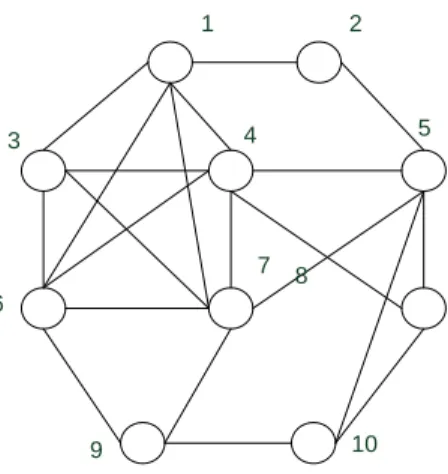
which uses the minimum number of colours. It is easy to convert the simplest timetabling problems to graph colouring problems (and vice-versa) by considering vertices as events and edge between any pair of vertices shows that there is a conflict between these lessons. So edge between any pair of vertices cannot have same colour. Then each colour in Graph colouring represents a period available for timetabling problem. Now task with respect to graph colouring problem is to use maximum colours which should be less or equal to the available periods for timetabling problem [20, 21]. Construction of timetable by graph colouring is shown in Figure 1.5.
The term “chromatic number” number (commonly denoted χ ) is used in graph colouring problems to refer the minimum number of colours which are required to colour a particular problem feasibly. Obviously for simple timetabling problem this means that the minimum number of required periods to schedule a clash free timetable for a particular problem.
The Clique is the second parallel that can be drawn between these two problems, which involves the identification of the features. A clique is a collection of vertices which are mutually adjacent, for example vertices 1, 3, 4, 6, and 7 in Figure 1.5 (b); this is a clique of size 5. It is worth noting that real world problems which uses graph colouring often have fairly large cliques. In many real world problems there are many events which are required not to be scheduled in the same period. In graph coulouring the vertices representing these events make a clique and it is trivial that no two vertices in this graph colorling could be assigned the same colour (or equivalently all events of a clique should be assigned different periods). So it can be deduced easily that for any graph colouring or timetabling problem if the maximum size of a clique is C then to make a feasible (that is χ ≥C) timetable minimum C colours are required [159].
As mentioned earlier, graph coluring problem only exists when one is considering hard conflicting constraints. When other type of constraints such as room type constraints, ordering constraints etc. are added in the problem then it will add extra complications. However, regardless of this nearly all timetabling problems are featuring this graph colouring problem in some form or another form in their work. Many timetabling problem algorithms are still using various bits of heuristic information extracted from this graph colouring problems as a driving force to achieve their solutions [102].
4 5 6 7 8 9 10 1 3 2 4 5 6 7 8 9 10 1 3 2
(a) Given a simple timetabling problem having 10 lessons to schedule by using minimum number of periods, first problem is converted into its graph colouring equivalent.
(b) A solution is then found, which uses five colours (optimal number of colours) for this problem. 1 2 3 4 5 Event 1 Event 9 Event 6 Event 3 Event 2 Event 5 Event 4 Event 10 Event 8 Event 7
(c) The graph colouring solution is converted back into a valid timetable, where each colour represents a period.
Figure 1.5: Describing the relationship between the graph colouring problem and a simple timetabling problem (only considering lesson conflict constraint).
However graph couloring provides us more clues of many other lower bounds. One can notice that, feasible solution could not be found by using less than colours
n m
, where n is total number of events and m is the total number of rooms. If number of colours is less than this number then room double booked constraint will be violated or some lessons will not be scheduled. One can also easily deduce that if nmp (where p is the total number of periods allowed for problem) then problem can not be solved feasibly because this means that number of events are more than the total number of places to schedule them. There are some other information about educational timetabling like if some lessons required a room of type b which is only one and the number of lessons which are requiring this room are Q then this timetabling problem could not be solved feasibly (if room type is used as a hard constraint) ifp
Q
.The component of trivial course timetabling is given in [2]. Three courses are given Juggling, Math 101 and Algo 101. Juggling has one lesson; Math101 has four (Math101_1, Math101_2, Math101_3 and Math101_4) lessons and Algo101has three lessons (Algo101_1, Algo101_2, Algo101_3) to schedule. Math 101, Algo 101 have some common students and Jugling 101, Algo 101 also have some common students, means that they are making two classes. Now in associated conflict graph edge between two lessons showing that these two lessons can not take place concurrently. The dashed edge represents that requirement is coming from the enrollment of students in both courses (Figure 1.6). Presence of conflict constraint (lesson clash constraint) makes this timetabling problem similar to the graph coloring problem. However other issues like each course should be assigned in required type room, room capacity and many other ordering constraints can cause problem. Now many feasible colorings of a timetable might still not corresponds to a feasible timetables due to the addition of these extra constraints.
Algo101_1 Math101_2 Math101_4 Math101_3 Math101_1 Juggling Algo101_3 Algo101_2
Figure 1.6: Associated conflict graph of lessons
1.8 Resolution techniques
Two techniques had been used in the literature to solve timetabling problems, namely exact methods and heuristic methods. In this section we shall present literature review on these two methods.
1.8.1 Exact methods
Exact methods consist of formulating and finding solution with integer programming models. Exact methods may not work to find optimal solution especially in short computing times for large size problem. This makes the reason to develop heuristics to get good solutions in moderate limit of time. We have presented generalized formulations for exam and course timetabling problems so we shall discuss integer programming techniques used in literature.
1.8.1.1 Integer programming techniques
Linear integer programming techniques have also been used to solve educational timetabling problems such as the algorithm of Carter [135], Tripathy [134] in the 1980s and Breslaw [120] provided a solution for the faculty assignment problem, a problem closely related to the timetabling problem, using linear programming models in the 1970s. The same problem was studied by McClure and Wells [139] and a solution was attempted again with the help of mathematical programming. Hultberg and Cardoso [155] formulated teacher assignment problem as a mixed integer programming problem and solved as a special case of the fixed charge transportation problem.
Among the first approaches in mathematical programming, in [156] the teacher assignment problem is combined with a form of the timetabling problem and solved through commercial software for goal programming. In a similar manner, Gosselin and Truchon [157] provided a linear programming formulation for the classroom allocation problem, a sub-problem of the university timetabling. Integer programming formulations for the school and the university timetabling problems as optimization problems are also discussed by Werra in [118], where the NP-completeness of both problems is shown even for simple versions. The author, however, chooses graph theory approaches for the solution of the problems under consideration. Extensions to this work, especially with regards to the so-called conflict matrix are presented by Tripathy in [158]. Given the difficulties of those days to solve large integer programming problems, the Lagrangean relaxation was proposed as a possible solution approach for the resulting model.
Many other articles have also used these techniques. Schimmelpfeng and Helber [121] described an integer programming approach which has been implemented at the School of Economics and Management at Hannover University, Germany, to create the complete timetable of all courses for a term and formulation was solved with CPLEX solver. Broek et al. [136] have divided the timetabling problem into four sub problems which are formulated as an integer linear programming problem. The goals of the four divided sub problems are specific as: maximize the number of assigned courses with urgency, maximize the total assigned workload, minimize the shortage of students to reach the minimum number of students of a section, optimize the timetable. The models introduced were solved by IP solver CPLEX.10.0. Boland et al. [27] applied blocking strategy, in which the classes can be
![Figure 1.9: Build procedure Lewis thesis [102]](https://thumb-eu.123doks.com/thumbv2/123doknet/14743394.755483/56.892.122.746.575.1029/figure-build-procedure-lewis-thesis.webp)