People‟s Democratic Republic
of Algeria
Ministry of Higher Education and Scientific Research
Mentouri University, Constantine
Faculty of Letters and Languages
Department of Foreign Language
Dissertation Submitted to the Department of Language
for the degree of Master in Language Science
Submitted by: Supervisor:
Miss. RAZIKA BOUCHECHE Prof. AHMED MOUMENE
Board of examiners
Chairman Dr. El-Kolli El-Arbi Mentouri University, Constantine
Supervisor Prof. AHMED MOUMENE Mentouri University, Constantine
The Role of Peer Interaction in
Developing Communicative Competence
The Case of Second –Year Students, Mentouri
University, Constantine
DEDICATION
I dedicate this work: To my parents
To all my family, especially my sisters and brothers To all my teachers and friends.
ACKNOWLEDGMENTS
I would like to express my hearty gratitude to Professor AHMED MOUMENE who guided this research and gave me his time and expertise. I thank him not only for his comments and valuable suggestions, but also for his encouragement and understanding. I would like to thank all the teachers and learners without their generous cooperation this work would not have been possible.
A final word of thanks is due to my sister whose efficient typing saved me much toil in the final stages.
List of Tables and Figures
Table1: Students‟ AgeTable2: Students‟ Sex
Table 3: Learners choice of English Table 4: The Level of Language Speaking Table 5: Classroom Participation
Table 6: The Way Learners Work in the Classroom Table 7: Learners‟ Justifications
Table 8: Learners situation in the Classroom Table 9: Learners‟ Participation
Table 10: Opinions about Classroom Activities Table 11: Teachers‟ and Learners‟ Relationship Table 12: Classroom Atmosphere
Table 13: Mistakes Correction
Table 14: The Nature of Language Learning
Table 15: Justification about the Nature of Language Learning Table 16: Learners‟ Preference in the Classroom
Table 17: Reasons
Table 18: Types of Activities
Table 19: Opinions about Peer Work Table 20: Learners‟ Suggestions Table 21: Teaching Experience Table 22: Teacher Approach
Table 25: The Teacher Role Table 26: Classroom Management Table27: Classroom Activities
Table 28: Communicative Explanation
Table 29: Communicative and Structural Activities Table 30: Learners‟ Participation
Table 31: Classroom Atmosphere Table 32: Learners‟ Relationship Table 33: The Role of 'Controller'
Table 34: Learners‟ Communicative Needs Table 35: Students‟ Mistakes
Table 36: Further Suggestions
Figure1: Components of Communicative Language Ability in Communicative Use
Figure 2: Long’s Model of the Relationship between Type of Conversational Task and
Language Acquisition.
Figure3: A Model of the Relationship between Negotiated Interaction and Language Acquisition.
List of ABBREVIATIONS
CLT: Communicative Language TeachingCC: Communicative Competence L2: Second Language Learning N: Number of Students and Teachers %: Percentage
ABSTRACT
The present dissertation attempts to investigate the role of peer interaction in developing students‟ communicative competence. The main problem underlying this endeavor resides in second-year students‟ inability to carry on a spontaneous communication either in the classroom or in any natural setting. This is a puzzling issue that may moans and groans on the part of teachers, researchers and pedagogues have been highly heard. It is hypothesized in this research work that through peer interaction, learners could boost up their communicative competence.
The main objective of this work then is to enable learners to use meaningful and purposeful utterances through communication in the classroom with their peers. It also presents learners with some communicative activities in order to develop their speaking ability.
In this case, teachers should cease from the traditional approaches which focus on developing the grammatical system of the language and to follow the theoretical foundations of communicative language teaching methodology to give learners the opportunity to use the language without fear and reticence.
Through two questionnaires administered to second-year students and to teachers at the department of English, University of Constantine, we intended to explore both learners‟ and teachers‟ opinions about the nature of language learning and the mechanics of developing communicative competence through peer interaction.
The results of the study show that most, if not all; teachers strongly believe that through interaction learners could build up communicative competence in using the target
language. In addition, the results demonstrate that learners need more exposure to interaction with their peers in order to promote accuracy as well as fluency.
The Role of Peer Interaction in Developing Communicative Competence
CONTENT
Dedication 1
Acknowledgment 2
Tables and Figures 3
List of Abbreviations 5
Abstract 6
Content 8
GENERAL INTRODUCTION 11
Statement of the Problem 11
Aim of the Study 11
Research Question 12
Hypothesis 12
Tools of Research 12
Structure of the Study 13
CHAPETER ONE: COMMUNICATIVE COMPETENCE
Introduction 1.1 Communicative language Teaching 141.1.1The Role of the learner 17
1.1.2 The Role of the Teacher 18
1.2 Communicative Competence 18
1.2.1 Communicative Ability 23
1.3.1 Principles of Communicative Methodology 27 1.3.2 Fluency vs. Accuracy 28
Conclusion
CHAPTER TWO: PEER INTERACTION
Introduction2.1 Peer Interaction 32
2.1.1The Management of Interactive Learning 35
2.1.2 Cooperative and Collaborative Learning 36
2.2 Communicative activities 38
2.2.1 Functional Communicative Activities 39
2.2.1.1 Peer Feed back 40
2.2.1.2 Advantages of Using Peer Feedback. 41
2.2.1.3 Negotiation of Meaning 42
2.2.1.4 Comprehensible Input 43
2.2.2 Social Interactive Activities 45
2.2.2.1 Role Play 45
2.2.2.2 Group Work 46
2.2.2.3 Discussion 46
CHAPTER THREE: DATA COLLECTION, ANALYSIS AND RESULT
Introduction3.1 Description of the Questionnaire 48
3.1.1 Teachers' Questionnaire 48
3.1. 2 Students' Questionnaire 49
3.2 Administration of the Questionnaire 49
3.2.1 Teachers' Questionnaire 49
3.2.2 Students' Questionnaire 49
3.3 Questionnaire Presentation and Analyses 50 3.3.1Students' Questionnaire 50 3.3.2 Teachers' Questionnaire 64
Conclusion
GENERAL CONCLUSION
Appendices
79Appendix 1: Teachers‟ Questionnaire 79
Appendix 2: Students‟ Questionnai 82
General Introduction
1. Statement of the Problem
The acquisition of a foreign language has become more difficult than it used to be. There are several reasons for this. The most important one is the shift of emphasis from teaching grammar to teaching what has become commonly termed communicative competence. Many researchers on classroom interaction and language learning as Ellis (1980) focus on providing interaction in the classroom in order to develop learners‟ communicative competence.
Developing oral proficiency or communicative competence, i.e., the skill which most learners today regard as their first priority is much more problematic, especially, when there is a lack of interaction in the classroom. Interaction among learners is viewed as significant because it enables learners to use the language. The problem that is raised in this research is learners‟ poor achievement in speaking the foreign language. This is due to the lack of interaction among them.
2. Aim of the Study
The aim of the study will focus on the role of peer interaction in developing learners‟ communicative abilities. In this research, we are going to investigate how interaction among learners provides knowledge that is responsible for developing communicative competence. During their learning process, learners are required to achieve their goal in mastering the foreign language. Involving learners in group work through interaction is the best way to reach such an aim. In addition, our aim in this research is to show to the learner that language learning is not only a matter of knowing the grammatical rules, but how to use them when they communicate in different situations.
3. Research Questions
The questions I would ask are:Question 1: Does peer interaction lead to communicative competence?
Question 2: Does the lack of peer interaction in the classroom lead to the failure of mastering the second language?
4. Hypothesis
We hypothesize that if learners interact with their peers in the classroom, they will be able to enhance their communicative competence.
5. Tools of Research
The study will take place at the university level, with the second- year students of
English. Many of these students plan to have a license in English and to graduate from the university with a good oral competence. To obtain information, I will deal with two samples chosen from the whole population:
A. Teachers of oral expression at the Department of English (about 10 teachers).
B. Second year students of the English department (25 students). It is difficult to work on the whole population; I have chosen a representative sample randomly to be given the questionnaire.
Concerning data collection, I would direct two questionnaires, one to the teachers who have been teaching English to make sure that their responses and suggestions are the product of interaction with language learners during the years. The second questionnaire will be directed to second- year students to know their opinions about the role of classroom interaction in the developing communicative competence.
After collecting the required data for the research, I would analyze them quantitatively and qualitatively to show the importance of applying interaction in classroom, this will enhance the learners‟ communicative competence.
The main reason behind the use of questionnaires, for both teachers and learners is to
investigate how students learn the foreign language, to know if communicative competence can be acquired better through peer interaction and to have an idea about how language is being thought.6. Structure of the Study
The present research is basically divided into three main chapters. Chapter one and two are devoted to the literature review, and chapter three is concerned with the analysis of both teachers' and learners' questionnaires.
Chapter one is devoted to highlight communicative language teaching and how it enables learners to develop communicative competence through producing meaningful and purposeful utterances. The second chapter provides a detailed explanation about how peer interaction enhances foreign language learning with some analysis of communicative activities used in the classroom like negotiation of meaning and peer feedback. The last chapter deals with data analysis. It contains a detailed analysis of the learners' and teachers' questionnaires and provides some suggestions about how to develop communicative competence
CHAPTER ONE
COMMUNICATIVE COMPETENCE
Introduction
In this chapter we are going to focus on learners‟ communicative competence. Most of them consider that language learning is a matter of developing grammatical competence and neglect the fact that it is important to communicate in English in different situations. To highlight this idea, we try to focus on communicative methodology that learners are required to follow to achieve communicative abilities and on the role communicative language teaching gives to help learners develop in language.
1.1 Communicative Language Teaching
Language teaching has undergone, through time, many changes. These have given birth to a variety of methods with different principles and techniques. Among them we have Grammar- Translation method which focuses on useless pieces of language. That is, the learner is taught, not the language (i.e communication), but about the language (i.e the system). In order for learners to use the language for communication purposes, sociocultural knowledge is necessary. Language is better viewed in its social context because speech varies from one situation to another. Communicative language teaching gives to the learner the ability of using and producing meaningful and purposeful utterances in different situations. If we concern ourselves just with linguistic forms and neglect communicative functions, we will distort the reality of language use ( Littlwood, 1981).
Nowadays, there is a growing importance attributed to communicative approaches and learners development of communicative ability. For many years ago, teachers were concerned with teaching grammar and no attention was given to communication. Later on,
researchers find that teaching a foreign language requires more than learning the form. Learners need to know how to use these structures in communication. They need to know how to ask for clarification, explanation, repetition. To do so, teachers shift their attention toward new methods that enable learners to practice the language ( Wilinks, 1972).
It is necessary for learners to know how to produce correct sentences in communication. For Wilinks (1972: 3) learning is only effective with ''doing''. Learners can not progress in language if they do not practice it in real situations. Communicative approach provides learners with these abilities to use the language in real situations.
The most salient feature of the communicative approach is the fact that it takes into consideration the nature of the process of communication. When evaluating this theoretical approach to language teaching, a number of interesting facts appears. Prominent among these is the effort to master the aspects of the process of communication not only from the point of view of the listener but also from the point of view of the speaker (Vacheck, 1975: 16).
In the 1970s, a reaction to traditional language teaching approaches began and soon spread around the world as older methods such as Audiolingualism and Situational Language Teaching fell out of fashion. The centrality of grammar in language teaching and learning was questioned, since it was argued that language ability involved much more than grammatical competence (Littlwood, 1991). While grammatical competence was needed to produce grammatically correct sentences, attention shifted to the knowledge and skills needed to use grammar and other aspects of language appropriately for different communicative purposes such as making requests, giving advice, making suggestions, describing wishes, needs and so on (Hymes, 1979).
The growing need for good communication skills in English has created demand for good teaching around the world. Today, learners want to improve their abilities of speaking language. Methods of teaching English are provided in many different ways such as formal instruction and task- based instruction. The requirement for good English has created an enormous demand for the quality of language teaching, teaching materials, and resources. Learners set themselves specific goals; they want to be able to master English to a high level of accuracy and fluency. The need of an appropriate teaching methodology is required.
The new methodology is known as communicative language teaching (CLT). It began in Britain in the 1960s as an alternative to the earlier structural method, called Situational language teaching. This was partly in response to Chomsky‟s (1965) (in Brumfit, 1984: 24) criticism of structural theories and to British functional linguists such as Firth and
Halliday, as well as American sociolinguists such as Hymes, Labov (Brumfit, 1984: 25).
Since its inception in the 1970s, CLT has passed through a number of different phases (Widdowson, 1978). In its first phase, a primary concern was the need to develop a syllabus and a teaching approach that was compatible with early conceptions of communicative competence. This led to the proposals for the organization of syllabuses in terms of functions and notions rather than grammatical structures. Later, the focus shifted to procedures for identifying learners‟ communicative needs, and this resulted in proposals to make needs analysis an essential component of communicative methodology. At the same time, methodologists focused on the kinds of classroom activities that could be used to implement group work, task work, and information gap activities (Widdowson, 1978: 11).
CLT involves learners in producing meaningful and purposeful utterances and not manipulating language forms and structures for their own sake. In addition, in CLT, more
freedom is given to learners to say what they want, when they want. The communicative approach sees errors as indicators of active learning, and is concerned with communicative process, how learners receive and convey information as Savignon and Sandra say (1972: 26):
Communication is not the rapid fire exchange
of linguistically accurate complete sentences.
It is the sometimes slow, sometimes painful, sometimes non- verbal exchange of thoughts
between human being
1.1.1 The Role of the Learner
Since CLT gives the freedom to use the language, learners are basically required to interact with each other and not only with the teacher. They should learn the language in a cooperative manner. Larson- Freeman (1986: 131) states
Students are, above all, communicators. They are actively engaged in negotiating meaning- in trying to make themselves understood even when their knowledge of the target language is incomplete. they learn to communicate by communicating. Since the teacher’s role is less dominant than in a teacher- centered method, students are seen as more responsible managers of their own learning.
1.1.2 The Role of the Teacher
The role of the teacher in CLT is viewed as a facilitator of the communicative
process. He is considered as a guide of the teaching process. His role is to make learners believe that the classroom is not a place to learn the grammatical components of a language by memorizing information from the teacher. It is important to show them that they are responsible for acquiring in addition to the grammatical features, how to use this knowledge in real communication. All the responsibility of learning is placed on their shoulders, and they should be aware of it. Bright and Mc Gregor (1970: 4) report that: '' Stop teaching and let them learn.'' Thesewords summarize the role of the teacher in developing the communicative competence of the learner.
1.2 Communicative Competence
For many learners, acquiring a foreign language is a matter of knowing how to build grammatical sentences. They believe that linguistic competence is the key to develop in a foreign language. Chomsky (1957, cited in Brumfit, 1984: 24), provides a definition to language as a set of sentences. Most linguists consider it as a valid, but they show that we need to look for more practice in language and make a distinction between structure and function. Chomsky (1965, cited in Brumfit, 1984: 24), selects the linguistic process to occurring acts of language. He makes a distinction between competence (the speaker – hearer's knowledge of his language) and performance (the actual use of language in concrete situation). Performance seems to embrace both the failure to achieve competence which is found in the traditional psychological distinction between what is actually known and what is actually done, and also some knowledge which allows us to produce utterances which are appropriate as well as grammatical.
Traditionally, focus was put on the linguistic skills of how to build grammatical
sentences (Littlwood, 1981). Later, it was believed that we need more than learning the structure. Communicative skills look after themselves as Widdowson (1978: 67) shows:
… The acquisition of linguistic skills does not seem to guarantee the consequent acquisition of communicative abilities in a language.
On the contrary, it would seem to be the case that an over emphasis on drills and exercises for the production and reception of sentences tends to inhibit the development of communicative abilities.
Knowing a language involves not only the production of correct sentences but also the ability to use them appropriately in different situations. Experience shows that even if the learner develops a whole knowledge of grammatical rules, this does not mean that he will be able to use them in every day life for the reason that communicative competence is absent.
Modern theories of language emphasize the need to teach learners how to communicate (Widowson, 1978). The theories give more interest to communicative competence and discussed by many Scholars. The notion of communicative competence describes our knowledge of language and how to operate with it. Here, learners should by all means learn to communicate in the foreign language after having acquired the communicative competence. Chomsky's linguistic competence is a reason to the appearance of communicative competence. He is criticized by many researchers to the way of looking to competence (in Brumfit, 1984: 25).
For Hymes, the notion of CC extends to embrace knowledge of „„rules of use without which the rules of grammar could be useless'' (Hymes, 1971: 18-19). These ideas
''competence in rules of use reflects ability to interact with social environment, and a possibility of differential competence emerges (in Brumfit &Johnson, eds., 1979:15).
Communicative competence in the usage of Hymes (1971) involves four sectors of communication:
1. Whether (and to what degree) something is formally possible; 2. Whether (and to what degree) something is feasible in virtue of the means of implementation available;
3. Whether (and to what degree) something is appropriate (adequate, happy, successful) in relation to a context in which it is used and evaluated,
4. Whether (and to what degree) something is in fact done, actually performed and what its doing entails (in Brumfit et al., eds., 1979: 19).
The first component is grammatical, the second psycholinguistic, the third sociocultural and the fourth probabilistic. Furthermore, Hymes (1971) suggests that any speech event is made up of seven components:
1. Sender (addresser: speaker, writer). 2. Receiver (address: listener, reader). 3. A message form
4. A channel
5. A code (language, regional dialect/ style). 6. A topic (the subject of discussion).
Communicative competence involves the connection between these components in order to convey a message.
Most teachers now are aware of the term communicative competence, and they start looking how to push learners towards developing their communicative competence. Widdowson (1978: 26) defines competence as knowledge of how to recognize and to use sentences for the performance of communicative acts. What Widdowson means here is that communicative competence consists of both rules of grammar and use. If learners are aware of learning a foreign language, both components should be taught and the teacher should not only be concerned with teaching grammar and forgetting about meaning.
Many researchers are concerned with the notion of CC, and they take into account all the aspects of language. Each one has a specific point of view.
Canal and Swain state that CC consists of three interrelated dimensions (1980: 1-47):
1. grammatical competence: i.e. to be able to produce and understand correct forms in a language including the three levels: syntactic, lexical and phonological.
2. sociolinguistic competence: i.e. to be able to use language in appropriate contexts. That is for Canal and Swain such a competence refers to socio-cultural rules and a pragmatic competence of discourse (mastery of the different types of discourse).
3. strategic competence: i.e. to be able to get meaning across effectively, and to use communication strategies when problem situations arise .It is the set of communicative strategies which help compensate of failures in communication, (i.e. compensation) in respect of linguistic or sociolinguistic competence. For Canal and Swain, strategic competence should be taught at the very beginning of foreign language learning because it helps to fill the gap in the two types of competence.
The learner of a foreign language faces a system of communication with new
structures of sentences, and new ways of expressing meaning. To develop communicative skills, the learner has to acquire a set of communicative rules which lead him to be competent speaker. In the acquisition of communicative rules which make him a proficient and competent speaker of English, he will have to know, in addition to the basic structural principles of the language how to use sentences in performing acts of communication for conveying meaning.
We can now summarize four different operations that make the learner of a foreign language a communicative competent speaker.
-The leaner must achieve a high degree of linguistic competence. That is, he must know all the grammatical features, and how to build correct sentence.
-The learner must learn to distinguish between the forms and meaning. In other words, items mastered as part of a linguistic system must also be understood as part of a communicative system. Communication requires the management of linguistic forms in discourse.
-The learner must develop skills and strategies for using language to communicate meaning as effectively as possible in concrete situation.
-The learner must practice language in different social contexts. That is, he needs to know how to ask for clarification, repetition, or explanation.
-The learner must develop skills and strategies for using language to communicate meaning as effectively as possible in concrete situation.
1.2.1Communicative ability
The notion of learning process brings us to the problem of how learners achieve their communicative ability. According to Candlin (1986: 40)
Communicative language ability (CLA) can be described as consisting of both knowledge, or competence, and the capacity for implementing, or executing that competence in appropriate contextualized communicative language use…the ability to create meanings by exploring the potential
inherent in any language for continual modification in response to change, negotiating the value of convention
rather than conforming to established principle. In sum, …a coming together of organized knowledge structure with a set of procedures for adapting this knowledge to solve new problems of communication that do not have ready- made and tailored solutions.
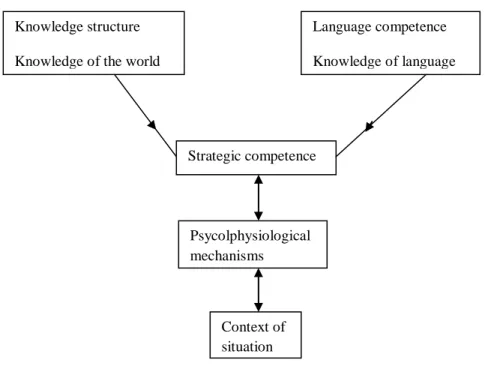
Through interaction, learners develop their communicative ability. In this process, they build knowledge about how to ask, answer, and discuss different topics with learners. The framework of communicative language ability proposed by Candlin (1986) includes three components: language competence which is a set of specific knowledge components that are used in communication. In order to achieve communicative competence ,learners are obliged to know the grammatical and communicative features of language. Second, Strategic competence is used to characterize the mental capacity learners follow to use the language. It provides the means for relating language competencies to features of the context of situation in which language use takes place and to the language user’s knowledge structures
Finally, physiological mechanisms refer to the neurological and psychological process involved in the process of acquiring a foreign language like producing sounds. These components of communicative ability with the language use context and learners‟ knowledge are illustrated in the figure below.
Figure 1: Components of Communicative Language Ability in communicative Language Use.
1.3 Developing a Communicative Methodology
Oral communication is an activity involving two (or more) learners in which the
participants are both hearers and speakers having to react to what they hear. A communicative approach emphasizes the use of language above the level of sentence (Wilkins, 1972). Structural approach, on the other hand, is concerned with the production of grammatically- accurate sentences. It is a less value to focus only on the systematic understanding of how words are combined at the level of the sentence and to forget about the use of this sentence on communication (Widdowson, 1978). Language competence Knowledge of language Psycolphysiological mechanisms Context of situation Strategic competence Knowledge structure
In the structural approach, the focus is always a structural one and no matter of how a sentence takes on meaning from its relation to surrounding utterances and non- linguistic factors. No attention is given to who speaks and how he speaks. The result of purely structural practice is the ability to produce a range of usages. However, a close look to leaning a foreign language requires more than developing grammatical competence (Wilkins, 1972).
According to Roger (in Brumfit, 1979: 70), the communicative approach on the other hand makes sure that interaction which takes place in the classroom is important for a communicative operation. The focus changes from the accurate production of isolated utterances to the fluent selection of appropriate utterances in communication (Allwright, 1984: 11). The learner is now concerned with using language, not English usages. In order to do this, learners take on roles and interact with other learners who also have roles. What they say is determined by the role they have.
Since the early 1970s, communicative movement has an influence on foreign language teaching. During this movement, the communicative approach opens up a wider perspective on language (Richards and Rodgers, 1986). In particular, it makes us consider language not only in terms of its structures (grammar and vocabulary), but also in terms of the communicative functions that it performs. In other words, we begin to look not only at language forms, but also at what people do with these forms when they want to communicate with each other.
This approach leads us toward a strong awareness that it is not enough to teach learners how to manipulate the structure of a foreign language. They must also develop strategies for relating this structure to their communicative functions in real situations. Therefore, we need to provide learners with opportunities to use language by themselves for
communicative purposes. We must remember that we are concerned with developing learners‟ ability to take part in the process of communicating through language, rather than with their perfect mastery of individual structures. It is important to develop a methodology in the communicative approach. Since the primary concern is to lead students to communicative competence. Two assumptions underlying the communicative approach stated by Finocchiaro and Brumfit (1983: 90):
The first assumption is that we are concerned in the classroom with the language use, not language knowledge; the second is the view that we learn language effectively by using it in realistic situation.
At the beginning of the communicative movement, the first assumption was the major concern of the syllabus designers. Most of teachers concern with teaching grammar. Later, attention shifts towards the application of the second assumption on the process of teaching, i.e., how to use language in realistic situations through methodological procedures (Brumfit and Johnon, 1979).
Communicative language teaching considers language to be interactive, purposive, and based on learners outcomes. This approach emphasizes on language use rather than usage. It is based on the premise that language is first and foremost a tool for communication. Morrow (1979: 145) sates:
…Knowledge of the elements of a language in fact counts for nothing unless the user is able to combine them in
new and appropriate ways to meet the linguistic demands of the situation in which he wishes to use the language.
1. 3.1 Principles of Communicative Methodology
In order to achieve goals in teaching a foreign language, we need to look for the best ways. Teachers are obliged to follow some principles to guide them in the process of teaching. Morrow (1981:59) establishes a set of principles which underlie communicative methodology. These principles give teachers certain criteria which guide them to know the procedures of teaching. These procedures enable learners to communicate more effectively in the foreign language:
1. Know what you are doing: it means that each lesson or part of it should focus on the performing of some operation: ''learn how to do something''. Every lesson should end with the learner ability to see clearly that he can do something which he could not do at the beginning and that something is communicatively useful (60).
2. The whole is more important than the sum of its parts: communication is dynamic and developing phenomenon. What is needed in communication is the ability to deal with sentences and ideas in real situations. When you have a conversation with somebody you can not study what they say before producing an appropriate reply (61).
3. The processes are as important as the forms: a communicative methodology is one which replicates as far as possible the processes of real communication. Morrow (1981), considers
information gap, choice and feedback, as three processes which make any exercise a communicative one (ibid).
4. To learn it, do it: CLT is not concerned only with teaching; it also takes into consideration how learning can take place. Everything that happens in the classroom must involve the learner. It is only by practicing communicative activities that students learn to communicate. Since this principle is based on developing learners‟ communicative ability: making choices, evaluating feedback, bridging information gaps. Such activities demand an environment where doing things is possible (ibid).
5. Mistakes are not always a mistake: since communicative methodology allows some freedom for learners to say what they want, it is obvious that they will make mistakes. The solution to this problem is to avoid insisting on accuracy and to focus on developing fluency.
1.3.
2 Fluency Vs Accuracy
The active use of the target language leads learners to be competent speakers. Communicative methodology confirms that providing fluency activities are important in the language progress. Through these activities, students are engaged in discussing different matters in the classroom. As Finocchiaro and Brumfit (1983: 98) put it: ''All that is needed is a teacher willing to commit a substantial proportion of time (anything up to two-thirds of class time) to such activities''.
ehT process of teaching requires the teacher to know learners‟ requirements. Needs analysis plays a role in this part. Teachers are not able to know learners‟ needs, especially in their communicative abilities. Giving learners the freedom to use the language in the classroom can help teachers to know the different areas and problems they face in the process of acquiring a foreign language.
In communicative methodology, fluency is favored over accuracy for various reasons. First, accuracy is a relative term. In fact, it is a judgment about language set up by descriptive linguistic who decide what is good in a language and what is not. Second, focus on fluency rather than accuracy leads to concentrate on the performance of communicative activities rather than linguistic forms, and we cannot ignore the effect of this concentration on communication (Richard and Rodgers: 1986).
The focus on accuracy has a number of disadvantages summarized by Brumfit (op. cit: 1979). First, language would be rigidly selected because there will always be a descriptive model to refer to. Second, adaptation and improvisations which are necessary aspects of communication are neglected. Third, the written form of language will be focused rather the spoken one. These disadvantages have a greater effect in developing communicative competence.
As Morrow (in Brumfit, 1984: 129) mentions, one of the goals of communicative methodology is to develop fluency in language use. Fluency is a natural use of language occurring when a speaker engages in meaningful interaction and maintains comprehensible and ongoing communication despite limitations in his communicative competence. Fluency is developed by creating classroom activities in which students must negotiate meaning, use communication strategies, correct misunderstandings and work to Fluency practice can be contrasted with accuracy practice, which focuses on creating correct examples of language avoiding communication breakdowns.
One of communicative methodology goals is to develop fluency in language use. Fluency is a natural language use occurring when a speaker engages in meaningful interaction and maintains comprehensible and ongoing communication despite limitations in his
communicative competence. Fluency is developed by creating classroom activities in which students must negotiate meaning, use communication strategies, correct misunderstandings and work to fluency practice can be contrasted with accuracy practice, which focuses on creating correct examples of language and avoiding communication breakdowns. Differences between activities that focus on fluency and those that focus on accuracy are provided by (Richards, Rodgers: 1891)
Activities focusing on fluency
• Require meaningful use of language • Focus on achieving communication • Reflect natural use of language
• Require the use of communication strategies • Produce language that may not be predictable • Seek to link language use to context
Activities focusing on accuracy
• Reflect classroom use of language
• Focus on the formation of correct examples of language • Choice of language is controlled
• Practice small samples of language
• Do not require meaningful communication • Practice language out of context
Conclusion
This chapter highlights the notion of communicative competence and its perspective in learning a new language. It is important to look for learners‟ needs in a foreign language and to seek for the best ways of the learning process. The communicative approach shifts teachers‟ and learners‟ attention to the reality of language learning; from learning the grammatical competence to learning the communicative competence. It stresses the importance of operating a real situation of language use and aims at making learners able to communicate in a foreign language
The traditional objectives and contents are now replaced by ones that are essentially communicative in nature. Communicative methodologies stress the active nature of the learning process and the involvement of the learner in negotiating meaning. Students in the classroom, use the target language in different social contexts to develop their communicative competence through interaction with their peers. This will be investigated in the next chapter.
CHAPTER TWO
PEER INTERACTION
Introduction
In this chapter we are going to look for the importance of managing classroom in order to help learners develop their communicative competence. Peer interaction is considered a key to this process. It helps learners to negotiate for meaning and discuss with peers different problems that face them during learning. By focusing on different activities that are required in interaction, we show to the learners the need for interacting in the classroom.
2.1 Peer Interaction
For many learners, the classroom is the one place they get to think about language practice it, take risks within, and reflect on their use of it. Providing learners with activities that nurture this exploration and allow for interaction is important for their language development and for preparing learners to use the language successfully when they leave the class environment (Allwright, 1984: 158).
Ellis (1980: 9) speculates that second language learners obtain more practice in a foreign language and are motivated to engage in further communication when they have greater opportunities to speak the language and achieve successful communication. In language learning, some teachers concentrate on usage in the design of the classroom. The aim is to show to learners how sentences are formed to illustrate linguistic and grammatical rules, but learning a foreign language requires more than learning the rules. It is necessary for learners to have the ability of using English knowledge to achieve communicative purposes.
Most teachers observe that keeping silent in the classroom without being active may affect the process of acquiring a foreign language. The learner may lack the ability to
communicate. Classroom interaction gives opportunities to learners to use the language in real situations. Interaction is viewed as significant because learners can decompose the target language structures and derive meaning from classroom events. Interaction also gives learners opportunities to incorporate structures into their speech.
Recent developments in education (Nunan, 1992, Slavin, 2003), emphasize the role of the learner in the learning process. Consequently, in recent years, there has been a shift from more traditional classes where teachers are the dominant factors and play the principle roles in the process of teaching to more learner –centered instruction in which the learner is responsible for learning process. Classroom research focuses on what action learners take to master the target language. A growing body of research seems to show that interaction plays an important role in learning a second language. It appears to be effective in developing communicative competence of the learner.
In traditional methods, the teacher focused only on transferring information and
linguistic knowledge about the language to learners. They listen without any reaction. Through these methods, learners develop their ability of building grammatical sentences. Later, teachers shift their attention toward developing the communicative competence of the learner. Woods (1996: 188) asks many questions relating to the exact nature of language learning: is language something we learn through first consciously 'knowing' and then transferring that knowledge to application, or something we learn through doing; i.e. through experience?. Wood‟s explanations about the nature of language teaching push teachers to think more seriously that mastering a foreign language is not only a matter of developing linguistic competence. Learners are required to be competent speakers.
Learners are asked to use their efforts in the process of learning and to discover things for themselves rather than focusing on teacher‟s knowledge. In traditional methods, teachers look to the teaching process as a matter of transferring knowledge from the teacher to the learner. They consider teaching and learning as a' cause and effect‟ relationship, but when learner -centered methods becomes dominant in teaching, teachers find that it is not necessary if teaching happens, learning will automatically take place ( Ellis, 1980).
Recent research focuses on the classroom setting where learners are able to use
language. Some classroom processes lead the learner to successful learning of communication ability. Peer interaction is regarded as an important factor in achieving communicative competence. Long (1983, cited in Nassaji, 2000: 243) reports that ''learning a new language is a function of social and meaningful interaction.'' Interaction consists of ‘‘sharing ideas and opinions, collaborating toward single goal, or competing to achieve individual goals.'' (Pica et al., 1993, cited in Nassaji, 2000: 245). During interaction, learners may notice things about their language that they do not notice by themselves and which are considered important in developing the ability to use the language. Learner- centered instruction gives learners the opportunity to interact with their peers, discuss topics, give opinions and ask for information about the language. This gives them the freedom to use language.
Woolfolk (2004: 41) emphasizes the importance of learners‟ interaction with their peers in order to test their thinking, to be challenged, to receive feedback, and to observe how others work out problems. Collaboration with peers has proven itself a successful and uniquely powerful learning method. The learner should create a friendly environment during interaction; this encourages the development of trust and cooperation among participants. To promote interaction among peers, teachers encourage cooperation rather than competition
because students learn from their peers and from working trough correcting mistakes (Ellis, 1980).
Interaction is considered beneficial for both good and weak learners (Woolfolk, 2004). During this process, proficient learners give to their peers information and knowledge about the language. This does not mean that proficient learners do not benefit from interaction. They work on making their peers understand by thinking, working and discovering information, or adding new knowledge to the old ones. They progress in the process of learning.
2. 1.1 The Management of interactive learning
Teachers must think about the management of interaction in the classroom; they are required to look for the best ways for improving learners‟ ability of communicating in a foreign language. They need to ask intelligent questions about learning and teaching processes. Recent research, as we have said before, shifts teacher‟s attention from focusing on methods of teaching to a focus on the learner‟s behavior in the classroom.
The sake of managing interaction between peers is to give every learner the possible opportunities to use the language (Black, 2005). In fact, everything we do in the classroom is for what learners possibly learn from being there (Brown, 2001: 13). Interactive language instruction involves teachers and learners to engage in activities that create conditions for faster language use which leads to achieve communicative competence.
Interactive activities need to be managed well (i.e. decide the kind of activities: role play, games, discussing topics…) and the teacher needs to stay engaged throughout, even when learners are working in peers. Teachers need to be ready to facilitate and provide resources for learners. According to Ellis (1980), it is important to spend time listening to
would be interested in talking about and to discover vocabulary problems or problems with learner's use of grammatical form that is causing communication breakdowns.
According to (Brown, 2001: 15), to make interaction meaningful and effective, teachers need to know their students well. Which students work well with other students? Are their individuals who would not be comfortable to work with each other? What are learners‟ goals, interests, and expectations? What do they want to get from the class? Interactive opportunities flourish in the classroom when there is a sense of trust and community among peers. The teacher can create this positive relationship by showing interest in students, encouraging them to voice their ideas and feelings, valuing what learners think and say, providing feedback.
2.1.2 Cooperative and Collaborative Learning
Choosing a given methodology for teaching a foreign language depends on what assumptions we have about learning and the way it takes place. In the classroom, learners use different strategies to achieve their goals. O'Mally & Chamot (1990: 139) classify learning strategies used by learners into three: metacognitive, cognitive and social/affective strategies. The latter include: questioning for clarification, cooperation, self talk and self reinforcement. They consider cooperation in classroom as an important factor in learning. They define it as ''working together with peers to solve a problem, pool information, check a learning task, model a language activity or get feedback on oral or written performance.''
Cooperative learning involves interaction with other people; this meets the principles of communicative language teaching. According to Richards and Rodgers (2001: 151),
Cooperative language learning originates outside of language teaching, but
because it is compatible with many of the assumption of communicative language teaching it has become a popular and relatively uncontroversial approach to the organization of classroom teaching in many parts of the world
Cooperative and competitive learning are two processes which promote progress in a foreign language. During interaction learners are required to help each other in providing knowledge. Only cooperation can meet this requirement. From Oxford’s (1990: 145) standpoint ''Cooperation implies the absence of competition and the presence of group spirit.''. Some learners do not have enough knowledge of the target language to provide useful input. In addition, some personalities of learners can make interaction ineffective. Most of these problems can be solved by using cooperative learning.
Richards and Rodgers (1986: 195) emphasize the role of cooperation in enhancing learning and provide the following definition:
Cooperation is working together to accomplish shared goals.
Within cooperative situations, individuals seek outcomes beneficial to themselves and all other group members.
Cooperative learning is the instructional use of small groups through which students work together to maximize their own and each others 'learning.
Learning a language is not a matter of looking to what other learners are doing. It requires engaging and interacting with them. Piaget (1964, cited in Woolfolk, 2004: 4) emphasizes on the vital role of interaction in helping learners to construct their own knowledge and understand a foreign language:
Knowledge is not a copy of reality. To know an object, to know an event, is not not simply to look at it and make a mental copy or image of it. To know an object is to act on it. To know is to modify, to transfer the object, and to understand the process of this transformation, and as a consequence to understand the way the
object is constructed.
Cooperative and collaborative learning have many advantages for learning. Nunan (1992: 13) mentions some of these:
-Learners are an important resource for their own collective learning, and this resource can be assessed through collaboration, cooperation and experiential learning.
- Learning is a social as well as a psychological process
-Collaborative learning can help learners to use what they already know to go beyond what they currently think.
2.2 Communicative Activities
A communicative activity is any kind of activity which engages the learner to use the L2. In interactive learning, teachers are asked to design communicative activities so as to provide opportunities for learners to produce the language. These communicative activities are designed to help learners to bridge the gap between linguistic competence and communicative competence (Widdowson, 1978). In addition, these activities provide opportunities for positive personal relationships that develop among teachers and learners. These relationships create an environment that supports the individual to use language.
In traditional methods, teachers are dominant the factor in the learning process. They play the principle roles: discussing, correcting, and giving knowledge. Learners are only
listening and memorizing information; they are passive participants. Recent teaching method shows that to develop communicative competence learners are required to conduct their learning. According to Littlewood (1991: 19), the role of the teacher is less important than in traditional methods. He can offer advice or provide necessary language items. If learners cannot agree on any point, he can resolve their disagreement. In other words, he is available as a source of guidance and help.
In communicative activities, the learner has to activate and integrate his knowledge and skills in order to use them for communication. During interaction process, learners are aware of the kind of language they use and, they try to look for ways of improving it. Some activities like discussion, peer feedback, negotiation of meaning are in a high status because they help learners to use and build knowledge about a foreign language.
2.2.1Functional Communicative Activities
According to Littlwood (1981: 12), language practice should help the learners relate the language forms to their social meaning. On the one hand, the activities should involve the learners in using the language to achieve a communicative purpose. Littlewood(1981) called this type of activities 'Functional Communicative Activities'. They are used to help the learners develop communicative abilities and strategies such as to keep in mind shared knowledge, to use feedback, to negotiate meaning, and to paraphrase. In addition, these activities help learners to learn how to interact successfully, when to interrupt, how to disagree, and how to take turns.
2.2.1.1Peer Feedback
Students‟ discussion is identified as a key component of interactive learning; researchers agree that this is where real learning takes place. According to Long (cited in Black, 2005), ''good discussion engages participants in a dialogical process that leads to increasingly sound well grounded and valid understanding of a topic or issue.''. Through discussion, learners develop their reflection and thinking. Thus, students are viewed as participants in the construction of meaning through interaction with their peers (Black, 2005). However neither interaction nor discussion alone is enough to guarantee that students will reach the critical interaction of learning the communicative competence.
Black (2005: 15) considers that most discussions consist of sharing and comparing information while little attention is given to promoting correction and analysis of language. In this exploratory study, peer feedback is used as a means of language development. Students provide feedback to each other, specifically related to the quality of language use. These feedbacks enable learners to grow and learn from each other.
Feedback plays an important role in learning a foreign language. In general, instructional feedback provides students with information that either confirms what they already know or changes their existing knowledge and beliefs about language (Mory, 2004: 745-783). Nicol and Macfarlandick (2006: 205) suggest that feedback serves as a form of formative assessment, designed to improve and accelerate learning the target language. Specifically, they describe feedback as ''anything that might strengthen students‟ capacity to self regulates their performances''. According (Nicol and Macfarlandick: 2006), good feedback performs the following functions:
1. Clarifies what good performances are (goals, criteria, and standards).
3. Delivers high quality information to students about their learning of the communicative competence.
4. Encourages teacher and peer dialogue around learning which promotes communicative competence.
5. Provides opportunities to close the gap between current and desired performance. 6. Encourages positive motivational beliefs and self esteem.
7. Provides information to teacher that can help shape teaching.
2.2.1.2 Advantages of Peer Feedback
The use of peer feedback in the classroom has a number of advantages. It provides new learning opportunities for both givers and receivers, and builds community that will create interaction (Mory, 2004). By asking students to provide feedback to each other, learning takes place and learners achieve greater understanding.
When students engage in a feedback process, meaningful interaction increases. Interaction with peers and interaction with the content of the discussion promote students satisfaction with the course (Swan, 1985). Peer feedback has the potential to increase the quality of discourse, and thus the quality of learning the target language. Receiving feedback has an influence on learning the language. In addition, students may also benefit from giving feedback to peers. Lin, Lin, Chiu and Yuan (2001: 248) propose that, ''When asked to offer feedback to peers , students progress beyond the cognitive processes required for completing a given task, as they must now read, compare, or question ideas, suggest modifications, or even reflect on how well one's own work is compared with others''.
McConnell (2002: 89) suggests that collaborative assessment moves students away from dependence on instructions as the only, or major, source of judgment about the quality
of learning to a ''more autonomous and independent situation where each individual develops the experience, know-how, and skills to assess their own learning''. Thus, students are offered the opportunity not only to reflect on the work of their peers but also on their own work.
2.2.1.3 Negotiation of Meaning
For Littlwood (1991), the concern in the communicative approach is to develop learners‟ ways of communication which aims at developing their communicative competence. It is widely argued that engaging in communicative language tasks help learners to enhance in a language. These tasks provide opportunities not only in producing the language, but also to manipulate, modify it, checking and clarifying problem utterances.
Negotiating for meaning confirms that through this process participants receive comprehensible input and generate comprehensible output, both have a role to achieve a communicative competence. Moreover, learners' should be given the opportunity to negotiate the new input through speech modifications and conversational adjustments. Long (1983: 19) justifies the need for negotiation of meaning as follows:
if it can be shown that linguistic and/or conversational adjustments promote comprehensibility, and that comprehensibility promotes acquisition, it can be decided that the adjustments promote acquisition.
Furthermore, since the purposes of communicative approach is to achieve communicative competence. It is not enough for students to have knowledge of a foreign language: forms, meaning and functions. They must be able to apply this knowledge in negotiating meaning and this can be achieved through interaction between learners.
2.2.1.4 Comprehensible Input
For language learners, successful comprehension has a role to develop in communicative processes. It is now regarded important to progress in a foreign language. Krashen has popularized the term comprehensible input. It refers to the fact that not all the target language they hear makes sense to them. According to Krashen(1982), we make progress in the language by understanding messages expressed in a way that is slightly beyond our current level of competence, but which we can make sense of by using background knowledge and the context (in Long: 1983, 211).
Inputs learners get do not only serve to comprehend the current message, but also to pick new items of grammar and vocabulary and to improve their fluency in speaking. It is not easy to see how comprehensible input promotes development (Long, 1983). One possibility is that it is the effort made by the learner to comprehend the input that fosters development. Long (1983: 214) has proposed the following model to account for the relationships between negotiated interactions, comprehensible input, and language acquisition.
Figure2: Long’s Model of the Relationship between Type of Conversational Task and
negotiated modification of the
conversation opportunity for the less
competent speaker to his or her lack of information
provide feedback on verbal
communication task involving a two way exchange of information
Comprehensible input Language acquisition
This model is different from Krashen’s idea of the sequence of events involved in acquisition of a foreign language. He summarized his idea as follows:
Comprehensible input is possible for progress in language acquisition.
Output is possible as a result of acquired competence. When performers speak,
they encourage input (people speak to them). This is conversation. (Krashen, 1982:61)
Comprehensible input is regarded sufficient for acquiring semantic competence in the target language. Comprehensible output is needed in order to gain grammatical competence. That is students are required to struggle with producing output which is comprehensible to their interlocutors if they are to master the grammatical markers of the language. Such mastery is a result of the negotiations in the process of interacting. (Swain, 1985).
Figure3: a Model of the Relationship between Negotiated Interaction and Language Acquisition (from Long, 1983).
The broken line between comprehensible input and language acquisition represents the possibility that comprehensible input might still make a direct contribution to language acquisition. Negotiated interaction refers to those modifications that occur in conversations between peers. These interactional adjustments include a range of attempts to understand and be understood.
Comprehensible Input
Language Acquisition Negotiated Interaction
2.2.2 Social Interactive Activities
In these activities, we take into consideration the social context for language use. Learners her have to pay attention to both the communicative and the social meaning of language. To achieve this purpose, teachers should give to the learners opportunities to use language in different social situations that go beyond the classroom environment. Learners are asked to imagine themselves outside the classroom. Their focus should be on communicating meanings rather than producing language forms.
2.2.2.1 Role play
Providing role play in the classroom is very important in developing learners‟ oral proficiency. The students may be asked to perform dialogues using the foreign language. This will help them to know how to behave in specific social contexts. This kind of activity creates a good atmosphere in the classroom that gives learners the freedom to practice the language and improve it.
Role play is a good technique for providing interaction in the classroom. Revell
(1979: 60) sees role play as: ''an individual’s spontaneous behavior reacting to others in a hypothetical situation.'' This indicates that the learner creates a new identity with new views. The advantages of role play are:- Acting requires the use of language; hence learners will develop their ability of communicating
-It provides spontaneous use of language during interaction
- Role players learn the interactive skills of arguing, informing discussing m asking, and
answering.2.2.2.2 Group work
Group work is extremely fruitful in the development of communicative ability. It gives learners a total freedom to express ideas, knowledge, and different problems they face
during learning. Here, learners correct each other‟s mistakes because they engage in debates with their classmates. Learners in this activity create a social environment of trust and community that helps them to interact freely.
Oral interaction involves collective work to solve problems and provide solution. Group work is a meaningful process because the students need to interact with their peers and to develop a range of social and linguistic skills which are of great importance to progress in language learning. It presents the following advantages:
- During this process they make an evaluation of the utterances. - Learners can ask for clarification and correction.
- Group work push engages learners in the process of negotiating meaning which is crucial for language development.
2.2.2.3 Discussion
A discussion is an activity for developing learners‟ communicative ability which aims to give and receive pinions and ideas about the language. For example, after presenting a work, the whole class discusses and comments on the subject. It is thus an important factor in promoting the use of language in interactive situation. In a discussion, not only the ability to speak is developed, but also learners can develop the ability to listen and understand, to answer appropriately. The advantages of discussion are:
- Participants are engaged in producing and analyzing utterances