HAL Id: hal-00721437
https://hal.archives-ouvertes.fr/hal-00721437v3
Submitted on 16 Jan 2013
HAL is a multi-disciplinary open access
archive for the deposit and dissemination of
sci-entific research documents, whether they are
pub-lished or not. The documents may come from
teaching and research institutions in France or
abroad, or from public or private research centers.
L’archive ouverte pluridisciplinaire HAL, est
destinée au dépôt et à la diffusion de documents
scientifiques de niveau recherche, publiés ou non,
émanant des établissements d’enseignement et de
recherche français ou étrangers, des laboratoires
publics ou privés.
Emergence of a non trivial fluctuating phase in the XY
model on regular networks
Sarah de Nigris, Xavier Leoncini
To cite this version:
Sarah de Nigris, Xavier Leoncini. Emergence of a non trivial fluctuating phase in the XY model on
reg-ular networks. EPL - Europhysics Letters, European Physical Society/EDP Sciences/Società Italiana
di Fisica/IOP Publishing, 2013, 101, pp.10002. �10.1209/0295-5075/101/10002�. �hal-00721437v3�
Emergence of a non trivial fluctuating phase in the XY-rotors
model on regular networks
Sarah De Nigris and Xavier Leoncini
Centre de Physique Th´eorique , CNRS - Aix-Marseille Universit´e, Luminy, Case 907, F-13288 Marseille cedex 9, France
PACS 05.20.-y– Classical statistical mechanics
PACS 05.45.-a– Nonlinear dynamics and chaos
Abstract –We study an XY-rotor model on regular one dimensional lattices by varying the number of neighbours. The parameter 2 ≥ γ ≥ 1 is defined. γ = 2 corresponds to mean field and γ = 1 to nearest neighbours coupling. We find that for γ < 1.5 the system does not exhibit a phase transition, while for γ > 1.5 the mean field second order transition is recovered. For the critical value γ = γc = 1.5, the systems can be in a non trivial fluctuating phase for
which the magnetisation shows important fluctuations in a given temperature range, implying an infinite susceptibilty. For all values of γ the magnetisation is computed analytically in the low temperatures range and the magnetised versus non-magnetised state which depends on the value of γ is recovered, confirming the critical value γc= 1.5.
In the last two decades, systems with long-range inter-actions have attracted increasing attention and have been widely studied [1, 2]. In systems with short range inter-actions, the property of additivity allows to construct the canonical ensemble from the microcanonical, the two ap-proaches being equivalent in the thermodynamic limit [3]. In constrast, the lack of additivity adds another layer of complexity to the picture when dealing with systems inter-acting via a long-range potential [4–9], giving for instance rise to possible negative specific heat in the microcanoni-cal ensemble. Another peculiar feature corresponds to the fact that some long-range systems may dynamically keep track of their initial configuration, leading to long-lasting quasistationary states (QSSs). Peculiar of those states is their duration, which diverges with the system size [10], leading to ergodicity breaking [2, 9, 11, 12]. Over the years the mean field rotator model (HMF), which corresponds to a mean field XY model with an added kinetic term [13], has become a paradigmatic model for the study of long range systems. In this frame, QSSs have been extensively studied and an out of equilibrium phase transition has been displayed [14, 15]. Moreover, these stationary states have been shown to display intriguing regular microscopic dynamics [16, 17] and an oscillating metastable state was observed [18], enriching the already various scenario of the HMF model. Moving one step further, a coupling constant depending on the distance r like 1/rα, 0 < α < 2 was
in-troduced, giving birth to the so called α − HMF model [19–22]. The parameter α allowed to explore the tran-sition between the non-additive regime, for α < 1, and the additive one for α > 1: the first case, belonging to the aforementioned class of long-ranged systems, unveiled the same degree of complexity than the HMF model, dis-playing as well QSSs and negative specific heat [23]. Re-laxing the assumption of global coupling, the XY model with just nearest neighbours interactions has been in his turn a very fertile subject for decades of numerical stud-ies [24–30] . Among countless other remarkable features, this model in two dimensions shows a infinite order phase transition, retrieved by Kosterlitz and Thouless [31], af-fecting the correlation function: for low temperatures it shows a power law decay, while it switches to an expo-nential behaviour for high temperatures. More recently, another issue challenged the study of long-range systems: their interplay with complex network topologies inspired by real world ones [32]. Concerning the XY model, we acknowledge for instance studies on random networks [33] or on Small-World networks [34, 35].
In this Letter, we address this issue of complex networks too, investigating the transition from short-range to long-range regime from a quite different point of view than previous works. We chose as control parameter a topo-logical condition, which is imposing the connectivity per interacting unit. We used the paradigmatic 1D-XY model
Sarah De Nigris Xavier Leoncini
for rotors and we will show that we can identify two limit regimes: a short-ranged one for low connectivity while, in the limit of high connectivity, the system shows global coherence via a second order phase transition. The main result of the paper is, however, the emergence of a pecu-liar new state in between in which the order parameter is affected by important fluctuations. Furthermore, we will show analytically that this state stems from the special topological condition on the connectivity we imposed.
In general the XY model describes a system of N pair-wise interacting units. At each unit i is assigned a real number θi, which we refer to as the spin i. In the follow-ing, we will consider the XY model from the point of view of classical Hamiltonian dynamical systems by adding a kinetic energy term to the XY Hamiltonian. The total Hamiltonian H takes the form:
H = N X i=1 p2 i 2 + J 2k N X i,j=1 ǫi,j(1 − cos(θi− θj)). (1)
We associate to each spin i a canonical momentum pi whose coupled dynamics with the {θi} will be given by the set of Hamilton equations:
˙θi = pi, ˙pi= −Jk N X i,j=1
ǫi,j(cos θjsin θi− sin θjcos θi). (2) The coupling constant J in Eqs. (1) and (2) is chosen positive in order to obtain a ferromagnetic behaviour and in the following it will be set at 1 without loss of generality. We encode the information about the links connecting the units in the adjacency matrix ǫi,j :
ǫi,j= (
1 if i, j are connected
0 otherwise . (3) By construction, the adjacency matrix is a symmetric ma-trix with null trace. In Eq. (1) the normalisation constant k ensures the extensivity of the energy, according to the Kac prescription, and it corresponds to the average num-ber of links per spin, often referred to as the average de-gree of the network. In this letter we focus on regular one dimensional rings in which each spin is connected to k/2 neighbours on each side and we shall tune the width of this neighbourhood by adjusting k. Following the philosophy devised in [33] for random networks, instead of considering k per se, we use the parameter γ defined by:
k ≡ N1 X i>j
ǫi,j= 2
2−γ(N − 1)γ
N , (4)
where γ ∈ [1, 2]. In order to get a natural number we take the integer part of Eq. (4) once the size N and γ are fixed. Given Eq. (4) we have:
γ = log(N k/4)
log((N − 1)/2). (5)
γ offers a simple manner to shift continuously from the short-range to the long-range regime: the case γ = 1 cor-responds to the linear chain with only the two nearest neighbours coupling and, on the other hand, γ = 2 corre-sponds to the full mean field coupling of all the spins. In the latter case the Hamiltonian in Eq. (1) reduces to the HMF model [13]. Hence the action of lowering γ corre-sponds to a dilution of the number of links with the HMF as a reference. To investigate the macroscopic behaviour of the system, we define the magnetisation M = (mx, my), where mx = N−1P
icos(θi) and my = N−1 P
isin(θi). The modulus M = |M| indicates the degree of coherence of the spin angular distribution: the incoherent state will have M = 0, while finite values of M are naturally asso-ciated to more coherent states. Having set the structure of the lattice via the parameter γ, we performed simula-tions in the microcanonical ensemble and we studied the evolution of the total equilibrium magnetisation M where the bar denotes the time average (we assume ergodicity). The system possesses two constants of motion preserved by the dynamics: the energy H = E and the total an-gular momentum P = P
ipi which are set by the initial conditions. We chose to start the system with a Gaussian distribution for both the spins and the momenta. We also impose P = 0 which, given the equations of motion, im-plies as well the conservation of Q =P
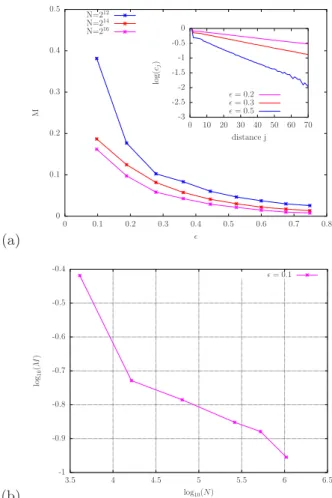
iθi. The numerical integration of Eqs. (2) is performed with the fifth optimal symplectic integrator proposed in [36]. In our simulations, we chose a ∆t = 0.05 and we monitored the conservations of E and P to ensure the correcteness of the numerical in-tegration. The thermodynamic quantities are calculated by averaging over time. The energy density is measured as ǫ = E/N and, for the temperature, we consider its kinetic definition as the average kinetic energy per par-ticle, since the average momentum is conserved and by our choice fixed to be zero. We first focused on the in-terval γ < 1.5 . For this regime, the system doesn’t show a phase transition of the order parameter. In fact, for γ approaching 1, the system is more or less identical to a short-range system and in that case, the Mermin-Wagner theorem imposes the order parameter to vanish. Still finite size effects are at play and the results displayed in Figs. 1a and 1b show that the magnetisation appears to decrease with the system size at every density energy ǫ = E/N in the physical range, so that in the thermodynamic limit we expect the residual magnetisation to be zero. Neverthe-less, quasi-long-range order could still arise at finite tem-peratures like in the 2−D short-ranged XY -model which displays the Berezinskij-Kosterlitz-Thouless phase transi-tion [31,37]. This particular phase transitransi-tion is character-ized by the change in behaviour of the correlation function, which decays as a power law at low temperatures and ex-ponentially in the high temperature phase. Hence to test the eventual presence of a Kosterlitz-Thouless transition,
(a) -3 -2.5 -2 -1.5 -1 -0.5 0 0 10 20 30 40 50 60 70 lo g( cj ) distance j 0 0.1 0.2 0.3 0.4 0.5 0 0.1 0.2 0.3 0.4 0.5 0.6 0.7 0.8 M ǫ ǫ= 0.2 ǫ= 0.3 ǫ= 0.5 N=212 N=214 N=216 (b) -1 -0.9 -0.8 -0.7 -0.6 -0.5 -0.4 3.5 4 4.5 5 5.5 6 6.5 lo g10 (M ) log10(N ) ǫ= 0.1
Fig. 1: (colour online) (a) Equilibrium magnetisation versus the energy density ǫ = E/N for γ = 1.25 and different sizes. The errorbars are of the size of the dots; (inset) Correlation function cj for γ = 1.25 and N = 2
14
. (b) Residual magneti-sation for γ = 1.25 at ǫ = 0.1 versus the system size. The simulations up to N = 216
have a duration of Tf = 20000,
while for N > 218
we set Tf = 30000. We took the temporal
mean on the second half of the simulation, after having checked the reaching of the equilibrium.
we monitored the correlation function:
c(j) = 1 N N X i=1 cos(θi− θi+j[N ]). (6)
At equilibrium, the correlation decays exponentially (See inset in Fig. 1) at any ǫ in the considered physical range, confirming the absence of the aforementioned phase tran-sition. For γ < 1.5, we conclude that the number of links is still too low to entail a change in the 1-D behaviour. It is interesting to notice that even a configuration with quite a large neighborhood per spin like γ = 1.4 corresponds to short range interactions.
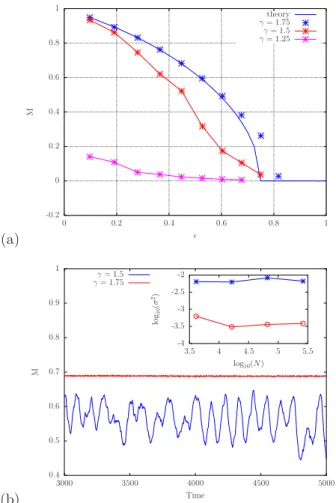
Symmetrically, the other important range to consider is γ > 1.5, when we approach the full coupling of the spins. As shown in Fig. 2a for γ = 1.75, the mean field transi-tion of the order parameter is recovered in this regime: it
is worth stressing here that we recover the meanfield re-sult even for γ significantly lower than 2, e.g. for γ = 1.6, implying that global coherence is still reachable with a weaker condition than the full coupling. Naturally, in Fig. 2a, a shift exists between the simulations at γ = 1.75, performed at finite size, and the theoretical curve which is obtained in the mean field case and in the thermodynamic limit. Nevertheless this interval shrinks with increasing size and it is a finite size artefact. In order to check the convergence towards equilibrium and the influence of finite size effects for both regimes, γ < 1.5 and γ > 1.5 , we mon-itored the variance of the magnetisation σ2 = (M− M)2 and verified that it is inversely proportional to the system size N and thus vanishes in the thermodynamic limit.
The transition between the 1-D behaviour and the mean field phase appears to be critical for γc = 1.5. As illus-trated in Fig. 2a, the magnetisation curve for γc never recoups the mean-field one even in the thermodynamic limit. Moreover for low energies 0.3 ≤ ǫ ≤ 0.75 the mag-netisation is affected by important fluctuations (Fig. 2b) and it is not clear if the equilibrium state simply does not exist or it is just not reached on the time scales con-sidered. But most likely these fluctuations are the result of the critical behaviour at γ = γc and will persist for-ever, reflecting the “hesitations” of the system to reach the mean field magnetised state or the disordered low-range one. In addition to this, the correlation function in Eq. (6) does not prove helpful in characterising this pecu-liar state: it acquires the exponential behaviour only for densities of energy above ǫ = 0.7, while in the interesting interval of energies it is heavily affected by the fluctuations and it is impossible to properly determine its behaviour. We observed these effects on several sizes from N = 212 up to N = 218 and, when considering the scaling of σ2 with the size (reported in the inset in Fig. 2b), it appears that the variance is not affected by increasing system size. This phenomenon is quite peculiar as it does not occur for γ > 1.5 and γ < 1.5. Moreover these persistent fluc-tuations of the magnetisation tend to suggest that in this phase the system has actually an infinite susceptibility χ when it is defined as
χ ∼ lim N →∞N σ
2. (7)
We now argue that k = √N , which corresponds to γ = 1.5, is the lowest value of connections per spin to allow the rise of long range order. Hence, to shed light on the mechanism underneath this topological transition, we derive a low energy analytical form for the magnetisa-tion which shows that the critical factor is embedded in the spectrum of the adiacency matrix. As mentioned, our first hypothesis is that we restrict our analysis to the low energy regime, which corresponds to the magnetised phase for γ > 1.5. Having the mean field picture in mind with a magnetisation close to 1 and considering for instance Q = 0, we can assume that most spins will not deviate
Sarah De Nigris Xavier Leoncini (a) -0.2 0 0.2 0.4 0.6 0.8 1 0 0.2 0.4 0.6 0.8 1 M ǫ theory γ= 1.75 γ= 1.5 γ= 1.25 (b) -4 -3.5 -3 -2.5 -2 3.5 4 4.5 5 5.5 lo g10 (σ 2) log10(N ) 0.4 0.5 0.6 0.7 0.8 0.9 1 3000 3500 4000 4500 5000 M Time γ= 1.5 γ= 1.75
Fig. 2: (colour online) (a) Equilibrium magnetisation for N = 216
and different γ. For γ 6= 1.5 the error bars are of the size of the dots. (b) Time series for the order parameter with N = 218
and ǫ = 0.6; (inset) Scaling of the magnetisation varianceσ2 for γ = 1.5, ǫ = 0.60 (stars) and ǫ = 0.74 (dots).
much from the direction of the magnetisation, which it-self does not fluctuate much. We shall hence assume that the difference θi− θj is small for connected rotors (when ǫi,j = 1) [38]. We therefore obtain a simple quadratic Hamiltonian: H =P i p2 i 2 + J 4k P
i,jǫij(θi− θj)2.
To proceed further, we consider a representation for the {θi, pi} as a sum of random phased modes [39, 40]:
θi=P lαl(t) cos(2πliN + φl), pi=P l ˙αl(t) cos( 2πli N + φl), (8)
where φl are randomly distributed phases on the circle. Since we make the hypothesis that the time dependence is totally encoded in the amplitudes αl, the momenta are simply related to the angles via the first Hamilton equation
˙
θi = pi. The basic idea behind this reasoning is that, at equilibrium, the momenta are Gaussian distributed vari-ables, justifying the representation in Eqs. (8). We also observe that it consists in a linear changing of variable since we use N modes for our representation. If we now consider different sets of phases {φl}m labeled by m, we
have that each one of them corresponds to a phase space trajectory and, hence, it is possible to replace the ensem-ble average with the average on the random phases [39]. Consequently, injecting Eqs. (8) in the linearised Hamil-tonian and averaging on the random phases, we obtain:
hHi N = 1 2 N X l=1 ˙α2 l + α2l(1 − λl), (9) where λl= 2 k k/2 X m=1 cos(2πml N ) (10) are the eigenvalues of the adiacency matrix. Using the sec-ond Hamilton equation d
dt( ∂hHi
∂ ˙αl ) = −
∂hHi
∂αl , we obtain from
Eq. (9) a dispersion relation of the wave amplitudes that embeds two levels of information: at the microscopic level, the structure of the links, via the adiacency matrix spec-trum and, from a more macroscopical point of view, Eq. (9) results from averaging on the random phases which, as explained, accounts for the ensemble averaging. Imposing the equipartition of the kinetic energy at equilibrium for the obtained collection of harmonic oscillators (see [39]) gives an additional relation between the frequencies ωland the amplitudes αl: α2
lωl2= 2T /N , where T is the kinetic temperature We evaluate now the magnetisation in the low temperature regime using the same approach: we in-ject the representation (8) and we average on the phases, obtaining [41]:
hMi =Y l
J0(αl)(cos θ0, sin θ0), (11)
where θ0 is the average of the {θi} which is a constant because of the conservation of the total momentum P = 0. The absolute value of the magnetisation hMi will hence be, from Eq. (11), the product over the l modes of the Bessel functions. To evaluate the logarithm of hMi , we observe that, at equilibrium and in the limit of large system size, we expect to have small α2
l. We can thus approximate the Bessel functions in the limit of small amplitudes αlwhich is, therefore, the low temperatures regime. This finally leads to: ln(hMi) = −X l α2 l 4 = − T 2N X l 1 1 − λl . (12)
We calculated numerically Eq. (12) for increasing N and in Fig. 3 we show how it correctly captures the behaviour of the magnetisation: in the low temperature regime, it retrieves the mean field value for γ > 1.5 and it vanishes when γ < 1.5. Moreover, with increasing size, the differ-ence between the two regimes becomes sharper confirming the critical nature of γc = 1.5. The key for this peculiar effect at γ = 1.5 appears thus to be fully encoded in the spectrum of the adiacency matrix, which drives the sys-tem to the mean field regime or to the short range one
0 0.2 0.4 0.6 0.8 1 1 1.2 1.4 1.6 1.8 2 < M (T = 0. 1) > γ N=222 N=223 N=224 N=225 theory
Fig. 3: (colour online) Approximated magnetisation hM i from Eq.(12) for T = 0.1 versus γ. Theory refers to the theoretical value obtained in the mean field situation.
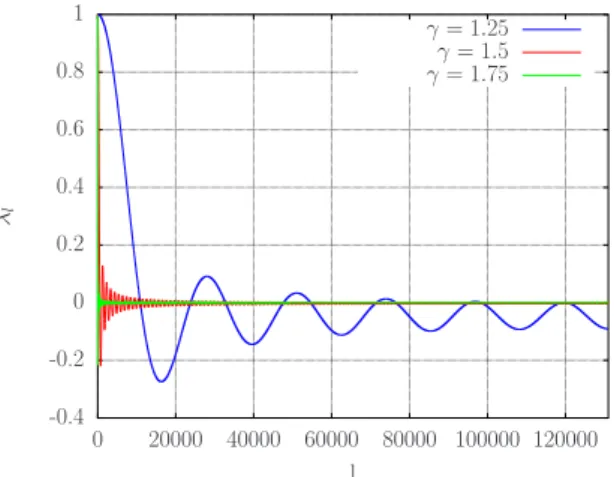
according to γ. Nevertheless, by a rapid inspection of Eq. (10), it appears non trivial to isolate the dependence of the eigenvalues on γ and on the size since each eigenvalue consists of a sum of k/2 contributions. In Fig. 4, we show the behaviour of the spectrum for three representative val-ues of γ: clearly the spectra qualitatively differ, but how to quantify this difference is still object of a more refined analysis to precisely relate the spectrum properties to the magnetisation behaviour.
In this Letter we introduce a model for the interaction, and focused on the regular lattice topology in which we monitored the length of the interaction by controlling the degree of each spin via the parameter γ. We showed that three different regimes existed: the interval γ < 1.5, where long-range order is absent, a highly connected phase (γ > 1.5) in which the mean field behaviour is recovered and a peculiar behaviour at the threshold of γ = 1.5. In-terestingly, we show that the mean field transition does not require the full coupling of the spins, like in the HMF model or in a random network [33], and it still arises for a regular topology even for γ = 1.6 , quite far hence from the extremal configuration of γ = 2. However, the main result of our analysis is the evidence of a unsteady almost tur-bulent like state when γ = 1.5: the important fluctuations affecting the order parameter and the invariance of these effects on the system size in a whole interval of energies are in total contrast with what observed in the other regimes, where with the same initial conditions the convergence to equilibrium is rapid. We present a analytical calculation for the magnetisation which is able to catch the appro-priate behaviour in the two limits discussed before. This result points out that γ = 1.5 is indeed the critical value for this passage from the 1-D topology to the mean field frame. Moreover, it shows that the spectrum of the adia-cency matrix, which carries the information on the links, is crucial to understand this shift. Hence this unstable state stems from topological features of the lattice, instead of from a particular choice of the initial conditions as in
-0.4 -0.2 0 0.2 0.4 0.6 0.8 1 0 20000 40000 60000 80000 100000 120000 λl l γ= 1.25 γ= 1.5 γ= 1.75
Fig. 4: (colour online) Spectra λlfor N = 2 18
and different γ values.
[42–44]. We anticipate that the same kind of “bifurcation“ phenomenon could be observed with different topologies and probably lower connectivities. We also believe that if we were able to find an efficient way to modify the param-eter γ, these systems could prove to be useful adaptable on-off switches for a somewhat larger energy/temperature range, as adding or removing a few links totally changes the macroscopic behaviour.
∗ ∗ ∗
The authors are grateful to W. Ettoumi for discussions. S.d.N. has been supported by DGA/DS/MRIS.
REFERENCES
[1] Dauxois T., Ruffo S., Arimondo E. and Wilkens M., (Editors) Dynamics and Thermodynamics of Systems
with Long Range InteractionsVol. 602 of Lect. Not. Phys.
(Springer-Verlag, Berlin) 2002.
[2] Campa A., Dauxois T. and Ruffo S., Phys. Rep. , 480 (2009) 57.
[3] G.Gallavotti, eprint chao-dyn, 9403004 (1994) . [4] Barre J., Mukamel D. and Ruffo S., Phys Rev Lett ,
87(2001) 030601.
[5] Leyvraz F. and Ruffo S., J.Phys A: Math Gen , 35 (2002) 285.
[6] Torcini A. and Antoni M., Phys. Rev. E , 59 (1999) 2746.
[7] Pluchino A., Rapisarda A. and Tsallis C., EPL , 80 (2007) 26002.
[8] Chavanis P. H., Eur. Phys. J. B , 53 (2006) 487. [9] Latora V., Rapisarda A. and Tsallis C., Physica A ,
305(2002) 129.
[10] Ettoumi W. and Firpo M. C., J. Phys. A: Math. Theor. , 44 (2011) 175002.
[11] Mukamel D., Ruffo S. and Schreiber N., Phys Rev Lett, 95 (2005) 240604.
[12] Chavanis P. H., Vatteville J. and Bouchet F., Eur.
Sarah De Nigris Xavier Leoncini
[13] Antoni M. and Ruffo S., Phys. Rev. E , 52 (1995) 2361. [14] Chavanis P. H., Ninno G. D., Fanelli D. and Ruffo S., Out of Equilibrium Phase Transitions in Mean-Field
Hamiltonian Dynamicsin proc. of Chaos, Complexity and
Transport, edited by Chandre C., Leoncini X. and Za-slavsky G., (World Scientific, Singapore) 2008 pp. 3–26. [15] Firpo M. C., EPL , 88 (2009) 30010.
[16] Bachelard R., Chandre C., Fanelli D., Leoncini X. and Ruffo S., Phys. Rev. Lett. , 101 (2008) 260603. [17] Leoncini X., Van den Berg T. L. and Fanelli D.,
EPL , 86 (2009) 20002.
[18] Morita H. and Kunihiko K., Phys Rev Lett , 96 (2006) 050602.
[19] Anteneodo C. and Tsallis C., Phys. Rev. Lett. , 80 (1998) 5313.
[20] Tamarit F. and Anteneodo C., Phys. Rev. Lett. , 84 (2000) 208.
[21] Giansanti A., Moroni D. and Campa A., Chaos,
Soli-tons and Fractals, 13 (2002) 407.
[22] Van den Berg T. L., Fanelli D. and Leoncini X., EPL , 89 (2010) 50010.
[23] Campa A., Giansanti A. and Moroni D., Physica A , 305(2002) 137.
[24] Lee D. H., Joannopoulos J. D., Negele J. W. and Landau D. P., Phys Rev Lett , 52 (1984) 433.
[25] Loft R. and DeGrand T. A., Phys. Rev. B , 35 (1987) 8528.
[26] Kim J. K., EPL , 28 (1994) 211.
[27] Janke W. and Nather K., Physics Letters A , 157 (1991) 11.
[28] McCarthy J. F., Nuclear Physics B , 275 (1986) 421. [29] Jain S. and Young A. P., J. Phys. C: Solid State Physics
, 19 (1986) 3913.
[30] Bramwell S. T., Fortin J. Y., Holdsworth
P. C. W., Peysson S., Pinton J. F., Portelli B.and Sellitto M., Phys. Rev. E , 63 (2001) 041106.
[31] Kosterlitz J. M. and Thouless D. J., Journal of
Physics C: Solid State Physics, 6 (1973) 1181.
[32] Barrat A., Barth´elemy M. and Vespignani A.,
Dynamical Processes on Complex Networks (Cambridge
Univ. Press,) 2008.
[33] Ciani A., Ruffo S. and Fanelli D., Long-range
inter-actions and diluted networks Vol. 0 (Springer) 2011.
[34] Kim B. J., Hong H., Holme P., Jeon G. S., Minnhagen P.and Choi M. Y., Phys. Rev. E , 64 (2001) 056135.
[35] Medvedyeva K., Holme P., Minnhagen P. and Kim B. J., Phys. Rev. E , 67 (2003) 036118.
[36] McLachlan R. I. and Atela P., Nonlinearity , 5 (1992) 541.
[37] Berezinskii V. L., Sov. Phys. JETP , 32 (1971) 493. [38] The approximation made corresponds to neglecting the
the modulo in δθ ≈ 0[2π]. In the low temperature regime, the width of the angle distribution is so small and, by our choice, centered on 0 so that this appears as a legitimate assumption.
[39] Leoncini X. and Verga A., Phys. Rev. E , 64 (2001) 066101.
[40] It is important to note that we considered periodic bound-ary conditions, in our simulations and our analytical treat-ment and to keep in mind that these conditions may in-fluence the results once the long range effects are at play.
[41] Leoncini X., Verga A. and Ruffo S., Phys. Rev. E , 57(1998) 6377.
[42] Antoniazzi A., Fanelli D., Ruffo S. and Yamaguchi Y. Y., Phys. Rev. Lett. , 99 (2007) 040601.
[43] Antoniazzi A., Califano F., Fanelli D. and Ruffo S., Phys Rev Lett , 98 (2007) 150602.
[44] Antoniazzi A., Fanelli D., Barre J., Chavanis P.-H., Dauxois T.and Ruffo S., Phys. Rev. E , 75 (2007) 011112.